10steps to
Training + assessment
Trainers + educators / Australasia
2
www.trainersandeducators.com.au
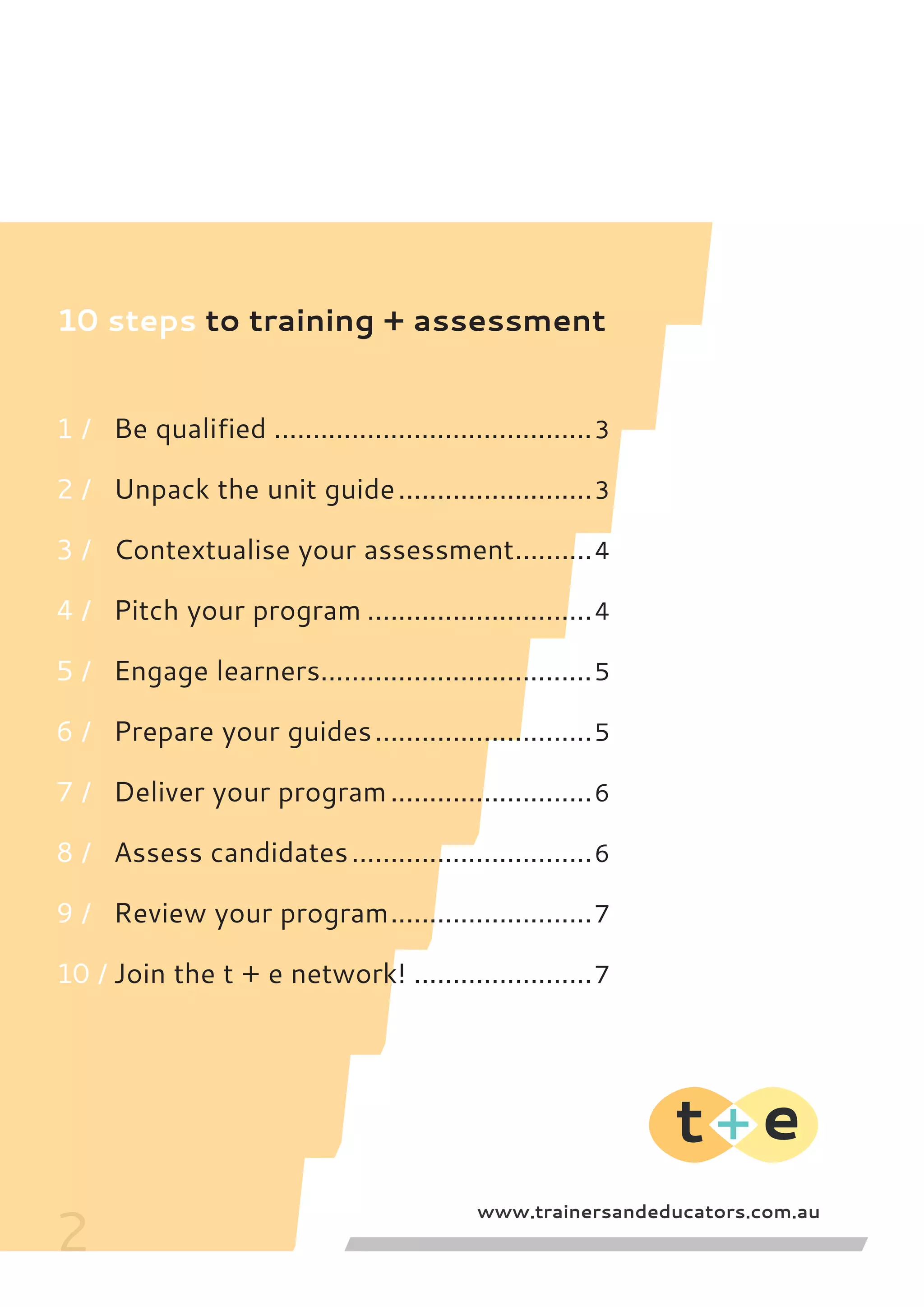
10 steps to training + assessment
1 /	 Be qualified..........................................3
2 /	 Unpack the unit guide..........................3	
3 /	 Contextualise your assessment...........4
4 /	 Pitch your program..............................4
5 /	 Engage learners...................................5
6 /	 Prepare your guides.............................5
7 /	 Deliver your program...........................6
8 /	 Assess candidates................................6
9 /	 Review your program...........................7
10 /	Join the t + e network!........................7
3
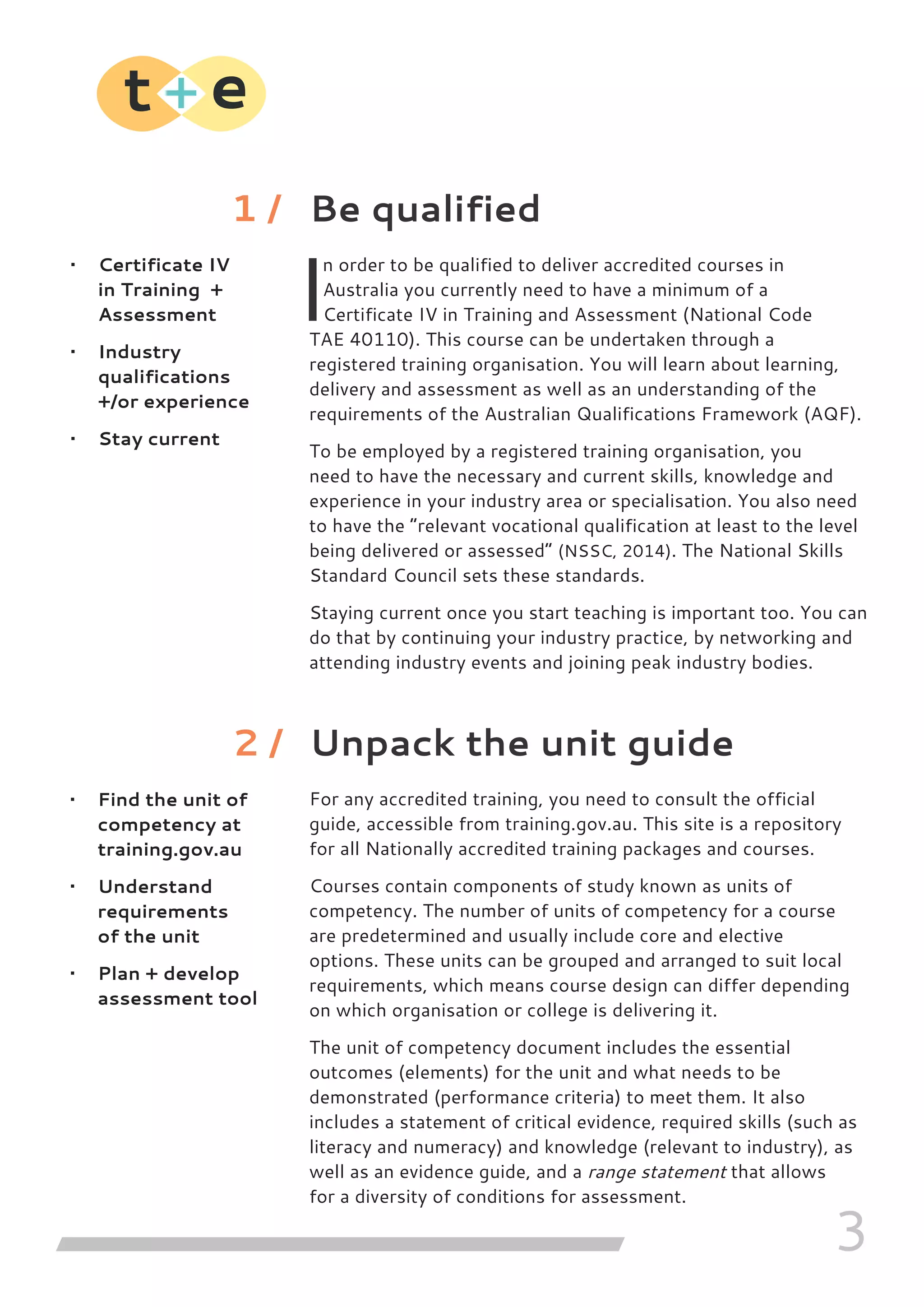
Be qualified
I
n order to be qualified to deliver accredited courses in
Australia you currently need to have a minimum of a
Certificate IV in Training and Assessment (National Code
TAE 40110). This course can be undertaken through a
registered training organisation. You will learn about learning,
delivery and assessment as well as an understanding of the
requirements of the Australian Qualifications Framework (AQF).
To be employed by a registered training organisation, you
need to have the necessary and current skills, knowledge and
experience in your industry area or specialisation. You also need
to have the “relevant vocational qualification at least to the level
being delivered or assessed” (NSSC, 2014). The National Skills
Standard Council sets these standards.
Staying current once you start teaching is important too. You can
do that by continuing your industry practice, by networking and
attending industry events and joining peak industry bodies.
Unpack the unit guide
For any accredited training, you need to consult the official
guide, accessible from training.gov.au. This site is a repository
for all Nationally accredited training packages and courses.
Courses contain components of study known as units of
competency. The number of units of competency for a course
are predetermined and usually include core and elective
options. These units can be grouped and arranged to suit local
requirements, which means course design can differ depending
on which organisation or college is delivering it.
The unit of competency document includes the essential
outcomes (elements) for the unit and what needs to be
demonstrated (performance criteria) to meet them. It also
includes a statement of critical evidence, required skills (such as
literacy and numeracy) and knowledge (relevant to industry), as
well as an evidence guide, and a range statement that allows
for a diversity of conditions for assessment.
•	 Certificate IV
in Training +
Assessment
•	 Industry
qualifications
+/or experience
•	 Stay current
1 /
•	 Find the unit of
competency at
training.gov.au
•	 Understand
requirements
of the unit
•	 Plan + develop
assessment tool
2 /
4
This guide is the go to when planning, developing, delivering
and assessing. In the guide will be the mandatory requirements
for the unit. It contains detailed information and advice to help
you develop an appropriate assessment tool. The assessment
tool is the program you will design. An assessment tool includes
a week by week program, a guide for students, and a range of
assessable tasks that address the requirements of the unit of
competency and that will assist you to gather sufficient evidence
to determine whether your candidate has achieved competency.
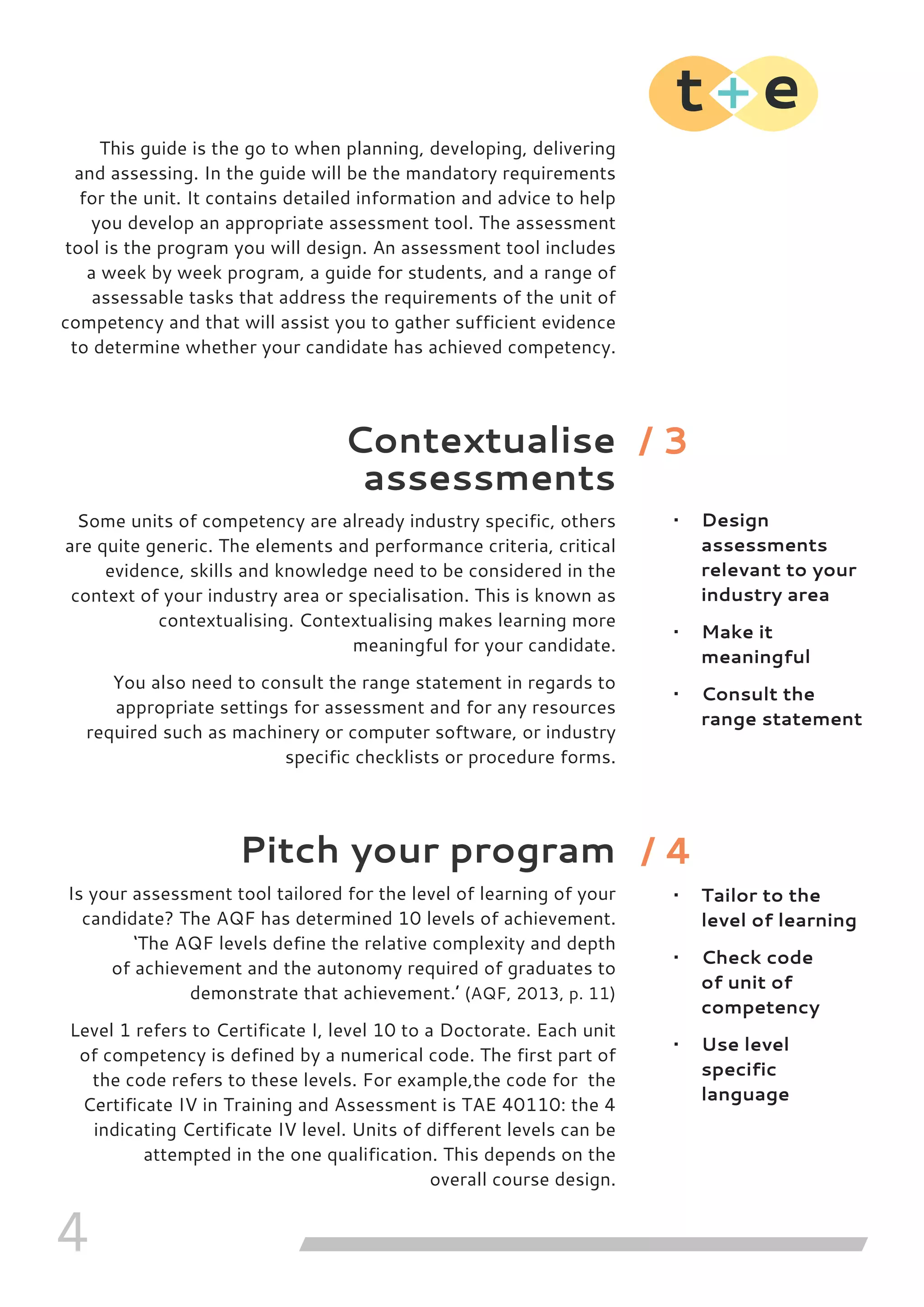
Contextualise
assessments
Some units of competency are already industry specific, others
are quite generic. The elements and performance criteria, critical
evidence, skills and knowledge need to be considered in the
context of your industry area or specialisation. This is known as
contextualising. Contextualising makes learning more
meaningful for your candidate.
You also need to consult the range statement in regards to
appropriate settings for assessment and for any resources
required such as machinery or computer software, or industry
specific checklists or procedure forms.
Pitch your program
Is your assessment tool tailored for the level of learning of your
candidate? The AQF has determined 10 levels of achievement.
‘The AQF levels define the relative complexity and depth
of achievement and the autonomy required of graduates to
demonstrate that achievement.’ (AQF, 2013, p. 11)
Level 1 refers to Certificate I, level 10 to a Doctorate. Each unit
of competency is defined by a numerical code. The first part of
the code refers to these levels. For example,the code for the
Certificate IV in Training and Assessment is TAE 40110: the 4
indicating Certificate IV level. Units of different levels can be
attempted in the one qualification. This depends on the
overall course design.
•	 Design
assessments
relevant to your
industry area
•	 Make it
meaningful
•	 Consult the
range statement
•	 Tailor to the
level of learning
•	 Check code
of unit of
competency
•	 Use level
specific
language
/ 3
/ 4
5
Consult with the Framework to ensure that your expectations
regarding complexity and supervision of tasks suit the level of
learning of your program; and that the language you are using to
convey learning and assessment requirements is appropriate.
Engage learners
People learn in different ways. Some people learn through
watching, others through doing; others through hearing or
reading about it. Include these different methods of delivery
when planning your program. You can source and prepare
learning resources to enrich your classroom or online delivery.
These could include a clip from you tube, a case study, a text, or
a tool or other workplace object.
Playing games is another way to engage learners, and people
learn best when they are having fun! Brainstorming is a simple
way to get everyone involved and can be a good way to introduce
an assessment task. There are many other group games for adult
learners. You can search the net or make up your own.
Prepare your guide
Now you are ready to document your program. You will need
an assessment guide for your candidates and a delivery and a
delivery guide for you.
The assessment guide that you prepare sets out what your
candidate needs to do to demonstrate competency. This is not a
direct copy from the unit of competency, but contextualised for
the assessment tool that you are preparing. You can include the
exact wording from the unit of competency, but then additionally
interpret it into a statement that relates specifically to your
assessment task. The required skills and knowledge also need to
be considered when designing your program.
Make sure you read the critical aspects for assessment and
evidence required as stated in the unit evidence guide, as this
really summarises what needs to be achieved for competency.
The delivery guide that you prepare will map the intended
learning sessions and timing of assessment tasks. It will also
•	 Consider
learning styles
•	 Use a variety
of media
•	 Incorporate
games
•	 Assessment
guide for your
candidate
•	 Delivery guide
for you
•	 Ensure critical
aspects are
covered
5 /
6 /
6
include a record of resources that you intend to use in a session.
Additionally your guide can record assessment of elements and
performance criteria. From this guide, you can develop individual
session plans.
Deliver your program
Delivery can be done face to face, online, or a combination
of both. You can have a set time or be flexibly responsive
depending on the individual needs of the candidate. Its good
practice to consult your own planning guide as you work
through your program! Do this before a session, so you have the
resources you need. Its also helpful to reflect on sessions after
you have delivered them, so you can refine your program.
Assess candidates
In order to assess candidates, you must collect evidence of their
competency.
The AQF principles of assessment require that the evidence you
collect be valid, authentic, sufficient and current. Valid means it
must demonstrate the requirements of the unit of competency.
If it’s not in the unit of competency, it shouldn’t be assessed.
Authentic means it must be the candidate’s own work. Sufficient
means that there needs to be enough evidence to show that the
candidate is competent for the task being assessed; usually more
than one example. Current means the evidence must be relevant
to current industry practices.
The range statement in the unit of competency will give you
guidance as to the types of evidence that are suitable. Consider
the individual needs of the candidate. When assessing you can
make a reasonable adjustment to the conditions of assessment.
For example if a learner has a disability or health issue, you may
need to modify session times and deadlines, or supply additional
equipment or support. All learners are required to achieve the
same outcomes and meet the same performance criteria but
the method and type of evidence can be negotiated. This helps
to ensure that assessments are valid, reliable, fair, and flexible,
which are the rules of assessment. Of course, you will ‘give clear
•	 Plan +
organise
•	 Have resources
ready
•	 Review session
delivery
•	 Principles are:
valid, authentic,
sufficient,
current
•	 Rules are:
valid, reliable,
fair, flexible
/ 7
/ 8
7
and constructive feedback regarding your assessment decision’
and develop a follow up plan if required. (training.gov.au, 2014)
Review your program
After you have delivered and assessed a candidate or groups
of candidates, it is good practice to evaluate your program and
improve it. You can do this informally just by thinking about it
or asking your colleagues or candidates for feedback or more
formally via a questionnaire or a checklist. Did candidates meet
your expectations for learning and competency? As a group, did
they meet the requriements of the unit/s of competency you
were assessing them against?
Join the trainers +
educators network!
Join the network to connect. Post a profile so that training
organisations can recruit you quickly and easily! Get tips on
best practice in an evolving workplace. Download useful
templates and e-resources. Participate in discussion with
colleagues and keep up to date with the latest developments
in training and education in Australasia.
For more information, go to
www.trainersandeducators.com.au
Sources:
Australian Qualifications Framework Council, [2013 ed.] Australian
Qualifications Framework, http://www.aqf.edu.au/wp-content/
uploads/2013/05/AQF-2nd-Edition-January-2013.pdf
Australian Qualifications Framework Council, [2007 ed.] Australian
Qualifications Framework Implementation Handbook http://www.aqf.edu.au/
wp-content/uploads/2013/05/AQF-Implementation-Handbook-Fourth-
Edition-2007.pdf
http://www.nssc.natese.gov.au/policies/determination_for_trainer_and_as-
sessor_competencies
http://training.gov.au/Training/Details/TAEASS402B
•	 Reflect on your
program
•	 Survey your
candidates
•	 Join the network
•	 Post a profile
•	 Stay informed
9 /
10 /
trainers + educators (2014)
8 www.trainersandeducators.com.au

10 steps to_training_and_assessment-1

  • 1.
    10steps to Training +assessment Trainers + educators / Australasia
  • 2.
    2 www.trainersandeducators.com.au 10 steps totraining + assessment 1 / Be qualified..........................................3 2 / Unpack the unit guide..........................3 3 / Contextualise your assessment...........4 4 / Pitch your program..............................4 5 / Engage learners...................................5 6 / Prepare your guides.............................5 7 / Deliver your program...........................6 8 / Assess candidates................................6 9 / Review your program...........................7 10 / Join the t + e network!........................7
  • 3.
    3 Be qualified I n orderto be qualified to deliver accredited courses in Australia you currently need to have a minimum of a Certificate IV in Training and Assessment (National Code TAE 40110). This course can be undertaken through a registered training organisation. You will learn about learning, delivery and assessment as well as an understanding of the requirements of the Australian Qualifications Framework (AQF). To be employed by a registered training organisation, you need to have the necessary and current skills, knowledge and experience in your industry area or specialisation. You also need to have the “relevant vocational qualification at least to the level being delivered or assessed” (NSSC, 2014). The National Skills Standard Council sets these standards. Staying current once you start teaching is important too. You can do that by continuing your industry practice, by networking and attending industry events and joining peak industry bodies. Unpack the unit guide For any accredited training, you need to consult the official guide, accessible from training.gov.au. This site is a repository for all Nationally accredited training packages and courses. Courses contain components of study known as units of competency. The number of units of competency for a course are predetermined and usually include core and elective options. These units can be grouped and arranged to suit local requirements, which means course design can differ depending on which organisation or college is delivering it. The unit of competency document includes the essential outcomes (elements) for the unit and what needs to be demonstrated (performance criteria) to meet them. It also includes a statement of critical evidence, required skills (such as literacy and numeracy) and knowledge (relevant to industry), as well as an evidence guide, and a range statement that allows for a diversity of conditions for assessment. • Certificate IV in Training + Assessment • Industry qualifications +/or experience • Stay current 1 / • Find the unit of competency at training.gov.au • Understand requirements of the unit • Plan + develop assessment tool 2 /
  • 4.
    4 This guide isthe go to when planning, developing, delivering and assessing. In the guide will be the mandatory requirements for the unit. It contains detailed information and advice to help you develop an appropriate assessment tool. The assessment tool is the program you will design. An assessment tool includes a week by week program, a guide for students, and a range of assessable tasks that address the requirements of the unit of competency and that will assist you to gather sufficient evidence to determine whether your candidate has achieved competency. Contextualise assessments Some units of competency are already industry specific, others are quite generic. The elements and performance criteria, critical evidence, skills and knowledge need to be considered in the context of your industry area or specialisation. This is known as contextualising. Contextualising makes learning more meaningful for your candidate. You also need to consult the range statement in regards to appropriate settings for assessment and for any resources required such as machinery or computer software, or industry specific checklists or procedure forms. Pitch your program Is your assessment tool tailored for the level of learning of your candidate? The AQF has determined 10 levels of achievement. ‘The AQF levels define the relative complexity and depth of achievement and the autonomy required of graduates to demonstrate that achievement.’ (AQF, 2013, p. 11) Level 1 refers to Certificate I, level 10 to a Doctorate. Each unit of competency is defined by a numerical code. The first part of the code refers to these levels. For example,the code for the Certificate IV in Training and Assessment is TAE 40110: the 4 indicating Certificate IV level. Units of different levels can be attempted in the one qualification. This depends on the overall course design. • Design assessments relevant to your industry area • Make it meaningful • Consult the range statement • Tailor to the level of learning • Check code of unit of competency • Use level specific language / 3 / 4
  • 5.
    5 Consult with theFramework to ensure that your expectations regarding complexity and supervision of tasks suit the level of learning of your program; and that the language you are using to convey learning and assessment requirements is appropriate. Engage learners People learn in different ways. Some people learn through watching, others through doing; others through hearing or reading about it. Include these different methods of delivery when planning your program. You can source and prepare learning resources to enrich your classroom or online delivery. These could include a clip from you tube, a case study, a text, or a tool or other workplace object. Playing games is another way to engage learners, and people learn best when they are having fun! Brainstorming is a simple way to get everyone involved and can be a good way to introduce an assessment task. There are many other group games for adult learners. You can search the net or make up your own. Prepare your guide Now you are ready to document your program. You will need an assessment guide for your candidates and a delivery and a delivery guide for you. The assessment guide that you prepare sets out what your candidate needs to do to demonstrate competency. This is not a direct copy from the unit of competency, but contextualised for the assessment tool that you are preparing. You can include the exact wording from the unit of competency, but then additionally interpret it into a statement that relates specifically to your assessment task. The required skills and knowledge also need to be considered when designing your program. Make sure you read the critical aspects for assessment and evidence required as stated in the unit evidence guide, as this really summarises what needs to be achieved for competency. The delivery guide that you prepare will map the intended learning sessions and timing of assessment tasks. It will also • Consider learning styles • Use a variety of media • Incorporate games • Assessment guide for your candidate • Delivery guide for you • Ensure critical aspects are covered 5 / 6 /
  • 6.
    6 include a recordof resources that you intend to use in a session. Additionally your guide can record assessment of elements and performance criteria. From this guide, you can develop individual session plans. Deliver your program Delivery can be done face to face, online, or a combination of both. You can have a set time or be flexibly responsive depending on the individual needs of the candidate. Its good practice to consult your own planning guide as you work through your program! Do this before a session, so you have the resources you need. Its also helpful to reflect on sessions after you have delivered them, so you can refine your program. Assess candidates In order to assess candidates, you must collect evidence of their competency. The AQF principles of assessment require that the evidence you collect be valid, authentic, sufficient and current. Valid means it must demonstrate the requirements of the unit of competency. If it’s not in the unit of competency, it shouldn’t be assessed. Authentic means it must be the candidate’s own work. Sufficient means that there needs to be enough evidence to show that the candidate is competent for the task being assessed; usually more than one example. Current means the evidence must be relevant to current industry practices. The range statement in the unit of competency will give you guidance as to the types of evidence that are suitable. Consider the individual needs of the candidate. When assessing you can make a reasonable adjustment to the conditions of assessment. For example if a learner has a disability or health issue, you may need to modify session times and deadlines, or supply additional equipment or support. All learners are required to achieve the same outcomes and meet the same performance criteria but the method and type of evidence can be negotiated. This helps to ensure that assessments are valid, reliable, fair, and flexible, which are the rules of assessment. Of course, you will ‘give clear • Plan + organise • Have resources ready • Review session delivery • Principles are: valid, authentic, sufficient, current • Rules are: valid, reliable, fair, flexible / 7 / 8
  • 7.
    7 and constructive feedbackregarding your assessment decision’ and develop a follow up plan if required. (training.gov.au, 2014) Review your program After you have delivered and assessed a candidate or groups of candidates, it is good practice to evaluate your program and improve it. You can do this informally just by thinking about it or asking your colleagues or candidates for feedback or more formally via a questionnaire or a checklist. Did candidates meet your expectations for learning and competency? As a group, did they meet the requriements of the unit/s of competency you were assessing them against? Join the trainers + educators network! Join the network to connect. Post a profile so that training organisations can recruit you quickly and easily! Get tips on best practice in an evolving workplace. Download useful templates and e-resources. Participate in discussion with colleagues and keep up to date with the latest developments in training and education in Australasia. For more information, go to www.trainersandeducators.com.au Sources: Australian Qualifications Framework Council, [2013 ed.] Australian Qualifications Framework, http://www.aqf.edu.au/wp-content/ uploads/2013/05/AQF-2nd-Edition-January-2013.pdf Australian Qualifications Framework Council, [2007 ed.] Australian Qualifications Framework Implementation Handbook http://www.aqf.edu.au/ wp-content/uploads/2013/05/AQF-Implementation-Handbook-Fourth- Edition-2007.pdf http://www.nssc.natese.gov.au/policies/determination_for_trainer_and_as- sessor_competencies http://training.gov.au/Training/Details/TAEASS402B • Reflect on your program • Survey your candidates • Join the network • Post a profile • Stay informed 9 / 10 / trainers + educators (2014)
  • 8.