ISO 9001:2008
Awareness Session
G.SREEDHARAN
SreeVaniConsultants
WHAT is ISO?
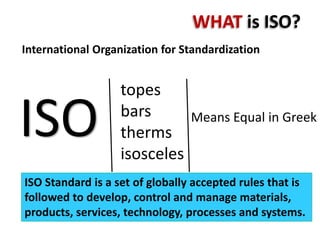
ISO
topes
bars
therms
isosceles
Means Equal in Greek
ISO Standard is a set of globally accepted rules that is
followed to develop, control and manage materials,
products, services, technology, processes and systems.
International Organization for Standardization
WHAT is ISO 9001:2008?
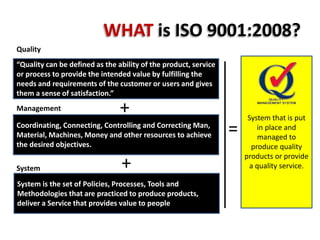
“Quality can be defined as the ability of the product, service
or process to provide the intended value by fulfilling the
needs and requirements of the customer or users and gives
them a sense of satisfaction.”
Coordinating, Connecting, Controlling and Correcting Man,
Material, Machines, Money and other resources to achieve
the desired objectives.
System is the set of Policies, Processes, Tools and
Methodologies that are practiced to produce products,
deliver a Service that provides value to people
System that is put
in place and
managed to
produce quality
products or provide
a quality service.
Quality
Management
System
+
+
=
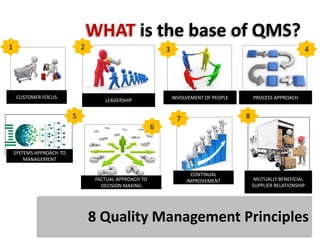
WHAT is the base of QMS?
1
CUSTOMER FOCUS
LEADERSHIP
2
INVOLVEMENT OF PEOPLE
3
PROCESS APPROACH
4
SYSTEMS APPROACH TO
MANAGEMENT
5
CONTINUAL
IMPROVEMENT
6
FACTUAL APPROACH TO
DECISION MAKING
7 8
MUTUALLY BENEFICIAL
SUPPLIER RELATIONSHIP
8 Quality Management Principles
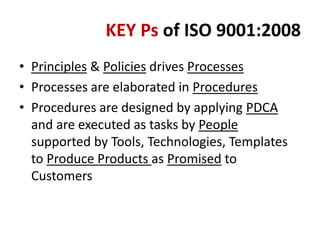
KEY Ps of ISO 9001:2008
• Principles & Policies drives Processes
• Processes are elaborated in Procedures
• Procedures are designed by applying PDCA
and are executed as tasks by People
supported by Tools, Technologies, Templates
to Produce Products as Promised to
Customers
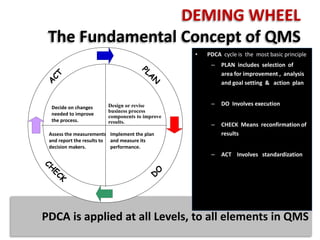
DEMING WHEEL
The Fundamental Concept of QMS
PDCA is applied at all Levels, to all elements in QMS
Design or revise
business process
components to improve
results.
Implement the plan
and measure its
performance.
Assess the measurements
and report the results to
decision makers.
Decide on changes
needed to improve
the process.
• PDCA cycle is the most basic principle
– PLAN includes selection of
area for improvement , analysis
and goal setting & action plan
– DO Involves execution
– CHECK Means reconfirmation of
results
– ACT Involves standardization
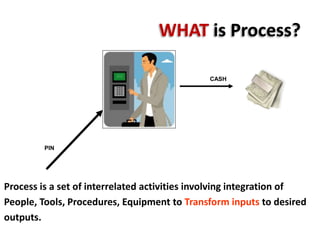
WHAT is Process?
Process is a set of interrelated activities involving integration of
People, Tools, Procedures, Equipment to Transform inputs to desired
outputs.
PIN
CASH
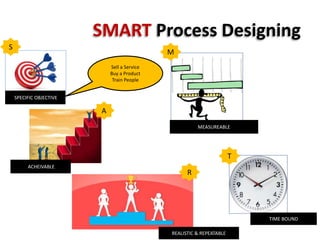
SMART Process Designing
S
SPECIFIC OBJECTIVE
Sell a Service
Buy a Product
Train People
MEASUREABLE
M
ACHEIVABLE
A
R
REALISTIC & REPEATABLE
TIME BOUND
T
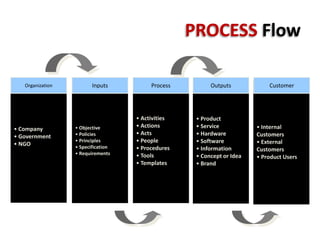
PROCESS Flow
• Company
• Government
• NGO
• Objective
• Policies
• Principles
• Specification
• Requirements
• Activities
• Actions
• Acts
• People
• Procedures
• Tools
• Templates
• Product
• Service
• Hardware
• Software
• Information
• Concept or Idea
• Brand
• Internal
Customers
• External
Customers
• Product Users
Organization Inputs Process Outputs Customer
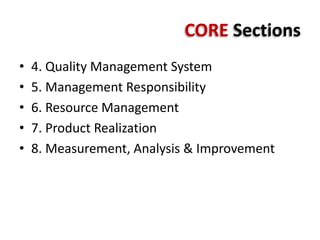
CORE Sections
• 4. Quality Management System
• 5. Management Responsibility
• 6. Resource Management
• 7. Product Realization
• 8. Measurement, Analysis & Improvement
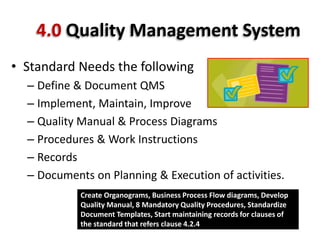
4.0 Quality Management System
• Standard Needs the following
– Define & Document QMS
– Implement, Maintain, Improve
– Quality Manual & Process Diagrams
– Procedures & Work Instructions
– Records
– Documents on Planning & Execution of activities.
Create Organograms, Business Process Flow diagrams, Develop
Quality Manual, 6 Mandatory Quality Procedures, Standardize
Document Templates, Start maintaining records for clauses of
the standard that refers clause 4.2.4
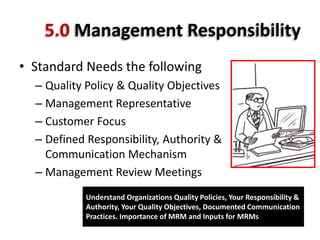
5.0 Management Responsibility
• Standard Needs the following
– Quality Policy & Quality Objectives
– Management Representative
– Customer Focus
– Defined Responsibility, Authority &
Communication Mechanism
– Management Review Meetings
Understand Organizations Quality Policies, Your Responsibility &
Authority, Your Quality Objectives, Documented Communication
Practices. Importance of MRM and Inputs for MRMs
6.0 Resource Management
• Standard Needs the following
– Provision of Resources
– Job Descriptions
– Competencies, Skill Matrix
– Training & Assessment
– Infrastructure facilities
– Work Environment
Understand how your Job contributes to Quality, Participate in
Training, Send your educational & Training certificates to HR
Auditor, Manager to develop training plan
7.0 Product ( Service) Realization
• Standard Needs the following
– Planning
– Review of Customer Contract & Requirements
– Purchasing Process
– Design & Development
– Production Process
– Stores Process
– Calibration
Go through our procedures for Sales, Stores, Purchase,
Production processes, maintain records on calibration, follow
proper identification process in stores, protect customer
property
8.0 Measurement, Analysis &
Improvement
• Standard Needs the following
– Monitoring & Measurement of
• Customer Satisfaction
• Internal Audits
• Measurement of Processes
• Inspection & Testing
– Analysis of Data
– Improvement
• Continual Improvement
• Corrective Action
• Preventive Action Conduct Customer Satisfaction Surveys, Internal
Audits, Do Inspection of Products before delivery.
Take corrective & preventive actions
CONTACT us for ISO Initiatives
Contact Mr. G. Sreedharan for the following
ISO 9001:2008 needs
Email: sreedharang@gmail.com
Can Assist in the following areas
 Documentation
 Document Review
 Internal Audits
 Certification Process
 Awareness Training Sessions
SreeVaniConsultants

Iso 9001 2008 qms

  • 1.
  • 2.
    WHAT is ISO? ISO topes bars therms isosceles MeansEqual in Greek ISO Standard is a set of globally accepted rules that is followed to develop, control and manage materials, products, services, technology, processes and systems. International Organization for Standardization
  • 3.
    WHAT is ISO9001:2008? “Quality can be defined as the ability of the product, service or process to provide the intended value by fulfilling the needs and requirements of the customer or users and gives them a sense of satisfaction.” Coordinating, Connecting, Controlling and Correcting Man, Material, Machines, Money and other resources to achieve the desired objectives. System is the set of Policies, Processes, Tools and Methodologies that are practiced to produce products, deliver a Service that provides value to people System that is put in place and managed to produce quality products or provide a quality service. Quality Management System + + =
  • 4.
    WHAT is thebase of QMS? 1 CUSTOMER FOCUS LEADERSHIP 2 INVOLVEMENT OF PEOPLE 3 PROCESS APPROACH 4 SYSTEMS APPROACH TO MANAGEMENT 5 CONTINUAL IMPROVEMENT 6 FACTUAL APPROACH TO DECISION MAKING 7 8 MUTUALLY BENEFICIAL SUPPLIER RELATIONSHIP 8 Quality Management Principles
  • 5.
    KEY Ps ofISO 9001:2008 • Principles & Policies drives Processes • Processes are elaborated in Procedures • Procedures are designed by applying PDCA and are executed as tasks by People supported by Tools, Technologies, Templates to Produce Products as Promised to Customers
  • 6.
    DEMING WHEEL The FundamentalConcept of QMS PDCA is applied at all Levels, to all elements in QMS Design or revise business process components to improve results. Implement the plan and measure its performance. Assess the measurements and report the results to decision makers. Decide on changes needed to improve the process. • PDCA cycle is the most basic principle – PLAN includes selection of area for improvement , analysis and goal setting & action plan – DO Involves execution – CHECK Means reconfirmation of results – ACT Involves standardization
  • 7.
    WHAT is Process? Processis a set of interrelated activities involving integration of People, Tools, Procedures, Equipment to Transform inputs to desired outputs. PIN CASH
  • 8.
    SMART Process Designing S SPECIFICOBJECTIVE Sell a Service Buy a Product Train People MEASUREABLE M ACHEIVABLE A R REALISTIC & REPEATABLE TIME BOUND T
  • 9.
    PROCESS Flow • Company •Government • NGO • Objective • Policies • Principles • Specification • Requirements • Activities • Actions • Acts • People • Procedures • Tools • Templates • Product • Service • Hardware • Software • Information • Concept or Idea • Brand • Internal Customers • External Customers • Product Users Organization Inputs Process Outputs Customer
  • 10.
    CORE Sections • 4.Quality Management System • 5. Management Responsibility • 6. Resource Management • 7. Product Realization • 8. Measurement, Analysis & Improvement
  • 11.
    4.0 Quality ManagementSystem • Standard Needs the following – Define & Document QMS – Implement, Maintain, Improve – Quality Manual & Process Diagrams – Procedures & Work Instructions – Records – Documents on Planning & Execution of activities. Create Organograms, Business Process Flow diagrams, Develop Quality Manual, 6 Mandatory Quality Procedures, Standardize Document Templates, Start maintaining records for clauses of the standard that refers clause 4.2.4
  • 12.
    5.0 Management Responsibility •Standard Needs the following – Quality Policy & Quality Objectives – Management Representative – Customer Focus – Defined Responsibility, Authority & Communication Mechanism – Management Review Meetings Understand Organizations Quality Policies, Your Responsibility & Authority, Your Quality Objectives, Documented Communication Practices. Importance of MRM and Inputs for MRMs
  • 13.
    6.0 Resource Management •Standard Needs the following – Provision of Resources – Job Descriptions – Competencies, Skill Matrix – Training & Assessment – Infrastructure facilities – Work Environment Understand how your Job contributes to Quality, Participate in Training, Send your educational & Training certificates to HR Auditor, Manager to develop training plan
  • 14.
    7.0 Product (Service) Realization • Standard Needs the following – Planning – Review of Customer Contract & Requirements – Purchasing Process – Design & Development – Production Process – Stores Process – Calibration Go through our procedures for Sales, Stores, Purchase, Production processes, maintain records on calibration, follow proper identification process in stores, protect customer property
  • 15.
    8.0 Measurement, Analysis& Improvement • Standard Needs the following – Monitoring & Measurement of • Customer Satisfaction • Internal Audits • Measurement of Processes • Inspection & Testing – Analysis of Data – Improvement • Continual Improvement • Corrective Action • Preventive Action Conduct Customer Satisfaction Surveys, Internal Audits, Do Inspection of Products before delivery. Take corrective & preventive actions
  • 16.
    CONTACT us forISO Initiatives Contact Mr. G. Sreedharan for the following ISO 9001:2008 needs Email: sreedharang@gmail.com Can Assist in the following areas  Documentation  Document Review  Internal Audits  Certification Process  Awareness Training Sessions SreeVaniConsultants