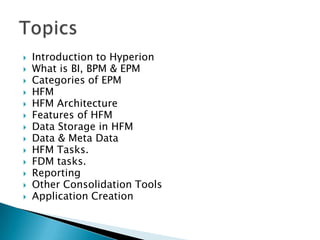
 Introduction to Hyperion
 What is BI, BPM & EPM
 Categories of EPM
 HFM
 HFM Architecture
 Features of HFM
 Data Storage in HFM
 Data & Meta Data
 HFM Tasks.
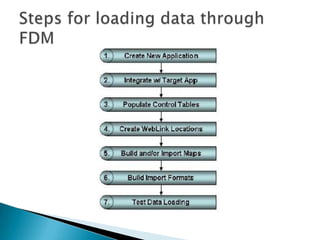
 FDM tasks.
 Reporting
 Other Consolidation Tools
 Application Creation
 Hyperion is an EPM system with Business
Intelligence (BI) and Business Performance
Management (BPM ) Tool
 It has applications for Planning,
consolidation, scorecarding, reporting,
dashboards, Analysis, Workspace, Master
Data Management and Foundation.
 BI tools enable organizations to analyze high
volumes of information in order to have
effective support during the decision-making
process.
 Business performance management is a set
of management and analytic processes that
enable the management of an organization's
performance to achieve one or more pre-
selected goals.
 Enterprise Performance Management (EPM) is
a management field of Business Performance
Management which considers the visibility of
operations in a closed-loop model across all
facets of the enterprise.
EPM (OLAP)
Application Reporting Data
Management
HFM IR ODI
Planning FR FDM
Web Analysis DRM
Essbase
 Oracle Hyperion Financial Management is a
comprehensive, Web-based application that
delivers global financial consolidation,
reporting and analysis in a single, highly
scalable software solution.
 Close Life Cycle
 Process management for tight control of the
review and approval process
 Data Validation, Auditing.
 Currency translation to support multiple local
currencies
 Automatic eliminations for intercompany
transactions
 sub cubic format.
 Dimensions
 There are 12 dimensions for every HFM
application
 Metadata is defined as the structural
elements of an application that describe and
hold data.
Eg: Dimension names, Member names
,Properties ,Exchange Rates and security.
 Spreadsheet-based solutions are difficult to
maintain and do not provide an audit trail.
Auditors agree that spreadsheets are
insufficient for financial consolidation and
reporting today.
 Point solutions for financial consolidations
are built only for the statutory reporting
process and are generally used by only a
limited number of employees in the
accounting department.
5 steps for creating Application.
 Creating Application Profile. (Year, Period,
View)
 Creating Application.
 Managing Application Security.
 Managing Metadata.
 Load Data, Data Forms, Member Lists, Rules,
Journals, ICP to the Application.
 Consolidation, Control of data.
 Data Loading Tool
 Reporting Tool
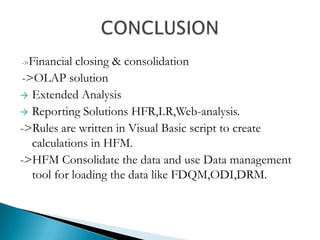
->Financial closing & consolidation
->OLAP solution
 Extended Analysis
 Reporting Solutions HFR,I.R,Web-analysis.
->Rules are written in Visual Basic script to create
calculations in HFM.
->HFM Consolidate the data and use Data management
tool for loading the data like FDQM,ODI,DRM.
Hfm demo (1)

Hfm demo (1)

  • 2.
     Introduction toHyperion  What is BI, BPM & EPM  Categories of EPM  HFM  HFM Architecture  Features of HFM  Data Storage in HFM  Data & Meta Data  HFM Tasks.  FDM tasks.  Reporting  Other Consolidation Tools  Application Creation
  • 3.
     Hyperion isan EPM system with Business Intelligence (BI) and Business Performance Management (BPM ) Tool  It has applications for Planning, consolidation, scorecarding, reporting, dashboards, Analysis, Workspace, Master Data Management and Foundation.
  • 4.
     BI toolsenable organizations to analyze high volumes of information in order to have effective support during the decision-making process.
  • 5.
     Business performancemanagement is a set of management and analytic processes that enable the management of an organization's performance to achieve one or more pre- selected goals.
  • 6.
     Enterprise PerformanceManagement (EPM) is a management field of Business Performance Management which considers the visibility of operations in a closed-loop model across all facets of the enterprise.
  • 8.
    EPM (OLAP) Application ReportingData Management HFM IR ODI Planning FR FDM Web Analysis DRM Essbase
  • 9.
     Oracle HyperionFinancial Management is a comprehensive, Web-based application that delivers global financial consolidation, reporting and analysis in a single, highly scalable software solution.
  • 11.
     Close LifeCycle  Process management for tight control of the review and approval process  Data Validation, Auditing.  Currency translation to support multiple local currencies  Automatic eliminations for intercompany transactions
  • 12.
     sub cubicformat.  Dimensions  There are 12 dimensions for every HFM application
  • 13.
     Metadata isdefined as the structural elements of an application that describe and hold data. Eg: Dimension names, Member names ,Properties ,Exchange Rates and security.
  • 15.
     Spreadsheet-based solutionsare difficult to maintain and do not provide an audit trail. Auditors agree that spreadsheets are insufficient for financial consolidation and reporting today.  Point solutions for financial consolidations are built only for the statutory reporting process and are generally used by only a limited number of employees in the accounting department.
  • 16.
    5 steps forcreating Application.  Creating Application Profile. (Year, Period, View)  Creating Application.  Managing Application Security.  Managing Metadata.  Load Data, Data Forms, Member Lists, Rules, Journals, ICP to the Application.
  • 19.
     Consolidation, Controlof data.  Data Loading Tool  Reporting Tool
  • 20.
    ->Financial closing &consolidation ->OLAP solution  Extended Analysis  Reporting Solutions HFR,I.R,Web-analysis. ->Rules are written in Visual Basic script to create calculations in HFM. ->HFM Consolidate the data and use Data management tool for loading the data like FDQM,ODI,DRM.