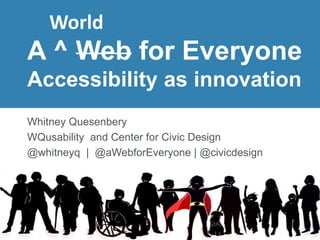
A ^ Web for Everyone
Accessibility as innovation
Whitney Quesenbery
WQusability and Center for Civic Design
@whitneyq | @aWebforEveryone | @civicdesign
World
It's a wicked problem:
incomplete
contradictory
or changing
Usability and accessibility
are like twins separated at birth
How do we include
people with disabilities in our
design considerations?
Hidden
Invisible
Misunderstood
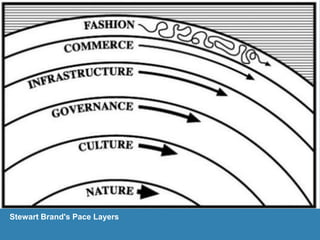
Stewart Brand's Pace Layers
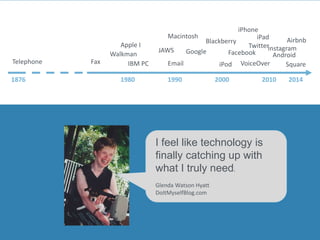
I feel like technology is
finally catching up with
what I truly need.
Glenda Watson Hyatt
DoItMyselfBlog.com
1876 2010200019901980
Telephone Fax Email
Walkman
Blackberry
iPod
iPhone
JAWS
VoiceOver
Facebook
Twitter
Google
Apple I
Macintosh
IBM PC
iPad
Android
2014
Airbnb
Square
Instagram
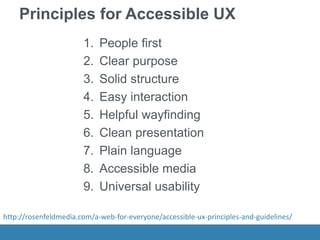
Principles for Accessible UX
1. People first
2. Clear purpose
3. Solid structure
4. Easy interaction
5. Helpful wayfinding
6. Clean presentation
7. Plain language
8. Accessible media
9. Universal usability
http://rosenfeldmedia.com/a-web-for-everyone/accessible-ux-principles-and-guidelines/
Take ^ participation seriously
diverse
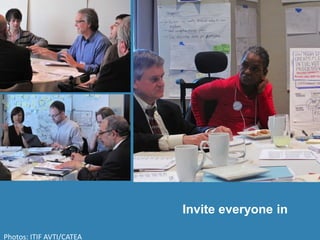
Invite everyone in
Photos: ITIF AVTI/CATEA
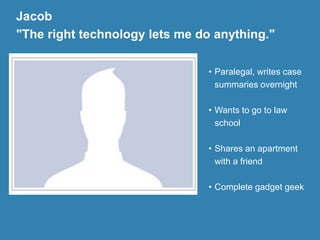
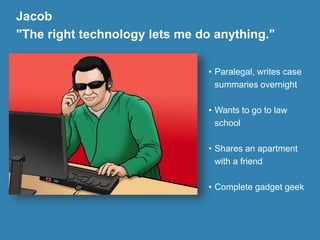
Jacob
"The right technology lets me do anything."
• Paralegal, writes case
summaries overnight
• Wants to go to law
school
• Shares an apartment
with a friend
• Complete gadget geek
Jacob
"The right technology lets me do anything."
• Paralegal, writes case
summaries overnight
• Wants to go to law
school
• Shares an apartment
with a friend
• Complete gadget geek
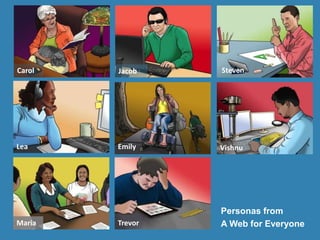
Carol Jacob
Lea Emily
Steven
Maria Trevor
Vishnu
Personas from
A Web for Everyone
Create ^ ways to innovate
better
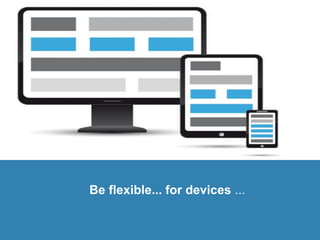
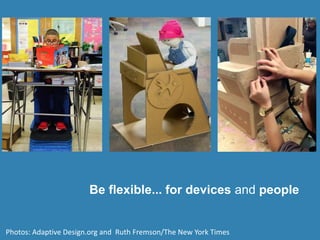
Be flexible... for devices ...
Photos: Adaptive Design.org and Ruth Fremson/The New York Times
Be flexible... for devices and people
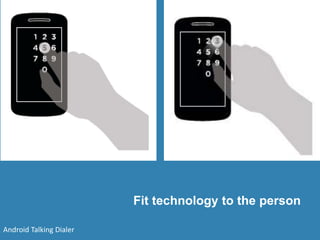
Fit technology to the person
Android Talking Dialer
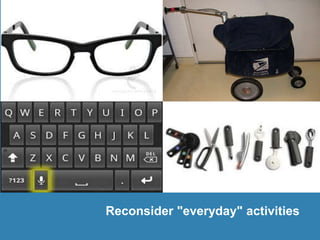
Reconsider "everyday" activities
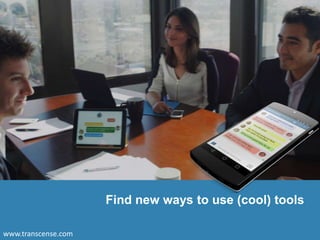
Find new ways to use (cool) tools
www.transcense.com
Appeal to all senses
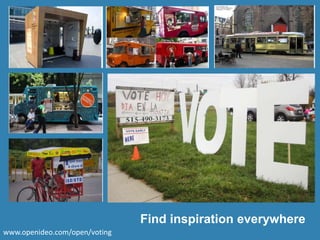
Find inspiration everywhere
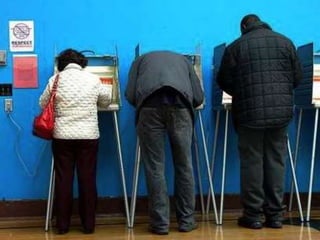
www.openideo.com/open/voting
Change ^ perspective
your
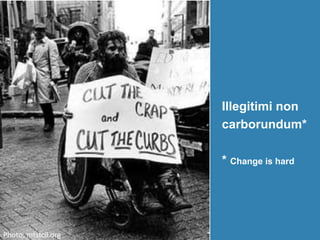
Illegitimi non
carborundum*
* Change is hard
Photo: mtstcil.org
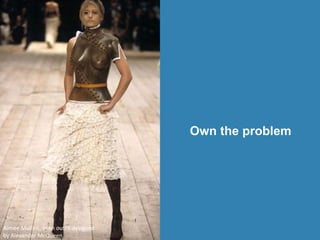
Own the problem
Aimee Mullins, in an outfit designed
by Alexander McQueen
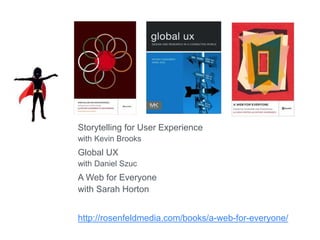
Storytelling for User Experience
with Kevin Brooks
Global UX
with Daniel Szuc
A Web for Everyone
with Sarah Horton
http://rosenfeldmedia.com/books/a-web-for-everyone/
Get in touch!
Whitney Quesenbery
whitneyq@wqusability.com
@whitneyq
civicdesign.org
@civicdesign
@aWebforEveryone
Thank you.

Accessibility as innovation

Editor's Notes

  • #4 Usability The effectiveness, efficiency and satisfaction with which a specified set of users can achieve a specified set of tasks in a particular environment. – ISO 9241-11 Accessibility The usability of a product, service, environment or facility by people with the widest range of capabilities – ISO 9241-20
  • #5 19 million people over 18 have trouble seeing 31 million people over 18 have trouble hearing 28 million people over 18 experience physical difficulty 3 million have trouble grasping or handling small objects That’s 17-20% of non-institutionalized adults
  • #6 Hidden: Less likely to graduate from college, work, be in public Invisible: Not all disabilties are obvious Misunderstood: Because they are hidden and invisible, we don't know how to design for them.
  • #7 A concept that has been useful for me in thinking about how we adopt changes that are both social/societal and technical is Stewart Brand's Pace Layers But I wanted to think specifically about the pace of change and how we adopt new ways of thinking and workig
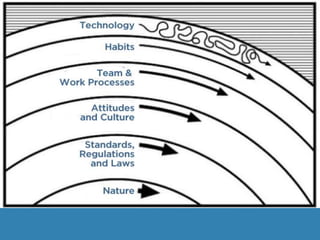
  • #8 Whether we're thinking about accessibility or voting systems or changing how we run elections... we need to understand the pace of change of the different elements of that change. I've moved technology to the outer ring, because today, technology is fashion as much as anything else And when we look at how we create technology...
  • #9 Another way to look at the pace of change and you can see that rapid, accellerating loopy journey of tecnology. But there's also the social impact of new technology and how it fits into our habits, attitudes and culture. Glenda W-H and that change that unobtrusive (and affordable) technology can bring to how we see the problem.
  • #11 Three ways we can innovate around accessibility. The first is to find more ways to bring people with disabilities into the creative process. For me, this builds on an increasing emphasis on ethnographic methods of user research – seeing people in context – rather than bringing them in at the end of the process.
  • #12 Are you inviting people of all kinds to be an active part of the project. These workshops, part of the ITIF AVTI, funded by the EAC, brought together two groups of 32 people: election officials, voting system designers, technology folks, designers, advocates, people with disabilities.
  • #13 A fairly generic profile until we add a few more details
  • #14 Because people with disabilities have the same range of preferences and interests as anyone else.
  • #15 Open up your recruiting – people are an inspiration. Let them in
  • #16 The second is the value of opening up the creative process. For me, this builds on an increasing emphasis on ethnographic methods of user research – seeing people in context – and participatory design. Make with and not for Nothing about us without us
  • #17 Design for mobile first because... Mobile forces you to focus (November 2009) The idea of mobile first and responsive design sweeping the web design world. Like plain language, this is an opportunity for accessibility to meet forces at work in the general technology design space. It's not only a moment we can capitalize on, but one we can learn from. So when I talk about designing for extremes, I mean that the diversity of devices can also reflect the diversity of assistive technology – and of people
  • #18 Echos of pioneer designer Victor Papanek and Design for the Real World
  • #19 Where is the "5" on a screen keyboard Anywhere you put your finger
  • #20 Instead of designing specialized AT, or thinking of what we do as creating tools only for people with specific disabilities, it's perhaps more interesting to think about what we can learn from extreme needs that exposes solutions for everyone.
  • #21 Phones in front of all of us gives us individual microphones Speech to text provides rough transcription, and identifies speakers End result: people who are hard of hearing can participate in social and business meetings
  • #23 Voting Van: www.openideo.com/open/voting Iowa popup polling site: www.npr.org/2012/10/24/163560324/vote-while-you-shop-pop-up-poll-sites-sweep-iowa
  • #26 Alexander McQueen legs, designed for Aimee Mullins
  • #27 Because people come in all shapes and sizes.