Research data spring
AMASED Access Methods for Analysing SEnsitive Data27/2/2015
Taking the analysis to sensitive data. Test cases
with the British Library Digital Data and F1000
Research Data
Team
»Lead: University of Bristol
»Collaborators: London Metropolitan University,
Content Mine, British Library, F1000 Research
»Stakeholders: research data providers, researchers,
research libraries, publishers etc.
18/02/2015 Title of presentation (Go to ‘View’ menu > ‘Header and Footer…’ to edit the footers on this slide) 2
Scope and Gap
»Sensitive data crucial in almost all areas.
›Patchy understanding of how to deal with them (3.9). Tools and
methods evolving rapidly.
»DataSHIELD (www.datashield.ac.uk) developed for Biomedical/Life
sciences (EU,MRC)
›Extend to new roles in biomedicine, text data in humanities, and work
with 3.3 to develop capacity for data cleaning
»Goal 1: Scope integration of the data cleaning tool ICT-RD (3.3) with
DataSHIELD
»Goal 2: Local instance of DataSHIELD for open text data (digitised books)
from the British Library
»Goal 3: Scope the challenges of implementing DataSHIELD as a paper
data access-analysis solution for F1000 Research.
»FINAL (Month 13): Final products implemented with London Met, British
Library, F1000 Research
18/02/2015 Title of presentation (Go to ‘View’ menu > ‘Header and Footer…’ to edit the footers on this slide) 3
Impact and Benefits
18/02/2015 Title of presentation (Go to ‘View’ menu > ‘Header and Footer…’ to edit the footers on this slide) 4
Researchers
Increase their access to datasets globally
Simplify the process of pooled data analysis
Ability to analyse individual level data
Data providers
Increase usability of datasets globally
Preserve intellectual property
Preserve participant confidentiality
Ethics
Explain DataSHIELD to ethical and data access
committees
Hackathon will feed into ongoing evaluation by the
proposed DataSHIELD Security Oversight Committee
Potential developers
Raise interest in new project to optimise the exploitation
of biomedical data, opportunity to develop new
functionality
New use cases
Raise awareness of DataSHIELD beyond scope of
biomedical community. Application to other research
areas?
Sustainability
»Open source products
»Free to user and data provider
»Growing international development community
›Protocols for quality control
»Open for others to join us
18/02/2015 Title of presentation (Go to ‘View’ menu > ‘Header and Footer…’ to edit the footers on this slide) 5
success
18/02/2015 Title of presentation (Go to ‘View’ menu > ‘Header and Footer…’ to edit the footers on this slide) 6
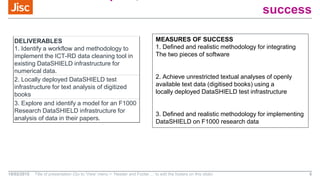
DELIVERABLES
1. Identify a workflow and methodology to
implement the ICT-RD data cleaning tool in
existing DataSHIELD infrastructure for
numerical data.
2. Locally deployed DataSHIELD test
infrastructure for text analysis of digitized
books
3. Explore and identify a model for an F1000
Research DataSHIELD infrastructure for
analysis of data in their papers.
MEASURES OF SUCCESS
1. Defined and realistic methodology for integrating
The two pieces of software
2. Achieve unrestricted textual analyses of openly
available text data (digitised books) using a
locally deployed DataSHIELD test infrastructure
3. Defined and realistic methodology for implementing
DataSHIELD on F1000 research data
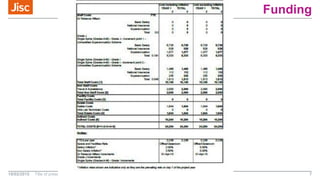
Funding
18/02/2015 Title of presentation (Go to ‘View’ menu > ‘Header and Footer…’ to edit the footers on this slide) 7

Access methods for analysing sensitive data (amased)

  • 1.
    Research data spring AMASEDAccess Methods for Analysing SEnsitive Data27/2/2015 Taking the analysis to sensitive data. Test cases with the British Library Digital Data and F1000 Research Data
  • 2.
    Team »Lead: University ofBristol »Collaborators: London Metropolitan University, Content Mine, British Library, F1000 Research »Stakeholders: research data providers, researchers, research libraries, publishers etc. 18/02/2015 Title of presentation (Go to ‘View’ menu > ‘Header and Footer…’ to edit the footers on this slide) 2
  • 3.
    Scope and Gap »Sensitivedata crucial in almost all areas. ›Patchy understanding of how to deal with them (3.9). Tools and methods evolving rapidly. »DataSHIELD (www.datashield.ac.uk) developed for Biomedical/Life sciences (EU,MRC) ›Extend to new roles in biomedicine, text data in humanities, and work with 3.3 to develop capacity for data cleaning »Goal 1: Scope integration of the data cleaning tool ICT-RD (3.3) with DataSHIELD »Goal 2: Local instance of DataSHIELD for open text data (digitised books) from the British Library »Goal 3: Scope the challenges of implementing DataSHIELD as a paper data access-analysis solution for F1000 Research. »FINAL (Month 13): Final products implemented with London Met, British Library, F1000 Research 18/02/2015 Title of presentation (Go to ‘View’ menu > ‘Header and Footer…’ to edit the footers on this slide) 3
  • 4.
    Impact and Benefits 18/02/2015Title of presentation (Go to ‘View’ menu > ‘Header and Footer…’ to edit the footers on this slide) 4 Researchers Increase their access to datasets globally Simplify the process of pooled data analysis Ability to analyse individual level data Data providers Increase usability of datasets globally Preserve intellectual property Preserve participant confidentiality Ethics Explain DataSHIELD to ethical and data access committees Hackathon will feed into ongoing evaluation by the proposed DataSHIELD Security Oversight Committee Potential developers Raise interest in new project to optimise the exploitation of biomedical data, opportunity to develop new functionality New use cases Raise awareness of DataSHIELD beyond scope of biomedical community. Application to other research areas?
  • 5.
    Sustainability »Open source products »Freeto user and data provider »Growing international development community ›Protocols for quality control »Open for others to join us 18/02/2015 Title of presentation (Go to ‘View’ menu > ‘Header and Footer…’ to edit the footers on this slide) 5
  • 6.
    success 18/02/2015 Title ofpresentation (Go to ‘View’ menu > ‘Header and Footer…’ to edit the footers on this slide) 6 DELIVERABLES 1. Identify a workflow and methodology to implement the ICT-RD data cleaning tool in existing DataSHIELD infrastructure for numerical data. 2. Locally deployed DataSHIELD test infrastructure for text analysis of digitized books 3. Explore and identify a model for an F1000 Research DataSHIELD infrastructure for analysis of data in their papers. MEASURES OF SUCCESS 1. Defined and realistic methodology for integrating The two pieces of software 2. Achieve unrestricted textual analyses of openly available text data (digitised books) using a locally deployed DataSHIELD test infrastructure 3. Defined and realistic methodology for implementing DataSHIELD on F1000 research data
  • 7.
    Funding 18/02/2015 Title ofpresentation (Go to ‘View’ menu > ‘Header and Footer…’ to edit the footers on this slide) 7