
What to monitor?
Research policy monitoring in the era of Open Science and Big Data – the what and the how
Ghent, 27 May 2019
What to measure?
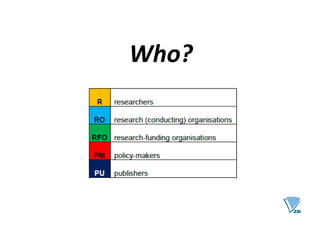
Who?
Who says what to
measure and monitor?
Who does the measuring
and monitoring?
Why?
What to measure?
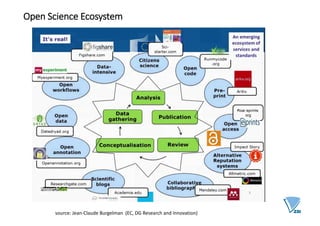
source: Jean-Claude Burgelman (EC, DG Research and Innovation)
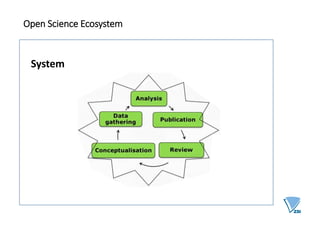
Open Science Ecosystem
System
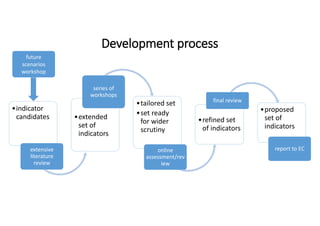
Development process
•indicator
candidates
extensive
literature
review
•extended
set of
indicators
series of
workshops
•tailored set
•set ready
for wider
scrutiny
online
assessment/rev
iew
•refined set
of indicators
final review
•proposed
set of
indicators
report to EC
future
scenarios
workshop
Results of the process
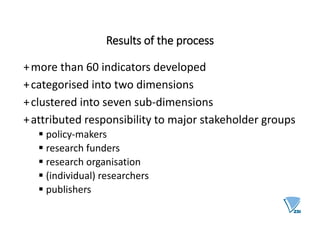
+more than 60 indicators developed
+categorised into two dimensions
+clustered into seven sub-dimensions
+attributed responsibility to major stakeholder groups
▪ policy-makers
▪ research funders
▪ research organisation
▪ (individual) researchers
▪ publishers
Results of the process
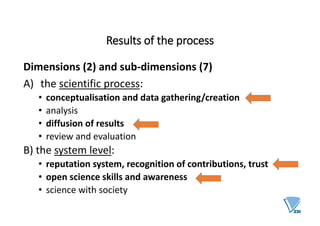
Dimensions (2) and sub-dimensions (7)
A) the scientific process:
• conceptualisation and data gathering/creation
• analysis
• diffusion of results
• review and evaluation
B) the system level:
• reputation system, recognition of contributions, trust
• open science skills and awareness
• science with society
Who?
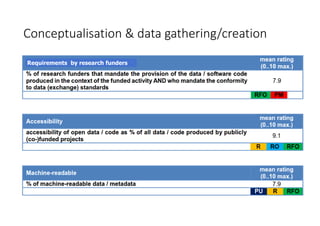
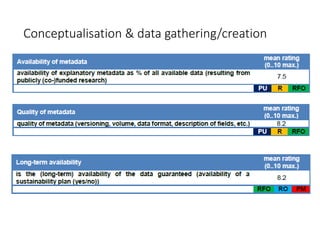
Conceptualisation & data gathering/creation
Requirements by research funders
Conceptualisation & data gathering/creation
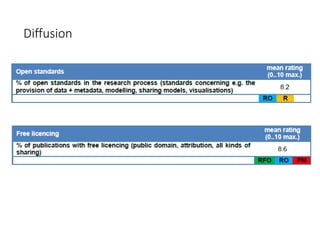
Diffusion
System level:
Reputation system, recognition of contribution, trust
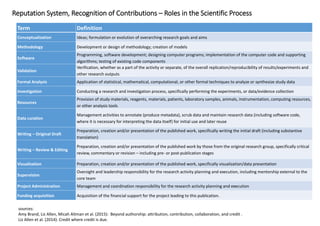
Reputation System, Recognition of Contributions – Roles in the Scientific Process
Term Definition
Conceptualization Ideas; formulation or evolution of overarching research goals and aims
Methodology Development or design of methodology; creation of models
Software
Programming, software development; designing computer programs; implementation of the computer code and supporting
algorithms; testing of existing code components
Validation
Verification, whether as a part of the activity or separate, of the overall replication/reproducibility of results/experiments and
other research outputs
Formal Analysis Application of statistical, mathematical, computational, or other formal techniques to analyze or synthesize study data
Investigation Conducting a research and investigation process, specifically performing the experiments, or data/evidence collection
Resources
Provision of study materials, reagents, materials, patients, laboratory samples, animals, instrumentation, computing resources,
or other analysis tools
Data curation
Management activities to annotate (produce metadata), scrub data and maintain research data (including software code,
where it is necessary for interpreting the data itself) for initial use and later reuse
Writing – Original Draft
Preparation, creation and/or presentation of the published work, specifically writing the initial draft (including substantive
translation)
Writing – Review & Editing
Preparation, creation and/or presentation of the published work by those from the original research group, specifically critical
review, commentary or revision – including pre- or post-publication stages
Visualization Preparation, creation and/or presentation of the published work, specifically visualization/data presentation
Supervision
Oversight and leadership responsibility for the research activity planning and execution, including mentorship external to the
core team
Project Administration Management and coordination responsibility for the research activity planning and execution
Funding acquisition Acquisition of the financial support for the project leading to this publication.
sources:
Amy Brand, Liz Allen, Micah Altman et al. (2015): Beyond authorship: attribution, contribution, collaboration, and credit .
Liz Allen et al. (2014): Credit where credit is due.
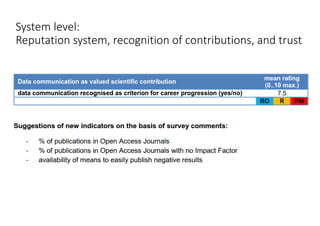
System level:
Reputation system, recognition of contributions, and trust
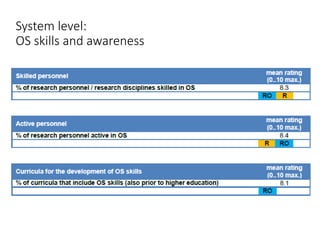
System level:
OS skills and awareness
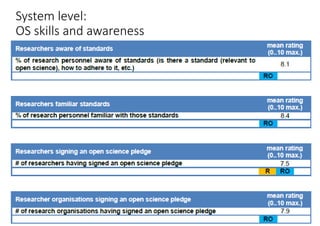
System level:
OS skills and awareness
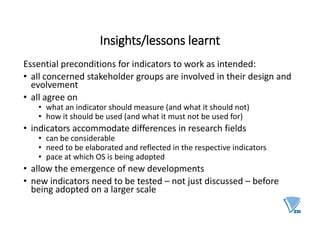
Insights/lessons learnt
Essential preconditions for indicators to work as intended:
• all concerned stakeholder groups are involved in their design and
evolvement
• all agree on
• what an indicator should measure (and what it should not)
• how it should be used (and what it must not be used for)
• indicators accommodate differences in research fields
• can be considerable
• need to be elaborated and reflected in the respective indicators
• pace at which OS is being adopted
• allow the emergence of new developments
• new indicators need to be tested – not just discussed – before
being adopted on a larger scale
Thank you for your attention!
Contact details:
Dietmar LAMPERT
ZSI – Centre for Social Innovation
www.zsi.at

20190527_Dietmar Lampert _ New indicators for Open Sciene

  • 1.
    What to monitor? Researchpolicy monitoring in the era of Open Science and Big Data – the what and the how Ghent, 27 May 2019
  • 2.
  • 3.
    Who? Who says whatto measure and monitor? Who does the measuring and monitoring?
  • 4.
  • 5.
  • 6.
    source: Jean-Claude Burgelman(EC, DG Research and Innovation) Open Science Ecosystem
  • 7.
  • 8.
    Development process •indicator candidates extensive literature review •extended set of indicators seriesof workshops •tailored set •set ready for wider scrutiny online assessment/rev iew •refined set of indicators final review •proposed set of indicators report to EC future scenarios workshop
  • 9.
    Results of theprocess +more than 60 indicators developed +categorised into two dimensions +clustered into seven sub-dimensions +attributed responsibility to major stakeholder groups ▪ policy-makers ▪ research funders ▪ research organisation ▪ (individual) researchers ▪ publishers
  • 10.
    Results of theprocess Dimensions (2) and sub-dimensions (7) A) the scientific process: • conceptualisation and data gathering/creation • analysis • diffusion of results • review and evaluation B) the system level: • reputation system, recognition of contributions, trust • open science skills and awareness • science with society
  • 11.
  • 12.
    Conceptualisation & datagathering/creation Requirements by research funders
  • 13.
    Conceptualisation & datagathering/creation
  • 14.
  • 15.
    System level: Reputation system,recognition of contribution, trust
  • 16.
    Reputation System, Recognitionof Contributions – Roles in the Scientific Process Term Definition Conceptualization Ideas; formulation or evolution of overarching research goals and aims Methodology Development or design of methodology; creation of models Software Programming, software development; designing computer programs; implementation of the computer code and supporting algorithms; testing of existing code components Validation Verification, whether as a part of the activity or separate, of the overall replication/reproducibility of results/experiments and other research outputs Formal Analysis Application of statistical, mathematical, computational, or other formal techniques to analyze or synthesize study data Investigation Conducting a research and investigation process, specifically performing the experiments, or data/evidence collection Resources Provision of study materials, reagents, materials, patients, laboratory samples, animals, instrumentation, computing resources, or other analysis tools Data curation Management activities to annotate (produce metadata), scrub data and maintain research data (including software code, where it is necessary for interpreting the data itself) for initial use and later reuse Writing – Original Draft Preparation, creation and/or presentation of the published work, specifically writing the initial draft (including substantive translation) Writing – Review & Editing Preparation, creation and/or presentation of the published work by those from the original research group, specifically critical review, commentary or revision – including pre- or post-publication stages Visualization Preparation, creation and/or presentation of the published work, specifically visualization/data presentation Supervision Oversight and leadership responsibility for the research activity planning and execution, including mentorship external to the core team Project Administration Management and coordination responsibility for the research activity planning and execution Funding acquisition Acquisition of the financial support for the project leading to this publication. sources: Amy Brand, Liz Allen, Micah Altman et al. (2015): Beyond authorship: attribution, contribution, collaboration, and credit . Liz Allen et al. (2014): Credit where credit is due.
  • 17.
    System level: Reputation system,recognition of contributions, and trust
  • 18.
  • 19.
  • 20.
    Insights/lessons learnt Essential preconditionsfor indicators to work as intended: • all concerned stakeholder groups are involved in their design and evolvement • all agree on • what an indicator should measure (and what it should not) • how it should be used (and what it must not be used for) • indicators accommodate differences in research fields • can be considerable • need to be elaborated and reflected in the respective indicators • pace at which OS is being adopted • allow the emergence of new developments • new indicators need to be tested – not just discussed – before being adopted on a larger scale
  • 21.
    Thank you foryour attention! Contact details: Dietmar LAMPERT ZSI – Centre for Social Innovation www.zsi.at