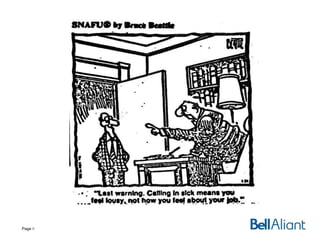
De-medicalizing Disability
Management
“Accept and Assist”.
Matthew Burnstein, MD, MCFP, MRO
Chief Medical Officer – Bell Aliant
Feb 13th, 2014

Page 1
Objectives
• Understand Total Cost and the Drivers of
Disability
• Weakness in the Traditional Approach to
Disability Management
• Time for a Paradigm Shift?
• A New Model
• Study the results
• Lessons Learned
Page 2
Bell Aliant Regional Communications
• 7000 union and non union members (>60% unionized)
• 6 provinces, widely dispersed
• Customer care workers, field technicians, engineers, marketing
and sales, finance, support services
• TV, internet, home security systems and phones – ever-changing
product mix
• Former monopoly
• <2% staff turnover
• In house team of Health and Wellness (H&W) professionals
• Self insured for short term disability- up to 1 yr at full salary
• Unlimited incidental absence at 100% pay

Page 3
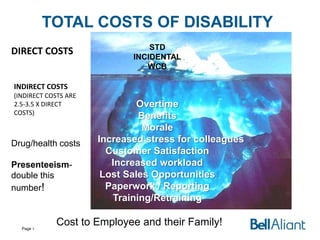
TOTAL COSTS OF DISABILITY
DIRECT COSTS

STD
INCIDENTAL
WCB

INDIRECT COSTS
(INDIRECT COSTS ARE
2.5-3.5 X DIRECT
COSTS)

Drug/health costs
Presenteeismdouble this
number!

Page 4

Overtime
Benefits
Morale
Increased stress for colleagues
Customer Satisfaction
Increased workload
Lost Sales Opportunities
Paperwork / Reporting
Training/Retraining

Cost to Employee and their Family!
What’s behind the high rates of
disability today?
We’ve never been healthier,
never lived as long,
never had such great medical knowledge,
yet, as a society,
we’ve never been so disabled.

Page 5
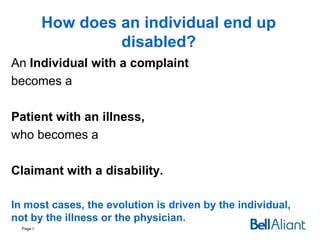
How does an individual end up
disabled?
An Individual with a complaint
becomes a
Patient with an illness,
who becomes a
Claimant with a disability.
In most cases, the evolution is driven by the individual,
not by the illness or the physician.
Page 6
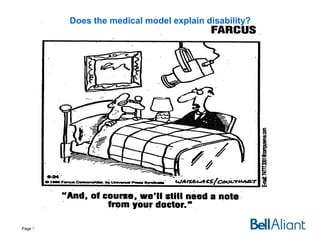
Does the medical model explain disability?

Page 7
• “The experience of disability is more related to
society’s willingness to accommodate and
individual motivation than any underlying
impairment or limitation. Our narrow concepts of
health and disability limit our potential.
• Over the years, I have been impressed by the
relative lack of correlation between impairment
and disability….Much of disability results from
learned experiences, lack of adaptive skills and
reinforcements from physicians, family
members, attorneys, employers and others.
• We can no longer accept this societal illness;
the costs are too enormous”.
Page 8

Dr Chris Brigham
President ABIME
Preface the MDAs
Page 9
Only a small fraction of medically excused days off work is
medically required – meaning work of any kind is medically
contraindicated. The remaining days off work result from a
variety of non-medical factors such as administrative delays
of treatment and specialty referral, lack of transitional work,
ineffective communications, lax management, and logistical
problems. These days off are based on non-medical decisions
and are either discretionary or clearly unnecessary.
Participants in the disability benefits system seem largely
unaware that so much disability is not medically required.
Absence from work is “excused” and benefits are generally
awarded based on a physician’s decision confirming that a
medical condition exists. This implies that a diagnosis creates
disability.
ACOEM Guideline on Preventing Needless
Work Disability by Helping People Stay Employed

Page 10
Page 11
• “Disability is a complicated psychosocial
problem that extends beyond the sole question
of illness or injury. Many factors contribute to
the complexity of the problem.
• They include, but are not limited to an
individual’s values and beliefs; the role of
illness in the individual’s childhood..; the
specific symbolic meaning of illness or injury to
the individual; the individual’s relationship with
his employer; economic issues; workplace
accommodations made available by the
employer; and the employer’s
policies/practices, culture, and values”.
Page 12

Dr Presley Reed
The Medical Disability Advisor 4th Ed.
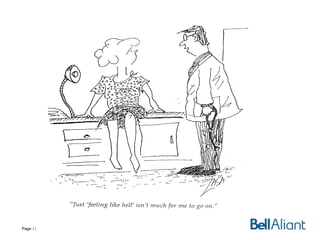
Disability is not a medical concept
 Defined by a contract, usually related to
occupation
 Therefore, it is a legal rather than a
medical concept
 Influenced by non medical factors :
–
–
–
–
Page 13

Employer, availability of alternate duties
Training, experience, education
Psychosocial factors
Personality
Reality check:

Doctors are trained to treat
illness,
not disability

Page 14
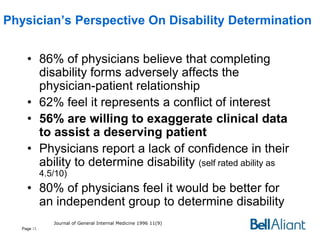
Physician’s Perspective On Disability Determination
• 86% of physicians believe that completing
disability forms adversely affects the
physician-patient relationship
• 62% feel it represents a conflict of interest
• 56% are willing to exaggerate clinical data
to assist a deserving patient
• Physicians report a lack of confidence in their
ability to determine disability (self rated ability as
4.5/10)

• 80% of physicians feel it would be better for
an independent group to determine disability
Journal of General Internal Medicine 1996 11(9)
Page 15
Page 16
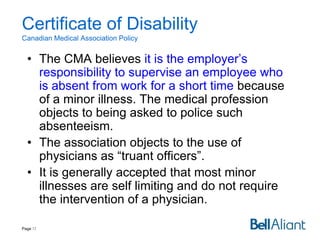
Certificate of Disability
Canadian Medical Association Policy

• The CMA believes it is the employer’s
responsibility to supervise an employee who
is absent from work for a short time because
of a minor illness. The medical profession
objects to being asked to police such
absenteeism.
• The association objects to the use of
physicians as “truant officers”.
• It is generally accepted that most minor
illnesses are self limiting and do not require
the intervention of a physician.
Page 17
Page 18
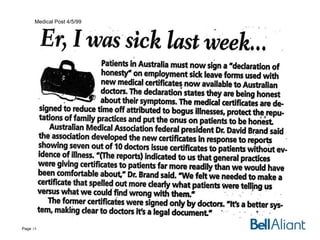
Medical Post 4/5/99

Page 19
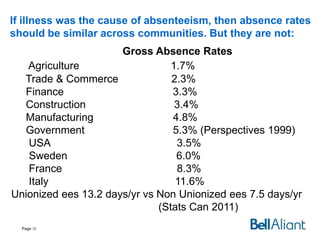
If illness was the cause of absenteeism, then absence rates
should be similar across communities. But they are not:
Gross Absence Rates
Agriculture
1.7%
Trade & Commerce
2.3%
Finance
3.3%
Construction
3.4%
Manufacturing
4.8%
Government
5.3% (Perspectives 1999)
USA
3.5%
Sweden
6.0%
France
8.3%
Italy
11.6%
Unionized ees 13.2 days/yr vs Non Unionized ees 7.5 days/yr
(Stats Can 2011)
Page 20
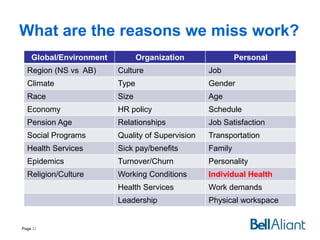
What are the reasons we miss work?
Global/Environment

Organization

Personal

Region (NS vs AB)

Culture

Job

Climate

Type

Gender

Race

Size

Age

Economy

HR policy

Schedule

Pension Age

Relationships

Job Satisfaction

Social Programs

Quality of Supervision

Transportation

Health Services

Sick pay/benefits

Family

Epidemics

Turnover/Churn

Personality

Religion/Culture

Working Conditions

Individual Health

Health Services

Work demands

Leadership

Physical workspace

Page 21
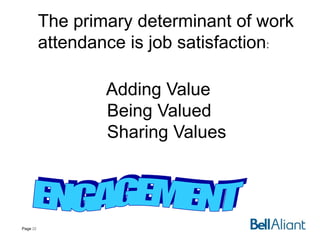
The primary determinant of work
attendance is job satisfaction:
Adding Value
Being Valued
Sharing Values

Page 22
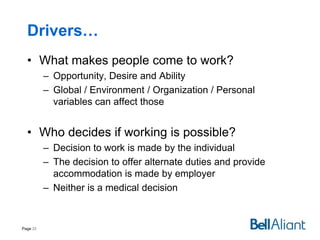
Drivers…
• What makes people come to work?
– Opportunity, Desire and Ability
– Global / Environment / Organization / Personal
variables can affect those

• Who decides if working is possible?
– Decision to work is made by the individual
– The decision to offer alternate duties and provide
accommodation is made by employer
– Neither is a medical decision

Page 23
Page 24

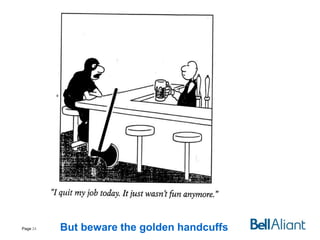
But beware the golden handcuffs
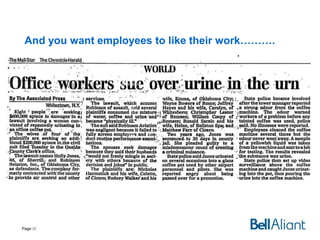
And you want employees to like their work……….

Page 25
Hippocrates:
“It is always more important to
know what type of person has a
disease than it is to know what
type of disease a person has.”

Page 26
Disability vs Disease
• Disability and disease are distinct concepts;
diagnosis does not determine disability
• Doctors don’t know disability and are not truant
officers
• Disability from work is determined by a multitude
of non medical factors
• While supporting the concept of early return to
work, doctors are patient advocates, and
ultimately, patients determine their ability to work
• The workplace/workplace policies must
encourage employees to remain at work (even
in the face of challenges)
• Engagement may reduce absenteeism
Page 27
So, if disability is not driven
by disease, and doctors
don’t know much about
disability or the workplace,
what do we do?
How do we determine or
manage disability?
Page 28
The first paradigm shift

Stop talking to
doctors and start
talking to
employees.
Page 29
Talk to employees
• Doctors talk to their patients - they trust them and
advocate for them, but they don’t know the workplace
• Trust your employees – they are telling you the truth*
• Treat them as you’d treat a manager or a colleague
or want to be treated yourself
• They know their job and what aspects they can do
and can’t do
• Allow them flexibility to do the job
• It is their motivation which determines outcome – so
what is motivating them to come to work or keep
them off?
* Most of the time. Why treat the 99% who are honest to catch the 1%?

Page 30
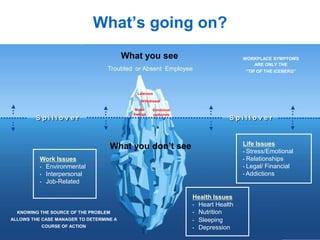
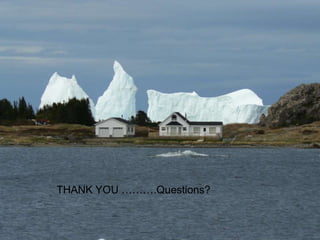
What’s going on?
What you see

WORKPLACE SYMPTOMS
ARE ONLY THE

Troubled or Absent Employee

“TIP OF THE ICEBERG”

Lateness
Withdrawal

Mood
Swings

Spillover

Emotional
outbursts

Spillover

What you don’t see

Life Issues
• Stress/Emotional
• Relationships
• Legal/ Financial
• Addictions

Work Issues
• Environmental
• Interpersonal
• Job-Related

KNOWING THE SOURCE OF THE PROBLEM
ALLOWS THE CASE MANAGER TO DETERMINE A
Page 31

COURSE OF ACTION

Health Issues
• Heart Health
• Nutrition
• Sleeping
• Depression
The Second Paradigm Shift
• Accept them and help them
• You cannot rehabilitate someone who is busy proving they are
disabled
• Malingerer’s are rare. Anxious and overwhelmed individuals are
common.
• Often the claimant is just in the wrong basket – needs family
leave, needs to change jobs, needs to be on administrative leave
or re-assigned while workplace conflict is addressed
• Chronic diseases are chronic/recurrent and need to be addressed
holistically (is public health up to the task?)
• Whatever the barrier or reason for being off work, the outcome is
better, and total cost reduced, if you support the employee and
work through the issues
Page 32
The Third Paradigm Shift: think long term
• Employees are there for the long term, so you
need to think long-term
• An injured/ill employee who could be at work,
but chooses not to rtw, generates a greater
loss to the organization over the long term
than the “extra” few weeks of sick leave. They
are disengaged.
• Presenteeism costs more than absenteeism
• Forcing an employee to rtw when they feel
they are “unfit” will cost the employer money
every day
Page 33
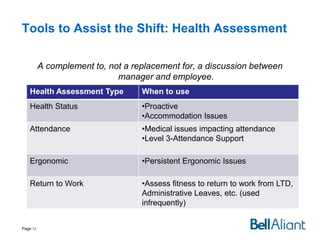
Tools to Assist the Shift: Health Assessment
A complement to, not a replacement for, a discussion between
manager and employee.
Health Assessment Type

When to use

Health Status

•Proactive
•Accommodation Issues

Attendance

•Medical issues impacting attendance
•Level 3-Attendance Support

Ergonomic

•Persistent Ergonomic Issues

Return to Work

•Assess fitness to return to work from LTD,
Administrative Leaves, etc. (used
infrequently)

Page 34
Train Managers to Identify Employees at Risk

• How to help employees stay at work
– Identify employees who is having difficulties, as early as
possible.
• Absence is a predictable event
– How to predict absences?
• Know the workplace / know the people and know when
action is necessary

Page 35
Tools to Assist Shift:
Attendance/Performance Improvement
Program
• Triggered when there is a demonstrated history of being over the average
for the department for absence or not meeting performance targets
• Absence is absence
–– it’s not why you missed work, it’s that you missed work (assumed
innocent).

• The reasons for the absences/poor performance determine the help
needed.
• Early identification is key.
• No fault, no blame but the absences/performance is an issue
–What can you do? What can we do?
• Non-disciplinary

Page 36
36
Transitional Return to Work
Page 37
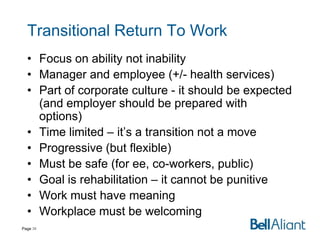
Transitional Return To Work
• Focus on ability not inability
• Manager and employee (+/- health services)
• Part of corporate culture - it should be expected
(and employer should be prepared with
options)
• Time limited – it’s a transition not a move
• Progressive (but flexible)
• Must be safe (for ee, co-workers, public)
• Goal is rehabilitation – it cannot be punitive
• Work must have meaning
• Workplace must be welcoming
Page 38
Bell Aliant is Committed to Early and
Safe RTW (as is the Union!)
• 28.12 It is agreed that the rehabilitation of
sick and injured employees is a priority. The
Company and the Council will participate in
programs that will enable early and safe
return to work…The rehabilitation plan will be
based on the employee’s functional
capability, input from the employee’s existing
health care providers, and other health care
professionals as deemed necessary by the
company.
Page 39
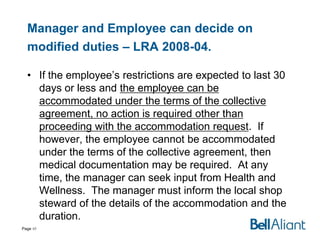
Manager and Employee can decide on
modified duties – LRA 2008-04.
• If the employee’s restrictions are expected to last 30
days or less and the employee can be
accommodated under the terms of the collective
agreement, no action is required other than
proceeding with the accommodation request. If
however, the employee cannot be accommodated
under the terms of the collective agreement, then
medical documentation may be required. At any
time, the manager can seek input from Health and
Wellness. The manager must inform the local shop
steward of the details of the accommodation and the
duration.
Page 40
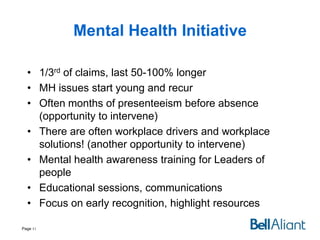
Mental Health Initiative
• 1/3rd of claims, last 50-100% longer
• MH issues start young and recur
• Often months of presenteeism before absence
(opportunity to intervene)
• There are often workplace drivers and workplace
solutions! (another opportunity to intervene)
• Mental health awareness training for Leaders of
people
• Educational sessions, communications
• Focus on early recognition, highlight resources
Page 41
Results of this Approach
•
•
•
•
•
•

Gross Absence Rate* 4.5%>4.3%>4.1%>3.6%>3.6% (2013)
SDB as % salary` 1.36%>1.28%> 1.24% >0.97% >0.99%
Denials < 1% - usually wrong basket
Grievances on denials – rare
Relationship with Union - positive
# of Health Assessments – increased (some referred by
Union)
• # of IMEs for SDB adjudication – rare
• # of IMEs for HA’s and SDB mgmnt - frequent
* Cdn GAR: Company >500 ee =4.4%;Unionized Workplace 5.3% (stats can 2011)
`SDB % of Income Cdn average 1.5% (Towers Watson)
Page 42
Lessons Learned
•
•
•
•
•
•
•
•
•
•

Accept and Assist trumps Deny and Defend
Think Total Cost and think long term
Talk to employees, not doctors
Engage HR/LR/Ops in program development – make them
stakeholders/ambassadors; train mgrs/union
Don’t under estimate cultural resistance
Become health navigators – focus on Chronic Disease
Orient new employees/managers
Address presenteeism- its your next SDB claim, offer help
Performance = Attendance improvement
EE who can, but won’t participate in TRTW, is likely
disengaged and a problem beyond their SDB claim
Page 43
THANK YOU ……….Questions?

Page 44

Disability Management: Accept and Assist

  • 1.
    De-medicalizing Disability Management “Accept andAssist”. Matthew Burnstein, MD, MCFP, MRO Chief Medical Officer – Bell Aliant Feb 13th, 2014 Page 1
  • 2.
    Objectives • Understand TotalCost and the Drivers of Disability • Weakness in the Traditional Approach to Disability Management • Time for a Paradigm Shift? • A New Model • Study the results • Lessons Learned Page 2
  • 3.
    Bell Aliant RegionalCommunications • 7000 union and non union members (>60% unionized) • 6 provinces, widely dispersed • Customer care workers, field technicians, engineers, marketing and sales, finance, support services • TV, internet, home security systems and phones – ever-changing product mix • Former monopoly • <2% staff turnover • In house team of Health and Wellness (H&W) professionals • Self insured for short term disability- up to 1 yr at full salary • Unlimited incidental absence at 100% pay Page 3
  • 4.
    TOTAL COSTS OFDISABILITY DIRECT COSTS STD INCIDENTAL WCB INDIRECT COSTS (INDIRECT COSTS ARE 2.5-3.5 X DIRECT COSTS) Drug/health costs Presenteeismdouble this number! Page 4 Overtime Benefits Morale Increased stress for colleagues Customer Satisfaction Increased workload Lost Sales Opportunities Paperwork / Reporting Training/Retraining Cost to Employee and their Family!
  • 5.
    What’s behind thehigh rates of disability today? We’ve never been healthier, never lived as long, never had such great medical knowledge, yet, as a society, we’ve never been so disabled. Page 5
  • 6.
    How does anindividual end up disabled? An Individual with a complaint becomes a Patient with an illness, who becomes a Claimant with a disability. In most cases, the evolution is driven by the individual, not by the illness or the physician. Page 6
  • 7.
    Does the medicalmodel explain disability? Page 7
  • 8.
    • “The experienceof disability is more related to society’s willingness to accommodate and individual motivation than any underlying impairment or limitation. Our narrow concepts of health and disability limit our potential. • Over the years, I have been impressed by the relative lack of correlation between impairment and disability….Much of disability results from learned experiences, lack of adaptive skills and reinforcements from physicians, family members, attorneys, employers and others. • We can no longer accept this societal illness; the costs are too enormous”. Page 8 Dr Chris Brigham President ABIME Preface the MDAs
  • 9.
  • 10.
    Only a smallfraction of medically excused days off work is medically required – meaning work of any kind is medically contraindicated. The remaining days off work result from a variety of non-medical factors such as administrative delays of treatment and specialty referral, lack of transitional work, ineffective communications, lax management, and logistical problems. These days off are based on non-medical decisions and are either discretionary or clearly unnecessary. Participants in the disability benefits system seem largely unaware that so much disability is not medically required. Absence from work is “excused” and benefits are generally awarded based on a physician’s decision confirming that a medical condition exists. This implies that a diagnosis creates disability. ACOEM Guideline on Preventing Needless Work Disability by Helping People Stay Employed Page 10
  • 11.
  • 12.
    • “Disability isa complicated psychosocial problem that extends beyond the sole question of illness or injury. Many factors contribute to the complexity of the problem. • They include, but are not limited to an individual’s values and beliefs; the role of illness in the individual’s childhood..; the specific symbolic meaning of illness or injury to the individual; the individual’s relationship with his employer; economic issues; workplace accommodations made available by the employer; and the employer’s policies/practices, culture, and values”. Page 12 Dr Presley Reed The Medical Disability Advisor 4th Ed.
  • 13.
    Disability is nota medical concept  Defined by a contract, usually related to occupation  Therefore, it is a legal rather than a medical concept  Influenced by non medical factors : – – – – Page 13 Employer, availability of alternate duties Training, experience, education Psychosocial factors Personality
  • 14.
    Reality check: Doctors aretrained to treat illness, not disability Page 14
  • 15.
    Physician’s Perspective OnDisability Determination • 86% of physicians believe that completing disability forms adversely affects the physician-patient relationship • 62% feel it represents a conflict of interest • 56% are willing to exaggerate clinical data to assist a deserving patient • Physicians report a lack of confidence in their ability to determine disability (self rated ability as 4.5/10) • 80% of physicians feel it would be better for an independent group to determine disability Journal of General Internal Medicine 1996 11(9) Page 15
  • 16.
  • 17.
    Certificate of Disability CanadianMedical Association Policy • The CMA believes it is the employer’s responsibility to supervise an employee who is absent from work for a short time because of a minor illness. The medical profession objects to being asked to police such absenteeism. • The association objects to the use of physicians as “truant officers”. • It is generally accepted that most minor illnesses are self limiting and do not require the intervention of a physician. Page 17
  • 18.
  • 19.
  • 20.
    If illness wasthe cause of absenteeism, then absence rates should be similar across communities. But they are not: Gross Absence Rates Agriculture 1.7% Trade & Commerce 2.3% Finance 3.3% Construction 3.4% Manufacturing 4.8% Government 5.3% (Perspectives 1999) USA 3.5% Sweden 6.0% France 8.3% Italy 11.6% Unionized ees 13.2 days/yr vs Non Unionized ees 7.5 days/yr (Stats Can 2011) Page 20
  • 21.
    What are thereasons we miss work? Global/Environment Organization Personal Region (NS vs AB) Culture Job Climate Type Gender Race Size Age Economy HR policy Schedule Pension Age Relationships Job Satisfaction Social Programs Quality of Supervision Transportation Health Services Sick pay/benefits Family Epidemics Turnover/Churn Personality Religion/Culture Working Conditions Individual Health Health Services Work demands Leadership Physical workspace Page 21
  • 22.
    The primary determinantof work attendance is job satisfaction: Adding Value Being Valued Sharing Values Page 22
  • 23.
    Drivers… • What makespeople come to work? – Opportunity, Desire and Ability – Global / Environment / Organization / Personal variables can affect those • Who decides if working is possible? – Decision to work is made by the individual – The decision to offer alternate duties and provide accommodation is made by employer – Neither is a medical decision Page 23
  • 24.
    Page 24 But bewarethe golden handcuffs
  • 25.
    And you wantemployees to like their work………. Page 25
  • 26.
    Hippocrates: “It is alwaysmore important to know what type of person has a disease than it is to know what type of disease a person has.” Page 26
  • 27.
    Disability vs Disease •Disability and disease are distinct concepts; diagnosis does not determine disability • Doctors don’t know disability and are not truant officers • Disability from work is determined by a multitude of non medical factors • While supporting the concept of early return to work, doctors are patient advocates, and ultimately, patients determine their ability to work • The workplace/workplace policies must encourage employees to remain at work (even in the face of challenges) • Engagement may reduce absenteeism Page 27
  • 28.
    So, if disabilityis not driven by disease, and doctors don’t know much about disability or the workplace, what do we do? How do we determine or manage disability? Page 28
  • 29.
    The first paradigmshift Stop talking to doctors and start talking to employees. Page 29
  • 30.
    Talk to employees •Doctors talk to their patients - they trust them and advocate for them, but they don’t know the workplace • Trust your employees – they are telling you the truth* • Treat them as you’d treat a manager or a colleague or want to be treated yourself • They know their job and what aspects they can do and can’t do • Allow them flexibility to do the job • It is their motivation which determines outcome – so what is motivating them to come to work or keep them off? * Most of the time. Why treat the 99% who are honest to catch the 1%? Page 30
  • 31.
    What’s going on? Whatyou see WORKPLACE SYMPTOMS ARE ONLY THE Troubled or Absent Employee “TIP OF THE ICEBERG” Lateness Withdrawal Mood Swings Spillover Emotional outbursts Spillover What you don’t see Life Issues • Stress/Emotional • Relationships • Legal/ Financial • Addictions Work Issues • Environmental • Interpersonal • Job-Related KNOWING THE SOURCE OF THE PROBLEM ALLOWS THE CASE MANAGER TO DETERMINE A Page 31 COURSE OF ACTION Health Issues • Heart Health • Nutrition • Sleeping • Depression
  • 32.
    The Second ParadigmShift • Accept them and help them • You cannot rehabilitate someone who is busy proving they are disabled • Malingerer’s are rare. Anxious and overwhelmed individuals are common. • Often the claimant is just in the wrong basket – needs family leave, needs to change jobs, needs to be on administrative leave or re-assigned while workplace conflict is addressed • Chronic diseases are chronic/recurrent and need to be addressed holistically (is public health up to the task?) • Whatever the barrier or reason for being off work, the outcome is better, and total cost reduced, if you support the employee and work through the issues Page 32
  • 33.
    The Third ParadigmShift: think long term • Employees are there for the long term, so you need to think long-term • An injured/ill employee who could be at work, but chooses not to rtw, generates a greater loss to the organization over the long term than the “extra” few weeks of sick leave. They are disengaged. • Presenteeism costs more than absenteeism • Forcing an employee to rtw when they feel they are “unfit” will cost the employer money every day Page 33
  • 34.
    Tools to Assistthe Shift: Health Assessment A complement to, not a replacement for, a discussion between manager and employee. Health Assessment Type When to use Health Status •Proactive •Accommodation Issues Attendance •Medical issues impacting attendance •Level 3-Attendance Support Ergonomic •Persistent Ergonomic Issues Return to Work •Assess fitness to return to work from LTD, Administrative Leaves, etc. (used infrequently) Page 34
  • 35.
    Train Managers toIdentify Employees at Risk • How to help employees stay at work – Identify employees who is having difficulties, as early as possible. • Absence is a predictable event – How to predict absences? • Know the workplace / know the people and know when action is necessary Page 35
  • 36.
    Tools to AssistShift: Attendance/Performance Improvement Program • Triggered when there is a demonstrated history of being over the average for the department for absence or not meeting performance targets • Absence is absence –– it’s not why you missed work, it’s that you missed work (assumed innocent). • The reasons for the absences/poor performance determine the help needed. • Early identification is key. • No fault, no blame but the absences/performance is an issue –What can you do? What can we do? • Non-disciplinary Page 36 36
  • 37.
  • 38.
    Transitional Return ToWork • Focus on ability not inability • Manager and employee (+/- health services) • Part of corporate culture - it should be expected (and employer should be prepared with options) • Time limited – it’s a transition not a move • Progressive (but flexible) • Must be safe (for ee, co-workers, public) • Goal is rehabilitation – it cannot be punitive • Work must have meaning • Workplace must be welcoming Page 38
  • 39.
    Bell Aliant isCommitted to Early and Safe RTW (as is the Union!) • 28.12 It is agreed that the rehabilitation of sick and injured employees is a priority. The Company and the Council will participate in programs that will enable early and safe return to work…The rehabilitation plan will be based on the employee’s functional capability, input from the employee’s existing health care providers, and other health care professionals as deemed necessary by the company. Page 39
  • 40.
    Manager and Employeecan decide on modified duties – LRA 2008-04. • If the employee’s restrictions are expected to last 30 days or less and the employee can be accommodated under the terms of the collective agreement, no action is required other than proceeding with the accommodation request. If however, the employee cannot be accommodated under the terms of the collective agreement, then medical documentation may be required. At any time, the manager can seek input from Health and Wellness. The manager must inform the local shop steward of the details of the accommodation and the duration. Page 40
  • 41.
    Mental Health Initiative •1/3rd of claims, last 50-100% longer • MH issues start young and recur • Often months of presenteeism before absence (opportunity to intervene) • There are often workplace drivers and workplace solutions! (another opportunity to intervene) • Mental health awareness training for Leaders of people • Educational sessions, communications • Focus on early recognition, highlight resources Page 41
  • 42.
    Results of thisApproach • • • • • • Gross Absence Rate* 4.5%>4.3%>4.1%>3.6%>3.6% (2013) SDB as % salary` 1.36%>1.28%> 1.24% >0.97% >0.99% Denials < 1% - usually wrong basket Grievances on denials – rare Relationship with Union - positive # of Health Assessments – increased (some referred by Union) • # of IMEs for SDB adjudication – rare • # of IMEs for HA’s and SDB mgmnt - frequent * Cdn GAR: Company >500 ee =4.4%;Unionized Workplace 5.3% (stats can 2011) `SDB % of Income Cdn average 1.5% (Towers Watson) Page 42
  • 43.
    Lessons Learned • • • • • • • • • • Accept andAssist trumps Deny and Defend Think Total Cost and think long term Talk to employees, not doctors Engage HR/LR/Ops in program development – make them stakeholders/ambassadors; train mgrs/union Don’t under estimate cultural resistance Become health navigators – focus on Chronic Disease Orient new employees/managers Address presenteeism- its your next SDB claim, offer help Performance = Attendance improvement EE who can, but won’t participate in TRTW, is likely disengaged and a problem beyond their SDB claim Page 43
  • 44.

Editor's Notes

  • #2 g.day. The last lecture. I hate being the last lecturer. People are tired, many haven’t sat in a classroom for 30 years. Ready to go home, unless there’s an after conference open bar. Some people have to catch rides and leave half way through – which as a lecturer – you never know if its because your presentation is lousy or simply a reflection of a child needing to be picked up at daycare. So , and I’ve never done this before, if you know you’re going to leave, I must ask you to move to the back now – that way I won’t be disturbed nor will you disturb other attendees. Now, of course if people start leaving from the front, I know I’m in trouble. If you stay, I think it will be worthwhile.
  • #4 A little bit about BA,where we adopted this approach about 5 years ago.. While thought of as an Atlantic Canadian Company, we’re a major player in the ON and QC market. Muskoka, Mount Tremblant. Wherever there is a phone, there’s a BA ee within 100km. We’re not in the big metropolises, we’re in small towns. Our programs need to address the often virtual reality of our workforce. Tough, for a number of reasons, BA does not support telework. A decade ago we were operators placing long distance calls, now we’re remotely setting up internets. Generous benefits.
  • #5 Everyone focuses on direct costs, but you don’t wake up one day too depressed to work! direct cost are only a small piece of total cost! As an employer, we need to look at TOTAL COST. No good closing an sdb or wcb claim if the ee does not rtw productive!
  • #6 Some questions to ponder.
  • #7 How does one become disabled? Who decides to go see the doctor, who decides that they are too ill to work?
  • #9 This is the President of ABIME. Writing in the MEDICAL disability asdvisor.
  • #12 Not just for MUDS, but headache, URIs, IHD…the decision on work is made by pt!
  • #14 Not a medica
  • #21 And if you don’t believe me, believe stats canada – because statistics can’t lie!Being in a Union doesn’t make you ill!
  • #22 Lets stop focusing on the factor in red, and start looking at the others!
  • #35 Opportunity to address issues affecting performance/attendance; ideally before there is a problem.
  • #42 Start young and recur – employees for life.Unlike MIs or Gallbladder – sudden show up, get treated and move on; spiral in/out over months or year. Opportunity for early recognition and enhanced treatment.