Dancing on the Stage of a
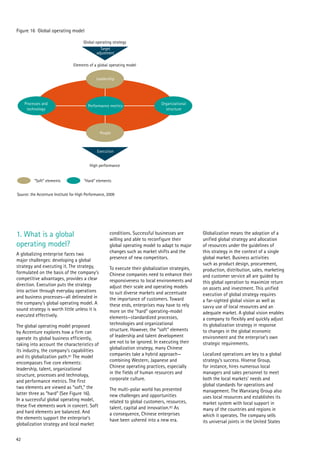
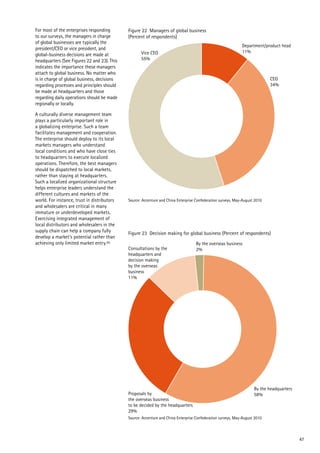
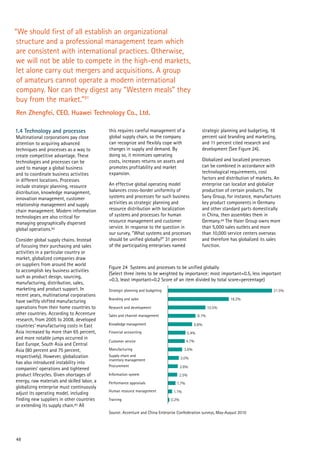
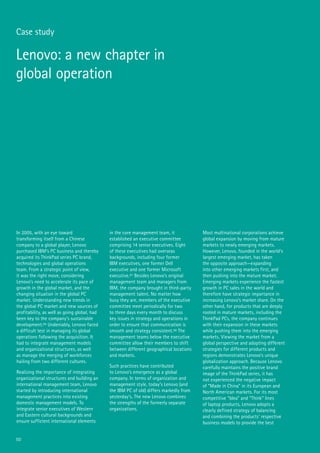
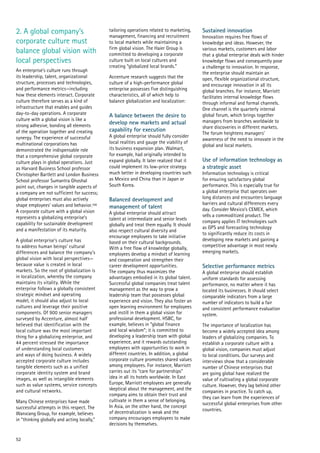
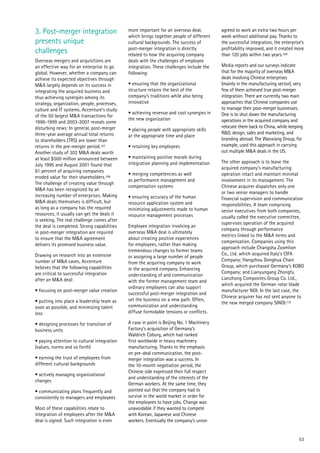
Multi-Polar World:
The Path to Globalization for
Chinese Enterprises
2
Table of Contents
I. Globalization: the necessary choice	 4
1.	 Through reform and opening up, China has integrated itself into the global economy	 5
2.	 The rise of a multi-polar world and emerging market multinationals (EMMs) creates
	 globalization opportunities for China	 5
3.	 To develop further, Chinese enterprises must globalize	 5
4.	 Globalization catalyzes new ways of competing	 7
II. A closer look at globalization	 8
1.	 What is globalization?	 9
2.	 How do enterprises globalize?	 9
III. Globalization of Chinese enterprises: an overview	 12
IV. Globalization: strategic choice	 23
1.	 Why should our company go global?	 24
2.	 What businesses do we want to compete in?	 26
3.	 Where should we locate our global businesses?	 30
4.	 What means of investment will we use?	 33
5.	 Different industries require different strategic choices	 37
V. Global operating models	 41
1.	 What is a global operating model?	 42
2.	 A global company’s corporate culture must balance global vision with local perspectives	 52
3.	 Post-merger integration presents unique challenges	 53
4.	 A successful global operating model has several hallmarks	 54
VI. Challenges facing globalizing Chinese enterprises	 56
1.	 The multi-polar world has presented new difficulties	 57
2.	 Chinese companies are taking steps to address the challenges	 58
VII. Conclusion	 62
VIII. Appendixes	 63
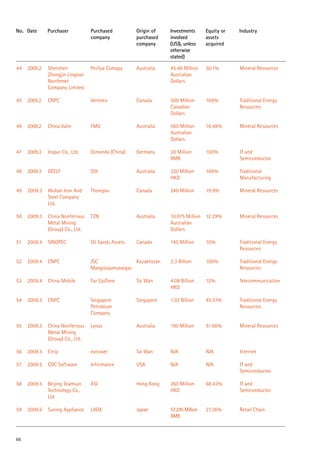
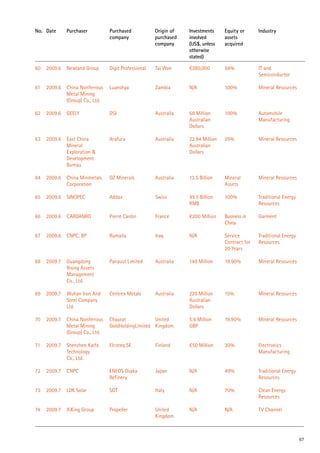
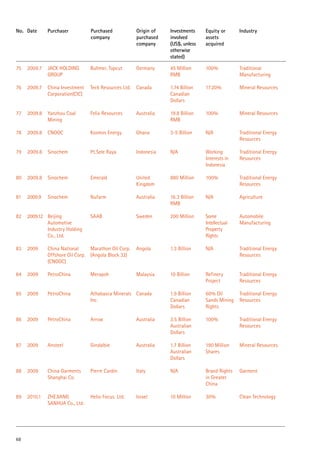
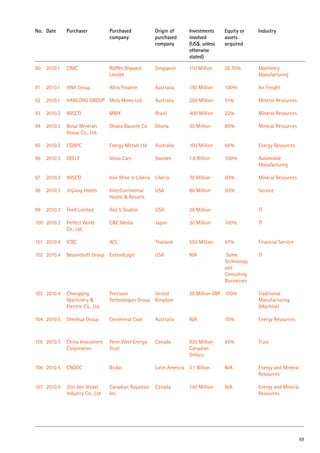
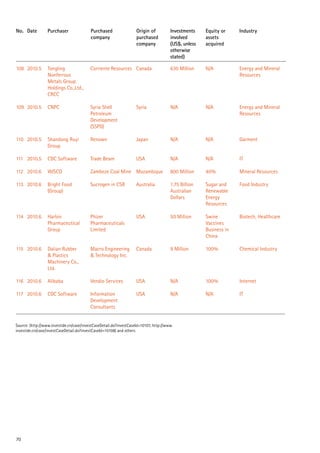
Appendix 1: Overseas M&As by Chinese enterprises, January 1, 2008-June 30, 2010	 63
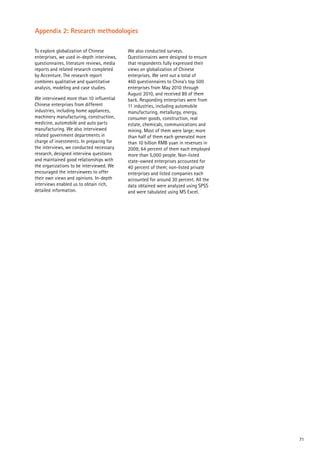
Appendix 2: Research methodologies	 71
3
an export orientation and efforts to
optimize the organization’s value chain;
the advanced stage is distinguished by
true realization of global operations
that is not bound by national borders
in designing strategies and carrying
out business activities. Few Chinese
enterprises have reached the advanced
stage of global operations.
• Chinese enterprises embarked on the
road to globalization in the early days
of reform and opening up. Since the
financial crisis struck, they have forged
ahead more vigorously.
• An enterprise seeking to “go global”
must craft strategic plans detailing what
businesses to be in, where to compete on
the global stage, and how to invest in the
overseas market. To make such decisions,
business leaders need to consider, among
other things, the goals they want to
achieve through globalization and the
characteristics of their industry.
• To ensure the success of their
globalization drive, companies must build
a global operating model that aligns with
the local environments in which they are
doing business. This means constructing
a model that has the right leadership
capabilities, organizational structures,
talent management practices, processes,
technologies and performance metrics.
• As newcomers to globalization, Chinese
enterprises face a raft of challenges.
While they are moving ahead with
confidence, they must also devote
sufficient attention to developing a
leadership team with a global vision,
recruiting the right talent through the
right means, accommodating local
business environments and establishing
a global ecosystem of local partners and
fellow Chinese companies going global.
Chinese enterprises have already set sail
on their globalization voyage. Nothing
can stop them. However, the voyage
will prove long, arduous and stormy.
It is our sincere hope that they will
remain undaunted despite the inevitable
setbacks. If in the not-so-distant
future, people who are talking about
globalization associates it with a string
of names of Chinese companies, then we
can safely say that China has successfully
navigated the journey. We will continue
to closely follow the efforts of Chinese
businesses as they pursue globalization
and will do our utmost to help new global
leaders emerge.
Foreword
Gong Li	
Chairman, Accenture
Greater China
Li Decheng	
Executive Vice President and
Director-General, China
Enterprise Confederation
In the aftermath of the worldwide
financial crisis, Chinese enterprises
are grappling with questions about
globalization: Should they pursue it?
And if so, how? The answers to these
questions will have a great bearing on
these companies’ strategic directions and
growth tactics in the post-crisis era, as
well as on their standing in the global
economic system. The answers seem
apparent. The world has witnessed a series
of stunning acts by Chinese companies
toward globalization since the downturn
struck. These firms have initiated and led
wave upon wave of overseas investment
and have participated in a storm of
high-profile merger-and-acquisition
(M&A) deals. While Western markets
remain troubled by the “new normal” of
sluggish growth and depressed consumer
demand, Chinese enterprises have shown
remarkable vitality. They are making
big strides beyond China’s borders and
constitute a gathering force on the global
economic stage.
These developments have prompted
Accenture and the China Enterprise
Confederation to join efforts to study
the phenomenon. For the past three
years, Accenture has analyzed how high
performance Chinese businesses have
achieved profitable growth, narrowed
the gap between themselves and their
world-class peers, coped with the short-
term impact of the global financial crisis
with a vision for long-term growth and
pioneered their future beyond the recession.
For the past eight consecutive years,
the China Enterprise Confederation has
published its annual list of China’s
top 500 enterprises, followed by
research reports, in a bid to help
Chinese businesses enhance their
performance. The current research
undertaken by the two organizations,
reflected in this report, builds on their
respective previous studies. In a global
economy characterized by increasing
interdependence, pursuing cross-border
operations has become an indispensible
component of companies’ efforts to
achieve high performance. The stronger
and bigger an enterprise becomes, the
more it must seek new space for growth
beyond its traditional familiar competition
base. We hope that this report will go
a long way toward assisting Chinese
enterprises in this effort.
Our research has yielded the following
principal findings:
• Globalization is the necessary choice
for Chinese enterprises today. Businesses
in China are embracing the globalization
trend to spur their own development and
evolution, to support China’s integration
into the global economy as a result
of reform, to reinforce China’s rising
economic power and to transform their
business models.
• Through globalization, an enterprise
gradually becomes dependent on overseas
markets and continuously augments its
capabilities to better manage globalized
production, distribution, resources
allocation and operations management.
A globalized enterprise does not yoke
itself to the local market. Instead, it uses
the global market as its only reference in
shaping its strategies, operating decisions
and corporate culture.
• Globalization is marked by an initial
stage in which a company has some
interaction with the global market; the
intermediate stage is characterized by
4
I. Globalization:
the necessary choice
5
1. Through reform and
opening up, China has
integrated itself into the
global economy
Since the initiation of reform and
opening up in the late 1970s, China
has achieved sustained, rapid economic
growth. From 1978 through 2009,
its annual GDP growth averaged 9.8
percent, the highest in the world for that
period of time.1 Over the past 30 years,
China has evolved from a centralized
economy with widespread shortages
of suppliers of goods and services, and
the ever-present danger of collapse
to a vibrant economic world power. In
doing so, the country has stepped out
of self-imposed seclusion to integrate
itself into the global economic system.
This achievement has stemmed not only
from the opportunities presented by
economic globalization but also from the
country’s relentless efforts to develop a
market economy, follow market rules and
participate in the international division
of labor.
Today, China is the world’s second
largest economy, as measured by
GDP and imports and exports. With
its increasingly significant role in the
global economy, it will need to adopt a
broader vision and seek new space for
its development. At the same time, it will
have to shoulder more responsibilities
in global economic affairs and
reassess its position in the worldwide
economic system. Only by doing so
can it successfully address the array of
challenges it will encounter in the post-
crisis era.
To go global on a grander scale is
the next logical step for China. But
globalization must be supported and
sustained by both soft power, such
as culture, value, talent, corporate
governance, social responsibility, and
respect to intellectual property rights,
and hard power, such as technology,
equipment, capital, and resources.
Therefore, the country’s economic
strength will be put to a severe test. The
world’s major economies are still reeling
from the impact of the financial crisis,
and the global economic balance of
power has shifted. At this unique point
in history, the Chinese economy, with its
sustained, stable growth, has the rare
opportunity to accelerate its pursuit of
globalization.
2. The rise of a multi-
polar world and
emerging market
multinationals (EMMs)
creates globalization
opportunities for China
Over the past decade, globalization
has entered a new phase marked
by the appearance of emerging
economies including China. Following
the footprint of the four Asia tigers
(Hong Kong, Singapore, South Korea
and Taiwan), Brazil, Russia, India and
China (BRIC) now stand as the world’s
emerging market powerhouses.2 This
development has transformed the
global political, economic and social
landscapes—creating a multi-polar
world. A distinguishing characteristic
of the multi-polar world is the
spreading of economic power from
the traditional centers of developed
countries to the developing countries.
The traditional economic structure, led
by the advanced Western market, was
characterized by one-directional flows
of economic power from the advanced
markets to the developing markets.
This is giving way to a structure
characterized by many centers of
economic power, multiple directions
of capital, talent and technology flows
and interdependency among all the
players. This new configuration has
made further globalization of emerging
markets possible and has provided them
with rare opportunities for further
development. Today, the extent to which
an economy is globalized determines its
status in the world.
A country integrates, by necessity,
into the global economic system when
its economic development reaches a
level that national boundaries become
constraint to further growth. Similarly,
competition dictates that an enterprise
must goes global when it achieves a
certain scale. Only by competing on the
global stage can it continue to produce
the innovative products, services,
processes and technologies on which its
future depends.
The tidal wave of globalization has
spawned a host of emerging market
multinationals (EMMs). In the past, most
people associated the word multinational
with Western consumer-product giants
such as the Coca-Cola Company, Exxon
Mobil and GE, and later with developed-
world high-tech leaders including
Microsoft, Intel and Nokia. Seemingly
overnight, multinational now also
includes the Tata Group of India, Vale of
Brazil, Samsung of Korea, PetroChina,
Huawei, Lenovo and Baosteel of China.
According to a joint study by Columbia
University and Fudan University,3
by the end of 2007, the combined
overseas assets of China’s 18 topmost
transnational corporations had reached
US$105.7 billion, or 15.4 percent of these
companies’ aggregate assets. The rise
of EMMs in a multi-polar environment
has captured worldwide attention. Born
out of globalization, EMMs are now
powerfully adding to its momentum.
3. To develop further,
Chinese enterprises must
globalize
In the so-called post-crisis “new normal,”
shrinking consumer spending and
slowing economic growth have triggered
much discussion among economic
experts, scholars and business leaders
in the West. Since China has protected
itself from the worst of the crisis, it
has managed to sustain high levels of
growth and avoid the brunt of “new
normal” hardships. Nonetheless, the
crisis has prompted China to reflect on
its economic development models. From
a macroeconomic point of view, national
leaders know that China cannot continue
driving economic growth primarily
through investment, exports and huge
consumption of resources. This approach
simply is not sustainable. The nation
must move to a more balanced growth
model—one comprising investment,
exporting and domestic consumption
that uses resources efficiently.
Businesses, for their part, can no longer
rely on extensive manufacturing that
hinges on low costs. They will need to
put more emphasis on innovation and
move up the value chain. The worldwide
recession may have dealt a moderate
blow to Chinese business operations.
However, it has transformed the way
people in China think about business.
As the global economy recovers, Chinese
enterprises will need to ponder two sets
of fundamental questions:
• Will the financial crisis lead to a
deceleration of globalization? Will
the problems inherent in developed
economies and enterprises that made
them vulnerable to the crisis mean
the demise of Western management
thinking? Or is such thinking still
instructive to Chinese enterprises?
6
• Do Chinese businesses need to change
their business and operating models?
Should they reinvent themselves by
adopting new strategic perspectives?
The answer to the first set of questions
should be self-evident. Although the
financial crisis laid bare the serious
flaws inherent in developed economies,
the claim that Western management
philosophies and experiences are no
longer valid or instructive is untenable.
Rather, the lessons Western enterprises
have gleaned from the global downturn
can help all businesses guard against
another worldwide recession. Still,
Chinese business leaders will face a
daunting challenge in using such lessons
to restructure, transform and improve
managerial skills to establish highly
competitive modern corporations.
The answer to the second set of
questions is a decided yes. The global
financial crisis turned the global
economic landscape and operating
environment upside down. Accordingly,
all countries must reconfigure their
macroeconomic structures, and
businesses should rethink their growth
models. Pre-crisis business models may
not necessarily be valid in the new
global competitive environment. It is
imperative that enterprises seek new
ways to fuel growth through reform and
transformation. Integrating themselves
into the global economic system and
competing on a larger stage will be
vital steps for Chinese enterprises.
The previous 30 years of reform has
produced a roster of competitive
enterprises; these same businesses will
likely take center stage in the global
economy in the next 30 years, and will
powerfully shape global business rules.
As a necessary and sound strategic
choice, globalization is gaining
acceptance by an increasing number
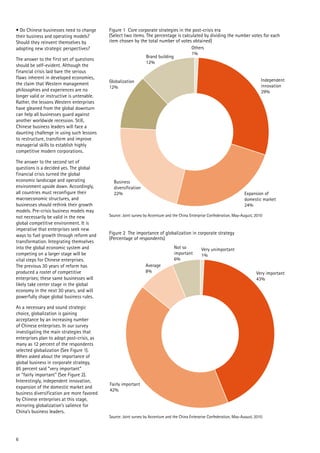
of Chinese enterprises. In our survey
investigating the main strategies that
enterprises plan to adopt post-crisis, as
many as 12 percent of the respondents
selected globalization (See Figure 1).
When asked about the importance of
global business in corporate strategy,
85 percent said “very important”
or “fairly important” (See Figure 2).
Interestingly, independent innovation,
expansion of the domestic market and
business diversification are more favored
by Chinese enterprises at this stage,
mirroring globalization’s salience for
China’s business leaders.
Figure 2 The importance of globalization in corporate strategy
(Percentage of respondents)
Very unimportant
1%
Not so
important
6%
Source: Joint survey by Accenture and the China Enterprise Confederation, May-August, 2010
Very important
43%
Average
8%
Fairly important
42%
Figure 1 Core corporate strategies in the post-crisis era
(Select two items. The percentage is calculated by dividing the number votes for each
item chosen by the total number of votes obtained)
Others
1%
Brand building
12%
Expansion of
domestic market
24%
Independent
innovation
29%
Source: Joint survey by Accenture and the China Enterprise Confederation, May-August, 2010
Globalization
12%
Business
diversification
22%
7
4. Globalization catalyzes
new ways of competing
Economic globalization emerged first in
the early 1970s. Since the dawn of the
new century, it has entered a new and
more complex phase characterized by
the rise of a multi-polar world. In this
environment, companies face significant
challenges in the struggle for talent,
capital, customers, resources and
innovation. And the rules of the game
have changed accordingly:
• Talent: The war for talent is no
longer confined within national
borders, and competition for innovative
employees with strong technical skills is
intensifying.
• Capital: The flow of capital is no longer
unilateral. Developing countries are
simultaneously recipients and exporters
of capital.
• Customers: New consumer groups are
developing rapidly in emerging markets.
Their demands for products and services
vary; businesses must think hard about
how best to meet those demands and
capture these consumers’ loyalty.
• Resources: Competition for resources
will be fiercer than ever. It will center not
only on control of resources, but also on
their sustainable use.
• Innovation: Developed countries no
longer have a monopoly on the creation
of new technologies, products, services
and even managerial expertise. Today,
emerging markets and businesses
are contributing their fair share of
innovations in these areas.
Any business, be it in a mature market
or emerging market, must grasp the
dynamics of competition to achieve
high performance and attain growth
in today’s increasingly complex global
environment. In the multi-polar world,
economies are becoming increasingly
interdependent and connected. To
maintain a sharp competitive edge,
companies must adopt a global mindset
and operations.4
Accenture and the China Enterprise
Confederation have jointly undertaken
the research presented in this report
as part of the effort to illuminate the
globalization process experienced
by Chinese enterprises, explore the
formulation and implementation of
global strategies and operating models,
and summarize lessons learned from
globalization. Our hope is that this
work will support the efforts of Chinese
enterprises seeking to become global
companies. Drawing on extensive
surveys of Chinese companies, face-to-
face interviews with senior executives,
previous research and Accenture’s
methodologies in the areas of global
operating model, this report aims to
answer the following questions:
1. Why should Chinese enterprises pursue
globalization?
2. What is globalization, and how should
it be measured?
3. What is the current status of
globalization among Chinese businesses?
4. How can Chinese business leaders
make strategic choices to support their
pursuit of globalization?
5. How might Chinese companies build
and implement effective global operating
models?
6. What challenges does globalization
present, and how can Chinese companies
best address those challenges?
8
II. A closer look at
globalization
9
The global economic landscape
underwent tremendous changes after
the Second World War, as many Western
multinational corporations became
active in non-Western economies. The
1960s and 1970s saw the largest scale
of post-war transformation in the global
economic structure. Numerous labor-
intensive manufacturing industries
from the developed countries, armed
with capital and technologies, sought
to gain a foothold in the Third World
countries. Under the new paradigm of
global division of labor, export-oriented
economies such as the Four Asian
Tigers (Hong Kong, Singapore, South
Korea and Taiwan) were created. The
concept of globalization emerged in the
1980s and has stimulated discussion
among politicians, economists and
management researchers ever since.
Another epochal event in the 20th-
century world economy was the adoption
of reform and opening-up program in
China. This program brought the most
populous country on earth into the
global division of labor, further fueling
globalization’s momentum. The pace of
globalization accelerated in the 1990s
thanks to advances in information and
communication technologies, particularly
the rise of the Internet.
Globalization has changed dramatically
since the outbreak of the 2008 global
financial crisis, which resulted in the
rise of multiple centers of economic
power and activity. In this new multi-
polar world, the flows of products,
services and capital are no longer one
directional but rather bi-directional or
multi-directional. Economies have grown
increasingly interdependent. Developed
countries no longer have a monopoly on
the export of capital and technologies.
And EMMs are striding onto the global
economic stage.
1. What is globalization?
The term globalization has inspired a
number of definitions and interpretations
by international organizations,
researchers and the business world.
Consider these examples:
• According to the IMF’s World Economic
Outlook 1997, “Globalization refers to
the growing economic interdependence
of countries worldwide through the
increasing volume and variety of cross-
border transactions in goods and services
and of international capital flows,
and also through the more rapid and
widespread diffusion of technology.”5
This definition accentuates economic
interdependence and the role played by
technology in the globalization process.
• According to the United Nations
Conference on Trade and Development
(UNCTAD), globalization occurs when
producers’ and investors’ activities are
increasingly internationalized, and when
the world economy consists of a single
market and production zone, rather than
being linked by trade and investment
flows among different economies. Regions
and countries are only sub-units of the
world economy.6 This definition further
expands the meaning of globalization,
emphasizing the integration of the global
economy. It stresses the merging of
economies into one entity, rather than
the exchanges and interdependencies
between economies.
• Similarly, the Organization for Economic
Co-operation and Development (OECD)
interprets globalization as a process
in which markets, technologies and
communications function in ways marked
increasingly by “globality,” whereby
national and regional characteristics
become less and less distinct.7
• Alan Rugman, former president of
the Academy of International Business,
defines globalization as activities of
transnational corporations in conducting
cross-border foreign direct investment
and establishing commercial networks,
thereby creating value.8
• The Economics Institute of the Chinese
Academy of Social Sciences defines
globalization in its Dictionary of Modern
Economics as “the trend of global
free flows of goods, labor, capital and
information.”9
2. How do enterprises
globalize?
While a universally agreed definition of
globalization does not exist, each of the
above definitions captures the essence
and implications of the concept from a
unique angle. However, these definitions
take a macroeconomic approach to
globalization, giving scant attention
to organizations’ micro-level strategic
and operational activities. Our current
research centers on how globalization
has influenced companies’ strategies and
operations and how enterprises should
cope with the challenges created by
globalization to become global players.
Therefore, we examine globalization from
a micro-level perspective; that is, in the
context of enterprises.
First, globalization has geographical
implications for enterprises: Globalized
businesses rely to some extent on
overseas markets for their products
and services, raw materials sources,
technologies and operations.
Second, globalization is a process, not an
event. An organization enters the global
market progressively through several
stages, each of which exhibits unique
characteristics of globalization.
Initial stage
In the initial stage, some of an
enterprise’s raw materials, technologies,
equipment and personnel originate
from other countries. The company’s
Globalization is a process in which an enterprise
increasingly relies on overseas markets for its business,
and acquires and enhances its capabilities in global
production, distribution, resource allocation and
managerial expertise. A globalized enterprise does not
limit itself to the local market in its ways of thinking,
formulation of strategies, decision making and corporate
culture. Rather, it uses the global market as the sole
context for all of these matters.
10
products are sold on the global market
directly or indirectly, and as finished
or semi-finished goods. However, the
organization’s operations are firmly
rooted domestically, and its global
business accounts for only a modest
proportion of its total business.
Intermediate stage
In the intermediate stage, globalization
presents two models and emphases:
• Export orientation. The enterprise
manufactures products to be sold in
overseas markets using local cheap
labor and land resources. Over the
past decade, a large number of labor-
intensive and export-oriented original
equipment manufacturers (OEMs) and
original design manufacturers (ODMs)
have sprung up in China’s Pearl River
Delta and Yangtze River Delta areas,
transforming the country from a manual
workshop to the world’s factory. These
enterprises have strong manufacturing
and factory-management capabilities.
They rely on low-cost labor and achieve
low profit margins. Few of them have
their own brands or sales channels in the
domestic market or abroad. They derive
most or all of their income from exports.
• Value-chain optimization. The
enterprise capitalizes on globalization
to move up and expand the value
chain. It strives to improve its position
in the value chain and achieve better
performance through a variety of means,
including acquisition of technologies,
recruiting of talent, market expansion,
enhancing of brands and acquisition of
resources. For example, many Chinese
enterprises set their sights on the
European and US markets to improve their
competitiveness in areas such as research
and development, product design,
technologies, marketing and branding.
Other Chinese enterprises are eager to
establish their presence in the Middle
East, Africa and Latin America to tap
these regions’ abundant local resources.
Globalized operations stage
In the globalized operations stage, the
enterprise becomes truly globalized
in terms of its resource distribution,
industrial value chain, strategies,
operations and culture. Its national origin
ceases to be important. At this stage,
the enterprise is no longer satisfied with
global connectedness but devotes itself
to global orchestration. That is, the
organization not only makes itself present
in various places of the world, but the
global presence enables it to structure
and operate in a more efficient and
coherent way to take advantage of the
large global market.10 More important, it
transcends national borders in its ways of
thinking, decision-making processes and
corporate culture. Nevertheless, achieving
truly globalized operations is an arduous,
protracted process, requiring painstaking
efforts to build capabilities in business
architecture and operation proficiency. In
fact, only a sprinkling of enterprises has
reached this lofty stage, including the
Coca–Cola Company, PepsiCo, Toyota and
Exxon Mobil.
Taking geographic footprint and the
above-described stages into account, we
propose the following working definition
of globalization:
Globalization is a process in which an
enterprise increasingly relies on overseas
markets for its business, and acquires
and enhances its capabilities in global
production, distribution, resource
allocation and managerial expertise.
A globalized enterprise does not limit
itself to the local market in its ways
of thinking, formulation of strategies,
decision making and corporate culture.
Rather, it uses the global market as the
sole context for all of these matters.
11
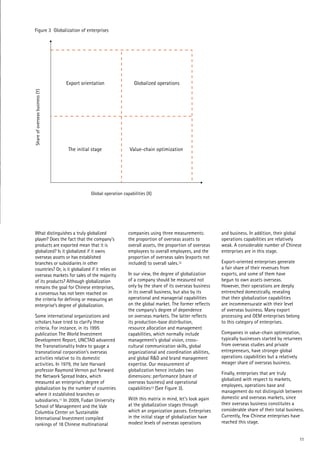
Figure 3 Globalization of enterprises
Global operation capabilities (X)
Export orientation
The initial stage Value-chain optimization
Globalized operations
Shareofoverseasbusiness(Y)
What distinguishes a truly globalized
player? Does the fact that the company’s
products are exported mean that it is
globalized? Is it globalized if it owns
overseas assets or has established
branches or subsidiaries in other
countries? Or, is it globalized if it relies on
overseas markets for sales of the majority
of its products? Although globalization
remains the goal for Chinese enterprises,
a consensus has not been reached on
the criteria for defining or measuring an
enterprise’s degree of globalization.
Some international organizations and
scholars have tried to clarify these
criteria. For instance, in its 1995
publication The World Investment
Development Report, UNCTAD advanced
the Transnationality Index to gauge a
transnational corporation’s overseas
activities relative to its domestic
activities. In 1979, the late Harvard
professor Raymond Vernon put forward
the Network Spread Index, which
measured an enterprise’s degree of
globalization by the number of countries
where it established branches or
subsidiaries.11 In 2009, Fudan University
School of Management and the Vale
Columbia Center on Sustainable
International Investment compiled
rankings of 18 Chinese multinational
companies using three measurements:
the proportion of overseas assets to
overall assets, the proportion of overseas
employees to overall employees, and the
proportion of overseas sales (exports not
included) to overall sales.12
In our view, the degree of globalization
of a company should be measured not
only by the share of its overseas business
in its overall business, but also by its
operational and managerial capabilities
on the global market. The former reflects
the company’s degree of dependence
on overseas markets. The latter reflects
its production-base distribution,
resource allocation and management
capabilities, which normally include
management’s global vision, cross-
cultural communication skills, global
organizational and coordination abilities,
and global R&D and brand management
expertise. Our measurement of
globalization hence includes two
dimensions: performance (share of
overseas business) and operational
capabilities13 (See Figure 3).
With this matrix in mind, let’s look again
at the globalization stages through
which an organization passes. Enterprises
in the initial stage of globalization have
modest levels of overseas operations
and business. In addition, their global
operations capabilities are relatively
weak. A considerable number of Chinese
enterprises are in this stage.
Export-oriented enterprises generate
a fair share of their revenues from
exports, and some of them have
begun to own assets overseas.
However, their operations are deeply
entrenched domestically, revealing
that their globalization capabilities
are incommensurate with their level
of overseas business. Many export
processing and OEM enterprises belong
to this category of enterprises.
Companies in value-chain optimization,
typically businesses started by returnees
from overseas studies and private
entrepreneurs, have stronger global
operations capabilities but a relatively
meager share of overseas business.
Finally, enterprises that are truly
globalized with respect to markets,
employees, operations base and
management do not distinguish between
domestic and overseas markets, since
their overseas business constitutes a
considerable share of their total business.
Currently, few Chinese enterprises have
reached this stage.
12
III. Globalization of
Chinese enterprises:
an overview
13
Figure 4 China’s outbound FDI
China’s outbound FDI (100 million US dollars)
Source: Statistical Bulletin of China's Outbound Foreign Direct Investment 2009, Ministry of Commerce of the PRC
0
100
2000
9.16
68.85
25.18 28.55
54.98
122.61
211.60 224.69
521.50
720.51
2001 2002 2003 2004 2005 2006 2007 2008 2009
200
300
400
500
600
700
800
We can trace the beginnings of Chinese
enterprise’s globalization process back
to 1978, when the country launched
its reform and opening-up program.
The period from that year through the
1980s constitutes the initial stage of
globalization. Chinese firms began to
participate in the international division
of labor through exporting their products
and establishing joint-venture businesses
with foreign companies, which were
entering China in increasing numbers.
At the same time, certain forward-
looking Chinese companies attempted
transnational operations. For instance, in
November 1979, the Beijing Friendship
Store established Kyowa Co., Ltd. in
Tokyo through a joint investment with
Japan’s Maruichi Shoji, Inc.—marking
the onset of overseas investments
by Chinese enterprises.14 Economic
globalization and regional economic
integration gathered momentum starting
in the mid-1980s. According to UNCTAD
statistics, Chinese investors’ foreign
direct investments (FDI) surpassed the
US$100 million threshold for the first
time in 1984 and averaged $670 million
annually for the next five years. However,
only a scattering of Chinese enterprises
were seeking to go beyond their nation’s
borders. Moreover, their awareness and
scale of globalization were modest.
In the 1990s, as the wave of
globalization engulfed the world, Chinese
enterprises entered the second stage of
globalization. In 1992, China defined a
goal of establishing a socialist market
economy, ushering in a golden age for
Chinese enterprises. In the mid-1990s,
the country announced its “going
out” strategy15 and launched a series
of policies and measures designed to
encourage Chinese enterprises to expand
into overseas markets. Soon a large
number of enterprises sprang up. At the
same time, China’s overseas investments
increased. UNCTAD data indicate
that China’s outward FDI reached the
US$1 billion mark in 1992 and, despite
downturns after the 1992 and 1993
peaks, averaged $2.3 billion annually for
the entire decade.16
Since the year 2000 and especially since
the outbreak of the worldwide financial
crisis in 2008, Chinese companies have
accelerated their globalization efforts.
This third stage of globalization has
been driven by the rising trend toward
globalization worldwide as well as
favorable domestic policies. Since
2001, when China acceded to the
World Trade Organization, Chinese
enterprises have further integrated into
the world economy and deepened their
understanding of the rules of the game
in making overseas investments.
1. China’s outward FDI
has grown increasingly
diverse
The past two years have been
phenomenal for Chinese firms. They
have been able to implement their
globalization strategy after 30 years of
continuously strengthening themselves.
In the 2010 Fortune Global 500 list, 42
companies hailed from the Chinese
mainland, equal the number coming from
France, and second only to the number
based in the United States (139) and
Japan (71). At the same time, demand
for external capital by developed
markets devastated by the financial
crisis, along with availability of devalued
overseas assets, has created favorable
opportunities. Statistics provided by
China’s Ministry of Commerce suggest
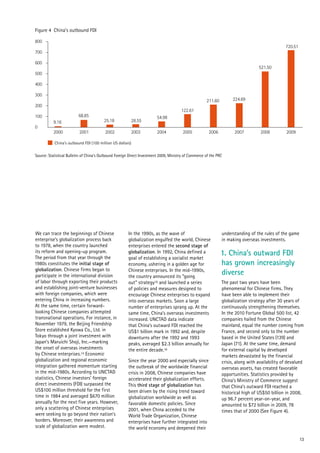
that China’s outward FDI reached a
historical high of US$50 billion in 2008,
up 96.7 percent year-on-year, and
amounted to $72 billion in 2009, 78
times that of 2000 (See Figure 4).
14
Chinese enterprises have made steadfast,
impressive progress on the road to
globalization, evidenced by their outward
FDI, the diversity of investors, and the
scope of such investments. Consider
that China’s overseas investments
have occurred in almost all industrial
sectors. In recent years, mining, retail
and wholesale, financial services and
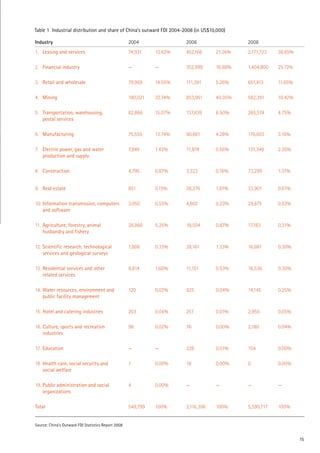
leasing have each accounted for more
than 10 percent of these investments. In
2008, these industries accounted for a
combined 86 percent (See Table 1). By
contrast, share of manufacturing has
decreased.
China’s overseas investments in mining
are of increasing strategic importance,
as domestic demand for minerals and
energy soars with the nation’s rapid
economic development. At present, a
significant proportion of China’s overseas
investments has gone to mineral-rich
Australia. According to China Economic
Net, in 2009 China surpassed Japan
as Australia’s second-largest foreign
investor, and most of its investments
flowed into the mining and energy
industries. To be sure, China’s overseas
investments in the retail and wholesale
industry (mainly in trade), the financial
services industry (primarily through
the banking sector), and leasing and
services (mostly through shareholding)
have grown rapidly. However, these
investments tend to be more scattered
than concentrated. They are therefore
small in scale at the firm level and do
not reflect the typical characteristics
of Chinese companies’ globalization
effort. In contrast, China’s investments
in the manufacturing, mining and energy
industries show significant concentration
and are dominated by a number of
heavyweight enterprises. Most have
resulted from high-profile mergers and
acquisitions and joint investments. Our
current research effort focuses on these
investments.
15
Industry 2004 2006 2008
1.		 Leasing and services 74,931 13.63% 452,166 21.36% 2,171,723 38.85%
2.		 Financial industry — — 352,999 16.68% 1,404,800 25.13%
3.		 Retail and wholesale 79,969 14.55% 111,391 5.26% 651,413 11.65%
4.		 Mining 180,021 32.74% 853,951 40.35% 582,351 10.42%
5.		 Transportation, warehousing,
	 postal services
82,866 15.07% 137,639 6.50% 265,574 4.75%
6.		 Manufacturing 75,555 13.74% 90,661 4.28% 176,603 3.16%
7.		 Electric power, gas and water
	 production and supply
7,849 1.43% 11,874 0.56% 131,349 2.35%
8.		 Construction 4,795 0.87% 3,323 0.16% 73,299 1.31%
9.		 Real estate 851 0.15% 38,376 1.81% 33,901 0.61%
10.	Information transmission, computers
	 and software
3,050 0.55% 4,802 0.23% 29,875 0.53%
11.	Agriculture, forestry, animal
	 husbandry and fishery
28,866 5.25% 18,504 0.87% 17,183 0.31%
12.	Scientific research, technological
	 services and geological surveys
1,806 0.33% 28,161 1.33% 16,681 0.30%
13.	Residential services and other
	 related services
8,814 1.60% 11,151 0.53% 16,536 0.30%
14.	Water resources, environment and
	 public facility management
120 0.02% 825 0.04% 14,145 0.25%
15.	Hotel and catering industries 203 0.04% 251 0.01% 2,950 0.05%
16.	Culture, sports and recreation
	 industries
98 0.02% 76 0.00% 2,180 0.04%
17.	Education — — 228 0.01% 154 0.00%
18.	Health care, social security and
	 social welfare
1 0.00% 18 0.00% 0 0.00%
19.	Public administration and social
	 organizations
4 0.00% — — — —
Total 549,799 100% 2,116,396 100% 5,590,717 100%
Source: China’s Outward FDI Statistics Report 2008
Table 1 Industrial distribution and share of China’s outward FDI 2004-2008 (in US$10,000)
Continent 2005 2006 2007 2008
Total 1,226,117 100% 1,763,397 100% 2,650,609 100% 5,590,717 100%
Asia 448,417 36.60% 766,325 43.50% 1,659,315 62.60% 4,354,750 77.90%
Africa 39,168 3.20% 51,986 2.90% 157,431 5.90% 549,055 9.80%
Latin America 646,616 52.70% 846,874 48.00% 490,241 18.50% 367,725 6.60%
Oceania 20,283 1.70% 12,636 0.70% 77,008 2.90% 195,187 3.50%
Europe 39,549 3.20% 59,771 3.40% 154,043 5.80% 87,579 1.60%
North America 32,084 2.60% 25,805 1.50% 112,571 4.20% 36,421 0.70%
Continent Investment
coverage
Overseas businesses As a percentage
of total overseas
businesses
Asia 90% 6,000 51.2%
Africa 81% 1,600 12.9%
Europe 74% 2,000 16.3%
North America 75% 1,400 11.3%
Latin America 55% 600 4.8%
Oceania 42% 400 3.5%
Figure 5 Overseas M&As by Chinese enterprises
2000 2001 2002 2003 2004 2005 2006 2007 2008 2009
0
50
100
150
200
250
300
4.70 4.52 10.47
149.04
63
302
175
16.47 11.25
52.79
350
Source: UNCTAD M&A statistics for 2000-2006, Chinese Ministry of Commerce statistics for 2007-2009
Overseas M&As (100 million US dollars)
16
Source: China’s Outbound FDI Statistics Report 2008
Source: China’s Outbound FDI Statistics 2008
Table 2 Geographical distribution and share of China’s outward FDI 2003-2008 (in US$10,000)
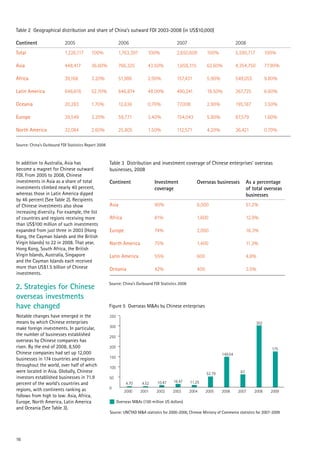
In addition to Australia, Asia has
become a magnet for Chinese outward
FDI. From 2005 to 2008, Chinese
investments in Asia as a share of total
investments climbed nearly 40 percent,
whereas those in Latin America dipped
by 46 percent (See Table 2). Recipients
of Chinese investments also show
increasing diversity. For example, the list
of countries and regions receiving more
than US$100 million of such investments
expanded from just three in 2003 (Hong
Kong, the Cayman Islands and the British
Virgin Islands) to 22 in 2008. That year,
Hong Kong, South Africa, the British
Virgin Islands, Australia, Singapore
and the Cayman Islands each received
more than US$1.5 billion of Chinese
investments.
2. Strategies for Chinese
overseas investments
have changed
Notable changes have emerged in the
means by which Chinese enterprises
make foreign investments. In particular,
the number of businesses established
overseas by Chinese companies has
risen. By the end of 2008, 8,500
Chinese companies had set up 12,000
businesses in 174 countries and regions
throughout the world, over half of which
were located in Asia. Globally, Chinese
investors established businesses in 71.9
percent of the world’s countries and
regions, with continents ranking as
follows from high to low: Asia, Africa,
Europe, North America, Latin America
and Oceania (See Table 3).
Table 3 Distribution and investment coverage of Chinese enterprises’ overseas
businesses, 2008
Figure 6 The globalization process of Chinese enterprises (Number of respondents (%))
Not intending to engage in
overseas business in two years
6%
Currently engaged in
overseas business
89%
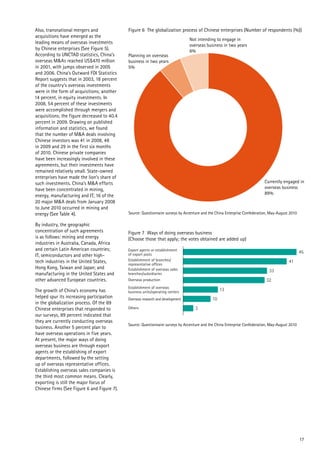
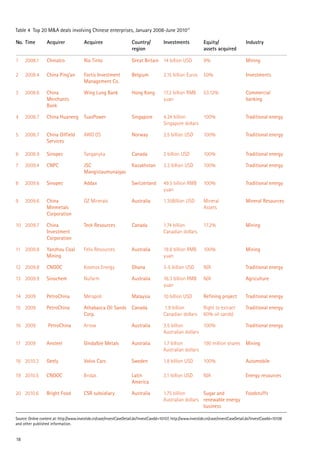
Source: Questionnaire surveys by Accenture and the China Enterprise Confederation, May-August 2010
Planning on overseas
business in two years
5%
Figure 7 Ways of doing overseas business
(Choose those that apply; the votes obtained are added up)
Source: Questionnaire surveys by Accenture and the China Enterprise Confederation, May-August 2010
45
41
33
32
13
10
3
Export agents or establishment
of export posts
Establishment of branches/
representative offices
Establishment of overseas sales
branches/subsidiaries
Overseas production
Establishment of overseas
business units/operating centers
Overseas research and development
Others
17
Also, transnational mergers and
acquisitions have emerged as the
leading means of overseas investments
by Chinese enterprises (See Figure 5).
According to UNCTAD statistics, China’s
overseas M&As reached US$470 million
in 2001, with jumps observed in 2005
and 2006. China’s Outward FDI Statistics
Report suggests that in 2003, 18 percent
of the country’s overseas investments
were in the form of acquisitions; another
14 percent, in equity investments. In
2008, 54 percent of these investments
were accomplished through mergers and
acquisitions; the figure decreased to 40.4
percent in 2009. Drawing on published
information and statistics, we found
that the number of M&A deals involving
Chinese investors was 41 in 2008, 48
in 2009 and 29 in the first six months
of 2010. Chinese private companies
have been increasingly involved in these
agreements, but their investments have
remained relatively small. State-owned
enterprises have made the lion’s share of
such investments. China’s M&A efforts
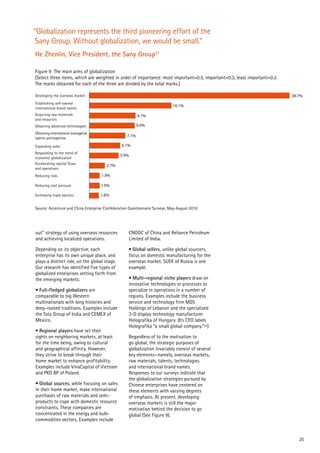
have been concentrated in mining,
energy, manufacturing and IT; 16 of the
20 major M&A deals from January 2008
to June 2010 occurred in mining and
energy (See Table 4).
By industry, the geographic
concentration of such agreements
is as follows: mining and energy
industries in Australia, Canada, Africa
and certain Latin American countries;
IT, semiconductors and other high-
tech industries in the United States,
Hong Kong, Taiwan and Japan; and
manufacturing in the United States and
other advanced European countries.
The growth of China’s economy has
helped spur its increasing participation
in the globalization process. Of the 89
Chinese enterprises that responded to
our surveys, 89 percent indicated that
they are currently conducting overseas
business. Another 5 percent plan to
have overseas operations in five years.
At present, the major ways of doing
overseas business are through export
agents or the establishing of export
departments, followed by the setting
up of overseas representative offices.
Establishing overseas sales companies is
the third most common means. Clearly,
exporting is still the major focus of
Chinese firms (See Figure 6 and Figure 7).
No. Time Acquirer Acquiree Country/
region
Investments Equity/
assets acquired
Industry
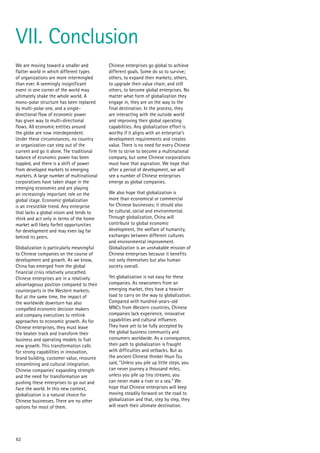
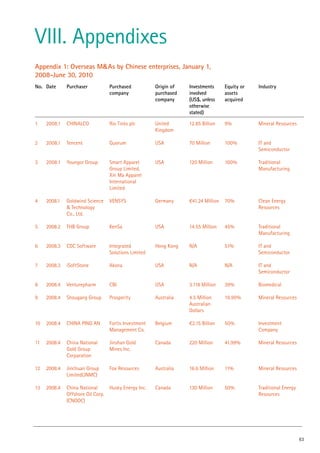
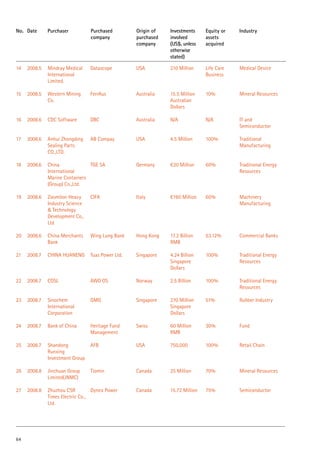
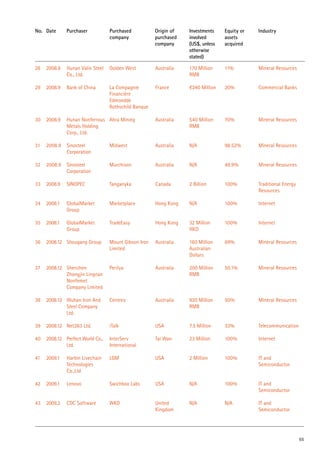
1 2008.1 Chinalco Rio Tinto Great Britain 14 billion USD 9% Mining
2 2008.4 China Ping’an Fortis Investment
Management Co.
Belgium 2.15 billion Euros 50% Investments
3 2008.6 China
Merchants
Bank
Wing Lung Bank Hong Kong 17.2 billion RMB
yuan
53.12% Commercial
banking
4 2008.7 China Huaneng TuasPower Singapore 4.24 billion
Singapore dollars
100% Traditional energy
5 2008.7 China Oilfield
Services
AWO OS Norway 2.5 billion USD 100% Traditional energy
6 2008.9 Sinopec Tanganyka Canada 2 billion USD 100% Traditional energy
7 2009.4 CNPC JSC
Mangistaumunaigas
Kazakhstan 3.3 billion USD 100% Traditional energy
8 2009.6 Sinopec Addax Switzerland 49.5 billion RMB
yuan
100% Traditional energy
9 2009.6 China
Minmetals
Corporation
OZ Minerals Australia 1.35Billion USD Mineral	
Assets
Mineral Resources
10 2009.7 China
Investment
Corporation
Teck Resources Canada 1.74 billion
Canadian dollars
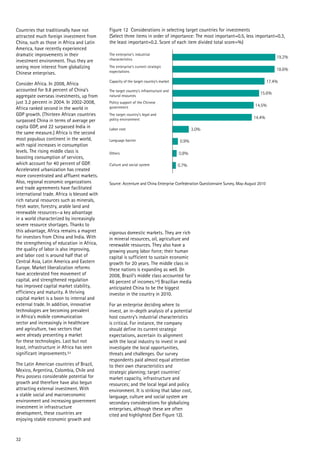
17.2% Mining
11 2009.8 Yanzhou Coal
Mining
Felix Resources Australia 19.8 billion RMB
yuan
100% Mining
12 2009.8 CNOOC Kosmos Energy Ghana 3-5 billion USD N/A Traditional energy
13 2009.9 Sinochem Nufarm Australia 16.3 billion RMB
yuan
N/A Agriculture
14 2009 PetroChina Merapoh Malaysia 10 billion USD Refining project Traditional energy
15 2009 PetroChina Athabasca Oil Sands
Corp.
Canada 1.9 billion
Canadian dollars
Right to extract
60% oil sands)
Traditional energy
16 2009 PetroChina Arrow Australia 3.5 billion
Australian dollars
100% Traditional energy
17 2009 Ansteel Gindalbie Metals Australia 1.7 billion
Australian dollars
190 million shares Mining
18 2010.3 Geely Volvo Cars Sweden 1.8 billion USD 100% Automobile
19 2010.5 CNOOC Bridas Latin
America
3.1 billion USD N/A Energy resources
20 2010.6 Bright Food CSR subsidiary Australia 1.75 billion
Australian dollars
Sugar and
renewable energy
business
Foodstuffs
18
Table 4 Top 20 M&A deals involving Chinese enterprises, January 2008-June 201017
Source: Online content at: http://www.investide.cn/case/investCaseDetail.do?investCaseId=10107, http://www.investide.cn/case/investCaseDetail.do?investCaseId=10108
and other published information.
19
Case study
Haier’s global branding
strategy
The Haier Group was established in
December 1991. Its predecessor was the
Qingdao Refrigerator Company, founded
in 1984. In 2009, the company generated
124.3 billion yuan in revenue globally,
and its brand name was valued at 81.2
billion yuan.18 For each of the past eight
years, Haier has topped the list of the
most valuable brands in China. It was
ranked 27th in Bloomberg Business
Week’s list of the 50 Most Innovative
Companies in June 2010.19 Data from the
business intelligence firm Euromonitor
International, as cited by Dazhong Daily
in December 2009, suggest that in 2009
Haier took the top spot in white-goods
retail volume, boasting a global share
of 5.1 percent, up 0.8 percent from the
previous year.20
Since 1984, Haier has evolved from
a collectively owned small enterprise
with 53 dissatisfied employees and
annual losses of 1.47 million yuan21 to a
renowned global consumer electronics
giant. It brings in annual revenues in
excess of 100 billion yuan (30 percent of
which are generated overseas). It owns
16 industrial parks (four overseas), 29
factories (24 overseas), eight research
and development centers (five overseas),
61 trading companies (19 overseas) and
58,800 sales outlets (45,800 overseas).
The company employs 60,000-plus
people (more than 3,000 overseas). Its
overseas business revenue soars at an
annual rate of 30-50 percent.22
From “defender” to “extender”
What has enabled Haier to transform
itself in such a short span of time?
Haier’s management team firmly
believed that an enterprise cannot move
onto the international stage without
first establishing a leadership position
in its home market. However, executives
also realized early in the company’s
history that Haier could not sustain its
competitive advantage if it clung to
the home market. They therefore made
participation in global competition
a core component of the company’s
strategy. After China joined the World
Trade Organization, Haier’s leaders
resolved to expand internationally while
staying strong in the domestic market
and letting the two markets complement
each other.
Haier’s strategy had two stages, which
moved the company from “defender” to
“extender.” First, the company established
itself as a leading brand in China by
enhancing its core competencies and
improving product quality. Its place in
the domestic market secure, it began
to reach out to the global market with
its products, brand name and corporate
culture, therefore achieving its objective
of “dancing with wolves” (See Figure 8).
Figure 8 Two stages of Haier’s strategy
Source: Haier.com
1984 1991 1998 2005
Capturing the domestic market Developing the global market
Branding
strategy
Total quality
control
OEC management
model
“market chain” process
reengineering
The T model in
processing orders
Diversification
strategy
Outward looking
strategy
Global branding
strategy
20
Capturing the domestic market
Haier implemented its branding strategy
from 1984 to 1991, focusing its time
and energy on building up a refrigerator
brand name. In 1988, the company
was awarded a gold medal for product
quality--the first of its kind ever
awarded in China’s refrigerator industry.
At the same time, Haier accumulated
experience in managing refrigerator
production lines.
From 1991 to 1998, Haier carried out its
diversification strategy. Having made its
name with its refrigerators, the company
set out to transfer its operational
expertise to other product lines. To do so,
it revitalized the industry’s “shocked fish”
(enterprises that were well equipped but
poorly managed) through a series of low-
cost mergers. Its goal? Establish a “fleet,”
rather than a handful, of well-branded
products in the home-appliances market.
Developing the global market
By 1998, Haier was the undisputed leader
in China’s home-appliance industry.
However, domestic and international
competition was intensifying. Rivals were
upgrading their offerings. And consumers
were growing increasingly sophisticated
in their demands. Under these conditions,
Haier could not afford to rest on its
laurels. The company promptly set its
sights on the international market.
Haier initially focused its global market
strategy on exports, realizing the
importance of gaining a foothold in
the overseas markets. It then took its
globalization effort to the next level by
constructing research and development
centers, sales and distribution channels
and after-sale service networks around
the world. These constituted the
company’s localized operations.
In implementing its global growth
strategy, Haier took a “difficult to easy”
approach, selecting foreign markets with
meticulous care. It first set its sights
on the hard-to-penetrate US market,
characterized by mature technologies
and varied consumer demand. By doing
so, it established a solid reputation for
its brand name in the world’s developed
markets. Its successful experience in the
United States would serve as a model
for its expansion in other countries
and regions. In 1998, Haier founded its
industrial park in the United States and
a refrigerator manufacturing facility
in South Carolina, thereby achieving
localized production. In 2001, it set up
another industrial park in Pakistan, also a
production center.
At the end of 2005, Haier began pursuing
a customer-centric approach to its global
growth strategy, realigning internal
resources to serve customer needs. For
example, it created the T model, whereby
teams try to create value for customers
on a specific link and timing of the value
chain by fulfilling certain targets on time
through collaboration.23 (To illustrate,
T = manufacturing day; T-10 = order
placement day; T+20 = container loading
day.) The collective task of meeting
customer demands can be broken down
to each individual’s responsibilities,
and each person’s efforts aggregate
into overall company performance.
Individual employees and a customer’s
“order form” are thus combined into one.
Haier’s Chinese name for this model—ren
dan heyi—means “unity of people and
customer order.”
The company’s global branding strategy
was one step ahead of the outward-
looking international strategy. While
“outward looking” views China as a base
reaching out to the outside world, global
branding focuses on creating localized
brands in every market into which Haier
had made inroads.
21
Three steps to globalization
In 1999, Haier defined a three-step
strategy of “going out, going inside,
and going upward.” This strategy would
complete the company’s globalization
process by establishing its capabilities
for globalized operations and laying
a solid foundation for becoming a
prestigious local brand in every market
Haier entered (See Table 5).
By 1999, Haier had established its global
presence. Consider these highlights in
the Haier story:
• The United States: (the first stop
in Haier’s road to globalization): In
1998, Haier established a research and
development center in Los Angeles, an
industrial park in South Carolina and a
sales center in New York City.
• Europe: In 2001, Haier took over a
refrigerator manufacturing facility under
Italy’s Meneghetti Company (the first
transnational M&A case involving a
Chinese home appliance manufacturer).
Earlier, Haier had established R&D
centers in Italy, the Netherlands,
Germany and Denmark. It had also
constructed a sales and distribution
center in Italy’s Milan.
• South Asia: In 2001, Haier set up an
industrial park in Pakistan and in 2006
established the Haier-Ruba Economic
Zone. By 2005, the company owned
nearly 3,000 sales outlets and 14
exhibition halls in India. In 2007, its
manufacturing facility in India became
operational.
• Africa: In 2000, Haier and Great
Britain’s PZ Group established a joint
venture in Nigeria for assembling and
marketing Haier-Thermocool product
line. In June 2007, Haier’s largest
exhibition hall in Nigeria opened in
Victoria Island, the business center of the
capital city of Lagos.
• ASEAN: In July 2005, Haier established
an exhibition hall in Malaysia. In April
2007, it acquired the Refrigerator
Factory from Sanyo in Thailand.
• Oceania: Haier is currently purchasing
local manufacturing shares in New
Zealand and Australia. (In 2009, it
acquired FPA, New Zealand’s famous
home appliances manufacturer.) Haier
is also forming alliances with local
marketers.
“Going out” “Going inside” “Going upward”
Timeline 1990—1999 2000—2006 2007—2010
Objective Enter mainstream markets in
Europe and North America
Enter mainstream channels in the
mainstream markets
Become local mainstream brand
Difficulties •	 Low brand recognition; “made
in China” not widely accepted
in international market
•	 Insufficient understanding
of the European and North
American markets
•	 Insufficient sales networks
and low energy consumption
standards
•	 Localized design falling short of
consumer requirements
•	 Limited resources for channel
construction and advertising
•	 Lack of understanding of
consumers
•	 Consumer demand becoming
more sophisticated and
individualistic
Solutions •	 Expand overseas markets
mainly through exports
•	 Take advantage of local small
distributers and retail stores
•	 Fully utilize low-cost
advantage
•	 Keep products affordable
•	 Develop niche products
•	 Establish overseas production
facilities
•	 Form localized operational system
combining design, production and
marketing
•	 Enter mainstream channels
•	 Develop mainstream products
•	 Create localized brands
•	 Implement “Resource for
resource” strategy, gaining
global resources by exchange
of domestic resources
•	 Establish stable relationships
with big local customers
•	 Differentiate brand to make it
well known locally
•	 Develop high-end products
Table 5 Haier’s three-step globalization strategy
22
Case study
Holley Group, founded in September
1970, is a diversified enterprise with
pharmaceuticals as its core business.24
It currently owns factories, industrial
parks and more than 20 sales outlets in
other countries, and its products are sold
in 120 nations and regions. Exports and
imports account for 15 percent of its
revenues. It employs more than 10,000
people worldwide.25
Holley started off mainly as a
manufacturer of electric meters and
commands 40 percent of China’s
domestic market for these products.
Having experienced explosive growth in
the 1990s, Holley began facing stiffer
competition on its home turf. China has
more than 600 meter manufacturers. The
company had to seek new opportunities
for growth, and it opted for product
diversification. Holley entered the
pharmaceuticals industry by acquiring
the Kunming Pharmaceuticals Company
and Wuhan Jianmin Pharmaceutical
Group, and by reconfiguring its internal
business.26
In 1999, Holley defined its “international
strategy for the 21st century,” which had
several components:
• Independently develop international
brands. Holley’s leaders believed that
creating an internationally recognized
brand name would be more important
than merely selling its products in the
international market. It has accomplished
this by registering the Holley brand
name in its major overseas markets and
potential markets, doing so in more
than 100 countries to date. Since 2000,
95 percent of the company’s electric-
meter exports bear the Holley brand.
The independent branding strategy has
sharpened the group’s competitive edge.
• Take advantage of synergies in
overseas sales outlets. Holley owns
more than 20 overseas sales companies
or agencies. Each deals in Holley’s
products as well as other companies’
products, including electric meters,
pharmaceuticals, cable and satellite
receivers. This has not only increased
the sales companies’ revenues but also
expanded other Chinese companies’
overseas sales.
• Localize talent. Holley relies heavily
on local partners and recruits talent
locally. At the same time, it encourages
Chinese employees stationed overseas
to settle there. When the company first
implemented its strategy of “going out,”
it tightly controlled its expatriates; for
example, requiring them to live in dorms
and forbidding them from socializing
with foreigners at night. Gradually, its
management philosophy shifted. For
example, it now encourages expatriates to
learn the local languages and assimilate
into the surrounding society. And it allows
them to live in rented houses as well as
socialize with local colleagues and friends.
Indeed, since this change, six or seven such
employees married local people, and many
of them have stayed overseas for more
than 10 years.
• Shift from manufacturing to services.
The year 2006 saw Holley’s creation
of the Thai-Chinese Rayong Industrial
Zone, with a planned area of 4 square
kilometers. The first phase of the project,
with an area of 1.5 square kilometers,
has now been completed, with road,
utilities and other infrastructure ready
for industrial use. More than 20 Chinese
enterprises have set up factories there,
with combined investments totaling
US$170 million. The industrial zone
created a thriving ecosystem for other
Chinese companies investing there.27
Its success has bolstered Holley’s
confidence, and plans for another zone
in Indonesia are now in the works.
• Move from wholly owned to joint
venture. Holley usually chose to work
alone when it first went global. However,
as its overseas business grew more
complex, it felt the need to partner with
other players (for example, through joint
ventures) to navigate in an unfamiliar
business environment. The company
adopted the strategy of allying with
local partners, especially for projects
that required coordinated efforts among
multiple parties and that were under
government regulation. The Thai-Chinese
Rayong Industrial Zone, for instance, is
collaboration between the company
and its Thai partners. The project has
proceeded smoothly, thanks to the local
partners’ social and political networks.
Despite Holley’s successes, its
globalization journey has not always
been smooth. Volatile market conditions
and companies’ unpredictable responses
to change have introduced obstacles.
For example, in 2001, to gain a foothold
in the telecommunication-equipment
sector, Holley purchased the US-based
CDMA chip R&D center from Philips in an
attempt to get access to the CDMA core
technology. With this move, it hoped
to acquire a competitive advantage in
the telecom value chain by combining
technology with the vast application
market in China. However, things did
not pan out as Holley had hoped. First,
Philips and Qualcomm had certain cross-
licensing agreements on CDMA chips,
and most 3-G-related CDMA patents
are in the hands of Qualcomm.28 As a
result, Holley found it more difficult than
it had expected to gain access to some
key 3-G related technologies. Second,
China’s domestic 3-G market had been
slow in getting under way, so it took
longer to realize the financial benefit
of the investment. Third, as a newcomer
to the communications industry, Holley
found it difficult to manage an R&D
center located as far away as the United
States As a consequence, communication
between engineers and researchers and
the management team suffered. The
company also saw its operating costs
skyrocket. By 2005, Holley had achieved
breakthroughs in its pharmaceutical
business, which had grown large enough
to become the company’s core offering.
Pharmaceutical products accounted
for 50 percent of its revenues. Holley
redirected its strategy, cut back on the
operations of its CDMA R&D center and
relocated the center’s main operations
to China.
Holley Group’s corporate
transformation through
globalization
23
IV. Globalization:
strategic choices
24
Chinese companies seeking to globalize
face numerous strategic questions—
including why the company should go
global, what businesses it should engage
in, where it should locate its global
activities and operations, and what
means of investment the company will
use to conduct business globally. The
goals of globalization and the industries
in which companies compete will
influence the answers that executives
generate for these strategic questions.
1. Why should our
company go global?
Globalization has now become an
inevitable trend for Chinese enterprises.
In the post-crisis era, in particular,
globalization enables Chinese companies
to achieve performance breakthroughs
and fuel long-term development. A
globalized firm has access to more
resources, wider markets, more
diversified talent and a more innovative
environment. However, Chinese
businesses have gone global for a set
of distinctive strategic reasons and
motivations. The “breakthroughs” they
seek by way of globalization therefore
have multiple meanings – breaking
threats to their survival, breaking
limitations to development, breaking
their reliance on certain growth paths
and breaking their traditional status
as followers rather than leaders. Our
observation reveals four different
motivations behind Chinese companies’
push for globalization.
Reduce threats to survival
The global financial crisis presented
Chinese enterprises with immense
challenges; some businesses’ very
survival was threatened. Export
processing enterprises, represented
by the traditional OEM manufacturers
of apparel and toys in the Pearl River
Delta, have borne the brunt of the
crisis, owing to their lack of adequate
domestic sales and marketing systems,
insufficient capabilities for innovation
and reliance on foreign orders. As many
countries raised trade barriers during the
recession, numerous Chinese exporters
faced a shrinking international market
and the specter of bankruptcy. At the
same time, countries including India
and Vietnam increasingly became the
destination of choice for multinational
corporations seeking cheap labor, a
trend that has eroded China’s labor-
cost advantage. Under these worrisome
circumstances, many export-oriented
businesses have decided to go beyond
China’s national border and capture host
countries’ markets by establishing local
production and distribution channels
or leveraging those countries’ low-cost
advantage. For example, one Chinese
company runs an industrial park in a
Southeast Asian country jointly with a
local partner. The executives from the
company revealed that the majority of
investors setting up businesses in the
park were Chinese enterprises. Some
Chinese businesses quickly signed leasing
contracts because their exports from
China to the European and US markets
faced anti-dumping investigations. They
had to relocate their businesses quickly
to a third country to avoid disruption to
exports.29
Expand space for development
Although the global economy remains
sluggish, China has a vast number of
ambitious and pioneering enterprises
that are experiencing a growth spurt or
have remained stable and strong. The
global devaluation of assets in the post-
crisis era has created a rare opportunity
for these companies to expand their
overseas markets and leverage those
markets’ resources. At the same time,
other Chinese enterprises are following
suit because of saturation of the
domestic market, vicious competition
or dearth of critical resources. For
instance, competition within China’s
construction industry has intensified,
especially with the entry of foreign
construction contractors. In the face of
shrinking profitability, many construction
companies, such as the China
Construction Engineering Corporation
and the Anhui Construction Group, have
chosen to go global. Ambitious and
strong firms have decided to globalize
to escape the constraints of the home
market and maximize their development
on the global stage.
Move up the value chain
Moving up the value chain can help
Chinese businesses improve their
profitability and achieve sustainable
development. But deficiency in
capabilities in business functions such
as financing, research and development,
production, branding and marketing
has limited these companies’ ability to
move up the value chain. Globalization
provides the necessary conditions for
Chinese enterprises to optimize their
operations and extend their value chain.
The Chery Company, for instance, has
promoted its products in the EU and
North American markets while meeting
the domestic need for low-end cars.
(See “Case study: A tale of two Chinese
automakers..”) The Haier Group, on
the other hand, pursues globalization
through the “resource for resource”
approach, thereby extending its value
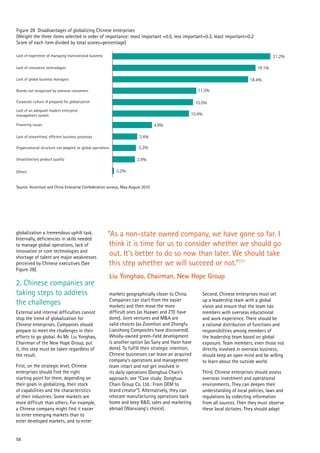
chain from its main line of products to
high-end products.
Become a global player
Since China’s movement toward reform
and opening up, foreign investments
have flowed into the country and have
brought advanced technologies and
managerial expertise. Most Chinese
enterprises were passive recipients of
these new experiences at first. Some
gradually became active followers
of best practices. As China is more
and more integrated into the world
economy, Chinese companies are no
longer content to follow and compete
in the domestic market. Going global is
the right choice for Chinese enterprises
seeking to develop and excel today.
Since the launch of the “going out”
strategy in the mid-1990s, the Chinese
government has consistently supported
enterprises of various ownership
structures in their efforts to engage
in international economic activity
and technological cooperation and to
build global brand names. The global
financial crisis in 2008 created the
opportunity for Chinese enterprises to
“go out” further. Blessed with favorable
conditions, a large number of visionary
companies are pursuing globalization
in an effort to become multinational
companies with international brand
names. The Chery Company, in expanding
to overseas markets, will focus on the
long-term objective of constructing an
international brand name. The Wanxiang
Group has also established its “going
“For CSR, [competing] in the global market today means
[our] survival and development tomorrow.”
Zhao Xiaogang, Chairman, CSR Corporation Ltd.30
25
out” strategy of using overseas resources
and achieving localized operations.
Depending on its objective, each
enterprise has its own unique place, and
plays a distinct role, on the global stage.
Our research has identified five types of
globalized enterprises setting forth from
the emerging markets:
• Full-fledged globalizers are
comparable to big Western
multinationals with long histories and
deep-rooted traditions. Examples include
the Tata Group of India and CEMEX of
Mexico.
• Regional players have set their
sights on neighboring markets, at least
for the time being, owing to cultural
and geographical affinity. However,
they strive to break through their
home market to enhance profitability.
Examples include VinaCapital of Vietnam
and PKO BP of Poland.
• Global sources, while focusing on sales
in their home market, make international
purchases of raw materials and semi-
products to cope with domestic resource
constraints. These companies are
concentrated in the energy and bulk-
commodities sectors. Examples include
CNOOC of China and Reliance Petroleum
Limited of India.
• Global sellers, unlike global sourcers,
focus on domestic manufacturing for the
overseas market. SUEK of Russia is one
example.
• Multi-regional niche players draw on
innovative technologies or processes to
specialize in operations in a number of
regions. Examples include the business
service and technology firm MDS
Holdings of Lebanon and the specialized
3-D display technology manufacturer
Holografika of Hungary. (Its CEO labels
Holografika “a small global company.”32)
Regardless of to the motivation to
go global, the strategic purposes of
globalization invariably consist of several
key elements—namely, overseas markets,
raw materials, talents, technologies
and international brand names.
Responses to our surveys indicate that
the globalization strategies pursued by
Chinese enterprises have centered on
these elements with varying degrees
of emphasis. At present, developing
overseas markets is still the major
motivation behind the decision to go
global (See Figure 9).
38.7%
16.1%
9.1%
9.0%
7.1%
6.1%
5.6%
2.7%
1.9%
1.9%
1.8%Eschewing trade barriers
Reducing cost pressure
Reducing risks
Accelerating capital flows
and operations
Responding to the trend of
economic globalization
Expanding sales
Obtaining international managerial
talents and expertise
Obtaining advanced technologies
Acquiring raw materials
and resources
Establishing self-owned
international brand names
Developing the overseas market
Figure 9 The main aims of globalization
(Select three items, which are weighted in order of importance: most important=0.5, important=0.3, least important=0.2.
The marks obtained for each of the three are divided by the total marks.)
Source: Accenture and China Enterprise Confederation Questionnaire Surveys, May-August 2010
“Globalization represents the third pioneering effort of the
Sany Group. Without globalization, we would be small.”
He Zhenlin, Vice President, the Sany Group31
26
While constructing an overall
globalization strategy from a long-
term perspective is essential, it is
equally important that an enterprise
approach globalization in line with its
current situation and objectives. More
specifically, companies need to consider
such factors as their capabilities, stage
of development and characteristics of
the industries in which they compete
in formulating globalization strategies.
Otherwise, globalization will remain
out of reach or could even endanger
an enterprise’s development. While
globalization is a worthy goal, a firm
should not pursue it merely for its own
sake. Of the enterprises that responded
to our surveys, most indicated that they
have finalized globalization moves of one
sort or another or plan to do so within
two years, but 6 percent said they have
no plans for globalizing within the next
two years. Evidently, globalization is not
the only road worth pursuing.
Regardless of the objectives globalization
is intended to support, success requires
a leadership team with a vision and
capabilities for globalization. The
ultimate goal of any enterprise is
to create value. Strategies that do
not contribute to value creation are
unjustified, however grand they may
appear. Therefore, the material result
of a globalization strategy ought to be
enhanced international competitiveness
and the creation of value for
stakeholders.
2. What businesses do we
want to compete in?
In addition to assessing desired
outcomes of globalization, companies
must ask, “What kinds of overseas
businesses do we want to engage in?”
Companies achieve global growth in
various ways but mainly through the
following stages:
1. Relocating existing lines of business
overseas. This approach enables
optimization of a company’s current
operations to reduce costs and improve
profitability, thus ensuring sustainable
development. Coca-Cola setting up
production lines in China is an example
of this model. It is true to the majority of
companie’s overseas busineses.
2. Extending the value chain
downstream or upstream, or moving
up the value chain. By adopting this
approach, an enterprise enlarges its
sphere of business in its own industry
through expansion of the activities in
which it engages.34 For instance, Google,
which generates the bulk of its income
through online advertisements, has taken
a major step by establishing Google
Wave, a shared space on the Web where
people can collaborate using richly
formatted texts, photos, videos, maps
and more. This product has significantly
expanded Google’s advertising business.
3. Developing new business in a new
environment. GE offers an apt example
of such transformation. The company
has made breakthrough innovations in
emerging markets by designing portable
and affordable medical instruments.
For instance, it has developed portable
electrocardiographic equipment priced at
US$1,000.00 for the Indian rural market
and portable ultrasound equipment
priced at US$15,000.00, for the Chinese
rural market. In the process, GE has
reaped huge profits in these emerging
markets and has fueled growth by
bringing these low-end products back to
the US market.35
Few globalizing Chinese enterprises have
reached the stage of developing new
businesses in new environments. Notable
exceptions include the Holley Group and
the Haier Group, which have established
industrial parks overseas. While some
enterprises cling to their original line of
business, many others strive to extend
their value chain. In an interview with
us, the senior manager of one enterprise
said that his company had gone global by
establishing a global value chain rather
than by exporting its products to the
global market.
We believe that this approach has
great merit. An enterprise’s value
chain represents the various processes
involved in the production of goods
(and services)—from research and
development to the acquisition of
raw materials, and from production
and marketing to final delivery of
products. It also represents the various
activities the enterprise undertakes
to generate profits and strengthen its
competitiveness. A company establishes
its core competencies by enhancing
various capabilities while managing
and developing its value chain. The
value chain varies from enterprise to
enterprise. In setting up a globalization
strategy, a business should first
analyze its comparative strengths and
weaknesses in terms of resources and
capabilities, and then determine which
links in the value chain should go global.
Innovation is a primary consideration
for the majority of Chinese enterprises—
it is the only avenue through which
they can expand to the global market,
extend from the low end to the high
end of the value chain and therefore
achieve profitability and sustainable
development. Amid a volatile
international business environment
and rapid technological advances, it
is imperative that Chinese enterprises
fundamentally improve their managerial
and innovation capabilities to become
truly globalized players.
“An enterprise should think through and be clear about
what it wants to achieve by globalization. The financial
crisis has led many export-oriented companies to realize
the importance of market. Foreign companies flock
to China because China is a big market. An enterprise
may not necessarily have to go the harder way of
globalization; it may not be so late for it to do so when
it has been well established in the domestic market.”
Liu Chuanzhi, Chairman, Lenovo Group33
27
To maximize profitability, Chinese
companies must become more
innovative in research and development,
marketing, brand construction and other
key business functions.36 They used to
compete on cost and price, without core
innovative technologies or independent
brands, and seldom broke into the
highly profitable service sectors.
Most Chinese primary equipment
manufacturers, for example, are at the
bottom of the global value chain, with
their profits accounting for less than 5
percent of the value of their products.
At a time when the global economy
and the manufacturing industry are in
a critical period of recovery, Chinese
enterprises need to shift their products’
reputation from “Made in China”
to “Made with China” or “Created
in China.” Such a transformation is
crucial for Chinese businesses seeking
to own world-class brands and thus
feature more prominently in the global
economic landscape.
To access advanced technologies and
upgrade their value chain, more Chinese
enterprises are focusing their research
and development efforts in North
America and Europe. Some have taken on
independent technologies and absorbed
technological advances in developed
countries by means of overseas mergers
and acquisitions or the establishment of
R&D centers or labs in other countries.
Gree Air Conditioners, for instance,
successfully developed an advanced
air-conditioning technology following
its failure in 2001 to purchase such
technology from a Japanese company.
The company has long insisted on
mastering core technologies to support
its development strategy. It does not
set a ceiling for R&D expenditures,
and it became the first in its industry
to establish three research institutes
devoted to medium- and long-term
research in sophisticated technologies.
It has moved on from medium- and
low-end manufacturing, and is the
global bellwether in air-conditioning
technologies.37
Other enterprises, by contrast, have
acquired advanced manufacturing
technologies, managerial expertise, sales
channels, customers, markets and even
brands by purchasing overseas peers that
are technological leaders. For example,
in April 2010, the Chongqing Machinery
and Electronics Company acquired the
UK-based Precision Technologies Group
(PTG) for £20 million. The company
plans to pump £10 million into PTG in
the next several years to strengthen its
competitiveness in the machine-tool
product area. PTG, which owns two
factories in the UK, has provided the
Chongqing Machinery and Electronics
Company with precision machinery
manufacturing technologies, thereby
enhancing Chongqing’s technological and
managerial prowess.38
“The first phase of our strategy is a global market for our
products, and the second phase is a global brand.”
Wu Fei, General Manager of COFCO Wine39
28
Case study
A tale of two Chinese
automakers
The year 1997 will go down as a
shining page in the history of China’s
automobile industry. In March of that
year, the Chery Motor Company broke
ground. Also in 1997, the Geely Company,
which had started in the refrigerator
components business, declared its entry
into the automobile industry.
The two companies have striking
similarities. Both had begun by developing
cars targeted to the masses and following
a low-price strategy. They adopted
this approach because of the large
gaps between them and their foreign
counterparts with regard to technological
levels, brand value and market influence.
Because multinational automakers’ prices
were relatively high, middle-income
Chinese families could not afford them.
Chery and Geely concentrated on the
medium- and low-end segments of
the market for middle-income Chinese
families, carving out a narrow space for
themselves in the crowded and highly
competitive auto market.
The two companies have also tried to
push into the global market. China
accounted for no more than 10 percent
of the global automobile market in the
late 1990s, so a Chinese automaker
had to go global to achieve world-
class status. Yin Tongyue, Chairman of
Chery Company, noted, “The Chinese
auto market is a small part of the
global market though it grows fast.”40
Li Shufu, Chairman of Geely Company,
pointed out, “China’s auto industry
has got to participate in global market
competition in order to improve its
competitiveness.”41 Both started to “go
out” by selling their products on the
world market. Owning independent
brands, they could decide where to
export. Unlike partners in a Chinese-
foreign joint venture, which is limited
by foreign partners’ global strategies,
Chery and Geely took globalization into
their own hands. In October 2001, Chery
began exporting its sedans to Syria. In
August 2003, Geely also began to export
its sedans.42
However, the two businesses chose
different paths to expand into the global
market. Chery took the incremental
approach of emphasizing exports, green-
field development and independent
research and development. In contrast,
Geely chose the more radical strategy
of strengthening itself through overseas
mergers and acquisitions—swiftly
increasing its scale and market presence.
Spotlight on Chery
The Chery Company has spread its
wings overseas cautiously. Its chairman,
Yin Tongyue, sees overseas M&A as
risky, especially when it comes to the
integration of diverse corporate cultures.
Consequently, Chery has focused on
organic growth.43 It reached out to the
overseas market in a substantial way
in 2004 and established a specialized
international company for its export
business. The destinations of its
products initially included the Middle
East, Southeast Asia and Africa, and
slowly expanded to include Russia,
Southeast Europe and Latin America.
Chery targeted medium- and low-
income consumers in these countries and
regions. And it refrained from entering
the West European and North American
markets, which set more rigorous quality
and environmental standards.44
Chery began building factories overseas
in 2006. In light of financing and
operational risks, it chose to embark
on this building effort jointly with
local partners. In exporting products, it
insisted on constructing CKD (complete
knock down) or SKD (semi-knock
down) assembling facilities with these
partners. Such localized production,
29
which contributed to local taxation and
employment, largely protected Chery
from local trade protectionism.45
In 2008, the Chery Company sold
356,000 cars, winning fifth place on
China’s passenger-car sales chart. For
the 10th consecutive year, it was the
champion in sales of domestic brand
products. About 135,000 of the cars it
sold were exports, which made Chery
the No. 1 auto exporter for the sixth
year running. The company is now firmly
established in Asia, Europe and Africa,
with localized production and selling
in countries including Thailand, Russia,
Argentina and Uruguay. Its products
have reached more than 70 countries
and regions.46
Spotlight on Geely
In contrast to Chery’s methodological
approach, the Geely Company has
globalization more energetically. In
October 2006, it signed a deal with
UK-based Shanghai Maple and
Manganese Bronze Holdings (MBH) to
jointly produce brand-name taxicabs.
By acquiring a shareholding stake
in MBH, Geely obtained related car-
manufacturing technologies and, most
important, sales channels in Europe for
its independent brand products. Also, it
could take advantage of MBH’s after-
sales services in the UK and in Europe
overall.47
In June 2009, Geely plunked down 54.6
million Australian dollars to acquire the
Australian automatic gearbox maker
Drivetrain Systems International Pty
Ltd. (DSI), which was under bankruptcy
protection. As one of the two
independent manufacturers of automatic
gearboxes in the world, DSI had strong
design, R&D and production capabilities.
The move significantly improved Geely’s
technological and production capabilities
in the area of automatic gearboxes. In
addition to meeting its own demand for
gearboxes, it supplied these products to
other automakers. The acquired business
had strategic importance for Geely’s
core car manufacturing business. Indeed,
the acquisition helped Geely to upgrade
its value chain.48
In March 2010, Geely completed the
purchase of Volvo Cars from Ford Motor
Co. with a hefty US$1.8 billion, acquiring
100 percent of Volvo’s equity and related
assets (including intellectual property
rights). The deal constituted the biggest
overseas acquisition ever by a Chinese
automobile manufacturer.49 Geely
maintained that the acquisition met its
strategic needs in an age of globalization.
It expects to create high-end products
as quickly as possible and therefore
improve its international visibility, by
relying on Volvo Cars’ core intellectual
property rights, brand value and
market position. However, Geely faces
formidable challenges in integrating
Volvo Cars’ advanced management
systems, establishing a cross- cultural
management team and making Volvo
Cars’ technologies and brand name
entirely its own.
Wang Ziliang, Vice President of Geely,
noted that Geely’s acquisition was made
with the company’s unique situation
and needs in mind, and that acquisition
for acquisition’s sake is meaningless.50
However, inking the deal is only the
first step. The post-merger integration
process, upon which the acquisition’s
long-term success hinges, is anticipated
to be protracted.
The Chery Company and the Geely
Company have taken diverse approaches
to globalization not only because of the
differences in their strategic orientations,
management philosophies, market
positioning and corporate cultures, but
also because of the differences in their
leadership styles and preferences.
30
3. Where should we locate
our global businesses?
Executives at globalizing Chinese firms
take into account their globalization
objectives to decide where to locate
their global business. Companies
seeking to acquire resources have to
go where such resources are abundant.
Those whose main purpose is market
expansion need to go where their target
markets are large enough. Enterprises
most concerned about avoiding trade
barriers must go to third-party countries
or regions through which they can
access their target markets. Those
whose primary aim is the acquisition
of innovative technologies have to go
to countries where businesses possess
considerable technological strengths.
Political, cultural, social and linguistic
factors also influence the geographical
choice of enterprises seeking to
globalize. For instance, some executives
we interviewed defined Southeast
Asia as an ideal destination for their
investments, noting that it is home to a
substantial ethnic Chinese population,
which facilitates communication and
management. Others said that they
would not attempt to do business in
countries that are not friendly to China.
In deciding where to go, executives
should gain a thorough understanding
of a potential market’s competitive
strengths, products and availability of
opportunities. Integration of cross-
regional resources optimizes an
enterprise’s portfolio of resources and
thus sharpens its competitive edge.
According to Bruce Kogut’s global
strategy model on comparative
strengths and geographical choice, an
enterprise should give capital and human
resource inputs primary consideration
in deciding where to locate their global
business activities. Capital and human
resource inputs are closely correlated
with countries and industries. For
example, countries have different cost
structures in areas of taxation, tariff,
transportation, salary and so forth.
Various industries require different
levels of inputs in capital and human
resource. Businesses can formulate
their geographic strategy based on their
industry’s defining characteristics, their
own competitive advantage and whether
they follow a capital- or labor-intensive
strategy. Thus, they can choose to locate
their business in developed countries,
emerging markets or developing
countries51 (See Figure 10).
Developed countries, which enjoy
comparative strengths in talent and
capital, have industries concentrated in
digitized production and manufacturing,
services and product research and
development. In contrast, developing
countries generally have cheap and
abundant labor and hence have relative
strengths in production costs. Many
transnational corporations originating
in developed countries relocate their
manufacturing processes to developing
countries to capitalize on this low-cost
advantage. Therefore, industries that are
concentrated in developing countries
and regions include food processing and
export of simple consumer products.
However, the so-called emerging markets
have already begun challenging this
paradigm. Such markets include the IMF
classifications of “newly industrialized
Asian economic entities” and “other
newly emerging markets.” Distinctive
features of these markets include a
gradually advancing market economy,
rapid economic growth, big market
potential and ongoing integration into
the global economic system through
institutional reforms and economic
progress. Emerging-market nations
usually include Brazil, China, India,
Indonesia, Mexico, Russia, South Africa,
South Korea and Turkey.52 These countries
are experiencing accelerated economic
growth and technological progress
and have accumulated huge pools of
high-end talent. Because overall wage
levels in these emerging markets are far
lower than those of developed countries,
multinational corporations are competing
to establish research and development
centers in localities characterized by a
concentration of high-quality talent. This,
in turn, promotes further technological
progress and rapid development of
high-tech industries in these countries.
Therefore, the industries in emerging
market economies currently encompass
basic production and manufacturing,
digitized production and manufacturing
and so on.
Emerging market multinationals (EMMs)
are racing to catch up with their peers in
developed countries, although they are
newcomers to globalization. Globalizing
Chinese enterprises should recognize
and employ the comparative strengths of
the aforementioned different markets in
making geographical choices.
Chinese companies’ comparative
advantages lie in low-cost labor and
Product research and development
Technological service industries
Digitalized production and manufacturing
Industrialized machinery production and manufacturing
Basic production and manufacturing
Assembly production
Exports of simple
consumer goods
Food
processing
Emerging markets
Developing countries
Developed countries
Human resource inputs
Source: “Designing Global Strategies: Comparative and Competitive Value-Added Chains.”
Bruce Kogut, in Smart Globalization: Designing Global Strategies, Creating Global Networks,
the MIT Sloan Management Review Innovation Series 2003
Figure 10 Industries’ comparative strengths in different countries
Capitalinputs
23.0%
20.5%
19.3%
16.8%
14.3%
6.2%
Figure 11 Countries and regions preferred for globalization by Chinese firms
(Select two items. The votes of each item divided by total votes = %)
Source: Accenture and China Enterprise Confederation Questionnaire Survey, May-August 2010
European and North American
markets
Asia-Pacific emerging markets
Other emerging markets
Pacific developed markets
(Japan, Australia and New Zealand)
The BRICs (Brazil, Russia and India)
Taiwan, Hong Kong and Macao
31
raw materials. However, a sizable gap
exists between them and multinational
corporations with respect to market
share, technologies, innovation
capabilities and high-end talent. Chinese
enterprises generally have an edge over
their counterparts in other developing
countries in terms of capital, R&D and
technologies, but lag behind some of
them when it comes to volumes of
natural resources commanded, such as
land, forests and oil. Although emerging
market countries have achieved rapid
economic growth, the drivers behind
each nation’s growth are unique.
Globalizing Chinese enterprises should
make geographical choices on the
basis of their target industries, capital
reserve and human resources as well as
the comparative advantages offered by
potential countries and regions in which
to do business.
In our research, we have broken down
the global market into the following
components:
• European and North American
developed markets
• Asia-Pacific developed markets (Japan,
Australia and New Zealand)
• Taiwan, Hong Kong and Macao
• the BRIC countries (Brazil, Russia, India
and China)
• the Asia-Pacific emerging markets
• other emerging markets
According to our surveys, the Asia-
Pacific emerging markets are the most
favored by Chinese enterprises, with
23 percent of the enterprises targeting
these markets as the prime locations
for their overseas investments (See
Figure 11). These findings coincide with
related Chinese official statistics, which
suggest that in 2008 Asia accounted
for a remarkable 78 percent of China’s
total overseas investments. Chinese
enterprises prefer these Asia-Pacific
countries and regions for two main
reasons:
• China’s geographical proximity to
them and affinity with them historically,
culturally and ideologically. For example,
these countries and regions have long
served as markets for China’s exports.
• Rapid pace of industrialization, high
per-capita income and large markets.
The stable macro-economic environment
in these countries and regions provides
assurance of returns on Chinese
enterprises’ investments.
Roughly 20 percent of the Chinese
enterprises that responded to our
survey preferred the European and
North American developed markets
second to the Asia-Pacific emerging
markets. These markets have high
levels of economic development, a large
capacity for outside investments, an
outstanding investment environment,
highly developed transportation
and communication infrastructure,
and stable market regulations, legal
systems and societies. These countries
also offer a huge consumer market as
well as high levels of division of labor
and high market differentiation. In
addition, they are traditionally leaders
of global technological innovation and
originators of high-tech industries, such
as biomedical engineering, material
technologies, aeronautic and space
technologies and microelectronics.
Therefore, by investing in Europe and
North America, a Chinese enterprise
not only keeps in close touch with
international market trends and
regulatory standards, but also stays up
to date on the latest developments in
technologies and products.
19.2%
17.4%
15.6%
14.5%
14.4%
3.0%
0.9%
0.8%
0.7%
Figure 12 Considerations in selecting target countries for investments
(Select three items in order of importance: The most important=0.5, less important=0.3,
the least important=0.2. Score of each item divided total score=%)
Source: Accenture and China Enterprise Confederation Questionnaire Survey, May-August 2010
The enterprise’s current strategic
expectations
The enterprise’s industrial
characteristics
Capacity of the target country’s market
The target country’s infrastructure and
natural resources
Policy support of the Chinese
government
The target country’s legal and
policy environment
Labor cost
Language barrier
Others
Culture and social system
18.6%
32
Countries that traditionally have not
attracted much foreign investment from
China, such as those in Africa and Latin
America, have recently experienced
dramatic improvements in their
investment environment. Thus they are
seeing more interest from globalizing
Chinese enterprises.
Consider Africa. In 2008, Africa
accounted for 9.8 percent of China’s
aggregate overseas investments, up from
just 3.2 percent in 2004. In 2002-2008,
Africa ranked second in the world in
GDP growth. (Thirteen African countries
surpassed China in terms of average per
capita GDP, and 22 surpassed India in
the same measure.) Africa is the second
most populous continent in the world,
with rapid increases in consumption
levels. The rising middle class is
boosting consumption of services,
which account for 40 percent of GDP.
Accelerated urbanization has created
more concentrated and affluent markets.
Also, regional economic organizations
and trade agreements have facilitated
international trade. Africa is blessed with
rich natural resources such as minerals,
fresh water, forestry, arable land and
renewable resources—a key advantage
in a world characterized by increasingly
severe resource shortages. Thanks to
this advantage, Africa remains a magnet
for investors from China and India. With
the strengthening of education in Africa,
the quality of labor is also improving,
and labor cost is around half that of
Central Asia, Latin America and Eastern
Europe. Market liberalization reforms
have accelerated free movement of
capital, and strengthened regulation
has improved capital market stability,
efficiency and maturity. A thriving
capital market is a boon to internal and
external trade. In addition, innovative
technologies are becoming prevalent
in Africa’s mobile communication
sector and increasingly in healthcare
and agriculture, two sectors that
were already presenting a market
for these technologies. Last but not
least, infrastructure in Africa has seen
significant improvements.53
The Latin American countries of Brazil,
Mexico, Argentina, Colombia, Chile and
Peru possess considerable potential for
growth and therefore have also begun
attracting external investment. With
a stable social and macroeconomic
environment and increasing government
investment in infrastructure
development, these countries are
enjoying stable economic growth and
vigorous domestic markets. They are rich
in mineral resources, oil, agriculture and
renewable resources. They also have a
growing young labor force; their human
capital is sufficient to sustain economic
growth for 20 years. The middle class in
these nations is expanding as well. (In
2008, Brazil’s middle class accounted for
46 percent of incomes.54) Brazilian media
anticipated China to be the biggest
investor in the country in 2010.
For an enterprise deciding where to
invest, an in-depth analysis of a potential
host country’s industrial characteristics
is critical. For instance, the company
should define its current strategic
expectations, ascertain its alignment
with the local industry to invest in and
investigate the local opportunities,
threats and challenges. Our survey
respondents paid almost equal attention
to their own characteristics and
strategic planning; target countries’
market capacity, infrastructure and
resources; and the local legal and policy
environment. It is striking that labor cost,
language, culture and social system are
secondary considerations for globalizing
enterprises, although these are often
cited and highlighted (See Figure 12).
33
4. What means of
investment will we use?
Ideal ways of investment are those that
are consistent with the enterprise’s
characteristics, needs and competitive
strengths. In the past, China stimulated
economic development by vigorously
attracting foreign investment and
encouraging companies to export. Many
enterprises went global by engaging in
exports, at least in the initial stage of
their globalization effort. Today, however,
most enterprises choose to globalize by
making merger and acquisition deals or
by joining hands with local companies.55
Specifically, these enterprises invest
overseas by establishing independent
production facilities, forming joint
or cooperative ventures or strategic
alliances with local partners, making
equity investments, conducting mergers
and acquisitions and so forth. Exports,
mergers and acquisitions and joint
ventures constitute the most popular
means of investment (See Figure 13).
Notably, establishing wholly owned
companies is not preferred, perhaps
because wholly owned businesses take
more time to set up and hence are slow
in going to market. Moreover, “going it
alone” is disadvantageous because no
partners are there to share risk.
Our surveys show that the overriding
consideration of Chinese enterprises
deciding where to invest is how to avoid
the host country’s market risks. This
reveals a widespread desire for assurance
and stability. Their second consideration
is whether they own a strong
international management team, which
strongly influences decisions about how
to invest (See Figure 14).
Some Chinese enterprises we interviewed
shared their views and experiences
regarding their globalization practices.
For example:
Organic growth is the best way
for incremental globalization
By establishing green-field production
facilities independently or in partnership
with local companies, an enterprise can
expand into the global market through
organic growth. This is a relatively
slow approach, but the firm is able
to manage its pace and control risks.
Such approaches to investment ensure
greater preferential treatment from
local governments because the investing
company helps to create jobs and
inject capital into the local economy. In
Figure 13 Chinese companies’ preferred overseas investments approaches
(Select two items. The votes of each item divided by total votes=%)
Source: Accenture and China Enterprise Confederation Questionnaire Survey, May-August 2010
Establishing exclusively
owned companies
8%
Becoming listed (IPO)
10%
Shareholding
in local
companies
13%
Establishing
joint ventures
17%
Mergers and
acquisitions
23%
Exports
29%
34.0%
13.8%
13.7%
9.9%
6.0%
3.3%
0.7%
Figure 14 Factors weighed in Chinese firms’ investment decisions
(Select three items in order of importance: The most important=0.5, less important=0.3,
the least important=0.2. Score of each item divided by total scores=%)
Existence of a strong international
management team
Market risks
Political risks
Capabilities for cultural management
and resource integration
Capabilities for cultural management
and resource integration
Capabilities for cultural management
and resource integration
Prior experience in globalization
Others
18.7%
Source: Accenture and China Enterprise Confederation Questionnaire Survey, May-August 2010
34
“If we had not had a grand vision and gone out, we
would still be small. Like a fish in a small pond, we
would never grow big. So we must go out.”60
Zhang Ruimin, CEO, Haier Group Company
addition, the investing company avoids
the complexities of integration that
come with mergers and acquisitions. In
the words of one senior executive who
spoke with us, this is an issue of new
business versus existing business. New
business means injecting additional
resources into local communities
and would be welcomed by local
governments. Existing business involves
change of ownership, replacement of
workers without necessarily creating new
jobs. Indeed, the gradual approach gives
the management team time to learn
and gives the company an opportunity
to improve its competitiveness in a
controllable way. It also ensures the
alignment of internal management
systems and culture.56 A number of
leading Chinese enterprises have
succeeded through organic growth,
including the Haier Group, Trend Micro,
Huawei and ZTE.
However, a major drawback of this
investment approach is that research
and development ae often slow to
develop and faces numerous hurdles.
For instance, the Sany Group decided to
found its European R&D center at the
same time it planned on constructing its
factory in Germany. (See “Case study:
Sany and Zoomlion: building up one’s
own business versus making M&A deals”)
The company expects that establishing
the center will be a long, drawn-out
process because of the conservative
German culture and the relatively high
R&D costs.
M&A drives growth quickly,
but watch out for post-merger
integration challenges
Through M&A—the purchasing of a
targeted company’s equity or assets
with cash or securities—a company
obtains ownership rights to the acquired
entity’s whole or partial assets, or
controlling power over the acquired
firm. M&A is a common approach to
globalization. World Investment Report
2009 suggests that 36 percent of global
foreign direct investment (FDI) in 2008
was accomplished through mergers and
acquisitions.57 According to Accenture
research, since 2008, Chinese enterprises
have achieved approximately 70 percent
of their M&A deals in the European
and North American markets and the
remaining 30 percent or so in Asia,
Africa and Latin America. Most Chinese
acquirers favor companies in developed
markets because these deals enable them
to acquire advanced technologies and
managerial expertise as well as expand
their market networks. For example,
China’s Pacific Century Motors (PCM)
recently reached an agreement with
General Motors to acquire GM’s auto-
parts business, Nexteer Automotive.
PCM’s goal is to boost its capability
in steering and driveline systems. The
single largest Chinese investment in a
US-based automotive supplier and in
the global automotive supplier industry,
the deal was completed in November
2010, making PCM the official owner of
Nexteer Automotive and opening new
channels for growth in China.58
Mergers and acquisitions yield
instant results in the acquisition of
advanced technologies, brands and an
international team. However, post-
merger integration (PMI), which entails
changes in organizational structures,
people, processes, technologies and
corporate cultures, is often daunting.
The success rate of such integration
has been proven discouraging. Chinese
enterprises are zealous about mergers
and acquisitions. But according to a joint
study by Accenture and The Economist
Intelligence Unit, these companies are
not well prepared for these activities.
As much as 82 percent of Chinese
senior managers believe that Chinese
enterprises lack experience in managing
overseas investments.
In implementing its M&A strategy, a firm
should clearly analyze pre-merger risks
and evaluate post-merger investment
needs. At the same time, it should have
a clear idea about its own capabilities,
strengths and weaknesses. The success
of a merger or acquisition depends on the
generation of cost and revenue synergies.
Therefore, an acquirer should think
twice about signing a deal if executives
question whether the expected synergies
will result. Also, executives should ask
whether the technology that would be
acquired through the M&A deal will
quickly become obsolete. If the answer is
yes, the deal may not be wise.
Few Chinese enterprises possess a
dedicated team to manage overseas
mergers and acquisitions. Usually, they
hire investment bankers for these efforts.
As a consequence, they tend to be overly
focused on deal making and ill prepared
for the range of issues that arise during
the PMI process. In addition to drawing
on assistance from intermediary
organizations in making M&A decisions,
Chinese companies must also build up
their own M&A capabilities if they hope
to make wise choices.59
Strategic alliances can create win-
win outcomes
Shared goals and complementary
strengths form the basis on which
two enterprises forge a strategic
alliance. Such an alliance is a long-term
arrangement between two enterprises
to cooperate in the value chain and is
an ideal choice for maximizing mutual
benefits and increasing competitiveness.
A globalizing enterprise can enter the
overseas market quickly by forming
an international alliance, and the
arrangement’s success depends largely
on the quality of the relationship with
the international partner. Long-term
mutual trust and coordination are
essential. The two sides can strengthen
technological innovation and improve
managerial capabilities by exchanging
technologies and personnel.
Each approach to globalization has its
own characteristics and advantages.
An enterprise ought to select a path or
paths to globalization in accordance
with its strategic requirements and goals
and its particular stage of development.
For instance, Sinochem relies on M&A
for its core businesses to strengthen its
competitive position in key technology,
distribution channels and branding. For
non-core businesses, it forms strategic
alliances.
35
Case study
Sany and Zoomlion: Building
up one’s own business versus
making M&A deals
The Sany Heavy Industrial Group (Sany)
and the Zoomlion Heavy Industrial
Science & Technology Development
Company (Zoomlion), both based in
Changsha, capital of Hunan Province,
are well- known engineering machinery
manufacturers. The former ranked 266th
and the latter 236th on the list of China’s
top 500 enterprises in 2009.61
With the continuous expansion of China’s
engineering machinery manufacturing
industry and rapid increases in the
number of overseas construction projects
contracted by Chinese companies, both
companies have embarked on the road
to globalization in R&D, manufacturing,
sales and distribution, and services.
Their businesses have now reached Italy,
India, Brazil, the US, Germany and other
countries, and their products are sold to
more than 100 countries. Their income
generated by overseas operations in
2009 declined significantly owing to the
financial crisis. However, the Sany Group
still brought home 1.46 billion yuan in
such income, or roughly 9 percent of its
overall income,62 and Zoomlion brought
home 2.61 billion yuan, or about 13
percent of its overall income.63
Spotlight on Sany
In 2006, Sany ranked No. 1 in the world
in sales of concrete pumps, surpassing
Germany’s Putzmeister.64 Its globalization
strategy emphasizes optimization of
its value chain rather than exports; for
example, the company seeks to overcome
bottlenecks in its hydraulic technology
through globalization activities. “Sany’s
globalization begins with value chain
optimization, instead of product export,”
says Vice President He Zhenlin.65 Having
weighed the pros and cons of mergers
and acquisitions and establishing Sany’s
own production facilities, executives
decided to attach greater importance to
the latter. By doing so, they have avoided
the local cultural, managerial and legal
pitfalls that might have come with M&A.
Sany selects target overseas markets on
the basis of its own characteristics and
capabilities, bearing in mind its supreme
goal of value chain optimization. It has
established production bases in the US,
Germany and India, and is planning one
in Brazil. The US is the world’s largest
engineering machinery market and is
home to giant engineering machinery
manufacturers. By setting up a base in
the US, Sany can secure adequate parts
supply and learn advanced management
ideas. Germany enjoys advantages in
industrial design, precision instruments
manufacturing, technology, business
processes and research and development.
In the words of a senior manager at
Sany, by establishing a plant in Germany,
the company can “conquer the world’s
heartland of engineering technologies.”
Also, assembling products in Germany
saves costs for selling to European
clients.66 Sany’s concrete pump plant
located near Cologne was scheduled
to go into operation in early 2011.67
Sany has also made its way to India,
attracted by the country’s vast market
and sales channels. By establishing a
presence in such an important emerging
market, Sany can be close to clients and
understand their needs better. Brazil
is on a fast track for growth, but its
tariff levels and transportation costs are
relatively high. Therefore, setting up a
factory within the country saves costs.
In addition, Sany has implemented
domestic or global strategies in
accordance with the characteristics
and requirements of its value chain.
For example, it takes both global and
domestic approaches to research and
development. Chinese engineers and
their German colleagues work together
36
closely, with the latter providing the
conceptual framework and the former
completing the functional designs. The
company fosters collaboration between
Chinese and German engineers in R&D
and design by fully utilizing IT-enabled
colloabration tools. Such interaction
and communication is expected to save
on research and development costs.
In contrast, manufacturing (with the
exception of precision devices) takes
place in China since manufacturing
costs there are a fraction of those in
Germany. Finished products are then sent
to Germany for assembly. In expanding
its markets, Sany takes full advantage
of existing sales channels to develop
local and neighboring markets. In talent
management, the company ensures that
Chinese and foreign skilled workers team
up to maximize technical diversity.
Spotlight on Zoomlion
Zoomlion, unlike Sany, strives for both
internal growth and external expansion.
Its notion of globalization consists
of the dual elements of “diffusion”
(the existence of multiple divisions/
departments by product categories so
that every product line receives the
largest amount of attention) and “fusion”
(formation of a transnational business
division through overseas mergers
and acquisitions which integrate the
company’s global business and overseas
companies in the same industry).
In September 2008, Zoomlion purchased
Italy’s cement equipment manufacturer
CIFA (the third-ranking brand in cement
equipment in Europe). This acquisition
represented a major act of “fusion”
by the company. In purchasing CIFA,
Zoomlion paid particular attention
to reducing risks. The company had
had business relations with CIFA, its
supplier of components, since 2001.
Therefore, executives were intimately
familiar with CIFA’s business and
management. CIFA was an 80-year-old,
family-run business. It operated under
capacity but had a strong research and
development function and solid sales
networks in Europe, North Africa and
the Middle East. Struggling with the
impact of the global financial crisis,
some members of the family decided to
sell the business, and its management
team wanted Zoomlion to be the buyer.
Zoomlion made the acquisition jointly
with Goldman Sachs, Mandarin Capital
Partners and the Chinese private equity
firm Hony Capital, with Zoomlion holding
60 percent of the stake and its partners
the remaining 40 percent. Through this
move, the company not only diffused
financial risks but also realized greater
market expansion.68 The first two
quarters of 2009 were difficult, but
things began to improve in the second
half of the year.
The completion of an M&A deal is
only the first step. Whether a deal
ultimately succeeds depends on how
effectively executives handle the post-
merger integration process. Zoomlion
achieved seamless integration with
CIFA by applying a series of practices.
For example, after the acquisition,
Zoomlion established a joint committee
to oversee the new company’s business
and facilitate cross-border and cross-
cultural cooperation and communication.
The committee comprises the Zoomlion
Chairman, the CIFA Chairman and senior
managers from the investment partners.
Zoomlion also merged CIFA with its
domestic cement division to achieve
operational synergies. The Chairman
of CIFA retained his position and was
concurrently appointed Vice President of
Zoomlion. The former CIFA CFO served
as CEO. CIFA’s new CFO was named
by Zoomlion and stationed in Milan.
Zoomlion also named two deputy general
managers. These moves created an
international management team. At the
same time, the functional departments in
charge of strategy, markets, research and
development and sales were established.
The new company has both Chinese and
Italian headquarters.
Zoomlion takes an integrated approach
to research and development, fully
absorbing and using advanced Italian
technologies. It has founded its R&D
center in Italy. Chinese and Italian
engineers work jointly to develop new
products. R&D accounts for 3-5 percent
of Zoomlion’s overall investments.
Shortly after the acquisition, Zoomlion
came up with the innovative “factory
within factory” model for fully utilizing
CIFA’s advanced technologies and
managerial skills. It has “transplanted”
to China the original CIFA manufacturing
processes, equipment and even
personnel, so the Chinese side can learn
from firsthand experience and replicate
the mature operating model.
Zoomlion’s global R&D center for
cement machinery and market center
have been relocated to Milan, while
strategic planning, procurements and
manufacturing are based in Changsha.
These centers support each other while
handling their unique responsibilities.
Zoomlion is now making efforts to
acquire and consolidate global markets
for specialized cement machinery.
In the process, Zoomlion and CIFA
mutually back each other in different
regions. Zoomlion has now secured its
No. 1 position in the world in cement
machinery.
In sum, the Sany Group and the Zoomlion
Group have taken different approaches
to raising their global profile. The former
focuses on internal growth by building
its own plants and adopting business
models that are in line with its own
requirements and capabilities. The latter
relies heavily on acquiring the assets of
its international counterparts and fully
taking advantage of their capabilities
and managerial experience.
37
5. Different industries
require different strategic
choices
The type of industry in which an
enterprise competes influences its
strategic choices regarding globalization:
Natural resource-based industries
are characterized by high risk, high
capital intensiveness and use of
advanced technologies. Therefore,
many transnational companies that
compete in these industries and that
originate in emerging market countries
are state-owned enterprises. In trying
to improve their competitiveness and
meet the country’s strategic needs,
Chinese natural resource companies
should develop their overseas resources
and secure supply for domestic
consumption. Distribution of natural
resources is a primary determinant of
these companies’ geographical choices.
They acquire overseas natural resources
mainly through mergers and acquisitions.
By April 2009, China’s National
Development and Reform Commission
had approved 26 overseas M&A projects
in energy resources, each involving over
US$300 million, with a total investment
of US$45.8 billion (78 percent of the
overall investments of non-financial
overseas M&A projects of US$10
million and above).69 A number of large
enterprises in these industries choose to
globalize through a combination of M&A,
international alliances and joint ventures
or collaborations, depending on their
value chain and strategic requirements.
In the early days, most Chinese
mechanical and communication
equipment manufactures took the
OEM approach in participating in
global competition. They possessed
considerable processing capacities but
were less strong in R&D and innovation.
In the initial stage of implementing the
“going out” strategy, these enterprises
expanded overseas mainly by relying
on exports. More of these enterprises
have realized that only through
enhancing their operational efficiency
and innovation capabilities can they
own prestigious global brands and
independent intellectual property rights.
Therefore, some have chosen to establish
overseas production bases or R&D
centers to access high-tech talent and
information technologies.70 Huawei, for
instance, recently established a number
of domestic and overseas research
institutes, allowing R&D to boost market
expansion. Its annual inputs into these
efforts consistently account for over
10 percent of its revenues. At the same
time, Huawei introduces new products
at lower costs than its competitors do,
which gives it a competitive edge as
well as satisfactory financial returns.
In all, the company has established a
sustainable competitive advantage by
relying on low-cost and high-quality
R&D efforts.
Chinese enterprises in traditional
mature industries, such as consumer
goods, home appliances and personal
computers, have reached advanced
international levels in technology use
and product quality. Nevertheless,
they lag behind leading multinationals
in profitability, which weakens their
research and development capability.
Also, they are at a significant
disadvantage when it comes to brands
and sales channels. The Haier Group,
for example, has not been able to build
up its R&D capabilities in the highly
competitive global market, even if
it leads its domestic competitors in
R&D and patents granted. Chinese
home appliances and consumer goods
companies should acquire advanced
technologies, managerial expertise
and sales channels by mergers and
acquisitions or the construction of
production facilities, depending on their
stage of development and strategic
needs. For instance, in 2009, the Suning
Electrical Appliances Company paid
RMB57 million for 27.36 percent of the
shares of Japan’s Laox, thereby becoming
its biggest shareholder. Through the
purchase, which was Suning’s first step
toward globalization, the company aimed
to acquire the managerial expertise and
approaches of Japanese chain stores.71
Service-based businesses, such as
those in retail, financial services,
catering, tourism, advertising, rentals
and intermediary services, globalize to
achieve economies of scale and improve
their international competitiveness.
A major challenge they encounter
in going global is the coordination
of human resources, materials and
processes. Our research has shown that
transportation and delivery services
enterprises strengthen their global
operational networks by establishing
supply chains in Hong Kong, Taiwan
and Macao. Chinese financial service
enterprises seek overseas expansion
mainly through mergers and acquisitions
and establishment of facilities in foreign
countries. For example, in 2008, the
Ping’an Insurance Company purchased
50 percent of the shares of the asset
management arm of Fortis to establish
its asset management business in Europe
and speed up its QDII investment product
design.72 As more Chinese enterprises
have entered the global stage, global
services provided by Chinese banks
are much in demand.73 The Industrial
and Commercial Bank of China has
recently renamed the Bank of East Asia
in Canada, in which it has a controlling
stake, as the Industrial and Commercial
Bank of China (Canada). ICBC plans
to open a branch in Russia, and its
application to establish offices in Dubai
and Doha have been approved.
Our conclusion so far is that Chinese
enterprises’ globalization strategies
are shaped by their aims, capabilities
and industry characteristics. Therefore,
these strategies differ from enterprise
to enterprise based on variations in
these three factors. Those driven to
globalize by the pressure for survival
emphasize the expansion of overseas
sales channels, investments in new
factories and use of local low-cost
advantages. Those eager to expand the
scope of their development focus on
capturing overseas markets or entering
new lines of business through M&A
or through building factories in other
countries. Others, however, seek to
optimize their operations and extend
their value chain by going global. For
example, they explore ways to transcend
low-end manufacturing, improve R&D
capabilities and acquire state-of-the-art
technologies and managerial expertise
at minimal cost. Many seasoned Chinese
enterprises aim to transform themselves
into global multinationals. These
companies can expand globally through
a variety of means, such as registering
global brands, localizing operations,
engaging in mergers and acquisitions and
establishing overseas factories.
Enterprises that are mulling over whether
and how to globalize can make strategic
choices in accordance with their aims
and characteristics (See Figure 15
and “Case study: China Construction
and Anhui Construction: expanding
development in the global market.”).
Figure 15 Strategic choices for globalization
Strategic choices Types of industry
Dealing with
pressure for
survival
Expanding scope
of development
Optimizing
operations and
moving up the
value chain
Becoming a
globalized
company
Resource based
industries
Mechanical and
communication
equipment
manufacturing
industries
Consumer goods
and home
appliances
industries
Service industries
Geographical choice (where)
Asia-Pacific emerging markets;
Europe and North America;
Asia-Pacific developed markets;
BRICs; other emerging markets;
Taiwan, Hong Kong and Macao
Choice of ways of investment (how)
Wholly-owned greenfield;
JV greenfield; JV or cooperation with
existing partners; strategic alliances;
equity investment; M&A
Objectives of globalization
Choice of businesses (what)
Duplicating existing businesses
Expanding the value chain
(Design, distribution, production,
marketing, R&D)
Entering new businesses
38
39
Case study
China Construction and
Anhui Construction:
expanding development in
the global market
Any enterprise can make globalization
serve its needs and wants, whether the
company is small or large, state owned
or privately owned, national or local, or a
manufacturer or service provider.
China Construction Engineering
Corporation was established in 1982,
but its origins can be traced back to
1952. That year, the central government
established the Ministry of Construction,
which oversaw six construction bureaus.
China Construction is China’s largest
construction enterprise as well as the
largest international contractor, ranking
first among the world’s residential
housing construction companies.74 Its
overseas revenues in 2009 climbed
18.6 percent to top 29.8 billion yuan,
or 11.5 percent of its total revenue.75
Anhui Construction Group Co., Ltd. was
established in 1996, with its origins also
dating back to 1952. Since 2003, on
average, the company’s overall revenue,
profits and overseas revenues have
increased 45 percent, 80 percent and
92 percent, respectively, per annum.
Currently, its overseas business accounts
for 20-25 percent of its overall revenue.76
Spotlight on China
Construction
China Construction started on its
globalization journey in 1978. As a
centrally owned enterprise, it initially
focused on labor exports for the purpose
of generating foreign exchange. Then,
its business evolved to include overseas
subcontracting and contracting. From
1978 to 2000, the company undertook
more than 5,000 overseas contracting
projects, which made up 57 percent of the
country’s total projects. It currently does
business in 28 countries and regions, with
a workforce of more than 6,000.77
Recently, China Construction has
restructured its overseas business by
shifting focus toward infrastructure
and industrial areas. It has submitted
the winning bids for a number of road
and bridge construction projects in the
US, Algeria and the Congo, such as the
Haier Refrigerator Factory in the US,
New York subway stations and bridges
and some schools in South Carolina.
Infrastructure construction accounts for
37 percent of the total contracted value
of its overseas business.
Meanwhile, the company has made
breakthroughs in managerial and
marketing approaches. As a prominent
example, it was awarded the contract
for Revel Atlantic City through joining
forces with the Export-Import Bank of
China. While expanding overseas, China
Construction has nurtured a large team
of talented managers with international
experience. Young managers in their 30s
oversee projects valued at hundreds of
millions of dollars and involving tens
of thousands of workers. In addition,
the company has cooperated and allied
with leading international contractors,
specialized subcontractors and suppliers,
creating a win-win competitive
environment in global market
development and resource allocation.
The company is now inclined toward the
high-end markets and has penetrated
into a number of regional markets
including Hong Kong and Macao,
Southeast Asia (mainly Singapore
and Vietnam), North Africa (primarily
Algeria), South Africa (mostly Botswana),
North America (mainly the US) and the
Gulf region in the Middle East (primarily
the United Arab Emirates).78
40
Spotlight on Anhui
Construction
Anhui Construction went global in
1982. Initially, its overseas business
concentrated on the construction
of Chinese embassies. These were
small projects and did not constitute
true “going out.” In recent years,
competition in the domestic construction
industry has intensified. The overseas
construction business promises higher
profitability, and deposits paid by
proprietors in overseas markets prior
to the start of construction reduces
risks. These factors compelled Anhui
Construction to seriously reconsider
its globalization strategy. In 2002, the
company resumed its globalization
efforts on a different scale, defining a
strategy of “concentrating on project
contracting with labor and building
material exports.”79 In executing the
strategy, Anhui relied on its own efforts
while collaborating with its peers. It
went overseas by “building a ship” and
“borrowing a ship,” so to speak. Later on,
executives realized that labor exports
entail bigger risks and management
costs. Therefore, they reduced labor
exports gradually. Currently, Anhui’s
overseas business encompasses
construction of embassies, projects for
China’s foreign aid purposes and projects
undertaken jointly with other centrally
owned construction enterprises.
Anhui Construction has established a
presence in nearly 30 countries and
regions, where it has two branches, three
management departments and more than
20 project departments. These entities
involve more than 500 project managers
and 3,000 construction workers.
Executives have made the strategic
decision to give up the European market,
because it is tending toward saturation.
(There is also the visa issue.) It now zeros
in on the African, Middle East, ASEAN
and Latin American markets, establishing
one or two management departments in
each host country.80
Spotlight on the overseas
construction sector
The overseas construction sector
involves economic risks, standard risks,
political risks and the risk of inadequate
integration of resources.
• Economic risks include the legal issues
concerning contracts and currency
devaluations. These risks increase costs
and management expenses.
• Standard risks include complexities
introduced by construction standards
that differ from Chinese standards.
(North Africa, for instance, adopts
French standards.) Such risks also
include different construction norms and
approval procedures.
• Political risks consist of political
instability and frequent policy changes in
host countries.
• Resource integration risks arise
when Chinese construction companies
lag behind multinational construction
companies in terms of their ability to
integrate global resources.
China Construction and Anhui
Construction strive to control these
risks in their overseas businesses. To do
so, China Construction has consistently
emphasized management. First, it
has enhanced its risk management
practices and controls institutional risks.
Its overseas agencies (branches and
management departments) are gradually
evolving to become limited companies
so that any mistakes made by one of
them will not affect the others or hurt
the entire company. Second, it stresses
management based on law or rules. Third,
it puts a premium on scientific decision
making. For example, it has adopted
centralized procurement processes and
increased coordination in bidding and
subcontracting to minimize risk.
Anhui Construction imposes strict risk
control and assessments on overseas
projects by applying four cardinal
principles:
1. Cooperate with domestic and
international companies to complement
each other’s strengths and share risks.
Take multiple approaches to international
contracting, including overall
contracting, subcontracting, alliances
and outsourcing.
2. Mitigate cultural conflicts by, for
example, requiring employees to respect
local customs in countries such as Iran
and Saudi Arabia.
3. Assess the host country’s payment
abilities; the payment of deposits reduces
risk of default.
4. Consider the relationship between
China and the host country. Select
countries that are on friendly terms
with China, such as Algeria, Nigeria and
Angola.
China’s construction service industry is
edging toward its Japanese and Korean
counterparts in terms of market share
and scale. Nevertheless, it needs to
augment its engineering, procurement
and construction capabilities. Both China
Construction and Anhui Construction
must move up their value chain to
achieve these goals. While Chinese
construction companies single-mindedly
focus on labor-intensive construction,
their European and US counterparts are
diverting rapidly into consulting services.
For the two companies featured in this
case study, deepening globalization
means development of capabilities in
financing, design, procurement and
project management.
41
V. Global operating
models
42
1. What is a global
operating model?
A globalizing enterprise faces two
major challenges: developing a global
strategy and executing it. The strategy,
formulated on the basis of the company’s
competitive advantages, provides a clear
direction. Execution puts the strategy
into action through everyday operations
and business processes—all delineated in
the company’s global operating model. A
sound strategy is worth little unless it is
executed effectively.
The global operating model proposed
by Accenture explores how a firm can
operate its global business efficiently,
taking into account the characteristics of
its industry, the company’s capabilities
and its globalization path.81 The model
encompasses five core elements:
leadership, talent, organizational
structure, processes and technology,
and performance metrics. The first
two elements are viewed as “soft,” the
latter three as “hard” (See Figure 16).
In a successful global operating model,
these five elements work in concert. Soft
and hard elements are balanced. And
the elements support the enterprise’s
globalization strategy and local market
conditions. Successful businesses are
willing and able to reconfigure their
global operating model to adapt to major
changes such as market shifts and the
presence of new competitors.
To execute their globalization strategies,
Chinese companies need to enhance their
responsiveness to local environments and
adjust their scale and operating models
to suit diverse markets and accentuate
the importance of customers. Toward
these ends, enterprises may have to rely
more on the “hard” operating-model
elements—standardized processes,
technologies and organizational
structure. However, the “soft” elements
of leadership and talent development
are not to be ignored. In executing their
globalization strategy, many Chinese
companies take a hybrid approach—
combining Western, Japanese and
Chinese operating practices, especially
in the fields of human resources and
corporate culture.
The multi-polar world has presented
new challenges and opportunities
related to global customers, resources,
talent, capital and innovation.82 As
a consequence, Chinese enterprises
have been ushered into a new era.
Globalization means the adoption of a
unified global strategy and allocation
of resources under the guidelines of
this strategy in the context of a single
global market. Business activities
such as product design, procurement,
production, distribution, sales, marketing
and customer service all are guided by
this global operation to maximize return
on assets and investment. This unified
execution of global strategy requires
a far-sighted global vision as well as
savvy use of local resources and an
adequate market. A global vision enables
a company to flexibly and quickly adjust
its globalization strategy in response
to changes in the global economic
environment and the enterprise’s own
strategic requirements.
Localized operations are key to a global
strategy’s success. Hisense Group,
for instance, hires numerous local
managers and sales personnel to meet
both the local markets’ needs and
global standards for operations and
management. The Wanxiang Group also
uses local resources and establishes its
market system with local support in
many of the countries and regions in
which it operates. The company sells
its universal joints in the United States
Figure 16 Global operating model
Source: the Accenture Institute for High Performance, 2009
Global operating strategy
Elements of a global operating model
High performance
"Soft" elements "Hard“ elements
Target
adjustment
Execution
People
Performance metrics
Leadership
Processes and
technology
Organizational
structure
43
through the Rockwell International
Corporation, and draws on the sales
networks of Japan’s NTN Company
and the United States’ GBC. In South
America, it uses the entire sales network
of Schaeffler, and in Europe it seeks
out the personnel of GKN Driveline. In
addition, Wanxiang has set up bonded
warehouses in the US, the UK, Mexico
and Brazil to meet customers’ time
requirements and ensure top-quality
service.83
Localizing their global operating models
through such means helps Chinese
enterprises establish their brands and
capture local markets. It also enables
them to fully leverage local comparative
advantages to lower production costs,
extend their value chain, reduce
inventories as well as logistics costs,
and provide individualized services.
In addition, such models facilitate
their efforts to master local advanced
technologies and managerial expertise
as well as improve their innovation
capabilities.
In the sections that follow, we take
a closer look at the elements of an
effective global operating model.
1.1 Leadership
It is vitally important that an enterprise’s
core leadership team possesses a global
vision and the capabilities for executing
a globalization strategy. A strong senior
leadership team is arguably the most
important group in any organization.
Through its leadership style, members’
diverse abilities and decision-making
approaches, the team continuously
influences the organization. An effective
management team is capable of handling
global operations and is committed to
the enterprise’s globalization objectives.
The team localizes managerial talent—
cultivating managers from within the
country in which the enterprise operates.
To build a strong leadership team with a
global vision and the right capabilities,
the enterprise should first define its
leadership strategy, which depends on the
company’s global business requirements
and future development goals. The
leadership strategy should align with and
serve the company’s global operating
strategy. The enterprise should also define
its criteria for successful leadership.
Respondents to our survey believe that a
leader of a globalizing enterprise should
possess a global vision and global way
of thinking. Interestingly, other more
practical skills, such as English proficiency
and an education received overseas, are
considered far less important, according
to our survey participants (See Figure 17).
40.8%
10.7%
10.5%
8.9%
6.9%
4.9%
1.1%
0.8%
0.4%
Figure 17 Qualities expected of globalizing enterprise leaders
(Select three items in order of importance: most important=0.5, less important=0.3,
lest important=0.2 Score of an item divided by total scores=percentage)
Source: Accenture and China Enterprise Confederation surveys, May-August 2010
14.9%
Understanding of the global economy
and markets
Capability for setting strategic goals
Global vision, global way of thinking
Capability for integrating transnational
resources
Capability for cross cultural
management
Cross cultural communication
Capability for organizational innovation
Background of received an education
overseas
English proficiency
Capability for data analysis and
information for decision making
44
Financing
56
44
38
30
28
27
26
23
1
Figure 18 Independent power of leaders in charge of global businesses
(No restriction of the choice of items; the votes obtained are added together)
Source: Accenture and China Enterprise Confederation surveys, May-August 2010
Day to day operations
Marketing, markets
Recruitments
Budgeting
Strategic decision making
Appointment/dismissal
of senior manager
Investment decision
making
Product development
Others
56
• Senior managers at headquarters to
take responsibility for overall planning
as well as selection, cultivation and
coordination of the first three types
of managers. These senior managers
constitute the most important type of
talent.84
Recruiting and retaining qualified
global talent are priorities for Chinese
enterprises that are going global. An
enterprise gains access to global talent
through the following channels:
• Recruiting from external sources. An
enterprise can quickly obtain talent this
way, but integrating new recruits with
existing employees takes time. Therefore,
the company should consider how well
these recruits fit with the corporate
culture.
• Developing talent from within.
Internally developed employees are more
committed to the enterprise’s culture and
values, and hence more attuned to its
globalization requirements. Compared to
externally recruited employees, they tend
to be more dedicated to the company’s
goals. However, it takes time to develop
talent from within.
• Obtaining talent through mergers and
acquisitions (M&A). This is a quick and
effective way to bring in new expertise.
However, it can take extensive effort
and time for the acquired employees
to play a constructive role in the new
entity created during the post-merger
integration process.
• Using consultants or cooperating with
other intermediate firms. Compared to
other methods, this one is less costly and
more flexible.85
An enterprise should select a method
for acquiring global talent that supports
its globalization progress, management
capabilities and current resources.
However, internal development of
talent should always receive serious
consideration. If an organization relies
on attracting employees from outside
while neglecting development of its own
talent from within, it will not survive
intensifying global competition. CNPC,
for example, balances development of
internal and external talent. To meet its
globalization requirements, the company
has established an international talent
training center that provides training
in foreign language skills, managerial
expertise, technologies and so on. At
the same time, it vigorously introduces
global talent into the organization.
The CEOs of the most successful Chinese
enterprises have insight into their own
organizations and the markets where
their companies are operating. By
drawing on this knowledge, they can
make the right judgment calls regarding
their global operations. They are
charismatic and personally involved in
formulating and approving globalization
strategies. As a result, in many Chinese
enterprises, the power to make decisions
related to global business rests in the
hands of the core leadership team.
Those in charge of global business often
handle daily operational issues as well.
All of this indicates that globalization
is given high priority in the enterprise.
On the other hand, it also suggests that
managers of global businesses are not
yet part of the core team. When asked
how much independent power the leader
of a global business unit has, our survey
respondents said that the two most
common forms of power are sales and
marketing, as well as daily operations
(See Figure 18).
1.2 Talent
Almost all the enterprises responding
to our survey considered international
talent the most crucial determinant
of success for their globalization
strategy—and they see the shortage
of such talent as a daunting challenge.
Whoever wins talent wins the day, as the
Chinese saying goes. Harvard Business
School professor Christopher Bartlett
and London Business School professor
Sumantra Ghoshal point out that a
transnational corporation needs four
types of talent:
• Business managers to achieve global
economies of scale and competitive
advantage
• Regional managers to capture the
local market demand and respond
flexibly
• Functional managers to conduct
transnational transfer of specialized
knowledge and integrate the resources
and capabilities of the countries in which
the company operates
Localization of talents
27.9%
20.3%
10.2%
9.3%
6.1%
3.7%
Figure 19 Talent strategies for successful globalization
(Select three items in order of importance: most important=0.5, less important=0.3,
least important=0.2 Score of each item divided by total scores=percentage)
Source: Accenture and China Enterprise Confederation surveys, May-August 2010
Training of global talents
Clear standards on the quality
of talents
Incentive mechanisms for
global talents
Encouraging Chinese employees to be
stationed overseas for an extended
period of time
Establishing a system by which
employees work domestic and
overseas shifts
22.6%
Increasing the proportion of foreigners
or people with international experience
in its senior management team
45
In 2009, as it expanded its overseas
business, it signed employment contracts
with 63 Chinese graduates studying in
Russia and Azerbaijan, and introduced
27 Chinese graduates from Europe and
North America.
M&A enables a company to take in
a large number of new employees
relatively quickly. For instance, Neusoft
focuses more on human capital than on
other types of assets in identifying and
forging M&A deals. The employees of the
acquired entities are usually software
developers. Neusoft seeks to obtain
high-end experts in the industry through
M&A. The company had started by
providing software outsourcing services
for Japanese clients such as Sony,
Toshiba and Alpine. Later, it purchased
three Finnish software design companies,
establishing a global service network
connecting China, Japan and the US.
Today, Neusoft is a strong competitor
as a provider of industry solutions,
product engineering solutions and
related software products, platforms and
services. As many as 6,000 of its 16,000
people engage in global software design
and development.86 Talent it acquired
through M&A has played an important
role in its growth and success.
While trying to retain talent through
attractive salaries, training in corporate
values and other means, a globalizing
enterprise should pay attention to
localization of talent as well. The
Wanxiang Group has accumulated an
international talent pool by tapping local
human resources and implementing a
system of “domestic and overseas post
rotation” for employees.87 Of the more
than 50 people working for Wanxiang’s
US branch, only two or three come
from China; the rest are locals. By the
end of 2009, more than 26,000 of the
workers for CNPC’s overseas oil and gas
cooperative project were locally sourced;
in the Sudan and Kazakhstan, the
company’s localization rate had reached
90 percent.
To manage talent in a globalizing
enterprise, we suggest the following
practices:
• Define an overall plan in accordance
with the company’s talent requirements,
deciding (for example) which functional
departments should use local people,
and which need globalized managing
expertise.
• Increase the proportion of foreigners in
the senior management team while also
building up a reserve of managers with
global leadership skills.
• Establish exchange programs to
provide employees with opportunities to
work in different geographical locations,
to promote communication and
collaboration between employees from
different cultural backgrounds.
• Set up forums for information and
knowledge sharing and constructive
discussions.
• Establish mechanisms for attracting
and retaining global talent. Businesses
located in developed countries should
emphasize the adoption of local
employment standards, while those
located domestically in China should
maintain their Chinese characteristics.
When asked about the talent required
for successful globalization, our survey
respondents cited a clear standard for
talent, intensified development of global
talents and an increase in the proportion
of foreigners or people with international
experience in top management teams as
more important than other practices (See
Figure 19).
1.3 Organizational structure
An efficient and flexible organizational
structure—clearly defined departments
and functions, along with coordination
and reporting relations between
them—also helps ensure successful
globalization. A globalizing enterprise
should take into account its strategic
needs and competitive advantages in
selecting an appropriate organizational
structure. When an organization
has grown to a certain size and
expands globally, it needs to adopt
a decentralized, agile and flexible
structure. This calls for clear definition
of roles and responsibilities among
departments, reporting relationships
and accountabilities. In a company that
has global operations, a centralized
management structure divorces the
leadership team from local realities and
markets, which leads to sluggish or blind
decision making.88
Figure 20 Organizational structures for global business
(Percent of respondents)
International business
department
33%
Export department
29%
Source: Accenture and China Enterprise Confederation surveys, May-August 2010
Overseas division
23%
Integration of
overseas and domestic
businesses
15%
Figure 21 Models of overseas business management
(Percent of respondents)
Management by
geographical location
40%
Management by
host country
3%
Unified management
28%
Source: Accenture and China Enterprise Confederation surveys, May-August 2010
Management
by project
29%
46
A globalizing enterprise should, in
line with its strategic requirements
and characteristics, establish a global
coordination mechanism that includes
uniform business standards and service
philosophy, common goals and sufficient
cooperation between the various
departments, as well as a mechanism
for resource sharing. As globalization
progresses, the organizational structure
should evolve. When Chinese companies
first began to “go out,” they established
an international business department
or overseas business department as
an independent entity. Our surveys
indicate that most Chinese enterprises
still do this; integration of domestic
and overseas businesses is not the
mainstream practice (See Figure
20). With the expansion of overseas
business and the resulting increased
interrelatedness between domestic
and overseas operating environments,
the original international business
department will need to evolve
into a matrix defined by functional
departments, products, markets,
geographical regions and customer
groups. When the enterprise has fully
globalized, it will have to distribute
its resources globally, integrate its
operations and extend its supply chain; it
should no longer need an “international”
department.
For instance, in 2009, Huawei began to
implement a decentralized management
structure. Its organizational matrix
consists of strategy and sales/marketing,
research and development, business
units, market units, a delivery platform
and supporting functions.89 However,
many other Chinese enterprises lack
such a structure to support and
coordinate their global business. As they
further expand overseas, their existing
organizational arrangements become
inadequate. Our surveys show that most
enterprises based in China are inclined
to manage their overseas business
by geographical location rather than
integrated management, a practice that
may hinder their efforts to integrate
their overseas business operations (See
Figure 21).
47
Department/product head
11%
CEO
34%
Vice CEO
55%
Figure 22 Managers of global business
(Percent of respondents)
Source: Accenture and China Enterprise Confederation surveys, May-August 2010
Figure 23 Decision making for global business (Percent of respondents)
Source: Accenture and China Enterprise Confederation surveys, May-August 2010
By the overseas business
2%
By the headquarters
58%
Consultations by the
headquarters and
decision making
by the overseas
business
11%
Proposals by
the overseas business
to be decided by the headquarters
29%
For most of the enterprises responding
to our surveys, the managers in charge
of global businesses are typically the
president/CEO or vice president, and
global-business decisions are made at
headquarters (See Figures 22 and 23). This
indicates the importance these managers
attach to global business. No matter who
is in charge of global business, decisions
regarding processes and principles should
be made at headquarters and those
regarding daily operations should be made
regionally or locally.
A culturally diverse management team
plays a particularly important role in
a globalizing enterprise. Such a team
facilitates management and cooperation.
The enterprise should deploy to its local
markets managers who understand
local conditions and who have close ties
to headquarters to execute localized
operations. Therefore, the best managers
should be dispatched to local markets,
rather than staying at headquarters.
Such a localized organizational structure
helps enterprise leaders understand the
different cultures and markets of the
world. For instance, trust in distributors
and wholesalers are critical in many
immature or underdeveloped markets.
Exercising integrated management of
local distributors and wholesalers in the
supply chain can help a company fully
develop a market’s potential rather than
achieving only limited market entry.90
48
1.4 Technology and processes
Multinational corporations pay close
attention to acquiring advanced
techniques and processes as a way to
create competitive advantage. These
technologies and processes can be
used to manage a global business
and to coordinate business activities
in different locations. Processes
include strategic planning, resource
distribution, knowledge management,
innovation management, customer
relationship management and supply
chain management. Modern information
technologies are also critical for
managing geographically dispersed
global operations.92
Consider global supply chains. Instead
of focusing their purchasing and sales
activities in a particular country or
market, globalized companies draw
on suppliers from around the world
to accomplish key business activities
such as product design, sourcing,
manufacturing, distribution, sales,
marketing and product support. In
recent years, multinational corporations
have swiftly shifted manufacturing
operations from their home countries to
other countries. According to Accenture
research, from 2005 to 2008, developed
countries’ manufacturing costs in East
Asia increased by more than 65 percent,
and more notable jumps occurred in
East Europe, South Asia and Central
Asia (80 percent and 75 percent,
respectively). However, globalization
has also introduced instability into
companies’ operations and tightened
product lifecycles. Given shortages of
energy, raw materials and skilled labor, a
globalizing enterprise must continuously
adjust its operating model, including
finding new suppliers in other countries
or extending its supply chain.93 All
“We should first of all establish an organizational
structure and a professional management team which
are consistent with international practices. Otherwise,
we will not be able to compete in the high-end markets,
let alone carry out mergers and acquisitions. A group
of amateurs cannot operate a modern international
company. Nor can they digest any “Western meals” they
buy from the market.”91
Ren Zhengfei, CEO, Huawei Technology Co., Ltd.
31.5%
18.2%
10.5%
8.1%
6.8%
5.4%
4.7%
3.6%
3.0%
2.6%
2.5%
1.7%
1.1%
0.2%Training
Human resource management
Performance appraisals
Information system
Procurement
Supply chain and
inventory management
Manufacturing
Customer service
Financial accounting
Knowledge management
Sales and channel management
Research and development
Branding and sales
Strategic planning and budgeting
Figure 24 Systems and processes to be unified globally
(Select three items to be weighted by importance: most important=0.5, less important
=0.3, least important=0.2 Score of an item divided by total score=percentage)
Source: Accenture and China Enterprise Confederation surveys, May-August 2010
this requires careful management of a
global supply chain, so the company
can recognize and flexibly cope with
changes in supply and demand. By
doing so, it minimizes operating
costs, increases returns on assets and
promotes profitability and market
expansion.
An effective global operating model
balances cross-border uniformity of
systems and processes for such business
activities as strategic planning and
resource distribution with localization
of systems and processes for human
resource management and customer
service. In response to the question in
our survey, “What systems and processes
should be unified globally?” 31 percent
of the participating enterprises named
strategic planning and budgeting, 18
percent said branding and marketing,
and 11 percent cited research and
development (See Figure 24).
Globalized and localized processes
can be combined in accordance with
technological requirements, cost
factors and distribution of markets. An
enterprise can localize and globalize
production of certain products. The
Sany Group, for instance, manufactures
key product components in Germany
and other standard parts domestically
in China, then assembles them in
Germany.94 The Haier Group owns more
than 5,000 sales outlets and more
than 10,000 service centers overseas
and therefore has globalized its sales
function.
49
Figure 25 Performance management promoting globalization
Value chain
optimization linked
to performance
management
Driving individual
and organizational
performance to
facilitate globalization
Source: Accenture
Globalization
Strategy and
competitiveness
Optimization of
the value chain
Organizational matrix
Execution
Balanced scorecard
Business unite performance metrics
Individuals performance metrics
“Whether an enterprise is truly global does not depend
on how [many] assets it has acquired overseas.
Instead, one should examine if the company possesses
global brands, global operating capabilities, and if its
management philosophy, organizational structure,
human resources and corporate culture are all
globalized.”95
Liu Jiren, President of Neusoft
1.5 Performance metrics
Effective performance metrics
ensure successful management of
an enterprise’s global business. A
performance evaluation system should
be directly linked to the globalization
process and therefore facilitate
coordination of various global business
priorities. When a company establishes
the right performance metrics, internal
and external activities work in concert
and thus support the development of
new products or services. According
to Accenture research, to achieve high
performance, a globalizing enterprise
should set clear strategic goals and a
roadmap, establish an organizational
structure and business processes on that
basis and define a detailed execution
plan to promote its globalization process.
Metrics assess, incentivize and manage
the performance of the organization
overall as well as employees and
thus improve the enterprise’s value-
creation process. Effective performance
management links the organization’s
strategic priorities and execution
plans to different levels within the
organization, from the top management
team down to individual employees.
By linking business requirements to
organizations and individuals, the right
metrics drive performance, thereby
accelerating globalization (See Figure 25).
The establishment of key performance
indicators is crucial for the
implementation of a performance
management system. A company’s
senior management team should define
financial and nonfinancial indicators for
assessing business processes, employee
quality and leadership skills. Many
multinational corporations adopt the
balanced scorecard methodology for
performance management. The balanced
scorecard enables every individual in the
organization to understand how his or
her performance and decisions influence
the entire organization. Through this
approach, the organization can define
measurable goals, gain companywide
consensus on their importance and
establish accountability for achieving
the goals.
The top management team should
consider how to evaluate performance
of different business units across various
regions, because performance evaluation
influences employees’ work priorities
and orientation. Evaluation criteria
usually include profitability, costs and
other areas (such as global market share,
speed of new product launches on the
global market and the number and
profitability of new products). Evaluation
criteria should communicate clearly
defined priorities; be based on particular
organizations’ key roles, responsibilities
and goals; be consistent across
departments; and aim to strengthen
the entire organization’s competitive
position.
As Chinese enterprises have continued
down the path of globalization, they
have realized that a performance
evaluation system plays an indispensible
role in improving management of their
global business. This is particularly the
case for companies involved in overseas
M&As. Management of the merged or
acquired company through strategic
planning, goal setting and performance
appraisals has proven effective for
addressing challenges that arise during
the post-merger integration process (See
“Case study: Lenovo: a new chapter in
global operation”).
50
Case study
Lenovo: a new chapter in
global operation
In 2005, with an eye toward
transforming itself from a Chinese
company to a global player, Lenovo
purchased IBM’s PC business and thereby
acquired its ThinkPad series PC brand,
technologies and global operations
team. From a strategic point of view,
it was the right move, considering
Lenovo’s need to accelerate its pace of
growth in the global market, and the
changing situation in the global PC
market. Understanding new trends in
the global PC market and new sources of
profitability, as well as going global, had
been key to the company’s sustainable
development.96 Undeniably, Lenovo faced
a difficult test in managing its global
operations following the acquisition. It
had to integrate management models
and organizational structures, as well
as manage the merging of workforces
hailing from two different cultures.
Realizing the importance of integrating
organizational structures and building an
international management team, Lenovo
started by introducing international
management practices into existing
domestic management models. To
integrate senior executives of Western
and Eastern cultural backgrounds and
ensure sufficient international elements
in the core management team, it
established an executive committee
comprising 14 senior executives. Eight
of these executives had overseas
backgrounds, including four former
IBM executives, one former Dell
executive and one former Microsoft
executive.97 Besides Lenovo’s original
management team and managers from
IBM, the company brought in third-party
management talent. No matter how
busy they are, members of the executive
committee meet periodically for two
to three days every month to discuss
key issues in strategy and operations in
order to ensure that communication is
smooth and strategy consistent.98 The
management teams below the executive
committee allow their members to shift
between different geographical locations
and markets.
Such practices have contributed
to Lenovo’s emergence as a global
company. In terms of organization and
management style, today’s Lenovo (and
the IBM PC of old) differs markedly from
yesterday’s. The new Lenovo combines
the strengths of the formerly separate
organizations.
Most multinational corporations achieve
global expansion by moving from mature
markets to newly emerging markets.
However, Lenovo, founded in the world’s
largest emerging market, has taken
the opposite approach—expanding
into other emerging markets first, and
then pushing into the mature market.
Emerging markets experience the fastest
growth in PC sales in the world and
therefore have strategic importance in
increasing Lenovo’s market share. On the
other hand, for products that are deeply
rooted in mature markets, including the
ThinkPad PCs, the company continues
with their expansion in these markets
while pushing them into the emerging
markets. Viewing the market from a
global perspective and adopting different
strategies for different products and
regions demonstrates Lenovo’s unique
globalization approach. Because Lenovo
carefully maintains the positive brand
image of the ThinkPad series, it has
not experienced the negative impact
of “Made in China” in its European and
North American markets. For its most
competitive “Idea” and “Think” lines
of laptop products, Lenovo adopts a
clearly defined strategy of balancing
and combining the products’ respective
business models to provide the best
51
offerings. At the same time, Lenovo
combines the advantages of its erstwhile
“deal based” sales and marketing
approach and IBM’s “relationship based”
approach to increase sales in different
markets. This practice played an
important role in helping the company
survive the global financial crisis that
struck in 2008.
Lenovo is committed to establishing a
unique, outstanding global corporate
culture. For any entity formed through
a merger or acquisition, particularly a
cross-border M&A deal, it takes time
and effort to soften the impact of
cultural differences and the differences
between professional managers and
entrepreneurs. Wherever Lenovo
operates in the world, the company
sticks unswervingly to its cultural values,
which include “keeping promises and
trying our best” and “putting individuals
in the first place.”99 These seemingly
simple statements reveal a long-
term view, a commitment to strategy
formulation and execution, and the
belief that employee are valuable assets.
Lenovo further communicated its values
by launching its “Cultural Day” activities
in China, West Europe and North America
in 2010, announcing its new Lenovo Way:
“Plan, Prioritize, Perform, and Progress.”100
In endeavoring to become a world-class
global company,101 Lenovo is committed
to bringing together different cultures,
fostering entrepreneurship and providing
world-class products and services.
In expanding globally, Lenovo has
consistently attached importance to the
domestic market, which, according to a
UBS report, accounts for 45 percent of
its profits from sales worldwide.102 As a
point on its global innovation “triangle,”
the company has established the Beijing
R&D Center. The other two points are
innovation parks in Tokyo, Japan, and
in North Carolina, in the United States.
Most of Lenovo’s suppliers are located in
the Asia-Pacific region, especially China,
where labor costs remain relatively
low. Low-cost manufacturing in China
is the basis for the company’s global
expansion.103 More important, the
huge Chinese PC market and maturing
consumers provide incentive for Lenovo
to develop new products and a reference
point for launching fresh offerings
into other emerging markets as well as
mature markets. In terms of regional
strategy, Lenovo has integrated the
Chinese market into its global market
system. The Chinese Lenovo has turned
into a global Lenovo.
In 2008, Lenovo struggled with the
impact of the worldwide financial
crisis and complexities in its operations
following the merger deal. However, its
performance during the 2009-2010
fiscal year markedly improved, thanks to
organizational restructuring, improved
business processes and re-establishment
of the company’s cultural values. By
the end of March 2010, Lenovo had
generated US$129 million in profits after
having sustained losses for several years,
surpassing its leading competitors in
profit growth.104 In releasing Lenovo’s
2009-2010 financial report, Liu Chuanzhi,
chairman of the board, remarked, “In
the past year Lenovo has demonstrated
its ability to overcome difficulties. The
financial performance has come as a
result of correct strategies, technological
innovations and an excellent global
culture.”105
52
2. A global company’s
corporate culture must
balance global vision with
local perspectives
An enterprise’s culture runs through
its leadership, talent, organizational
structure, processes and technologies,
and performance metrics—including
how these elements interact. Corporate
culture therefore serves as a kind of
infrastructure that enables and guides
day-to-day operations. A corporate
culture with a global vision is like a
strong adhesive, bonding all elements
of the operation together and creating
synergy. The experience of successful
multinational corporations has
demonstrated the indispensable role
that a comprehensive global corporate
culture plays in global operations. Just
as Harvard Business School professor
Christopher Bartlett and London Business
School professor Sumantra Ghoshal
point out, changes in tangible aspects of
a company are not sufficient for success;
global enterprises must also actively
shape employees’ values and behavior.106
A corporate culture with a global vision
represents a globalizing enterprise’s
capability for sustainable development
and a manifestation of its maturity.
A global enterprise’s culture has
to address human beings’ cultural
differences and balance the company’s
global vision with local perspectives—
because value is created in local
markets. So the root of globalization is
in localization, whereby the company
maintains its vitality. While the
enterprise follows a globally consistent
strategic mindset and operating
model, it should also adjust to local
cultures and leverage their positive
components. Of 900 senior managers
surveyed by Accenture, almost half
believed that identification with the
local culture was the most important
thing for a globalizing enterprise, and
44 percent stressed the importance
of understanding local customers
and ways of doing business. A widely
accepted corporate culture includes
tangible elements such as a unified
corporate identity system and brand
images, as well as intangible elements
such as value systems, service concepts
and cultural networks.
Many Chinese enterprises have made
successful attempts in this respect. The
Wanxiang Group, for example, believes
in “thinking globally and acting locally,”
tailoring operations related to marketing,
management, financing and recruitment
to local markets while maintaining a
firm global vision. The Haier Group is
committed to developing a corporate
culture built on local cultures and
creating “globalized local brands.”
Accenture research suggests that the
culture of a high-performance global
enterprise possesses five distinguishing
characteristics, all of which help to
balance globalization and localization:
A balance between the desire to
develop new markets and actual
capability for execution
A global enterprise should fully consider
local realities and gauge the viability of
its business expansion plan. Walmart,
for example, had originally intended to
expand globally. It later realized that it
could implement its low-price strategy
much better in developing countries such
as Mexico and China than in Japan or
South Korea.
Balanced development and
management of talent
A global enterprise should attract
talent at intermediate and senior levels
globally and treat them equally. It should
also respect cultural diversity and
encourage employees to take initiative
based on their cultural backgrounds.
With a free flow of knowledge globally,
employees develop a mindset of learning
and cooperation and strengthen their
career development opportunities.
The company thus maximizes the
advantages embodied in its global talent.
Successful global companies treat talent
management as the way to grow a
leadership team that possesses global
experience and vision. They also foster an
open learning environment for employees
and instill in them a global vision for
professional development. HSBC, for
example, believes in “global finance
and local wisdom”; it is committed to
developing a leadership team with global
experience, and it rewards outstanding
employees with opportunities to work in
different countries. In addition, a global
corporate culture promotes shared values
among employees. For instance, Marriott
carries out its “care for partnerships”
idea in all its hotels worldwide. In East
Europe, Marriott employees are generally
skeptical about the management, and the
company aims to obtain their trust and
cultivate in them a sense of belonging.
In Asia, on the other hand, the concept
of decentralization is weak and the
company encourages employees to make
decisions by themselves.
Sustained innovation
Innovation requires free flows of
knowledge and ideas. However, the
various markets, customers and labor
that a global enterprise deals with hinder
knowledge flows and consequently pose
a challenge to innovation. In response,
the enterprise should maintain an
open, flexible organizational structure,
and encourage innovation in all its
global branches. For instance, Marriott
facilitates internal knowledge flows
through informal and formal channels.
One channel is the quarterly internal
global forum, which brings together
managers from branches worldwide to
share discoveries in different markets.
The forum heightens managers’
awareness of the need to innovate in the
global and local markets.
Use of information technology as
a strategic asset
Information technology is critical
for ensuring satisfactory global
performance. This is especially true for
a global enterprise that operates over
long distances and encounters language
barriers and cultural differences every
day. Consider Mexico’s CEMEX, which
sells a commoditized product. The
company applies IT technologies such
as GPS and forecasting technology
to significantly reduce its costs in
developing new markets and gaining a
competitive advantage in most newly
emerging markets.
Selective performance metrics
A global enterprise should establish
uniform standards for assessing
performance, no matter where it has
located its businesses. It should select
comparable indicators from a large
number of indicators to build a fair
and consistent performance evaluation
system.
The importance of localization has
become a widely accepted idea among
leaders of globalizing companies. To
establish a corporate culture with a
global vision, companies must adjust
to local conditions. Our surveys and
interviews show that a considerable
number of Chinese enterprises that
are going global have realized the
value of cultivating a global corporate
culture. However, they lag behind other
companies in practice. To catch up,
they can learn from the experiences of
successful global enterprises from other
countries.
53
3. Post-merger integration
presents unique
challenges
Overseas mergers and acquisitions are
an effective way for an enterprise to go
global. However, whether a company can
achieve its expected objectives through
M&A largely depends on its success in
integrating the acquired business and
thus achieving synergies among its
strategy, organization, people, processes,
culture and IT systems. Accenture’s study
of the 50 largest M&A transactions for
1996-1999 and 2003-2007 reveals some
disturbing news: In general, post-merger
three-year average annual total returns
to shareholders (TRS) are lower than
returns in the pre-merger period.107
Another study of 302 M&A deals worth
at least $500 million announced between
July 1995 and August 2001 found that
61 percent of acquiring companies
eroded value for their shareholders.108
The challenge of creating value through
M&A has been recognized by an
increasing number of enterprises. Making
M&A deals themselves is difficult, but
as long as a company has the required
resources, it usually can get the deals it
is seeking. The real challenge comes after
the deal is completed. Strong capabilities
in post-merger integration are required
to ensure that the M&A agreement
delivers its promised business value.
Drawing on research into an extensive
number of M&A cases, Accenture
believes that the following capabilities
are critical to successful integration
after an M&A deal:
• focusing on post-merger value creation
• putting into place a leadership team as
soon as possible, and minimizing talent
loss
• designing processes for transition of
business units
• paying attention to cultural integration
(values, norms and so forth)
• earning the trust of employees from
different cultural backgrounds
• actively managing organizational
changes
• communicating plans frequently and
consistently to managers and employees
Most of these capabilities relate to
integration of employees after the M&A
deal is signed. Such integration is even
more important for an overseas deal,
which brings together people of different
cultural backgrounds. The success of
post-merger integration is directly
related to how the acquiring company
deals with the challenges of employee
integration. These challenges include the
following:
• ensuring that the organizational
structure retains the best of the
company’s traditions while also being
innovative
• achieving revenue and cost synergies in
the new organization
• placing people with appropriate skills
at the appropriate time and place
• retaining key employees
• maintaining positive morale during
integration planning and implementation
• merging competencies as well
as performance management and
compensation systems
• ensuring accuracy of the human
resource application system and
minimizing adjustments made to human
resource management processes
Employee integration involving an
overseas M&A deal is ultimately
about creating positive experiences
for employees, rather than making
tremendous changes to former teams
or assigning a large number of people
from the acquiring company to work
in the acquired company. Enhancing
understanding of and communication
with the former management team and
ordinary employees can also support
successful post-merger integration and
set the business on a new path. Often,
communication and understanding
diffuse formidable tensions or conflicts.
A case in point is Beijing No. 1 Machinery
Factory’s acquisition of Germany’s
Waldrich Coburg, which had ranked
first worldwide in heavy machinery
manufacturing. Thanks to the emphasis
on pre-deal communication, the post-
merger integration was a success. In
the 10-month negotiation period, the
Chinese side expressed their full respect
and understanding of the interests of the
German workers. At the same time, they
pointed out that the company had to
survive in the world market in order for
the employees to have jobs. Change was
unavoidable if they wanted to compete
with Korean, Japanese and Chinese
workers. Eventually the company’s union
agreed to work an extra two hours per
week without additional pay. Thanks to
the successful integration, the enterprise’s
profitability improved, and it created more
than 120 jobs within two years.109
Media reports and our surveys indicate
that for the majority of overseas M&A
deals involving Chinese enterprises
(mainly in the manufacturing sector), very
few of them achieved true post-merger
integration. There are currently two main
approaches that Chinese companies use
to manage their post-merger businesses.
One is to shut down the manufacturing
operations in the acquired company and
relocate them back to China, while keeping
R&D, design, sales and marketing, and
branding abroad. The Wanxiang Group, for
example, used this approach in carrying
out multiple M&A deals in the US.
The other approach is to leave the
acquired company’s manufacturing
operation intact and maintain minimal
involvement in its management. The
Chinese acquirer dispatches only one
or two senior managers to handle
financial supervision and communication
responsibilities. A team comprising
senior executives from both companies,
usually called the executive committee,
supervises operation of the acquired
company through performance
metrics linked to the M&A terms and
compensation. Companies using this
approach include Changsha Zoomlion
Co., Ltd. which acquired Italy’s CIFA
Company; Hangzhou Donghua Chain
Group, which purchased Germany’s KOBO
Company; and Lianyungang Zhongfu
Lianzhong Composites Group Co. Ltd.,
which acquired the German rotor blade
manufacturer NOI. In the last case, the
Chinese acquirer has not sent anyone to
the new merged company SINOI.110
22.2%
19.9%
18.7%
12.9%
8.6%
5.8%
4.1%
3.9%
3.8%
Integrating procurement and
distribution channels
Immediately implementing the merged
or acquired company’s management
philosophy and systems
Organizational structure adjustments
Integrating information systems and
technological platforms
Minimizing changes
Maintaining stability of the former
management
Stabilizing production and markets
Retaining the talents of the merged or
acquired company the merged or
acquired company
Building up communication and trust
Figure 26 First priority following an overseas M&A deal
(Select three items to be weighted by importance: most important=0.5,
less important=0.3, least important=0.2
Score of each item divided by the total scores=percentage)
Source: Accenture and China Enterprise Confederation surveys, May-August 2010
54
Chinese acquiring companies may
select the second of these approaches
for several reasons. For one thing, the
costs of overseas manufacturing remain
high, making it not competitive against
domestic manufacturing. However, R&D
and design, branding and sales channels
are strengths of the global entities. It
is a natural choice to fully leverage the
strengths and avoid the weaknesses.
Moreover, the management team in a
purchased company based in a developed
country is mature and advanced, while
the Chinese party is still learning and
lacks a comprehensive management
system to integrate the acquired
company. Therefore, “doing nothing” is
the right strategy. Finally, most Chinese
enterprises have not reached the stage of
globally distributed operations. They at
best own some isolated entities in local
markets; hence they lack the capability
or urgency to carry out management
integration (See Figure 26). Eventually,
as the low-cost advantage diminishes,
Chinese companies will become more
sophisticated in their managerial skills
and gain more confidence in dealing
with overseas counterparts. Their global
business units will no longer be isolated,
and the companies will be better
positioned to devote sufficient time and
effort to post-deal integration.
4. A successful global
operating model has
several hallmarks
There are several criteria for judging
the success of an enterprise’s global
operating model. The first is localized
operation. From adjustment to the
external environment (social networks,
partnerships and consumers) to internal
management (leadership, people,
management methods and corporate
culture), the company adapts to
local conditions and becomes a local
enterprise. The second is a globalized
structure; that is, the company sells
to the global markets, allocates its
production facilities on a global basis,
sources its talent from a global pool and
forms its top management team with
senior executives who have extensive
global experience. When it comes to
internal management, governance
structure and management process
flow freely on the global stage without
regional hindrance or management silos.
The third criterion is a global mindset.
Top management teams must reorient
their perception of management,
orchestrating a global enterprise from a
global point of view.
Whether an enterprise globalizes
successfully depends on its globalization
strategy. Decisions regarding what global
businesses to enter, where to place the
businesses and how to invest globally
should be informed by the company’s
objectives, capabilities and the
characteristics of its industry. Only by
starting with a clearly defined goal and
designing an executable strategy based
on its own capabilities and industry
characteristics can a company lay a
solid foundation for success. However, a
smart strategy that is not well executed
is just a castle in the air. This is where
an efficient global operating model
comes into play. The model transforms
a strategic blueprint into reality, step by
step, through the right leadership, talent,
organizational structure, processes and
technologies, and performance metrics.
Indeed, the reason many Chinese
enterprises have lagged behind in going
global is that they lack experience and
capabilities in managing and operating
global businesses. As globalization
activities proceed, Chinese enterprises
will accumulate managerial and
operational expertise. (See “Case study:
Wanxiang’s success story in integrating
global resources.”)
55
Wanxiang’s success story in
integrating global resources
A globalizing enterprise should view
the world as one market and integrate
resources globally to build an optimal
operating model. The Wanxiang Group’s
success lies in its effective integration
and utilization of global resources.
Wanxiang, established as a blacksmith
shop in 1969 with 7 employees and
4,000 yuan in capital, is now an
auto-parts manufacturing enterprise
operating in 9 countries. In 2009, it
generated revenues of 51.48 billion yuan
(US$7.84 billion), US$1.169 billion from
overseas sales, and profits and taxes
of 5.227 billion yuan (US$794 million),
maintaining a growth rate of over 20
percent for the 30th consecutive year.111
Wanxiang is a leader in the globalization
race. The company successfully achieved
its goal of “penetrating the domestic
market through export.” In the early
1980s, it decided to adopt an export
orientation to address market challenges.
In the centrally planned economy
that existed at that time in China, the
township of Wanxiang was not included
in the state planning. This meant that
the company could not purchase raw
materials or sell its products in the
domestic market. To survive as well
as fuel its development, founder Lu
Guanqiu decided to “go out,” seeking
opportunities in the global market. In
March 1984, Wanxiang was recognized
by the Schaeffler Group of the US for
the quality of its products and received
an order of 30,000 universal joints,
becoming the first Chinese auto-parts
manufacturer to enter the US market.112
Its success in the overseas market
attracted widespread notice. In 1985,
domestic auto manufacturers started to
use Wanxiang’s products, demonstrating
the wisdom of its strategy of promoting
domestic sales through overseas sales.
In 1994, with the approval of the
Ministry of Foreign Trade and Economic
Cooperation, Wanxiang established
Wanxiang US. Wanxiang delegates
its main global businesses (including
those in Europe and North America) to
Wanxiang US, rather than managing
them from headquarters. With Wanxiang
US managing all global businesses, the
company does not have an international
department. All business units in China
assist Wanxiang US in global operations.
This structure differs from that used in
other Chinese companies. Wanxiang US
has established 18 overseas companies in
eight countries (including Brazil, Canada,
Germany, Mexico, Venezuela, the UK and
the US) and has an international sales
and service network covering more than
50 countries and regions. Wanxiang US’s
M&A deals include the following:
• July 1997: Purchased 60 percent of the
equity of the AS Company to establish
the Wanxiang European Bearings
Company, which became a stronghold for
Wanxiang’s expansion in the European
bearings market.
• October 2000: Spent US$420,000
to purchase the Schaeffler Group’s
equipment, brand, patented technologies
and global market network, which
generated US$5 million in revenues
annually for Wanxiang.
• October 2000: Purchased 35 percent of
the equity of the LT Company to fully use
its processing and assembling center in
North America.
• August 2001: Spent US$2.8 million to
acquire 21 percent of the equity of the
UAI Company. The agreement stipulated
that UAI purchase US$25 million worth
of brake systems and components from
Wanxiang every year and introduce its
well-known brand UBP to China.113
• September 2003: Purchased 33.5
percent of the Rockford Company,
becoming its largest shareholder.
With over 100 years of history,
Rockford possessed multiple product
lines, patents, advanced testing and
technology centers, and capable
engineers. However, owing to high
production costs, it had lost its
competitiveness. After the acquisition,
Wanxiang relocated many standard
processes to China, keeping only
precision manufacturing in the US. This
measure greatly reduced cost, and the
company soon turned a profit.114
In integrating and optimizing the
resources of the companies it acquired,
Wanxiang US maintained their research
and development centers and sales
channels, established centralized
overseas R&D centers, and conducted
periodical exchanges between Chinese
technological personnel and their
overseas counterparts. The transfer of
basic manufacturing to China helped
reduce production costs. For key
processes and technologies, the company
sought the assistance of overseas
technological personnel. Therefore, it
realized comprehensive integration from
research and development to markets
and products.
Wanxiang has achieved optimal
synergies between the domestic low-
cost labor advantage and overseas
strengths in technologies, finances and
markets. It has thus broken through the
geographical barrier to needed resources
and has successfully implemented its
“going out” strategy.
Case study
56
VI. Challenges facing
globalizing Chinese
enterprises
57
1. The multi-polar world
has presented new
difficulties
China is now indisputably an important
player in today’s multi-polar world.
Globalization has penetrated every
facet of the Chinese economy. It is no
exaggeration to say that any Chinese
enterprise, big or small, is connected to
the outside world in one way or another.
From this point of view, we can say
that Chinese companies not only have
started their journey of globalization but
also have established a foundation and
achieved a degree of scale. Nevertheless,
from a historical and global perspective,
these enterprises are relatively new
players on the global stage. They lag
behind the multinational corporations
of the developed countries and those of
other newly emerging economics such as
Korea, Taiwan, Hong Kong and Singapore.
The path to globalization for Chinese
enterprises is paved with difficulties.
These challenges stem from the standing
of the Chinese economy in the global
economic system. As latecomers, Chinese
enterprises are at a disadvantage in
terms of overall strength, globalization
experience and managerial expertise.
Globalization is an uphill battle for them.
A senior manager from a large home
appliance manufacturer who spoke with
us commented, “Foreign companies enter
China armed with strength and experience
accumulated over many years. Chinese
companies, however, go global with little
experience to speak of.”115
Cultural barriers and differences in
social systems also present obstacles for
globalizing Chinese companies. This is
the case whether they have a presence
in Southeast Asia, Latin America, Europe
or North America. Respondents to
our surveys listed “local market entry
barriers and trade protectionism” and
“local government policy restrictions and
social risks” as their biggest challenges
(See Figure 27). This is precisely why
diplomatic support by the Chinese
government tops the list of support
requested by these enterprises. In
practice, differences in such issues as
labor laws and regulations, work ethic,
awareness of rights and interests,
attitudes regarding overtime work,
collective bargaining and the role of
trade unions make local operational and
management routines more demanding.
Chinese executives striving to manage
global businesses using practices that are
customary in the domestic market are
bound to run into difficulties—especially
in Europe and North America. During
our interviews, top managers confessed
their frustration in dealing with these
issues. Their responses suggest that
Chinese management systems and
social conventions are not conducive
to global operations, although they are
not necessarily inferior. To continue
globalizing, Chinese companies may have
to learn to adapt to different economic,
business and operational environments.
Another challenge facing Chinese
enterprises is a lack of managers
proficient in foreign languages and
versed in local cultures, international
laws and international management
practices. As China’s domestic standard
of living continues to improve and
professional development opportunities
multiply, Chinese managers’ willingness
to work overseas is waning. This is
particularly the case for managers sent
to areas in developing countries where
local conditions are harsh.116
Difficulties stem from external and
internal sources. Externally, cultural,
social and political barriers make
Figure 27 Challenges faced by globalizing Chinese enterprises
(Weight the three items selected in order of importance: most important =0.5, less important=0.3, least important=0.2
Score of each item divided by total scores=percentage)
Others
Complicated procedures for roject reviews
and approvals
Post-M & A integration
Insufficient government support
Difficulty in transnational financing
Exchange rate risks, strict foreign
exchange controls
Difficulty in finding M & A targets
Low-cost disorderly competition within
the same industry
Cultural differences
Local government policy restrictions and
social risks and social risks
Local market entry barriers and trade
protectionism
22.1%
20.0%
11.6%
11.0%
8.3%
6.2%
5.0%
4.3%
4.2%
3.4%
0.8%
Source: Accenture and China Enterprise Confederation surveys, May-August 2010
58
globalization a tremendous uphill task.
Internally, deficiencies in skills needed
to manage global operations, lack of
innovation or core technologies and
shortage of talent are major weaknesses
perceived by Chinese executives (See
Figure 28).
2. Chinese companies are
taking steps to address
the challenges
External and internal difficulties cannot
stop the trend of globalization for
Chinese enterprises. Companies should
prepare to meet the challenges in their
efforts to go global. As Mr. Liu Yonghao,
Chairman of the New Hope Group, put
it, this step must be taken regardless of
the result.
First, on the strategic level, Chinese
enterprises should find the right
starting point for them, depending on
their goals in globalizing, their stock
of capabilities and the characteristics
of their industries. Some markets are
more difficult than others. For example,
a Chinese company might find it easier
to enter emerging markets than to
enter developed markets, and to enter
Source: Accenture and China Enterprise Confederation surveys, May-August 2010
Figure 28 Disadvantages of globalizing Chinese enterprises
(Weight the three items selected in order of importance: most important =0.5, less important=0.3, least important=0.2
Score of each item divided by total scores=percentage)
Others
Unsatisfactory product quality
Organizational structure not adapted to global operations
Lack of streamlined, efficient business processes
Financing issues
Lack of an adequate modern enterprise
management system
Corporate culture ill prepared for globalization
Brands not recognized by overseas consumers
Lack of global business managers
Lack of innovative technologies
Lack of experience of managing transnational business 21.2%
19.1%
18.4%
11.3%
10.5%
10.4%
4.9%
3.4%
3.3%
2.9%
0.2%
“As a non-state owned company, we have gone so far. I
think it is time for us to consider whether we should go
out. It’s better to do so now than later. We should take
this step whether we will succeed or not.”117
Liu Yonghao, Chairman, New Hope Group
markets geographically closer to China.
Companies can start from the easier
markets and then move the more
difficult ones (as Huawei and ZTE have
done). Joint ventures and M&A are
valid choices (as Zoomlion and Zhongfu
Lianzhong Composites have discovered).
Wholly-owned green-field development
is another option (as Sany and Haier have
done). To fulfill their strategic intention,
Chinese businesses can leave an acquired
company’s operations and management
team intact and not get involved in
its daily operations (Donghua Chain’s
approach; see “Case study: Donghua
Chain Group Co. Ltd.: From OEM to
brand creator”). Alternatively, they can
relocate manufacturing operations back
home and keep R&D, sales and marketing
abroad (Wanxiang’s choice).
Second, Chinese enterprises must set
up a leadership team with a global
vision and ensure that the team has
members with overseas educational
and work experience. There should be
a rational distribution of functions and
responsibilities among members of
the leadership team based on global
exposure. Team members, even those not
directly involved in overseas business,
should keep an open mind and be willing
to learn about the outside world.
Third, Chinese enterprises should assess
overseas investment and operational
environments. They can deepen their
understanding of local policies, laws and
regulations by collecting information
from all sources. Then they must observe
these local dictates. They should adapt
59
“My experience is that more and more Chinese
companies are switching from cheap and low-cost
products to more sophisticated products. They often eye
the Germans as paragons. This new type of competition
has to be taken very seriously.”123
Hermann Simon, Chairman, Kucher & Partners
their products and services on the basis
of their knowledge of the local market, as
well as understand local markets’ supply
of human resources, natural resources
and innovative resources. In our
interviews, many executives told us that
lack of adequate information prevented
them from further going global. They are
not clear about what opportunities exist
or where to find these opportunities.
They expect the Chinese government to
provide more market information—which
it has done.
During our interview with the Investment
Promotion Agency of the Ministry of
Commerce, we discovered that the
agency provides extensive information
regarding overseas investment by signing
agreements with its counterparts in
65 countries, sending personnel to
Chinese embassies and consulates and
cooperating with foreign investment
agencies in China. For example, the
agency has compiled an overseas
investment map in collaboration with
Thomson Reuters that provides details
such as the distribution of patents, the
possession of patented technology by
enterprises, the availability of substitute
technologies, and potential competitors
and partners. In addition, it publishes
related information on its public website.
The menu “Overseas Investment”
includes these five sub-menus:
• “Investment Environments by Country,”
which contains investment reports on 24
countries and regions
• “Overseas Investment Statistics”
• “Overseas Investment Projects”
• “Overseas Investment Plans”
• “Overseas Investment Research”
Agency employees told us that few
companies had taken advantage of the
database. Chinese enterprises aspiring to
go global need to take full leverage these
sources of information provided by the
government.118
Fourth, Chinese enterprises should seek
out globalization talent, regardless of
nationality. By July 2010, eight of the
14 members of the Lenovo Group’s top
management team were from outside
Mainland China (including a Hong
Kong citizen). The other six, including
Chairman Liu Chuanzhi and CEO Yang
Yuanqing, each had some overseas
education and work experience.119 At
the same time, Chinese enterprises
should maximize use of young managers
and develop globalization managers
from inside. China State Construction
Engineering Corporation Ltd., for
instance, has built up a team of young
managers for its global business. Some
of them are in their early thirties,
but they are already leading overseas
projects involving tens of thousands of
workers and worth hundreds of millions
of US dollars.120 In addition, enterprises
should encourage the managers of their
overseas operations to assimilate into
the local society. For example, when
Holley Group first started its global
operation, the company set strict rules
regarding Chinese employees’ behavior.
They lived in company dorms and were
not allowed to leave the dorms at night.
As managers realized the importance
of cultural mingling, they began
encouraging Chinese employees to “go
out.” Employees could rent their own
apartments and socialize in restaurants
and bars after work. Supported by the
company, six or seven employees have
married locals. A number of Chinese
employees have served in overseas
markets for over 10 years.121
Fifth, Chinese companies can create a
globalization ecosystem by establishing
alliances involving multiple parties.
This is smart, because most enterprises
cannot successfully expand into overseas
markets alone. Alliances of two, three
or even more parties can help the
participants identify and capitalize
on global opportunities. For example,
companies in industrial equipment
manufacturing and those in construction
can join hands in market development.
Companies can also establish joint
ventures or cooperative entities with
domestic and even international
counterparts (in subcontracting or
co-bidding, for example). Also, firms
may partner with financial institutions,
using the financial resources to expand
markets.
During an interview with us, the CEO of
a large railway equipment manufacturer
revealed that although orders from
the European and North American
markets had dwindled owing to the
financial crisis, orders from developing
countries had remained stable. Indeed,
he said that the company’s exports for
the first half of 2009 increased over
60 percent against the same period of
the previous year. He pointed out that
many developing countries with limited
financial resources are still using the
locomotives and railroad equipment that
characterized the colonial period, as one
modern locomotive costs up to several
million US dollars.
In the past, European and North
American banks financed the operation
of these countries’ railway systems. The
financial crisis weakened the banks’
capabilities, and railway systems were
left with little resources to continue the
business. In contrast, Chinese banks were
not hurt as much as Western banks were.
Chinese enterprises began allying with
Chinese banks to capture this market.
The CEO we spoke with was confident
about his business because he believed
that his products rivaled those of
multinational corporations in quality. He
said that even though China had mainly
exported consumer products in the past,
more and more industrial equipment
would be exported, and that this trend
could not be stopped.122
Chinese enterprises ought to focus
on developing their capabilities as
they grapple with the challenges
confronting them. Those responding to
our surveys listed leading technologies
and innovation as the most important
60
capabilities to be cultivated, followed
by financing capability and top
management teams’ global experience
(See Figure 29). Interestingly, none of
our respondents listed foreign language
proficiency as a key capability. This
is probably because they believe that
such capabilities as innovation, finance
and international experience are more
difficult to acquire than language
proficiency.
In addition to increasing their own
capabilities, Chinese enterprises also
see government support as crucial
for successful globalization. In our
interviews, many executives said they
expected the government to be more
supportive of them. They noted the
significant role that the Japanese and
Korean governments (and industry
associations) played in the endeavors of
their enterprises to go global. Diplomatic
support comes up as the most expected
form of support, followed by financial
and information services (See Figure 30).
28.9%
17.9%
16.5%
11.0%
10.8%
6.5%
4.1%
2.6%
1.6%
0.9%
0.6%
0.0%
English proficiency
Others
Proper use of local talents
Adaptability
Establishment of a localized corporate culture
Networking with the local government,
community and trade union
Globalization talents
Internationally recognized brands
Risk control ability
Top management’s international experience
Sufficient finances and strong financing ability
Leading technologies and innovation
Figure 29 Key capabilities for success in globalization
(Weight the three items selected in order of importance: most important =0.5,
less important=0.3, least important=0.2
Score of each item divided by total scores=percentage)
Source: Accenture and China Enterprise Confederation surveys, May-August 2010
Figure 30 Government support needed by globalizing enterprises
(Select two items. Votes of each item divided by total votes=percentage)
Consulting services
Foreign exchange support
Taxation preferential treatment
Legal services
Provision of information
Financing support
Diplomatic support
Source: Accenture and China Enterprise Confederation surveys, May-August 2010
26.5%
23.5%
15.4%
14.7%
10.3%
7.4%
2.2%
61
Donghua Chain Group Co. Ltd.:
From OEM to brand creator
Continuous appreciation of the RMB
yuan. Lowering and even cancelation
of export tax rebates. Rising labor
costs. Mounting trade barriers. Since
the worldwide financial crisis, Chinese
manufacturing enterprises at the lower
end of the value chain have wondered
how they can best cope with these
challenges and break new ground. They
may draw some inspiration from the
experience of the Hangzhou-based
Donghua Chain Group Co. Ltd., which
successfully pursued a globalization
strategy by transitioning from an OEM
producer to creating its own brand.
Established in November 1991, Donghua
Chain is one of the largest chain
manufacturing enterprises in China.124
The company exports 65 percent of its
products to Europe, the Americas, Japan
and Southeast Asia. It is the supplier
to many leading industrial equipment
manufacturers in the world, such as
Claas, Hitachi, John Deere, Kubota, New
Holland, Otis and Yanmar. It also supplies
chains to the assembly lines of many
world-class companies.125
Donghua is known at home and abroad
for the quality of its products. In 1996,
less than five years after its founding,
it achieved ISO9002 quality standards.
It achieved ISO9001 standards in 1999
and ISO9001:2000 in 2002. At the same
time, the company actively participates
in defining national standards for the
chain industry. For example, it helped
establish the ISO/TC100 international
standard for chains, and in 2004 it
hosted the 16th ISO/TC100 international
annual conference.126
Donghua is a preferred supplier to
multinational corporations because
of the proven quality of its products,
its understanding of the rules of the
game in the international market and
its participation in the establishment of
standards for the chain industry. It has
been an OEM manufacturer for nearly all
the leading companies in the industry.
Its global business has grown steadily;
exports now account for over 60 percent
of its products. However, no more than
12 percent of these exports bear its own
brands, and the remaining 88 percent are
OEM manufactured.127 That is, Donghua
stays at the lower end of the industrial
value chain. Even more worrisome, it has
seen its export orders decrease since the
onset of the financial crisis.
Executives have realized that “going
out” means emphasizing building
brands over having products sold
in the global market, and that real
globalization requires extending the
value chain and transitioning from “order
fulfillment” to “brand management.”
To these ends, the company formally
launched its “Donghua” brand in the
European and North American markets
in 2009 and declared 2010 its “Year of
Globalization.”128 These were heroic,
history-making moves—and painful
ones. Donghua’s branding strategy
met with resistance from nearly all of
its customers, and sales plummeted.
So far, the branding strategy has not
generated profit for Donghua, because
overseas markets are still recovering
from the global recession. However, the
company remains committed to crafting
its own brand. To expand the influence
of the “Donghua” brand, it has had the
brand registered in 70 countries and
regions. It has also established six sales
companies—one each in the US, Thailand,
Germany, the Netherlands, the UK and
Hungary—and is contemplating setting
up a production facility in Thailand.129
As another strategic move, Donghua
used overseas M&A in the aftermath
of the global financial crisis. Its
management team decided to take
advantage of the crisis by purchasing
cheap overseas manufacturing assets.
At the end of 2009, it had spent nearly
€10 million purchasing the entire assets
of Kobo, Germany’s second-largest
transmission chain manufacturer. The
newly formed Kobo-Donghua Company
started operations on January 1, 2010.
Kobo, established in 1896, had combined
R&D and manufacturing capabilities. It
struggled with a shortage of capital after
the financial crisis. Donghua had long
been an OEM manufacturer for Kobo,
and both sides knew each other well.
The merger went smoothly, thanks to the
companies’ past cooperation, and the
two sides established a solid relationship
based on trust. Donghua obtained Kobo’s
technologies, markets and brands. At
the same time, it entrusted day-to-
day management to the Kobo team,
maintaining only financial supervision of
the acquired business. Donghua’s liaison
group stays in close communication
with Kobo, which sends people to
work in China every month. Both sides
have strived to smooth away cultural
differences. In addition, the interests of
the two companies were closely bundled
in the M&A deal. According to the
purchase agreement, the purchasing sum
would be paid in installments and linked
to the new company’s performance.130
Kobo-Donghua’s most recent financial
statement indicates that it is earning
modest profits—an indication that
the two sides make a good pair. With
Kobo’s reputation in Europe, leading
technologies and mature sales channels,
Donghua has multiple benefits to
gain. Engineers at Donghua will have
more channels for communicating
with the outside world, for gaining
new experience and for following
international practice in technical
standards, design, process, testing and
equipment. Donghua will be able to
fulfill its vision of becoming a premier
transmission chain manufacturer in the
world within five to 10 years.
Case study
We are moving toward a smaller and
flatter world in which different types
of organizations are more intermingled
than ever. A seemingly insignificant
event in one corner of the world may
ultimately shake the whole world. A
mono-polar structure has been replaced
by multi-polar one, and a single-
directional flow of economic power
has given way to multi-directional
flows. All economic entities around
the globe are now interdependent.
Under these circumstances, no country
or organization can step out of the
current and go it alone. The traditional
balance of economic power has been
toppled, and there is a shift of power
from developed markets to emerging
markets. A large number of multinational
corporations have taken shape in the
emerging economies and are playing
an increasingly important role on the
global stage. Economic globalization
is an irresistible trend. Any enterprise
that lacks a global vision and tends to
think and act only in terms of the home
market will likely forfeit opportunities
for development and may even lag far
behind its peers.
Globalization is particularly meaningful
to Chinese companies on the course of
development and growth. As we know,
China has emerged from the global
financial crisis relatively unscathed.
Chinese enterprises are in a relatively
advantageous position compared to their
counterparts in the Western markets.
But at the same time, the impact of
the worldwide downturn has also
compelled economic decision makers
and company executives to rethink
approaches to economic growth. As for
Chinese enterprises, they must leave
the beaten track and transform their
business and operating models to fuel
new growth. This transformation calls
for strong capabilities in innovation,
brand building, customer value, resource
streamlining and cultural integration.
Chinese companies’ expanding strength
and the need for transformation are
pushing these enterprises to go out and
face the world. In this new context,
globalization is a natural choice for
Chinese businesses. There are no other
options for most of them.
Chinese enterprises go global to achieve
different goals. Some do so to survive;
others, to expand their markets; others,
to upgrade their value chain; and still
others, to become global enterprises. No
matter what form of globalization they
engage in, they are on the way to the
final destination. In the process, they
are interacting with the outside world
and improving their global operating
capabilities. Any globalization effort is
worthy if it aligns with an enterprise’s
development requirements and creates
value. There is no need for every Chinese
firm to strive to become a multinational
company, but some Chinese corporations
must have that aspiration. We hope that
after a period of development, we will
see a number of Chinese enterprises
emerge as global companies.
We also hope that globalization is
more than economical or commercial
for Chinese businesses; it should also
be cultural, social and environmental.
Through globalization, China will
contribute to global economic
development, the welfare of humanity,
exchanges between different cultures
and environmental improvement.
Globalization is an unshakable mission of
Chinese enterprises because it benefits
not only themselves but also human
society overall.
Yet globalization is not easy for these
companies. As newcomers from an
emerging market, they have a heavier
load to carry on the way to globalization.
Compared with hundred-years-old
MNCs from Western countries, Chinese
companies lack experience, innovative
capabilities and cultural influence.
They have yet to be fully accepted by
the global business community and
consumers worldwide. As a consequence,
their path to globalization is fraught
with difficulties and setbacks. But as
the ancient Chinese thinker Hsun Tzu
said, “Unless you pile up little steps, you
can never journey a thousand miles;
unless you pile up tiny streams, you
can never make a river or a sea.” We
hope that Chinese enterprises will keep
moving steadily forward on the road to
globalization and that, step by step, they
will reach their ultimate destination.
62
VII. Conclusion
No. Date Purchaser Purchased
company
Origin of
purchased
company
Investments
involved
(US$, unless
otherwise
stated)
Equity or
assets
acquired
Industry
1 2008.1 CHINALCO Rio Tinto plc United
Kingdom
12.85 Billion 9% Mineral Resources
2 2008.1 Tencent Quorum USA 70 Million 100% IT and
Semiconductor
3 2008.1 Youngor Group Smart Apparel
Group Limited,
Xin Ma Apparel
International
Limited
USA 120 Million 100% Traditional
Manufacturing
4 2008.1 Goldwind Science
& Technology
Co., Ltd.
VENSYS Germany €41.24 Million 70% Clean Energy
Resources
5 2008.2 THB Group KenSa USA 14.55 Million 45% Traditional
Manufacturing
6 2008.3 CDC Software Integrated
Solutions Limited
Hong Kong N/A 51% IT and
Semiconductor
7 2008.3 iSoftStone Akona USA N/A N/A IT and
Semiconductor
8 2008.4 Venturepharm CBI USA 3.118 Million 39% Biomedical
9 2008.4 Shougang Group Prosperity Australia 4.5 Million
Australian
Dollars
19.90% Mineral Resources
10 2008.4 CHINA PING AN Fortis Investment
Management Co.
Belgium €2.15 Billion 50% Investment
Company
11 2008.4 China National
Gold Group
Corparation
Jinshan Gold
Mines Inc.
Canada 220 Million 41.99% Mineral Resources
12 2008.4 Jinchuan Group
Limited(JNMC)
Fox Resources Australia 16.6 Million 11% Mineral Resources
13 2008.4 China National
Offshore Oil Corp.
(CNOOC)
Husky Energy Inc. Canada 130 Million 50% Traditional Energy
Resources
Appendix 1: Overseas M&As by Chinese enterprises, January 1,
2008-June 30, 2010
63
VIII. Appendixes
14 2008.5 Mindray Medical
International
Limited.
Datascope USA 210 Million Life Care
Business
Medical Device
15 2008.5 Western Mining
Co.
FerrAus Australia 15.5 Million
Australian
Dollars
10% Mineral Resources
16 2008.6 CDC Software DBC Australia N/A N/A IT and
Semiconductor
17 2008.6 Anhui Zhongding
Sealing Parts
CO.,LTD.
AB Compay USA 4.5 Million 100% Traditional
Manufacturing
18 2008.6 China
International
Marine Containers
(Group) Co.,Ltd.
TGE SA Germany €20 Million 60% Traditional Energy
Resources
19 2008.6 Zoomlion Heavy
Industry Science
& Technology
Development Co.,
Ltd
CIFA Italy €160 Million 60% Machinery
Manufacturing
20 2008.6 China Merchants
Bank
Wing Lung Bank Hong Kong 17.2 Billion
RMB
53.12% Commercial Banks
21 2008.7 CHINA HUANENG Tuas Power Ltd. Singapore 4.24 Billion
Singapore
Dollars
100% Traditional Energy
Resources
22 2008.7 COSL AWO OS Norway 2.5 Billion 100% Traditional Energy
Resources
23 2008.7 Sinochem
International
Corporation
GMG Singapore 270 Million
Singapore
Dollars
51% Rubber Industry
24 2008.7 Bank of China Heritage Fund
Management
Swiss 60 Million
RMB
30% Fund
25 2008.7 Shandong
Runxing
Investment Group
AFB USA 750,000 100% Retail Chain
26 2008.8 Jinchuan Group
Limited(JNMC)
Tiomin Canada 25 Million 70% Mineral Resources
27 2008.8 Zhuzhou CSR
Times Electric Co.,
Ltd.
Dynex Power Canada 15.72 Million 75% Semiconductor
No. Date Purchaser Purchased
company
Origin of
purchased
company
Investments
involved
(US$, unless
otherwise
stated)
Equity or
assets
acquired
Industry
64
28 2008.8 Hunan Valin Steel
Co., Ltd.
Golden West Australia 170 Million
RMB
11% Mineral Resources
29 2008.9 Bank of China La Compagnie
Financière
Edmondde
Rothschild Banque
France €240 Million 20% Commercial Banks
30 2008.9 Hunan Nonferrous
Metals Holding
Corp., Ltd.
Abra Mining Australia 540 Million
RMB
70% Mineral Resources
31 2008.9 Sinosteel
Corporation
Midwest Australia N/A 98.52% Mineral Resources
32 2008.9 Sinosteel
Corporation
Murchison Australia N/A 49.9% Mineral Resources
33 2008.9 SINOPEC Tanganyka Canada 2 Billion 100% Traditional Energy
Resources
34 2008.1 GlobalMarket
Group
Marketplace Hong Kong N/A 100% Internet
35 2008.1 GlobalMarket
Group
TradeEasy Hong Kong 32 Million
HKD
100% Internet
36 2008.12 Shougang Group Mount Gibson Iron
Limited
Australia 160 Million
Australian
Dollars
69% Mineral Resources
37 2008.12 Shenzhen
Zhongjin Lingnan
Nonfemet
Company Limited
Perilya Australia 200 Million
RMB
50.1% Mineral Resources
38 2008.12 Wuhan Iron And
Steel Company
Ltd.
Centrex Australia 920 Million
RMB
50% Mineral Resources
39 2008.12 Net263 Ltd. iTalk USA 7.5 Million 33% Telecommunication
40 2008.12 Perfect World Co.,
Ltd.
InterServ
International
Tai Wan 23 Million 100% Internet
41 2009.1 Harbin Livechain
Technologies
Co.,Ltd
LGM USA 2 Million 100% IT and
Semiconductor
42 2009.1 Lenovo Swichbox Labs USA N/A 100% IT and
Semiconductor
43 2009.2 CDC Software WKD United
Kingdom
N/A N/A IT and
Semiconductor
No. Date Purchaser Purchased
company
Origin of
purchased
company
Investments
involved
(US$, unless
otherwise
stated)
Equity or
assets
acquired
Industry
65
44 2009.2 Shenzhen
Zhongjin Lingnan
Nonfemet
Company Limited
Perilya Comapy Australia 45.46 Million
Australian
Dollars
50.1% Mineral Resources
45 2009.2 CNPC Verenex Canada 500 Million
Canadian
Dollars
100% Traditional Energy
Resources
46 2009.2 China Valin FMG Australia 560 Million
Australian
Dollars
16.48% Mineral Resources
47 2009.3 Inspur Co., Ltd. Qimonda (China) Germany 30 Million
RMB
100% IT and
Semiconductor
48 2009.3 GEELY DSI Australia 320 Million
HKD
100% Traditional
Manufacturing
49 2009.3 Wuhan Iron And
Steel Company
Ltd.
Thompso Canada 240 Million 19.9% Mineral Resources
50 2009.3 China Nonferrous
Metal Mining
(Group) Co., Ltd.
TZN Australia 10.075 Million
Australian
Dollars
12.29% Mineral Resources
51 2009.4 SINOPEC Oil Sands Assets Canada 140 Million 10% Traditional Energy
Resources
52 2009.4 CNPC JSC
Mangistaumunaigas
Kazakhstan 3.3 Billion 100% Traditional Energy
Resources
53 2009.4 China Mobile Far EasTone Tai Wan 4.08 Billion
HKD
12% Telecommunication
54 2009.5 CNPC Singapore
Petroleum
Company
Singapore 1.02 Billion 45.51% Traditional Energy
Resources
55 2009.5 China Nonferrous
Metal Mining
(Group) Co., Ltd.
Lynas Australia 190 Million 51.66% Mineral Resources
56 2009.5 Ctrip eatravel Tai Wan N/A N/A Internet
57 2009.5 CDC Software Informance USA N/A N/A IT and
Semiconductor
58 2009.5 Beijing Teamsun
Technology Co.,
Ltd
ASI Hong Kong 260 Million
HKD
68.43% IT and
Semiconductor
59 2009.6 Suning Appliance LAOX Japan 57.295 Million
RMB
27.36% Retail Chain
No. Date Purchaser Purchased
company
Origin of
purchased
company
Investments
involved
(US$, unless
otherwise
stated)
Equity or
assets
acquired
Industry
66
60 2009.6 Newland Group Digit Professional Tai Wan €280,000 58% IT and
Semiconductor
61 2009.6 China Nonferrous
Metal Mining
(Group) Co., Ltd.
Luanshya Zambia N/A 100% Mineral Resources
62 2009.6 GEELY DSI Australia 58 Million
Australian
Dollars
100% Automobile
Manufacturing
63 2009.6 East China
Mineral
Exploration &
Development
Bureau
Arafura Australia 22.94 Million
Australian
Dollars
25% Mineral Resources
64 2009.6 China Minmetals
Corporation
OZ Minerals Australia 13.5 Billion Mineral
Assets
Mineral Resources
65 2009.6 SINOPEC Addax Swiss 49.5 Billion
RMB
100% Traditional Energy
Resources
66 2009.6 CARDANRO Pierre Cardin France €200 Million Business in
China
Garment
67 2009.6 CNPC, BP Rumaila Iraq N/A Service
Contract for
20 Years
Traditional Energy
Resources
68 2009.7 Guangdong
Rising Assets
Management
Co., Ltd.
Panaust Limited Australia 140 Million 19.90% Mineral Resources
69 2009.7 Wuhan Iron And
Steel Company
Ltd.
Centrex Metals Australia 220 Million
Australian
Dollars
15% Mineral Resources
70 2009.7 China Nonferrous
Metal Mining
(Group) Co., Ltd.
Chaarat
GoldHoldingLimited
United
Kingdom
5.6 Million
GBP
19.90% Mineral Resources
71 2009.7 Shenzhen Kaifa
Technology
Co., Ltd.
Elcoteq SE Finland €50 Million 30% Electronics
Manufacturing
72 2009.7 CNPC ENEOS Osaka
Refinery
Japan N/A 49% Traditional Energy
Resources
73 2009.7 LDK Solar SGT Italy N/A 70% Clean Energy
Resources
74 2009.7 XiKing Group Propeller United
Kingdom
N/A N/A TV Channel
No. Date Purchaser Purchased
company
Origin of
purchased
company
Investments
involved
(US$, unless
otherwise
stated)
Equity or
assets
acquired
Industry
67
75 2009.7 JACK HOLDING
GROUP
Bullmer, Topcut Germany 45 Million
RMB
100% Traditional
Manufacturing
76 2009.7 China Investment
Corporation(CIC)
Teck Resources Ltd. Canada 1.74 Billion
Canadian
Dollars
17.20% Mineral Resources
77 2009.8 Yanzhou Coal
Mining
Felix Resources Australia 19.8 Billion
RMB
100% Mineral Resources
78 2009.8 CNOOC Kosmos Energy Ghana 3-5 Billion N/A Traditional Energy
Resources
79 2009.8 Sinochem Pt.Sele Raya Indonesia N/A Working
Interests in
Indonesia
Traditional Energy
Resources
80 2009.8 Sinochem Emerald United
Kingdom
880 Million 100% Traditional Energy
Resources
81 2009.9 Sinochem Nufarm Australia 16.3 Billion
RMB
N/A Agriculture
82 2009.12 Beijing
Automotive
Industry Holding
Co., Ltd.
SAAB Sweden 200 Million Some
Intellectual
Property
Rights
Automobile
Manufacturing
83 2009 China National
Offshore Oil Corp.
(CNOOC)
Marathon Oil Corp.
(Angola Block 32)
Angola 1.3 Billion N/A Traditional Energy
Resources
84 2009 PetroChina Merapoh Malaysia 10 Billion Refinery
Project
Traditional Energy
Resources
85 2009 PetroChina Athabasca Minerals
Inc.
Canada 1.9 Billion
Canadian
Dollars
60% Oil
Sands Mining
Rights
Traditional Energy
Resources
86 2009 PetroChina Arrow Australia 3.5 Billion
Australian
Dollars
100% Traditional Energy
Resources
87 2009 Ansteel Gindalbie Australia 1.7 Billion
Australian
Dollars
190 Million
Shares
Mineral Resources
88 2009 China Garments
Shanghai Co.
Pierre Cardin Italy N/A Brand Rights
in Greater
China
Garment
89 2010.1 ZHEJIANG
SANHUA Co., Ltd.
Helio Focus. Ltd. Israel 10 Million 30% Clean Technology
No. Date Purchaser Purchased
company
Origin of
purchased
company
Investments
involved
(US$, unless
otherwise
stated)
Equity or
assets
acquired
Industry
68
90 2010.1 CIMC Raffles Shipyard
Limited
Singapore 110 Million 28.70% Machinery
Manufacturing
91 2010.1 HNA Group Allco Finance Australia 150 Million 100% Air Freight
92 2010.1 HANLONG GROUP Moly Mines Ltd. Australia 200 Million 51% Mineral Resources
93 2010.2 WISCO MMX Brazil 400 Million 22% Mineral Resources
94 2010.2 Bosai Minerals
Group Co., Ltd.
Ghana Bauxite Co. Ghana 30 Million 80% Mineral Resources
95 2010.2 CGNPC Energy Metals Ltd Australia 100 Million 66% Energy Resources
96 2010.3 GEELY Volvo Cars Sweden 1.8 Billion 100% Automobile
Manufacturing
97 2010.3 WISCO Iron Mine in Liberia Liberia 70 Million 60% Mineral Resources
98 2010.3 Jinjiang Hotels InterContinental
Hotels & Resorts
USA 80 Million 50% Service
99 2010.3 The9 Limited Red 5 Studios USA 20 Million IT
100 2010.3 Perfect World
Co., Ltd.
C&C Media Japan 20 Million 100% IT
101 2010.4 ICBC ACL Thailand 550 Million 97% Financial Service
102 2010.4 Beyondsoft Group ExtendLogic USA N/A Some
Technology
and
Consulting
Businesses
IT
103 2010.4 Chongqing
Machinery &
Electric Co., Ltd.
Precision
Technologies Group
United
Kingdom
20 Million GBP 100% Traditional
Manufacturing
(Machine)
104 2010.5 Shenhua Group Centennial Coal Australia N/A 10% Energy Resources
105 2010.5 China Investment
Corporation
Penn West Energy
Trust
Canada 820 Million
Canadian
Dollars
45% Trust
106 2010.5 CNOOC Bridas Latin America 3.1 Billion N/A Energy and Mineral
Resources
107 2010.5 Jilin Jien Nickel
Industry Co., Ltd.
Canadian Royalties
Inc.
Canada 140 Million N/A Energy and Mineral
Resources
No. Date Purchaser Purchased
company
Origin of
purchased
company
Investments
involved
(US$, unless
otherwise
stated)
Equity or
assets
acquired
Industry
69
108 2010.5 Tongling
Nonferrous
Metals Group
Holdings Co.,Ltd.,
CRCC
Corriente Resources Canada 630 Million N/A Energy and Mineral
Resources
109 2010.5 CNPC Syria Shell
Petroleum
Development
(SSPD)
Syria N/A N/A Energy and Mineral
Resources
110 2010.5 Shandong Ruyi
Group
Renown Japan N/A N/A Garment
111 2010.5 CDC Software Trade Beam USA N/A N/A IT
112 2010.6 WISCO Zambeze Coal Mine Mozambique 800 Million 40% Mineral Resources
113 2010.6 Bright Food
(Group)
Sucrogen in CSR Australia 1.75 Billion
Australian
Dollars
Sugar and
Renewable
Energy
Resources
Food Industry
114 2010.6 Harbin
Pharmaceutical
Group
Phizer
Pharmaceuticals
Limited
USA 50 Million Swine
Vaccines
Business in
China
Biotech, Healthcare
115 2010.6 Dalian Rubber
& Plastics
Machinery Co.,
Ltd.
Macro Engineering
& Technology Inc.
Canada 9 Million 100% Chemical Industry
116 2010.6 Alibaba Vendio Services USA N/A 100% Internet
117 2010.6 CDC Software Information
Development
Consultants
USA N/A N/A IT
No. Date Purchaser Purchased
company
Origin of
purchased
company
Investments
involved
(US$, unless
otherwise
stated)
Equity or
assets
acquired
Industry
70
Source: (http://www.investide.cn/case/investCaseDetail.do?investCaseId=10107, http://www.
investide.cn/case/investCaseDetail.do?investCaseId=10108) and others
71
Appendix 2: Research methodologies
To explore globalization of Chinese
enterprises, we used in-depth interviews,
questionnaires, literature reviews, media
reports and related research completed
by Accenture. The research report
combines qualitative and quantitative
analysis, modeling and case studies.
We interviewed more than 10 influential
Chinese enterprises from different
industries, including home appliances,
machinery manufacturing, construction,
medicine, automobile and auto parts
manufacturing. We also interviewed
related government departments in
charge of investments. In preparing for
the interviews, we conducted necessary
research, designed interview questions
and maintained good relationships with
the organizations to be interviewed. We
encouraged the interviewees to offer
their own views and opinions. In-depth
interviews enabled us to obtain rich,
detailed information.
We also conducted surveys.
Questionnaires were designed to ensure
that respondents fully expressed their
views on globalization of Chinese
enterprises. We sent out a total of
460 questionnaires to China’s top 500
enterprises from May 2010 through
August 2010, and received 89 of them
back. Responding enterprises were from
11 industries, including automobile
manufacturing, metallurgy, energy,
consumer goods, construction, real
estate, chemicals, communications and
mining. Most of them were large; more
than half of them each generated more
than 10 billion RMB yuan in revenues in
2009; 64 percent of them each employed
more than 5,000 people. Non-listed
state-owned enterprises accounted for
40 percent of them; non-listed private
enterprises and listed companies each
accounted for around 30 percent. All the
data obtained were analyzed using SPSS
and were tabulated using MS Excel.
References
72
1.	 China Statistical Yearbook, National
Bureau of Statistics of China.
2.	 Some analysis frameworks add Korea and
Mexico to “BRIC” to make the “Big Six”
(B6), or, alternatively, add South Africa
(BRICS).
3.	 “Rapid Increases in Chinese Multinational
Enterprises’ Overseas Assets: Fudan-
VCC2009 Ranking of Chinese Multinational
Enterprises”, 2009 http://www.fdsm.
fudan.edu.cn/Aboutus/ShowNews.
aspx?InfoGuID=9aa3d6c6-181d-4f1c-
8ea5-e27a656cbe4b
4.	 “The Rise of a Multi-polar World”,
Accenture Institute for High Performance,
2007 http://www.accenture.com/NR/
rdonlyres/4D4C1A6A-82F3-418A-B66E-
0E1407E74E25/0/Accenture_China_
Special_Report_2.pdf
5.	 “Meeting the Challenges of Globalization
in Advanced Economies,” World Economic
Outlook 1997, IMF, p45.
6.	 UNCTAD, Informational Encounter on
International Governance: Trade in a
Globalization World Economy. Jakarta,
Indonesia. June 1991. pp.19-20. Cited in
Liao Fan, “Economic Globalization and the
New Trend in International Economic Law”
(in Chinese). Published in the website of
the Institute of Law, Chinese Academy of
Social Sciences, http://www.iolaw.org.cn/
showArticle.asp?id=2601
7.	 Cited in Liu Jianjiang, “The Meaning
of Economic Internationalization,
Globalization and Integration” (in Chinese),
January 16, 2006, http://www.chinavalue.
net/Article/Archive/2006/1/16/18535.html.
8.	 Alan Rugman, The End of Globalization,
2000, page 1-9, (Chinese translation),
Beijing: Central Compilation & Translation
Press.
9.	 Modern Economic Dictionary, The Institute
of Economics of CASS, 2005, p557; Editor-
in-chief Liu Shucheng, Nanjing: Phoenix
Publishing House; Jiangsu Renmin Press.
10.	 From Global Connection to Global
Orchestration, Accenture, 2010 http://
www.accenture.com/Countries/China/
Research_And_Insights/China-Special-
Reports.htm.
11.	 Vernon, R. 1979, “The Product Cycle
Hypothesis in a New International
Environment”, Oxford Bulletin of
Economics and Statistics, 41:255-267.
12.	 Strong Growth in Foreign Assets of
Chinese Multinationals, Fudan University
School of Business & Vale Columbia Center,
Fudan-VCC2009 Rankings of Chinese
Multinational Enterprises, December 17,
2009.
13.	 For example, the proportion of overseas
business can be calculated by the formula:
Y = 60% Y1 + 40% Y2, where Y1 is the
share of overseas sales in the overall sales
and Y2 is the share of overseas assets in
the overall assets. Because an enterprise’s
globalization capabilities involve multiple
aspects and are not easily quantifiable, an
alternative approach is the calculation of
capabilities for global operations: X = 70%
X1 + 30% X2, where X1 is the proportion
of overseas employees (including
senior managers) in the total number
of employees and X2 is the overseas
experience of senior management (the
combined overseas experience in years as
a percentage of the total work experience).
	 Due to data restrictions and lack of
time, our research has not performed
quantitative assessments on the
globalization levels of Chinese enterprises.
14.	 “Chinese Enterprises’ Transnational
Operations from a Perspective of
Globalization by These Enterprises”,
http://www.macrochina.com.cn/
zhzt/000070/005/20010608007953.shtml.
15.	 “Jiang Zemin’s ‘Going Out’ Strategy:
Its Formation and Significance”:
http://finance.people.com.cn/
GB/8215/126457/8313172.html
16.	 Data from UNCTAD FDI statistics
17.	 For a complete list of the M & A cases
involving Chinese enterprises, please see
the Appendix.
18.	“Haier Ranks First in Brand Value
at 81.2 Billion Yuan”, March
23, 2010: http://news.163.
com/10/0323/17/62FOP1GD0001125P.html
19.	 Business Week (Chinese edition), No. 6
2010, p56
20.	“Haier Ranks as World’s No.1 White
Goods Brand”, Dazhong Daily (Shandong),
December 7, 2009
21.	 Zhang Ruimin, “Take Haier Global”,
October 19, 2002: http://www.china.
com.cn/zhuanti2005/txt/2002-10/19/
content_5219777.htm
22.	 Interview, May 2010
23.	“T” symbolizes “Time, Target, Today and
Team.” Interview, May 2010.
24.	 Availabe at: http://www.holley.cn/about.
html
25. 	Interview, June 2010
26. 	“The Holley Group’s New Moves
in Integrating the Pharmaceutical
Business”, China Pharmaceutical News,
August 14, 2009: http://www.sz.gov.cn/
spypjdglj/szsspypjdglj/gzfw/hyjj/200908/
t20090814_1159786.htm
	 “The Holley Group: Kingdom Dominated
by Diversification”, China Urban & Rural
News, June 12,2009: http://www.yhgcc.
com/newsshow.aspx?artid=2318
27.	 Interview, June 2010
28.	“The Holley Group: Trial and Error in
Acquisitions in the Era of Globalization”,
March 28, 2005: http://biz.zjol.com.
cn/05biz/system/2005/03/28/004463503.
shtml
29.	 Interview, June 2010
30.	 The Car Making Story of CSR, South China
Weekly, July 29, 2010, D21
31.	 Interview, May 2010
32.	“Multi-Polar World 2: The Rise of the
Emerging-Market Multinational,” the
Accenture Institute for High Performance,
http://www.accenture.com/NR/
rdonlyres/89C0432D-6E4E-409F-BBC5-
C387C4481F66/0/Accenture_China_
Special_Report_3.pdf
33.	“Liu Chuanzhi Says Lenovo Group Is
Far from the Dangr Zone,” August
18, 2009: http://it.people.com.cn/
GB/42891/42893/9883968.html
34.	”From Global Connectedness to Global
Coordination”, Accenture, 2010: http://
www.accenture.com/Countries/China/
Research_And_Insights/China-Special-
Reports.htm
35.	 Jeffrey Immelt, Vijay Govindarajan, and
Chris Trimble, “How GE is disrupting itself,”
Harvard Business Review, October, 2009
36.	“Chinese Enterprises Go Global: Growing
in Pain”, 2010: http://www.gemag.com.
cn/gemag/new/Article_content.asp?D_
ID=11096
37.	“Dong Mingzhu: Moving up the Global
Value Chain by Relying on Core
Technologies”, 2010: http://big5.ifeng.
com/gate/big5/finance.ifeng.com/news/
people/20100715/2410645.shtml
38.	”Chinese Industrial Enterprises Going West”,
Financial Times (Chinese), September
7, 2010: http://www.ftchinese.com/
story/001034499
39.	2010: http://finance.sina.com.cn/
chanjing/b/20100603/15418055156.shtml
40.	“Chery’s Overseas Capacity Reaches
200,000”, July 5, 2010: http://auto.sina.
com.cn/news/2010-07-05/1744620931.
shtml
41.	 “Zhejiang Collectively Owned Enterprises
Go Global: Their Approaches in the
Globalization Age”, April 11, 2009: http://
lw.china-b.com/jjlw/20090411/1303407_1.
html
42.	“Geely’s Milestones”, September 20, 2004,
China Auto Net
43.	“Geely and Chery Forge Ahead”, 21th
Century Economic News, July 4, 2010
http://finance.sina.com.cn/stock/hkstock/
ggscyd/20100407/03407699331.shtml
44.	 Interview, May, 2010
73
45.	 Ibid.
46.	“Chery’s Overseas Capacity Reaches
200,000”, July 5, 2010 http://auto.sina.
com.cn/news/2010-07-05/1744620931.
shtml
47.	 “Chinese Automakers’ Overseas M
& A Deals: What and How”, June 8,
2009: http://finance.sina.com.cn/
roll/20090608/18222881939.shtml
48.	“Chery Annual Report 2009”
49.	“Geely’s M & A Drive: China Goes Further
in ‘Going Outside’ ”, China Economic
Weekly, April 5, 2010 http://finance.
qq.com/a/20100405/001292.htm
50.	“Geely Says an Enterprise shall be Realistic in
Pursuing Overseas M&As”, Xinhuanet, March
31, 2009: http://auto.daynews.com.cn/zxzq/
csyw/736405.html
51.	 Bruce Kogut, “Designing Global Strategies:
Comparative and Competitive Value-Added
Chains,” in Smart Globalization: Designing
Global Strategies, Creating Global
Networks. the MIT Sloan Management
Review Innovation Series, 2003
52.	 See, for example, “The Rise of the
Emerging Market Multinationals,” the
Accenture Institute for High Performance,
2008
53.	 Africa: The New Frontier for Growth,
Accenture, 2010
54.	 Accenture analysis, 2010
55.	“Chinese Enterprises Should Transcend
the Globalization Threshold,” 2010:
http://www.chinareviewnews.com/
doc/1013/0/6/2/101306259.html?coluid
=7&kindid=0&docid=101306259&mda
te=0430080253
56.	“Roses and Thorns: Exploring the Road to
Globalization by Chinese Enterprises”, Yang
Guoan etc., The Commercial Press, 2008
57.	“World Investment Report 2009”, UNCTAD,
2009
58.	 July 2010: http://www.chinanews.com.cn/
auto/2010/07-14/2400251.shtml
59.	“Globalization: The Future of Chinese
Enterprises,” Li Quanwei, Fortune, 2010
60.	 Zhang Ruimin’s Rermarks in Chongqing,
2010
61.	“Development Report on China’s Top
500 Enterprises 2009,” China Enterprise
Confederation and China Entrepreneurs
Association, Enterprise Management Press
62.	 Sany Heavy Industries Co., Ltd. Annual
Report 2009
63.	 Zoomlion Heavy Industrial Science &
Technology Development Company Annual
Report 2009
64.	“Chinese Enterprises Enter Germany,” The
Financial Times, August 13, 2010: http://
www.ftchinese.com/story/001034075
65.	 Interview, May 2010
66.	“Chinese Enterprises Enter Germany,” The
Financial Times, August 13, 2010: http://
www.ftchinese.com/story/001034075
67.	 Ibid
68.	 Interview, May 2010
69.	“Three Trends of Chinese Enterprises
Making Overseas M&As,” Wenhui
Daily (Hong Kong), 2009: http://
www.sinovision.net/index.
php?module=news&act=details&col_
id=3&news_id=90895
70.	“Technology Enterprises Go Global:
Different Trends”: http://www.people.com.
cn/GB/144613/151235/10450821.html
71.	“China’s Top Ten M&A Deals 2009”: http://
www.antimonopolylaw.org/article/default.
asp?id=745
72.	“Ping’an Purchases Fortis: What’s Behind
it?” Hexun News, March 20, 2008. This
deal later turned out to be very risky for
Ping’an, and the company suffered a huge
loss. http://news.hexun.com/2008-03-
20/104630547.html
73.	“CICB Aims Emerging Markets for
Globalization,” Xinhua Net, October
18, 2007: http://news.xinhuanet.com/
fortune/2007-10/18/content_6898952.
htm
74.	 China Construction Engineering Corp
public website: http://www.cscec.com.cn/
co.htm
75.	“China Construction Engineering Corp
Annual Report 2009”
76.	 Interview, May 2010
77.	 Interview, May 2010
78.	“Implementing the State Strategy of ‘Going
Outside’ for Expanding the Overseas
Market,” China Construction Industrial
Association, August 23, 2006: http://
www.zgjzy.org/guild/sites/ccia/detail.
asp?i=XHDT&id=8618
79.	 Interview, May 2010
80.	 Anhui Construction Group Overseas
Development website: http://www.
ahodc.com/main/model/childcatalog/
ChildCatalog.do?subfcode=0030101
81.	 Stephane, J. Griod, Joshua B. Bellin and
Robert Thomas, “Are Emerging-Market
Multinationals Creating the Global
Operating Models of the Future?”
Accenture Institute for High Performance,
2009.
82.	“Creating Effective Global Operations in a
Multi-polar World,” Accenture, 2008.
83.	 Accenture interview, 2010.
84.	 Christopher Bartlett, Sumantra Ghoshal,
“Who Is a Global Manager?” Harvard
Business Review (Chinese edition), June
2004, pp. 88-97.
85.	 Yang Guoan et al., Roses and Thorns:
Exploring the Path to Globalization for
Chinese Enterprises, The Commercial Press,
2008.
86.	 Li Quanwei, “Targeting High-end Talents,”
Fortune, 2010.
87.	 Accenture interview, June 2010.
88.	 “Creating Global Operating Models in a
	 Multi-polar World,” Accenture Institute
	 for High Performance, 2009.
89.		 Huawei Group Annual Report 2009.
90.		 Creating Effective Global Operations in a
	 Multi-polar World, Accenture Research,
	 2008.
91.		 IT Times, 2009: http://www.ittime.com.cn/
	 content.asp?id=6900.
92.	 “Creating Global Operating Models in a
	 Multi-polar World,” Accenture Institute 	
	 for High Performance, 2009.
93. 	“Creating Effective Global Operations in
	 a Multi-polar World,” Accenture Research,
	 2008.
94.		 Interview, May 2010.
95.		 http://chinasourcing.mofcom.gov.cn/
	 content2.jsp?id=74677.
96.		 Telephone interview, August 2010.
97.		 http://www.lenovo.com/lenovo/hk/en/
	 management.html.
98.		 Telephone interview, August 2010.
99.	 “Liu Chuanzhi’s 512 Days,” Liu Xiangming,
	 Business Value, July 5, 2010.
100.		Ibid.
101	.	http://www.lenovo.com/lenovo/us/en/
	 our_culture.html.
102.	“Credit Suisse lifts forecast for Lenovo
	 Group’s FY 2011 profit,” Xinhua News
	 Agency (CEIS) (China), August 3, 2010.
103.		“Lenovo Goes Global: From Brands to
	 Talents to Performance,” http://www.ic37.
	 cm/htm_news/2007-8/79672_230408.
	 htm.
104.		“Liu Chuanzhi’s 512 Days,” Liu Xiangming,
	 Business Value, July 5, 2010.
105.	 Lenovo reports fourth quarter and full-
	 year 2009/10 results.
106.		 Christopher Bartlett and Sumantra
	 Ghosal, Managing across Borders: The
	 Transnational Solution. Boston: Harvard
	 Business School Press, 2002.
107.		 Paul Nunes and Tim Breene, Jumping the
	 S-Curve, Harvard Business Press, 2011,
	 116-119.
108.		 David Henry and Frederick F. Jespersen.
	“Mergers: Why Most Big Deals Don’t Pay
	 Off,” BusinessWeek, October 14, 2002.
109.	 South China Weekly, July 29, 2010, B11.
110.		 Interview, February, 2011
111.	 Accenture interview, June 2010.
112.		 Ibid.
113.		“Wanxiang Purchases Ailing US
	 Companies,” China Daily, October 9,
	 2010: http://www.chinadaily.com.cn/
	 hqzx/2009-10/09/content_8772573.htm.
114.	 “Wanxiang Becomes Rockford’s Largest
	 Shareholder,” Zhejiang Daily, October 30,
	 2003: http://news.sina.com.cn/c/2003-
	 10-20/0832952252s.shtml.
115.	  Interview, May 2010
74
116.		 Interview, May - June, 2010
117.	”The Road of Globalization: Go It Earlier
Than Later,” Forbes, May 2010 (second
issue), p.18
118.		 Interview, July 2010
119.		 Lenovo website: http://www.lenovo.
	 com/lenovo/hk/en/management.html
120.		 Interview, May 2010
121.		 Interview, June 2010
122.		 Interview, September 2009
123.	”Chinese Push into Germany’s Heart
and Soul,” The Financial Times, August
13, 2010. http://www.ftchinese.com/
story/001034075/en
124.		Homepage of Donghua Chain Group
website: http://www.dhchain.net.cn/
athena/companyprofile/wangwjdh.html
125	.	Interview, June 2010
126	.	Ibid.
127	.	Ibid.
128.	“The Chain King’s Strategy,” China
Machinery Industry News, June 10, 2010:
http://business.sohu.com/20100610/
n272704703.shtml
129.		 Interview, June 2010
130.		 Interview, June 2010
75
Copyright © 2011 Accenture
All rights reserved.
Accenture, its logo, and
High Performance Delivered
are trademarks of Accenture.
ACC11-0703
About Accenture
Accenture is a global management
consulting, technology services and
outsourcing company, with more than
215,000 people serving clients in
more than 120 countries. Combining
unparalleled experience, comprehensive
capabilities across all industries and
business functions, and extensive
research on the world’s most successful
companies, Accenture collaborates
with clients to help them become
high-performance businesses and
governments. The company generated
net revenues of US$21.6 billion for the
fiscal year ended Aug. 31, 2010. Its home
page is www.accenture.com.
Accenture has conducted business in
Greater China for more than 20 years.
Today, it has more than 5,300 people
working in Greater China, throughout
offices in Beijing, Shanghai, Dalian,
Guangzhou, Hong Kong and Taipei.
With a proven track record, Accenture
is focused on leveraging local best
practices and successes, and is dedicated
to delivering premium client value and
results. Accenture helps clients define
strategy, streamline business processes,
integrate systems, promote innovation
and enhance overall competitive
advantage to ultimately attain high
performance.
For more information about Accenture,
please visit its corporate homepage
www.accenture.com and its Greater
China homepage www.accenture.cn.
Accenture Institute for
High Performance
This report was jointly produced
by the Accenture Institute for High
Performance and the China Enterprise
Confederation. The Accenture Institute
for High Performance creates strategic
insights into key management issues
and macroeconomic and political trends
through original research and analysis.
Its management researchers combine
world-class reputations with Accenture’s
extensive consulting, technology and
outsourcing experience to conduct
innovative research and analysis into
how organizations become and remain
high-performance businesses. For
details, please contact Yali Peng at
yali.peng@accenture.com.
China Enterprise
Confederation
The China Enterprise Confederation was
established in March 1979 with the
approval of the State Council as China’s
first national enterprise association.
Dedicated to the service of enterprises
and entrepreneurs, the CEC serves as
a bridge between the government,
enterprises and entrepreneurs. Also,
as the representative of Chinese
employers and enterprise organizations,
it participates in third-party mediation
mechanisms for labor relations of the
government, trade unions and enterprise
organizations, as well as in International
Labor Organization third-party meetings.
The CEC undertakes research on
enterprise reform and management,
represents enterprises and entrepreneurs
(employers), and provides suggestions
on the formulation of national laws
and regulations related to enterprises.
It provides training and management
consulting services to enterprises and
entrepreneurs (employers). It provides
media, publishing, information and
network services to enterprises and
entrepreneurs and organizes activities
recognizing outstanding enterprises
and entrepreneurs. It conducts
exchanges and cooperation with
overseas enterprises and entrepreneurs
(employers). It participates in related
activities of the UN, the ILO and the
International Organization of Employers
and conducts exchanges with employer
organizations of other countries. It
assists in the establishment of third-
party mediation mechanisms for labor
relations and participates in labor-
relations mediations.

Accenture-Globalization-Report-2010

  • 1.
    Dancing on theStage of a Multi-Polar World: The Path to Globalization for Chinese Enterprises
  • 2.
    2 Table of Contents I.Globalization: the necessary choice 4 1. Through reform and opening up, China has integrated itself into the global economy 5 2. The rise of a multi-polar world and emerging market multinationals (EMMs) creates globalization opportunities for China 5 3. To develop further, Chinese enterprises must globalize 5 4. Globalization catalyzes new ways of competing 7 II. A closer look at globalization 8 1. What is globalization? 9 2. How do enterprises globalize? 9 III. Globalization of Chinese enterprises: an overview 12 IV. Globalization: strategic choice 23 1. Why should our company go global? 24 2. What businesses do we want to compete in? 26 3. Where should we locate our global businesses? 30 4. What means of investment will we use? 33 5. Different industries require different strategic choices 37 V. Global operating models 41 1. What is a global operating model? 42 2. A global company’s corporate culture must balance global vision with local perspectives 52 3. Post-merger integration presents unique challenges 53 4. A successful global operating model has several hallmarks 54 VI. Challenges facing globalizing Chinese enterprises 56 1. The multi-polar world has presented new difficulties 57 2. Chinese companies are taking steps to address the challenges 58 VII. Conclusion 62 VIII. Appendixes 63 Appendix 1: Overseas M&As by Chinese enterprises, January 1, 2008-June 30, 2010 63 Appendix 2: Research methodologies 71
  • 3.
    3 an export orientationand efforts to optimize the organization’s value chain; the advanced stage is distinguished by true realization of global operations that is not bound by national borders in designing strategies and carrying out business activities. Few Chinese enterprises have reached the advanced stage of global operations. • Chinese enterprises embarked on the road to globalization in the early days of reform and opening up. Since the financial crisis struck, they have forged ahead more vigorously. • An enterprise seeking to “go global” must craft strategic plans detailing what businesses to be in, where to compete on the global stage, and how to invest in the overseas market. To make such decisions, business leaders need to consider, among other things, the goals they want to achieve through globalization and the characteristics of their industry. • To ensure the success of their globalization drive, companies must build a global operating model that aligns with the local environments in which they are doing business. This means constructing a model that has the right leadership capabilities, organizational structures, talent management practices, processes, technologies and performance metrics. • As newcomers to globalization, Chinese enterprises face a raft of challenges. While they are moving ahead with confidence, they must also devote sufficient attention to developing a leadership team with a global vision, recruiting the right talent through the right means, accommodating local business environments and establishing a global ecosystem of local partners and fellow Chinese companies going global. Chinese enterprises have already set sail on their globalization voyage. Nothing can stop them. However, the voyage will prove long, arduous and stormy. It is our sincere hope that they will remain undaunted despite the inevitable setbacks. If in the not-so-distant future, people who are talking about globalization associates it with a string of names of Chinese companies, then we can safely say that China has successfully navigated the journey. We will continue to closely follow the efforts of Chinese businesses as they pursue globalization and will do our utmost to help new global leaders emerge. Foreword Gong Li Chairman, Accenture Greater China Li Decheng Executive Vice President and Director-General, China Enterprise Confederation In the aftermath of the worldwide financial crisis, Chinese enterprises are grappling with questions about globalization: Should they pursue it? And if so, how? The answers to these questions will have a great bearing on these companies’ strategic directions and growth tactics in the post-crisis era, as well as on their standing in the global economic system. The answers seem apparent. The world has witnessed a series of stunning acts by Chinese companies toward globalization since the downturn struck. These firms have initiated and led wave upon wave of overseas investment and have participated in a storm of high-profile merger-and-acquisition (M&A) deals. While Western markets remain troubled by the “new normal” of sluggish growth and depressed consumer demand, Chinese enterprises have shown remarkable vitality. They are making big strides beyond China’s borders and constitute a gathering force on the global economic stage. These developments have prompted Accenture and the China Enterprise Confederation to join efforts to study the phenomenon. For the past three years, Accenture has analyzed how high performance Chinese businesses have achieved profitable growth, narrowed the gap between themselves and their world-class peers, coped with the short- term impact of the global financial crisis with a vision for long-term growth and pioneered their future beyond the recession. For the past eight consecutive years, the China Enterprise Confederation has published its annual list of China’s top 500 enterprises, followed by research reports, in a bid to help Chinese businesses enhance their performance. The current research undertaken by the two organizations, reflected in this report, builds on their respective previous studies. In a global economy characterized by increasing interdependence, pursuing cross-border operations has become an indispensible component of companies’ efforts to achieve high performance. The stronger and bigger an enterprise becomes, the more it must seek new space for growth beyond its traditional familiar competition base. We hope that this report will go a long way toward assisting Chinese enterprises in this effort. Our research has yielded the following principal findings: • Globalization is the necessary choice for Chinese enterprises today. Businesses in China are embracing the globalization trend to spur their own development and evolution, to support China’s integration into the global economy as a result of reform, to reinforce China’s rising economic power and to transform their business models. • Through globalization, an enterprise gradually becomes dependent on overseas markets and continuously augments its capabilities to better manage globalized production, distribution, resources allocation and operations management. A globalized enterprise does not yoke itself to the local market. Instead, it uses the global market as its only reference in shaping its strategies, operating decisions and corporate culture. • Globalization is marked by an initial stage in which a company has some interaction with the global market; the intermediate stage is characterized by
  • 4.
  • 5.
    5 1. Through reformand opening up, China has integrated itself into the global economy Since the initiation of reform and opening up in the late 1970s, China has achieved sustained, rapid economic growth. From 1978 through 2009, its annual GDP growth averaged 9.8 percent, the highest in the world for that period of time.1 Over the past 30 years, China has evolved from a centralized economy with widespread shortages of suppliers of goods and services, and the ever-present danger of collapse to a vibrant economic world power. In doing so, the country has stepped out of self-imposed seclusion to integrate itself into the global economic system. This achievement has stemmed not only from the opportunities presented by economic globalization but also from the country’s relentless efforts to develop a market economy, follow market rules and participate in the international division of labor. Today, China is the world’s second largest economy, as measured by GDP and imports and exports. With its increasingly significant role in the global economy, it will need to adopt a broader vision and seek new space for its development. At the same time, it will have to shoulder more responsibilities in global economic affairs and reassess its position in the worldwide economic system. Only by doing so can it successfully address the array of challenges it will encounter in the post- crisis era. To go global on a grander scale is the next logical step for China. But globalization must be supported and sustained by both soft power, such as culture, value, talent, corporate governance, social responsibility, and respect to intellectual property rights, and hard power, such as technology, equipment, capital, and resources. Therefore, the country’s economic strength will be put to a severe test. The world’s major economies are still reeling from the impact of the financial crisis, and the global economic balance of power has shifted. At this unique point in history, the Chinese economy, with its sustained, stable growth, has the rare opportunity to accelerate its pursuit of globalization. 2. The rise of a multi- polar world and emerging market multinationals (EMMs) creates globalization opportunities for China Over the past decade, globalization has entered a new phase marked by the appearance of emerging economies including China. Following the footprint of the four Asia tigers (Hong Kong, Singapore, South Korea and Taiwan), Brazil, Russia, India and China (BRIC) now stand as the world’s emerging market powerhouses.2 This development has transformed the global political, economic and social landscapes—creating a multi-polar world. A distinguishing characteristic of the multi-polar world is the spreading of economic power from the traditional centers of developed countries to the developing countries. The traditional economic structure, led by the advanced Western market, was characterized by one-directional flows of economic power from the advanced markets to the developing markets. This is giving way to a structure characterized by many centers of economic power, multiple directions of capital, talent and technology flows and interdependency among all the players. This new configuration has made further globalization of emerging markets possible and has provided them with rare opportunities for further development. Today, the extent to which an economy is globalized determines its status in the world. A country integrates, by necessity, into the global economic system when its economic development reaches a level that national boundaries become constraint to further growth. Similarly, competition dictates that an enterprise must goes global when it achieves a certain scale. Only by competing on the global stage can it continue to produce the innovative products, services, processes and technologies on which its future depends. The tidal wave of globalization has spawned a host of emerging market multinationals (EMMs). In the past, most people associated the word multinational with Western consumer-product giants such as the Coca-Cola Company, Exxon Mobil and GE, and later with developed- world high-tech leaders including Microsoft, Intel and Nokia. Seemingly overnight, multinational now also includes the Tata Group of India, Vale of Brazil, Samsung of Korea, PetroChina, Huawei, Lenovo and Baosteel of China. According to a joint study by Columbia University and Fudan University,3 by the end of 2007, the combined overseas assets of China’s 18 topmost transnational corporations had reached US$105.7 billion, or 15.4 percent of these companies’ aggregate assets. The rise of EMMs in a multi-polar environment has captured worldwide attention. Born out of globalization, EMMs are now powerfully adding to its momentum. 3. To develop further, Chinese enterprises must globalize In the so-called post-crisis “new normal,” shrinking consumer spending and slowing economic growth have triggered much discussion among economic experts, scholars and business leaders in the West. Since China has protected itself from the worst of the crisis, it has managed to sustain high levels of growth and avoid the brunt of “new normal” hardships. Nonetheless, the crisis has prompted China to reflect on its economic development models. From a macroeconomic point of view, national leaders know that China cannot continue driving economic growth primarily through investment, exports and huge consumption of resources. This approach simply is not sustainable. The nation must move to a more balanced growth model—one comprising investment, exporting and domestic consumption that uses resources efficiently. Businesses, for their part, can no longer rely on extensive manufacturing that hinges on low costs. They will need to put more emphasis on innovation and move up the value chain. The worldwide recession may have dealt a moderate blow to Chinese business operations. However, it has transformed the way people in China think about business. As the global economy recovers, Chinese enterprises will need to ponder two sets of fundamental questions: • Will the financial crisis lead to a deceleration of globalization? Will the problems inherent in developed economies and enterprises that made them vulnerable to the crisis mean the demise of Western management thinking? Or is such thinking still instructive to Chinese enterprises?
  • 6.
    6 • Do Chinesebusinesses need to change their business and operating models? Should they reinvent themselves by adopting new strategic perspectives? The answer to the first set of questions should be self-evident. Although the financial crisis laid bare the serious flaws inherent in developed economies, the claim that Western management philosophies and experiences are no longer valid or instructive is untenable. Rather, the lessons Western enterprises have gleaned from the global downturn can help all businesses guard against another worldwide recession. Still, Chinese business leaders will face a daunting challenge in using such lessons to restructure, transform and improve managerial skills to establish highly competitive modern corporations. The answer to the second set of questions is a decided yes. The global financial crisis turned the global economic landscape and operating environment upside down. Accordingly, all countries must reconfigure their macroeconomic structures, and businesses should rethink their growth models. Pre-crisis business models may not necessarily be valid in the new global competitive environment. It is imperative that enterprises seek new ways to fuel growth through reform and transformation. Integrating themselves into the global economic system and competing on a larger stage will be vital steps for Chinese enterprises. The previous 30 years of reform has produced a roster of competitive enterprises; these same businesses will likely take center stage in the global economy in the next 30 years, and will powerfully shape global business rules. As a necessary and sound strategic choice, globalization is gaining acceptance by an increasing number of Chinese enterprises. In our survey investigating the main strategies that enterprises plan to adopt post-crisis, as many as 12 percent of the respondents selected globalization (See Figure 1). When asked about the importance of global business in corporate strategy, 85 percent said “very important” or “fairly important” (See Figure 2). Interestingly, independent innovation, expansion of the domestic market and business diversification are more favored by Chinese enterprises at this stage, mirroring globalization’s salience for China’s business leaders. Figure 2 The importance of globalization in corporate strategy (Percentage of respondents) Very unimportant 1% Not so important 6% Source: Joint survey by Accenture and the China Enterprise Confederation, May-August, 2010 Very important 43% Average 8% Fairly important 42% Figure 1 Core corporate strategies in the post-crisis era (Select two items. The percentage is calculated by dividing the number votes for each item chosen by the total number of votes obtained) Others 1% Brand building 12% Expansion of domestic market 24% Independent innovation 29% Source: Joint survey by Accenture and the China Enterprise Confederation, May-August, 2010 Globalization 12% Business diversification 22%
  • 7.
    7 4. Globalization catalyzes newways of competing Economic globalization emerged first in the early 1970s. Since the dawn of the new century, it has entered a new and more complex phase characterized by the rise of a multi-polar world. In this environment, companies face significant challenges in the struggle for talent, capital, customers, resources and innovation. And the rules of the game have changed accordingly: • Talent: The war for talent is no longer confined within national borders, and competition for innovative employees with strong technical skills is intensifying. • Capital: The flow of capital is no longer unilateral. Developing countries are simultaneously recipients and exporters of capital. • Customers: New consumer groups are developing rapidly in emerging markets. Their demands for products and services vary; businesses must think hard about how best to meet those demands and capture these consumers’ loyalty. • Resources: Competition for resources will be fiercer than ever. It will center not only on control of resources, but also on their sustainable use. • Innovation: Developed countries no longer have a monopoly on the creation of new technologies, products, services and even managerial expertise. Today, emerging markets and businesses are contributing their fair share of innovations in these areas. Any business, be it in a mature market or emerging market, must grasp the dynamics of competition to achieve high performance and attain growth in today’s increasingly complex global environment. In the multi-polar world, economies are becoming increasingly interdependent and connected. To maintain a sharp competitive edge, companies must adopt a global mindset and operations.4 Accenture and the China Enterprise Confederation have jointly undertaken the research presented in this report as part of the effort to illuminate the globalization process experienced by Chinese enterprises, explore the formulation and implementation of global strategies and operating models, and summarize lessons learned from globalization. Our hope is that this work will support the efforts of Chinese enterprises seeking to become global companies. Drawing on extensive surveys of Chinese companies, face-to- face interviews with senior executives, previous research and Accenture’s methodologies in the areas of global operating model, this report aims to answer the following questions: 1. Why should Chinese enterprises pursue globalization? 2. What is globalization, and how should it be measured? 3. What is the current status of globalization among Chinese businesses? 4. How can Chinese business leaders make strategic choices to support their pursuit of globalization? 5. How might Chinese companies build and implement effective global operating models? 6. What challenges does globalization present, and how can Chinese companies best address those challenges?
  • 8.
    8 II. A closerlook at globalization
  • 9.
    9 The global economiclandscape underwent tremendous changes after the Second World War, as many Western multinational corporations became active in non-Western economies. The 1960s and 1970s saw the largest scale of post-war transformation in the global economic structure. Numerous labor- intensive manufacturing industries from the developed countries, armed with capital and technologies, sought to gain a foothold in the Third World countries. Under the new paradigm of global division of labor, export-oriented economies such as the Four Asian Tigers (Hong Kong, Singapore, South Korea and Taiwan) were created. The concept of globalization emerged in the 1980s and has stimulated discussion among politicians, economists and management researchers ever since. Another epochal event in the 20th- century world economy was the adoption of reform and opening-up program in China. This program brought the most populous country on earth into the global division of labor, further fueling globalization’s momentum. The pace of globalization accelerated in the 1990s thanks to advances in information and communication technologies, particularly the rise of the Internet. Globalization has changed dramatically since the outbreak of the 2008 global financial crisis, which resulted in the rise of multiple centers of economic power and activity. In this new multi- polar world, the flows of products, services and capital are no longer one directional but rather bi-directional or multi-directional. Economies have grown increasingly interdependent. Developed countries no longer have a monopoly on the export of capital and technologies. And EMMs are striding onto the global economic stage. 1. What is globalization? The term globalization has inspired a number of definitions and interpretations by international organizations, researchers and the business world. Consider these examples: • According to the IMF’s World Economic Outlook 1997, “Globalization refers to the growing economic interdependence of countries worldwide through the increasing volume and variety of cross- border transactions in goods and services and of international capital flows, and also through the more rapid and widespread diffusion of technology.”5 This definition accentuates economic interdependence and the role played by technology in the globalization process. • According to the United Nations Conference on Trade and Development (UNCTAD), globalization occurs when producers’ and investors’ activities are increasingly internationalized, and when the world economy consists of a single market and production zone, rather than being linked by trade and investment flows among different economies. Regions and countries are only sub-units of the world economy.6 This definition further expands the meaning of globalization, emphasizing the integration of the global economy. It stresses the merging of economies into one entity, rather than the exchanges and interdependencies between economies. • Similarly, the Organization for Economic Co-operation and Development (OECD) interprets globalization as a process in which markets, technologies and communications function in ways marked increasingly by “globality,” whereby national and regional characteristics become less and less distinct.7 • Alan Rugman, former president of the Academy of International Business, defines globalization as activities of transnational corporations in conducting cross-border foreign direct investment and establishing commercial networks, thereby creating value.8 • The Economics Institute of the Chinese Academy of Social Sciences defines globalization in its Dictionary of Modern Economics as “the trend of global free flows of goods, labor, capital and information.”9 2. How do enterprises globalize? While a universally agreed definition of globalization does not exist, each of the above definitions captures the essence and implications of the concept from a unique angle. However, these definitions take a macroeconomic approach to globalization, giving scant attention to organizations’ micro-level strategic and operational activities. Our current research centers on how globalization has influenced companies’ strategies and operations and how enterprises should cope with the challenges created by globalization to become global players. Therefore, we examine globalization from a micro-level perspective; that is, in the context of enterprises. First, globalization has geographical implications for enterprises: Globalized businesses rely to some extent on overseas markets for their products and services, raw materials sources, technologies and operations. Second, globalization is a process, not an event. An organization enters the global market progressively through several stages, each of which exhibits unique characteristics of globalization. Initial stage In the initial stage, some of an enterprise’s raw materials, technologies, equipment and personnel originate from other countries. The company’s Globalization is a process in which an enterprise increasingly relies on overseas markets for its business, and acquires and enhances its capabilities in global production, distribution, resource allocation and managerial expertise. A globalized enterprise does not limit itself to the local market in its ways of thinking, formulation of strategies, decision making and corporate culture. Rather, it uses the global market as the sole context for all of these matters.
  • 10.
    10 products are soldon the global market directly or indirectly, and as finished or semi-finished goods. However, the organization’s operations are firmly rooted domestically, and its global business accounts for only a modest proportion of its total business. Intermediate stage In the intermediate stage, globalization presents two models and emphases: • Export orientation. The enterprise manufactures products to be sold in overseas markets using local cheap labor and land resources. Over the past decade, a large number of labor- intensive and export-oriented original equipment manufacturers (OEMs) and original design manufacturers (ODMs) have sprung up in China’s Pearl River Delta and Yangtze River Delta areas, transforming the country from a manual workshop to the world’s factory. These enterprises have strong manufacturing and factory-management capabilities. They rely on low-cost labor and achieve low profit margins. Few of them have their own brands or sales channels in the domestic market or abroad. They derive most or all of their income from exports. • Value-chain optimization. The enterprise capitalizes on globalization to move up and expand the value chain. It strives to improve its position in the value chain and achieve better performance through a variety of means, including acquisition of technologies, recruiting of talent, market expansion, enhancing of brands and acquisition of resources. For example, many Chinese enterprises set their sights on the European and US markets to improve their competitiveness in areas such as research and development, product design, technologies, marketing and branding. Other Chinese enterprises are eager to establish their presence in the Middle East, Africa and Latin America to tap these regions’ abundant local resources. Globalized operations stage In the globalized operations stage, the enterprise becomes truly globalized in terms of its resource distribution, industrial value chain, strategies, operations and culture. Its national origin ceases to be important. At this stage, the enterprise is no longer satisfied with global connectedness but devotes itself to global orchestration. That is, the organization not only makes itself present in various places of the world, but the global presence enables it to structure and operate in a more efficient and coherent way to take advantage of the large global market.10 More important, it transcends national borders in its ways of thinking, decision-making processes and corporate culture. Nevertheless, achieving truly globalized operations is an arduous, protracted process, requiring painstaking efforts to build capabilities in business architecture and operation proficiency. In fact, only a sprinkling of enterprises has reached this lofty stage, including the Coca–Cola Company, PepsiCo, Toyota and Exxon Mobil. Taking geographic footprint and the above-described stages into account, we propose the following working definition of globalization: Globalization is a process in which an enterprise increasingly relies on overseas markets for its business, and acquires and enhances its capabilities in global production, distribution, resource allocation and managerial expertise. A globalized enterprise does not limit itself to the local market in its ways of thinking, formulation of strategies, decision making and corporate culture. Rather, it uses the global market as the sole context for all of these matters.
  • 11.
    11 Figure 3 Globalizationof enterprises Global operation capabilities (X) Export orientation The initial stage Value-chain optimization Globalized operations Shareofoverseasbusiness(Y) What distinguishes a truly globalized player? Does the fact that the company’s products are exported mean that it is globalized? Is it globalized if it owns overseas assets or has established branches or subsidiaries in other countries? Or, is it globalized if it relies on overseas markets for sales of the majority of its products? Although globalization remains the goal for Chinese enterprises, a consensus has not been reached on the criteria for defining or measuring an enterprise’s degree of globalization. Some international organizations and scholars have tried to clarify these criteria. For instance, in its 1995 publication The World Investment Development Report, UNCTAD advanced the Transnationality Index to gauge a transnational corporation’s overseas activities relative to its domestic activities. In 1979, the late Harvard professor Raymond Vernon put forward the Network Spread Index, which measured an enterprise’s degree of globalization by the number of countries where it established branches or subsidiaries.11 In 2009, Fudan University School of Management and the Vale Columbia Center on Sustainable International Investment compiled rankings of 18 Chinese multinational companies using three measurements: the proportion of overseas assets to overall assets, the proportion of overseas employees to overall employees, and the proportion of overseas sales (exports not included) to overall sales.12 In our view, the degree of globalization of a company should be measured not only by the share of its overseas business in its overall business, but also by its operational and managerial capabilities on the global market. The former reflects the company’s degree of dependence on overseas markets. The latter reflects its production-base distribution, resource allocation and management capabilities, which normally include management’s global vision, cross- cultural communication skills, global organizational and coordination abilities, and global R&D and brand management expertise. Our measurement of globalization hence includes two dimensions: performance (share of overseas business) and operational capabilities13 (See Figure 3). With this matrix in mind, let’s look again at the globalization stages through which an organization passes. Enterprises in the initial stage of globalization have modest levels of overseas operations and business. In addition, their global operations capabilities are relatively weak. A considerable number of Chinese enterprises are in this stage. Export-oriented enterprises generate a fair share of their revenues from exports, and some of them have begun to own assets overseas. However, their operations are deeply entrenched domestically, revealing that their globalization capabilities are incommensurate with their level of overseas business. Many export processing and OEM enterprises belong to this category of enterprises. Companies in value-chain optimization, typically businesses started by returnees from overseas studies and private entrepreneurs, have stronger global operations capabilities but a relatively meager share of overseas business. Finally, enterprises that are truly globalized with respect to markets, employees, operations base and management do not distinguish between domestic and overseas markets, since their overseas business constitutes a considerable share of their total business. Currently, few Chinese enterprises have reached this stage.
  • 12.
    12 III. Globalization of Chineseenterprises: an overview
  • 13.
    13 Figure 4 China’soutbound FDI China’s outbound FDI (100 million US dollars) Source: Statistical Bulletin of China's Outbound Foreign Direct Investment 2009, Ministry of Commerce of the PRC 0 100 2000 9.16 68.85 25.18 28.55 54.98 122.61 211.60 224.69 521.50 720.51 2001 2002 2003 2004 2005 2006 2007 2008 2009 200 300 400 500 600 700 800 We can trace the beginnings of Chinese enterprise’s globalization process back to 1978, when the country launched its reform and opening-up program. The period from that year through the 1980s constitutes the initial stage of globalization. Chinese firms began to participate in the international division of labor through exporting their products and establishing joint-venture businesses with foreign companies, which were entering China in increasing numbers. At the same time, certain forward- looking Chinese companies attempted transnational operations. For instance, in November 1979, the Beijing Friendship Store established Kyowa Co., Ltd. in Tokyo through a joint investment with Japan’s Maruichi Shoji, Inc.—marking the onset of overseas investments by Chinese enterprises.14 Economic globalization and regional economic integration gathered momentum starting in the mid-1980s. According to UNCTAD statistics, Chinese investors’ foreign direct investments (FDI) surpassed the US$100 million threshold for the first time in 1984 and averaged $670 million annually for the next five years. However, only a scattering of Chinese enterprises were seeking to go beyond their nation’s borders. Moreover, their awareness and scale of globalization were modest. In the 1990s, as the wave of globalization engulfed the world, Chinese enterprises entered the second stage of globalization. In 1992, China defined a goal of establishing a socialist market economy, ushering in a golden age for Chinese enterprises. In the mid-1990s, the country announced its “going out” strategy15 and launched a series of policies and measures designed to encourage Chinese enterprises to expand into overseas markets. Soon a large number of enterprises sprang up. At the same time, China’s overseas investments increased. UNCTAD data indicate that China’s outward FDI reached the US$1 billion mark in 1992 and, despite downturns after the 1992 and 1993 peaks, averaged $2.3 billion annually for the entire decade.16 Since the year 2000 and especially since the outbreak of the worldwide financial crisis in 2008, Chinese companies have accelerated their globalization efforts. This third stage of globalization has been driven by the rising trend toward globalization worldwide as well as favorable domestic policies. Since 2001, when China acceded to the World Trade Organization, Chinese enterprises have further integrated into the world economy and deepened their understanding of the rules of the game in making overseas investments. 1. China’s outward FDI has grown increasingly diverse The past two years have been phenomenal for Chinese firms. They have been able to implement their globalization strategy after 30 years of continuously strengthening themselves. In the 2010 Fortune Global 500 list, 42 companies hailed from the Chinese mainland, equal the number coming from France, and second only to the number based in the United States (139) and Japan (71). At the same time, demand for external capital by developed markets devastated by the financial crisis, along with availability of devalued overseas assets, has created favorable opportunities. Statistics provided by China’s Ministry of Commerce suggest that China’s outward FDI reached a historical high of US$50 billion in 2008, up 96.7 percent year-on-year, and amounted to $72 billion in 2009, 78 times that of 2000 (See Figure 4).
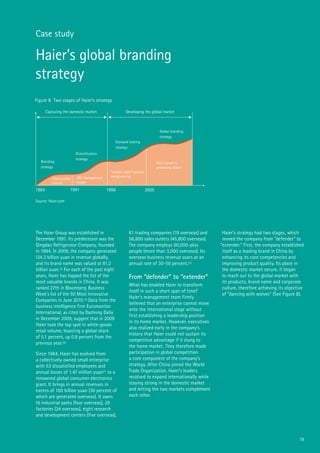
  • 14.
    14 Chinese enterprises havemade steadfast, impressive progress on the road to globalization, evidenced by their outward FDI, the diversity of investors, and the scope of such investments. Consider that China’s overseas investments have occurred in almost all industrial sectors. In recent years, mining, retail and wholesale, financial services and leasing have each accounted for more than 10 percent of these investments. In 2008, these industries accounted for a combined 86 percent (See Table 1). By contrast, share of manufacturing has decreased. China’s overseas investments in mining are of increasing strategic importance, as domestic demand for minerals and energy soars with the nation’s rapid economic development. At present, a significant proportion of China’s overseas investments has gone to mineral-rich Australia. According to China Economic Net, in 2009 China surpassed Japan as Australia’s second-largest foreign investor, and most of its investments flowed into the mining and energy industries. To be sure, China’s overseas investments in the retail and wholesale industry (mainly in trade), the financial services industry (primarily through the banking sector), and leasing and services (mostly through shareholding) have grown rapidly. However, these investments tend to be more scattered than concentrated. They are therefore small in scale at the firm level and do not reflect the typical characteristics of Chinese companies’ globalization effort. In contrast, China’s investments in the manufacturing, mining and energy industries show significant concentration and are dominated by a number of heavyweight enterprises. Most have resulted from high-profile mergers and acquisitions and joint investments. Our current research effort focuses on these investments.
  • 15.
    15 Industry 2004 20062008 1. Leasing and services 74,931 13.63% 452,166 21.36% 2,171,723 38.85% 2. Financial industry — — 352,999 16.68% 1,404,800 25.13% 3. Retail and wholesale 79,969 14.55% 111,391 5.26% 651,413 11.65% 4. Mining 180,021 32.74% 853,951 40.35% 582,351 10.42% 5. Transportation, warehousing, postal services 82,866 15.07% 137,639 6.50% 265,574 4.75% 6. Manufacturing 75,555 13.74% 90,661 4.28% 176,603 3.16% 7. Electric power, gas and water production and supply 7,849 1.43% 11,874 0.56% 131,349 2.35% 8. Construction 4,795 0.87% 3,323 0.16% 73,299 1.31% 9. Real estate 851 0.15% 38,376 1.81% 33,901 0.61% 10. Information transmission, computers and software 3,050 0.55% 4,802 0.23% 29,875 0.53% 11. Agriculture, forestry, animal husbandry and fishery 28,866 5.25% 18,504 0.87% 17,183 0.31% 12. Scientific research, technological services and geological surveys 1,806 0.33% 28,161 1.33% 16,681 0.30% 13. Residential services and other related services 8,814 1.60% 11,151 0.53% 16,536 0.30% 14. Water resources, environment and public facility management 120 0.02% 825 0.04% 14,145 0.25% 15. Hotel and catering industries 203 0.04% 251 0.01% 2,950 0.05% 16. Culture, sports and recreation industries 98 0.02% 76 0.00% 2,180 0.04% 17. Education — — 228 0.01% 154 0.00% 18. Health care, social security and social welfare 1 0.00% 18 0.00% 0 0.00% 19. Public administration and social organizations 4 0.00% — — — — Total 549,799 100% 2,116,396 100% 5,590,717 100% Source: China’s Outward FDI Statistics Report 2008 Table 1 Industrial distribution and share of China’s outward FDI 2004-2008 (in US$10,000)
  • 16.
    Continent 2005 20062007 2008 Total 1,226,117 100% 1,763,397 100% 2,650,609 100% 5,590,717 100% Asia 448,417 36.60% 766,325 43.50% 1,659,315 62.60% 4,354,750 77.90% Africa 39,168 3.20% 51,986 2.90% 157,431 5.90% 549,055 9.80% Latin America 646,616 52.70% 846,874 48.00% 490,241 18.50% 367,725 6.60% Oceania 20,283 1.70% 12,636 0.70% 77,008 2.90% 195,187 3.50% Europe 39,549 3.20% 59,771 3.40% 154,043 5.80% 87,579 1.60% North America 32,084 2.60% 25,805 1.50% 112,571 4.20% 36,421 0.70% Continent Investment coverage Overseas businesses As a percentage of total overseas businesses Asia 90% 6,000 51.2% Africa 81% 1,600 12.9% Europe 74% 2,000 16.3% North America 75% 1,400 11.3% Latin America 55% 600 4.8% Oceania 42% 400 3.5% Figure 5 Overseas M&As by Chinese enterprises 2000 2001 2002 2003 2004 2005 2006 2007 2008 2009 0 50 100 150 200 250 300 4.70 4.52 10.47 149.04 63 302 175 16.47 11.25 52.79 350 Source: UNCTAD M&A statistics for 2000-2006, Chinese Ministry of Commerce statistics for 2007-2009 Overseas M&As (100 million US dollars) 16 Source: China’s Outbound FDI Statistics Report 2008 Source: China’s Outbound FDI Statistics 2008 Table 2 Geographical distribution and share of China’s outward FDI 2003-2008 (in US$10,000) In addition to Australia, Asia has become a magnet for Chinese outward FDI. From 2005 to 2008, Chinese investments in Asia as a share of total investments climbed nearly 40 percent, whereas those in Latin America dipped by 46 percent (See Table 2). Recipients of Chinese investments also show increasing diversity. For example, the list of countries and regions receiving more than US$100 million of such investments expanded from just three in 2003 (Hong Kong, the Cayman Islands and the British Virgin Islands) to 22 in 2008. That year, Hong Kong, South Africa, the British Virgin Islands, Australia, Singapore and the Cayman Islands each received more than US$1.5 billion of Chinese investments. 2. Strategies for Chinese overseas investments have changed Notable changes have emerged in the means by which Chinese enterprises make foreign investments. In particular, the number of businesses established overseas by Chinese companies has risen. By the end of 2008, 8,500 Chinese companies had set up 12,000 businesses in 174 countries and regions throughout the world, over half of which were located in Asia. Globally, Chinese investors established businesses in 71.9 percent of the world’s countries and regions, with continents ranking as follows from high to low: Asia, Africa, Europe, North America, Latin America and Oceania (See Table 3). Table 3 Distribution and investment coverage of Chinese enterprises’ overseas businesses, 2008
  • 17.
    Figure 6 Theglobalization process of Chinese enterprises (Number of respondents (%)) Not intending to engage in overseas business in two years 6% Currently engaged in overseas business 89% Source: Questionnaire surveys by Accenture and the China Enterprise Confederation, May-August 2010 Planning on overseas business in two years 5% Figure 7 Ways of doing overseas business (Choose those that apply; the votes obtained are added up) Source: Questionnaire surveys by Accenture and the China Enterprise Confederation, May-August 2010 45 41 33 32 13 10 3 Export agents or establishment of export posts Establishment of branches/ representative offices Establishment of overseas sales branches/subsidiaries Overseas production Establishment of overseas business units/operating centers Overseas research and development Others 17 Also, transnational mergers and acquisitions have emerged as the leading means of overseas investments by Chinese enterprises (See Figure 5). According to UNCTAD statistics, China’s overseas M&As reached US$470 million in 2001, with jumps observed in 2005 and 2006. China’s Outward FDI Statistics Report suggests that in 2003, 18 percent of the country’s overseas investments were in the form of acquisitions; another 14 percent, in equity investments. In 2008, 54 percent of these investments were accomplished through mergers and acquisitions; the figure decreased to 40.4 percent in 2009. Drawing on published information and statistics, we found that the number of M&A deals involving Chinese investors was 41 in 2008, 48 in 2009 and 29 in the first six months of 2010. Chinese private companies have been increasingly involved in these agreements, but their investments have remained relatively small. State-owned enterprises have made the lion’s share of such investments. China’s M&A efforts have been concentrated in mining, energy, manufacturing and IT; 16 of the 20 major M&A deals from January 2008 to June 2010 occurred in mining and energy (See Table 4). By industry, the geographic concentration of such agreements is as follows: mining and energy industries in Australia, Canada, Africa and certain Latin American countries; IT, semiconductors and other high- tech industries in the United States, Hong Kong, Taiwan and Japan; and manufacturing in the United States and other advanced European countries. The growth of China’s economy has helped spur its increasing participation in the globalization process. Of the 89 Chinese enterprises that responded to our surveys, 89 percent indicated that they are currently conducting overseas business. Another 5 percent plan to have overseas operations in five years. At present, the major ways of doing overseas business are through export agents or the establishing of export departments, followed by the setting up of overseas representative offices. Establishing overseas sales companies is the third most common means. Clearly, exporting is still the major focus of Chinese firms (See Figure 6 and Figure 7).
  • 18.
    No. Time AcquirerAcquiree Country/ region Investments Equity/ assets acquired Industry 1 2008.1 Chinalco Rio Tinto Great Britain 14 billion USD 9% Mining 2 2008.4 China Ping’an Fortis Investment Management Co. Belgium 2.15 billion Euros 50% Investments 3 2008.6 China Merchants Bank Wing Lung Bank Hong Kong 17.2 billion RMB yuan 53.12% Commercial banking 4 2008.7 China Huaneng TuasPower Singapore 4.24 billion Singapore dollars 100% Traditional energy 5 2008.7 China Oilfield Services AWO OS Norway 2.5 billion USD 100% Traditional energy 6 2008.9 Sinopec Tanganyka Canada 2 billion USD 100% Traditional energy 7 2009.4 CNPC JSC Mangistaumunaigas Kazakhstan 3.3 billion USD 100% Traditional energy 8 2009.6 Sinopec Addax Switzerland 49.5 billion RMB yuan 100% Traditional energy 9 2009.6 China Minmetals Corporation OZ Minerals Australia 1.35Billion USD Mineral Assets Mineral Resources 10 2009.7 China Investment Corporation Teck Resources Canada 1.74 billion Canadian dollars 17.2% Mining 11 2009.8 Yanzhou Coal Mining Felix Resources Australia 19.8 billion RMB yuan 100% Mining 12 2009.8 CNOOC Kosmos Energy Ghana 3-5 billion USD N/A Traditional energy 13 2009.9 Sinochem Nufarm Australia 16.3 billion RMB yuan N/A Agriculture 14 2009 PetroChina Merapoh Malaysia 10 billion USD Refining project Traditional energy 15 2009 PetroChina Athabasca Oil Sands Corp. Canada 1.9 billion Canadian dollars Right to extract 60% oil sands) Traditional energy 16 2009 PetroChina Arrow Australia 3.5 billion Australian dollars 100% Traditional energy 17 2009 Ansteel Gindalbie Metals Australia 1.7 billion Australian dollars 190 million shares Mining 18 2010.3 Geely Volvo Cars Sweden 1.8 billion USD 100% Automobile 19 2010.5 CNOOC Bridas Latin America 3.1 billion USD N/A Energy resources 20 2010.6 Bright Food CSR subsidiary Australia 1.75 billion Australian dollars Sugar and renewable energy business Foodstuffs 18 Table 4 Top 20 M&A deals involving Chinese enterprises, January 2008-June 201017 Source: Online content at: http://www.investide.cn/case/investCaseDetail.do?investCaseId=10107, http://www.investide.cn/case/investCaseDetail.do?investCaseId=10108 and other published information.
  • 19.
    19 Case study Haier’s globalbranding strategy The Haier Group was established in December 1991. Its predecessor was the Qingdao Refrigerator Company, founded in 1984. In 2009, the company generated 124.3 billion yuan in revenue globally, and its brand name was valued at 81.2 billion yuan.18 For each of the past eight years, Haier has topped the list of the most valuable brands in China. It was ranked 27th in Bloomberg Business Week’s list of the 50 Most Innovative Companies in June 2010.19 Data from the business intelligence firm Euromonitor International, as cited by Dazhong Daily in December 2009, suggest that in 2009 Haier took the top spot in white-goods retail volume, boasting a global share of 5.1 percent, up 0.8 percent from the previous year.20 Since 1984, Haier has evolved from a collectively owned small enterprise with 53 dissatisfied employees and annual losses of 1.47 million yuan21 to a renowned global consumer electronics giant. It brings in annual revenues in excess of 100 billion yuan (30 percent of which are generated overseas). It owns 16 industrial parks (four overseas), 29 factories (24 overseas), eight research and development centers (five overseas), 61 trading companies (19 overseas) and 58,800 sales outlets (45,800 overseas). The company employs 60,000-plus people (more than 3,000 overseas). Its overseas business revenue soars at an annual rate of 30-50 percent.22 From “defender” to “extender” What has enabled Haier to transform itself in such a short span of time? Haier’s management team firmly believed that an enterprise cannot move onto the international stage without first establishing a leadership position in its home market. However, executives also realized early in the company’s history that Haier could not sustain its competitive advantage if it clung to the home market. They therefore made participation in global competition a core component of the company’s strategy. After China joined the World Trade Organization, Haier’s leaders resolved to expand internationally while staying strong in the domestic market and letting the two markets complement each other. Haier’s strategy had two stages, which moved the company from “defender” to “extender.” First, the company established itself as a leading brand in China by enhancing its core competencies and improving product quality. Its place in the domestic market secure, it began to reach out to the global market with its products, brand name and corporate culture, therefore achieving its objective of “dancing with wolves” (See Figure 8). Figure 8 Two stages of Haier’s strategy Source: Haier.com 1984 1991 1998 2005 Capturing the domestic market Developing the global market Branding strategy Total quality control OEC management model “market chain” process reengineering The T model in processing orders Diversification strategy Outward looking strategy Global branding strategy
  • 20.
    20 Capturing the domesticmarket Haier implemented its branding strategy from 1984 to 1991, focusing its time and energy on building up a refrigerator brand name. In 1988, the company was awarded a gold medal for product quality--the first of its kind ever awarded in China’s refrigerator industry. At the same time, Haier accumulated experience in managing refrigerator production lines. From 1991 to 1998, Haier carried out its diversification strategy. Having made its name with its refrigerators, the company set out to transfer its operational expertise to other product lines. To do so, it revitalized the industry’s “shocked fish” (enterprises that were well equipped but poorly managed) through a series of low- cost mergers. Its goal? Establish a “fleet,” rather than a handful, of well-branded products in the home-appliances market. Developing the global market By 1998, Haier was the undisputed leader in China’s home-appliance industry. However, domestic and international competition was intensifying. Rivals were upgrading their offerings. And consumers were growing increasingly sophisticated in their demands. Under these conditions, Haier could not afford to rest on its laurels. The company promptly set its sights on the international market. Haier initially focused its global market strategy on exports, realizing the importance of gaining a foothold in the overseas markets. It then took its globalization effort to the next level by constructing research and development centers, sales and distribution channels and after-sale service networks around the world. These constituted the company’s localized operations. In implementing its global growth strategy, Haier took a “difficult to easy” approach, selecting foreign markets with meticulous care. It first set its sights on the hard-to-penetrate US market, characterized by mature technologies and varied consumer demand. By doing so, it established a solid reputation for its brand name in the world’s developed markets. Its successful experience in the United States would serve as a model for its expansion in other countries and regions. In 1998, Haier founded its industrial park in the United States and a refrigerator manufacturing facility in South Carolina, thereby achieving localized production. In 2001, it set up another industrial park in Pakistan, also a production center. At the end of 2005, Haier began pursuing a customer-centric approach to its global growth strategy, realigning internal resources to serve customer needs. For example, it created the T model, whereby teams try to create value for customers on a specific link and timing of the value chain by fulfilling certain targets on time through collaboration.23 (To illustrate, T = manufacturing day; T-10 = order placement day; T+20 = container loading day.) The collective task of meeting customer demands can be broken down to each individual’s responsibilities, and each person’s efforts aggregate into overall company performance. Individual employees and a customer’s “order form” are thus combined into one. Haier’s Chinese name for this model—ren dan heyi—means “unity of people and customer order.” The company’s global branding strategy was one step ahead of the outward- looking international strategy. While “outward looking” views China as a base reaching out to the outside world, global branding focuses on creating localized brands in every market into which Haier had made inroads.
  • 21.
    21 Three steps toglobalization In 1999, Haier defined a three-step strategy of “going out, going inside, and going upward.” This strategy would complete the company’s globalization process by establishing its capabilities for globalized operations and laying a solid foundation for becoming a prestigious local brand in every market Haier entered (See Table 5). By 1999, Haier had established its global presence. Consider these highlights in the Haier story: • The United States: (the first stop in Haier’s road to globalization): In 1998, Haier established a research and development center in Los Angeles, an industrial park in South Carolina and a sales center in New York City. • Europe: In 2001, Haier took over a refrigerator manufacturing facility under Italy’s Meneghetti Company (the first transnational M&A case involving a Chinese home appliance manufacturer). Earlier, Haier had established R&D centers in Italy, the Netherlands, Germany and Denmark. It had also constructed a sales and distribution center in Italy’s Milan. • South Asia: In 2001, Haier set up an industrial park in Pakistan and in 2006 established the Haier-Ruba Economic Zone. By 2005, the company owned nearly 3,000 sales outlets and 14 exhibition halls in India. In 2007, its manufacturing facility in India became operational. • Africa: In 2000, Haier and Great Britain’s PZ Group established a joint venture in Nigeria for assembling and marketing Haier-Thermocool product line. In June 2007, Haier’s largest exhibition hall in Nigeria opened in Victoria Island, the business center of the capital city of Lagos. • ASEAN: In July 2005, Haier established an exhibition hall in Malaysia. In April 2007, it acquired the Refrigerator Factory from Sanyo in Thailand. • Oceania: Haier is currently purchasing local manufacturing shares in New Zealand and Australia. (In 2009, it acquired FPA, New Zealand’s famous home appliances manufacturer.) Haier is also forming alliances with local marketers. “Going out” “Going inside” “Going upward” Timeline 1990—1999 2000—2006 2007—2010 Objective Enter mainstream markets in Europe and North America Enter mainstream channels in the mainstream markets Become local mainstream brand Difficulties • Low brand recognition; “made in China” not widely accepted in international market • Insufficient understanding of the European and North American markets • Insufficient sales networks and low energy consumption standards • Localized design falling short of consumer requirements • Limited resources for channel construction and advertising • Lack of understanding of consumers • Consumer demand becoming more sophisticated and individualistic Solutions • Expand overseas markets mainly through exports • Take advantage of local small distributers and retail stores • Fully utilize low-cost advantage • Keep products affordable • Develop niche products • Establish overseas production facilities • Form localized operational system combining design, production and marketing • Enter mainstream channels • Develop mainstream products • Create localized brands • Implement “Resource for resource” strategy, gaining global resources by exchange of domestic resources • Establish stable relationships with big local customers • Differentiate brand to make it well known locally • Develop high-end products Table 5 Haier’s three-step globalization strategy
  • 22.
    22 Case study Holley Group,founded in September 1970, is a diversified enterprise with pharmaceuticals as its core business.24 It currently owns factories, industrial parks and more than 20 sales outlets in other countries, and its products are sold in 120 nations and regions. Exports and imports account for 15 percent of its revenues. It employs more than 10,000 people worldwide.25 Holley started off mainly as a manufacturer of electric meters and commands 40 percent of China’s domestic market for these products. Having experienced explosive growth in the 1990s, Holley began facing stiffer competition on its home turf. China has more than 600 meter manufacturers. The company had to seek new opportunities for growth, and it opted for product diversification. Holley entered the pharmaceuticals industry by acquiring the Kunming Pharmaceuticals Company and Wuhan Jianmin Pharmaceutical Group, and by reconfiguring its internal business.26 In 1999, Holley defined its “international strategy for the 21st century,” which had several components: • Independently develop international brands. Holley’s leaders believed that creating an internationally recognized brand name would be more important than merely selling its products in the international market. It has accomplished this by registering the Holley brand name in its major overseas markets and potential markets, doing so in more than 100 countries to date. Since 2000, 95 percent of the company’s electric- meter exports bear the Holley brand. The independent branding strategy has sharpened the group’s competitive edge. • Take advantage of synergies in overseas sales outlets. Holley owns more than 20 overseas sales companies or agencies. Each deals in Holley’s products as well as other companies’ products, including electric meters, pharmaceuticals, cable and satellite receivers. This has not only increased the sales companies’ revenues but also expanded other Chinese companies’ overseas sales. • Localize talent. Holley relies heavily on local partners and recruits talent locally. At the same time, it encourages Chinese employees stationed overseas to settle there. When the company first implemented its strategy of “going out,” it tightly controlled its expatriates; for example, requiring them to live in dorms and forbidding them from socializing with foreigners at night. Gradually, its management philosophy shifted. For example, it now encourages expatriates to learn the local languages and assimilate into the surrounding society. And it allows them to live in rented houses as well as socialize with local colleagues and friends. Indeed, since this change, six or seven such employees married local people, and many of them have stayed overseas for more than 10 years. • Shift from manufacturing to services. The year 2006 saw Holley’s creation of the Thai-Chinese Rayong Industrial Zone, with a planned area of 4 square kilometers. The first phase of the project, with an area of 1.5 square kilometers, has now been completed, with road, utilities and other infrastructure ready for industrial use. More than 20 Chinese enterprises have set up factories there, with combined investments totaling US$170 million. The industrial zone created a thriving ecosystem for other Chinese companies investing there.27 Its success has bolstered Holley’s confidence, and plans for another zone in Indonesia are now in the works. • Move from wholly owned to joint venture. Holley usually chose to work alone when it first went global. However, as its overseas business grew more complex, it felt the need to partner with other players (for example, through joint ventures) to navigate in an unfamiliar business environment. The company adopted the strategy of allying with local partners, especially for projects that required coordinated efforts among multiple parties and that were under government regulation. The Thai-Chinese Rayong Industrial Zone, for instance, is collaboration between the company and its Thai partners. The project has proceeded smoothly, thanks to the local partners’ social and political networks. Despite Holley’s successes, its globalization journey has not always been smooth. Volatile market conditions and companies’ unpredictable responses to change have introduced obstacles. For example, in 2001, to gain a foothold in the telecommunication-equipment sector, Holley purchased the US-based CDMA chip R&D center from Philips in an attempt to get access to the CDMA core technology. With this move, it hoped to acquire a competitive advantage in the telecom value chain by combining technology with the vast application market in China. However, things did not pan out as Holley had hoped. First, Philips and Qualcomm had certain cross- licensing agreements on CDMA chips, and most 3-G-related CDMA patents are in the hands of Qualcomm.28 As a result, Holley found it more difficult than it had expected to gain access to some key 3-G related technologies. Second, China’s domestic 3-G market had been slow in getting under way, so it took longer to realize the financial benefit of the investment. Third, as a newcomer to the communications industry, Holley found it difficult to manage an R&D center located as far away as the United States As a consequence, communication between engineers and researchers and the management team suffered. The company also saw its operating costs skyrocket. By 2005, Holley had achieved breakthroughs in its pharmaceutical business, which had grown large enough to become the company’s core offering. Pharmaceutical products accounted for 50 percent of its revenues. Holley redirected its strategy, cut back on the operations of its CDMA R&D center and relocated the center’s main operations to China. Holley Group’s corporate transformation through globalization
  • 23.
  • 24.
    24 Chinese companies seekingto globalize face numerous strategic questions— including why the company should go global, what businesses it should engage in, where it should locate its global activities and operations, and what means of investment the company will use to conduct business globally. The goals of globalization and the industries in which companies compete will influence the answers that executives generate for these strategic questions. 1. Why should our company go global? Globalization has now become an inevitable trend for Chinese enterprises. In the post-crisis era, in particular, globalization enables Chinese companies to achieve performance breakthroughs and fuel long-term development. A globalized firm has access to more resources, wider markets, more diversified talent and a more innovative environment. However, Chinese businesses have gone global for a set of distinctive strategic reasons and motivations. The “breakthroughs” they seek by way of globalization therefore have multiple meanings – breaking threats to their survival, breaking limitations to development, breaking their reliance on certain growth paths and breaking their traditional status as followers rather than leaders. Our observation reveals four different motivations behind Chinese companies’ push for globalization. Reduce threats to survival The global financial crisis presented Chinese enterprises with immense challenges; some businesses’ very survival was threatened. Export processing enterprises, represented by the traditional OEM manufacturers of apparel and toys in the Pearl River Delta, have borne the brunt of the crisis, owing to their lack of adequate domestic sales and marketing systems, insufficient capabilities for innovation and reliance on foreign orders. As many countries raised trade barriers during the recession, numerous Chinese exporters faced a shrinking international market and the specter of bankruptcy. At the same time, countries including India and Vietnam increasingly became the destination of choice for multinational corporations seeking cheap labor, a trend that has eroded China’s labor- cost advantage. Under these worrisome circumstances, many export-oriented businesses have decided to go beyond China’s national border and capture host countries’ markets by establishing local production and distribution channels or leveraging those countries’ low-cost advantage. For example, one Chinese company runs an industrial park in a Southeast Asian country jointly with a local partner. The executives from the company revealed that the majority of investors setting up businesses in the park were Chinese enterprises. Some Chinese businesses quickly signed leasing contracts because their exports from China to the European and US markets faced anti-dumping investigations. They had to relocate their businesses quickly to a third country to avoid disruption to exports.29 Expand space for development Although the global economy remains sluggish, China has a vast number of ambitious and pioneering enterprises that are experiencing a growth spurt or have remained stable and strong. The global devaluation of assets in the post- crisis era has created a rare opportunity for these companies to expand their overseas markets and leverage those markets’ resources. At the same time, other Chinese enterprises are following suit because of saturation of the domestic market, vicious competition or dearth of critical resources. For instance, competition within China’s construction industry has intensified, especially with the entry of foreign construction contractors. In the face of shrinking profitability, many construction companies, such as the China Construction Engineering Corporation and the Anhui Construction Group, have chosen to go global. Ambitious and strong firms have decided to globalize to escape the constraints of the home market and maximize their development on the global stage. Move up the value chain Moving up the value chain can help Chinese businesses improve their profitability and achieve sustainable development. But deficiency in capabilities in business functions such as financing, research and development, production, branding and marketing has limited these companies’ ability to move up the value chain. Globalization provides the necessary conditions for Chinese enterprises to optimize their operations and extend their value chain. The Chery Company, for instance, has promoted its products in the EU and North American markets while meeting the domestic need for low-end cars. (See “Case study: A tale of two Chinese automakers..”) The Haier Group, on the other hand, pursues globalization through the “resource for resource” approach, thereby extending its value chain from its main line of products to high-end products. Become a global player Since China’s movement toward reform and opening up, foreign investments have flowed into the country and have brought advanced technologies and managerial expertise. Most Chinese enterprises were passive recipients of these new experiences at first. Some gradually became active followers of best practices. As China is more and more integrated into the world economy, Chinese companies are no longer content to follow and compete in the domestic market. Going global is the right choice for Chinese enterprises seeking to develop and excel today. Since the launch of the “going out” strategy in the mid-1990s, the Chinese government has consistently supported enterprises of various ownership structures in their efforts to engage in international economic activity and technological cooperation and to build global brand names. The global financial crisis in 2008 created the opportunity for Chinese enterprises to “go out” further. Blessed with favorable conditions, a large number of visionary companies are pursuing globalization in an effort to become multinational companies with international brand names. The Chery Company, in expanding to overseas markets, will focus on the long-term objective of constructing an international brand name. The Wanxiang Group has also established its “going “For CSR, [competing] in the global market today means [our] survival and development tomorrow.” Zhao Xiaogang, Chairman, CSR Corporation Ltd.30
  • 25.
    25 out” strategy ofusing overseas resources and achieving localized operations. Depending on its objective, each enterprise has its own unique place, and plays a distinct role, on the global stage. Our research has identified five types of globalized enterprises setting forth from the emerging markets: • Full-fledged globalizers are comparable to big Western multinationals with long histories and deep-rooted traditions. Examples include the Tata Group of India and CEMEX of Mexico. • Regional players have set their sights on neighboring markets, at least for the time being, owing to cultural and geographical affinity. However, they strive to break through their home market to enhance profitability. Examples include VinaCapital of Vietnam and PKO BP of Poland. • Global sources, while focusing on sales in their home market, make international purchases of raw materials and semi- products to cope with domestic resource constraints. These companies are concentrated in the energy and bulk- commodities sectors. Examples include CNOOC of China and Reliance Petroleum Limited of India. • Global sellers, unlike global sourcers, focus on domestic manufacturing for the overseas market. SUEK of Russia is one example. • Multi-regional niche players draw on innovative technologies or processes to specialize in operations in a number of regions. Examples include the business service and technology firm MDS Holdings of Lebanon and the specialized 3-D display technology manufacturer Holografika of Hungary. (Its CEO labels Holografika “a small global company.”32) Regardless of to the motivation to go global, the strategic purposes of globalization invariably consist of several key elements—namely, overseas markets, raw materials, talents, technologies and international brand names. Responses to our surveys indicate that the globalization strategies pursued by Chinese enterprises have centered on these elements with varying degrees of emphasis. At present, developing overseas markets is still the major motivation behind the decision to go global (See Figure 9). 38.7% 16.1% 9.1% 9.0% 7.1% 6.1% 5.6% 2.7% 1.9% 1.9% 1.8%Eschewing trade barriers Reducing cost pressure Reducing risks Accelerating capital flows and operations Responding to the trend of economic globalization Expanding sales Obtaining international managerial talents and expertise Obtaining advanced technologies Acquiring raw materials and resources Establishing self-owned international brand names Developing the overseas market Figure 9 The main aims of globalization (Select three items, which are weighted in order of importance: most important=0.5, important=0.3, least important=0.2. The marks obtained for each of the three are divided by the total marks.) Source: Accenture and China Enterprise Confederation Questionnaire Surveys, May-August 2010 “Globalization represents the third pioneering effort of the Sany Group. Without globalization, we would be small.” He Zhenlin, Vice President, the Sany Group31
  • 26.
    26 While constructing anoverall globalization strategy from a long- term perspective is essential, it is equally important that an enterprise approach globalization in line with its current situation and objectives. More specifically, companies need to consider such factors as their capabilities, stage of development and characteristics of the industries in which they compete in formulating globalization strategies. Otherwise, globalization will remain out of reach or could even endanger an enterprise’s development. While globalization is a worthy goal, a firm should not pursue it merely for its own sake. Of the enterprises that responded to our surveys, most indicated that they have finalized globalization moves of one sort or another or plan to do so within two years, but 6 percent said they have no plans for globalizing within the next two years. Evidently, globalization is not the only road worth pursuing. Regardless of the objectives globalization is intended to support, success requires a leadership team with a vision and capabilities for globalization. The ultimate goal of any enterprise is to create value. Strategies that do not contribute to value creation are unjustified, however grand they may appear. Therefore, the material result of a globalization strategy ought to be enhanced international competitiveness and the creation of value for stakeholders. 2. What businesses do we want to compete in? In addition to assessing desired outcomes of globalization, companies must ask, “What kinds of overseas businesses do we want to engage in?” Companies achieve global growth in various ways but mainly through the following stages: 1. Relocating existing lines of business overseas. This approach enables optimization of a company’s current operations to reduce costs and improve profitability, thus ensuring sustainable development. Coca-Cola setting up production lines in China is an example of this model. It is true to the majority of companie’s overseas busineses. 2. Extending the value chain downstream or upstream, or moving up the value chain. By adopting this approach, an enterprise enlarges its sphere of business in its own industry through expansion of the activities in which it engages.34 For instance, Google, which generates the bulk of its income through online advertisements, has taken a major step by establishing Google Wave, a shared space on the Web where people can collaborate using richly formatted texts, photos, videos, maps and more. This product has significantly expanded Google’s advertising business. 3. Developing new business in a new environment. GE offers an apt example of such transformation. The company has made breakthrough innovations in emerging markets by designing portable and affordable medical instruments. For instance, it has developed portable electrocardiographic equipment priced at US$1,000.00 for the Indian rural market and portable ultrasound equipment priced at US$15,000.00, for the Chinese rural market. In the process, GE has reaped huge profits in these emerging markets and has fueled growth by bringing these low-end products back to the US market.35 Few globalizing Chinese enterprises have reached the stage of developing new businesses in new environments. Notable exceptions include the Holley Group and the Haier Group, which have established industrial parks overseas. While some enterprises cling to their original line of business, many others strive to extend their value chain. In an interview with us, the senior manager of one enterprise said that his company had gone global by establishing a global value chain rather than by exporting its products to the global market. We believe that this approach has great merit. An enterprise’s value chain represents the various processes involved in the production of goods (and services)—from research and development to the acquisition of raw materials, and from production and marketing to final delivery of products. It also represents the various activities the enterprise undertakes to generate profits and strengthen its competitiveness. A company establishes its core competencies by enhancing various capabilities while managing and developing its value chain. The value chain varies from enterprise to enterprise. In setting up a globalization strategy, a business should first analyze its comparative strengths and weaknesses in terms of resources and capabilities, and then determine which links in the value chain should go global. Innovation is a primary consideration for the majority of Chinese enterprises— it is the only avenue through which they can expand to the global market, extend from the low end to the high end of the value chain and therefore achieve profitability and sustainable development. Amid a volatile international business environment and rapid technological advances, it is imperative that Chinese enterprises fundamentally improve their managerial and innovation capabilities to become truly globalized players. “An enterprise should think through and be clear about what it wants to achieve by globalization. The financial crisis has led many export-oriented companies to realize the importance of market. Foreign companies flock to China because China is a big market. An enterprise may not necessarily have to go the harder way of globalization; it may not be so late for it to do so when it has been well established in the domestic market.” Liu Chuanzhi, Chairman, Lenovo Group33
  • 27.
    27 To maximize profitability,Chinese companies must become more innovative in research and development, marketing, brand construction and other key business functions.36 They used to compete on cost and price, without core innovative technologies or independent brands, and seldom broke into the highly profitable service sectors. Most Chinese primary equipment manufacturers, for example, are at the bottom of the global value chain, with their profits accounting for less than 5 percent of the value of their products. At a time when the global economy and the manufacturing industry are in a critical period of recovery, Chinese enterprises need to shift their products’ reputation from “Made in China” to “Made with China” or “Created in China.” Such a transformation is crucial for Chinese businesses seeking to own world-class brands and thus feature more prominently in the global economic landscape. To access advanced technologies and upgrade their value chain, more Chinese enterprises are focusing their research and development efforts in North America and Europe. Some have taken on independent technologies and absorbed technological advances in developed countries by means of overseas mergers and acquisitions or the establishment of R&D centers or labs in other countries. Gree Air Conditioners, for instance, successfully developed an advanced air-conditioning technology following its failure in 2001 to purchase such technology from a Japanese company. The company has long insisted on mastering core technologies to support its development strategy. It does not set a ceiling for R&D expenditures, and it became the first in its industry to establish three research institutes devoted to medium- and long-term research in sophisticated technologies. It has moved on from medium- and low-end manufacturing, and is the global bellwether in air-conditioning technologies.37 Other enterprises, by contrast, have acquired advanced manufacturing technologies, managerial expertise, sales channels, customers, markets and even brands by purchasing overseas peers that are technological leaders. For example, in April 2010, the Chongqing Machinery and Electronics Company acquired the UK-based Precision Technologies Group (PTG) for £20 million. The company plans to pump £10 million into PTG in the next several years to strengthen its competitiveness in the machine-tool product area. PTG, which owns two factories in the UK, has provided the Chongqing Machinery and Electronics Company with precision machinery manufacturing technologies, thereby enhancing Chongqing’s technological and managerial prowess.38 “The first phase of our strategy is a global market for our products, and the second phase is a global brand.” Wu Fei, General Manager of COFCO Wine39
  • 28.
    28 Case study A taleof two Chinese automakers The year 1997 will go down as a shining page in the history of China’s automobile industry. In March of that year, the Chery Motor Company broke ground. Also in 1997, the Geely Company, which had started in the refrigerator components business, declared its entry into the automobile industry. The two companies have striking similarities. Both had begun by developing cars targeted to the masses and following a low-price strategy. They adopted this approach because of the large gaps between them and their foreign counterparts with regard to technological levels, brand value and market influence. Because multinational automakers’ prices were relatively high, middle-income Chinese families could not afford them. Chery and Geely concentrated on the medium- and low-end segments of the market for middle-income Chinese families, carving out a narrow space for themselves in the crowded and highly competitive auto market. The two companies have also tried to push into the global market. China accounted for no more than 10 percent of the global automobile market in the late 1990s, so a Chinese automaker had to go global to achieve world- class status. Yin Tongyue, Chairman of Chery Company, noted, “The Chinese auto market is a small part of the global market though it grows fast.”40 Li Shufu, Chairman of Geely Company, pointed out, “China’s auto industry has got to participate in global market competition in order to improve its competitiveness.”41 Both started to “go out” by selling their products on the world market. Owning independent brands, they could decide where to export. Unlike partners in a Chinese- foreign joint venture, which is limited by foreign partners’ global strategies, Chery and Geely took globalization into their own hands. In October 2001, Chery began exporting its sedans to Syria. In August 2003, Geely also began to export its sedans.42 However, the two businesses chose different paths to expand into the global market. Chery took the incremental approach of emphasizing exports, green- field development and independent research and development. In contrast, Geely chose the more radical strategy of strengthening itself through overseas mergers and acquisitions—swiftly increasing its scale and market presence. Spotlight on Chery The Chery Company has spread its wings overseas cautiously. Its chairman, Yin Tongyue, sees overseas M&A as risky, especially when it comes to the integration of diverse corporate cultures. Consequently, Chery has focused on organic growth.43 It reached out to the overseas market in a substantial way in 2004 and established a specialized international company for its export business. The destinations of its products initially included the Middle East, Southeast Asia and Africa, and slowly expanded to include Russia, Southeast Europe and Latin America. Chery targeted medium- and low- income consumers in these countries and regions. And it refrained from entering the West European and North American markets, which set more rigorous quality and environmental standards.44 Chery began building factories overseas in 2006. In light of financing and operational risks, it chose to embark on this building effort jointly with local partners. In exporting products, it insisted on constructing CKD (complete knock down) or SKD (semi-knock down) assembling facilities with these partners. Such localized production,
  • 29.
    29 which contributed tolocal taxation and employment, largely protected Chery from local trade protectionism.45 In 2008, the Chery Company sold 356,000 cars, winning fifth place on China’s passenger-car sales chart. For the 10th consecutive year, it was the champion in sales of domestic brand products. About 135,000 of the cars it sold were exports, which made Chery the No. 1 auto exporter for the sixth year running. The company is now firmly established in Asia, Europe and Africa, with localized production and selling in countries including Thailand, Russia, Argentina and Uruguay. Its products have reached more than 70 countries and regions.46 Spotlight on Geely In contrast to Chery’s methodological approach, the Geely Company has globalization more energetically. In October 2006, it signed a deal with UK-based Shanghai Maple and Manganese Bronze Holdings (MBH) to jointly produce brand-name taxicabs. By acquiring a shareholding stake in MBH, Geely obtained related car- manufacturing technologies and, most important, sales channels in Europe for its independent brand products. Also, it could take advantage of MBH’s after- sales services in the UK and in Europe overall.47 In June 2009, Geely plunked down 54.6 million Australian dollars to acquire the Australian automatic gearbox maker Drivetrain Systems International Pty Ltd. (DSI), which was under bankruptcy protection. As one of the two independent manufacturers of automatic gearboxes in the world, DSI had strong design, R&D and production capabilities. The move significantly improved Geely’s technological and production capabilities in the area of automatic gearboxes. In addition to meeting its own demand for gearboxes, it supplied these products to other automakers. The acquired business had strategic importance for Geely’s core car manufacturing business. Indeed, the acquisition helped Geely to upgrade its value chain.48 In March 2010, Geely completed the purchase of Volvo Cars from Ford Motor Co. with a hefty US$1.8 billion, acquiring 100 percent of Volvo’s equity and related assets (including intellectual property rights). The deal constituted the biggest overseas acquisition ever by a Chinese automobile manufacturer.49 Geely maintained that the acquisition met its strategic needs in an age of globalization. It expects to create high-end products as quickly as possible and therefore improve its international visibility, by relying on Volvo Cars’ core intellectual property rights, brand value and market position. However, Geely faces formidable challenges in integrating Volvo Cars’ advanced management systems, establishing a cross- cultural management team and making Volvo Cars’ technologies and brand name entirely its own. Wang Ziliang, Vice President of Geely, noted that Geely’s acquisition was made with the company’s unique situation and needs in mind, and that acquisition for acquisition’s sake is meaningless.50 However, inking the deal is only the first step. The post-merger integration process, upon which the acquisition’s long-term success hinges, is anticipated to be protracted. The Chery Company and the Geely Company have taken diverse approaches to globalization not only because of the differences in their strategic orientations, management philosophies, market positioning and corporate cultures, but also because of the differences in their leadership styles and preferences.
  • 30.
    30 3. Where shouldwe locate our global businesses? Executives at globalizing Chinese firms take into account their globalization objectives to decide where to locate their global business. Companies seeking to acquire resources have to go where such resources are abundant. Those whose main purpose is market expansion need to go where their target markets are large enough. Enterprises most concerned about avoiding trade barriers must go to third-party countries or regions through which they can access their target markets. Those whose primary aim is the acquisition of innovative technologies have to go to countries where businesses possess considerable technological strengths. Political, cultural, social and linguistic factors also influence the geographical choice of enterprises seeking to globalize. For instance, some executives we interviewed defined Southeast Asia as an ideal destination for their investments, noting that it is home to a substantial ethnic Chinese population, which facilitates communication and management. Others said that they would not attempt to do business in countries that are not friendly to China. In deciding where to go, executives should gain a thorough understanding of a potential market’s competitive strengths, products and availability of opportunities. Integration of cross- regional resources optimizes an enterprise’s portfolio of resources and thus sharpens its competitive edge. According to Bruce Kogut’s global strategy model on comparative strengths and geographical choice, an enterprise should give capital and human resource inputs primary consideration in deciding where to locate their global business activities. Capital and human resource inputs are closely correlated with countries and industries. For example, countries have different cost structures in areas of taxation, tariff, transportation, salary and so forth. Various industries require different levels of inputs in capital and human resource. Businesses can formulate their geographic strategy based on their industry’s defining characteristics, their own competitive advantage and whether they follow a capital- or labor-intensive strategy. Thus, they can choose to locate their business in developed countries, emerging markets or developing countries51 (See Figure 10). Developed countries, which enjoy comparative strengths in talent and capital, have industries concentrated in digitized production and manufacturing, services and product research and development. In contrast, developing countries generally have cheap and abundant labor and hence have relative strengths in production costs. Many transnational corporations originating in developed countries relocate their manufacturing processes to developing countries to capitalize on this low-cost advantage. Therefore, industries that are concentrated in developing countries and regions include food processing and export of simple consumer products. However, the so-called emerging markets have already begun challenging this paradigm. Such markets include the IMF classifications of “newly industrialized Asian economic entities” and “other newly emerging markets.” Distinctive features of these markets include a gradually advancing market economy, rapid economic growth, big market potential and ongoing integration into the global economic system through institutional reforms and economic progress. Emerging-market nations usually include Brazil, China, India, Indonesia, Mexico, Russia, South Africa, South Korea and Turkey.52 These countries are experiencing accelerated economic growth and technological progress and have accumulated huge pools of high-end talent. Because overall wage levels in these emerging markets are far lower than those of developed countries, multinational corporations are competing to establish research and development centers in localities characterized by a concentration of high-quality talent. This, in turn, promotes further technological progress and rapid development of high-tech industries in these countries. Therefore, the industries in emerging market economies currently encompass basic production and manufacturing, digitized production and manufacturing and so on. Emerging market multinationals (EMMs) are racing to catch up with their peers in developed countries, although they are newcomers to globalization. Globalizing Chinese enterprises should recognize and employ the comparative strengths of the aforementioned different markets in making geographical choices. Chinese companies’ comparative advantages lie in low-cost labor and Product research and development Technological service industries Digitalized production and manufacturing Industrialized machinery production and manufacturing Basic production and manufacturing Assembly production Exports of simple consumer goods Food processing Emerging markets Developing countries Developed countries Human resource inputs Source: “Designing Global Strategies: Comparative and Competitive Value-Added Chains.” Bruce Kogut, in Smart Globalization: Designing Global Strategies, Creating Global Networks, the MIT Sloan Management Review Innovation Series 2003 Figure 10 Industries’ comparative strengths in different countries Capitalinputs

  • 31.
    23.0% 20.5% 19.3% 16.8% 14.3% 6.2% Figure 11 Countriesand regions preferred for globalization by Chinese firms (Select two items. The votes of each item divided by total votes = %) Source: Accenture and China Enterprise Confederation Questionnaire Survey, May-August 2010 European and North American markets Asia-Pacific emerging markets Other emerging markets Pacific developed markets (Japan, Australia and New Zealand) The BRICs (Brazil, Russia and India) Taiwan, Hong Kong and Macao 31 raw materials. However, a sizable gap exists between them and multinational corporations with respect to market share, technologies, innovation capabilities and high-end talent. Chinese enterprises generally have an edge over their counterparts in other developing countries in terms of capital, R&D and technologies, but lag behind some of them when it comes to volumes of natural resources commanded, such as land, forests and oil. Although emerging market countries have achieved rapid economic growth, the drivers behind each nation’s growth are unique. Globalizing Chinese enterprises should make geographical choices on the basis of their target industries, capital reserve and human resources as well as the comparative advantages offered by potential countries and regions in which to do business. In our research, we have broken down the global market into the following components: • European and North American developed markets • Asia-Pacific developed markets (Japan, Australia and New Zealand) • Taiwan, Hong Kong and Macao • the BRIC countries (Brazil, Russia, India and China) • the Asia-Pacific emerging markets • other emerging markets According to our surveys, the Asia- Pacific emerging markets are the most favored by Chinese enterprises, with 23 percent of the enterprises targeting these markets as the prime locations for their overseas investments (See Figure 11). These findings coincide with related Chinese official statistics, which suggest that in 2008 Asia accounted for a remarkable 78 percent of China’s total overseas investments. Chinese enterprises prefer these Asia-Pacific countries and regions for two main reasons: • China’s geographical proximity to them and affinity with them historically, culturally and ideologically. For example, these countries and regions have long served as markets for China’s exports. • Rapid pace of industrialization, high per-capita income and large markets. The stable macro-economic environment in these countries and regions provides assurance of returns on Chinese enterprises’ investments. Roughly 20 percent of the Chinese enterprises that responded to our survey preferred the European and North American developed markets second to the Asia-Pacific emerging markets. These markets have high levels of economic development, a large capacity for outside investments, an outstanding investment environment, highly developed transportation and communication infrastructure, and stable market regulations, legal systems and societies. These countries also offer a huge consumer market as well as high levels of division of labor and high market differentiation. In addition, they are traditionally leaders of global technological innovation and originators of high-tech industries, such as biomedical engineering, material technologies, aeronautic and space technologies and microelectronics. Therefore, by investing in Europe and North America, a Chinese enterprise not only keeps in close touch with international market trends and regulatory standards, but also stays up to date on the latest developments in technologies and products.
  • 32.
    19.2% 17.4% 15.6% 14.5% 14.4% 3.0% 0.9% 0.8% 0.7% Figure 12 Considerationsin selecting target countries for investments (Select three items in order of importance: The most important=0.5, less important=0.3, the least important=0.2. Score of each item divided total score=%) Source: Accenture and China Enterprise Confederation Questionnaire Survey, May-August 2010 The enterprise’s current strategic expectations The enterprise’s industrial characteristics Capacity of the target country’s market The target country’s infrastructure and natural resources Policy support of the Chinese government The target country’s legal and policy environment Labor cost Language barrier Others Culture and social system 18.6% 32 Countries that traditionally have not attracted much foreign investment from China, such as those in Africa and Latin America, have recently experienced dramatic improvements in their investment environment. Thus they are seeing more interest from globalizing Chinese enterprises. Consider Africa. In 2008, Africa accounted for 9.8 percent of China’s aggregate overseas investments, up from just 3.2 percent in 2004. In 2002-2008, Africa ranked second in the world in GDP growth. (Thirteen African countries surpassed China in terms of average per capita GDP, and 22 surpassed India in the same measure.) Africa is the second most populous continent in the world, with rapid increases in consumption levels. The rising middle class is boosting consumption of services, which account for 40 percent of GDP. Accelerated urbanization has created more concentrated and affluent markets. Also, regional economic organizations and trade agreements have facilitated international trade. Africa is blessed with rich natural resources such as minerals, fresh water, forestry, arable land and renewable resources—a key advantage in a world characterized by increasingly severe resource shortages. Thanks to this advantage, Africa remains a magnet for investors from China and India. With the strengthening of education in Africa, the quality of labor is also improving, and labor cost is around half that of Central Asia, Latin America and Eastern Europe. Market liberalization reforms have accelerated free movement of capital, and strengthened regulation has improved capital market stability, efficiency and maturity. A thriving capital market is a boon to internal and external trade. In addition, innovative technologies are becoming prevalent in Africa’s mobile communication sector and increasingly in healthcare and agriculture, two sectors that were already presenting a market for these technologies. Last but not least, infrastructure in Africa has seen significant improvements.53 The Latin American countries of Brazil, Mexico, Argentina, Colombia, Chile and Peru possess considerable potential for growth and therefore have also begun attracting external investment. With a stable social and macroeconomic environment and increasing government investment in infrastructure development, these countries are enjoying stable economic growth and vigorous domestic markets. They are rich in mineral resources, oil, agriculture and renewable resources. They also have a growing young labor force; their human capital is sufficient to sustain economic growth for 20 years. The middle class in these nations is expanding as well. (In 2008, Brazil’s middle class accounted for 46 percent of incomes.54) Brazilian media anticipated China to be the biggest investor in the country in 2010. For an enterprise deciding where to invest, an in-depth analysis of a potential host country’s industrial characteristics is critical. For instance, the company should define its current strategic expectations, ascertain its alignment with the local industry to invest in and investigate the local opportunities, threats and challenges. Our survey respondents paid almost equal attention to their own characteristics and strategic planning; target countries’ market capacity, infrastructure and resources; and the local legal and policy environment. It is striking that labor cost, language, culture and social system are secondary considerations for globalizing enterprises, although these are often cited and highlighted (See Figure 12).
  • 33.
    33 4. What meansof investment will we use? Ideal ways of investment are those that are consistent with the enterprise’s characteristics, needs and competitive strengths. In the past, China stimulated economic development by vigorously attracting foreign investment and encouraging companies to export. Many enterprises went global by engaging in exports, at least in the initial stage of their globalization effort. Today, however, most enterprises choose to globalize by making merger and acquisition deals or by joining hands with local companies.55 Specifically, these enterprises invest overseas by establishing independent production facilities, forming joint or cooperative ventures or strategic alliances with local partners, making equity investments, conducting mergers and acquisitions and so forth. Exports, mergers and acquisitions and joint ventures constitute the most popular means of investment (See Figure 13). Notably, establishing wholly owned companies is not preferred, perhaps because wholly owned businesses take more time to set up and hence are slow in going to market. Moreover, “going it alone” is disadvantageous because no partners are there to share risk. Our surveys show that the overriding consideration of Chinese enterprises deciding where to invest is how to avoid the host country’s market risks. This reveals a widespread desire for assurance and stability. Their second consideration is whether they own a strong international management team, which strongly influences decisions about how to invest (See Figure 14). Some Chinese enterprises we interviewed shared their views and experiences regarding their globalization practices. For example: Organic growth is the best way for incremental globalization By establishing green-field production facilities independently or in partnership with local companies, an enterprise can expand into the global market through organic growth. This is a relatively slow approach, but the firm is able to manage its pace and control risks. Such approaches to investment ensure greater preferential treatment from local governments because the investing company helps to create jobs and inject capital into the local economy. In Figure 13 Chinese companies’ preferred overseas investments approaches (Select two items. The votes of each item divided by total votes=%) Source: Accenture and China Enterprise Confederation Questionnaire Survey, May-August 2010 Establishing exclusively owned companies 8% Becoming listed (IPO) 10% Shareholding in local companies 13% Establishing joint ventures 17% Mergers and acquisitions 23% Exports 29% 34.0% 13.8% 13.7% 9.9% 6.0% 3.3% 0.7% Figure 14 Factors weighed in Chinese firms’ investment decisions (Select three items in order of importance: The most important=0.5, less important=0.3, the least important=0.2. Score of each item divided by total scores=%) Existence of a strong international management team Market risks Political risks Capabilities for cultural management and resource integration Capabilities for cultural management and resource integration Capabilities for cultural management and resource integration Prior experience in globalization Others 18.7% Source: Accenture and China Enterprise Confederation Questionnaire Survey, May-August 2010
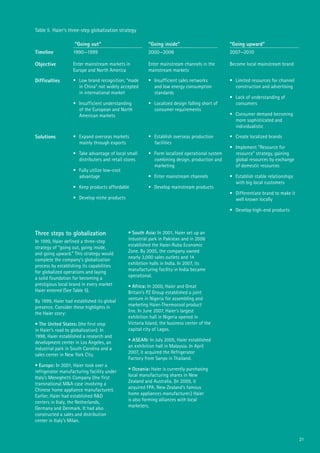
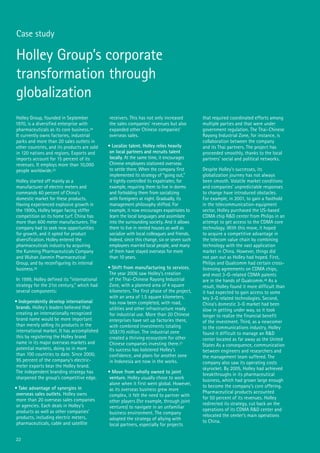
  • 34.
    34 “If we hadnot had a grand vision and gone out, we would still be small. Like a fish in a small pond, we would never grow big. So we must go out.”60 Zhang Ruimin, CEO, Haier Group Company addition, the investing company avoids the complexities of integration that come with mergers and acquisitions. In the words of one senior executive who spoke with us, this is an issue of new business versus existing business. New business means injecting additional resources into local communities and would be welcomed by local governments. Existing business involves change of ownership, replacement of workers without necessarily creating new jobs. Indeed, the gradual approach gives the management team time to learn and gives the company an opportunity to improve its competitiveness in a controllable way. It also ensures the alignment of internal management systems and culture.56 A number of leading Chinese enterprises have succeeded through organic growth, including the Haier Group, Trend Micro, Huawei and ZTE. However, a major drawback of this investment approach is that research and development ae often slow to develop and faces numerous hurdles. For instance, the Sany Group decided to found its European R&D center at the same time it planned on constructing its factory in Germany. (See “Case study: Sany and Zoomlion: building up one’s own business versus making M&A deals”) The company expects that establishing the center will be a long, drawn-out process because of the conservative German culture and the relatively high R&D costs. M&A drives growth quickly, but watch out for post-merger integration challenges Through M&A—the purchasing of a targeted company’s equity or assets with cash or securities—a company obtains ownership rights to the acquired entity’s whole or partial assets, or controlling power over the acquired firm. M&A is a common approach to globalization. World Investment Report 2009 suggests that 36 percent of global foreign direct investment (FDI) in 2008 was accomplished through mergers and acquisitions.57 According to Accenture research, since 2008, Chinese enterprises have achieved approximately 70 percent of their M&A deals in the European and North American markets and the remaining 30 percent or so in Asia, Africa and Latin America. Most Chinese acquirers favor companies in developed markets because these deals enable them to acquire advanced technologies and managerial expertise as well as expand their market networks. For example, China’s Pacific Century Motors (PCM) recently reached an agreement with General Motors to acquire GM’s auto- parts business, Nexteer Automotive. PCM’s goal is to boost its capability in steering and driveline systems. The single largest Chinese investment in a US-based automotive supplier and in the global automotive supplier industry, the deal was completed in November 2010, making PCM the official owner of Nexteer Automotive and opening new channels for growth in China.58 Mergers and acquisitions yield instant results in the acquisition of advanced technologies, brands and an international team. However, post- merger integration (PMI), which entails changes in organizational structures, people, processes, technologies and corporate cultures, is often daunting. The success rate of such integration has been proven discouraging. Chinese enterprises are zealous about mergers and acquisitions. But according to a joint study by Accenture and The Economist Intelligence Unit, these companies are not well prepared for these activities. As much as 82 percent of Chinese senior managers believe that Chinese enterprises lack experience in managing overseas investments. In implementing its M&A strategy, a firm should clearly analyze pre-merger risks and evaluate post-merger investment needs. At the same time, it should have a clear idea about its own capabilities, strengths and weaknesses. The success of a merger or acquisition depends on the generation of cost and revenue synergies. Therefore, an acquirer should think twice about signing a deal if executives question whether the expected synergies will result. Also, executives should ask whether the technology that would be acquired through the M&A deal will quickly become obsolete. If the answer is yes, the deal may not be wise. Few Chinese enterprises possess a dedicated team to manage overseas mergers and acquisitions. Usually, they hire investment bankers for these efforts. As a consequence, they tend to be overly focused on deal making and ill prepared for the range of issues that arise during the PMI process. In addition to drawing on assistance from intermediary organizations in making M&A decisions, Chinese companies must also build up their own M&A capabilities if they hope to make wise choices.59 Strategic alliances can create win- win outcomes Shared goals and complementary strengths form the basis on which two enterprises forge a strategic alliance. Such an alliance is a long-term arrangement between two enterprises to cooperate in the value chain and is an ideal choice for maximizing mutual benefits and increasing competitiveness. A globalizing enterprise can enter the overseas market quickly by forming an international alliance, and the arrangement’s success depends largely on the quality of the relationship with the international partner. Long-term mutual trust and coordination are essential. The two sides can strengthen technological innovation and improve managerial capabilities by exchanging technologies and personnel. Each approach to globalization has its own characteristics and advantages. An enterprise ought to select a path or paths to globalization in accordance with its strategic requirements and goals and its particular stage of development. For instance, Sinochem relies on M&A for its core businesses to strengthen its competitive position in key technology, distribution channels and branding. For non-core businesses, it forms strategic alliances.
  • 35.
    35 Case study Sany andZoomlion: Building up one’s own business versus making M&A deals The Sany Heavy Industrial Group (Sany) and the Zoomlion Heavy Industrial Science & Technology Development Company (Zoomlion), both based in Changsha, capital of Hunan Province, are well- known engineering machinery manufacturers. The former ranked 266th and the latter 236th on the list of China’s top 500 enterprises in 2009.61 With the continuous expansion of China’s engineering machinery manufacturing industry and rapid increases in the number of overseas construction projects contracted by Chinese companies, both companies have embarked on the road to globalization in R&D, manufacturing, sales and distribution, and services. Their businesses have now reached Italy, India, Brazil, the US, Germany and other countries, and their products are sold to more than 100 countries. Their income generated by overseas operations in 2009 declined significantly owing to the financial crisis. However, the Sany Group still brought home 1.46 billion yuan in such income, or roughly 9 percent of its overall income,62 and Zoomlion brought home 2.61 billion yuan, or about 13 percent of its overall income.63 Spotlight on Sany In 2006, Sany ranked No. 1 in the world in sales of concrete pumps, surpassing Germany’s Putzmeister.64 Its globalization strategy emphasizes optimization of its value chain rather than exports; for example, the company seeks to overcome bottlenecks in its hydraulic technology through globalization activities. “Sany’s globalization begins with value chain optimization, instead of product export,” says Vice President He Zhenlin.65 Having weighed the pros and cons of mergers and acquisitions and establishing Sany’s own production facilities, executives decided to attach greater importance to the latter. By doing so, they have avoided the local cultural, managerial and legal pitfalls that might have come with M&A. Sany selects target overseas markets on the basis of its own characteristics and capabilities, bearing in mind its supreme goal of value chain optimization. It has established production bases in the US, Germany and India, and is planning one in Brazil. The US is the world’s largest engineering machinery market and is home to giant engineering machinery manufacturers. By setting up a base in the US, Sany can secure adequate parts supply and learn advanced management ideas. Germany enjoys advantages in industrial design, precision instruments manufacturing, technology, business processes and research and development. In the words of a senior manager at Sany, by establishing a plant in Germany, the company can “conquer the world’s heartland of engineering technologies.” Also, assembling products in Germany saves costs for selling to European clients.66 Sany’s concrete pump plant located near Cologne was scheduled to go into operation in early 2011.67 Sany has also made its way to India, attracted by the country’s vast market and sales channels. By establishing a presence in such an important emerging market, Sany can be close to clients and understand their needs better. Brazil is on a fast track for growth, but its tariff levels and transportation costs are relatively high. Therefore, setting up a factory within the country saves costs. In addition, Sany has implemented domestic or global strategies in accordance with the characteristics and requirements of its value chain. For example, it takes both global and domestic approaches to research and development. Chinese engineers and their German colleagues work together
  • 36.
    36 closely, with thelatter providing the conceptual framework and the former completing the functional designs. The company fosters collaboration between Chinese and German engineers in R&D and design by fully utilizing IT-enabled colloabration tools. Such interaction and communication is expected to save on research and development costs. In contrast, manufacturing (with the exception of precision devices) takes place in China since manufacturing costs there are a fraction of those in Germany. Finished products are then sent to Germany for assembly. In expanding its markets, Sany takes full advantage of existing sales channels to develop local and neighboring markets. In talent management, the company ensures that Chinese and foreign skilled workers team up to maximize technical diversity. Spotlight on Zoomlion Zoomlion, unlike Sany, strives for both internal growth and external expansion. Its notion of globalization consists of the dual elements of “diffusion” (the existence of multiple divisions/ departments by product categories so that every product line receives the largest amount of attention) and “fusion” (formation of a transnational business division through overseas mergers and acquisitions which integrate the company’s global business and overseas companies in the same industry). In September 2008, Zoomlion purchased Italy’s cement equipment manufacturer CIFA (the third-ranking brand in cement equipment in Europe). This acquisition represented a major act of “fusion” by the company. In purchasing CIFA, Zoomlion paid particular attention to reducing risks. The company had had business relations with CIFA, its supplier of components, since 2001. Therefore, executives were intimately familiar with CIFA’s business and management. CIFA was an 80-year-old, family-run business. It operated under capacity but had a strong research and development function and solid sales networks in Europe, North Africa and the Middle East. Struggling with the impact of the global financial crisis, some members of the family decided to sell the business, and its management team wanted Zoomlion to be the buyer. Zoomlion made the acquisition jointly with Goldman Sachs, Mandarin Capital Partners and the Chinese private equity firm Hony Capital, with Zoomlion holding 60 percent of the stake and its partners the remaining 40 percent. Through this move, the company not only diffused financial risks but also realized greater market expansion.68 The first two quarters of 2009 were difficult, but things began to improve in the second half of the year. The completion of an M&A deal is only the first step. Whether a deal ultimately succeeds depends on how effectively executives handle the post- merger integration process. Zoomlion achieved seamless integration with CIFA by applying a series of practices. For example, after the acquisition, Zoomlion established a joint committee to oversee the new company’s business and facilitate cross-border and cross- cultural cooperation and communication. The committee comprises the Zoomlion Chairman, the CIFA Chairman and senior managers from the investment partners. Zoomlion also merged CIFA with its domestic cement division to achieve operational synergies. The Chairman of CIFA retained his position and was concurrently appointed Vice President of Zoomlion. The former CIFA CFO served as CEO. CIFA’s new CFO was named by Zoomlion and stationed in Milan. Zoomlion also named two deputy general managers. These moves created an international management team. At the same time, the functional departments in charge of strategy, markets, research and development and sales were established. The new company has both Chinese and Italian headquarters. Zoomlion takes an integrated approach to research and development, fully absorbing and using advanced Italian technologies. It has founded its R&D center in Italy. Chinese and Italian engineers work jointly to develop new products. R&D accounts for 3-5 percent of Zoomlion’s overall investments. Shortly after the acquisition, Zoomlion came up with the innovative “factory within factory” model for fully utilizing CIFA’s advanced technologies and managerial skills. It has “transplanted” to China the original CIFA manufacturing processes, equipment and even personnel, so the Chinese side can learn from firsthand experience and replicate the mature operating model. Zoomlion’s global R&D center for cement machinery and market center have been relocated to Milan, while strategic planning, procurements and manufacturing are based in Changsha. These centers support each other while handling their unique responsibilities. Zoomlion is now making efforts to acquire and consolidate global markets for specialized cement machinery. In the process, Zoomlion and CIFA mutually back each other in different regions. Zoomlion has now secured its No. 1 position in the world in cement machinery. In sum, the Sany Group and the Zoomlion Group have taken different approaches to raising their global profile. The former focuses on internal growth by building its own plants and adopting business models that are in line with its own requirements and capabilities. The latter relies heavily on acquiring the assets of its international counterparts and fully taking advantage of their capabilities and managerial experience.
  • 37.
    37 5. Different industries requiredifferent strategic choices The type of industry in which an enterprise competes influences its strategic choices regarding globalization: Natural resource-based industries are characterized by high risk, high capital intensiveness and use of advanced technologies. Therefore, many transnational companies that compete in these industries and that originate in emerging market countries are state-owned enterprises. In trying to improve their competitiveness and meet the country’s strategic needs, Chinese natural resource companies should develop their overseas resources and secure supply for domestic consumption. Distribution of natural resources is a primary determinant of these companies’ geographical choices. They acquire overseas natural resources mainly through mergers and acquisitions. By April 2009, China’s National Development and Reform Commission had approved 26 overseas M&A projects in energy resources, each involving over US$300 million, with a total investment of US$45.8 billion (78 percent of the overall investments of non-financial overseas M&A projects of US$10 million and above).69 A number of large enterprises in these industries choose to globalize through a combination of M&A, international alliances and joint ventures or collaborations, depending on their value chain and strategic requirements. In the early days, most Chinese mechanical and communication equipment manufactures took the OEM approach in participating in global competition. They possessed considerable processing capacities but were less strong in R&D and innovation. In the initial stage of implementing the “going out” strategy, these enterprises expanded overseas mainly by relying on exports. More of these enterprises have realized that only through enhancing their operational efficiency and innovation capabilities can they own prestigious global brands and independent intellectual property rights. Therefore, some have chosen to establish overseas production bases or R&D centers to access high-tech talent and information technologies.70 Huawei, for instance, recently established a number of domestic and overseas research institutes, allowing R&D to boost market expansion. Its annual inputs into these efforts consistently account for over 10 percent of its revenues. At the same time, Huawei introduces new products at lower costs than its competitors do, which gives it a competitive edge as well as satisfactory financial returns. In all, the company has established a sustainable competitive advantage by relying on low-cost and high-quality R&D efforts. Chinese enterprises in traditional mature industries, such as consumer goods, home appliances and personal computers, have reached advanced international levels in technology use and product quality. Nevertheless, they lag behind leading multinationals in profitability, which weakens their research and development capability. Also, they are at a significant disadvantage when it comes to brands and sales channels. The Haier Group, for example, has not been able to build up its R&D capabilities in the highly competitive global market, even if it leads its domestic competitors in R&D and patents granted. Chinese home appliances and consumer goods companies should acquire advanced technologies, managerial expertise and sales channels by mergers and acquisitions or the construction of production facilities, depending on their stage of development and strategic needs. For instance, in 2009, the Suning Electrical Appliances Company paid RMB57 million for 27.36 percent of the shares of Japan’s Laox, thereby becoming its biggest shareholder. Through the purchase, which was Suning’s first step toward globalization, the company aimed to acquire the managerial expertise and approaches of Japanese chain stores.71 Service-based businesses, such as those in retail, financial services, catering, tourism, advertising, rentals and intermediary services, globalize to achieve economies of scale and improve their international competitiveness. A major challenge they encounter in going global is the coordination of human resources, materials and processes. Our research has shown that transportation and delivery services enterprises strengthen their global operational networks by establishing supply chains in Hong Kong, Taiwan and Macao. Chinese financial service enterprises seek overseas expansion mainly through mergers and acquisitions and establishment of facilities in foreign countries. For example, in 2008, the Ping’an Insurance Company purchased 50 percent of the shares of the asset management arm of Fortis to establish its asset management business in Europe and speed up its QDII investment product design.72 As more Chinese enterprises have entered the global stage, global services provided by Chinese banks are much in demand.73 The Industrial and Commercial Bank of China has recently renamed the Bank of East Asia in Canada, in which it has a controlling stake, as the Industrial and Commercial Bank of China (Canada). ICBC plans to open a branch in Russia, and its application to establish offices in Dubai and Doha have been approved. Our conclusion so far is that Chinese enterprises’ globalization strategies are shaped by their aims, capabilities and industry characteristics. Therefore, these strategies differ from enterprise to enterprise based on variations in these three factors. Those driven to globalize by the pressure for survival emphasize the expansion of overseas sales channels, investments in new factories and use of local low-cost advantages. Those eager to expand the scope of their development focus on capturing overseas markets or entering new lines of business through M&A or through building factories in other countries. Others, however, seek to optimize their operations and extend their value chain by going global. For example, they explore ways to transcend low-end manufacturing, improve R&D capabilities and acquire state-of-the-art technologies and managerial expertise at minimal cost. Many seasoned Chinese enterprises aim to transform themselves into global multinationals. These companies can expand globally through a variety of means, such as registering global brands, localizing operations, engaging in mergers and acquisitions and establishing overseas factories. Enterprises that are mulling over whether and how to globalize can make strategic choices in accordance with their aims and characteristics (See Figure 15 and “Case study: China Construction and Anhui Construction: expanding development in the global market.”).
  • 38.
    Figure 15 Strategicchoices for globalization Strategic choices Types of industry Dealing with pressure for survival Expanding scope of development Optimizing operations and moving up the value chain Becoming a globalized company Resource based industries Mechanical and communication equipment manufacturing industries Consumer goods and home appliances industries Service industries Geographical choice (where) Asia-Pacific emerging markets; Europe and North America; Asia-Pacific developed markets; BRICs; other emerging markets; Taiwan, Hong Kong and Macao Choice of ways of investment (how) Wholly-owned greenfield; JV greenfield; JV or cooperation with existing partners; strategic alliances; equity investment; M&A Objectives of globalization Choice of businesses (what) Duplicating existing businesses Expanding the value chain (Design, distribution, production, marketing, R&D) Entering new businesses 38
  • 39.
    39 Case study China Constructionand Anhui Construction: expanding development in the global market Any enterprise can make globalization serve its needs and wants, whether the company is small or large, state owned or privately owned, national or local, or a manufacturer or service provider. China Construction Engineering Corporation was established in 1982, but its origins can be traced back to 1952. That year, the central government established the Ministry of Construction, which oversaw six construction bureaus. China Construction is China’s largest construction enterprise as well as the largest international contractor, ranking first among the world’s residential housing construction companies.74 Its overseas revenues in 2009 climbed 18.6 percent to top 29.8 billion yuan, or 11.5 percent of its total revenue.75 Anhui Construction Group Co., Ltd. was established in 1996, with its origins also dating back to 1952. Since 2003, on average, the company’s overall revenue, profits and overseas revenues have increased 45 percent, 80 percent and 92 percent, respectively, per annum. Currently, its overseas business accounts for 20-25 percent of its overall revenue.76 Spotlight on China Construction China Construction started on its globalization journey in 1978. As a centrally owned enterprise, it initially focused on labor exports for the purpose of generating foreign exchange. Then, its business evolved to include overseas subcontracting and contracting. From 1978 to 2000, the company undertook more than 5,000 overseas contracting projects, which made up 57 percent of the country’s total projects. It currently does business in 28 countries and regions, with a workforce of more than 6,000.77 Recently, China Construction has restructured its overseas business by shifting focus toward infrastructure and industrial areas. It has submitted the winning bids for a number of road and bridge construction projects in the US, Algeria and the Congo, such as the Haier Refrigerator Factory in the US, New York subway stations and bridges and some schools in South Carolina. Infrastructure construction accounts for 37 percent of the total contracted value of its overseas business. Meanwhile, the company has made breakthroughs in managerial and marketing approaches. As a prominent example, it was awarded the contract for Revel Atlantic City through joining forces with the Export-Import Bank of China. While expanding overseas, China Construction has nurtured a large team of talented managers with international experience. Young managers in their 30s oversee projects valued at hundreds of millions of dollars and involving tens of thousands of workers. In addition, the company has cooperated and allied with leading international contractors, specialized subcontractors and suppliers, creating a win-win competitive environment in global market development and resource allocation. The company is now inclined toward the high-end markets and has penetrated into a number of regional markets including Hong Kong and Macao, Southeast Asia (mainly Singapore and Vietnam), North Africa (primarily Algeria), South Africa (mostly Botswana), North America (mainly the US) and the Gulf region in the Middle East (primarily the United Arab Emirates).78
  • 40.
    40 Spotlight on Anhui Construction AnhuiConstruction went global in 1982. Initially, its overseas business concentrated on the construction of Chinese embassies. These were small projects and did not constitute true “going out.” In recent years, competition in the domestic construction industry has intensified. The overseas construction business promises higher profitability, and deposits paid by proprietors in overseas markets prior to the start of construction reduces risks. These factors compelled Anhui Construction to seriously reconsider its globalization strategy. In 2002, the company resumed its globalization efforts on a different scale, defining a strategy of “concentrating on project contracting with labor and building material exports.”79 In executing the strategy, Anhui relied on its own efforts while collaborating with its peers. It went overseas by “building a ship” and “borrowing a ship,” so to speak. Later on, executives realized that labor exports entail bigger risks and management costs. Therefore, they reduced labor exports gradually. Currently, Anhui’s overseas business encompasses construction of embassies, projects for China’s foreign aid purposes and projects undertaken jointly with other centrally owned construction enterprises. Anhui Construction has established a presence in nearly 30 countries and regions, where it has two branches, three management departments and more than 20 project departments. These entities involve more than 500 project managers and 3,000 construction workers. Executives have made the strategic decision to give up the European market, because it is tending toward saturation. (There is also the visa issue.) It now zeros in on the African, Middle East, ASEAN and Latin American markets, establishing one or two management departments in each host country.80 Spotlight on the overseas construction sector The overseas construction sector involves economic risks, standard risks, political risks and the risk of inadequate integration of resources. • Economic risks include the legal issues concerning contracts and currency devaluations. These risks increase costs and management expenses. • Standard risks include complexities introduced by construction standards that differ from Chinese standards. (North Africa, for instance, adopts French standards.) Such risks also include different construction norms and approval procedures. • Political risks consist of political instability and frequent policy changes in host countries. • Resource integration risks arise when Chinese construction companies lag behind multinational construction companies in terms of their ability to integrate global resources. China Construction and Anhui Construction strive to control these risks in their overseas businesses. To do so, China Construction has consistently emphasized management. First, it has enhanced its risk management practices and controls institutional risks. Its overseas agencies (branches and management departments) are gradually evolving to become limited companies so that any mistakes made by one of them will not affect the others or hurt the entire company. Second, it stresses management based on law or rules. Third, it puts a premium on scientific decision making. For example, it has adopted centralized procurement processes and increased coordination in bidding and subcontracting to minimize risk. Anhui Construction imposes strict risk control and assessments on overseas projects by applying four cardinal principles: 1. Cooperate with domestic and international companies to complement each other’s strengths and share risks. Take multiple approaches to international contracting, including overall contracting, subcontracting, alliances and outsourcing. 2. Mitigate cultural conflicts by, for example, requiring employees to respect local customs in countries such as Iran and Saudi Arabia. 3. Assess the host country’s payment abilities; the payment of deposits reduces risk of default. 4. Consider the relationship between China and the host country. Select countries that are on friendly terms with China, such as Algeria, Nigeria and Angola. China’s construction service industry is edging toward its Japanese and Korean counterparts in terms of market share and scale. Nevertheless, it needs to augment its engineering, procurement and construction capabilities. Both China Construction and Anhui Construction must move up their value chain to achieve these goals. While Chinese construction companies single-mindedly focus on labor-intensive construction, their European and US counterparts are diverting rapidly into consulting services. For the two companies featured in this case study, deepening globalization means development of capabilities in financing, design, procurement and project management.
  • 41.
  • 42.
    42 1. What isa global operating model? A globalizing enterprise faces two major challenges: developing a global strategy and executing it. The strategy, formulated on the basis of the company’s competitive advantages, provides a clear direction. Execution puts the strategy into action through everyday operations and business processes—all delineated in the company’s global operating model. A sound strategy is worth little unless it is executed effectively. The global operating model proposed by Accenture explores how a firm can operate its global business efficiently, taking into account the characteristics of its industry, the company’s capabilities and its globalization path.81 The model encompasses five core elements: leadership, talent, organizational structure, processes and technology, and performance metrics. The first two elements are viewed as “soft,” the latter three as “hard” (See Figure 16). In a successful global operating model, these five elements work in concert. Soft and hard elements are balanced. And the elements support the enterprise’s globalization strategy and local market conditions. Successful businesses are willing and able to reconfigure their global operating model to adapt to major changes such as market shifts and the presence of new competitors. To execute their globalization strategies, Chinese companies need to enhance their responsiveness to local environments and adjust their scale and operating models to suit diverse markets and accentuate the importance of customers. Toward these ends, enterprises may have to rely more on the “hard” operating-model elements—standardized processes, technologies and organizational structure. However, the “soft” elements of leadership and talent development are not to be ignored. In executing their globalization strategy, many Chinese companies take a hybrid approach— combining Western, Japanese and Chinese operating practices, especially in the fields of human resources and corporate culture. The multi-polar world has presented new challenges and opportunities related to global customers, resources, talent, capital and innovation.82 As a consequence, Chinese enterprises have been ushered into a new era. Globalization means the adoption of a unified global strategy and allocation of resources under the guidelines of this strategy in the context of a single global market. Business activities such as product design, procurement, production, distribution, sales, marketing and customer service all are guided by this global operation to maximize return on assets and investment. This unified execution of global strategy requires a far-sighted global vision as well as savvy use of local resources and an adequate market. A global vision enables a company to flexibly and quickly adjust its globalization strategy in response to changes in the global economic environment and the enterprise’s own strategic requirements. Localized operations are key to a global strategy’s success. Hisense Group, for instance, hires numerous local managers and sales personnel to meet both the local markets’ needs and global standards for operations and management. The Wanxiang Group also uses local resources and establishes its market system with local support in many of the countries and regions in which it operates. The company sells its universal joints in the United States Figure 16 Global operating model Source: the Accenture Institute for High Performance, 2009 Global operating strategy Elements of a global operating model High performance "Soft" elements "Hard“ elements Target adjustment Execution People Performance metrics Leadership Processes and technology Organizational structure

  • 43.
    43 through the RockwellInternational Corporation, and draws on the sales networks of Japan’s NTN Company and the United States’ GBC. In South America, it uses the entire sales network of Schaeffler, and in Europe it seeks out the personnel of GKN Driveline. In addition, Wanxiang has set up bonded warehouses in the US, the UK, Mexico and Brazil to meet customers’ time requirements and ensure top-quality service.83 Localizing their global operating models through such means helps Chinese enterprises establish their brands and capture local markets. It also enables them to fully leverage local comparative advantages to lower production costs, extend their value chain, reduce inventories as well as logistics costs, and provide individualized services. In addition, such models facilitate their efforts to master local advanced technologies and managerial expertise as well as improve their innovation capabilities. In the sections that follow, we take a closer look at the elements of an effective global operating model. 1.1 Leadership It is vitally important that an enterprise’s core leadership team possesses a global vision and the capabilities for executing a globalization strategy. A strong senior leadership team is arguably the most important group in any organization. Through its leadership style, members’ diverse abilities and decision-making approaches, the team continuously influences the organization. An effective management team is capable of handling global operations and is committed to the enterprise’s globalization objectives. The team localizes managerial talent— cultivating managers from within the country in which the enterprise operates. To build a strong leadership team with a global vision and the right capabilities, the enterprise should first define its leadership strategy, which depends on the company’s global business requirements and future development goals. The leadership strategy should align with and serve the company’s global operating strategy. The enterprise should also define its criteria for successful leadership. Respondents to our survey believe that a leader of a globalizing enterprise should possess a global vision and global way of thinking. Interestingly, other more practical skills, such as English proficiency and an education received overseas, are considered far less important, according to our survey participants (See Figure 17). 40.8% 10.7% 10.5% 8.9% 6.9% 4.9% 1.1% 0.8% 0.4% Figure 17 Qualities expected of globalizing enterprise leaders (Select three items in order of importance: most important=0.5, less important=0.3, lest important=0.2 Score of an item divided by total scores=percentage) Source: Accenture and China Enterprise Confederation surveys, May-August 2010 14.9% Understanding of the global economy and markets Capability for setting strategic goals Global vision, global way of thinking Capability for integrating transnational resources Capability for cross cultural management Cross cultural communication Capability for organizational innovation Background of received an education overseas English proficiency Capability for data analysis and information for decision making
  • 44.
    44 Financing 56 44 38 30 28 27 26 23 1 Figure 18 Independentpower of leaders in charge of global businesses (No restriction of the choice of items; the votes obtained are added together) Source: Accenture and China Enterprise Confederation surveys, May-August 2010 Day to day operations Marketing, markets Recruitments Budgeting Strategic decision making Appointment/dismissal of senior manager Investment decision making Product development Others 56 • Senior managers at headquarters to take responsibility for overall planning as well as selection, cultivation and coordination of the first three types of managers. These senior managers constitute the most important type of talent.84 Recruiting and retaining qualified global talent are priorities for Chinese enterprises that are going global. An enterprise gains access to global talent through the following channels: • Recruiting from external sources. An enterprise can quickly obtain talent this way, but integrating new recruits with existing employees takes time. Therefore, the company should consider how well these recruits fit with the corporate culture. • Developing talent from within. Internally developed employees are more committed to the enterprise’s culture and values, and hence more attuned to its globalization requirements. Compared to externally recruited employees, they tend to be more dedicated to the company’s goals. However, it takes time to develop talent from within. • Obtaining talent through mergers and acquisitions (M&A). This is a quick and effective way to bring in new expertise. However, it can take extensive effort and time for the acquired employees to play a constructive role in the new entity created during the post-merger integration process. • Using consultants or cooperating with other intermediate firms. Compared to other methods, this one is less costly and more flexible.85 An enterprise should select a method for acquiring global talent that supports its globalization progress, management capabilities and current resources. However, internal development of talent should always receive serious consideration. If an organization relies on attracting employees from outside while neglecting development of its own talent from within, it will not survive intensifying global competition. CNPC, for example, balances development of internal and external talent. To meet its globalization requirements, the company has established an international talent training center that provides training in foreign language skills, managerial expertise, technologies and so on. At the same time, it vigorously introduces global talent into the organization. The CEOs of the most successful Chinese enterprises have insight into their own organizations and the markets where their companies are operating. By drawing on this knowledge, they can make the right judgment calls regarding their global operations. They are charismatic and personally involved in formulating and approving globalization strategies. As a result, in many Chinese enterprises, the power to make decisions related to global business rests in the hands of the core leadership team. Those in charge of global business often handle daily operational issues as well. All of this indicates that globalization is given high priority in the enterprise. On the other hand, it also suggests that managers of global businesses are not yet part of the core team. When asked how much independent power the leader of a global business unit has, our survey respondents said that the two most common forms of power are sales and marketing, as well as daily operations (See Figure 18). 1.2 Talent Almost all the enterprises responding to our survey considered international talent the most crucial determinant of success for their globalization strategy—and they see the shortage of such talent as a daunting challenge. Whoever wins talent wins the day, as the Chinese saying goes. Harvard Business School professor Christopher Bartlett and London Business School professor Sumantra Ghoshal point out that a transnational corporation needs four types of talent: • Business managers to achieve global economies of scale and competitive advantage • Regional managers to capture the local market demand and respond flexibly • Functional managers to conduct transnational transfer of specialized knowledge and integrate the resources and capabilities of the countries in which the company operates
  • 45.
    Localization of talents 27.9% 20.3% 10.2% 9.3% 6.1% 3.7% Figure19 Talent strategies for successful globalization (Select three items in order of importance: most important=0.5, less important=0.3, least important=0.2 Score of each item divided by total scores=percentage) Source: Accenture and China Enterprise Confederation surveys, May-August 2010 Training of global talents Clear standards on the quality of talents Incentive mechanisms for global talents Encouraging Chinese employees to be stationed overseas for an extended period of time Establishing a system by which employees work domestic and overseas shifts 22.6% Increasing the proportion of foreigners or people with international experience in its senior management team 45 In 2009, as it expanded its overseas business, it signed employment contracts with 63 Chinese graduates studying in Russia and Azerbaijan, and introduced 27 Chinese graduates from Europe and North America. M&A enables a company to take in a large number of new employees relatively quickly. For instance, Neusoft focuses more on human capital than on other types of assets in identifying and forging M&A deals. The employees of the acquired entities are usually software developers. Neusoft seeks to obtain high-end experts in the industry through M&A. The company had started by providing software outsourcing services for Japanese clients such as Sony, Toshiba and Alpine. Later, it purchased three Finnish software design companies, establishing a global service network connecting China, Japan and the US. Today, Neusoft is a strong competitor as a provider of industry solutions, product engineering solutions and related software products, platforms and services. As many as 6,000 of its 16,000 people engage in global software design and development.86 Talent it acquired through M&A has played an important role in its growth and success. While trying to retain talent through attractive salaries, training in corporate values and other means, a globalizing enterprise should pay attention to localization of talent as well. The Wanxiang Group has accumulated an international talent pool by tapping local human resources and implementing a system of “domestic and overseas post rotation” for employees.87 Of the more than 50 people working for Wanxiang’s US branch, only two or three come from China; the rest are locals. By the end of 2009, more than 26,000 of the workers for CNPC’s overseas oil and gas cooperative project were locally sourced; in the Sudan and Kazakhstan, the company’s localization rate had reached 90 percent. To manage talent in a globalizing enterprise, we suggest the following practices: • Define an overall plan in accordance with the company’s talent requirements, deciding (for example) which functional departments should use local people, and which need globalized managing expertise. • Increase the proportion of foreigners in the senior management team while also building up a reserve of managers with global leadership skills. • Establish exchange programs to provide employees with opportunities to work in different geographical locations, to promote communication and collaboration between employees from different cultural backgrounds. • Set up forums for information and knowledge sharing and constructive discussions. • Establish mechanisms for attracting and retaining global talent. Businesses located in developed countries should emphasize the adoption of local employment standards, while those located domestically in China should maintain their Chinese characteristics. When asked about the talent required for successful globalization, our survey respondents cited a clear standard for talent, intensified development of global talents and an increase in the proportion of foreigners or people with international experience in top management teams as more important than other practices (See Figure 19). 1.3 Organizational structure An efficient and flexible organizational structure—clearly defined departments and functions, along with coordination and reporting relations between them—also helps ensure successful globalization. A globalizing enterprise should take into account its strategic needs and competitive advantages in selecting an appropriate organizational structure. When an organization has grown to a certain size and expands globally, it needs to adopt a decentralized, agile and flexible structure. This calls for clear definition of roles and responsibilities among departments, reporting relationships and accountabilities. In a company that has global operations, a centralized management structure divorces the leadership team from local realities and markets, which leads to sluggish or blind decision making.88
  • 46.
    Figure 20 Organizationalstructures for global business (Percent of respondents) International business department 33% Export department 29% Source: Accenture and China Enterprise Confederation surveys, May-August 2010 Overseas division 23% Integration of overseas and domestic businesses 15% Figure 21 Models of overseas business management (Percent of respondents) Management by geographical location 40% Management by host country 3% Unified management 28% Source: Accenture and China Enterprise Confederation surveys, May-August 2010 Management by project 29% 46 A globalizing enterprise should, in line with its strategic requirements and characteristics, establish a global coordination mechanism that includes uniform business standards and service philosophy, common goals and sufficient cooperation between the various departments, as well as a mechanism for resource sharing. As globalization progresses, the organizational structure should evolve. When Chinese companies first began to “go out,” they established an international business department or overseas business department as an independent entity. Our surveys indicate that most Chinese enterprises still do this; integration of domestic and overseas businesses is not the mainstream practice (See Figure 20). With the expansion of overseas business and the resulting increased interrelatedness between domestic and overseas operating environments, the original international business department will need to evolve into a matrix defined by functional departments, products, markets, geographical regions and customer groups. When the enterprise has fully globalized, it will have to distribute its resources globally, integrate its operations and extend its supply chain; it should no longer need an “international” department. For instance, in 2009, Huawei began to implement a decentralized management structure. Its organizational matrix consists of strategy and sales/marketing, research and development, business units, market units, a delivery platform and supporting functions.89 However, many other Chinese enterprises lack such a structure to support and coordinate their global business. As they further expand overseas, their existing organizational arrangements become inadequate. Our surveys show that most enterprises based in China are inclined to manage their overseas business by geographical location rather than integrated management, a practice that may hinder their efforts to integrate their overseas business operations (See Figure 21).
  • 47.
    47 Department/product head 11% CEO 34% Vice CEO 55% Figure22 Managers of global business (Percent of respondents) Source: Accenture and China Enterprise Confederation surveys, May-August 2010 Figure 23 Decision making for global business (Percent of respondents) Source: Accenture and China Enterprise Confederation surveys, May-August 2010 By the overseas business 2% By the headquarters 58% Consultations by the headquarters and decision making by the overseas business 11% Proposals by the overseas business to be decided by the headquarters 29% For most of the enterprises responding to our surveys, the managers in charge of global businesses are typically the president/CEO or vice president, and global-business decisions are made at headquarters (See Figures 22 and 23). This indicates the importance these managers attach to global business. No matter who is in charge of global business, decisions regarding processes and principles should be made at headquarters and those regarding daily operations should be made regionally or locally. A culturally diverse management team plays a particularly important role in a globalizing enterprise. Such a team facilitates management and cooperation. The enterprise should deploy to its local markets managers who understand local conditions and who have close ties to headquarters to execute localized operations. Therefore, the best managers should be dispatched to local markets, rather than staying at headquarters. Such a localized organizational structure helps enterprise leaders understand the different cultures and markets of the world. For instance, trust in distributors and wholesalers are critical in many immature or underdeveloped markets. Exercising integrated management of local distributors and wholesalers in the supply chain can help a company fully develop a market’s potential rather than achieving only limited market entry.90
  • 48.
    48 1.4 Technology andprocesses Multinational corporations pay close attention to acquiring advanced techniques and processes as a way to create competitive advantage. These technologies and processes can be used to manage a global business and to coordinate business activities in different locations. Processes include strategic planning, resource distribution, knowledge management, innovation management, customer relationship management and supply chain management. Modern information technologies are also critical for managing geographically dispersed global operations.92 Consider global supply chains. Instead of focusing their purchasing and sales activities in a particular country or market, globalized companies draw on suppliers from around the world to accomplish key business activities such as product design, sourcing, manufacturing, distribution, sales, marketing and product support. In recent years, multinational corporations have swiftly shifted manufacturing operations from their home countries to other countries. According to Accenture research, from 2005 to 2008, developed countries’ manufacturing costs in East Asia increased by more than 65 percent, and more notable jumps occurred in East Europe, South Asia and Central Asia (80 percent and 75 percent, respectively). However, globalization has also introduced instability into companies’ operations and tightened product lifecycles. Given shortages of energy, raw materials and skilled labor, a globalizing enterprise must continuously adjust its operating model, including finding new suppliers in other countries or extending its supply chain.93 All “We should first of all establish an organizational structure and a professional management team which are consistent with international practices. Otherwise, we will not be able to compete in the high-end markets, let alone carry out mergers and acquisitions. A group of amateurs cannot operate a modern international company. Nor can they digest any “Western meals” they buy from the market.”91 Ren Zhengfei, CEO, Huawei Technology Co., Ltd. 31.5% 18.2% 10.5% 8.1% 6.8% 5.4% 4.7% 3.6% 3.0% 2.6% 2.5% 1.7% 1.1% 0.2%Training Human resource management Performance appraisals Information system Procurement Supply chain and inventory management Manufacturing Customer service Financial accounting Knowledge management Sales and channel management Research and development Branding and sales Strategic planning and budgeting Figure 24 Systems and processes to be unified globally (Select three items to be weighted by importance: most important=0.5, less important =0.3, least important=0.2 Score of an item divided by total score=percentage) Source: Accenture and China Enterprise Confederation surveys, May-August 2010 this requires careful management of a global supply chain, so the company can recognize and flexibly cope with changes in supply and demand. By doing so, it minimizes operating costs, increases returns on assets and promotes profitability and market expansion. An effective global operating model balances cross-border uniformity of systems and processes for such business activities as strategic planning and resource distribution with localization of systems and processes for human resource management and customer service. In response to the question in our survey, “What systems and processes should be unified globally?” 31 percent of the participating enterprises named strategic planning and budgeting, 18 percent said branding and marketing, and 11 percent cited research and development (See Figure 24). Globalized and localized processes can be combined in accordance with technological requirements, cost factors and distribution of markets. An enterprise can localize and globalize production of certain products. The Sany Group, for instance, manufactures key product components in Germany and other standard parts domestically in China, then assembles them in Germany.94 The Haier Group owns more than 5,000 sales outlets and more than 10,000 service centers overseas and therefore has globalized its sales function.
  • 49.
    49 Figure 25 Performancemanagement promoting globalization Value chain optimization linked to performance management Driving individual and organizational performance to facilitate globalization Source: Accenture Globalization Strategy and competitiveness Optimization of the value chain Organizational matrix Execution Balanced scorecard Business unite performance metrics Individuals performance metrics “Whether an enterprise is truly global does not depend on how [many] assets it has acquired overseas. Instead, one should examine if the company possesses global brands, global operating capabilities, and if its management philosophy, organizational structure, human resources and corporate culture are all globalized.”95 Liu Jiren, President of Neusoft 1.5 Performance metrics Effective performance metrics ensure successful management of an enterprise’s global business. A performance evaluation system should be directly linked to the globalization process and therefore facilitate coordination of various global business priorities. When a company establishes the right performance metrics, internal and external activities work in concert and thus support the development of new products or services. According to Accenture research, to achieve high performance, a globalizing enterprise should set clear strategic goals and a roadmap, establish an organizational structure and business processes on that basis and define a detailed execution plan to promote its globalization process. Metrics assess, incentivize and manage the performance of the organization overall as well as employees and thus improve the enterprise’s value- creation process. Effective performance management links the organization’s strategic priorities and execution plans to different levels within the organization, from the top management team down to individual employees. By linking business requirements to organizations and individuals, the right metrics drive performance, thereby accelerating globalization (See Figure 25). The establishment of key performance indicators is crucial for the implementation of a performance management system. A company’s senior management team should define financial and nonfinancial indicators for assessing business processes, employee quality and leadership skills. Many multinational corporations adopt the balanced scorecard methodology for performance management. The balanced scorecard enables every individual in the organization to understand how his or her performance and decisions influence the entire organization. Through this approach, the organization can define measurable goals, gain companywide consensus on their importance and establish accountability for achieving the goals. The top management team should consider how to evaluate performance of different business units across various regions, because performance evaluation influences employees’ work priorities and orientation. Evaluation criteria usually include profitability, costs and other areas (such as global market share, speed of new product launches on the global market and the number and profitability of new products). Evaluation criteria should communicate clearly defined priorities; be based on particular organizations’ key roles, responsibilities and goals; be consistent across departments; and aim to strengthen the entire organization’s competitive position. As Chinese enterprises have continued down the path of globalization, they have realized that a performance evaluation system plays an indispensible role in improving management of their global business. This is particularly the case for companies involved in overseas M&As. Management of the merged or acquired company through strategic planning, goal setting and performance appraisals has proven effective for addressing challenges that arise during the post-merger integration process (See “Case study: Lenovo: a new chapter in global operation”).
  • 50.
    50 Case study Lenovo: anew chapter in global operation In 2005, with an eye toward transforming itself from a Chinese company to a global player, Lenovo purchased IBM’s PC business and thereby acquired its ThinkPad series PC brand, technologies and global operations team. From a strategic point of view, it was the right move, considering Lenovo’s need to accelerate its pace of growth in the global market, and the changing situation in the global PC market. Understanding new trends in the global PC market and new sources of profitability, as well as going global, had been key to the company’s sustainable development.96 Undeniably, Lenovo faced a difficult test in managing its global operations following the acquisition. It had to integrate management models and organizational structures, as well as manage the merging of workforces hailing from two different cultures. Realizing the importance of integrating organizational structures and building an international management team, Lenovo started by introducing international management practices into existing domestic management models. To integrate senior executives of Western and Eastern cultural backgrounds and ensure sufficient international elements in the core management team, it established an executive committee comprising 14 senior executives. Eight of these executives had overseas backgrounds, including four former IBM executives, one former Dell executive and one former Microsoft executive.97 Besides Lenovo’s original management team and managers from IBM, the company brought in third-party management talent. No matter how busy they are, members of the executive committee meet periodically for two to three days every month to discuss key issues in strategy and operations in order to ensure that communication is smooth and strategy consistent.98 The management teams below the executive committee allow their members to shift between different geographical locations and markets. Such practices have contributed to Lenovo’s emergence as a global company. In terms of organization and management style, today’s Lenovo (and the IBM PC of old) differs markedly from yesterday’s. The new Lenovo combines the strengths of the formerly separate organizations. Most multinational corporations achieve global expansion by moving from mature markets to newly emerging markets. However, Lenovo, founded in the world’s largest emerging market, has taken the opposite approach—expanding into other emerging markets first, and then pushing into the mature market. Emerging markets experience the fastest growth in PC sales in the world and therefore have strategic importance in increasing Lenovo’s market share. On the other hand, for products that are deeply rooted in mature markets, including the ThinkPad PCs, the company continues with their expansion in these markets while pushing them into the emerging markets. Viewing the market from a global perspective and adopting different strategies for different products and regions demonstrates Lenovo’s unique globalization approach. Because Lenovo carefully maintains the positive brand image of the ThinkPad series, it has not experienced the negative impact of “Made in China” in its European and North American markets. For its most competitive “Idea” and “Think” lines of laptop products, Lenovo adopts a clearly defined strategy of balancing and combining the products’ respective business models to provide the best
  • 51.
    51 offerings. At thesame time, Lenovo combines the advantages of its erstwhile “deal based” sales and marketing approach and IBM’s “relationship based” approach to increase sales in different markets. This practice played an important role in helping the company survive the global financial crisis that struck in 2008. Lenovo is committed to establishing a unique, outstanding global corporate culture. For any entity formed through a merger or acquisition, particularly a cross-border M&A deal, it takes time and effort to soften the impact of cultural differences and the differences between professional managers and entrepreneurs. Wherever Lenovo operates in the world, the company sticks unswervingly to its cultural values, which include “keeping promises and trying our best” and “putting individuals in the first place.”99 These seemingly simple statements reveal a long- term view, a commitment to strategy formulation and execution, and the belief that employee are valuable assets. Lenovo further communicated its values by launching its “Cultural Day” activities in China, West Europe and North America in 2010, announcing its new Lenovo Way: “Plan, Prioritize, Perform, and Progress.”100 In endeavoring to become a world-class global company,101 Lenovo is committed to bringing together different cultures, fostering entrepreneurship and providing world-class products and services. In expanding globally, Lenovo has consistently attached importance to the domestic market, which, according to a UBS report, accounts for 45 percent of its profits from sales worldwide.102 As a point on its global innovation “triangle,” the company has established the Beijing R&D Center. The other two points are innovation parks in Tokyo, Japan, and in North Carolina, in the United States. Most of Lenovo’s suppliers are located in the Asia-Pacific region, especially China, where labor costs remain relatively low. Low-cost manufacturing in China is the basis for the company’s global expansion.103 More important, the huge Chinese PC market and maturing consumers provide incentive for Lenovo to develop new products and a reference point for launching fresh offerings into other emerging markets as well as mature markets. In terms of regional strategy, Lenovo has integrated the Chinese market into its global market system. The Chinese Lenovo has turned into a global Lenovo. In 2008, Lenovo struggled with the impact of the worldwide financial crisis and complexities in its operations following the merger deal. However, its performance during the 2009-2010 fiscal year markedly improved, thanks to organizational restructuring, improved business processes and re-establishment of the company’s cultural values. By the end of March 2010, Lenovo had generated US$129 million in profits after having sustained losses for several years, surpassing its leading competitors in profit growth.104 In releasing Lenovo’s 2009-2010 financial report, Liu Chuanzhi, chairman of the board, remarked, “In the past year Lenovo has demonstrated its ability to overcome difficulties. The financial performance has come as a result of correct strategies, technological innovations and an excellent global culture.”105
  • 52.
    52 2. A globalcompany’s corporate culture must balance global vision with local perspectives An enterprise’s culture runs through its leadership, talent, organizational structure, processes and technologies, and performance metrics—including how these elements interact. Corporate culture therefore serves as a kind of infrastructure that enables and guides day-to-day operations. A corporate culture with a global vision is like a strong adhesive, bonding all elements of the operation together and creating synergy. The experience of successful multinational corporations has demonstrated the indispensable role that a comprehensive global corporate culture plays in global operations. Just as Harvard Business School professor Christopher Bartlett and London Business School professor Sumantra Ghoshal point out, changes in tangible aspects of a company are not sufficient for success; global enterprises must also actively shape employees’ values and behavior.106 A corporate culture with a global vision represents a globalizing enterprise’s capability for sustainable development and a manifestation of its maturity. A global enterprise’s culture has to address human beings’ cultural differences and balance the company’s global vision with local perspectives— because value is created in local markets. So the root of globalization is in localization, whereby the company maintains its vitality. While the enterprise follows a globally consistent strategic mindset and operating model, it should also adjust to local cultures and leverage their positive components. Of 900 senior managers surveyed by Accenture, almost half believed that identification with the local culture was the most important thing for a globalizing enterprise, and 44 percent stressed the importance of understanding local customers and ways of doing business. A widely accepted corporate culture includes tangible elements such as a unified corporate identity system and brand images, as well as intangible elements such as value systems, service concepts and cultural networks. Many Chinese enterprises have made successful attempts in this respect. The Wanxiang Group, for example, believes in “thinking globally and acting locally,” tailoring operations related to marketing, management, financing and recruitment to local markets while maintaining a firm global vision. The Haier Group is committed to developing a corporate culture built on local cultures and creating “globalized local brands.” Accenture research suggests that the culture of a high-performance global enterprise possesses five distinguishing characteristics, all of which help to balance globalization and localization: A balance between the desire to develop new markets and actual capability for execution A global enterprise should fully consider local realities and gauge the viability of its business expansion plan. Walmart, for example, had originally intended to expand globally. It later realized that it could implement its low-price strategy much better in developing countries such as Mexico and China than in Japan or South Korea. Balanced development and management of talent A global enterprise should attract talent at intermediate and senior levels globally and treat them equally. It should also respect cultural diversity and encourage employees to take initiative based on their cultural backgrounds. With a free flow of knowledge globally, employees develop a mindset of learning and cooperation and strengthen their career development opportunities. The company thus maximizes the advantages embodied in its global talent. Successful global companies treat talent management as the way to grow a leadership team that possesses global experience and vision. They also foster an open learning environment for employees and instill in them a global vision for professional development. HSBC, for example, believes in “global finance and local wisdom”; it is committed to developing a leadership team with global experience, and it rewards outstanding employees with opportunities to work in different countries. In addition, a global corporate culture promotes shared values among employees. For instance, Marriott carries out its “care for partnerships” idea in all its hotels worldwide. In East Europe, Marriott employees are generally skeptical about the management, and the company aims to obtain their trust and cultivate in them a sense of belonging. In Asia, on the other hand, the concept of decentralization is weak and the company encourages employees to make decisions by themselves. Sustained innovation Innovation requires free flows of knowledge and ideas. However, the various markets, customers and labor that a global enterprise deals with hinder knowledge flows and consequently pose a challenge to innovation. In response, the enterprise should maintain an open, flexible organizational structure, and encourage innovation in all its global branches. For instance, Marriott facilitates internal knowledge flows through informal and formal channels. One channel is the quarterly internal global forum, which brings together managers from branches worldwide to share discoveries in different markets. The forum heightens managers’ awareness of the need to innovate in the global and local markets. Use of information technology as a strategic asset Information technology is critical for ensuring satisfactory global performance. This is especially true for a global enterprise that operates over long distances and encounters language barriers and cultural differences every day. Consider Mexico’s CEMEX, which sells a commoditized product. The company applies IT technologies such as GPS and forecasting technology to significantly reduce its costs in developing new markets and gaining a competitive advantage in most newly emerging markets. Selective performance metrics A global enterprise should establish uniform standards for assessing performance, no matter where it has located its businesses. It should select comparable indicators from a large number of indicators to build a fair and consistent performance evaluation system. The importance of localization has become a widely accepted idea among leaders of globalizing companies. To establish a corporate culture with a global vision, companies must adjust to local conditions. Our surveys and interviews show that a considerable number of Chinese enterprises that are going global have realized the value of cultivating a global corporate culture. However, they lag behind other companies in practice. To catch up, they can learn from the experiences of successful global enterprises from other countries.
  • 53.
    53 3. Post-merger integration presentsunique challenges Overseas mergers and acquisitions are an effective way for an enterprise to go global. However, whether a company can achieve its expected objectives through M&A largely depends on its success in integrating the acquired business and thus achieving synergies among its strategy, organization, people, processes, culture and IT systems. Accenture’s study of the 50 largest M&A transactions for 1996-1999 and 2003-2007 reveals some disturbing news: In general, post-merger three-year average annual total returns to shareholders (TRS) are lower than returns in the pre-merger period.107 Another study of 302 M&A deals worth at least $500 million announced between July 1995 and August 2001 found that 61 percent of acquiring companies eroded value for their shareholders.108 The challenge of creating value through M&A has been recognized by an increasing number of enterprises. Making M&A deals themselves is difficult, but as long as a company has the required resources, it usually can get the deals it is seeking. The real challenge comes after the deal is completed. Strong capabilities in post-merger integration are required to ensure that the M&A agreement delivers its promised business value. Drawing on research into an extensive number of M&A cases, Accenture believes that the following capabilities are critical to successful integration after an M&A deal: • focusing on post-merger value creation • putting into place a leadership team as soon as possible, and minimizing talent loss • designing processes for transition of business units • paying attention to cultural integration (values, norms and so forth) • earning the trust of employees from different cultural backgrounds • actively managing organizational changes • communicating plans frequently and consistently to managers and employees Most of these capabilities relate to integration of employees after the M&A deal is signed. Such integration is even more important for an overseas deal, which brings together people of different cultural backgrounds. The success of post-merger integration is directly related to how the acquiring company deals with the challenges of employee integration. These challenges include the following: • ensuring that the organizational structure retains the best of the company’s traditions while also being innovative • achieving revenue and cost synergies in the new organization • placing people with appropriate skills at the appropriate time and place • retaining key employees • maintaining positive morale during integration planning and implementation • merging competencies as well as performance management and compensation systems • ensuring accuracy of the human resource application system and minimizing adjustments made to human resource management processes Employee integration involving an overseas M&A deal is ultimately about creating positive experiences for employees, rather than making tremendous changes to former teams or assigning a large number of people from the acquiring company to work in the acquired company. Enhancing understanding of and communication with the former management team and ordinary employees can also support successful post-merger integration and set the business on a new path. Often, communication and understanding diffuse formidable tensions or conflicts. A case in point is Beijing No. 1 Machinery Factory’s acquisition of Germany’s Waldrich Coburg, which had ranked first worldwide in heavy machinery manufacturing. Thanks to the emphasis on pre-deal communication, the post- merger integration was a success. In the 10-month negotiation period, the Chinese side expressed their full respect and understanding of the interests of the German workers. At the same time, they pointed out that the company had to survive in the world market in order for the employees to have jobs. Change was unavoidable if they wanted to compete with Korean, Japanese and Chinese workers. Eventually the company’s union agreed to work an extra two hours per week without additional pay. Thanks to the successful integration, the enterprise’s profitability improved, and it created more than 120 jobs within two years.109 Media reports and our surveys indicate that for the majority of overseas M&A deals involving Chinese enterprises (mainly in the manufacturing sector), very few of them achieved true post-merger integration. There are currently two main approaches that Chinese companies use to manage their post-merger businesses. One is to shut down the manufacturing operations in the acquired company and relocate them back to China, while keeping R&D, design, sales and marketing, and branding abroad. The Wanxiang Group, for example, used this approach in carrying out multiple M&A deals in the US. The other approach is to leave the acquired company’s manufacturing operation intact and maintain minimal involvement in its management. The Chinese acquirer dispatches only one or two senior managers to handle financial supervision and communication responsibilities. A team comprising senior executives from both companies, usually called the executive committee, supervises operation of the acquired company through performance metrics linked to the M&A terms and compensation. Companies using this approach include Changsha Zoomlion Co., Ltd. which acquired Italy’s CIFA Company; Hangzhou Donghua Chain Group, which purchased Germany’s KOBO Company; and Lianyungang Zhongfu Lianzhong Composites Group Co. Ltd., which acquired the German rotor blade manufacturer NOI. In the last case, the Chinese acquirer has not sent anyone to the new merged company SINOI.110
  • 54.
    22.2% 19.9% 18.7% 12.9% 8.6% 5.8% 4.1% 3.9% 3.8% Integrating procurement and distributionchannels Immediately implementing the merged or acquired company’s management philosophy and systems Organizational structure adjustments Integrating information systems and technological platforms Minimizing changes Maintaining stability of the former management Stabilizing production and markets Retaining the talents of the merged or acquired company the merged or acquired company Building up communication and trust Figure 26 First priority following an overseas M&A deal (Select three items to be weighted by importance: most important=0.5, less important=0.3, least important=0.2 Score of each item divided by the total scores=percentage) Source: Accenture and China Enterprise Confederation surveys, May-August 2010 54 Chinese acquiring companies may select the second of these approaches for several reasons. For one thing, the costs of overseas manufacturing remain high, making it not competitive against domestic manufacturing. However, R&D and design, branding and sales channels are strengths of the global entities. It is a natural choice to fully leverage the strengths and avoid the weaknesses. Moreover, the management team in a purchased company based in a developed country is mature and advanced, while the Chinese party is still learning and lacks a comprehensive management system to integrate the acquired company. Therefore, “doing nothing” is the right strategy. Finally, most Chinese enterprises have not reached the stage of globally distributed operations. They at best own some isolated entities in local markets; hence they lack the capability or urgency to carry out management integration (See Figure 26). Eventually, as the low-cost advantage diminishes, Chinese companies will become more sophisticated in their managerial skills and gain more confidence in dealing with overseas counterparts. Their global business units will no longer be isolated, and the companies will be better positioned to devote sufficient time and effort to post-deal integration. 4. A successful global operating model has several hallmarks There are several criteria for judging the success of an enterprise’s global operating model. The first is localized operation. From adjustment to the external environment (social networks, partnerships and consumers) to internal management (leadership, people, management methods and corporate culture), the company adapts to local conditions and becomes a local enterprise. The second is a globalized structure; that is, the company sells to the global markets, allocates its production facilities on a global basis, sources its talent from a global pool and forms its top management team with senior executives who have extensive global experience. When it comes to internal management, governance structure and management process flow freely on the global stage without regional hindrance or management silos. The third criterion is a global mindset. Top management teams must reorient their perception of management, orchestrating a global enterprise from a global point of view. Whether an enterprise globalizes successfully depends on its globalization strategy. Decisions regarding what global businesses to enter, where to place the businesses and how to invest globally should be informed by the company’s objectives, capabilities and the characteristics of its industry. Only by starting with a clearly defined goal and designing an executable strategy based on its own capabilities and industry characteristics can a company lay a solid foundation for success. However, a smart strategy that is not well executed is just a castle in the air. This is where an efficient global operating model comes into play. The model transforms a strategic blueprint into reality, step by step, through the right leadership, talent, organizational structure, processes and technologies, and performance metrics. Indeed, the reason many Chinese enterprises have lagged behind in going global is that they lack experience and capabilities in managing and operating global businesses. As globalization activities proceed, Chinese enterprises will accumulate managerial and operational expertise. (See “Case study: Wanxiang’s success story in integrating global resources.”)
  • 55.
    55 Wanxiang’s success storyin integrating global resources A globalizing enterprise should view the world as one market and integrate resources globally to build an optimal operating model. The Wanxiang Group’s success lies in its effective integration and utilization of global resources. Wanxiang, established as a blacksmith shop in 1969 with 7 employees and 4,000 yuan in capital, is now an auto-parts manufacturing enterprise operating in 9 countries. In 2009, it generated revenues of 51.48 billion yuan (US$7.84 billion), US$1.169 billion from overseas sales, and profits and taxes of 5.227 billion yuan (US$794 million), maintaining a growth rate of over 20 percent for the 30th consecutive year.111 Wanxiang is a leader in the globalization race. The company successfully achieved its goal of “penetrating the domestic market through export.” In the early 1980s, it decided to adopt an export orientation to address market challenges. In the centrally planned economy that existed at that time in China, the township of Wanxiang was not included in the state planning. This meant that the company could not purchase raw materials or sell its products in the domestic market. To survive as well as fuel its development, founder Lu Guanqiu decided to “go out,” seeking opportunities in the global market. In March 1984, Wanxiang was recognized by the Schaeffler Group of the US for the quality of its products and received an order of 30,000 universal joints, becoming the first Chinese auto-parts manufacturer to enter the US market.112 Its success in the overseas market attracted widespread notice. In 1985, domestic auto manufacturers started to use Wanxiang’s products, demonstrating the wisdom of its strategy of promoting domestic sales through overseas sales. In 1994, with the approval of the Ministry of Foreign Trade and Economic Cooperation, Wanxiang established Wanxiang US. Wanxiang delegates its main global businesses (including those in Europe and North America) to Wanxiang US, rather than managing them from headquarters. With Wanxiang US managing all global businesses, the company does not have an international department. All business units in China assist Wanxiang US in global operations. This structure differs from that used in other Chinese companies. Wanxiang US has established 18 overseas companies in eight countries (including Brazil, Canada, Germany, Mexico, Venezuela, the UK and the US) and has an international sales and service network covering more than 50 countries and regions. Wanxiang US’s M&A deals include the following: • July 1997: Purchased 60 percent of the equity of the AS Company to establish the Wanxiang European Bearings Company, which became a stronghold for Wanxiang’s expansion in the European bearings market. • October 2000: Spent US$420,000 to purchase the Schaeffler Group’s equipment, brand, patented technologies and global market network, which generated US$5 million in revenues annually for Wanxiang. • October 2000: Purchased 35 percent of the equity of the LT Company to fully use its processing and assembling center in North America. • August 2001: Spent US$2.8 million to acquire 21 percent of the equity of the UAI Company. The agreement stipulated that UAI purchase US$25 million worth of brake systems and components from Wanxiang every year and introduce its well-known brand UBP to China.113 • September 2003: Purchased 33.5 percent of the Rockford Company, becoming its largest shareholder. With over 100 years of history, Rockford possessed multiple product lines, patents, advanced testing and technology centers, and capable engineers. However, owing to high production costs, it had lost its competitiveness. After the acquisition, Wanxiang relocated many standard processes to China, keeping only precision manufacturing in the US. This measure greatly reduced cost, and the company soon turned a profit.114 In integrating and optimizing the resources of the companies it acquired, Wanxiang US maintained their research and development centers and sales channels, established centralized overseas R&D centers, and conducted periodical exchanges between Chinese technological personnel and their overseas counterparts. The transfer of basic manufacturing to China helped reduce production costs. For key processes and technologies, the company sought the assistance of overseas technological personnel. Therefore, it realized comprehensive integration from research and development to markets and products. Wanxiang has achieved optimal synergies between the domestic low- cost labor advantage and overseas strengths in technologies, finances and markets. It has thus broken through the geographical barrier to needed resources and has successfully implemented its “going out” strategy. Case study
  • 56.
  • 57.
    57 1. The multi-polarworld has presented new difficulties China is now indisputably an important player in today’s multi-polar world. Globalization has penetrated every facet of the Chinese economy. It is no exaggeration to say that any Chinese enterprise, big or small, is connected to the outside world in one way or another. From this point of view, we can say that Chinese companies not only have started their journey of globalization but also have established a foundation and achieved a degree of scale. Nevertheless, from a historical and global perspective, these enterprises are relatively new players on the global stage. They lag behind the multinational corporations of the developed countries and those of other newly emerging economics such as Korea, Taiwan, Hong Kong and Singapore. The path to globalization for Chinese enterprises is paved with difficulties. These challenges stem from the standing of the Chinese economy in the global economic system. As latecomers, Chinese enterprises are at a disadvantage in terms of overall strength, globalization experience and managerial expertise. Globalization is an uphill battle for them. A senior manager from a large home appliance manufacturer who spoke with us commented, “Foreign companies enter China armed with strength and experience accumulated over many years. Chinese companies, however, go global with little experience to speak of.”115 Cultural barriers and differences in social systems also present obstacles for globalizing Chinese companies. This is the case whether they have a presence in Southeast Asia, Latin America, Europe or North America. Respondents to our surveys listed “local market entry barriers and trade protectionism” and “local government policy restrictions and social risks” as their biggest challenges (See Figure 27). This is precisely why diplomatic support by the Chinese government tops the list of support requested by these enterprises. In practice, differences in such issues as labor laws and regulations, work ethic, awareness of rights and interests, attitudes regarding overtime work, collective bargaining and the role of trade unions make local operational and management routines more demanding. Chinese executives striving to manage global businesses using practices that are customary in the domestic market are bound to run into difficulties—especially in Europe and North America. During our interviews, top managers confessed their frustration in dealing with these issues. Their responses suggest that Chinese management systems and social conventions are not conducive to global operations, although they are not necessarily inferior. To continue globalizing, Chinese companies may have to learn to adapt to different economic, business and operational environments. Another challenge facing Chinese enterprises is a lack of managers proficient in foreign languages and versed in local cultures, international laws and international management practices. As China’s domestic standard of living continues to improve and professional development opportunities multiply, Chinese managers’ willingness to work overseas is waning. This is particularly the case for managers sent to areas in developing countries where local conditions are harsh.116 Difficulties stem from external and internal sources. Externally, cultural, social and political barriers make Figure 27 Challenges faced by globalizing Chinese enterprises (Weight the three items selected in order of importance: most important =0.5, less important=0.3, least important=0.2 Score of each item divided by total scores=percentage) Others Complicated procedures for roject reviews and approvals Post-M & A integration Insufficient government support Difficulty in transnational financing Exchange rate risks, strict foreign exchange controls Difficulty in finding M & A targets Low-cost disorderly competition within the same industry Cultural differences Local government policy restrictions and social risks and social risks Local market entry barriers and trade protectionism 22.1% 20.0% 11.6% 11.0% 8.3% 6.2% 5.0% 4.3% 4.2% 3.4% 0.8% Source: Accenture and China Enterprise Confederation surveys, May-August 2010
  • 58.
    58 globalization a tremendousuphill task. Internally, deficiencies in skills needed to manage global operations, lack of innovation or core technologies and shortage of talent are major weaknesses perceived by Chinese executives (See Figure 28). 2. Chinese companies are taking steps to address the challenges External and internal difficulties cannot stop the trend of globalization for Chinese enterprises. Companies should prepare to meet the challenges in their efforts to go global. As Mr. Liu Yonghao, Chairman of the New Hope Group, put it, this step must be taken regardless of the result. First, on the strategic level, Chinese enterprises should find the right starting point for them, depending on their goals in globalizing, their stock of capabilities and the characteristics of their industries. Some markets are more difficult than others. For example, a Chinese company might find it easier to enter emerging markets than to enter developed markets, and to enter Source: Accenture and China Enterprise Confederation surveys, May-August 2010 Figure 28 Disadvantages of globalizing Chinese enterprises (Weight the three items selected in order of importance: most important =0.5, less important=0.3, least important=0.2 Score of each item divided by total scores=percentage) Others Unsatisfactory product quality Organizational structure not adapted to global operations Lack of streamlined, efficient business processes Financing issues Lack of an adequate modern enterprise management system Corporate culture ill prepared for globalization Brands not recognized by overseas consumers Lack of global business managers Lack of innovative technologies Lack of experience of managing transnational business 21.2% 19.1% 18.4% 11.3% 10.5% 10.4% 4.9% 3.4% 3.3% 2.9% 0.2% “As a non-state owned company, we have gone so far. I think it is time for us to consider whether we should go out. It’s better to do so now than later. We should take this step whether we will succeed or not.”117 Liu Yonghao, Chairman, New Hope Group markets geographically closer to China. Companies can start from the easier markets and then move the more difficult ones (as Huawei and ZTE have done). Joint ventures and M&A are valid choices (as Zoomlion and Zhongfu Lianzhong Composites have discovered). Wholly-owned green-field development is another option (as Sany and Haier have done). To fulfill their strategic intention, Chinese businesses can leave an acquired company’s operations and management team intact and not get involved in its daily operations (Donghua Chain’s approach; see “Case study: Donghua Chain Group Co. Ltd.: From OEM to brand creator”). Alternatively, they can relocate manufacturing operations back home and keep R&D, sales and marketing abroad (Wanxiang’s choice). Second, Chinese enterprises must set up a leadership team with a global vision and ensure that the team has members with overseas educational and work experience. There should be a rational distribution of functions and responsibilities among members of the leadership team based on global exposure. Team members, even those not directly involved in overseas business, should keep an open mind and be willing to learn about the outside world. Third, Chinese enterprises should assess overseas investment and operational environments. They can deepen their understanding of local policies, laws and regulations by collecting information from all sources. Then they must observe these local dictates. They should adapt
  • 59.
    59 “My experience isthat more and more Chinese companies are switching from cheap and low-cost products to more sophisticated products. They often eye the Germans as paragons. This new type of competition has to be taken very seriously.”123 Hermann Simon, Chairman, Kucher & Partners their products and services on the basis of their knowledge of the local market, as well as understand local markets’ supply of human resources, natural resources and innovative resources. In our interviews, many executives told us that lack of adequate information prevented them from further going global. They are not clear about what opportunities exist or where to find these opportunities. They expect the Chinese government to provide more market information—which it has done. During our interview with the Investment Promotion Agency of the Ministry of Commerce, we discovered that the agency provides extensive information regarding overseas investment by signing agreements with its counterparts in 65 countries, sending personnel to Chinese embassies and consulates and cooperating with foreign investment agencies in China. For example, the agency has compiled an overseas investment map in collaboration with Thomson Reuters that provides details such as the distribution of patents, the possession of patented technology by enterprises, the availability of substitute technologies, and potential competitors and partners. In addition, it publishes related information on its public website. The menu “Overseas Investment” includes these five sub-menus: • “Investment Environments by Country,” which contains investment reports on 24 countries and regions • “Overseas Investment Statistics” • “Overseas Investment Projects” • “Overseas Investment Plans” • “Overseas Investment Research” Agency employees told us that few companies had taken advantage of the database. Chinese enterprises aspiring to go global need to take full leverage these sources of information provided by the government.118 Fourth, Chinese enterprises should seek out globalization talent, regardless of nationality. By July 2010, eight of the 14 members of the Lenovo Group’s top management team were from outside Mainland China (including a Hong Kong citizen). The other six, including Chairman Liu Chuanzhi and CEO Yang Yuanqing, each had some overseas education and work experience.119 At the same time, Chinese enterprises should maximize use of young managers and develop globalization managers from inside. China State Construction Engineering Corporation Ltd., for instance, has built up a team of young managers for its global business. Some of them are in their early thirties, but they are already leading overseas projects involving tens of thousands of workers and worth hundreds of millions of US dollars.120 In addition, enterprises should encourage the managers of their overseas operations to assimilate into the local society. For example, when Holley Group first started its global operation, the company set strict rules regarding Chinese employees’ behavior. They lived in company dorms and were not allowed to leave the dorms at night. As managers realized the importance of cultural mingling, they began encouraging Chinese employees to “go out.” Employees could rent their own apartments and socialize in restaurants and bars after work. Supported by the company, six or seven employees have married locals. A number of Chinese employees have served in overseas markets for over 10 years.121 Fifth, Chinese companies can create a globalization ecosystem by establishing alliances involving multiple parties. This is smart, because most enterprises cannot successfully expand into overseas markets alone. Alliances of two, three or even more parties can help the participants identify and capitalize on global opportunities. For example, companies in industrial equipment manufacturing and those in construction can join hands in market development. Companies can also establish joint ventures or cooperative entities with domestic and even international counterparts (in subcontracting or co-bidding, for example). Also, firms may partner with financial institutions, using the financial resources to expand markets. During an interview with us, the CEO of a large railway equipment manufacturer revealed that although orders from the European and North American markets had dwindled owing to the financial crisis, orders from developing countries had remained stable. Indeed, he said that the company’s exports for the first half of 2009 increased over 60 percent against the same period of the previous year. He pointed out that many developing countries with limited financial resources are still using the locomotives and railroad equipment that characterized the colonial period, as one modern locomotive costs up to several million US dollars. In the past, European and North American banks financed the operation of these countries’ railway systems. The financial crisis weakened the banks’ capabilities, and railway systems were left with little resources to continue the business. In contrast, Chinese banks were not hurt as much as Western banks were. Chinese enterprises began allying with Chinese banks to capture this market. The CEO we spoke with was confident about his business because he believed that his products rivaled those of multinational corporations in quality. He said that even though China had mainly exported consumer products in the past, more and more industrial equipment would be exported, and that this trend could not be stopped.122 Chinese enterprises ought to focus on developing their capabilities as they grapple with the challenges confronting them. Those responding to our surveys listed leading technologies and innovation as the most important
  • 60.
    60 capabilities to becultivated, followed by financing capability and top management teams’ global experience (See Figure 29). Interestingly, none of our respondents listed foreign language proficiency as a key capability. This is probably because they believe that such capabilities as innovation, finance and international experience are more difficult to acquire than language proficiency. In addition to increasing their own capabilities, Chinese enterprises also see government support as crucial for successful globalization. In our interviews, many executives said they expected the government to be more supportive of them. They noted the significant role that the Japanese and Korean governments (and industry associations) played in the endeavors of their enterprises to go global. Diplomatic support comes up as the most expected form of support, followed by financial and information services (See Figure 30). 28.9% 17.9% 16.5% 11.0% 10.8% 6.5% 4.1% 2.6% 1.6% 0.9% 0.6% 0.0% English proficiency Others Proper use of local talents Adaptability Establishment of a localized corporate culture Networking with the local government, community and trade union Globalization talents Internationally recognized brands Risk control ability Top management’s international experience Sufficient finances and strong financing ability Leading technologies and innovation Figure 29 Key capabilities for success in globalization (Weight the three items selected in order of importance: most important =0.5, less important=0.3, least important=0.2 Score of each item divided by total scores=percentage) Source: Accenture and China Enterprise Confederation surveys, May-August 2010 Figure 30 Government support needed by globalizing enterprises (Select two items. Votes of each item divided by total votes=percentage) Consulting services Foreign exchange support Taxation preferential treatment Legal services Provision of information Financing support Diplomatic support Source: Accenture and China Enterprise Confederation surveys, May-August 2010 26.5% 23.5% 15.4% 14.7% 10.3% 7.4% 2.2%
  • 61.
    61 Donghua Chain GroupCo. Ltd.: From OEM to brand creator Continuous appreciation of the RMB yuan. Lowering and even cancelation of export tax rebates. Rising labor costs. Mounting trade barriers. Since the worldwide financial crisis, Chinese manufacturing enterprises at the lower end of the value chain have wondered how they can best cope with these challenges and break new ground. They may draw some inspiration from the experience of the Hangzhou-based Donghua Chain Group Co. Ltd., which successfully pursued a globalization strategy by transitioning from an OEM producer to creating its own brand. Established in November 1991, Donghua Chain is one of the largest chain manufacturing enterprises in China.124 The company exports 65 percent of its products to Europe, the Americas, Japan and Southeast Asia. It is the supplier to many leading industrial equipment manufacturers in the world, such as Claas, Hitachi, John Deere, Kubota, New Holland, Otis and Yanmar. It also supplies chains to the assembly lines of many world-class companies.125 Donghua is known at home and abroad for the quality of its products. In 1996, less than five years after its founding, it achieved ISO9002 quality standards. It achieved ISO9001 standards in 1999 and ISO9001:2000 in 2002. At the same time, the company actively participates in defining national standards for the chain industry. For example, it helped establish the ISO/TC100 international standard for chains, and in 2004 it hosted the 16th ISO/TC100 international annual conference.126 Donghua is a preferred supplier to multinational corporations because of the proven quality of its products, its understanding of the rules of the game in the international market and its participation in the establishment of standards for the chain industry. It has been an OEM manufacturer for nearly all the leading companies in the industry. Its global business has grown steadily; exports now account for over 60 percent of its products. However, no more than 12 percent of these exports bear its own brands, and the remaining 88 percent are OEM manufactured.127 That is, Donghua stays at the lower end of the industrial value chain. Even more worrisome, it has seen its export orders decrease since the onset of the financial crisis. Executives have realized that “going out” means emphasizing building brands over having products sold in the global market, and that real globalization requires extending the value chain and transitioning from “order fulfillment” to “brand management.” To these ends, the company formally launched its “Donghua” brand in the European and North American markets in 2009 and declared 2010 its “Year of Globalization.”128 These were heroic, history-making moves—and painful ones. Donghua’s branding strategy met with resistance from nearly all of its customers, and sales plummeted. So far, the branding strategy has not generated profit for Donghua, because overseas markets are still recovering from the global recession. However, the company remains committed to crafting its own brand. To expand the influence of the “Donghua” brand, it has had the brand registered in 70 countries and regions. It has also established six sales companies—one each in the US, Thailand, Germany, the Netherlands, the UK and Hungary—and is contemplating setting up a production facility in Thailand.129 As another strategic move, Donghua used overseas M&A in the aftermath of the global financial crisis. Its management team decided to take advantage of the crisis by purchasing cheap overseas manufacturing assets. At the end of 2009, it had spent nearly €10 million purchasing the entire assets of Kobo, Germany’s second-largest transmission chain manufacturer. The newly formed Kobo-Donghua Company started operations on January 1, 2010. Kobo, established in 1896, had combined R&D and manufacturing capabilities. It struggled with a shortage of capital after the financial crisis. Donghua had long been an OEM manufacturer for Kobo, and both sides knew each other well. The merger went smoothly, thanks to the companies’ past cooperation, and the two sides established a solid relationship based on trust. Donghua obtained Kobo’s technologies, markets and brands. At the same time, it entrusted day-to- day management to the Kobo team, maintaining only financial supervision of the acquired business. Donghua’s liaison group stays in close communication with Kobo, which sends people to work in China every month. Both sides have strived to smooth away cultural differences. In addition, the interests of the two companies were closely bundled in the M&A deal. According to the purchase agreement, the purchasing sum would be paid in installments and linked to the new company’s performance.130 Kobo-Donghua’s most recent financial statement indicates that it is earning modest profits—an indication that the two sides make a good pair. With Kobo’s reputation in Europe, leading technologies and mature sales channels, Donghua has multiple benefits to gain. Engineers at Donghua will have more channels for communicating with the outside world, for gaining new experience and for following international practice in technical standards, design, process, testing and equipment. Donghua will be able to fulfill its vision of becoming a premier transmission chain manufacturer in the world within five to 10 years. Case study
  • 62.
    We are movingtoward a smaller and flatter world in which different types of organizations are more intermingled than ever. A seemingly insignificant event in one corner of the world may ultimately shake the whole world. A mono-polar structure has been replaced by multi-polar one, and a single- directional flow of economic power has given way to multi-directional flows. All economic entities around the globe are now interdependent. Under these circumstances, no country or organization can step out of the current and go it alone. The traditional balance of economic power has been toppled, and there is a shift of power from developed markets to emerging markets. A large number of multinational corporations have taken shape in the emerging economies and are playing an increasingly important role on the global stage. Economic globalization is an irresistible trend. Any enterprise that lacks a global vision and tends to think and act only in terms of the home market will likely forfeit opportunities for development and may even lag far behind its peers. Globalization is particularly meaningful to Chinese companies on the course of development and growth. As we know, China has emerged from the global financial crisis relatively unscathed. Chinese enterprises are in a relatively advantageous position compared to their counterparts in the Western markets. But at the same time, the impact of the worldwide downturn has also compelled economic decision makers and company executives to rethink approaches to economic growth. As for Chinese enterprises, they must leave the beaten track and transform their business and operating models to fuel new growth. This transformation calls for strong capabilities in innovation, brand building, customer value, resource streamlining and cultural integration. Chinese companies’ expanding strength and the need for transformation are pushing these enterprises to go out and face the world. In this new context, globalization is a natural choice for Chinese businesses. There are no other options for most of them. Chinese enterprises go global to achieve different goals. Some do so to survive; others, to expand their markets; others, to upgrade their value chain; and still others, to become global enterprises. No matter what form of globalization they engage in, they are on the way to the final destination. In the process, they are interacting with the outside world and improving their global operating capabilities. Any globalization effort is worthy if it aligns with an enterprise’s development requirements and creates value. There is no need for every Chinese firm to strive to become a multinational company, but some Chinese corporations must have that aspiration. We hope that after a period of development, we will see a number of Chinese enterprises emerge as global companies. We also hope that globalization is more than economical or commercial for Chinese businesses; it should also be cultural, social and environmental. Through globalization, China will contribute to global economic development, the welfare of humanity, exchanges between different cultures and environmental improvement. Globalization is an unshakable mission of Chinese enterprises because it benefits not only themselves but also human society overall. Yet globalization is not easy for these companies. As newcomers from an emerging market, they have a heavier load to carry on the way to globalization. Compared with hundred-years-old MNCs from Western countries, Chinese companies lack experience, innovative capabilities and cultural influence. They have yet to be fully accepted by the global business community and consumers worldwide. As a consequence, their path to globalization is fraught with difficulties and setbacks. But as the ancient Chinese thinker Hsun Tzu said, “Unless you pile up little steps, you can never journey a thousand miles; unless you pile up tiny streams, you can never make a river or a sea.” We hope that Chinese enterprises will keep moving steadily forward on the road to globalization and that, step by step, they will reach their ultimate destination. 62 VII. Conclusion
  • 63.
    No. Date PurchaserPurchased company Origin of purchased company Investments involved (US$, unless otherwise stated) Equity or assets acquired Industry 1 2008.1 CHINALCO Rio Tinto plc United Kingdom 12.85 Billion 9% Mineral Resources 2 2008.1 Tencent Quorum USA 70 Million 100% IT and Semiconductor 3 2008.1 Youngor Group Smart Apparel Group Limited, Xin Ma Apparel International Limited USA 120 Million 100% Traditional Manufacturing 4 2008.1 Goldwind Science & Technology Co., Ltd. VENSYS Germany €41.24 Million 70% Clean Energy Resources 5 2008.2 THB Group KenSa USA 14.55 Million 45% Traditional Manufacturing 6 2008.3 CDC Software Integrated Solutions Limited Hong Kong N/A 51% IT and Semiconductor 7 2008.3 iSoftStone Akona USA N/A N/A IT and Semiconductor 8 2008.4 Venturepharm CBI USA 3.118 Million 39% Biomedical 9 2008.4 Shougang Group Prosperity Australia 4.5 Million Australian Dollars 19.90% Mineral Resources 10 2008.4 CHINA PING AN Fortis Investment Management Co. Belgium €2.15 Billion 50% Investment Company 11 2008.4 China National Gold Group Corparation Jinshan Gold Mines Inc. Canada 220 Million 41.99% Mineral Resources 12 2008.4 Jinchuan Group Limited(JNMC) Fox Resources Australia 16.6 Million 11% Mineral Resources 13 2008.4 China National Offshore Oil Corp. (CNOOC) Husky Energy Inc. Canada 130 Million 50% Traditional Energy Resources Appendix 1: Overseas M&As by Chinese enterprises, January 1, 2008-June 30, 2010 63 VIII. Appendixes
  • 64.
    14 2008.5 MindrayMedical International Limited. Datascope USA 210 Million Life Care Business Medical Device 15 2008.5 Western Mining Co. FerrAus Australia 15.5 Million Australian Dollars 10% Mineral Resources 16 2008.6 CDC Software DBC Australia N/A N/A IT and Semiconductor 17 2008.6 Anhui Zhongding Sealing Parts CO.,LTD. AB Compay USA 4.5 Million 100% Traditional Manufacturing 18 2008.6 China International Marine Containers (Group) Co.,Ltd. TGE SA Germany €20 Million 60% Traditional Energy Resources 19 2008.6 Zoomlion Heavy Industry Science & Technology Development Co., Ltd CIFA Italy €160 Million 60% Machinery Manufacturing 20 2008.6 China Merchants Bank Wing Lung Bank Hong Kong 17.2 Billion RMB 53.12% Commercial Banks 21 2008.7 CHINA HUANENG Tuas Power Ltd. Singapore 4.24 Billion Singapore Dollars 100% Traditional Energy Resources 22 2008.7 COSL AWO OS Norway 2.5 Billion 100% Traditional Energy Resources 23 2008.7 Sinochem International Corporation GMG Singapore 270 Million Singapore Dollars 51% Rubber Industry 24 2008.7 Bank of China Heritage Fund Management Swiss 60 Million RMB 30% Fund 25 2008.7 Shandong Runxing Investment Group AFB USA 750,000 100% Retail Chain 26 2008.8 Jinchuan Group Limited(JNMC) Tiomin Canada 25 Million 70% Mineral Resources 27 2008.8 Zhuzhou CSR Times Electric Co., Ltd. Dynex Power Canada 15.72 Million 75% Semiconductor No. Date Purchaser Purchased company Origin of purchased company Investments involved (US$, unless otherwise stated) Equity or assets acquired Industry 64
  • 65.
    28 2008.8 HunanValin Steel Co., Ltd. Golden West Australia 170 Million RMB 11% Mineral Resources 29 2008.9 Bank of China La Compagnie Financière Edmondde Rothschild Banque France €240 Million 20% Commercial Banks 30 2008.9 Hunan Nonferrous Metals Holding Corp., Ltd. Abra Mining Australia 540 Million RMB 70% Mineral Resources 31 2008.9 Sinosteel Corporation Midwest Australia N/A 98.52% Mineral Resources 32 2008.9 Sinosteel Corporation Murchison Australia N/A 49.9% Mineral Resources 33 2008.9 SINOPEC Tanganyka Canada 2 Billion 100% Traditional Energy Resources 34 2008.1 GlobalMarket Group Marketplace Hong Kong N/A 100% Internet 35 2008.1 GlobalMarket Group TradeEasy Hong Kong 32 Million HKD 100% Internet 36 2008.12 Shougang Group Mount Gibson Iron Limited Australia 160 Million Australian Dollars 69% Mineral Resources 37 2008.12 Shenzhen Zhongjin Lingnan Nonfemet Company Limited Perilya Australia 200 Million RMB 50.1% Mineral Resources 38 2008.12 Wuhan Iron And Steel Company Ltd. Centrex Australia 920 Million RMB 50% Mineral Resources 39 2008.12 Net263 Ltd. iTalk USA 7.5 Million 33% Telecommunication 40 2008.12 Perfect World Co., Ltd. InterServ International Tai Wan 23 Million 100% Internet 41 2009.1 Harbin Livechain Technologies Co.,Ltd LGM USA 2 Million 100% IT and Semiconductor 42 2009.1 Lenovo Swichbox Labs USA N/A 100% IT and Semiconductor 43 2009.2 CDC Software WKD United Kingdom N/A N/A IT and Semiconductor No. Date Purchaser Purchased company Origin of purchased company Investments involved (US$, unless otherwise stated) Equity or assets acquired Industry 65
  • 66.
    44 2009.2 Shenzhen ZhongjinLingnan Nonfemet Company Limited Perilya Comapy Australia 45.46 Million Australian Dollars 50.1% Mineral Resources 45 2009.2 CNPC Verenex Canada 500 Million Canadian Dollars 100% Traditional Energy Resources 46 2009.2 China Valin FMG Australia 560 Million Australian Dollars 16.48% Mineral Resources 47 2009.3 Inspur Co., Ltd. Qimonda (China) Germany 30 Million RMB 100% IT and Semiconductor 48 2009.3 GEELY DSI Australia 320 Million HKD 100% Traditional Manufacturing 49 2009.3 Wuhan Iron And Steel Company Ltd. Thompso Canada 240 Million 19.9% Mineral Resources 50 2009.3 China Nonferrous Metal Mining (Group) Co., Ltd. TZN Australia 10.075 Million Australian Dollars 12.29% Mineral Resources 51 2009.4 SINOPEC Oil Sands Assets Canada 140 Million 10% Traditional Energy Resources 52 2009.4 CNPC JSC Mangistaumunaigas Kazakhstan 3.3 Billion 100% Traditional Energy Resources 53 2009.4 China Mobile Far EasTone Tai Wan 4.08 Billion HKD 12% Telecommunication 54 2009.5 CNPC Singapore Petroleum Company Singapore 1.02 Billion 45.51% Traditional Energy Resources 55 2009.5 China Nonferrous Metal Mining (Group) Co., Ltd. Lynas Australia 190 Million 51.66% Mineral Resources 56 2009.5 Ctrip eatravel Tai Wan N/A N/A Internet 57 2009.5 CDC Software Informance USA N/A N/A IT and Semiconductor 58 2009.5 Beijing Teamsun Technology Co., Ltd ASI Hong Kong 260 Million HKD 68.43% IT and Semiconductor 59 2009.6 Suning Appliance LAOX Japan 57.295 Million RMB 27.36% Retail Chain No. Date Purchaser Purchased company Origin of purchased company Investments involved (US$, unless otherwise stated) Equity or assets acquired Industry 66
  • 67.
    60 2009.6 NewlandGroup Digit Professional Tai Wan €280,000 58% IT and Semiconductor 61 2009.6 China Nonferrous Metal Mining (Group) Co., Ltd. Luanshya Zambia N/A 100% Mineral Resources 62 2009.6 GEELY DSI Australia 58 Million Australian Dollars 100% Automobile Manufacturing 63 2009.6 East China Mineral Exploration & Development Bureau Arafura Australia 22.94 Million Australian Dollars 25% Mineral Resources 64 2009.6 China Minmetals Corporation OZ Minerals Australia 13.5 Billion Mineral Assets Mineral Resources 65 2009.6 SINOPEC Addax Swiss 49.5 Billion RMB 100% Traditional Energy Resources 66 2009.6 CARDANRO Pierre Cardin France €200 Million Business in China Garment 67 2009.6 CNPC, BP Rumaila Iraq N/A Service Contract for 20 Years Traditional Energy Resources 68 2009.7 Guangdong Rising Assets Management Co., Ltd. Panaust Limited Australia 140 Million 19.90% Mineral Resources 69 2009.7 Wuhan Iron And Steel Company Ltd. Centrex Metals Australia 220 Million Australian Dollars 15% Mineral Resources 70 2009.7 China Nonferrous Metal Mining (Group) Co., Ltd. Chaarat GoldHoldingLimited United Kingdom 5.6 Million GBP 19.90% Mineral Resources 71 2009.7 Shenzhen Kaifa Technology Co., Ltd. Elcoteq SE Finland €50 Million 30% Electronics Manufacturing 72 2009.7 CNPC ENEOS Osaka Refinery Japan N/A 49% Traditional Energy Resources 73 2009.7 LDK Solar SGT Italy N/A 70% Clean Energy Resources 74 2009.7 XiKing Group Propeller United Kingdom N/A N/A TV Channel No. Date Purchaser Purchased company Origin of purchased company Investments involved (US$, unless otherwise stated) Equity or assets acquired Industry 67
  • 68.
    75 2009.7 JACKHOLDING GROUP Bullmer, Topcut Germany 45 Million RMB 100% Traditional Manufacturing 76 2009.7 China Investment Corporation(CIC) Teck Resources Ltd. Canada 1.74 Billion Canadian Dollars 17.20% Mineral Resources 77 2009.8 Yanzhou Coal Mining Felix Resources Australia 19.8 Billion RMB 100% Mineral Resources 78 2009.8 CNOOC Kosmos Energy Ghana 3-5 Billion N/A Traditional Energy Resources 79 2009.8 Sinochem Pt.Sele Raya Indonesia N/A Working Interests in Indonesia Traditional Energy Resources 80 2009.8 Sinochem Emerald United Kingdom 880 Million 100% Traditional Energy Resources 81 2009.9 Sinochem Nufarm Australia 16.3 Billion RMB N/A Agriculture 82 2009.12 Beijing Automotive Industry Holding Co., Ltd. SAAB Sweden 200 Million Some Intellectual Property Rights Automobile Manufacturing 83 2009 China National Offshore Oil Corp. (CNOOC) Marathon Oil Corp. (Angola Block 32) Angola 1.3 Billion N/A Traditional Energy Resources 84 2009 PetroChina Merapoh Malaysia 10 Billion Refinery Project Traditional Energy Resources 85 2009 PetroChina Athabasca Minerals Inc. Canada 1.9 Billion Canadian Dollars 60% Oil Sands Mining Rights Traditional Energy Resources 86 2009 PetroChina Arrow Australia 3.5 Billion Australian Dollars 100% Traditional Energy Resources 87 2009 Ansteel Gindalbie Australia 1.7 Billion Australian Dollars 190 Million Shares Mineral Resources 88 2009 China Garments Shanghai Co. Pierre Cardin Italy N/A Brand Rights in Greater China Garment 89 2010.1 ZHEJIANG SANHUA Co., Ltd. Helio Focus. Ltd. Israel 10 Million 30% Clean Technology No. Date Purchaser Purchased company Origin of purchased company Investments involved (US$, unless otherwise stated) Equity or assets acquired Industry 68
  • 69.
    90 2010.1 CIMCRaffles Shipyard Limited Singapore 110 Million 28.70% Machinery Manufacturing 91 2010.1 HNA Group Allco Finance Australia 150 Million 100% Air Freight 92 2010.1 HANLONG GROUP Moly Mines Ltd. Australia 200 Million 51% Mineral Resources 93 2010.2 WISCO MMX Brazil 400 Million 22% Mineral Resources 94 2010.2 Bosai Minerals Group Co., Ltd. Ghana Bauxite Co. Ghana 30 Million 80% Mineral Resources 95 2010.2 CGNPC Energy Metals Ltd Australia 100 Million 66% Energy Resources 96 2010.3 GEELY Volvo Cars Sweden 1.8 Billion 100% Automobile Manufacturing 97 2010.3 WISCO Iron Mine in Liberia Liberia 70 Million 60% Mineral Resources 98 2010.3 Jinjiang Hotels InterContinental Hotels & Resorts USA 80 Million 50% Service 99 2010.3 The9 Limited Red 5 Studios USA 20 Million IT 100 2010.3 Perfect World Co., Ltd. C&C Media Japan 20 Million 100% IT 101 2010.4 ICBC ACL Thailand 550 Million 97% Financial Service 102 2010.4 Beyondsoft Group ExtendLogic USA N/A Some Technology and Consulting Businesses IT 103 2010.4 Chongqing Machinery & Electric Co., Ltd. Precision Technologies Group United Kingdom 20 Million GBP 100% Traditional Manufacturing (Machine) 104 2010.5 Shenhua Group Centennial Coal Australia N/A 10% Energy Resources 105 2010.5 China Investment Corporation Penn West Energy Trust Canada 820 Million Canadian Dollars 45% Trust 106 2010.5 CNOOC Bridas Latin America 3.1 Billion N/A Energy and Mineral Resources 107 2010.5 Jilin Jien Nickel Industry Co., Ltd. Canadian Royalties Inc. Canada 140 Million N/A Energy and Mineral Resources No. Date Purchaser Purchased company Origin of purchased company Investments involved (US$, unless otherwise stated) Equity or assets acquired Industry 69
  • 70.
    108 2010.5 Tongling Nonferrous MetalsGroup Holdings Co.,Ltd., CRCC Corriente Resources Canada 630 Million N/A Energy and Mineral Resources 109 2010.5 CNPC Syria Shell Petroleum Development (SSPD) Syria N/A N/A Energy and Mineral Resources 110 2010.5 Shandong Ruyi Group Renown Japan N/A N/A Garment 111 2010.5 CDC Software Trade Beam USA N/A N/A IT 112 2010.6 WISCO Zambeze Coal Mine Mozambique 800 Million 40% Mineral Resources 113 2010.6 Bright Food (Group) Sucrogen in CSR Australia 1.75 Billion Australian Dollars Sugar and Renewable Energy Resources Food Industry 114 2010.6 Harbin Pharmaceutical Group Phizer Pharmaceuticals Limited USA 50 Million Swine Vaccines Business in China Biotech, Healthcare 115 2010.6 Dalian Rubber & Plastics Machinery Co., Ltd. Macro Engineering & Technology Inc. Canada 9 Million 100% Chemical Industry 116 2010.6 Alibaba Vendio Services USA N/A 100% Internet 117 2010.6 CDC Software Information Development Consultants USA N/A N/A IT No. Date Purchaser Purchased company Origin of purchased company Investments involved (US$, unless otherwise stated) Equity or assets acquired Industry 70 Source: (http://www.investide.cn/case/investCaseDetail.do?investCaseId=10107, http://www. investide.cn/case/investCaseDetail.do?investCaseId=10108) and others
  • 71.
    71 Appendix 2: Researchmethodologies To explore globalization of Chinese enterprises, we used in-depth interviews, questionnaires, literature reviews, media reports and related research completed by Accenture. The research report combines qualitative and quantitative analysis, modeling and case studies. We interviewed more than 10 influential Chinese enterprises from different industries, including home appliances, machinery manufacturing, construction, medicine, automobile and auto parts manufacturing. We also interviewed related government departments in charge of investments. In preparing for the interviews, we conducted necessary research, designed interview questions and maintained good relationships with the organizations to be interviewed. We encouraged the interviewees to offer their own views and opinions. In-depth interviews enabled us to obtain rich, detailed information. We also conducted surveys. Questionnaires were designed to ensure that respondents fully expressed their views on globalization of Chinese enterprises. We sent out a total of 460 questionnaires to China’s top 500 enterprises from May 2010 through August 2010, and received 89 of them back. Responding enterprises were from 11 industries, including automobile manufacturing, metallurgy, energy, consumer goods, construction, real estate, chemicals, communications and mining. Most of them were large; more than half of them each generated more than 10 billion RMB yuan in revenues in 2009; 64 percent of them each employed more than 5,000 people. Non-listed state-owned enterprises accounted for 40 percent of them; non-listed private enterprises and listed companies each accounted for around 30 percent. All the data obtained were analyzed using SPSS and were tabulated using MS Excel.
  • 72.
    References 72 1. China StatisticalYearbook, National Bureau of Statistics of China. 2. Some analysis frameworks add Korea and Mexico to “BRIC” to make the “Big Six” (B6), or, alternatively, add South Africa (BRICS). 3. “Rapid Increases in Chinese Multinational Enterprises’ Overseas Assets: Fudan- VCC2009 Ranking of Chinese Multinational Enterprises”, 2009 http://www.fdsm. fudan.edu.cn/Aboutus/ShowNews. aspx?InfoGuID=9aa3d6c6-181d-4f1c- 8ea5-e27a656cbe4b 4. “The Rise of a Multi-polar World”, Accenture Institute for High Performance, 2007 http://www.accenture.com/NR/ rdonlyres/4D4C1A6A-82F3-418A-B66E- 0E1407E74E25/0/Accenture_China_ Special_Report_2.pdf 5. “Meeting the Challenges of Globalization in Advanced Economies,” World Economic Outlook 1997, IMF, p45. 6. UNCTAD, Informational Encounter on International Governance: Trade in a Globalization World Economy. Jakarta, Indonesia. June 1991. pp.19-20. Cited in Liao Fan, “Economic Globalization and the New Trend in International Economic Law” (in Chinese). Published in the website of the Institute of Law, Chinese Academy of Social Sciences, http://www.iolaw.org.cn/ showArticle.asp?id=2601 7. Cited in Liu Jianjiang, “The Meaning of Economic Internationalization, Globalization and Integration” (in Chinese), January 16, 2006, http://www.chinavalue. net/Article/Archive/2006/1/16/18535.html. 8. Alan Rugman, The End of Globalization, 2000, page 1-9, (Chinese translation), Beijing: Central Compilation & Translation Press. 9. Modern Economic Dictionary, The Institute of Economics of CASS, 2005, p557; Editor- in-chief Liu Shucheng, Nanjing: Phoenix Publishing House; Jiangsu Renmin Press. 10. From Global Connection to Global Orchestration, Accenture, 2010 http:// www.accenture.com/Countries/China/ Research_And_Insights/China-Special- Reports.htm. 11. Vernon, R. 1979, “The Product Cycle Hypothesis in a New International Environment”, Oxford Bulletin of Economics and Statistics, 41:255-267. 12. Strong Growth in Foreign Assets of Chinese Multinationals, Fudan University School of Business & Vale Columbia Center, Fudan-VCC2009 Rankings of Chinese Multinational Enterprises, December 17, 2009. 13. For example, the proportion of overseas business can be calculated by the formula: Y = 60% Y1 + 40% Y2, where Y1 is the share of overseas sales in the overall sales and Y2 is the share of overseas assets in the overall assets. Because an enterprise’s globalization capabilities involve multiple aspects and are not easily quantifiable, an alternative approach is the calculation of capabilities for global operations: X = 70% X1 + 30% X2, where X1 is the proportion of overseas employees (including senior managers) in the total number of employees and X2 is the overseas experience of senior management (the combined overseas experience in years as a percentage of the total work experience). Due to data restrictions and lack of time, our research has not performed quantitative assessments on the globalization levels of Chinese enterprises. 14. “Chinese Enterprises’ Transnational Operations from a Perspective of Globalization by These Enterprises”, http://www.macrochina.com.cn/ zhzt/000070/005/20010608007953.shtml. 15. “Jiang Zemin’s ‘Going Out’ Strategy: Its Formation and Significance”: http://finance.people.com.cn/ GB/8215/126457/8313172.html 16. Data from UNCTAD FDI statistics 17. For a complete list of the M & A cases involving Chinese enterprises, please see the Appendix. 18. “Haier Ranks First in Brand Value at 81.2 Billion Yuan”, March 23, 2010: http://news.163. com/10/0323/17/62FOP1GD0001125P.html 19. Business Week (Chinese edition), No. 6 2010, p56 20. “Haier Ranks as World’s No.1 White Goods Brand”, Dazhong Daily (Shandong), December 7, 2009 21. Zhang Ruimin, “Take Haier Global”, October 19, 2002: http://www.china. com.cn/zhuanti2005/txt/2002-10/19/ content_5219777.htm 22. Interview, May 2010 23. “T” symbolizes “Time, Target, Today and Team.” Interview, May 2010. 24. Availabe at: http://www.holley.cn/about. html 25. Interview, June 2010 26. “The Holley Group’s New Moves in Integrating the Pharmaceutical Business”, China Pharmaceutical News, August 14, 2009: http://www.sz.gov.cn/ spypjdglj/szsspypjdglj/gzfw/hyjj/200908/ t20090814_1159786.htm “The Holley Group: Kingdom Dominated by Diversification”, China Urban & Rural News, June 12,2009: http://www.yhgcc. com/newsshow.aspx?artid=2318 27. Interview, June 2010 28. “The Holley Group: Trial and Error in Acquisitions in the Era of Globalization”, March 28, 2005: http://biz.zjol.com. cn/05biz/system/2005/03/28/004463503. shtml 29. Interview, June 2010 30. The Car Making Story of CSR, South China Weekly, July 29, 2010, D21 31. Interview, May 2010 32. “Multi-Polar World 2: The Rise of the Emerging-Market Multinational,” the Accenture Institute for High Performance, http://www.accenture.com/NR/ rdonlyres/89C0432D-6E4E-409F-BBC5- C387C4481F66/0/Accenture_China_ Special_Report_3.pdf 33. “Liu Chuanzhi Says Lenovo Group Is Far from the Dangr Zone,” August 18, 2009: http://it.people.com.cn/ GB/42891/42893/9883968.html 34. ”From Global Connectedness to Global Coordination”, Accenture, 2010: http:// www.accenture.com/Countries/China/ Research_And_Insights/China-Special- Reports.htm 35. Jeffrey Immelt, Vijay Govindarajan, and Chris Trimble, “How GE is disrupting itself,” Harvard Business Review, October, 2009 36. “Chinese Enterprises Go Global: Growing in Pain”, 2010: http://www.gemag.com. cn/gemag/new/Article_content.asp?D_ ID=11096 37. “Dong Mingzhu: Moving up the Global Value Chain by Relying on Core Technologies”, 2010: http://big5.ifeng. com/gate/big5/finance.ifeng.com/news/ people/20100715/2410645.shtml 38. ”Chinese Industrial Enterprises Going West”, Financial Times (Chinese), September 7, 2010: http://www.ftchinese.com/ story/001034499 39. 2010: http://finance.sina.com.cn/ chanjing/b/20100603/15418055156.shtml 40. “Chery’s Overseas Capacity Reaches 200,000”, July 5, 2010: http://auto.sina. com.cn/news/2010-07-05/1744620931. shtml 41. “Zhejiang Collectively Owned Enterprises Go Global: Their Approaches in the Globalization Age”, April 11, 2009: http:// lw.china-b.com/jjlw/20090411/1303407_1. html 42. “Geely’s Milestones”, September 20, 2004, China Auto Net 43. “Geely and Chery Forge Ahead”, 21th Century Economic News, July 4, 2010 http://finance.sina.com.cn/stock/hkstock/ ggscyd/20100407/03407699331.shtml 44. Interview, May, 2010
  • 73.
    73 45. Ibid. 46. “Chery’s OverseasCapacity Reaches 200,000”, July 5, 2010 http://auto.sina. com.cn/news/2010-07-05/1744620931. shtml 47. “Chinese Automakers’ Overseas M & A Deals: What and How”, June 8, 2009: http://finance.sina.com.cn/ roll/20090608/18222881939.shtml 48. “Chery Annual Report 2009” 49. “Geely’s M & A Drive: China Goes Further in ‘Going Outside’ ”, China Economic Weekly, April 5, 2010 http://finance. qq.com/a/20100405/001292.htm 50. “Geely Says an Enterprise shall be Realistic in Pursuing Overseas M&As”, Xinhuanet, March 31, 2009: http://auto.daynews.com.cn/zxzq/ csyw/736405.html 51. Bruce Kogut, “Designing Global Strategies: Comparative and Competitive Value-Added Chains,” in Smart Globalization: Designing Global Strategies, Creating Global Networks. the MIT Sloan Management Review Innovation Series, 2003 52. See, for example, “The Rise of the Emerging Market Multinationals,” the Accenture Institute for High Performance, 2008 53. Africa: The New Frontier for Growth, Accenture, 2010 54. Accenture analysis, 2010 55. “Chinese Enterprises Should Transcend the Globalization Threshold,” 2010: http://www.chinareviewnews.com/ doc/1013/0/6/2/101306259.html?coluid =7&kindid=0&docid=101306259&mda te=0430080253 56. “Roses and Thorns: Exploring the Road to Globalization by Chinese Enterprises”, Yang Guoan etc., The Commercial Press, 2008 57. “World Investment Report 2009”, UNCTAD, 2009 58. July 2010: http://www.chinanews.com.cn/ auto/2010/07-14/2400251.shtml 59. “Globalization: The Future of Chinese Enterprises,” Li Quanwei, Fortune, 2010 60. Zhang Ruimin’s Rermarks in Chongqing, 2010 61. “Development Report on China’s Top 500 Enterprises 2009,” China Enterprise Confederation and China Entrepreneurs Association, Enterprise Management Press 62. Sany Heavy Industries Co., Ltd. Annual Report 2009 63. Zoomlion Heavy Industrial Science & Technology Development Company Annual Report 2009 64. “Chinese Enterprises Enter Germany,” The Financial Times, August 13, 2010: http:// www.ftchinese.com/story/001034075 65. Interview, May 2010 66. “Chinese Enterprises Enter Germany,” The Financial Times, August 13, 2010: http:// www.ftchinese.com/story/001034075 67. Ibid 68. Interview, May 2010 69. “Three Trends of Chinese Enterprises Making Overseas M&As,” Wenhui Daily (Hong Kong), 2009: http:// www.sinovision.net/index. php?module=news&act=details&col_ id=3&news_id=90895 70. “Technology Enterprises Go Global: Different Trends”: http://www.people.com. cn/GB/144613/151235/10450821.html 71. “China’s Top Ten M&A Deals 2009”: http:// www.antimonopolylaw.org/article/default. asp?id=745 72. “Ping’an Purchases Fortis: What’s Behind it?” Hexun News, March 20, 2008. This deal later turned out to be very risky for Ping’an, and the company suffered a huge loss. http://news.hexun.com/2008-03- 20/104630547.html 73. “CICB Aims Emerging Markets for Globalization,” Xinhua Net, October 18, 2007: http://news.xinhuanet.com/ fortune/2007-10/18/content_6898952. htm 74. China Construction Engineering Corp public website: http://www.cscec.com.cn/ co.htm 75. “China Construction Engineering Corp Annual Report 2009” 76. Interview, May 2010 77. Interview, May 2010 78. “Implementing the State Strategy of ‘Going Outside’ for Expanding the Overseas Market,” China Construction Industrial Association, August 23, 2006: http:// www.zgjzy.org/guild/sites/ccia/detail. asp?i=XHDT&id=8618 79. Interview, May 2010 80. Anhui Construction Group Overseas Development website: http://www. ahodc.com/main/model/childcatalog/ ChildCatalog.do?subfcode=0030101 81. Stephane, J. Griod, Joshua B. Bellin and Robert Thomas, “Are Emerging-Market Multinationals Creating the Global Operating Models of the Future?” Accenture Institute for High Performance, 2009. 82. “Creating Effective Global Operations in a Multi-polar World,” Accenture, 2008. 83. Accenture interview, 2010. 84. Christopher Bartlett, Sumantra Ghoshal, “Who Is a Global Manager?” Harvard Business Review (Chinese edition), June 2004, pp. 88-97. 85. Yang Guoan et al., Roses and Thorns: Exploring the Path to Globalization for Chinese Enterprises, The Commercial Press, 2008. 86. Li Quanwei, “Targeting High-end Talents,” Fortune, 2010. 87. Accenture interview, June 2010. 88. “Creating Global Operating Models in a Multi-polar World,” Accenture Institute for High Performance, 2009. 89. Huawei Group Annual Report 2009. 90. Creating Effective Global Operations in a Multi-polar World, Accenture Research, 2008. 91. IT Times, 2009: http://www.ittime.com.cn/ content.asp?id=6900. 92. “Creating Global Operating Models in a Multi-polar World,” Accenture Institute for High Performance, 2009. 93. “Creating Effective Global Operations in a Multi-polar World,” Accenture Research, 2008. 94. Interview, May 2010. 95. http://chinasourcing.mofcom.gov.cn/ content2.jsp?id=74677. 96. Telephone interview, August 2010. 97. http://www.lenovo.com/lenovo/hk/en/ management.html. 98. Telephone interview, August 2010. 99. “Liu Chuanzhi’s 512 Days,” Liu Xiangming, Business Value, July 5, 2010. 100. Ibid. 101 . http://www.lenovo.com/lenovo/us/en/ our_culture.html. 102. “Credit Suisse lifts forecast for Lenovo Group’s FY 2011 profit,” Xinhua News Agency (CEIS) (China), August 3, 2010. 103. “Lenovo Goes Global: From Brands to Talents to Performance,” http://www.ic37. cm/htm_news/2007-8/79672_230408. htm. 104. “Liu Chuanzhi’s 512 Days,” Liu Xiangming, Business Value, July 5, 2010. 105. Lenovo reports fourth quarter and full- year 2009/10 results. 106. Christopher Bartlett and Sumantra Ghosal, Managing across Borders: The Transnational Solution. Boston: Harvard Business School Press, 2002. 107. Paul Nunes and Tim Breene, Jumping the S-Curve, Harvard Business Press, 2011, 116-119. 108. David Henry and Frederick F. Jespersen. “Mergers: Why Most Big Deals Don’t Pay Off,” BusinessWeek, October 14, 2002. 109. South China Weekly, July 29, 2010, B11. 110. Interview, February, 2011 111. Accenture interview, June 2010. 112. Ibid. 113. “Wanxiang Purchases Ailing US Companies,” China Daily, October 9, 2010: http://www.chinadaily.com.cn/ hqzx/2009-10/09/content_8772573.htm. 114.  “Wanxiang Becomes Rockford’s Largest Shareholder,” Zhejiang Daily, October 30, 2003: http://news.sina.com.cn/c/2003- 10-20/0832952252s.shtml. 115.   Interview, May 2010
  • 74.
    74 116. Interview, May- June, 2010 117. ”The Road of Globalization: Go It Earlier Than Later,” Forbes, May 2010 (second issue), p.18 118. Interview, July 2010 119. Lenovo website: http://www.lenovo. com/lenovo/hk/en/management.html 120. Interview, May 2010 121. Interview, June 2010 122. Interview, September 2009 123. ”Chinese Push into Germany’s Heart and Soul,” The Financial Times, August 13, 2010. http://www.ftchinese.com/ story/001034075/en 124. Homepage of Donghua Chain Group website: http://www.dhchain.net.cn/ athena/companyprofile/wangwjdh.html 125 . Interview, June 2010 126 . Ibid. 127 . Ibid. 128. “The Chain King’s Strategy,” China Machinery Industry News, June 10, 2010: http://business.sohu.com/20100610/ n272704703.shtml 129. Interview, June 2010 130. Interview, June 2010
  • 75.
  • 76.
    Copyright © 2011Accenture All rights reserved. Accenture, its logo, and High Performance Delivered are trademarks of Accenture. ACC11-0703 About Accenture Accenture is a global management consulting, technology services and outsourcing company, with more than 215,000 people serving clients in more than 120 countries. Combining unparalleled experience, comprehensive capabilities across all industries and business functions, and extensive research on the world’s most successful companies, Accenture collaborates with clients to help them become high-performance businesses and governments. The company generated net revenues of US$21.6 billion for the fiscal year ended Aug. 31, 2010. Its home page is www.accenture.com. Accenture has conducted business in Greater China for more than 20 years. Today, it has more than 5,300 people working in Greater China, throughout offices in Beijing, Shanghai, Dalian, Guangzhou, Hong Kong and Taipei. With a proven track record, Accenture is focused on leveraging local best practices and successes, and is dedicated to delivering premium client value and results. Accenture helps clients define strategy, streamline business processes, integrate systems, promote innovation and enhance overall competitive advantage to ultimately attain high performance. For more information about Accenture, please visit its corporate homepage www.accenture.com and its Greater China homepage www.accenture.cn. Accenture Institute for High Performance This report was jointly produced by the Accenture Institute for High Performance and the China Enterprise Confederation. The Accenture Institute for High Performance creates strategic insights into key management issues and macroeconomic and political trends through original research and analysis. Its management researchers combine world-class reputations with Accenture’s extensive consulting, technology and outsourcing experience to conduct innovative research and analysis into how organizations become and remain high-performance businesses. For details, please contact Yali Peng at yali.peng@accenture.com. China Enterprise Confederation The China Enterprise Confederation was established in March 1979 with the approval of the State Council as China’s first national enterprise association. Dedicated to the service of enterprises and entrepreneurs, the CEC serves as a bridge between the government, enterprises and entrepreneurs. Also, as the representative of Chinese employers and enterprise organizations, it participates in third-party mediation mechanisms for labor relations of the government, trade unions and enterprise organizations, as well as in International Labor Organization third-party meetings. The CEC undertakes research on enterprise reform and management, represents enterprises and entrepreneurs (employers), and provides suggestions on the formulation of national laws and regulations related to enterprises. It provides training and management consulting services to enterprises and entrepreneurs (employers). It provides media, publishing, information and network services to enterprises and entrepreneurs and organizes activities recognizing outstanding enterprises and entrepreneurs. It conducts exchanges and cooperation with overseas enterprises and entrepreneurs (employers). It participates in related activities of the UN, the ILO and the International Organization of Employers and conducts exchanges with employer organizations of other countries. It assists in the establishment of third- party mediation mechanisms for labor relations and participates in labor- relations mediations.