GLOBALISATION
(Unit-1)
Dr. R. THANGASUNDARI, MBA., M.Phil., Ph.D.,
Assistant professor, (Research Adviser)
PG and Research Department of Management studies
Bon secours college for women, Thanjavur-06
Tamil Nadu, south India
Globalisation Meaning
Globalisation is the process of international integration arising from the interchange of
worldviews,products,ideas,andotheraspectsofculture.Putinsimpleterms,Globalization refers
to processes that promote world-wide exchanges of national and cultural resources. Advances
in transportation and telecommunications infrastructure, including the rise of the Internet, are
major factors in globalization, generating further interdependence of economic, and cultural
activities.
The term globalization has been in increasing use since the mid-1980s and especially
since the mid-1990s. In 2000, the International Monetary Fund (IMF) identified four basic
aspects of globalization: trade and transactions, capital and investment movements, migration
and movement of people and the dissemination of knowledge. Further, environmental
challenges such as climate change, cross-boundary water and air pollution, andover-fishing of
the ocean are linked with globalization. Globalizing processes affect and are affected by
business and work organization, economics, socio-cultural resources, and the natural
environment.
Defines of Globalisation
“The geographic dispersion of industrial and service activities, for example research and
development, sourcing of inputs, production and distribution, and the cross-border networking
of companies, for example through joint ventures and the sharing of assets”
The Different Facets of Globalization and their Indicators
Globalization is manifested in four interrelated developments:
1. The increase in the international exchange of goods and services, and despite all the
restrictions therein, the movement of human resources;
2. The internalization of production and real investments;
3. The increased integration of financial markets;
4. The relative high degree of policy convergence among countries.
The statistical evidence onthese developments is truly impressive. Inthe trade area, the
ratio ofinternationaltradetotheGDPofpracticallyallcountries has morethandoubled over the
last two decades. Trade has substantially outpaced the growth of the GDP in all but very few
years over the past twenty-five years. A major new phenomenon is the size of services in total
trade, in particular financial services.
Dimensions of Globalization
Globalization encompasses the following:
1. Doing, or planning to expand, business globally.
2. Giving up the distinction between domestic market and foreign market and developing
a globaloutlook on business.
3. Locating the production and other physical facilities on a consideration of the global
dynamics, irrespective of nationalconsiderations.
4. Basing product development and product planning on the global market
considerations.
5. Global sourcing of factors of production, i.e., raw materials, components, machinery,
technology, finance, etc., are obtained from the best source anywhere in the world.
6. Global orientation of organizational structure and management culture.
IMPLICATIONS OF GLOBALIZATION IN INDIA
Globalization is essentially an economic phenomenon which has strong implications.
To understand the effect of globalization on Indian economy, society, culture, religion and
psyche, it is essential for us to know how and when economic reforms were carried out.
IMF (International Monetary Fund) has prescribed a set of rules for the carrying out of
economic reforms. When the Chandra Sekhar’s government was defeated at the hands of
Congress, Indian economy was undergoing through a chaotic situation.
Fiscal deficit soared up to new heights, which earned nothing except high rate of
inflation. Due to the populist form of government spending in the 1980s, supported by huge
borrowings without sufficient return, India’s internal and external debt touched the sky.
Short term commercial borrowings from abroad led to a difficult situation for the
government. India virtually came to the brink of default. Under this situation, the Government
borrowed a huge sum of conditional loan’ from IMF. Thus India became obliged to follow
IMF prescribed ‘structural reforms’.
(i) Monetary Policies
➢ Positive real interestrates
➢ Increase in reserverate
➢ More vigorous open marketoperations
➢ Credit controls
(ii) Realignment of the Exchange Rate to a Near Market Determined Rate.
(iii) Reduction of Budgetary Deficits
➢ Increased revenue mobilizationefforts
➢ Review of public investment priorities and identification of a core programme of
investment.
(iv)Real Wage Restraint
➢ Removal of formal indexationarrangements
The Long Term ‘Structural Reforms’ prescribed by IMF include
(i) Promotion of Private Sector (Domestic-and Foreign)
➢ Definitive political commitment
➢ Rapid improvement in infrastructure
➢ Improvement in regulatoryregimes
➢ Facilitation of investment approvalprocedures
(ii) Commercialization of Public Enterprises-Improvement in Operational Efficiency
➢ Privatization programmes
(iii) Financial Sectors Reforms
➢ Movement to market determined rates capital market development, including
promotion of stockexchanges
(iv)Liberalization of Trade Regime
Removal of import and exchange control and progress towards lower and less- dispersed
band of tariffs.
(v) Price-Flexibility
(vi) Tax-Reforms
➢ Reduction of distortion effects on resource allocation
➢ Increased elasticity oftax-system
(vii)Administrative Reforms
➢ Reduction in size of public service
➢ Safety net well targeted programmes of transfers to vulnerable groups.
➢ Training, credit and employment programmes for vulnerable group. Impact of
Globalization on IndianEconomy
Due to globalization, the export sector of the Indian economy received a big boost.
The growth performance of the exports improved during 1993-1996.
The proponents of globalization in India have argued that economic integration will
improvethelocativeefficiencyofresources,reducethecapitaloutputratio,andincrease the
labourproductivity,helptodeveloptheexportspheresande*portculture,increasethe inflow of the
capital and updated technology into
the country, increase the degree of competition in the domestic economy, reduce the
relative prices of industrial and manufactured goods, improve terms of trade in agriculture and
in general give a boost to the average growth of the economy in the years to come. To some
extent this has proved true.
The Problem and Challenges of Globalization
 If globalization is a non-stoppable train, as, any argue, it seems to be a rather
selectiveoneinadmittingpassengersabroad.
 Economics possessive of skilled and educated manpower and endowed with
well-developed production and marketing capacities can get on board to reap
significant benefits if they have developed financial systemsand assess to
technology.
 It is a system where the benefits accrue only to the capable and prepared. Those
who do not have the products and services to sell or the means to market them
will assuredly be left in the station.
 Finally, the asymmetric distribution of benefits across countries is breeding
theories about disguised and new forms of economic domination under
globalization.
 Even though such views are often not empirically demonstrated, nonetheless,
they are voiced by important segments in openness societies, which have
become permanent and non-discrimination opponents of WTO and
globalization.
Goals of international finance
 Ensure that the international financial system contributes towards poverty
eradication, environmental sustainability, an equitable distribution of wealth
and the full realization of human rights.
 End the unsustainable policies and practices of the international financial
institutions.
 Contribute to the realization of an alternative agenda for environmentally
and socially sustainable development than the Washington Consensus.
Scope of International Finance
Three conceptually distinct but interrelated parts are identifiable in international finance:
1. International Financial Economics: It is concerned with causes and
effects of financial flows among nations -application of macroeconomic
theory and policy to the globaleconomy.
2. International Financial Management: It is concerned with how individual
economic units, especially MNCs, cope with the complex financial
environment of international business. Focuses on issues most relevant for
making sound business decision in a global economy
3. International Financial Markets: It is concerned with international
financial/ investment instruments, foreign exchange markets, international
banking, international securities markets, financial derivatives, etc
International Monetary System
International monetary system is a set of internationally agreed rules, conventions
and supporting institutions that facilitate international trade, cross border investment and
generally the reallocation of capital between nation states.
The international monetary system consists of
(i) Exchange rate arrangements;
(ii) Capital flows; and
(iii) A collection of institutions, rules, and conventions that govern its operation.
Domestic monetary policy frameworks dovetail, and are essential to, the
global system. A well-functioning system promotes economic growth and
prosperity through the efficient allocation of resources, increased specialization
in production based on comparative advantage, and the diversification of risk. It
also encourages macroeconomic and financial stability by adjusting real exchange
rates to shifts in trade and capital flows.
 To be effective, the international monetary system must deliver both
sufficient nominal stability in exchange rates and domestic prices, and
timely adjustment to shocks and structural changes. Attaining this
balance can be very difficult.
 Changes in the geographic distribution of economic and political
power, the global integration of goods and asset markets, wars, and
inconsistent monetary and fiscal policies all have the potential to
undermine a monetary system.
 Past systems could not incent systemic countries to adjust policies in a
timely manner. The question is whether the current shock of integrating
one-third of humanity into the global economy – positive as it is – will
overwhelm the adjustment mechanisms of the current system.
 History shows that systems dominated by fixed or pegged exchange
rates seldom cope well with major structural shocks. This failure is the
result of two pervasive problems: an asymmetric adjustment process
and the downward rigidity of nominal prices and wages.
 In the short run, it is generally much less costly, economically as well
as politically, for countries with a balance ofpayments surplus to run
persistentsurplusesandaccumulatereservesthanitisfordeficit countries
to sustain deficits.
 This is because the only limit on reserve accumulation is its ultimate
impact on domestic prices. Depending on the openness of the financial
system and the degree ofsterilization, this can be delayed for a very long
time.
 In contrast, deficit countries must either deflate or run-down reserves.
Flexible exchange rates prevent many of these problems by providing
less costly and more symmetric adjustment.
 Relative wages and prices can adjust quickly to shocks through nominal exchange
rate movements in order to restore external balance. When the exchange rate floats
and there is a liquid foreign exchange market, reserve holdings are seldom
required. Most fundamentally, floating exchange rates overcome the seemingly
innate tendency of countries to delay adjustment.
Bimetallism
Bimetallism is a monetary standard in which the value of the monetary unit
is defined as equivalent to certain quantities of two metals, typically gold and silver,
creating a fixed rate of exchange between them.
“In economics, bimetallism is a monetary standard in which the value of the
monetary unit is defined as equivalent both to a certain quantity of gold and to a
certain quantity of silver; such a system establishes a fixed rate of exchange
between the two metals”. The defining characteristics of bimetallismare
➢ Both gold and silver money are legal tender in unlimited amounts.
➢ The government will convert both gold and silver into legal tender coins at
a fixed rate for individuals in unlimited quantities. This is called free
coinage because the quantity is unlimited, even if a fee is charged.
Gold Standard
The gold standard is a monetary system where a country's currency or paper money
has a value directly linked to gold. With the gold standard, countries agreed to convert
paper money into a fixed amount of gold. That fixed price is used to determine the value
of the currency.
The Gold Standard
In today’s national economies and the current international monetary
system, fiat currencies are the norm. With no backing other than the full faith and
credit ofthe governments that issue them, the evolution of today’s money began with
the introduction and acceptance of paper money in the seventeenth century in the
form of receipts for deposits of gold in the Bank of Amsterdam. The growing role of
the state and its ability to tax and impose tariffs to provide metallic backing made it
possible to instill confidence in issues of bank notes convertible into gold and silver
and paper currencies spread across Europeas a more convenient vehicle forpayments
than coins. Bank notes thus became the standard currency for transactions within
national economies in the eighteenth and nineteenth centuries.
The Gold Exchange Standard
 When adopting the gold standard, many European nations changed the
name of their currency from Daler (Sweden and Denmark) or Gulden
(Austria-Hungary) to Crown, since the former names were traditionally
associated with silver coins and the latter with gold coins.
 It is probable that the success of the gold standard also depended on a
parallel development that emerged out of the mechanisms the
industrializing countries used to ‘manage’ the gold standard—the
development of the gold exchange standard. This monetary system
differs from the gold standard in that international reserves consist of
both gold and convertible currencies so that the system can function
with less gold.
 Another difference is that, because those convertible currencies tend to
be invested in interest-bearing financial assets, the gold exchange
standard includes a mechanismthat allows for growth in world reserves
independent of increases in gold production. The use of a mixture of
foreign exchange assets and gold as components of reserve holdings
was not just a post-World War I phenomenon.
 The mechanisms for settlement of foreign exchange holdings evolved
throughout Europe with the development of financial markets and
central banks. A government (treasury or central bank) bought and
sold foreign exchange in transactions with its own private sector,
becoming the creditor by drawing down or building up its own
holdings of foreign exchange.
 This permitted the development of a larger role for the public sector in
controlling international payments as these transactions replaced the
earlier and less efficient transfers ofgold reserves to net out holdings of
bills ofexchange between private banks in differentcountries.
Thus, the addition of convertible currency assets as components of international reserves
constituted a significant revision of the rules of the game in international payments that
persisted until the collapse of Bretton woods in 1971.
Bretton Woods: the Dollar Exchange Rate Regime
The “Revived Bretton Woods system” identified in 2003
International monetary systems over two centuries[16]
Date System Reserve assets Leaders
1803–1873 Bimetallism Gold, silver France, UK
1873–1914 Gold standard Gold, pound UK
1914–1924 Anchored dollar standard Gold, dollar US, UK, France
1924–1933 Gold standard Gold, dollar, pound US, UK, France
1933–1971 Anchored dollar standard Gold, dollar US, G-10
1971–1973 Dollar standard Dollar US
1973–1985 Flexible exchange rates Dollar, mark, pound US, Germany, Japan
1985–1999 Managed exchange rates Dollar, mark, yen US, G7, IMF
1999- Dollar, euro Dollar, euro, yen US, Eurozone, IMF
Floating Exchange-Rate Regime
An exchange-rate regime is the way an authority manages its currency in
relation to other currencies and the foreign exchange market. It is closely related to
monetary policy and the two are generally dependent on many of the same
factors.The basic types are a floating exchange rate, where the market dictates
movements in the exchange rate; a pegged float, where a central bank keeps the
rate from deviating too far from a target band or value; and a fixed exchange rate,
which ties the currency to another currency, mostly more widespread currencies
such as the U.S. dollar orthe euro or a basket ofcurrencies.
Types of Exchange Rate Regime
➢ Float
Floating rates are the most common exchange rate regime today. For
example, the dollar, euro, yen, and British pound all are floating currencies.
However, since central banks frequently intervene to avoid excessive
appreciation or depreciation, these regimes are often called managed float
or a dirty float.
➢ Pegged Float
Pegged floating currencies are pegged to some band or value, either fixed
or periodically adjusted. Pegged floatsare:
➢ Crawling Bands
The rate is allowed to fluctuate in a band around a central value, which is
adjusted periodically. This is done at a preannounced rate or in a controlled
way following economic indicators.
➢ Crawling Pegs
The rate itself is fixed, and adjusted as above.
➢ Pegged with Horizontal Bands
The rate is allowed to fluctuate in a fixed band (bigger than 1%) around a
central rate.
➢ Fixed
Fixedratesarethosethathavedirect convertibilitytowardsanothercurrency.
Incase of a separate currency, also known as a currency board arrangement,
the domestic currency is backed one to one by foreign reserves. A pegged
currency with very small bands (< 1%) and countries that have adopted
another country’s currency and abandoned its own also fall under this
category.
Dollarization occurs when the inhabitants of a country use foreign currency
in parallel to or instead of the domestic currency. The term is not only applied to
usage of
the United States dollar, but generally to the use of any foreign currency as the
national currency. Zimbabwe is an example of dollarization since the collapse of the
Zimbabwean dollar.
European Monetary System
European Monetary System (EMS) was an arrangement established in 1979
under the Jenkins European Commission where most nations of the European
Economic Community (EEC) linked their currencies to prevent large fluctuations
relative to one another.
The basic elements of the arrangement were:
 The ECU: With this arrangement, member currencies agreed to keep their
FX rates within an agreed band which the narrow band of +/- 2.25% and a
wide band of +/- 6%.
 An Exchange Rate Mechanism(ERM)
 An extension of European credit facilities.
 The European Monetary Cooperation Fund: created in October 1972 and
allocates ECUs to members’ central banks in exchange for gold and US
dollar deposits.
Although no currency was designated as an anchor, the Deutsche Mark and
German Bundesbank soon emerged as the centre ofthe EMS. Because ofits relative
strength, and the low-inflation policies of the bank, all other currencies were
forced to follow its lead if they wanted to stay inside the system. Eventually, this
situation led to dissatisfaction in most countries, and was one of the primary forces
behind the drive to a monetary union (ultimately the euro).
Periodic adjustments raised the values of strong currencies and lowered
those of weaker ones, but after 1986 changes in national interest rates were used
to keep the currencies within a narrow range. In the early 1990s the European
Monetary System was strained by the differing economic policies and conditions
of its members, especially the newly reunified Germany, and Britain (which had
initially declined to join and only did so in 1990) permanently withdrew from the
system inSeptember 1992.
The Outstanding Issues in the International Monetary and Financial Systems
The outstanding issues in the international monetary and financial systems
can be listed under the followingheadings:
 The governance and regulation of the capital and monetary flows:
 The management of financial crisis and the foundation of the bank of Last Resort.
 The Foreign ExchangeSystem
 The Reform of theIMF
The Governance and Regulation of Financial Flows
 The articles of agreements of the IMF contained disparate references to
financial flows in articles IV and VI. As indicated above, Article IV made
the free exchange of finance among member states a fundamental objective
of the IMF. Article VI provides permissibility of capital controls as long as
they do not impede or restrict payments made from the current account
transactions (the balance of trade and unilateral transfers). It also disallows
theuse of the resources of the fund to support large capital outflows.
 The concern with the growth of financial instability impelled the G7 (the
group of seven major industrial countries) in February 1999 to establish
the “Financial Stability Forum” with the aim of promoting international
financial stability through improved exchangeofinformation, cooperation
with respect to financial supervision and surveillance, and streamlining
standards and norms in the various participant countries. Naturally, this
work cannot be confirmed to financial flows and the financial institutions,
as it has direct implications with respect to macroeconomic policies, the
various standards ofthe financial system and its judicialframework.
 In each of the various areas, a key standard was established with a lead
institution responsible for developing the necessarycodes, rules, norms and
standards. Consequently, the BIS has over the last decade been the forum
in which officials from the participating countries and international
organizations, without the presence of private sector agents, have
concluded numerous agreements aiming at establishing cooperative
modalities for collecting systematically information on capital and
monetary flows and disseminating them to members andpublic.
 The forum has reached numerous agreements on codes of behavior such as
the code of “Good Practices on Transparency in Monetary and Financial
Policies”, and the same for transparency in fiscal policy. It reached
agreements on financial regulation and supervision such as “The Core
Principles of Effective Banking Supervision” and those of security and
insurance.
 It also agreed on regulation standards for insolvency, for corporate
governance, for auditing and accounting and principles to deal with money
laundering. It also agreed to rules and procedures for the treatment of
important financial concepts such as risk and exposure as well as setting up
modalities of cooperation among officials of member states. An important
part ofwhat was achieved is the collection ofdata and the establishment ofa
shared database.
 Unfortunately, the private sector was not involved directly in devising the
new rules and principles and not asked to share any responsibilities.
Furthermore, no modalities were agreed for securing its continuous
involvement in financial governance, let alone setting up a non-voluntary
code of investors’ behavior.
 All of this work, with all its due importance, amounted in effect to
organizing in the source countries the supervision of their institutions and
setting up financial regulations andbehavior standards fortheir institutions.
Naturally, global financial governance involves conduct in crises,
obligations on the source authorities as well as the recipient country
authorities and above all, setting up proper models of conduct and codes of
standards for private investors. But this was not to be, as the private sector
participationremainedstrictly voluntary.
 As noted earlier, the increased globalization of the world economy and the
evolved integration of financial markets have resulted in enormous
increase in cross border financial flows, with a concomitant increase in
financial instability and frequent eruptions offinancialand currencycrisis.
No doubt, the purpose ofthe new codes and standards can increase financial
stability and prevent, or at least, forewarn of impending crises.
 Another variant more concerned with system issues and policies, developed
proposals to establish a super agency over all the relevant international
organizations to be responsible for the whole system: its policies,
regulations, supervision, and crisis management.
 All these proposals share the aim of establishing a global authority with a
global perspective and enforceable authority to deal with the application of
regulations, codes of behavior, and methods of controls and rules of
functioning onradically different basis than thepiecemeal,patchyapproach
of the present institutions. It is argued that the globalization of the world
economy now calls for such an approach.
 Another problem concerns the treatment of private sector. Since the private
investors and speculators inthe source countries are responsible forthe bulk
of the financial flows, the voluntary character of the application of the
established rules and codes to them stands in starkcontrasttothesummons
toobeywithconsequentsanctionsaddressedtotherecipient and their private
concerns.
 A code of behavior for investors would be an enormous development.
However,there are severalobjections to sucha binding code. The first argue
that it is exceedingly difficult to enforce it. The second is an efficiency
argument about the distortion of allocation of international investment
funds in case of insolvency controls.
 The third concerns the deterrence to capital movements it might bring
about, in particular, inflows to the poorer countries. The fourth is the
desirability of avoiding bureaucratic decision – making and conflict of
jurisdictions in case of crisis. The counter arguments are familiar from the
work of the BIS and the literature on capital controls and the Tobintax.
Briefly, it is argued that feasibility is an open empirical question; that the
efficiency argument assumes that a code – free system is optimal and is already in
place and that the fear of bureaucratic conflicts is exaggerated. On balance, a
universal code applied by all an impartial international authority, such as the IMF,
should be feasible.
International Monitory Fund
The International Monetary Fund (IMF) is an organization of 188 countries,
working to foster global monetary cooperation, secure financial stability, facilitate
international trade, promote high employment and sustainable economic growth,
and reduce poverty around the world. With its near-global membership of 188
countries, the IMF is uniquely placed to help member governments take advantage
of the opportunities—and manage the challenges—posed by globalization and
economic development more generally. The IMF tracks global economic trends and
performance, alerts its member countries when it sees problems on the horizon,
provides a forum for policy dialogue, and passes on know-how to governments on
how to tackle economic difficulties.
The IMF provides policy advice and financing to members in economic
difficulties and also works with developing nations to help them achieve
macroeconomic stability and reduce poverty.
Marked by massive movements of capital and abrupt shifts in comparative
advantage, globalization affects countries’ policy choices in many areas, including
labor, trade, and tax policies. Helping a country, benefit from globalization while
avoiding potential downsides is an important task for the IMF. The global
economic crisis has highlighted just how interconnected countries have become in
today’s world economy.
Key IMF Activities
The IMF supports its membership by providing
➢ Policyadvicetogovernmentsandcentralbanksbasedonanalysisofeconomic
trends and cross-countryexperiences;
➢ Research, statistics, forecasts, and analysis based on tracking of global,
regional, and individual economies andmarkets;
➢ Loans to help countries overcome economic difficulties;
➢ Concessional loans to help fight poverty in developing countries; and
➢ Technical assistance and training to help countries improve the management
oftheir economies.
Original Aims
The IMF was founded more than 60 years ago toward the end of World War
II (see History). The founders aimed to build a framework for economic cooperation
that would avoid a repetition of the disastrous economic policies that had contributed
to the Great Depression of the 1930s and the global conflict that followed. Since
then the world has changed dramatically, bringing extensive prosperity and lifting
millions out of poverty, especially in Asia. In many ways the IMF’s main
purpose—to provide the global public good of financial stability—is the same today
as it was when the organization was established.
More specifically, the IMF continues to:
➢ Provide a forum for cooperation on international monetary problems
➢ Facilitate the growth of international trade, thus promoting job creation,
economic growth, and povertyreduction;
➢ Promote exchange rate stability and an open system of international payments; and
➢ Lend countries foreign exchange when needed, on a temporary basis and
under adequate safeguards, to help them address balance of payments
problems.
An Adapting IMF
The IMF has evolved along with the global economy throughout its 65-year
history, allowing the organization to retain its central role within the international
financial architecture
As the world economy struggles to restore growth and jobs after the worst
crisis since the Great Depression, the IMF has emerged as a very different
institution. During the crisis, it mobilized on many fronts to support its member
countries. It increased its lending, used its cross-country experience to advice on
policy solutions, supported global policy coordination, and reformed the way it
makes decisions.
The result is an institution that is more in tune with the needs of its 188 member countries.
➢ Stepping up crisis lending. The IMF responded quickly to the global
economic crisis, with lending commitments reaching a record level of more
than US$250 billion in 2010. This figure includes a sharp increase in
concessional lending (that’s to say, subsidized lending at rates below those
being charged by the market) to the world’s poorest nations.
➢ Greater lending flexibility. The IMF has overhauled its lending framework
to make it better suited to countries’ individual needs. It is also working
with other regional institutions to create a broader financial safety net,
which could help prevent new crises.
➢ Providing analysis and advice. The IMF’s monitoring, forecasts, and
policy advice, informed by a global perspective and by experience from
previous crises, have been in high demand and have been used by the G-20.
➢ Drawing lessons from the crisis. The IMF is contributing to the ongoing
effort to draw lessons fromthe crisis for policy, regulation, and reform ofthe
global financial architecture.
➢ Historic reform of governance. The IMF’s member countries also agreed
to a significant increase in the voice of dynamic emerging and developing
economies in the decision making of the institution, while preserving the
voice of the low-income members.
The IMF’s main goal is to ensure the stability of the international
monetary and financial system. It helps resolve crises, and works with its member
countries to promote growth and alleviate poverty. It has three main tools at its
disposal to carry out its mandate: surveillance,technicalassistanceandtraining,and
lending.Thesefunctionsareunderpinned by the IMF’s research and statistics.
The Governance of the IMF
The IMF is accountable to the governments of its member countries. The
fund Governance has been a contentious issue between the developing and
developed countries since the mid of 1950’s. The familiar argument of the former is
that the quota system is not fairasakeyfordecision–making andaccesstoresources.
The response ofthe latter is that it is only normal and fair that each country share in
the decision making be commensurate with its contribution to the fund resources.
IMF Members’ Quotas and Voting Power, and IMF Board of Governors
The Board of Governors, the highest decision-making body of the IMF,
consists of one governor and one alternate governor for each member country. The
governor is appointed by the member country and is usually the minister of finance
or the governor of the central bank. All powers of the IMF are vested in the Board
of Governors. The Board of Governors may delegate to the Executive Board all
except certain reserved powers. The Board of Governors normally meets once a
year.
Timeline for Implementing the Reform
The Board of Governors, the IMF’s highest decision-making body, must
ratify the new agreement by an 85 percent majority before it comes into effect.
Accountability
The IMF is accountable to its 188 member governments, and is also
scrutinized by multiple stakeholders, from political leaders and officials to, the
media, civil society, academia, and its own internal watchdog. The IMF, in turn,
encourages its own members to be asopen as possible about their economic policies
to encourage their accountability and transparency.
Country Representation
Unlike the General Assembly of the United Nations, where each country has
one vote, decision making at the IMF was designed to reflect the position of each
member country in the global economy. Each IMF member country is assigned a
quota that determinesits financial commitment to the IMF, as well as its voting
power
World Trade Organization (WTO)
The World Trade Organization (WTO) establishes rules of trade among its member
nations. To this end, the WTO also handles trade disputes, monitors trade policies, provides
technical assistance for developing countries and cooperates with other international trade
organizations.
The WTO was created on January 1, 1995, and is headquartered in Geneva, Switzerland.
The WTO replaced the General Agreement on Tariffs and Trade (GATT), which was
created in 1948. GATT primarily regulated the trade of goods; the WTO regulates the trade
of services and intellectual property as well. GATT still exists as the WTO's umbrella treaty
for trade in goods.
Functions of WTO
➢ Administering WTO tradeagreements
➢ Forum for tradenegotiations
➢ Handling trade disputes
➢ Monitoring national tradepolicies
➢ Technical assistance and training for developing countries
➢ Cooperation with other internationalorganizations
 The World Trade Organization (WTO) is the only global international
organization dealingwiththerulesoftradebetweennations.AtitsheartaretheWTO
agreements, nego- tiated and signed by the bulk of the world’s trading nations and
ratified in their parliaments. The goal is to help producers of goods and services,
exporters, and importers conduct their business.
 The WTO was born out of negotiations, and everything the WTO does is the result
of negotiations. The bulk of the WTO’s current work comes from the 1986–94
negotiations called the Uruguay Round and earlier negotiations under the General
Agreement on Tariffs and Trade (GATT). The WTO is currently the host to new
negotiations, under the ‘Doha Development Agenda’ launched in 2001.
 Where countries have faced trade barriers and wanted them lowered, the negotia-
tions have helped to open markets for trade. But the WTO is not just about opening
mar- kets, and in some circumstances its rules support maintaining trade barriers —
for example, to protect consumers or prevent the spread of disease.
 At its heart are the WTO agreements, negotiated and signed by the bulk of the
world’s trading nations. These documents provide the legal ground rules for
international commerce. They are essentially contracts, binding governments to
keep their trade policies within agreed limits. Although negotiated and signed by
governments, the goal is to help producers of goods and services, exporters, and
importers conduct their business, while al- lowing governments to meet social and
environmental objectives.
 The system’s overriding purpose is to help trade flow as freely as possible — so long
as there are no undesirable side effects — because this is important for economic
develop- ment and well-being. That partly means removing obstacles. It also
means ensuring that individuals, companies and governments know what the trade
rules are around the world, and giving them the confidence that there will be no
sudden changes of policy. In other words, the rules have to be ‘transparent’ and
predictable.
Trade relations often involve conflicting interests. Agreements, including
those painstakingly negotiated in the WTO system, often need interpreting. The
most harmoni- ous wayto settle these differences is through some neutralprocedure
based on an agreed legal foundation. That is the purpose behind the dispute
settlement process written intothe WTO agreements.
Principles of the Trading System
The WTO agreements are lengthy and complex because they are legal texts
cover- ing a wide range of activities. They deal with: agriculture, textiles and
clothing, banking, telecommunications, government purchases, industrial standards
and product safety, food sanitation regulations, intellectual property, and much
more. But a number of simple,
fundamental principles run throughout all of these documents.
These principles are the foundation of the multilateral trading system:
Most-Favored-Nation (MFN)
Treating other people equally Under the WTO agreements, countries
cannot normally dis- criminate between their trading partners. Grant someone a
special favour (such as a lower customs duty rate for one of their products) and you
have to do the same for all other WTO members. This principle is known as most-
favored-nation (MFN) treatment (see box). It is so important that it is the first
article of the General Agreement on Tariffs and Trade (GATT), which governs
trade in goods. MFN is also a priority in the General Agreement on Trade in
Services (GATS) (Article 2) and the Agreement on Trade-Related Aspects of
Intellectual Property Rights (TRIPS) (Article 4), although in each agreement the
principle is handled slightly differently. Together, those three agreements cover
all three main areas of trade handled by the WTO.
 National Treatment
Treating foreigners and locals equally Imported and locally-produced
goods should be treated equally — at least after the foreign goods have entered
the market. Thesame should apply to foreign and domestic services, and to foreign
and local trademarks, copy- rights and patents. This principle of “national
treatment” (giving others the same treatment as one’s own nationals) is also found
in all the three main WTO agreements (Article 3 of GATT, Article 17 of GATS
and Article 3 of TRIPS), although once again the principle is handled slightly
differently in each of these. National treatment only applies once a product, service
or itemof intellectual property has entered the market.
 Freer Trade: Gradually, Through Negotiation
Lowering trade barriers is one of the most obvious means of encouraging
trade. The barriers concerned include customs duties (or tariffs) and measures such
as import bans or quotas that restrict quantities selectively. From time to time other
issues such as red tape and exchange rate policies have also been discussed.
 Predictability: Through Binding and Transparency
Sometimes, promising not to raise a trade barrier can be as important as
lowering one, because the promise gives businesses a clearer view of their future
opportunities. With stabilityandpredictability,investmentisencouraged,jobsare
createdandconsumerscan fully enjoy the benefits of competition — choice and
lowerprices.
 Promoting Fair Competition
The WTO is sometimes described as a “free trade” institution, but that is
not entirely accurate. The system does allow tariffs and, in limited circumstances,
other forms ofprotection. More accurately, it is a system of rules dedicated to open,
fair and undistorted competition.
Encouraging Development and Economic Reform
The WTO system contributes to development. On the other hand, developing countries need
flexibility in the time they take to implement the system’s agreements. And the agreements
themselves inherit the earlier provisions of GATT that allow for special assistance and trade
concessions for developing countries.
Over three quarters of WTO members are developing countries and countries in transition
to market economies. During the seven and a half years of the Uruguay Round, over 60 of
these countries implemented trade liberalization programmes autonomously. At the same
time, developing countries and transition economies were much more active and influential
in the Uruguay Round negotiations than in any previous round, and they are even more so
in the current Doha Development Agenda.
At the end of the Uruguay Round, developing countries were prepared to take on most of
the obligations that are required of developed countries. But, the agreements did give them
transition periods to adjust to the more unfamiliar and, perhaps, difficult WTO provisions
— particularly so for the poorest, “least-developed” countries.
Activities of WTO
WTO’s main activities are:
➢ Negotiating the reduction or elimination of obstacles to trade (import
tariffs, other barriers to trade) and agreeing on rules governing the conduct
of international trade (e.g. antidumping, subsidies, product standards, etc.).
➢ AdministeringandmonitoringtheapplicationoftheWTO’sagreedrulesfor
trade in goods, trade in services, and trade-related intellectual property
rights.
➢ Monitoring and reviewing the trade policies of our members, as well as
ensuring transparency of regional and bilateral trade agreements.
➢ Settling disputes among our members regarding the interpretation and
application of the agreements.
➢ Building capacity of developing country government officials in
international trade matters.
➢ Assisting the process of accession of some 30 countries who are not yet
members of the organization.
➢ Conducting economic research and collecting and disseminating trade data
in support of the WTO’s other main activities.
➢ Explaining to and educating the public about the WTO, its mission and its activities.
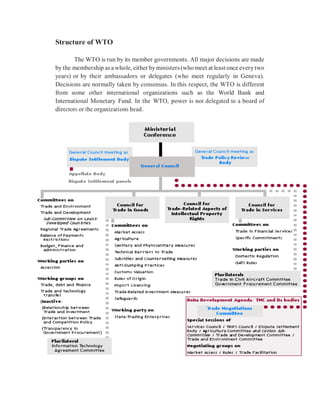
Structure of WTO
The WTO is run by its member governments. All major decisions are made
by the membership as a whole, either byministers(who meet at least once everytwo
years) or by their ambassadors or delegates (who meet regularly in Geneva).
Decisions are normally taken by consensus. In this respect, the WTO is different
from some other international organizations such as the World Bank and
International Monetary Fund. In the WTO, power is not delegated to a board of
directors or the organization’s head.

Globalisation

  • 1.
    GLOBALISATION (Unit-1) Dr. R. THANGASUNDARI,MBA., M.Phil., Ph.D., Assistant professor, (Research Adviser) PG and Research Department of Management studies Bon secours college for women, Thanjavur-06 Tamil Nadu, south India
  • 2.
    Globalisation Meaning Globalisation isthe process of international integration arising from the interchange of worldviews,products,ideas,andotheraspectsofculture.Putinsimpleterms,Globalization refers to processes that promote world-wide exchanges of national and cultural resources. Advances in transportation and telecommunications infrastructure, including the rise of the Internet, are major factors in globalization, generating further interdependence of economic, and cultural activities. The term globalization has been in increasing use since the mid-1980s and especially since the mid-1990s. In 2000, the International Monetary Fund (IMF) identified four basic aspects of globalization: trade and transactions, capital and investment movements, migration and movement of people and the dissemination of knowledge. Further, environmental challenges such as climate change, cross-boundary water and air pollution, andover-fishing of the ocean are linked with globalization. Globalizing processes affect and are affected by business and work organization, economics, socio-cultural resources, and the natural environment. Defines of Globalisation “The geographic dispersion of industrial and service activities, for example research and development, sourcing of inputs, production and distribution, and the cross-border networking of companies, for example through joint ventures and the sharing of assets” The Different Facets of Globalization and their Indicators Globalization is manifested in four interrelated developments: 1. The increase in the international exchange of goods and services, and despite all the restrictions therein, the movement of human resources; 2. The internalization of production and real investments; 3. The increased integration of financial markets; 4. The relative high degree of policy convergence among countries. The statistical evidence onthese developments is truly impressive. Inthe trade area, the ratio ofinternationaltradetotheGDPofpracticallyallcountries has morethandoubled over the last two decades. Trade has substantially outpaced the growth of the GDP in all but very few years over the past twenty-five years. A major new phenomenon is the size of services in total trade, in particular financial services.
  • 3.
    Dimensions of Globalization Globalizationencompasses the following: 1. Doing, or planning to expand, business globally. 2. Giving up the distinction between domestic market and foreign market and developing a globaloutlook on business. 3. Locating the production and other physical facilities on a consideration of the global dynamics, irrespective of nationalconsiderations. 4. Basing product development and product planning on the global market considerations. 5. Global sourcing of factors of production, i.e., raw materials, components, machinery, technology, finance, etc., are obtained from the best source anywhere in the world. 6. Global orientation of organizational structure and management culture. IMPLICATIONS OF GLOBALIZATION IN INDIA Globalization is essentially an economic phenomenon which has strong implications. To understand the effect of globalization on Indian economy, society, culture, religion and psyche, it is essential for us to know how and when economic reforms were carried out. IMF (International Monetary Fund) has prescribed a set of rules for the carrying out of economic reforms. When the Chandra Sekhar’s government was defeated at the hands of Congress, Indian economy was undergoing through a chaotic situation. Fiscal deficit soared up to new heights, which earned nothing except high rate of inflation. Due to the populist form of government spending in the 1980s, supported by huge borrowings without sufficient return, India’s internal and external debt touched the sky. Short term commercial borrowings from abroad led to a difficult situation for the government. India virtually came to the brink of default. Under this situation, the Government borrowed a huge sum of conditional loan’ from IMF. Thus India became obliged to follow IMF prescribed ‘structural reforms’. (i) Monetary Policies ➢ Positive real interestrates ➢ Increase in reserverate ➢ More vigorous open marketoperations ➢ Credit controls
  • 4.
    (ii) Realignment ofthe Exchange Rate to a Near Market Determined Rate. (iii) Reduction of Budgetary Deficits ➢ Increased revenue mobilizationefforts ➢ Review of public investment priorities and identification of a core programme of investment. (iv)Real Wage Restraint ➢ Removal of formal indexationarrangements The Long Term ‘Structural Reforms’ prescribed by IMF include (i) Promotion of Private Sector (Domestic-and Foreign) ➢ Definitive political commitment ➢ Rapid improvement in infrastructure ➢ Improvement in regulatoryregimes ➢ Facilitation of investment approvalprocedures (ii) Commercialization of Public Enterprises-Improvement in Operational Efficiency ➢ Privatization programmes (iii) Financial Sectors Reforms ➢ Movement to market determined rates capital market development, including promotion of stockexchanges (iv)Liberalization of Trade Regime Removal of import and exchange control and progress towards lower and less- dispersed band of tariffs. (v) Price-Flexibility (vi) Tax-Reforms ➢ Reduction of distortion effects on resource allocation ➢ Increased elasticity oftax-system
  • 5.
    (vii)Administrative Reforms ➢ Reductionin size of public service ➢ Safety net well targeted programmes of transfers to vulnerable groups. ➢ Training, credit and employment programmes for vulnerable group. Impact of Globalization on IndianEconomy Due to globalization, the export sector of the Indian economy received a big boost. The growth performance of the exports improved during 1993-1996. The proponents of globalization in India have argued that economic integration will improvethelocativeefficiencyofresources,reducethecapitaloutputratio,andincrease the labourproductivity,helptodeveloptheexportspheresande*portculture,increasethe inflow of the capital and updated technology into the country, increase the degree of competition in the domestic economy, reduce the relative prices of industrial and manufactured goods, improve terms of trade in agriculture and in general give a boost to the average growth of the economy in the years to come. To some extent this has proved true. The Problem and Challenges of Globalization  If globalization is a non-stoppable train, as, any argue, it seems to be a rather selectiveoneinadmittingpassengersabroad.  Economics possessive of skilled and educated manpower and endowed with well-developed production and marketing capacities can get on board to reap significant benefits if they have developed financial systemsand assess to technology.  It is a system where the benefits accrue only to the capable and prepared. Those who do not have the products and services to sell or the means to market them will assuredly be left in the station.  Finally, the asymmetric distribution of benefits across countries is breeding theories about disguised and new forms of economic domination under globalization.  Even though such views are often not empirically demonstrated, nonetheless, they are voiced by important segments in openness societies, which have become permanent and non-discrimination opponents of WTO and globalization.
  • 6.
    Goals of internationalfinance  Ensure that the international financial system contributes towards poverty eradication, environmental sustainability, an equitable distribution of wealth and the full realization of human rights.  End the unsustainable policies and practices of the international financial institutions.  Contribute to the realization of an alternative agenda for environmentally and socially sustainable development than the Washington Consensus. Scope of International Finance Three conceptually distinct but interrelated parts are identifiable in international finance: 1. International Financial Economics: It is concerned with causes and effects of financial flows among nations -application of macroeconomic theory and policy to the globaleconomy. 2. International Financial Management: It is concerned with how individual economic units, especially MNCs, cope with the complex financial environment of international business. Focuses on issues most relevant for making sound business decision in a global economy 3. International Financial Markets: It is concerned with international financial/ investment instruments, foreign exchange markets, international banking, international securities markets, financial derivatives, etc International Monetary System International monetary system is a set of internationally agreed rules, conventions and supporting institutions that facilitate international trade, cross border investment and generally the reallocation of capital between nation states. The international monetary system consists of (i) Exchange rate arrangements; (ii) Capital flows; and (iii) A collection of institutions, rules, and conventions that govern its operation.
  • 7.
    Domestic monetary policyframeworks dovetail, and are essential to, the global system. A well-functioning system promotes economic growth and prosperity through the efficient allocation of resources, increased specialization in production based on comparative advantage, and the diversification of risk. It also encourages macroeconomic and financial stability by adjusting real exchange rates to shifts in trade and capital flows.  To be effective, the international monetary system must deliver both sufficient nominal stability in exchange rates and domestic prices, and timely adjustment to shocks and structural changes. Attaining this balance can be very difficult.  Changes in the geographic distribution of economic and political power, the global integration of goods and asset markets, wars, and inconsistent monetary and fiscal policies all have the potential to undermine a monetary system.  Past systems could not incent systemic countries to adjust policies in a timely manner. The question is whether the current shock of integrating one-third of humanity into the global economy – positive as it is – will overwhelm the adjustment mechanisms of the current system.  History shows that systems dominated by fixed or pegged exchange rates seldom cope well with major structural shocks. This failure is the result of two pervasive problems: an asymmetric adjustment process and the downward rigidity of nominal prices and wages.  In the short run, it is generally much less costly, economically as well as politically, for countries with a balance ofpayments surplus to run persistentsurplusesandaccumulatereservesthanitisfordeficit countries to sustain deficits.  This is because the only limit on reserve accumulation is its ultimate impact on domestic prices. Depending on the openness of the financial system and the degree ofsterilization, this can be delayed for a very long time.  In contrast, deficit countries must either deflate or run-down reserves. Flexible exchange rates prevent many of these problems by providing less costly and more symmetric adjustment.  Relative wages and prices can adjust quickly to shocks through nominal exchange rate movements in order to restore external balance. When the exchange rate floats
  • 8.
    and there isa liquid foreign exchange market, reserve holdings are seldom required. Most fundamentally, floating exchange rates overcome the seemingly innate tendency of countries to delay adjustment. Bimetallism Bimetallism is a monetary standard in which the value of the monetary unit is defined as equivalent to certain quantities of two metals, typically gold and silver, creating a fixed rate of exchange between them. “In economics, bimetallism is a monetary standard in which the value of the monetary unit is defined as equivalent both to a certain quantity of gold and to a certain quantity of silver; such a system establishes a fixed rate of exchange between the two metals”. The defining characteristics of bimetallismare ➢ Both gold and silver money are legal tender in unlimited amounts. ➢ The government will convert both gold and silver into legal tender coins at a fixed rate for individuals in unlimited quantities. This is called free coinage because the quantity is unlimited, even if a fee is charged. Gold Standard The gold standard is a monetary system where a country's currency or paper money has a value directly linked to gold. With the gold standard, countries agreed to convert paper money into a fixed amount of gold. That fixed price is used to determine the value of the currency. The Gold Standard In today’s national economies and the current international monetary system, fiat currencies are the norm. With no backing other than the full faith and credit ofthe governments that issue them, the evolution of today’s money began with the introduction and acceptance of paper money in the seventeenth century in the form of receipts for deposits of gold in the Bank of Amsterdam. The growing role of the state and its ability to tax and impose tariffs to provide metallic backing made it possible to instill confidence in issues of bank notes convertible into gold and silver and paper currencies spread across Europeas a more convenient vehicle forpayments than coins. Bank notes thus became the standard currency for transactions within national economies in the eighteenth and nineteenth centuries.
  • 9.
    The Gold ExchangeStandard  When adopting the gold standard, many European nations changed the name of their currency from Daler (Sweden and Denmark) or Gulden (Austria-Hungary) to Crown, since the former names were traditionally associated with silver coins and the latter with gold coins.  It is probable that the success of the gold standard also depended on a parallel development that emerged out of the mechanisms the industrializing countries used to ‘manage’ the gold standard—the development of the gold exchange standard. This monetary system differs from the gold standard in that international reserves consist of both gold and convertible currencies so that the system can function with less gold.  Another difference is that, because those convertible currencies tend to be invested in interest-bearing financial assets, the gold exchange standard includes a mechanismthat allows for growth in world reserves independent of increases in gold production. The use of a mixture of foreign exchange assets and gold as components of reserve holdings was not just a post-World War I phenomenon.  The mechanisms for settlement of foreign exchange holdings evolved throughout Europe with the development of financial markets and central banks. A government (treasury or central bank) bought and sold foreign exchange in transactions with its own private sector, becoming the creditor by drawing down or building up its own holdings of foreign exchange.  This permitted the development of a larger role for the public sector in controlling international payments as these transactions replaced the earlier and less efficient transfers ofgold reserves to net out holdings of bills ofexchange between private banks in differentcountries. Thus, the addition of convertible currency assets as components of international reserves constituted a significant revision of the rules of the game in international payments that persisted until the collapse of Bretton woods in 1971.
  • 10.
    Bretton Woods: theDollar Exchange Rate Regime The “Revived Bretton Woods system” identified in 2003 International monetary systems over two centuries[16] Date System Reserve assets Leaders 1803–1873 Bimetallism Gold, silver France, UK 1873–1914 Gold standard Gold, pound UK 1914–1924 Anchored dollar standard Gold, dollar US, UK, France 1924–1933 Gold standard Gold, dollar, pound US, UK, France 1933–1971 Anchored dollar standard Gold, dollar US, G-10 1971–1973 Dollar standard Dollar US 1973–1985 Flexible exchange rates Dollar, mark, pound US, Germany, Japan 1985–1999 Managed exchange rates Dollar, mark, yen US, G7, IMF 1999- Dollar, euro Dollar, euro, yen US, Eurozone, IMF Floating Exchange-Rate Regime An exchange-rate regime is the way an authority manages its currency in relation to other currencies and the foreign exchange market. It is closely related to monetary policy and the two are generally dependent on many of the same factors.The basic types are a floating exchange rate, where the market dictates movements in the exchange rate; a pegged float, where a central bank keeps the rate from deviating too far from a target band or value; and a fixed exchange rate, which ties the currency to another currency, mostly more widespread currencies such as the U.S. dollar orthe euro or a basket ofcurrencies. Types of Exchange Rate Regime ➢ Float Floating rates are the most common exchange rate regime today. For example, the dollar, euro, yen, and British pound all are floating currencies. However, since central banks frequently intervene to avoid excessive appreciation or depreciation, these regimes are often called managed float or a dirty float.
  • 11.
    ➢ Pegged Float Peggedfloating currencies are pegged to some band or value, either fixed or periodically adjusted. Pegged floatsare: ➢ Crawling Bands The rate is allowed to fluctuate in a band around a central value, which is adjusted periodically. This is done at a preannounced rate or in a controlled way following economic indicators. ➢ Crawling Pegs The rate itself is fixed, and adjusted as above. ➢ Pegged with Horizontal Bands The rate is allowed to fluctuate in a fixed band (bigger than 1%) around a central rate. ➢ Fixed Fixedratesarethosethathavedirect convertibilitytowardsanothercurrency. Incase of a separate currency, also known as a currency board arrangement, the domestic currency is backed one to one by foreign reserves. A pegged currency with very small bands (< 1%) and countries that have adopted another country’s currency and abandoned its own also fall under this category. Dollarization occurs when the inhabitants of a country use foreign currency in parallel to or instead of the domestic currency. The term is not only applied to usage of the United States dollar, but generally to the use of any foreign currency as the national currency. Zimbabwe is an example of dollarization since the collapse of the Zimbabwean dollar.
  • 12.
    European Monetary System EuropeanMonetary System (EMS) was an arrangement established in 1979 under the Jenkins European Commission where most nations of the European Economic Community (EEC) linked their currencies to prevent large fluctuations relative to one another. The basic elements of the arrangement were:  The ECU: With this arrangement, member currencies agreed to keep their FX rates within an agreed band which the narrow band of +/- 2.25% and a wide band of +/- 6%.  An Exchange Rate Mechanism(ERM)  An extension of European credit facilities.  The European Monetary Cooperation Fund: created in October 1972 and allocates ECUs to members’ central banks in exchange for gold and US dollar deposits. Although no currency was designated as an anchor, the Deutsche Mark and German Bundesbank soon emerged as the centre ofthe EMS. Because ofits relative strength, and the low-inflation policies of the bank, all other currencies were forced to follow its lead if they wanted to stay inside the system. Eventually, this situation led to dissatisfaction in most countries, and was one of the primary forces behind the drive to a monetary union (ultimately the euro). Periodic adjustments raised the values of strong currencies and lowered those of weaker ones, but after 1986 changes in national interest rates were used to keep the currencies within a narrow range. In the early 1990s the European Monetary System was strained by the differing economic policies and conditions of its members, especially the newly reunified Germany, and Britain (which had initially declined to join and only did so in 1990) permanently withdrew from the system inSeptember 1992. The Outstanding Issues in the International Monetary and Financial Systems The outstanding issues in the international monetary and financial systems can be listed under the followingheadings:
  • 13.
     The governanceand regulation of the capital and monetary flows:  The management of financial crisis and the foundation of the bank of Last Resort.  The Foreign ExchangeSystem  The Reform of theIMF The Governance and Regulation of Financial Flows  The articles of agreements of the IMF contained disparate references to financial flows in articles IV and VI. As indicated above, Article IV made the free exchange of finance among member states a fundamental objective of the IMF. Article VI provides permissibility of capital controls as long as they do not impede or restrict payments made from the current account transactions (the balance of trade and unilateral transfers). It also disallows theuse of the resources of the fund to support large capital outflows.  The concern with the growth of financial instability impelled the G7 (the group of seven major industrial countries) in February 1999 to establish the “Financial Stability Forum” with the aim of promoting international financial stability through improved exchangeofinformation, cooperation with respect to financial supervision and surveillance, and streamlining standards and norms in the various participant countries. Naturally, this work cannot be confirmed to financial flows and the financial institutions, as it has direct implications with respect to macroeconomic policies, the various standards ofthe financial system and its judicialframework.  In each of the various areas, a key standard was established with a lead institution responsible for developing the necessarycodes, rules, norms and standards. Consequently, the BIS has over the last decade been the forum in which officials from the participating countries and international organizations, without the presence of private sector agents, have concluded numerous agreements aiming at establishing cooperative modalities for collecting systematically information on capital and monetary flows and disseminating them to members andpublic.  The forum has reached numerous agreements on codes of behavior such as the code of “Good Practices on Transparency in Monetary and Financial Policies”, and the same for transparency in fiscal policy. It reached agreements on financial regulation and supervision such as “The Core Principles of Effective Banking Supervision” and those of security and insurance.
  • 14.
     It alsoagreed on regulation standards for insolvency, for corporate governance, for auditing and accounting and principles to deal with money laundering. It also agreed to rules and procedures for the treatment of important financial concepts such as risk and exposure as well as setting up modalities of cooperation among officials of member states. An important part ofwhat was achieved is the collection ofdata and the establishment ofa shared database.  Unfortunately, the private sector was not involved directly in devising the new rules and principles and not asked to share any responsibilities. Furthermore, no modalities were agreed for securing its continuous involvement in financial governance, let alone setting up a non-voluntary code of investors’ behavior.  All of this work, with all its due importance, amounted in effect to organizing in the source countries the supervision of their institutions and setting up financial regulations andbehavior standards fortheir institutions. Naturally, global financial governance involves conduct in crises, obligations on the source authorities as well as the recipient country authorities and above all, setting up proper models of conduct and codes of standards for private investors. But this was not to be, as the private sector participationremainedstrictly voluntary.  As noted earlier, the increased globalization of the world economy and the evolved integration of financial markets have resulted in enormous increase in cross border financial flows, with a concomitant increase in financial instability and frequent eruptions offinancialand currencycrisis. No doubt, the purpose ofthe new codes and standards can increase financial stability and prevent, or at least, forewarn of impending crises.  Another variant more concerned with system issues and policies, developed proposals to establish a super agency over all the relevant international organizations to be responsible for the whole system: its policies, regulations, supervision, and crisis management.  All these proposals share the aim of establishing a global authority with a global perspective and enforceable authority to deal with the application of regulations, codes of behavior, and methods of controls and rules of functioning onradically different basis than thepiecemeal,patchyapproach
  • 15.
    of the presentinstitutions. It is argued that the globalization of the world economy now calls for such an approach.  Another problem concerns the treatment of private sector. Since the private investors and speculators inthe source countries are responsible forthe bulk of the financial flows, the voluntary character of the application of the established rules and codes to them stands in starkcontrasttothesummons toobeywithconsequentsanctionsaddressedtotherecipient and their private concerns.  A code of behavior for investors would be an enormous development. However,there are severalobjections to sucha binding code. The first argue that it is exceedingly difficult to enforce it. The second is an efficiency argument about the distortion of allocation of international investment funds in case of insolvency controls.  The third concerns the deterrence to capital movements it might bring about, in particular, inflows to the poorer countries. The fourth is the desirability of avoiding bureaucratic decision – making and conflict of jurisdictions in case of crisis. The counter arguments are familiar from the work of the BIS and the literature on capital controls and the Tobintax. Briefly, it is argued that feasibility is an open empirical question; that the efficiency argument assumes that a code – free system is optimal and is already in place and that the fear of bureaucratic conflicts is exaggerated. On balance, a universal code applied by all an impartial international authority, such as the IMF, should be feasible. International Monitory Fund The International Monetary Fund (IMF) is an organization of 188 countries, working to foster global monetary cooperation, secure financial stability, facilitate international trade, promote high employment and sustainable economic growth, and reduce poverty around the world. With its near-global membership of 188 countries, the IMF is uniquely placed to help member governments take advantage of the opportunities—and manage the challenges—posed by globalization and economic development more generally. The IMF tracks global economic trends and performance, alerts its member countries when it sees problems on the horizon, provides a forum for policy dialogue, and passes on know-how to governments on how to tackle economic difficulties.
  • 16.
    The IMF providespolicy advice and financing to members in economic difficulties and also works with developing nations to help them achieve macroeconomic stability and reduce poverty. Marked by massive movements of capital and abrupt shifts in comparative advantage, globalization affects countries’ policy choices in many areas, including labor, trade, and tax policies. Helping a country, benefit from globalization while avoiding potential downsides is an important task for the IMF. The global economic crisis has highlighted just how interconnected countries have become in today’s world economy. Key IMF Activities The IMF supports its membership by providing ➢ Policyadvicetogovernmentsandcentralbanksbasedonanalysisofeconomic trends and cross-countryexperiences; ➢ Research, statistics, forecasts, and analysis based on tracking of global, regional, and individual economies andmarkets; ➢ Loans to help countries overcome economic difficulties; ➢ Concessional loans to help fight poverty in developing countries; and ➢ Technical assistance and training to help countries improve the management oftheir economies. Original Aims The IMF was founded more than 60 years ago toward the end of World War II (see History). The founders aimed to build a framework for economic cooperation that would avoid a repetition of the disastrous economic policies that had contributed to the Great Depression of the 1930s and the global conflict that followed. Since then the world has changed dramatically, bringing extensive prosperity and lifting millions out of poverty, especially in Asia. In many ways the IMF’s main purpose—to provide the global public good of financial stability—is the same today as it was when the organization was established. More specifically, the IMF continues to: ➢ Provide a forum for cooperation on international monetary problems ➢ Facilitate the growth of international trade, thus promoting job creation,
  • 17.
    economic growth, andpovertyreduction; ➢ Promote exchange rate stability and an open system of international payments; and ➢ Lend countries foreign exchange when needed, on a temporary basis and under adequate safeguards, to help them address balance of payments problems. An Adapting IMF The IMF has evolved along with the global economy throughout its 65-year history, allowing the organization to retain its central role within the international financial architecture As the world economy struggles to restore growth and jobs after the worst crisis since the Great Depression, the IMF has emerged as a very different institution. During the crisis, it mobilized on many fronts to support its member countries. It increased its lending, used its cross-country experience to advice on policy solutions, supported global policy coordination, and reformed the way it makes decisions. The result is an institution that is more in tune with the needs of its 188 member countries. ➢ Stepping up crisis lending. The IMF responded quickly to the global economic crisis, with lending commitments reaching a record level of more than US$250 billion in 2010. This figure includes a sharp increase in concessional lending (that’s to say, subsidized lending at rates below those being charged by the market) to the world’s poorest nations. ➢ Greater lending flexibility. The IMF has overhauled its lending framework to make it better suited to countries’ individual needs. It is also working with other regional institutions to create a broader financial safety net, which could help prevent new crises. ➢ Providing analysis and advice. The IMF’s monitoring, forecasts, and policy advice, informed by a global perspective and by experience from previous crises, have been in high demand and have been used by the G-20. ➢ Drawing lessons from the crisis. The IMF is contributing to the ongoing effort to draw lessons fromthe crisis for policy, regulation, and reform ofthe global financial architecture.
  • 18.
    ➢ Historic reformof governance. The IMF’s member countries also agreed to a significant increase in the voice of dynamic emerging and developing economies in the decision making of the institution, while preserving the voice of the low-income members. The IMF’s main goal is to ensure the stability of the international monetary and financial system. It helps resolve crises, and works with its member countries to promote growth and alleviate poverty. It has three main tools at its disposal to carry out its mandate: surveillance,technicalassistanceandtraining,and lending.Thesefunctionsareunderpinned by the IMF’s research and statistics. The Governance of the IMF The IMF is accountable to the governments of its member countries. The fund Governance has been a contentious issue between the developing and developed countries since the mid of 1950’s. The familiar argument of the former is that the quota system is not fairasakeyfordecision–making andaccesstoresources. The response ofthe latter is that it is only normal and fair that each country share in the decision making be commensurate with its contribution to the fund resources. IMF Members’ Quotas and Voting Power, and IMF Board of Governors The Board of Governors, the highest decision-making body of the IMF, consists of one governor and one alternate governor for each member country. The governor is appointed by the member country and is usually the minister of finance or the governor of the central bank. All powers of the IMF are vested in the Board of Governors. The Board of Governors may delegate to the Executive Board all except certain reserved powers. The Board of Governors normally meets once a year. Timeline for Implementing the Reform The Board of Governors, the IMF’s highest decision-making body, must ratify the new agreement by an 85 percent majority before it comes into effect. Accountability The IMF is accountable to its 188 member governments, and is also scrutinized by multiple stakeholders, from political leaders and officials to, the media, civil society, academia, and its own internal watchdog. The IMF, in turn, encourages its own members to be asopen as possible about their economic policies
  • 19.
    to encourage theiraccountability and transparency. Country Representation Unlike the General Assembly of the United Nations, where each country has one vote, decision making at the IMF was designed to reflect the position of each member country in the global economy. Each IMF member country is assigned a quota that determinesits financial commitment to the IMF, as well as its voting power World Trade Organization (WTO) The World Trade Organization (WTO) establishes rules of trade among its member nations. To this end, the WTO also handles trade disputes, monitors trade policies, provides technical assistance for developing countries and cooperates with other international trade organizations.
  • 20.
    The WTO wascreated on January 1, 1995, and is headquartered in Geneva, Switzerland. The WTO replaced the General Agreement on Tariffs and Trade (GATT), which was created in 1948. GATT primarily regulated the trade of goods; the WTO regulates the trade of services and intellectual property as well. GATT still exists as the WTO's umbrella treaty for trade in goods. Functions of WTO ➢ Administering WTO tradeagreements ➢ Forum for tradenegotiations ➢ Handling trade disputes ➢ Monitoring national tradepolicies ➢ Technical assistance and training for developing countries ➢ Cooperation with other internationalorganizations  The World Trade Organization (WTO) is the only global international organization dealingwiththerulesoftradebetweennations.AtitsheartaretheWTO agreements, nego- tiated and signed by the bulk of the world’s trading nations and ratified in their parliaments. The goal is to help producers of goods and services, exporters, and importers conduct their business.  The WTO was born out of negotiations, and everything the WTO does is the result of negotiations. The bulk of the WTO’s current work comes from the 1986–94 negotiations called the Uruguay Round and earlier negotiations under the General Agreement on Tariffs and Trade (GATT). The WTO is currently the host to new negotiations, under the ‘Doha Development Agenda’ launched in 2001.  Where countries have faced trade barriers and wanted them lowered, the negotia- tions have helped to open markets for trade. But the WTO is not just about opening mar- kets, and in some circumstances its rules support maintaining trade barriers — for example, to protect consumers or prevent the spread of disease.  At its heart are the WTO agreements, negotiated and signed by the bulk of the world’s trading nations. These documents provide the legal ground rules for international commerce. They are essentially contracts, binding governments to keep their trade policies within agreed limits. Although negotiated and signed by governments, the goal is to help producers of goods and services, exporters, and importers conduct their business, while al- lowing governments to meet social and
  • 21.
    environmental objectives.  Thesystem’s overriding purpose is to help trade flow as freely as possible — so long as there are no undesirable side effects — because this is important for economic develop- ment and well-being. That partly means removing obstacles. It also means ensuring that individuals, companies and governments know what the trade rules are around the world, and giving them the confidence that there will be no sudden changes of policy. In other words, the rules have to be ‘transparent’ and predictable. Trade relations often involve conflicting interests. Agreements, including those painstakingly negotiated in the WTO system, often need interpreting. The most harmoni- ous wayto settle these differences is through some neutralprocedure based on an agreed legal foundation. That is the purpose behind the dispute settlement process written intothe WTO agreements. Principles of the Trading System The WTO agreements are lengthy and complex because they are legal texts cover- ing a wide range of activities. They deal with: agriculture, textiles and clothing, banking, telecommunications, government purchases, industrial standards and product safety, food sanitation regulations, intellectual property, and much more. But a number of simple, fundamental principles run throughout all of these documents. These principles are the foundation of the multilateral trading system: Most-Favored-Nation (MFN) Treating other people equally Under the WTO agreements, countries cannot normally dis- criminate between their trading partners. Grant someone a special favour (such as a lower customs duty rate for one of their products) and you have to do the same for all other WTO members. This principle is known as most- favored-nation (MFN) treatment (see box). It is so important that it is the first article of the General Agreement on Tariffs and Trade (GATT), which governs trade in goods. MFN is also a priority in the General Agreement on Trade in Services (GATS) (Article 2) and the Agreement on Trade-Related Aspects of Intellectual Property Rights (TRIPS) (Article 4), although in each agreement the principle is handled slightly differently. Together, those three agreements cover all three main areas of trade handled by the WTO.
  • 22.
     National Treatment Treatingforeigners and locals equally Imported and locally-produced goods should be treated equally — at least after the foreign goods have entered the market. Thesame should apply to foreign and domestic services, and to foreign and local trademarks, copy- rights and patents. This principle of “national treatment” (giving others the same treatment as one’s own nationals) is also found in all the three main WTO agreements (Article 3 of GATT, Article 17 of GATS and Article 3 of TRIPS), although once again the principle is handled slightly differently in each of these. National treatment only applies once a product, service or itemof intellectual property has entered the market.  Freer Trade: Gradually, Through Negotiation Lowering trade barriers is one of the most obvious means of encouraging trade. The barriers concerned include customs duties (or tariffs) and measures such as import bans or quotas that restrict quantities selectively. From time to time other issues such as red tape and exchange rate policies have also been discussed.  Predictability: Through Binding and Transparency Sometimes, promising not to raise a trade barrier can be as important as lowering one, because the promise gives businesses a clearer view of their future opportunities. With stabilityandpredictability,investmentisencouraged,jobsare createdandconsumerscan fully enjoy the benefits of competition — choice and lowerprices.  Promoting Fair Competition The WTO is sometimes described as a “free trade” institution, but that is not entirely accurate. The system does allow tariffs and, in limited circumstances, other forms ofprotection. More accurately, it is a system of rules dedicated to open, fair and undistorted competition. Encouraging Development and Economic Reform The WTO system contributes to development. On the other hand, developing countries need flexibility in the time they take to implement the system’s agreements. And the agreements themselves inherit the earlier provisions of GATT that allow for special assistance and trade concessions for developing countries.
  • 23.
    Over three quartersof WTO members are developing countries and countries in transition to market economies. During the seven and a half years of the Uruguay Round, over 60 of these countries implemented trade liberalization programmes autonomously. At the same time, developing countries and transition economies were much more active and influential in the Uruguay Round negotiations than in any previous round, and they are even more so in the current Doha Development Agenda. At the end of the Uruguay Round, developing countries were prepared to take on most of the obligations that are required of developed countries. But, the agreements did give them transition periods to adjust to the more unfamiliar and, perhaps, difficult WTO provisions — particularly so for the poorest, “least-developed” countries. Activities of WTO WTO’s main activities are: ➢ Negotiating the reduction or elimination of obstacles to trade (import tariffs, other barriers to trade) and agreeing on rules governing the conduct of international trade (e.g. antidumping, subsidies, product standards, etc.). ➢ AdministeringandmonitoringtheapplicationoftheWTO’sagreedrulesfor trade in goods, trade in services, and trade-related intellectual property rights. ➢ Monitoring and reviewing the trade policies of our members, as well as ensuring transparency of regional and bilateral trade agreements. ➢ Settling disputes among our members regarding the interpretation and application of the agreements. ➢ Building capacity of developing country government officials in international trade matters. ➢ Assisting the process of accession of some 30 countries who are not yet members of the organization. ➢ Conducting economic research and collecting and disseminating trade data in support of the WTO’s other main activities. ➢ Explaining to and educating the public about the WTO, its mission and its activities.
  • 24.
    Structure of WTO TheWTO is run by its member governments. All major decisions are made by the membership as a whole, either byministers(who meet at least once everytwo years) or by their ambassadors or delegates (who meet regularly in Geneva). Decisions are normally taken by consensus. In this respect, the WTO is different from some other international organizations such as the World Bank and International Monetary Fund. In the WTO, power is not delegated to a board of directors or the organization’s head.