SOARING EAGLE COMMUNITY
EDUCATIONAL SERVICES
P.O BOX 196 – 90203
KITUI
TEL: +254 724 327 237
+254 791 847 073
DEPARTMENT OF
ENTREPRENEURSHIP
EDUCATION
ENTREPRENEURSHIP EDUCATION
Topic Sub – Topic
1)Introduction to
Entrepreneurship • Meaning of terms
• Difference between self-employment and salaried
employment
• Contribution of entrepreneurship to national development
• Requirement for entry into Self Employment
2)Evolution of
Entrepreneurship
• History of Entrepreneurship
• Myths associated with entrepreneurship in Kenya
• Theories of entrepreneurship
• Importance of entrepreneurship theories
• Factors affecting entrepreneurship development
3)The
Entrepreneur
• Types of Entrepreneurs
• Qualities of an entrepreneur
• Roles of an entrepreneur in an enterprise
Page 2 of 165
4)Creativity and
Innovation • Meaning of creativity and innovation
• Process of creativity and innovation
• Importance of creativity and innovation
• Barriers to creativity and innovation
• Managing creativity and innovation
5)Entrepreneurial
Culture • Concept of entrepreneurial culture
• Habits that promote entrepreneurial development
• Factors inhibiting entrepreneurial development
• Ways of managing factors that inhibit development of
entrepreneurial culture
Topic Sub – Topic
6)Entrepreneurial
Opportunities • Meaning of entrepreneurial opportunities
• Ways of generating business ideas
• Evaluation of business opportunities
7)Entrepreneurial
Motivation
• Definition of entrepreneurial motivation
• Entrepreneurial motivation factors
8)Entrepreneurial
competence • Definition of entrepreneurial competence
• Key entrepreneurial competence
9)Starting a small
business • Procedure of starting a small enterprise
• Factors to consider when starting a small enterprise
• Legal forms of business ownership
• Challenges faced when starting a small enterprise
• Business life cycle
• Regulations affecting business
• Business support services available for a small business
Page 3 of 165
10) Business
enterprise
Management
• Definition of terms
• Functions of management in an enterprise
• Inventory management
• Managing enterprise resources
11) Financial
Management • Meaning of financial Management
• Importance of financial management
• Sources of business finance
• Types of business records
• Recording business transactions in the books of accounts
• Preparation of financial statement
• Interpretation of financial statements
Topic Sub – Topic
□Importance of budgeting to a business
12) Marketing
• Definition of terms
• Components of marketing
• Process of marketing
13) Enterprise
Social
Responsibility
and Business
Ethics
• Definition of terms
• Enterprise social responsibility
• Types of enterprise social responsibility
• Importance of enterprise social responsibility
• Ethical behavior in an enterprise
14)Introduction to
business Plan • Definition of business plan
• Components of a business plan
• Uses of a business plan
• Preparation of a business plan
Page 4 of 165
15) ICT in
enterprise
Management
• Definition of terms
• Benefits of ICT
• Uses of ICT Equipment
16) Emerging trends
and issues in
entrepreneurship
• Emerging issues and trends
• Challenges posed by emerging issues and trends
• Ways of managing challenges posed by emerging issues andtrends.
INTRODUCTION TO ENTREPRENEURSHIP
Definition of Terms
Definition of an entrepreneur
 An entrepreneur is a person who identifies a business opportunity, harnesses and obtains the
resources necessary to initiate a successful business activity.
 The entrepreneur implements the idea
 Undertakes to operate the business
 An entrepreneur is therefore a central key individual in the society who makes things
happens for economic development.
Entrepreneurship meaning
 In the broader sense entrepreneurship refers to the means of stimulating innovative and
creative undertakings for a better business community or world.
 The act or process of identifying business opportunities and gathering the necessary
resources to initiate a successful business activity.
 Entrepreneurship is a French word meaning to undertake and focuses on a business enterprise
 Entrepreneurship can exist in any situation – therefore it is the creation of values through
establishing a business enterprise.
 Entrepreneurship means having an idea of one’s own and trying to implement the idea to
create values on it.
 Entrepreneurship is a term which encompasses what entrepreneurs do i.e
 Identifying a business opportunity of a particular demand
 Look at the opportunity as a process of creating, something that did not exist.
 Constantly searching/ harnessing ones environment and resources to implement the
activities.
 Creating a totally new product and using it in as new.
 Entrepreneurship there is the practice of starting a new business or revitalizing existing
businesses in response to identifying opportunities.
Page 5 of 165
Self-Employment
 Working independently and earning a living from it.
 This is a concept that arises when the entrepreneur relies on revenues from his business as a
source of income
 What is Unemployment? Advantages and disadvantages of Self Employment?
 What is Salaried Employment? Advantages and Disadvantages of Salaried employment?
Enterprise
 A business undertaking by an individual for the purpose of making a profit.
Factors impeding the growth of Entrepreneurship
 High Taxation Levels
 Corruption and Official Harassment
 Unregulated competition from outside countries
 Decline in personal incomes
 The high cost of finance
 Lack of entrepreneurial culture
 Poor transport and communication networks
 Lack of skills and knowledge
 Explain the distinctions between an Entrepreneur and a Manager
Contribution of Entrepreneurship to National Development
 The economic growth, the improved quality of life, the equitable distribution of resources
and the capacity of the economy to deal with economic, social and environmental
development.
 Main objectives of national development include:
 Provide basic needs to every citizen:- food, shelter, health, security, education,
clothing
 Elimination / Reduction of poverty: reduce rural-urban migration
 Provision ofopportunities for employment and personal advancement
 Trying to narrow the income differences between the rich and the poor.
i) Employment Creation:
ii) Promotion of National Productivity: This is through production of goods and services
within the country and therefore they contribute to the Gross Domestic Product (GDP)
iii) Raising Standards of Living: It’s measured by the capacity of people of a country to buy
goods and services. Entrepreneurs contribute by employing people and giving them
salaries or wages to buy their necessities.
iv) Conservation of foreign Exchange: Entrepreneurs produce goods and services that are
needed by people and reduction in importing those goods and hence the government
saves foreign exchange.
v) Export Promotion: Entrepreneurs who produce goods and services for export earn.
vi) Conservation Agent: Entrepreneurs can contribute to conservation and utilization of
resources e.g. manufacturing a Jiko that uses sawdust instead of wood charcoal
vii) Rural development which in effect.
Page 6 of 165
 Promotes change to the formal sector from informal sector
 Equitable development
 Reduced rural-urban migrations.
viii) Development of technology through
 establishment of research institutions
 education systems
ix) Government revenue
 Through taxes - From domestic borrowing (TBs)
x) Facilitating community development through
 Establishment of small businesses
 ii) Participation in community dev. Projects
 Providing a positive role model and facilitating.
 Competition between domestic entrepreneurship and imported
 Stimulating dev. Ofentrepreneurship.
xi) Reducing dependence on imported goods and services.
xii) Stimulates competition through
 Quality production methods are adopted
 Quality products are produced
 Variety goods and services are produced.
xiii) Facilitated development of the financial sector through which;
 Capital accumulation is possible through savings
 Loaning is facilitated
 Development of the capital market.
Entrepreneurship
i) Entrepreneurship looks at particular individuals in a business set-up. It operates in large
business or organization which is business minded to make profit.
ii) Entrepreneurs operate autonomously for the welfare of the organization.
iii) The term Intra – refers to within – therefore Entrepreneurship is a process whereby an
individual or group within a large organization creates something new or different to
maximize on the available opportunities to that organization.
iv) Intra can therefore be equated to entra within the context of a large organization where the
workers are a leeway to be creative or innovative on their own.
v) They become competitive, socially and economically the idea is to allow individuals within the
organization to act and think independently.
Entrepreneurial Behavior
 Several theories have been developed to explain why entrepreneurs behave the way they
do.
 There has been debate on whether entrepreneurs are born or made
 Born-hereditary, made-entrepreneurs are environmental influenced by where they are born.
 These are;
i) Economic
Page 7 of 165
 The theory explains entrepreneurial behavior as influenced by economic factors
through which.
a) It is possible to introduce new methods
b) It is possible to find new sources of materials
c) It is possible to open new markets
 The economic prospective is important since they create enabling environment for the
entrepreneur to combine the factors of production.
ii) Psychological factors
 The theory states that entrepreneurs have unique values, attitudes and needs within which
drive them.
 It is mostly concerned with personality traits as the main determinants of entrepreneurial
behavior
 People are likely to become entrepreneurs because of high liking of say.
a) Independence
b) Attitude
c) Need to satisfy certain needs.
iii) Sociological factors
 Maintains that environmental factors such as beliefs, culture, social structures determine
entrepreneurial behavior.
iv) Management factors
 Emphasizes on the organization of resources in a specific way to attain profits
 Leadership impacts on behavior and facilitates pioneership, achieving of goals and provides
vision.
The Functions of an Entrepreneur
i) The bearing of uncertainty is the primary function of the entrepreneur i.e losses or profits.
ii) The management of the business enterprise ie can delegate
iii) Provision of risk capital and invention.
iv) Identifying gaps in the market and turning such gaps to business opportunities i.e to initiate a
business.
v) Financing the businesses, through raising and mobilizing the necessary resources to exploit
opportunity.
vi) Searching for business opportunities through environmental scans. vii) Mobilization of
resources needed to start and run a business e.g. from
a) Personal savings
b) Friends & relatives
c) Financial institutions e.t.c
viii) Evaluation of business opportunities to access viability and any other benefits that might
accrue to the business.
ix) Provide the necessary leadership for the business and those working in it.
Page 8 of 165
Advantages of Entrepreneurship
i.) Financial gains
ii.) Self-employment which leads to job satisfaction and flexibility
iii.) Provide job opportunities to the unemployed or those seeking better jobs.
iv.) A means of opening up new industries especially in the rural areas - facilitating globalization
v.) A source of generating income and increased economic growth.
vi.) Facilitates competition encouraging high quality products
vii.) Facilitates production of more goods and services
viii.) Leads to the development of newer markets
ix.) Promotes use of modern technology in especially small- scale manufacturing to enhance higher
productivity
Drawbacks of entrepreneurship
a) Challenges of a being an entrepreneur
 long working hours
 poor pay
 unclear future
 fear of losing all that has been invested
 bankruptcies and closure
b) Other challenges
 Fear of delegating
 the problem do it yourself and know it all
 competition by established business
 lack of funds especially before break even
 Mismanagement by employees
Promotion of Entrepreneurship
 Integrating entrepreneurship into the education system
 Registration to encourage risk taking
 National companies to promote entrepreneurship
 Support of entrepreneurs through friendly loans at the appropriate time.
2. EVOLUTION OF ENTREPRENEURSHIP The Evolution of Entrepreneurship in Kenya
 Interest in the development of entrepreneurship and small enterprise in Kenya gained momentum as
a possible remedy to the stagnation of economic development and the escalating unemployment
problem between the early 1960 and 1970s
 Although there were attempts by the government to develop entrepreneurship, the main impetus
came from the international labor organization (ILO) report.
 The report centered on the potential of the informal sector and suggested that the bulk of Kenya’s
urban workers were self –employed in small enterprises.
 The report proposed that the development of this sector could;
i. Promote employment
ii. Facilitate development
iii. Facilitate equitable distribution of resources.
 Based on this report the government responded with a seasonal paper in 1973 – which recognized
the role of entrepreneurship in employment creation not just in the informal sector but also in the
Page 9 of 165
formal sector.
 Subsequent development plans have devoted time to the development of strategies and to promote
small-scale enterprises and entrepreneurs which include.
 The industrial estate programme
 Establishment of development agents e.g ICDC and KIE
 Policy and institutional framework to promote entrepreneurs.
 Promoting indigenous Kenyan enterprises.
Economic, Social and Political Factors Affecting Entrepreneurial Development
a) High taxation levels. For business and personal incomes
 Which in effect reduce profits earned making it un-attractive to engage in business
Taxation of raw materials and other inputs raise production costs.
b) Corruption and official harassment
 Occurs where entrepreneurs are forced to bribe officials in various government departments to
allow operation or start up.
 Raids under one pretext or another which tends to be very harassing.
c) Unregulated competition from the outside world due.
 Liberalization which opened importation competing locally produced goods.
d) Declining personal incomes of people due to
 Over-increasing cost of living
 Arise in unemployment
e) The high cost of finance
 The cost of borrowing is high
 Business collapses because they lack ability to repay loans.
f) Lack of necessary skills and knowledge due to
 lack of training opportunities
 high education costs
g)Poor transport and communication network
 making business difficult
 Inconveniencing consumers
 High energy costs
 Lack of entrepreneurial culture
Myths Associatedwith Entrepreneurship
1) Entrepreneurs are doers not thinkers: Although it is true entrepreneurs tend towards action, they are
also thinkers.
2) Entrepreneurs are born not made: The idea that the characteristics of entrepreneurs cannot be taught
or learned, that they have innate trait, has long been prevalent. Today, however, the recognition of
entrepreneurship as a discipline is helping to dispel the myth.
1) Entrepreneurs are always inventors: entrepreneurship covers more than just invention. It
requires a complete understanding of innovative behavior in all forms.
2) Entrepreneurs are academic and social misfits. The belief that entrepreneurs are academically
and socially ineffective is as a result of some business owners having started successful
enterprise after dropping out of school or quitting a job. Today the entrepreneur is considered
a hero socially, economically and academically and no longer misfit.
3) Entrepreneurs must fit the profile many books and articles have presented checklist of
Page 10 of 165
characteristics of a successful entrepreneur. Today we realize that a standard entrepreneurial
profile
4) All entrepreneurs need to run a business successful is money: Many business fail because of
managerial incompetence, lack of financial understanding, poor planning etc. To many
entrepreneurs money is a source but not an end in itself.
5) All entrepreneurs need is luck. Being at “the right place at the right time” is always an
advantage. But luck happens when preparation meets opportunity as an equally appropriate
advantage. Prepared entrepreneurs who seize the opportunity when it arises often seem
“Lucky” they are in fact simply better prepared to deal with situations and turn them into
success. What appears to be luck really is preparation, determination, desire, knowledge and
innovativeness?
6) Entrepreneurs must fail; in fact failure can teach many lessons to those willing to learn and
often leads to future successes.
7) Entrepreneurs are extremely risk takers (Gamblers). Entrepreneur is usually working on a
moderate or calculated risk.
8) It takes a lot of money to start a business. This is false because it is all about using the little
resources to make the most out of it.
9) Those who make it are those with rich backups. You can start from scratch with no special
favors or advantages and succeed
10) Some people go about thinking that banks do not lend to those who wish to start up
businesses.
11) Those who start business, do so in very attractive industries
12) All entrepreneurs are rich and have financial success
13) Starting a business is easy. It is difficult and getting it running takes a lot.
Theories of entrepreneurship
The theories that explains entrepreneurship include:
a) Psychological Theory
b) Motivational Theory
c) Sociological Theory
d) Economic Theory
e) The Resource Based Theory
f) Competence Based Theory.
g) Heterogeneous Demand Theory
Psychological theory
The focus is that entrepreneurs have unique values, attitudes and need which drive them.
People’s behavior results from their attempts to satisfy their unique needs and values.
The psychological school focuses on personality factors believing that entrepreneurs
have unique values and attitudes towards work and life.
Among the most frequent traits of entrepreneurs include the Need for achievement,
Page 11 of 165
Locus of Control and Risk taking propensity.
Motivational Theory
 Motivation is that which causes you to behave in the way you behave i.e. the why of behavior
 Entrepreneurial motivation is those factors and forces or events that energizes an individual, his desires
and the needs to go into and sustain a business venture.
Types of motivation;
i) Internal Motivation Factors
ii) External Motivation Factors
i). Internal Motivations and Drives
Refers to those personal traits and desires that induce a person to become an entrepreneur. Such motivations are;
 Employment Creation Need.
 Need for independence or self-Reliance:
 Need for Power:
 Need for Recognition:
 Need for Security:
 Self-actualization need:
ii). External Motivations and Drives
Infrastructure:.
Credit Facilities:
Information Support
Pricing Policy
Tax Policy
Legal Control
Political Climate
Technical Technology Assistance
Training Consultancy Assistance
Friends Motivation
Maslow’s NeedTheory
 Theory of human needs is identified with the psychologist Abraham Maslow. This
theory is based on three specific assumptions:
 The human beings are never satisfied. Their wants are determined by what they have.
When people are hungry or thirsty, the quest for food or water influences how they
behave. However if food and water is acquired, the same person will want something
else, perhaps a safe place to live in or a social status.
 A satisfied need does not cause behavior. Once people satisfy their need for safety, they
are motivated by yet unsatisfied needs, not the ones – that are satisfied,
 Human needs are arranged in hierarchy of importance. These needs range from low
level biological (physiological) needs to such high level needs as self-actualization.
Page 12 of 165
Factors Affecting Entrepreneurial Development
Political Factors
 Political environment is concerned with the policies pursued by the government.
Components of political environment include;
 The political stability
 Political system e.g.
i. Capitalism: whereby the means of production are owned by individuals.
A capitalist is a wealthy merchant who uses his/her money to invest in
trade for profit.
ii. Socialist: means of production are owned by government
iii. iii.Market economy: whereby means of production are owned by
government andindividuals.
□ Political climate being favorable
□ Policies pursued by the government:
e.g.
 Changes in monetary and fiscal policy
 Policies concerning price and wage control
 Policies concerning nationalization
 Economic Factors: Concerned with factors that affect consumers purchasing power and
spending patterns:
Self – Actualization Needs (Desire to fulfil our potential)
Esteem Needs (awareness of importance of ourselves)
Belongingness Needs (Desire for friendship and happiness)
Safety Needs (Desire for security from present and future
Physiological Needs (Food, Cloth, Shelter)
Page 13 of 165
o Inflation: increase in prices of goods and services without a corresponding increase
in output.
o Money supply: Quantity of money in circulation which is supplied by Central Bank
oInterest Rates: rate charged by commercial banks on the money that it lends
o Exchange rates and controls
o Taxes and subsidies(Incentives given to encourage production of good or services
o Income levels
Social Cultural Factors
o Is made up of institutions and other forces that affect a society’s basic values, perceptions,
preferences and behaviors. People grow up in a particular society that shapes their basic
beliefs and values.
o Social factors e.g. family, religion, social roles and status, reference groups
Cultural factors like values, beliefs, customs and lifestyle.
 Technological Factors. Ways and means of production
THE ENTREPRENEUR
Types of Entrepreneurs
a)Craft entrepreneurs
 Exploits and utilizes personal skills to start a business without thinking of its growth or the
expansion objectives
 Often times than not in this type of entrepreneurship;
i. There is no expanding even after a long time
ii. It is not business expansion oriented.
iii. The skills can be technical skills, professional skill e.t.c
b) Opportunistic entrepreneurs
 This is a person who starts a business, acts as a manager and with a view to expand the business to
maximum.
 He might not have the skill or profession but he has the opportunity to start and direct others.
 He sees beyond and has abilities to initiate and venture into business that will expand and grow.
 He is innovative i.e. somebody able to delegate activities to others, ready and able to see, scan the
environment.
c)Social entrepreneur
 Recognizes a social problem and uses entrepreneurial principles to organize, create and manage a
venture to achieve social change.
d) Political entrepreneur
 Is a business person who utilizes political systems or seeks support from political bodies in order to
promote, expand and profit from their own commercial ventures.
Apolitical player who seeks to gain certain political and social benefits in return for providing the common
goods that can be shared by an organized general public.
e)High Tech:
Page 14 of 165
 New technological developments have created opportunities for those with the right technical
expertise
f)Concept Multipliers
 Someone who identifies a successful concept that can be duplicated by others eg
g)Acquirer :
 Those who take over a business started by others and use their own ideas to make it
successful
h) Buy/Sell artists: those who buy a company for the purpose of improving it before selling it for
a profit.
i) Economy of Scale exploiters: Those who benefit from large volume of sales by offering
discount prices and operating with low overheads.
j) Inventors: Those with particular inventive abilities who design a better product and then create
companies to develop, produce and sell the item.
k) Self-employed: individuals who perform all the work and keep all the profit.
l) Speculator/Value: Those individuals who buy property at a low price with the anticipation
that prices will go up and sell at a higher price.
m) Conglomerate: an entrepreneur who builds up a portfolio of ownership in small businesses,
sometimes using shares or assets of one company to provide the financial base to acquire
another.
n) Matriarch or patriarch: The head of family owned business who often employs several
members of the family.
Characteristic/Traits of a Potential Entrepreneur
a)Initiative and risks taken by;
 Doing things before being asked or forced by events
 Acts to extend business in to new areas products etc
 Sees and acts on opportunities
 Looks for and takes action on opportunities.
 Sees and acts on new business opportunities
b) Persistence and patience through
 Taking repeated action to overcome obstacles
 Taking action to overcome obstacles
 Taking action in the face of significant obstacles.
c) Information and property seeking
 Takes action on his own to get information to help reach business objectives
 Does personal research on how to provide a product or service
 Consultation of experts on business and technical advice
 Asks questions to clarify information
 Undertakes market research analysis and investigation.
d) Concern for high quality work by
Page 15 of 165
 Acting to do things that meet or beat existing standards
 A desire to produce and sell top and better quality products or services
Compares ownwork favorable to other.
e) Commitment to work contract by
 Placing the highest priority on getting the job completed.
 Accepts full responsibility for problems that may arise in getting the job done
Expressesconcern on customers satisfaction.
f) Efficiency orientation by;
 Finding ways of doing things faster and cost effectively
Uses information to improve efficiently.
 Express concern on costs improvements change etc.
g) Systematic planning;
 by developing and using logical plans to meet goals
 breaking tasks down to sub-tasks
 developing plans which anticipate obstacles
 evaluates alternatives
 takes logical and systematic approach to activities
 identifies new and potential unique ideas to reach goals
Switches to alternative strategies to reach goals.
h) Self –confidence;
 has a strong belief in self and own abilities
 expresses confidence in own ability to complete task or meet challenges
 Sticks with own judgment in the face of opposition or early lack of success
confronts problems and issues directly
Tells others what they have to do.
i) Persuasion;
 convinces people to buy the products or service
 convinces people on providing funds
 Asserts own competence reliability and the company product.
j) Uses strategic influence and networking;
 To develop business contact
 Uses influential people as agent to accomplish objectives
Role of an entrepreneur inan enterprise;
 Risk taker,
 Mobilizer,
 Marketer,
 Financier,
 Shareholder,
 Director, Initiator
Page 16 of 165
Factors to consider in starting a business
a)Personal Factors
i.Personal abilities
One must have personality traits that will enable him/her to start, continue and
succeed in business. One must have entrepreneurial traits and be motivated and
determined to succeed in business. E.g. one must be willing to work hard and pursue
his/her goals persistently he/she must be innovative, creative and optimistic.
ii. Skills:
One needs to have the training and experience necessary in the proposed line of
business. He/she must have adequate knowledge about product or service and the
necessary managerial skills for the business to succeed.
iii. Interests / hobbies: As an entrepreneur, how much interests does one have in line of his/her
business? Ann interest or hobby can be a basis for a business.
iv. Family: Small businesses and family are inseparable, one affects the other. You need to
consider possible effects of the business on the family and how the family could affect the
business.
v. Health: Running a business successfully calls for a lot of hard work. It involves a lot of
physical and mental energies. If an entrepreneur has failing health, it is advisable to engage in
less strenuous activities.
b). Resource Factors
i.) Financial Resources: These include money saved by the entrepreneur and money that may be borrowed
from individuals and institutions like banks, building societies, cooperatives, etc to start and run a business.
ii.) Labor Resources: The availability and suitability of labour should be assessed.
iii.) Equipment/Machinery: Tools of the trade that are essential in any business. They may include furniture,
office equipment, machine for a specific job, etc.
iv.) Raw Materials: These are items that are to be converted to states that can be readily used by consumers.
These include timber if one is furniture business, clothe materials if in dress making business.
c). Environmental factors
i.) Location: Factors such as community profile, communication, road, water, safety, source of raw materials
and competition should be considered when locating a business. This enables easy accessibility of the business
by customers.
ii.) Government Policies / regulations: Policies such as taxation, pricing, licensing, loans and policy documents
affect small enterprises. Information on the above is available from district Information Offices, Trade
Organizations, Kenya Chamber of Commerce and Government Printers.
iii.)Infrastructure: Availability of roads, power, water and telephone services are very important in some types
of business.
iv.) The economy of the society: The average income and employment trends determine the demand for
goods and services within the community to sell products or services at reduced profits, a strong economy
creates ample demand and good profits.
v.) Competition: An entrepreneur should try to assess the number of competitors in his or her environment in
order to compete with them successful.
vi.) Market: A market for the product or services is very important to the entrepreneur.
One has to assess whether there’s a steady market.
vii.) Community and Culture: The entrepreneur has to consider:
a) General Customs of the region eg customs about mode of dressing
Page 17 of 165
b) The mix of politics
c) Taboos / beliefs eg Muslims cannot operate any business dealing with pork products
d) Traditions peculiar to his / her community
Page 18 of 165
CREATIVITY AND INNOVATION
Definition
 Creativity refers to the process of devising a new idea, or thing that result in the
improved efficiency or effectiveness of a system.
 Innovation means improving an existing idea or thing. Commercializing of an idea or
turning idea into an opportunity.
 Innovation builds on creativity when something new, tangible and value-creating is
developed from the ideas.
 Innovation turns new concepts into realities, creating wealth and power.
 Creative destruction occurs when innovations make long-standing arrangement obsolete
and frees resources to be employed elsewhere leading to greater economic efficiency.
E.g. computerization.
Reasons for Opposing Innovation
i) The entrepreneurs tend to have a practical concern that unforeseen innovation may cause a
disaster e.g. side effects e.g. of a drug.
ii) Fear of losing profits in the event innovation does not translate to the expectations.
iii) Where the entrepreneur held a monopoly position in the market, there is fear of losing
authority and control.
iv) Fear of upsetting the moral and social value of demand for the product.
v) Desire to preserve the existing market confidence
vi) Fear of upsetting tradition in production management and market scope.
vii) Fear of opening a loophole to competition hence loss of business grip.
Reasons for Innovation
 Innovation is essential for the entrepreneur in solving the inefficiency problems.
 As a means of cost reduction and imposing significance social and market grip.
 Profit improvements are looked at from the innovation point of view though newer
technology in management and production.
 To encounter competition by already established businesses.
 To facilitate opening up of new markets both locally and internationally.
 To facilitate diversification of products risks and losses.
To protect current position ofmonopoly or success.
1.2.4 Requirements of Innovation
i.) Economic demand
 People engage in innovation out of belief that the economic returns will be greater than
its costs.
ii.) Surplus capital
 Provides the necessary time and startup costs for implementing a new idea.
 iii.) Ability to assemble and invest capital.
iv.) Mobile capital which is stable.
Page 19 of 165
Capital cannot serve unless it can move to potential innovator unless it can move to
allow the various types of wealth to be created e.g. title deeds – stability is provided
by a rule of law.
v.) Availability of growth- fostering social institutions which facilitate the speed of technological
advancement.
vi.)Ability and willingness to think and act creativity (Entrepreneurs) I.e. the philosophical and
psychological requirements.
vii.) Geographical and other circumstantial causes such as ethical issues.
Societies in which innovation is seen as a sinful or people are punished or are shunned to
think differently than others are unlikely to experience innovation.
viii.) The size of the firm.
 Large firms have the advantage of introducing innovation since they can afford it.
They tend to attract more talents employees to advice on new ideas.
THE ENTREPRENEURSHIP CULTURE
Culture Definition
 Culture is defined as a set of values, perceptions wants and behavior learned by a member of a
society from family and other institutions
 Weber argues that “Protestantism encourages a culture which emphasizes individualism,
achievement motivation, legislation of entrepreneurial vocations, rationality and self – reliance.
 Hosted – defines culture as a collective programming of the mind which distinguishes the
member of one group or category of people from another.
Entrepreneurial Culture
Refers to the way of embracing the concept of finding new opportunities in business and gathering
the necessary resources to fill the opportunity.
 Many governments around the world want to promote entrepreneurship because they have
recognized the importance of entrepreneurship.
 In other words entrepreneurial culture is a way of people embarrassing life by participating in
activities that enable them create new business enterprises.
 A country can develop the entrepreneurial culture by forming policies that constitute the
following ;
i. Integration of entrepreneurship training in the overall education system to tap on youths
ii. Exposure of entrepreneurship to those who look potential to actual business practices and
activities through the networks and business contacts of rule models.
iii. Creation of a conducive and enabling environment that permits new business to immerge
and flourish.
 The creation of entrepreneurial culture has to come from deep social convictions based on
strong values and systems of the locals
 It should be created in a way that it welcomes entrepreneurship and respects the investor and
also reflecting the core values
Importance of Entrepreneurship Culture
Page 20 of 165
i. Enhances economic growth and building of social capital.
ii. Enhances jobcreation
iii. Acts as a primary source of innovation
iv. Helps in the devolution of government power for policy
implementation.
v. Direct influence development in tech. H/R capital formation e.t.c.
The cultural habits that promote entrepreneurial development
a)Money orientation
 Money oriented people know the value of money and has the intention of making it.
 The money oriented people use the need of money as a motivating factor pushing then to being
entrepreneurs.
b) Future orientation
 A society that has foresight to know about the future business environment is likely to have
more entrepreneurs.
 This is because they are likely to visualize key changes that are likely to create opportunity.
c) Time consciousness
 Knowledge that time exists and its importance
 Knowing the right time to start an entrepreneurial activity.
 Utilization of time
 The correct timing of the market conditions
d) Trust and honesty
 Through trust consumer demand is gained on the products and services available.
 Entrepreneurs should reciprocate this by ensuring honesty by providing the expected
standards.
e) Hard work i.e
 Willingness to work hard distinguishes between successful and unsuccessful persons.
The cultural factors inhibiting entrepreneurial development.
a) Religion – religious believes may deter entrepreneurial investments in items such as
night clubs and pubs.
b) Language – establishing businesses in areas where language barrier may allow poor
communication or fear of invasion.
c) Personal relationship – Married people may avoid getting involved in business activities
since no time is spared for the family.
d) Attitude towards innovation
 Especially in cultures which oppose innovation due to fear of change
e) Networks – poor networking and ability to meet people limit new
 Opportunities
 New knowledge
 New information.
f) Technology – lack of technical skills and knowledge may slow growth and dev. Of
entrepreneurial
Lock one out of being competitive.
Page 21 of 165
ENTREPRENEURIAL OPPORTUNITIES
Procedures of Starting a Business
 Identification of a business idea
 Development of a business plan
 Location of a business demand evaluation
 Registration of the business
 Choice of the business organization
 Business name
 Trading licences / permit
 Start-up and management of the business.
 All entrepreneurs are business people – though not all business people are entrepreneurs.
 Entrepreneurs tend to be more innovative than ordinary business people and end up
developing a business plans.
Means of Generating a Business Idea
a) identifying a need
b) brainstorming
c) building on ones skill, hobbies or interests
d) spotting a market niche
e) listening to what people say
f) attribute listening
g) gaining from waste
h) look to see and listen to hear
i) research
j) importing an idea
k) day dreaming
l) Spin off from employment.
Identifying a Need
 A need can be an opportunity and indeed a consumer buys to satisfy need. Abraham
Maslow in his humanistic hierarchy of needs, physical needs to very high personalized
needs.
 Therefore identifying an unidentified or unserved need is a sure way of generating
business ideas.
Brain Storming
 This is a process of detaching analysis of an idea from the actual ideas.
 The idea may or may not be related to a given product. In brainstorming even silly and
stupid ideas may be generated.
Building on One’s Skill, Hobbies or Interests
 Business ideas can be generated through
a. personal interests and hobbies
b. Copying or improving somebody’s ideas. ( skills)
Sporting a Market Niche
Page 22 of 165
 Entrepreneurs usually look for gaps in the growing markets, identifying market sections
which are not being utilized.
Listening to what People say.
 These are people who simply say or speak their needs e.g if these good bus services
Attribute listening
 This method of generating business ideas is based on changing the way one looks at something in
order to find a new use for it.
 It attempts to answer the question – what do we do with this product.
Gaining from Waste
 What would appear waste can be used- say recycles to create a new opportunity. Others By soliciting
ideas by interview, reading, observations, listening
The Process of Screening a Business Idea.
 After generating business ideas- it is important that some evaluation through a screening process be
made.
 The screening process is a systematic evaluation ideas in order to select the best idea which would
suit one.
 The screening process must be done carefully, objectively, soberly and without any emotions.
 The business idea screening is required even when there is only one idea to consider. This is because
this is a stage of starting a business that may be not be profitable or may be difficult to run
 The screening process must therefore evaluate the following
a)Personal Evaluation
- the objective for going to business
- personal interests
- The degree of commitment to the business or others e.g. family.
b) Personal Skills
- The self SWOT analysis – this aims at analyzing ones
a. Strengths
b. Weaknesses
c. Opportunities
d. Treats
- “Strengths” and “Weaknesses” should focus on the internal environment (management,
product/service), whilst “Opportunities” and “Threats” should focus on the external
environment (economy, market and competitors).
- Clearly, it is important that your business idea has significant strengths (or can develop
them) and a plan to counter to any weaknesses. Your business idea should be developed to
take advantage of any opportunities and thought should be given to how you would respond
to threats.
- A SWOT analysis should provide proof to you, your investors and funders etc., of the
likelihood of your business succeeding or failing. If your analysis suggests it will fail you
need to reconsider your idea.
The screening process or evaluation helps identify;
□ Strengths: E.g. Distinctive competence, Adequate finances, Access to economies of
scale, Good innovation ability, proven management.
□ Weakness: E.g. Lack of key skill , Internal operations problems , Low morale , Poor
Page 23 of 165
track records , Weak internal image
□ Opportunities: E.g. Potential customers , Potential goodwill , A favorable social
environment
□ Threats: Strong competitions , Adverse government policies, Political instability,
mismanaged economy , Unfavorable legislation
Market evaluations
The aim is to create assurance of adequate market. The main components include
i.) Consumer demand analysis
ii.) Product price and placements
iii.) No. of competitors in markets.
An analysis of availability of raw materials in terms of
i) Adequacy
ii) Reliability
iii) Price
Analysis of providing technology in terms of
i) Appropriateness
ii) Affordability
iii) An analysis of skills available
iv). Analysis of the government policies.
Characteristics of a Good Business idea.
i) Easy to manage and involve minimal risk.
ii) Does not require excessive capital investments
iii) Offers a good returns on capital
iv).The idea has scope for growth, expansion and diversification
v) Comparative with owner’s goal and interest
vi)Not against expectation of the society
v) Has a short gestation period
vi) Has a readily available market
vii) Easy to exit when necessary.
The sources of new ideas
Some of the more frequently used sources of business ideas for entrepreneurs include.
i.) Consumers:- Potential entrepreneurs not only pay attention to potential customers but also monitor their
potential needs through allowing the customers to express their opinions.
ii.) Existing products and services:- Through monitoring and evaluating competitive products and
services.
iii.) Distribution channels:- Contact with members of the distribution channels since they are familiar with
the needs of the market and give suggestions of new products and consumer needs.
iv.) Government:- Can be a source of a business idea through. The patent office which contains numerous
product possibilities.
□ Official government magazines
□ Government regulatory bodies e.g KBS
□ Government shows and exhibitions
Page 24 of 165
v.) Research and development
□ Is the largest source of new ideas to the entrepreneur.
vi.) Education – i.e picking a given line of study e.g construction, Vocational training programmes and
experience.
vii.) Personal hobbies especially for craft entrepreneurs.
viii.) Personal contacts and observations through.
Interactions, Newspapers and magazines.
ix.) Conducting surveys and interviews of the people around.
Definition of a Business Opportunity
 A business opportunity may be defined as an attractive project idea Which an entrepreneur accepts for
investment on the basis of what is known about the possible success for the project
 A real business opportunity can by distinguish from a mere possibility through the following two
ingredients.
i. A good market scope
ii. An attractive return on investment ( profit)
Qualities (Characteristics) of a Good Business Opportunity:
The following are qualities of a good business opportunity.
a) Demand – there should exist a good market scope
b) Returns on investment
– i.e the business should be sufficiently profitable.
c) Availability of raw materials
d) Enough skilled people.
Evaluation of Business Opportunities (objectives of a pre-feasibility study)
 Once a business opportunity has been identified one needs to confirm that it is viable through a pre-
feasibility study.
 The main objective of a feasibility study is to determine whether.
a. The investment opportunity is promising enough
b. The project is viable from the marketing manufacturing and other points of view.
c. Any aspect of the project that may be crucial to call for in-depth analysis.
The Purpose of Pre-feasibility Study (Market Research)
i.) To verify that the investment opportunity is promising enough to make a firm decision.
ii.) To confirm that the project is viable from the
a. Marketing
b. Manufacturing and
c. Other points of view iii.)To identify any aspects of the project that is critical or
crucial enough to call for in depth analysis
iv.) To acquire comprehensive technical, economic and commercial data for the final investment decision.
v.) To enable an in-depth study of aspects such as
Market potential, Technical requirements, Managerial ability, financial projections and analysis, Risks
evaluation, Business environmental analysis.
vi.) To enable sourcing reliable information such as
Page 25 of 165
a. Authorized publications
b. Consultant’s openings.
vii.)To establish the final outcome of whether or not to proceed with the business.
Business Incubation
 Business incubation is the process of nurturing small and start – up initiatives or business to relative
maturity to become self-sustaining business, healthy and wealth-generating entities.
 The failure rate of any start-up business stands at 90% globally.
 The main causes of business failure;
i) Insufficient capital for start-up.
ii) Insufficient knowledge of business and industry.
iii) Lack of Entrepreneurial and business skills.
iv) Lack of Managerial skills.
v) Inadequate Training.
vi) Lack of credit facilities.
vii) Lack of markets.
viii) Insufficient knowledge of markets.
ix) Inadequate infrastructure.
x) Non-Empowering political environment.
 For these reasons, many businesses which are ill-equipped do not survive. A business incubator is
important for precisely those reasons above to provide these support services.
 Statistics show that the success rate for incubated businesses initiatives is very high (over 80%) are
bound to succeed.
The Incubation Process
 The business incubation programmes are designed to accelerate successful development of
entrepreneurial companies through a vary of support resources and services.
 Incubators vary in the way they deliver their services in their organizational structure and in the
types of clients they serve.
 Business incubators differ from research and technology in their dedication to start-up and early
stage businesses.
 Research and Technology institutes tend to be large scale projects that house everything from
corporate government or university labs to very small companies.
 The research institutions do not offer business assistance services which are the main objective of
business incubation.
 Unlike many business assistance programmes business incubators do not serve any and all
companies.
 Entrepreneurs who may wish to enter a business incubation program must apply for admission.
 Acceptance criteria vary from program to program but in general only those with feasible business
ideas and workable business plan are admitted.
 The time a company spends in an incubation programme vary widely depending on a number of
factors, including the type of business and the Entrepreneur’s level of business Expertise.
The Benefits of Incubation.
 Creating jobs and wealth
 Fosters a community’s Entrepreneurial climate-Technology commercialization.
Page 26 of 165
 Diversification of Local Resource.
 Acceleration of local development.
 Facilitation of Business creation and growth.
 Encouraging entrepreneurship especially women.
 Revitalization of the community as a whole.
 Growth of Private Sector Investment.
 Increased Tax Revenue.
 Equitable Development.
Government Roles in Promoting Incubation
a.) Creation of an enabling environment through;
i. Purchasing consumer products.
ii. Support programmes financially of the incubation process.
b.) Government policy to buy from incubators.
c.) Give small scale businesses loans and grants.
d.) Launch campaign to sensitize the private sector to work with business incubation initiative.
e.) Take a lead role in the incubation process.
f.) Assist in the coordination, encouraging and streamling the efforts of incubation at National level.
g.) Lobby and Rally with Kenyans in Diaspora together with developing partners to support business
Incubation. h.) To encourage coordination of independent efforts country-wide for better
synergy and a more effective Natural impact
i.) To rally universities and other research institutions behind the concept to facilitate research and
development in order to enrich business incubation
j.) To provide support to business incubation initiative by providing morale support through Media Initiatives.
Protections of Business ideas & maintaining Secrecy
 Most entrepreneurs will not be inventors, at least not in the classic sense but all entrepreneurs are
concerned with protecting their business ideas, especially when those ideas are related to;
O Un usual production
O Unique designs et.c
 And for this to be done understand the “ patent law” becomes but simply paramount
 When entrepreneurs want to protect unusual brand name, products business ideas or simply
establishing ownership, then understanding trademarks and copyrights if vital as a way of
protecting a business idea.
 The government law pertaining to;
o Patents
o Trademarks
o Copyrights – are not complicated
 Many entrepreneurs file their own patent claims or prepare documentation for trademark or
copyright protection without professional help from the Attorney or patent agents.
 However it is always wise to have professional assistance though the laws are simple.
Ways of Protecting Business ideas a) A patent
 A patent is a grant of property right by the government to an inventor. It is issued thought the
commissioner of patent rights, and the most common type of patent is called a utility patent. All
patent however, have the distinction of being assets with a commercial value because they provide
Page 27 of 165
exclusive rights of ownership the patent holders.
 Patents are exclusive property rights that can be sold, transferred, or used as collateral much alike
other valuable assets.
 The patent law stipulates broad categories of what can and cannot be patented and in the words of
the statute any person who “ invents or discovers any new and useful process, machine
manufacture, or composition of matter, or ay new and useful improvements thereof may obtain a
patent”
 Anything that is patentable must be new and useful ( must have some demonstrated function)
Trademarks
 Trademarks include any word, name, symbol or distinguishing device or any combination thereof
adopted and used by a manufacturer or merchant to identify his goods and distinguish them from
those manufactured or sold by others.
 Trade-marks can be names used in commerce such as KCA it can be a symbol or any distinguishing
device artistic in nature.
 An important qualification for a trademark is that mark, name etc. must be used commercially.
Service mark
Is similar to a trademark and can be registered in the same way with the sale protection. A service market can be
a name, wording used in advertising symbols or artistic figures that create a distinctive service concept.
Copyrights
 Are similar to patents in establishing ownership and protection for creative ideas but they pertain to
the intellectual property.
 The copyright is distinct from patents and trademarks in that intellectual property is protected for
the life of the originator plus a further 50 years.
 This protection affords an extraordinary property right and substantial estates. It extends protection
to author, composers and artists.
Trade Secrets
□ Are proprietary information used in the course of business to gain an advantage in manufacturing or
commercialization of products or services.
i) Formulas
ii) Patterns
iii) List of customers
iv) Data bases
v) Chemical compounds
vi) Combinations of ingredients for commercial products
vii) Process of manufacturing
viii) Complied information.
□ Every organization must keep their secrets because
 Modern communications systems contain so much information which if not guarded, the
business may collapse.
 Employees leaving may disseminate information to competitors.
 In any business to maintain a market Niche, then desire to protect their product.
Page 28 of 165
Trade Secrets
In certain instances the entrepreneur may prefer to maintain an idea or process as confidential, and eventually
sell or license it as a trade secret.
 The trade secret will have a life as long as the idea or process remains secret.
 A trade secret in not covered by any law but is recognized under a governing body.
 Employees involved in working with an idea or process may be asked to first sign a confidential
information agreement that will protect against their giving out the trade secret either while as
employees or when leaving the organization – this is called trade secret non -disclosure agreement.
 Most entrepreneurs have limited resources so they choose not to find means of protecting their
ideas or products or services.
Licensing
 Licensing may be defined as an agreement between two parties, where one party has proprietary
rights over some information, process or technology protected by a patent, trademark or copyright.
 This arrangement specified in a contract requires the licence to pay royalty or some other specified
sum to the holder of the proprietary rights in return for permission to copy the patent trade mark or
copyright.
 Licensing has significance as a marketing strategy to holders of patents, trademarks or copyrights to
grow their business in a new market when they lack resources or experiences in such markets.
 It is also an important marketing strategy for entrepreneurs who wish to start a new venture but
need permission to a copy or incorporate the patent trademark or copyright with the ideas.
Product Safety and Liability
 It is very important for the entrepreneur to assess whether any product that is to be marketed in the
new venture is subject to any regulations under the consumer product.
 In addition to setting standards for products the commission also has a great deal of responsibility
and power to identify what to consider being a substantial hazard and barring any products that may
be considered unsafe.
 Any products introduced by entrepreneurs must obtain clearance from the Kenya bureau of
standards under the consumer’s protection Act.
ENTREPRENEURIAL MOTIVATION
• Entrepreneur motivation is the drives, the desires, the need to achieve or fulfil certain
entrepreneurial needs.
• Motivation is that which causes you to behave in the way you behave i.e. the why of behavior
• Entrepreneurial motivation are those factors and forces or events that energizes an individual, his
desires and the needs to go into and sustain a business venture.
• Types of motivation;
a) Internal Motivation Factors
b) External Motivation Factors
a). Internal Motivations and Drives
Refers to those personal traits and desires that induce a person to become an entrepreneur.
Such motivations are;
i. Employment Creation Need.
ii. Need for independence or self-Reliance: one may want to be one’s own boss
especially if one doesn’t like taking orders from others. You may also want to be in
control of your own destiny (internal locus of control) making your own business
Page 29 of 165
decisions, using your time maximally.
iii. Need for Power: Need to exercise power over others and need to control others.
People with a high need for power have a greater concern for exercising influence
and control.
iv. Need for Recognition: We normally strive to get recognition about our achievement
in life, by our peers, family and society. If you aspire to be recognized, then this
could be an important drive for you to go into self-employment
v. Need for Security: All men thrive to be free from anxiety;
□ Anxiety about our very survival
□ Survival of our near dearest
□ Anxiety about the future, both for ourselves as well as for our families It is for this
reason that we all strive to maximize our returns, wage employment may not meet this
anxiety especially if we are not pensionable.
vi. Self-actualization need;
Refers to the need to accomplish that which you as a person is capable of achieving, the need to be unique.
Through entrepreneurial activities and with dedication and commitment, you can realize this need, a need that is
very difficult to realize by all or most individuals in the formal employment.
b). External Motivations and Drives
Unlike internal motivations which are in your inner being, the external motivations refer to
those that are provided by others, especially the legal authorities and society in general.
These provide an enabling environment for entrepreneurship. Some of them are;
i. Infrastructure: To operate efficiently, any business requires the provision of certain
basic facilities such as power, water, electricity, communication and accessibility.
ii. Credit Facilities: Refers to provision of money through loans to be used in starting as
well as expanding a business. It is usually very rare for a person to have adequate
finance to start or expand his own business. Some of the external sources include;
□ Government agencies
□ Banks and non-bank financial institutions
□ Non-governmental organizations
iii. Information Support
Entrepreneurs need information related to the market for their products since they may not have resources to
carryout significant marketing research, yet the success of business depends on how well they understand the
market. It is therefore necessary for such information to be made easily accessible to entrepreneurs.
iv. Pricing Policy
Pricing policy of the government should be an incentive to an entrepreneur. It should motivate more and more
people to venture into such entrepreneurial activities. When venturing into a particular business, you will first
have to understand the pricing policy applied in such an industry and assess how that policy will affect your
earnings and the survival of your business.
v. Tax Policy
It is important that the tax policy act as a motivator to entrepreneurship, all too often, the authorities in their
endeavor to raise revenue resort to increasing indirect taxes such as value added tax and customs duty.
vi. Legal Control
Legal controls and the attendant bureaucracy should be minimized as much as possible so as to attract
entrepreneurs. The legal control can be manifested in the licensing requirements for establishing various types
of businesses.
vii. Political Climate
The prevailing political climate should be conducive to smooth operation of business. This climate should be
Page 30 of 165
that there is no discrimination and conducive law and order, no tribal barrier.
Page 31 of 165
viii. Technical Technology Assistance
This covers giving advice on production aspects of the business and the
projection studies for lending institutions.
ix. Training Consultancy Assistance
The government offers vocational training courses for entrepreneurs. It
also provides counseling to help entrepreneurs solve their problems. Eg
of government agencies is Kenya Institute of Business Training (KIBT)
Maslow’s Need Theory
Theory of human needs is identified with the psychologist Abraham Maslow. This theory is based
on three specific assumptions:
1. That human beings are never satisfied. Their wants are determined by what
they have. When people are hungry or thirsty, the quest for food or water
influences how they behave. However if food and water is acquired, the same
person will want something else, perhaps a safe place to live in or a social
status.
2. A satisfied need does not cause behavior. Once people satisfy their need for
safety, they are motivated by yet unsatisfied needs, not the ones – that are
satisfied,
3. Human needs are arranged in hierarchy of importance. These needs range
from low level biological (physiological) needs to such high level needs as
self-actualization.
Physiological Needs: The need for Food, Clothing Shelter. They are required for survival. We
require money to satisfy these basic needs. If we do not have any source of income and cannot
get wage employment, we may be motivated to entrepreneurship.
Safety or security needs: Once or basic needs are satisfied, our behavior is no longer motivated
by them. At this point we begin to worry about the security or safety of our families ie the need
to be free from physical danger and fear of loss of job. For entrepreneurs, since their ability to
Self – Actualization Needs (Desire to fulfil our potential)
Esteem Needs (awareness of importance of ourselves)
Belongingness Needs (Desire for friendship and happiness)
Safety Needs (Desire for security from present and future
Physiological needs (food, clothing, shelter)
Page 32 of 165
cater for these needs depend on how hard they work, these needs will motivate their behavior. They
save money to use in the case of illness, purchase of insurance policies.
Belongingness Need (Affiliation or acceptance needs): Once safety needs are satisfied, they no
longer motivate us to work harder. Since we are social beings, we need to belong, to be accepted
by others like family, work groups, mentors.
Esteem needs: They are more abstract than physiological, safety and belonging needs. This kind of
needs produces such satisfaction as; Power, Prestige, Status, self-confidence.
Self-Actualization Needs: Means making the most of what we have to maximize our potential.
They want to achieve the best and believe that no one is better than them. They aspire for a
standard of excellence.
What demotivate people to Entrepreneurship?
• Lack of proper information
• Fear of competition. Fear of taking risk
• Inhibiting government laws
• Lack of adequate start-up capital
• Lack of knowledge and skills
• Wrong attitudes towards employment
State how Maslow’s Hierarchy of needs theory is relate to Motivation in entrepreneurship.
ENTREPRENEURIAL COMPETENCIES
LEADERSHIP
 Leadership is the ability to inspire, influence, persuade others to give maximum effort and
cooperation willingly and voluntarily towards the attainment of the unplanned goals.
 Good leadership is a necessity in any business organization. It is important your portray
appropriate leadership qualities such as leadership behavior, leading and motivating others,
leadership responsibilities, leaders influence and activities;
Leadership Behavior
 As a leader, your should have the following qualities:
a) Vision and foresight: you should look into the future when making plans, you need vision in
order to be able to determine how you want your business to develop
Page 33 of 165
b) Strong desire to influence others: You can influence your staff if they have confidence and
trust in you.
c) Ability to learn from past errors and build on past experience ie experience is the best
teacher, you should be able to improve your business through learning from experience and
avoiding past mistakes
d) High ambition: Should always aim high and for the best in your undertakings and
expectations.
e) Imagination: as a leader you should see beyond the horizon
f) Creativity: You should be as original as possible in ideas and activities. You should have the
daring to try new methods of operation.
g) Initiative as a leader, you have the role of getting things started. You should also find new
and better ways of doing things you are the agent of change.
h) Good human relations: as a leader you should sell good image of your business.
Leading and Motivating Others
As an entrepreneur success depends on how you motivate your employees. The following
techniques should be employed:
i. Built Workers self-esteem- By praising the good work done by your employees, you are
building confidence in selves. Appreciate what they have done.
ii. Inform employees- Tell your staff what you are trying to accomplish.
iii. Delegation of authority and responsibility:- Good delegation will allow you as a leader to
devote more time to important and crucial issues within your business.
iv. Maintain contact: know your staff well enough by maintaining personal contact.
v. Apply reinforcement principal:- you should reward behaviours that you consider desirable
because people tend to repeat rewarded behavior. Don’t reward undesirable behavior as
people tend not to repeat unrewarded behavior.
vi. Be an active listener: By active listening you will be an effective communicator which is
an important quality of a leader. Your employees will take it that you appreciate them and
have concern in them.
vii. Set specific goals: set specific clearly understood measurable goals and continuously
review them.
viii. Take collective action- When you must deal with some negative aspects of a workers
performance you should talk to that worker in private, never criticize a worker in public.
Leadership Styles
Leadership styles are divided into three classification;
a) Autocratic Style:
o The oldest and most traditional form of leadership style. In this style, the manager draws
a very firm discipline line.
Page 34 of 165
o Everybody knows what he/she can or cannot do.
O Many like this form of leadership because it gives a sense of purpose and security.
o They know what is expected of them and they know that they must leave upto certain
standards
b) Laissez Faire / Free-Reign
O A very permissive type of style, employees are left alone toreach their own potential.
o Some people are responsive to these style and do not abuse their freedom, others take
advantage of the climate and do not leave up to their potential.
c) Democratic Style
oThis style depends upon the organization, its objectives and thepersonalities of its
people.
o In democratic climate a manager builds a sense of union and common interest among
his/her workers.
o It is at times even hard to recognize who the manager is.
o Leaders set discipline lines against which nobody seems to object.
Most leaders use a combination of styles, depending on the group and the situations.
Theory X and Theory Y
 According to Mc Gregory each manager will manage his employees according to his own
attitudes and ideas about people, their needs and their motivations.
 If an appointed a manager believes that individuals are naturally lazy, then he or she will
treat subordinate employees in a certain way, such as issuing precise orders and exercising
tight control over their work.
 For purposes of comparison he stated that the extremes in contrasting attitudes among
managers could be classified as Theory X and Theory Y
Theory X Theory Y
1.Inert, lazy, prodded Naturally active, striving
2.Work for threat of hunger, loss of job Work to achieve goals, find satisfaction, build good
life
3.Pay is almost the only motive Many motives, achievement, recognition, service
4.Dependent, must be directed, push, needs
leader to inspire
Independent capable of self-directing, setting own
goal
5.Irresponsible, immature, must be
closely supervised and
carefully checked
Mature, responsible, capable of self-correction
6.Conformists-needs prescribed routine and
resist change
Inventive, adaptive, creative needs to device new
ways
7.Satisfied with good pay Seeks broader meaning in work life
Page 35 of 165
8.Not to be trusted Usually trusted
Page 36 of 165
9.Individualistic, selfish Social, naturally concerned with affiliation
andcooperation
Sources of influence in Leadership
a) Legitimate Authority:- A person may gain compliance from sub-ordinates because of
the authority which is associated with the office the person holds. The power of the office
is often derived from the person’s responsibilities as a manager, administrator or
politician. Owners of business enterprises enjoy the power to reward, reprimand or
punish their subordinates.
b) Economic Power:- the clout that comes with economic might sometimes referred to as
reward power. So a person who is in a position to administer economic rewards, could
influence the behavior of subordinates through appointments or denial of such rewards.
c) Coercive Power: a person who is in a position to get other people to do things by the use
of force or threats and intimidation is said to posses coercive involuntary action where the
subordinates submit their consent only because they fear the repercussions of punishment
or violence.
d) Persuasion; There are times when persons in positions of responsibility need to use wit
and sweet words in order to get things done through others.
e) Referent power: Is based on the subordinate’s identification with the leader. The leader
exercises influence because of perceived attractiveness, personal character, reputation or
what is called “charisma”. E.g. doctors, athletes, academicians, wealthy people. This
respect could be turned into a source of influence for those who admire a particular
person.
f) Expert Power.
Theories of Leadership
a)Trait Theory
 Assumes that leaders are born not made.
 Leadership consists of certain inherited characteristics or personality traits which distinguish
leaders from followers. E.g. need for achievement, focus, assertiveness, etc b)Situational
Theory
 Leadership is considered to be a function of the situation which a leader emerges and works.
It is based on assumption that leadership is basically situational.
 The person who becomes the leader of the work group is thought to be the person who
knows best what to do and seen by the group as the most suitable leader in the particular
situation
c)Behavioral Theory
 It is based on the assumption that leadership effectiveness depends upon what the leader
does. The leadership behavior is the product of the leader and the followers.
 A leader uses his skills to exercise influence and modify behavior of his subordinates.
Qualities of a leader: Should have energy, perseverance, education-up-to-date, intelligent,
personality, creative, innovative, optimistic, balanced, objective, enthusiastic
Page 37 of 165
DECISION MAKING
This is selection from among alternatives of a course of action.
Is a process of choosing from among various alternatives?
Categories of business problems
i. Inadequacy of resources such as raw materials to produce products, skilled manpower,
capital etc.
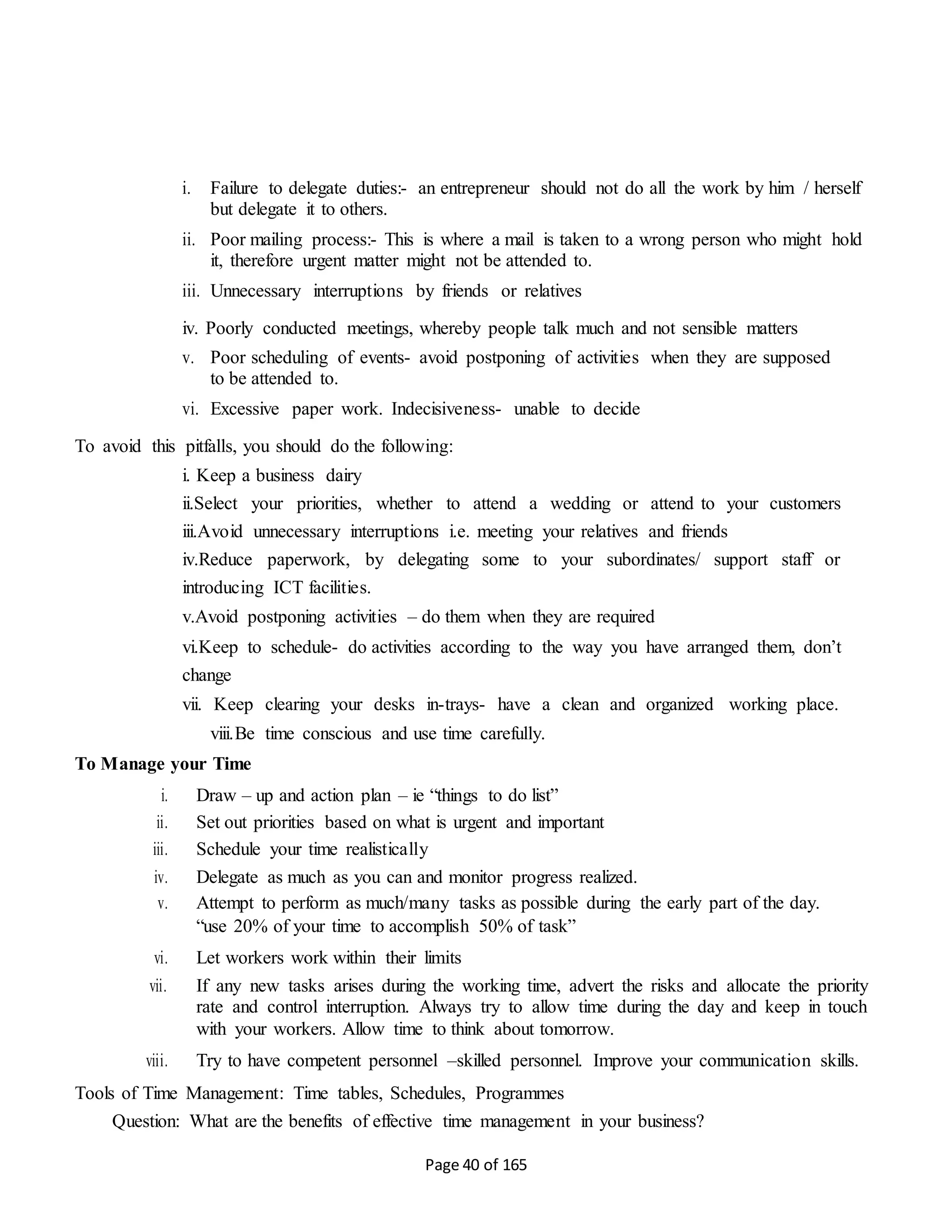
ii. Organizational problems such as poor delegation of duties, undefined rules etc
iii. Environmental problems such as poor business locations, poor or unsafe working conditions
etc.
How to identify a problem in a business.
i. Past Experience: where you have experienced a similar problem ii.
Conducting a survey to find out if activities are carried out according to plan
iii. Hiring consultancy services
iv. Employing work study methods
Methods of DecisionMaking
These are several methods you can use to make business decisions, among them we have;
i. Rule of Thumb: A decision is made based on existing established procedures e.g. based on
laws, customs, religion, etc. You can’t change
ii. Committee Approach/ Team work: Its where using a selected number of people from the
main group to make a decision which will be accepted by all.
iii. Critical Path Analysis: This is making decision stage by stage until the final decision is
reached.
iv. Brainstorming: This is where all members of a group develop ideas for a solution
v. Problem solving Chart
vi. Solution Evaluation Form
Steps of the DecisionMaking
process
1) Identify the major problem e.g. low productivity
2) Determine major causes of the problem e.g. low salaries, poor working conditions
3) Determine potential solutions – how to solve
4) Evaluate potential solutions
5) Select the best solution
6) Implement the solution
7) Verify the solution.
Page 38 of 165
Problem Solving Chart
 You can use a problem solving chart as one way of organizing possible solutions to the
problems.
 After completing it you will be able to analyze alternative solutions in terms of potential
advantages disadvantages and consequences. A space is provided on the chart for four
possible solutions.
 If there are more than four possible solutions, it may be difficult for you to analyze the information
adequately.
 Listing potential advantage will indicate how each potential disadvantage will illustrate how the
potential solution will adversely affect you
 In some instances, an advantage or disadvantage may be the same for two or more alternative
solutions.
 Potential consequences you identify in the last column will be the results of analyzing the potential
advantages and disadvantages.
 They should equal the potential net result of implementing a particular solution.
 The problem solving chart can help you to analyse and solve major problems which would
otherwise have an adverse effect on your business.
Alternative Solution Potential Advantage Potential Disadvantage Potential consequences
1.Salary Increment High productivity Reduced profits High production costs
2.Improve working
conditions
3.Buying new computers
4.
Solution Evaluation Form
 Another procedure for analyzing potential solutions is to identify reasons for and reasons against
each potential solution.
 To use the solution evaluation form to the best advantage, you should: 1.Write a brief description of
the problem at the top of the form
2. Write a brief description of the proposed solution.
3. In the reasons for column, list important factors which would favuor implementing the
proposed solution.
4. In the reasons against column list important factors for not implementing the proposed
solutions.
5. Rate each factor by its importance to you. The numerical ratings might be 1, 2, 3, 4, 5 where
a low rating of 1 indicates that the factor affects the problem only slightly and a high rating
of 5 indicates that the factor is extremely important in making your decision. Each factor in
the reason for column and each factor in the reason against column would receive a
numerical rating
Page 39 of 165
6. Add the ratings in each of the two rating columns, the column with a higher total will give
you some indication of the potential for a particular solution. If there is a big difference
between the two totals (in favor of reasons for the solution) you may feel more secure in the
use of this technique to make a decision. If there is little difference in totals for both
columns, it might indicate that you need additional information about the problem.
Problem Description:
Problem Solution:
Low Morale
Numerical Rating Reasons for Reasons against Numerical Rating
The Use of Group Participation
 Are Many advantages of involving the members of a workgroup in a decision
 Some positive aspects of group decision making are;
1. The sum total of the groups knowledge is greater
2. The group generally develops a much wider range of alternatives in the decision process.
3. Participation increases the acceptability of the decision to the group
4.
decisions:
1. It takes more time
2. One individual may dominate and control the group
3. Social pressures to confirm may inhibit group members
4. Competition can become overly intense among the group members
5. Groups have a tendency to accept the first potentially positive alternative 6.The
decision is often a compromise that is likely to be unsatisfactory Assignment:
1. Women entrepreneurs have unique problems which hinder the development of their enterprises.
Explain this problems
2. Entrepreneurs are born not made discuss!
TIME MANAGEMENT
 Time is a measure of life.
 A unique resource, shared equally, cannot be stored, cannot be replaced once it is lost.
 Time is an entrepreneurs scarcest resource & unless it’s managed, nothing else can be managed
 Time Management is the management of the activities we engage in during our time to achieve a goal.
 Some of the factors that contribute to time wasting in a business include;
Page 40 of 165
i. Failure to delegate duties:- an entrepreneur should not do all the work by him / herself
but delegate it to others.
ii. Poor mailing process:- This is where a mail is taken to a wrong person who might hold
it, therefore urgent matter might not be attended to.
iii. Unnecessary interruptions by friends or relatives
iv. Poorly conducted meetings, whereby people talk much and not sensible matters
v. Poor scheduling of events- avoid postponing of activities when they are supposed
to be attended to.
vi. Excessive paper work. Indecisiveness- unable to decide
To avoid this pitfalls, you should do the following:
i. Keep a business dairy
ii.Select your priorities, whether to attend a wedding or attend to your customers
iii.Avoid unnecessary interruptions i.e. meeting your relatives and friends
iv.Reduce paperwork, by delegating some to your subordinates/ support staff or
introducing ICT facilities.
v.Avoid postponing activities – do them when they are required
vi.Keep to schedule- do activities according to the way you have arranged them, don’t
change
vii. Keep clearing your desks in-trays- have a clean and organized working place.
viii.Be time conscious and use time carefully.
To Manage your Time
i. Draw – up and action plan – ie “things to do list”
ii. Set out priorities based on what is urgent and important
iii. Schedule your time realistically
iv. Delegate as much as you can and monitor progress realized.
v. Attempt to perform as much/many tasks as possible during the early part of the day.
“use 20% of your time to accomplish 50% of task”
vi. Let workers work within their limits
vii. If any new tasks arises during the working time, advert the risks and allocate the priority
rate and control interruption. Always try to allow time during the day and keep in touch
with your workers. Allow time to think about tomorrow.
viii. Try to have competent personnel –skilled personnel. Improve your communication skills.
Tools of Time Management: Time tables, Schedules, Programmes
Question: What are the benefits of effective time management in your business?
Page 41 of 165
CHANGE
Change is the need to make or become different, to replace or improve, to reform or reorganize to
fit to the current situation which results in higher productivity or performance.
Is a systematic planned effort to improve effectiveness of the business. Change is risky, uncertain
As an entrepreneur you play a key role of managing change in your business.
Need for Change
a) There is need to adopt / adapt
b) To remain viable (economically)
c) We want growth (sales + profit), employees, customers (increase market share), diversify
d) Enhance chances of survival (Change before Change changes you).
Reasons for change
a) People change because they are dissatisfied with the status quo.
b) Interdepartmental conflicts – conflicts in departments
c) The need to cut costs
d) To need to improve efficiency
e) Need for company or personal security
f) Existence of a new demand in the market
g) Tough international and national competition
h) Change in technology etc
These conditions create threats and present opportunities in an organization Factors that influence
change in your business
a) Economic activities: e.g. changes in the prices of some input
b) Competition: The competitors activities; be watchful on competition to respong in good time
e.g. by aggressive advertising, reducing the price
c) The government and political environment: New policies, regulations relating to taxation and
remuneration policies
d) Technology: For adaptability and business growth. Go for the new technology
e) Educational and social factors: e.g your customers changes in education status, taste, family
size, status, age, sex, population distribution,
The above call for change in terms of quality, price, promptness in delivery, packaging, labelling of
your product etc.
Page 42 of 165
Types of change:
a) Change of Product: e.g you change your products labelling, size, packaging, color, taste,
quality, smell
b) Change of service: change in terms of promptness (quick/fastness) and quality service
c) Change of technology: e.g. Tools and equipment, material, technical skills, procedures,
production methods
d) Change of policy:. Change of objectives, goals and policies to follow to meet government
policies.
Why People Resist Change
1. Fear of the unknown (don’t know what next)
2. Misinformation (false information), no information at all, no communication
3. Threat to status quo
4. Threat to power base – Most want to retain their normal ways of life. Fear of no one
recognizing business in foreign places, location/town
5. Miss-trust or distrust of change agents. Eg some people don’t take change because of the
people who bring about or initiate that particular change.
6. Fear of possible failure:- either social or economic failures
7. No perceived tangible benefits – people want immediate returns / gains Managing Change
8. 5 basic steps in the process of change management / implementation
9. Precise definition of the operational changes needed
10. Define how the new working methods will affect particular people and groups
11. Identification of attitudes and perspectives currently held by employees and how this support
current practice
12. Outline statement of attitudes and perspectives necessary to enable people too adapt
successfully to new environments and new working methods
13. Implementation of measure designed to change existing attitudes.
COPING WITH COMPETITION
Competition is the act to vie for customers or market.
Direct competitors – Services / Products which are similar to the same already in the
market.
Page 43 of 165
Indirect competitor –offering different kinds of goods/ services to the same
market/customers.
Identification:- Identify and list out names, location and activities of all your competitors.
Analysis
You analyze yourself and your competitors on the basis of yourself and your competitors on
the basis of:
 Market: What is your/ the market? What share of the market do you/they have?
What advantages do you/they have in servicing your/their market segments?
 Product: How does your product quality compare with the competitors? What
special services do you / they offer? Do you/they have a programme to improve
your/their products? Is there a possibility of developing a new/ or improved product
to satisfy new needs?
 Production: How do you compare your technology with the competitors? How do
you compare sources of raw materials with those of your competitors? How do your
skills (and those of your workers) compare with the competitors? What advantages /
disadvantages does your / their location have?
 Finance: How do you compare your financial resources with your competitors?
 Government Policy: have you identified any opportunities or threats resulting from
new or existing government policies(eg relaxation of import restrictions, introduction
of VAT)
 Environment: Do changes in the general environment including the local
communities offer any opportunities or threats to you for example there is a large
number of young people whose tastes are different from the rest of society.
After obtaining answers to these and any other questions you develop arrange them in a strength/
weaknesses / opportunities and threats SWOT Table.
Types of Competition
a) Pure / Perfect competition
Characterized by situation homogeneous (similar)
b) Oligopolistic competition
c) Monopolistic competition
Entrepreneurial Skills
A skill is knowledge which is demonstrated by action.
An entrepreneur is someone who has good business idea and can turn that idea into reality. To be
successful an entrepreneur must
Page 44 of 165
i. Identify an opportunity and understand it in great depth
ii. Spot a gap in the market and recognize what new product or service will fill the gap
□ Must know what features the product will have and why it will appeal to customers
□ Know how to inform the customer about it and deliver the new product.
Turning an idea into reality an entrepreneur needs skills; General Management skill and People
Management Skills
General management business skills include;
i. Strategy skills, planning skills, marketing skills, financial skills, project management
skills, time management skills, leadership skills, motivational skills, communication
skills, negotiation skills
MARKET
Meaning of Market:
□ A word derived from Latin; ‘Marcatus’ which means: Merchandise, trade or place where
business is conducted.
□ A place and where goods are bought and sold.
□ Generally it means “anybody of persons who are in intimate business relations and carry on
extensive transactions in any commodity.”
□ A set of potential buyers and sellers of a product or service”
Marketing Functions and strategies
Marketing consists of a multitude activities that include decisions about the company’s
i. Products or services
ii. Pricing policies □Promotions and
iii. Distribution methods.
The ultimate equal is to facilitate exchange between an enterprise and its customers.
This exchange relationship exists as one party becomes willing to give something of value in order
to receive something of value.
Marketing is the process of conceiving than exchange and then accomplishing the tasks necessary
to deliver the goods or services in a manner that satisfies customer and meets the business
objective.
Page 45 of 165
Marketing Functions
Marketing functions include:
i) The product – involves the planning, designing and developing the right type of the product
in order to meet the customer’s satisfaction. It includes.
a) The packing of the product
b) The image
c) The brand name and label
d) The product
e) The product quality
f) The product range
g) The product output
h) The product warrantees and after sale services
i) The product policy
ii) The price- involves giving value which is charged by the suppliers. This is an important
element of marking because;
a) It relates directly to the generation of revenue
b) Measures the profit cost and revenue elements.
c) Affects the product quality and quantity
d) Has a psychological impact on consumers.
iii)The placement – also known as distribution is concerned with linking the seller and buyer
through the product and involves elements of a)Inform potential customers
b) To convince and persuade existing customers to continuer choosing the product
c) To establish a business image or good will
d) To canter competition from other business dealings
e) To increase sales and revenue.
The marketing strategy
 This is a consciously formulated plan that describes how the new venture will compete.
 It focuses the business enterprise on a target market to fill the gap or create a niche.
 A well calculated marketing strategy provides guidelines for the entrepreneur concerning-:
i. The expected results
ii. Allocation of resources □Responsibilities for marketing
iii. Ways of controlling the enterprise.
The marketing Plan
Page 46 of 165
Solidifies the marketing strategy by defining customers, sales forecasts and marketing objectives.
 It synthesizes market research and the entrepreneurs strategy into a blueprint for action
 The plan is implemented through a marketing programme, which addresses the marketing
activities decisions regarding product, the pricing, the promotional activities and the placement
activities.
The Marketing Mix
 The term marketing mix refers to the apportionment of effort, combinations, designing and
integration of all elements of marketing into a single programme aimed at achieving the
objective of a business enterprise.
 It is a detailed strategy, tasks, operations policies programmes, techniques and activities to which
resources may be allocated to achieve marketing objectives.
 The term is used to describe the combination of the four inputs which constitute a marketing
system ( 4pcs) i.e
i. The product
ii. The price
iii. The placement
iv. The promotions
The 4 Ps (the four Ps)
The marketing mix denotes a combination of the various elements which in their totality make up a
marketing system i.e.
i. The product,
ii. The price,
iii. The placement
iv. The promotion.
The Product
 The product element of the marketing mix involves the planning, designing and developing the
right type of the product or service to meet the customer satisfaction. The main decisions
involve-;
i)The product involve
ii)The product size
iii)The product quality
iv)The product design
v)The product range
vi)The product volume
vii)The product packaging
viii)The brand name and label.
ix) The product warranties and after sale service.
The product element of the marketing mix strives to establish.
Page 47 of 165
O A product policy
O The product strategies
O The product mix
The Price
 Pricing the product is an important element of the marketing mix.
 Price is the value or sum of money which is charged by the supplier of a product or service from
the buyer.
 The financial price is the measurement of value and has the following importance.
i.) Economic value- because it relates to the generation of product revenue
ii.) Profits – through price profit cost and revenue elements are measurable.
iii.) Product quality – price gives indication of the product quality.
iv.) The psychological element- price has a psychological influence in the market i.e high prices
co-relate to superiority.
v.) Co-operate goals- are achievable through pricing decisions especially in formulating
marking strategies
vi.) Meeting consumer expectations is measurable through price.
Placement
 Also known as distribution of goods physically
 This component of the marketing mix is concerned with linking the seller and the buyer.
 It involves the elements of - The channels of distribution - The transport means - The warehousing -The
routing of the product.
Promotions
(A promotional message)
 A product promotion is the act of providing information about a product to its prospective users in
order to persuade them to buy , enjoy or choose the product
 Any product promotional message usually includes information which shows;
 That the product exists
 That the product has ability to satisfy a particular want
 The physical location where the product can be obtained or enjoyed
 The qualities that the product can be obtained or enjoyed.
 The quantities that the product can be obtained or enjoyed
 the times when the product can be obtained.
 The price of the product.
 Exam quest, briefly explain what entails a promotional message.
The importance of product promotion
i.)To inform potential customers about the existence qualities and other important details regarding a product.
ii.)To convince or persuade existing customers to continue buying the product and potential customers to choose
it.
iii.) To establish a business image or goodwill among the existing and prospective customers
iv.) To facilitate more sales revenue.
Methods of Product Promotion
There are five main ways of promoting products namely;
i)Advertising
Page 48 of 165
ii) Personal selling
iii) Sales promotion
iv) Publicity
v) Public relations.
Advertising
 Refers to drawing attention to or describing a product in a public medium e.g newspapers , radio,
television e.t.c
 Any advert in order to give value for its purpose should contain the following aspects.
i) a media presentation
ii) Payments for the advert
iii) Identifiable sponsor who pays for the advert.
Note:
 Any communication without costs to the sponsor is publicity and not advertisement.
Advertising Media
 An advertising media is the means through which an advertised message is conveyed to the
members of the public who are consumers.
 The following are some of types of media available to advertisement. The press e.g newspapers,
Posters , Billboards , Brochures ,Shopping news ,Radio ,Television , Neon signs e,t.c
Factors which determine choice of an advertising medium
a)The intended target group
 The nature of the target group in terms of habits customers age, e,t.c will determine choice of the
right medium.
b)the physical characteristics
 The mediums physical characteristics i.e visual aspects, colour, movement’s e.t.c. c. Media
circulation
 Where an advertiser aims to reach countrywide cliental, choice of a nationwide media is
necessary.
c)Cost of advertising
 Should be affordable and that they should be reasonable compared to the returns. d)Urgency of
the advertisement
 Urgent and quick adverts may require mediums such as Radio , TV e.t.c
Sales Promotion
 Sales promotion refers to the strategies and incentives which are aimed at promoting the purchase
of a given product.
 The sales promotion strategies include;
i) gifts and other premiums e,g soap, toothbrushes
ii)Discounts
iii).displays e,g supermarket
iv) credit facilities Use of loss leaders – one good is sold cheap to attract customers.
vii.Use of free samples
viii).After sale services.
b) Publicity
 Refers to the free advertising whereby the desire for a product is created or boasted by unpaid – for
features or presentation in the mass-media ( e.g a feature in press)
 These features may be solicited for or unsolicited for but remain entirely unpaid for by the busiess.
Page 49 of 165
– or a news release sent to studio.
c) Public Relations
The term public relations (PR) when used in product promotion refers to the process of communicating
information of an organization product, Policies and actions to specific consumer groups or the public at large.
 This is done with the view of creating awareness and a positive attitude towards the organization
and the product.
 It could also be done to correct misinformation or rehabilitate a spoilt image in order to get a
satisfied client.
 It aims at creating a favorable attitude towards the organization in order to promote acceptance.
Factors which may influence an entrepreneur in choosing a promotional method.
1. cost element of each method of promotion should be analyzed in order to suit financial abilities
2. Targeted audience is important in order to address an appropriate combination method.
3. The nature of the product to be promoted i.e those that may require demonstrations and training
et.c
4. Urgency of the promotional message.
5. Availability of resources especially the mechanical physical and human resources to implement a
promotional mix.
6. Level of demand for the product ; where demand is high fewer promotional methods are required
7. the competitors promotional strategies
8. availability of media that is most accessible to its customers
ORGANIZATIONAL FORMS
Unincorporated Business
 These are business which do not have separate entity ( existence from that of their owners)
 According to law such organizations are one and same in the existence of the owner.
They do not have separate rights and obligations from those of their owners
 They include
i)Sole proprietors
ii) partnership
Sole Proprietorship
 Sole means single while proprietorship refers to the owner of a business owned by one person who
takes responsibility on risks of the business.
 He either enjoys the profits or servers the losses of the business alone.
Formation of Sole Proprietorship
 It is simple and easy to form since legally only licensed from the government is required
 If the name of the business is different from that of the owner the business name should be
registered with the registrar.
Management of Sole Proprietor
The owner of the business is the manager of the business
 He makes decisions operating the day to day activities the business.
 He may employ people to work in the business or be assisted by family members.
Page 50 of 165
Sources of Capital
 The term capital is used here to refer to the resource required to start and operate the business
 He may obtain capital from;
i) his own savings
ii) borrowing from friends and relatives
iii) banks and other financial institutions
iv) credit suppliers
v) borrowing from government institutions i.e. KIE, ICDC
vi) funding from non-government organizations
vii) hire purchase funds
viii) The business itself from retained profits.
Liability
Liability refers to the extent which the owner of the business can be called upon to meet the debts of the
business.
 A sole proprietorship is viewed as being one and the same with the owner hence does not have
separate rights and obligation.
 Where a sole proprietorship business cannot pay its liabilities all its assets and the business
properties are sold in order to clear the business debts.
 The responsibility of the owner of the sole proprietorship business is thus unlimited.
 The sole proprietor is therefore said to have unlimited liability.
This means that the liability of the owner is no just restricted to capital contributed but extends to include its
personal property.
Features of a Sole Proprietorship
1. Is a business owned by one person
2. It had no separate legal existence from its owner
3. It has a limited legal life since its existence depends on the life of the owner.
4. The owner has unlimited liability in the business.
Advantages of a Sole Proprietorship
1. It is easy to start since only a license is required
2. Quick decision making
3. Freedom of action at any time
4. Flexibility in adopting quickly to changes in customers needs
5. Profits are entirely on the owner’s hands
6.There is control over business secrets
7.Easy to use family labor cheaply.
Disadvantages of Sole Proprietorship
1. Limited life in case of death of the owner
2. Unlimited liability may cause the owner to loosing personal property.
3. 3.The sole proprietor serves loses entirely by himself
4. Limited capital may delay expansion.
5. working for longer hours may result to fatigue
6. Lack of essential skills may cause mis-management.
Circumstances under which the Sole Proprietorship ideal
Page 51 of 165
1 When customers show preference to specialized services
2 Where small capital is required to start up a business
3 Where returns are low and may not warrantee existence of a large business.
4 Where the market experiences frequent demand changes 5Where locations are remote and
the population may be small.
Dissolution of a Sole Proprietorship
 Dissolution refers to the termination of the legal existence of the business.
This may be caused by;
i) The death of the owner
ii) The transfer of the business to another person.
Page 52 of 165
Problems the Sole Proprietorship may face.
1. Lack of continuity in case of death.
2. Lack of skills may lead to mismanagement
3. Working for longer hours may lead to fatigue
4. Loses are served by the owner
5. Limited capital to facilitate expansion functions.
6. Lack of consultancy may lead to poor decision making
7. Unlimited liability may cause lose of property.
Partnership
 According to the partnership Act. A partnership is referred to as a relationship which subsists
between persons carrying on a business in common with view of making profits.
 A partnership is thus an extension of sole proprietorship and is in fact necessitated by the fact that a
sole trader may for several reasons fail to carry out his business efficiently and profitability.
 Partners pull the financial and managerial skills together in order to make profit.
Formation
 According to the partnership Act (934) a partnership business may come into existence through any
of the following ways.
i). Orally
ii) By actions of persons concerned
iii) By a simple put in written
iv) By a partnership deed
NB: The above ways of forming a partnership are allowed by the partnership Act, However its better to
remember that it may be made illegal under the following circumstances.
Circumstances under which the Partnership is illegal
 If the partnership has been formed for an illegal purpose e.g. theft.
If is formed and the partners do not meet the minimum qualifications e.g. auditing
 Where the partnership contains more than 20 members.
 Where the partnership wants to run their business with the name which does not disclose the true
names of all the partners or the name had not been registered under the registration of the business
Act under which it is deemed illegal.
Requirements for the Registration of a Business Name.
 Under the partnership Act , the partners must furnish the registrar of business names for the
following
a) The business name
b) The general nature of the business
c) The principle place of location of the business
d) The present Christian and sir names together with their usual residential address.
e) The nationality of each partners
f) Any other occupation of the partners
Page 53 of 165
g) The date of commencement of their business.
Types of Partners
a) General partners
 These are the real partners in new sense of the partners which refers to those partners who are the
most active partners in the partnership
 In most cases the general partner is a reliable of the debts of the partnership. b) Limited partners
 This is a partner whose liabilities are limited to the amount of capital contributed to the partnership
business
 This type of partners do not usually participate in the management of the partnership becus4 if they
do they loose their limited liability in respect to the transaction and decisions participated in.
c) Active partner
 This is the type of partner who takes the active part in the running of the business.
 In most cases such a partner may be employed somewhere or may be in another business altogether.
 The partner contributes capital to the partnership business and the profits or losses at lower
proportions.
Articles of Partnership/ Partnership Deed.
 Although it is not a statutory requirement the partnership can be formed by a written agreement, it is
usual for the partnership business in particular those involved in huge commitments to write articles
of a partnership also known as a partnership deed.
 The aim of this document is to safeguard the interest of each partner and it constitutes a legal
contract among the partners.
Contents of a Partnership Deed
1. The nature of the business to be carried out
2. The capital and property of the firm together with the respective capital contributions of each
partner.
3. The sharing of profits or loses by partners.
4. The rules as to the case of interest on capital and drawings by partners. 5.Provision for proper
accounts and their audit
6. The power of each partner.
7. The drowns for the resolution of the partnership
8. The method of determining the value of good will on retirement of drafting in of a new partner.
9. The method of determining the amount payable to a deceased partner.
10. No partners may should carry on a competing business
11. Any changes in partnership composition must be agreed upon by all partners.
Management of Partnership
 Members of a partnership are correctively responsible for the management of the business.
 The members may share responsibilities and duties according to their respective skills and
availability in order to ensure effectiveness in management of the partnership.
The partners may decide to hire skilled or non-skilled labour to assist the management of the partners.
Page 54 of 165
Features/ characteristics of a Partnership
1. Mutual agency – each partner is an agent of the partnership and therefore any action by
one partner with transacting the business binds the rest of the partners provided his
actions are within the partners express or implied authority.
2. Limited life- since the partnership is a relationship originating from an agreement
between two or more members any changes in their relationship caused by factors such
as- death withdrawal of a partner e.t.c terminates the partnership or dissolves it.
3. Unlimited liability
 In a partnership the partners’ liability is not limited to the amount of capital investment.
 The partners are separately held liable for the debts of business and their personal
properties may be sold to meet such debts.
4. Ownership of interests – the interest of a partner in a partnership business e.g. right to
inspect the accounting records of a firm of a firm, admission or dismissal of partner
transit of interest e.t.c must have the full consent of the partnership.
5. Sharing of profits
Each partners share of profits of proportional to his/her investment in the partnership. And any
agreement of non-partner to share the profits does not make a non-partner a partner.
NB circumstances under which a non-partner may be included in sharing the partnership profits and
losses.
1. As compensation for services rendered to the partnership
2. As compensation for the partnership use of his/her property or name. 3. As
payments for loans advanced to the firm 4. As payment to the next of kin.
Sources of Capital of a Partnership
1. contributions from partners
2. Loans from commercial banks and other financial institutions
3. Stock from hire purchase firms
4. Credit facilities from suppliers
5. Loans from government institutions e.g. K.I.E e.t.c.
6. Plough backs from retained profits
Classification of Partnerships
There are five ways through which partnership are classified.
1. By trading
A partnership may be classified was
a) Non-trading partnerships- these partnerships whose activities are to offer services e.g.
legal, medical, accountancy, teaching e.t.c.
Page 55 of 165
b) Trading partnerships – these are partnerships whose main activities are manufacturing,
purchasing or sales of goods.
2.By liability
a) General partnerships – are partnerships in which all partners may publicity act
on behalf of the firm and each partner individually be held responsible for the
debts of the firm. Their properties may be attached to clear the debts of their
partnership.
b) Limited partnerships – a partnership whose activities of certain partners are
limited. The personal liabilities of such partners (limited partners) are limited to a
certain amount stated. These amounts are normally equivalent to the amount of
their contributions.
NB the following conditions must be fulfilled for a limited partnership to be formed.
1. The partnership should not consist more than 20 partners.
2. The partnership must consist one or more general partners.
3. The limited partners are not liable to the partnership debts beyond his capital
contribution.
NB Restrictions of the limited partners.
1. Is entitled to inspect the books of the firm and examine the partnership state at any time.
2. The death, withdrawal bankruptcy of a partner shall not cause dissolution of a partnership or the
partnership can not be dissolved by a court order because of lunacy of the partner.
3. A limited partnership is only dissolved by the general partners unless brought through a court order.
4. Any differences on partnership matters can only be decided by a majority of the general partners.
5. With the consent of the general partners a limited partner may assign his/her shares in the
partnership to another person.
6. A person may be introduced into the partnership without the consent of the limited partners.
3. By time duration
a) A temporally partnership ( joint venture partnership) – this is a partnership formed for a specified
period of time
 Termination of the stated period or accomplishment of the purpose may cause the partnership to
come to an end.
b) a permanent partnership (partnership at will) – This is a partnership formed to carry the business
indefinitely
 It does not have a fixed life of fulfilling its purpose
4. By activity
 a) Active partner – this is a partner who is actively involved in the day to day management of the
Page 56 of 165
partnership and may be paid a salary for these services. And the partner is held liable for the debts of
the firm.
b) A dormant /sleeping partner – does not take part of the day to day management of the partnership but
contributes capital,shares profits and is liable for the business debts.
5. By capital contributed
Real partner – a partner who contributes capital into the business and whose name may be used in relation to
transactions of the business and enjoys the profits of the partnerships.
Nominal partner – is a partner who has not contributed any capital to the business but allows his or her
name to be used in the business. They are usually influential persons whose names can be used.
He is not fully liable to the partnership debts however is he presents himself to the public in a manner
that portrays him a general partner he will be held liable.
Quinsy-partners – a partner who has retired from the partnership but has left his capital in the partnership
business which is treated as a loan, he earns interest
6. By age
Majority partner – A partner who has attained the age of 18 years and above. Such a partner unless stated to the
centrally can be held liable for the partner.
Partner shares only profits and not losses since he didn’t participate in decision making that may have caused
such losses.
The liability of the minor is limited only to the amount of capital contributed to the business since any liabilities
arising may not be part his decision making.
The minor partners can act on behalf the partnership and such acts shall be binding on the other partnership iv)
When the minor partner attains the age of majority he/she has up to six months to decide whether or not to
continue with the partnership. If he/she decides to stay, he has full responsibilities and rights of a major partner.
Termination/ Dissolution of Partnership
Although the partnership deed or articles of partnership will contain regulations of terminating the partnership,
nevertheless in the absence of our subject these regulations, a partnership may be dissolved in the following
ways.
1. When the fixed time if any are stated in the articles of the partnership expires.
2. If the partnership was specifically entered into for a given venture, transactions or undertakings the
completion of which or achievement will automatically dissolve the partnership.
3. If the partnership is a partnership at will, it can be dissolved by any partner giving notice of his
intention to dissolve the partnership.
4. By mutual consent of all partners
5. By bankruptcy or death of one the partners.
6. By one partner’s shares in the partnership being changed or attached by a court order for private
debts.
7. If any events occur which will make the partnership business illegal, the partnership will stand
dissolved irrespective of the content of the partnership deed.
Page 57 of 165
8. Automatic or compulsory dissolution as it is provided section 39 of the partnership Act which lay
the following grounds under which a partnership may be dissolved by a court order.
i) If any one of the partners becomes insane
ii) If any of one partner becomes permanently in case of performing his/her duties through in
capabilities, accidents or disabilities
iii) Where a partner has acted in a manner which is pre-judicial to the carrying out firm’s
business and may bring the name of the business to its disables.
iv) Where a partner was found guilty of breach the partnership contract.
v) Where the firm has been operating in losses.
Circumstances under which the Partnership Deed is ideal.
1. In a business where the amount of capital required is reasonably large.
2. If professional were pulling together effort for efficiency and better performance.
3. If professional areas where the law prohibits a couple of days.
Advantages of Operating a Business under a Partnership
1. A partnership business benefits from the talents of individual ensuring almost efficiency and
acceptance.
2. Since a partnership would be owned by a no. of partners it sets a basis of pulling together saving to
raise large capital for investments
3. Sound decision making through consultative processes
4. A higher growth rate as a result of combining ambitious from different partners.
5. Partnerships have a good will and financial influence enabling it to raise finance easily.
6. Collateral or security of loans can be easily be raised.
7. Formation of partnership business requires minimal government interventions.
Disadvantages of Operating a Business under a Partnership
1. Slow decision making due to long discussion processes 2.Sharing of profits
tends to disregard hard working partners.
3. Partnership business have limited life incase of retirement or dead of one partner.
4. Disagreements make partnerships business vulnerable to disputes among partners.
5. The partners have unlimited liability which lead to loosing personal property in the event
the partnership business cannot settle its debts.
6. The agency burden where every partner is an agent of the partnership and one’s partner’s
mistake may affect the rest.
7. Limited managerial skill may lead to mismanagement of the business.
Incorporated Business / Joint Stock Companies
i) Incorporated Business
 We have so far looked at unincorporated business and have seen the main features of such
business is that they do not have a separate legal existence from the owners.
Page 58 of 165
 We shall now focus on business units that are legally viewed as separate and distinct units
from their owners
 Such businesses are called in co-operated or joint stock companies.
 Incorporated business organizations are legally separate and distinct from their owners or
members.
 The main forms of incorporated business or joint stock company include;
i) Companies
ii) Co-operative societies.
iii) Public co-operation
 These are advanced forms of companies where a group of people pull their savings together
and contribute as capital to set up a business enterprises or companies.
 These companies are governed by Acts of parliament under the Kenya all joint stock
companies fall under the Kenya Companies Act = (cap 486) of 1948.
 The Act lays down the formation and general conduct of joint stock companies.
Companies
 A company is a business registered by the registrar of companies Act.
 The Act of registering a company is known as incorporation.
Incorporation
 This is a process that creates an organization separate and distinct from the person forming
it (owners)
 The organization is known as a body corporate and registered company is known as a
cooperation
NB companies are business organizations or units formed to carry out a specific activity.
 They are organized by processing an existence that is separate and distinct from the persons
who own it.
 Companies have rights and obligations of a natural person.
Rights and Obligations of Companies
1. It can ownand dispose of property.
2. It can enter into a contract on its own name
3. It can borrow and lend money in its own capacity
4. It can hire and fire employees
5. It can sue and be sued in its own right
6. It can form subordinate agencies and its authority
7. It can spread information.
Features of a Company
 It is an artificial person created through legal process
 A company has rights and obligations of natural person e.g. holding and disposing
property.
Page 59 of 165
 A company has a perpetual life independency of the owners lives i.e. has perpetual
succession.
 A company has a separate legal identity from the owner.
 A company is created for aparticular purpose
 The owners of a company enjoy limited liability
Types of Companies
 There are basically two types of companies. Namely
a) Public limited companies
b) Private limited companies
Public Limited Companies
 A public limited company has a minimum number of 7 members with no maximum
membership.
 The maximum membership normally is determined by the number of authorized shares
(capital) of the company
 In Kenya a public limited company has the term limited at the end.
Characteristics/features of a Public Limited Company.
1. Minimum membership is 7 with no maximum
2. Invites members of the public to subscribe to its shares
3. The shares are easily transferable among shareholders
4. It has a minimum of 3 directors
5. It has authorized minimum capita figure.
NB authorized share capital is to the total shares that have been legally authorized by the
government during the company’s registration.
A public limited company starts to operate after receiving a certificate of commencement
(t
rading)
A private Limited Company
 This is a company with a minimum of 2 persons and a maximum of 50 persons excluding
all past and present employees.
 A private limited company should have name ending with limited.
Characteristics of a Private Limited Company.
1. Has a minimum of 2 members and maximum 50 members
2. It does not invite the members of the public to subscribe its shares.
3. It’s shares are not easily transferable unless with consent with other share holders.
4. Operates with only one director.
Page 60 of 165
5. Its shares don’t have authorized minimum capital figure It can start its operations after
receiving its certificate
Limited liability Concept in Companies
This is the fact that the liability of companies of owners is restricted to he amount of investment
of a company plus any other amounts that to be undertaken to be contributed towards payment of
one companies debt.
 The word limited indicates that the liability of the owners of members in respect to this
amounts (capital contributed) and not their personal property. A company may be
limited by-:
i) Shares
ii) Guarantee.
Companies Limited by Shares
 This is a company where member’s liability is limited to the value of shares held.
 The liability of members is limited to the share contributed.
Company limited by guarantee
 This is a company whose members liability is limited to the amount that members have
undertaken to contribute to the business debts.
 These contributions may cover for;-
O Court charges and
o Any other expenses.
Formation of Companies
 A company may be formed by any person or persons associating for a legal purpose
through registration with a registrar of companies under the companies Act.
 Although a limited company is a legal person it can only act through human agents who
must register it with registrar of companies and for a company to be MEMORANDUM
OF ASSOCIATION
This is document that defines that relationship between the company and outsiders.
 It informs the outsiders what the company does, the amount that is required.
 The memorandum of association is the company’s chatter constitution and once the
company is registered the memo becomes a legal document that can only be altered by law.
Contents of a Memorandum of Association.
1. Name clause – This states that name of the company ending with the work limited.
 Any name may be selected to be used by the company as long as it is not prohibited by
Page 61 of 165
law.
 This requirement is meant to protect people who may erroneously enter into a contract in
the company believing it to be another company an also protects companies from
possibly mis-use of their names.
2.Object clause – this clause outline the objectives of the company anything outside
this objective will ultra virus.
Importance of the Memorandum of Association
a) It defines the limits of company associations.
b) It informs subscribers the purpose for which their money will be put.
c) It protects subscribers form possible misuse of their money
d) It protects outside parties dealing with the company by informing them the extent of its
operation.
3.Situation clause- This clause discloses the locations of the legislative office and it
contains the following elements.
a) Where the company is situated
b) Where the letters may be delivered
c) Where sermons may be served.
4.Liability clause – This clause states the status of the member’s liability with regard to
thedebts of the company.
 The clause enables people who may enter into contract with the company to determine
the extent of the company’s liability.
 The statement of liability should clearly specify the members liability regard to the
company debts.
5. Capital clause
 The clause states the total capital of the company is authorized capital into shares and
their corresponding value.
 Incase of a public company, the capital clause will give the minimum amount of capital
hat the company must raise before it commences business.
6. Association of substitution clause- This contains a declaration by the promoters (original
owners) that they desire to form a company to pursue the objects of the memorandum of
association and that they agree to take payments of their shares.
 The promoters are required to give details of their name addresses, occupation and no. of
shares
Page 62 of 165
ARTICLES OF ASSOCIATION
 This document contains the rules and regulations pertaining the relationship between the
shareholders and the company among the shareholders themselves.
 These rules regulate the internal relations of the company forming a binding contact
between the members and the companies and as well as among the members themselves.
Content of Articles of Association.
1. The right of each member e.g voting rights.
2. The issue, transfer and for future of shares and the alterations of shareholders.
3. procedures of calling and conducting meeting
4. the methods of appointing or electing officials
5. Qualification procedures duties and rights of directors 6.Preparation of books of
accounts and the auditor’s report.
NB whereas the memorandum of association is mandatory document of all companies, thearticles
of association are optional.
 Where the company does not draw the articles of association, it can adopt the standard
articles of association contained in the company Act.
 A company may alter or amend its articles of association and such amends shall be valid.
 The power to alter the articles of association is specified in the memorandum of
association.
List of persons who have consented to the directors of a company
 The directors are chosen from the founders of the company referred to as promoters and the
list contains details of names addresses, occupations, shares subscribed and a statement of
agreement to serve as directors.
A statutory declaration of compliant with the requirement of the company’s Act.
 The declaration must be signed by person’s names as directors or the company’s secretary.
63

The declaration must be equally by signed by the advocate engaged in the formation of the
company and must expressly state that the company is formed by lawful persons.
CERTIFICATE OF INCORPORATION/ REGISTRATION OF A COMPANY.
 Once all the required documents are properly filled with the registrar of companies is
ratified with what is contained in these documents.
 The registration brings the company into being and the companies issued with a certificate
of registration.
 The registration gives a company an identity that is separated and distinct from its owners.
 From the date of incorporation the company becomes a body corporate with the name
powers and rights and obligations of an incorporated company.
 The process of forming a company is formalized when a certificate of incorporation issued
has inclusive evidence that all the information has been complied with and that the
company is duly registered.
NB - A private company can start its business operations immediately it is issued with a certificate of
incorporation, this is because the company does not have to invite the members of the public to buy
shares.
 A public limited company must proceed to issue proposals inviting the members of the
public to buy shares.(A prospectus a notice or circular of advertisement inviting the public
to purchase the shares of a company).
 Public limited companies can only be allowed to purchase goods only when the registrar is
satisfied that-:
i)The company has raised a minimum amount of capital as required by the memo.
ii)That every director has paid to the company the minimum amount of money on the
shares to be taken.
iii)That there’s a declaration by at least one director that the company shall comply with
the regulations stipulated by the law that governs companies.
Once the registrar is satisfied by the above requirements then the public limited company is
issued with the certificate of trading which will enable the company to commerce its operations.
Ownership and Management of Companies
i)Ownership
 A company is owned by any person who has subscribed and purchased that company’s
shares.
The owners of a company are known as shareholders and their names are entered into the
company’s registrar.
64
 Each share holder has a claim in the property of the company proportional to the shares
held.
 The shareholders of a company have unlimited rights to the transfer or sale of their shares
in the company. ii) Management
 The management of a company is in the hands of the board of directors.
 The initial directors stay in the office till the first meeting (AGM) is held at which new
directors are elected.
 The size of the board is usually determined by the size of the company.
 The board of directors is charged of formulating and overseeing the implementation of
company policies.
 The board is normally supported by a terms of profession employed to the responsible for
the day to day management of various departments.
 For a public limited company, the directors are required by law to present the company’s
financial statement at the AGM meetings and filled with the registrar of companies.
Sources of Capital of a Company
a) From the public through the sale of shares
b) From commercial banks ad other financial institutions
c) government institutions i.e. KIT, ICDC e.t.c
d) Suppliers inform of trade credits.
e) The business itself inform of retained profits.
f) Higher purchase traders.
g) Rent revenue earnings from any investments.
1. Public limited companies
 These are stock joint companies that have sold stock to the general public and thus attracts
public money in form of share capital I,e ordinary or preference shares.
 Such companies are usually quoted at the stock exchange where shares are bought and sold
through stock brokers.
 These companies usually raise large size of money from the public and in order to do so the
companies must;
a)Obtain permission from the development market authority also known as “ New issue
committee” this committee assesses the financial soundness of such companies before
allowing theme to attract public money.
i) The aim is to safeguard the interests of public investors
ii) The company in need of public money will have to obtain permission from the Nairobi stock
exchange council before it can be allowed to have its shares dealt with.
2. Private limited companies
 These companies are formed by submitting the necessary requirement to the registrar of
65
companies ( the five documents)
Once this has satisfied the registrar of companies such a company will receive a certificate
of incorporation.
 The private limited companies are usually not allowed to advertise their shares to attract
public money and as such they sell their shares privately ( private placing to the interested
members of the public.
 Like public limited companies, private limited companies have limited liability, their
shares are not fully transferable as they are not quoted at the stock exchange.
 Any transfer of shares requires the consent of other share members of the company.
Advantages of a Company
1. More capital can be raised since it has large membership
2. The company offers better collateral for loans to be advanced.
3. Limited liability secures private property incase of inability to pay debts.
4. The companies have continuity i.e. have perpetual life or succession.
5. A company has a liability to hire highly qualified professionals facilitating better
management
6. Shares are easily transferable.
7. The companies have legal identity and therefore no conflicts to its members.
Disadvantages of a Company
1. Difficult to form since it is costly and has long legal procedures
2. The company has restricted operations by the memorandum of association
3. Slow decision making due to long approval procedures
4. Limited ownership caused by land of control of the firm
5. The agency burden may cause mismanagement when especially the board is weak.
6. Double taxation especially of the dividends
7. Lack of secrecy since the company has to publish its financial status annually.
Main Features of Joint Stock Companies
 As already noted a joint stock company is an association of people who contribute capital
to form common stock in order to carry on a business activity for product motive.
 The company formed comprises- corporate status and is registered under the company’s
act.
 A joint stock company may be public or private company and its main features include;
a) Legal personality – the company has identities separates from that of other persons
contributing capital and can therefore hold property, contract in its own name sue and
be sued.
Page 66 of 165

b) The shares are transferable – the shareholders can sell their interest in the companies to
other persons willing to invest in it (freely for public ltd company but limited to the consent
of the rest of the shareholders for private company.
c) Common sill – as a separate entity it will be necessary for a joint stock company to sign
documents and such signatures are normally embodied in a common sill of a company.
 The sill is kept under custody of the responsible offices.
d) Members/ shareholders can not bind the company by their Acts
e) Individual/ members are not entitled to take part in business since it is managed by the board
of directors
f) Shareholders have a limited liability.
Advantages of Joint Stock Companies
1. The liability of shareholders is limited to the capital contributed by shares guarantee.
2. A joint stock company is going concern implying that it has perpetual existence separate
from that of the shareholders.
3. A joint stock company is an artificial legal person independent of the shareholders and it
can own its assets and liabilities.
4. The shares of a joint stock company in particular public limited company are freely
transferable.
5. The shares of a joint stock company can easily be used as security for loans making it
easy to obtain loans.
Disadvantages of Joint Stock Companies
 It lacks secrecy and privacy since it requires audited financial statement annually.
 The formation of a joint stock company requires long legal formalities.
 They are difficult to form since they require a heavy capital investment.
 Joint stock companies can not increase their capital investments beyond the legally authorized
capital.
 The decision making process of joint stock company is slow and bureaucratic due to
consultations.
 Joint stock companies are not flexible to changes.
Dissolution of a Joint Stock Company
 When a company has started its expected to continue with its operations to the future since it is a
form of business with perpetual succession.
 Termination of the life of a company may be through;
1. Failure to commerce business within one year of its formation – upon this it may be
would up by its court order on application.
2. The membership falling below the required minimum and this dissolution may be
Page 67 of 165
decided by a court order.
3. Accomplishment of the purpose or expirely of the period of operation.
4. The registration if it fails to comply with statutory cooperation e.g failure to file annual
files to the registrar of companies or engaging in illegal activities.
5. A resolution by members to voluntarily wind up the company which may
arise through.;
a) where the company does not have a future on that line of business
b) The members wish to sell it as a going concern in order to share profits.
c) Where one company is acquired by another and the members wish to discontinue it so as to
terminate its existence a separate legal entity.
6. Through a merger with a larger company
7. Insolvency – the company is not able to meet its obligations.
Holding Companies
 The company Act of the laws of Kenya defines a holding company as one which has more than
half of equity share capital of another company of which it is a member or controls a bigger
percentage of the board of directors of one or more other companies which are called subsidiary
companies.
 A holding company may be public or private depending upon wishes of the promoters or
shareholders.
 In Kenya a good example of a holding company is ICDC.
Public Corporations
 This is the net price to which the government has stakes in
 The government owns a certain percentage of the enterprises shares.
 Where a government has a fall ownership of the corporation, the business enterprise is known as
a parastatal
 Some public corporations are profit seeking while other are not.
 examples of such public corporations include;oKenya pipeline oKenya airways oKCB
(Kenya commercial Bank)oKenya lighting company (KPLC)
 Parastatals are run to provide the essential services such as education, medical etc.
Similarities between public cooperation’s and joint stock companies.
 They are both legal entities
 They are governed by a board of directors appointed They are self financing.
Public corporations
1. A cooperation is wholly and partially owned by the government
Page 68 of 165
2. Corporations tend to be monopolists
3. Are operated on public interest not entirely on profit motive.
4. They are paid for by the public from the taxes collected by the government.
Joint stock companies
1. Owned by the public and has shareholders.
2. They are subjected to companies
3. Purely operate on a profit motive.
4. Private funds finance joint stock companies.
Parastatal Bodies
A parastatal body is an organization distinguished from a body government but in which the
government is a sole owner.
 They are established by the government to perform specific functions and their management
is in the hands of board of directors.
 The board of directors is appointed by the government and the parastatals bodies do not sell
shares since they are whole financed by the government.
Examples
 Marketing boards
 Coffee board of Kenya e.t.c.
Marketing Boards
 These are produce organizations set up to encourage and control of the Agricultural produce.
 Their objective is to protect producers and consumers and may be formed by both producers
coming together or be constituted by the government.
Classification of Marketing Boards
1. commodity marketing boards- these are producer organizations with objectives are
restricted to purchasing and selling of commodities e.g coffee, tea, pyrethrum
2. producer marketing boards- this is a produce organization dealing with a wide range of
products e,g maize, wheat e.t.c
3. Expert marketing boards- this concentrate on marking one or more products overseas e.g
KTDA or coffee board.
Functions of Marketing Boards.
1. To encourage and control the marketing of Agricultural produce through purchasing at
fixed prices to facilitate stable incomes
Page 69 of 165
2. To encourage income and price stability through the buffer stock in buffer funding
system.
3. To facilitate farmers to obtain loans for farm inputs e.g quality fertilizers, seeds and
equipment.
4. To support the government in licensing regulations
5. To provide a wide range of sport e.g transport, grading, packaging of products e.t.c
6. Marketing boards provide advisory advise to farmers
7. They facilitate research on agricultural products and markets.
Formation of a Public Cooperation
 They are formed by a specific Act of parliament which define and powers and the overall
mandate of there institutions.
 The law creating corporations also state the minimum capital under which they will operate.
 The corporations are viewed as separate legal entities and may be wholly or partially owned
by the government.
Management of Public Corporations.
 This is under a board of directors.
 The directors are appointed by the government when the government owns wholly the
corporation or relevant joint directors and government appointed directors where the
government owns partially the cooperation.
 The government influences decisions of the corporations either directly or indirectly e.g
pricing decisions.
 In Kenya the board of directors is appointed by the relevant ministries or by the president.
 It is this board which is responsible for the implementation of the policies of the
organization.
 The board may employ professional managers charged with the day to day running
corporations.
Sources of Share Capital
1. Public corporations may get their capital from the government through loans or
budgetary provisions.
2. Where the government own corporations jointly both contributions of capital and the
public will raise capital through issuing shares.
3. As a body corporate a public corporate has power to borrow money from financial
institutions.
Features of a Public Corporation
1. A service motive- they provide essential services to the citizens and may therefore not
aim at making profits – entirely.
2. They are formed by an Act of parliament which states that government ministries will
take charge of such corporations.
Page 70 of 165
3. They are subsidized by the government to enable them provide essential goods and
services at minimum fees.
4. The board of directors is wholly appointed by the government or jointly with other stake
holders to influence the policies of the cooperation.
5. They are financed by the government but for jointly owned public corporations.
6. It has a legal distinct from the government or any other owners
7. They have limited liability
Advantages of Public Corporations.
1. Raising initial capital is each since funds comes from the government
2. Public corporations improve the welfare of the people since basic goods and services
are offered at affordable prices
3. The company has limited liability
4. They are used to meet government objectives.
Disadvantages of Public Corporations
1. Political influence may lead to a week management
2. Public corporations may not respond to consumer needs since some operate as
monopolist.
3. Public corporations have a public interest making them difficult to achieve their
objectives.
4. The job insecurity of senior managers e,g C.O.S , may lead to dishonest management
5. Slow decision making because of the size of same public corporations
6. most corporations are loss making
Dissolution of Public Corporations.
 Since formation of a public corporation is by an Act of parliament it follows therefore, that
in order to dissolve such an organization onc would have to repeal the Act of parliament
under which they are allowed.
 The following reasons may lead to repealing the Act of parliament under which they are
formed.
1. Perpetual operations of the corporation of a loss.
2. Outright insolvency.
3. Mismanagement which mat adversely affect the performance of the corporation
Co-operative Societies
This refers to a co-operative.
 The term co-operative is derived from cooperation
 It is a body of people or a body of persons who have agreed to come together to achieve a
Page 71 of 165
certain goal.
 The members of the public get together to voluntarily contributes capital to he corporative
society sharing the risks of investments in order to achieve and enjoy the benefits.
Reasons for Promoting Cooperative Societies in Kenya.
 They facilitate members to manage their own society and distribute themselves the benefit
generated.
 In order to increase bargaining power in selling the members produce or gaining maximum
satisfaction.
 In order to enhance participation by members in economic activities minimizing the
middlemen.
 In order to reduce market cost of produce especially in transportation and storage.
 In order to promote and improve quality production
 In order to facilitate stable income earning
 In order to put together capital resources of expensive investment e.g transport,
refrigeration e.t.c.
Formation of Co-operative Societies
 They are formed by a minimum number of 10 members who pursue to undertake some
objectives
 The members work out a defined plan of what the co-operative society is supposed to do.
For the co-operative society to be formed they have to submit their constitution to the
commissions of co-operative societies with the following detail.
 The objectives of the society
 By-laws of the society
 The areas of corporation of the society.The nature of the business to be undertakenThe
location of the head office.
 The application of registration is to be submitted to the commissioner through the local
cooperatives.
 Upon satisfying the commissioner, a certificate of registration is issued .
 The co-operation then recruits members who pay registration fees and buy their specified
shares in the society.
 No member is allowed to buy more than 5% of the share capital .
 The registration of the co-operative society makes it a body separate meaning it becomes a
separated entity distinct from its owners and with perpetual succession.
Ownership and Management of a Co-operative Societies.
 It is owned by its owners and its ownership and membership is opened and voluntarily
Page 72 of 165
The members in a co-operative society have a limited liability to the amount contributed.
 The supreme authority of the registered co-operative society is in the AGM (Annual general
meeting).
 During the AGM the managing director is elected on one person one vote basis irrespective
of the shares owned by each member.
 The outcome is determined by a simple majority and such elections are supervised by the
district corporation officer.
 The managing director serves for a period of time after which elections are held by a vote.
 The elected members hold constant meetings to discuss operations and the concerned of the
cooperative.
 The committee may employ professional staff to charge of various parts in the society.
 A number of sub-committees may be formed from the elected officers to take to take various
responsibilities of various societies.
Examples of Committees in a Co-operative society
1.Executive Committee-The committee is charged with the day to day running of the
society and its membership is made up of the following
a) Chairman
b) V-chairman
c) Honorable secretary
d) Treasurer
e) Secretary
2. Education committee- It is charged with educating members of the society and it is
made up of 3-members answerable to the executive.
3. Credit committee- It is normally common in saving and credit societies. It is made up
of 3-members answerable to the executive and it is charged with the following:
i) Processing loan applied and making recommendations.
ii) Loan recovery
iii) Credit recommendations and approval
4.Supervisory committee-It is charged with overseeing the overall management of the
society’s finances.
The Relationship between the Cooperative Society and its Business with its
Members
Page 73 of 165
A cooperative society should usually transact its business with its members.
This business relationship relates the following relations.
i) The customer relations- The members can be customers of the cooperative society
by purchasing its goods and services ii) The supplier relations-The members can
supply to the society by the seeling to the cooperative society marketing their produce.
iii) The employee relations- The members can be employees who work for the
cooperative society which they jointly own.
Sources of Capital for Cooperative Societies.
1. Members contributions through
i).Registration fee
ii).Amount contributed by members to purchase shares
iii).The fee charged from the proceeds or sales of the members
produce.
iv).Interest earned on money loaned out or firm inputs advanced to members.
2. The loans from financial institutions.
3. Plough backs or financing through retained profits.
Features of the Cooperative Society
1. Separate entity- Registration of a cooperative society makes it separate from its owners
and the cooperative society has rights and obligations that are separate distinct from
those of its owners.
2. Liability-The liability of its members is restricted to the amounts they have contributed
in terms of capital.
3. The minimum membership of a cooperative society is 10 persons and the maximum
number is specified since it depends on the share capital of the society.
4. Continuity-The cooperative society has a perpetual life.
5. Cooperative societies are governed using by-laws contained in the constitution of the
cooperatives.
Page 74 of 165
6. The share capital is divided into units both persons who want to become members of the
society.
7. The cooperative society is run by management committee elected
8. The distribution of profits to the members is according to the level of activity carried out
among members-High volume of activity command high portions of profits.
Essentials for the Success of a Cooperative Society.
1. Adequate volumes to secure the benefits of large scale production.
2. Adequate finance to fund operations construction purchasing of equipments.
3. A sound management team with effective entrepreneur skills.
4. Existence of a definite objective
Principles of Cooperatives
1. Open Membership
Membership is open and voluntary without artificial restriction imposed on membership
2. Democratic administration. The affairs of the cooperative society are managed in a democratic
manner and elections are on one person
3. Service to members-The primary purpose of a cooperative society is to render services to
members.
4. Distribution of profits or surplus- Distribution of profits or surplus is based on a
specified rate.
5. Limited interest on capital- This is because the aim of cooperative society is to help its
members and not make profit.
6. Cooperation with officer cooperative society so as to achieve a common purpose and a
common objective.
7. Education to its members.
Types of Cooperative Societies.
A cooperative is a voluntary association of persons who come together to promote their
social economic interest.
The types include:-
a) Producer cooperatives
A producer cooperative is an association of producers such as societies which collect, process,
market and distribute the members produce.
Functions of Producer Cooperatives
i) Getting better prizes for members produce.
Page 75 of 165
ii) Providing better transport facilities for moving the produce from the source to the
market.
iii) Providing better storage facilities for members for members produce.
iv) Proving grading, packing and processing services to the members.
v) Extending credit facilities to its members.
vi) Educating members on better methods of production through seminars, demonstrations
etc.
vii) Facilitating use of quality seeds, fertilizers and farm input.
Consumers Cooperatives
 A consumer cooperative is an association of borers who have the same consumer
needs.
 The consumers buy bulky and sells to the consumers at lower/fair prices.
 This reduces the cost of products by eliminating the middle men.
 The main function of these cooperative societies is to purchase and distribute quality
goods to members at reasonable prices.
Benefits of the Consumer Cooperatives
i) They make goods easy available to members.
ii) They buy goods in bulky and sell to members at lower prices. iii) They
distribute the realized profits to members at lower prices
Why consumer cooperatives are not popular in Kenya.
 Fears competition between the local traders which push prices down and provide
quality goods hence no need for cooperatives.
 Many people supply enough subsequent food for themselves.
 Most people cannot afford large amount of capital required to start.
 Most population in Kenya lives in the rural setup and may not accept the cooperative
rule.
 No proper attention to such cooperatives by the government.
Savings and Credit Cooperative Society (SACCOS)
• These societies are formed by persons who come together to save their money in a common
pull with a view of getting loans to improve their welfare.
• The members of a SACCO are usually under one employer and members contributions are
deducted from their salaries but the employer to the cooperative society through a check of
system at regular intervals usually monthly.
Page 76 of 165
• At the members savings earn interest and get loans at reasonable interest rates normally 1%
per month.
• Members savings serves as a security for a loan, three guarantors and a pay slip.
Why SACCOS are Popular among Employees
i)It is easy to save with the SACCO since deductions are done through a check of system.
i) Easy to get loans from SACCOS due to fewer simple requirements.
ii). Interest chargeon loans is low compared to commercial banks.
iii)Loans do not require collateral except far members’ salary slip and guarantors.
iv)Members savings are save since they are insured.
v)Incase of death the beneficiaries do not lose their savings in cooperatives nor they are called upon
to repay.
vi) vi)SACCOS are flexible since they give different types of loans e.g. normal, emergency, school
fees loans, medical etc.
Structure of Cooperative Societies
 This refers to the hierarchy of the cooperative movement.
 It shows the various levels of which various cooperatives operate this include:
i) Primary Cooperatives
 Draw membership from business organizations engaged in production of particular goods
and services.
 Such cooperatives are found in specific geographical turgid or sector.
Examples:- Local agricultural societies in different regions.
ii). Secondary cooperatives made up of the primary cooperative within a region e.g. a district. Through
such cooperative the primary cooperative society pulls their objectives.
Main Reasons of Forming a Cooperative Union
 To strengthen the buying capacity especially of farm inputs or transport facilities.
 To negotiate for loans for members cooperatives from the cooperative banks.
 To market the produce of members cooperatives.
Page 77 of 165
 To help members cooperatives with the processing of their produce.
 To help member’s cooperatives with storage, administrative services, accounting etc.
 To educate, advice, train, the staff of members cooperatives.
National Union.
 This is the union of various cooperative unions.
 The national cooperatives form umbrella bodies of cooperatives formed.
 The membership of such a cooperative comprises cooperative societies or operating in a
particular production line.
Examples:-
a) The Kenya Planters Cooperative Union.
b) The Kenya Union of Savings and Credit.
Apex Cooperatives.
These are the overall cooperative bodies to which all other cooperatives i.e primary, cooperative unions
and national union are carried. An example in Kenya is is the Kenya National Federation of
Cooperatives Union. They are formed to promote cooperative performance with the aim of:-
a) Providing information about the activities of cooperative in Kenya.
b) Providing education and training for member cooperative for efficient and
c) Represent Kenya cooperatives both regionally and internationally.
Another example is the Kenya cooperative bank.
iii) International cooperatives:
Are composed of national cooperatives from various countries
e.g. The Kenya Federation of Cooperatives.
Problems Facing Cooperative Societies.
 Mismanagement by cooperative officials who take advantage of their knowledge and position to
benefit themselves.
 Unskilled management elected without any knowledge whatsoever with management skills.
 Lack of adequate capital due to small contributors and difficult to get bank loans.
 Capital interference and self interests.
 Most cooperatives are agro based facing price fluctuations climatic problems, low prices etc.
 Little government input to rejuvenate the cooperative societies.
Advantages of Cooperative Societies.
 Low cost services to members.
 Improved welfare of members enhancing their participation in economic activities.
Page 78 of 165
 Encourage savings enabling members to accumulate their capital.
 Extended credits to members at low interest rates improving their welfare.
 Limited liability protecting personal property.
 Flexibility in membership for entity and exit.
 Equality of the members in terms of rights irrespective of the number of shares held.
Large capital base due to high membership.
Disadvantages of Cooperative Society
 Poor management caused by the system of choosing the managers I.e. AGM elections.
 Constant political interference causing unrest and mismanagement.
 Withdrawals are easy which may cause instability and discontinuity.
 Slow decision making due to over consultation.
 Lack of secrecy since all activities must be approved by all members.
 Large membership may cause management problems.
Dissolution of a Cooperative Society
 Disagreement among members or an agreement of members may lead to application of
registration.
 Insolvency- Where the cooperative is unable to meet its debts.
 By a court order upon application by one or more members.
 An order of dissolution by the apparent ministry in the interest of its members.
 Withdrawal of members leaving membership to less than the minimum required.
Review Questions
1. Explain advantages of running a business as a sole trader
2. Describe hurdles faced by a sole trader in raising capital
3. Explain at least 3 types of partners
4. What is a partnership deed and what are its contents.
5. Briefly explain circumstances under which a partnership may be dissolved
6. Briefly explain circumstances under which a partnership deed may be ideal
7. Describe the process of setting up a company
8. What are the main features of a limited liability company?
9. Explain the features of a public company
10. What are the characteristics of a private company?
11. What are the contents of memorandum of association?
12. Define cooperative society and state reasons for formation of cooperative movement
Page 79 of 165
13. Briefly explain principles of cooperative movement
CHAPTER FIVE
RESOURCE NEEDS FOR ENTREPRENEURSHIP
In this lecture we shall discuss the sources of business finance which include equity finance, debt finance – loan,
bills of exchange. ,factoring ,trade debtors ,accrued expenses ,credit card buying (plastic money) ,debenture
finance, invoice discounting (confidential factoring) ,factoring ,sale and lease –back ,sale of an asset, and
purchase.
General objectives
By the end of the course the learner should be able to identify the appropriate sources of funding for
entrepreneurship. At the end of this lecture you should be able to:
1. Explain the Various sources of finance for entrepreneurship
2. Discuss the advantages and disadvantages of the various sources of finance
3. Identify factors that influence the various sources of finance sought.
Sources of Business Finance
 The entrepreneur may obtain finance from the following main sources.
oDebt financing
oEquity financing
oExternal and internal sources.
 Debt financing requires a borrowing system and the entrepreneur is bound to pay back the
funds borrowed together with interest payable.
 Debt financing can be long term or short term. Depending on the lender collateral, amy be
required.
 Equity financing does not require collateral and offers the investor some form of ownership
position in the business.
 Internal financing are funds generated from several sources within the company, they
include profits sale of Assets, reduction in the working capital accounts receivable, retained
profits e.t.c
 External sources of finance may come from family members, credit suppliers, government
programmes, grants e.t.c.
Equity Finance
 It the largest source of finance to a business organization and usually forms the base of
which other finances are raised.
 Equity is the total sum of the business ordinary shares plus the retained earnings also known
as revenue reserves.
Page 80 of 165
a). Ordinary share-capital
 It that finance contributed by ordinary shareholders of a business. It is raised through the
sale of the company’s ordinary shares- who are the real owners of the business.
 The finance type is only raised by limited companies and is permanent in nature and can
only be refunded in the event of liquidation.
 It earns ordinary dividends as a return to the investments.
 The investors carry voting rights and usually each share is equal to one vote.
 The ordinary shares are quoted at the stock exchange where they are sold and bought.
 The finance carriers the highest risks in the company because it gets its return after other
finances have got their and also in the event of liquidation is it paid last.
 The ordinary dividends are not a legal obligation on the part of the company to pay.
 Where the profits are good ordinary shareholders get the highest return because their
dividends are varied.
 This type of finance grows with time and this growth is equity which basically is
facilitated by retention earnings.
Advantages of Ordinary Share Capital to Shareholders
 Ordinary shares have a right to vote and their votes influence the company’s activities.
Ordinary shareholders can use their shares to secure loan.
 Ordinary shares are easily transferable.
 The owners of the ordinary shareholders earn dividends in perpetuity.
 The fluctuating nature of dividends is earned.
 The ordinary shareholders benefit from the residual claim in the event of liquidation.
Disadvantages of Ordinary Shareholders.
 Carry variable returns in case of low or non-profit dividends are not paid..
 Incase of liquidation an ordinary shareholder may lose everything.
 The sale of more ordinary shares dilutes ownership of the existing shareholders.
 The dividends of an ordinary shareholder are double taxed.
b). Retained earnings (revenue reserves)
 This is a source part of equity finance which arises out of undistributed profits over and
above dividends paid to shareholders
 It is a cost free source of finance and its cost is opportunity cost in terms of foregone
dividends to ordinary shareholders.
 The retained earnings constitute growth in equity which is a cost of equity because the
company may declare retained earnings as extra dividends or inform of bonus issues.
Page 81 of 165
Arguments in Favour of Retention
1 Acts as a stabilizer to future dividends (ordinary dividends) especially when profits
perform poorly.
2 No cost are incurred for it’s acquisition
3 It is able to be raised at no notice especially during unforeseen events e,.g
a. Abrupt increases in the prices of raw materials
b. Fire hazards e.t.c
4 Promotes savings promoting investments and growth.
5 Large volumes of retained earnings influence the company’s shares positively.
6 A good source of finance to those very urgent short-term ventures whose returns are
immediate.
7 The boost the company’s creditability to the company’s creditors.
The advantages of using retained earnings as a source of finance to the company.
1. It is the largest internal source of finance which the business will use without paying any
costs.
2. The use increases the equity base of the company making it possible to generate more
debt finance.
3. Retained earnings are used to finance new fixed assets whose value cannot be met by
other sources
4. It is used without pre-conditions or restrictions making it the most flexible source of
finance.
5. It boosts confidence among the company’s creditors
6. It is a permanent source of finance to the company to be used on long –term investments.
The disadvantages of using retained earnings as a source of finance to the company.
1. Easily misused by the management as it may be invested in areas which are prejudicial to
majority shareholders.
2. Retained earnings once used will leave not shield to take care of contingencies exposing the
company.
3. The finance can easily be mis-invested in areas of quite low returns.
4. The source involves a lot of sacrifice to the ordinary shareholders inform of opportunity cost.
5. Easily invested in high risk investments.
Page 82 of 165
Capital reserve
 these are reserves which cannot usually be classified as normal trading profits arising out of
the company’s ordinary trading activities – but are created with say shares are sold at a
higher price than the per value and the excess is profit – such are credited to he capital
reserve account and is used to offset the issuing expenses.
 It can also be created from revaluation of assets ( fixed assets) iii) Quasi equity finance
(preference share capital)
 This is finance contributed by Quasi – owners or preference shareholders
 It is called quasi – equity because it combines features of debt finance and those of equity
finance.
 It is called preference share capital because it is accorded preferential treatment over
ordinary shareholders.
Similarities between Ordinary & Preference Shares Capital
Both finances earn a return in the form of dividends
i) They are a permanent source of finance especially the irredeemable
preference shares
ii) Both receive perpetual dividends ( irredeemable preference shares)
iii) Both form the company share capital =.
iv) Both are difficult to raisedue to prolonged formalities.
v) Both claim on assets residual and in profits after debt
finance has had it’s claim.
vi) Payment of dividends not a legal obligation.
vii) Both finances are not secured.
viii) viii)Both arelong –term finance to the company.
Debt Finance – Loan
This is the type of finance which is obtained from persons other those actual owners of the
company i.e creditors to the company. The finance can be in any of the following forms;
oLoans
oDebentures
oBank overdrafts
oTrade creditors
Page 83 of 165
oBorrowing against bills of exchange
oLease finance
oMortgage finance
oHire purchase finance
All the above finances have a legal claim or change against he company’s resources or assets.
Requirements a Company must meet before raising Debt Finance.
1. The company must provide a summary of history of the business and its nature. This is
used to assess the risk of the company’s business line.
2. Details of management – names, ages, qualification and experience of managers and
directors. If these are of questionable integrity, such as a company may not get debt
finance.
3. To produce five years audited accounts which will reflect the company‘s financial ability
to service debt finance.
4. the purpose of the loan must be;
i)within the lender’s priority
ii) ii)Within the government areas of priority for development purposes.
5. Furnish lenders with cash flow forecast and proposed trend of repayment.
6. Major shareholders of the company must give consent to the loan.
Reasons why Commercial Banks prefer to lend short-term
1. Majority of deposits with these banks are subject to withdrawal on demand and
shortterm notice these cannot be lent long term. The violation of this principle led to the
downfall of a number of financial institutions in 1986/87 in Kenya.
2. Commercial banks are subject to sudden credit squeeze imposed by the central Bank and
as such they have to keep their investments in short-term investments to meet the
requirements of the central bank.
3. Short-term forecasts are usually accurate and also short-term investments are less risky
which is thus preferable to commercial banks.
4. Short-term investments are usually more profitable to the banks e.g overdrafts which
carry higher rates of interest than long-term loans.
5. Usually short-term investments are not secured e.g overdrafts and thus are easier and
more flexible go give.
Limitations of debt finance/ disadvantages of using debt finance to the company.
Page 84 of 165
1. Interest is a legal obligation and failure to pay it may lead to company into receivership and
consequently liquidation.
2. Using debt finance entails conditions and restrictions as to its use and this makes it
nonflexible finance which can only be invested in those ventures approved by the lenders.
3. Its use on large scale increases the company’s gearing level which exposes the company to
incidences of receivership and thus liquidation.
4. It is not usually long-term finance and the payment of principal leaves the company in
financial strain and may cause liquidity problems to the company.
5. the use of excessive debt finance i.e beyond 67% level puts the company at the mercy of the
lenders because they can come in to control their interests which dilutes the control of
owners and this may lead to lower share prices. Moreover,
6. This finance calls for a security i.e it is usually secured against a collateral security which
may be rare or lenders may be rare or lenders may restrict the use of such asset thus
reducing the company’s operations and thus its profit.
7. The lenders usually insist that the security be compressively insured which will compound
the cost of this finance as it will entail an implicit cost to the company.
8. This finance is available only in big businesses which are known to lenders and as such
small companies will not be able to raise it easily as they are assumed to be risky and are in
most cases unknown to lenders.
Advantages of using Debt Financing.
1. Most debt financing is short-term and as such it will not burden the company‘s cost of
financing for long i.e cost is short-lived.
2. Interest on debt is a tax-allowable expense and thus the effective/real cost of debt will
be equal to interest less tax on interest I,e interest is less by the much of tax on it. ( refer
to cost of finance)
3. the principal is later reduced in real monetary values by much of inflation on it I.e the
company pays less on long- term loans by virtue of inflation reducing the real monetary
value of the principal and interest.
4. The use of debt finance does not necessarily entail dilution of control to existing
shareholders are these shareholders may only lose the control if the company has used
67% of debt finance in its financing i.e in its total capital employed.
5. it is usually invested in viable ventures whose return is higher than its cost, thus it is
used with a good investment policy
6. This finance does not call for a lot of formalities in its use in as much as it does not
involve a lot of floatation costs.
Circumstances under which a company should use short-term debt finance.
1. Under situations when the company has identified a venture which calls for finance on
short-term notice and will pay back early enough to facilitate repayment of the loan.
2. Under situations where the company’s venture promises higher returns that the cost of debt
finances.
Page 85 of 165
3. Under high debtor’s turnover where the company wants to boost sales through further
investment in stock.
4. Under boom conditions when the company’s cost of debt is relatively lower as profits will
increase relatively and the company can be able to service debt finance. This will raise the
earning per share of the company’s shares.
Characteristics of Debt Finance
1. It is a fixed return finance i.e interest on debt is fixed regarding less of the profits made
by the company.
2. Interest of debt finance is a legal obligation on the part of company to pay and failure to
pay it may lead the company into receivership in the extreme.
3. It is usually given on conditions and restrictions except for overdrafts.
4. It carries a first claim on profits and assets before other finances.
5. It does not carry voting rights and as such it does not participate in the decision making
process of the company.
6. Its use rises the company’s gearing level.
7. It is always refundable except for irredeemable debentures.
8. it is usually a secured type of finance
9. Interest on debt finance is a tax-allowable expense.
Similarities between Debt finance and Ordinary Share Capital
1. in the case of irredeemable debentures both form a permanent source of finance to the
company
2. Both carry explicit costs to the company I. e interest on debt finance and
3. Dividends on ordinary share capital.
4. both are raised by financially strong companies
5. In case or irredeemable debentures both will entail a permanent cost to the company.
6. In case the company has used overdrafts then both are not secured finances.
7. Both are external sources of finance to the company.
8. Both have control over the company if the company has used debt finance of up to 67%
of the company’s total financing.
Classifications of debt Finance.
1. short-term finance
This ranges from 1 month up to 4 years and is given to customers known to the bank or to lenders.
The agreement of this loan will mention both the repayment of principal and interest, and must
identify whether it is simple or compound interest. For principal, it has to be paid over some time.
This finance usually secured and the terms of the loan will be restrictive. Usually be invested in an
area acceptable to the bank or lender. Usually this finance should be used to solve short-term liquidity
problems.
Page 86 of 165
2. Medium –term finance.
This finance will be in the business for a period ranging between 4-7 years. This term is relative and
will depend upon the nature of the business. This type of loan is used for investment purpose and is
usually secured but the security should not be sensitive to the company’s operations. The finance
obtained must be investigated while respecting the matching approach to financing i.e the term and
pay back period must be matched. This type of finance if the most popular of all debt financing
because most of the business will need it both in their growing stages and also their mature stages of
development.
3. Long-term finance
This is a rare finance and is only raised by financially strong companies. It will be in business for a
period of 7 yeas and above. This finance is used to purchase fixed assets in particular during the early
stages of a company’s development. It is always secured with a long-term fixed asset. Usually land or
buildings. Its investment, however must obey the matching approach. In all, the companies needing
such finance do not have to be known to the lenders.
Page 87 of 165
Reasons why long term loans are difficult to raise on Kenya’s financial markets/ limitations
of using long-term debts.
1. This finance calls for long-term securities such as land and buildings which most
businesses in Kenya may not have.
2. There are no long –term savings to back-up these loans due to low income of average
Kenyans and as much most of the savings are short-term and cannot be made available
on long-term basis.
3. Most business in Kenya are agro-based and these are risky and as such lenders cannot
avail their finance to such businesses of long-term.
4. The central bank has tended to stimulate the development of money markets that
capital markets which have not been fully developed to avail such finance to meet the
development needs of industry and commercial sectors of the economy.
5. Long-term loans are not usually profitable because interest and principal repayment are
eroded by the by the impact of inflation and thus banks may be reluctant to give such.
6. The size of the businesses in Kenya is small and such businesses are not going
concerns so as to be able to attract this finance on long term basis.
7. A number of companies in Kenya are multinational companies which obtain long-term
finances from parent companies abroad and this has limited the development of capital
markets in Kenya as demand by such companies is low.
8. there are been a tendency by the financial institutions to avail long term debt for
building purposes and little attention has been paid to long-term finances for
businesses.
9. This finance is given on conditions and restrictions to avail long-term debt for building
purposes and little attention has been paid to long-term finances for businesses.
10. This finance is given on conditions and restrictions which make it less ideal for
profitable ventures as such restriction may reduce profitability of companies
concerned.
11. Long-term forecasts by commercial banks are inaccurate and filled with a lot of
uncertainties thus the banks are very reluctant to shield such potential risks and prefer
to lend short term which they can forecast with some degree of accuracy and certainty.
Solutions to the above problems.
1. The government should diversify the security such that the same asset acquired acts as
its on security and also to allow guarantees as securities in particular personal
guarantees
2. The government or individual commercial banks should undertake mass education
campaigns to businessmen so as to induce them to save/keep their money in banks so
as to avail such money of long –term lending.
Page 88 of 165
3. the government should participate in the development of this capital market
by;
i) Allowing some parastatals to go public i.e. to sell shares to the public.
ii) Selling or purchasing long-term debt instrument or creating a market for these and
allowing the forces of demand and supply for money to operate freely in Kenya so as to
determine the prices of securities in the financial market.
4. The government should introduce insurance schemes to cover agro-based industries so
as to reduce their risk and so as to be open to long-term finance.
5. There should be diversification in the economy from over-dependence on agro-based
industries to manufacturing which will create employment and thus boost the incomes
of average Kenyans and thus saving which will be available for lending.
6. The government should stabilize the value of the Kenyan currency so as to attract
foreign long-term investors and aim at exporting more as means of gaining foreign
exchange which can be used to stimulate long-term growth through importation of
more capital goods and less consumer goods.
General Limitations of Debt Financing
1. The economic life of the asset to be used a security act as an outer limit to debt
financing both the terms of principal and the term.
2. If the balance of debt outstanding in the company’s capital structure is high it means t
hat the company is highly geared and this cannot allow lenders to give further finance
to such a company as it will be viewed as risky.
3. Debt financing may be expensive because it carries both implicit and explicit costs.
These may out-weigh the returns from the investments.
4. Ordinary shareholders may limit the much a company can use in debt financing as the
level of the gearing is influenced by this finance thus putting them at risk.
5. The size of the company may influence its ability to raise debt finance this size works
better for quoted companies and unquoted companies usually find it difficult to raise
such finance.
6. General economic conditions may limit the availability of debt finance because in
recession it is quite dangerous to use large sums of debt finance as these may not be
serviced under conditions of low profits and may lead to the company’s receivership in
extreme.
7. The management for the company may also limit the availability of this finance either
by virtue of its nature (if its integrity is questionable) or if it is conservative in the use
of debt.
Page 89 of 165
Advantages of using an Overdraft
1. it can be used to bail the company out of short-term financial liquidity problems
2. Usually it is not secured as the company’s goodwill is all that matters in obtaining this
finance as long as the company is known to lenders.
3. It is used without pre-conditions or restrictions which makes it a flexible source of
finance,.
4. It can be raised fast thus very useful in emergency financing endeavors.
5. It is not expensive to raise i.e there are no costs paid to obtain it such as
floatation costs. ‘
6. Its cost and financial constraints are short lived.
7. it can assist the company to meet its obligations in particular short term obligations thus
sustaining the goodwill from creditors.
8. Overdraft finance does not increase the company’s gearing level, at least in the long run.
9. Overdraft finance is used without consent of shareholders thus it is flexible as it can be
used as and when it is needed.
Disadvantages of using Overdrafts
1. It is very expensive finance and its lending rate is usually 1-2 % higher than the usual
lending rates.
2. Its constant use of a sign of bad/poor financial management policy and this may
endanger the company’s ability to raise long-term finance as longterm lenders view
constant use of overdrafts as a sign of lack of overdrafts as a sign of lack of cash
forecasts and budgeting policies on the part of the economy.
3. It is not easily available to every business thus it is obtained by companies know better
to the bankers,.
4. In some cases this finance may be used in a manner flexible to the management which
most cases may not be in the interest of shareholders it may be used in areas which may
not directly benefit shareholders i.e it
5. It is only available is small quantities and as such may not be useful for bigger ventures.
6. The bank may recall this overdraft in part or in whole at any time and this may
inconvenience the Company affected.
7. Overdraft finance may only be used to finance non-profitable operations e.g working
capital and cannot be used to finance fixed assets which are the most important
ingredients in the company’s production and profitable operations.
Page 90 of 165
CHAPTER SIX
BUSINESS PLAN DEVELOPMENT
In this chapter, we shall discuss the structure of business plain which entails business description
,product/ service description ,definition of the product or service ,marketing plan, organizational
and management plan ,financial statement ( personal) ,executive summary and appendices.
General Objectives
By the end of the course the learner should be able to develop a business plan.
Specifically the learner should:
i) Explain the motives for capital expenditure and the steps followed
in the capital budgeting process.
ii) Define business plan iii) Explain the
importance of business plan; iv)
Explain the components of a business plan
Planning for the Business Venture
 Planning is a predetermine cause of action. It is a statement outlining an organizational
mission and future direction, short and long term performance, targets and strategies
 Planning as a formal document contain a mission statement description of the firm’s
goods and services, a market analysis, financial projections and description of
management strategies together with policies for attain the goals.
 Planning is a process of determining the goals and objectives of the enterprises for a
future period of time developing the strategies guiding the firms operational and utilizing
the available resources towards achieving the set goals and objectives.
Page 91 of 165
 Planning involves;
oPredicting into the future by defining the enterprise mission statement
oDetermining the organizational goals and objectives
oFormulating strategies towards achieving and objectives.
oAssigning of responsibilities and functions
oAllocating resources
oMonitoring and evaluation
oTaking corrective action or re- designing the original.
Need for Planning
 Planning is the cornerstone and backbone of management.
 It covers all the functional levels and activities of the entrepreneurs/ enterprise.
 It involves predicting and projecting the future and making adequate arrangements on
how to reach there.
 Planning helps entrepreneurs in the following ways.
o To develop the most effective way of achieving maximum growth.
o To properly informed about the competitors and the able to predict their next cause of action
oTo meet up with the consumers needs and income
o oTo meet up with the frequent changes in the market
o oTo be acquitted with the market forces of fluctuations.
o oTo have adequate knowledge of the financial requirements of the business.
The planning function
 The planning function covers all activities of the business i.e finance, sales, marketing,
personnel management, research and development.
 Planning functions involve formulation of the enterprise goals, objectives, strategies,
policies standards, budgets, procedures and programmes to be embarked upon towards
fulfilling the business mission statement.
The components of planning function
a) Objective - is the measurable, verifiable, specific and attainable
- The objective gives focus and direction to a business mission
statement.
b) Strategies - are a scheme & methods which an entrepreneur hopes to
Page 92 of 165
deploy in order to move the enterprises from it’s present
position to arrive at its targeted goals
c) Policies - are overall guides to action which must be followed
consistently for the achievement of organization goals
- they act as rules & regulations which an entrepreneur imposes on
the enterprise in order to achieve the major objectives.
d) Standards - are a planning function that permit an entrepreneur to use values
as forms (acceptable standards) when certain things have been
adopted as norms in the entrepreneur, they acts as control
measures for evaluation of performance.
e) Budgets – are quantitative expressions of future cause of action. They
usually show cash flow of an organization and act as a guide especially for the
entrepreneurial spending i.e osales budgets opurchases oexperiences ocash
f) Procedures - help and entrepreneur to chart the sequence or related tasks to be performed
for the accomplishment of theenterprises objectives.
-it enables the entrepreneurship determine how a particular taskwill performed and
when it should be done.
g) Methods reveal the manner of performing specific tasks. It mainly prescribes how one step of a
procedure should be carried out.
h) Programme- are a set of activities undertaken to accomplish objectives e.g production
programme may specify a production objective production standard or even
production policies.
Business Plan
Page 93 of 165
Definition: a business plan is a document that convincingly demonstrate that your business idea
can sell enough of its products and services so as to make products and services so as to make
satisfactory profit and attractable to potential financiers.
In other words a business plan in a road map you can follow to start and manage a successful
business. It shows step by step on how to start, fund, manage, monitor, and evaluate a successful
business.
Business Plan as a Tool
1. Objective and goal creating tool
2. management tool
3. training tool
4. promotion tool
5. fund raising tool/capital
6. staffing tool
7. monitoring and evaluating tool
8. business creation tool
9. weakness/ omissions identifying tool
10. measuring performance
11. for motivation
Why Prepare a Business Plan
1. To avoid silly mistakes
2. It defines and focus business objectives and goals
3. As a tool for fundraising, marketing, monitoring, evaluation, staffing
4. To be realistic on our intentions
5. To clearly communicate your vision/ ideas to other within and outside.
Who should writes a Business Plan?
Page 94 of 165
1. should be written by entrepreneur since he/ she is the owner of the business idea and is
the custodian of the vision
2. Can be written by consultants and employees.
What is a “good” Plan?
1. a good plan should be dynamic document which should be available for reference for
decision making evaluation and future plans
2. it should clearly communicate visions and ideas
3. should show the evidence of understanding of target customers
4. Appealing to the potential financier.
Benefits
1. It forces would be entrepreneur to establish written goals and objectives for their
proposed businesses.
2. it enables potential entrepreneur to assess the viability of their business opportunity on
paper
3. it assist in identifying the potential customers, marketing opportunities, pricing strategy,
promotional activities, distribution strategy and a competitive conditions needed for
business success.
4. it identifies the number of employees needed, the skills they should possess, the task they
will perform and the methods of remuneration to be adopted.
5. it establishes the financial needs of a business and suggests the possible sources of
financing
6. it helps to identify critical factors for successful entry and growth of a businesses in a
given market place.
Components of a business plan
Business plans include details under the following main sections;
1. Executive summary
2. Business description
3. Marketing plan
4. Competitor analysis
5. Management plan
Page 95 of 165
6. Business operation (production/ service, delivery plan)
7. Financial plan
8 Appendices
Executive Summary
N/B. This should be done last
It includes the;
1. type of venture
2. products/ service to be offered ‘
3. how unique
4. it there a major opportunity for products/ services
5. the business status/ stage
6. legal form of business
7. location of business
8. target market
9. % share of market
10. competitor strength and weakness
11. strategy of entering the market
12. managing staff and their qualifications and experiences
13. Time frame for accomplishing your goals.
14. how mach money needed for starting and running the business
15. what type of financing are seeking
a. loan
b. grand
16. the strength of the business that will make it succeed
17. future plans of the business
Business Description
For a new startup business it will include
1. objectives, vision, mission statement and goals
Page 96 of 165
2. specific objectives (SMART)
a. service objective (qualify of service)
b. profit objective ( actual % and amount targeted)
c. growth objective
d. social objectives ( corporate responsibility)
3. type/form of business venture
4. date of commencement
5. physical location
6. advantages of the location
7. postal address, physical address/ street/buildings/ road
8. telephone contact/ email/ fax/website
9. brief history of the business (company)
10. experiences of the owners
Marketing Plan
1. description of the target market ( customer segment)
2. description of products/ services
3. prices of products/ services
4. distribution of products /services
5. promotion of productions/ services
Competitor Analysis
1. internal analysis both strength and weakness
2. external analysis ( opportunities and threats)
3. environmental analysis ( political, social, economic, regulatory factors that can impact on
your business)
Management and Organization
3. key management staff
a. their positions/ designations and responsibilities
b. qualification and experience
4. other staff
Page 97 of 165
a. their positions/ designation and responsibilities
b. qualification and experience
c. Their number.
5. Human resources practices
a. Staff recruitment
b. Motivation ‘
c. Training and development
d. Reward and recognition
e. Staff appraisal
Business Operation
1. Product/service development design and facilities.
2. Description of premises
3. ownership status
4. renovations/ facelifts/medications
5. products and services to be offered
6. machinery, tools, equipment and other facilities required
7. implementation
a. procurement
b. repair and maintenance
c. repair and maintenance
d. future expansions
8. legal requirements: business name, tax compliance, labour laws, by-laws e.t.c
9. monthly overhead expenses
10. professional and support services
Financial Plan
1. pre-operational costs ( costs before start-up
2. working capital
3. projected monthly cash flow statement
4. projected annual cash flow statement
5. projected profoma income statement
6. projected balance sheet
Page 98 of 165
Appendix
1. brochures and advertisement materials
2. maps and photos of location
3. copies of lease and contracts
4. company certificates of registration
5. list of assets available as collateral for a loan
6. copies of licences
7. research and marketing results
8. any other materials needed to support your business plan
9. list of equipment owned or to be purchased
How does Potential Lenders and Investors Evaluate the Plan
 Potential readers or evaluators should reflect on the strengths of management and
personnel, the product or service and the available resources.
 Suppliers who may want to see a business plan before signing a contract together with
customers who may want to see the business plan before buying the product or service and
the available resources
 Suppliers who may want to see a business plan before signing a contract together with
customers who may want to see the business plan before buying the products pay more
attention to the
i) experience of the entrepreneur
ii)Market projections
 Lenders will primarily be interest in the ability of the new venture to pay back the debt of
together with the interest within a designated period of time.
 Banks want facts with an objective analysis of the business opportunity and all the
potential risks associated with a business
 Lenders forcus on the 4cs of credit i.e
i.Cash flow
ii.Collateral
iii.Character
iv.Contribution of equity
 The business plan must therefore reflect the entrepreneurs credit history, the ability of the
entrepreneur to meet the debt and the interest payable ( cash flow) the collateral or tangible
Page 99 of 165
assets being secured for the loan and the amount of personal equity the entrepreneur has
invested in the business.
 Investors on the other hand place more emphasis on the enterprenuers character then
lenders.
 Investors want to make sure that the entrepreneur is complaint and willing to accept this
involvement.
 They also demand a high rate of returns and will therefore focus on the market and
financial projections
 In preparing a business plan it is important for the entrepreneurs to consider the needs of
external sources and not merely provide their own perspective.
Presenting the Business Plan
 It is often necessary for an entrepreneur to orally present the business plan before and
audience of potential investors – in this case the entrepreneur is expected to provide a short
presentation of the business plan.
 The entrepreneurs are expected to sell their business concept in this short period – try and
persuade potential investors that his is a good investment
 The focus of such presentation is why this is a good opportunity – an overview of the
marketing program.
 Concluding remarks might reflect the recognized risks and how the entrepreneur plans to
address them.
 Unlike oral presentation –written presentation requires the entrepreneur to consult where
necessary the services of lawyers accountants, marketing consults and engineers in
preparation of the business plan.
 The plan must give a detailed account of the needs of the expected readers.
Information Needs
 Before committing time and energy to preparing a business plan, the entrepreneur should
do quick feasibility study of the business concept to see whether there are possible barriers
to success.
 The information obtainable from the many sources should focus on
i.marketing
ii.goals and objectives
iii.finance
iv.production
Goals and Objectives
Page 100 of 165
 Before beginning the feasibility study the entrepreneur should clearly define the goals and
objectives and also provide frame work for the business plan, marketing plan and financial
plan.
 Goals and objects that are too general or that are not feasible make the business plan
difficult to control and implement.
Market Information Needs
 One of the initial and important elements of information needed by the entrepreneur is the
market potential for the product or service
 In order to ascertain the size of the market it is important for the entrepreneur to define the
market e.g the consumer group men, women, youths e.tc.
 The consumers income – high or low- are they rural or urban deadlier.
 The education level is another important aspect of consideration
 A well defined target market will make it easier to project the market size and subsequent
market goals.
 In order to build a strong marketing plan with reasonable and measurable market goals and
objectives the entrepreneur will need to gather information on the industry and market.
 Most entrepreneurs have difficulty with this stage and do not of tern known where to
begin. The best way to start is to first visualize the following process of gathering market
information.
 This means that we start with very broad –based data and information and work down until
we develop a positioning strategy and quantifiable goals and objectives.
 We begin the process by evaluating the general environments trends – this would include
household income trends.
oPopulation shifts
oFood consumption habits and trends
oTravel trends and
oEmployment trends
Page 101 of 165
 The next step is to assess the trends in the national food service industry- here the points of
interest would be; oTotal food sales oThe commercial restaurant sales e.t.c.
 This first two stages focuses on the national market and the located
 This consists of the general local economic trends and as assessment of the local food
industry
 The final step is an analysis of the local competitive environment by analyzing each
competitors strengths and weaknesses.
 Once this analysis is completed, the entrepreneur is ready to clarify the product of service
he/she would offer, the actual market positioning in the competitive environment and the
market objectives – in order to form the marketing plan.
Writing of a Business Plan
 The time of writing a business plan depends on the experience and knowledge of the writer
(entrepreneur) as well as the purpose it intends to serve.
 It should be comprehensive enough to give any potential investor a complete picture and
understanding of the new venture
 The following is a simple outline of a business plan.
Outline of a Business Plan
i) Introducing page;
oName andaddress of the business
oNames and addresses of the principal owners
oThe nature of the business
oStatement of financing needs
oStatement of confidentiality of the report
ii) executive summary
iii) description of the venture ( business )
a. the product/services offered
b. the size of the business
c. the background of the entrepreneurs
iv) the production plan
a. the manufacturing process
b. the physical plant and machinery
c. the suppliers
v) the marketing plan
d. the pricing
Page 102 of 165
e. the distribution
f. the promoters
v) competitors analysis
vii)Management plan.
viii). Financial plan
ix)Appendices
Introductory page
 This is the title of cover page that provides a brief summary of the business plan’s
content. The introductory page should contain the following oThe name and address
oThe names of entrepreneurs ( Tel, Fax , Email , Box e.t.c)
oA description of the company and the business nature
oThe amount of finance needed
oA statement of the confidentiality of the report.
Executive Summary
 This section of the business plan is prepared after the total plan is written – normally to
maximum of two pages.
 It should stimulate the interest of the potential investor and therefore should not be taken
lightly
 The executive summary should be concise and convincing, addressing issues such as
oThe business concept or model
oThe unique aspects of concept
oThe individual starting the business
oHow the money will be made and how much
 Any supportive evidence that may give it strength are included
 The section is only meant to highlight factors and provide a strong motivation to the
person reading the plan.
Description of the Business
 The description of the venture should be detailed so as to enable the investor to ascertain
the size and scope of the business
 This sect ion should begin with the mission statement and vision of the business venture
 The statement basically describes the nature of the business and what the entrepreneur
hopes to accomplish
 The definition will guide the firm through long –term decision making
Page 103 of 165
 After the mission statement a number of important factors that provide a clear description
and understanding of the business venture should be discussed.
 Key elements are the
 Products or services
 The location and size of the business The history of the
venture.
Production Plan
 The plan should describe the complete product. If some or all of manufacturing process is
to be subcontracted
 The plan should describe the sub-contractors, including location, reasons for selection,
costs and any contracts competed.
 Others include – manufacturing operations and layout the raw materials the suppliers,
costs capital equipment e.t.c.
Operation Plan
 This section goes beyond the manufacturing process and describes the flow of goods and
services from production to the customer
 It includes storage, shipping, control procedures, customer support services Others
include renovations, product service, machinery and tools et.c
Marketing Plan
 The marketing plan- is an important part of the business plan since it describes how the
product or service will be distributed, priced and promoted.
 Marketing plan – is an important part of the business plan since it describes how the
product or service will be distributed, priced and promoted
 Marketing research evidence to support any critical marketing decisions as well as
forecasting sales should be described in this section.
Organization Plan
 The organizational plan in part of the business plan that describes the ventures form of
ownership
 That is, proprietorship, partnership or corporation
Page 104 of 165
 The details the shares of stock authorized, share options as well as names and resume of
directors
 It details the organizational structure.
Financial Plan
 Is an important part of business plan since it determines the potential investment
commitment needed for the new business venture and indicate its economic feasibility
Appendix
 The appendix of a business plan generally contains any back-up materials that are
necessary in the text of the document. Reference to any documents in the appendix
should be made in the plan itself.
Review Questions
1) What are the components of planning function?
2) What is the importance of preparing business plans?
3) How do Potential Lenders and Investors Evaluate the Plan
4) Describe the contents of a good business plan
Page 105 of 165
CHAPTER SEVEN
CURRENT ISSUES IN ENTERPRENEUSHIP
In this chapter we shall discuss concept of business ethics, social responsibility, and
environmental issues in business, taxation trade exhibitions, e-commerce globalization, business
outsourcing and HIV/AIDS and entrepreneurship.
General objectives
By the end of the course the learner should be able to identify and explain current issues in
entrepreneurship. At the end of this lecture the learner should be able to:
i) Explain the concept of business ethics process.
ii) Define Social responsibility
iii) Explain the role of business responsibility in entrepreneurship iv)Discuss environmental
issues in business
v) Explain the concept of business outsourcing
vi) Explain the impact of HIV/AIDS on entrepreneurship
Business Ethics
1. Ethics: this is a set of moral principal that govern the action of an individual or group
2. The principal should play a significant role in guiding the conduct of manager’s
entrepreneurs and employees in the operation of the business.
3. Business ethics is concerned the right and wrong in the practice of entrepreneurs (
business)
4. It addresses both the body of principals governing business practice with emphasis on the
product the consumers and the entrepreneur’s moral concepts.
Sources of Moral Principles
i) Doctrines: primarily religion & politics that have there over years since the beginning of
Page 106 of 165
the history e.g
- the mosaic ten commandments
- Athenian principle of democracy - The British
concept of individual justice - The bill of rights
of UK.
ii) Value and norms
 Values and norms of a given society are related to religious tendencies, customs and
traditions that vary from society to society.
iii) Code and standards
 Codes and standards formulated by a particular professional groups and business
organizations.
 The entrepreneur needs to be critical in all his dealings i.e conduct and his dealings with
others should be within acceptable business limits as established by business principals,
manners and values.
Important Aspects of Business Ethics
1. Competition
Competition is regarded as healthy and fair when carried on within acceptable business
limits as established by business principals, manners and values.
Unfair competitive aspects
i) Reduction of prices of goods and services to very low levels with the object of putting
competitors out of business.
ii) Explaining the ignorance or the consumers as on quality and quantity.
iii) Grouping together with a view of lowering the prices in order to push other out of
business.
Page 107 of 165
iv) Bribing – in order to get business contracts prevents fair competition.
v) Gaining control over the supply of any commodity in order to create an artificial scarcity.
2. Pricing
 An entrepreneur it is necessary to give fair prices of goods and services
 Over pricing is likely to put customers away while under pricing might not be good for
competitors.
3. Customer/Supply relations oEthical business owners treat customers and suppliers with
fairness and consideration.
oHonestly and courtesy is required in dealing with customers e.g Preferential
treatment.
4. Goods & service
 The products and services offered by customers must meet the quality and quantity
requirements
5. Employee treatment
Employees should be treated ethnically e.g
oWorking for reasonable number of hours
o Pleasant working conditions
oListen to their complaints and give satisfactory answers
oNo discrimination
6. Product promotions
7. oThe entrepreneurs should make sure that all promotional activities are
ethnically presented i.e
 No misrepresentation
 Packaging of the right products
 Fair promotional method which confirm to good morals.
Aspects of Management Ethics
1.Organization ethics e.g code of ethics
Page 108 of 165
 Organization ethics refer to the moral principals or policies set by the organization with
guide behaviour in the organization with guide behaviour in the organization which guide
behaviour in the organization referred to as code of ethics
 The code of ethics should guide the behaviour of all persons in an organization referred to as
the code of ethics.
 The code of ethics should guide the behaviour of all persons in an organization and it’s
effectiveness include. i)starting the code ii)Appointing ethics committee.
iii) Holding regular updates on the codes
The entrepreneur should maintain good codes of conduct in order to enable him deal with.
i) legal issues.
ii). government regulations
iii). Social pressures
2. Individual ethics
 Involve personal attributes such as honesty avoiding criminal Acts, willingness to perform
e.t.c
 The individual ethics in influenced by determined by religious political and family
backgrounds.
 Together with the standards of organization one is working in.
3. Social ethics
 Involve ethical issues which relate to;
i)Environmental awareness.
ii)Public relations
iii) Fair competition
4. Government obligations
Page 109 of 165
Involves ethical practices to statutory laws and regulation such as
i. Payment of taxes
ii. Making annual returns e.g NHIF, NSSF
iii. Insurance e.t.c
Role of an Organization (entrepreneurs) to Stakeholders
Stakeholders include the society, employees and the government.
i) The role of the business enterprise to society
 To provide employment
 Conservation of the environment
 Develop social amenities e.g schools ii) Role of the society to the organization A
source of labour
 Raw materials to the organization Market for the products and services Capital to
invest in the business.
iii) Organization role to employees
 Good compensation ( wages and salaries)
 Good working conditions
 Training programmes
 Recreation facilities iv) Role of employees to organization
 Creativity and innovation
 Time management
 Working to set goals
 Following rates and regulations
 Respecting other co-working and management.
 Working to set goals
 Following roles / instructions
 Roles of organization
 Job creation
 Infrastructure
 Tax
 Foreign exchange through exports
Page 110 of 165
Tools of Ethics
Ethical language
 The key terms of ethical language are values, rights, duties and roles
 Values are permanent desires that seem to be good in themselves e.g peace
 Values are answers to answers to questions of why? E.g why should managers behave
ethically?
Rights
 It’s a claim that entails a person to do something. While a duty is an obligation to take
responsibility e.g to pay tax.
How Companies/ Organizations improve their Ethical Standards Having
codes of conduct
 Forming ethical committees
 Social audience/ judicial courts
 Enhancing control measures i.e rewarding, punishment. This will motivate people to
work
Training ethics to people.
Using role models.
Discipline
 The term discipline simply means that members of a group confirm to the rules and
regulations framed by an organization
 Discipline is the orderly conduct of affairs by the members of an organization who
adheres to its regulations because they desire to corporate harmoniously in forwarding
the end which the group has in view, and willingly recognized that, to do this, either
wishes must be bought into a reasonable union with the requirements of the group in
action.
Note;
 Discipline means ordering i.e the opposite of confusion.
Page 111 of 165
 Discipline does not merely mean a strict and technical observance of rigid, inflexible
rules and regulations
 Discipline simply means working co-operatively and behaving in an orderly and
normal way as responsible person would expect and employee to do.
Discipline is the training that corrects mould strengthens or perfects
Discipline is the control gained by enforcing obedience.
Discipline requires punishment.
Code of Ethics
The term ethics refers to a general idea or belief that influences people’s behaviour and attitude.
A code of ethics refers to a set of laid down moral rules or principles which govern behaviour on
deciding on what is right and what is wrong,
 Ethics from the foundation of the people of an organization as they
make decisions or internally and with other stakeholders
The basis of ethical standards
 Three main elements from a basis of ethical standards
oThe law
 Law defines for society as a whole, which actions are permissible and
which are not
 The law establishes the minimum standards of behavuiour Actions
that are legal may not necessary be ethical
oPolicies and procedures of the company.
N/B Research suggests that merely a half of an organization have a written code of ethics
These serve as specific guidelines for people as decisions are made.
o Morale stance
Page 112 of 165
 This is the stance or the position of an individual taken when faced with a dilemma may
not be governed by moral rules.
 Such behaviour is influenced by the values individuals learn from childhood schools and
family and church.
o Training
 A major determinant of ethical behaviour is training.
Note” you get a good adult by getting the right child and teaching him right things.
Ethical principles that guide behaviour
1. honesty; which refers to being truthful, sincere, forthright forward and frank
2. integrity – that is being principled, honorable, upright and courageous
3. act with convictions
4. do not be two faced
5. do not adopt an “ End justifies means philosophy
6. Promise keeping; being worth of trusting, keep promises, fulfill commitments and abide
by the spirit as well as the intent or aim of an agreement.
7. fidelity- being faithful and loyal to family, friends, employees and the country, being
confidential
Safeguard the ability to make independent professional judgment by avoiding undue influence of
conflict.
Establishing Ethical Standards in an Organization
 although there are no single standards for ethical behaviour managers must encourage
employees to be familiar with various tasks for judging behaviour using; outilitarian principle
this refers to choosing the option that offers the greatest number of people
Page 113 of 165
o Kant ‘s categorized imperative
 Act such that the action taken under the circumstances could be a universal rule of
behaviour oThe professional ethics
 Take only those actions that a disinterested panel of professional colleagues would
view as proper
o Golden rule
Refers to treating other people the way you’d like them treat you.
o The television rule
Would you and colleagues fell comfortable explaining your actions to a national T.V
The family rule
Would you feel comfortable explaining to your children your spouse or your parentwhy you
took a certain action?
Ways of maintaining respectful conduct by office employees
i) Respect seniors by adhering to their requirements in terms of duty, social life.
ii) Respect of colleagues – recognize other employees and respect then to create a friendly
working environment
iii) Respect your work simply because it sustains you and do what is expected of you.
iv) Respect visitors so as to get a positive image of the organization, treat them with a lot of
respect.
v) Respect customers and clients.
Situations of sexual harassment and discrimination
i) indecent dressing is a common cause and it is be that both men and women dress in a way not
provocative to others in terms of thought and feelings
ii) sexual favour- this can be in form of seniors asking for sexual favouor so that they can give promotion
transfers e.t.c or a.junior staff offering such to get promotions and transfers.
iii) Use of obscene language
Page 114 of 165
Social Responsibility
 Refers to the roles undertaken by business organization on the surrounding
environment.
 It is the liability the organization undertakes to be called upon to account for the
conduct that affects communities or the society at large
 Organizations are constraint in their conduct by legislation which in essence affects
their relationship with stake-holders, employee’s suppliers, customers the society at
large and the environment.
The Stakeholders
 Therefore business organizations have social responsibility to a number of groups
(stakeholders) who include the society, employees and the government.
 The idea behind the stakeholder’s concept is that there are certain groups which have
specific interest in a business. The interests may differ from one group to another and
can be classified into three main groups.
a) Internal stakeholders (employees)
 This evolves on the objectives of employees and management who are bound to have
an influence on how the organization is run- they are likely to be interested in.
iv) continuity of employment
Page 115 of 165
v) the growth of the organization in order to share its prosperity vi)
personal esteem arising with this success vii)
Individual interests and goals.
b) Connected stakeholders
 Shareholders are not part of the organization itself, except in the case of managers and
staff who hold equity in the company. They will have distinctive interests in the
business, such as
i. A return on their investment in the form of dividends and an increase in the
capital
ii. Concerns that the business performs within the law and reasonable ethical
parameters
iii. Participation in decision-taking through exercising rights to attend the annual
General meeting and vote.
 The organization’s bankers will have specific concerns relating to the financial
performance of the company, so that any short and long-term financing will be repaid
with the minimum of risk. If the bank provides finance for a company, it will also wish
to ensure that is kept informed of the company’s financial condition.
 The customers of the enterprise require a good quality goods and services at the right
price. They also want to have access to products through convenient, low cost
distribution channels. In addition, businesses are seeing increasing evidence of
consumerism – customers being more demanding of enterprise not only in what they
manufacturer using child labour in Asian countries is evidence of this- not only did it
impact on the manufacture, but it had a major effect on perceptions of large football
league teams buying the merchandise.
i. Ongoing and mutually beneficial business relationship.
ii. Being paid in time.
b)External stakeholders
 External stakeholders are those generally unconnected with the business but who
nevertheless have an interest in its activities. This category includes virtually everyone
else.
The government seeks compliance with legal requirements as well as; Ongoing
creation of employment and wealth.
Page 116 of 165
 Revenues in the form of income tax, capital gains tax, corporation tax, national
insurance contributions, value added tax and excise duties.
 Information, such as statutory company return and export/ import information for the
department on Trade and Industry.
Local authorities
 Have a specific concern with the economic activity that can be brought to their
catchments area. They will also be interested in revenues though local taxation. A
wider concern is the impact of the business on the local environment.
 The competitors of the business with to ensure that there is fair competition and that
all businesses operating in a sector are behaving ethically and in a climate of mutual
respect.
Importance of Enterprise social Responsibility
2.Enhance business relations with the society. Just as a society depends on business
organization for goods and services, so business depends on society.
When business participate in social responsibility. It creates acceptance by the
society as a whole and as such; it will create a good working conditions that will
enable them to work for the benefits of their organization.
3. Recognition of the society’s good will. By engaging in social responsibility, the business
organization is appreciating is appreciating the fact that it is the society as a whole that
has enabled their continual existence.
4. Supplement governments effort in development organization also have a relationships
with the government at the local, state and federal levels. By participating in socially
responsible activities that relates to national development such as buildings of schools or
providing training activities to members of a society, the business organization are
helping in the governments efforts in development.
5. Means of waste management- business organization also acts as means of waste
management because they ensure that they participate in a clean environment,.
6. They ensure that they keep the environment safe for all in the society hence they act as a
means of waste management. They also help in waste management by recycling waste
products.
Page 117 of 165
Social Concerns of an Entrepreneur
Protection of the environment-
The environment has over the years become increasingly common within the business
organization agenda, promoted by a consumer interest in the environment impact of business
actions.
 Business enterprises considers now they impact the environment ( how their activities
influence the environment) and how the government influences their activities.
 Most business enterprises participates in activities that ensure the following
 That the environment is polluted as little as possible
 That they adopt preventive measures ( gives due consideration to the environment in
the early stages of the activity) That law materials are used economically.
Participation in community work:-
 The immediate areas play a very importance part in the creation of an organization, its
reputation, and its continued operation. The business enterprise are concerned with
active participation in community development programmes like welfare programmes
for the aged, supporting of activities by providing educational, recreational, cultural,
health, transportation, welfare and housing facilities and welfare and welfare
programmer for the handicapped and undernourished in the community.
Gender issues
 Business organization also strive to participate in gender based issues which is a
historical problem. They do this by ensuring that they employ both men and women in
their organization and that the promotions at work are based on merits not on the fact
that one is a woman or a man. Since women in activities that will ensure that they
ensure that hey are empowered i.e creating training programmes for women and
providing funds to the women to start small businesses. They also participate in
programs of gender based violence and female genital mutilation by funding such
programmes.
Page 118 of 165
Provision of quality goods and services.
 The business enterprises are also concerned with the quality of goods and services that
they provide to the market. They ensure the goods and services are safe and are of the
correct standard and not defective. They do this by conducting ample research before
introducing the product into the market. They also ensure that any complaints by the
consumers are attendant to and remedies made. Most business enterprise also educate
consumers on their products and they also avoid misleading adverts.
Ethical Business Practices
 Ethics is a major factor in the social responsibility of business. Ethical philosophy if a
branch of philosophy that is concerned with the judgments of the rightness or
wrongness of an act. The aim of professional or business ethics in the protection of
professionalism, human rights, integrity of character, and good service. In general, the
issues considered in such code of ethics consists of;
a) Honest – in this respect, it is necessary that facts are presented fairly and accurately.
Claims made about products or services, even in the
b) Fairness – every one whom you deal with should be given appropriate consideration. This
includes workers, customers, suppliers and others with whom the organization interacts.
a. Loyalty- this is in terms of loyalty to other stakeholders i.e customers,
b. Workers, n suppliers’ e.g.
c) Confidentially – this is especially important for service industries such as banks. It is
important that transactions with customers are respected and protected so that they are
not disclosed to third parties.
d) Trust- there should be a mutual trust where the owners of a business should have proper
trust in their customers, while the customers should also have enough trust in the
organization. Without trust, no meanigl and lasting relationship can develop.
e) Courage- this refers to the need to treat others with respect, be incorruptible in business
operations, even when it means losing the business
There are four main schools of thought in moral philosophy, offering different approaches to
solving ethical dilemmas. These approaches are ways of an organization forming their code of
ethics. They include
Page 119 of 165
a) Deontology- this is the ethics of principle equating any decision with a moral law. This
principle maintains that the act itself should be considered in judging the rightness of an
act. For the “ normal idealist” the motives of the actor and the a consequences of the act
should be ignored in such judgments. This means that any act is right if it is consistent
with an accepted moral principles or law. Societies have developed certain rules that
members generally accept e.g people do not rob or deliberately injure each other. These
rules are valid in many situations including organizational ones.
b) Utilitarianism – this is the most deliberate of the three approaches. It maintains that the
rightness or morality of an act lies not in lies not in the act nor in the motives of the act
and deems it right if majority benefits. According to utilitarianisms, if the consequences
of an act to the individual and society, both the good and the bad, represent a net increase
in society’s happiness, then the act is good.
c) Teleogy- this is the ethics of purpose. It considers whether the outcome of an action
accomplishes the original goal. It uses the actor’s motives in determining whether the act
is right or wrong. It gives priority to the individual to judge the action. If an act which is
within the law ensures the continuation of the business then it is right.
d) Egoism: this is the ethics of self- interest, claiming that personal or organization benefits
are the only rational criterion for judging economic actions.
Technology issues
E-Commerce
 Communication – is the art of sending and receiving messages or information from one
person to another via a channel
 Information- this is a product of data which has been given a structure and put into a
context. In order for people to design and make what is needed to solve a problem, they
first need information.
 Technology – this is the generation of knowledge and process to develop systems that solve
problems and extend human capabilities. Other words, people create technology to solve
problems and to make it possible to do new things. E.g people needed a way to keep cold
during how weather so, they invested the refrigerators
 Communication technology is the knowledge, tools, machines and skills that to into
communicating. In other words communication technology is all the things people make
and do to send and receive messages. Telephones, radios, television and computers are all
examples of technologies that help us communicate with one another. In addition to
communicating with other people, communication technology can be used to communicate
with machines and to help machines communicate with each other. Information is the
knowledge and skill needed in order to take a particular action.
Page 120 of 165
Benefits of ICT to a Business Enterprise
 We make use of information to such a great extent in our daily lives that we probably do
not realize how much we are relying on it. Although information is itself invisible and
intangible, the information may have to use repeatedly will have been recorded in a paper
or prepare for display on a computer screen; though we can also find whether forecast on
radio, convenient at times
 Turning to the world of business, we can see that obtaining and using information
effectively is vital. Business makes decisions, at all levels, more or less continuously; and
the quality of those decisions depends almost entirely on the quality of the information on
which they are based. Businesses complete with one another and thrive or wither according
to how sound their decisions have been.
 Business thus needs accessible information that is accurate, up-to- date and sufficient. ICT
(Information and Communication Technology) refers to the developed knowledge, skills
and ideas that pertain to human communication process and the information they handle.
 It is the new science of collecting, storing, processing and transmitting of information.
 Although ICT is important in all organizations, there is a difference in how important it is.
In some organization it is part of the infrastructure; in some the delivery of goods and
services depends on it; in some, it is a major areas for strategic
i) improved accuracy, internally and externally
ii) services to customers that are more comprehensive than before.
iii) faster processing, leading to prompter responses to customers
iv) Information for management, not previously available, or available too late to be useful;
and tighter financial control.
v) New customer services previously not possible
vi)New sources of information to allow improved product design and marketing.
vii)New customer services previously not possible.
viii)New sources of information to allow improved product design and marketing
ix)Reduced costs arising from the greater productivity of staff who supported and assisted
by appropriate computer services
x)A more attractive, cleaner working environment in some cases, helping recruitment and
retention of staff.
Uses of e- business, E, government, e, procurement in small enterprises E- Business
E- Business is the use of the internet and other networks and information technology to
support electronic commerce, enterprise communication and collaboration, E, business can
also be defined as web-enabled business process both within an internet worked enterprise
and with its customers and business partners.
Page 121 of 165
Benefits of E-Business
i). consumers have a much wider choice available on the cyber market
ii). consumers can compareproducts, features, prices and even look up reviews before they select what
they want.
iii). Consumers also have the convenience of having their orders delivered right to the door step.
iv). Consumers are driven to e-shopping in holders as even branded goods cost less on the net.
v). It minimizes inventory costs to theorganization. They do this by adopting just in time- system
enhancing the firm’s ability to forecast demand more accurately.
v) It improves customer services
vii)It reduces distribution costs
viii) It helps business globalize. This is done through the interest by making information
about certain products available on the net.
ix) It helps market products move quickly.
 Because of the significance of small enterprise worldwide, it is increasingly being realized
that if small sector gets behind in the information, then the whole
 The information revolution has opened up a great deal of potential for small enterprise in
the marketing field. The excellent opportunities E- business offers to small enterprises are
to;
oAccess new market
oImprove customization
oLower various kinds of costs
oReduce the size of the enterprise
oSell products/ goods into global market
 The fact remains that E- business has empowered small enterprise like nothing else and
done so in the past. E- Business has emerged as an opportunity for small enterprises. Not
making use of a will turn into a threat to their very survival
E-Government
 E- Government is a new term that finds wide applicability. While the term still, means
different things to different people, available evidence suggests that it had been undergoing
progressive conceptual development. So for the three generations their conceptual
developments that have been identified are discussed below.
1.First Generation Conceptualization
Page 122 of 165
 In this conceptual generation, e-government is conceived as the government equivalent of
e-commerce, and used to mean the application of advanced ICT to deliver government
services. This conceptualization emerged from the relative success of “ e- commerce”
applications resulting in pressure being placed on government organization were doing. As
a public sector equivalent of e-commerce, e-government is viewed primarily as a tool for
electronic delivery of public services. The government transfers a range of services into
electronic formats so as to make them more conveniently accessible over the internet.
 Proponents of this conceptual view include Douglas Holmes (2001), Negaham cook (2000)
and John (Arrow 2001). According to Holmes “electronic government or egovernment, is
the use of information technology, in particular the internet to deliver public services in as
much more convenient, customer –oriented, costeffective and altogether different and better
way. He further points out that cutting costs, and improving government efficiency,
meeting and improving citizens expectations and relationships and facilitating economic
development are some of the important considerations driving e-government.
Features of E-Government
a) It is smart government in the sense that it selectively used of variety if ICT in ways and
areas to add value.
b) It is customer- driver in that, customer needs and conveniences drive its organizing
structures and business processes.
c) It is responsive, transparent and accountable, responds to the needs of its customers, and
employs ICT to support continuous engagement with customers.
d) It is available on a 24* 7 basis ( 24 hours a day and seven days a week.) thus it does not
kept its customers waiting for office hours and working days.
e) It is accessible from anywhere since it is ICT – enabled.
What E- Government is not
 E- Government is not simply about technology; it is about the applicants of technology
specifically ICT, in government.
 E- government is not so much what the government does but it is about how it
accomplishes its tasks
Page 123 of 165
 E- government is not about building a smaller or leaner government, Smart in the sense that
it is simple, moral, accountable, responsive and transparent and also in the sense that its
decisions and actions are goal-oriented, outcome –driven and performance-based.
E-Procurement
 E-procurement has been defined by the CIPS as;
 The combined use of information and communication technology through electronic means
to enhance external and internal purchasing and supply management process alternating a
shooter definition is;
 E-procurement is the business –to – business purchase and sale of suppliers and services
over the internet.
 The key enabler of e-procurement is the ability for systems to communicate across
organization boundaries. While technology for e-procurement provides the basic means, the
main benefits derive from the resultant change in business procedures, process and
perspectives. E-procurement is made possible by the open standards of XML (extensive
mark-up language), a structured language that allows easy identification of data types in
multiple formats and can be understood across all standard internet technologies. Adoption
of XML will help organizations to integrate policies seamlessly and exchange information
with trading partners.
Implementation issues of e-procurement
 The CLPs has provided the following list of issues to be overcome when implementing e-
procurement, organization are not simply passing costs or process inefficiency onto
another part of the organization or onto suppliers
 Competition issues i.e in exchanges using collaborative purchasing.
 Possible negative perceptions from supplier’s e.g their margins reduced further from
eauctions.
 Website and information control lost to exchange administrators
 Negotiated procurement benefits may be shared with other exchange users who may be
competitors
 Creation of catalogues can be long process and costly to suppliers.
 Education – the concerned people in the organization should be educated by the
entrepreneur in new technologies that have been selected for the project.
 Product quality requirements – the technology selected should consistently give a uniform
product quickly that is demanded by the customer segment.
Page 124 of 165
 Technology that gives overall cost and market acceptance ;- the selection of technology
should aim at giving products and services of consistent quality that market is looking for.
The technology is selected based on long range requirements of the organization and that
gives consistent product differentiation in the market place
Globalization Trends
 Globalization is an international phenomena which sweeping across all continents and
every sector of business. The political barriers to business are being eliminated. The
electronic media and communication have reduced the distances putting the customer at the
center of business.
 Business is going global due to the reasons of globalization and development of state of art
technologies, infrastructural facilities and reducing time and every for transaction.
 Entrepreneurs are taking up new ventures in their quest fro global size organization, profit
and large markets beyond the national boundaries of the entrepreneur. With the result,
entrepreneur is also going global size organizations; result entrepreneurship is also going
global thus making manufacturing, marketing and management that are represented by
different nationalities. The situation calls for different strategies in countries not as diverse
as South Asia countries, USA, Kazakhstan, Uzbek or Kenya.
 The globalization process started worldwide in 80s, the entrepreneurs are moving to
different countries and starting new ventures,. Many organizations are founded, organized
and operated one the principle that the globe is their field of operations. Modern
communication and transport systems are helping to go global; initially small business
ventures were based on local domestic markets. International business was consideration
domain of large organizations. This perception is fast changing. Trade has been conducted
on international scale for many years. Establishment of manufacturing organizations, and
development of business by licensing, arrangements management contracts, joint ventures,
mergers, acquisitions, subsidiaries and strategic partnerships
 The availability of cheaper inputs for the production such as raw materials, infrastructure,
trained labour force are taking entrepreneurs to different counties to give global competitive
advantage to their proposed ventures. Large markets
 Going global can generate greater revenue and greater operating margins. With large funds,
it is possible to purchase sophisticated equipments, update designs and adopt global
manufacturing qualities. An international entrepreneur would like to go to the countries
where there are economic developments and where the scale of economies can be attained.
Factors Restraining Entrepreneurs from going Global
1. Government controls and barriers
Page 125 of 165
 To protect the local industries, existing industries and employment, every country tries to
protect them. This is done by two ways.
 One, by fiscal regulatory measures like, high taxation, inspection, monitoring controls,
quantitative restrictions and foreign exchange controls. Second through non- monitoring
barriers like introduction of controllers and inspectors, large documentation, legal insecurity,
social and cultural barriers and treatment of outsiders in a different way as compared to
insiders.
2. Entrepreneurial culture
 An entrepreneur should be open to consider dispassionately the business opportunities that
are coming in other countries. The entrepreneur should have a wide vision to expand
geographically.
Advantages of an entrepreneur going global.
 Large markets beyond home country borders
 Greater motivation in new opportunities
 Improvements in the technologies, quality and operations
 Extending life of product cycle
 Challenges in doing business in competitive environment
 Earning foreign exchange for the organization and home country.
Social Cultural Trends
 The social cultural environment of a business consists of class structure, social mobility
nature of social organization, social institutions, customers and taboos. People’s basic
beliefs, values and norms are largely shaped by their society.
 The social setting consists of among other things, people and their characteristics, their real
or apparent roles and their interpersonal relationships, culture has been defined as “ that
complex whole which includes knowledge, beliefs, art, law, morals, customs and any other
capabilities and habits acquired by people as members of a society. Thus culture consists of
common habits like people behaviors in their daily lives, and common interest in
entrainment, sports, news advertising e.t.c
 Culture serves the needs of people within a society. For instance, culture provides standards
and rules regarding when to eat and what is appropriate to, eat fro
Page 126 of 165
 People‘s behaviors, particularly their consumption patterns and life styles are influenced to
great extent by the social classes to which they belong. The most commonly used measures
of social status are income, education, occupation and area of residence. Entrepreneurs
should consider their consumers social status before introducing a product the Kenyan slum
area of Kibera.
 Another dimension to social and cultural life is the manner in which social relationships
manifest themselves in business, operations, and operations. Obligations to immediate and
extended family members, kismen, friends and quittances are carried over to reach of
considerations in most business dealings such as those involving recruitment of personnel
and credit sales
 The social –cultural dimensions has been identified as one of the factors contributing to the
failure in most African countries.
Economic Trends
 Some of the economic factors which promotes and hinders entrepreneurship includes.
1, Capital: capital is the most important perquisite to establish an entrepreneur one, machine of
another to create his business enterprise.
The stage of economic development in a country plays and important role while considering
establishment of new venture. To some capital refers to funds available for investment; to
others it refers to equipment and machinery used by entrepreneurs and managers to produce
goods and services; and others still, it refers to postponed consumption. All these refer to the
term capital.
2. land- according to economies the term land refers to all farm land and all natural
resources provided by nature. Therefore agricultural land, forests, rivers lakes, seas and all
natural resources are according to economists, land, forests, rivers, lakes, seas and all natural
resources area according to economies to economists land. It should be realized that the amount
of land is finite and can, therefore, not be appreciably increased.. Land as a factor of economic
production explains the existence of a variety of business including furniture business and food
business.
3. Labour – this refers to all the physical and mental effort exerted in the production of
goods and services. Unlike land, labour can be substantially expanded by increasing both its
quantity and or improving its quality. Quantity of labour can be increased by higher birthrates
and or/ improving its quality its quality. Quantity of labour can be increased by higher birthrates
and / or from inflow of people from other countries. The quantity on other had can be improved
Page 127 of 165
through better health of labourers, better education and vocational training of people or
combining labour with more and better quantities of the other factors of production.
4. entrepreneurship – the process of combining land, labour and capital in some one way in
order to produce pertinent goods and services is called entrepreneurship .One factor that bothers
many potential business owners is how to determine in advance whether one has the qualities of
a successful entrepreneur. Although it is difficult to predict to predict whether a particular
individual will succeed or not if he ventures into business.
Consumer Trends
 A consumer is the end user of a product offered by an organization. Understanding consumer
behaviour is of paramount importance because and entrepreneur first have to identify
consumer needs and then develop a product that will satisfy those needs if the firm to
succeed in the long –term. There are certain factors that influence consumer behaviour that
the present and future entrepreneurs have to consider.
These factors are divided into;
Internal influences.
External influences
Internal influences
 Needs and motives- a need is simply a deprivation of something of value. When a need is
sufficiently aroused it becomes a motive. That is, a motive is an inner state that directs and
individual towards the goals of satisfying a felt need.
 Perception- perception refers to the way an individual vies the world around him. An
individual’s perception of an object will determine how he or she will react towards that
object or event. Entrepreneurs acquire the purchase and consumption experience they apply
to the future related behaviour.
 Attributes – an attitude is a leaned tendency to respond to product, brand of company in a
way that is consistently favourable or unfavorable. The more favorable a consumer’s attitude
towards a product, the higher the usage rate and vice-versa
 Personality- personality refers to rather enduring traits or factors that affect t he manner in
which an individual deals with hi immediate environment.
Entrepreneurs are interested in personality because they believe it affects consumer behaviors.
External factors
i) Culture- culture is a learned behaviour and results of behaviour whose component elements are shared and
transmitted by members of a particular society. The entrepreneurs who hope to avoid costly mistakes should
familiarize.
Themselves with the culture and sub-cultures of people they plan to market their products to.
i) Social class- a social class is defined as an open aggregate of people with similar social ranking. Class
differences are important to entrepreneurs because certain product is more likely to appeal to one class
Page 128 of 165
that another.
ii) Family- the family has an important influence on the consumption behaviour of an individual. Quite
often each consumption family member has specific roles in the buying process.
iv) Purchasing power- this is people’s ability to buy goods and services according to economists whether
people buy a product or not largely depends on their incomes. Price of the present product and prices of
substitute products and complimentary goods among others.
Challenges Posed by Emerging Trends
 There is a challenge in changing the type of business activity to engage in.
 It is also difficult to attract additional capital especially for those who want to venture in small businesses
due to the preference accorded to large enterprise owners by the loaning institutions
 Entrepreneurs also have the challenge of sustaining and maintaining their businesses
 Human resource is the one who can make best use of other resource to convert raw materials into finished
products. If no proper resource to convert raw materials into finished products. If not properly managed,
the enterprise may not be able to realize its objectives
 Marketing is also a challenge because if no proper marketing strategy is not formulated, then the business
enterprise may collapse. Marketing is the lifeline of any firm.
 Developing and entrepreneur culture is also very difficult due to difficult of many cultural activities that
inhibit entrepreneurship.
Management of the Challenges
 One should identify a business opportunity and develop a business idea and do several evaluation of the
business idea before engaging into business
 To sustain the business avoid excessive optimism, prepare good marketing plans, make good cash
projection, keep familiar with the market and be sensitive to stress points in the business
 To attract an additional capital ensures you have a proper business plan that can enable the lenders to lend
you money.
 An entrepreneur should ensure that there are effective measures to develop, maintain and motivate his
employees in order to manage his human resource effective
 The entrepreneur should find it necessary to update the technology processes and product as per the need
of that time.
 An entrepreneur should ensure he/she consider all the factors that affect consumer consumption before
establishing which marketing strategy to use
Page 129 of 165
SAMPLE QUESTION PAPERS
SECOTEC 005 : INTRODUCTION TO ENTREPRENUERSHIP (Sample Paper 1)
TIME: 2 HRS
Instructions
Answer Question ONE is compulsory and any other TWO questions
QUESTION ONE (30 marks)
a) Define the term
entrepreneurship (2 marks )
b) State and explain four ways
of identifying a business opportunities (8 marks
c) What is market? (2
marks )
d) How do markets determine the success of enterprise? (8 marks)
e) Describe 5 function of the entrepreneur in a society. (10 marks)
QUESTION TWO
a) Explain any 5 characteristics of an entrepreneur must have in answering the question,
explain whether an entrepreneur is born with the traits or they can be leaned. (10
marks)
b) Describe 5 entry requirement unto self-employment. (10 marks)
QUESTION THREE (20 marks)
a) Most small scale enterprises carry out the trading activities at a central location.
Outline themeasures an entrepreneur would take to gain a competitive edge over
her competitors.(10 marks)
b) Explain the steps the Kenya government has taken in order to promote entrepreneurship. (10 marks)
QUESTION FOUR (20 marks)
Assuming that you have required resources (financial) as an entrepreneur identifying a business
activity you will pursue in your area. Give reasons and process of identifying the activity. (20 marks)
QUESTION FIVE
Page 130 of 165
a) Explain 5 internal factors that motivate a person to become an entrepreneur(10 marks)
b) The entrepreneur has been recognized as a major contribution in the achievement of national
development. Discuss.(10 marks)
SECOTEC 005 INTRODUCTION TO ENTREPRENUERSHIP (Sample Paper 2)
TIME: 2 HRS
Instructions
Answer Question ONE is compulsory and any other TWO questions
QUESTION ONE (30 marks)
a) What are the problems of small business that enterprises should consider before starting
up a business and how can they avoid them?(10 marks)
b) What are the considerations partners should make before entering into a partnership?(10 marks)
What are advantages of sole proprietorships over limited companies. (10 marks)
QUESTION TWO (20 marks)
a) What factors do you consider in selecting a good business opportunity?(10 marks)
b)What are the characteristics of small enterprises and of what importance are they to
country’s national development?(10 marks)
QUESTION THREE
a) Discuss the commonalities between creativity, innovation and entrepreneurship(10marks)
b)Examine the various sources of innovations(10 marks)
QUESTION FOUR (20 marks)
a) Discuss five reasons why entrepreneurs and small firms have difficulties in accessing
finance for start up and expansion. For each reason stated suggest a solution.(20 marks)
QUESTION FIVE (20 marks)
a)Discuss five reasons why planning is important to an entrepreneur(10 marks)
Page 131 of 165
b). Explain four ways in which the government contributes to the development of
entrepreneurship.(10 marks)
Page 132 of 165

SIAYA.docx

  • 1.
    SOARING EAGLE COMMUNITY EDUCATIONALSERVICES P.O BOX 196 – 90203 KITUI TEL: +254 724 327 237 +254 791 847 073 DEPARTMENT OF ENTREPRENEURSHIP EDUCATION ENTREPRENEURSHIP EDUCATION
  • 2.
    Topic Sub –Topic 1)Introduction to Entrepreneurship • Meaning of terms • Difference between self-employment and salaried employment • Contribution of entrepreneurship to national development • Requirement for entry into Self Employment 2)Evolution of Entrepreneurship • History of Entrepreneurship • Myths associated with entrepreneurship in Kenya • Theories of entrepreneurship • Importance of entrepreneurship theories • Factors affecting entrepreneurship development 3)The Entrepreneur • Types of Entrepreneurs • Qualities of an entrepreneur • Roles of an entrepreneur in an enterprise
  • 3.
    Page 2 of165 4)Creativity and Innovation • Meaning of creativity and innovation • Process of creativity and innovation • Importance of creativity and innovation • Barriers to creativity and innovation • Managing creativity and innovation 5)Entrepreneurial Culture • Concept of entrepreneurial culture • Habits that promote entrepreneurial development • Factors inhibiting entrepreneurial development • Ways of managing factors that inhibit development of entrepreneurial culture Topic Sub – Topic 6)Entrepreneurial Opportunities • Meaning of entrepreneurial opportunities • Ways of generating business ideas • Evaluation of business opportunities 7)Entrepreneurial Motivation • Definition of entrepreneurial motivation • Entrepreneurial motivation factors 8)Entrepreneurial competence • Definition of entrepreneurial competence • Key entrepreneurial competence 9)Starting a small business • Procedure of starting a small enterprise • Factors to consider when starting a small enterprise • Legal forms of business ownership • Challenges faced when starting a small enterprise • Business life cycle • Regulations affecting business • Business support services available for a small business
  • 4.
    Page 3 of165 10) Business enterprise Management • Definition of terms • Functions of management in an enterprise • Inventory management • Managing enterprise resources 11) Financial Management • Meaning of financial Management • Importance of financial management • Sources of business finance • Types of business records • Recording business transactions in the books of accounts • Preparation of financial statement • Interpretation of financial statements Topic Sub – Topic □Importance of budgeting to a business 12) Marketing • Definition of terms • Components of marketing • Process of marketing 13) Enterprise Social Responsibility and Business Ethics • Definition of terms • Enterprise social responsibility • Types of enterprise social responsibility • Importance of enterprise social responsibility • Ethical behavior in an enterprise 14)Introduction to business Plan • Definition of business plan • Components of a business plan • Uses of a business plan • Preparation of a business plan
  • 5.
    Page 4 of165 15) ICT in enterprise Management • Definition of terms • Benefits of ICT • Uses of ICT Equipment 16) Emerging trends and issues in entrepreneurship • Emerging issues and trends • Challenges posed by emerging issues and trends • Ways of managing challenges posed by emerging issues andtrends. INTRODUCTION TO ENTREPRENEURSHIP Definition of Terms Definition of an entrepreneur  An entrepreneur is a person who identifies a business opportunity, harnesses and obtains the resources necessary to initiate a successful business activity.  The entrepreneur implements the idea  Undertakes to operate the business  An entrepreneur is therefore a central key individual in the society who makes things happens for economic development. Entrepreneurship meaning  In the broader sense entrepreneurship refers to the means of stimulating innovative and creative undertakings for a better business community or world.  The act or process of identifying business opportunities and gathering the necessary resources to initiate a successful business activity.  Entrepreneurship is a French word meaning to undertake and focuses on a business enterprise  Entrepreneurship can exist in any situation – therefore it is the creation of values through establishing a business enterprise.  Entrepreneurship means having an idea of one’s own and trying to implement the idea to create values on it.  Entrepreneurship is a term which encompasses what entrepreneurs do i.e  Identifying a business opportunity of a particular demand  Look at the opportunity as a process of creating, something that did not exist.  Constantly searching/ harnessing ones environment and resources to implement the activities.  Creating a totally new product and using it in as new.  Entrepreneurship there is the practice of starting a new business or revitalizing existing businesses in response to identifying opportunities.
  • 6.
    Page 5 of165 Self-Employment  Working independently and earning a living from it.  This is a concept that arises when the entrepreneur relies on revenues from his business as a source of income  What is Unemployment? Advantages and disadvantages of Self Employment?  What is Salaried Employment? Advantages and Disadvantages of Salaried employment? Enterprise  A business undertaking by an individual for the purpose of making a profit. Factors impeding the growth of Entrepreneurship  High Taxation Levels  Corruption and Official Harassment  Unregulated competition from outside countries  Decline in personal incomes  The high cost of finance  Lack of entrepreneurial culture  Poor transport and communication networks  Lack of skills and knowledge  Explain the distinctions between an Entrepreneur and a Manager Contribution of Entrepreneurship to National Development  The economic growth, the improved quality of life, the equitable distribution of resources and the capacity of the economy to deal with economic, social and environmental development.  Main objectives of national development include:  Provide basic needs to every citizen:- food, shelter, health, security, education, clothing  Elimination / Reduction of poverty: reduce rural-urban migration  Provision ofopportunities for employment and personal advancement  Trying to narrow the income differences between the rich and the poor. i) Employment Creation: ii) Promotion of National Productivity: This is through production of goods and services within the country and therefore they contribute to the Gross Domestic Product (GDP) iii) Raising Standards of Living: It’s measured by the capacity of people of a country to buy goods and services. Entrepreneurs contribute by employing people and giving them salaries or wages to buy their necessities. iv) Conservation of foreign Exchange: Entrepreneurs produce goods and services that are needed by people and reduction in importing those goods and hence the government saves foreign exchange. v) Export Promotion: Entrepreneurs who produce goods and services for export earn. vi) Conservation Agent: Entrepreneurs can contribute to conservation and utilization of resources e.g. manufacturing a Jiko that uses sawdust instead of wood charcoal vii) Rural development which in effect.
  • 7.
    Page 6 of165  Promotes change to the formal sector from informal sector  Equitable development  Reduced rural-urban migrations. viii) Development of technology through  establishment of research institutions  education systems ix) Government revenue  Through taxes - From domestic borrowing (TBs) x) Facilitating community development through  Establishment of small businesses  ii) Participation in community dev. Projects  Providing a positive role model and facilitating.  Competition between domestic entrepreneurship and imported  Stimulating dev. Ofentrepreneurship. xi) Reducing dependence on imported goods and services. xii) Stimulates competition through  Quality production methods are adopted  Quality products are produced  Variety goods and services are produced. xiii) Facilitated development of the financial sector through which;  Capital accumulation is possible through savings  Loaning is facilitated  Development of the capital market. Entrepreneurship i) Entrepreneurship looks at particular individuals in a business set-up. It operates in large business or organization which is business minded to make profit. ii) Entrepreneurs operate autonomously for the welfare of the organization. iii) The term Intra – refers to within – therefore Entrepreneurship is a process whereby an individual or group within a large organization creates something new or different to maximize on the available opportunities to that organization. iv) Intra can therefore be equated to entra within the context of a large organization where the workers are a leeway to be creative or innovative on their own. v) They become competitive, socially and economically the idea is to allow individuals within the organization to act and think independently. Entrepreneurial Behavior  Several theories have been developed to explain why entrepreneurs behave the way they do.  There has been debate on whether entrepreneurs are born or made  Born-hereditary, made-entrepreneurs are environmental influenced by where they are born.  These are; i) Economic
  • 8.
    Page 7 of165  The theory explains entrepreneurial behavior as influenced by economic factors through which. a) It is possible to introduce new methods b) It is possible to find new sources of materials c) It is possible to open new markets  The economic prospective is important since they create enabling environment for the entrepreneur to combine the factors of production. ii) Psychological factors  The theory states that entrepreneurs have unique values, attitudes and needs within which drive them.  It is mostly concerned with personality traits as the main determinants of entrepreneurial behavior  People are likely to become entrepreneurs because of high liking of say. a) Independence b) Attitude c) Need to satisfy certain needs. iii) Sociological factors  Maintains that environmental factors such as beliefs, culture, social structures determine entrepreneurial behavior. iv) Management factors  Emphasizes on the organization of resources in a specific way to attain profits  Leadership impacts on behavior and facilitates pioneership, achieving of goals and provides vision. The Functions of an Entrepreneur i) The bearing of uncertainty is the primary function of the entrepreneur i.e losses or profits. ii) The management of the business enterprise ie can delegate iii) Provision of risk capital and invention. iv) Identifying gaps in the market and turning such gaps to business opportunities i.e to initiate a business. v) Financing the businesses, through raising and mobilizing the necessary resources to exploit opportunity. vi) Searching for business opportunities through environmental scans. vii) Mobilization of resources needed to start and run a business e.g. from a) Personal savings b) Friends & relatives c) Financial institutions e.t.c viii) Evaluation of business opportunities to access viability and any other benefits that might accrue to the business. ix) Provide the necessary leadership for the business and those working in it.
  • 9.
    Page 8 of165 Advantages of Entrepreneurship i.) Financial gains ii.) Self-employment which leads to job satisfaction and flexibility iii.) Provide job opportunities to the unemployed or those seeking better jobs. iv.) A means of opening up new industries especially in the rural areas - facilitating globalization v.) A source of generating income and increased economic growth. vi.) Facilitates competition encouraging high quality products vii.) Facilitates production of more goods and services viii.) Leads to the development of newer markets ix.) Promotes use of modern technology in especially small- scale manufacturing to enhance higher productivity Drawbacks of entrepreneurship a) Challenges of a being an entrepreneur  long working hours  poor pay  unclear future  fear of losing all that has been invested  bankruptcies and closure b) Other challenges  Fear of delegating  the problem do it yourself and know it all  competition by established business  lack of funds especially before break even  Mismanagement by employees Promotion of Entrepreneurship  Integrating entrepreneurship into the education system  Registration to encourage risk taking  National companies to promote entrepreneurship  Support of entrepreneurs through friendly loans at the appropriate time. 2. EVOLUTION OF ENTREPRENEURSHIP The Evolution of Entrepreneurship in Kenya  Interest in the development of entrepreneurship and small enterprise in Kenya gained momentum as a possible remedy to the stagnation of economic development and the escalating unemployment problem between the early 1960 and 1970s  Although there were attempts by the government to develop entrepreneurship, the main impetus came from the international labor organization (ILO) report.  The report centered on the potential of the informal sector and suggested that the bulk of Kenya’s urban workers were self –employed in small enterprises.  The report proposed that the development of this sector could; i. Promote employment ii. Facilitate development iii. Facilitate equitable distribution of resources.  Based on this report the government responded with a seasonal paper in 1973 – which recognized the role of entrepreneurship in employment creation not just in the informal sector but also in the
  • 10.
    Page 9 of165 formal sector.  Subsequent development plans have devoted time to the development of strategies and to promote small-scale enterprises and entrepreneurs which include.  The industrial estate programme  Establishment of development agents e.g ICDC and KIE  Policy and institutional framework to promote entrepreneurs.  Promoting indigenous Kenyan enterprises. Economic, Social and Political Factors Affecting Entrepreneurial Development a) High taxation levels. For business and personal incomes  Which in effect reduce profits earned making it un-attractive to engage in business Taxation of raw materials and other inputs raise production costs. b) Corruption and official harassment  Occurs where entrepreneurs are forced to bribe officials in various government departments to allow operation or start up.  Raids under one pretext or another which tends to be very harassing. c) Unregulated competition from the outside world due.  Liberalization which opened importation competing locally produced goods. d) Declining personal incomes of people due to  Over-increasing cost of living  Arise in unemployment e) The high cost of finance  The cost of borrowing is high  Business collapses because they lack ability to repay loans. f) Lack of necessary skills and knowledge due to  lack of training opportunities  high education costs g)Poor transport and communication network  making business difficult  Inconveniencing consumers  High energy costs  Lack of entrepreneurial culture Myths Associatedwith Entrepreneurship 1) Entrepreneurs are doers not thinkers: Although it is true entrepreneurs tend towards action, they are also thinkers. 2) Entrepreneurs are born not made: The idea that the characteristics of entrepreneurs cannot be taught or learned, that they have innate trait, has long been prevalent. Today, however, the recognition of entrepreneurship as a discipline is helping to dispel the myth. 1) Entrepreneurs are always inventors: entrepreneurship covers more than just invention. It requires a complete understanding of innovative behavior in all forms. 2) Entrepreneurs are academic and social misfits. The belief that entrepreneurs are academically and socially ineffective is as a result of some business owners having started successful enterprise after dropping out of school or quitting a job. Today the entrepreneur is considered a hero socially, economically and academically and no longer misfit. 3) Entrepreneurs must fit the profile many books and articles have presented checklist of
  • 11.
    Page 10 of165 characteristics of a successful entrepreneur. Today we realize that a standard entrepreneurial profile 4) All entrepreneurs need to run a business successful is money: Many business fail because of managerial incompetence, lack of financial understanding, poor planning etc. To many entrepreneurs money is a source but not an end in itself. 5) All entrepreneurs need is luck. Being at “the right place at the right time” is always an advantage. But luck happens when preparation meets opportunity as an equally appropriate advantage. Prepared entrepreneurs who seize the opportunity when it arises often seem “Lucky” they are in fact simply better prepared to deal with situations and turn them into success. What appears to be luck really is preparation, determination, desire, knowledge and innovativeness? 6) Entrepreneurs must fail; in fact failure can teach many lessons to those willing to learn and often leads to future successes. 7) Entrepreneurs are extremely risk takers (Gamblers). Entrepreneur is usually working on a moderate or calculated risk. 8) It takes a lot of money to start a business. This is false because it is all about using the little resources to make the most out of it. 9) Those who make it are those with rich backups. You can start from scratch with no special favors or advantages and succeed 10) Some people go about thinking that banks do not lend to those who wish to start up businesses. 11) Those who start business, do so in very attractive industries 12) All entrepreneurs are rich and have financial success 13) Starting a business is easy. It is difficult and getting it running takes a lot. Theories of entrepreneurship The theories that explains entrepreneurship include: a) Psychological Theory b) Motivational Theory c) Sociological Theory d) Economic Theory e) The Resource Based Theory f) Competence Based Theory. g) Heterogeneous Demand Theory Psychological theory The focus is that entrepreneurs have unique values, attitudes and need which drive them. People’s behavior results from their attempts to satisfy their unique needs and values. The psychological school focuses on personality factors believing that entrepreneurs have unique values and attitudes towards work and life. Among the most frequent traits of entrepreneurs include the Need for achievement,
  • 12.
    Page 11 of165 Locus of Control and Risk taking propensity. Motivational Theory  Motivation is that which causes you to behave in the way you behave i.e. the why of behavior  Entrepreneurial motivation is those factors and forces or events that energizes an individual, his desires and the needs to go into and sustain a business venture. Types of motivation; i) Internal Motivation Factors ii) External Motivation Factors i). Internal Motivations and Drives Refers to those personal traits and desires that induce a person to become an entrepreneur. Such motivations are;  Employment Creation Need.  Need for independence or self-Reliance:  Need for Power:  Need for Recognition:  Need for Security:  Self-actualization need: ii). External Motivations and Drives Infrastructure:. Credit Facilities: Information Support Pricing Policy Tax Policy Legal Control Political Climate Technical Technology Assistance Training Consultancy Assistance Friends Motivation Maslow’s NeedTheory  Theory of human needs is identified with the psychologist Abraham Maslow. This theory is based on three specific assumptions:  The human beings are never satisfied. Their wants are determined by what they have. When people are hungry or thirsty, the quest for food or water influences how they behave. However if food and water is acquired, the same person will want something else, perhaps a safe place to live in or a social status.  A satisfied need does not cause behavior. Once people satisfy their need for safety, they are motivated by yet unsatisfied needs, not the ones – that are satisfied,  Human needs are arranged in hierarchy of importance. These needs range from low level biological (physiological) needs to such high level needs as self-actualization.
  • 13.
    Page 12 of165 Factors Affecting Entrepreneurial Development Political Factors  Political environment is concerned with the policies pursued by the government. Components of political environment include;  The political stability  Political system e.g. i. Capitalism: whereby the means of production are owned by individuals. A capitalist is a wealthy merchant who uses his/her money to invest in trade for profit. ii. Socialist: means of production are owned by government iii. iii.Market economy: whereby means of production are owned by government andindividuals. □ Political climate being favorable □ Policies pursued by the government: e.g.  Changes in monetary and fiscal policy  Policies concerning price and wage control  Policies concerning nationalization  Economic Factors: Concerned with factors that affect consumers purchasing power and spending patterns: Self – Actualization Needs (Desire to fulfil our potential) Esteem Needs (awareness of importance of ourselves) Belongingness Needs (Desire for friendship and happiness) Safety Needs (Desire for security from present and future Physiological Needs (Food, Cloth, Shelter)
  • 14.
    Page 13 of165 o Inflation: increase in prices of goods and services without a corresponding increase in output. o Money supply: Quantity of money in circulation which is supplied by Central Bank oInterest Rates: rate charged by commercial banks on the money that it lends o Exchange rates and controls o Taxes and subsidies(Incentives given to encourage production of good or services o Income levels Social Cultural Factors o Is made up of institutions and other forces that affect a society’s basic values, perceptions, preferences and behaviors. People grow up in a particular society that shapes their basic beliefs and values. o Social factors e.g. family, religion, social roles and status, reference groups Cultural factors like values, beliefs, customs and lifestyle.  Technological Factors. Ways and means of production THE ENTREPRENEUR Types of Entrepreneurs a)Craft entrepreneurs  Exploits and utilizes personal skills to start a business without thinking of its growth or the expansion objectives  Often times than not in this type of entrepreneurship; i. There is no expanding even after a long time ii. It is not business expansion oriented. iii. The skills can be technical skills, professional skill e.t.c b) Opportunistic entrepreneurs  This is a person who starts a business, acts as a manager and with a view to expand the business to maximum.  He might not have the skill or profession but he has the opportunity to start and direct others.  He sees beyond and has abilities to initiate and venture into business that will expand and grow.  He is innovative i.e. somebody able to delegate activities to others, ready and able to see, scan the environment. c)Social entrepreneur  Recognizes a social problem and uses entrepreneurial principles to organize, create and manage a venture to achieve social change. d) Political entrepreneur  Is a business person who utilizes political systems or seeks support from political bodies in order to promote, expand and profit from their own commercial ventures. Apolitical player who seeks to gain certain political and social benefits in return for providing the common goods that can be shared by an organized general public. e)High Tech:
  • 15.
    Page 14 of165  New technological developments have created opportunities for those with the right technical expertise f)Concept Multipliers  Someone who identifies a successful concept that can be duplicated by others eg g)Acquirer :  Those who take over a business started by others and use their own ideas to make it successful h) Buy/Sell artists: those who buy a company for the purpose of improving it before selling it for a profit. i) Economy of Scale exploiters: Those who benefit from large volume of sales by offering discount prices and operating with low overheads. j) Inventors: Those with particular inventive abilities who design a better product and then create companies to develop, produce and sell the item. k) Self-employed: individuals who perform all the work and keep all the profit. l) Speculator/Value: Those individuals who buy property at a low price with the anticipation that prices will go up and sell at a higher price. m) Conglomerate: an entrepreneur who builds up a portfolio of ownership in small businesses, sometimes using shares or assets of one company to provide the financial base to acquire another. n) Matriarch or patriarch: The head of family owned business who often employs several members of the family. Characteristic/Traits of a Potential Entrepreneur a)Initiative and risks taken by;  Doing things before being asked or forced by events  Acts to extend business in to new areas products etc  Sees and acts on opportunities  Looks for and takes action on opportunities.  Sees and acts on new business opportunities b) Persistence and patience through  Taking repeated action to overcome obstacles  Taking action to overcome obstacles  Taking action in the face of significant obstacles. c) Information and property seeking  Takes action on his own to get information to help reach business objectives  Does personal research on how to provide a product or service  Consultation of experts on business and technical advice  Asks questions to clarify information  Undertakes market research analysis and investigation. d) Concern for high quality work by
  • 16.
    Page 15 of165  Acting to do things that meet or beat existing standards  A desire to produce and sell top and better quality products or services Compares ownwork favorable to other. e) Commitment to work contract by  Placing the highest priority on getting the job completed.  Accepts full responsibility for problems that may arise in getting the job done Expressesconcern on customers satisfaction. f) Efficiency orientation by;  Finding ways of doing things faster and cost effectively Uses information to improve efficiently.  Express concern on costs improvements change etc. g) Systematic planning;  by developing and using logical plans to meet goals  breaking tasks down to sub-tasks  developing plans which anticipate obstacles  evaluates alternatives  takes logical and systematic approach to activities  identifies new and potential unique ideas to reach goals Switches to alternative strategies to reach goals. h) Self –confidence;  has a strong belief in self and own abilities  expresses confidence in own ability to complete task or meet challenges  Sticks with own judgment in the face of opposition or early lack of success confronts problems and issues directly Tells others what they have to do. i) Persuasion;  convinces people to buy the products or service  convinces people on providing funds  Asserts own competence reliability and the company product. j) Uses strategic influence and networking;  To develop business contact  Uses influential people as agent to accomplish objectives Role of an entrepreneur inan enterprise;  Risk taker,  Mobilizer,  Marketer,  Financier,  Shareholder,  Director, Initiator
  • 17.
    Page 16 of165 Factors to consider in starting a business a)Personal Factors i.Personal abilities One must have personality traits that will enable him/her to start, continue and succeed in business. One must have entrepreneurial traits and be motivated and determined to succeed in business. E.g. one must be willing to work hard and pursue his/her goals persistently he/she must be innovative, creative and optimistic. ii. Skills: One needs to have the training and experience necessary in the proposed line of business. He/she must have adequate knowledge about product or service and the necessary managerial skills for the business to succeed. iii. Interests / hobbies: As an entrepreneur, how much interests does one have in line of his/her business? Ann interest or hobby can be a basis for a business. iv. Family: Small businesses and family are inseparable, one affects the other. You need to consider possible effects of the business on the family and how the family could affect the business. v. Health: Running a business successfully calls for a lot of hard work. It involves a lot of physical and mental energies. If an entrepreneur has failing health, it is advisable to engage in less strenuous activities. b). Resource Factors i.) Financial Resources: These include money saved by the entrepreneur and money that may be borrowed from individuals and institutions like banks, building societies, cooperatives, etc to start and run a business. ii.) Labor Resources: The availability and suitability of labour should be assessed. iii.) Equipment/Machinery: Tools of the trade that are essential in any business. They may include furniture, office equipment, machine for a specific job, etc. iv.) Raw Materials: These are items that are to be converted to states that can be readily used by consumers. These include timber if one is furniture business, clothe materials if in dress making business. c). Environmental factors i.) Location: Factors such as community profile, communication, road, water, safety, source of raw materials and competition should be considered when locating a business. This enables easy accessibility of the business by customers. ii.) Government Policies / regulations: Policies such as taxation, pricing, licensing, loans and policy documents affect small enterprises. Information on the above is available from district Information Offices, Trade Organizations, Kenya Chamber of Commerce and Government Printers. iii.)Infrastructure: Availability of roads, power, water and telephone services are very important in some types of business. iv.) The economy of the society: The average income and employment trends determine the demand for goods and services within the community to sell products or services at reduced profits, a strong economy creates ample demand and good profits. v.) Competition: An entrepreneur should try to assess the number of competitors in his or her environment in order to compete with them successful. vi.) Market: A market for the product or services is very important to the entrepreneur. One has to assess whether there’s a steady market. vii.) Community and Culture: The entrepreneur has to consider: a) General Customs of the region eg customs about mode of dressing
  • 18.
    Page 17 of165 b) The mix of politics c) Taboos / beliefs eg Muslims cannot operate any business dealing with pork products d) Traditions peculiar to his / her community
  • 19.
    Page 18 of165 CREATIVITY AND INNOVATION Definition  Creativity refers to the process of devising a new idea, or thing that result in the improved efficiency or effectiveness of a system.  Innovation means improving an existing idea or thing. Commercializing of an idea or turning idea into an opportunity.  Innovation builds on creativity when something new, tangible and value-creating is developed from the ideas.  Innovation turns new concepts into realities, creating wealth and power.  Creative destruction occurs when innovations make long-standing arrangement obsolete and frees resources to be employed elsewhere leading to greater economic efficiency. E.g. computerization. Reasons for Opposing Innovation i) The entrepreneurs tend to have a practical concern that unforeseen innovation may cause a disaster e.g. side effects e.g. of a drug. ii) Fear of losing profits in the event innovation does not translate to the expectations. iii) Where the entrepreneur held a monopoly position in the market, there is fear of losing authority and control. iv) Fear of upsetting the moral and social value of demand for the product. v) Desire to preserve the existing market confidence vi) Fear of upsetting tradition in production management and market scope. vii) Fear of opening a loophole to competition hence loss of business grip. Reasons for Innovation  Innovation is essential for the entrepreneur in solving the inefficiency problems.  As a means of cost reduction and imposing significance social and market grip.  Profit improvements are looked at from the innovation point of view though newer technology in management and production.  To encounter competition by already established businesses.  To facilitate opening up of new markets both locally and internationally.  To facilitate diversification of products risks and losses. To protect current position ofmonopoly or success. 1.2.4 Requirements of Innovation i.) Economic demand  People engage in innovation out of belief that the economic returns will be greater than its costs. ii.) Surplus capital  Provides the necessary time and startup costs for implementing a new idea.  iii.) Ability to assemble and invest capital. iv.) Mobile capital which is stable.
  • 20.
    Page 19 of165 Capital cannot serve unless it can move to potential innovator unless it can move to allow the various types of wealth to be created e.g. title deeds – stability is provided by a rule of law. v.) Availability of growth- fostering social institutions which facilitate the speed of technological advancement. vi.)Ability and willingness to think and act creativity (Entrepreneurs) I.e. the philosophical and psychological requirements. vii.) Geographical and other circumstantial causes such as ethical issues. Societies in which innovation is seen as a sinful or people are punished or are shunned to think differently than others are unlikely to experience innovation. viii.) The size of the firm.  Large firms have the advantage of introducing innovation since they can afford it. They tend to attract more talents employees to advice on new ideas. THE ENTREPRENEURSHIP CULTURE Culture Definition  Culture is defined as a set of values, perceptions wants and behavior learned by a member of a society from family and other institutions  Weber argues that “Protestantism encourages a culture which emphasizes individualism, achievement motivation, legislation of entrepreneurial vocations, rationality and self – reliance.  Hosted – defines culture as a collective programming of the mind which distinguishes the member of one group or category of people from another. Entrepreneurial Culture Refers to the way of embracing the concept of finding new opportunities in business and gathering the necessary resources to fill the opportunity.  Many governments around the world want to promote entrepreneurship because they have recognized the importance of entrepreneurship.  In other words entrepreneurial culture is a way of people embarrassing life by participating in activities that enable them create new business enterprises.  A country can develop the entrepreneurial culture by forming policies that constitute the following ; i. Integration of entrepreneurship training in the overall education system to tap on youths ii. Exposure of entrepreneurship to those who look potential to actual business practices and activities through the networks and business contacts of rule models. iii. Creation of a conducive and enabling environment that permits new business to immerge and flourish.  The creation of entrepreneurial culture has to come from deep social convictions based on strong values and systems of the locals  It should be created in a way that it welcomes entrepreneurship and respects the investor and also reflecting the core values Importance of Entrepreneurship Culture
  • 21.
    Page 20 of165 i. Enhances economic growth and building of social capital. ii. Enhances jobcreation iii. Acts as a primary source of innovation iv. Helps in the devolution of government power for policy implementation. v. Direct influence development in tech. H/R capital formation e.t.c. The cultural habits that promote entrepreneurial development a)Money orientation  Money oriented people know the value of money and has the intention of making it.  The money oriented people use the need of money as a motivating factor pushing then to being entrepreneurs. b) Future orientation  A society that has foresight to know about the future business environment is likely to have more entrepreneurs.  This is because they are likely to visualize key changes that are likely to create opportunity. c) Time consciousness  Knowledge that time exists and its importance  Knowing the right time to start an entrepreneurial activity.  Utilization of time  The correct timing of the market conditions d) Trust and honesty  Through trust consumer demand is gained on the products and services available.  Entrepreneurs should reciprocate this by ensuring honesty by providing the expected standards. e) Hard work i.e  Willingness to work hard distinguishes between successful and unsuccessful persons. The cultural factors inhibiting entrepreneurial development. a) Religion – religious believes may deter entrepreneurial investments in items such as night clubs and pubs. b) Language – establishing businesses in areas where language barrier may allow poor communication or fear of invasion. c) Personal relationship – Married people may avoid getting involved in business activities since no time is spared for the family. d) Attitude towards innovation  Especially in cultures which oppose innovation due to fear of change e) Networks – poor networking and ability to meet people limit new  Opportunities  New knowledge  New information. f) Technology – lack of technical skills and knowledge may slow growth and dev. Of entrepreneurial Lock one out of being competitive.
  • 22.
    Page 21 of165 ENTREPRENEURIAL OPPORTUNITIES Procedures of Starting a Business  Identification of a business idea  Development of a business plan  Location of a business demand evaluation  Registration of the business  Choice of the business organization  Business name  Trading licences / permit  Start-up and management of the business.  All entrepreneurs are business people – though not all business people are entrepreneurs.  Entrepreneurs tend to be more innovative than ordinary business people and end up developing a business plans. Means of Generating a Business Idea a) identifying a need b) brainstorming c) building on ones skill, hobbies or interests d) spotting a market niche e) listening to what people say f) attribute listening g) gaining from waste h) look to see and listen to hear i) research j) importing an idea k) day dreaming l) Spin off from employment. Identifying a Need  A need can be an opportunity and indeed a consumer buys to satisfy need. Abraham Maslow in his humanistic hierarchy of needs, physical needs to very high personalized needs.  Therefore identifying an unidentified or unserved need is a sure way of generating business ideas. Brain Storming  This is a process of detaching analysis of an idea from the actual ideas.  The idea may or may not be related to a given product. In brainstorming even silly and stupid ideas may be generated. Building on One’s Skill, Hobbies or Interests  Business ideas can be generated through a. personal interests and hobbies b. Copying or improving somebody’s ideas. ( skills) Sporting a Market Niche
  • 23.
    Page 22 of165  Entrepreneurs usually look for gaps in the growing markets, identifying market sections which are not being utilized. Listening to what People say.  These are people who simply say or speak their needs e.g if these good bus services Attribute listening  This method of generating business ideas is based on changing the way one looks at something in order to find a new use for it.  It attempts to answer the question – what do we do with this product. Gaining from Waste  What would appear waste can be used- say recycles to create a new opportunity. Others By soliciting ideas by interview, reading, observations, listening The Process of Screening a Business Idea.  After generating business ideas- it is important that some evaluation through a screening process be made.  The screening process is a systematic evaluation ideas in order to select the best idea which would suit one.  The screening process must be done carefully, objectively, soberly and without any emotions.  The business idea screening is required even when there is only one idea to consider. This is because this is a stage of starting a business that may be not be profitable or may be difficult to run  The screening process must therefore evaluate the following a)Personal Evaluation - the objective for going to business - personal interests - The degree of commitment to the business or others e.g. family. b) Personal Skills - The self SWOT analysis – this aims at analyzing ones a. Strengths b. Weaknesses c. Opportunities d. Treats - “Strengths” and “Weaknesses” should focus on the internal environment (management, product/service), whilst “Opportunities” and “Threats” should focus on the external environment (economy, market and competitors). - Clearly, it is important that your business idea has significant strengths (or can develop them) and a plan to counter to any weaknesses. Your business idea should be developed to take advantage of any opportunities and thought should be given to how you would respond to threats. - A SWOT analysis should provide proof to you, your investors and funders etc., of the likelihood of your business succeeding or failing. If your analysis suggests it will fail you need to reconsider your idea. The screening process or evaluation helps identify; □ Strengths: E.g. Distinctive competence, Adequate finances, Access to economies of scale, Good innovation ability, proven management. □ Weakness: E.g. Lack of key skill , Internal operations problems , Low morale , Poor
  • 24.
    Page 23 of165 track records , Weak internal image □ Opportunities: E.g. Potential customers , Potential goodwill , A favorable social environment □ Threats: Strong competitions , Adverse government policies, Political instability, mismanaged economy , Unfavorable legislation Market evaluations The aim is to create assurance of adequate market. The main components include i.) Consumer demand analysis ii.) Product price and placements iii.) No. of competitors in markets. An analysis of availability of raw materials in terms of i) Adequacy ii) Reliability iii) Price Analysis of providing technology in terms of i) Appropriateness ii) Affordability iii) An analysis of skills available iv). Analysis of the government policies. Characteristics of a Good Business idea. i) Easy to manage and involve minimal risk. ii) Does not require excessive capital investments iii) Offers a good returns on capital iv).The idea has scope for growth, expansion and diversification v) Comparative with owner’s goal and interest vi)Not against expectation of the society v) Has a short gestation period vi) Has a readily available market vii) Easy to exit when necessary. The sources of new ideas Some of the more frequently used sources of business ideas for entrepreneurs include. i.) Consumers:- Potential entrepreneurs not only pay attention to potential customers but also monitor their potential needs through allowing the customers to express their opinions. ii.) Existing products and services:- Through monitoring and evaluating competitive products and services. iii.) Distribution channels:- Contact with members of the distribution channels since they are familiar with the needs of the market and give suggestions of new products and consumer needs. iv.) Government:- Can be a source of a business idea through. The patent office which contains numerous product possibilities. □ Official government magazines □ Government regulatory bodies e.g KBS □ Government shows and exhibitions
  • 25.
    Page 24 of165 v.) Research and development □ Is the largest source of new ideas to the entrepreneur. vi.) Education – i.e picking a given line of study e.g construction, Vocational training programmes and experience. vii.) Personal hobbies especially for craft entrepreneurs. viii.) Personal contacts and observations through. Interactions, Newspapers and magazines. ix.) Conducting surveys and interviews of the people around. Definition of a Business Opportunity  A business opportunity may be defined as an attractive project idea Which an entrepreneur accepts for investment on the basis of what is known about the possible success for the project  A real business opportunity can by distinguish from a mere possibility through the following two ingredients. i. A good market scope ii. An attractive return on investment ( profit) Qualities (Characteristics) of a Good Business Opportunity: The following are qualities of a good business opportunity. a) Demand – there should exist a good market scope b) Returns on investment – i.e the business should be sufficiently profitable. c) Availability of raw materials d) Enough skilled people. Evaluation of Business Opportunities (objectives of a pre-feasibility study)  Once a business opportunity has been identified one needs to confirm that it is viable through a pre- feasibility study.  The main objective of a feasibility study is to determine whether. a. The investment opportunity is promising enough b. The project is viable from the marketing manufacturing and other points of view. c. Any aspect of the project that may be crucial to call for in-depth analysis. The Purpose of Pre-feasibility Study (Market Research) i.) To verify that the investment opportunity is promising enough to make a firm decision. ii.) To confirm that the project is viable from the a. Marketing b. Manufacturing and c. Other points of view iii.)To identify any aspects of the project that is critical or crucial enough to call for in depth analysis iv.) To acquire comprehensive technical, economic and commercial data for the final investment decision. v.) To enable an in-depth study of aspects such as Market potential, Technical requirements, Managerial ability, financial projections and analysis, Risks evaluation, Business environmental analysis. vi.) To enable sourcing reliable information such as
  • 26.
    Page 25 of165 a. Authorized publications b. Consultant’s openings. vii.)To establish the final outcome of whether or not to proceed with the business. Business Incubation  Business incubation is the process of nurturing small and start – up initiatives or business to relative maturity to become self-sustaining business, healthy and wealth-generating entities.  The failure rate of any start-up business stands at 90% globally.  The main causes of business failure; i) Insufficient capital for start-up. ii) Insufficient knowledge of business and industry. iii) Lack of Entrepreneurial and business skills. iv) Lack of Managerial skills. v) Inadequate Training. vi) Lack of credit facilities. vii) Lack of markets. viii) Insufficient knowledge of markets. ix) Inadequate infrastructure. x) Non-Empowering political environment.  For these reasons, many businesses which are ill-equipped do not survive. A business incubator is important for precisely those reasons above to provide these support services.  Statistics show that the success rate for incubated businesses initiatives is very high (over 80%) are bound to succeed. The Incubation Process  The business incubation programmes are designed to accelerate successful development of entrepreneurial companies through a vary of support resources and services.  Incubators vary in the way they deliver their services in their organizational structure and in the types of clients they serve.  Business incubators differ from research and technology in their dedication to start-up and early stage businesses.  Research and Technology institutes tend to be large scale projects that house everything from corporate government or university labs to very small companies.  The research institutions do not offer business assistance services which are the main objective of business incubation.  Unlike many business assistance programmes business incubators do not serve any and all companies.  Entrepreneurs who may wish to enter a business incubation program must apply for admission.  Acceptance criteria vary from program to program but in general only those with feasible business ideas and workable business plan are admitted.  The time a company spends in an incubation programme vary widely depending on a number of factors, including the type of business and the Entrepreneur’s level of business Expertise. The Benefits of Incubation.  Creating jobs and wealth  Fosters a community’s Entrepreneurial climate-Technology commercialization.
  • 27.
    Page 26 of165  Diversification of Local Resource.  Acceleration of local development.  Facilitation of Business creation and growth.  Encouraging entrepreneurship especially women.  Revitalization of the community as a whole.  Growth of Private Sector Investment.  Increased Tax Revenue.  Equitable Development. Government Roles in Promoting Incubation a.) Creation of an enabling environment through; i. Purchasing consumer products. ii. Support programmes financially of the incubation process. b.) Government policy to buy from incubators. c.) Give small scale businesses loans and grants. d.) Launch campaign to sensitize the private sector to work with business incubation initiative. e.) Take a lead role in the incubation process. f.) Assist in the coordination, encouraging and streamling the efforts of incubation at National level. g.) Lobby and Rally with Kenyans in Diaspora together with developing partners to support business Incubation. h.) To encourage coordination of independent efforts country-wide for better synergy and a more effective Natural impact i.) To rally universities and other research institutions behind the concept to facilitate research and development in order to enrich business incubation j.) To provide support to business incubation initiative by providing morale support through Media Initiatives. Protections of Business ideas & maintaining Secrecy  Most entrepreneurs will not be inventors, at least not in the classic sense but all entrepreneurs are concerned with protecting their business ideas, especially when those ideas are related to; O Un usual production O Unique designs et.c  And for this to be done understand the “ patent law” becomes but simply paramount  When entrepreneurs want to protect unusual brand name, products business ideas or simply establishing ownership, then understanding trademarks and copyrights if vital as a way of protecting a business idea.  The government law pertaining to; o Patents o Trademarks o Copyrights – are not complicated  Many entrepreneurs file their own patent claims or prepare documentation for trademark or copyright protection without professional help from the Attorney or patent agents.  However it is always wise to have professional assistance though the laws are simple. Ways of Protecting Business ideas a) A patent  A patent is a grant of property right by the government to an inventor. It is issued thought the commissioner of patent rights, and the most common type of patent is called a utility patent. All patent however, have the distinction of being assets with a commercial value because they provide
  • 28.
    Page 27 of165 exclusive rights of ownership the patent holders.  Patents are exclusive property rights that can be sold, transferred, or used as collateral much alike other valuable assets.  The patent law stipulates broad categories of what can and cannot be patented and in the words of the statute any person who “ invents or discovers any new and useful process, machine manufacture, or composition of matter, or ay new and useful improvements thereof may obtain a patent”  Anything that is patentable must be new and useful ( must have some demonstrated function) Trademarks  Trademarks include any word, name, symbol or distinguishing device or any combination thereof adopted and used by a manufacturer or merchant to identify his goods and distinguish them from those manufactured or sold by others.  Trade-marks can be names used in commerce such as KCA it can be a symbol or any distinguishing device artistic in nature.  An important qualification for a trademark is that mark, name etc. must be used commercially. Service mark Is similar to a trademark and can be registered in the same way with the sale protection. A service market can be a name, wording used in advertising symbols or artistic figures that create a distinctive service concept. Copyrights  Are similar to patents in establishing ownership and protection for creative ideas but they pertain to the intellectual property.  The copyright is distinct from patents and trademarks in that intellectual property is protected for the life of the originator plus a further 50 years.  This protection affords an extraordinary property right and substantial estates. It extends protection to author, composers and artists. Trade Secrets □ Are proprietary information used in the course of business to gain an advantage in manufacturing or commercialization of products or services. i) Formulas ii) Patterns iii) List of customers iv) Data bases v) Chemical compounds vi) Combinations of ingredients for commercial products vii) Process of manufacturing viii) Complied information. □ Every organization must keep their secrets because  Modern communications systems contain so much information which if not guarded, the business may collapse.  Employees leaving may disseminate information to competitors.  In any business to maintain a market Niche, then desire to protect their product.
  • 29.
    Page 28 of165 Trade Secrets In certain instances the entrepreneur may prefer to maintain an idea or process as confidential, and eventually sell or license it as a trade secret.  The trade secret will have a life as long as the idea or process remains secret.  A trade secret in not covered by any law but is recognized under a governing body.  Employees involved in working with an idea or process may be asked to first sign a confidential information agreement that will protect against their giving out the trade secret either while as employees or when leaving the organization – this is called trade secret non -disclosure agreement.  Most entrepreneurs have limited resources so they choose not to find means of protecting their ideas or products or services. Licensing  Licensing may be defined as an agreement between two parties, where one party has proprietary rights over some information, process or technology protected by a patent, trademark or copyright.  This arrangement specified in a contract requires the licence to pay royalty or some other specified sum to the holder of the proprietary rights in return for permission to copy the patent trade mark or copyright.  Licensing has significance as a marketing strategy to holders of patents, trademarks or copyrights to grow their business in a new market when they lack resources or experiences in such markets.  It is also an important marketing strategy for entrepreneurs who wish to start a new venture but need permission to a copy or incorporate the patent trademark or copyright with the ideas. Product Safety and Liability  It is very important for the entrepreneur to assess whether any product that is to be marketed in the new venture is subject to any regulations under the consumer product.  In addition to setting standards for products the commission also has a great deal of responsibility and power to identify what to consider being a substantial hazard and barring any products that may be considered unsafe.  Any products introduced by entrepreneurs must obtain clearance from the Kenya bureau of standards under the consumer’s protection Act. ENTREPRENEURIAL MOTIVATION • Entrepreneur motivation is the drives, the desires, the need to achieve or fulfil certain entrepreneurial needs. • Motivation is that which causes you to behave in the way you behave i.e. the why of behavior • Entrepreneurial motivation are those factors and forces or events that energizes an individual, his desires and the needs to go into and sustain a business venture. • Types of motivation; a) Internal Motivation Factors b) External Motivation Factors a). Internal Motivations and Drives Refers to those personal traits and desires that induce a person to become an entrepreneur. Such motivations are; i. Employment Creation Need. ii. Need for independence or self-Reliance: one may want to be one’s own boss especially if one doesn’t like taking orders from others. You may also want to be in control of your own destiny (internal locus of control) making your own business
  • 30.
    Page 29 of165 decisions, using your time maximally. iii. Need for Power: Need to exercise power over others and need to control others. People with a high need for power have a greater concern for exercising influence and control. iv. Need for Recognition: We normally strive to get recognition about our achievement in life, by our peers, family and society. If you aspire to be recognized, then this could be an important drive for you to go into self-employment v. Need for Security: All men thrive to be free from anxiety; □ Anxiety about our very survival □ Survival of our near dearest □ Anxiety about the future, both for ourselves as well as for our families It is for this reason that we all strive to maximize our returns, wage employment may not meet this anxiety especially if we are not pensionable. vi. Self-actualization need; Refers to the need to accomplish that which you as a person is capable of achieving, the need to be unique. Through entrepreneurial activities and with dedication and commitment, you can realize this need, a need that is very difficult to realize by all or most individuals in the formal employment. b). External Motivations and Drives Unlike internal motivations which are in your inner being, the external motivations refer to those that are provided by others, especially the legal authorities and society in general. These provide an enabling environment for entrepreneurship. Some of them are; i. Infrastructure: To operate efficiently, any business requires the provision of certain basic facilities such as power, water, electricity, communication and accessibility. ii. Credit Facilities: Refers to provision of money through loans to be used in starting as well as expanding a business. It is usually very rare for a person to have adequate finance to start or expand his own business. Some of the external sources include; □ Government agencies □ Banks and non-bank financial institutions □ Non-governmental organizations iii. Information Support Entrepreneurs need information related to the market for their products since they may not have resources to carryout significant marketing research, yet the success of business depends on how well they understand the market. It is therefore necessary for such information to be made easily accessible to entrepreneurs. iv. Pricing Policy Pricing policy of the government should be an incentive to an entrepreneur. It should motivate more and more people to venture into such entrepreneurial activities. When venturing into a particular business, you will first have to understand the pricing policy applied in such an industry and assess how that policy will affect your earnings and the survival of your business. v. Tax Policy It is important that the tax policy act as a motivator to entrepreneurship, all too often, the authorities in their endeavor to raise revenue resort to increasing indirect taxes such as value added tax and customs duty. vi. Legal Control Legal controls and the attendant bureaucracy should be minimized as much as possible so as to attract entrepreneurs. The legal control can be manifested in the licensing requirements for establishing various types of businesses. vii. Political Climate The prevailing political climate should be conducive to smooth operation of business. This climate should be
  • 31.
    Page 30 of165 that there is no discrimination and conducive law and order, no tribal barrier.
  • 32.
    Page 31 of165 viii. Technical Technology Assistance This covers giving advice on production aspects of the business and the projection studies for lending institutions. ix. Training Consultancy Assistance The government offers vocational training courses for entrepreneurs. It also provides counseling to help entrepreneurs solve their problems. Eg of government agencies is Kenya Institute of Business Training (KIBT) Maslow’s Need Theory Theory of human needs is identified with the psychologist Abraham Maslow. This theory is based on three specific assumptions: 1. That human beings are never satisfied. Their wants are determined by what they have. When people are hungry or thirsty, the quest for food or water influences how they behave. However if food and water is acquired, the same person will want something else, perhaps a safe place to live in or a social status. 2. A satisfied need does not cause behavior. Once people satisfy their need for safety, they are motivated by yet unsatisfied needs, not the ones – that are satisfied, 3. Human needs are arranged in hierarchy of importance. These needs range from low level biological (physiological) needs to such high level needs as self-actualization. Physiological Needs: The need for Food, Clothing Shelter. They are required for survival. We require money to satisfy these basic needs. If we do not have any source of income and cannot get wage employment, we may be motivated to entrepreneurship. Safety or security needs: Once or basic needs are satisfied, our behavior is no longer motivated by them. At this point we begin to worry about the security or safety of our families ie the need to be free from physical danger and fear of loss of job. For entrepreneurs, since their ability to Self – Actualization Needs (Desire to fulfil our potential) Esteem Needs (awareness of importance of ourselves) Belongingness Needs (Desire for friendship and happiness) Safety Needs (Desire for security from present and future Physiological needs (food, clothing, shelter)
  • 33.
    Page 32 of165 cater for these needs depend on how hard they work, these needs will motivate their behavior. They save money to use in the case of illness, purchase of insurance policies. Belongingness Need (Affiliation or acceptance needs): Once safety needs are satisfied, they no longer motivate us to work harder. Since we are social beings, we need to belong, to be accepted by others like family, work groups, mentors. Esteem needs: They are more abstract than physiological, safety and belonging needs. This kind of needs produces such satisfaction as; Power, Prestige, Status, self-confidence. Self-Actualization Needs: Means making the most of what we have to maximize our potential. They want to achieve the best and believe that no one is better than them. They aspire for a standard of excellence. What demotivate people to Entrepreneurship? • Lack of proper information • Fear of competition. Fear of taking risk • Inhibiting government laws • Lack of adequate start-up capital • Lack of knowledge and skills • Wrong attitudes towards employment State how Maslow’s Hierarchy of needs theory is relate to Motivation in entrepreneurship. ENTREPRENEURIAL COMPETENCIES LEADERSHIP  Leadership is the ability to inspire, influence, persuade others to give maximum effort and cooperation willingly and voluntarily towards the attainment of the unplanned goals.  Good leadership is a necessity in any business organization. It is important your portray appropriate leadership qualities such as leadership behavior, leading and motivating others, leadership responsibilities, leaders influence and activities; Leadership Behavior  As a leader, your should have the following qualities: a) Vision and foresight: you should look into the future when making plans, you need vision in order to be able to determine how you want your business to develop
  • 34.
    Page 33 of165 b) Strong desire to influence others: You can influence your staff if they have confidence and trust in you. c) Ability to learn from past errors and build on past experience ie experience is the best teacher, you should be able to improve your business through learning from experience and avoiding past mistakes d) High ambition: Should always aim high and for the best in your undertakings and expectations. e) Imagination: as a leader you should see beyond the horizon f) Creativity: You should be as original as possible in ideas and activities. You should have the daring to try new methods of operation. g) Initiative as a leader, you have the role of getting things started. You should also find new and better ways of doing things you are the agent of change. h) Good human relations: as a leader you should sell good image of your business. Leading and Motivating Others As an entrepreneur success depends on how you motivate your employees. The following techniques should be employed: i. Built Workers self-esteem- By praising the good work done by your employees, you are building confidence in selves. Appreciate what they have done. ii. Inform employees- Tell your staff what you are trying to accomplish. iii. Delegation of authority and responsibility:- Good delegation will allow you as a leader to devote more time to important and crucial issues within your business. iv. Maintain contact: know your staff well enough by maintaining personal contact. v. Apply reinforcement principal:- you should reward behaviours that you consider desirable because people tend to repeat rewarded behavior. Don’t reward undesirable behavior as people tend not to repeat unrewarded behavior. vi. Be an active listener: By active listening you will be an effective communicator which is an important quality of a leader. Your employees will take it that you appreciate them and have concern in them. vii. Set specific goals: set specific clearly understood measurable goals and continuously review them. viii. Take collective action- When you must deal with some negative aspects of a workers performance you should talk to that worker in private, never criticize a worker in public. Leadership Styles Leadership styles are divided into three classification; a) Autocratic Style: o The oldest and most traditional form of leadership style. In this style, the manager draws a very firm discipline line.
  • 35.
    Page 34 of165 o Everybody knows what he/she can or cannot do. O Many like this form of leadership because it gives a sense of purpose and security. o They know what is expected of them and they know that they must leave upto certain standards b) Laissez Faire / Free-Reign O A very permissive type of style, employees are left alone toreach their own potential. o Some people are responsive to these style and do not abuse their freedom, others take advantage of the climate and do not leave up to their potential. c) Democratic Style oThis style depends upon the organization, its objectives and thepersonalities of its people. o In democratic climate a manager builds a sense of union and common interest among his/her workers. o It is at times even hard to recognize who the manager is. o Leaders set discipline lines against which nobody seems to object. Most leaders use a combination of styles, depending on the group and the situations. Theory X and Theory Y  According to Mc Gregory each manager will manage his employees according to his own attitudes and ideas about people, their needs and their motivations.  If an appointed a manager believes that individuals are naturally lazy, then he or she will treat subordinate employees in a certain way, such as issuing precise orders and exercising tight control over their work.  For purposes of comparison he stated that the extremes in contrasting attitudes among managers could be classified as Theory X and Theory Y Theory X Theory Y 1.Inert, lazy, prodded Naturally active, striving 2.Work for threat of hunger, loss of job Work to achieve goals, find satisfaction, build good life 3.Pay is almost the only motive Many motives, achievement, recognition, service 4.Dependent, must be directed, push, needs leader to inspire Independent capable of self-directing, setting own goal 5.Irresponsible, immature, must be closely supervised and carefully checked Mature, responsible, capable of self-correction 6.Conformists-needs prescribed routine and resist change Inventive, adaptive, creative needs to device new ways 7.Satisfied with good pay Seeks broader meaning in work life
  • 36.
    Page 35 of165 8.Not to be trusted Usually trusted
  • 37.
    Page 36 of165 9.Individualistic, selfish Social, naturally concerned with affiliation andcooperation Sources of influence in Leadership a) Legitimate Authority:- A person may gain compliance from sub-ordinates because of the authority which is associated with the office the person holds. The power of the office is often derived from the person’s responsibilities as a manager, administrator or politician. Owners of business enterprises enjoy the power to reward, reprimand or punish their subordinates. b) Economic Power:- the clout that comes with economic might sometimes referred to as reward power. So a person who is in a position to administer economic rewards, could influence the behavior of subordinates through appointments or denial of such rewards. c) Coercive Power: a person who is in a position to get other people to do things by the use of force or threats and intimidation is said to posses coercive involuntary action where the subordinates submit their consent only because they fear the repercussions of punishment or violence. d) Persuasion; There are times when persons in positions of responsibility need to use wit and sweet words in order to get things done through others. e) Referent power: Is based on the subordinate’s identification with the leader. The leader exercises influence because of perceived attractiveness, personal character, reputation or what is called “charisma”. E.g. doctors, athletes, academicians, wealthy people. This respect could be turned into a source of influence for those who admire a particular person. f) Expert Power. Theories of Leadership a)Trait Theory  Assumes that leaders are born not made.  Leadership consists of certain inherited characteristics or personality traits which distinguish leaders from followers. E.g. need for achievement, focus, assertiveness, etc b)Situational Theory  Leadership is considered to be a function of the situation which a leader emerges and works. It is based on assumption that leadership is basically situational.  The person who becomes the leader of the work group is thought to be the person who knows best what to do and seen by the group as the most suitable leader in the particular situation c)Behavioral Theory  It is based on the assumption that leadership effectiveness depends upon what the leader does. The leadership behavior is the product of the leader and the followers.  A leader uses his skills to exercise influence and modify behavior of his subordinates. Qualities of a leader: Should have energy, perseverance, education-up-to-date, intelligent, personality, creative, innovative, optimistic, balanced, objective, enthusiastic
  • 38.
    Page 37 of165 DECISION MAKING This is selection from among alternatives of a course of action. Is a process of choosing from among various alternatives? Categories of business problems i. Inadequacy of resources such as raw materials to produce products, skilled manpower, capital etc. ii. Organizational problems such as poor delegation of duties, undefined rules etc iii. Environmental problems such as poor business locations, poor or unsafe working conditions etc. How to identify a problem in a business. i. Past Experience: where you have experienced a similar problem ii. Conducting a survey to find out if activities are carried out according to plan iii. Hiring consultancy services iv. Employing work study methods Methods of DecisionMaking These are several methods you can use to make business decisions, among them we have; i. Rule of Thumb: A decision is made based on existing established procedures e.g. based on laws, customs, religion, etc. You can’t change ii. Committee Approach/ Team work: Its where using a selected number of people from the main group to make a decision which will be accepted by all. iii. Critical Path Analysis: This is making decision stage by stage until the final decision is reached. iv. Brainstorming: This is where all members of a group develop ideas for a solution v. Problem solving Chart vi. Solution Evaluation Form Steps of the DecisionMaking process 1) Identify the major problem e.g. low productivity 2) Determine major causes of the problem e.g. low salaries, poor working conditions 3) Determine potential solutions – how to solve 4) Evaluate potential solutions 5) Select the best solution 6) Implement the solution 7) Verify the solution.
  • 39.
    Page 38 of165 Problem Solving Chart  You can use a problem solving chart as one way of organizing possible solutions to the problems.  After completing it you will be able to analyze alternative solutions in terms of potential advantages disadvantages and consequences. A space is provided on the chart for four possible solutions.  If there are more than four possible solutions, it may be difficult for you to analyze the information adequately.  Listing potential advantage will indicate how each potential disadvantage will illustrate how the potential solution will adversely affect you  In some instances, an advantage or disadvantage may be the same for two or more alternative solutions.  Potential consequences you identify in the last column will be the results of analyzing the potential advantages and disadvantages.  They should equal the potential net result of implementing a particular solution.  The problem solving chart can help you to analyse and solve major problems which would otherwise have an adverse effect on your business. Alternative Solution Potential Advantage Potential Disadvantage Potential consequences 1.Salary Increment High productivity Reduced profits High production costs 2.Improve working conditions 3.Buying new computers 4. Solution Evaluation Form  Another procedure for analyzing potential solutions is to identify reasons for and reasons against each potential solution.  To use the solution evaluation form to the best advantage, you should: 1.Write a brief description of the problem at the top of the form 2. Write a brief description of the proposed solution. 3. In the reasons for column, list important factors which would favuor implementing the proposed solution. 4. In the reasons against column list important factors for not implementing the proposed solutions. 5. Rate each factor by its importance to you. The numerical ratings might be 1, 2, 3, 4, 5 where a low rating of 1 indicates that the factor affects the problem only slightly and a high rating of 5 indicates that the factor is extremely important in making your decision. Each factor in the reason for column and each factor in the reason against column would receive a numerical rating
  • 40.
    Page 39 of165 6. Add the ratings in each of the two rating columns, the column with a higher total will give you some indication of the potential for a particular solution. If there is a big difference between the two totals (in favor of reasons for the solution) you may feel more secure in the use of this technique to make a decision. If there is little difference in totals for both columns, it might indicate that you need additional information about the problem. Problem Description: Problem Solution: Low Morale Numerical Rating Reasons for Reasons against Numerical Rating The Use of Group Participation  Are Many advantages of involving the members of a workgroup in a decision  Some positive aspects of group decision making are; 1. The sum total of the groups knowledge is greater 2. The group generally develops a much wider range of alternatives in the decision process. 3. Participation increases the acceptability of the decision to the group 4. decisions: 1. It takes more time 2. One individual may dominate and control the group 3. Social pressures to confirm may inhibit group members 4. Competition can become overly intense among the group members 5. Groups have a tendency to accept the first potentially positive alternative 6.The decision is often a compromise that is likely to be unsatisfactory Assignment: 1. Women entrepreneurs have unique problems which hinder the development of their enterprises. Explain this problems 2. Entrepreneurs are born not made discuss! TIME MANAGEMENT  Time is a measure of life.  A unique resource, shared equally, cannot be stored, cannot be replaced once it is lost.  Time is an entrepreneurs scarcest resource & unless it’s managed, nothing else can be managed  Time Management is the management of the activities we engage in during our time to achieve a goal.  Some of the factors that contribute to time wasting in a business include;
  • 41.
    Page 40 of165 i. Failure to delegate duties:- an entrepreneur should not do all the work by him / herself but delegate it to others. ii. Poor mailing process:- This is where a mail is taken to a wrong person who might hold it, therefore urgent matter might not be attended to. iii. Unnecessary interruptions by friends or relatives iv. Poorly conducted meetings, whereby people talk much and not sensible matters v. Poor scheduling of events- avoid postponing of activities when they are supposed to be attended to. vi. Excessive paper work. Indecisiveness- unable to decide To avoid this pitfalls, you should do the following: i. Keep a business dairy ii.Select your priorities, whether to attend a wedding or attend to your customers iii.Avoid unnecessary interruptions i.e. meeting your relatives and friends iv.Reduce paperwork, by delegating some to your subordinates/ support staff or introducing ICT facilities. v.Avoid postponing activities – do them when they are required vi.Keep to schedule- do activities according to the way you have arranged them, don’t change vii. Keep clearing your desks in-trays- have a clean and organized working place. viii.Be time conscious and use time carefully. To Manage your Time i. Draw – up and action plan – ie “things to do list” ii. Set out priorities based on what is urgent and important iii. Schedule your time realistically iv. Delegate as much as you can and monitor progress realized. v. Attempt to perform as much/many tasks as possible during the early part of the day. “use 20% of your time to accomplish 50% of task” vi. Let workers work within their limits vii. If any new tasks arises during the working time, advert the risks and allocate the priority rate and control interruption. Always try to allow time during the day and keep in touch with your workers. Allow time to think about tomorrow. viii. Try to have competent personnel –skilled personnel. Improve your communication skills. Tools of Time Management: Time tables, Schedules, Programmes Question: What are the benefits of effective time management in your business?
  • 42.
    Page 41 of165 CHANGE Change is the need to make or become different, to replace or improve, to reform or reorganize to fit to the current situation which results in higher productivity or performance. Is a systematic planned effort to improve effectiveness of the business. Change is risky, uncertain As an entrepreneur you play a key role of managing change in your business. Need for Change a) There is need to adopt / adapt b) To remain viable (economically) c) We want growth (sales + profit), employees, customers (increase market share), diversify d) Enhance chances of survival (Change before Change changes you). Reasons for change a) People change because they are dissatisfied with the status quo. b) Interdepartmental conflicts – conflicts in departments c) The need to cut costs d) To need to improve efficiency e) Need for company or personal security f) Existence of a new demand in the market g) Tough international and national competition h) Change in technology etc These conditions create threats and present opportunities in an organization Factors that influence change in your business a) Economic activities: e.g. changes in the prices of some input b) Competition: The competitors activities; be watchful on competition to respong in good time e.g. by aggressive advertising, reducing the price c) The government and political environment: New policies, regulations relating to taxation and remuneration policies d) Technology: For adaptability and business growth. Go for the new technology e) Educational and social factors: e.g your customers changes in education status, taste, family size, status, age, sex, population distribution, The above call for change in terms of quality, price, promptness in delivery, packaging, labelling of your product etc.
  • 43.
    Page 42 of165 Types of change: a) Change of Product: e.g you change your products labelling, size, packaging, color, taste, quality, smell b) Change of service: change in terms of promptness (quick/fastness) and quality service c) Change of technology: e.g. Tools and equipment, material, technical skills, procedures, production methods d) Change of policy:. Change of objectives, goals and policies to follow to meet government policies. Why People Resist Change 1. Fear of the unknown (don’t know what next) 2. Misinformation (false information), no information at all, no communication 3. Threat to status quo 4. Threat to power base – Most want to retain their normal ways of life. Fear of no one recognizing business in foreign places, location/town 5. Miss-trust or distrust of change agents. Eg some people don’t take change because of the people who bring about or initiate that particular change. 6. Fear of possible failure:- either social or economic failures 7. No perceived tangible benefits – people want immediate returns / gains Managing Change 8. 5 basic steps in the process of change management / implementation 9. Precise definition of the operational changes needed 10. Define how the new working methods will affect particular people and groups 11. Identification of attitudes and perspectives currently held by employees and how this support current practice 12. Outline statement of attitudes and perspectives necessary to enable people too adapt successfully to new environments and new working methods 13. Implementation of measure designed to change existing attitudes. COPING WITH COMPETITION Competition is the act to vie for customers or market. Direct competitors – Services / Products which are similar to the same already in the market.
  • 44.
    Page 43 of165 Indirect competitor –offering different kinds of goods/ services to the same market/customers. Identification:- Identify and list out names, location and activities of all your competitors. Analysis You analyze yourself and your competitors on the basis of yourself and your competitors on the basis of:  Market: What is your/ the market? What share of the market do you/they have? What advantages do you/they have in servicing your/their market segments?  Product: How does your product quality compare with the competitors? What special services do you / they offer? Do you/they have a programme to improve your/their products? Is there a possibility of developing a new/ or improved product to satisfy new needs?  Production: How do you compare your technology with the competitors? How do you compare sources of raw materials with those of your competitors? How do your skills (and those of your workers) compare with the competitors? What advantages / disadvantages does your / their location have?  Finance: How do you compare your financial resources with your competitors?  Government Policy: have you identified any opportunities or threats resulting from new or existing government policies(eg relaxation of import restrictions, introduction of VAT)  Environment: Do changes in the general environment including the local communities offer any opportunities or threats to you for example there is a large number of young people whose tastes are different from the rest of society. After obtaining answers to these and any other questions you develop arrange them in a strength/ weaknesses / opportunities and threats SWOT Table. Types of Competition a) Pure / Perfect competition Characterized by situation homogeneous (similar) b) Oligopolistic competition c) Monopolistic competition Entrepreneurial Skills A skill is knowledge which is demonstrated by action. An entrepreneur is someone who has good business idea and can turn that idea into reality. To be successful an entrepreneur must
  • 45.
    Page 44 of165 i. Identify an opportunity and understand it in great depth ii. Spot a gap in the market and recognize what new product or service will fill the gap □ Must know what features the product will have and why it will appeal to customers □ Know how to inform the customer about it and deliver the new product. Turning an idea into reality an entrepreneur needs skills; General Management skill and People Management Skills General management business skills include; i. Strategy skills, planning skills, marketing skills, financial skills, project management skills, time management skills, leadership skills, motivational skills, communication skills, negotiation skills MARKET Meaning of Market: □ A word derived from Latin; ‘Marcatus’ which means: Merchandise, trade or place where business is conducted. □ A place and where goods are bought and sold. □ Generally it means “anybody of persons who are in intimate business relations and carry on extensive transactions in any commodity.” □ A set of potential buyers and sellers of a product or service” Marketing Functions and strategies Marketing consists of a multitude activities that include decisions about the company’s i. Products or services ii. Pricing policies □Promotions and iii. Distribution methods. The ultimate equal is to facilitate exchange between an enterprise and its customers. This exchange relationship exists as one party becomes willing to give something of value in order to receive something of value. Marketing is the process of conceiving than exchange and then accomplishing the tasks necessary to deliver the goods or services in a manner that satisfies customer and meets the business objective.
  • 46.
    Page 45 of165 Marketing Functions Marketing functions include: i) The product – involves the planning, designing and developing the right type of the product in order to meet the customer’s satisfaction. It includes. a) The packing of the product b) The image c) The brand name and label d) The product e) The product quality f) The product range g) The product output h) The product warrantees and after sale services i) The product policy ii) The price- involves giving value which is charged by the suppliers. This is an important element of marking because; a) It relates directly to the generation of revenue b) Measures the profit cost and revenue elements. c) Affects the product quality and quantity d) Has a psychological impact on consumers. iii)The placement – also known as distribution is concerned with linking the seller and buyer through the product and involves elements of a)Inform potential customers b) To convince and persuade existing customers to continuer choosing the product c) To establish a business image or good will d) To canter competition from other business dealings e) To increase sales and revenue. The marketing strategy  This is a consciously formulated plan that describes how the new venture will compete.  It focuses the business enterprise on a target market to fill the gap or create a niche.  A well calculated marketing strategy provides guidelines for the entrepreneur concerning-: i. The expected results ii. Allocation of resources □Responsibilities for marketing iii. Ways of controlling the enterprise. The marketing Plan
  • 47.
    Page 46 of165 Solidifies the marketing strategy by defining customers, sales forecasts and marketing objectives.  It synthesizes market research and the entrepreneurs strategy into a blueprint for action  The plan is implemented through a marketing programme, which addresses the marketing activities decisions regarding product, the pricing, the promotional activities and the placement activities. The Marketing Mix  The term marketing mix refers to the apportionment of effort, combinations, designing and integration of all elements of marketing into a single programme aimed at achieving the objective of a business enterprise.  It is a detailed strategy, tasks, operations policies programmes, techniques and activities to which resources may be allocated to achieve marketing objectives.  The term is used to describe the combination of the four inputs which constitute a marketing system ( 4pcs) i.e i. The product ii. The price iii. The placement iv. The promotions The 4 Ps (the four Ps) The marketing mix denotes a combination of the various elements which in their totality make up a marketing system i.e. i. The product, ii. The price, iii. The placement iv. The promotion. The Product  The product element of the marketing mix involves the planning, designing and developing the right type of the product or service to meet the customer satisfaction. The main decisions involve-; i)The product involve ii)The product size iii)The product quality iv)The product design v)The product range vi)The product volume vii)The product packaging viii)The brand name and label. ix) The product warranties and after sale service. The product element of the marketing mix strives to establish.
  • 48.
    Page 47 of165 O A product policy O The product strategies O The product mix The Price  Pricing the product is an important element of the marketing mix.  Price is the value or sum of money which is charged by the supplier of a product or service from the buyer.  The financial price is the measurement of value and has the following importance. i.) Economic value- because it relates to the generation of product revenue ii.) Profits – through price profit cost and revenue elements are measurable. iii.) Product quality – price gives indication of the product quality. iv.) The psychological element- price has a psychological influence in the market i.e high prices co-relate to superiority. v.) Co-operate goals- are achievable through pricing decisions especially in formulating marking strategies vi.) Meeting consumer expectations is measurable through price. Placement  Also known as distribution of goods physically  This component of the marketing mix is concerned with linking the seller and the buyer.  It involves the elements of - The channels of distribution - The transport means - The warehousing -The routing of the product. Promotions (A promotional message)  A product promotion is the act of providing information about a product to its prospective users in order to persuade them to buy , enjoy or choose the product  Any product promotional message usually includes information which shows;  That the product exists  That the product has ability to satisfy a particular want  The physical location where the product can be obtained or enjoyed  The qualities that the product can be obtained or enjoyed.  The quantities that the product can be obtained or enjoyed  the times when the product can be obtained.  The price of the product.  Exam quest, briefly explain what entails a promotional message. The importance of product promotion i.)To inform potential customers about the existence qualities and other important details regarding a product. ii.)To convince or persuade existing customers to continue buying the product and potential customers to choose it. iii.) To establish a business image or goodwill among the existing and prospective customers iv.) To facilitate more sales revenue. Methods of Product Promotion There are five main ways of promoting products namely; i)Advertising
  • 49.
    Page 48 of165 ii) Personal selling iii) Sales promotion iv) Publicity v) Public relations. Advertising  Refers to drawing attention to or describing a product in a public medium e.g newspapers , radio, television e.t.c  Any advert in order to give value for its purpose should contain the following aspects. i) a media presentation ii) Payments for the advert iii) Identifiable sponsor who pays for the advert. Note:  Any communication without costs to the sponsor is publicity and not advertisement. Advertising Media  An advertising media is the means through which an advertised message is conveyed to the members of the public who are consumers.  The following are some of types of media available to advertisement. The press e.g newspapers, Posters , Billboards , Brochures ,Shopping news ,Radio ,Television , Neon signs e,t.c Factors which determine choice of an advertising medium a)The intended target group  The nature of the target group in terms of habits customers age, e,t.c will determine choice of the right medium. b)the physical characteristics  The mediums physical characteristics i.e visual aspects, colour, movement’s e.t.c. c. Media circulation  Where an advertiser aims to reach countrywide cliental, choice of a nationwide media is necessary. c)Cost of advertising  Should be affordable and that they should be reasonable compared to the returns. d)Urgency of the advertisement  Urgent and quick adverts may require mediums such as Radio , TV e.t.c Sales Promotion  Sales promotion refers to the strategies and incentives which are aimed at promoting the purchase of a given product.  The sales promotion strategies include; i) gifts and other premiums e,g soap, toothbrushes ii)Discounts iii).displays e,g supermarket iv) credit facilities Use of loss leaders – one good is sold cheap to attract customers. vii.Use of free samples viii).After sale services. b) Publicity  Refers to the free advertising whereby the desire for a product is created or boasted by unpaid – for features or presentation in the mass-media ( e.g a feature in press)  These features may be solicited for or unsolicited for but remain entirely unpaid for by the busiess.
  • 50.
    Page 49 of165 – or a news release sent to studio. c) Public Relations The term public relations (PR) when used in product promotion refers to the process of communicating information of an organization product, Policies and actions to specific consumer groups or the public at large.  This is done with the view of creating awareness and a positive attitude towards the organization and the product.  It could also be done to correct misinformation or rehabilitate a spoilt image in order to get a satisfied client.  It aims at creating a favorable attitude towards the organization in order to promote acceptance. Factors which may influence an entrepreneur in choosing a promotional method. 1. cost element of each method of promotion should be analyzed in order to suit financial abilities 2. Targeted audience is important in order to address an appropriate combination method. 3. The nature of the product to be promoted i.e those that may require demonstrations and training et.c 4. Urgency of the promotional message. 5. Availability of resources especially the mechanical physical and human resources to implement a promotional mix. 6. Level of demand for the product ; where demand is high fewer promotional methods are required 7. the competitors promotional strategies 8. availability of media that is most accessible to its customers ORGANIZATIONAL FORMS Unincorporated Business  These are business which do not have separate entity ( existence from that of their owners)  According to law such organizations are one and same in the existence of the owner. They do not have separate rights and obligations from those of their owners  They include i)Sole proprietors ii) partnership Sole Proprietorship  Sole means single while proprietorship refers to the owner of a business owned by one person who takes responsibility on risks of the business.  He either enjoys the profits or servers the losses of the business alone. Formation of Sole Proprietorship  It is simple and easy to form since legally only licensed from the government is required  If the name of the business is different from that of the owner the business name should be registered with the registrar. Management of Sole Proprietor The owner of the business is the manager of the business  He makes decisions operating the day to day activities the business.  He may employ people to work in the business or be assisted by family members.
  • 51.
    Page 50 of165 Sources of Capital  The term capital is used here to refer to the resource required to start and operate the business  He may obtain capital from; i) his own savings ii) borrowing from friends and relatives iii) banks and other financial institutions iv) credit suppliers v) borrowing from government institutions i.e. KIE, ICDC vi) funding from non-government organizations vii) hire purchase funds viii) The business itself from retained profits. Liability Liability refers to the extent which the owner of the business can be called upon to meet the debts of the business.  A sole proprietorship is viewed as being one and the same with the owner hence does not have separate rights and obligation.  Where a sole proprietorship business cannot pay its liabilities all its assets and the business properties are sold in order to clear the business debts.  The responsibility of the owner of the sole proprietorship business is thus unlimited.  The sole proprietor is therefore said to have unlimited liability. This means that the liability of the owner is no just restricted to capital contributed but extends to include its personal property. Features of a Sole Proprietorship 1. Is a business owned by one person 2. It had no separate legal existence from its owner 3. It has a limited legal life since its existence depends on the life of the owner. 4. The owner has unlimited liability in the business. Advantages of a Sole Proprietorship 1. It is easy to start since only a license is required 2. Quick decision making 3. Freedom of action at any time 4. Flexibility in adopting quickly to changes in customers needs 5. Profits are entirely on the owner’s hands 6.There is control over business secrets 7.Easy to use family labor cheaply. Disadvantages of Sole Proprietorship 1. Limited life in case of death of the owner 2. Unlimited liability may cause the owner to loosing personal property. 3. 3.The sole proprietor serves loses entirely by himself 4. Limited capital may delay expansion. 5. working for longer hours may result to fatigue 6. Lack of essential skills may cause mis-management. Circumstances under which the Sole Proprietorship ideal
  • 52.
    Page 51 of165 1 When customers show preference to specialized services 2 Where small capital is required to start up a business 3 Where returns are low and may not warrantee existence of a large business. 4 Where the market experiences frequent demand changes 5Where locations are remote and the population may be small. Dissolution of a Sole Proprietorship  Dissolution refers to the termination of the legal existence of the business. This may be caused by; i) The death of the owner ii) The transfer of the business to another person.
  • 53.
    Page 52 of165 Problems the Sole Proprietorship may face. 1. Lack of continuity in case of death. 2. Lack of skills may lead to mismanagement 3. Working for longer hours may lead to fatigue 4. Loses are served by the owner 5. Limited capital to facilitate expansion functions. 6. Lack of consultancy may lead to poor decision making 7. Unlimited liability may cause lose of property. Partnership  According to the partnership Act. A partnership is referred to as a relationship which subsists between persons carrying on a business in common with view of making profits.  A partnership is thus an extension of sole proprietorship and is in fact necessitated by the fact that a sole trader may for several reasons fail to carry out his business efficiently and profitability.  Partners pull the financial and managerial skills together in order to make profit. Formation  According to the partnership Act (934) a partnership business may come into existence through any of the following ways. i). Orally ii) By actions of persons concerned iii) By a simple put in written iv) By a partnership deed NB: The above ways of forming a partnership are allowed by the partnership Act, However its better to remember that it may be made illegal under the following circumstances. Circumstances under which the Partnership is illegal  If the partnership has been formed for an illegal purpose e.g. theft. If is formed and the partners do not meet the minimum qualifications e.g. auditing  Where the partnership contains more than 20 members.  Where the partnership wants to run their business with the name which does not disclose the true names of all the partners or the name had not been registered under the registration of the business Act under which it is deemed illegal. Requirements for the Registration of a Business Name.  Under the partnership Act , the partners must furnish the registrar of business names for the following a) The business name b) The general nature of the business c) The principle place of location of the business d) The present Christian and sir names together with their usual residential address. e) The nationality of each partners f) Any other occupation of the partners
  • 54.
    Page 53 of165 g) The date of commencement of their business. Types of Partners a) General partners  These are the real partners in new sense of the partners which refers to those partners who are the most active partners in the partnership  In most cases the general partner is a reliable of the debts of the partnership. b) Limited partners  This is a partner whose liabilities are limited to the amount of capital contributed to the partnership business  This type of partners do not usually participate in the management of the partnership becus4 if they do they loose their limited liability in respect to the transaction and decisions participated in. c) Active partner  This is the type of partner who takes the active part in the running of the business.  In most cases such a partner may be employed somewhere or may be in another business altogether.  The partner contributes capital to the partnership business and the profits or losses at lower proportions. Articles of Partnership/ Partnership Deed.  Although it is not a statutory requirement the partnership can be formed by a written agreement, it is usual for the partnership business in particular those involved in huge commitments to write articles of a partnership also known as a partnership deed.  The aim of this document is to safeguard the interest of each partner and it constitutes a legal contract among the partners. Contents of a Partnership Deed 1. The nature of the business to be carried out 2. The capital and property of the firm together with the respective capital contributions of each partner. 3. The sharing of profits or loses by partners. 4. The rules as to the case of interest on capital and drawings by partners. 5.Provision for proper accounts and their audit 6. The power of each partner. 7. The drowns for the resolution of the partnership 8. The method of determining the value of good will on retirement of drafting in of a new partner. 9. The method of determining the amount payable to a deceased partner. 10. No partners may should carry on a competing business 11. Any changes in partnership composition must be agreed upon by all partners. Management of Partnership  Members of a partnership are correctively responsible for the management of the business.  The members may share responsibilities and duties according to their respective skills and availability in order to ensure effectiveness in management of the partnership. The partners may decide to hire skilled or non-skilled labour to assist the management of the partners.
  • 55.
    Page 54 of165 Features/ characteristics of a Partnership 1. Mutual agency – each partner is an agent of the partnership and therefore any action by one partner with transacting the business binds the rest of the partners provided his actions are within the partners express or implied authority. 2. Limited life- since the partnership is a relationship originating from an agreement between two or more members any changes in their relationship caused by factors such as- death withdrawal of a partner e.t.c terminates the partnership or dissolves it. 3. Unlimited liability  In a partnership the partners’ liability is not limited to the amount of capital investment.  The partners are separately held liable for the debts of business and their personal properties may be sold to meet such debts. 4. Ownership of interests – the interest of a partner in a partnership business e.g. right to inspect the accounting records of a firm of a firm, admission or dismissal of partner transit of interest e.t.c must have the full consent of the partnership. 5. Sharing of profits Each partners share of profits of proportional to his/her investment in the partnership. And any agreement of non-partner to share the profits does not make a non-partner a partner. NB circumstances under which a non-partner may be included in sharing the partnership profits and losses. 1. As compensation for services rendered to the partnership 2. As compensation for the partnership use of his/her property or name. 3. As payments for loans advanced to the firm 4. As payment to the next of kin. Sources of Capital of a Partnership 1. contributions from partners 2. Loans from commercial banks and other financial institutions 3. Stock from hire purchase firms 4. Credit facilities from suppliers 5. Loans from government institutions e.g. K.I.E e.t.c. 6. Plough backs from retained profits Classification of Partnerships There are five ways through which partnership are classified. 1. By trading A partnership may be classified was a) Non-trading partnerships- these partnerships whose activities are to offer services e.g. legal, medical, accountancy, teaching e.t.c.
  • 56.
    Page 55 of165 b) Trading partnerships – these are partnerships whose main activities are manufacturing, purchasing or sales of goods. 2.By liability a) General partnerships – are partnerships in which all partners may publicity act on behalf of the firm and each partner individually be held responsible for the debts of the firm. Their properties may be attached to clear the debts of their partnership. b) Limited partnerships – a partnership whose activities of certain partners are limited. The personal liabilities of such partners (limited partners) are limited to a certain amount stated. These amounts are normally equivalent to the amount of their contributions. NB the following conditions must be fulfilled for a limited partnership to be formed. 1. The partnership should not consist more than 20 partners. 2. The partnership must consist one or more general partners. 3. The limited partners are not liable to the partnership debts beyond his capital contribution. NB Restrictions of the limited partners. 1. Is entitled to inspect the books of the firm and examine the partnership state at any time. 2. The death, withdrawal bankruptcy of a partner shall not cause dissolution of a partnership or the partnership can not be dissolved by a court order because of lunacy of the partner. 3. A limited partnership is only dissolved by the general partners unless brought through a court order. 4. Any differences on partnership matters can only be decided by a majority of the general partners. 5. With the consent of the general partners a limited partner may assign his/her shares in the partnership to another person. 6. A person may be introduced into the partnership without the consent of the limited partners. 3. By time duration a) A temporally partnership ( joint venture partnership) – this is a partnership formed for a specified period of time  Termination of the stated period or accomplishment of the purpose may cause the partnership to come to an end. b) a permanent partnership (partnership at will) – This is a partnership formed to carry the business indefinitely  It does not have a fixed life of fulfilling its purpose 4. By activity  a) Active partner – this is a partner who is actively involved in the day to day management of the
  • 57.
    Page 56 of165 partnership and may be paid a salary for these services. And the partner is held liable for the debts of the firm. b) A dormant /sleeping partner – does not take part of the day to day management of the partnership but contributes capital,shares profits and is liable for the business debts. 5. By capital contributed Real partner – a partner who contributes capital into the business and whose name may be used in relation to transactions of the business and enjoys the profits of the partnerships. Nominal partner – is a partner who has not contributed any capital to the business but allows his or her name to be used in the business. They are usually influential persons whose names can be used. He is not fully liable to the partnership debts however is he presents himself to the public in a manner that portrays him a general partner he will be held liable. Quinsy-partners – a partner who has retired from the partnership but has left his capital in the partnership business which is treated as a loan, he earns interest 6. By age Majority partner – A partner who has attained the age of 18 years and above. Such a partner unless stated to the centrally can be held liable for the partner. Partner shares only profits and not losses since he didn’t participate in decision making that may have caused such losses. The liability of the minor is limited only to the amount of capital contributed to the business since any liabilities arising may not be part his decision making. The minor partners can act on behalf the partnership and such acts shall be binding on the other partnership iv) When the minor partner attains the age of majority he/she has up to six months to decide whether or not to continue with the partnership. If he/she decides to stay, he has full responsibilities and rights of a major partner. Termination/ Dissolution of Partnership Although the partnership deed or articles of partnership will contain regulations of terminating the partnership, nevertheless in the absence of our subject these regulations, a partnership may be dissolved in the following ways. 1. When the fixed time if any are stated in the articles of the partnership expires. 2. If the partnership was specifically entered into for a given venture, transactions or undertakings the completion of which or achievement will automatically dissolve the partnership. 3. If the partnership is a partnership at will, it can be dissolved by any partner giving notice of his intention to dissolve the partnership. 4. By mutual consent of all partners 5. By bankruptcy or death of one the partners. 6. By one partner’s shares in the partnership being changed or attached by a court order for private debts. 7. If any events occur which will make the partnership business illegal, the partnership will stand dissolved irrespective of the content of the partnership deed.
  • 58.
    Page 57 of165 8. Automatic or compulsory dissolution as it is provided section 39 of the partnership Act which lay the following grounds under which a partnership may be dissolved by a court order. i) If any one of the partners becomes insane ii) If any of one partner becomes permanently in case of performing his/her duties through in capabilities, accidents or disabilities iii) Where a partner has acted in a manner which is pre-judicial to the carrying out firm’s business and may bring the name of the business to its disables. iv) Where a partner was found guilty of breach the partnership contract. v) Where the firm has been operating in losses. Circumstances under which the Partnership Deed is ideal. 1. In a business where the amount of capital required is reasonably large. 2. If professional were pulling together effort for efficiency and better performance. 3. If professional areas where the law prohibits a couple of days. Advantages of Operating a Business under a Partnership 1. A partnership business benefits from the talents of individual ensuring almost efficiency and acceptance. 2. Since a partnership would be owned by a no. of partners it sets a basis of pulling together saving to raise large capital for investments 3. Sound decision making through consultative processes 4. A higher growth rate as a result of combining ambitious from different partners. 5. Partnerships have a good will and financial influence enabling it to raise finance easily. 6. Collateral or security of loans can be easily be raised. 7. Formation of partnership business requires minimal government interventions. Disadvantages of Operating a Business under a Partnership 1. Slow decision making due to long discussion processes 2.Sharing of profits tends to disregard hard working partners. 3. Partnership business have limited life incase of retirement or dead of one partner. 4. Disagreements make partnerships business vulnerable to disputes among partners. 5. The partners have unlimited liability which lead to loosing personal property in the event the partnership business cannot settle its debts. 6. The agency burden where every partner is an agent of the partnership and one’s partner’s mistake may affect the rest. 7. Limited managerial skill may lead to mismanagement of the business. Incorporated Business / Joint Stock Companies i) Incorporated Business  We have so far looked at unincorporated business and have seen the main features of such business is that they do not have a separate legal existence from the owners.
  • 59.
    Page 58 of165  We shall now focus on business units that are legally viewed as separate and distinct units from their owners  Such businesses are called in co-operated or joint stock companies.  Incorporated business organizations are legally separate and distinct from their owners or members.  The main forms of incorporated business or joint stock company include; i) Companies ii) Co-operative societies. iii) Public co-operation  These are advanced forms of companies where a group of people pull their savings together and contribute as capital to set up a business enterprises or companies.  These companies are governed by Acts of parliament under the Kenya all joint stock companies fall under the Kenya Companies Act = (cap 486) of 1948.  The Act lays down the formation and general conduct of joint stock companies. Companies  A company is a business registered by the registrar of companies Act.  The Act of registering a company is known as incorporation. Incorporation  This is a process that creates an organization separate and distinct from the person forming it (owners)  The organization is known as a body corporate and registered company is known as a cooperation NB companies are business organizations or units formed to carry out a specific activity.  They are organized by processing an existence that is separate and distinct from the persons who own it.  Companies have rights and obligations of a natural person. Rights and Obligations of Companies 1. It can ownand dispose of property. 2. It can enter into a contract on its own name 3. It can borrow and lend money in its own capacity 4. It can hire and fire employees 5. It can sue and be sued in its own right 6. It can form subordinate agencies and its authority 7. It can spread information. Features of a Company  It is an artificial person created through legal process  A company has rights and obligations of natural person e.g. holding and disposing property.
  • 60.
    Page 59 of165  A company has a perpetual life independency of the owners lives i.e. has perpetual succession.  A company has a separate legal identity from the owner.  A company is created for aparticular purpose  The owners of a company enjoy limited liability Types of Companies  There are basically two types of companies. Namely a) Public limited companies b) Private limited companies Public Limited Companies  A public limited company has a minimum number of 7 members with no maximum membership.  The maximum membership normally is determined by the number of authorized shares (capital) of the company  In Kenya a public limited company has the term limited at the end. Characteristics/features of a Public Limited Company. 1. Minimum membership is 7 with no maximum 2. Invites members of the public to subscribe to its shares 3. The shares are easily transferable among shareholders 4. It has a minimum of 3 directors 5. It has authorized minimum capita figure. NB authorized share capital is to the total shares that have been legally authorized by the government during the company’s registration. A public limited company starts to operate after receiving a certificate of commencement (t rading) A private Limited Company  This is a company with a minimum of 2 persons and a maximum of 50 persons excluding all past and present employees.  A private limited company should have name ending with limited. Characteristics of a Private Limited Company. 1. Has a minimum of 2 members and maximum 50 members 2. It does not invite the members of the public to subscribe its shares. 3. It’s shares are not easily transferable unless with consent with other share holders. 4. Operates with only one director.
  • 61.
    Page 60 of165 5. Its shares don’t have authorized minimum capital figure It can start its operations after receiving its certificate Limited liability Concept in Companies This is the fact that the liability of companies of owners is restricted to he amount of investment of a company plus any other amounts that to be undertaken to be contributed towards payment of one companies debt.  The word limited indicates that the liability of the owners of members in respect to this amounts (capital contributed) and not their personal property. A company may be limited by-: i) Shares ii) Guarantee. Companies Limited by Shares  This is a company where member’s liability is limited to the value of shares held.  The liability of members is limited to the share contributed. Company limited by guarantee  This is a company whose members liability is limited to the amount that members have undertaken to contribute to the business debts.  These contributions may cover for;- O Court charges and o Any other expenses. Formation of Companies  A company may be formed by any person or persons associating for a legal purpose through registration with a registrar of companies under the companies Act.  Although a limited company is a legal person it can only act through human agents who must register it with registrar of companies and for a company to be MEMORANDUM OF ASSOCIATION This is document that defines that relationship between the company and outsiders.  It informs the outsiders what the company does, the amount that is required.  The memorandum of association is the company’s chatter constitution and once the company is registered the memo becomes a legal document that can only be altered by law. Contents of a Memorandum of Association. 1. Name clause – This states that name of the company ending with the work limited.  Any name may be selected to be used by the company as long as it is not prohibited by
  • 62.
    Page 61 of165 law.  This requirement is meant to protect people who may erroneously enter into a contract in the company believing it to be another company an also protects companies from possibly mis-use of their names. 2.Object clause – this clause outline the objectives of the company anything outside this objective will ultra virus. Importance of the Memorandum of Association a) It defines the limits of company associations. b) It informs subscribers the purpose for which their money will be put. c) It protects subscribers form possible misuse of their money d) It protects outside parties dealing with the company by informing them the extent of its operation. 3.Situation clause- This clause discloses the locations of the legislative office and it contains the following elements. a) Where the company is situated b) Where the letters may be delivered c) Where sermons may be served. 4.Liability clause – This clause states the status of the member’s liability with regard to thedebts of the company.  The clause enables people who may enter into contract with the company to determine the extent of the company’s liability.  The statement of liability should clearly specify the members liability regard to the company debts. 5. Capital clause  The clause states the total capital of the company is authorized capital into shares and their corresponding value.  Incase of a public company, the capital clause will give the minimum amount of capital hat the company must raise before it commences business. 6. Association of substitution clause- This contains a declaration by the promoters (original owners) that they desire to form a company to pursue the objects of the memorandum of association and that they agree to take payments of their shares.  The promoters are required to give details of their name addresses, occupation and no. of shares
  • 63.
    Page 62 of165 ARTICLES OF ASSOCIATION  This document contains the rules and regulations pertaining the relationship between the shareholders and the company among the shareholders themselves.  These rules regulate the internal relations of the company forming a binding contact between the members and the companies and as well as among the members themselves. Content of Articles of Association. 1. The right of each member e.g voting rights. 2. The issue, transfer and for future of shares and the alterations of shareholders. 3. procedures of calling and conducting meeting 4. the methods of appointing or electing officials 5. Qualification procedures duties and rights of directors 6.Preparation of books of accounts and the auditor’s report. NB whereas the memorandum of association is mandatory document of all companies, thearticles of association are optional.  Where the company does not draw the articles of association, it can adopt the standard articles of association contained in the company Act.  A company may alter or amend its articles of association and such amends shall be valid.  The power to alter the articles of association is specified in the memorandum of association. List of persons who have consented to the directors of a company  The directors are chosen from the founders of the company referred to as promoters and the list contains details of names addresses, occupations, shares subscribed and a statement of agreement to serve as directors. A statutory declaration of compliant with the requirement of the company’s Act.  The declaration must be signed by person’s names as directors or the company’s secretary.
  • 64.
    63  The declaration mustbe equally by signed by the advocate engaged in the formation of the company and must expressly state that the company is formed by lawful persons. CERTIFICATE OF INCORPORATION/ REGISTRATION OF A COMPANY.  Once all the required documents are properly filled with the registrar of companies is ratified with what is contained in these documents.  The registration brings the company into being and the companies issued with a certificate of registration.  The registration gives a company an identity that is separated and distinct from its owners.  From the date of incorporation the company becomes a body corporate with the name powers and rights and obligations of an incorporated company.  The process of forming a company is formalized when a certificate of incorporation issued has inclusive evidence that all the information has been complied with and that the company is duly registered. NB - A private company can start its business operations immediately it is issued with a certificate of incorporation, this is because the company does not have to invite the members of the public to buy shares.  A public limited company must proceed to issue proposals inviting the members of the public to buy shares.(A prospectus a notice or circular of advertisement inviting the public to purchase the shares of a company).  Public limited companies can only be allowed to purchase goods only when the registrar is satisfied that-: i)The company has raised a minimum amount of capital as required by the memo. ii)That every director has paid to the company the minimum amount of money on the shares to be taken. iii)That there’s a declaration by at least one director that the company shall comply with the regulations stipulated by the law that governs companies. Once the registrar is satisfied by the above requirements then the public limited company is issued with the certificate of trading which will enable the company to commerce its operations. Ownership and Management of Companies i)Ownership  A company is owned by any person who has subscribed and purchased that company’s shares. The owners of a company are known as shareholders and their names are entered into the company’s registrar.
  • 65.
    64  Each shareholder has a claim in the property of the company proportional to the shares held.  The shareholders of a company have unlimited rights to the transfer or sale of their shares in the company. ii) Management  The management of a company is in the hands of the board of directors.  The initial directors stay in the office till the first meeting (AGM) is held at which new directors are elected.  The size of the board is usually determined by the size of the company.  The board of directors is charged of formulating and overseeing the implementation of company policies.  The board is normally supported by a terms of profession employed to the responsible for the day to day management of various departments.  For a public limited company, the directors are required by law to present the company’s financial statement at the AGM meetings and filled with the registrar of companies. Sources of Capital of a Company a) From the public through the sale of shares b) From commercial banks ad other financial institutions c) government institutions i.e. KIT, ICDC e.t.c d) Suppliers inform of trade credits. e) The business itself inform of retained profits. f) Higher purchase traders. g) Rent revenue earnings from any investments. 1. Public limited companies  These are stock joint companies that have sold stock to the general public and thus attracts public money in form of share capital I,e ordinary or preference shares.  Such companies are usually quoted at the stock exchange where shares are bought and sold through stock brokers.  These companies usually raise large size of money from the public and in order to do so the companies must; a)Obtain permission from the development market authority also known as “ New issue committee” this committee assesses the financial soundness of such companies before allowing theme to attract public money. i) The aim is to safeguard the interests of public investors ii) The company in need of public money will have to obtain permission from the Nairobi stock exchange council before it can be allowed to have its shares dealt with. 2. Private limited companies  These companies are formed by submitting the necessary requirement to the registrar of
  • 66.
    65 companies ( thefive documents) Once this has satisfied the registrar of companies such a company will receive a certificate of incorporation.  The private limited companies are usually not allowed to advertise their shares to attract public money and as such they sell their shares privately ( private placing to the interested members of the public.  Like public limited companies, private limited companies have limited liability, their shares are not fully transferable as they are not quoted at the stock exchange.  Any transfer of shares requires the consent of other share members of the company. Advantages of a Company 1. More capital can be raised since it has large membership 2. The company offers better collateral for loans to be advanced. 3. Limited liability secures private property incase of inability to pay debts. 4. The companies have continuity i.e. have perpetual life or succession. 5. A company has a liability to hire highly qualified professionals facilitating better management 6. Shares are easily transferable. 7. The companies have legal identity and therefore no conflicts to its members. Disadvantages of a Company 1. Difficult to form since it is costly and has long legal procedures 2. The company has restricted operations by the memorandum of association 3. Slow decision making due to long approval procedures 4. Limited ownership caused by land of control of the firm 5. The agency burden may cause mismanagement when especially the board is weak. 6. Double taxation especially of the dividends 7. Lack of secrecy since the company has to publish its financial status annually. Main Features of Joint Stock Companies  As already noted a joint stock company is an association of people who contribute capital to form common stock in order to carry on a business activity for product motive.  The company formed comprises- corporate status and is registered under the company’s act.  A joint stock company may be public or private company and its main features include; a) Legal personality – the company has identities separates from that of other persons contributing capital and can therefore hold property, contract in its own name sue and be sued.
  • 67.
    Page 66 of165  b) The shares are transferable – the shareholders can sell their interest in the companies to other persons willing to invest in it (freely for public ltd company but limited to the consent of the rest of the shareholders for private company. c) Common sill – as a separate entity it will be necessary for a joint stock company to sign documents and such signatures are normally embodied in a common sill of a company.  The sill is kept under custody of the responsible offices. d) Members/ shareholders can not bind the company by their Acts e) Individual/ members are not entitled to take part in business since it is managed by the board of directors f) Shareholders have a limited liability. Advantages of Joint Stock Companies 1. The liability of shareholders is limited to the capital contributed by shares guarantee. 2. A joint stock company is going concern implying that it has perpetual existence separate from that of the shareholders. 3. A joint stock company is an artificial legal person independent of the shareholders and it can own its assets and liabilities. 4. The shares of a joint stock company in particular public limited company are freely transferable. 5. The shares of a joint stock company can easily be used as security for loans making it easy to obtain loans. Disadvantages of Joint Stock Companies  It lacks secrecy and privacy since it requires audited financial statement annually.  The formation of a joint stock company requires long legal formalities.  They are difficult to form since they require a heavy capital investment.  Joint stock companies can not increase their capital investments beyond the legally authorized capital.  The decision making process of joint stock company is slow and bureaucratic due to consultations.  Joint stock companies are not flexible to changes. Dissolution of a Joint Stock Company  When a company has started its expected to continue with its operations to the future since it is a form of business with perpetual succession.  Termination of the life of a company may be through; 1. Failure to commerce business within one year of its formation – upon this it may be would up by its court order on application. 2. The membership falling below the required minimum and this dissolution may be
  • 68.
    Page 67 of165 decided by a court order. 3. Accomplishment of the purpose or expirely of the period of operation. 4. The registration if it fails to comply with statutory cooperation e.g failure to file annual files to the registrar of companies or engaging in illegal activities. 5. A resolution by members to voluntarily wind up the company which may arise through.; a) where the company does not have a future on that line of business b) The members wish to sell it as a going concern in order to share profits. c) Where one company is acquired by another and the members wish to discontinue it so as to terminate its existence a separate legal entity. 6. Through a merger with a larger company 7. Insolvency – the company is not able to meet its obligations. Holding Companies  The company Act of the laws of Kenya defines a holding company as one which has more than half of equity share capital of another company of which it is a member or controls a bigger percentage of the board of directors of one or more other companies which are called subsidiary companies.  A holding company may be public or private depending upon wishes of the promoters or shareholders.  In Kenya a good example of a holding company is ICDC. Public Corporations  This is the net price to which the government has stakes in  The government owns a certain percentage of the enterprises shares.  Where a government has a fall ownership of the corporation, the business enterprise is known as a parastatal  Some public corporations are profit seeking while other are not.  examples of such public corporations include;oKenya pipeline oKenya airways oKCB (Kenya commercial Bank)oKenya lighting company (KPLC)  Parastatals are run to provide the essential services such as education, medical etc. Similarities between public cooperation’s and joint stock companies.  They are both legal entities  They are governed by a board of directors appointed They are self financing. Public corporations 1. A cooperation is wholly and partially owned by the government
  • 69.
    Page 68 of165 2. Corporations tend to be monopolists 3. Are operated on public interest not entirely on profit motive. 4. They are paid for by the public from the taxes collected by the government. Joint stock companies 1. Owned by the public and has shareholders. 2. They are subjected to companies 3. Purely operate on a profit motive. 4. Private funds finance joint stock companies. Parastatal Bodies A parastatal body is an organization distinguished from a body government but in which the government is a sole owner.  They are established by the government to perform specific functions and their management is in the hands of board of directors.  The board of directors is appointed by the government and the parastatals bodies do not sell shares since they are whole financed by the government. Examples  Marketing boards  Coffee board of Kenya e.t.c. Marketing Boards  These are produce organizations set up to encourage and control of the Agricultural produce.  Their objective is to protect producers and consumers and may be formed by both producers coming together or be constituted by the government. Classification of Marketing Boards 1. commodity marketing boards- these are producer organizations with objectives are restricted to purchasing and selling of commodities e.g coffee, tea, pyrethrum 2. producer marketing boards- this is a produce organization dealing with a wide range of products e,g maize, wheat e.t.c 3. Expert marketing boards- this concentrate on marking one or more products overseas e.g KTDA or coffee board. Functions of Marketing Boards. 1. To encourage and control the marketing of Agricultural produce through purchasing at fixed prices to facilitate stable incomes
  • 70.
    Page 69 of165 2. To encourage income and price stability through the buffer stock in buffer funding system. 3. To facilitate farmers to obtain loans for farm inputs e.g quality fertilizers, seeds and equipment. 4. To support the government in licensing regulations 5. To provide a wide range of sport e.g transport, grading, packaging of products e.t.c 6. Marketing boards provide advisory advise to farmers 7. They facilitate research on agricultural products and markets. Formation of a Public Cooperation  They are formed by a specific Act of parliament which define and powers and the overall mandate of there institutions.  The law creating corporations also state the minimum capital under which they will operate.  The corporations are viewed as separate legal entities and may be wholly or partially owned by the government. Management of Public Corporations.  This is under a board of directors.  The directors are appointed by the government when the government owns wholly the corporation or relevant joint directors and government appointed directors where the government owns partially the cooperation.  The government influences decisions of the corporations either directly or indirectly e.g pricing decisions.  In Kenya the board of directors is appointed by the relevant ministries or by the president.  It is this board which is responsible for the implementation of the policies of the organization.  The board may employ professional managers charged with the day to day running corporations. Sources of Share Capital 1. Public corporations may get their capital from the government through loans or budgetary provisions. 2. Where the government own corporations jointly both contributions of capital and the public will raise capital through issuing shares. 3. As a body corporate a public corporate has power to borrow money from financial institutions. Features of a Public Corporation 1. A service motive- they provide essential services to the citizens and may therefore not aim at making profits – entirely. 2. They are formed by an Act of parliament which states that government ministries will take charge of such corporations.
  • 71.
    Page 70 of165 3. They are subsidized by the government to enable them provide essential goods and services at minimum fees. 4. The board of directors is wholly appointed by the government or jointly with other stake holders to influence the policies of the cooperation. 5. They are financed by the government but for jointly owned public corporations. 6. It has a legal distinct from the government or any other owners 7. They have limited liability Advantages of Public Corporations. 1. Raising initial capital is each since funds comes from the government 2. Public corporations improve the welfare of the people since basic goods and services are offered at affordable prices 3. The company has limited liability 4. They are used to meet government objectives. Disadvantages of Public Corporations 1. Political influence may lead to a week management 2. Public corporations may not respond to consumer needs since some operate as monopolist. 3. Public corporations have a public interest making them difficult to achieve their objectives. 4. The job insecurity of senior managers e,g C.O.S , may lead to dishonest management 5. Slow decision making because of the size of same public corporations 6. most corporations are loss making Dissolution of Public Corporations.  Since formation of a public corporation is by an Act of parliament it follows therefore, that in order to dissolve such an organization onc would have to repeal the Act of parliament under which they are allowed.  The following reasons may lead to repealing the Act of parliament under which they are formed. 1. Perpetual operations of the corporation of a loss. 2. Outright insolvency. 3. Mismanagement which mat adversely affect the performance of the corporation Co-operative Societies This refers to a co-operative.  The term co-operative is derived from cooperation  It is a body of people or a body of persons who have agreed to come together to achieve a
  • 72.
    Page 71 of165 certain goal.  The members of the public get together to voluntarily contributes capital to he corporative society sharing the risks of investments in order to achieve and enjoy the benefits. Reasons for Promoting Cooperative Societies in Kenya.  They facilitate members to manage their own society and distribute themselves the benefit generated.  In order to increase bargaining power in selling the members produce or gaining maximum satisfaction.  In order to enhance participation by members in economic activities minimizing the middlemen.  In order to reduce market cost of produce especially in transportation and storage.  In order to promote and improve quality production  In order to facilitate stable income earning  In order to put together capital resources of expensive investment e.g transport, refrigeration e.t.c. Formation of Co-operative Societies  They are formed by a minimum number of 10 members who pursue to undertake some objectives  The members work out a defined plan of what the co-operative society is supposed to do. For the co-operative society to be formed they have to submit their constitution to the commissions of co-operative societies with the following detail.  The objectives of the society  By-laws of the society  The areas of corporation of the society.The nature of the business to be undertakenThe location of the head office.  The application of registration is to be submitted to the commissioner through the local cooperatives.  Upon satisfying the commissioner, a certificate of registration is issued .  The co-operation then recruits members who pay registration fees and buy their specified shares in the society.  No member is allowed to buy more than 5% of the share capital .  The registration of the co-operative society makes it a body separate meaning it becomes a separated entity distinct from its owners and with perpetual succession. Ownership and Management of a Co-operative Societies.  It is owned by its owners and its ownership and membership is opened and voluntarily
  • 73.
    Page 72 of165 The members in a co-operative society have a limited liability to the amount contributed.  The supreme authority of the registered co-operative society is in the AGM (Annual general meeting).  During the AGM the managing director is elected on one person one vote basis irrespective of the shares owned by each member.  The outcome is determined by a simple majority and such elections are supervised by the district corporation officer.  The managing director serves for a period of time after which elections are held by a vote.  The elected members hold constant meetings to discuss operations and the concerned of the cooperative.  The committee may employ professional staff to charge of various parts in the society.  A number of sub-committees may be formed from the elected officers to take to take various responsibilities of various societies. Examples of Committees in a Co-operative society 1.Executive Committee-The committee is charged with the day to day running of the society and its membership is made up of the following a) Chairman b) V-chairman c) Honorable secretary d) Treasurer e) Secretary 2. Education committee- It is charged with educating members of the society and it is made up of 3-members answerable to the executive. 3. Credit committee- It is normally common in saving and credit societies. It is made up of 3-members answerable to the executive and it is charged with the following: i) Processing loan applied and making recommendations. ii) Loan recovery iii) Credit recommendations and approval 4.Supervisory committee-It is charged with overseeing the overall management of the society’s finances. The Relationship between the Cooperative Society and its Business with its Members
  • 74.
    Page 73 of165 A cooperative society should usually transact its business with its members. This business relationship relates the following relations. i) The customer relations- The members can be customers of the cooperative society by purchasing its goods and services ii) The supplier relations-The members can supply to the society by the seeling to the cooperative society marketing their produce. iii) The employee relations- The members can be employees who work for the cooperative society which they jointly own. Sources of Capital for Cooperative Societies. 1. Members contributions through i).Registration fee ii).Amount contributed by members to purchase shares iii).The fee charged from the proceeds or sales of the members produce. iv).Interest earned on money loaned out or firm inputs advanced to members. 2. The loans from financial institutions. 3. Plough backs or financing through retained profits. Features of the Cooperative Society 1. Separate entity- Registration of a cooperative society makes it separate from its owners and the cooperative society has rights and obligations that are separate distinct from those of its owners. 2. Liability-The liability of its members is restricted to the amounts they have contributed in terms of capital. 3. The minimum membership of a cooperative society is 10 persons and the maximum number is specified since it depends on the share capital of the society. 4. Continuity-The cooperative society has a perpetual life. 5. Cooperative societies are governed using by-laws contained in the constitution of the cooperatives.
  • 75.
    Page 74 of165 6. The share capital is divided into units both persons who want to become members of the society. 7. The cooperative society is run by management committee elected 8. The distribution of profits to the members is according to the level of activity carried out among members-High volume of activity command high portions of profits. Essentials for the Success of a Cooperative Society. 1. Adequate volumes to secure the benefits of large scale production. 2. Adequate finance to fund operations construction purchasing of equipments. 3. A sound management team with effective entrepreneur skills. 4. Existence of a definite objective Principles of Cooperatives 1. Open Membership Membership is open and voluntary without artificial restriction imposed on membership 2. Democratic administration. The affairs of the cooperative society are managed in a democratic manner and elections are on one person 3. Service to members-The primary purpose of a cooperative society is to render services to members. 4. Distribution of profits or surplus- Distribution of profits or surplus is based on a specified rate. 5. Limited interest on capital- This is because the aim of cooperative society is to help its members and not make profit. 6. Cooperation with officer cooperative society so as to achieve a common purpose and a common objective. 7. Education to its members. Types of Cooperative Societies. A cooperative is a voluntary association of persons who come together to promote their social economic interest. The types include:- a) Producer cooperatives A producer cooperative is an association of producers such as societies which collect, process, market and distribute the members produce. Functions of Producer Cooperatives i) Getting better prizes for members produce.
  • 76.
    Page 75 of165 ii) Providing better transport facilities for moving the produce from the source to the market. iii) Providing better storage facilities for members for members produce. iv) Proving grading, packing and processing services to the members. v) Extending credit facilities to its members. vi) Educating members on better methods of production through seminars, demonstrations etc. vii) Facilitating use of quality seeds, fertilizers and farm input. Consumers Cooperatives  A consumer cooperative is an association of borers who have the same consumer needs.  The consumers buy bulky and sells to the consumers at lower/fair prices.  This reduces the cost of products by eliminating the middle men.  The main function of these cooperative societies is to purchase and distribute quality goods to members at reasonable prices. Benefits of the Consumer Cooperatives i) They make goods easy available to members. ii) They buy goods in bulky and sell to members at lower prices. iii) They distribute the realized profits to members at lower prices Why consumer cooperatives are not popular in Kenya.  Fears competition between the local traders which push prices down and provide quality goods hence no need for cooperatives.  Many people supply enough subsequent food for themselves.  Most people cannot afford large amount of capital required to start.  Most population in Kenya lives in the rural setup and may not accept the cooperative rule.  No proper attention to such cooperatives by the government. Savings and Credit Cooperative Society (SACCOS) • These societies are formed by persons who come together to save their money in a common pull with a view of getting loans to improve their welfare. • The members of a SACCO are usually under one employer and members contributions are deducted from their salaries but the employer to the cooperative society through a check of system at regular intervals usually monthly.
  • 77.
    Page 76 of165 • At the members savings earn interest and get loans at reasonable interest rates normally 1% per month. • Members savings serves as a security for a loan, three guarantors and a pay slip. Why SACCOS are Popular among Employees i)It is easy to save with the SACCO since deductions are done through a check of system. i) Easy to get loans from SACCOS due to fewer simple requirements. ii). Interest chargeon loans is low compared to commercial banks. iii)Loans do not require collateral except far members’ salary slip and guarantors. iv)Members savings are save since they are insured. v)Incase of death the beneficiaries do not lose their savings in cooperatives nor they are called upon to repay. vi) vi)SACCOS are flexible since they give different types of loans e.g. normal, emergency, school fees loans, medical etc. Structure of Cooperative Societies  This refers to the hierarchy of the cooperative movement.  It shows the various levels of which various cooperatives operate this include: i) Primary Cooperatives  Draw membership from business organizations engaged in production of particular goods and services.  Such cooperatives are found in specific geographical turgid or sector. Examples:- Local agricultural societies in different regions. ii). Secondary cooperatives made up of the primary cooperative within a region e.g. a district. Through such cooperative the primary cooperative society pulls their objectives. Main Reasons of Forming a Cooperative Union  To strengthen the buying capacity especially of farm inputs or transport facilities.  To negotiate for loans for members cooperatives from the cooperative banks.  To market the produce of members cooperatives.
  • 78.
    Page 77 of165  To help members cooperatives with the processing of their produce.  To help member’s cooperatives with storage, administrative services, accounting etc.  To educate, advice, train, the staff of members cooperatives. National Union.  This is the union of various cooperative unions.  The national cooperatives form umbrella bodies of cooperatives formed.  The membership of such a cooperative comprises cooperative societies or operating in a particular production line. Examples:- a) The Kenya Planters Cooperative Union. b) The Kenya Union of Savings and Credit. Apex Cooperatives. These are the overall cooperative bodies to which all other cooperatives i.e primary, cooperative unions and national union are carried. An example in Kenya is is the Kenya National Federation of Cooperatives Union. They are formed to promote cooperative performance with the aim of:- a) Providing information about the activities of cooperative in Kenya. b) Providing education and training for member cooperative for efficient and c) Represent Kenya cooperatives both regionally and internationally. Another example is the Kenya cooperative bank. iii) International cooperatives: Are composed of national cooperatives from various countries e.g. The Kenya Federation of Cooperatives. Problems Facing Cooperative Societies.  Mismanagement by cooperative officials who take advantage of their knowledge and position to benefit themselves.  Unskilled management elected without any knowledge whatsoever with management skills.  Lack of adequate capital due to small contributors and difficult to get bank loans.  Capital interference and self interests.  Most cooperatives are agro based facing price fluctuations climatic problems, low prices etc.  Little government input to rejuvenate the cooperative societies. Advantages of Cooperative Societies.  Low cost services to members.  Improved welfare of members enhancing their participation in economic activities.
  • 79.
    Page 78 of165  Encourage savings enabling members to accumulate their capital.  Extended credits to members at low interest rates improving their welfare.  Limited liability protecting personal property.  Flexibility in membership for entity and exit.  Equality of the members in terms of rights irrespective of the number of shares held. Large capital base due to high membership. Disadvantages of Cooperative Society  Poor management caused by the system of choosing the managers I.e. AGM elections.  Constant political interference causing unrest and mismanagement.  Withdrawals are easy which may cause instability and discontinuity.  Slow decision making due to over consultation.  Lack of secrecy since all activities must be approved by all members.  Large membership may cause management problems. Dissolution of a Cooperative Society  Disagreement among members or an agreement of members may lead to application of registration.  Insolvency- Where the cooperative is unable to meet its debts.  By a court order upon application by one or more members.  An order of dissolution by the apparent ministry in the interest of its members.  Withdrawal of members leaving membership to less than the minimum required. Review Questions 1. Explain advantages of running a business as a sole trader 2. Describe hurdles faced by a sole trader in raising capital 3. Explain at least 3 types of partners 4. What is a partnership deed and what are its contents. 5. Briefly explain circumstances under which a partnership may be dissolved 6. Briefly explain circumstances under which a partnership deed may be ideal 7. Describe the process of setting up a company 8. What are the main features of a limited liability company? 9. Explain the features of a public company 10. What are the characteristics of a private company? 11. What are the contents of memorandum of association? 12. Define cooperative society and state reasons for formation of cooperative movement
  • 80.
    Page 79 of165 13. Briefly explain principles of cooperative movement CHAPTER FIVE RESOURCE NEEDS FOR ENTREPRENEURSHIP In this lecture we shall discuss the sources of business finance which include equity finance, debt finance – loan, bills of exchange. ,factoring ,trade debtors ,accrued expenses ,credit card buying (plastic money) ,debenture finance, invoice discounting (confidential factoring) ,factoring ,sale and lease –back ,sale of an asset, and purchase. General objectives By the end of the course the learner should be able to identify the appropriate sources of funding for entrepreneurship. At the end of this lecture you should be able to: 1. Explain the Various sources of finance for entrepreneurship 2. Discuss the advantages and disadvantages of the various sources of finance 3. Identify factors that influence the various sources of finance sought. Sources of Business Finance  The entrepreneur may obtain finance from the following main sources. oDebt financing oEquity financing oExternal and internal sources.  Debt financing requires a borrowing system and the entrepreneur is bound to pay back the funds borrowed together with interest payable.  Debt financing can be long term or short term. Depending on the lender collateral, amy be required.  Equity financing does not require collateral and offers the investor some form of ownership position in the business.  Internal financing are funds generated from several sources within the company, they include profits sale of Assets, reduction in the working capital accounts receivable, retained profits e.t.c  External sources of finance may come from family members, credit suppliers, government programmes, grants e.t.c. Equity Finance  It the largest source of finance to a business organization and usually forms the base of which other finances are raised.  Equity is the total sum of the business ordinary shares plus the retained earnings also known as revenue reserves.
  • 81.
    Page 80 of165 a). Ordinary share-capital  It that finance contributed by ordinary shareholders of a business. It is raised through the sale of the company’s ordinary shares- who are the real owners of the business.  The finance type is only raised by limited companies and is permanent in nature and can only be refunded in the event of liquidation.  It earns ordinary dividends as a return to the investments.  The investors carry voting rights and usually each share is equal to one vote.  The ordinary shares are quoted at the stock exchange where they are sold and bought.  The finance carriers the highest risks in the company because it gets its return after other finances have got their and also in the event of liquidation is it paid last.  The ordinary dividends are not a legal obligation on the part of the company to pay.  Where the profits are good ordinary shareholders get the highest return because their dividends are varied.  This type of finance grows with time and this growth is equity which basically is facilitated by retention earnings. Advantages of Ordinary Share Capital to Shareholders  Ordinary shares have a right to vote and their votes influence the company’s activities. Ordinary shareholders can use their shares to secure loan.  Ordinary shares are easily transferable.  The owners of the ordinary shareholders earn dividends in perpetuity.  The fluctuating nature of dividends is earned.  The ordinary shareholders benefit from the residual claim in the event of liquidation. Disadvantages of Ordinary Shareholders.  Carry variable returns in case of low or non-profit dividends are not paid..  Incase of liquidation an ordinary shareholder may lose everything.  The sale of more ordinary shares dilutes ownership of the existing shareholders.  The dividends of an ordinary shareholder are double taxed. b). Retained earnings (revenue reserves)  This is a source part of equity finance which arises out of undistributed profits over and above dividends paid to shareholders  It is a cost free source of finance and its cost is opportunity cost in terms of foregone dividends to ordinary shareholders.  The retained earnings constitute growth in equity which is a cost of equity because the company may declare retained earnings as extra dividends or inform of bonus issues.
  • 82.
    Page 81 of165 Arguments in Favour of Retention 1 Acts as a stabilizer to future dividends (ordinary dividends) especially when profits perform poorly. 2 No cost are incurred for it’s acquisition 3 It is able to be raised at no notice especially during unforeseen events e,.g a. Abrupt increases in the prices of raw materials b. Fire hazards e.t.c 4 Promotes savings promoting investments and growth. 5 Large volumes of retained earnings influence the company’s shares positively. 6 A good source of finance to those very urgent short-term ventures whose returns are immediate. 7 The boost the company’s creditability to the company’s creditors. The advantages of using retained earnings as a source of finance to the company. 1. It is the largest internal source of finance which the business will use without paying any costs. 2. The use increases the equity base of the company making it possible to generate more debt finance. 3. Retained earnings are used to finance new fixed assets whose value cannot be met by other sources 4. It is used without pre-conditions or restrictions making it the most flexible source of finance. 5. It boosts confidence among the company’s creditors 6. It is a permanent source of finance to the company to be used on long –term investments. The disadvantages of using retained earnings as a source of finance to the company. 1. Easily misused by the management as it may be invested in areas which are prejudicial to majority shareholders. 2. Retained earnings once used will leave not shield to take care of contingencies exposing the company. 3. The finance can easily be mis-invested in areas of quite low returns. 4. The source involves a lot of sacrifice to the ordinary shareholders inform of opportunity cost. 5. Easily invested in high risk investments.
  • 83.
    Page 82 of165 Capital reserve  these are reserves which cannot usually be classified as normal trading profits arising out of the company’s ordinary trading activities – but are created with say shares are sold at a higher price than the per value and the excess is profit – such are credited to he capital reserve account and is used to offset the issuing expenses.  It can also be created from revaluation of assets ( fixed assets) iii) Quasi equity finance (preference share capital)  This is finance contributed by Quasi – owners or preference shareholders  It is called quasi – equity because it combines features of debt finance and those of equity finance.  It is called preference share capital because it is accorded preferential treatment over ordinary shareholders. Similarities between Ordinary & Preference Shares Capital Both finances earn a return in the form of dividends i) They are a permanent source of finance especially the irredeemable preference shares ii) Both receive perpetual dividends ( irredeemable preference shares) iii) Both form the company share capital =. iv) Both are difficult to raisedue to prolonged formalities. v) Both claim on assets residual and in profits after debt finance has had it’s claim. vi) Payment of dividends not a legal obligation. vii) Both finances are not secured. viii) viii)Both arelong –term finance to the company. Debt Finance – Loan This is the type of finance which is obtained from persons other those actual owners of the company i.e creditors to the company. The finance can be in any of the following forms; oLoans oDebentures oBank overdrafts oTrade creditors
  • 84.
    Page 83 of165 oBorrowing against bills of exchange oLease finance oMortgage finance oHire purchase finance All the above finances have a legal claim or change against he company’s resources or assets. Requirements a Company must meet before raising Debt Finance. 1. The company must provide a summary of history of the business and its nature. This is used to assess the risk of the company’s business line. 2. Details of management – names, ages, qualification and experience of managers and directors. If these are of questionable integrity, such as a company may not get debt finance. 3. To produce five years audited accounts which will reflect the company‘s financial ability to service debt finance. 4. the purpose of the loan must be; i)within the lender’s priority ii) ii)Within the government areas of priority for development purposes. 5. Furnish lenders with cash flow forecast and proposed trend of repayment. 6. Major shareholders of the company must give consent to the loan. Reasons why Commercial Banks prefer to lend short-term 1. Majority of deposits with these banks are subject to withdrawal on demand and shortterm notice these cannot be lent long term. The violation of this principle led to the downfall of a number of financial institutions in 1986/87 in Kenya. 2. Commercial banks are subject to sudden credit squeeze imposed by the central Bank and as such they have to keep their investments in short-term investments to meet the requirements of the central bank. 3. Short-term forecasts are usually accurate and also short-term investments are less risky which is thus preferable to commercial banks. 4. Short-term investments are usually more profitable to the banks e.g overdrafts which carry higher rates of interest than long-term loans. 5. Usually short-term investments are not secured e.g overdrafts and thus are easier and more flexible go give. Limitations of debt finance/ disadvantages of using debt finance to the company.
  • 85.
    Page 84 of165 1. Interest is a legal obligation and failure to pay it may lead to company into receivership and consequently liquidation. 2. Using debt finance entails conditions and restrictions as to its use and this makes it nonflexible finance which can only be invested in those ventures approved by the lenders. 3. Its use on large scale increases the company’s gearing level which exposes the company to incidences of receivership and thus liquidation. 4. It is not usually long-term finance and the payment of principal leaves the company in financial strain and may cause liquidity problems to the company. 5. the use of excessive debt finance i.e beyond 67% level puts the company at the mercy of the lenders because they can come in to control their interests which dilutes the control of owners and this may lead to lower share prices. Moreover, 6. This finance calls for a security i.e it is usually secured against a collateral security which may be rare or lenders may be rare or lenders may restrict the use of such asset thus reducing the company’s operations and thus its profit. 7. The lenders usually insist that the security be compressively insured which will compound the cost of this finance as it will entail an implicit cost to the company. 8. This finance is available only in big businesses which are known to lenders and as such small companies will not be able to raise it easily as they are assumed to be risky and are in most cases unknown to lenders. Advantages of using Debt Financing. 1. Most debt financing is short-term and as such it will not burden the company‘s cost of financing for long i.e cost is short-lived. 2. Interest on debt is a tax-allowable expense and thus the effective/real cost of debt will be equal to interest less tax on interest I,e interest is less by the much of tax on it. ( refer to cost of finance) 3. the principal is later reduced in real monetary values by much of inflation on it I.e the company pays less on long- term loans by virtue of inflation reducing the real monetary value of the principal and interest. 4. The use of debt finance does not necessarily entail dilution of control to existing shareholders are these shareholders may only lose the control if the company has used 67% of debt finance in its financing i.e in its total capital employed. 5. it is usually invested in viable ventures whose return is higher than its cost, thus it is used with a good investment policy 6. This finance does not call for a lot of formalities in its use in as much as it does not involve a lot of floatation costs. Circumstances under which a company should use short-term debt finance. 1. Under situations when the company has identified a venture which calls for finance on short-term notice and will pay back early enough to facilitate repayment of the loan. 2. Under situations where the company’s venture promises higher returns that the cost of debt finances.
  • 86.
    Page 85 of165 3. Under high debtor’s turnover where the company wants to boost sales through further investment in stock. 4. Under boom conditions when the company’s cost of debt is relatively lower as profits will increase relatively and the company can be able to service debt finance. This will raise the earning per share of the company’s shares. Characteristics of Debt Finance 1. It is a fixed return finance i.e interest on debt is fixed regarding less of the profits made by the company. 2. Interest of debt finance is a legal obligation on the part of company to pay and failure to pay it may lead the company into receivership in the extreme. 3. It is usually given on conditions and restrictions except for overdrafts. 4. It carries a first claim on profits and assets before other finances. 5. It does not carry voting rights and as such it does not participate in the decision making process of the company. 6. Its use rises the company’s gearing level. 7. It is always refundable except for irredeemable debentures. 8. it is usually a secured type of finance 9. Interest on debt finance is a tax-allowable expense. Similarities between Debt finance and Ordinary Share Capital 1. in the case of irredeemable debentures both form a permanent source of finance to the company 2. Both carry explicit costs to the company I. e interest on debt finance and 3. Dividends on ordinary share capital. 4. both are raised by financially strong companies 5. In case or irredeemable debentures both will entail a permanent cost to the company. 6. In case the company has used overdrafts then both are not secured finances. 7. Both are external sources of finance to the company. 8. Both have control over the company if the company has used debt finance of up to 67% of the company’s total financing. Classifications of debt Finance. 1. short-term finance This ranges from 1 month up to 4 years and is given to customers known to the bank or to lenders. The agreement of this loan will mention both the repayment of principal and interest, and must identify whether it is simple or compound interest. For principal, it has to be paid over some time. This finance usually secured and the terms of the loan will be restrictive. Usually be invested in an area acceptable to the bank or lender. Usually this finance should be used to solve short-term liquidity problems.
  • 87.
    Page 86 of165 2. Medium –term finance. This finance will be in the business for a period ranging between 4-7 years. This term is relative and will depend upon the nature of the business. This type of loan is used for investment purpose and is usually secured but the security should not be sensitive to the company’s operations. The finance obtained must be investigated while respecting the matching approach to financing i.e the term and pay back period must be matched. This type of finance if the most popular of all debt financing because most of the business will need it both in their growing stages and also their mature stages of development. 3. Long-term finance This is a rare finance and is only raised by financially strong companies. It will be in business for a period of 7 yeas and above. This finance is used to purchase fixed assets in particular during the early stages of a company’s development. It is always secured with a long-term fixed asset. Usually land or buildings. Its investment, however must obey the matching approach. In all, the companies needing such finance do not have to be known to the lenders.
  • 88.
    Page 87 of165 Reasons why long term loans are difficult to raise on Kenya’s financial markets/ limitations of using long-term debts. 1. This finance calls for long-term securities such as land and buildings which most businesses in Kenya may not have. 2. There are no long –term savings to back-up these loans due to low income of average Kenyans and as much most of the savings are short-term and cannot be made available on long-term basis. 3. Most business in Kenya are agro-based and these are risky and as such lenders cannot avail their finance to such businesses of long-term. 4. The central bank has tended to stimulate the development of money markets that capital markets which have not been fully developed to avail such finance to meet the development needs of industry and commercial sectors of the economy. 5. Long-term loans are not usually profitable because interest and principal repayment are eroded by the by the impact of inflation and thus banks may be reluctant to give such. 6. The size of the businesses in Kenya is small and such businesses are not going concerns so as to be able to attract this finance on long term basis. 7. A number of companies in Kenya are multinational companies which obtain long-term finances from parent companies abroad and this has limited the development of capital markets in Kenya as demand by such companies is low. 8. there are been a tendency by the financial institutions to avail long term debt for building purposes and little attention has been paid to long-term finances for businesses. 9. This finance is given on conditions and restrictions to avail long-term debt for building purposes and little attention has been paid to long-term finances for businesses. 10. This finance is given on conditions and restrictions which make it less ideal for profitable ventures as such restriction may reduce profitability of companies concerned. 11. Long-term forecasts by commercial banks are inaccurate and filled with a lot of uncertainties thus the banks are very reluctant to shield such potential risks and prefer to lend short term which they can forecast with some degree of accuracy and certainty. Solutions to the above problems. 1. The government should diversify the security such that the same asset acquired acts as its on security and also to allow guarantees as securities in particular personal guarantees 2. The government or individual commercial banks should undertake mass education campaigns to businessmen so as to induce them to save/keep their money in banks so as to avail such money of long –term lending.
  • 89.
    Page 88 of165 3. the government should participate in the development of this capital market by; i) Allowing some parastatals to go public i.e. to sell shares to the public. ii) Selling or purchasing long-term debt instrument or creating a market for these and allowing the forces of demand and supply for money to operate freely in Kenya so as to determine the prices of securities in the financial market. 4. The government should introduce insurance schemes to cover agro-based industries so as to reduce their risk and so as to be open to long-term finance. 5. There should be diversification in the economy from over-dependence on agro-based industries to manufacturing which will create employment and thus boost the incomes of average Kenyans and thus saving which will be available for lending. 6. The government should stabilize the value of the Kenyan currency so as to attract foreign long-term investors and aim at exporting more as means of gaining foreign exchange which can be used to stimulate long-term growth through importation of more capital goods and less consumer goods. General Limitations of Debt Financing 1. The economic life of the asset to be used a security act as an outer limit to debt financing both the terms of principal and the term. 2. If the balance of debt outstanding in the company’s capital structure is high it means t hat the company is highly geared and this cannot allow lenders to give further finance to such a company as it will be viewed as risky. 3. Debt financing may be expensive because it carries both implicit and explicit costs. These may out-weigh the returns from the investments. 4. Ordinary shareholders may limit the much a company can use in debt financing as the level of the gearing is influenced by this finance thus putting them at risk. 5. The size of the company may influence its ability to raise debt finance this size works better for quoted companies and unquoted companies usually find it difficult to raise such finance. 6. General economic conditions may limit the availability of debt finance because in recession it is quite dangerous to use large sums of debt finance as these may not be serviced under conditions of low profits and may lead to the company’s receivership in extreme. 7. The management for the company may also limit the availability of this finance either by virtue of its nature (if its integrity is questionable) or if it is conservative in the use of debt.
  • 90.
    Page 89 of165 Advantages of using an Overdraft 1. it can be used to bail the company out of short-term financial liquidity problems 2. Usually it is not secured as the company’s goodwill is all that matters in obtaining this finance as long as the company is known to lenders. 3. It is used without pre-conditions or restrictions which makes it a flexible source of finance,. 4. It can be raised fast thus very useful in emergency financing endeavors. 5. It is not expensive to raise i.e there are no costs paid to obtain it such as floatation costs. ‘ 6. Its cost and financial constraints are short lived. 7. it can assist the company to meet its obligations in particular short term obligations thus sustaining the goodwill from creditors. 8. Overdraft finance does not increase the company’s gearing level, at least in the long run. 9. Overdraft finance is used without consent of shareholders thus it is flexible as it can be used as and when it is needed. Disadvantages of using Overdrafts 1. It is very expensive finance and its lending rate is usually 1-2 % higher than the usual lending rates. 2. Its constant use of a sign of bad/poor financial management policy and this may endanger the company’s ability to raise long-term finance as longterm lenders view constant use of overdrafts as a sign of lack of overdrafts as a sign of lack of cash forecasts and budgeting policies on the part of the economy. 3. It is not easily available to every business thus it is obtained by companies know better to the bankers,. 4. In some cases this finance may be used in a manner flexible to the management which most cases may not be in the interest of shareholders it may be used in areas which may not directly benefit shareholders i.e it 5. It is only available is small quantities and as such may not be useful for bigger ventures. 6. The bank may recall this overdraft in part or in whole at any time and this may inconvenience the Company affected. 7. Overdraft finance may only be used to finance non-profitable operations e.g working capital and cannot be used to finance fixed assets which are the most important ingredients in the company’s production and profitable operations.
  • 91.
    Page 90 of165 CHAPTER SIX BUSINESS PLAN DEVELOPMENT In this chapter, we shall discuss the structure of business plain which entails business description ,product/ service description ,definition of the product or service ,marketing plan, organizational and management plan ,financial statement ( personal) ,executive summary and appendices. General Objectives By the end of the course the learner should be able to develop a business plan. Specifically the learner should: i) Explain the motives for capital expenditure and the steps followed in the capital budgeting process. ii) Define business plan iii) Explain the importance of business plan; iv) Explain the components of a business plan Planning for the Business Venture  Planning is a predetermine cause of action. It is a statement outlining an organizational mission and future direction, short and long term performance, targets and strategies  Planning as a formal document contain a mission statement description of the firm’s goods and services, a market analysis, financial projections and description of management strategies together with policies for attain the goals.  Planning is a process of determining the goals and objectives of the enterprises for a future period of time developing the strategies guiding the firms operational and utilizing the available resources towards achieving the set goals and objectives.
  • 92.
    Page 91 of165  Planning involves; oPredicting into the future by defining the enterprise mission statement oDetermining the organizational goals and objectives oFormulating strategies towards achieving and objectives. oAssigning of responsibilities and functions oAllocating resources oMonitoring and evaluation oTaking corrective action or re- designing the original. Need for Planning  Planning is the cornerstone and backbone of management.  It covers all the functional levels and activities of the entrepreneurs/ enterprise.  It involves predicting and projecting the future and making adequate arrangements on how to reach there.  Planning helps entrepreneurs in the following ways. o To develop the most effective way of achieving maximum growth. o To properly informed about the competitors and the able to predict their next cause of action oTo meet up with the consumers needs and income o oTo meet up with the frequent changes in the market o oTo be acquitted with the market forces of fluctuations. o oTo have adequate knowledge of the financial requirements of the business. The planning function  The planning function covers all activities of the business i.e finance, sales, marketing, personnel management, research and development.  Planning functions involve formulation of the enterprise goals, objectives, strategies, policies standards, budgets, procedures and programmes to be embarked upon towards fulfilling the business mission statement. The components of planning function a) Objective - is the measurable, verifiable, specific and attainable - The objective gives focus and direction to a business mission statement. b) Strategies - are a scheme & methods which an entrepreneur hopes to
  • 93.
    Page 92 of165 deploy in order to move the enterprises from it’s present position to arrive at its targeted goals c) Policies - are overall guides to action which must be followed consistently for the achievement of organization goals - they act as rules & regulations which an entrepreneur imposes on the enterprise in order to achieve the major objectives. d) Standards - are a planning function that permit an entrepreneur to use values as forms (acceptable standards) when certain things have been adopted as norms in the entrepreneur, they acts as control measures for evaluation of performance. e) Budgets – are quantitative expressions of future cause of action. They usually show cash flow of an organization and act as a guide especially for the entrepreneurial spending i.e osales budgets opurchases oexperiences ocash f) Procedures - help and entrepreneur to chart the sequence or related tasks to be performed for the accomplishment of theenterprises objectives. -it enables the entrepreneurship determine how a particular taskwill performed and when it should be done. g) Methods reveal the manner of performing specific tasks. It mainly prescribes how one step of a procedure should be carried out. h) Programme- are a set of activities undertaken to accomplish objectives e.g production programme may specify a production objective production standard or even production policies. Business Plan
  • 94.
    Page 93 of165 Definition: a business plan is a document that convincingly demonstrate that your business idea can sell enough of its products and services so as to make products and services so as to make satisfactory profit and attractable to potential financiers. In other words a business plan in a road map you can follow to start and manage a successful business. It shows step by step on how to start, fund, manage, monitor, and evaluate a successful business. Business Plan as a Tool 1. Objective and goal creating tool 2. management tool 3. training tool 4. promotion tool 5. fund raising tool/capital 6. staffing tool 7. monitoring and evaluating tool 8. business creation tool 9. weakness/ omissions identifying tool 10. measuring performance 11. for motivation Why Prepare a Business Plan 1. To avoid silly mistakes 2. It defines and focus business objectives and goals 3. As a tool for fundraising, marketing, monitoring, evaluation, staffing 4. To be realistic on our intentions 5. To clearly communicate your vision/ ideas to other within and outside. Who should writes a Business Plan?
  • 95.
    Page 94 of165 1. should be written by entrepreneur since he/ she is the owner of the business idea and is the custodian of the vision 2. Can be written by consultants and employees. What is a “good” Plan? 1. a good plan should be dynamic document which should be available for reference for decision making evaluation and future plans 2. it should clearly communicate visions and ideas 3. should show the evidence of understanding of target customers 4. Appealing to the potential financier. Benefits 1. It forces would be entrepreneur to establish written goals and objectives for their proposed businesses. 2. it enables potential entrepreneur to assess the viability of their business opportunity on paper 3. it assist in identifying the potential customers, marketing opportunities, pricing strategy, promotional activities, distribution strategy and a competitive conditions needed for business success. 4. it identifies the number of employees needed, the skills they should possess, the task they will perform and the methods of remuneration to be adopted. 5. it establishes the financial needs of a business and suggests the possible sources of financing 6. it helps to identify critical factors for successful entry and growth of a businesses in a given market place. Components of a business plan Business plans include details under the following main sections; 1. Executive summary 2. Business description 3. Marketing plan 4. Competitor analysis 5. Management plan
  • 96.
    Page 95 of165 6. Business operation (production/ service, delivery plan) 7. Financial plan 8 Appendices Executive Summary N/B. This should be done last It includes the; 1. type of venture 2. products/ service to be offered ‘ 3. how unique 4. it there a major opportunity for products/ services 5. the business status/ stage 6. legal form of business 7. location of business 8. target market 9. % share of market 10. competitor strength and weakness 11. strategy of entering the market 12. managing staff and their qualifications and experiences 13. Time frame for accomplishing your goals. 14. how mach money needed for starting and running the business 15. what type of financing are seeking a. loan b. grand 16. the strength of the business that will make it succeed 17. future plans of the business Business Description For a new startup business it will include 1. objectives, vision, mission statement and goals
  • 97.
    Page 96 of165 2. specific objectives (SMART) a. service objective (qualify of service) b. profit objective ( actual % and amount targeted) c. growth objective d. social objectives ( corporate responsibility) 3. type/form of business venture 4. date of commencement 5. physical location 6. advantages of the location 7. postal address, physical address/ street/buildings/ road 8. telephone contact/ email/ fax/website 9. brief history of the business (company) 10. experiences of the owners Marketing Plan 1. description of the target market ( customer segment) 2. description of products/ services 3. prices of products/ services 4. distribution of products /services 5. promotion of productions/ services Competitor Analysis 1. internal analysis both strength and weakness 2. external analysis ( opportunities and threats) 3. environmental analysis ( political, social, economic, regulatory factors that can impact on your business) Management and Organization 3. key management staff a. their positions/ designations and responsibilities b. qualification and experience 4. other staff
  • 98.
    Page 97 of165 a. their positions/ designation and responsibilities b. qualification and experience c. Their number. 5. Human resources practices a. Staff recruitment b. Motivation ‘ c. Training and development d. Reward and recognition e. Staff appraisal Business Operation 1. Product/service development design and facilities. 2. Description of premises 3. ownership status 4. renovations/ facelifts/medications 5. products and services to be offered 6. machinery, tools, equipment and other facilities required 7. implementation a. procurement b. repair and maintenance c. repair and maintenance d. future expansions 8. legal requirements: business name, tax compliance, labour laws, by-laws e.t.c 9. monthly overhead expenses 10. professional and support services Financial Plan 1. pre-operational costs ( costs before start-up 2. working capital 3. projected monthly cash flow statement 4. projected annual cash flow statement 5. projected profoma income statement 6. projected balance sheet
  • 99.
    Page 98 of165 Appendix 1. brochures and advertisement materials 2. maps and photos of location 3. copies of lease and contracts 4. company certificates of registration 5. list of assets available as collateral for a loan 6. copies of licences 7. research and marketing results 8. any other materials needed to support your business plan 9. list of equipment owned or to be purchased How does Potential Lenders and Investors Evaluate the Plan  Potential readers or evaluators should reflect on the strengths of management and personnel, the product or service and the available resources.  Suppliers who may want to see a business plan before signing a contract together with customers who may want to see the business plan before buying the product or service and the available resources  Suppliers who may want to see a business plan before signing a contract together with customers who may want to see the business plan before buying the products pay more attention to the i) experience of the entrepreneur ii)Market projections  Lenders will primarily be interest in the ability of the new venture to pay back the debt of together with the interest within a designated period of time.  Banks want facts with an objective analysis of the business opportunity and all the potential risks associated with a business  Lenders forcus on the 4cs of credit i.e i.Cash flow ii.Collateral iii.Character iv.Contribution of equity  The business plan must therefore reflect the entrepreneurs credit history, the ability of the entrepreneur to meet the debt and the interest payable ( cash flow) the collateral or tangible
  • 100.
    Page 99 of165 assets being secured for the loan and the amount of personal equity the entrepreneur has invested in the business.  Investors on the other hand place more emphasis on the enterprenuers character then lenders.  Investors want to make sure that the entrepreneur is complaint and willing to accept this involvement.  They also demand a high rate of returns and will therefore focus on the market and financial projections  In preparing a business plan it is important for the entrepreneurs to consider the needs of external sources and not merely provide their own perspective. Presenting the Business Plan  It is often necessary for an entrepreneur to orally present the business plan before and audience of potential investors – in this case the entrepreneur is expected to provide a short presentation of the business plan.  The entrepreneurs are expected to sell their business concept in this short period – try and persuade potential investors that his is a good investment  The focus of such presentation is why this is a good opportunity – an overview of the marketing program.  Concluding remarks might reflect the recognized risks and how the entrepreneur plans to address them.  Unlike oral presentation –written presentation requires the entrepreneur to consult where necessary the services of lawyers accountants, marketing consults and engineers in preparation of the business plan.  The plan must give a detailed account of the needs of the expected readers. Information Needs  Before committing time and energy to preparing a business plan, the entrepreneur should do quick feasibility study of the business concept to see whether there are possible barriers to success.  The information obtainable from the many sources should focus on i.marketing ii.goals and objectives iii.finance iv.production Goals and Objectives
  • 101.
    Page 100 of165  Before beginning the feasibility study the entrepreneur should clearly define the goals and objectives and also provide frame work for the business plan, marketing plan and financial plan.  Goals and objects that are too general or that are not feasible make the business plan difficult to control and implement. Market Information Needs  One of the initial and important elements of information needed by the entrepreneur is the market potential for the product or service  In order to ascertain the size of the market it is important for the entrepreneur to define the market e.g the consumer group men, women, youths e.tc.  The consumers income – high or low- are they rural or urban deadlier.  The education level is another important aspect of consideration  A well defined target market will make it easier to project the market size and subsequent market goals.  In order to build a strong marketing plan with reasonable and measurable market goals and objectives the entrepreneur will need to gather information on the industry and market.  Most entrepreneurs have difficulty with this stage and do not of tern known where to begin. The best way to start is to first visualize the following process of gathering market information.  This means that we start with very broad –based data and information and work down until we develop a positioning strategy and quantifiable goals and objectives.  We begin the process by evaluating the general environments trends – this would include household income trends. oPopulation shifts oFood consumption habits and trends oTravel trends and oEmployment trends
  • 102.
    Page 101 of165  The next step is to assess the trends in the national food service industry- here the points of interest would be; oTotal food sales oThe commercial restaurant sales e.t.c.  This first two stages focuses on the national market and the located  This consists of the general local economic trends and as assessment of the local food industry  The final step is an analysis of the local competitive environment by analyzing each competitors strengths and weaknesses.  Once this analysis is completed, the entrepreneur is ready to clarify the product of service he/she would offer, the actual market positioning in the competitive environment and the market objectives – in order to form the marketing plan. Writing of a Business Plan  The time of writing a business plan depends on the experience and knowledge of the writer (entrepreneur) as well as the purpose it intends to serve.  It should be comprehensive enough to give any potential investor a complete picture and understanding of the new venture  The following is a simple outline of a business plan. Outline of a Business Plan i) Introducing page; oName andaddress of the business oNames and addresses of the principal owners oThe nature of the business oStatement of financing needs oStatement of confidentiality of the report ii) executive summary iii) description of the venture ( business ) a. the product/services offered b. the size of the business c. the background of the entrepreneurs iv) the production plan a. the manufacturing process b. the physical plant and machinery c. the suppliers v) the marketing plan d. the pricing
  • 103.
    Page 102 of165 e. the distribution f. the promoters v) competitors analysis vii)Management plan. viii). Financial plan ix)Appendices Introductory page  This is the title of cover page that provides a brief summary of the business plan’s content. The introductory page should contain the following oThe name and address oThe names of entrepreneurs ( Tel, Fax , Email , Box e.t.c) oA description of the company and the business nature oThe amount of finance needed oA statement of the confidentiality of the report. Executive Summary  This section of the business plan is prepared after the total plan is written – normally to maximum of two pages.  It should stimulate the interest of the potential investor and therefore should not be taken lightly  The executive summary should be concise and convincing, addressing issues such as oThe business concept or model oThe unique aspects of concept oThe individual starting the business oHow the money will be made and how much  Any supportive evidence that may give it strength are included  The section is only meant to highlight factors and provide a strong motivation to the person reading the plan. Description of the Business  The description of the venture should be detailed so as to enable the investor to ascertain the size and scope of the business  This sect ion should begin with the mission statement and vision of the business venture  The statement basically describes the nature of the business and what the entrepreneur hopes to accomplish  The definition will guide the firm through long –term decision making
  • 104.
    Page 103 of165  After the mission statement a number of important factors that provide a clear description and understanding of the business venture should be discussed.  Key elements are the  Products or services  The location and size of the business The history of the venture. Production Plan  The plan should describe the complete product. If some or all of manufacturing process is to be subcontracted  The plan should describe the sub-contractors, including location, reasons for selection, costs and any contracts competed.  Others include – manufacturing operations and layout the raw materials the suppliers, costs capital equipment e.t.c. Operation Plan  This section goes beyond the manufacturing process and describes the flow of goods and services from production to the customer  It includes storage, shipping, control procedures, customer support services Others include renovations, product service, machinery and tools et.c Marketing Plan  The marketing plan- is an important part of the business plan since it describes how the product or service will be distributed, priced and promoted.  Marketing plan – is an important part of the business plan since it describes how the product or service will be distributed, priced and promoted  Marketing research evidence to support any critical marketing decisions as well as forecasting sales should be described in this section. Organization Plan  The organizational plan in part of the business plan that describes the ventures form of ownership  That is, proprietorship, partnership or corporation
  • 105.
    Page 104 of165  The details the shares of stock authorized, share options as well as names and resume of directors  It details the organizational structure. Financial Plan  Is an important part of business plan since it determines the potential investment commitment needed for the new business venture and indicate its economic feasibility Appendix  The appendix of a business plan generally contains any back-up materials that are necessary in the text of the document. Reference to any documents in the appendix should be made in the plan itself. Review Questions 1) What are the components of planning function? 2) What is the importance of preparing business plans? 3) How do Potential Lenders and Investors Evaluate the Plan 4) Describe the contents of a good business plan
  • 106.
    Page 105 of165 CHAPTER SEVEN CURRENT ISSUES IN ENTERPRENEUSHIP In this chapter we shall discuss concept of business ethics, social responsibility, and environmental issues in business, taxation trade exhibitions, e-commerce globalization, business outsourcing and HIV/AIDS and entrepreneurship. General objectives By the end of the course the learner should be able to identify and explain current issues in entrepreneurship. At the end of this lecture the learner should be able to: i) Explain the concept of business ethics process. ii) Define Social responsibility iii) Explain the role of business responsibility in entrepreneurship iv)Discuss environmental issues in business v) Explain the concept of business outsourcing vi) Explain the impact of HIV/AIDS on entrepreneurship Business Ethics 1. Ethics: this is a set of moral principal that govern the action of an individual or group 2. The principal should play a significant role in guiding the conduct of manager’s entrepreneurs and employees in the operation of the business. 3. Business ethics is concerned the right and wrong in the practice of entrepreneurs ( business) 4. It addresses both the body of principals governing business practice with emphasis on the product the consumers and the entrepreneur’s moral concepts. Sources of Moral Principles i) Doctrines: primarily religion & politics that have there over years since the beginning of
  • 107.
    Page 106 of165 the history e.g - the mosaic ten commandments - Athenian principle of democracy - The British concept of individual justice - The bill of rights of UK. ii) Value and norms  Values and norms of a given society are related to religious tendencies, customs and traditions that vary from society to society. iii) Code and standards  Codes and standards formulated by a particular professional groups and business organizations.  The entrepreneur needs to be critical in all his dealings i.e conduct and his dealings with others should be within acceptable business limits as established by business principals, manners and values. Important Aspects of Business Ethics 1. Competition Competition is regarded as healthy and fair when carried on within acceptable business limits as established by business principals, manners and values. Unfair competitive aspects i) Reduction of prices of goods and services to very low levels with the object of putting competitors out of business. ii) Explaining the ignorance or the consumers as on quality and quantity. iii) Grouping together with a view of lowering the prices in order to push other out of business.
  • 108.
    Page 107 of165 iv) Bribing – in order to get business contracts prevents fair competition. v) Gaining control over the supply of any commodity in order to create an artificial scarcity. 2. Pricing  An entrepreneur it is necessary to give fair prices of goods and services  Over pricing is likely to put customers away while under pricing might not be good for competitors. 3. Customer/Supply relations oEthical business owners treat customers and suppliers with fairness and consideration. oHonestly and courtesy is required in dealing with customers e.g Preferential treatment. 4. Goods & service  The products and services offered by customers must meet the quality and quantity requirements 5. Employee treatment Employees should be treated ethnically e.g oWorking for reasonable number of hours o Pleasant working conditions oListen to their complaints and give satisfactory answers oNo discrimination 6. Product promotions 7. oThe entrepreneurs should make sure that all promotional activities are ethnically presented i.e  No misrepresentation  Packaging of the right products  Fair promotional method which confirm to good morals. Aspects of Management Ethics 1.Organization ethics e.g code of ethics
  • 109.
    Page 108 of165  Organization ethics refer to the moral principals or policies set by the organization with guide behaviour in the organization with guide behaviour in the organization which guide behaviour in the organization referred to as code of ethics  The code of ethics should guide the behaviour of all persons in an organization referred to as the code of ethics.  The code of ethics should guide the behaviour of all persons in an organization and it’s effectiveness include. i)starting the code ii)Appointing ethics committee. iii) Holding regular updates on the codes The entrepreneur should maintain good codes of conduct in order to enable him deal with. i) legal issues. ii). government regulations iii). Social pressures 2. Individual ethics  Involve personal attributes such as honesty avoiding criminal Acts, willingness to perform e.t.c  The individual ethics in influenced by determined by religious political and family backgrounds.  Together with the standards of organization one is working in. 3. Social ethics  Involve ethical issues which relate to; i)Environmental awareness. ii)Public relations iii) Fair competition 4. Government obligations
  • 110.
    Page 109 of165 Involves ethical practices to statutory laws and regulation such as i. Payment of taxes ii. Making annual returns e.g NHIF, NSSF iii. Insurance e.t.c Role of an Organization (entrepreneurs) to Stakeholders Stakeholders include the society, employees and the government. i) The role of the business enterprise to society  To provide employment  Conservation of the environment  Develop social amenities e.g schools ii) Role of the society to the organization A source of labour  Raw materials to the organization Market for the products and services Capital to invest in the business. iii) Organization role to employees  Good compensation ( wages and salaries)  Good working conditions  Training programmes  Recreation facilities iv) Role of employees to organization  Creativity and innovation  Time management  Working to set goals  Following rates and regulations  Respecting other co-working and management.  Working to set goals  Following roles / instructions  Roles of organization  Job creation  Infrastructure  Tax  Foreign exchange through exports
  • 111.
    Page 110 of165 Tools of Ethics Ethical language  The key terms of ethical language are values, rights, duties and roles  Values are permanent desires that seem to be good in themselves e.g peace  Values are answers to answers to questions of why? E.g why should managers behave ethically? Rights  It’s a claim that entails a person to do something. While a duty is an obligation to take responsibility e.g to pay tax. How Companies/ Organizations improve their Ethical Standards Having codes of conduct  Forming ethical committees  Social audience/ judicial courts  Enhancing control measures i.e rewarding, punishment. This will motivate people to work Training ethics to people. Using role models. Discipline  The term discipline simply means that members of a group confirm to the rules and regulations framed by an organization  Discipline is the orderly conduct of affairs by the members of an organization who adheres to its regulations because they desire to corporate harmoniously in forwarding the end which the group has in view, and willingly recognized that, to do this, either wishes must be bought into a reasonable union with the requirements of the group in action. Note;  Discipline means ordering i.e the opposite of confusion.
  • 112.
    Page 111 of165  Discipline does not merely mean a strict and technical observance of rigid, inflexible rules and regulations  Discipline simply means working co-operatively and behaving in an orderly and normal way as responsible person would expect and employee to do. Discipline is the training that corrects mould strengthens or perfects Discipline is the control gained by enforcing obedience. Discipline requires punishment. Code of Ethics The term ethics refers to a general idea or belief that influences people’s behaviour and attitude. A code of ethics refers to a set of laid down moral rules or principles which govern behaviour on deciding on what is right and what is wrong,  Ethics from the foundation of the people of an organization as they make decisions or internally and with other stakeholders The basis of ethical standards  Three main elements from a basis of ethical standards oThe law  Law defines for society as a whole, which actions are permissible and which are not  The law establishes the minimum standards of behavuiour Actions that are legal may not necessary be ethical oPolicies and procedures of the company. N/B Research suggests that merely a half of an organization have a written code of ethics These serve as specific guidelines for people as decisions are made. o Morale stance
  • 113.
    Page 112 of165  This is the stance or the position of an individual taken when faced with a dilemma may not be governed by moral rules.  Such behaviour is influenced by the values individuals learn from childhood schools and family and church. o Training  A major determinant of ethical behaviour is training. Note” you get a good adult by getting the right child and teaching him right things. Ethical principles that guide behaviour 1. honesty; which refers to being truthful, sincere, forthright forward and frank 2. integrity – that is being principled, honorable, upright and courageous 3. act with convictions 4. do not be two faced 5. do not adopt an “ End justifies means philosophy 6. Promise keeping; being worth of trusting, keep promises, fulfill commitments and abide by the spirit as well as the intent or aim of an agreement. 7. fidelity- being faithful and loyal to family, friends, employees and the country, being confidential Safeguard the ability to make independent professional judgment by avoiding undue influence of conflict. Establishing Ethical Standards in an Organization  although there are no single standards for ethical behaviour managers must encourage employees to be familiar with various tasks for judging behaviour using; outilitarian principle this refers to choosing the option that offers the greatest number of people
  • 114.
    Page 113 of165 o Kant ‘s categorized imperative  Act such that the action taken under the circumstances could be a universal rule of behaviour oThe professional ethics  Take only those actions that a disinterested panel of professional colleagues would view as proper o Golden rule Refers to treating other people the way you’d like them treat you. o The television rule Would you and colleagues fell comfortable explaining your actions to a national T.V The family rule Would you feel comfortable explaining to your children your spouse or your parentwhy you took a certain action? Ways of maintaining respectful conduct by office employees i) Respect seniors by adhering to their requirements in terms of duty, social life. ii) Respect of colleagues – recognize other employees and respect then to create a friendly working environment iii) Respect your work simply because it sustains you and do what is expected of you. iv) Respect visitors so as to get a positive image of the organization, treat them with a lot of respect. v) Respect customers and clients. Situations of sexual harassment and discrimination i) indecent dressing is a common cause and it is be that both men and women dress in a way not provocative to others in terms of thought and feelings ii) sexual favour- this can be in form of seniors asking for sexual favouor so that they can give promotion transfers e.t.c or a.junior staff offering such to get promotions and transfers. iii) Use of obscene language
  • 115.
    Page 114 of165 Social Responsibility  Refers to the roles undertaken by business organization on the surrounding environment.  It is the liability the organization undertakes to be called upon to account for the conduct that affects communities or the society at large  Organizations are constraint in their conduct by legislation which in essence affects their relationship with stake-holders, employee’s suppliers, customers the society at large and the environment. The Stakeholders  Therefore business organizations have social responsibility to a number of groups (stakeholders) who include the society, employees and the government.  The idea behind the stakeholder’s concept is that there are certain groups which have specific interest in a business. The interests may differ from one group to another and can be classified into three main groups. a) Internal stakeholders (employees)  This evolves on the objectives of employees and management who are bound to have an influence on how the organization is run- they are likely to be interested in. iv) continuity of employment
  • 116.
    Page 115 of165 v) the growth of the organization in order to share its prosperity vi) personal esteem arising with this success vii) Individual interests and goals. b) Connected stakeholders  Shareholders are not part of the organization itself, except in the case of managers and staff who hold equity in the company. They will have distinctive interests in the business, such as i. A return on their investment in the form of dividends and an increase in the capital ii. Concerns that the business performs within the law and reasonable ethical parameters iii. Participation in decision-taking through exercising rights to attend the annual General meeting and vote.  The organization’s bankers will have specific concerns relating to the financial performance of the company, so that any short and long-term financing will be repaid with the minimum of risk. If the bank provides finance for a company, it will also wish to ensure that is kept informed of the company’s financial condition.  The customers of the enterprise require a good quality goods and services at the right price. They also want to have access to products through convenient, low cost distribution channels. In addition, businesses are seeing increasing evidence of consumerism – customers being more demanding of enterprise not only in what they manufacturer using child labour in Asian countries is evidence of this- not only did it impact on the manufacture, but it had a major effect on perceptions of large football league teams buying the merchandise. i. Ongoing and mutually beneficial business relationship. ii. Being paid in time. b)External stakeholders  External stakeholders are those generally unconnected with the business but who nevertheless have an interest in its activities. This category includes virtually everyone else. The government seeks compliance with legal requirements as well as; Ongoing creation of employment and wealth.
  • 117.
    Page 116 of165  Revenues in the form of income tax, capital gains tax, corporation tax, national insurance contributions, value added tax and excise duties.  Information, such as statutory company return and export/ import information for the department on Trade and Industry. Local authorities  Have a specific concern with the economic activity that can be brought to their catchments area. They will also be interested in revenues though local taxation. A wider concern is the impact of the business on the local environment.  The competitors of the business with to ensure that there is fair competition and that all businesses operating in a sector are behaving ethically and in a climate of mutual respect. Importance of Enterprise social Responsibility 2.Enhance business relations with the society. Just as a society depends on business organization for goods and services, so business depends on society. When business participate in social responsibility. It creates acceptance by the society as a whole and as such; it will create a good working conditions that will enable them to work for the benefits of their organization. 3. Recognition of the society’s good will. By engaging in social responsibility, the business organization is appreciating is appreciating the fact that it is the society as a whole that has enabled their continual existence. 4. Supplement governments effort in development organization also have a relationships with the government at the local, state and federal levels. By participating in socially responsible activities that relates to national development such as buildings of schools or providing training activities to members of a society, the business organization are helping in the governments efforts in development. 5. Means of waste management- business organization also acts as means of waste management because they ensure that they participate in a clean environment,. 6. They ensure that they keep the environment safe for all in the society hence they act as a means of waste management. They also help in waste management by recycling waste products.
  • 118.
    Page 117 of165 Social Concerns of an Entrepreneur Protection of the environment- The environment has over the years become increasingly common within the business organization agenda, promoted by a consumer interest in the environment impact of business actions.  Business enterprises considers now they impact the environment ( how their activities influence the environment) and how the government influences their activities.  Most business enterprises participates in activities that ensure the following  That the environment is polluted as little as possible  That they adopt preventive measures ( gives due consideration to the environment in the early stages of the activity) That law materials are used economically. Participation in community work:-  The immediate areas play a very importance part in the creation of an organization, its reputation, and its continued operation. The business enterprise are concerned with active participation in community development programmes like welfare programmes for the aged, supporting of activities by providing educational, recreational, cultural, health, transportation, welfare and housing facilities and welfare and welfare programmer for the handicapped and undernourished in the community. Gender issues  Business organization also strive to participate in gender based issues which is a historical problem. They do this by ensuring that they employ both men and women in their organization and that the promotions at work are based on merits not on the fact that one is a woman or a man. Since women in activities that will ensure that they ensure that hey are empowered i.e creating training programmes for women and providing funds to the women to start small businesses. They also participate in programs of gender based violence and female genital mutilation by funding such programmes.
  • 119.
    Page 118 of165 Provision of quality goods and services.  The business enterprises are also concerned with the quality of goods and services that they provide to the market. They ensure the goods and services are safe and are of the correct standard and not defective. They do this by conducting ample research before introducing the product into the market. They also ensure that any complaints by the consumers are attendant to and remedies made. Most business enterprise also educate consumers on their products and they also avoid misleading adverts. Ethical Business Practices  Ethics is a major factor in the social responsibility of business. Ethical philosophy if a branch of philosophy that is concerned with the judgments of the rightness or wrongness of an act. The aim of professional or business ethics in the protection of professionalism, human rights, integrity of character, and good service. In general, the issues considered in such code of ethics consists of; a) Honest – in this respect, it is necessary that facts are presented fairly and accurately. Claims made about products or services, even in the b) Fairness – every one whom you deal with should be given appropriate consideration. This includes workers, customers, suppliers and others with whom the organization interacts. a. Loyalty- this is in terms of loyalty to other stakeholders i.e customers, b. Workers, n suppliers’ e.g. c) Confidentially – this is especially important for service industries such as banks. It is important that transactions with customers are respected and protected so that they are not disclosed to third parties. d) Trust- there should be a mutual trust where the owners of a business should have proper trust in their customers, while the customers should also have enough trust in the organization. Without trust, no meanigl and lasting relationship can develop. e) Courage- this refers to the need to treat others with respect, be incorruptible in business operations, even when it means losing the business There are four main schools of thought in moral philosophy, offering different approaches to solving ethical dilemmas. These approaches are ways of an organization forming their code of ethics. They include
  • 120.
    Page 119 of165 a) Deontology- this is the ethics of principle equating any decision with a moral law. This principle maintains that the act itself should be considered in judging the rightness of an act. For the “ normal idealist” the motives of the actor and the a consequences of the act should be ignored in such judgments. This means that any act is right if it is consistent with an accepted moral principles or law. Societies have developed certain rules that members generally accept e.g people do not rob or deliberately injure each other. These rules are valid in many situations including organizational ones. b) Utilitarianism – this is the most deliberate of the three approaches. It maintains that the rightness or morality of an act lies not in lies not in the act nor in the motives of the act and deems it right if majority benefits. According to utilitarianisms, if the consequences of an act to the individual and society, both the good and the bad, represent a net increase in society’s happiness, then the act is good. c) Teleogy- this is the ethics of purpose. It considers whether the outcome of an action accomplishes the original goal. It uses the actor’s motives in determining whether the act is right or wrong. It gives priority to the individual to judge the action. If an act which is within the law ensures the continuation of the business then it is right. d) Egoism: this is the ethics of self- interest, claiming that personal or organization benefits are the only rational criterion for judging economic actions. Technology issues E-Commerce  Communication – is the art of sending and receiving messages or information from one person to another via a channel  Information- this is a product of data which has been given a structure and put into a context. In order for people to design and make what is needed to solve a problem, they first need information.  Technology – this is the generation of knowledge and process to develop systems that solve problems and extend human capabilities. Other words, people create technology to solve problems and to make it possible to do new things. E.g people needed a way to keep cold during how weather so, they invested the refrigerators  Communication technology is the knowledge, tools, machines and skills that to into communicating. In other words communication technology is all the things people make and do to send and receive messages. Telephones, radios, television and computers are all examples of technologies that help us communicate with one another. In addition to communicating with other people, communication technology can be used to communicate with machines and to help machines communicate with each other. Information is the knowledge and skill needed in order to take a particular action.
  • 121.
    Page 120 of165 Benefits of ICT to a Business Enterprise  We make use of information to such a great extent in our daily lives that we probably do not realize how much we are relying on it. Although information is itself invisible and intangible, the information may have to use repeatedly will have been recorded in a paper or prepare for display on a computer screen; though we can also find whether forecast on radio, convenient at times  Turning to the world of business, we can see that obtaining and using information effectively is vital. Business makes decisions, at all levels, more or less continuously; and the quality of those decisions depends almost entirely on the quality of the information on which they are based. Businesses complete with one another and thrive or wither according to how sound their decisions have been.  Business thus needs accessible information that is accurate, up-to- date and sufficient. ICT (Information and Communication Technology) refers to the developed knowledge, skills and ideas that pertain to human communication process and the information they handle.  It is the new science of collecting, storing, processing and transmitting of information.  Although ICT is important in all organizations, there is a difference in how important it is. In some organization it is part of the infrastructure; in some the delivery of goods and services depends on it; in some, it is a major areas for strategic i) improved accuracy, internally and externally ii) services to customers that are more comprehensive than before. iii) faster processing, leading to prompter responses to customers iv) Information for management, not previously available, or available too late to be useful; and tighter financial control. v) New customer services previously not possible vi)New sources of information to allow improved product design and marketing. vii)New customer services previously not possible. viii)New sources of information to allow improved product design and marketing ix)Reduced costs arising from the greater productivity of staff who supported and assisted by appropriate computer services x)A more attractive, cleaner working environment in some cases, helping recruitment and retention of staff. Uses of e- business, E, government, e, procurement in small enterprises E- Business E- Business is the use of the internet and other networks and information technology to support electronic commerce, enterprise communication and collaboration, E, business can also be defined as web-enabled business process both within an internet worked enterprise and with its customers and business partners.
  • 122.
    Page 121 of165 Benefits of E-Business i). consumers have a much wider choice available on the cyber market ii). consumers can compareproducts, features, prices and even look up reviews before they select what they want. iii). Consumers also have the convenience of having their orders delivered right to the door step. iv). Consumers are driven to e-shopping in holders as even branded goods cost less on the net. v). It minimizes inventory costs to theorganization. They do this by adopting just in time- system enhancing the firm’s ability to forecast demand more accurately. v) It improves customer services vii)It reduces distribution costs viii) It helps business globalize. This is done through the interest by making information about certain products available on the net. ix) It helps market products move quickly.  Because of the significance of small enterprise worldwide, it is increasingly being realized that if small sector gets behind in the information, then the whole  The information revolution has opened up a great deal of potential for small enterprise in the marketing field. The excellent opportunities E- business offers to small enterprises are to; oAccess new market oImprove customization oLower various kinds of costs oReduce the size of the enterprise oSell products/ goods into global market  The fact remains that E- business has empowered small enterprise like nothing else and done so in the past. E- Business has emerged as an opportunity for small enterprises. Not making use of a will turn into a threat to their very survival E-Government  E- Government is a new term that finds wide applicability. While the term still, means different things to different people, available evidence suggests that it had been undergoing progressive conceptual development. So for the three generations their conceptual developments that have been identified are discussed below. 1.First Generation Conceptualization
  • 123.
    Page 122 of165  In this conceptual generation, e-government is conceived as the government equivalent of e-commerce, and used to mean the application of advanced ICT to deliver government services. This conceptualization emerged from the relative success of “ e- commerce” applications resulting in pressure being placed on government organization were doing. As a public sector equivalent of e-commerce, e-government is viewed primarily as a tool for electronic delivery of public services. The government transfers a range of services into electronic formats so as to make them more conveniently accessible over the internet.  Proponents of this conceptual view include Douglas Holmes (2001), Negaham cook (2000) and John (Arrow 2001). According to Holmes “electronic government or egovernment, is the use of information technology, in particular the internet to deliver public services in as much more convenient, customer –oriented, costeffective and altogether different and better way. He further points out that cutting costs, and improving government efficiency, meeting and improving citizens expectations and relationships and facilitating economic development are some of the important considerations driving e-government. Features of E-Government a) It is smart government in the sense that it selectively used of variety if ICT in ways and areas to add value. b) It is customer- driver in that, customer needs and conveniences drive its organizing structures and business processes. c) It is responsive, transparent and accountable, responds to the needs of its customers, and employs ICT to support continuous engagement with customers. d) It is available on a 24* 7 basis ( 24 hours a day and seven days a week.) thus it does not kept its customers waiting for office hours and working days. e) It is accessible from anywhere since it is ICT – enabled. What E- Government is not  E- Government is not simply about technology; it is about the applicants of technology specifically ICT, in government.  E- government is not so much what the government does but it is about how it accomplishes its tasks
  • 124.
    Page 123 of165  E- government is not about building a smaller or leaner government, Smart in the sense that it is simple, moral, accountable, responsive and transparent and also in the sense that its decisions and actions are goal-oriented, outcome –driven and performance-based. E-Procurement  E-procurement has been defined by the CIPS as;  The combined use of information and communication technology through electronic means to enhance external and internal purchasing and supply management process alternating a shooter definition is;  E-procurement is the business –to – business purchase and sale of suppliers and services over the internet.  The key enabler of e-procurement is the ability for systems to communicate across organization boundaries. While technology for e-procurement provides the basic means, the main benefits derive from the resultant change in business procedures, process and perspectives. E-procurement is made possible by the open standards of XML (extensive mark-up language), a structured language that allows easy identification of data types in multiple formats and can be understood across all standard internet technologies. Adoption of XML will help organizations to integrate policies seamlessly and exchange information with trading partners. Implementation issues of e-procurement  The CLPs has provided the following list of issues to be overcome when implementing e- procurement, organization are not simply passing costs or process inefficiency onto another part of the organization or onto suppliers  Competition issues i.e in exchanges using collaborative purchasing.  Possible negative perceptions from supplier’s e.g their margins reduced further from eauctions.  Website and information control lost to exchange administrators  Negotiated procurement benefits may be shared with other exchange users who may be competitors  Creation of catalogues can be long process and costly to suppliers.  Education – the concerned people in the organization should be educated by the entrepreneur in new technologies that have been selected for the project.  Product quality requirements – the technology selected should consistently give a uniform product quickly that is demanded by the customer segment.
  • 125.
    Page 124 of165  Technology that gives overall cost and market acceptance ;- the selection of technology should aim at giving products and services of consistent quality that market is looking for. The technology is selected based on long range requirements of the organization and that gives consistent product differentiation in the market place Globalization Trends  Globalization is an international phenomena which sweeping across all continents and every sector of business. The political barriers to business are being eliminated. The electronic media and communication have reduced the distances putting the customer at the center of business.  Business is going global due to the reasons of globalization and development of state of art technologies, infrastructural facilities and reducing time and every for transaction.  Entrepreneurs are taking up new ventures in their quest fro global size organization, profit and large markets beyond the national boundaries of the entrepreneur. With the result, entrepreneur is also going global size organizations; result entrepreneurship is also going global thus making manufacturing, marketing and management that are represented by different nationalities. The situation calls for different strategies in countries not as diverse as South Asia countries, USA, Kazakhstan, Uzbek or Kenya.  The globalization process started worldwide in 80s, the entrepreneurs are moving to different countries and starting new ventures,. Many organizations are founded, organized and operated one the principle that the globe is their field of operations. Modern communication and transport systems are helping to go global; initially small business ventures were based on local domestic markets. International business was consideration domain of large organizations. This perception is fast changing. Trade has been conducted on international scale for many years. Establishment of manufacturing organizations, and development of business by licensing, arrangements management contracts, joint ventures, mergers, acquisitions, subsidiaries and strategic partnerships  The availability of cheaper inputs for the production such as raw materials, infrastructure, trained labour force are taking entrepreneurs to different counties to give global competitive advantage to their proposed ventures. Large markets  Going global can generate greater revenue and greater operating margins. With large funds, it is possible to purchase sophisticated equipments, update designs and adopt global manufacturing qualities. An international entrepreneur would like to go to the countries where there are economic developments and where the scale of economies can be attained. Factors Restraining Entrepreneurs from going Global 1. Government controls and barriers
  • 126.
    Page 125 of165  To protect the local industries, existing industries and employment, every country tries to protect them. This is done by two ways.  One, by fiscal regulatory measures like, high taxation, inspection, monitoring controls, quantitative restrictions and foreign exchange controls. Second through non- monitoring barriers like introduction of controllers and inspectors, large documentation, legal insecurity, social and cultural barriers and treatment of outsiders in a different way as compared to insiders. 2. Entrepreneurial culture  An entrepreneur should be open to consider dispassionately the business opportunities that are coming in other countries. The entrepreneur should have a wide vision to expand geographically. Advantages of an entrepreneur going global.  Large markets beyond home country borders  Greater motivation in new opportunities  Improvements in the technologies, quality and operations  Extending life of product cycle  Challenges in doing business in competitive environment  Earning foreign exchange for the organization and home country. Social Cultural Trends  The social cultural environment of a business consists of class structure, social mobility nature of social organization, social institutions, customers and taboos. People’s basic beliefs, values and norms are largely shaped by their society.  The social setting consists of among other things, people and their characteristics, their real or apparent roles and their interpersonal relationships, culture has been defined as “ that complex whole which includes knowledge, beliefs, art, law, morals, customs and any other capabilities and habits acquired by people as members of a society. Thus culture consists of common habits like people behaviors in their daily lives, and common interest in entrainment, sports, news advertising e.t.c  Culture serves the needs of people within a society. For instance, culture provides standards and rules regarding when to eat and what is appropriate to, eat fro
  • 127.
    Page 126 of165  People‘s behaviors, particularly their consumption patterns and life styles are influenced to great extent by the social classes to which they belong. The most commonly used measures of social status are income, education, occupation and area of residence. Entrepreneurs should consider their consumers social status before introducing a product the Kenyan slum area of Kibera.  Another dimension to social and cultural life is the manner in which social relationships manifest themselves in business, operations, and operations. Obligations to immediate and extended family members, kismen, friends and quittances are carried over to reach of considerations in most business dealings such as those involving recruitment of personnel and credit sales  The social –cultural dimensions has been identified as one of the factors contributing to the failure in most African countries. Economic Trends  Some of the economic factors which promotes and hinders entrepreneurship includes. 1, Capital: capital is the most important perquisite to establish an entrepreneur one, machine of another to create his business enterprise. The stage of economic development in a country plays and important role while considering establishment of new venture. To some capital refers to funds available for investment; to others it refers to equipment and machinery used by entrepreneurs and managers to produce goods and services; and others still, it refers to postponed consumption. All these refer to the term capital. 2. land- according to economies the term land refers to all farm land and all natural resources provided by nature. Therefore agricultural land, forests, rivers lakes, seas and all natural resources are according to economists, land, forests, rivers, lakes, seas and all natural resources area according to economies to economists land. It should be realized that the amount of land is finite and can, therefore, not be appreciably increased.. Land as a factor of economic production explains the existence of a variety of business including furniture business and food business. 3. Labour – this refers to all the physical and mental effort exerted in the production of goods and services. Unlike land, labour can be substantially expanded by increasing both its quantity and or improving its quality. Quantity of labour can be increased by higher birthrates and or/ improving its quality its quality. Quantity of labour can be increased by higher birthrates and / or from inflow of people from other countries. The quantity on other had can be improved
  • 128.
    Page 127 of165 through better health of labourers, better education and vocational training of people or combining labour with more and better quantities of the other factors of production. 4. entrepreneurship – the process of combining land, labour and capital in some one way in order to produce pertinent goods and services is called entrepreneurship .One factor that bothers many potential business owners is how to determine in advance whether one has the qualities of a successful entrepreneur. Although it is difficult to predict to predict whether a particular individual will succeed or not if he ventures into business. Consumer Trends  A consumer is the end user of a product offered by an organization. Understanding consumer behaviour is of paramount importance because and entrepreneur first have to identify consumer needs and then develop a product that will satisfy those needs if the firm to succeed in the long –term. There are certain factors that influence consumer behaviour that the present and future entrepreneurs have to consider. These factors are divided into; Internal influences. External influences Internal influences  Needs and motives- a need is simply a deprivation of something of value. When a need is sufficiently aroused it becomes a motive. That is, a motive is an inner state that directs and individual towards the goals of satisfying a felt need.  Perception- perception refers to the way an individual vies the world around him. An individual’s perception of an object will determine how he or she will react towards that object or event. Entrepreneurs acquire the purchase and consumption experience they apply to the future related behaviour.  Attributes – an attitude is a leaned tendency to respond to product, brand of company in a way that is consistently favourable or unfavorable. The more favorable a consumer’s attitude towards a product, the higher the usage rate and vice-versa  Personality- personality refers to rather enduring traits or factors that affect t he manner in which an individual deals with hi immediate environment. Entrepreneurs are interested in personality because they believe it affects consumer behaviors. External factors i) Culture- culture is a learned behaviour and results of behaviour whose component elements are shared and transmitted by members of a particular society. The entrepreneurs who hope to avoid costly mistakes should familiarize. Themselves with the culture and sub-cultures of people they plan to market their products to. i) Social class- a social class is defined as an open aggregate of people with similar social ranking. Class differences are important to entrepreneurs because certain product is more likely to appeal to one class
  • 129.
    Page 128 of165 that another. ii) Family- the family has an important influence on the consumption behaviour of an individual. Quite often each consumption family member has specific roles in the buying process. iv) Purchasing power- this is people’s ability to buy goods and services according to economists whether people buy a product or not largely depends on their incomes. Price of the present product and prices of substitute products and complimentary goods among others. Challenges Posed by Emerging Trends  There is a challenge in changing the type of business activity to engage in.  It is also difficult to attract additional capital especially for those who want to venture in small businesses due to the preference accorded to large enterprise owners by the loaning institutions  Entrepreneurs also have the challenge of sustaining and maintaining their businesses  Human resource is the one who can make best use of other resource to convert raw materials into finished products. If no proper resource to convert raw materials into finished products. If not properly managed, the enterprise may not be able to realize its objectives  Marketing is also a challenge because if no proper marketing strategy is not formulated, then the business enterprise may collapse. Marketing is the lifeline of any firm.  Developing and entrepreneur culture is also very difficult due to difficult of many cultural activities that inhibit entrepreneurship. Management of the Challenges  One should identify a business opportunity and develop a business idea and do several evaluation of the business idea before engaging into business  To sustain the business avoid excessive optimism, prepare good marketing plans, make good cash projection, keep familiar with the market and be sensitive to stress points in the business  To attract an additional capital ensures you have a proper business plan that can enable the lenders to lend you money.  An entrepreneur should ensure that there are effective measures to develop, maintain and motivate his employees in order to manage his human resource effective  The entrepreneur should find it necessary to update the technology processes and product as per the need of that time.  An entrepreneur should ensure he/she consider all the factors that affect consumer consumption before establishing which marketing strategy to use
  • 130.
    Page 129 of165 SAMPLE QUESTION PAPERS SECOTEC 005 : INTRODUCTION TO ENTREPRENUERSHIP (Sample Paper 1) TIME: 2 HRS Instructions Answer Question ONE is compulsory and any other TWO questions QUESTION ONE (30 marks) a) Define the term entrepreneurship (2 marks ) b) State and explain four ways of identifying a business opportunities (8 marks c) What is market? (2 marks ) d) How do markets determine the success of enterprise? (8 marks) e) Describe 5 function of the entrepreneur in a society. (10 marks) QUESTION TWO a) Explain any 5 characteristics of an entrepreneur must have in answering the question, explain whether an entrepreneur is born with the traits or they can be leaned. (10 marks) b) Describe 5 entry requirement unto self-employment. (10 marks) QUESTION THREE (20 marks) a) Most small scale enterprises carry out the trading activities at a central location. Outline themeasures an entrepreneur would take to gain a competitive edge over her competitors.(10 marks) b) Explain the steps the Kenya government has taken in order to promote entrepreneurship. (10 marks) QUESTION FOUR (20 marks) Assuming that you have required resources (financial) as an entrepreneur identifying a business activity you will pursue in your area. Give reasons and process of identifying the activity. (20 marks) QUESTION FIVE
  • 131.
    Page 130 of165 a) Explain 5 internal factors that motivate a person to become an entrepreneur(10 marks) b) The entrepreneur has been recognized as a major contribution in the achievement of national development. Discuss.(10 marks) SECOTEC 005 INTRODUCTION TO ENTREPRENUERSHIP (Sample Paper 2) TIME: 2 HRS Instructions Answer Question ONE is compulsory and any other TWO questions QUESTION ONE (30 marks) a) What are the problems of small business that enterprises should consider before starting up a business and how can they avoid them?(10 marks) b) What are the considerations partners should make before entering into a partnership?(10 marks) What are advantages of sole proprietorships over limited companies. (10 marks) QUESTION TWO (20 marks) a) What factors do you consider in selecting a good business opportunity?(10 marks) b)What are the characteristics of small enterprises and of what importance are they to country’s national development?(10 marks) QUESTION THREE a) Discuss the commonalities between creativity, innovation and entrepreneurship(10marks) b)Examine the various sources of innovations(10 marks) QUESTION FOUR (20 marks) a) Discuss five reasons why entrepreneurs and small firms have difficulties in accessing finance for start up and expansion. For each reason stated suggest a solution.(20 marks) QUESTION FIVE (20 marks) a)Discuss five reasons why planning is important to an entrepreneur(10 marks)
  • 132.
    Page 131 of165 b). Explain four ways in which the government contributes to the development of entrepreneurship.(10 marks)
  • 133.