
MANAGEMENT INFORMATION SYSTEM
-J.Delince
BSA-11-409
MIS-MANAGEMENT INFORMATION SYSTEM
 It is an organized collection of peoples,
procedures, softwares, databases and
devices used to provide routine information
to managers and decision makers.
 It is a informative database for providing the
market status to the managers and other
decision makers
HISTORY
 MIS was started at the early 1960’s
 There a regularly generated report called
scheduled report were used during daily,
weekly, monthly
 Demand report- based on the information
requirement of the decision maker
 Exception report- used to represent unusual
events or critical conditions
 Now, all are merged from all fields to form
MIS
MIS
 The objective of MIS is on Operational
efficiency, marketing, production, finance,
and other areas are supported by MIS linked
through a common database
 The reports are generated from data from the
Transaction processing system (TPS)
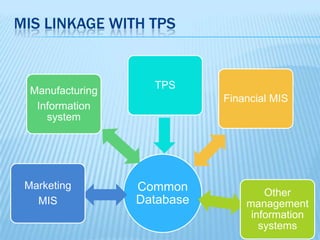
MIS LINKAGE WITH TPS
Common
Database
Marketing
MIS
Manufacturing
Information
system
Other
management
information
systems
Financial MIS
TPS
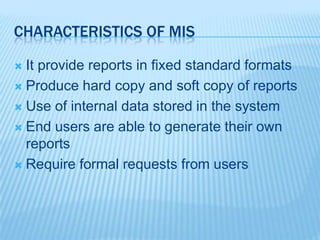
CHARACTERISTICS OF MIS
 It provide reports in fixed standard formats
 Produce hard copy and soft copy of reports
 Use of internal data stored in the system
 End users are able to generate their own
reports
 Require formal requests from users
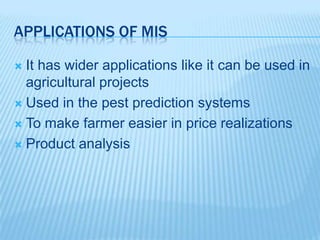
APPLICATIONS OF MIS
 It has wider applications like it can be used in
agricultural projects
 Used in the pest prediction systems
 To make farmer easier in price realizations
 Product analysis
E-SAGU
 A web based Agricultural expert Advice
dissemination system
 Exploiting the Information technology
 To disseminate agricultural knowledge and to
improve the crop productivity
PEST PREDICTION SYSTEMS
 To understand the population dynamics of
pests by data mining technique
 It is made collabration with ICRISAT
AGMARKET
 Agricultural Marketing Information Network
 A portal serves as source of agricultural
information system
 It serves as a single window delivery system
for accessing websites of various
organizations
 It is linked with FAO to know international
marketing trends
THANK YOU

Management Information System

  • 1.
  • 2.
    MIS-MANAGEMENT INFORMATION SYSTEM It is an organized collection of peoples, procedures, softwares, databases and devices used to provide routine information to managers and decision makers.  It is a informative database for providing the market status to the managers and other decision makers
  • 3.
    HISTORY  MIS wasstarted at the early 1960’s  There a regularly generated report called scheduled report were used during daily, weekly, monthly  Demand report- based on the information requirement of the decision maker  Exception report- used to represent unusual events or critical conditions  Now, all are merged from all fields to form MIS
  • 4.
    MIS  The objectiveof MIS is on Operational efficiency, marketing, production, finance, and other areas are supported by MIS linked through a common database  The reports are generated from data from the Transaction processing system (TPS)
  • 5.
    MIS LINKAGE WITHTPS Common Database Marketing MIS Manufacturing Information system Other management information systems Financial MIS TPS
  • 6.
    CHARACTERISTICS OF MIS It provide reports in fixed standard formats  Produce hard copy and soft copy of reports  Use of internal data stored in the system  End users are able to generate their own reports  Require formal requests from users
  • 7.
    APPLICATIONS OF MIS It has wider applications like it can be used in agricultural projects  Used in the pest prediction systems  To make farmer easier in price realizations  Product analysis
  • 8.
    E-SAGU  A webbased Agricultural expert Advice dissemination system  Exploiting the Information technology  To disseminate agricultural knowledge and to improve the crop productivity
  • 9.
    PEST PREDICTION SYSTEMS To understand the population dynamics of pests by data mining technique  It is made collabration with ICRISAT
  • 10.
    AGMARKET  Agricultural MarketingInformation Network  A portal serves as source of agricultural information system  It serves as a single window delivery system for accessing websites of various organizations  It is linked with FAO to know international marketing trends
  • 11.