CORE
OR
NOT CORE?THAT’S THE QUESTION
When wondering to in- or outsource
on seeks criteria for this consideration.
A criterion often used
is the distinction between
something being
“CORE” or “NON CORE”
to the business.
WHAT’S THE QUESTION?
SO WHAT
IS CORE?
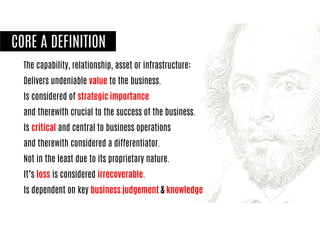
The capability, relationship, asset or infrastructure:
Delivers undeniable value to the business.
Is considered of strategic importance
and therewith crucial to the success of the business.
Is critical and central to business operations
and therewith considered a differentiator.
Not in the least due to its proprietary nature.
It’s loss is considered irrecoverable.
Is dependent on key business judgement & knowledge
CORE A DEFINITION
HOW TO
DETERMINE?
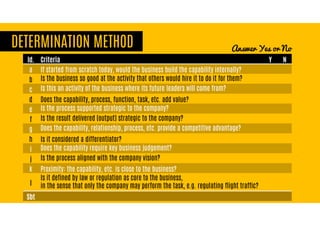
Id. Criteria Y N
a If started from scratch today, would the business build the capability internally?
b Is the business so good at the activity that others would hire it to do it for them?
c Is this an activity of the business where its future leaders will come from?
d Does the capability, process, function, task, etc. add value?
e Is the process supported strategic to the company?
f Is the result delivered (output) strategic to the company?
g Does the capability, relationship, process, etc. provide a competitive advantage?
h Is it considered a differentiator?
i Does the capability require key business judgement?
j Is the process aligned with the company vision?
k Proximity: the capability, etc. is close to the business?
l
Is it defined by law or regulation as core to the business,
in the sense that only the company may perform the task, e.g. regulating flight traffic?
Sbt
DETERMINATION METHOD Answer Yes or No
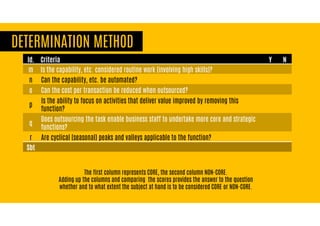
Id. Criteria Y N
m Is the capability, etc. considered routine work (involving high skills)?
n Can the capability, etc. be automated?
o Can the cost per transaction be reduced when outsourced?
p
Is the ability to focus on activities that deliver value improved by removing this
function?
q
Does outsourcing the task enable business staff to undertake more core and strategic
functions?
r Are cyclical (seasonal) peaks and valleys applicable to the function?
Sbt
DETERMINATION METHOD
The first column represents CORE, the second column NON-CORE.
Adding up the columns and comparing the scores provides the answer to the question
whether and to what extent the subject at hand is to be considered CORE or NON-CORE.
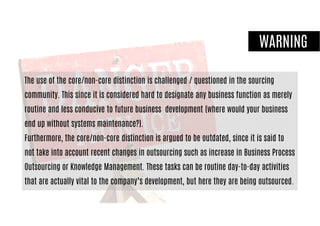
WARNING
The use of the core/non-core distinction is challenged / questioned in the sourcing
community. This since it is considered hard to designate any business function as merely
routine and less conducive to future business development (where would your business
end up without systems maintenance?).
Furthermore, the core/non-core distinction is argued to be outdated, since it is said to
not take into account recent changes in outsourcing such as increase in Business Process
Outsourcing or Knowledge Management. These tasks can be routine day-to-day activities
that are actually vital to the company’s development, but here they are being outsourced.
JUSTIFICATION
Finding Focus - How Non-Core Activities Are Blurring Your Strategic Vision.
~ Sutherland Global Services
Strategic, Core and Non-Core Activities. What to outsource for best results.
~ Intetics 2014.
IAOP OPBOK (outsourcing professional body of knowledge).
~ Van Haren 2010.
Strategic Frameworks for Outsourcing Decisions Part Two.
~ Vivek Sood, 2014.
Strategic Sourcing: From Periphery to the Core.
~ Gottfredson, et al, Harvard Business Review, 2015 issue.
Vested Outsourcing: Game Changing Rules for Outsourcing.
~ Visatek & Ledyard, 2010.
Images
Courtesy of
Flickr
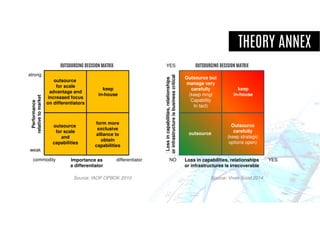
THEORY ANNEX
Importance as
a differentiator
differentiatorcommodity
weak
strong
Performance
relativetomarket
outsource
for scale
advantage and
increased focus
on differentiators
outsource
for scale
and
capabilities
keep
in-house
form more
exclusive
alliance to
obtain
capabilities
OUTSOURCING DECISION MATRIX
Source: IAOP OPBOK 2010
Loss in capabilities, relationships
or infrastructures is irrecoverable
YESNO
YES
Lossincapabilities,relationships
orinfrastructureisbusinesscritical
Outsource but
manage very
carefully
(keep mngt
Capability
In tact)
outsource
keep
in-house
Outsource
carefully
(keep strategic
options open)
OUTSOURCING DECISION MATRIX
Source: Vivek Sood 2014
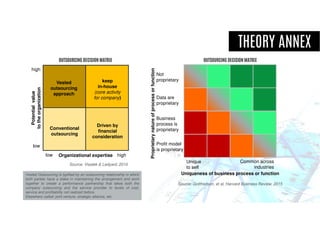
THEORY ANNEX
Source: Gottfredson, et al, Harvard Business Review, 2015
Uniqueness of business process or function
Common across
industries
Not
proprietary
OUTSOURCING DECISION MATRIX
Unique
to self
Proprietarynatureofprocessorfunction
Data are
proprietary
Business
process is
proprietary
Profit model
is proprietary
Organizational expertise highlow
low
high
Potentialvalue
totheorganization
Vested
outsourcing
approach
Conventional
outsourcing
keep
in-house
(core activity
for company)
Driven by
financial
consideration
OUTSOURCING DECISION MATRIX
Source: Visatek & Ledyard, 2010
Vested Outsourcing is typified by an outsourcing relationship in which
both parties have a stake in maintaining the arrangement and work
together to create a performance partnership that takes both the
company outsourcing and the service provider to levels of cost,
service and profitability not realized before.
Elsewhere called: joint venture, strategic alliance, etc.
Contact
M o
www.lucide.org
Phone: +31(0)578 - 642575 / | e-mail: info@lucide.org
You’re more than welcome to visit us
we are more than willing to travel to you
+31(0)6 – 51 123 500
+31(0)6 – 43 247 157
+31(0)578 – 64 25 75
info@lucide.org
www.lucide.org
Huttenbosweg 2
8167 LB OENE
The Netherlands
Contact us
www.lucide.org
Phone: +31(0)578 - 642575 / | e-mail: info@lucide.org
Follow us
Twitter
twitter.com/LucideBV
linkedin
linkedin.com/lucide
t
YOU
THANK
For your
attention
See you soon!

About sourcing: core or not core

  • 1.
  • 2.
    When wondering toin- or outsource on seeks criteria for this consideration. A criterion often used is the distinction between something being “CORE” or “NON CORE” to the business. WHAT’S THE QUESTION?
  • 3.
  • 4.
    The capability, relationship,asset or infrastructure: Delivers undeniable value to the business. Is considered of strategic importance and therewith crucial to the success of the business. Is critical and central to business operations and therewith considered a differentiator. Not in the least due to its proprietary nature. It’s loss is considered irrecoverable. Is dependent on key business judgement & knowledge CORE A DEFINITION
  • 5.
  • 6.
    Id. Criteria YN a If started from scratch today, would the business build the capability internally? b Is the business so good at the activity that others would hire it to do it for them? c Is this an activity of the business where its future leaders will come from? d Does the capability, process, function, task, etc. add value? e Is the process supported strategic to the company? f Is the result delivered (output) strategic to the company? g Does the capability, relationship, process, etc. provide a competitive advantage? h Is it considered a differentiator? i Does the capability require key business judgement? j Is the process aligned with the company vision? k Proximity: the capability, etc. is close to the business? l Is it defined by law or regulation as core to the business, in the sense that only the company may perform the task, e.g. regulating flight traffic? Sbt DETERMINATION METHOD Answer Yes or No
  • 7.
    Id. Criteria YN m Is the capability, etc. considered routine work (involving high skills)? n Can the capability, etc. be automated? o Can the cost per transaction be reduced when outsourced? p Is the ability to focus on activities that deliver value improved by removing this function? q Does outsourcing the task enable business staff to undertake more core and strategic functions? r Are cyclical (seasonal) peaks and valleys applicable to the function? Sbt DETERMINATION METHOD The first column represents CORE, the second column NON-CORE. Adding up the columns and comparing the scores provides the answer to the question whether and to what extent the subject at hand is to be considered CORE or NON-CORE.
  • 8.
    WARNING The use ofthe core/non-core distinction is challenged / questioned in the sourcing community. This since it is considered hard to designate any business function as merely routine and less conducive to future business development (where would your business end up without systems maintenance?). Furthermore, the core/non-core distinction is argued to be outdated, since it is said to not take into account recent changes in outsourcing such as increase in Business Process Outsourcing or Knowledge Management. These tasks can be routine day-to-day activities that are actually vital to the company’s development, but here they are being outsourced.
  • 9.
    JUSTIFICATION Finding Focus -How Non-Core Activities Are Blurring Your Strategic Vision. ~ Sutherland Global Services Strategic, Core and Non-Core Activities. What to outsource for best results. ~ Intetics 2014. IAOP OPBOK (outsourcing professional body of knowledge). ~ Van Haren 2010. Strategic Frameworks for Outsourcing Decisions Part Two. ~ Vivek Sood, 2014. Strategic Sourcing: From Periphery to the Core. ~ Gottfredson, et al, Harvard Business Review, 2015 issue. Vested Outsourcing: Game Changing Rules for Outsourcing. ~ Visatek & Ledyard, 2010. Images Courtesy of Flickr
  • 10.
    THEORY ANNEX Importance as adifferentiator differentiatorcommodity weak strong Performance relativetomarket outsource for scale advantage and increased focus on differentiators outsource for scale and capabilities keep in-house form more exclusive alliance to obtain capabilities OUTSOURCING DECISION MATRIX Source: IAOP OPBOK 2010 Loss in capabilities, relationships or infrastructures is irrecoverable YESNO YES Lossincapabilities,relationships orinfrastructureisbusinesscritical Outsource but manage very carefully (keep mngt Capability In tact) outsource keep in-house Outsource carefully (keep strategic options open) OUTSOURCING DECISION MATRIX Source: Vivek Sood 2014
  • 11.
    THEORY ANNEX Source: Gottfredson,et al, Harvard Business Review, 2015 Uniqueness of business process or function Common across industries Not proprietary OUTSOURCING DECISION MATRIX Unique to self Proprietarynatureofprocessorfunction Data are proprietary Business process is proprietary Profit model is proprietary Organizational expertise highlow low high Potentialvalue totheorganization Vested outsourcing approach Conventional outsourcing keep in-house (core activity for company) Driven by financial consideration OUTSOURCING DECISION MATRIX Source: Visatek & Ledyard, 2010 Vested Outsourcing is typified by an outsourcing relationship in which both parties have a stake in maintaining the arrangement and work together to create a performance partnership that takes both the company outsourcing and the service provider to levels of cost, service and profitability not realized before. Elsewhere called: joint venture, strategic alliance, etc.
  • 12.
  • 13.
    www.lucide.org Phone: +31(0)578 -642575 / | e-mail: info@lucide.org You’re more than welcome to visit us we are more than willing to travel to you +31(0)6 – 51 123 500 +31(0)6 – 43 247 157 +31(0)578 – 64 25 75 info@lucide.org www.lucide.org Huttenbosweg 2 8167 LB OENE The Netherlands Contact us
  • 14.
    www.lucide.org Phone: +31(0)578 -642575 / | e-mail: info@lucide.org Follow us Twitter twitter.com/LucideBV linkedin linkedin.com/lucide t
  • 15.