INTRODUCTION Panchakarma is Ayurveda's primary purification and detoxification treatment. Panchakarma means the "five therapies". These 5  therapeutic means of eliminating toxins from the body are Vamana, Virechana, Nasya, Basti and Raktamoskshana. This series of five therapies help remove deep rooted stress and illness causing toxins from the body while balancing the doshas  (energies that govern all biological functions).
SNEHAN
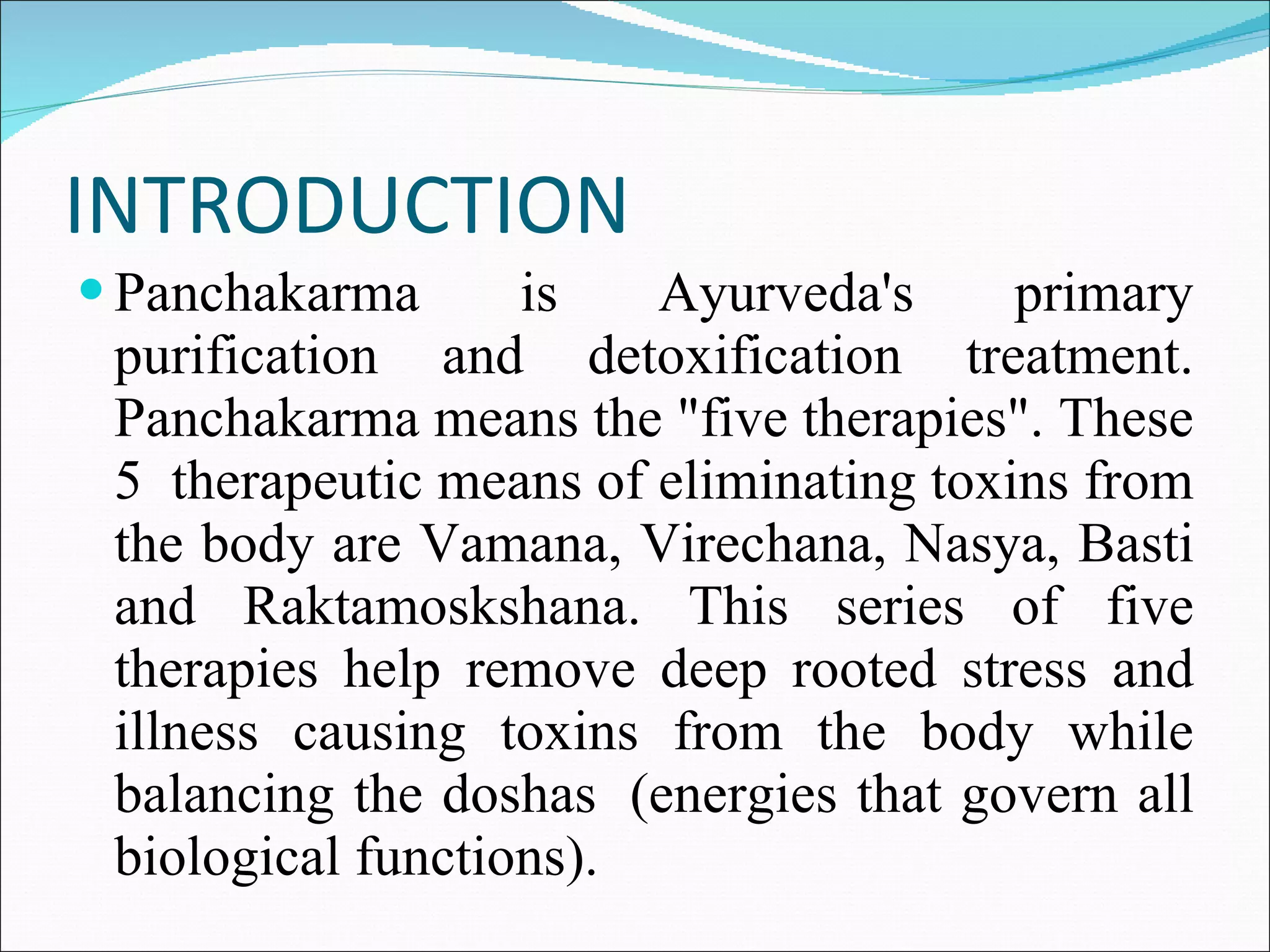
Properties of Sneha Drugs Heaviness  Coolness  Softness  Easily penetrating  Liquidness
TYPES OF SNEH MATERIAL Ghee  Oil  Fat  Bone marrow
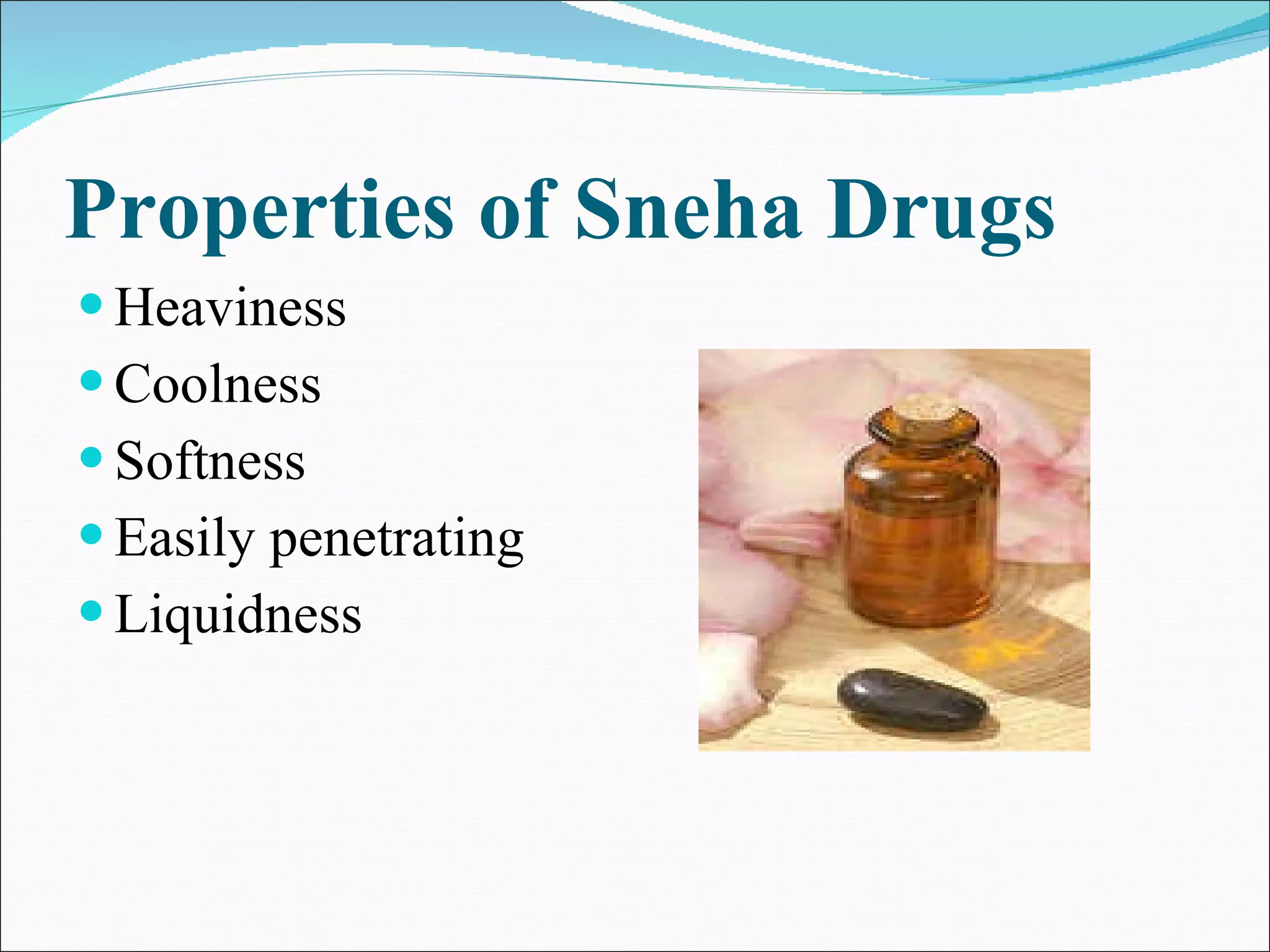
Common oil used in external oleation Sesame oil Sunflower oil Dhanwantri oil Ashvgandha oil Mahanarayan oil Bala oil Vishgarbha oil
Indications of Oleo Therapy Before fomentation therapy  Before purification therapy  Vata vitiated conditions  Anxiety  Mental stress  To improve stamina
PROCEDURE Warm ¼ cup of oil to slightly above body temp place a small amount of oil on the finger tips and palms and begin to massage, using the open part of the hand rather than the fingertips. Start with the head. Apply oil directly to the scalp and then cover the entire  scalp with small circular strokes.  Next apply oil gently to face and outer part of ears. Massage both the front and back of the neck, and the upper part of the spine. Apply a small amount of oil to entire body and then proceed with the massage to each area of the body Massage arms with back and forth motion over long bones
Put oil on chest and abdomen , over the abdomen, use a gentle circular clockwise motion, and over the breast bone, a straight up and down motion.  Massage the back and spine  Massage the legs use a back and forth motion over the long bones and circular over the joints.  Lastly, massage the bottom of the feet. The feet are especially important, and more time should be spent here than on other parts of the body. Use the open part of your hand and massage vigorously back and forth over the soles of the feet.  Shower or bathe with warm, not hot water and a mild soap. This will keep a small undetectable film of oil on the body even after the bath. This is very beneficial.
Contraindications Vitiated conditions of Kapha  Pregnancy  Anorexia  Indigestion  Person with excessive digestive fire  Fever Diarrhoea
Different Types of Oleo therapy Materials Oral usage  MEDIUM COOKED (Panchtikta ghrita) Nasal drops  MEDIUM COOKED (Anu oil) Massage  WELL COOKED (Mahanarayan oil) Enema  MEDIUM COOKED (Bala oil) Ear drop  MEDIUM COOKED (Mustard oil)
Steps of Oleo Therapy Examination of the patient  Determination of duration for oleo therapy  Determination of dosage  Dietary management prior to oleo therapy  Collection of materials useful for therapy  Procedure of therapy  Observation of adequate/inadequate/excessive oleo therapy signs & symptoms  Complications of oleo therapy  Post-therapy regimen
Complications of oleo therapy:   Acute complication Anorexia  Vomiting Indigestion Abdominal pain.
Chronic complication Skin lesions Itching sensation Anaemia Oedema Numbness
Adequate symptoms Increased digestive fire Normal bowel movements Lightness of the body Normal movement of Vata in the body
Inadequate symptoms Painful, dry stools Weak digestive capacity Improper movements of Vata in the body Dryness
Excessive symptoms Heaviness of the body Stiffness of the body Nausea Salivation Anaemic
Post-Oleo Therapy Regimen Bed rest  Night sleeping  Warm water intake  Good, easily digestible, fresh foods  Do not suppress natural urges  No day sleep
External oleo therapies Massage  Pouring warm/hot medicated liquids on the body  Gargling with medicated fluids  Medicated oil application on the head  Keeping the medicated oil on the eye  Medicated nasal drops  Instillation of eye drops  Application of medicated oil with paste on the head
Swedana Karma Inducing sweating by heat application is known as "Sudation therapy". It is good for Vata and Kapha diseases and bad for Pitta and blood diseases. It is also a specific treatment for a number of diseases like Vata diseases etc.
SWEDAN DRUGS Shobhanjan Ark Erand Punarnava Kulath Badar Maash Til Yava
Qualities of Swedan materials Hot  Quickly spreading  Roughness  Penetrating  Heavy/bulkiness
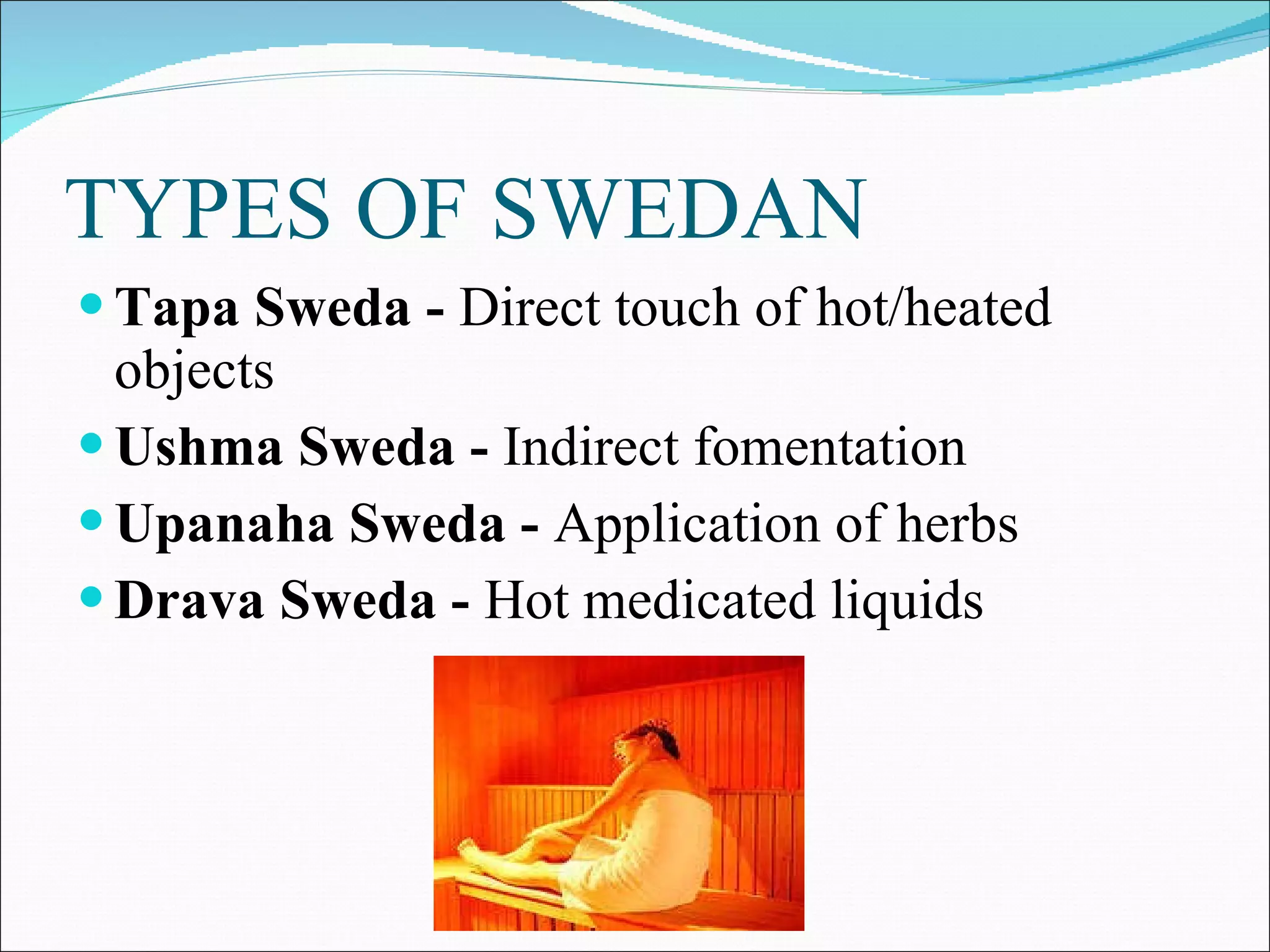
TYPES OF SWEDAN Tapa Sweda -  Direct touch of hot/heated objects  Ushma Sweda -  Indirect fomentation  Upanaha Sweda -  Application of herbs  Drava Sweda -  Hot medicated liquids
Indications Cough  Hiccough  Heaviness of the body  Stiffness and pain in the neck region  Rigid neck - flanks- body parts  Facial palsy  Paralysis  All Vata diseases and vitiated conditions  Numbness and loss of sensation  Vata and Kapha diseases
Contraindications of sudation therapy Vitiated conditions of Pitta/diseases of Pitta (Blood)  Alcoholism  Burns  Poisoning Indigestion anger sorrow  pregnancy
Types Of Sudation Sudation therapy with fire (Agni Sweda)- Again divided into 13 types  Sudation with out fire (Anagni Sweda)- Again divided into 10 types
Sudation with Fire - Agni Sweda  Sankara - Pinda Sweda Prasthara Sweda Avagaha Sweda: Nadi Sweda / Bashpa Sweda Pariseka Sweda Avagaha Sweda Jentaka Sweda Ashma Ghana Sweda Karshoo Sweda Kutee Koopa Sweda: Sweda Bhoo Sweda Kumbhee Sweda Holaaka Sweda
Pariseka Sweda:   Lukewarm medicated decoctions(Dashmula decoction), oil, ghee, milk etc. are poured on the body from a height of 9-inches for a specific time.  Drugs used: tulsi, opiun, castor, bhringraaj Indications: sarvaang vaat, pelvic pain
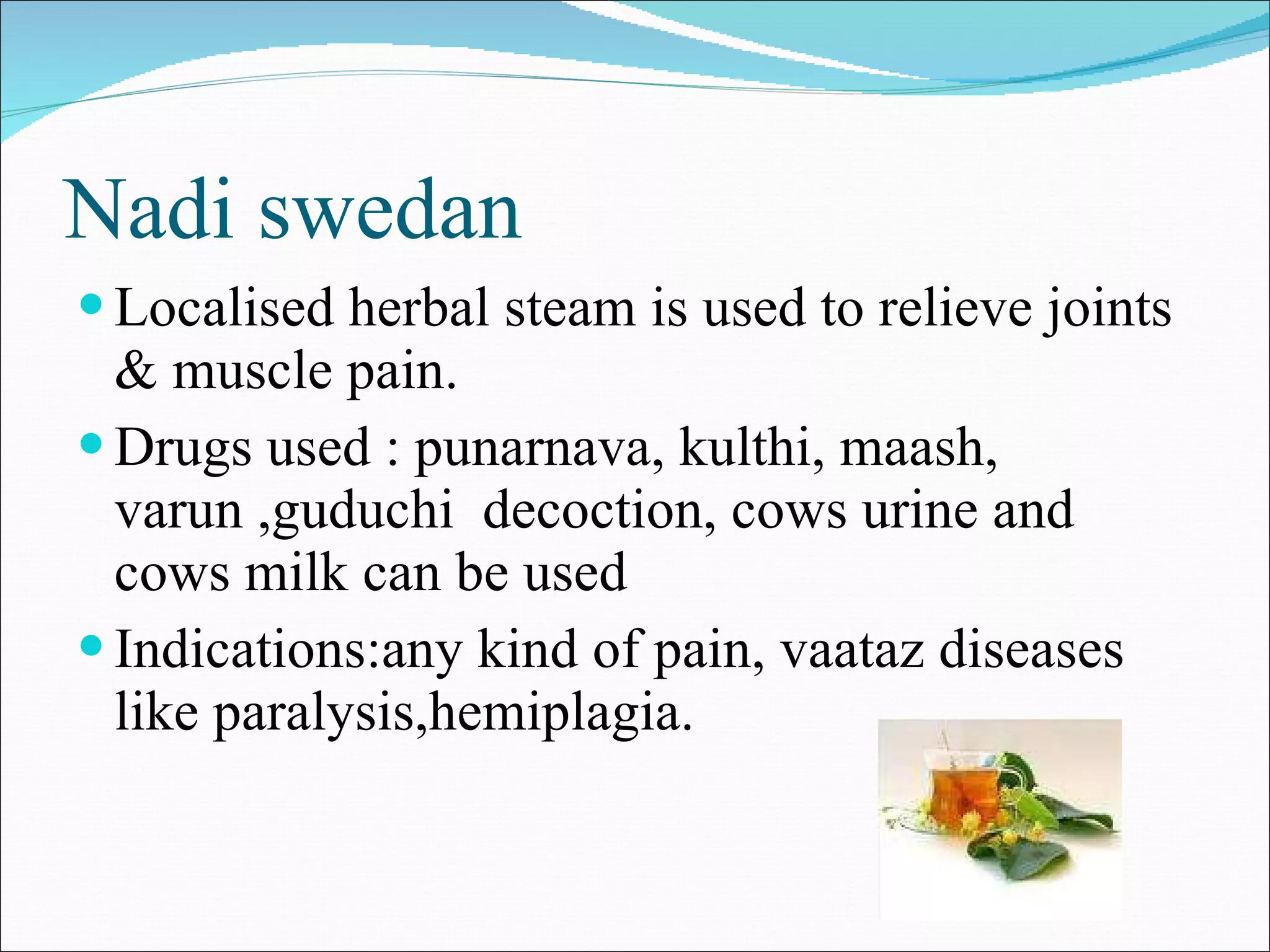
Nadi swedan Localised herbal steam is used to relieve joints & muscle pain. Drugs used : punarnava, kulthi, maash, varun ,guduchi  decoction, cows urine and cows milk can be used Indications:any kind of pain, vaataz diseases like paralysis,hemiplagia.
Avagaha Sweda: Medicated decoctions, oils, milk, ghee, meat soup etc. should be filled in a tub and the person is asked to dip up to the neck for ½ - 1 hours. Drugs used:decoction of neem, dashmool, bala,nirgundi  Indication :sciatica,arthritis,pelvic pain,backache
Sudation with out fire (Anagni Sweda)-  By Anger Sorrow Worry  Through sun By keeping in hot room Drinking excessive water Excess alcohol consumption Covering with blanket etc……
Pre-treatment procedures Collection of required materials like medicines etc.  Assessment of the patient  Seasonal indications etc.
Features of good  sudation symptoms Disappearance of cold Relief from pain Relief from stiffness Relief from heaviness Getting smoothness of the body Adequate sweating Desire for cold items
Features of inadequate sudation symptoms Less sweating No relief from pain Stiffness Heaviness and cold
Features of excess sudation symptoms Burning sensation of the body Fainting Heaviness Joint pain and body pains Eruption of de-pigmented papules on the skin  Vertigo Thirst Fever
Post-Treatment Regimen Do not expose to cold/hot open air directly  Avoid the use of cold water  Warm water sponging for proper cleaning  Rest  Sleeping after taking light and non-sticky food
Benefits of sweating therapy Removes rigidity  Reduces heaviness  Reduces coldness  Induces sweating  Liquefies doshas  Maintains the normalcy of doshas  Brings softness to the organs  Promotes appetite  Brings normal pigmentation and softness to skin  Removes unwanted sleep/laziness of the body
Akshi Tarpan
PROCEDURE A paste of black gram flour is applied around the eyes and warm medicated oil or ghee is poured inside in such a way that the entire eye is submerged in the medication for some time. The duration for this procedure is adjusted according to the severity of the condition. After a specified time, the medicine is drained out, the surrounding paste is removed, and the eyes are cleaned.
INDICATIONS VATTA  AND  PITTAZ  DISEASES OF EYE BLEPHRITIS REFRACTIVE ERRORS MACULAR DEGENERATION DRY EYE ABHISHYAND ADHINMANTH
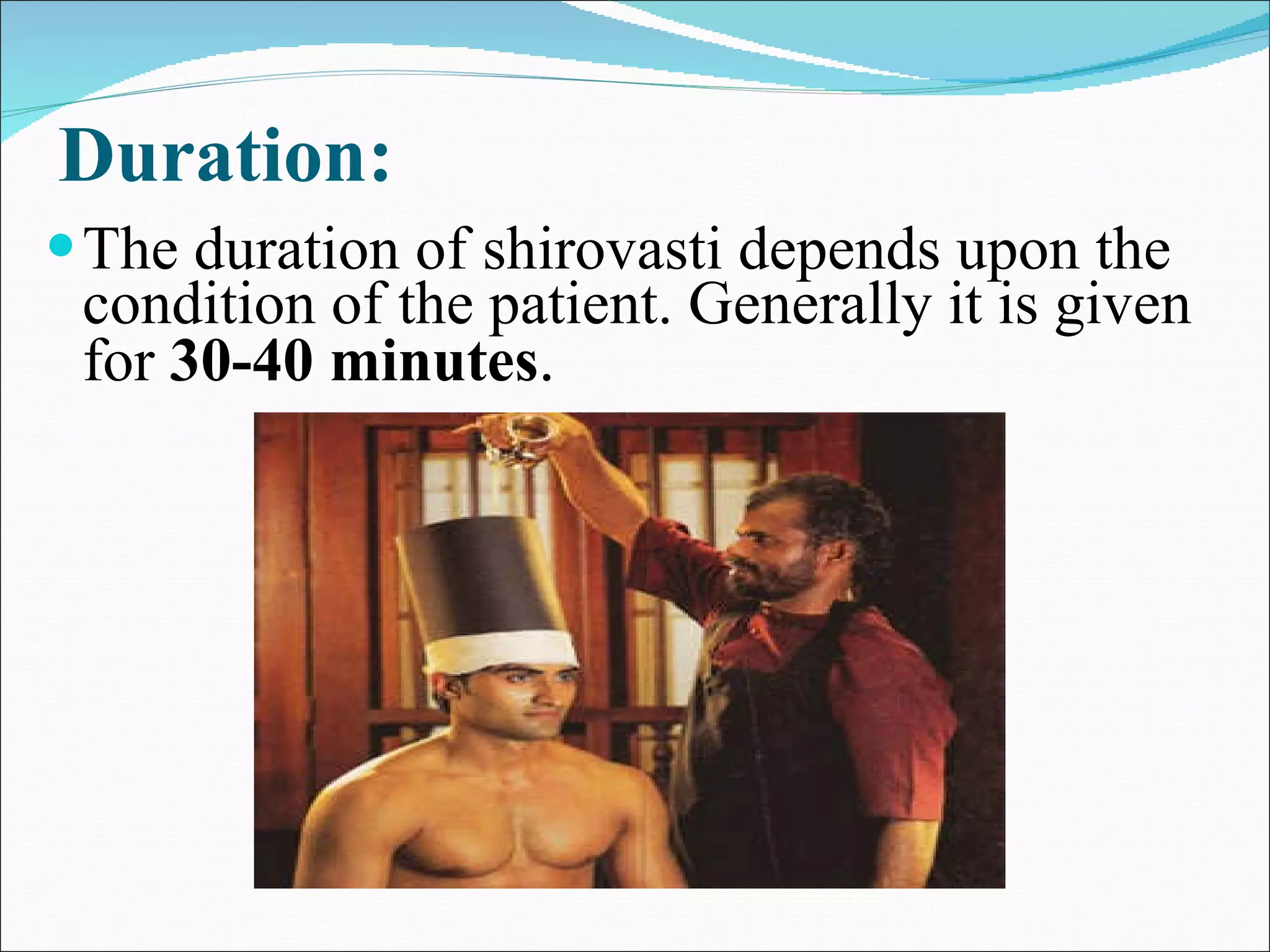
Shirovasti  Shirovasti is a very special  bathing treatment for the head . In this treatment a long cap open at the top is fitted around the patients head. Some precious lukewarm herbal oils are poured into the cap for 30 to 45 minutes per day, for a period 5 to 7 days.
INDICATIONS Cervical Problems  Dementia  Disease of scalp like aloplecia  Facial paralysis  Headache  Hemiplegia
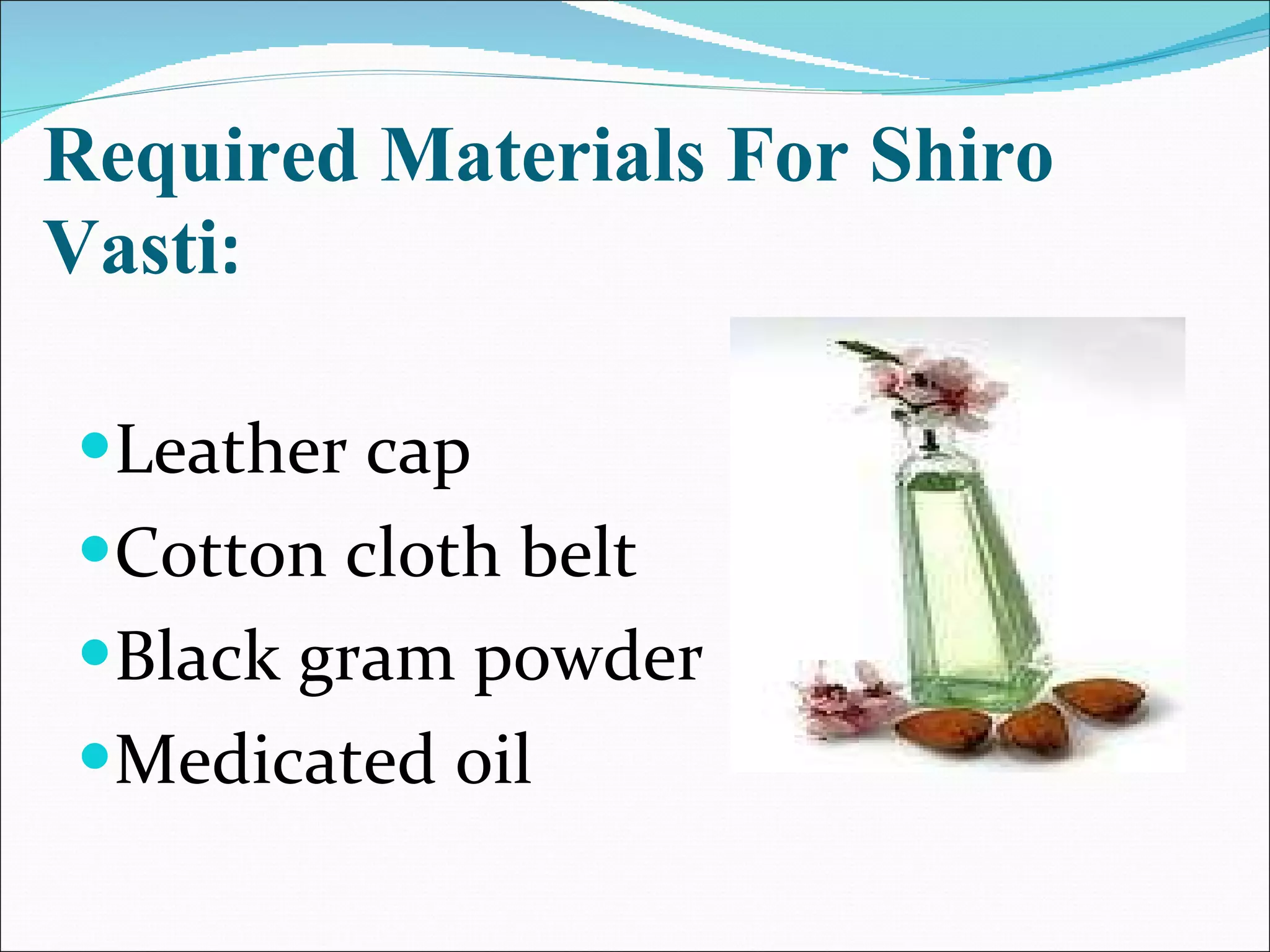
Required Materials For Shiro Vasti : Leather cap  Cotton cloth belt  Black gram powder  Medicated oil
Selection Of The Oil: For   Dry hair : Coconut and sesame oils.  Memory : brahmi, amalaki, bhringaraj oils.  Ear Pain : Mustard oil  For All : Sesame, brahmi, bhringaraj, amalaki oils
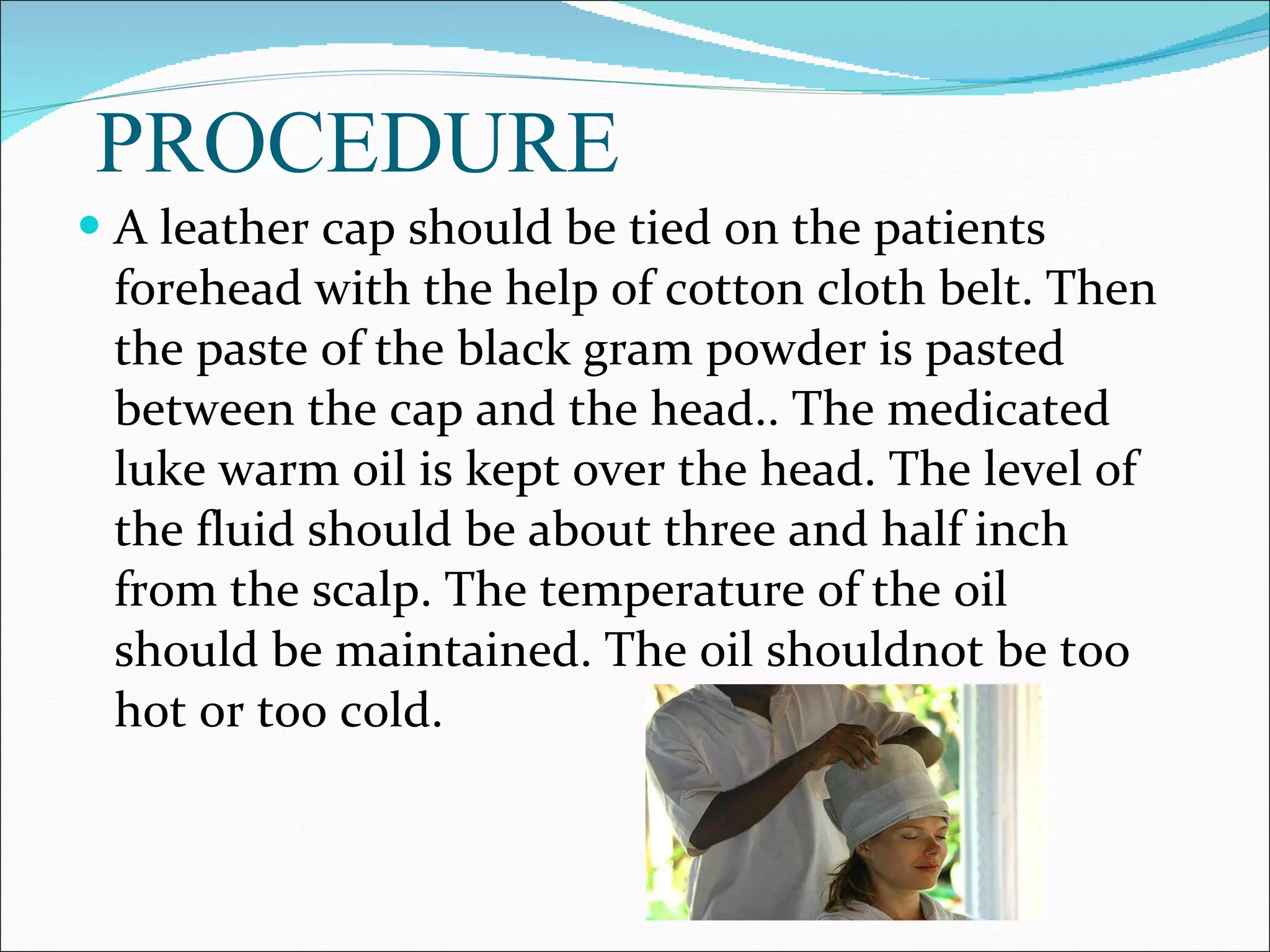
PROCEDURE A leather cap should be tied on the patients forehead with the help of cotton cloth belt. Then the paste of the black gram powder is pasted between the cap and the head.. The medicated luke warm oil is kept over the head. The level of the fluid should be about three and half inch from the scalp. The temperature of the oil should be maintained. The oil shouldnot be too hot or too cold.
Duration: The duration of shirovasti depends upon the condition of the patient. Generally it is given for  30-40 minutes .
 
Benefits of shirovasti Nourishes the brain hence promotes intellect.  Brings mental calmness.  Nourishes the hair roots and makes the hair soft and glossy.  Cures various eye disorders, sinusitis and improves complexion.  Stimulates the marma point in the head acting like acupressure points by its pressure effect.  Balances the vata and kapha in the brain in between the brain and skull.
Precautions The hair of the patient should not be long. If long, the hair should be cut to shout.  The leather cap should be tight so that there is no leakage of any fluid during the treatment.  The fluid poured in the leather cap should not be too cold or too warm.  The temperature of the fluid should be maintained.
THANKS

Nutri Health Systems Panchkarma

  • 1.
  • 2.
    INTRODUCTION Panchakarma isAyurveda's primary purification and detoxification treatment. Panchakarma means the "five therapies". These 5  therapeutic means of eliminating toxins from the body are Vamana, Virechana, Nasya, Basti and Raktamoskshana. This series of five therapies help remove deep rooted stress and illness causing toxins from the body while balancing the doshas  (energies that govern all biological functions).
  • 3.
  • 4.
    Properties of SnehaDrugs Heaviness Coolness Softness Easily penetrating Liquidness
  • 5.
    TYPES OF SNEHMATERIAL Ghee Oil Fat Bone marrow
  • 6.
    Common oil usedin external oleation Sesame oil Sunflower oil Dhanwantri oil Ashvgandha oil Mahanarayan oil Bala oil Vishgarbha oil
  • 7.
    Indications of OleoTherapy Before fomentation therapy Before purification therapy Vata vitiated conditions Anxiety Mental stress To improve stamina
  • 8.
    PROCEDURE Warm ¼cup of oil to slightly above body temp place a small amount of oil on the finger tips and palms and begin to massage, using the open part of the hand rather than the fingertips. Start with the head. Apply oil directly to the scalp and then cover the entire scalp with small circular strokes. Next apply oil gently to face and outer part of ears. Massage both the front and back of the neck, and the upper part of the spine. Apply a small amount of oil to entire body and then proceed with the massage to each area of the body Massage arms with back and forth motion over long bones
  • 9.
    Put oil onchest and abdomen , over the abdomen, use a gentle circular clockwise motion, and over the breast bone, a straight up and down motion. Massage the back and spine Massage the legs use a back and forth motion over the long bones and circular over the joints. Lastly, massage the bottom of the feet. The feet are especially important, and more time should be spent here than on other parts of the body. Use the open part of your hand and massage vigorously back and forth over the soles of the feet. Shower or bathe with warm, not hot water and a mild soap. This will keep a small undetectable film of oil on the body even after the bath. This is very beneficial.
  • 10.
    Contraindications Vitiated conditionsof Kapha Pregnancy Anorexia Indigestion Person with excessive digestive fire Fever Diarrhoea
  • 11.
    Different Types ofOleo therapy Materials Oral usage MEDIUM COOKED (Panchtikta ghrita) Nasal drops MEDIUM COOKED (Anu oil) Massage WELL COOKED (Mahanarayan oil) Enema MEDIUM COOKED (Bala oil) Ear drop MEDIUM COOKED (Mustard oil)
  • 12.
    Steps of OleoTherapy Examination of the patient Determination of duration for oleo therapy Determination of dosage Dietary management prior to oleo therapy Collection of materials useful for therapy Procedure of therapy Observation of adequate/inadequate/excessive oleo therapy signs & symptoms Complications of oleo therapy Post-therapy regimen
  • 13.
    Complications of oleotherapy: Acute complication Anorexia Vomiting Indigestion Abdominal pain.
  • 14.
    Chronic complication Skinlesions Itching sensation Anaemia Oedema Numbness
  • 15.
    Adequate symptoms Increaseddigestive fire Normal bowel movements Lightness of the body Normal movement of Vata in the body
  • 16.
    Inadequate symptoms Painful,dry stools Weak digestive capacity Improper movements of Vata in the body Dryness
  • 17.
    Excessive symptoms Heavinessof the body Stiffness of the body Nausea Salivation Anaemic
  • 18.
    Post-Oleo Therapy RegimenBed rest Night sleeping Warm water intake Good, easily digestible, fresh foods Do not suppress natural urges No day sleep
  • 19.
    External oleo therapiesMassage Pouring warm/hot medicated liquids on the body Gargling with medicated fluids Medicated oil application on the head Keeping the medicated oil on the eye Medicated nasal drops Instillation of eye drops Application of medicated oil with paste on the head
  • 20.
    Swedana Karma Inducingsweating by heat application is known as "Sudation therapy". It is good for Vata and Kapha diseases and bad for Pitta and blood diseases. It is also a specific treatment for a number of diseases like Vata diseases etc.
  • 21.
    SWEDAN DRUGS ShobhanjanArk Erand Punarnava Kulath Badar Maash Til Yava
  • 22.
    Qualities of Swedanmaterials Hot Quickly spreading Roughness Penetrating Heavy/bulkiness
  • 23.
    TYPES OF SWEDANTapa Sweda - Direct touch of hot/heated objects Ushma Sweda - Indirect fomentation Upanaha Sweda - Application of herbs Drava Sweda - Hot medicated liquids
  • 24.
    Indications Cough Hiccough Heaviness of the body Stiffness and pain in the neck region Rigid neck - flanks- body parts Facial palsy Paralysis All Vata diseases and vitiated conditions Numbness and loss of sensation Vata and Kapha diseases
  • 25.
    Contraindications of sudationtherapy Vitiated conditions of Pitta/diseases of Pitta (Blood) Alcoholism Burns Poisoning Indigestion anger sorrow pregnancy
  • 26.
    Types Of SudationSudation therapy with fire (Agni Sweda)- Again divided into 13 types Sudation with out fire (Anagni Sweda)- Again divided into 10 types
  • 27.
    Sudation with Fire- Agni Sweda Sankara - Pinda Sweda Prasthara Sweda Avagaha Sweda: Nadi Sweda / Bashpa Sweda Pariseka Sweda Avagaha Sweda Jentaka Sweda Ashma Ghana Sweda Karshoo Sweda Kutee Koopa Sweda: Sweda Bhoo Sweda Kumbhee Sweda Holaaka Sweda
  • 28.
    Pariseka Sweda: Lukewarm medicated decoctions(Dashmula decoction), oil, ghee, milk etc. are poured on the body from a height of 9-inches for a specific time. Drugs used: tulsi, opiun, castor, bhringraaj Indications: sarvaang vaat, pelvic pain
  • 29.
    Nadi swedan Localisedherbal steam is used to relieve joints & muscle pain. Drugs used : punarnava, kulthi, maash, varun ,guduchi decoction, cows urine and cows milk can be used Indications:any kind of pain, vaataz diseases like paralysis,hemiplagia.
  • 30.
    Avagaha Sweda: Medicateddecoctions, oils, milk, ghee, meat soup etc. should be filled in a tub and the person is asked to dip up to the neck for ½ - 1 hours. Drugs used:decoction of neem, dashmool, bala,nirgundi Indication :sciatica,arthritis,pelvic pain,backache
  • 31.
    Sudation with outfire (Anagni Sweda)- By Anger Sorrow Worry Through sun By keeping in hot room Drinking excessive water Excess alcohol consumption Covering with blanket etc……
  • 32.
    Pre-treatment procedures Collectionof required materials like medicines etc. Assessment of the patient Seasonal indications etc.
  • 33.
    Features of good sudation symptoms Disappearance of cold Relief from pain Relief from stiffness Relief from heaviness Getting smoothness of the body Adequate sweating Desire for cold items
  • 34.
    Features of inadequatesudation symptoms Less sweating No relief from pain Stiffness Heaviness and cold
  • 35.
    Features of excesssudation symptoms Burning sensation of the body Fainting Heaviness Joint pain and body pains Eruption of de-pigmented papules on the skin Vertigo Thirst Fever
  • 36.
    Post-Treatment Regimen Donot expose to cold/hot open air directly Avoid the use of cold water Warm water sponging for proper cleaning Rest Sleeping after taking light and non-sticky food
  • 37.
    Benefits of sweatingtherapy Removes rigidity Reduces heaviness Reduces coldness Induces sweating Liquefies doshas Maintains the normalcy of doshas Brings softness to the organs Promotes appetite Brings normal pigmentation and softness to skin Removes unwanted sleep/laziness of the body
  • 38.
  • 39.
    PROCEDURE A pasteof black gram flour is applied around the eyes and warm medicated oil or ghee is poured inside in such a way that the entire eye is submerged in the medication for some time. The duration for this procedure is adjusted according to the severity of the condition. After a specified time, the medicine is drained out, the surrounding paste is removed, and the eyes are cleaned.
  • 40.
    INDICATIONS VATTA AND PITTAZ DISEASES OF EYE BLEPHRITIS REFRACTIVE ERRORS MACULAR DEGENERATION DRY EYE ABHISHYAND ADHINMANTH
  • 41.
    Shirovasti Shirovastiis a very special bathing treatment for the head . In this treatment a long cap open at the top is fitted around the patients head. Some precious lukewarm herbal oils are poured into the cap for 30 to 45 minutes per day, for a period 5 to 7 days.
  • 42.
    INDICATIONS Cervical Problems Dementia Disease of scalp like aloplecia Facial paralysis Headache Hemiplegia
  • 43.
    Required Materials ForShiro Vasti : Leather cap Cotton cloth belt Black gram powder Medicated oil
  • 44.
    Selection Of TheOil: For Dry hair : Coconut and sesame oils. Memory : brahmi, amalaki, bhringaraj oils. Ear Pain : Mustard oil For All : Sesame, brahmi, bhringaraj, amalaki oils
  • 45.
    PROCEDURE A leathercap should be tied on the patients forehead with the help of cotton cloth belt. Then the paste of the black gram powder is pasted between the cap and the head.. The medicated luke warm oil is kept over the head. The level of the fluid should be about three and half inch from the scalp. The temperature of the oil should be maintained. The oil shouldnot be too hot or too cold.
  • 46.
    Duration: The durationof shirovasti depends upon the condition of the patient. Generally it is given for 30-40 minutes .
  • 47.
  • 48.
    Benefits of shirovastiNourishes the brain hence promotes intellect. Brings mental calmness. Nourishes the hair roots and makes the hair soft and glossy. Cures various eye disorders, sinusitis and improves complexion. Stimulates the marma point in the head acting like acupressure points by its pressure effect. Balances the vata and kapha in the brain in between the brain and skull.
  • 49.
    Precautions The hairof the patient should not be long. If long, the hair should be cut to shout. The leather cap should be tight so that there is no leakage of any fluid during the treatment. The fluid poured in the leather cap should not be too cold or too warm. The temperature of the fluid should be maintained.
  • 50.