• The process which produces :
 Snehana
Vishyandana
Mardavam
Kleda
स्नेहनं स्नेहविष्यन्दमाददिंक्लेदााका
ं ||
स्नेह स्िेदािनभ्यस्य ा
ु यादत्संशोधनं तु यः|
दारु शुष्ाममिाऽऽनामेशकीकं तस्य दीयदते ||
(अ.ह.सू – १८/५९)
िृद्ध्या विष्यन्दनात्पााात् स्रोतो मुख विशोधनात् |
शाखान्मुक्तिा मलाः ाोष्ठं यान्न्त िायोश्च ननग्रहात् ||
(च.सू – २८/४७)
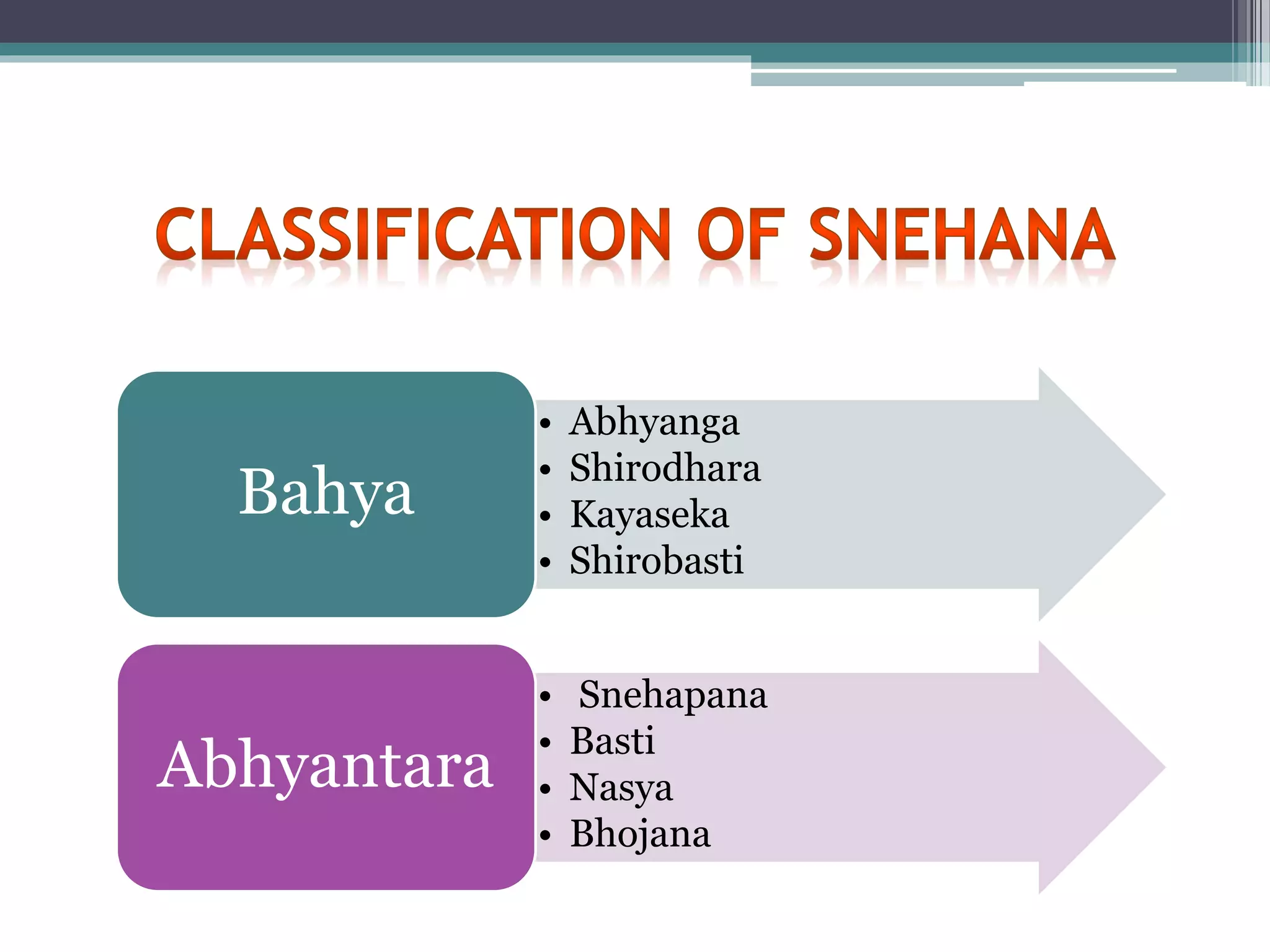
• Abhyanga
• Shirodhara
• Kayaseka
• Shirobasti
Bahya
• Snehapana
• Basti
• Nasya
• Bhojana
Abhyantara
PASCHATKARMA
Ahara Vihar Shodhana (if required)
PRADHANA KARMA
Accha Sneha pana
PURVAKARMA
Deepana Pachana
 Agnivardhana
 Removes srotorodha
 Helps in better absorption of snehana and dravya.
 Reduces the risk of complication
Vata
• Panchkola Phanta
• Shunthi churna
• Ajmodadi Churna
Pitta
• Shunthi Churna
• Jeerak Churna
• Chitrakadi vati
Kapha
• Trikatu Churna
• Agnitundi Vati
Swedaya
Samshodhya
Vatavyadhi
Skin diseases
Gynaecological diseases
Psychiatric diseases
Neurological disorders
Myopathies
Mandagni
Kaphanubandha diseases
Rukshanarh
Aruchi
Atisara
Annadvesh
Garbhini
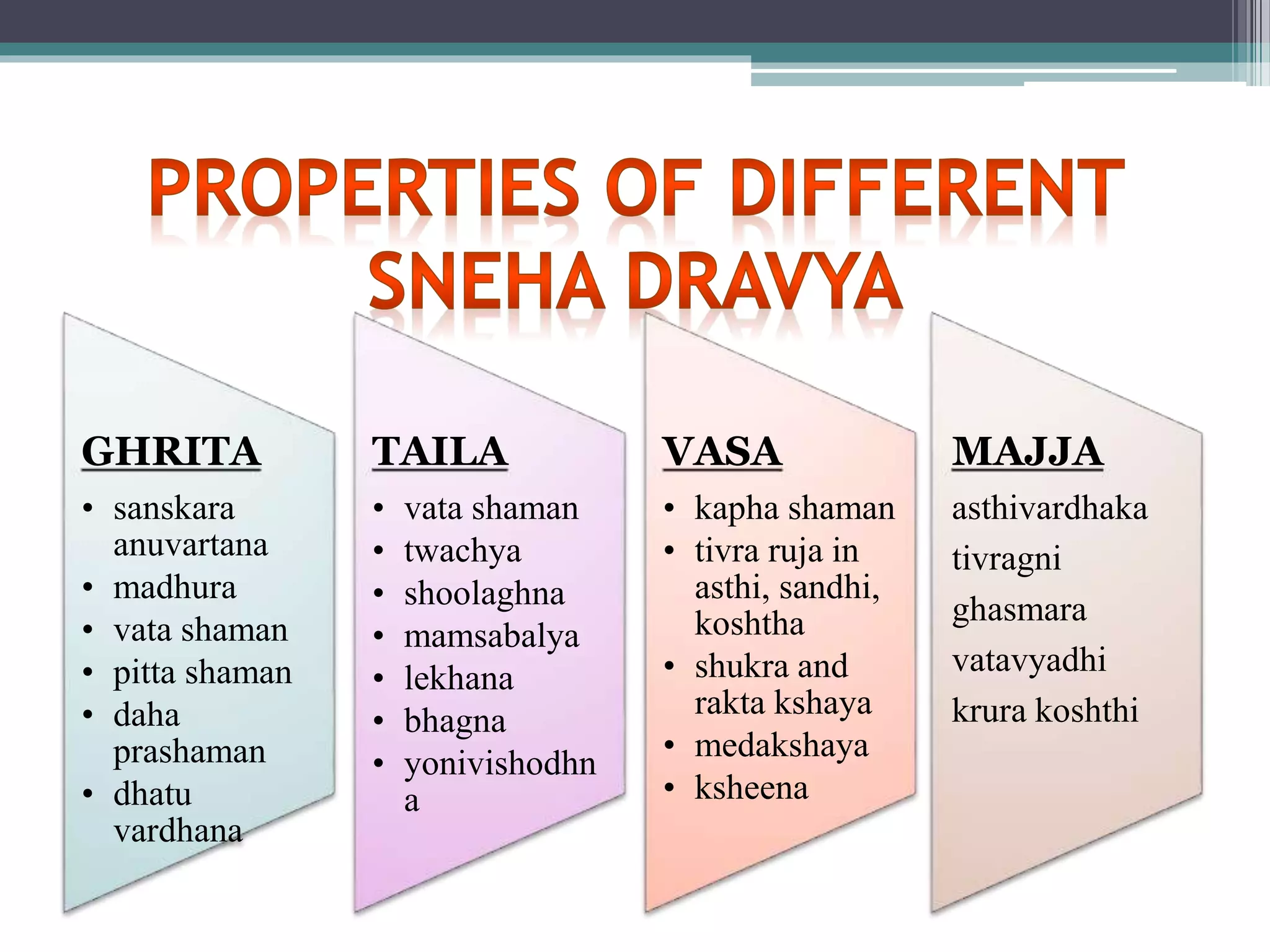
GHRITA TAILA
MAJJA
VASA
GHRITA
• sanskara
anuvartana
• madhura
• vata shaman
• pitta shaman
• daha
prashaman
• dhatu
vardhana
TAILA
• vata shaman
• twachya
• shoolaghna
• mamsabalya
• lekhana
• bhagna
• yonivishodhn
a
VASA
• kapha shaman
• tivra ruja in
asthi, sandhi,
koshtha
• shukra and
rakta kshaya
• medakshaya
• ksheena
MAJJA
asthivardhaka
tivragni
ghasmara
vatavyadhi
krura koshthi
SHODHANA
SNEHA
SHAMANA
SNEHA
BRIMHANA
SNEHA
CRITERIA SHODHANA SHAMANA BRIMHANA
PURPOSE Dosha Utklesha Vyadhi shamana Brimhana
FORM Accha sneha/
Vicharna
Accha sneha Vicharna sneha
DOSE Uttama Madhyam Alpa
TIME Morning Morning Any time with
food
METHOD Akshudhita Kshudhita -
DURATION Maximum 7 days Till vyadhi
shamana
Till samyak
brimhana
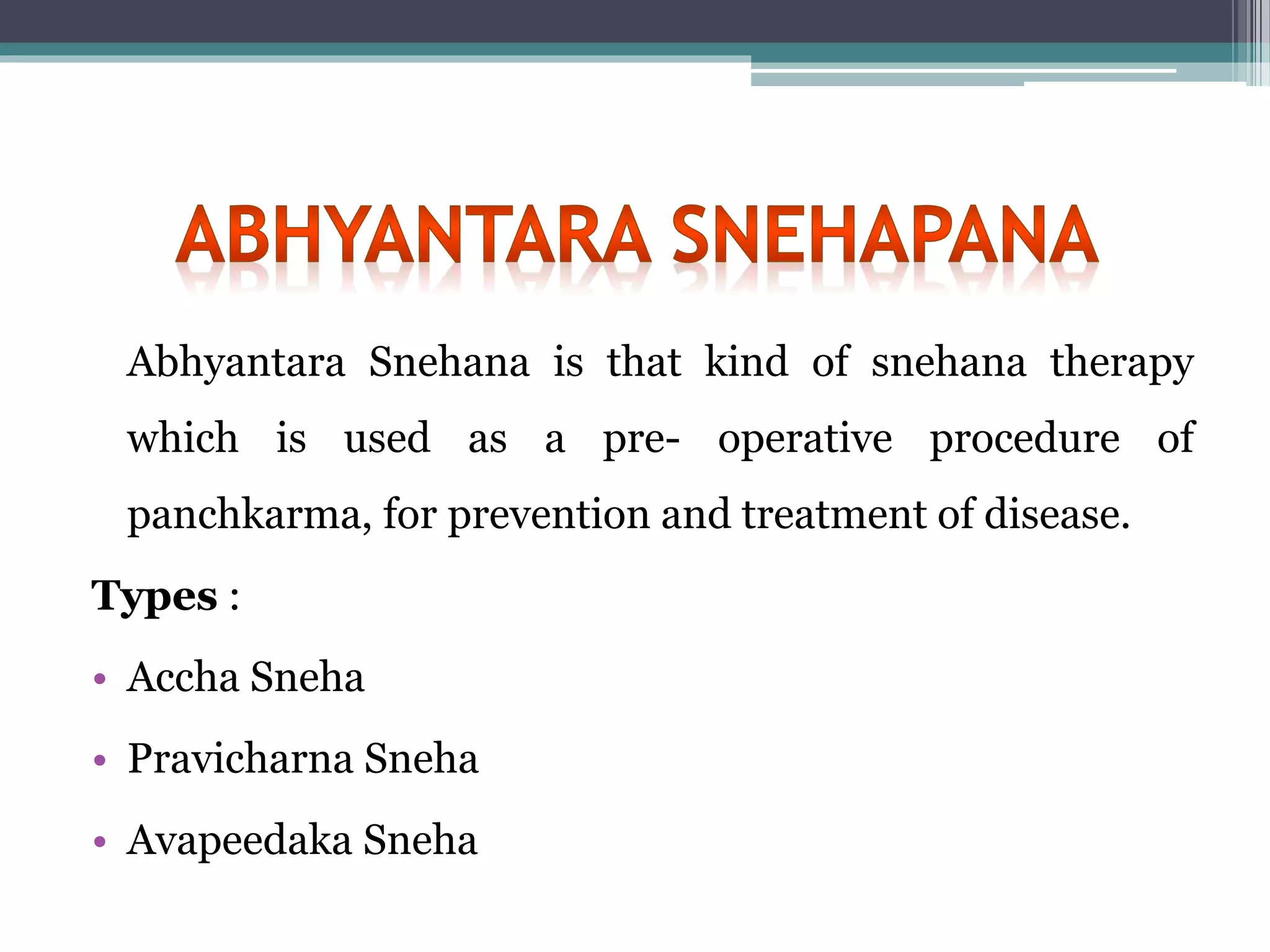
Abhyantara Snehana is that kind of snehana therapy
which is used as a pre- operative procedure of
panchkarma, for prevention and treatment of disease.
Types :
• Accha Sneha
• Pravicharna Sneha
• Avapeedaka Sneha
Intake of only sneha (without mixing with any other
food) in large quantity.
Sneha is taken either in increasing order or fixed dose.
Sneha is taken in morning after digestion of previous
night meal.
अच्छः क
े वलो यः स्नेहो पीयते | (अ.ह्.सू – १६/१६)
Indications Contraindications
• Sneha satmya
• Klesh saha
• Nati sheet and Ushna kala
• Sneha dweshi
• Kshama
• Mridu koshtha
• Nitya Snehi
• Nitya Madya sevi
• Adhva, Prajagar, Stri Shranta
• Sneha Prakarsh Kala – maximum time taken for
snehana procedure .
• minimum 3 days to maximum 7 days (according to
Koshtha and Agnibala of patient).
• Krura Koshtha – 7 days
• Madhyam Koshtha – 4 to 6 days
• Mridu Koshtha – 3 days
(or upto appearance of Samyak Snigdha Lakshana.)
For 3 days For 7 days
1st day - 25 to 30 ml 1st day – 25 to 30 ml (test dose)
2nd day – 50 to 60 ml 2nd day – 50 to 60 ml
3rd day – 75 to 90 ml 3rd day – 75 to 90 ml
4th day – 100 to 120 ml
5th day - 120 to 150 ml
6th day - 140 to 170 ml
7th day - 160 to 200ml
• Sneha Dravya
• Glass
• Warm water
• Napkin
• Saindhav Lavana
• Medicines for sneha vyapad
• Atura Pariksha:
a. To assess the Snehana Yogyata of subject.
b. To assess Dosha.
c. To assess the type and dosage of Snehapana.
d. Dashvidha Pariksha.
Dose Time required
for digestion
Action Indication
Prathama matra 3 hrs. Agnidipti Alpadosha
Dvitiya matra 6 hrs. Vrushya Madhya Dosha
Tritiya matra 9 hrs. Brimhana Bahu Dosha
Chaturtha matra 12 hrs. Snehaniya Glani, murchha,
mada.
Panchama matra 24 hrs. Pujaniya Kushtha, Visha,
Unmada, Graha,
Apsmara.
• Assessment of Koshtha
• Assessment of Agni
• Determined by following questions
 frequency of stool?
 consistency of stool ?
 time of defecation ?
 level of Satisfaction?
 effect of food items and medicines ?
Any GIT pathology ?
• Determined by following questions
 degree of appetite?
 details of food habits?
 Any history of Ajeerna?
Quantity and quality of food?
 timing and interval of food ?
• Complete Blood Count
• Lipid Profile
• LFT
• Sugar levels
• Urine examination
• Stool examination
• ECG (if required)
• The mode of administration of Sneha.
• Observation of Sneha Jiryamana and Jirna
Lakshana.
• Observation of Snigdha, Asnigdha and Ati-
snigdha Lakshana.
• Sneha Vyapad and their Management.
• Decide the Sneha to be administered based on
examination and disease of patient.
• Fix the dose of sneha according to vaya, prakriti, dosha,
and agni.
• Sneha should be administered within 15 – 30 minutes of
sunrise.
• Patient should be seated in comfortable position and
sneha is given in empty stomach.
• Then patient is given anupana according to
sneha.
• Ushnodaka is given as Anupana for most sneha ,
yusha for taila and Manda for Vasa and Majja.
• Observe for Sneha Jiryamana and Jeerna
Lakshana.
• Ask patient to wash face and mouth with hot
water to remove the taste of sneha.
• The dose for next day is decided by assessing the
time taken for digestion of sneha.
Shiroruja
Bhrama
Nishthiva
Murccha
Sada
Klama
Trishna, Daha
Jiryamana
Prashamana
Vatanulomana
Svasthya
Kshudha
Trishna
Udgarashuddhi
Laghuta
िातानुलोम्यं दीप्तोन्नन िचदःन्स्ननधं असंहतं |
माददिं न्स्ननधता चाङ्गे न्स्ननधानां जपयायते ||
(च.सू – १३/५८)
Key factors –
1. Vatanulomana
2. Agnideepti
3. Adhstat sneha darshana
4. Asmahat and snigdha mala
5. Snehodwega
6. Klama
पुकीषं ग्रथितं रूक्षं िायुः अप्रगुणो मृदुः |
पक्ता खकत्िं कौक्ष्यं च गात्रस्य अन्स्ननध लक्षणं ||
(च. सू – १३/५७)
Key factors –
1. Agnimandya
2. Kricchra annapachana
3. Grathit mala
4. Vayu pratiloma
5. Excess Udgara
पाण्डुता गौकिं याड्यं पुकीषस्य अविपक्िता |
तन््ाः अरुथचः जत्क्लेशः स्यात ् अनतन्स्ननधलक्षणं ||
(च.सू -१३/५९)
Key factors –
1. Sharira Gaurav
2. Apakva Mala
3. Aruchi
4. Utklesha
5. Vamana (sometimes)
6. Mala Atipravrutti
7. Bhaktadwesh
Complications Management
Shirah Shula Ushna jala sevana, Rasnadi lepa,
Shunthi dhanyak Pana
Vata pratiloma Hinguvachadi vati, Pippalyasav
Hikka Shunthi dhanyak gutika,
Dhanvantaram gutika
Daha Drakshadi Kashaya, Avipattikara
churna,
Complications Management
Utklesha Ushna Jala sevana, Bilvadi leha,
Dadima rasa
Fatigue Purnachandrodaya rasa, Balarishta,
Draksharishta
Diarrhoea Bilvadi gutika, Mustarishta
Indigestion Hinguvachadi Gutika, Abhayarishta,
Jirakarishta
जष्णोदाोपचाकी स्यात् ब्रह्मचाकी क्षपाशय |
शाृ न्मूत्राननलोद्धगाकान जदीणादश्च न धाकयेत्
व्यायाममुच्चैिदचनं क्रोध शोाौ हहमा तपौ |
ियदत् प्रिातं च सेिेत् शयनासनम ् ||
(च. सू – १३/६२,६३)
• Ask patient to take rest but avoid day sleep.
• Lemon can be given to smell to avoid nausea.
• Warm water is given to drink if thirst occurs.
• Avoid driving, contact with direct air.
• Avoid fan, A.C, coolers.
• Avoid excess work and exertion.
्िोष्णं अनमिष्यन्न्द िोज्यं अन्नं प्रमाणतः |
नानतन्स्ननध असन्ाीणद श्िः स्नेहं पातुममच्छता ||
(च. सू – १३/६०)
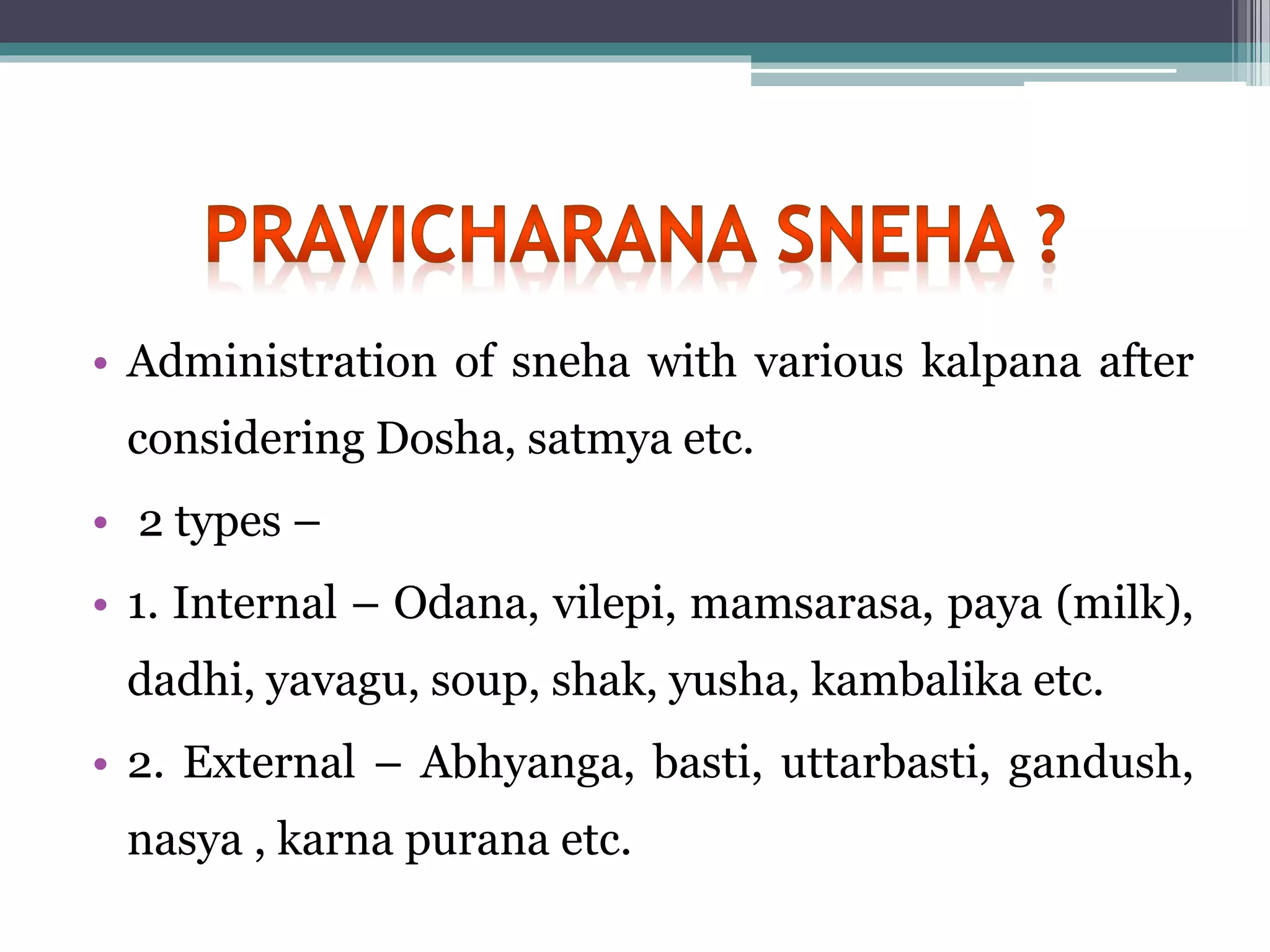
• Administration of sneha with various kalpana after
considering Dosha, satmya etc.
• 2 types –
• 1. Internal – Odana, vilepi, mamsarasa, paya (milk),
dadhi, yavagu, soup, shak, yusha, kambalika etc.
• 2. External – Abhyanga, basti, uttarbasti, gandush,
nasya , karna purana etc.
• Sukumar
• Krisha
• Vriddha
• Shishu
• Sneha dweshi
• Madya Nitya
• Sneha Nitya
• Mridu Koshtha
• Klesha Asaha
• Ushna Kala
• Administration of Sneha to achieve Snehana
instantly or within shorter duration.
• It brings Snigdha lakshana quickly on the day of
snehana itself.
• Lakshana can appear from 1 to 3 days.
• Pippali, Saindhava, ghrita and tila pishta.
• Ghrita, sugar and Cow’s milk – (ruksha person)
• Krishara along with Sneha and phanita.
• Ghrita processed with curd, vyosha, amalki and draksha.
• Sneha with decoction of triphala.
• Intake of yavagu of rice cooked in milk and added with
ghrita.
• The sneha given at the middle of the meal, gets
pidana by food.
• Virddha vagbhata told that Avapidaka sneha
should be given in Yojana dvaya i.e.
अन्नावपीडितं च मध्यभोजनपीतं घृतं भवतत |
(चक्र. च.चच – १५/२०९)
1. Before food (Pragbhakta Sneha) in Hrisva
Matra.
2. After digestion (Jirnantiki Sneha) in Uttama
Matra.
• It is included in Shaman Sneha.
• Vatavyadhi
• Mutravega Dharanjanya roga
• Mutraja Roga
• Arsha
स्नेहोऽननलम् हन्न्त मृदुाकोनत देहं मलानां
विननहन्न्त सङ्गं ||
(च.मस -१/७)
Sneha
Vata shaman
by opposite
guna
Vatanulom
ana
Bring dosha
from shakha
to koshtha
Proper gati
of vata
Snigdha and Mridu Guna of Sneha
Pacifies Rukshta
Sneha Mardavkrit
Assessed by Gatra
Mardavata
Malasang is caused due to rukshata in
koshtha
Snigdha guna overcomes this rukshta
Sneha increases Apyamsa (watery
content) in body
It dissolves the mala and morbid doshas
resulting in Klinata and Utklesha.
• In vataj disorders, ghrita mixed with lavana is given.
• In pittaj disorders, kevala ghrita is given
• In bahu kapha, ghrita should be combined with
trikatu and yavakshara.
• In mandagni and krura koshtha, ghrita is
administered with kshara and lavana.
• Agni and Koshtha should be assessed prior to
administration of sneha.
• Deepana and Pachana should be done to attain
proper snehana.
• Rukshana should be done in mamsala, medura and
bahu kapha, vishamgni and sneha satmya before
snehana.
• Haritaki can be used as rukshana drug.
• In patients with mridu koshtha and avara agni
test dose should be less.
• Investigation of lipid profile before and after
treatment in patients having hyperlipidemia,
CAD, and who are prone to hyperlipidemia.
Abhyantara Snehana (internal oleation)

Abhyantara Snehana (internal oleation)

  • 2.
    • The processwhich produces :  Snehana Vishyandana Mardavam Kleda स्नेहनं स्नेहविष्यन्दमाददिंक्लेदााका ं ||
  • 3.
    स्नेह स्िेदािनभ्यस्य ा ुयादत्संशोधनं तु यः| दारु शुष्ाममिाऽऽनामेशकीकं तस्य दीयदते || (अ.ह.सू – १८/५९) िृद्ध्या विष्यन्दनात्पााात् स्रोतो मुख विशोधनात् | शाखान्मुक्तिा मलाः ाोष्ठं यान्न्त िायोश्च ननग्रहात् || (च.सू – २८/४७)
  • 4.
    • Abhyanga • Shirodhara •Kayaseka • Shirobasti Bahya • Snehapana • Basti • Nasya • Bhojana Abhyantara
  • 5.
    PASCHATKARMA Ahara Vihar Shodhana(if required) PRADHANA KARMA Accha Sneha pana PURVAKARMA Deepana Pachana
  • 6.
     Agnivardhana  Removessrotorodha  Helps in better absorption of snehana and dravya.  Reduces the risk of complication
  • 7.
    Vata • Panchkola Phanta •Shunthi churna • Ajmodadi Churna Pitta • Shunthi Churna • Jeerak Churna • Chitrakadi vati Kapha • Trikatu Churna • Agnitundi Vati
  • 8.
  • 9.
  • 10.
  • 11.
    GHRITA • sanskara anuvartana • madhura •vata shaman • pitta shaman • daha prashaman • dhatu vardhana TAILA • vata shaman • twachya • shoolaghna • mamsabalya • lekhana • bhagna • yonivishodhn a VASA • kapha shaman • tivra ruja in asthi, sandhi, koshtha • shukra and rakta kshaya • medakshaya • ksheena MAJJA asthivardhaka tivragni ghasmara vatavyadhi krura koshthi
  • 12.
  • 13.
    CRITERIA SHODHANA SHAMANABRIMHANA PURPOSE Dosha Utklesha Vyadhi shamana Brimhana FORM Accha sneha/ Vicharna Accha sneha Vicharna sneha DOSE Uttama Madhyam Alpa TIME Morning Morning Any time with food METHOD Akshudhita Kshudhita - DURATION Maximum 7 days Till vyadhi shamana Till samyak brimhana
  • 14.
    Abhyantara Snehana isthat kind of snehana therapy which is used as a pre- operative procedure of panchkarma, for prevention and treatment of disease. Types : • Accha Sneha • Pravicharna Sneha • Avapeedaka Sneha
  • 15.
    Intake of onlysneha (without mixing with any other food) in large quantity. Sneha is taken either in increasing order or fixed dose. Sneha is taken in morning after digestion of previous night meal. अच्छः क े वलो यः स्नेहो पीयते | (अ.ह्.सू – १६/१६)
  • 16.
    Indications Contraindications • Snehasatmya • Klesh saha • Nati sheet and Ushna kala • Sneha dweshi • Kshama • Mridu koshtha • Nitya Snehi • Nitya Madya sevi • Adhva, Prajagar, Stri Shranta
  • 17.
    • Sneha PrakarshKala – maximum time taken for snehana procedure . • minimum 3 days to maximum 7 days (according to Koshtha and Agnibala of patient). • Krura Koshtha – 7 days • Madhyam Koshtha – 4 to 6 days • Mridu Koshtha – 3 days (or upto appearance of Samyak Snigdha Lakshana.)
  • 18.
    For 3 daysFor 7 days 1st day - 25 to 30 ml 1st day – 25 to 30 ml (test dose) 2nd day – 50 to 60 ml 2nd day – 50 to 60 ml 3rd day – 75 to 90 ml 3rd day – 75 to 90 ml 4th day – 100 to 120 ml 5th day - 120 to 150 ml 6th day - 140 to 170 ml 7th day - 160 to 200ml
  • 19.
    • Sneha Dravya •Glass • Warm water • Napkin • Saindhav Lavana • Medicines for sneha vyapad
  • 20.
    • Atura Pariksha: a.To assess the Snehana Yogyata of subject. b. To assess Dosha. c. To assess the type and dosage of Snehapana. d. Dashvidha Pariksha.
  • 21.
    Dose Time required fordigestion Action Indication Prathama matra 3 hrs. Agnidipti Alpadosha Dvitiya matra 6 hrs. Vrushya Madhya Dosha Tritiya matra 9 hrs. Brimhana Bahu Dosha Chaturtha matra 12 hrs. Snehaniya Glani, murchha, mada. Panchama matra 24 hrs. Pujaniya Kushtha, Visha, Unmada, Graha, Apsmara.
  • 22.
    • Assessment ofKoshtha • Assessment of Agni
  • 23.
    • Determined byfollowing questions  frequency of stool?  consistency of stool ?  time of defecation ?  level of Satisfaction?  effect of food items and medicines ? Any GIT pathology ?
  • 24.
    • Determined byfollowing questions  degree of appetite?  details of food habits?  Any history of Ajeerna? Quantity and quality of food?  timing and interval of food ?
  • 25.
    • Complete BloodCount • Lipid Profile • LFT • Sugar levels • Urine examination • Stool examination • ECG (if required)
  • 26.
    • The modeof administration of Sneha. • Observation of Sneha Jiryamana and Jirna Lakshana. • Observation of Snigdha, Asnigdha and Ati- snigdha Lakshana. • Sneha Vyapad and their Management.
  • 27.
    • Decide theSneha to be administered based on examination and disease of patient. • Fix the dose of sneha according to vaya, prakriti, dosha, and agni. • Sneha should be administered within 15 – 30 minutes of sunrise. • Patient should be seated in comfortable position and sneha is given in empty stomach.
  • 28.
    • Then patientis given anupana according to sneha. • Ushnodaka is given as Anupana for most sneha , yusha for taila and Manda for Vasa and Majja. • Observe for Sneha Jiryamana and Jeerna Lakshana.
  • 29.
    • Ask patientto wash face and mouth with hot water to remove the taste of sneha. • The dose for next day is decided by assessing the time taken for digestion of sneha.
  • 30.
  • 31.
    िातानुलोम्यं दीप्तोन्नन िचदःन्स्ननधंअसंहतं | माददिं न्स्ननधता चाङ्गे न्स्ननधानां जपयायते || (च.सू – १३/५८)
  • 32.
    Key factors – 1.Vatanulomana 2. Agnideepti 3. Adhstat sneha darshana 4. Asmahat and snigdha mala 5. Snehodwega 6. Klama
  • 33.
    पुकीषं ग्रथितं रूक्षंिायुः अप्रगुणो मृदुः | पक्ता खकत्िं कौक्ष्यं च गात्रस्य अन्स्ननध लक्षणं || (च. सू – १३/५७)
  • 34.
    Key factors – 1.Agnimandya 2. Kricchra annapachana 3. Grathit mala 4. Vayu pratiloma 5. Excess Udgara
  • 35.
    पाण्डुता गौकिं याड्यंपुकीषस्य अविपक्िता | तन््ाः अरुथचः जत्क्लेशः स्यात ् अनतन्स्ननधलक्षणं || (च.सू -१३/५९)
  • 36.
    Key factors – 1.Sharira Gaurav 2. Apakva Mala 3. Aruchi 4. Utklesha 5. Vamana (sometimes) 6. Mala Atipravrutti 7. Bhaktadwesh
  • 37.
    Complications Management Shirah ShulaUshna jala sevana, Rasnadi lepa, Shunthi dhanyak Pana Vata pratiloma Hinguvachadi vati, Pippalyasav Hikka Shunthi dhanyak gutika, Dhanvantaram gutika Daha Drakshadi Kashaya, Avipattikara churna,
  • 38.
    Complications Management Utklesha UshnaJala sevana, Bilvadi leha, Dadima rasa Fatigue Purnachandrodaya rasa, Balarishta, Draksharishta Diarrhoea Bilvadi gutika, Mustarishta Indigestion Hinguvachadi Gutika, Abhayarishta, Jirakarishta
  • 39.
    जष्णोदाोपचाकी स्यात् ब्रह्मचाकीक्षपाशय | शाृ न्मूत्राननलोद्धगाकान जदीणादश्च न धाकयेत् व्यायाममुच्चैिदचनं क्रोध शोाौ हहमा तपौ | ियदत् प्रिातं च सेिेत् शयनासनम ् || (च. सू – १३/६२,६३)
  • 40.
    • Ask patientto take rest but avoid day sleep. • Lemon can be given to smell to avoid nausea. • Warm water is given to drink if thirst occurs. • Avoid driving, contact with direct air. • Avoid fan, A.C, coolers. • Avoid excess work and exertion.
  • 41.
    ्िोष्णं अनमिष्यन्न्द िोज्यंअन्नं प्रमाणतः | नानतन्स्ननध असन्ाीणद श्िः स्नेहं पातुममच्छता || (च. सू – १३/६०)
  • 42.
    • Administration ofsneha with various kalpana after considering Dosha, satmya etc. • 2 types – • 1. Internal – Odana, vilepi, mamsarasa, paya (milk), dadhi, yavagu, soup, shak, yusha, kambalika etc. • 2. External – Abhyanga, basti, uttarbasti, gandush, nasya , karna purana etc.
  • 43.
    • Sukumar • Krisha •Vriddha • Shishu • Sneha dweshi • Madya Nitya • Sneha Nitya • Mridu Koshtha • Klesha Asaha • Ushna Kala
  • 44.
    • Administration ofSneha to achieve Snehana instantly or within shorter duration. • It brings Snigdha lakshana quickly on the day of snehana itself. • Lakshana can appear from 1 to 3 days.
  • 45.
    • Pippali, Saindhava,ghrita and tila pishta. • Ghrita, sugar and Cow’s milk – (ruksha person) • Krishara along with Sneha and phanita. • Ghrita processed with curd, vyosha, amalki and draksha. • Sneha with decoction of triphala. • Intake of yavagu of rice cooked in milk and added with ghrita.
  • 46.
    • The snehagiven at the middle of the meal, gets pidana by food. • Virddha vagbhata told that Avapidaka sneha should be given in Yojana dvaya i.e. अन्नावपीडितं च मध्यभोजनपीतं घृतं भवतत | (चक्र. च.चच – १५/२०९)
  • 47.
    1. Before food(Pragbhakta Sneha) in Hrisva Matra. 2. After digestion (Jirnantiki Sneha) in Uttama Matra. • It is included in Shaman Sneha.
  • 48.
    • Vatavyadhi • MutravegaDharanjanya roga • Mutraja Roga • Arsha
  • 49.
    स्नेहोऽननलम् हन्न्त मृदुाकोनतदेहं मलानां विननहन्न्त सङ्गं || (च.मस -१/७)
  • 50.
    Sneha Vata shaman by opposite guna Vatanulom ana Bringdosha from shakha to koshtha Proper gati of vata
  • 51.
    Snigdha and MriduGuna of Sneha Pacifies Rukshta Sneha Mardavkrit Assessed by Gatra Mardavata
  • 52.
    Malasang is causeddue to rukshata in koshtha Snigdha guna overcomes this rukshta Sneha increases Apyamsa (watery content) in body It dissolves the mala and morbid doshas resulting in Klinata and Utklesha.
  • 53.
    • In vatajdisorders, ghrita mixed with lavana is given. • In pittaj disorders, kevala ghrita is given • In bahu kapha, ghrita should be combined with trikatu and yavakshara. • In mandagni and krura koshtha, ghrita is administered with kshara and lavana.
  • 54.
    • Agni andKoshtha should be assessed prior to administration of sneha. • Deepana and Pachana should be done to attain proper snehana. • Rukshana should be done in mamsala, medura and bahu kapha, vishamgni and sneha satmya before snehana. • Haritaki can be used as rukshana drug.
  • 55.
    • In patientswith mridu koshtha and avara agni test dose should be less. • Investigation of lipid profile before and after treatment in patients having hyperlipidemia, CAD, and who are prone to hyperlipidemia.