

Digital educational game: pedagogical design and developmentPaula Hodgson, HKUDonald Man, Showcase R & DAgnes Fong, PolyU1
Learning containsEnjoymentEngagementMotivation2
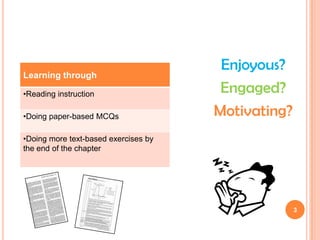
Enjoyous?Engaged?Motivating?3
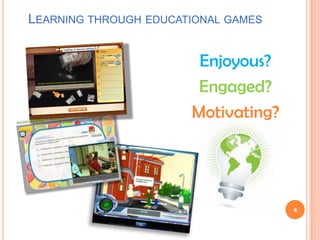
Learning through educational gamesEnjoyous?Engaged?Motivating?4
Educational design Digital game-based learning can be designed through a combination of actions, including experimentation, reflection, competitive or cooperative activity, and discussion (Gros 2007).5
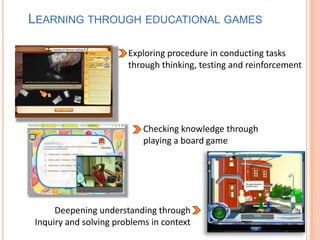
Learning through educational gamesExploring procedure in conducting tasks through thinking, testing and reinforcementChecking knowledge through playing a board gameDeepening understanding through Inquiry and solving problems in context 6
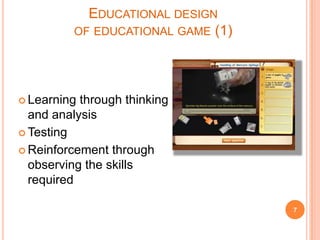
Educational design of educational game (1)Learning through thinking and analysisTestingReinforcement through observing the skills required 7
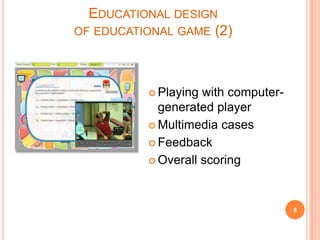
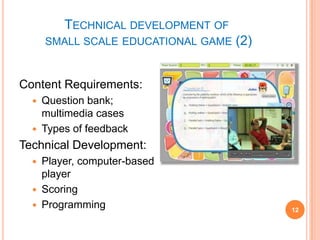
Playing with computer-generated playerMultimedia casesFeedbackOverall scoring8Educational design of educational game (2)
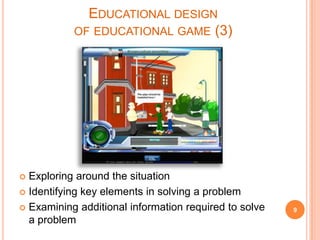
Exploring around the situationIdentifying key elements in solving a problemExamining additional information required to solve a problem9Educational design of educational game (3)
Value of educational gamesProviding learning opportunities for students developing higher-order thinking skills, such as strategic thinking, interpretative analysis, problem solving, plan formulation and execution, and adaptation to rapid change (FAS 2007).10
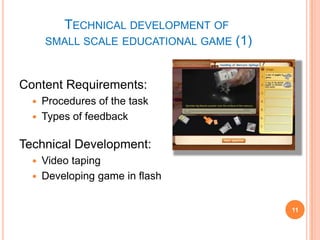
Technical development of  small scale educational game (1)Content Requirements:Procedures of the taskTypes of feedbackTechnical Development:Video tapingDeveloping game in flash11
Technical development of  small scale educational game (2)Content Requirements:Question bank; multimedia casesTypes of feedbackTechnical Development:Player, computer-based playerScoringProgramming12
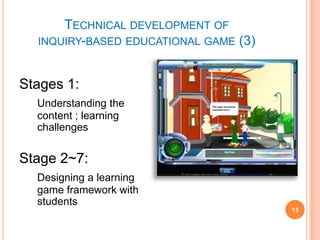
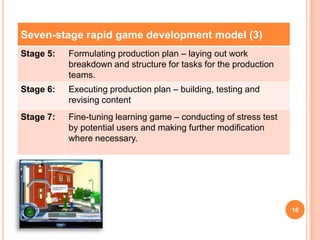
Technical development ofinquiry-based educational game (3)Stages 1:Understanding the content ; learning challengesStage 2~7:Designing a learning game framework with students13
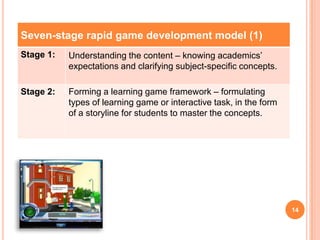
14
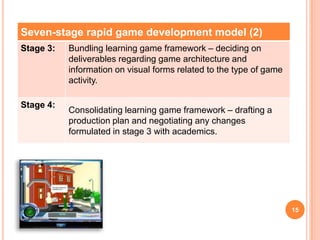
15
16
AcknowledgementDr Josephine Csete (eLDSS) Educational Development Centre, The Hong Kong Polytechnic UniversityKitty Chan, School of Nursing, The Hong Kong Polytechnic UniversitySo, Kit Ying, School of Nursing, The Hong Kong Polytechnic UniversityKen Cheung, Applied Biology and Chemical Technology, The Hong Kong Polytechnic University17
Referencesde Freitas, S. and Oliver, M. (2006). How can exploratory learning with games and simulations within the curriculum be most effectively evaluated? Computers & Education, 46(3), 249–64.Federation of American Scientists Report (FAS) (2006). Summit on educational games 2006: Harnessing the power of video games for learning.   Retrieved 18 December, 2009, from http://www.fas.org/gamesummit/Resources/Summit%20on%20Educational%20Games.pdfGros, B. (2007). Digital games in education: The design of games-based learning environments. Journal of Research on Technology in Education, 40(1), 23.Hodgson, P. and Lam, P. (2004) ‘Quality management of a joint-university e-learning project: e3Learning. Global Education, July 2004: http://www.globaled.com/articles/PaulaHodgeson2004.pdfHodgson, P., Lam, P. and Wong, Y.-H.E. (2007) Dovetailing pedagogical and technical support with evaluation, International Journal on E-Learning, AACE, 6(3), 363–78.Hodgson, P. Man, D. and Leung, J. (2010) Managing the development of digital educational games. To be presented in the IEEE 3rd International Conference on Digital Game and Intelligent Toy Enhanced Learning, Kaohsiung, Taiwan. 12–16, April. Resnick, M. (2004). Edutainment? No thanks. I prefer playful learning. Associazione Civita Report on Edutainment, 1–4.18
THANK YOU!19

Digital educational game: pedagogical design and development

  • 1.
    Digital educational game:pedagogical design and developmentPaula Hodgson, HKUDonald Man, Showcase R & DAgnes Fong, PolyU1
  • 2.
  • 3.
  • 4.
    Learning through educationalgamesEnjoyous?Engaged?Motivating?4
  • 5.
    Educational design Digitalgame-based learning can be designed through a combination of actions, including experimentation, reflection, competitive or cooperative activity, and discussion (Gros 2007).5
  • 6.
    Learning through educationalgamesExploring procedure in conducting tasks through thinking, testing and reinforcementChecking knowledge through playing a board gameDeepening understanding through Inquiry and solving problems in context 6
  • 7.
    Educational design ofeducational game (1)Learning through thinking and analysisTestingReinforcement through observing the skills required 7
  • 8.
    Playing with computer-generatedplayerMultimedia casesFeedbackOverall scoring8Educational design of educational game (2)
  • 9.
    Exploring around thesituationIdentifying key elements in solving a problemExamining additional information required to solve a problem9Educational design of educational game (3)
  • 10.
    Value of educationalgamesProviding learning opportunities for students developing higher-order thinking skills, such as strategic thinking, interpretative analysis, problem solving, plan formulation and execution, and adaptation to rapid change (FAS 2007).10
  • 11.
    Technical development of small scale educational game (1)Content Requirements:Procedures of the taskTypes of feedbackTechnical Development:Video tapingDeveloping game in flash11
  • 12.
    Technical development of small scale educational game (2)Content Requirements:Question bank; multimedia casesTypes of feedbackTechnical Development:Player, computer-based playerScoringProgramming12
  • 13.
    Technical development ofinquiry-basededucational game (3)Stages 1:Understanding the content ; learning challengesStage 2~7:Designing a learning game framework with students13
  • 14.
  • 15.
  • 16.
  • 17.
    AcknowledgementDr Josephine Csete(eLDSS) Educational Development Centre, The Hong Kong Polytechnic UniversityKitty Chan, School of Nursing, The Hong Kong Polytechnic UniversitySo, Kit Ying, School of Nursing, The Hong Kong Polytechnic UniversityKen Cheung, Applied Biology and Chemical Technology, The Hong Kong Polytechnic University17
  • 18.
    Referencesde Freitas, S.and Oliver, M. (2006). How can exploratory learning with games and simulations within the curriculum be most effectively evaluated? Computers & Education, 46(3), 249–64.Federation of American Scientists Report (FAS) (2006). Summit on educational games 2006: Harnessing the power of video games for learning. Retrieved 18 December, 2009, from http://www.fas.org/gamesummit/Resources/Summit%20on%20Educational%20Games.pdfGros, B. (2007). Digital games in education: The design of games-based learning environments. Journal of Research on Technology in Education, 40(1), 23.Hodgson, P. and Lam, P. (2004) ‘Quality management of a joint-university e-learning project: e3Learning. Global Education, July 2004: http://www.globaled.com/articles/PaulaHodgeson2004.pdfHodgson, P., Lam, P. and Wong, Y.-H.E. (2007) Dovetailing pedagogical and technical support with evaluation, International Journal on E-Learning, AACE, 6(3), 363–78.Hodgson, P. Man, D. and Leung, J. (2010) Managing the development of digital educational games. To be presented in the IEEE 3rd International Conference on Digital Game and Intelligent Toy Enhanced Learning, Kaohsiung, Taiwan. 12–16, April. Resnick, M. (2004). Edutainment? No thanks. I prefer playful learning. Associazione Civita Report on Edutainment, 1–4.18
  • 19.