Epistemologically Authentic Inquiry in Schools:
A Theoretical Framework for Evaluating Inquiry Tasks
Muhammad Husnul Khuluq
F131877
Article by:
Clark A. Chinn and Betina A. Malhotra
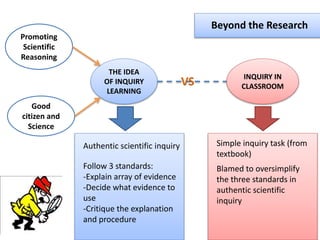
Beyond the Research
Promoting
Scientific
Reasoning
THE IDEA
OF INQUIRY
LEARNING
Good
citizen and
Science
INQUIRY IN
CLASSROOMVS
Authentic scientific inquiry
Follow 3 standards:
-Explain array of evidence
-Decide what evidence to
use
-Critique the explanation
and procedure
Simple inquiry task (from
textbook)
Blamed to oversimplify
the three standards in
authentic scientific
inquiry
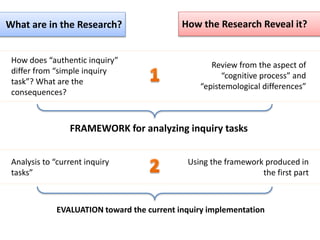
What are in the Research? How the Research Reveal it?
How does “authentic inquiry”
differ from “simple inquiry
task”? What are the
consequences?
Review from the aspect of
“cognitive process” and
“epistemological differences”
Analysis to “current inquiry
tasks”
Using the framework produced in
the first part
FRAMEWORK for analyzing inquiry tasks
EVALUATION toward the current inquiry implementation
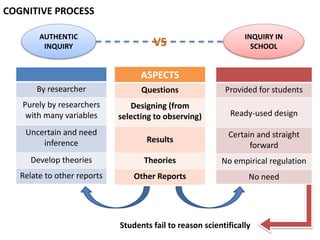
AUTHENTIC
INQUIRY
INQUIRY IN
SCHOOLVS
COGNITIVE PROCESS
ASPECTS
Questions
Designing (from
selecting to observing)
Results
Theories
Other Reports
Provided for students
Ready-used design
Certain and straight
forward
No empirical regulation
No need
By researcher
Purely by researchers
with many variables
Uncertain and need
inference
Develop theories
Relate to other reports
Students fail to reason scientifically
AUTHENTIC
INQUIRY
INQUIRY IN
SCHOOLVS
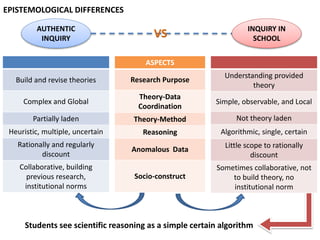
EPISTEMOLOGICAL DIFFERENCES
Students see scientific reasoning as a simple certain algorithm
ASPECTS
Research Purpose
Theory-Data
Coordination
Theory-Method
Reasoning
Anomalous Data
Socio-construct
Build and revise theories
Complex and Global
Partially laden
Heuristic, multiple, uncertain
Rationally and regularly
discount
Collaborative, building
previous research,
institutional norms
Understanding provided
theory
Simple, observable, and Local
Not theory laden
Algorithmic, single, certain
Little scope to rationally
discount
Sometimes collaborative, not
to build theory, no
institutional norm
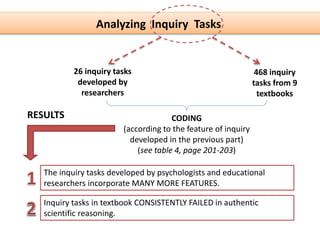
Analyzing Inquiry Tasks
468 inquiry
tasks from 9
textbooks
26 inquiry tasks
developed by
researchers
CODING
(according to the feature of inquiry
developed in the previous part)
(see table 4, page 201-203)
RESULTS
The inquiry tasks developed by psychologists and educational
researchers incorporate MANY MORE FEATURES.
Inquiry tasks in textbook CONSISTENTLY FAILED in authentic
scientific reasoning.
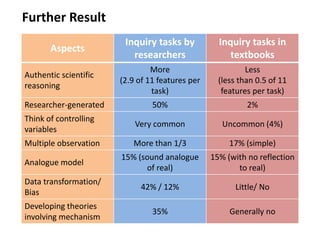
Further Result
Aspects
Inquiry tasks by
researchers
Inquiry tasks in
textbooks
Authentic scientific
reasoning
More
(2.9 of 11 features per
task)
Less
(less than 0.5 of 11
features per task)
Researcher-generated 50% 2%
Think of controlling
variables
Very common Uncommon (4%)
Multiple observation More than 1/3 17% (simple)
Analogue model
15% (sound analogue
of real)
15% (with no reflection
to real)
Data transformation/
Bias
42% / 12% Little/ No
Developing theories
involving mechanism
35% Generally no
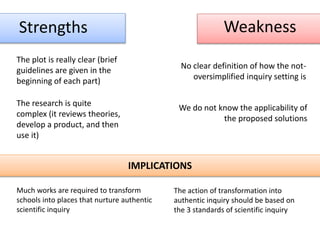
Strengths Weakness
The plot is really clear (brief
guidelines are given in the
beginning of each part)
The research is quite
complex (it reviews theories,
develop a product, and then
use it)
We do not know the applicability of
the proposed solutions
No clear definition of how the not-
oversimplified inquiry setting is
IMPLICATIONS
Much works are required to transform
schools into places that nurture authentic
scientific inquiry
The action of transformation into
authentic inquiry should be based on
the 3 standards of scientific inquiry
“Education begins with the curiosity of the learner”
(John Dewey)
Thank you for your
attention

Authentic Inquiry VS Simple Task Inquiry

  • 1.
    Epistemologically Authentic Inquiryin Schools: A Theoretical Framework for Evaluating Inquiry Tasks Muhammad Husnul Khuluq F131877 Article by: Clark A. Chinn and Betina A. Malhotra
  • 2.
    Beyond the Research Promoting Scientific Reasoning THEIDEA OF INQUIRY LEARNING Good citizen and Science INQUIRY IN CLASSROOMVS Authentic scientific inquiry Follow 3 standards: -Explain array of evidence -Decide what evidence to use -Critique the explanation and procedure Simple inquiry task (from textbook) Blamed to oversimplify the three standards in authentic scientific inquiry
  • 3.
    What are inthe Research? How the Research Reveal it? How does “authentic inquiry” differ from “simple inquiry task”? What are the consequences? Review from the aspect of “cognitive process” and “epistemological differences” Analysis to “current inquiry tasks” Using the framework produced in the first part FRAMEWORK for analyzing inquiry tasks EVALUATION toward the current inquiry implementation
  • 4.
    AUTHENTIC INQUIRY INQUIRY IN SCHOOLVS COGNITIVE PROCESS ASPECTS Questions Designing(from selecting to observing) Results Theories Other Reports Provided for students Ready-used design Certain and straight forward No empirical regulation No need By researcher Purely by researchers with many variables Uncertain and need inference Develop theories Relate to other reports Students fail to reason scientifically
  • 5.
    AUTHENTIC INQUIRY INQUIRY IN SCHOOLVS EPISTEMOLOGICAL DIFFERENCES Studentssee scientific reasoning as a simple certain algorithm ASPECTS Research Purpose Theory-Data Coordination Theory-Method Reasoning Anomalous Data Socio-construct Build and revise theories Complex and Global Partially laden Heuristic, multiple, uncertain Rationally and regularly discount Collaborative, building previous research, institutional norms Understanding provided theory Simple, observable, and Local Not theory laden Algorithmic, single, certain Little scope to rationally discount Sometimes collaborative, not to build theory, no institutional norm
  • 6.
    Analyzing Inquiry Tasks 468inquiry tasks from 9 textbooks 26 inquiry tasks developed by researchers CODING (according to the feature of inquiry developed in the previous part) (see table 4, page 201-203) RESULTS The inquiry tasks developed by psychologists and educational researchers incorporate MANY MORE FEATURES. Inquiry tasks in textbook CONSISTENTLY FAILED in authentic scientific reasoning.
  • 7.
    Further Result Aspects Inquiry tasksby researchers Inquiry tasks in textbooks Authentic scientific reasoning More (2.9 of 11 features per task) Less (less than 0.5 of 11 features per task) Researcher-generated 50% 2% Think of controlling variables Very common Uncommon (4%) Multiple observation More than 1/3 17% (simple) Analogue model 15% (sound analogue of real) 15% (with no reflection to real) Data transformation/ Bias 42% / 12% Little/ No Developing theories involving mechanism 35% Generally no
  • 8.
    Strengths Weakness The plotis really clear (brief guidelines are given in the beginning of each part) The research is quite complex (it reviews theories, develop a product, and then use it) We do not know the applicability of the proposed solutions No clear definition of how the not- oversimplified inquiry setting is IMPLICATIONS Much works are required to transform schools into places that nurture authentic scientific inquiry The action of transformation into authentic inquiry should be based on the 3 standards of scientific inquiry
  • 9.
    “Education begins withthe curiosity of the learner” (John Dewey) Thank you for your attention