EVALUATION DESIGN
The ABCD Model
Laarni A. Caorong
The ABCD model
• Background
• Features
• Definition
• Characteristics
• The ABCD component
• The ABCD Framework
• Sample Research study
• Analysis of the sample study
Dr. Jesus Ochave
Background
developed by Dr. Jesus Ochave in 1994
the model is comparable with classical models of evaluation like
those of Stufflebeam’s CIPP model and Provus discrepancy model.
comprehensive enough to allow the evaluator to assess aspects of
the program which bears the effectiveness.
Background
Flexible and allows the evaluator to trace the causal
factors that explain program effects without going
through a mass of other data.
It is a stakeholder-friendly evaluation model.
Is used in evaluating project, training or a curricular
program.
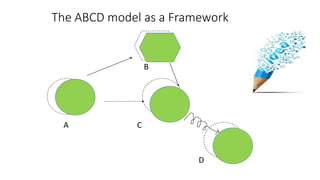
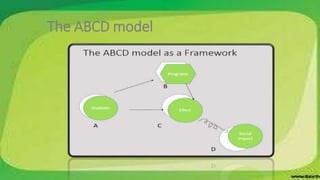
The ABCD model as a Framework
B
A C
D
The ABCD Framework Explanation
Solid and broken line as vectors
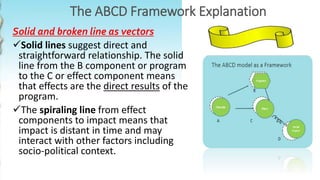
Solid lines suggest direct and
straightforward relationship. The solid
line from the B component or program
to the C or effect component means
that effects are the direct results of the
program.
The spiraling line from effect
components to impact means that
impact is distant in time and may
interact with other factors including
socio-political context.
The ABCD Framework Explanation
Solid and broken line as vectors
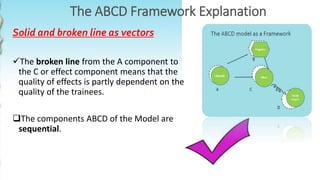
The broken line from the A component to
the C or effect component means that the
quality of effects is partly dependent on the
quality of the trainees.
The components ABCD of the Model are
sequential.
The ABCD Model Application
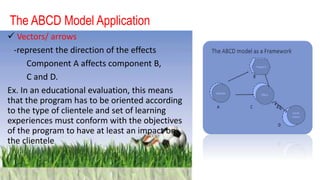
 Vectors/ arrows
-represent the direction of the effects
Component A affects component B,
C and D.
Ex. In an educational evaluation, this means
that the program has to be oriented according
to the type of clientele and set of learning
experiences must conform with the objectives
of the program to have at least an impact on
the clientele
,
.
.
The Dimensions of Program
“Intents” and “Actualities”
ACTUALITIES
are the observations and actual happenings
INTENTS
are the standards, expectations, ought-to-be’s, and in its simplest form,
plans;
can also mean purposes or objectives in the context of the model;
Aim and objectives
The Discrepancy between the Dimensions of Intents
and Actualities
The interfacing of the geometric shapes.
 A perfect fit is total interfacing, which means that
actualities of the program are totally consistent with
the intents of the said program.
 If there is no discrepancy between the two
dimensions, then intents and actualities are said
to be totally consistent since there is absolute
interfacing of dimensions. This is an impossibility
in the real world.
The Discrepancy between the Dimensions of Intents and
Actualities
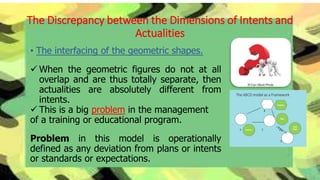
• The interfacing of the geometric shapes.
 When the geometric figures do not at all
overlap and are thus totally separate, then
actualities are absolutely different from
intents.
 This is a big problem in the management
of a training or educational program.
Problem in this model is operationally
defined as any deviation from plans or intents
or standards or expectations.
Role of the Management or Organization
 Lessening the discrepancy is the job
of the team, management or
organization.
 The team of stakeholder-evaluators
must, as its primary task, determine
the consistency and the discrepancy
between the “intents” and
“actualities” dimensions.
Solution for Discrepancy
 Monitoring and Evaluation
is necessary so that problems can be
identified as it can cause negative effects and
become barrier to the realization of targets and
objectives.
When Evaluating….
The task of the stakeholder- evaluators include the
following:
1. Discussions and consensus on what data to gather.
2. Development of data-gathering tool for data on actualities.
3. Division of labor among team members.
4. Review, critique and team approval of tools and timetable.
5. Collection, analyses and interpretation of data.
6. Writing of evaluation report.
7. Intra-team presentation of report
8. Cleaning the report, submission and presentation to a greater
number of stakeholders and the target audiences.
Utilization of the ABCD Model in
Education
Area of Evaluation: Curricular Program
Components:
A: includes the students (beneficiaries of the program)
B: the program (ex. New BSN curriculum)
C: effects of the program (learnings of the students)
-indicators: board exam result, employment,
D: social impact
 Impact may include economic, political and socio-cultural transformations
in the community traceable to the program.
 Generally, it includes contributions of students/people to social welfare
and community betterment.
The ABCD model
.
.
Botika ng Barangay (BnB)
The BnB refers to a drug outlet wherein primary, nonprescription, and
generic drugs are sold or made available.
Its objective is to promote equity in health by ensuring the availability
and accessibility of affordable, safe, quality and essential drugs to all,
especially to the marginalized, underserved, hard to reach areas of the
country.
Strategies by the BnB are: partnership building with LGUs, community
organizations, non-government organizations (NGOs) and the
communities; promotion, advocacy and marketing; provision of seed
capital; accreditation of NGO as PDN; and issuance of BnB Special License
to Operate.
Objectives of
the study
 Assess the contribution of BnB to living
standards to living standards in terms of
health, expenditures, savings
 determine the level of acceptance & the
extent of utilization of products this
 determine whether the BnB program has
realized the poverty alleviation thrust of the
government.
Analysis
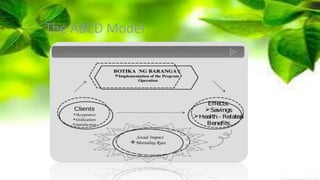
Community Drugstore (Botika ng Barangay): Its
Contribution to Family Living Standards
Components:
A- Filipino people/community people
B- Botika ng Barangay (BnB)
C- Savings and health related benefits for the community people
D- Reduction of infant mortality rate
Process of carrying out the Evaluation
Quantitative research
The descriptive design was utilized to determine the contributions of
the BnB on the improvement of family living standards which was
measured through health-related expenditures, savings, mean age at
death, mean infant mortality rate and mean infant mortality rate.
 The multi-stage purposive sampling was applied to select the research
locales from the municipalities to the selection of respondents BnBs.
Instrument: A researcher-made questionnaire was used which was pilot
tested prior to its actual use. The following variables were considered:
Personal Information, Level of Acceptance of the BnB Services, Extent
of Utilization of the BnB Services, Level of Satisfaction, Health-related
Expenditures, Savings and Problems encountered.
The ABCD Model
.
End.
.
References:
Ochave, J. (2003). Towards the Development of a Blueprint for a Stakeholder-Friendly
Evaluation Model for Training and Education Programmes. Journal of Southeast
Asian Education. Vol. 4, No. 2, pp. 25-44.
Palompon, D., Amparado, M., Cempron, J., Corvera, E., Ong, M. (2010). Community
Drugstore (Botika ng Barangay): Its Contribution to Family Living Standards. Liceo
Journal of Higher Education Research. Vol. 6 No. 2 December 2010 ISSN: 2094-
1064

ABCD Evaluation Model

  • 1.
    EVALUATION DESIGN The ABCDModel Laarni A. Caorong
  • 2.
    The ABCD model •Background • Features • Definition • Characteristics • The ABCD component • The ABCD Framework • Sample Research study • Analysis of the sample study
  • 3.
  • 4.
    Background developed by Dr.Jesus Ochave in 1994 the model is comparable with classical models of evaluation like those of Stufflebeam’s CIPP model and Provus discrepancy model. comprehensive enough to allow the evaluator to assess aspects of the program which bears the effectiveness.
  • 5.
    Background Flexible and allowsthe evaluator to trace the causal factors that explain program effects without going through a mass of other data. It is a stakeholder-friendly evaluation model. Is used in evaluating project, training or a curricular program.
  • 6.
    The ABCD modelas a Framework B A C D
  • 7.
    The ABCD FrameworkExplanation Solid and broken line as vectors Solid lines suggest direct and straightforward relationship. The solid line from the B component or program to the C or effect component means that effects are the direct results of the program. The spiraling line from effect components to impact means that impact is distant in time and may interact with other factors including socio-political context.
  • 8.
    The ABCD FrameworkExplanation Solid and broken line as vectors The broken line from the A component to the C or effect component means that the quality of effects is partly dependent on the quality of the trainees. The components ABCD of the Model are sequential.
  • 9.
    The ABCD ModelApplication  Vectors/ arrows -represent the direction of the effects Component A affects component B, C and D. Ex. In an educational evaluation, this means that the program has to be oriented according to the type of clientele and set of learning experiences must conform with the objectives of the program to have at least an impact on the clientele
  • 10.
  • 11.
  • 12.
  • 13.
    The Dimensions ofProgram “Intents” and “Actualities” ACTUALITIES are the observations and actual happenings INTENTS are the standards, expectations, ought-to-be’s, and in its simplest form, plans; can also mean purposes or objectives in the context of the model; Aim and objectives
  • 14.
    The Discrepancy betweenthe Dimensions of Intents and Actualities The interfacing of the geometric shapes.  A perfect fit is total interfacing, which means that actualities of the program are totally consistent with the intents of the said program.  If there is no discrepancy between the two dimensions, then intents and actualities are said to be totally consistent since there is absolute interfacing of dimensions. This is an impossibility in the real world.
  • 15.
    The Discrepancy betweenthe Dimensions of Intents and Actualities • The interfacing of the geometric shapes.  When the geometric figures do not at all overlap and are thus totally separate, then actualities are absolutely different from intents.  This is a big problem in the management of a training or educational program. Problem in this model is operationally defined as any deviation from plans or intents or standards or expectations.
  • 16.
    Role of theManagement or Organization  Lessening the discrepancy is the job of the team, management or organization.  The team of stakeholder-evaluators must, as its primary task, determine the consistency and the discrepancy between the “intents” and “actualities” dimensions.
  • 17.
    Solution for Discrepancy Monitoring and Evaluation is necessary so that problems can be identified as it can cause negative effects and become barrier to the realization of targets and objectives.
  • 18.
    When Evaluating…. The taskof the stakeholder- evaluators include the following: 1. Discussions and consensus on what data to gather. 2. Development of data-gathering tool for data on actualities. 3. Division of labor among team members. 4. Review, critique and team approval of tools and timetable. 5. Collection, analyses and interpretation of data. 6. Writing of evaluation report. 7. Intra-team presentation of report 8. Cleaning the report, submission and presentation to a greater number of stakeholders and the target audiences.
  • 19.
    Utilization of theABCD Model in Education Area of Evaluation: Curricular Program Components: A: includes the students (beneficiaries of the program) B: the program (ex. New BSN curriculum) C: effects of the program (learnings of the students) -indicators: board exam result, employment, D: social impact  Impact may include economic, political and socio-cultural transformations in the community traceable to the program.  Generally, it includes contributions of students/people to social welfare and community betterment.
  • 20.
  • 21.
  • 22.
    Botika ng Barangay(BnB) The BnB refers to a drug outlet wherein primary, nonprescription, and generic drugs are sold or made available. Its objective is to promote equity in health by ensuring the availability and accessibility of affordable, safe, quality and essential drugs to all, especially to the marginalized, underserved, hard to reach areas of the country. Strategies by the BnB are: partnership building with LGUs, community organizations, non-government organizations (NGOs) and the communities; promotion, advocacy and marketing; provision of seed capital; accreditation of NGO as PDN; and issuance of BnB Special License to Operate.
  • 23.
    Objectives of the study Assess the contribution of BnB to living standards to living standards in terms of health, expenditures, savings  determine the level of acceptance & the extent of utilization of products this  determine whether the BnB program has realized the poverty alleviation thrust of the government.
  • 24.
    Analysis Community Drugstore (Botikang Barangay): Its Contribution to Family Living Standards Components: A- Filipino people/community people B- Botika ng Barangay (BnB) C- Savings and health related benefits for the community people D- Reduction of infant mortality rate
  • 25.
    Process of carryingout the Evaluation Quantitative research The descriptive design was utilized to determine the contributions of the BnB on the improvement of family living standards which was measured through health-related expenditures, savings, mean age at death, mean infant mortality rate and mean infant mortality rate.  The multi-stage purposive sampling was applied to select the research locales from the municipalities to the selection of respondents BnBs. Instrument: A researcher-made questionnaire was used which was pilot tested prior to its actual use. The following variables were considered: Personal Information, Level of Acceptance of the BnB Services, Extent of Utilization of the BnB Services, Level of Satisfaction, Health-related Expenditures, Savings and Problems encountered.
  • 26.
  • 27.
  • 28.
    References: Ochave, J. (2003).Towards the Development of a Blueprint for a Stakeholder-Friendly Evaluation Model for Training and Education Programmes. Journal of Southeast Asian Education. Vol. 4, No. 2, pp. 25-44. Palompon, D., Amparado, M., Cempron, J., Corvera, E., Ong, M. (2010). Community Drugstore (Botika ng Barangay): Its Contribution to Family Living Standards. Liceo Journal of Higher Education Research. Vol. 6 No. 2 December 2010 ISSN: 2094- 1064

Editor's Notes

  • #2 .
  • #15 The interfacing of the geometric shapes. A perfect fit is total interfacing, which means that actualities of the program are totally consistent with the intents of the said program. This is ideal but can never happen in social and educational projects. In an extreme case when the geometric figures do not at all overlap and are thus totally separate, then actualities are absolutely different from intents. This is a big problem in the management of a training or educational program. Problem in this model is operationally defined as any deviation from plans or intents or standards or expectations.