Visit ebookfinal.com to download the full version and
explore more ebooks or textbooks
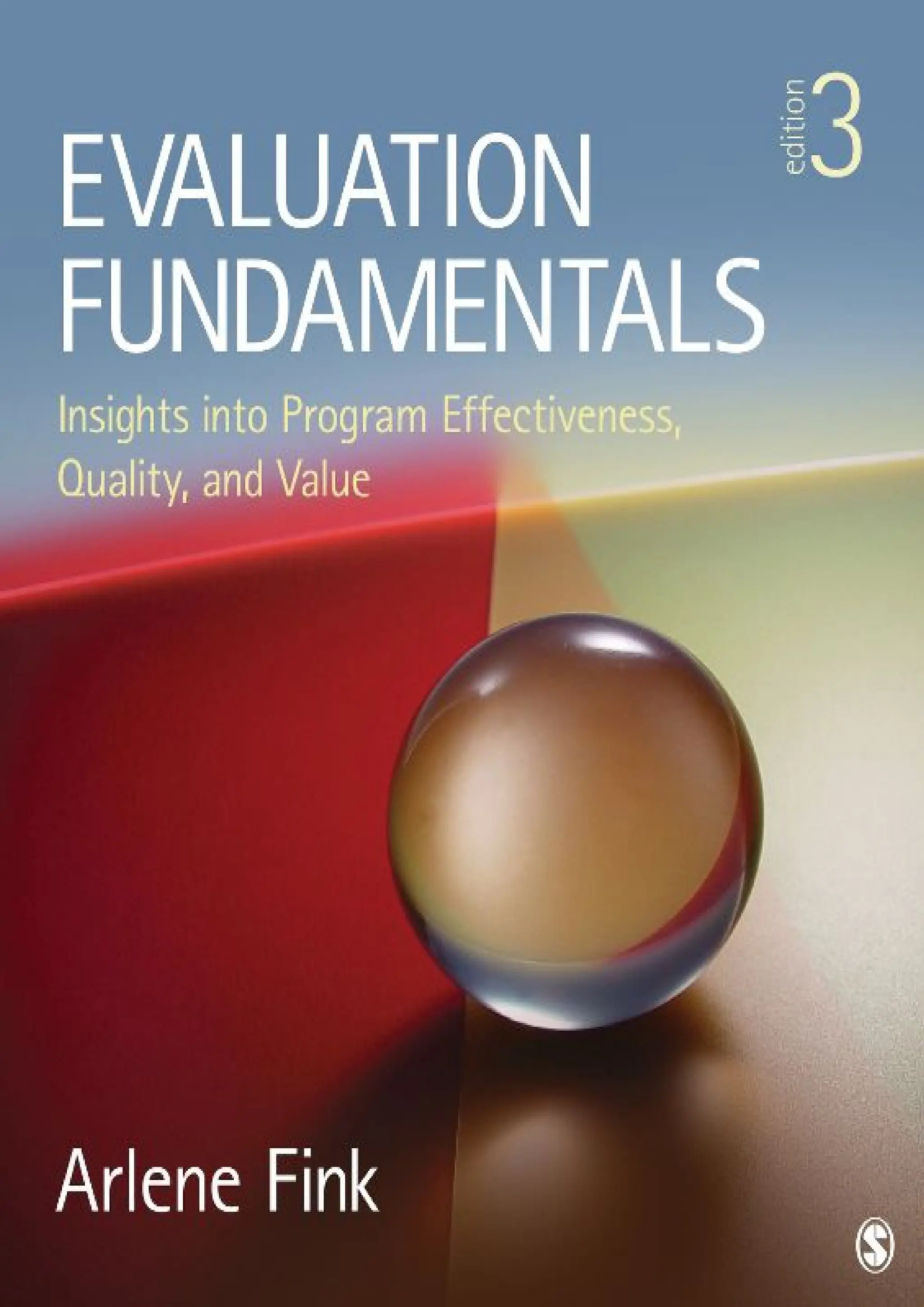
Evaluation Fundamentals Insights into Program
Effectiveness Quality and Value 3rd Edition Arlene
Fink
_____ Click the link below to download _____
https://ebookfinal.com/download/evaluation-fundamentals-
insights-into-program-effectiveness-quality-and-value-3rd-
edition-arlene-fink/
Explore and download more ebooks or textbook at ebookfinal.com
Here are some recommended products that we believe you will be
interested in. You can click the link to download.
Practical Program Evaluation Theory Driven Evaluation and
the Integrated Evaluation Perspective 2nd Edition Huey T.
Chen
https://ebookfinal.com/download/practical-program-evaluation-theory-
driven-evaluation-and-the-integrated-evaluation-perspective-2nd-
edition-huey-t-chen/
How to Sample in Surveys The Survey Kit 7 2nd Edition Dr.
Arlene G. Fink
https://ebookfinal.com/download/how-to-sample-in-surveys-the-survey-
kit-7-2nd-edition-dr-arlene-g-fink/
New Insights into Corpora and Translation 1st Edition
Daniel Gallego-Hernández (Ed.)
https://ebookfinal.com/download/new-insights-into-corpora-and-
translation-1st-edition-daniel-gallego-hernandez-ed/
The Creative School A Framework for Creativity Quality and
Effectiveness 1st Edition Bob Jeffrey
https://ebookfinal.com/download/the-creative-school-a-framework-for-
creativity-quality-and-effectiveness-1st-edition-bob-jeffrey/
Insights Into the Amygdala Structure Functions and
Implications for Disorders 1st Edition Deniz Yilmazer-
Hanke
https://ebookfinal.com/download/insights-into-the-amygdala-structure-
functions-and-implications-for-disorders-1st-edition-deniz-yilmazer-
hanke/
American Criminal Justice Policy An Evaluation Approach to
Increasing Accountability and Effectiveness 1st Edition
Daniel P. Mears
https://ebookfinal.com/download/american-criminal-justice-policy-an-
evaluation-approach-to-increasing-accountability-and-
effectiveness-1st-edition-daniel-p-mears/
Insights into Game Theory An Alternative Mathematical
Experience 1st Edition Ein-Ya Gura
https://ebookfinal.com/download/insights-into-game-theory-an-
alternative-mathematical-experience-1st-edition-ein-ya-gura/
Program Evaluation An Introduction to an Evidence Based
Approach 6th Edition David Royse
https://ebookfinal.com/download/program-evaluation-an-introduction-to-
an-evidence-based-approach-6th-edition-david-royse/
Managers of Innovation Insights into Making Innovation
Happen Management Organizations and Business 1st Edition
John Storey
https://ebookfinal.com/download/managers-of-innovation-insights-into-
making-innovation-happen-management-organizations-and-business-1st-
edition-john-storey/
Evaluation Fundamentals Insights into Program
Effectiveness Quality and Value 3rd Edition Arlene Fink
Digital Instant Download
Author(s): Arlene Fink
ISBN(s): 9781483312835, 1483312836
Edition: 3
File Details: PDF, 5.87 MB
Year: 2014
Language: english
2
This book is dedicated to the ones I love: John C. Beck and, of course, Ingvard.
3
4
Copyright © 2015 by SAGE Publications, Inc.
All rights reserved. No part of this book may be reproduced or utilized in any form or by any means, electronic or mechanical, including
photocopying, recording, or by any information storage and retrieval system, without permission in writing from the publisher.
Printed in the United States of America
Library of Congress Cataloging-in-Publication Data
Fink, Arlene.
Evaluation fundamentals : insights into program effectiveness, quality, and value / Arlene Fink, University of California at Los Angeles, the
Langley Research Institute. — Third edition.
pages cm
Includes bibliographical references and index.
ISBN 978-1-4522-8200-8 (pbk. : alk. paper) —
ISBN 978-1-4833-1283-5 (web pdf)
1. Medical care—Evaluation. 2. Public health—Evaluation.
3. Medical care—Quality control. 4. Health planning.
5. Outcome assessment (Medical care) I. Title.
RA399.A1F563 2015
362.1—dc23 2013038069
This book is printed on acid-free paper.
14 15 16 17 18 10 9 8 7 6 5 4 3 2 1
5
FOR INFORMATION:
SAGE Publications, Inc.
2455 Teller Road
Thousand Oaks, California 91320
E-mail: order@sagepub.com
SAGE Publications Ltd.
1 Oliver’s Yard
55 City Road
London EC1Y 1SP
United Kingdom
SAGE Publications India Pvt. Ltd.
B 1/I 1 Mohan Cooperative Industrial Area
Mathura Road, New Delhi 110 044
India
SAGE Publications Asia-Pacific Pte. Ltd.
3 Church Street
#10-04 Samsung Hub
Singapore 049483
Acquisitions Editor: Vicki Knight
Assistant Editor: Katie Guarino
Editorial Assistant: Jessica Miller
Production Editor: Stephanie Palermini
Copy Editor: Janet Ford
Typesetter: C&M Digitals (P) Ltd.
Proofreader: Susan Schon
Indexer: Sylvia Coates
Cover Designer: Anupama Krishnan
Marketing Manager: Nicole Elliott
6
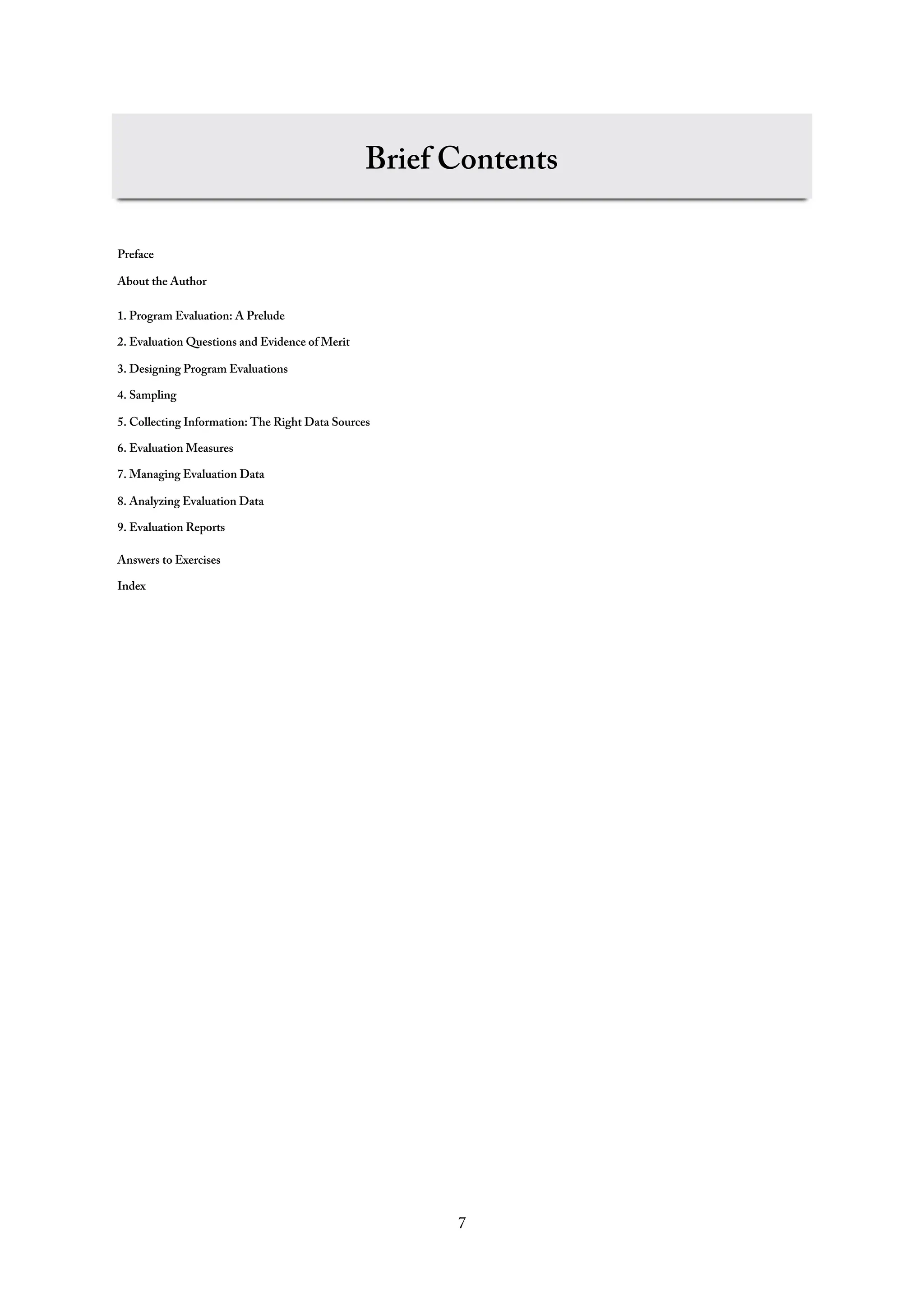
Brief Contents
Preface
About the Author
1. Program Evaluation: A Prelude
2. Evaluation Questions and Evidence of Merit
3. Designing Program Evaluations
4. Sampling
5. Collecting Information: The Right Data Sources
6. Evaluation Measures
7. Managing Evaluation Data
8. Analyzing Evaluation Data
9. Evaluation Reports
Answers to Exercises
Index
7
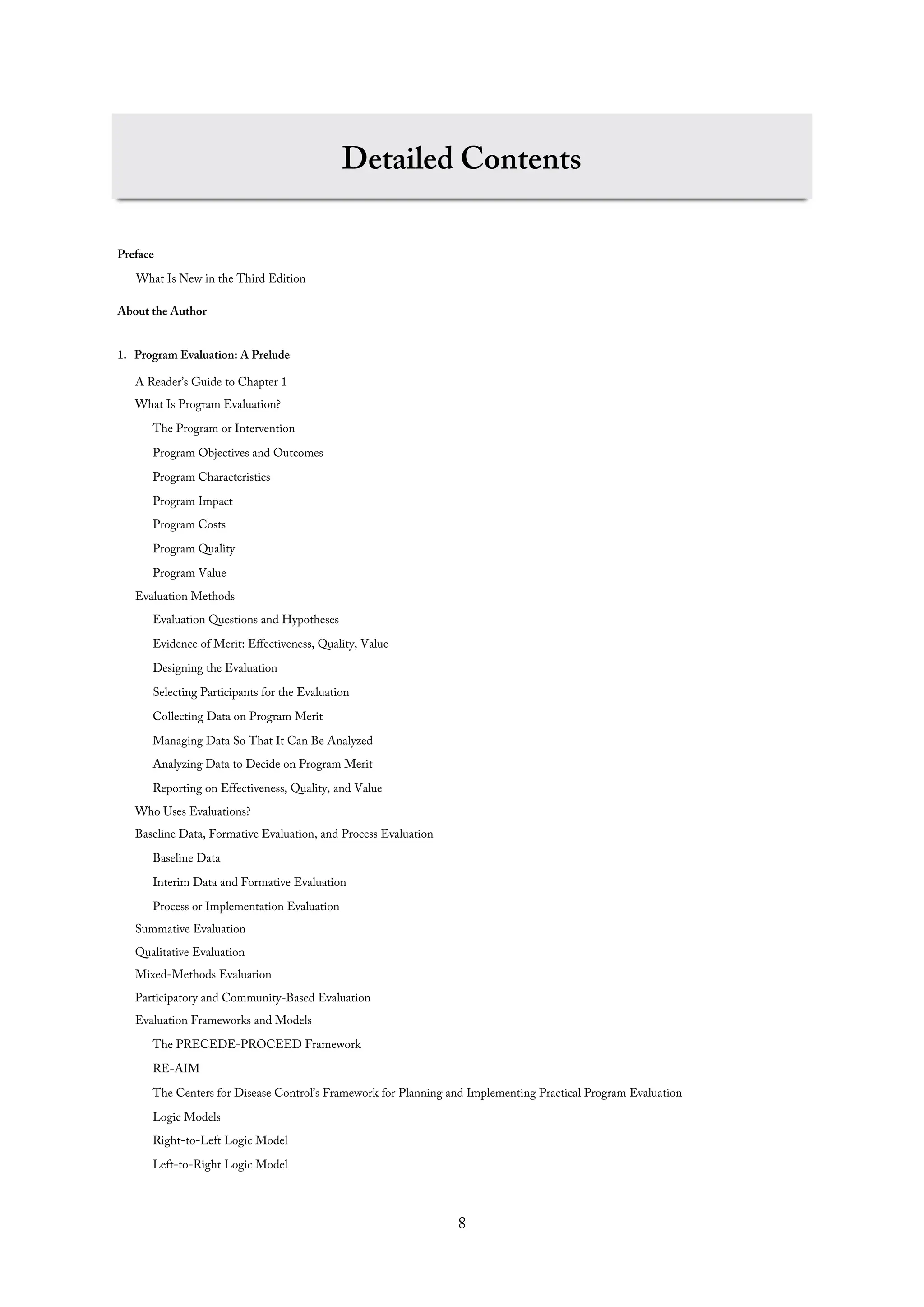
Detailed Contents
Preface
What Is New in the Third Edition
About the Author
1. Program Evaluation: A Prelude
A Reader’s Guide to Chapter 1
What Is Program Evaluation?
The Program or Intervention
Program Objectives and Outcomes
Program Characteristics
Program Impact
Program Costs
Program Quality
Program Value
Evaluation Methods
Evaluation Questions and Hypotheses
Evidence of Merit: Effectiveness, Quality, Value
Designing the Evaluation
Selecting Participants for the Evaluation
Collecting Data on Program Merit
Managing Data So That It Can Be Analyzed
Analyzing Data to Decide on Program Merit
Reporting on Effectiveness, Quality, and Value
Who Uses Evaluations?
Baseline Data, Formative Evaluation, and Process Evaluation
Baseline Data
Interim Data and Formative Evaluation
Process or Implementation Evaluation
Summative Evaluation
Qualitative Evaluation
Mixed-Methods Evaluation
Participatory and Community-Based Evaluation
Evaluation Frameworks and Models
The PRECEDE-PROCEED Framework
RE-AIM
The Centers for Disease Control’s Framework for Planning and Implementing Practical Program Evaluation
Logic Models
Right-to-Left Logic Model
Left-to-Right Logic Model
8
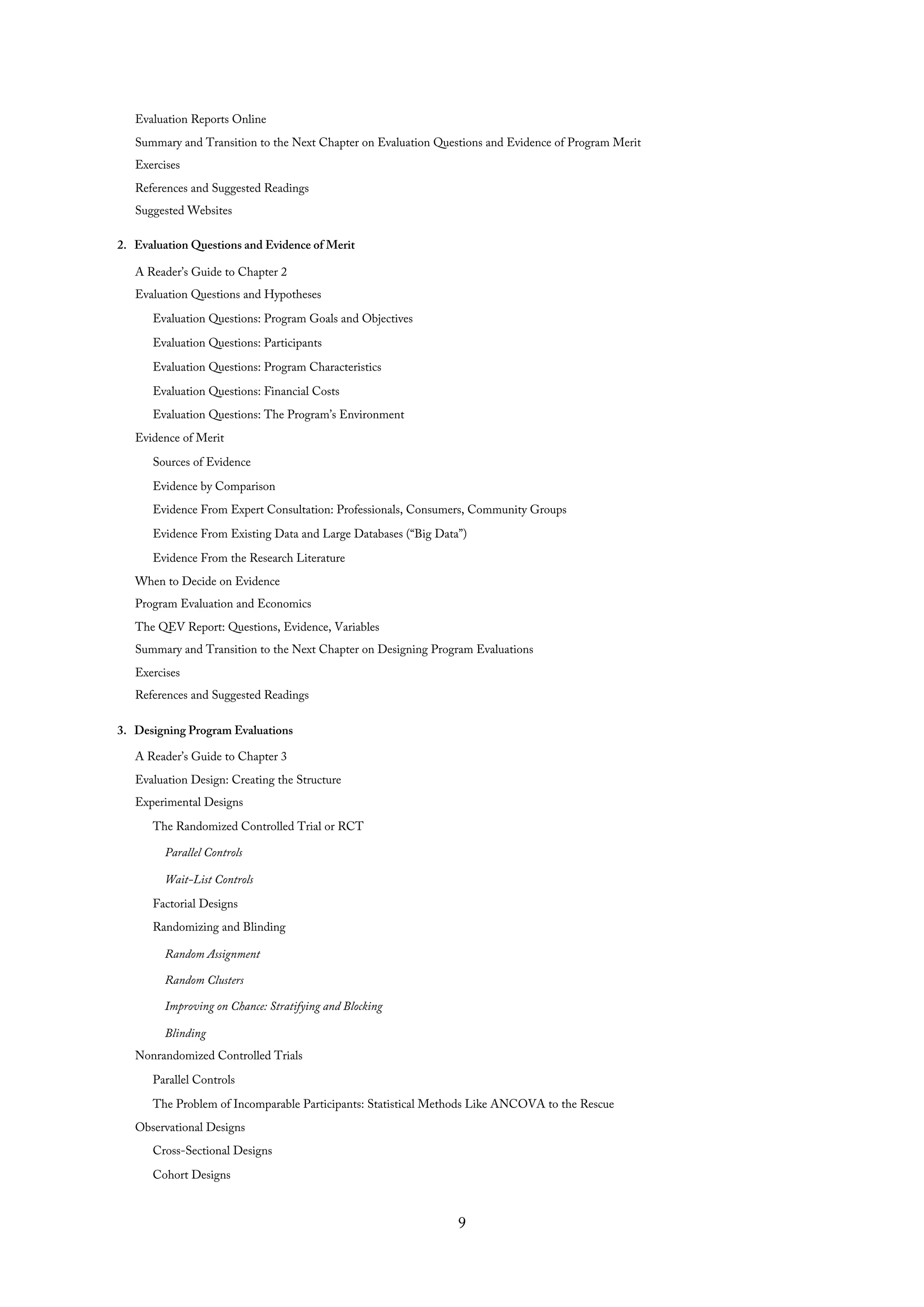
Evaluation Reports Online
Summary and Transition to the Next Chapter on Evaluation Questions and Evidence of Program Merit
Exercises
References and Suggested Readings
Suggested Websites
2. Evaluation Questions and Evidence of Merit
A Reader’s Guide to Chapter 2
Evaluation Questions and Hypotheses
Evaluation Questions: Program Goals and Objectives
Evaluation Questions: Participants
Evaluation Questions: Program Characteristics
Evaluation Questions: Financial Costs
Evaluation Questions: The Program’s Environment
Evidence of Merit
Sources of Evidence
Evidence by Comparison
Evidence From Expert Consultation: Professionals, Consumers, Community Groups
Evidence From Existing Data and Large Databases (“Big Data”)
Evidence From the Research Literature
When to Decide on Evidence
Program Evaluation and Economics
The QEV Report: Questions, Evidence, Variables
Summary and Transition to the Next Chapter on Designing Program Evaluations
Exercises
References and Suggested Readings
3. Designing Program Evaluations
A Reader’s Guide to Chapter 3
Evaluation Design: Creating the Structure
Experimental Designs
The Randomized Controlled Trial or RCT
Parallel Controls
Wait-List Controls
Factorial Designs
Randomizing and Blinding
Random Assignment
Random Clusters
Improving on Chance: Stratifying and Blocking
Blinding
Nonrandomized Controlled Trials
Parallel Controls
The Problem of Incomparable Participants: Statistical Methods Like ANCOVA to the Rescue
Observational Designs
Cross-Sectional Designs
Cohort Designs
9
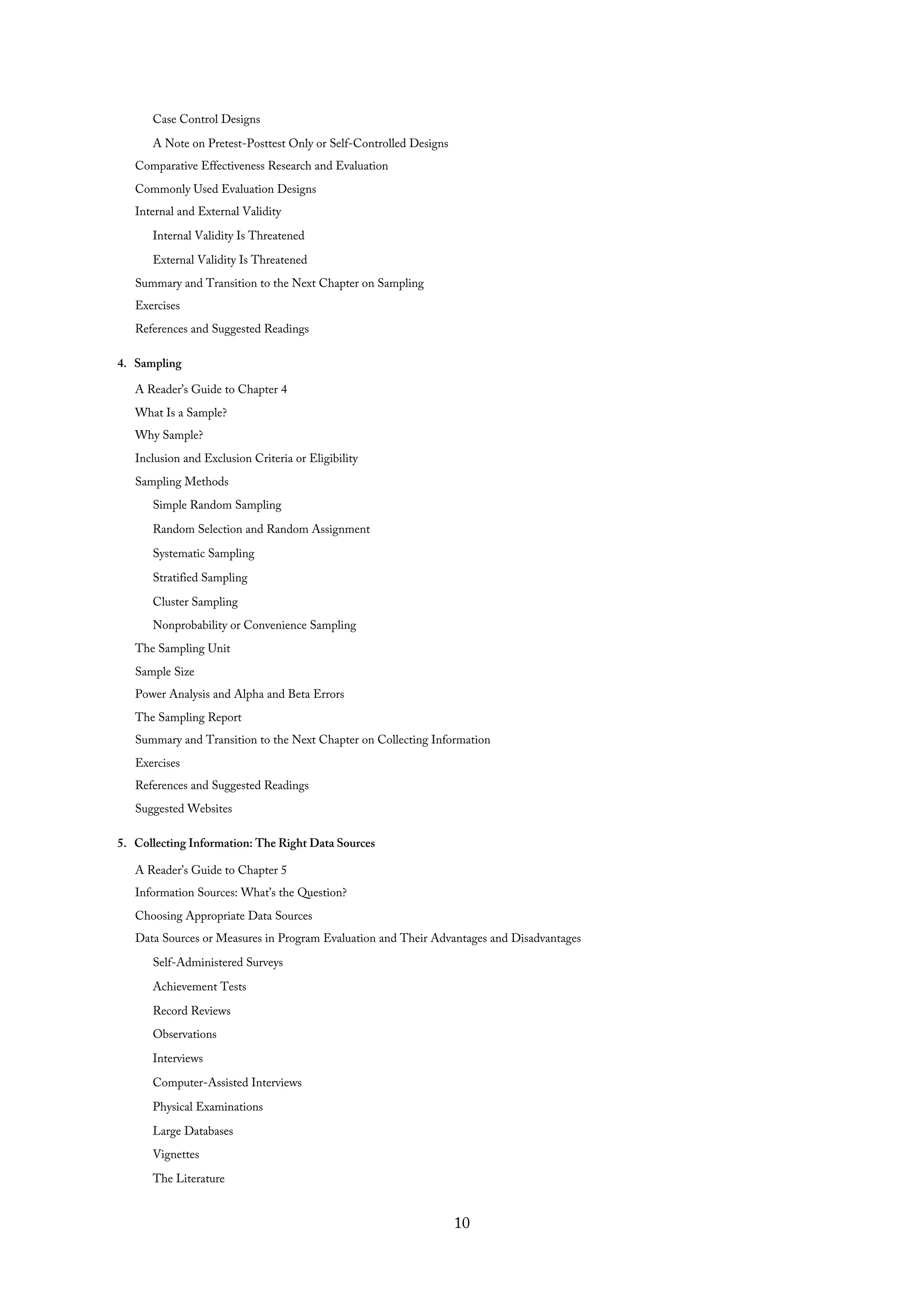
Case Control Designs
A Note on Pretest-Posttest Only or Self-Controlled Designs
Comparative Effectiveness Research and Evaluation
Commonly Used Evaluation Designs
Internal and External Validity
Internal Validity Is Threatened
External Validity Is Threatened
Summary and Transition to the Next Chapter on Sampling
Exercises
References and Suggested Readings
4. Sampling
A Reader’s Guide to Chapter 4
What Is a Sample?
Why Sample?
Inclusion and Exclusion Criteria or Eligibility
Sampling Methods
Simple Random Sampling
Random Selection and Random Assignment
Systematic Sampling
Stratified Sampling
Cluster Sampling
Nonprobability or Convenience Sampling
The Sampling Unit
Sample Size
Power Analysis and Alpha and Beta Errors
The Sampling Report
Summary and Transition to the Next Chapter on Collecting Information
Exercises
References and Suggested Readings
Suggested Websites
5. Collecting Information: The Right Data Sources
A Reader’s Guide to Chapter 5
Information Sources: What’s the Question?
Choosing Appropriate Data Sources
Data Sources or Measures in Program Evaluation and Their Advantages and Disadvantages
Self-Administered Surveys
Achievement Tests
Record Reviews
Observations
Interviews
Computer-Assisted Interviews
Physical Examinations
Large Databases
Vignettes
The Literature
10
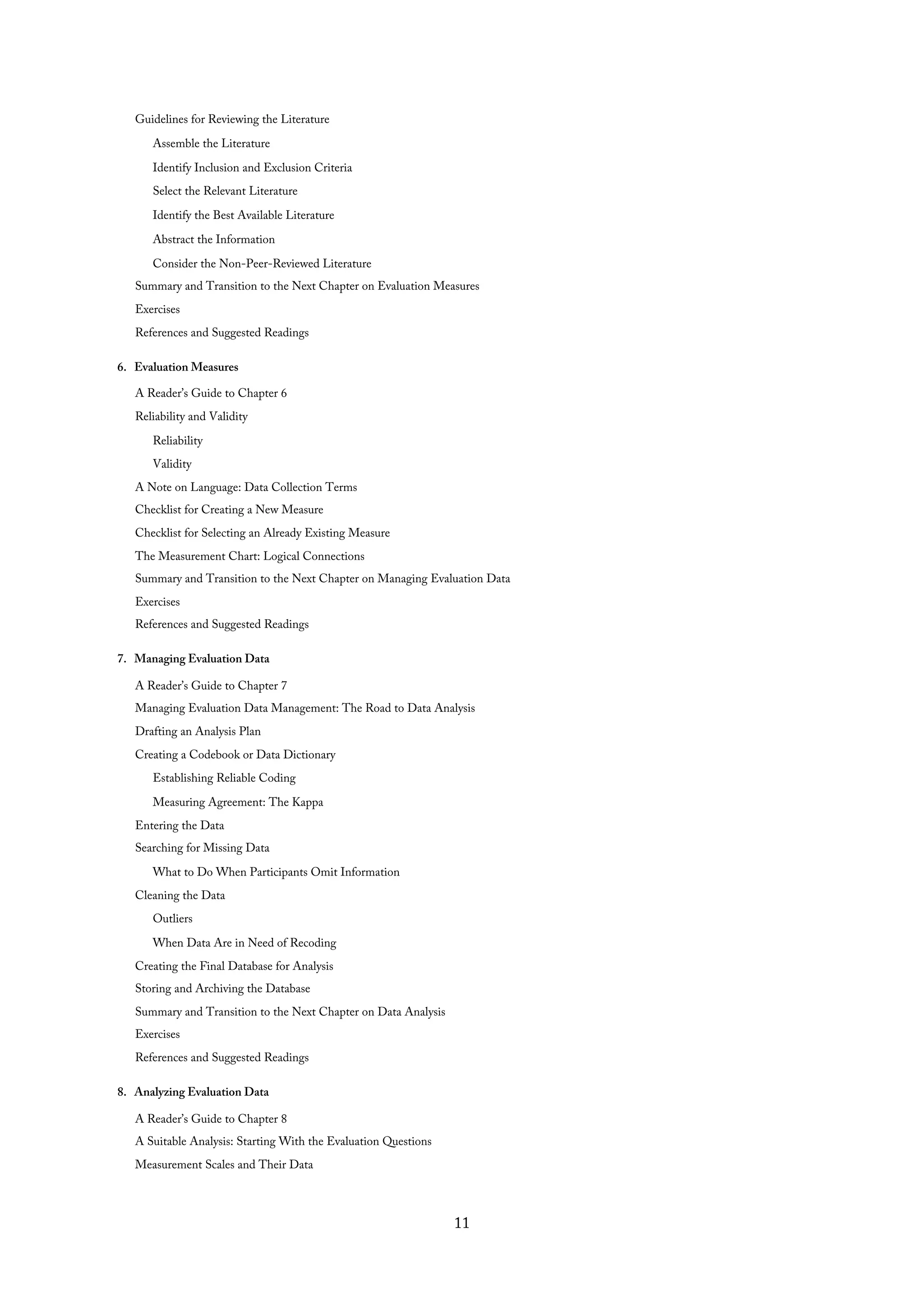
Guidelines for Reviewing the Literature
Assemble the Literature
Identify Inclusion and Exclusion Criteria
Select the Relevant Literature
Identify the Best Available Literature
Abstract the Information
Consider the Non-Peer-Reviewed Literature
Summary and Transition to the Next Chapter on Evaluation Measures
Exercises
References and Suggested Readings
6. Evaluation Measures
A Reader’s Guide to Chapter 6
Reliability and Validity
Reliability
Validity
A Note on Language: Data Collection Terms
Checklist for Creating a New Measure
Checklist for Selecting an Already Existing Measure
The Measurement Chart: Logical Connections
Summary and Transition to the Next Chapter on Managing Evaluation Data
Exercises
References and Suggested Readings
7. Managing Evaluation Data
A Reader’s Guide to Chapter 7
Managing Evaluation Data Management: The Road to Data Analysis
Drafting an Analysis Plan
Creating a Codebook or Data Dictionary
Establishing Reliable Coding
Measuring Agreement: The Kappa
Entering the Data
Searching for Missing Data
What to Do When Participants Omit Information
Cleaning the Data
Outliers
When Data Are in Need of Recoding
Creating the Final Database for Analysis
Storing and Archiving the Database
Summary and Transition to the Next Chapter on Data Analysis
Exercises
References and Suggested Readings
8. Analyzing Evaluation Data
A Reader’s Guide to Chapter 8
A Suitable Analysis: Starting With the Evaluation Questions
Measurement Scales and Their Data
11
Categorical Data
Ordinal Data
Numerical Data
Selecting a Method of Analysis
Hypothesis Testing and p Values: Statistical Significance
Guidelines for Hypothesis Testing, Statistical Significance, and p Values
Clinical or Practical Significance: Using Confidence Intervals
Establishing Clinical or Practical Significance
Risks and Odds
Odds Ratios and Relative Risk
Qualitative Evaluation Data: Content Analysis
Assembling the Data
Learning the Contents of the Data
Creating a Codebook or Data Dictionary
Entering and Cleaning the Data
Doing the Analysis
Meta-Analysis
Summary and Transition to the Next Chapter on Evaluation Reports
Exercises
References and Suggested Readings
9. Evaluation Reports
A Reader’s Guide to Chapter 9
The Written Evaluation Report
Composition of the Report
Introduction
Methods
Results
Conclusions or Discussion
Recommendations
The Abstract
The Executive Summary
Reviewing the Report for Quality and Ethics
Oral Presentations
Recommendations for Slide Presentations
Posters
Ethical Evaluations
Evaluations That Need Institutional Review or Ethics Board Approval
Evaluations That Are Exempt From IRB Approval
What the IRB Will Review
Informed Consent
The Internet and Ethical Evaluations
Communication Between the Evaluator and the Participant
Communication Between the Participant and the Website
Communication Between the Website and the Evaluator
Data Protection
12
Sample Questionnaire: Maintaining Ethically Sound Online Data Collection
Example: Consent Form for an Online Survey
Research Misconduct
Exercises
Suggested Websites
Answers to Exercises
Index
13
O
Preface
ver the past decade, program evaluation has made important contributions to practice, policy,
administration, education, and research in the health, nursing, medicine psychology, criminal justice,
social work, and education fields. Program evaluation is an unbiased investigation of a program’s merits,
including its effectiveness, quality, and value. Programs are designed to improve health, education, and social
and psychological well-being. An effective program provides substantial benefits to individuals, communities,
and societies, and these benefits are greater than their costs. A high-quality program meets its users’ needs
and is based on sound theory and the best available research evidence. Value is measured by how efficiently a
high-quality program achieves important individual, community, and societal outcomes.
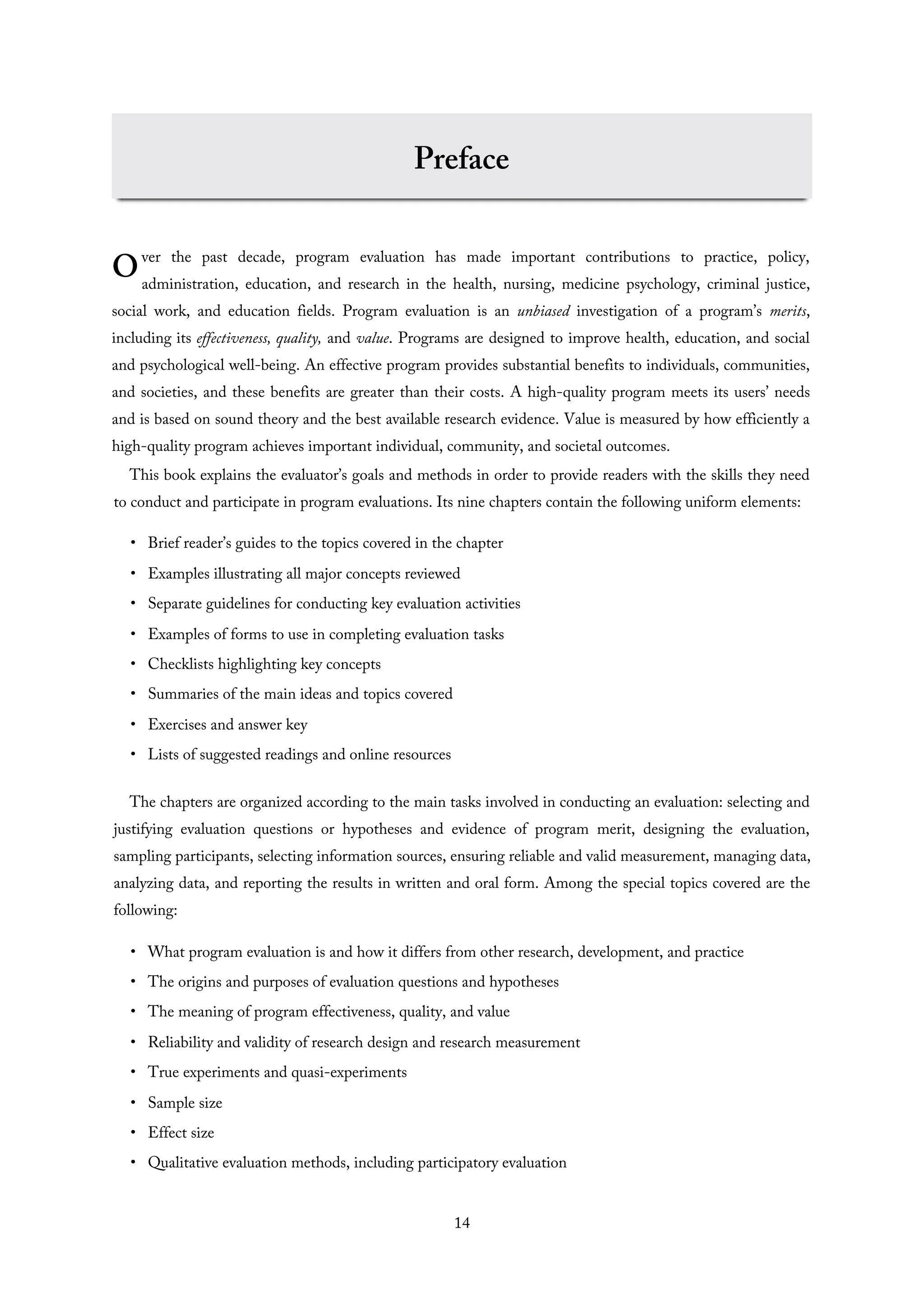
This book explains the evaluator’s goals and methods in order to provide readers with the skills they need
to conduct and participate in program evaluations. Its nine chapters contain the following uniform elements:
• Brief reader’s guides to the topics covered in the chapter
• Examples illustrating all major concepts reviewed
• Separate guidelines for conducting key evaluation activities
• Examples of forms to use in completing evaluation tasks
• Checklists highlighting key concepts
• Summaries of the main ideas and topics covered
• Exercises and answer key
• Lists of suggested readings and online resources
The chapters are organized according to the main tasks involved in conducting an evaluation: selecting and
justifying evaluation questions or hypotheses and evidence of program merit, designing the evaluation,
sampling participants, selecting information sources, ensuring reliable and valid measurement, managing data,
analyzing data, and reporting the results in written and oral form. Among the special topics covered are the
following:
• What program evaluation is and how it differs from other research, development, and practice
• The origins and purposes of evaluation questions and hypotheses
• The meaning of program effectiveness, quality, and value
• Reliability and validity of research design and research measurement
• True experiments and quasi-experiments
• Sample size
• Effect size
• Qualitative evaluation methods, including participatory evaluation
14
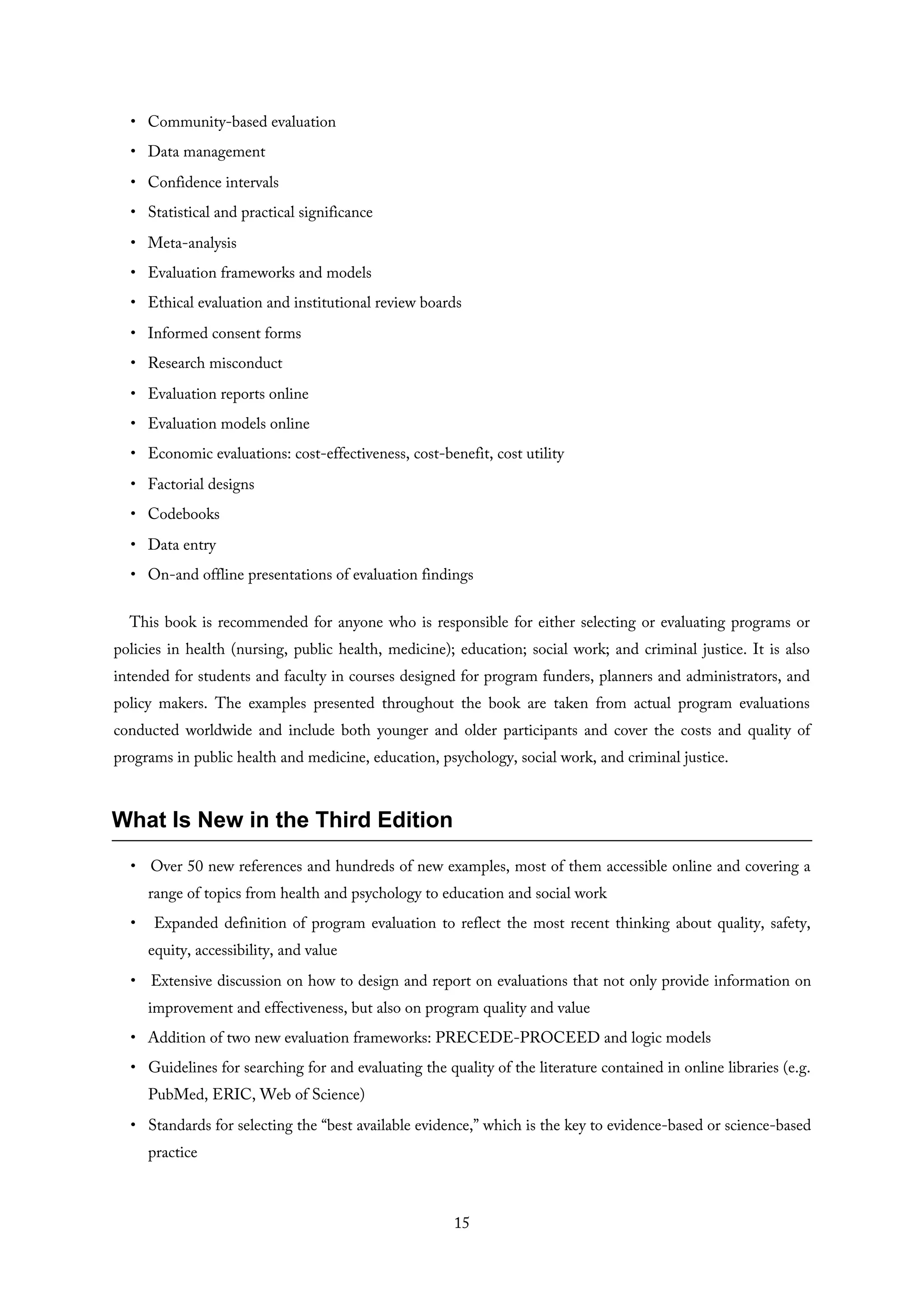
• Community-based evaluation
• Data management
• Confidence intervals
• Statistical and practical significance
• Meta-analysis
• Evaluation frameworks and models
• Ethical evaluation and institutional review boards
• Informed consent forms
• Research misconduct
• Evaluation reports online
• Evaluation models online
• Economic evaluations: cost-effectiveness, cost-benefit, cost utility
• Factorial designs
• Codebooks
• Data entry
• On-and offline presentations of evaluation findings
This book is recommended for anyone who is responsible for either selecting or evaluating programs or
policies in health (nursing, public health, medicine); education; social work; and criminal justice. It is also
intended for students and faculty in courses designed for program funders, planners and administrators, and
policy makers. The examples presented throughout the book are taken from actual program evaluations
conducted worldwide and include both younger and older participants and cover the costs and quality of
programs in public health and medicine, education, psychology, social work, and criminal justice.
What Is New in the Third Edition
• Over 50 new references and hundreds of new examples, most of them accessible online and covering a
range of topics from health and psychology to education and social work
• Expanded definition of program evaluation to reflect the most recent thinking about quality, safety,
equity, accessibility, and value
• Extensive discussion on how to design and report on evaluations that not only provide information on
improvement and effectiveness, but also on program quality and value
• Addition of two new evaluation frameworks: PRECEDE-PROCEED and logic models
• Guidelines for searching for and evaluating the quality of the literature contained in online libraries (e.g.
PubMed, ERIC, Web of Science)
• Standards for selecting the “best available evidence,” which is the key to evidence-based or science-based
practice
15
• Guide to comparative effectiveness program evaluation and its similarities and differences from other
evaluations in design and purpose
• New section on ethical considerations for online evaluations and surveys
• Expanded section on qualitative methods
• Discussion, explanation, and examples of mixed-methods research
• Guide to presenting evaluation results in poster form
• Discussion and rationale for using standardized reporting checklists, such as CONSORT (for RCTs)
and TREND (for non RCTs)
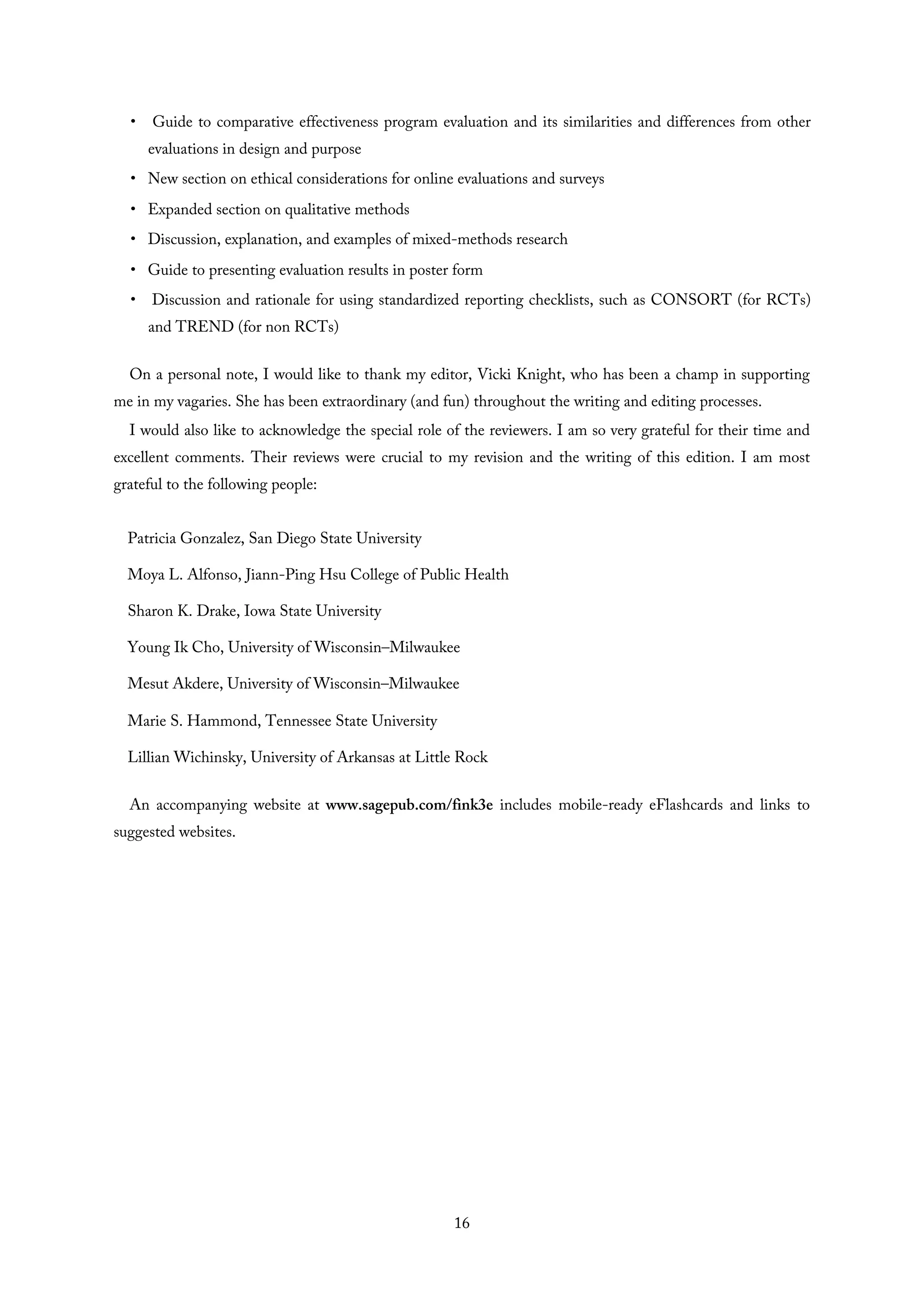
On a personal note, I would like to thank my editor, Vicki Knight, who has been a champ in supporting
me in my vagaries. She has been extraordinary (and fun) throughout the writing and editing processes.
I would also like to acknowledge the special role of the reviewers. I am so very grateful for their time and
excellent comments. Their reviews were crucial to my revision and the writing of this edition. I am most
grateful to the following people:
Patricia Gonzalez, San Diego State University
Moya L. Alfonso, Jiann-Ping Hsu College of Public Health
Sharon K. Drake, Iowa State University
Young Ik Cho, University of Wisconsin–Milwaukee
Mesut Akdere, University of Wisconsin–Milwaukee
Marie S. Hammond, Tennessee State University
Lillian Wichinsky, University of Arkansas at Little Rock
An accompanying website at www.sagepub.com/fink3e includes mobile-ready eFlashcards and links to
suggested websites.
16
About the Author
Arlene Fink (PhD) is professor of medicine and public health at the University of California, Los Angeles,
and president of the Langley Research Institute. Her main interests include evaluation and survey research
and the conduct of research literature reviews as well as the evaluation of their quality. Dr. Fink has conducted
scores of literature reviews and evaluation studies in public health, medicine, and education. She is on the
faculty of UCLA’s Robert Wood Johnson Clinical Scholars Program and is a scientific and evaluation advisor
to UCLA’s Gambling Studies and IMPACT (Improving Access, Counseling, & Treatment for Californians
with Prostate Cancer) programs. She consults nationally and internationally for agencies, such as L’Institut de
Promotion del la Prévention Secondaire en Addictologie (IPPSA) in Paris, France, and Peninsula Health in
Victoria, Australia. Professor Fink has taught and lectured extensively all over the world and is the author of
over 135 peer-reviewed articles and 15 textbooks.
17
Purpose of This Chapter
Program evaluation is an unbiased exploration of a program’s merits, including its effectiveness,
quality, and value. What does a program evaluation look like? Why do one? This chapter provides
examples of program evaluations and describes their purposes, methods, and uses. It also discusses
formative and summative evaluations and qualitative and mixed-methods research. The chapter
introduces comparative and cost-effectiveness evaluations and describes their methods and
importance. The chapter also provides examples of program evaluation models and offers guidelines
for identifying relevant online evaluation reports.
18
1
Program Evaluation:
A Prelude
A Reader’s Guide to Chapter 1
What Is Program Evaluation?
The Program or Intervention
Program Objectives and Outcomes
Program Characteristics
Program Impact
Program Costs
Program Quality
Program Value
Evaluation Methods
Posing evaluation questions and hypotheses; deciding on evidence of merit: effectiveness, quality,
value; designing the evaluation; selecting participants for the evaluation; collecting data on program
merit; managing data so that it can be analyzed; analyzing data to decide on program merit; reporting
on effectiveness, quality, and value.
Who Uses Evaluations?
Baseline Data, Formative Evaluation, and Process Evaluations
Summative Evaluation
Qualitative Evaluation
Mixed-Methods Evaluation
Participatory and Community-Based Evaluation
Evaluation Frameworks and Models
PRECEDE-PROCEED, RE-AIM, Centers for Disease Control Framework, Practical Program
Evaluation, and Logic Models
Evaluation Reports Online
Exercises
Suggested References and Readings
19
Suggested Websites
What Is Program Evaluation?
Program evaluation is an unbiased exploration of a program’s merits, including its effectiveness, quality, and
value. An effective program provides substantial benefits to individuals, communities, and societies and these
benefits are greater than their human and financial costs. A high-quality program meets its users’ needs and is
based on sound theory and the best available research evidence. A program’s value is measured by its worth to
individuals, the community, and society.
The Program or Intervention
At the core of an evaluation is a program, intervention, treatment, or policy. Programs, interventions, and
treatments are systematic efforts to achieve explicit objectives for improving health, education, and well-
being. They occur in all fields, including medicine, education, and business and law and involve individuals,
communities, and society. A program may be relatively small (e.g., a course in web design for seniors in two
high schools; a new community health center for persons over 75 years of age), or relatively large (e.g., a
nation’s health plan or a global initiative to eliminate poverty). Programs can take place in differing
geographic and political settings, and they vary in their purposes, structures, organization, and constituents. A
policy is a system of laws, regulatory measures, courses of action, and funding priorities associated with
private and public governing agencies, trusts, and boards. A policy can be used to support or discontinue
programs, interventions, treatments, and evaluations.
Are the following objectives likely to come from program evaluations?
Objective: To determine the effectiveness of an abuse-prevention curriculum designed to empower
women with mental retardation to become effective decision makers.
The answer is yes. The evaluation is for an abuse-prevention program.
What about this objective?
Objective: To investigate the effectiveness of acupuncture compared with sham acupuncture and with no
acupuncture in patients with migraine.
This objective is also likely to come from an evaluation. The investigators compare three interventions:
acupuncture, sham acupuncture, and no acupuncture. (No acupuncture is considered an intervention because
the absence of acupuncture does not mean the absence of anything at all. The no acupuncture group may be
on medication or other forms of therapy.)
Finally, is this objective likely to come from a program evaluation?
Objective: To assess whether the Acquittal Project has effectively exonerated wrongfully convicted
20
Discovering Diverse Content Through
Random Scribd Documents
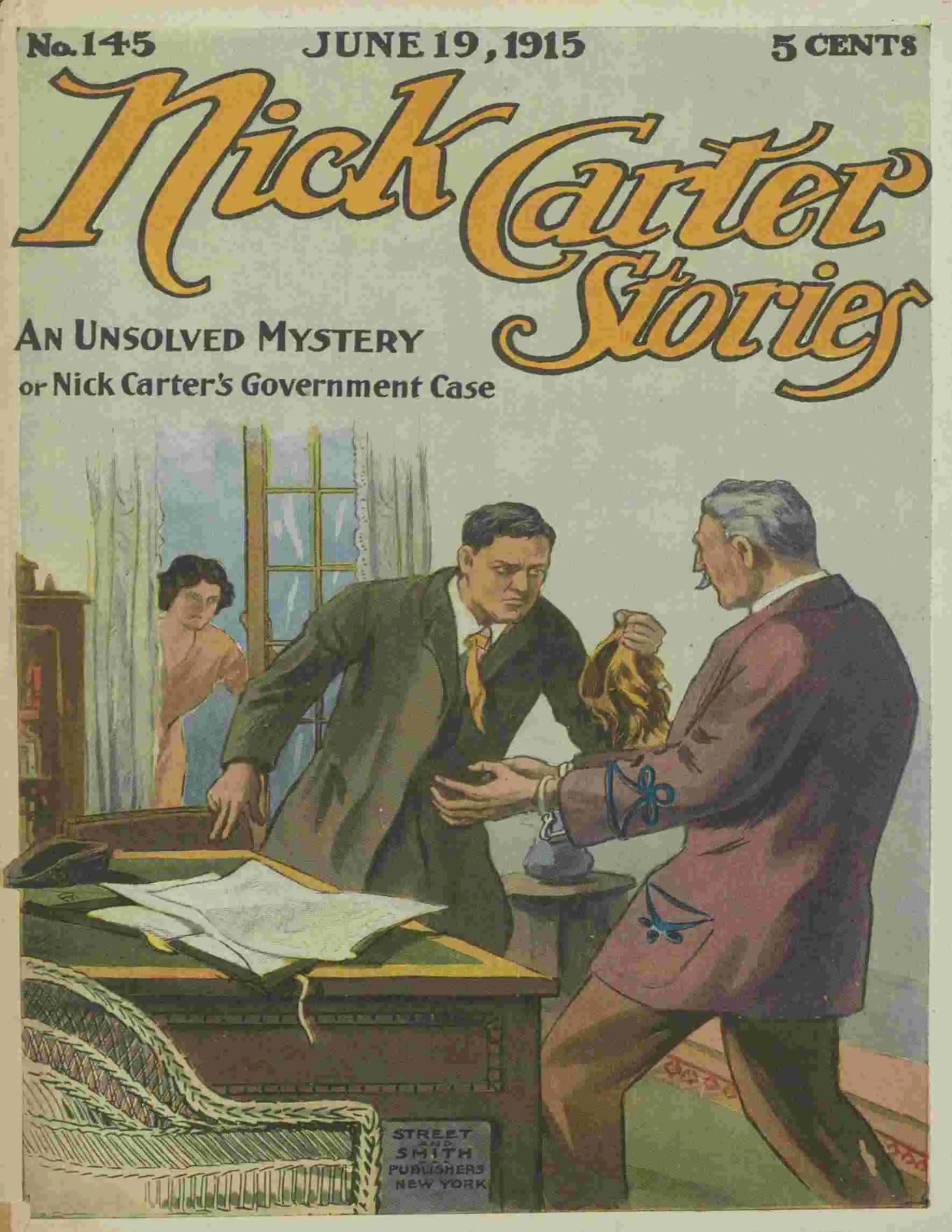
The Project Gutenberg eBook of Nick Carter Stories
No. 145, June 19, 1915: An Unsolved Mystery; Or, Nick
Carter's Goverment Case
This ebook is for the use of anyone anywhere in the United
States and most other parts of the world at no cost and with
almost no restrictions whatsoever. You may copy it, give it away
or re-use it under the terms of the Project Gutenberg License
included with this ebook or online at www.gutenberg.org. If you
are not located in the United States, you will have to check the
laws of the country where you are located before using this
eBook.
Title: Nick Carter Stories No. 145, June 19, 1915: An Unsolved
Mystery; Or, Nick Carter's Goverment Case
Author: Nicholas Carter
C. C. Waddell
Release date: May 8, 2022 [eBook #68022]
Language: English
Original publication: United States: Street & Smaith, 1914
Credits: David Edwards, Chuck Greif and the Online Distributed
Proofreading Team at https://www.pgdp.net (Northern
Illinois University Digital Library)
*** START OF THE PROJECT GUTENBERG EBOOK NICK
CARTER STORIES NO. 145, JUNE 19, 1915: AN UNSOLVED
MYSTERY; OR, NICK CARTER'S GOVERMENT CASE ***
Issued Weekly. Entered as Second-class Matter at the New York Post
Office, by Street & Smith, 79-89 Seventh Ave., New York. Copyright, 1915,
by Street & Smith. O. G. Smith and G. C. Smith, Proprietors.
Terms to NICK CARTER STORIES Mail Subscribers.
Issued Weekly. Entered as Second-class Matter at the New York Post Office,
by Street & Smith, 79-89 Seventh Ave., New York. Copyright, 1915, by
Street & Smith. O. G. Smith and G. C. Smith, Proprietors.
Statement of ownership, management, circulation, etc., of Nick Carter
Stories, published weekly, at New York City, required by the Act of August
24, 1912.... Editor, W. E. Blackwell, 32 W. 75th Street, New York City....
Managing editors, business managers, publishers and owners, Street &
Smith, 79-89 Seventh Avenue, New York City.... Known bondholders,
mortgagees, and other security holders, holding 1 per cent. or more of total
amount of bonds, mortgages, or other securities: None.... Signed by George
C. Smith, for Street & Smith.... Sworn to and subscribed before me this 30th
day of September, 1912, Chas. W. Ostertag, Notary Public No. 31, New
York County (my commission expires March 30th, 1913).
TERMS TO NICK CARTER STORIES MAIL SUBSCRIBERS.
(Postage Free.)
Single Copies or Back Numbers, 5c. Each.
3 months 65c.
4 months 85c.
6 months $1.25
One year 2.50
2 copies one year 4.00
1 copy two years 4.00
How to Send Money—By post-office or express money order,
registered letter, bank check or draft, at our risk. At your own risk if sent
by currency, coin, or postage stamps in ordinary letter.
Receipts—Receipt of your remittance is acknowledged by proper
change of number on your label. If not correct you have not been
properly credited and should let us know at once.
No. 145. NEW YORK, June 19, 1915. Price Five Cents.
AN UNSOLVED MYSTERY;
Or, NICK CARTER’S GOVERNMENT CASE.
Edited by CHICKERING CARTER.
CHAPTER I.
A SECRET CONFERENCE.
The old gentleman passed the other two as if they were strangers. He
jostled by them without so much as a glance. The most observing person in
the throng then pouring out of the railway station, like a swarm of busy bees
out of a colossal hive, would have detected no relation between them.
While passing the couple, nevertheless, the old gentleman said quickly to
one of them, though scarce above his breath:
“Go to the new Willard. Register as directed, and get a suite, Wait there
till I come.”
The man addressed heard him, but did not turn his head, nor evince the
fact with the slightest change of countenance.
His companion, a natty, keen-eyed chap with a blond mustache twirled
upward at the ends à la kaiser, appeared oblivious to what had occurred.
The scene of this trivial episode, which was far more portentous than one
would suppose, having a bearing on no less tremendous an issue than the
possible fate of a nation, was the new Union Station in the city of
Washington, and the hour was two o’clock one fine afternoon in October.
The old gentleman hastened out with the throng into Massachusetts
Avenue, seeking a trolley car and mingling with the crowd in a plebian sort
of a way, as if business of no great importance had brought him to the
nation’s capital.
He rode down Pennsylvania Avenue as far as Fourteenth Street, where he
alighted and walked the remaining distance to the Treasury Building,
entering one of the side doors with an air and display of interest often
observed in the crowds of tourists to be seen in this vast building at that hour
of the day. No observer would have supposed him other than a sight-seeing
stranger, viewing Uncle Sam’s great money box and financial institution for
the first time in his life.
Something like five minutes later, nevertheless, he entered one of the
numerous offices without the ceremony of knocking, and blandly addressed
a clerk who turned from his desk to see who had entered.
“I suppose Chief Welden is inside?” he said inquiringly.
“Yes, sir,” bowed the clerk. “I will take in your card, or name, if——”
“Don’t trouble,” interrupted the old gentleman, smiling. “I am his uncle.
He is expecting me. I will go right in.”
He did not wait for an objection, had any been forthcoming, but opened a
near door and walked into an adjoining private office. It was quite large and
elaborately furnished. But the only occupant was an attractive, clean-cut man
seated at a large, roll-top desk.
“Don’t rise, Welden,” said the old gentleman, after closing the door.
“Have a look at my card. It will supply the needed link. Even you are not
likely to recognize me.”
Chief Welden, then the head of the United States secret service, glanced
at the card the speaker displayed for a moment and then coolly returned to
his own pocket.
It bore the name of the celebrated New York detective—Nick Carter.
Chief Welden laughed.
“Gracious!” said he, pointing to a chair with one hand and extending the
other. “No, indeed; I would not recognize you. You’re the limit, Nick, when
it comes to giving one a surprise. Why did you come in this rig?”
“A summons direct from the nation’s chief executive, Welden, must be
occasioned by something of vast importance,” Nick replied, drawing up a
chair and cordially shaking hands with the treasury official. “It imposes
corresponding circumspection upon one of my vocation. I decided to drop in
here under cover and learn what is wanted of me.”
“I knew that the president had communicated with you and I was
expecting you to show up during the day,” said Chief Welden, more gravely.
“I got the special-delivery letter this morning.”
“When did you arrive?”
“Half an hour ago.”
“Alone?”
“As you see,” said Nick evasively.
Chief Welden swung round in his swivel chair, so as to directly face the
noted detective. There had been other times when the keen and clever men
under his direction had been baffled by perplexing problems, resulting in an
appeal to the famous New York detective; but judging from Welden’s
expression at that moment, none could have been more important than that
which had occasioned this summons of Nick Carter to Washington, an
appeal direct from the president himself.
“I will tell you as briefly as possible what has occurred, Nick, and why it
has been thought wise to employ you,” said Welden.
“Do so,” bowed the detective.
“To begin with, Carter, we have in the war department a young man
named Harold Garland. He is about thirty, remarkably gifted along certain
lines, and strictly reliable. Understand that at the outset; his integrity is
above suspicion. I am absolutely sure of that.”
“Very good,” said Nick. “What about him?”
“He is a graduate from West Point, and is in the employ of the
government as an expert engineer, in which capacity he is, as I have said,
remarkably gifted. He unquestionably is without a peer in this country in his
special line. He has an office in the war department, and I will presently send
for him.”
“I shall be glad to meet him,” Nick observed.
“Now, to go back a little,” Chief Welden continued. “Something like
eight months ago, Nick, I was informed by two of our secret-service agents
abroad that foreign spies were known to be in Washington, said to be here on
some secret mission, the nature of which was not definitely known. It was
suspected, nevertheless, that they were here after information concerning
elaborate coast defenses and fortifications contemplated by the government,
which in some sections are under secret construction.”
“You received that information eight months ago?”
“Yes.”
“Were the reports verified? Were the spies identified?”
“Neither,” said Welden. “The suspicion could not be confirmed either
here or abroad. The fact that the same report came at about the same time
from two of our foreign agents, one then located in Vienna and the other in
Paris, and there having been no communication between them, led me to
give considerable credit to their report, much more than if there had been but
one.”
“I see the point,” Nick nodded.
“We were not able to verify it, nevertheless, nor have we since succeeded
in doing so. Nor have our agents abroad been able to add to the meager
information obtained at the time. Under such circumstances, of course,
having no confirmation of their reports, the matter became a little stale after
eight months.”
“Naturally,” Nick allowed.
“But it was brought up again very vividly three days ago,” Chief Welden
pointedly added.
“How so?”
“I will explain in a nutshell.”
“I’m all attention.”
“For nearly a year, now, Garland has been collaborating with Captain
Arthur Backas, a naval officer now stationed in Annapolis, and who also is a
recognized expert along engineering lines.”
“I know him by name,” Nick bowed.
“For the past year these two government engineers have been secretly and
exclusively at work on plans for elaborate coast-line defenses and
fortifications extending from Chesapeake Bay to Sandy Hook. It is one
section of a vast and for the most part secret coast-defense system
contemplated by the government, and the first steps in the construction of
which have already been taken.”
“I follow you, Welden.”
“And you know, of course, that secrecy is one of the absolute
requirements in such work,” Chief Welden proceeded. “There is no occasion
for me to enlarge upon that. Secrecy is imperative to adequate protection. If
other nations were to learn——”
“I know all about that, Welden,” Nick interposed, checking him with a
gesture. “It goes without saying. Come to the point.”
“That may be done with few words,” Chief Welden replied. “Last Friday,
three days ago, Garland had occasion to confer with Captain Backas about a
very important part of their mutual plans, and he went to Annapolis for that
purpose.”
“I see.”
“He took the plans with him in a leather portfolio. He spent most of the
day with Captain Backas, returning alone to Washington in the early
evening. He was met at the Union Station by two young women, one the
only daughter of Senator Barclay, the other a Miss Verona Warren, an
intimate friend of Miss Barclay, and with whom Garland is deeply in love.
The girls knew he was to arrive from Annapolis at seven o’clock, and they
met him with Senator Barclay’s touring car, driven by his chauffeur. They at
once took Garland to his apartments, where they dropped him and returned
home.”
“Garland, I infer, brought back the plans taken to Annapolis,” Nick
observed.
“He put them in the portfolio before leaving the office in which he had
talked with Captain Backas. Their conference had been strictly private. The
portfolio did not leave Garland’s hands from that time until he entered his
apartments in the Grayling, where he has a safe in which to lock them. He
opened the portfolio to inclose a memorandum relating to the plans—and
found them gone.”
“The plans?”
“Yes. The portfolio contained, instead, a quantity of blank paper
resembling them in size and thickness.”
“I disagree with you,” said Nick, after listening with scarce a change of
countenance. “You have made one wrong statement.”
“Namely?”
“You said the portfolio did not leave Garland’s hands after he had placed
the plans in it,” said Nick. “It did leave them, Welden, or there could not
have been a substitution of worthless paper for such tremendously important
plans.”
Chief Welden smiled and nodded.
“That goes without saying,” he admitted. “As a matter of fact, Nick, it
was not the same portfolio.”
“The whole business had been substituted?”
“Exactly. The substituted portfolio was so like his own, however, that he
did not detect the difference until after he had opened it,” said Welden. “His
own was nearly new and his name was written with ink on the inside of a
flap that closes it, and which is secured with two small straps and buckles.
There was no name in the substituted portfolio. It was slightly defaced,
moreover, so like his own that he detected no difference.”
“Which plainly denotes that whoever turned the trick, or planned and
directed the job, was perfectly familiar with Garland’s portfolio,” said Nick.
“That is obvious, of course,” Chief Welden agreed.
Nick Carter took up the matter as if it were merely a petty theft, instead
of one threatening the nation. No need to tell him, nevertheless, of the
terrible danger from further construction in accord with the stolen plans, or
of the vast expense and innumerable difficulties in changing them, they
presumably having been made to the best advantages discernible to the
expert government engineers in charge of that part of the work. One scarce
could conceive of a more serious and possibly far-reaching loss.
Nick gazed at Chief Welden for a moment, then asked tersely:
“Any clew?”
“None, so far,” was the reply.
“You suspect it was the work of the spies mentioned?”
“Naturally.”
“Who is on the case?”
“Several of my best men,” said Welden. “I have talked with the president,
who is much disturbed by the matter, and we realize that these men may be
known by sight and that they are connected with the secret service. We have
thought wise, therefore, to employ you on the case, assuming that you are
not known and can work to greater advantage. There is this much to it,
Carter,” he forcibly added: “Those plans must be recovered. They must be
found before copies can be made, or——”
“One moment,” Nick interposed. “I appreciate all that is involved. It is
bad, terribly bad, but I will do my best to meet the situation. Send for
Garland. I wish to question him.”
“I think I can answer any questions that——”
“You won’t do,” Nick again interrupted. “I might ask questions that you
could not possibly answer. I shall want them answered. Send for Garland. I
wish to talk with him.”
Chief Welden turned to his desk and rang for the clerk in the outer office.
CHAPTER II.
THE GOVERNMENT ENGINEER.
Nick Carter was a keen physiognomist. He no sooner saw the face of the
young man who entered Chief Welden’s office a little later, than he was sure
of his lofty character and sterling integrity, as Welden already had asserted.
He was tall and erect, with the carriage of a soldier and set up like an
athlete. His smoothly shaved face was of a classical cast, with clean-cut,
regular features, a fair complexion, and frank blue eyes, with a broad brow
and wavy brown hair.
He then looked white and drawn, however, as men look who have aged
years in as many days under some terrible experience. Mental distress of the
most poignant kind was reflected in his face, and Nick rightly inferred, as
Chief Welden also perceived, that the young man apprehended further
direful disclosures and additional misery from this unexpected summons to
the chief’s office.
Welden hastened to reassure him, however, by saying, with sympathetic
voice and a smile:
“Draw up a chair, Garland, and shake hands with this gentleman. We
have brought him from New York to pull you out of this affair. I think he
may succeed in doing so, for he rarely fails, if ever, in what he seriously
undertakes. His own mother would not know him just now, however. Shake
hands with Nick Carter.”
Garland’s face lighted as if a ray of sunshine had fallen on it. He clasped
Nick’s hand, felt its cordial and sympathetic pressure, and his voice choked
despite himself.
“I’m awfully glad to know you, Mr. Carter, and ten thousand times more
so in knowing that you are to look into this matter,” he said feelingly; then,
with a quick glance at the chief: “Why have I not been told of this, Chief
Welden? You know what horrible anguish and anxiety I am undergoing.”
“Very true, Garland,” said Welden, smiling significantly. “But we did not
know positively that Carter would be in a position to comply with the
president’s request. What good to have extended you false hopes? Sit down,
now, and have a talk with Mr. Carter. He wants to ask you a few questions.”
Garland hastened to comply, while Nick said, in a more businesslike
fashion:
“Welden has told me all of the superficial circumstances, Mr. Garland,
and I’ll do what I can for you. Let’s waste no time in getting right at the
matter, for time is always valuable. Steady yourself and answer my questions
as quickly and concisely as possible.”
“I will do so, Mr. Carter,” said Garland eagerly.
“To begin with, then, who else occupies your office in the war
department? Are there any clerks, or others, in the employ of the
government?”
“No, indeed,” said Garland. “I have a private room and an outer office
resembling these. I employ only a girl stenographer, who has a desk in the
outer office.”
“Does she know on what work you have been engaged?”
“No, sir. That is known only to Captain Backas and the heads of the
department.”
“All of whom are, of course, perfectly reliable,” said Nick. “I now am
aiming only to pick up a clew, Garland, to the identity of the person who
could have had the information necessary to have framed up this job. Did
your stenographer know you were going to Annapolis last Friday?”
“Yes, sir. I told her I was going the day before.”
“Did you tell her for what?”
“No.”
“Let’s make a jump, then,” said Nick. “Whom did you see in Annapolis,
who might by any means have learned of your mission?”
“Only Captain Backas,” said Garland emphatically. “I went directly to his
office, where I remained until I left for my train to Washington.”
“Who else was in the office during your conference with Captain
Backas?”
“Nobody. We were alone.”
“Did any one enter while you were talking with him?”
“No, sir. I am sure of that.”
“And you are sure you placed the missing plans in the portfolio before
leaving, and that it was not substituted for another before you left?”
“Yes, sir; absolutely sure.”
“How did you go to the station?”
“In a taxicab.”
“Alone?”
“Yes, sir.”
“Very good,” said Nick. “Where did you ride in the train?”
“In the smoking car,” said Garland. “I occupied a seat alone.”
“Where was the portfolio?”
“I placed it between me and the wall of the car, next to the window,
where my arm could rest on it during the ride. I was reading a book in the
meantime.”
“Could the portfolio have been removed by a person in the seat behind
you without your knowing it?” Nick inquired.
“No, sir, absolutely,” said Garland. “When I placed it there, Mr. Carter, I
made sure there was no space between the end of the seat and the wall,
through which the portfolio could slip. Naturally, sir, knowing the vast
importance of its contents, I was exceedingly careful and constantly alert. It
would have been utterly impossible for any person to have removed my
portfolio and substituted another on the train.”
“We will go a step farther, then,” said Nick. “When you arrived in
Washington and came from the Union Station, what did you do?”
“I hastened to find my friends who promised to meet me, Miss Barclay
and Miss Warren,” said Garland. “I found them nearly opposite the main
exit. I got into the automobile with them and they——”
“One moment,” Nick interposed. “Was it a limousine or an ordinary
touring car?”
“A touring car.”
“Top up?”
“No, sir.”
“Who was in the car?”
“Only the two ladies and Hopkins, the chauffeur,” said Garland. “To be
more correct, however, Miss Barclay had alighted and was standing beside
the car when I approached. She knew I would like to ride in the seat with
Miss Warren, of whom I am especially fond, and she took the seat next to the
chauffeur after our greeting.”
“Just before you started for home, I infer?”
“Certainly.”
“What were you carrying except the portfolio?”
“Only the book I had been reading.”
“What did you do with them after entering the touring car?”
“I placed them beside me on the seat,” said Garland.
Then, with a quick frown, he impulsively added:
“See here, Mr. Carter, don’t suppose for a moment that either of my
companions at that time know anything about this matter. They are incapable
of such treachery as that. Put it out of your head, sir, if you have any such
suspicion. I know positively that Verona Warren and Miss Barclay are above
——”
“Pardon me,” Nick interrupted a bit dryly. “What you know about them,
Mr. Garland, is not material. I am not seeking to cast suspicion upon any
one, least of all, your two lady friends. I want only to trace your movements
as precisely as possible from the moment you left Annapolis. Pray don’t
infer that I have formed any definite suspicion.”
A tinge of color came to Garland’s pale face.
“I beg your pardon, Mr. Carter,” he said quickly. “I meant no offense. Nor
do I question your motives. None could realize more keenly how much
depends upon what you can do for me. Please continue your questions. I will
answer them to the best of my ability.”
“Very good,” Nick replied. “As a matter of fact, then, you have not the
slightest idea when, where, or by whom one portfolio was substituted for the
other?”
“No, Mr. Carter, not the slightest,” Garland quickly answered. “I am
absolutely in the dark. I nearly fainted when I opened the portfolio and
discovered my loss.”
“Were you then alone in your apartments?”
“I was.”
“What is the Grayling?” Nick inquired. “A hotel?”
“No. It is a private boarding house in Vermont Avenue, not far from the
Thomas Circle.”
“It’s a first-class house, Carter,” put in Chief Welden.
“I have no family,” Garland added. “I’m quite alone in the world and
likely to remain so—unless Verona Warren accepts me for her husband. It
was my intention to lock the portfolio in a safe which I have in my room. I
frequently have taken plans home for night study, Mr. Carter, so I thought
nothing of doing so on this occasion. It was too late to put them in the vault
in the department building.”
“How soon after entering your room did you open the portfolio?” Nick
asked.
“Immediately,” said Garland. “I had in my overcoat pocket a
memorandum relating to the plans, and I was about to put it in the portfolio
before removing my coat.”
“The substitution could not possibly have been made, then, after you
entered your room?” Nick questioned.
“No, sir. There was no other person in the room.”
“How long have you had the portfolio, Mr. Garland?”
“About a month. I bought it expressly to carry the plans in when I had
occasion to take them from my office.”
“Where did you buy it?”
“In Raymond’s leather store in Pennsylvania Avenue.”
“Were you alone at that time?”
“I was.”
“Did you see others like it in the store?”
“Yes. There were several of the same kind.”
“Now, Mr. Garland, about the plans,” said Nick. “Are they so marked that
the thief, or thieves, can definitely determine what they are and to precisely
what part of the government work they relate?”
“No, not immediately,” said Garland. “They are marked in cipher. It
would take an expert, even, some little time to thoroughly understand them
and to what they refer. In that, Mr. Carter, lies our only hope. If the plans
could be recovered before the rascals learn just what they are——”
“They know what they are, Garland, or they would not have framed up so
crafty a job to get them,” Nick interrupted. “We may be able, nevertheless, to
recover them before they can be deciphered and definitely understood. In
that, as you have said, lies our only hope. I will lose no time in getting in my
work.”
“What are your plans, Nick?” Chief Welden inquired. “If I can aid you in
any way——”
“I will let you know, Welden, in that case,” Nick interposed, rising to go.
“I have no plans at present, nor do I know just how I shall proceed. I must
consider the circumstances thoroughly. I will note your home address, Mr.
Garland, in case I want to reach you out of business hours. That is all I
require of you at present.”
CHAPTER III.
A CURIOUS CLEW.
It was nearly four o’clock when Nick Carter left the Treasury Building,
and he at once turned his steps toward the hotel to which he had directed the
two men who had emerged with him from the Union Station.
They were, as no doubt was inferred, his two most efficient assistants,
Chick Carter and Patsy Garvan, both in disguise, and four o’clock found
them seated in the suite assigned them, to which their trunks and other
luggage already had been brought.
Both then had removed their disguise and were reading the local
newspapers, when Nick knocked on the door and was admitted by Patsy.
“Well, chief, what’s up?” Patsy eagerly inquired, after closing the door.
Nick removed his outside garments and sat down.
“We have a hard nut to crack,” he replied. “The case is a serious one, very
serious.”
“What’s the nature of it?” Chick questioned. “I have been vainly
searching the newspapers.”
“The case has not reached the newspapers. The facts have been
suppressed. They are known by only a few except the persons involved.”
Nick then proceeded to tell them of what the case consisted, covering in
detail all that he had learned from Chief Welden and Harold Garland.
“By Jove, it does look like a hard nut to crack,” Chick agreed, after
listening attentively. “It will make a mighty bad mess for the government
unless those plans can be quickly recovered. Have you any definite
suspicions?”
“Not exactly,” Nick replied. “There is one point on which we first must
decide.”
“Just when and where the dummy portfolio was substituted for the other,”
said Chick.
“Precisely.”
“How can we arrive at that?”
“By a process of elimination,” said Nick. “It’s not reasonable to suppose,
in view of Garland’s positive assertions, that Captain Backas is guilty of
treachery and treason.”
“Surely not,” Chick coincided. “Furthermore, he would not have taken
the risk that Garland would discover the crime even before leaving, or
arriving at the Annapolis station. In that case he would, of course, have
instantly attributed the crime to Backas.”
“Very true,” Nick nodded. “That alone is enough to confirm Garland’s
statements. He undoubtedly had the plans, then, when he started for the
station. He rode alone in a taxicab. We can safely assume, then, that he still
had his own portfolio when he boarded the train.”
“It strikes me, chief, that there is the most likely place for the trick to
have been turned,” said Patsy.
“I don’t agree with you.”
“Why not?”
“Because of the publicity on a train,” said Nick. “It would have been
exceedingly difficult to steal the portfolio and substitute another without
being seen by other passengers. If caught in the act, moreover, escape from a
fast-moving train is almost impossible. Crooks shrink from taking such
chances. They would have been much more likely to select a safer place for
the job.”
“That seems reasonable, chief, after all,” nodded Patsy.
“It convinced me that Garland is right, which eliminates that part of his
journey,” Nick continued. “I think he had his own portfolio up to the time he
entered the touring car with the two young ladies.”
“But would either of them serve him such a trick?” Chick questioned
doubtfully.
“Garland don’t think so,” Nick replied, smiling. “He was very quick to
resent a mere suggestion to that effect. He admits having placed the portfolio
on the seat, nevertheless, and it may have been then, or during the ride to his
apartments, that the substitution was accomplished.”
“By one of the women?”
“Presumably. The chauffeur could not have done it without being
detected.”
Welcome to our website – the ideal destination for book lovers and
knowledge seekers. With a mission to inspire endlessly, we offer a
vast collection of books, ranging from classic literary works to
specialized publications, self-development books, and children's
literature. Each book is a new journey of discovery, expanding
knowledge and enriching the soul of the reade
Our website is not just a platform for buying books, but a bridge
connecting readers to the timeless values of culture and wisdom. With
an elegant, user-friendly interface and an intelligent search system,
we are committed to providing a quick and convenient shopping
experience. Additionally, our special promotions and home delivery
services ensure that you save time and fully enjoy the joy of reading.
Let us accompany you on the journey of exploring knowledge and
personal growth!
ebookfinal.com

Evaluation Fundamentals Insights into Program Effectiveness Quality and Value 3rd Edition Arlene Fink
  • 1.
    Visit ebookfinal.com todownload the full version and explore more ebooks or textbooks Evaluation Fundamentals Insights into Program Effectiveness Quality and Value 3rd Edition Arlene Fink _____ Click the link below to download _____ https://ebookfinal.com/download/evaluation-fundamentals- insights-into-program-effectiveness-quality-and-value-3rd- edition-arlene-fink/ Explore and download more ebooks or textbook at ebookfinal.com
  • 2.
    Here are somerecommended products that we believe you will be interested in. You can click the link to download. Practical Program Evaluation Theory Driven Evaluation and the Integrated Evaluation Perspective 2nd Edition Huey T. Chen https://ebookfinal.com/download/practical-program-evaluation-theory- driven-evaluation-and-the-integrated-evaluation-perspective-2nd- edition-huey-t-chen/ How to Sample in Surveys The Survey Kit 7 2nd Edition Dr. Arlene G. Fink https://ebookfinal.com/download/how-to-sample-in-surveys-the-survey- kit-7-2nd-edition-dr-arlene-g-fink/ New Insights into Corpora and Translation 1st Edition Daniel Gallego-Hernández (Ed.) https://ebookfinal.com/download/new-insights-into-corpora-and- translation-1st-edition-daniel-gallego-hernandez-ed/ The Creative School A Framework for Creativity Quality and Effectiveness 1st Edition Bob Jeffrey https://ebookfinal.com/download/the-creative-school-a-framework-for- creativity-quality-and-effectiveness-1st-edition-bob-jeffrey/
  • 3.
    Insights Into theAmygdala Structure Functions and Implications for Disorders 1st Edition Deniz Yilmazer- Hanke https://ebookfinal.com/download/insights-into-the-amygdala-structure- functions-and-implications-for-disorders-1st-edition-deniz-yilmazer- hanke/ American Criminal Justice Policy An Evaluation Approach to Increasing Accountability and Effectiveness 1st Edition Daniel P. Mears https://ebookfinal.com/download/american-criminal-justice-policy-an- evaluation-approach-to-increasing-accountability-and- effectiveness-1st-edition-daniel-p-mears/ Insights into Game Theory An Alternative Mathematical Experience 1st Edition Ein-Ya Gura https://ebookfinal.com/download/insights-into-game-theory-an- alternative-mathematical-experience-1st-edition-ein-ya-gura/ Program Evaluation An Introduction to an Evidence Based Approach 6th Edition David Royse https://ebookfinal.com/download/program-evaluation-an-introduction-to- an-evidence-based-approach-6th-edition-david-royse/ Managers of Innovation Insights into Making Innovation Happen Management Organizations and Business 1st Edition John Storey https://ebookfinal.com/download/managers-of-innovation-insights-into- making-innovation-happen-management-organizations-and-business-1st- edition-john-storey/
  • 5.
    Evaluation Fundamentals Insightsinto Program Effectiveness Quality and Value 3rd Edition Arlene Fink Digital Instant Download Author(s): Arlene Fink ISBN(s): 9781483312835, 1483312836 Edition: 3 File Details: PDF, 5.87 MB Year: 2014 Language: english


  • 7.
  • 8.
    This book isdedicated to the ones I love: John C. Beck and, of course, Ingvard. 3
  • 9.
  • 10.
    Copyright © 2015by SAGE Publications, Inc. All rights reserved. No part of this book may be reproduced or utilized in any form or by any means, electronic or mechanical, including photocopying, recording, or by any information storage and retrieval system, without permission in writing from the publisher. Printed in the United States of America Library of Congress Cataloging-in-Publication Data Fink, Arlene. Evaluation fundamentals : insights into program effectiveness, quality, and value / Arlene Fink, University of California at Los Angeles, the Langley Research Institute. — Third edition. pages cm Includes bibliographical references and index. ISBN 978-1-4522-8200-8 (pbk. : alk. paper) — ISBN 978-1-4833-1283-5 (web pdf) 1. Medical care—Evaluation. 2. Public health—Evaluation. 3. Medical care—Quality control. 4. Health planning. 5. Outcome assessment (Medical care) I. Title. RA399.A1F563 2015 362.1—dc23 2013038069 This book is printed on acid-free paper. 14 15 16 17 18 10 9 8 7 6 5 4 3 2 1 5
  • 11.
    FOR INFORMATION: SAGE Publications,Inc. 2455 Teller Road Thousand Oaks, California 91320 E-mail: order@sagepub.com SAGE Publications Ltd. 1 Oliver’s Yard 55 City Road London EC1Y 1SP United Kingdom SAGE Publications India Pvt. Ltd. B 1/I 1 Mohan Cooperative Industrial Area Mathura Road, New Delhi 110 044 India SAGE Publications Asia-Pacific Pte. Ltd. 3 Church Street #10-04 Samsung Hub Singapore 049483 Acquisitions Editor: Vicki Knight Assistant Editor: Katie Guarino Editorial Assistant: Jessica Miller Production Editor: Stephanie Palermini Copy Editor: Janet Ford Typesetter: C&M Digitals (P) Ltd. Proofreader: Susan Schon Indexer: Sylvia Coates Cover Designer: Anupama Krishnan Marketing Manager: Nicole Elliott 6
  • 12.
    Brief Contents Preface About theAuthor 1. Program Evaluation: A Prelude 2. Evaluation Questions and Evidence of Merit 3. Designing Program Evaluations 4. Sampling 5. Collecting Information: The Right Data Sources 6. Evaluation Measures 7. Managing Evaluation Data 8. Analyzing Evaluation Data 9. Evaluation Reports Answers to Exercises Index 7
  • 13.
    Detailed Contents Preface What IsNew in the Third Edition About the Author 1. Program Evaluation: A Prelude A Reader’s Guide to Chapter 1 What Is Program Evaluation? The Program or Intervention Program Objectives and Outcomes Program Characteristics Program Impact Program Costs Program Quality Program Value Evaluation Methods Evaluation Questions and Hypotheses Evidence of Merit: Effectiveness, Quality, Value Designing the Evaluation Selecting Participants for the Evaluation Collecting Data on Program Merit Managing Data So That It Can Be Analyzed Analyzing Data to Decide on Program Merit Reporting on Effectiveness, Quality, and Value Who Uses Evaluations? Baseline Data, Formative Evaluation, and Process Evaluation Baseline Data Interim Data and Formative Evaluation Process or Implementation Evaluation Summative Evaluation Qualitative Evaluation Mixed-Methods Evaluation Participatory and Community-Based Evaluation Evaluation Frameworks and Models The PRECEDE-PROCEED Framework RE-AIM The Centers for Disease Control’s Framework for Planning and Implementing Practical Program Evaluation Logic Models Right-to-Left Logic Model Left-to-Right Logic Model 8
  • 14.
    Evaluation Reports Online Summaryand Transition to the Next Chapter on Evaluation Questions and Evidence of Program Merit Exercises References and Suggested Readings Suggested Websites 2. Evaluation Questions and Evidence of Merit A Reader’s Guide to Chapter 2 Evaluation Questions and Hypotheses Evaluation Questions: Program Goals and Objectives Evaluation Questions: Participants Evaluation Questions: Program Characteristics Evaluation Questions: Financial Costs Evaluation Questions: The Program’s Environment Evidence of Merit Sources of Evidence Evidence by Comparison Evidence From Expert Consultation: Professionals, Consumers, Community Groups Evidence From Existing Data and Large Databases (“Big Data”) Evidence From the Research Literature When to Decide on Evidence Program Evaluation and Economics The QEV Report: Questions, Evidence, Variables Summary and Transition to the Next Chapter on Designing Program Evaluations Exercises References and Suggested Readings 3. Designing Program Evaluations A Reader’s Guide to Chapter 3 Evaluation Design: Creating the Structure Experimental Designs The Randomized Controlled Trial or RCT Parallel Controls Wait-List Controls Factorial Designs Randomizing and Blinding Random Assignment Random Clusters Improving on Chance: Stratifying and Blocking Blinding Nonrandomized Controlled Trials Parallel Controls The Problem of Incomparable Participants: Statistical Methods Like ANCOVA to the Rescue Observational Designs Cross-Sectional Designs Cohort Designs 9
  • 15.
    Case Control Designs ANote on Pretest-Posttest Only or Self-Controlled Designs Comparative Effectiveness Research and Evaluation Commonly Used Evaluation Designs Internal and External Validity Internal Validity Is Threatened External Validity Is Threatened Summary and Transition to the Next Chapter on Sampling Exercises References and Suggested Readings 4. Sampling A Reader’s Guide to Chapter 4 What Is a Sample? Why Sample? Inclusion and Exclusion Criteria or Eligibility Sampling Methods Simple Random Sampling Random Selection and Random Assignment Systematic Sampling Stratified Sampling Cluster Sampling Nonprobability or Convenience Sampling The Sampling Unit Sample Size Power Analysis and Alpha and Beta Errors The Sampling Report Summary and Transition to the Next Chapter on Collecting Information Exercises References and Suggested Readings Suggested Websites 5. Collecting Information: The Right Data Sources A Reader’s Guide to Chapter 5 Information Sources: What’s the Question? Choosing Appropriate Data Sources Data Sources or Measures in Program Evaluation and Their Advantages and Disadvantages Self-Administered Surveys Achievement Tests Record Reviews Observations Interviews Computer-Assisted Interviews Physical Examinations Large Databases Vignettes The Literature 10
  • 16.
    Guidelines for Reviewingthe Literature Assemble the Literature Identify Inclusion and Exclusion Criteria Select the Relevant Literature Identify the Best Available Literature Abstract the Information Consider the Non-Peer-Reviewed Literature Summary and Transition to the Next Chapter on Evaluation Measures Exercises References and Suggested Readings 6. Evaluation Measures A Reader’s Guide to Chapter 6 Reliability and Validity Reliability Validity A Note on Language: Data Collection Terms Checklist for Creating a New Measure Checklist for Selecting an Already Existing Measure The Measurement Chart: Logical Connections Summary and Transition to the Next Chapter on Managing Evaluation Data Exercises References and Suggested Readings 7. Managing Evaluation Data A Reader’s Guide to Chapter 7 Managing Evaluation Data Management: The Road to Data Analysis Drafting an Analysis Plan Creating a Codebook or Data Dictionary Establishing Reliable Coding Measuring Agreement: The Kappa Entering the Data Searching for Missing Data What to Do When Participants Omit Information Cleaning the Data Outliers When Data Are in Need of Recoding Creating the Final Database for Analysis Storing and Archiving the Database Summary and Transition to the Next Chapter on Data Analysis Exercises References and Suggested Readings 8. Analyzing Evaluation Data A Reader’s Guide to Chapter 8 A Suitable Analysis: Starting With the Evaluation Questions Measurement Scales and Their Data 11
  • 17.
    Categorical Data Ordinal Data NumericalData Selecting a Method of Analysis Hypothesis Testing and p Values: Statistical Significance Guidelines for Hypothesis Testing, Statistical Significance, and p Values Clinical or Practical Significance: Using Confidence Intervals Establishing Clinical or Practical Significance Risks and Odds Odds Ratios and Relative Risk Qualitative Evaluation Data: Content Analysis Assembling the Data Learning the Contents of the Data Creating a Codebook or Data Dictionary Entering and Cleaning the Data Doing the Analysis Meta-Analysis Summary and Transition to the Next Chapter on Evaluation Reports Exercises References and Suggested Readings 9. Evaluation Reports A Reader’s Guide to Chapter 9 The Written Evaluation Report Composition of the Report Introduction Methods Results Conclusions or Discussion Recommendations The Abstract The Executive Summary Reviewing the Report for Quality and Ethics Oral Presentations Recommendations for Slide Presentations Posters Ethical Evaluations Evaluations That Need Institutional Review or Ethics Board Approval Evaluations That Are Exempt From IRB Approval What the IRB Will Review Informed Consent The Internet and Ethical Evaluations Communication Between the Evaluator and the Participant Communication Between the Participant and the Website Communication Between the Website and the Evaluator Data Protection 12
  • 18.
    Sample Questionnaire: MaintainingEthically Sound Online Data Collection Example: Consent Form for an Online Survey Research Misconduct Exercises Suggested Websites Answers to Exercises Index 13
  • 19.
    O Preface ver the pastdecade, program evaluation has made important contributions to practice, policy, administration, education, and research in the health, nursing, medicine psychology, criminal justice, social work, and education fields. Program evaluation is an unbiased investigation of a program’s merits, including its effectiveness, quality, and value. Programs are designed to improve health, education, and social and psychological well-being. An effective program provides substantial benefits to individuals, communities, and societies, and these benefits are greater than their costs. A high-quality program meets its users’ needs and is based on sound theory and the best available research evidence. Value is measured by how efficiently a high-quality program achieves important individual, community, and societal outcomes. This book explains the evaluator’s goals and methods in order to provide readers with the skills they need to conduct and participate in program evaluations. Its nine chapters contain the following uniform elements: • Brief reader’s guides to the topics covered in the chapter • Examples illustrating all major concepts reviewed • Separate guidelines for conducting key evaluation activities • Examples of forms to use in completing evaluation tasks • Checklists highlighting key concepts • Summaries of the main ideas and topics covered • Exercises and answer key • Lists of suggested readings and online resources The chapters are organized according to the main tasks involved in conducting an evaluation: selecting and justifying evaluation questions or hypotheses and evidence of program merit, designing the evaluation, sampling participants, selecting information sources, ensuring reliable and valid measurement, managing data, analyzing data, and reporting the results in written and oral form. Among the special topics covered are the following: • What program evaluation is and how it differs from other research, development, and practice • The origins and purposes of evaluation questions and hypotheses • The meaning of program effectiveness, quality, and value • Reliability and validity of research design and research measurement • True experiments and quasi-experiments • Sample size • Effect size • Qualitative evaluation methods, including participatory evaluation 14
  • 20.
    • Community-based evaluation •Data management • Confidence intervals • Statistical and practical significance • Meta-analysis • Evaluation frameworks and models • Ethical evaluation and institutional review boards • Informed consent forms • Research misconduct • Evaluation reports online • Evaluation models online • Economic evaluations: cost-effectiveness, cost-benefit, cost utility • Factorial designs • Codebooks • Data entry • On-and offline presentations of evaluation findings This book is recommended for anyone who is responsible for either selecting or evaluating programs or policies in health (nursing, public health, medicine); education; social work; and criminal justice. It is also intended for students and faculty in courses designed for program funders, planners and administrators, and policy makers. The examples presented throughout the book are taken from actual program evaluations conducted worldwide and include both younger and older participants and cover the costs and quality of programs in public health and medicine, education, psychology, social work, and criminal justice. What Is New in the Third Edition • Over 50 new references and hundreds of new examples, most of them accessible online and covering a range of topics from health and psychology to education and social work • Expanded definition of program evaluation to reflect the most recent thinking about quality, safety, equity, accessibility, and value • Extensive discussion on how to design and report on evaluations that not only provide information on improvement and effectiveness, but also on program quality and value • Addition of two new evaluation frameworks: PRECEDE-PROCEED and logic models • Guidelines for searching for and evaluating the quality of the literature contained in online libraries (e.g. PubMed, ERIC, Web of Science) • Standards for selecting the “best available evidence,” which is the key to evidence-based or science-based practice 15
  • 21.
    • Guide tocomparative effectiveness program evaluation and its similarities and differences from other evaluations in design and purpose • New section on ethical considerations for online evaluations and surveys • Expanded section on qualitative methods • Discussion, explanation, and examples of mixed-methods research • Guide to presenting evaluation results in poster form • Discussion and rationale for using standardized reporting checklists, such as CONSORT (for RCTs) and TREND (for non RCTs) On a personal note, I would like to thank my editor, Vicki Knight, who has been a champ in supporting me in my vagaries. She has been extraordinary (and fun) throughout the writing and editing processes. I would also like to acknowledge the special role of the reviewers. I am so very grateful for their time and excellent comments. Their reviews were crucial to my revision and the writing of this edition. I am most grateful to the following people: Patricia Gonzalez, San Diego State University Moya L. Alfonso, Jiann-Ping Hsu College of Public Health Sharon K. Drake, Iowa State University Young Ik Cho, University of Wisconsin–Milwaukee Mesut Akdere, University of Wisconsin–Milwaukee Marie S. Hammond, Tennessee State University Lillian Wichinsky, University of Arkansas at Little Rock An accompanying website at www.sagepub.com/fink3e includes mobile-ready eFlashcards and links to suggested websites. 16
  • 22.
    About the Author ArleneFink (PhD) is professor of medicine and public health at the University of California, Los Angeles, and president of the Langley Research Institute. Her main interests include evaluation and survey research and the conduct of research literature reviews as well as the evaluation of their quality. Dr. Fink has conducted scores of literature reviews and evaluation studies in public health, medicine, and education. She is on the faculty of UCLA’s Robert Wood Johnson Clinical Scholars Program and is a scientific and evaluation advisor to UCLA’s Gambling Studies and IMPACT (Improving Access, Counseling, & Treatment for Californians with Prostate Cancer) programs. She consults nationally and internationally for agencies, such as L’Institut de Promotion del la Prévention Secondaire en Addictologie (IPPSA) in Paris, France, and Peninsula Health in Victoria, Australia. Professor Fink has taught and lectured extensively all over the world and is the author of over 135 peer-reviewed articles and 15 textbooks. 17
  • 23.
    Purpose of ThisChapter Program evaluation is an unbiased exploration of a program’s merits, including its effectiveness, quality, and value. What does a program evaluation look like? Why do one? This chapter provides examples of program evaluations and describes their purposes, methods, and uses. It also discusses formative and summative evaluations and qualitative and mixed-methods research. The chapter introduces comparative and cost-effectiveness evaluations and describes their methods and importance. The chapter also provides examples of program evaluation models and offers guidelines for identifying relevant online evaluation reports. 18
  • 24.
    1 Program Evaluation: A Prelude AReader’s Guide to Chapter 1 What Is Program Evaluation? The Program or Intervention Program Objectives and Outcomes Program Characteristics Program Impact Program Costs Program Quality Program Value Evaluation Methods Posing evaluation questions and hypotheses; deciding on evidence of merit: effectiveness, quality, value; designing the evaluation; selecting participants for the evaluation; collecting data on program merit; managing data so that it can be analyzed; analyzing data to decide on program merit; reporting on effectiveness, quality, and value. Who Uses Evaluations? Baseline Data, Formative Evaluation, and Process Evaluations Summative Evaluation Qualitative Evaluation Mixed-Methods Evaluation Participatory and Community-Based Evaluation Evaluation Frameworks and Models PRECEDE-PROCEED, RE-AIM, Centers for Disease Control Framework, Practical Program Evaluation, and Logic Models Evaluation Reports Online Exercises Suggested References and Readings 19
  • 25.
    Suggested Websites What IsProgram Evaluation? Program evaluation is an unbiased exploration of a program’s merits, including its effectiveness, quality, and value. An effective program provides substantial benefits to individuals, communities, and societies and these benefits are greater than their human and financial costs. A high-quality program meets its users’ needs and is based on sound theory and the best available research evidence. A program’s value is measured by its worth to individuals, the community, and society. The Program or Intervention At the core of an evaluation is a program, intervention, treatment, or policy. Programs, interventions, and treatments are systematic efforts to achieve explicit objectives for improving health, education, and well- being. They occur in all fields, including medicine, education, and business and law and involve individuals, communities, and society. A program may be relatively small (e.g., a course in web design for seniors in two high schools; a new community health center for persons over 75 years of age), or relatively large (e.g., a nation’s health plan or a global initiative to eliminate poverty). Programs can take place in differing geographic and political settings, and they vary in their purposes, structures, organization, and constituents. A policy is a system of laws, regulatory measures, courses of action, and funding priorities associated with private and public governing agencies, trusts, and boards. A policy can be used to support or discontinue programs, interventions, treatments, and evaluations. Are the following objectives likely to come from program evaluations? Objective: To determine the effectiveness of an abuse-prevention curriculum designed to empower women with mental retardation to become effective decision makers. The answer is yes. The evaluation is for an abuse-prevention program. What about this objective? Objective: To investigate the effectiveness of acupuncture compared with sham acupuncture and with no acupuncture in patients with migraine. This objective is also likely to come from an evaluation. The investigators compare three interventions: acupuncture, sham acupuncture, and no acupuncture. (No acupuncture is considered an intervention because the absence of acupuncture does not mean the absence of anything at all. The no acupuncture group may be on medication or other forms of therapy.) Finally, is this objective likely to come from a program evaluation? Objective: To assess whether the Acquittal Project has effectively exonerated wrongfully convicted 20
  • 26.
    Discovering Diverse ContentThrough Random Scribd Documents
  • 29.
    The Project GutenbergeBook of Nick Carter Stories No. 145, June 19, 1915: An Unsolved Mystery; Or, Nick Carter's Goverment Case
  • 30.
    This ebook isfor the use of anyone anywhere in the United States and most other parts of the world at no cost and with almost no restrictions whatsoever. You may copy it, give it away or re-use it under the terms of the Project Gutenberg License included with this ebook or online at www.gutenberg.org. If you are not located in the United States, you will have to check the laws of the country where you are located before using this eBook. Title: Nick Carter Stories No. 145, June 19, 1915: An Unsolved Mystery; Or, Nick Carter's Goverment Case Author: Nicholas Carter C. C. Waddell Release date: May 8, 2022 [eBook #68022] Language: English Original publication: United States: Street & Smaith, 1914 Credits: David Edwards, Chuck Greif and the Online Distributed Proofreading Team at https://www.pgdp.net (Northern Illinois University Digital Library) *** START OF THE PROJECT GUTENBERG EBOOK NICK CARTER STORIES NO. 145, JUNE 19, 1915: AN UNSOLVED MYSTERY; OR, NICK CARTER'S GOVERMENT CASE ***
  • 31.
    Issued Weekly. Enteredas Second-class Matter at the New York Post Office, by Street & Smith, 79-89 Seventh Ave., New York. Copyright, 1915, by Street & Smith. O. G. Smith and G. C. Smith, Proprietors. Terms to NICK CARTER STORIES Mail Subscribers. Issued Weekly. Entered as Second-class Matter at the New York Post Office, by Street & Smith, 79-89 Seventh Ave., New York. Copyright, 1915, by Street & Smith. O. G. Smith and G. C. Smith, Proprietors. Statement of ownership, management, circulation, etc., of Nick Carter Stories, published weekly, at New York City, required by the Act of August 24, 1912.... Editor, W. E. Blackwell, 32 W. 75th Street, New York City.... Managing editors, business managers, publishers and owners, Street & Smith, 79-89 Seventh Avenue, New York City.... Known bondholders, mortgagees, and other security holders, holding 1 per cent. or more of total amount of bonds, mortgages, or other securities: None.... Signed by George C. Smith, for Street & Smith.... Sworn to and subscribed before me this 30th day of September, 1912, Chas. W. Ostertag, Notary Public No. 31, New York County (my commission expires March 30th, 1913). TERMS TO NICK CARTER STORIES MAIL SUBSCRIBERS. (Postage Free.) Single Copies or Back Numbers, 5c. Each. 3 months 65c. 4 months 85c. 6 months $1.25 One year 2.50 2 copies one year 4.00
  • 32.
    1 copy twoyears 4.00 How to Send Money—By post-office or express money order, registered letter, bank check or draft, at our risk. At your own risk if sent by currency, coin, or postage stamps in ordinary letter. Receipts—Receipt of your remittance is acknowledged by proper change of number on your label. If not correct you have not been properly credited and should let us know at once. No. 145. NEW YORK, June 19, 1915. Price Five Cents. AN UNSOLVED MYSTERY; Or, NICK CARTER’S GOVERNMENT CASE. Edited by CHICKERING CARTER.
  • 33.
    CHAPTER I. A SECRETCONFERENCE. The old gentleman passed the other two as if they were strangers. He jostled by them without so much as a glance. The most observing person in the throng then pouring out of the railway station, like a swarm of busy bees out of a colossal hive, would have detected no relation between them. While passing the couple, nevertheless, the old gentleman said quickly to one of them, though scarce above his breath: “Go to the new Willard. Register as directed, and get a suite, Wait there till I come.” The man addressed heard him, but did not turn his head, nor evince the fact with the slightest change of countenance. His companion, a natty, keen-eyed chap with a blond mustache twirled upward at the ends à la kaiser, appeared oblivious to what had occurred. The scene of this trivial episode, which was far more portentous than one would suppose, having a bearing on no less tremendous an issue than the possible fate of a nation, was the new Union Station in the city of Washington, and the hour was two o’clock one fine afternoon in October. The old gentleman hastened out with the throng into Massachusetts Avenue, seeking a trolley car and mingling with the crowd in a plebian sort of a way, as if business of no great importance had brought him to the nation’s capital. He rode down Pennsylvania Avenue as far as Fourteenth Street, where he alighted and walked the remaining distance to the Treasury Building, entering one of the side doors with an air and display of interest often observed in the crowds of tourists to be seen in this vast building at that hour of the day. No observer would have supposed him other than a sight-seeing stranger, viewing Uncle Sam’s great money box and financial institution for the first time in his life. Something like five minutes later, nevertheless, he entered one of the numerous offices without the ceremony of knocking, and blandly addressed
  • 34.
    a clerk whoturned from his desk to see who had entered. “I suppose Chief Welden is inside?” he said inquiringly. “Yes, sir,” bowed the clerk. “I will take in your card, or name, if——” “Don’t trouble,” interrupted the old gentleman, smiling. “I am his uncle. He is expecting me. I will go right in.” He did not wait for an objection, had any been forthcoming, but opened a near door and walked into an adjoining private office. It was quite large and elaborately furnished. But the only occupant was an attractive, clean-cut man seated at a large, roll-top desk. “Don’t rise, Welden,” said the old gentleman, after closing the door. “Have a look at my card. It will supply the needed link. Even you are not likely to recognize me.” Chief Welden, then the head of the United States secret service, glanced at the card the speaker displayed for a moment and then coolly returned to his own pocket. It bore the name of the celebrated New York detective—Nick Carter. Chief Welden laughed. “Gracious!” said he, pointing to a chair with one hand and extending the other. “No, indeed; I would not recognize you. You’re the limit, Nick, when it comes to giving one a surprise. Why did you come in this rig?” “A summons direct from the nation’s chief executive, Welden, must be occasioned by something of vast importance,” Nick replied, drawing up a chair and cordially shaking hands with the treasury official. “It imposes corresponding circumspection upon one of my vocation. I decided to drop in here under cover and learn what is wanted of me.” “I knew that the president had communicated with you and I was expecting you to show up during the day,” said Chief Welden, more gravely. “I got the special-delivery letter this morning.” “When did you arrive?” “Half an hour ago.” “Alone?” “As you see,” said Nick evasively. Chief Welden swung round in his swivel chair, so as to directly face the noted detective. There had been other times when the keen and clever men under his direction had been baffled by perplexing problems, resulting in an
  • 35.
    appeal to thefamous New York detective; but judging from Welden’s expression at that moment, none could have been more important than that which had occasioned this summons of Nick Carter to Washington, an appeal direct from the president himself. “I will tell you as briefly as possible what has occurred, Nick, and why it has been thought wise to employ you,” said Welden. “Do so,” bowed the detective. “To begin with, Carter, we have in the war department a young man named Harold Garland. He is about thirty, remarkably gifted along certain lines, and strictly reliable. Understand that at the outset; his integrity is above suspicion. I am absolutely sure of that.” “Very good,” said Nick. “What about him?” “He is a graduate from West Point, and is in the employ of the government as an expert engineer, in which capacity he is, as I have said, remarkably gifted. He unquestionably is without a peer in this country in his special line. He has an office in the war department, and I will presently send for him.” “I shall be glad to meet him,” Nick observed. “Now, to go back a little,” Chief Welden continued. “Something like eight months ago, Nick, I was informed by two of our secret-service agents abroad that foreign spies were known to be in Washington, said to be here on some secret mission, the nature of which was not definitely known. It was suspected, nevertheless, that they were here after information concerning elaborate coast defenses and fortifications contemplated by the government, which in some sections are under secret construction.” “You received that information eight months ago?” “Yes.” “Were the reports verified? Were the spies identified?” “Neither,” said Welden. “The suspicion could not be confirmed either here or abroad. The fact that the same report came at about the same time from two of our foreign agents, one then located in Vienna and the other in Paris, and there having been no communication between them, led me to give considerable credit to their report, much more than if there had been but one.” “I see the point,” Nick nodded.
  • 36.
    “We were notable to verify it, nevertheless, nor have we since succeeded in doing so. Nor have our agents abroad been able to add to the meager information obtained at the time. Under such circumstances, of course, having no confirmation of their reports, the matter became a little stale after eight months.” “Naturally,” Nick allowed. “But it was brought up again very vividly three days ago,” Chief Welden pointedly added. “How so?” “I will explain in a nutshell.” “I’m all attention.” “For nearly a year, now, Garland has been collaborating with Captain Arthur Backas, a naval officer now stationed in Annapolis, and who also is a recognized expert along engineering lines.” “I know him by name,” Nick bowed. “For the past year these two government engineers have been secretly and exclusively at work on plans for elaborate coast-line defenses and fortifications extending from Chesapeake Bay to Sandy Hook. It is one section of a vast and for the most part secret coast-defense system contemplated by the government, and the first steps in the construction of which have already been taken.” “I follow you, Welden.” “And you know, of course, that secrecy is one of the absolute requirements in such work,” Chief Welden proceeded. “There is no occasion for me to enlarge upon that. Secrecy is imperative to adequate protection. If other nations were to learn——” “I know all about that, Welden,” Nick interposed, checking him with a gesture. “It goes without saying. Come to the point.” “That may be done with few words,” Chief Welden replied. “Last Friday, three days ago, Garland had occasion to confer with Captain Backas about a very important part of their mutual plans, and he went to Annapolis for that purpose.” “I see.” “He took the plans with him in a leather portfolio. He spent most of the day with Captain Backas, returning alone to Washington in the early
  • 37.
    evening. He wasmet at the Union Station by two young women, one the only daughter of Senator Barclay, the other a Miss Verona Warren, an intimate friend of Miss Barclay, and with whom Garland is deeply in love. The girls knew he was to arrive from Annapolis at seven o’clock, and they met him with Senator Barclay’s touring car, driven by his chauffeur. They at once took Garland to his apartments, where they dropped him and returned home.” “Garland, I infer, brought back the plans taken to Annapolis,” Nick observed. “He put them in the portfolio before leaving the office in which he had talked with Captain Backas. Their conference had been strictly private. The portfolio did not leave Garland’s hands from that time until he entered his apartments in the Grayling, where he has a safe in which to lock them. He opened the portfolio to inclose a memorandum relating to the plans—and found them gone.” “The plans?” “Yes. The portfolio contained, instead, a quantity of blank paper resembling them in size and thickness.” “I disagree with you,” said Nick, after listening with scarce a change of countenance. “You have made one wrong statement.” “Namely?” “You said the portfolio did not leave Garland’s hands after he had placed the plans in it,” said Nick. “It did leave them, Welden, or there could not have been a substitution of worthless paper for such tremendously important plans.” Chief Welden smiled and nodded. “That goes without saying,” he admitted. “As a matter of fact, Nick, it was not the same portfolio.” “The whole business had been substituted?” “Exactly. The substituted portfolio was so like his own, however, that he did not detect the difference until after he had opened it,” said Welden. “His own was nearly new and his name was written with ink on the inside of a flap that closes it, and which is secured with two small straps and buckles. There was no name in the substituted portfolio. It was slightly defaced, moreover, so like his own that he detected no difference.”
  • 38.
    “Which plainly denotesthat whoever turned the trick, or planned and directed the job, was perfectly familiar with Garland’s portfolio,” said Nick. “That is obvious, of course,” Chief Welden agreed. Nick Carter took up the matter as if it were merely a petty theft, instead of one threatening the nation. No need to tell him, nevertheless, of the terrible danger from further construction in accord with the stolen plans, or of the vast expense and innumerable difficulties in changing them, they presumably having been made to the best advantages discernible to the expert government engineers in charge of that part of the work. One scarce could conceive of a more serious and possibly far-reaching loss. Nick gazed at Chief Welden for a moment, then asked tersely: “Any clew?” “None, so far,” was the reply. “You suspect it was the work of the spies mentioned?” “Naturally.” “Who is on the case?” “Several of my best men,” said Welden. “I have talked with the president, who is much disturbed by the matter, and we realize that these men may be known by sight and that they are connected with the secret service. We have thought wise, therefore, to employ you on the case, assuming that you are not known and can work to greater advantage. There is this much to it, Carter,” he forcibly added: “Those plans must be recovered. They must be found before copies can be made, or——” “One moment,” Nick interposed. “I appreciate all that is involved. It is bad, terribly bad, but I will do my best to meet the situation. Send for Garland. I wish to question him.” “I think I can answer any questions that——” “You won’t do,” Nick again interrupted. “I might ask questions that you could not possibly answer. I shall want them answered. Send for Garland. I wish to talk with him.” Chief Welden turned to his desk and rang for the clerk in the outer office.
  • 39.
    CHAPTER II. THE GOVERNMENTENGINEER. Nick Carter was a keen physiognomist. He no sooner saw the face of the young man who entered Chief Welden’s office a little later, than he was sure of his lofty character and sterling integrity, as Welden already had asserted. He was tall and erect, with the carriage of a soldier and set up like an athlete. His smoothly shaved face was of a classical cast, with clean-cut, regular features, a fair complexion, and frank blue eyes, with a broad brow and wavy brown hair. He then looked white and drawn, however, as men look who have aged years in as many days under some terrible experience. Mental distress of the most poignant kind was reflected in his face, and Nick rightly inferred, as Chief Welden also perceived, that the young man apprehended further direful disclosures and additional misery from this unexpected summons to the chief’s office. Welden hastened to reassure him, however, by saying, with sympathetic voice and a smile: “Draw up a chair, Garland, and shake hands with this gentleman. We have brought him from New York to pull you out of this affair. I think he may succeed in doing so, for he rarely fails, if ever, in what he seriously undertakes. His own mother would not know him just now, however. Shake hands with Nick Carter.” Garland’s face lighted as if a ray of sunshine had fallen on it. He clasped Nick’s hand, felt its cordial and sympathetic pressure, and his voice choked despite himself. “I’m awfully glad to know you, Mr. Carter, and ten thousand times more so in knowing that you are to look into this matter,” he said feelingly; then, with a quick glance at the chief: “Why have I not been told of this, Chief Welden? You know what horrible anguish and anxiety I am undergoing.” “Very true, Garland,” said Welden, smiling significantly. “But we did not know positively that Carter would be in a position to comply with the
  • 40.
    president’s request. Whatgood to have extended you false hopes? Sit down, now, and have a talk with Mr. Carter. He wants to ask you a few questions.” Garland hastened to comply, while Nick said, in a more businesslike fashion: “Welden has told me all of the superficial circumstances, Mr. Garland, and I’ll do what I can for you. Let’s waste no time in getting right at the matter, for time is always valuable. Steady yourself and answer my questions as quickly and concisely as possible.” “I will do so, Mr. Carter,” said Garland eagerly. “To begin with, then, who else occupies your office in the war department? Are there any clerks, or others, in the employ of the government?” “No, indeed,” said Garland. “I have a private room and an outer office resembling these. I employ only a girl stenographer, who has a desk in the outer office.” “Does she know on what work you have been engaged?” “No, sir. That is known only to Captain Backas and the heads of the department.” “All of whom are, of course, perfectly reliable,” said Nick. “I now am aiming only to pick up a clew, Garland, to the identity of the person who could have had the information necessary to have framed up this job. Did your stenographer know you were going to Annapolis last Friday?” “Yes, sir. I told her I was going the day before.” “Did you tell her for what?” “No.” “Let’s make a jump, then,” said Nick. “Whom did you see in Annapolis, who might by any means have learned of your mission?” “Only Captain Backas,” said Garland emphatically. “I went directly to his office, where I remained until I left for my train to Washington.” “Who else was in the office during your conference with Captain Backas?” “Nobody. We were alone.” “Did any one enter while you were talking with him?” “No, sir. I am sure of that.”
  • 41.
    “And you aresure you placed the missing plans in the portfolio before leaving, and that it was not substituted for another before you left?” “Yes, sir; absolutely sure.” “How did you go to the station?” “In a taxicab.” “Alone?” “Yes, sir.” “Very good,” said Nick. “Where did you ride in the train?” “In the smoking car,” said Garland. “I occupied a seat alone.” “Where was the portfolio?” “I placed it between me and the wall of the car, next to the window, where my arm could rest on it during the ride. I was reading a book in the meantime.” “Could the portfolio have been removed by a person in the seat behind you without your knowing it?” Nick inquired. “No, sir, absolutely,” said Garland. “When I placed it there, Mr. Carter, I made sure there was no space between the end of the seat and the wall, through which the portfolio could slip. Naturally, sir, knowing the vast importance of its contents, I was exceedingly careful and constantly alert. It would have been utterly impossible for any person to have removed my portfolio and substituted another on the train.” “We will go a step farther, then,” said Nick. “When you arrived in Washington and came from the Union Station, what did you do?” “I hastened to find my friends who promised to meet me, Miss Barclay and Miss Warren,” said Garland. “I found them nearly opposite the main exit. I got into the automobile with them and they——” “One moment,” Nick interposed. “Was it a limousine or an ordinary touring car?” “A touring car.” “Top up?” “No, sir.” “Who was in the car?” “Only the two ladies and Hopkins, the chauffeur,” said Garland. “To be more correct, however, Miss Barclay had alighted and was standing beside
  • 42.
    the car whenI approached. She knew I would like to ride in the seat with Miss Warren, of whom I am especially fond, and she took the seat next to the chauffeur after our greeting.” “Just before you started for home, I infer?” “Certainly.” “What were you carrying except the portfolio?” “Only the book I had been reading.” “What did you do with them after entering the touring car?” “I placed them beside me on the seat,” said Garland. Then, with a quick frown, he impulsively added: “See here, Mr. Carter, don’t suppose for a moment that either of my companions at that time know anything about this matter. They are incapable of such treachery as that. Put it out of your head, sir, if you have any such suspicion. I know positively that Verona Warren and Miss Barclay are above ——” “Pardon me,” Nick interrupted a bit dryly. “What you know about them, Mr. Garland, is not material. I am not seeking to cast suspicion upon any one, least of all, your two lady friends. I want only to trace your movements as precisely as possible from the moment you left Annapolis. Pray don’t infer that I have formed any definite suspicion.” A tinge of color came to Garland’s pale face. “I beg your pardon, Mr. Carter,” he said quickly. “I meant no offense. Nor do I question your motives. None could realize more keenly how much depends upon what you can do for me. Please continue your questions. I will answer them to the best of my ability.” “Very good,” Nick replied. “As a matter of fact, then, you have not the slightest idea when, where, or by whom one portfolio was substituted for the other?” “No, Mr. Carter, not the slightest,” Garland quickly answered. “I am absolutely in the dark. I nearly fainted when I opened the portfolio and discovered my loss.” “Were you then alone in your apartments?” “I was.” “What is the Grayling?” Nick inquired. “A hotel?”
  • 43.
    “No. It isa private boarding house in Vermont Avenue, not far from the Thomas Circle.” “It’s a first-class house, Carter,” put in Chief Welden. “I have no family,” Garland added. “I’m quite alone in the world and likely to remain so—unless Verona Warren accepts me for her husband. It was my intention to lock the portfolio in a safe which I have in my room. I frequently have taken plans home for night study, Mr. Carter, so I thought nothing of doing so on this occasion. It was too late to put them in the vault in the department building.” “How soon after entering your room did you open the portfolio?” Nick asked. “Immediately,” said Garland. “I had in my overcoat pocket a memorandum relating to the plans, and I was about to put it in the portfolio before removing my coat.” “The substitution could not possibly have been made, then, after you entered your room?” Nick questioned. “No, sir. There was no other person in the room.” “How long have you had the portfolio, Mr. Garland?” “About a month. I bought it expressly to carry the plans in when I had occasion to take them from my office.” “Where did you buy it?” “In Raymond’s leather store in Pennsylvania Avenue.” “Were you alone at that time?” “I was.” “Did you see others like it in the store?” “Yes. There were several of the same kind.” “Now, Mr. Garland, about the plans,” said Nick. “Are they so marked that the thief, or thieves, can definitely determine what they are and to precisely what part of the government work they relate?” “No, not immediately,” said Garland. “They are marked in cipher. It would take an expert, even, some little time to thoroughly understand them and to what they refer. In that, Mr. Carter, lies our only hope. If the plans could be recovered before the rascals learn just what they are——” “They know what they are, Garland, or they would not have framed up so crafty a job to get them,” Nick interrupted. “We may be able, nevertheless, to
  • 44.
    recover them beforethey can be deciphered and definitely understood. In that, as you have said, lies our only hope. I will lose no time in getting in my work.” “What are your plans, Nick?” Chief Welden inquired. “If I can aid you in any way——” “I will let you know, Welden, in that case,” Nick interposed, rising to go. “I have no plans at present, nor do I know just how I shall proceed. I must consider the circumstances thoroughly. I will note your home address, Mr. Garland, in case I want to reach you out of business hours. That is all I require of you at present.”
  • 45.
    CHAPTER III. A CURIOUSCLEW. It was nearly four o’clock when Nick Carter left the Treasury Building, and he at once turned his steps toward the hotel to which he had directed the two men who had emerged with him from the Union Station. They were, as no doubt was inferred, his two most efficient assistants, Chick Carter and Patsy Garvan, both in disguise, and four o’clock found them seated in the suite assigned them, to which their trunks and other luggage already had been brought. Both then had removed their disguise and were reading the local newspapers, when Nick knocked on the door and was admitted by Patsy. “Well, chief, what’s up?” Patsy eagerly inquired, after closing the door. Nick removed his outside garments and sat down. “We have a hard nut to crack,” he replied. “The case is a serious one, very serious.” “What’s the nature of it?” Chick questioned. “I have been vainly searching the newspapers.” “The case has not reached the newspapers. The facts have been suppressed. They are known by only a few except the persons involved.” Nick then proceeded to tell them of what the case consisted, covering in detail all that he had learned from Chief Welden and Harold Garland. “By Jove, it does look like a hard nut to crack,” Chick agreed, after listening attentively. “It will make a mighty bad mess for the government unless those plans can be quickly recovered. Have you any definite suspicions?” “Not exactly,” Nick replied. “There is one point on which we first must decide.” “Just when and where the dummy portfolio was substituted for the other,” said Chick. “Precisely.”
  • 46.
    “How can wearrive at that?” “By a process of elimination,” said Nick. “It’s not reasonable to suppose, in view of Garland’s positive assertions, that Captain Backas is guilty of treachery and treason.” “Surely not,” Chick coincided. “Furthermore, he would not have taken the risk that Garland would discover the crime even before leaving, or arriving at the Annapolis station. In that case he would, of course, have instantly attributed the crime to Backas.” “Very true,” Nick nodded. “That alone is enough to confirm Garland’s statements. He undoubtedly had the plans, then, when he started for the station. He rode alone in a taxicab. We can safely assume, then, that he still had his own portfolio when he boarded the train.” “It strikes me, chief, that there is the most likely place for the trick to have been turned,” said Patsy. “I don’t agree with you.” “Why not?” “Because of the publicity on a train,” said Nick. “It would have been exceedingly difficult to steal the portfolio and substitute another without being seen by other passengers. If caught in the act, moreover, escape from a fast-moving train is almost impossible. Crooks shrink from taking such chances. They would have been much more likely to select a safer place for the job.” “That seems reasonable, chief, after all,” nodded Patsy. “It convinced me that Garland is right, which eliminates that part of his journey,” Nick continued. “I think he had his own portfolio up to the time he entered the touring car with the two young ladies.” “But would either of them serve him such a trick?” Chick questioned doubtfully. “Garland don’t think so,” Nick replied, smiling. “He was very quick to resent a mere suggestion to that effect. He admits having placed the portfolio on the seat, nevertheless, and it may have been then, or during the ride to his apartments, that the substitution was accomplished.” “By one of the women?” “Presumably. The chauffeur could not have done it without being detected.”
  • 47.
    Welcome to ourwebsite – the ideal destination for book lovers and knowledge seekers. With a mission to inspire endlessly, we offer a vast collection of books, ranging from classic literary works to specialized publications, self-development books, and children's literature. Each book is a new journey of discovery, expanding knowledge and enriching the soul of the reade Our website is not just a platform for buying books, but a bridge connecting readers to the timeless values of culture and wisdom. With an elegant, user-friendly interface and an intelligent search system, we are committed to providing a quick and convenient shopping experience. Additionally, our special promotions and home delivery services ensure that you save time and fully enjoy the joy of reading. Let us accompany you on the journey of exploring knowledge and personal growth! ebookfinal.com