Positive Behavior Support

                         BEHAVIORS

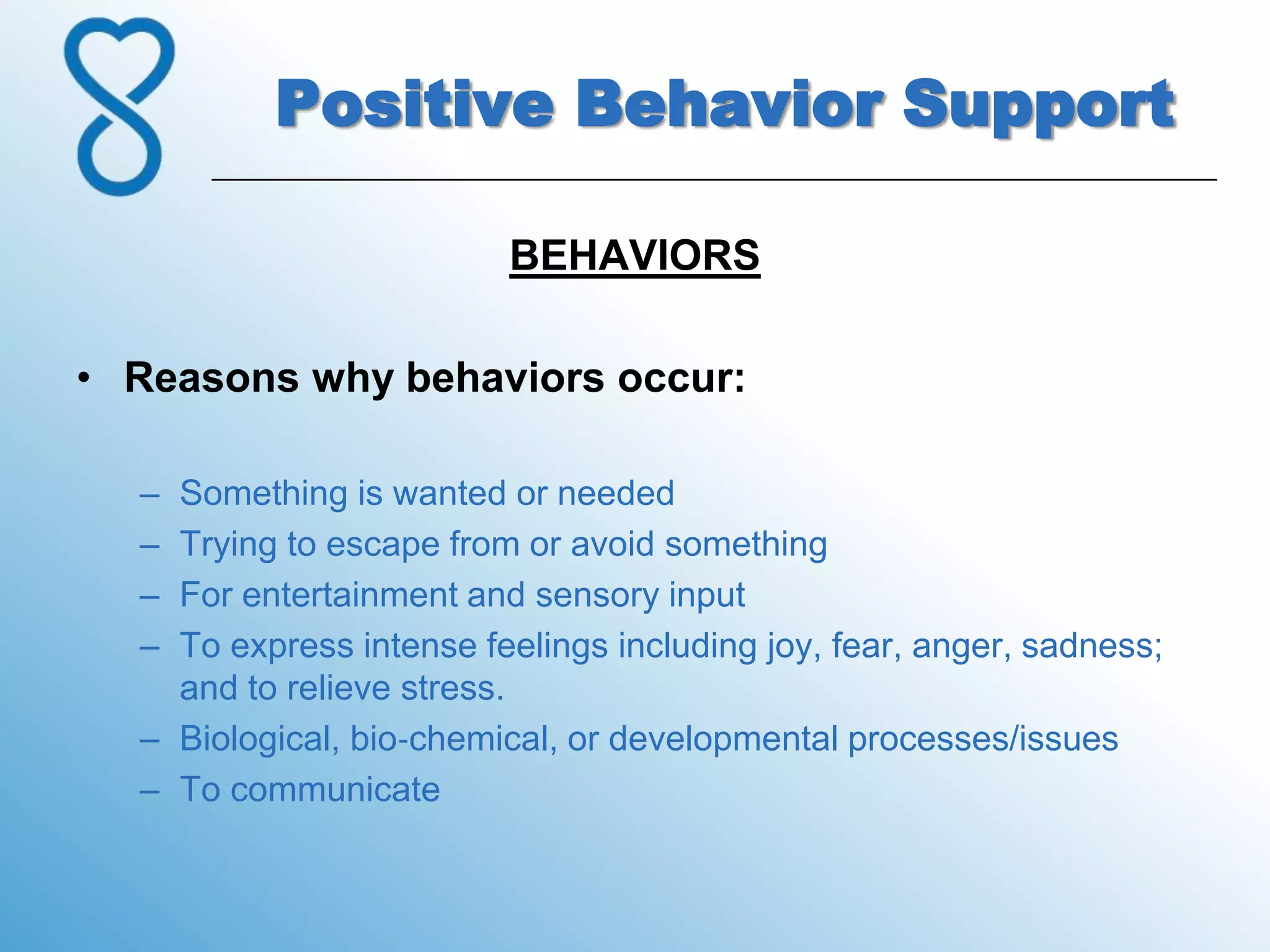
• Reasons why behaviors occur:

  – Something is wanted or needed
  – Trying to escape from or avoid something
  – For entertainment and sensory input
  – To express intense feelings including joy, fear, anger, sadness;
    and to relieve stress.
  – Biological, bio‐chemical, or developmental processes/issues
  – To communicate
Positive Behavior Support

                             SUPPORT

• Identify what works for the Consumer to support
  success:

   – Observe
   – “Listen” to the person (not just with ears, but also with eyes)
   – Listen to others who know the person well
   – Review the documentation (the ISP)
   – Evaluations from professionals (Psychological, Physical
     Therapy, Occupational Therapy, Speech Therapy, Physical
     Exams, Hearing Screenings, etc..)
   – Any behavioral guidelines, analyses, programs
Positive Behavior Support

                              POSITIVE

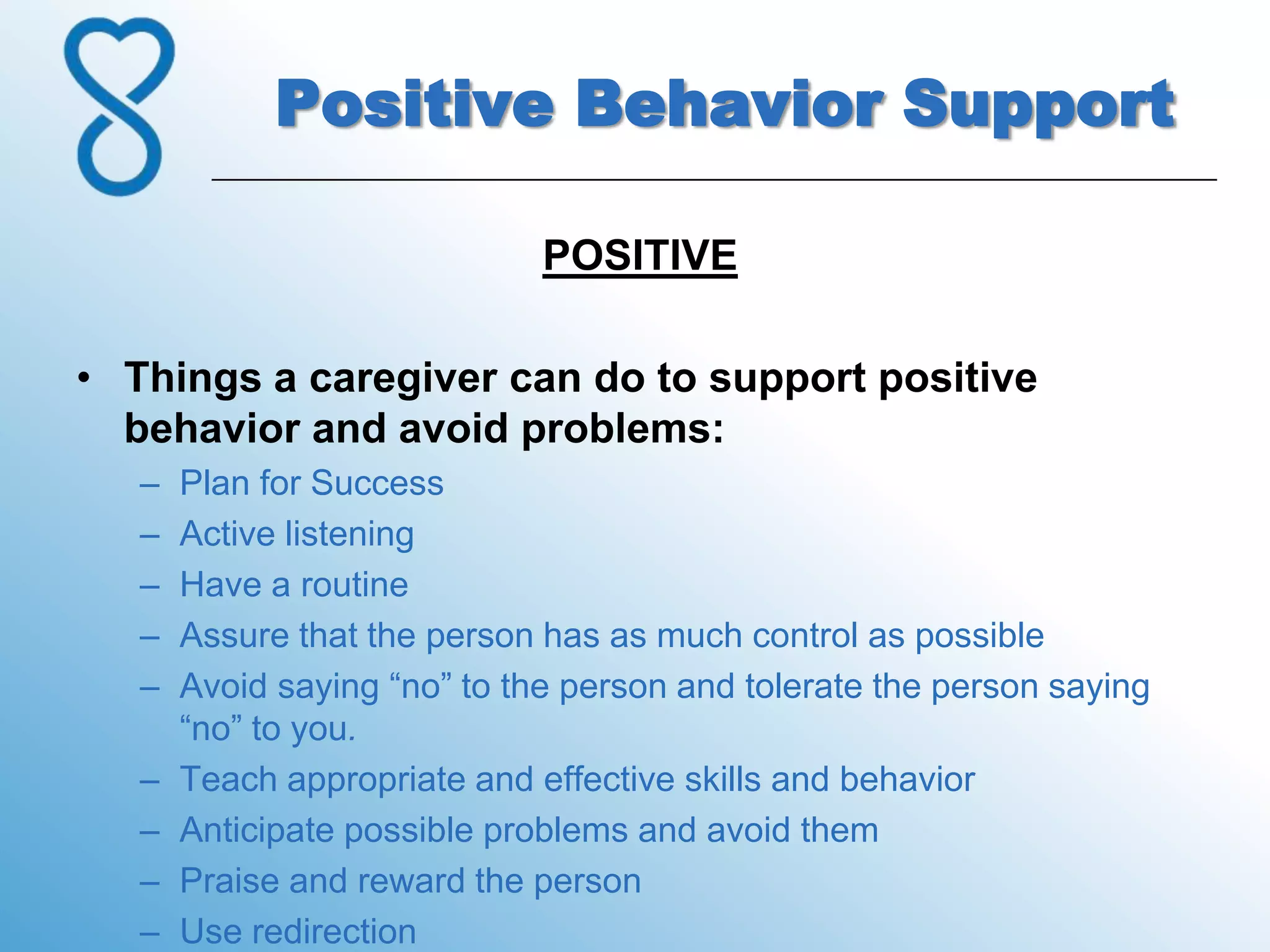
• Things a caregiver can do to support positive
  behavior and avoid problems:
   –   Plan for Success
   –   Active listening
   –   Have a routine
   –   Assure that the person has as much control as possible
   –   Avoid saying “no” to the person and tolerate the person saying
       “no” to you.
   –   Teach appropriate and effective skills and behavior
   –   Anticipate possible problems and avoid them
   –   Praise and reward the person
   –   Use redirection
Positive Behavior Support
                  AVOIDING CONFLICTS

• Avoid power struggles:
  – Work for both people “winning”, both getting at least a part of
    what is wanted/needed.
  – Take a “both/and” approach, not either/or.
  – Do not take the conflict personally.
  – Remember you are not there to dictate or enforce rules, but to
    support and assist.
  – The person should never perceive that they are being punished
    by you.
  – The person should be allowed and encouraged to arrive at
    his/her own acceptable solution.
  – This means that choices and control are given to the individual
    supported.
Positive Behavior Support
                  AVOIDING CONFLICTS

• Do something unexpected:

  – Responding in a unique and unexpected way to the conflict.
  – This can sidestep the conflict for the moment, give both parties
    an opportunity to pause, reconsider and rebuild the collaborative
    relationship and may include laughter.
Positive Behavior Support
                     AVOIDING CONFLICTS

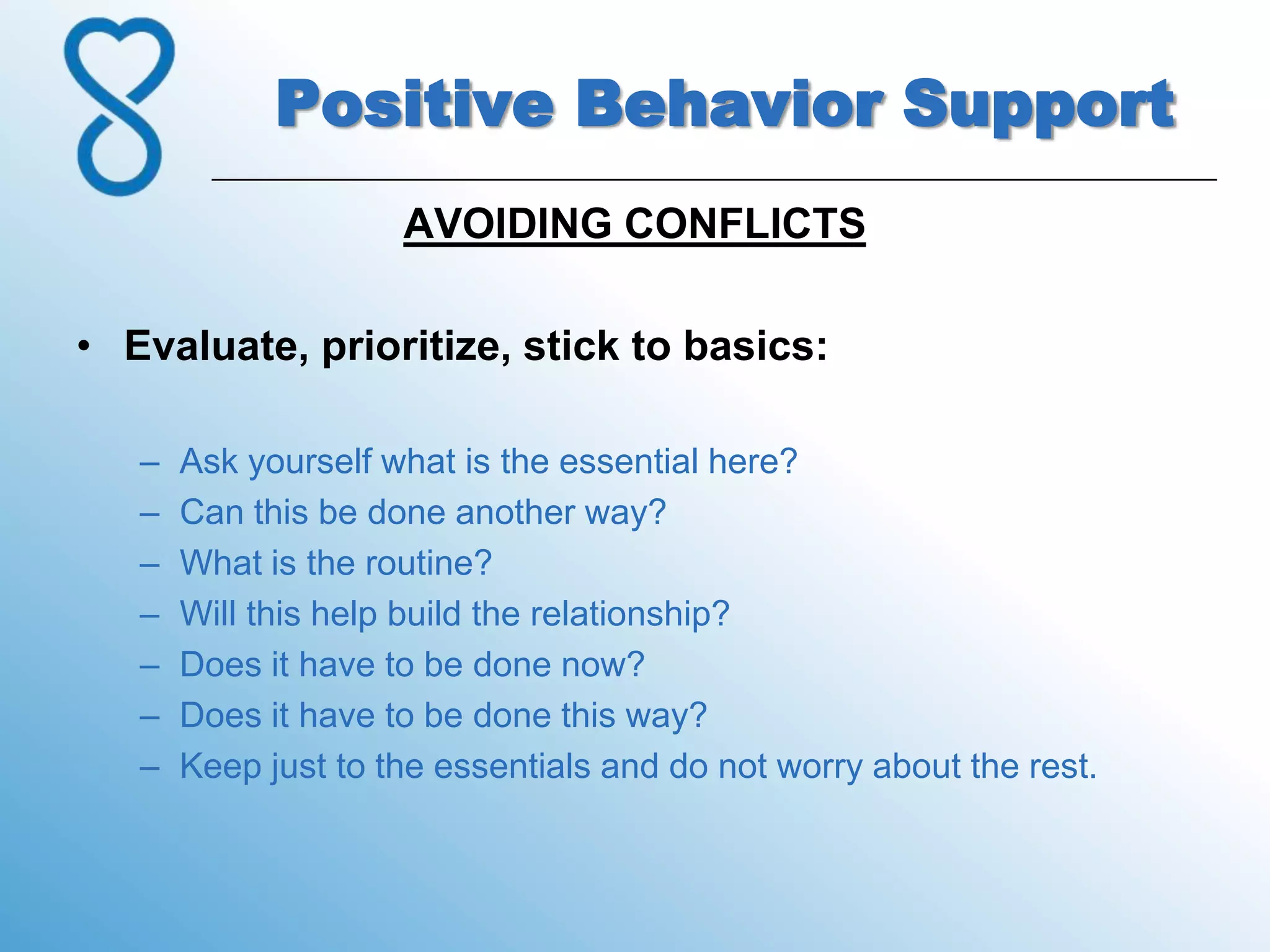
• Evaluate, prioritize, stick to basics:

   –   Ask yourself what is the essential here?
   –   Can this be done another way?
   –   What is the routine?
   –   Will this help build the relationship?
   –   Does it have to be done now?
   –   Does it have to be done this way?
   –   Keep just to the essentials and do not worry about the rest.
Positive Behavior Support
                    AVOIDING CONFLICTS

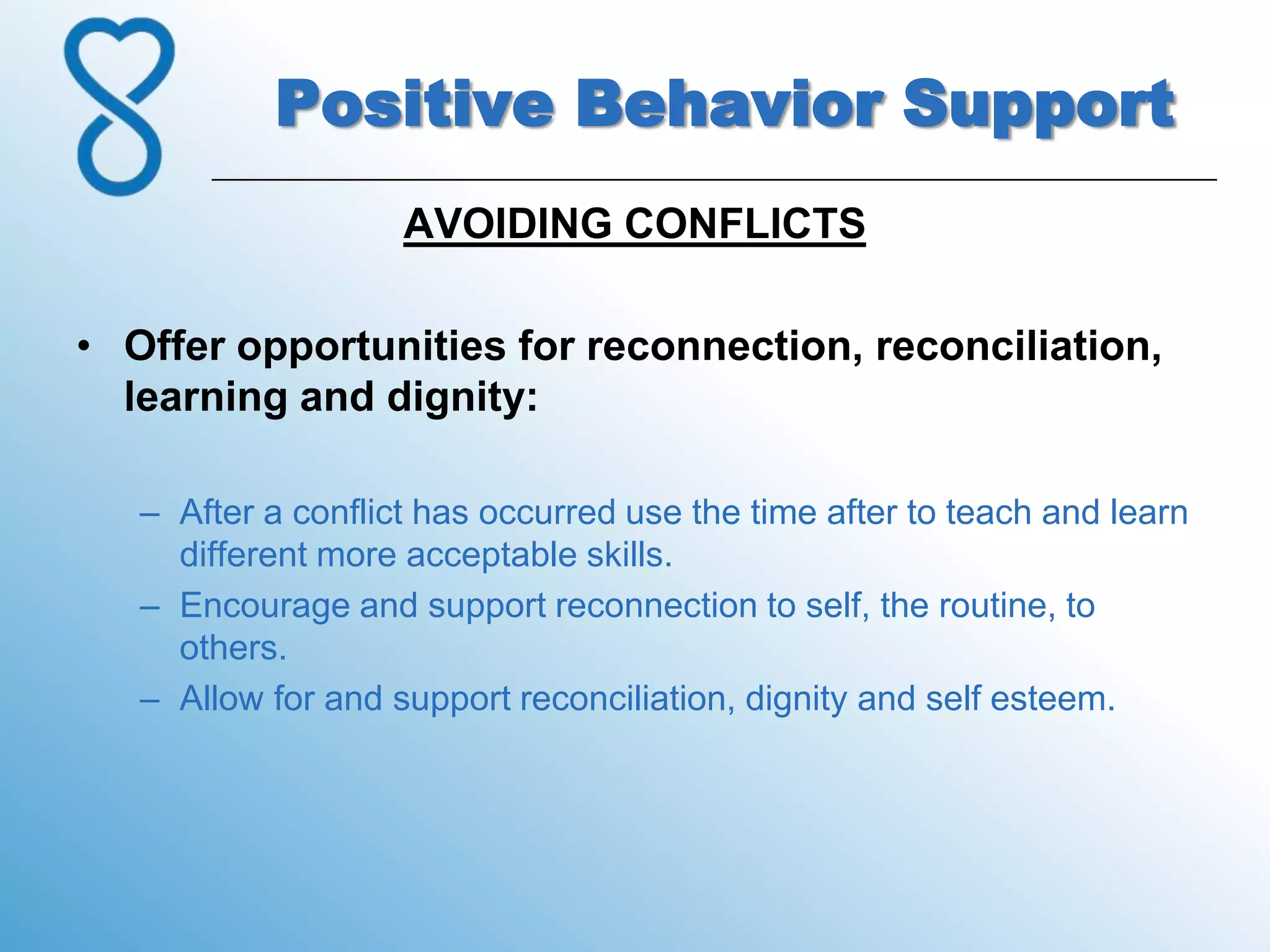
• Offer opportunities for reconnection, reconciliation,
  learning and dignity:

   – After a conflict has occurred use the time after to teach and learn
     different more acceptable skills.
   – Encourage and support reconnection to self, the routine, to
     others.
   – Allow for and support reconciliation, dignity and self esteem.
Positive Behavior Support

                           REDIRECTION

• Describe and role-play redirection and/or avoiding a
  power struggle:

   –   Use a calm, soothing voice
   –   Try soothing touch, this is powerful in conveying a caring attitude
   –   Use short, simple sentences.
   –   Do not argue about statements the person makes.
   –   Respect people's feelings
   –   Try switching to a different activity.

8.positive behavior supports

  • 1.
  • 2.
    Positive Behavior Support BEHAVIORS • Reasons why behaviors occur: – Something is wanted or needed – Trying to escape from or avoid something – For entertainment and sensory input – To express intense feelings including joy, fear, anger, sadness; and to relieve stress. – Biological, bio‐chemical, or developmental processes/issues – To communicate
  • 3.
    Positive Behavior Support SUPPORT • Identify what works for the Consumer to support success: – Observe – “Listen” to the person (not just with ears, but also with eyes) – Listen to others who know the person well – Review the documentation (the ISP) – Evaluations from professionals (Psychological, Physical Therapy, Occupational Therapy, Speech Therapy, Physical Exams, Hearing Screenings, etc..) – Any behavioral guidelines, analyses, programs
  • 4.
    Positive Behavior Support POSITIVE • Things a caregiver can do to support positive behavior and avoid problems: – Plan for Success – Active listening – Have a routine – Assure that the person has as much control as possible – Avoid saying “no” to the person and tolerate the person saying “no” to you. – Teach appropriate and effective skills and behavior – Anticipate possible problems and avoid them – Praise and reward the person – Use redirection
  • 5.
    Positive Behavior Support AVOIDING CONFLICTS • Avoid power struggles: – Work for both people “winning”, both getting at least a part of what is wanted/needed. – Take a “both/and” approach, not either/or. – Do not take the conflict personally. – Remember you are not there to dictate or enforce rules, but to support and assist. – The person should never perceive that they are being punished by you. – The person should be allowed and encouraged to arrive at his/her own acceptable solution. – This means that choices and control are given to the individual supported.
  • 6.
    Positive Behavior Support AVOIDING CONFLICTS • Do something unexpected: – Responding in a unique and unexpected way to the conflict. – This can sidestep the conflict for the moment, give both parties an opportunity to pause, reconsider and rebuild the collaborative relationship and may include laughter.
  • 7.
    Positive Behavior Support AVOIDING CONFLICTS • Evaluate, prioritize, stick to basics: – Ask yourself what is the essential here? – Can this be done another way? – What is the routine? – Will this help build the relationship? – Does it have to be done now? – Does it have to be done this way? – Keep just to the essentials and do not worry about the rest.
  • 8.
    Positive Behavior Support AVOIDING CONFLICTS • Offer opportunities for reconnection, reconciliation, learning and dignity: – After a conflict has occurred use the time after to teach and learn different more acceptable skills. – Encourage and support reconnection to self, the routine, to others. – Allow for and support reconciliation, dignity and self esteem.
  • 9.
    Positive Behavior Support REDIRECTION • Describe and role-play redirection and/or avoiding a power struggle: – Use a calm, soothing voice – Try soothing touch, this is powerful in conveying a caring attitude – Use short, simple sentences. – Do not argue about statements the person makes. – Respect people's feelings – Try switching to a different activity.