Developing Effective School Based Program for Individuals with Autism Spectrum Disorder Sharon A. Reeve, Ph.D., BCBA Caldwell College Director of Graduate Programs in ABA Mary E. McDonald, Ph.D., BCBA Hofstra University Assistant Professor of Special Education
Goals of Today Overview of autism and ABA Components of comprehensive school-based ABA program Sequence of events in developing an educational program for a particular student Integrated curriculum Skill domains Sample assessment Goals selection based on assessment Program development Developing a data sheet Developing a skill acquisition program Writing progress reports
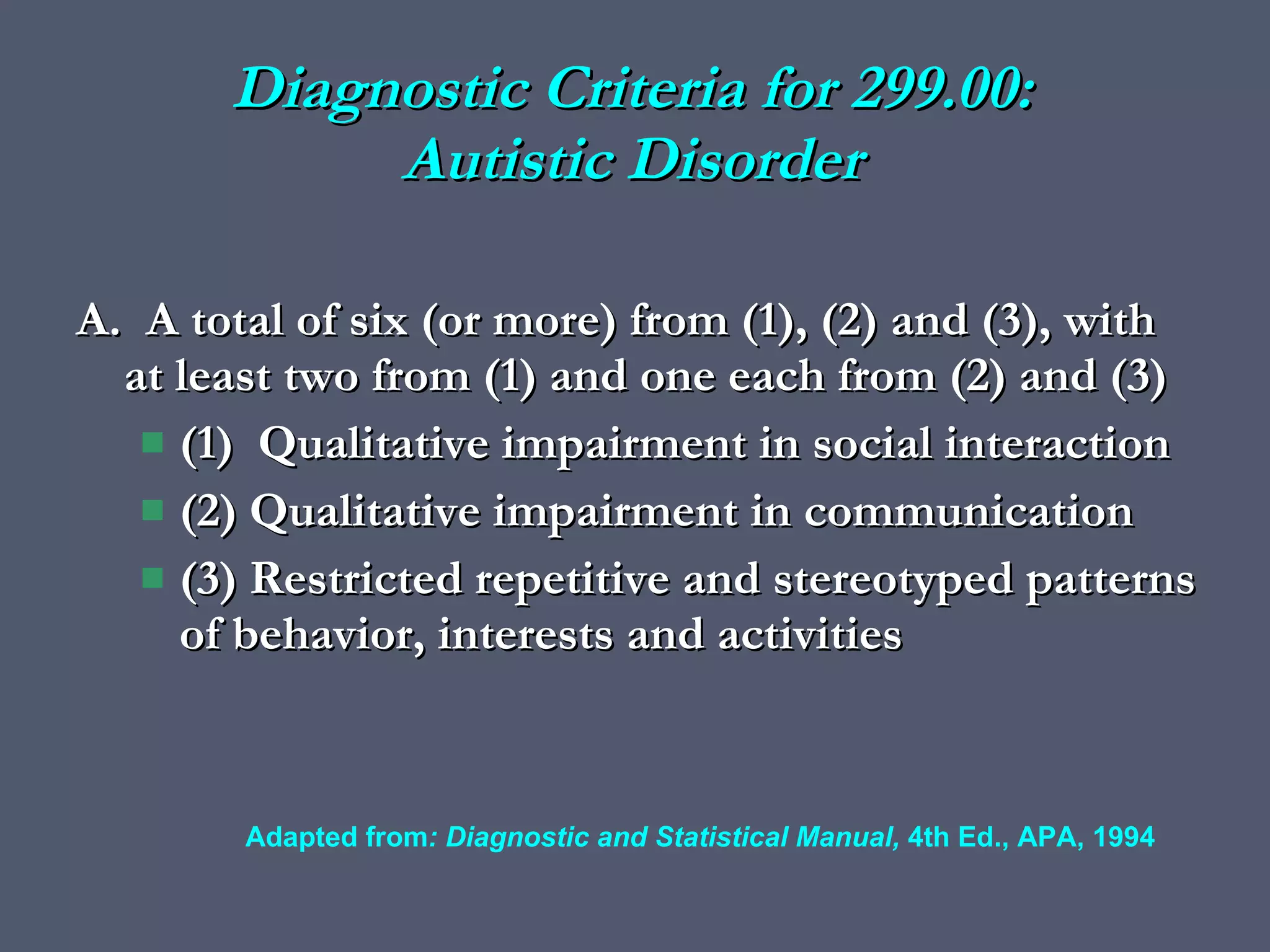
Diagnostic Criteria for 299.00: Autistic Disorder A.  A total of six (or more) from (1), (2) and (3), with at least two from (1) and one each from (2) and (3) (1)  Qualitative impairment in social interaction (2) Qualitative impairment in communication (3) Restricted repetitive and stereotyped patterns of behavior, interests and activities Adapted from : Diagnostic and Statistical Manual,  4th Ed., APA, 1994
Autism and  Pervasive Developmental Disorders Autism is a type of Pervasive Developmental Disorder (PDD)  A child with autism is affected along  multiple  dimensions (Unlike other  single  dimension problems) learning disability, communication disorder, emotional and behavioral disorders
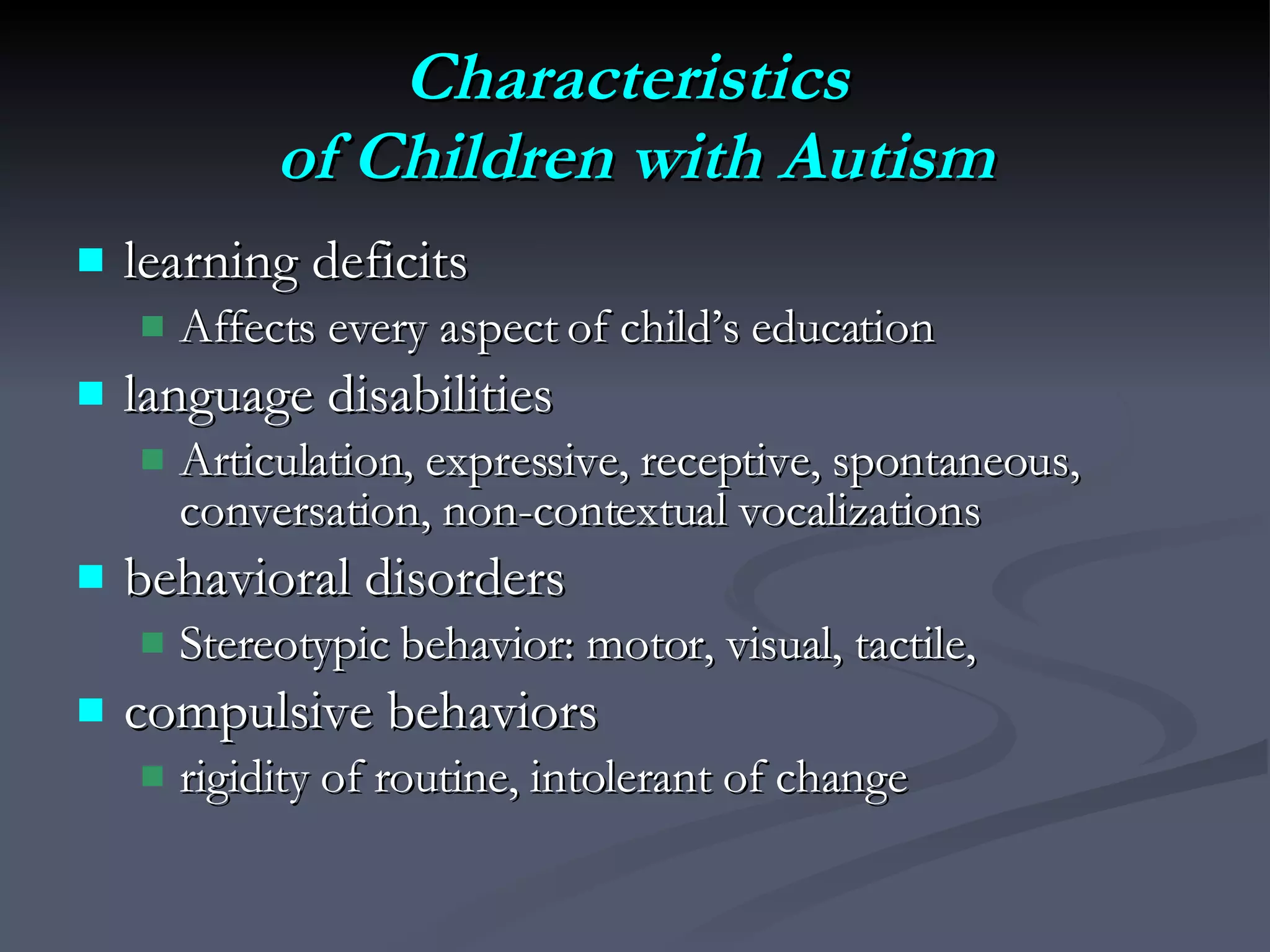
Characteristics  of Children with Autism learning deficits Affects every aspect of child’s education language disabilities Articulation, expressive, receptive, spontaneous, conversation, non-contextual vocalizations behavioral disorders Stereotypic behavior: motor, visual, tactile,  compulsive behaviors rigidity of routine, intolerant of change
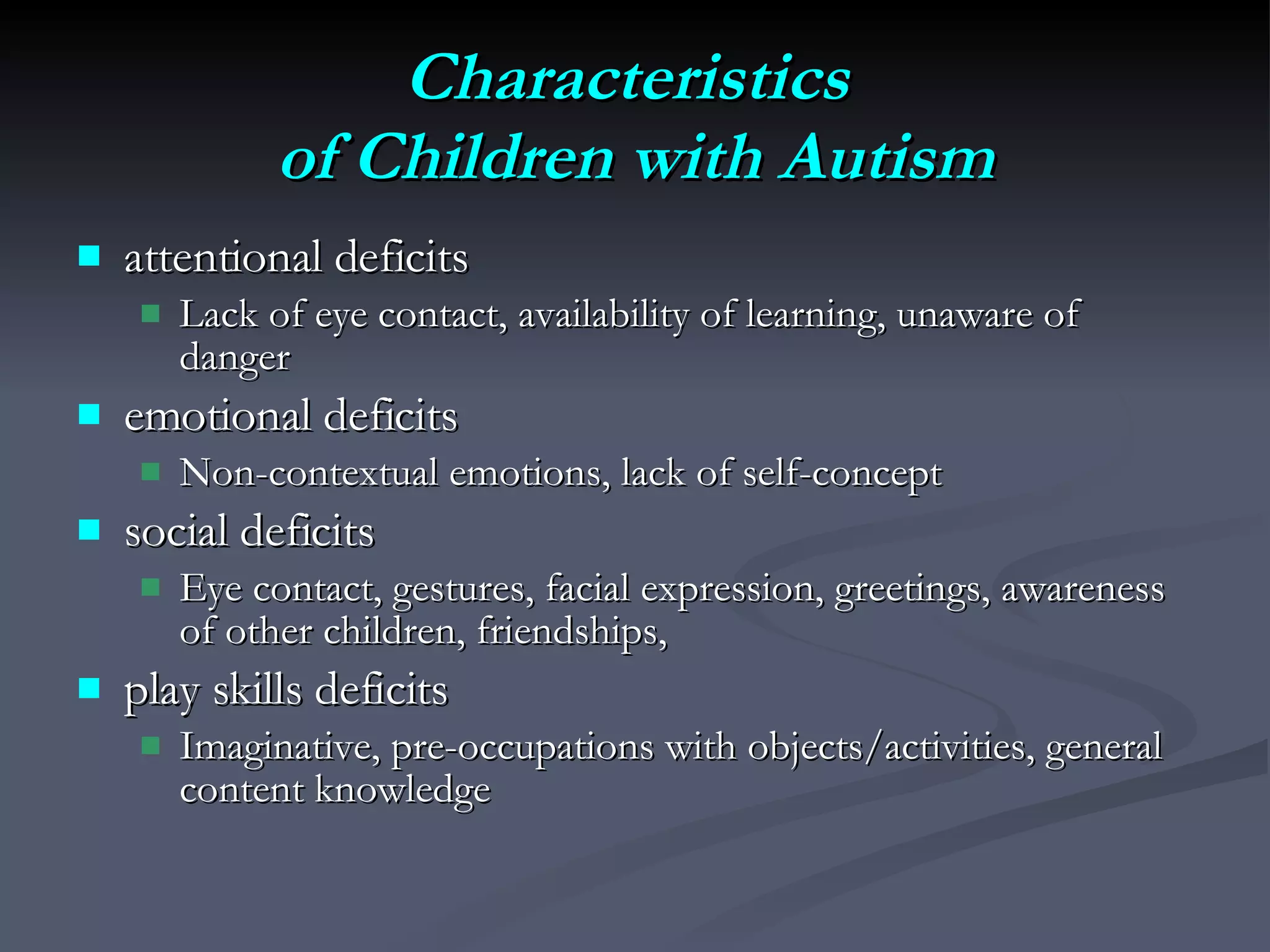
Characteristics  of Children with Autism attentional deficits  Lack of eye contact, availability of learning, unaware of danger emotional deficits Non-contextual emotions, lack of self-concept social deficits Eye contact, gestures, facial expression, greetings, awareness of other children, friendships,  play skills deficits Imaginative, pre-occupations with objects/activities, general content knowledge
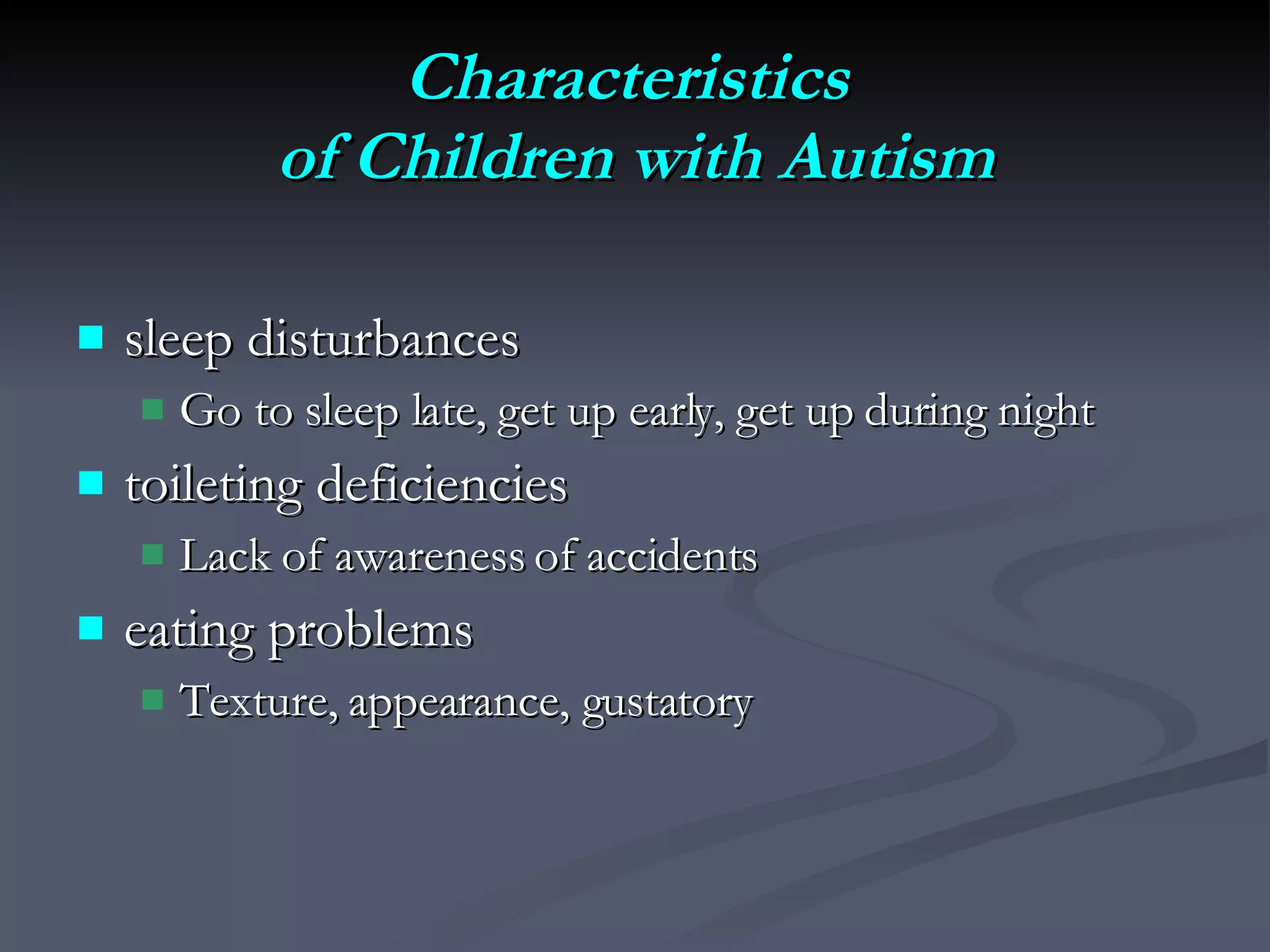
Characteristics  of Children with Autism sleep disturbances Go to sleep late, get up early, get up during night toileting deficiencies Lack of awareness of accidents eating problems Texture, appearance, gustatory
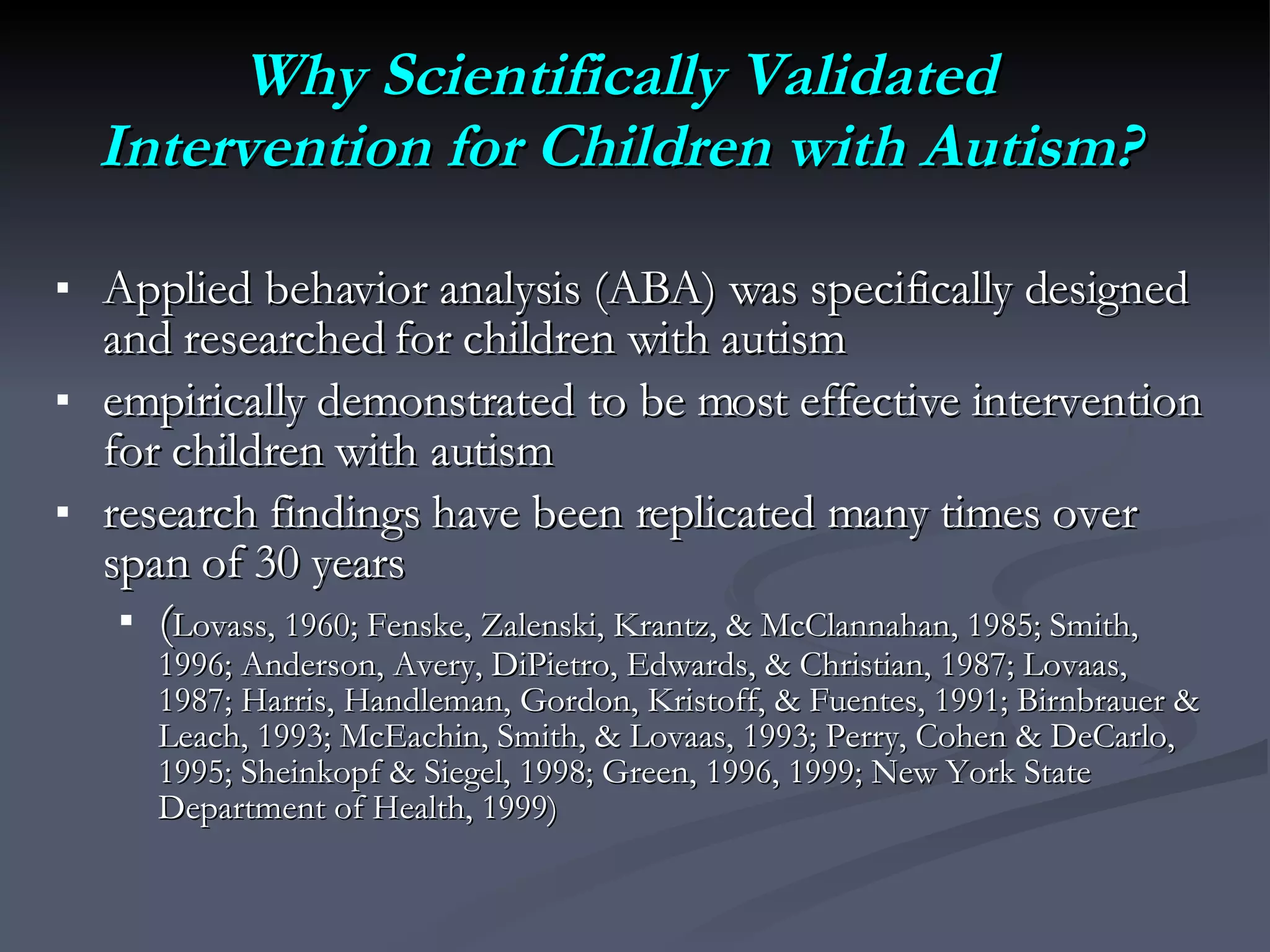
Why Scientifically Validated Intervention for Children with Autism? Applied behavior analysis (ABA) was specifically designed and researched for children with autism empirically demonstrated to be most effective intervention for children with autism research findings have been replicated many times over span of 30 years ( Lovass, 1960; Fenske, Zalenski, Krantz, & McClannahan, 1985; Smith, 1996; Anderson, Avery, DiPietro, Edwards, & Christian, 1987; Lovaas, 1987; Harris, Handleman, Gordon, Kristoff, & Fuentes, 1991; Birnbrauer & Leach, 1993; McEachin, Smith, & Lovaas, 1993; Perry, Cohen & DeCarlo, 1995; Sheinkopf & Siegel, 1998; Green, 1996, 1999; New York State Department of Health, 1999)
What Makes a Scientifically Validated Treatment Intervention for Children with Autism Effective? The science of ABA is a flexible and powerful enough to address every aspect/dimension of the disorder every aspects of the child’s life Over 500 studies published in peer-reviewed research journals about teaching many specific skills to children with autism using principles of applied behavior analysis General skill domains include: gross motor, fine motor, speech and language, reading, math, leisure, social, self-help and independence In addition, we have dozens of teaching procedures that have shown to be effective and additional teaching procedures continue to be developed and refined
Applied Behavior Analysis   Applied behavior analysis (ABA) is: A  science   Teaching procedures derived from learning principles  Teaching procedures systematically applied Teaching procedures geared to improve socially significant behavior Requires experimental demonstration that the teaching  procedures employed were responsible for the improvement in behavior (accountability)
Components of Comprehensive  School-Based ABA Program Individualized Skill Assessment and Goal Selection Individualized Teaching Programs Individualized Curriculum Individualized Data Collection Assessing Progress Of Each Skill On-going Hands-on Staff Training Workshop Training School Visits Home Visits Related Services Evaluation of Program Effectiveness
Components of Comprehensive  School-Based ABA Program INDIVIDUALIZED SKILL ASSESSMENT AND GOAL SELECTION   (Bondy, 1996; Jacobson, 2001) First several weeks after child enters program  Skills assessed in all domains: gross- and fine-motor skills, academics, pre-requisite learning skills, self-help, independence, receptive and expressive language, non-productive behavior that interferes with learning, and leisure skills Updated on a continual basis Goals selected by parents, teacher, speech therapist, occupational therapist, and school psychologist
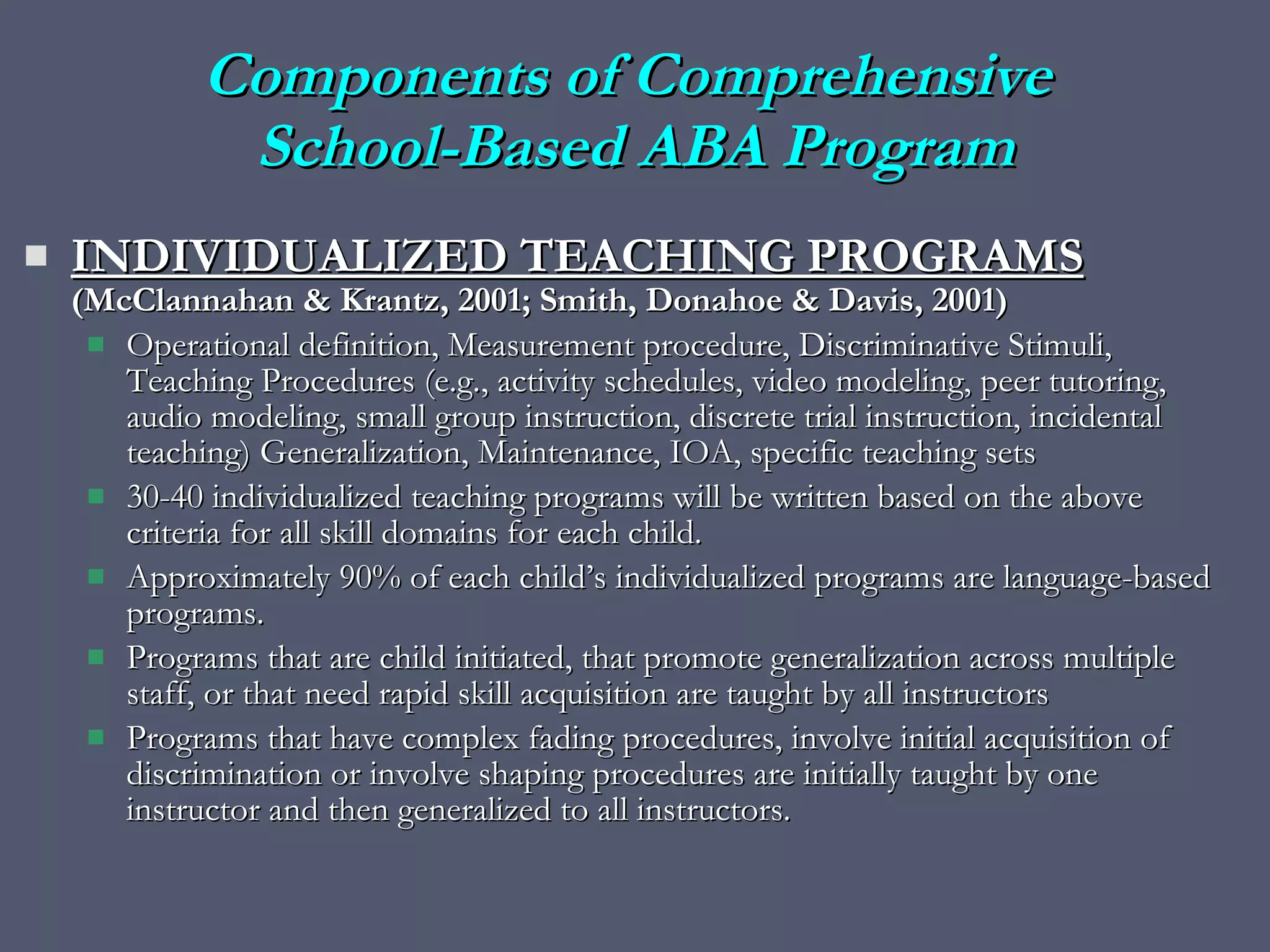
Components of Comprehensive  School-Based ABA Program INDIVIDUALIZED TEACHING PROGRAMS   (McClannahan & Krantz, 2001; Smith, Donahoe & Davis, 2001) Operational definition, Measurement procedure, Discriminative Stimuli, Teaching Procedures (e.g., activity schedules, video modeling, peer tutoring, audio modeling, small group instruction, discrete trial instruction, incidental teaching) Generalization, Maintenance, IOA, specific teaching sets 30-40 individualized teaching programs will be written based on the above criteria for all skill domains for each child.  Approximately 90% of each child’s individualized programs are language-based programs. Programs that are child initiated, that promote generalization across multiple staff, or that need rapid skill acquisition are taught by all instructors Programs that have complex fading procedures, involve initial acquisition of discrimination or involve shaping procedures are initially taught by one instructor and then generalized to all instructors.
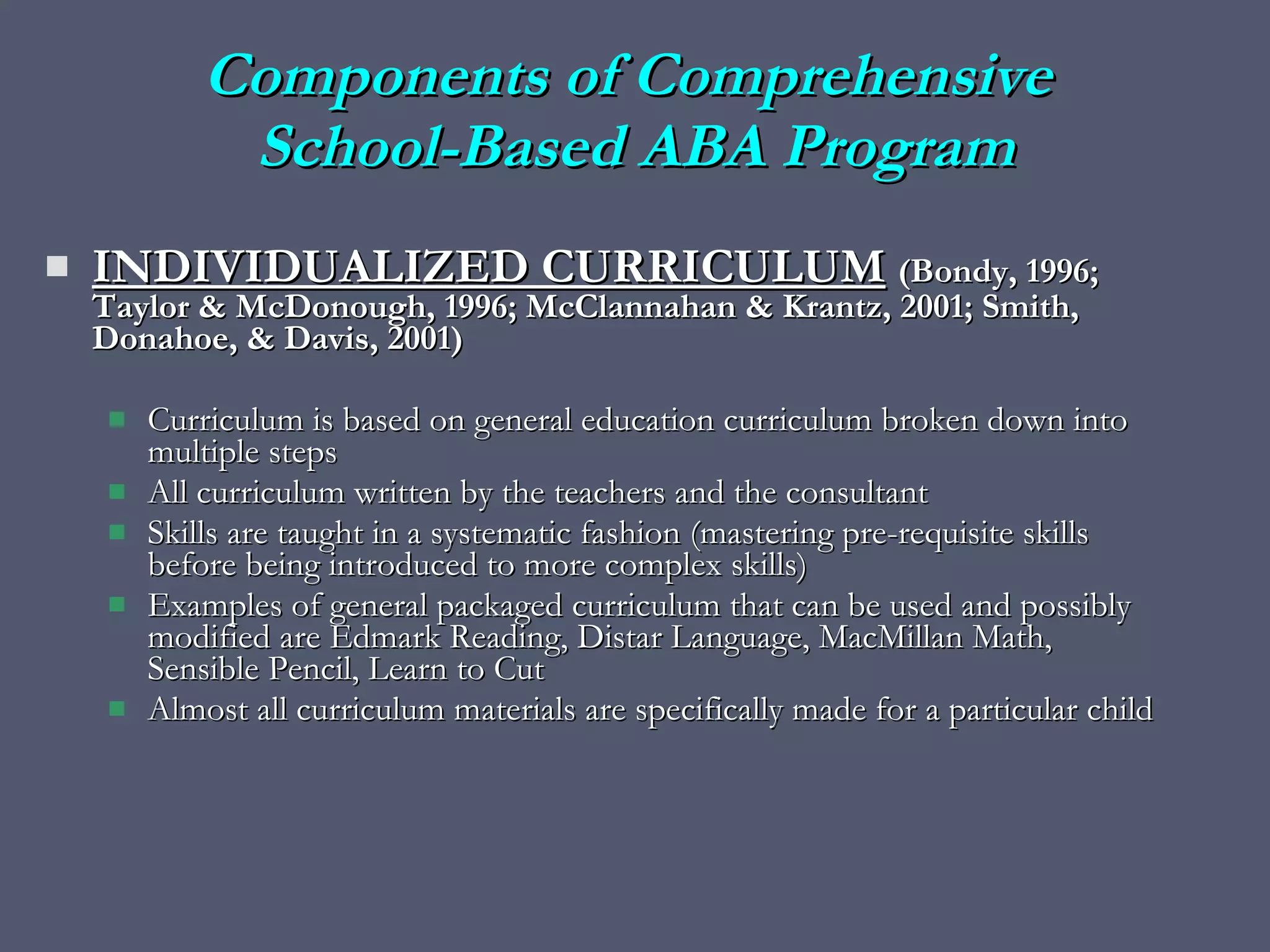
INDIVIDUALIZED CURRICULUM   (Bondy, 1996; Taylor & McDonough, 1996; McClannahan & Krantz, 2001; Smith, Donahoe, & Davis, 2001) Curriculum is based on general education curriculum broken down into multiple steps All curriculum written by the teachers and the consultant  Skills are taught in a systematic fashion (mastering pre-requisite skills before being introduced to more complex skills) Examples of general packaged curriculum that can be used and possibly modified are Edmark Reading, Distar Language, MacMillan Math, Sensible Pencil, Learn to Cut Almost all curriculum materials are specifically made for a particular child Components of Comprehensive  School-Based ABA Program
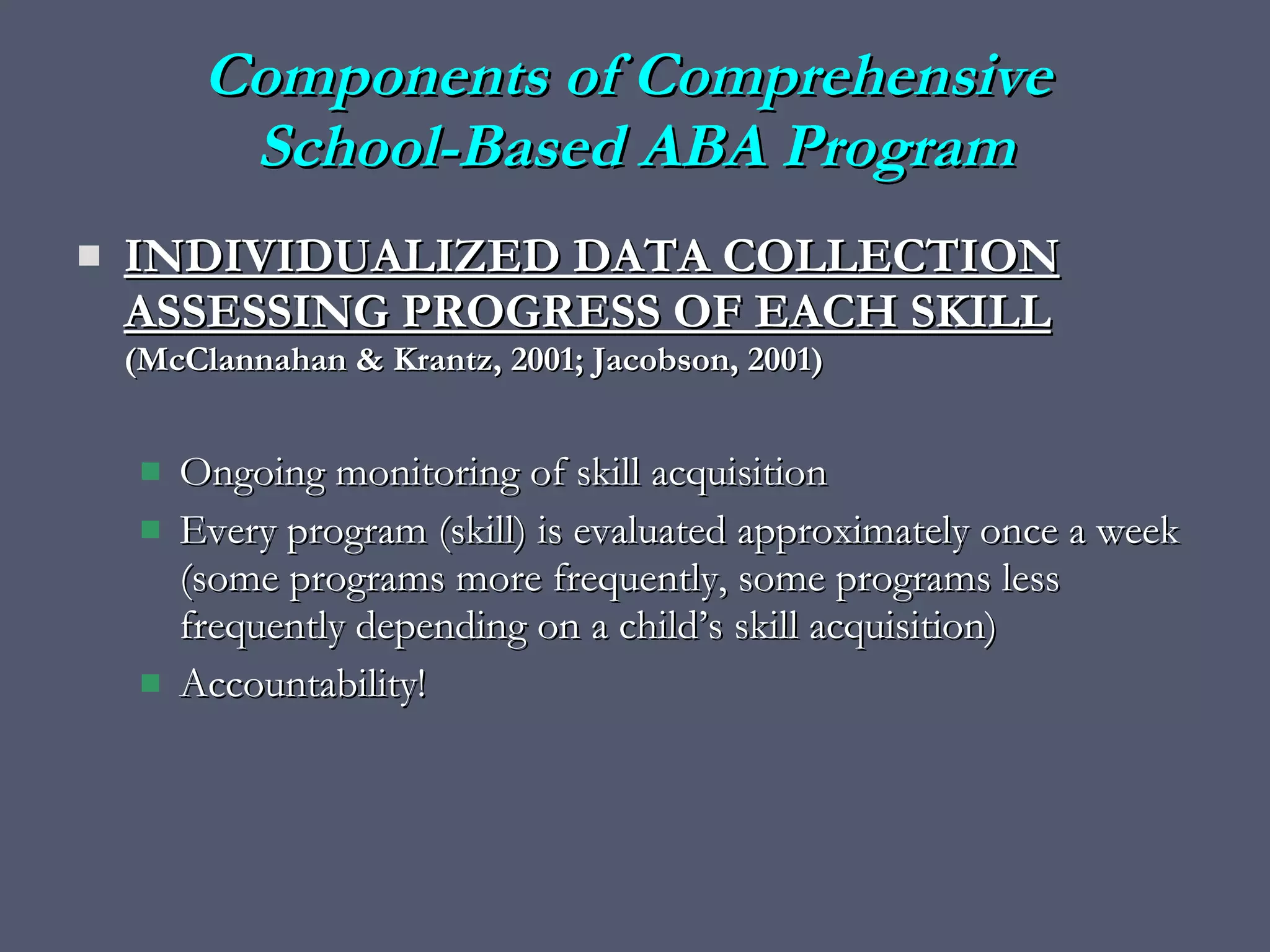
INDIVIDUALIZED DATA COLLECTION ASSESSING PROGRESS OF EACH SKILL   (McClannahan & Krantz, 2001; Jacobson, 2001) Ongoing monitoring of skill acquisition Every program (skill) is evaluated approximately once a week (some programs more frequently, some programs less frequently depending on a child’s skill acquisition) Accountability! Components of Comprehensive  School-Based ABA Program
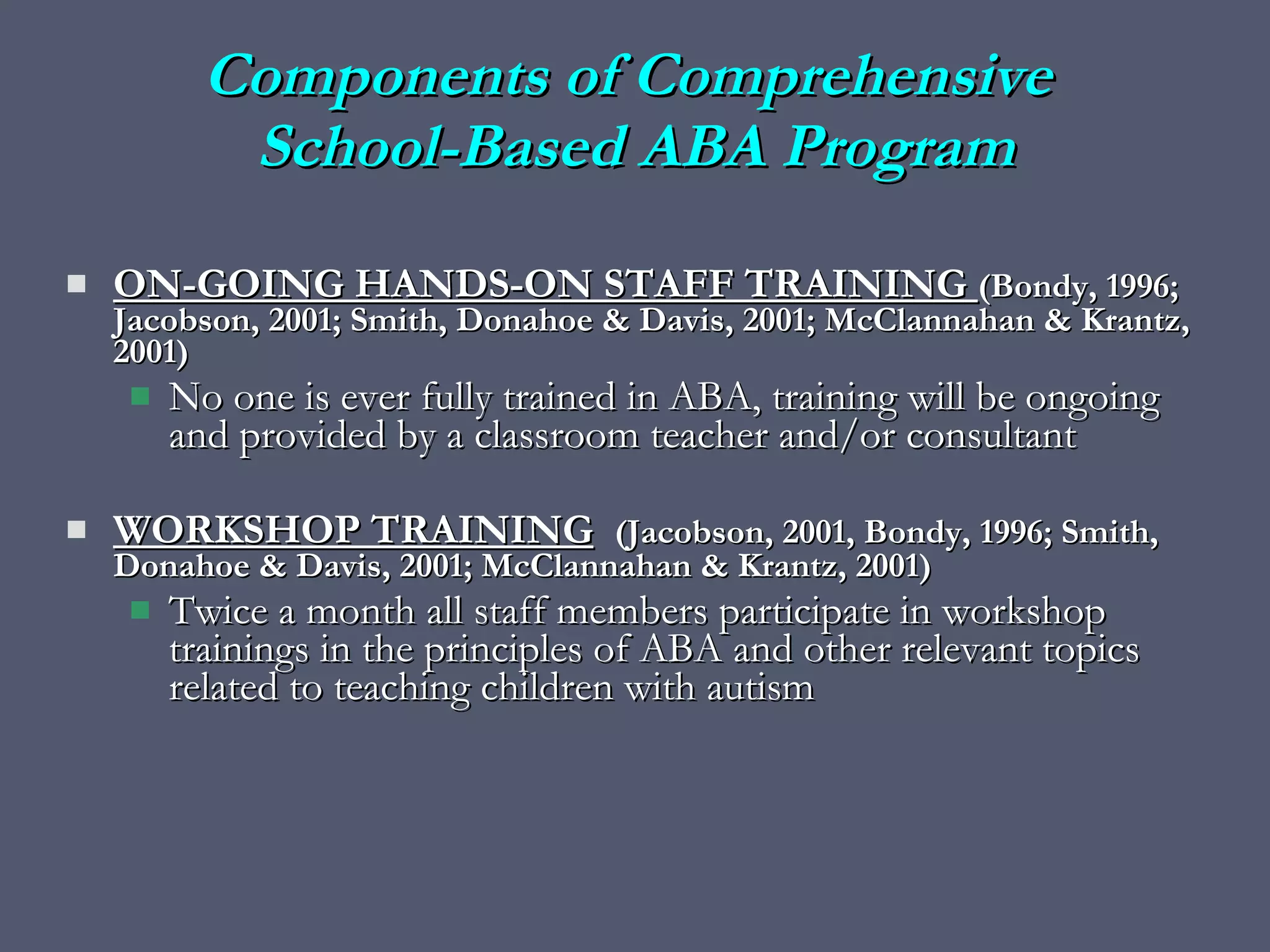
ON-GOING HANDS-ON STAFF TRAINING  (Bondy, 1996; Jacobson, 2001; Smith, Donahoe & Davis, 2001; McClannahan & Krantz, 2001) No one is ever fully trained in ABA, training will be ongoing and provided by a classroom teacher and/or consultant WORKSHOP TRAINING   (Jacobson, 2001, Bondy, 1996; Smith, Donahoe & Davis, 2001; McClannahan & Krantz, 2001) Twice a month all staff members participate in workshop trainings in the principles of ABA and other relevant topics related to teaching children with autism Components of Comprehensive  School-Based ABA Program
SCHOOL VISITS   (McClannahan & Krantz, 2001; Jacobson, 2001; Bondy, 1996) Bi-monthly school visits in which parents will receive training in teaching their child various skills During school visits parents access to child’s data notebook and can monitor progress Workshop training several times per year Components of Comprehensive  School-Based ABA Program
HOME VISITS   (McClannahan & Krantz, 2001; Smith, Donahoe & Davis, 2001; Bondy, 1996) Home visits provided at least monthly by classroom teacher Child’s progress will be reviewed  Training provided in areas specific to home (e.g., going to dentist, doctor, mall, grocery store; eating; sleeping; leisure skills; language skills) Any instructional staff hired by the parents at home has the opportunity to receive training several times per week by the school program.  Recommend that approximately 20 hours of training with child  at school  before home staff teaches the child  at home . Components of Comprehensive  School-Based ABA Program
RELATED SERVICES :  Many ABA techniques shown to be effective for increasing and improving language and communication in children with autism (e.g., activity schedules, audio modeling, video modeling, PECS)  (Skinner, 1957; Lovaas, 1977, 1987; McGee, Krantz, & McClannahan, 1985; Sundberg & Partington, 1998; McClannahan & Krantz, 1999; New York State Department of Health, 1999; Bondy & Frost, 1994; Fenske, Krantz, & McClannahan, 2001; Rappaport, 2001; Reeve, Reeve, Poulson, & Buffington-Townsend, manuscript in preparation). When teaching children with autism, related services have been shown to be maximally effective when delivered using the principles of ABA  (Jacobson, 2000; Smith, 1993; New York State Department of Health, 1999; Bondy, 1996; Romanczyk, Lockshin,& Matey, 2001; Meyer, Taylor, Levin, & Fisher, 2001).  Components of Comprehensive  School-Based ABA Program
Evaluation of Program Effectiveness   (McClannahan & Krantz, 2004) Engagement with Activities with Other Persons Opportunities to Respond Behavior-Descriptive Praise Relationship Building Children’s Hygiene and Personal Appearance Social Competence  Inappropriate Behavior Family Participation in Intervention  Components of Comprehensive  School-Based ABA Program
Direct Care Team Membership Consultant/Director  Provides supervision for teacher Helps teacher develop goals and objectives for each child Helps teacher develop data management system to evaluate effectiveness of each child’s program Provides direction for the development of curriculum Trains teacher in effective individualized teaching procedures  Provides frequent hands-on training to all instructional staff Provides workshop training for all team members Periodically accompanies teacher and/or instructional aide on home visits Consults with and brings in other doctoral level professionals in the field when necessary
Direct Care Team Membership Teacher/Trainers Enrollment in BCBA-approved program and certified in special ed Develops individualized programs for each child Manages all data collection systems to ensure program effectiveness for each child Creates individualized curriculum to accompany each program for each child Provides hands-on training to instructional aides and the implementation of individualized programs for each child Provides hands-on training to parents and any person that frequently interacts with the child Teaches each child
Direct Care Team Membership Instructional Aides Training in applied behavior analysis (ABA) and autism Continually receives hands-on training  Teaches all children in the classroom rotating approximately every half hour Serve as data analyst for one child Prepares individualized curriculum for one specific child May be selected by consultant and teacher to provide home visits and training on home staff
Direct Care Team Membership Parents Active participation in annual home and school selection of goals and objectives for their child Active participation in hands-on training in how to effectively keep their child engaged in productive activity at home and in the community, increase child’s direction following skills, and maximize their child’s use of language at home and/or whatever other area parent requests training in Receives workshop training in specific areas of applied behavior analysis
Assessment Most of what we do is child-specific.  There is no one correct sequence or number of steps or number of pre-requisite skills.  The is no “one size fits all”.  One of the hallmarks of applied behavior analysis is its focus on the identification of goals and the development of educational interventions specifically tailored for individual learners.
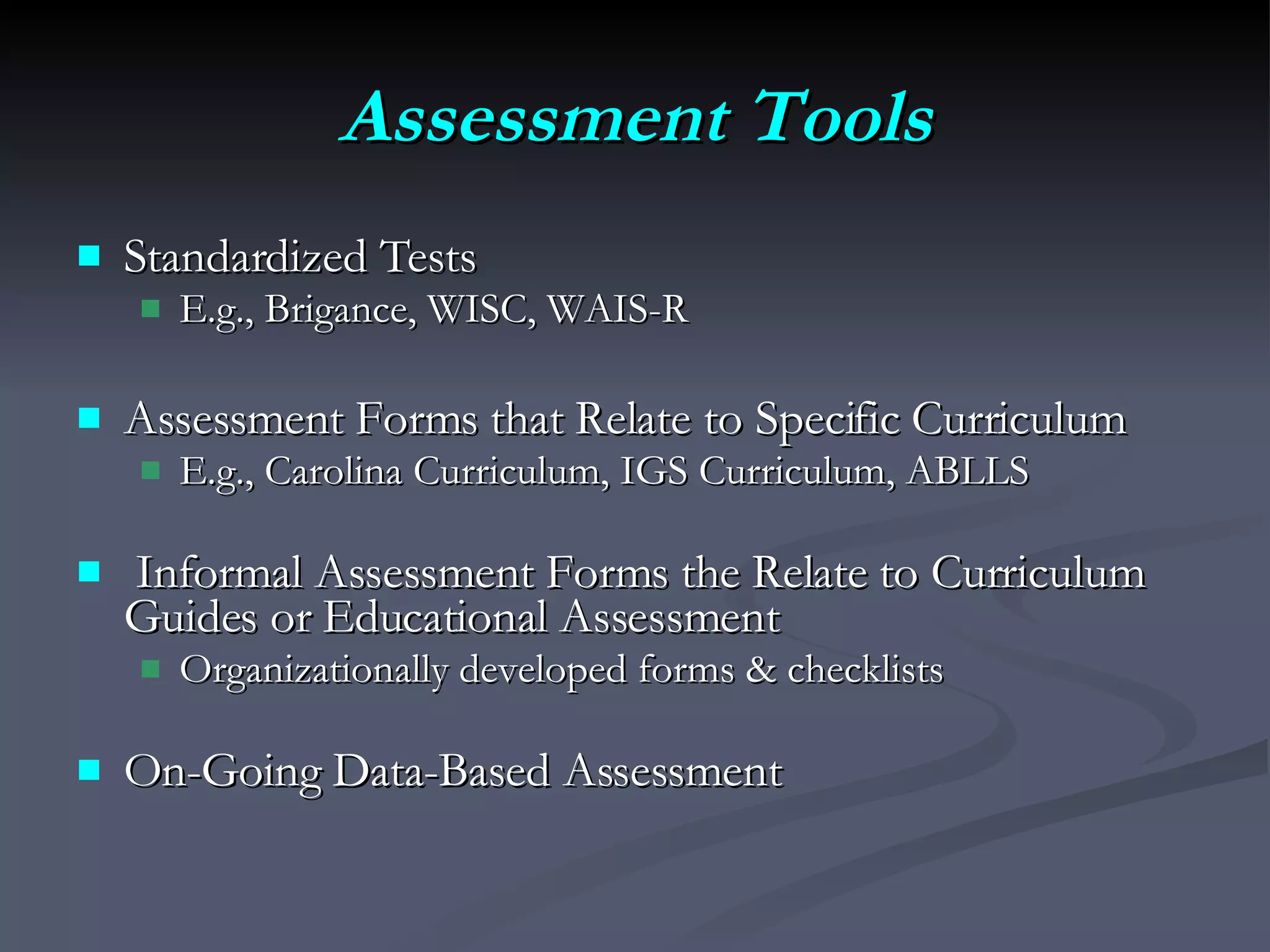
Assessment Tools Standardized Tests E.g., Brigance, WISC, WAIS-R  Assessment Forms that Relate to Specific Curriculum E.g., Carolina Curriculum, IGS Curriculum, ABLLS Informal Assessment Forms the Relate to Curriculum Guides or Educational Assessment Organizationally developed forms & checklists On-Going Data-Based Assessment
Which One? All of them can be helpful We will focus on i nformal assessment forms the relate to curriculum guides or educational assessments Why? Enables us to develop a comprehensive and individualized educational program for a child with autism
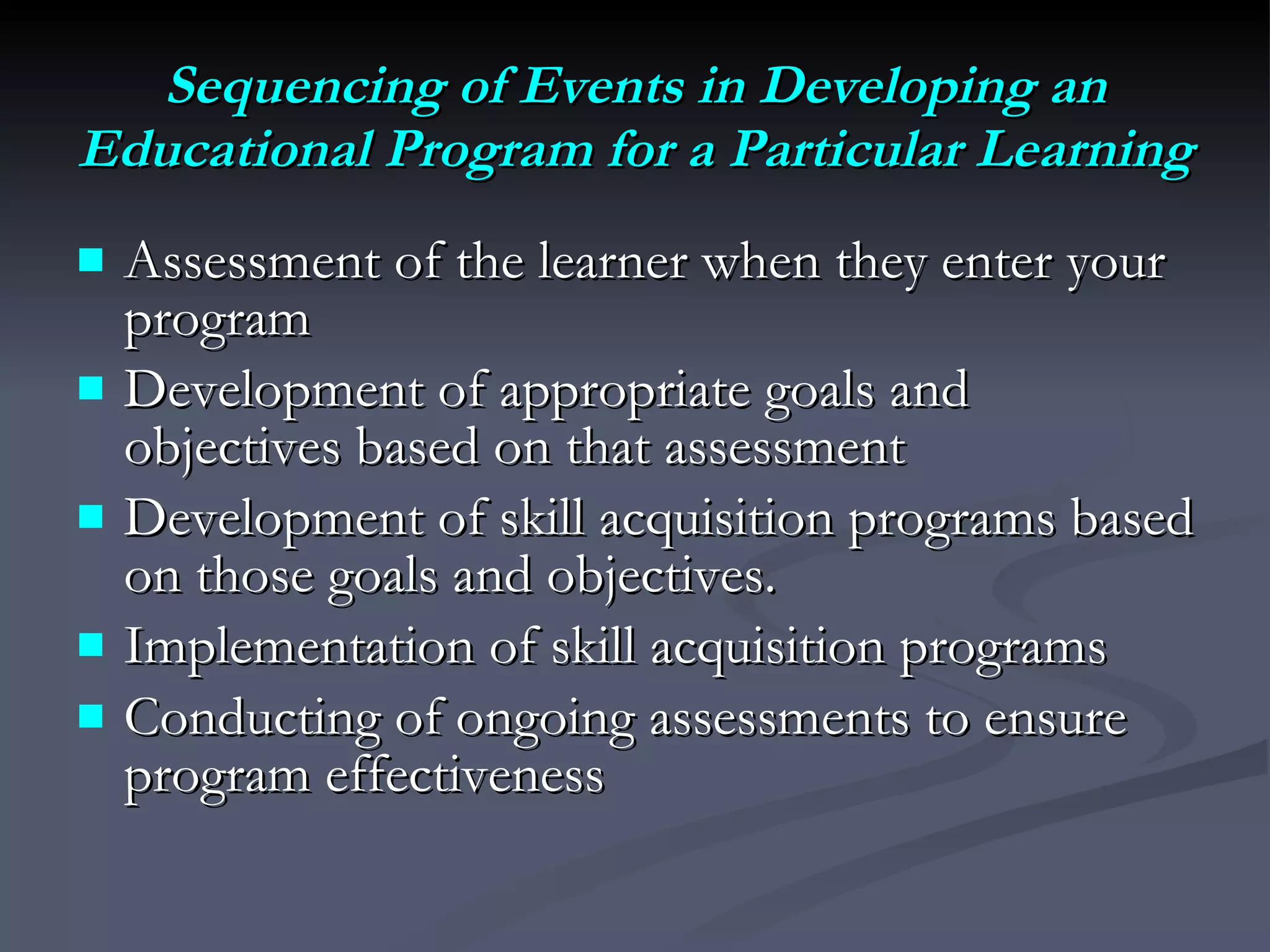
Sequencing of Events in Developing an Educational Program for a Particular Learning Assessment of the learner when they enter your program Development of appropriate goals and objectives based on that assessment  Development of skill acquisition programs based on those goals and objectives.  Implementation of skill acquisition programs Conducting of ongoing assessments to ensure program effectiveness
Effective Because? Comprehensive All skill domains are addressed Integrated the same tools are used for each and every component, from initial assessment to program development Continuum of services     ---------------------------------    General  Specific Individualized  Ongoing development of educational program for a particular consumer One size does not fit all
Integrated Curriculum Not simply a reference or a rigid linear sequence,  It is a curriculum that is fully integrated into The assessment,  Selection of goals and objectives,  Development of program  Implementation of the program Ongoing evaluation of educational program It is a work in progress because you are always developing additional individualized programs specific to a particular learner.
Integrated Curriculum A curriculum is a framework based on the general education curriculum to determine appropriate sequencing for each child.  There is no instructional sequence that is appropriate for each child.  Often children with autism have splinter skills  May not learn in a developmental sequence
Integrated Curriculum One must always choose goals in a context and take into consideration: Age appropriateness  Level of skill in each skill domain Criterion level of each skill .
Skill Domains Expressive Language Receptive Language  Social and Peer Interaction Skills  Gross Motor Skills Fine Motor Skills  Academics Math Reading
Skill Domains Leisure Independence Self-Care and Home-Living Skills Community Living  Vocational Skills Transition Motivational system Non-productive Behavior
Expressive Language Speech Verbal imitation of phonemes, words & phrases, delayed imitation, imitation of audio/video prompt, volume, inflection/intonation, prosody, simple sentences Spontaneous Requesting, gestures, polite-positive language
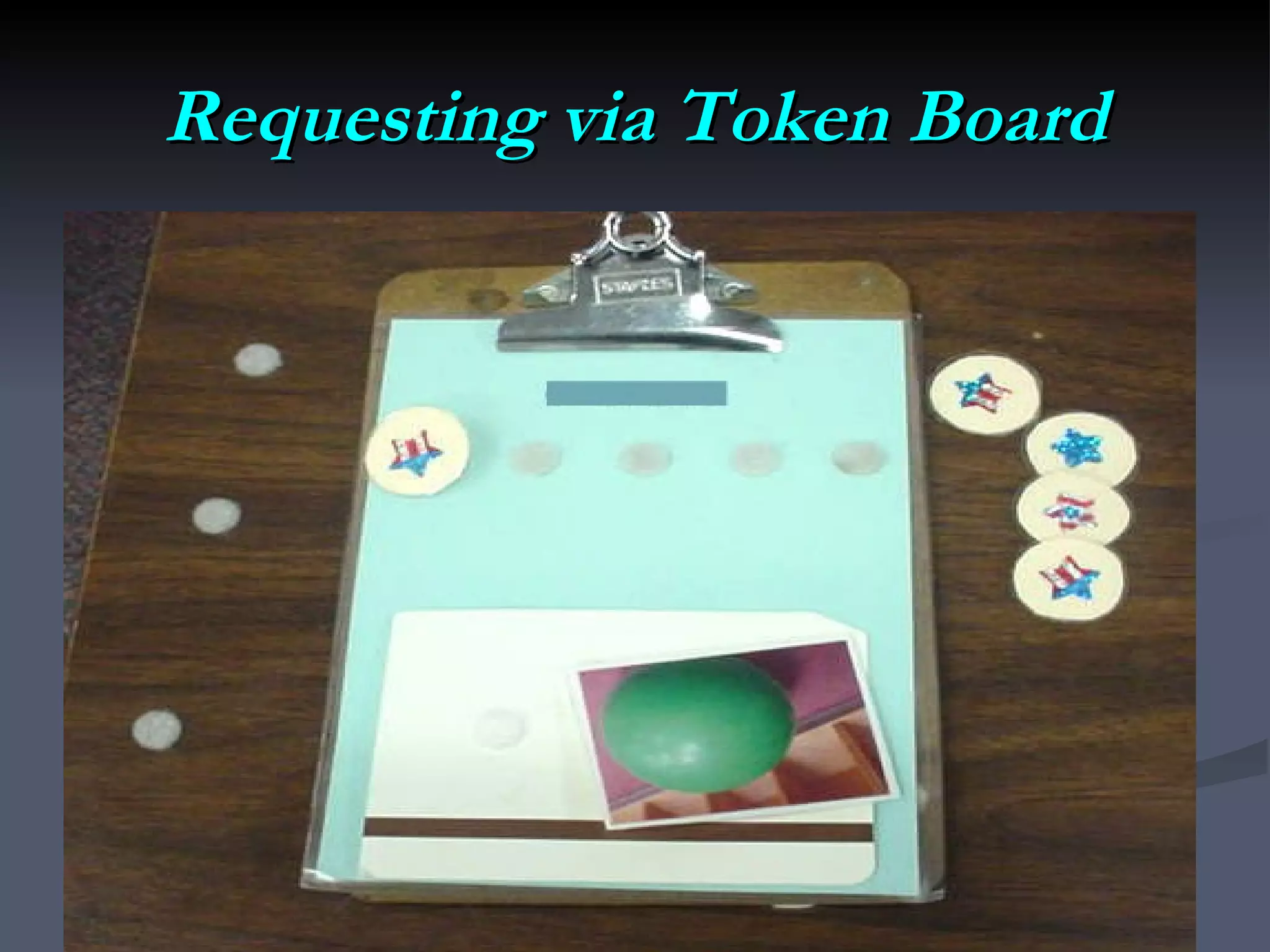
Requesting via Token Board
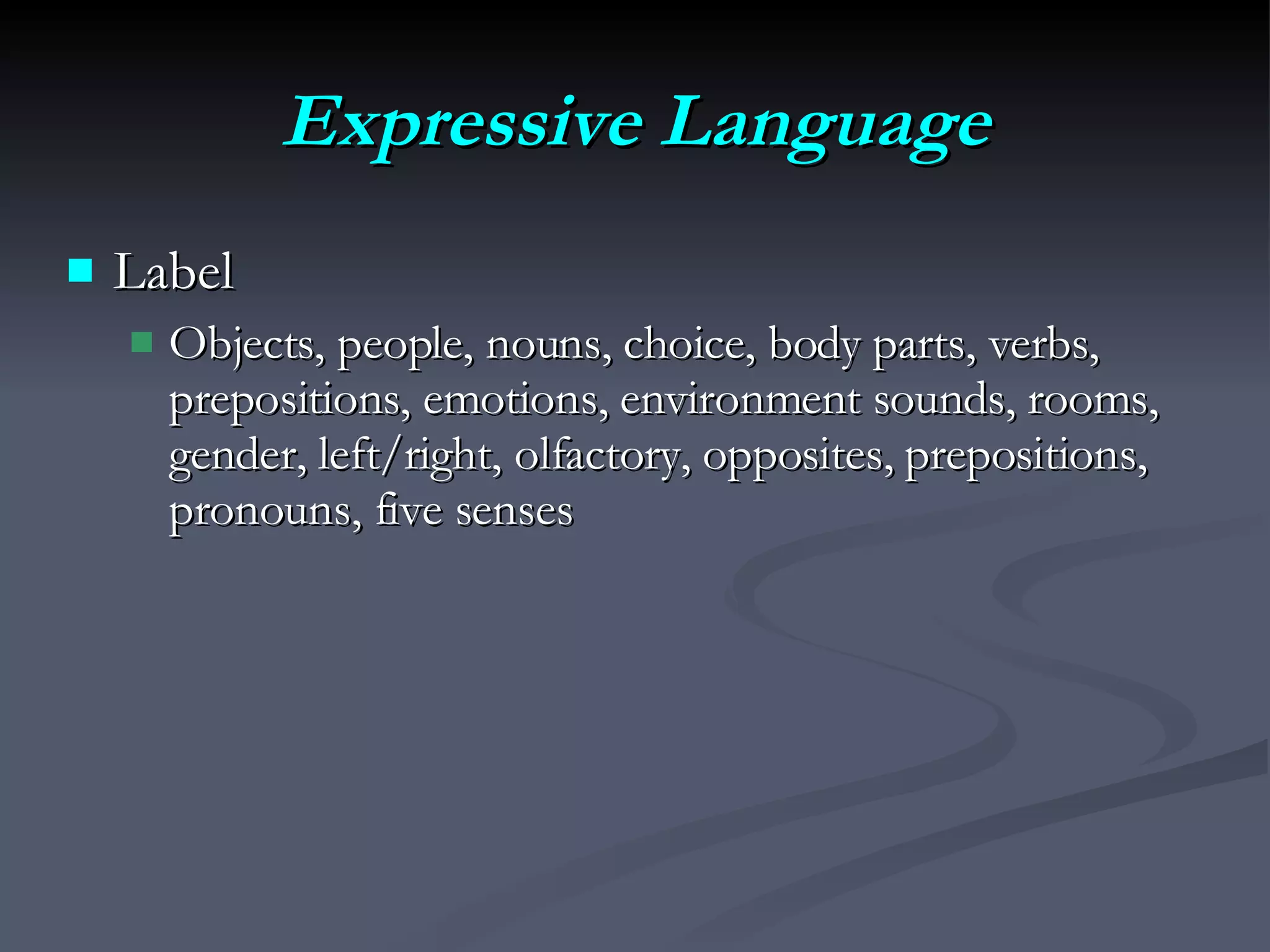
Expressive Language Label Objects, people, nouns, choice, body parts, verbs, prepositions, emotions, environment sounds, rooms, gender, left/right, olfactory, opposites, prepositions, pronouns, five senses
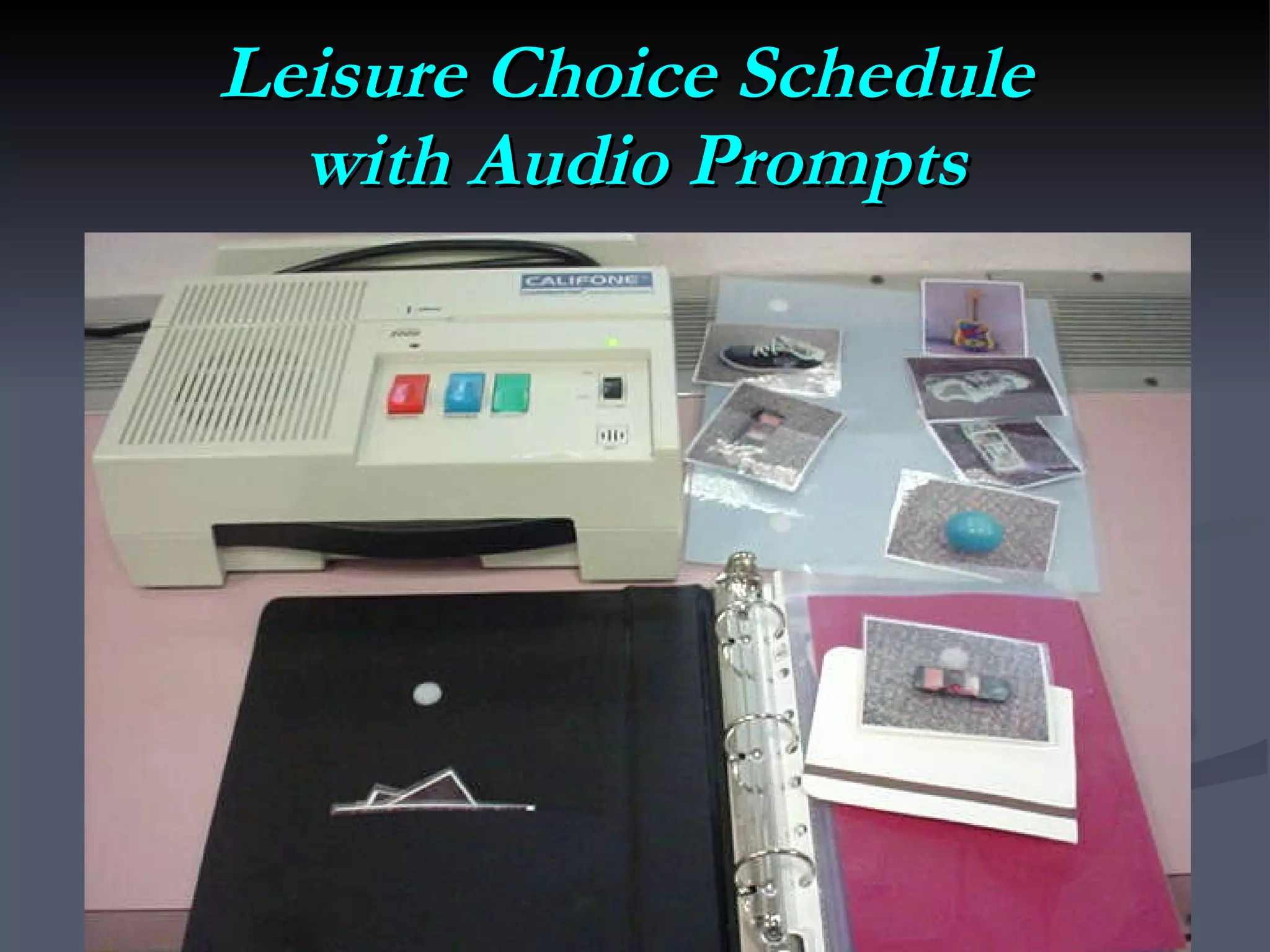
Leisure Choice Schedule  with Audio Prompts
Expressive Language Description Objects, occupations, animals, using adjectives, olfactory, photo album
Expressive Language Answering questions General information, yes/no, analogies, what’s missing, what’s wrong, distar language (video), acknowledgement, remote events, recalling information, social stories
Building Initial Token Systems Earning five stickers video
Expressive Language Category & Concepts Colors, attributes/adjectives, names of, functions, concepts, same/different Conversation giving items, delivering a message, reciprocal language, verbal reasoning, interaction, topical, during meals, recalling events, riddles
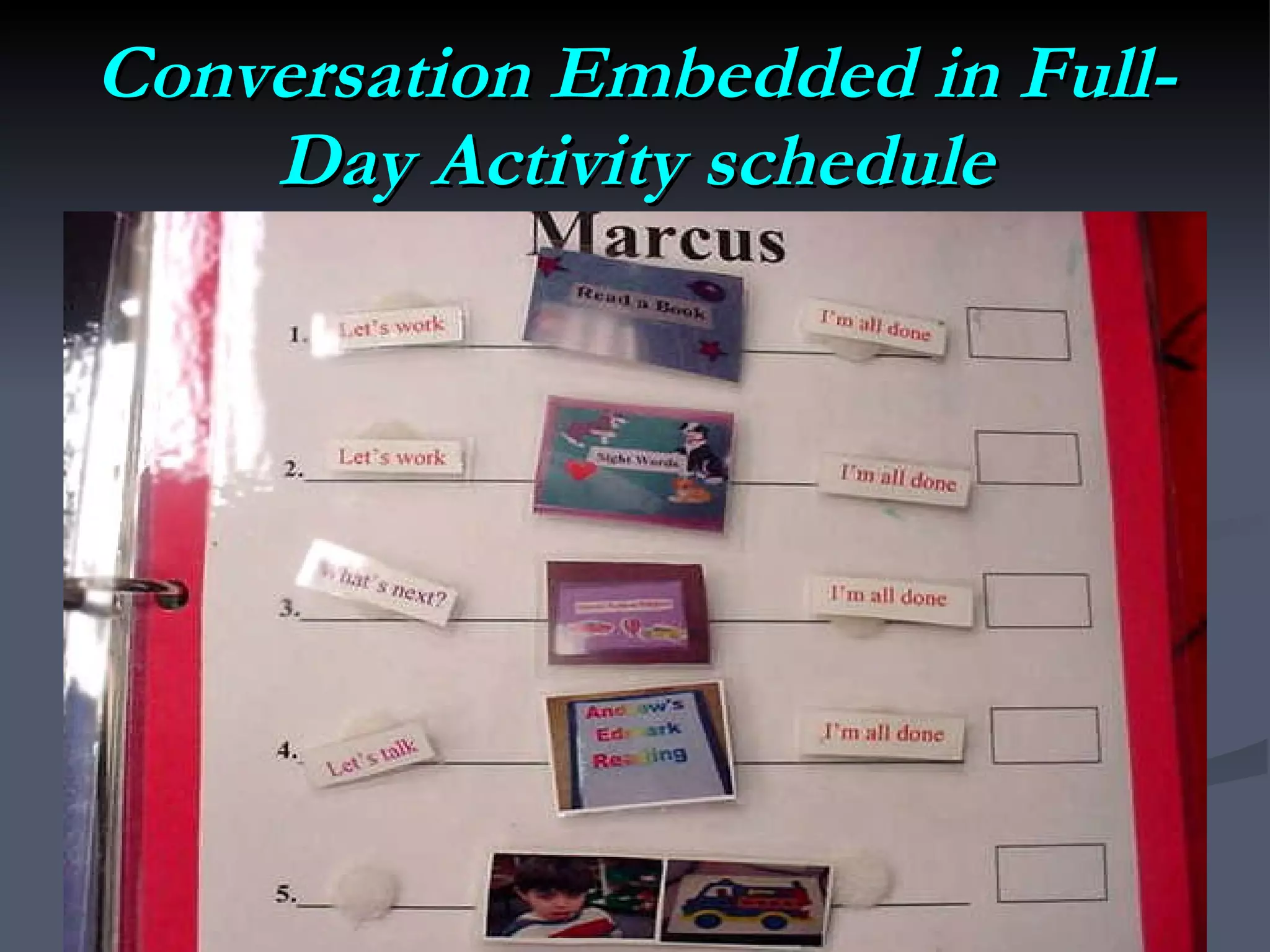
Conversation Embedded in Full-Day Activity schedule
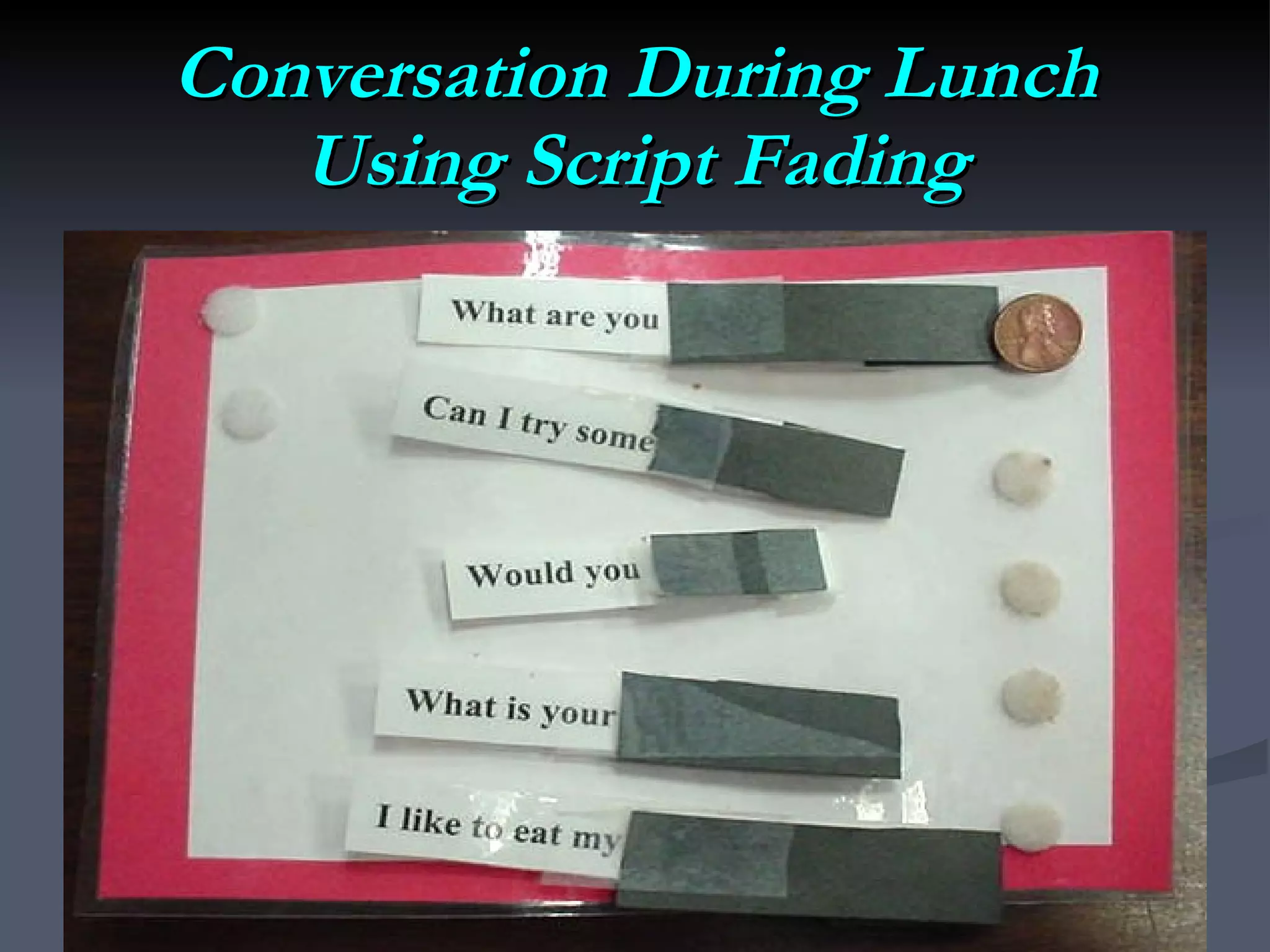
Conversation During Lunch Using Script Fading
Expressive Language Question asking Obtaining information, locating objects,
Receptive Language Direction following Pointing, One-step, multi-step, performs actions/emotions, if-then statements, temporal concepts, written directions Identification Objects, people, nouns, choice, body parts, verbs, prepositions, emotions, environment sounds, rooms, gender, left/right Categories/Concepts Colors, attributes/adjectives, categories, functions, concepts  Imitation Gross-motor, fine-motor, video models, imitation of songs/story time (video), simon says
Early Small-Group Video
Receptive Language Matching  Identity, picture/object, sorting identical object, sorting non-identical pictures
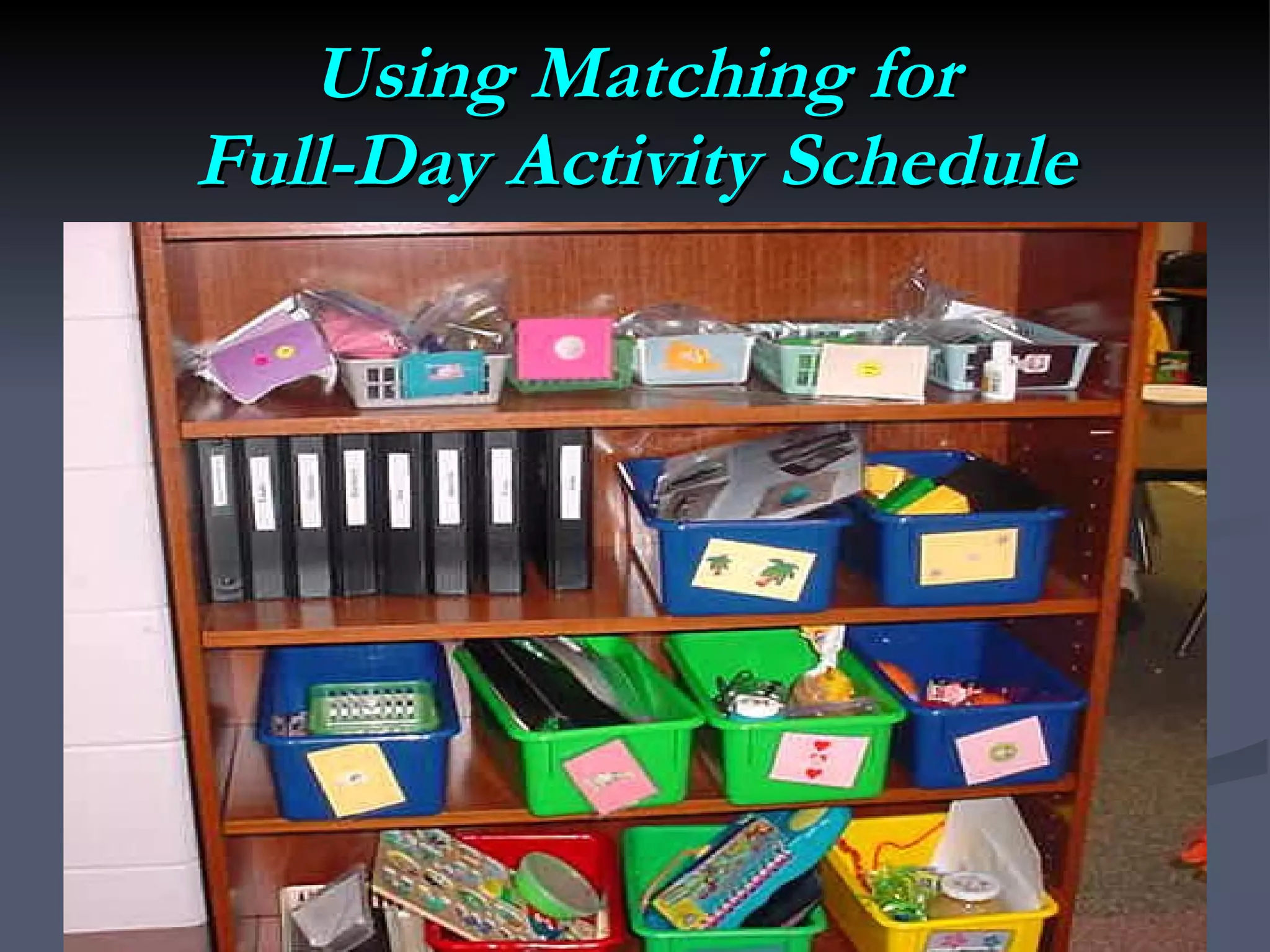
Using Matching for Full-Day Activity Schedule
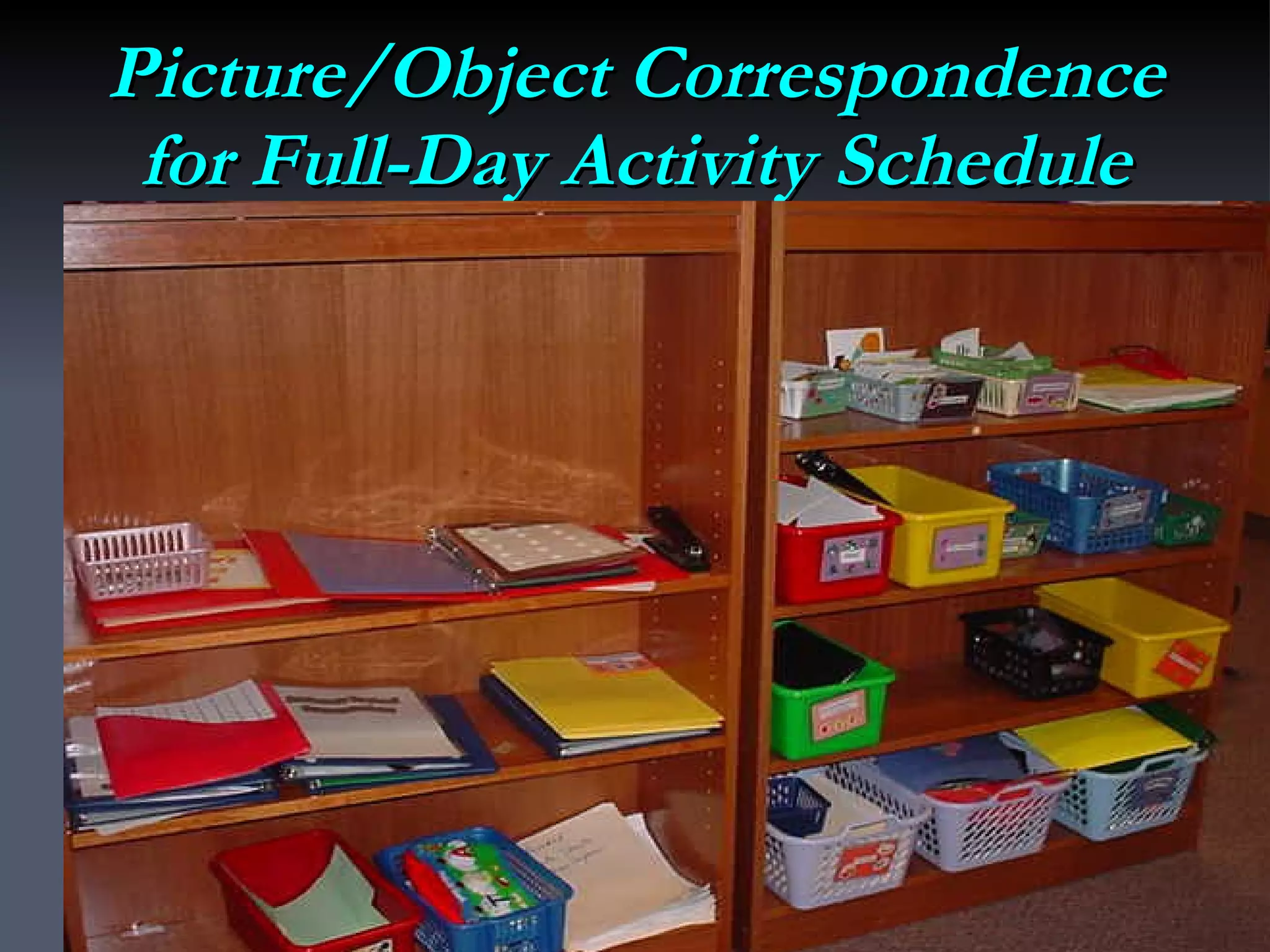
Picture/Object Correspondence for Full-Day Activity Schedule
Social and Peer Interaction Skills Social competence/Prosocial behavior Eye contact, offering assistance, polite/positive language, waiting (toy, on-line, attention, for a direction),  tolerating (vitamins, “no”, change in routine, not winning/being first, mistakes), asking for help, greetings, responding to strangers, responding to co-workers, empathy, perspective taking, social referencing, giving directions, walking (with someone, in the mall, grocery store) Games and toy play Turntaking (video), play-doh, 21 questions, riddles, pretend play, puzzles, independent, musical chairs (video), tag
Early Turn-Taking Video
Later Turn-Taking Video
Musical Chairs Video
Social and Peer Interaction Skills Peers Eye contact, offering assistance, polite/positive language, greetings, waiting (toy, on-line, attention, for a direction),  tolerating (vitamins, “no”, change in routine, not winning/being first, mistakes), walking (with someone, in the mall, grocery store), asking for help, ask for permission, responding to strangers, responding to co-workers, empathy, perspective taking, social referencing, giving directions), safety skills
Peer Imitation Video
Peer Tutoring Video
Early Social Initiation Video
Later Social Initiation Video
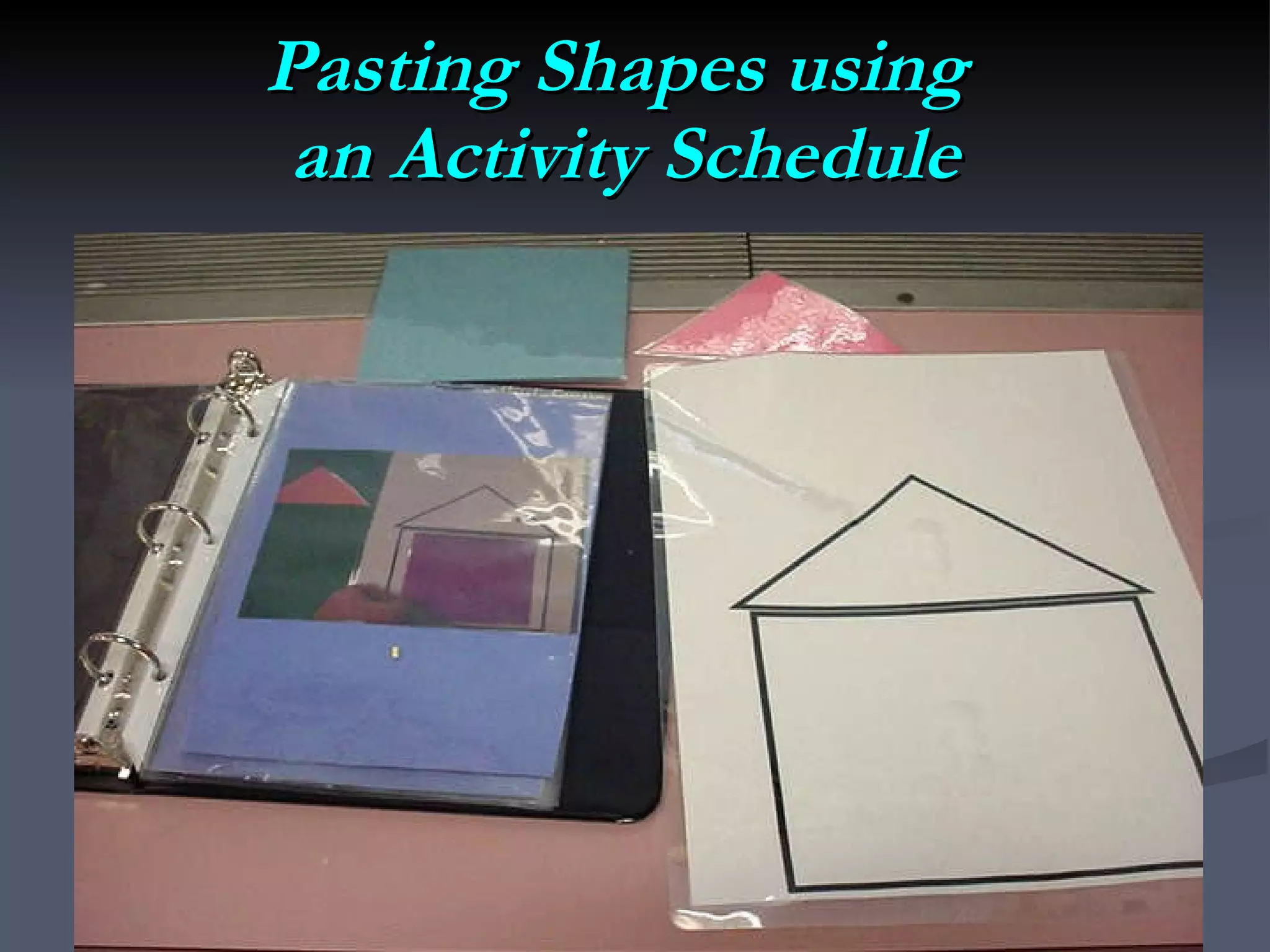
Fine Motor Skills   Art Coloring, cutting, copying a drawing, drawing shapes drawing people and objects, pasting shapes, painting
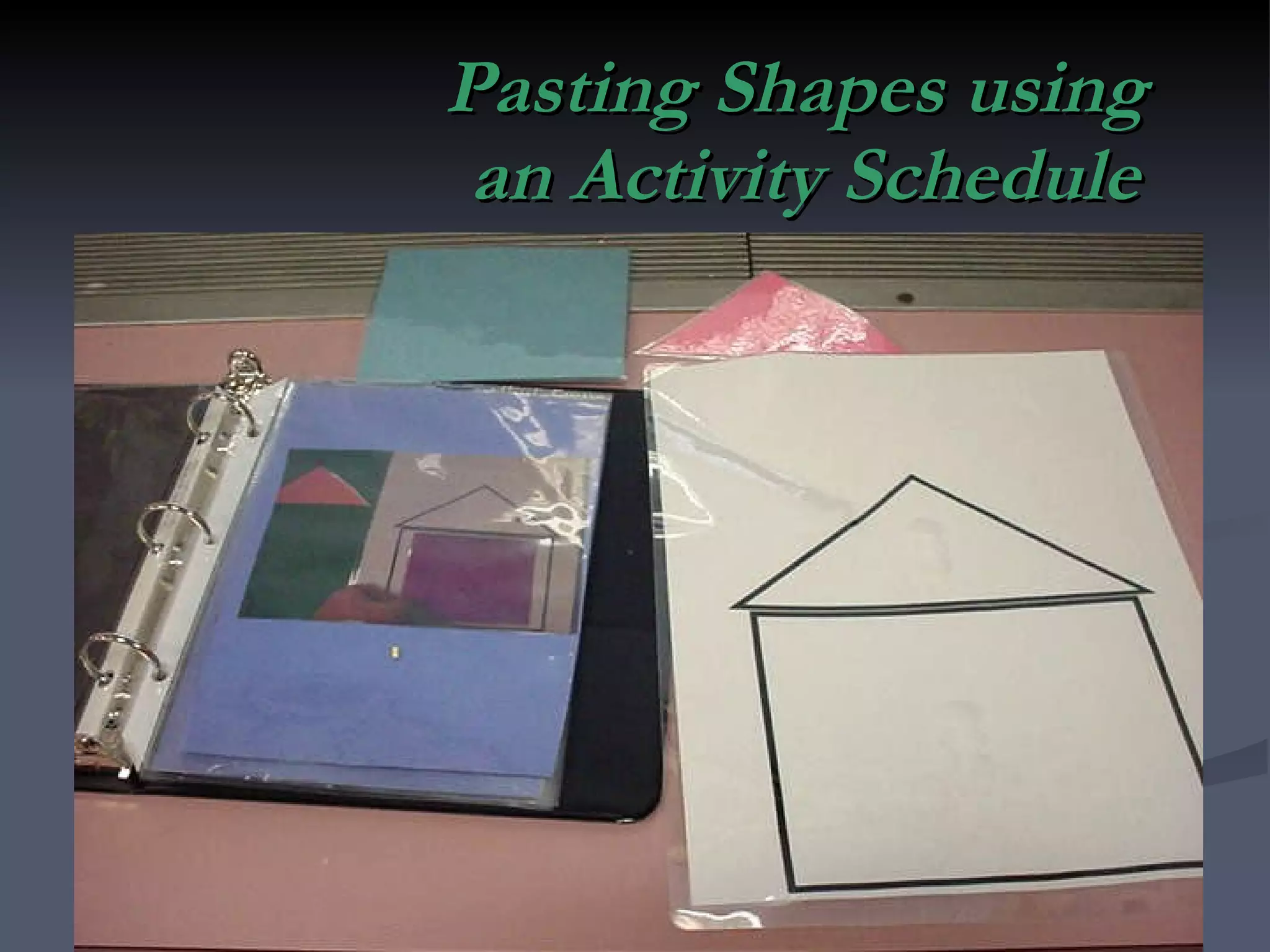
Pasting Shapes using  an Activity Schedule
Fine Motor Skills   Handwriting Scribbling, Holding pencil, imitating lines, Tracing letters, sensible pencil, writing letters, writing name, copying words and sentences, signing name Keyboard skills Data entry, typing, using a keyboard, using a mouse, type to learn, word processing
Gross Motor Skills Team sports kick ball, tee ball, bowling, basketball, tennis, volley ball Individual/Peer activity Motor imitation, ball skills, aerobics, riding vehicles, riding a bike, dancing, circuit training, exercising, gymnastics, golf, jumping rope, playing hopscotch, jogging, rollerblading, swinging, swimming, treadmill, walking
Academics Science Color matching, color labeling, anatomy, animals, plants, skills in applied science Social Studies States, capitals, US geography, US history, using a map, using a newspaper
Math Pre-Math Matching numbers, number/object, shape id Math Number id, counting (video), oral counting (1s, 5s, 10s), money skills, more/less, patterning, measuring, addition, subtraction, multiplication ,division, word problems, McMillan Math, telling time, calendar, budgeting, reconciling checkbook, estimating costs, paying a bill, using a calculator
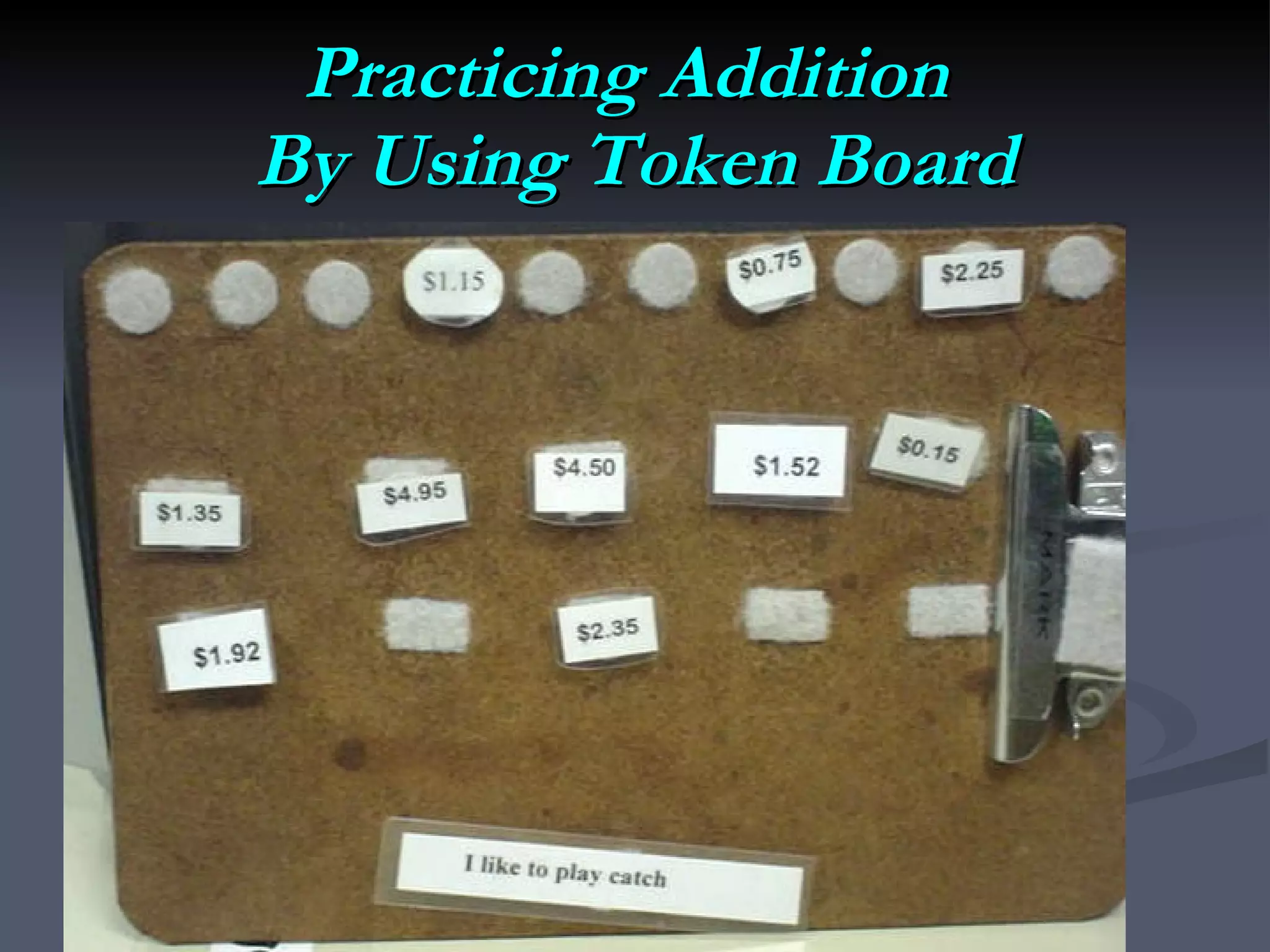
Practicing Addition  By Using Token Board
DRO Video
Reading Pre-reading Matching letters, word/objects/pictures, Letter id, sequencing, alphabet
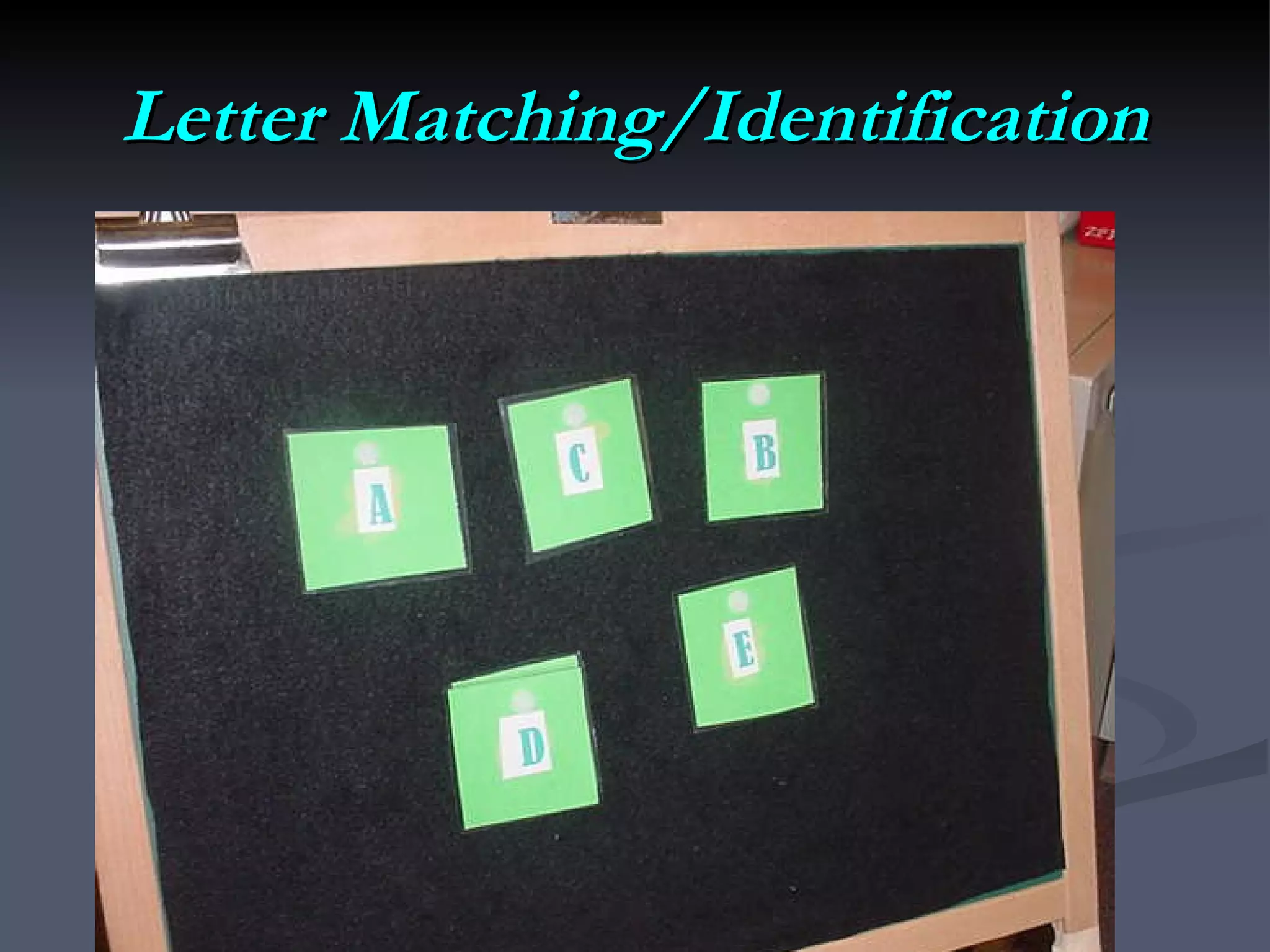
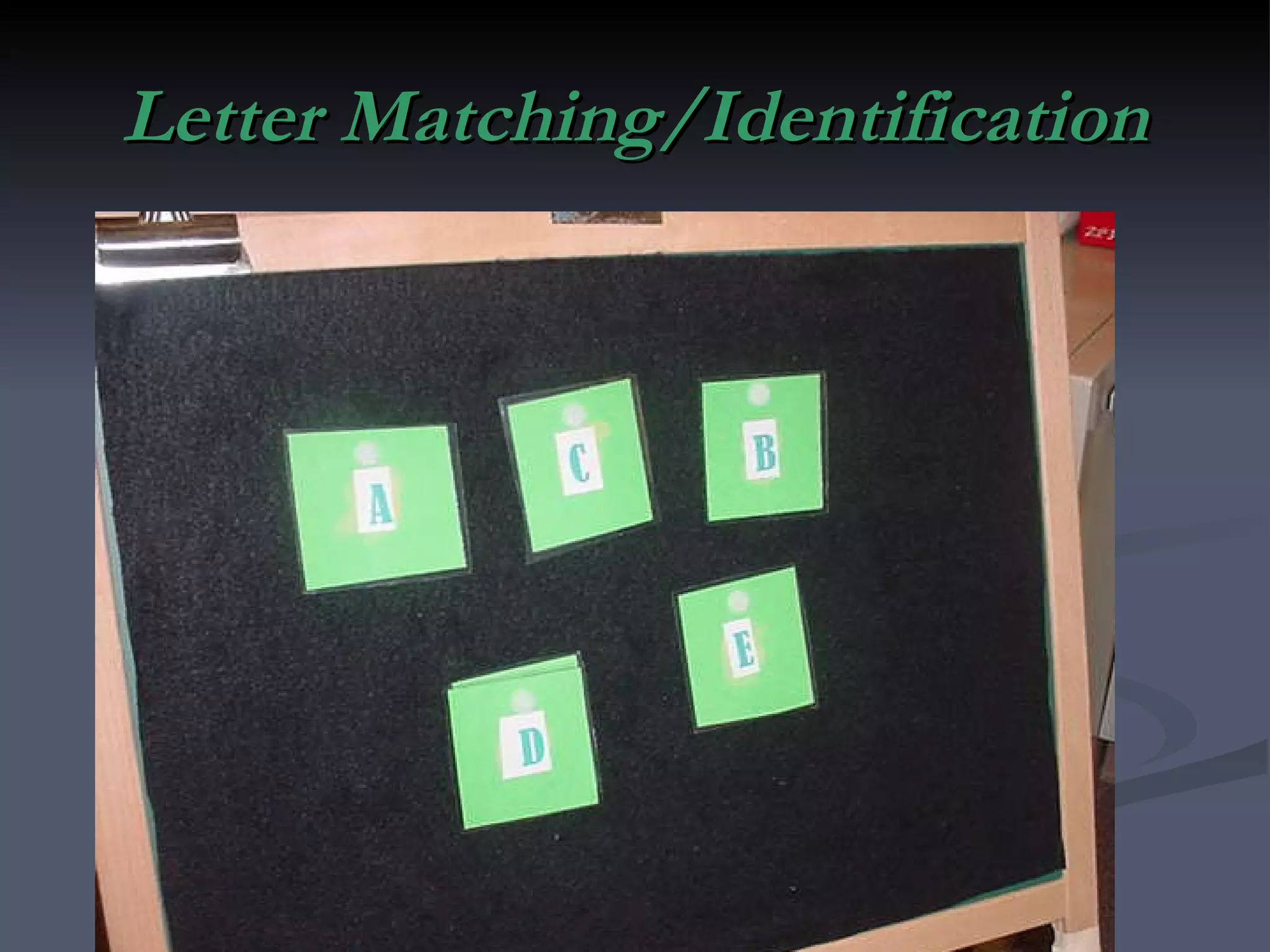
Letter Matching/Identification
Reading Reading  , before/after, sight words, reading a storybook, Edmark reading, phonics, vocabulary words, rhyming, spelling, using a dictionary, proofreading,  Reading Comprehension Wh concepts, reading for understanding, retelling a story, answering questions about a story Writing Journal writing,
Leisure Bingo, don’t spill the beans, board games, model building, connect four, checkers, maisy, scrambled eggs, card games, dominoes, Air hockey, bowling, stamp collecting, playing piano (video), parquetry, ping pong, puzzle, book & tape, playing a video game/computer game, I-pod, singing songs, gameboy, going to movies, dating
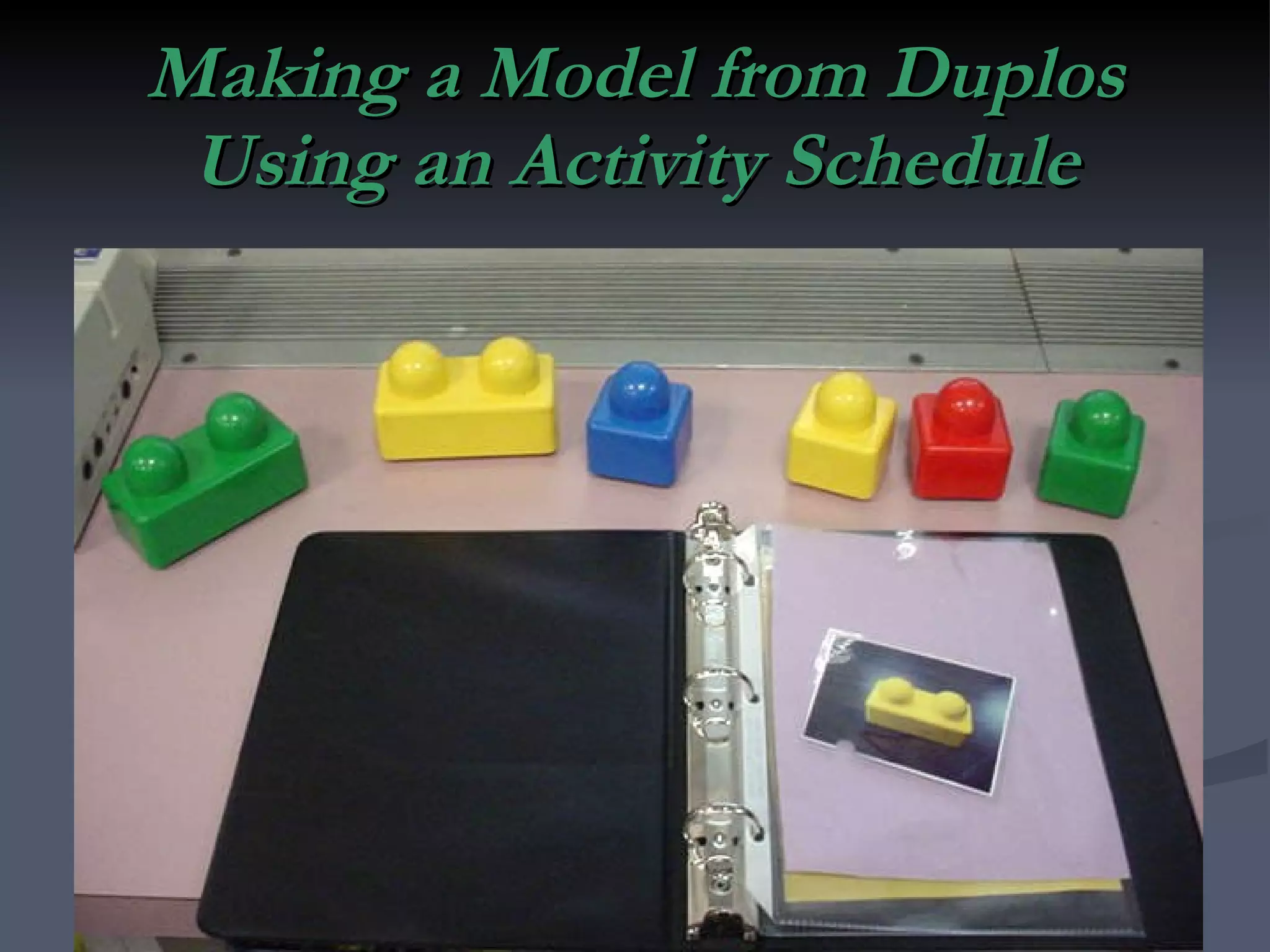
Making a Model from Duplos Using an Activity Schedule
Twinkle Video
Independence Schedule Following Pictorial, written, independent, interactive, with language
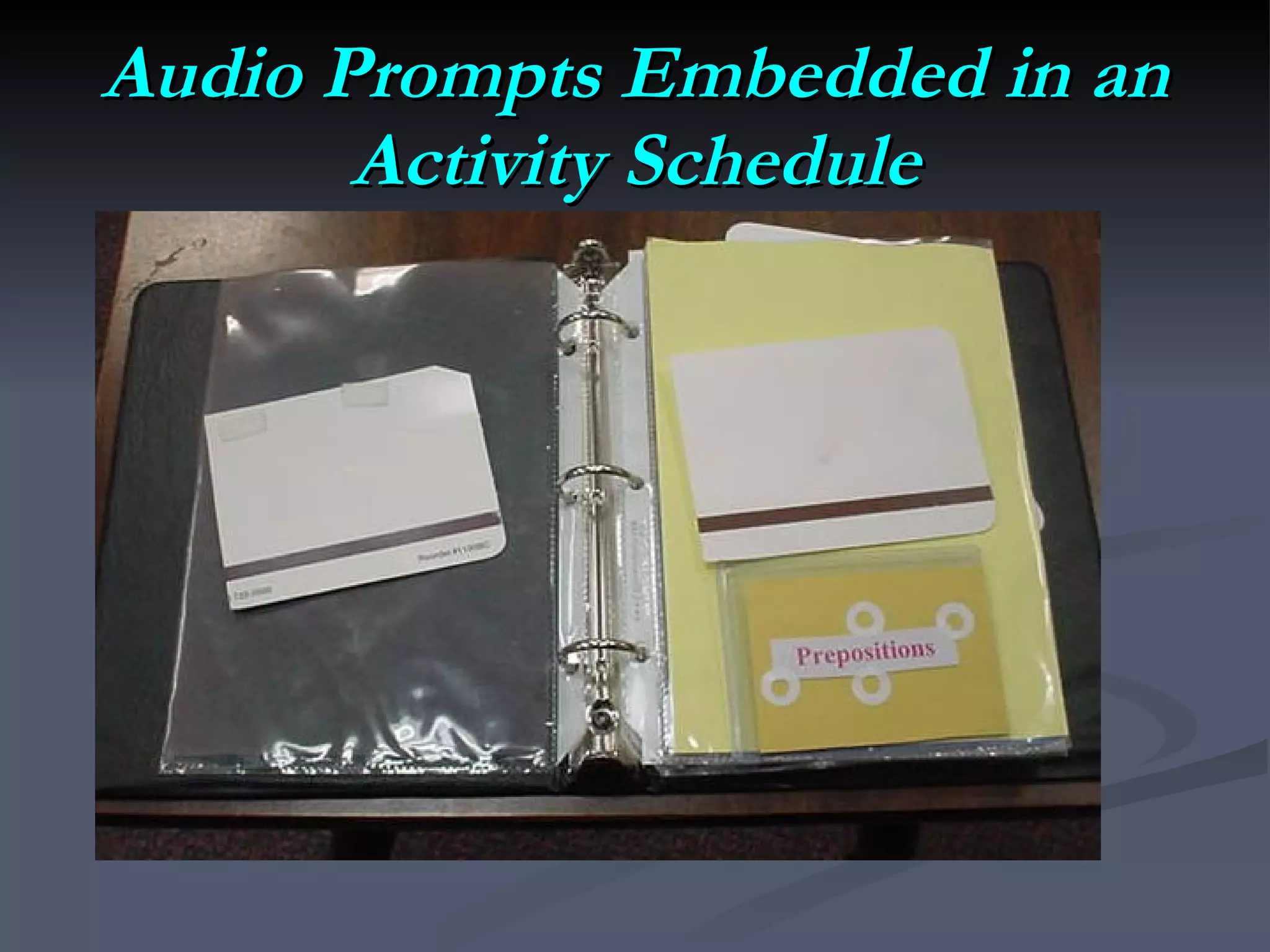
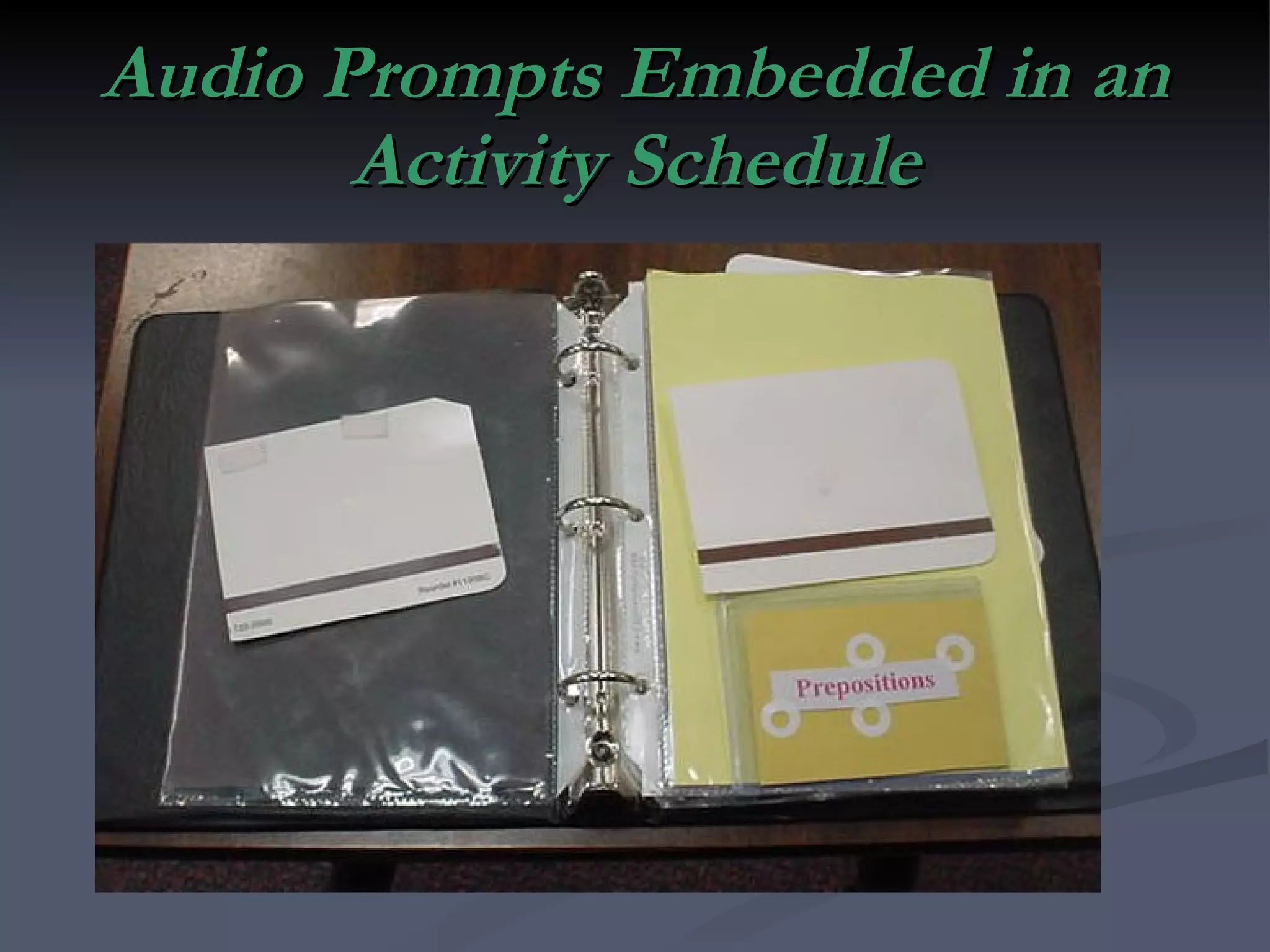
Audio Prompts Embedded in an Activity Schedule
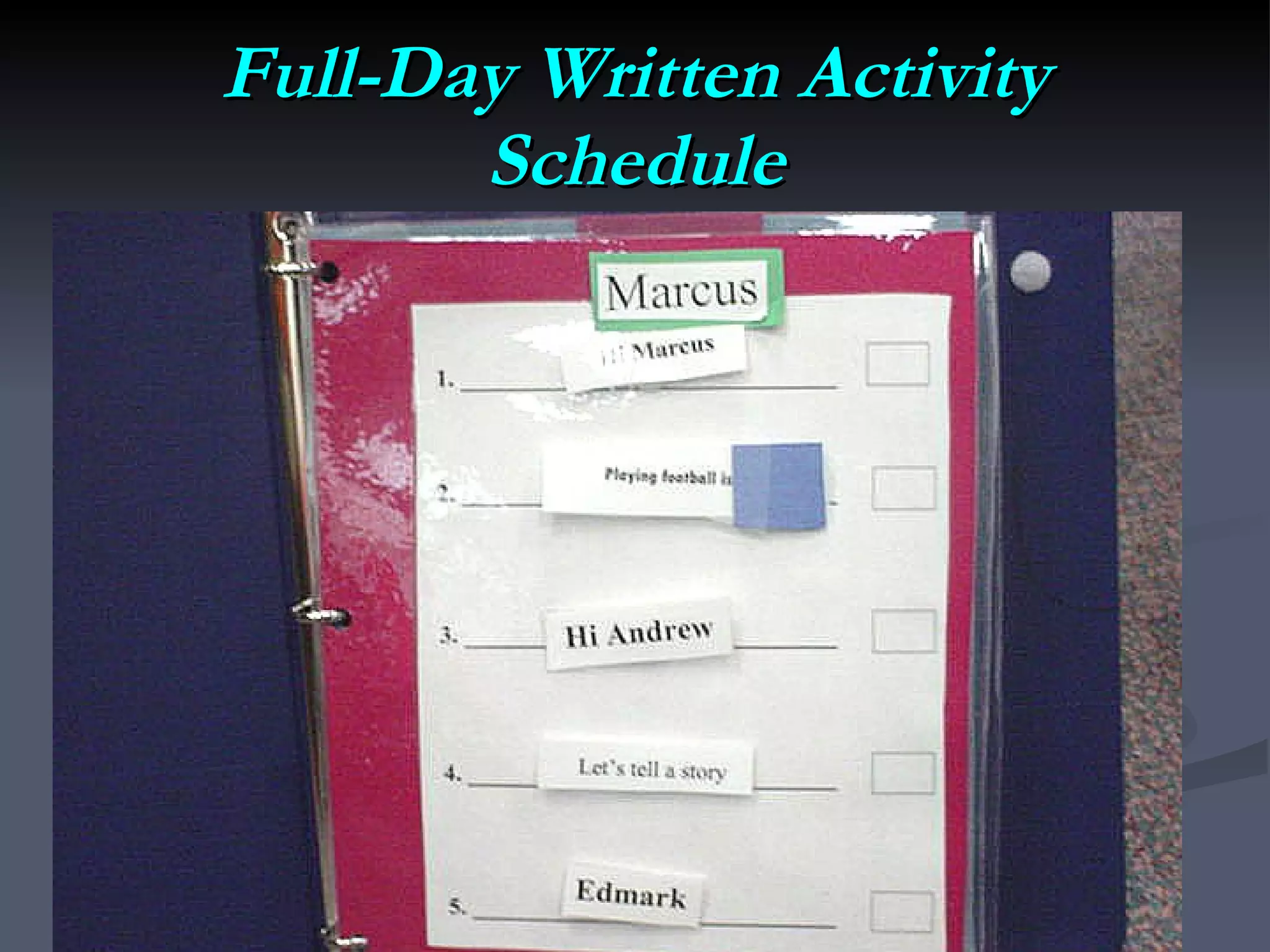
Full-Day Written Activity Schedule
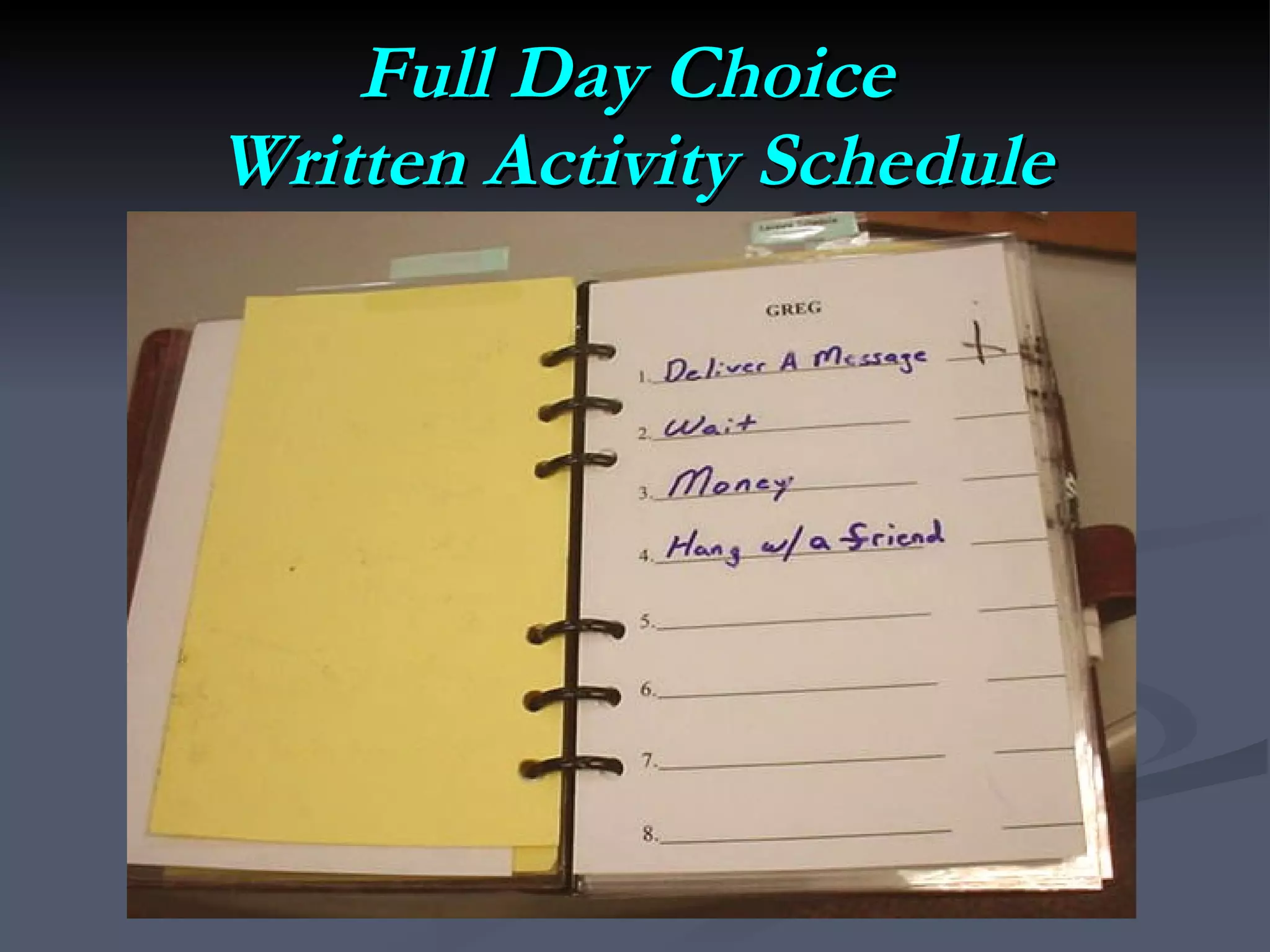
Full Day Choice  Written Activity Schedule
Independence Independent tasks Remain in designated area Completing a homework assignment Building endurance/longevity Keeping appointments Using a planner
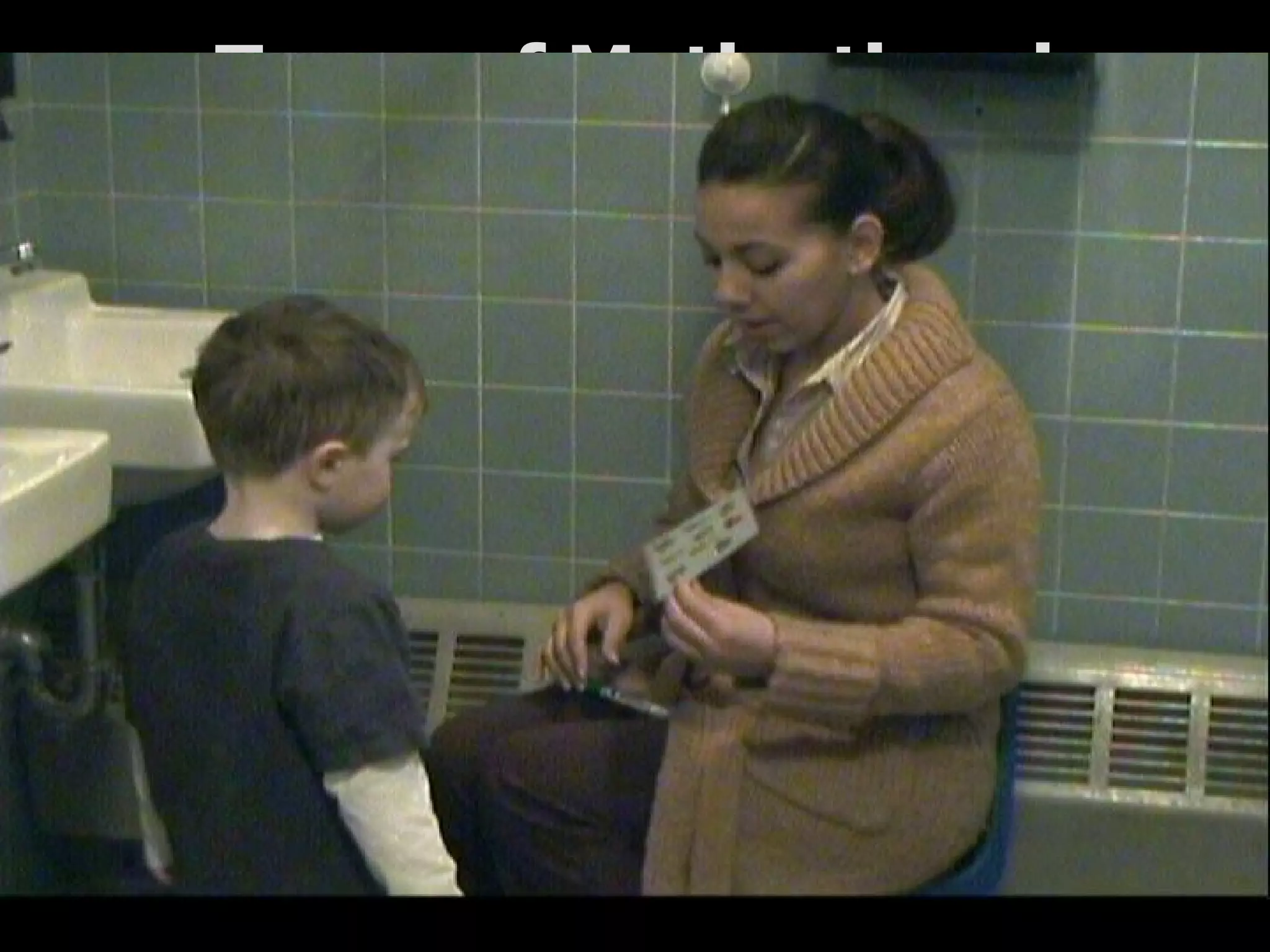
Self-Care Tolerating toothbrushing (video) Toothbrushing
Types of Motivational Systems Video: Sticker-Check Board
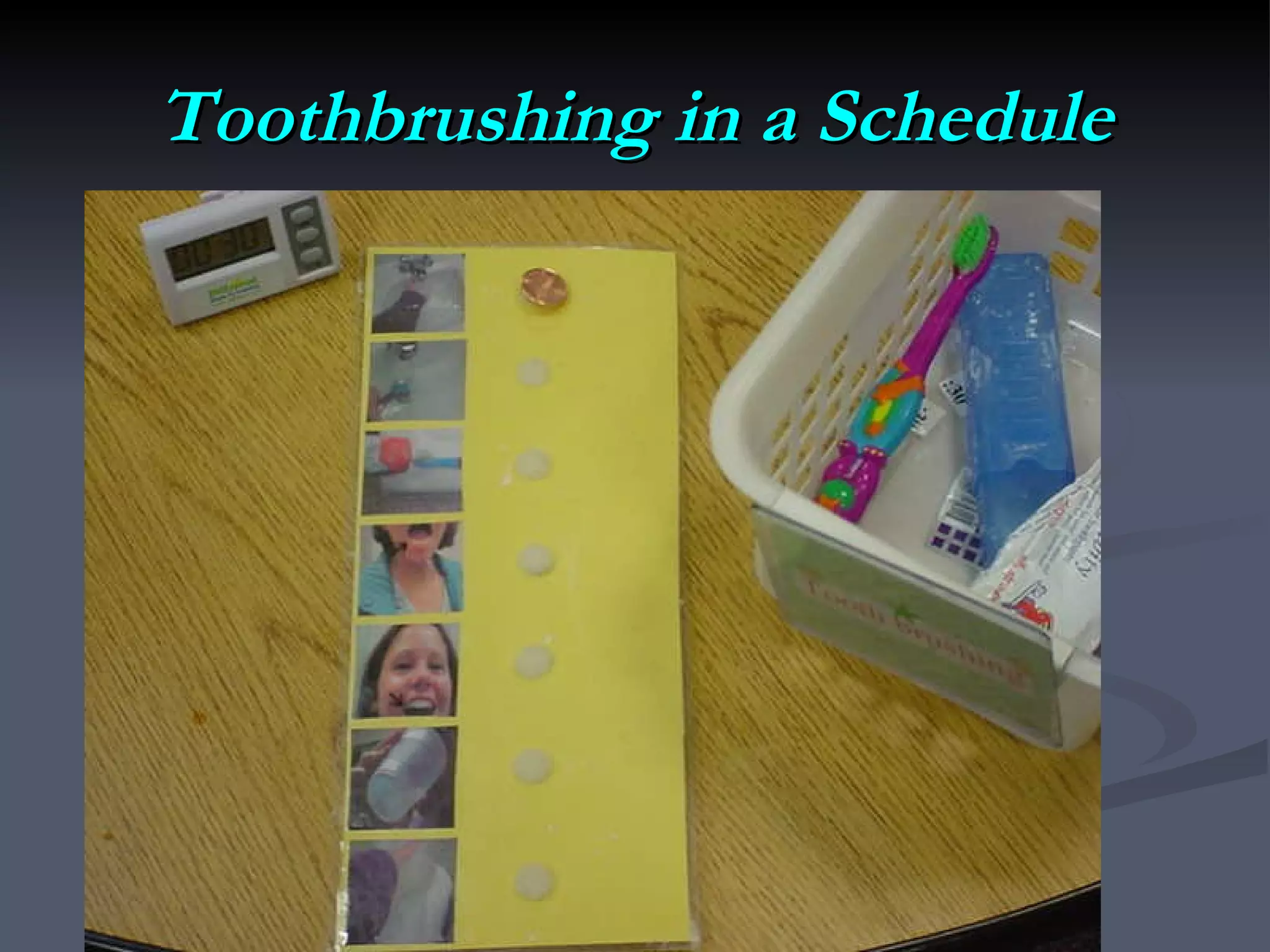
Toothbrushing in a Schedule
Self-Care Washing face Toileting Fastening Shoe tying Tying necktie Getting dressed Getting undressed Selecting clothing Styling hair Bathing Showering Non-preferred foods Polite eating Using a utensil Morning routine Nighttime routine Personal hygiene Checking appearance
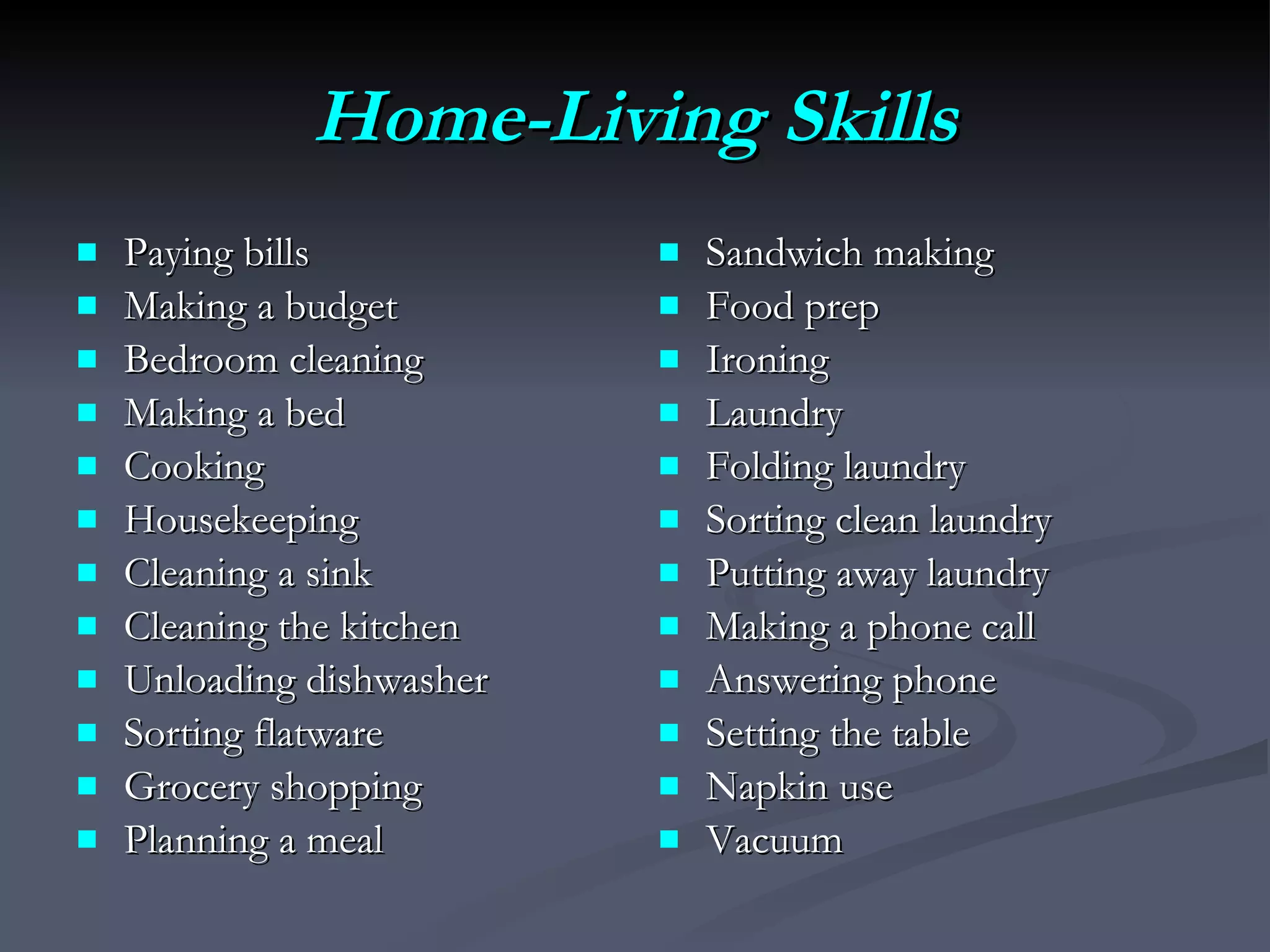
Home-Living Skills Paying bills Making a budget Bedroom cleaning Making a bed Cooking Housekeeping Cleaning a sink Cleaning the kitchen Unloading dishwasher Sorting flatware Grocery shopping Planning a meal Sandwich making Food prep Ironing Laundry Folding laundry Sorting clean laundry Putting away laundry Making a phone call Answering phone Setting the table Napkin use Vacuum
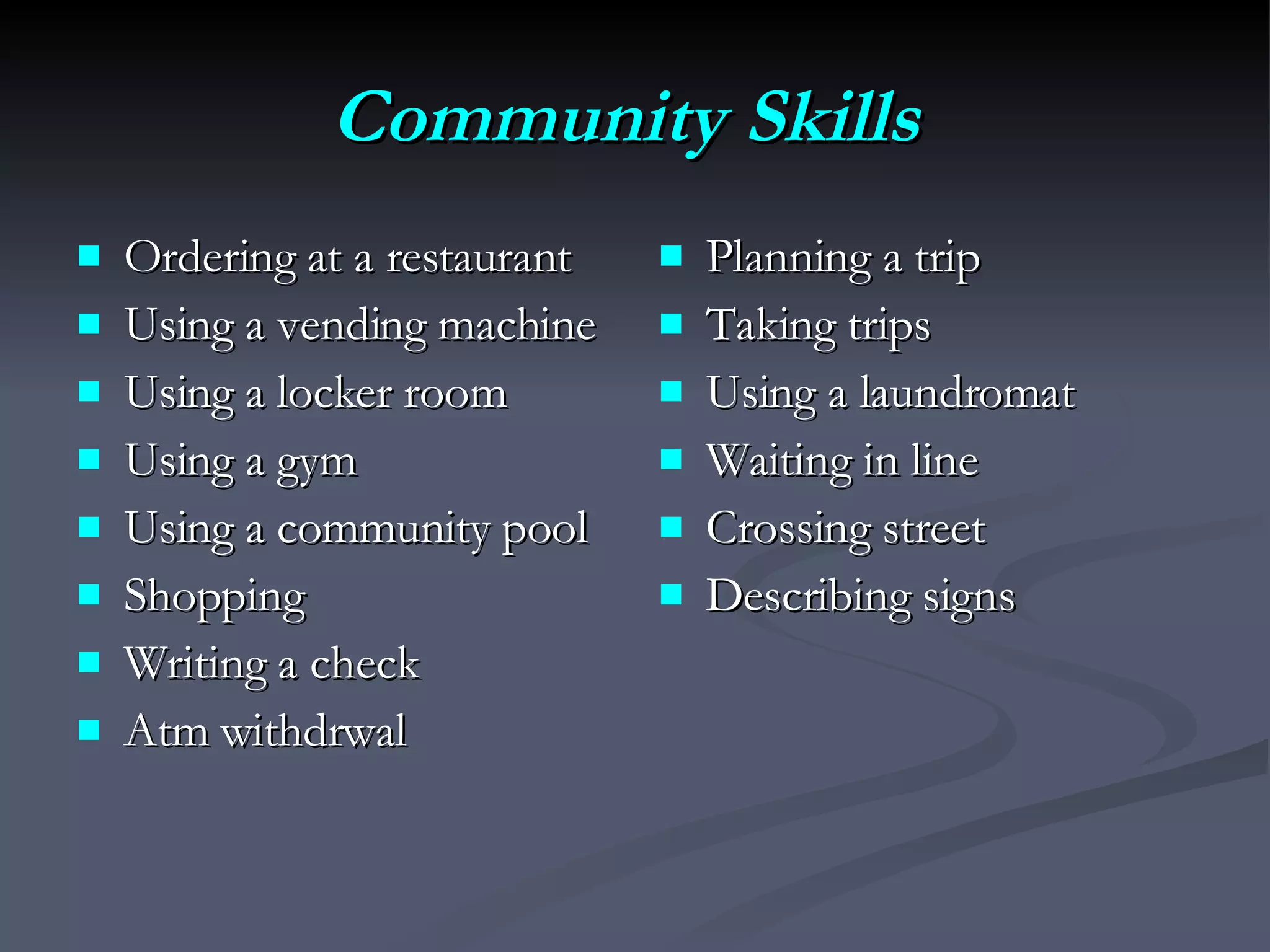
Community Skills   Ordering at a restaurant Using a vending machine Using a locker room Using a gym Using a community pool Shopping Writing a check Atm withdrwal Planning a trip Taking trips Using a laundromat Waiting in line Crossing street Describing signs
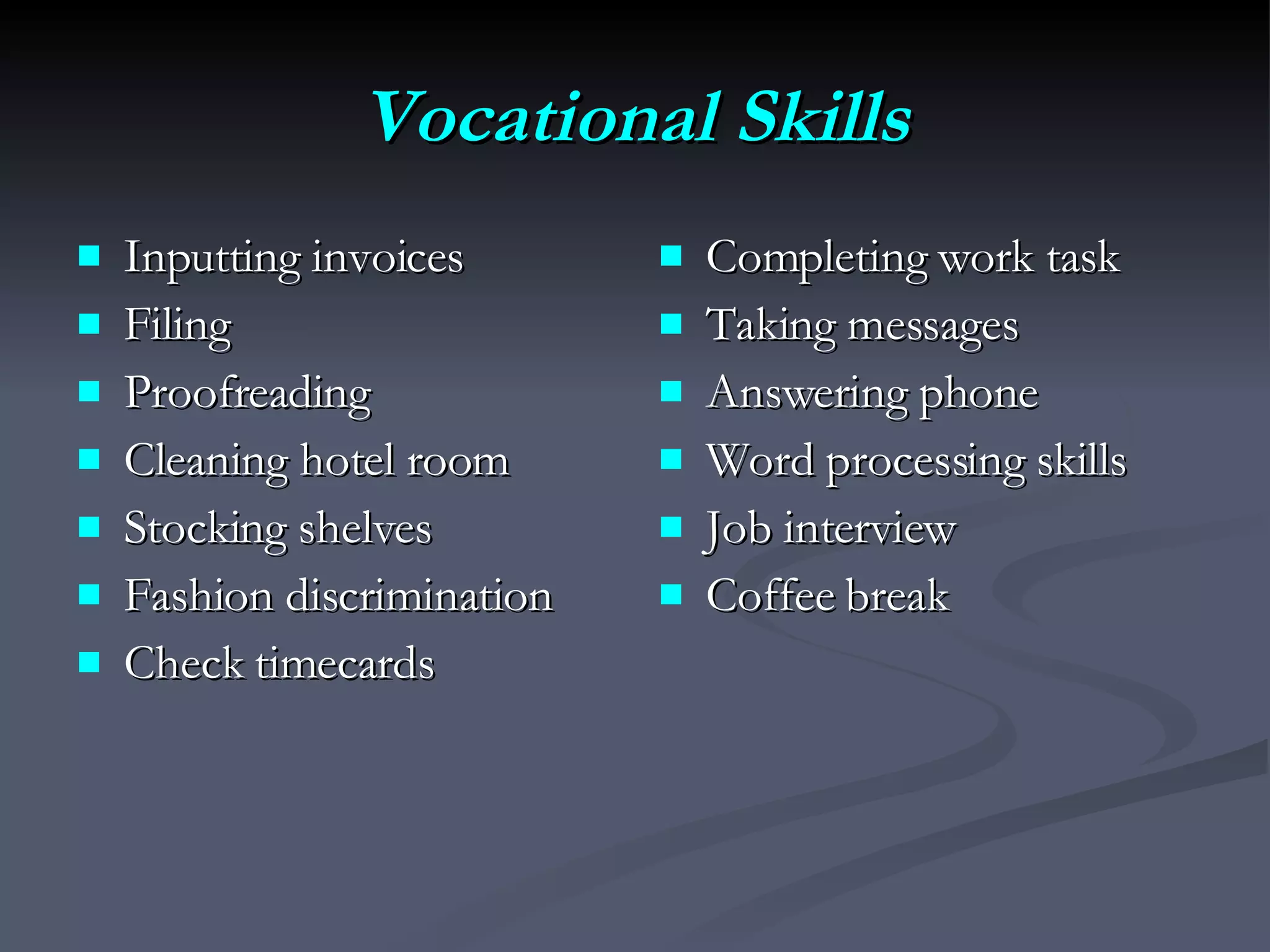
Vocational Skills Inputting invoices Filing Proofreading Cleaning hotel room Stocking shelves Fashion discrimination Check timecards Completing work task Taking messages Answering phone Word processing skills Job interview Coffee break
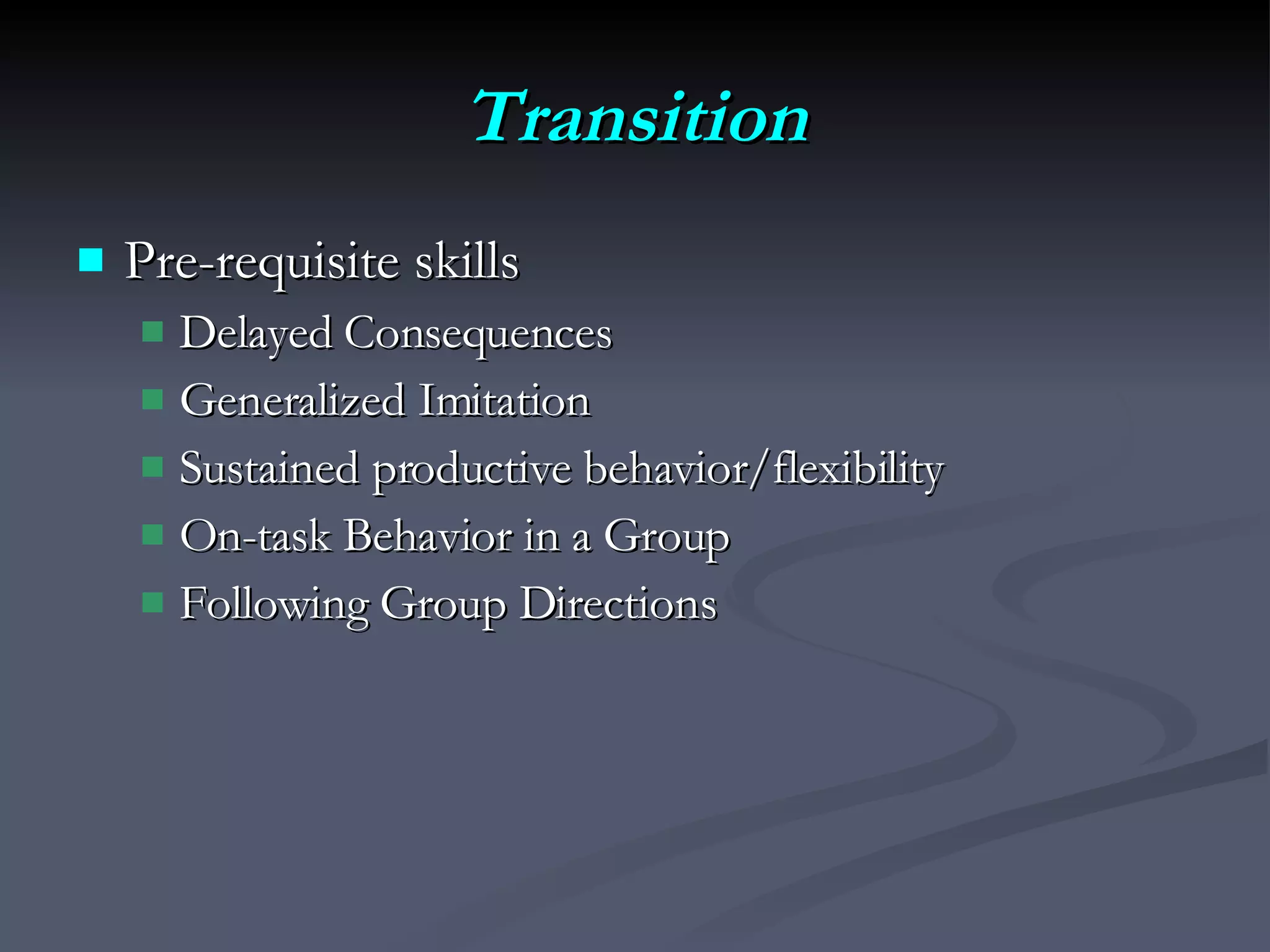
Transition Pre-requisite skills Delayed Consequences Generalized Imitation Sustained productive behavior/flexibility On-task Behavior in a Group  Following Group Directions
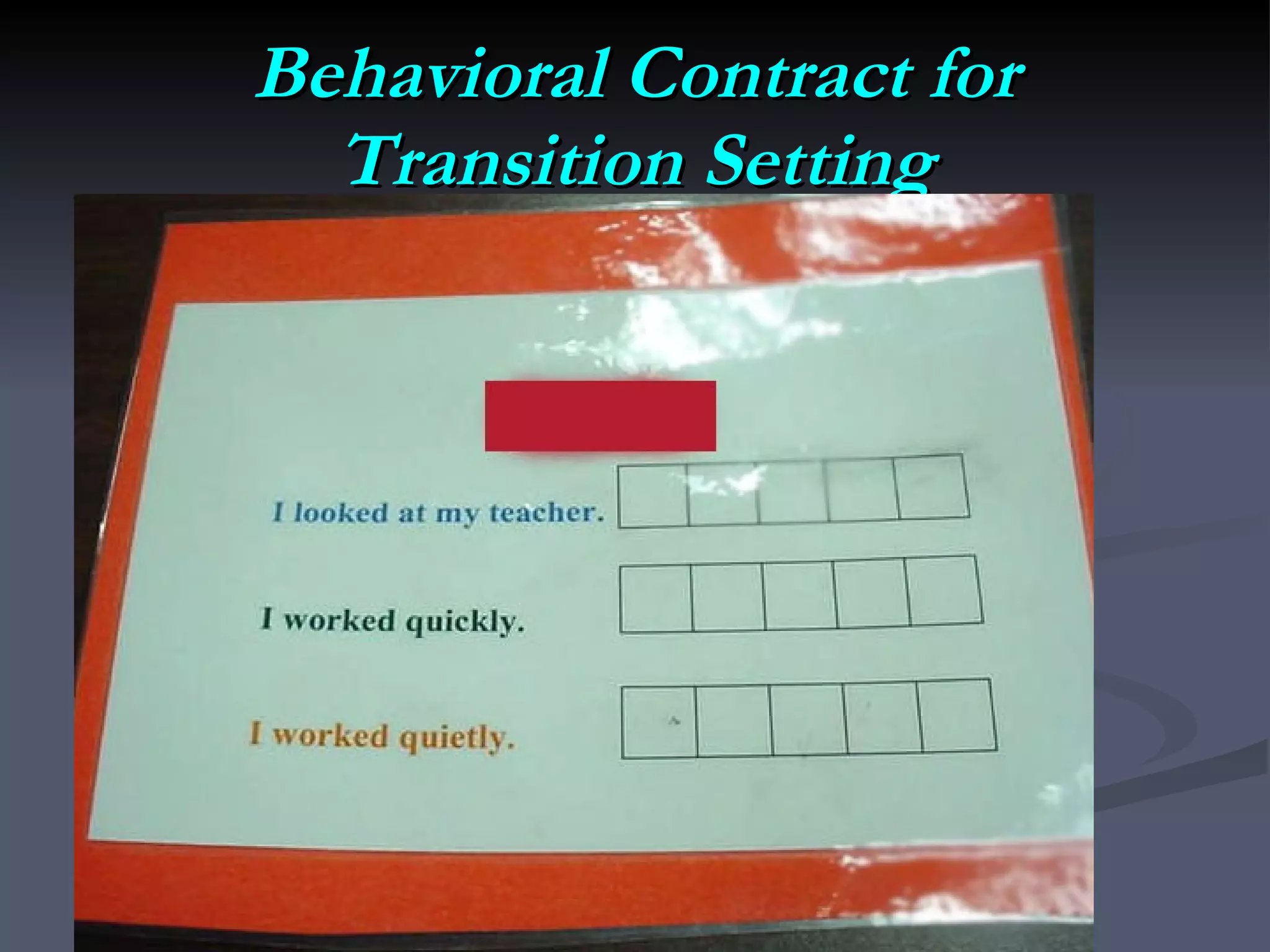
Behavioral Contract for Transition Setting
Transition School skills  Initiating conversation Responding to questions Recruiting teacher attention Walking in a line Hand raising Cares for belongings Following class routines Asking for help
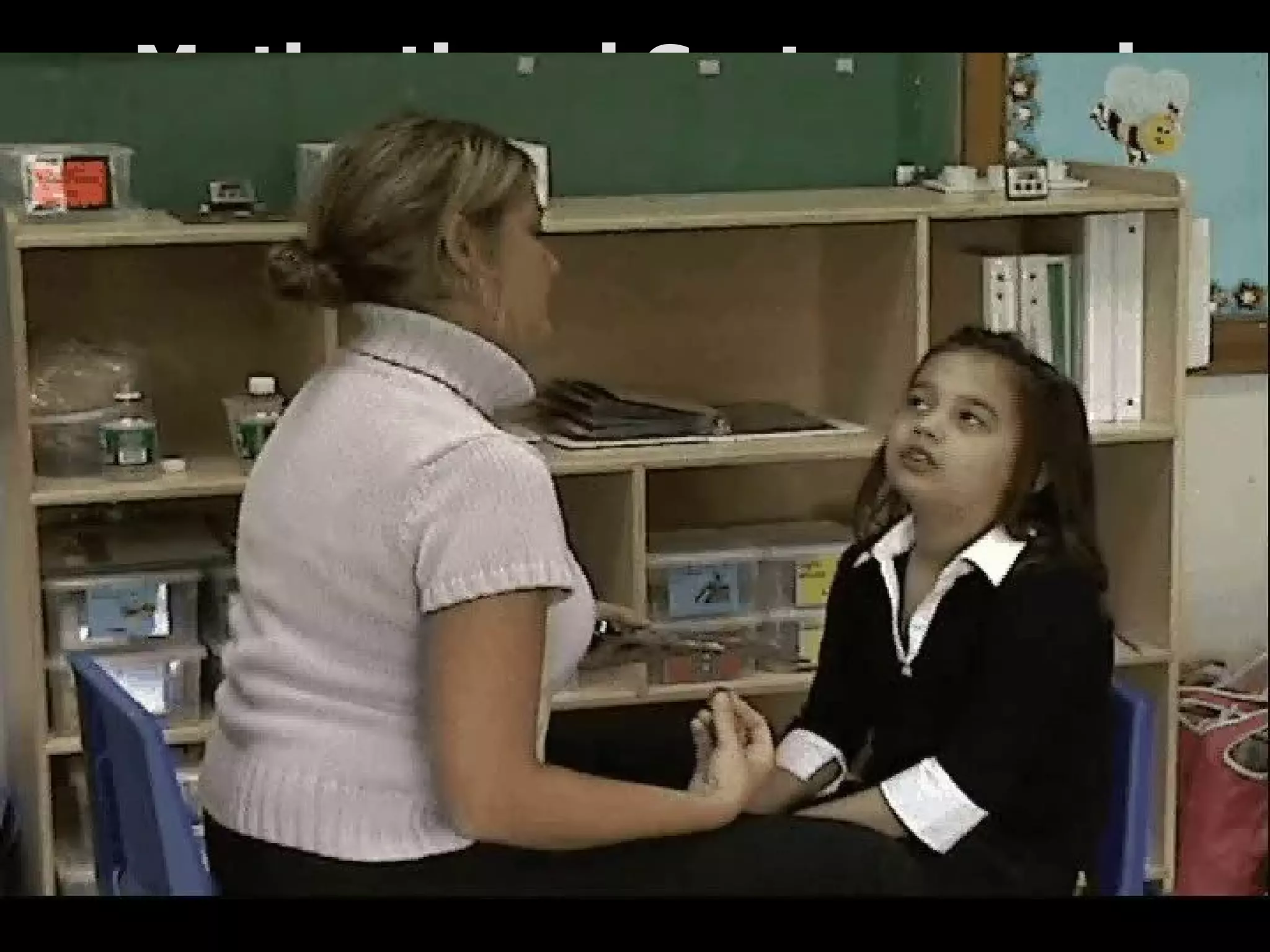
On-Task Behavior Instructional time (video)
Motivational Systems and Behavior Chains Video: Behavior Chain
On-Task Behavior Leisure activities Self-help skills Vocational task In a group
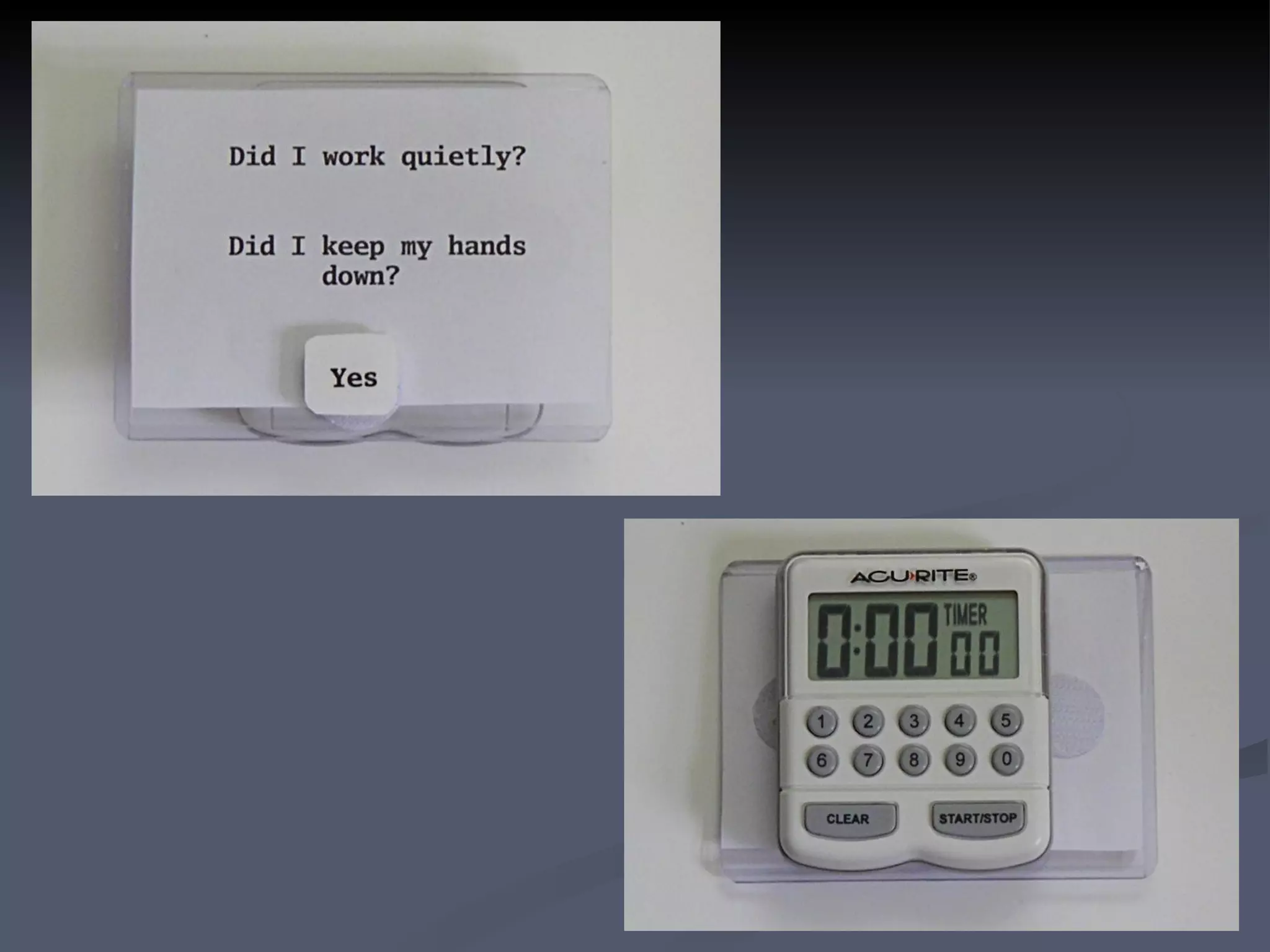
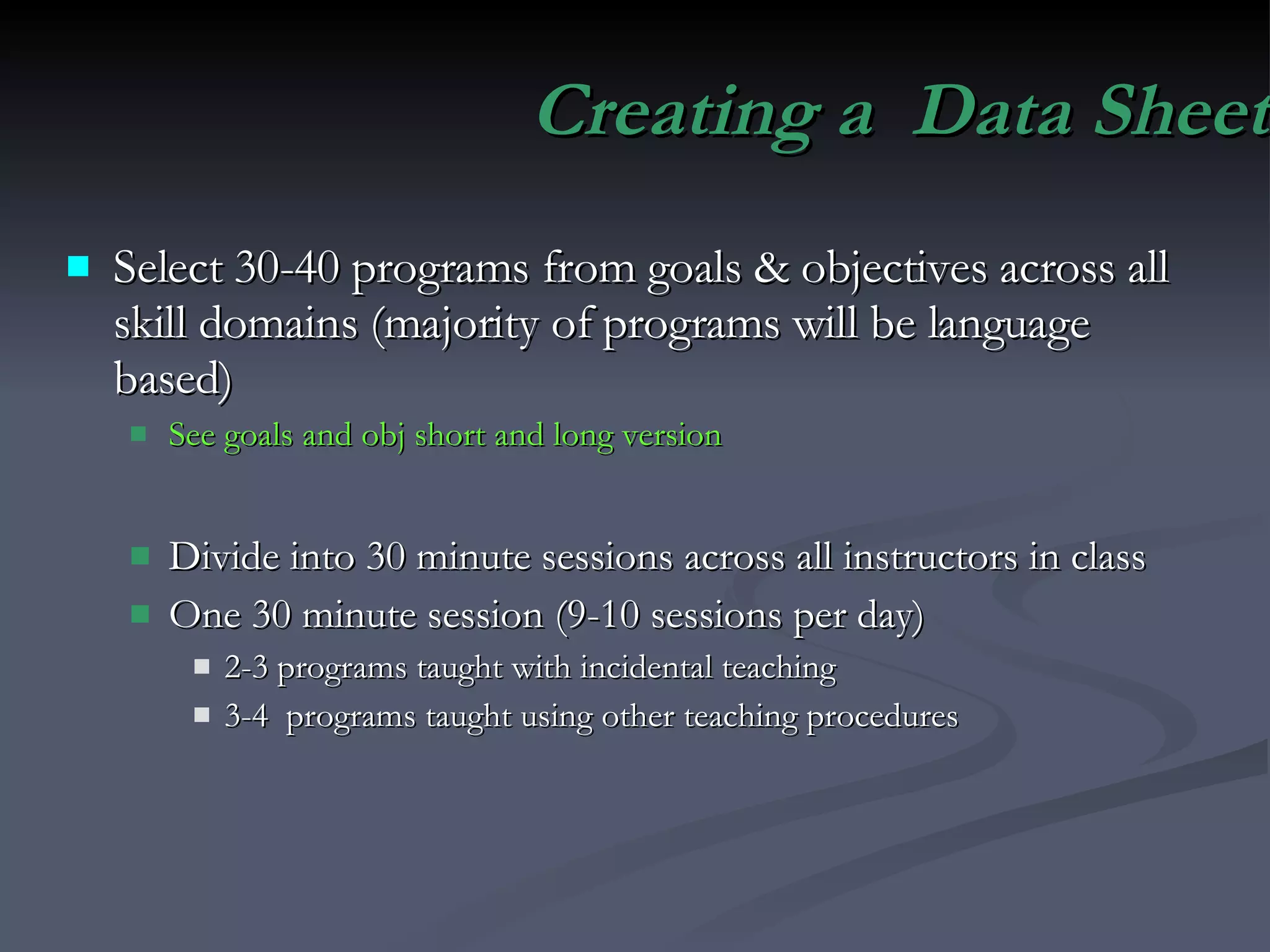
Motivational System Working a Token Board (video) Responding to Timer (video)


Building Initial Token Systems Video: Trading one token for a toy
Motivational Systems and Behavior Chains Video: Behavior Chain
Motivational System Following a Behavioral Contract
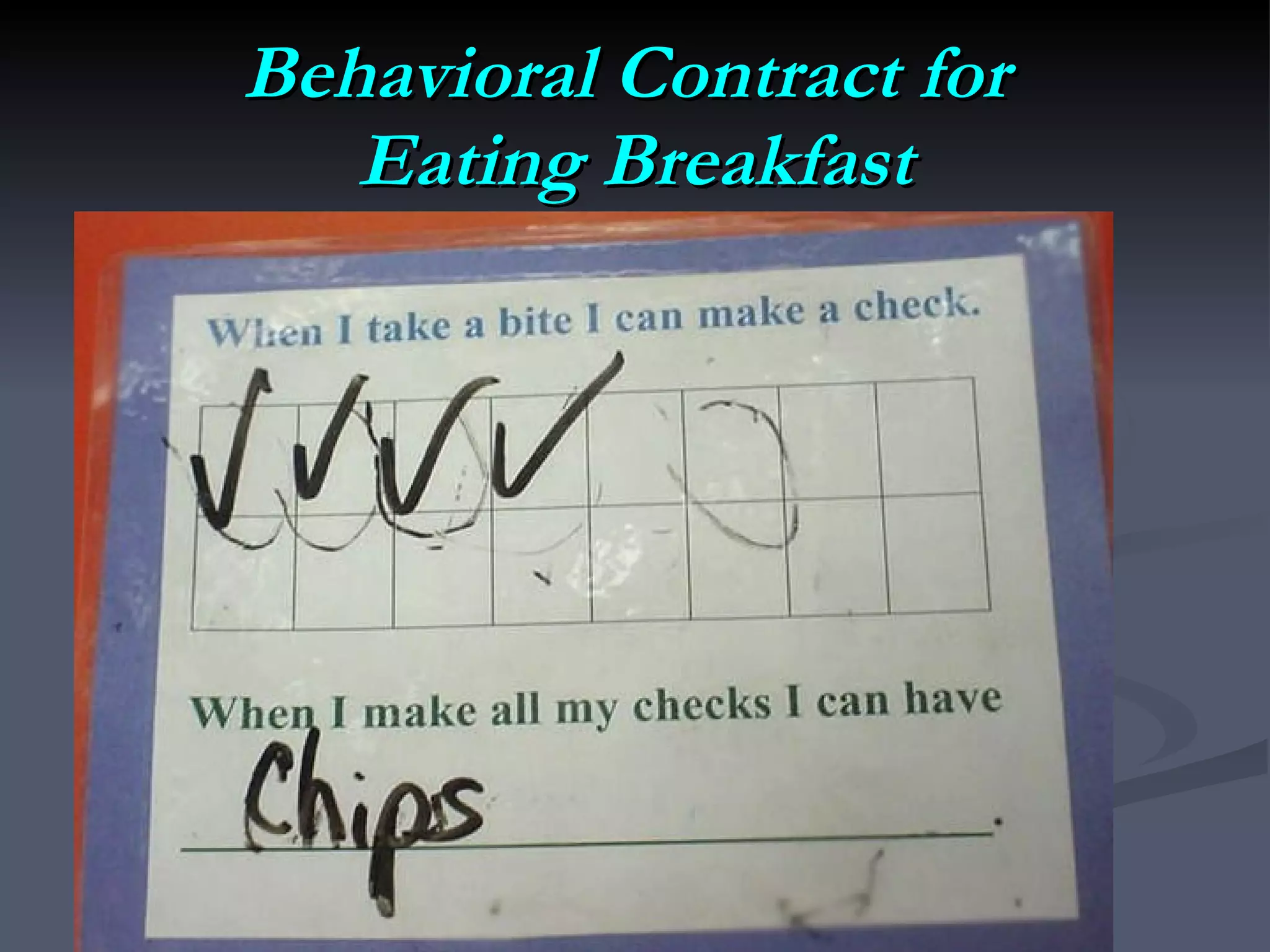
Behavioral Contract for  Eating Breakfast
Motivational System Following a School Note (video)
Types of Motivational Systems Video: School Note
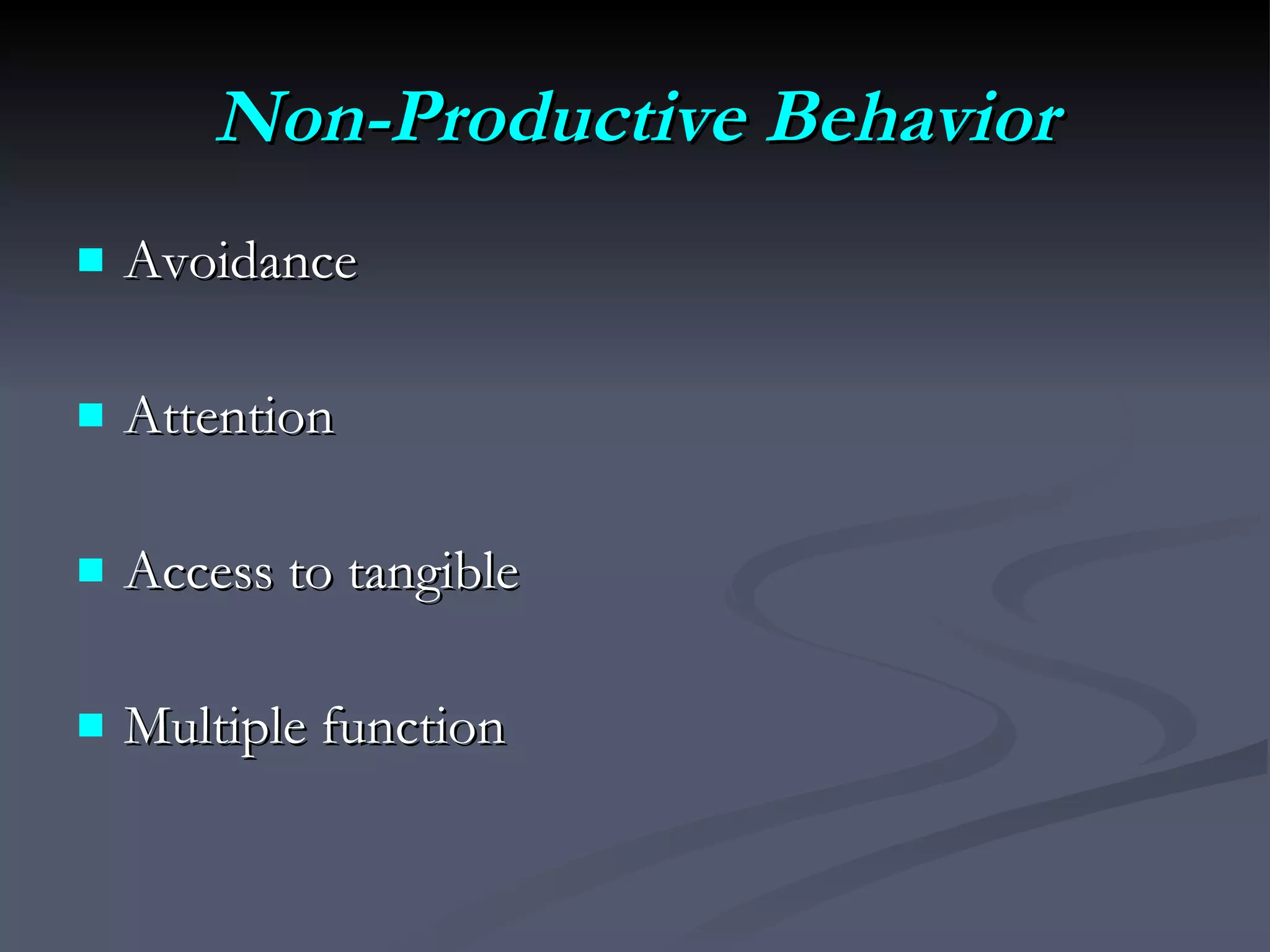
Non-Productive Behavior Avoidance Attention Access to tangible Multiple function
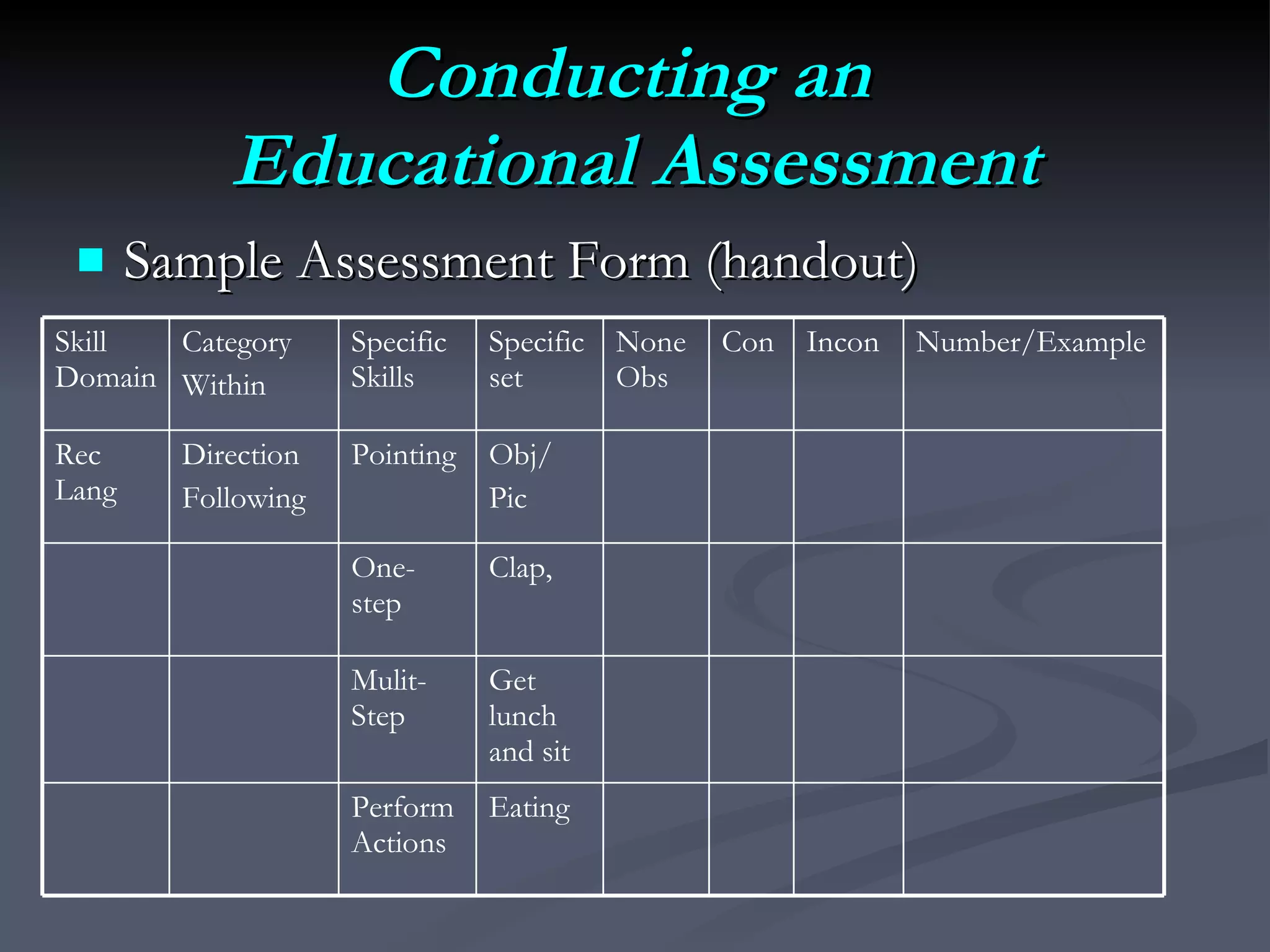
Conducting an  Educational Assessment Sample Assessment Form (handout) Eating PerformActions Get lunch and sit Mulit-Step Clap,  One-step Obj/ Pic Pointing Direction Following Rec Lang Number/Example Incon Con None Obs Specific set Specific Skills Category Within Skill Domain
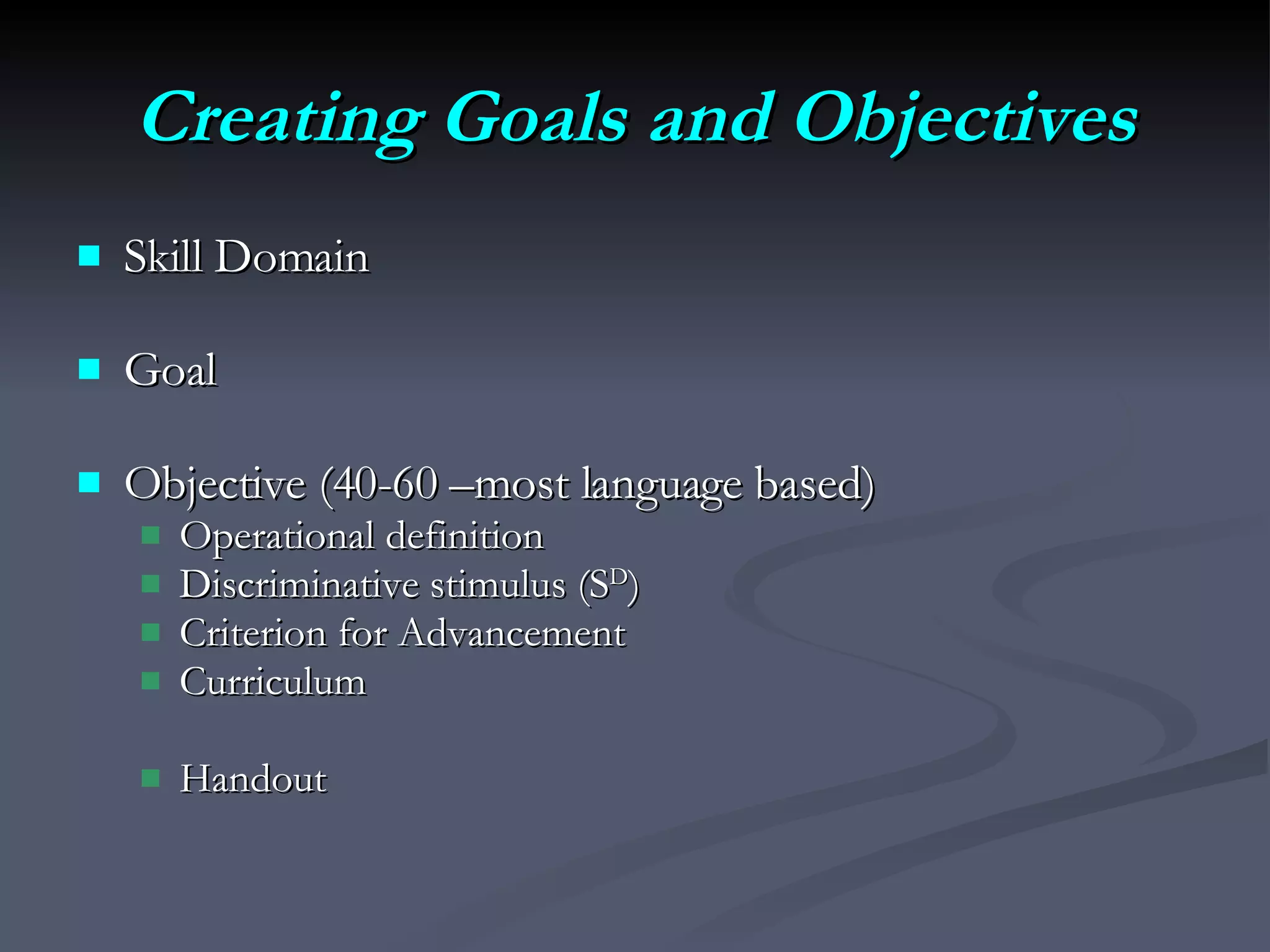
Creating Goals and Objectives Skill Domain  Goal  Objective (40-60 –most language based) Operational definition Discriminative stimulus (S D ) Criterion for Advancement Curriculum Handout
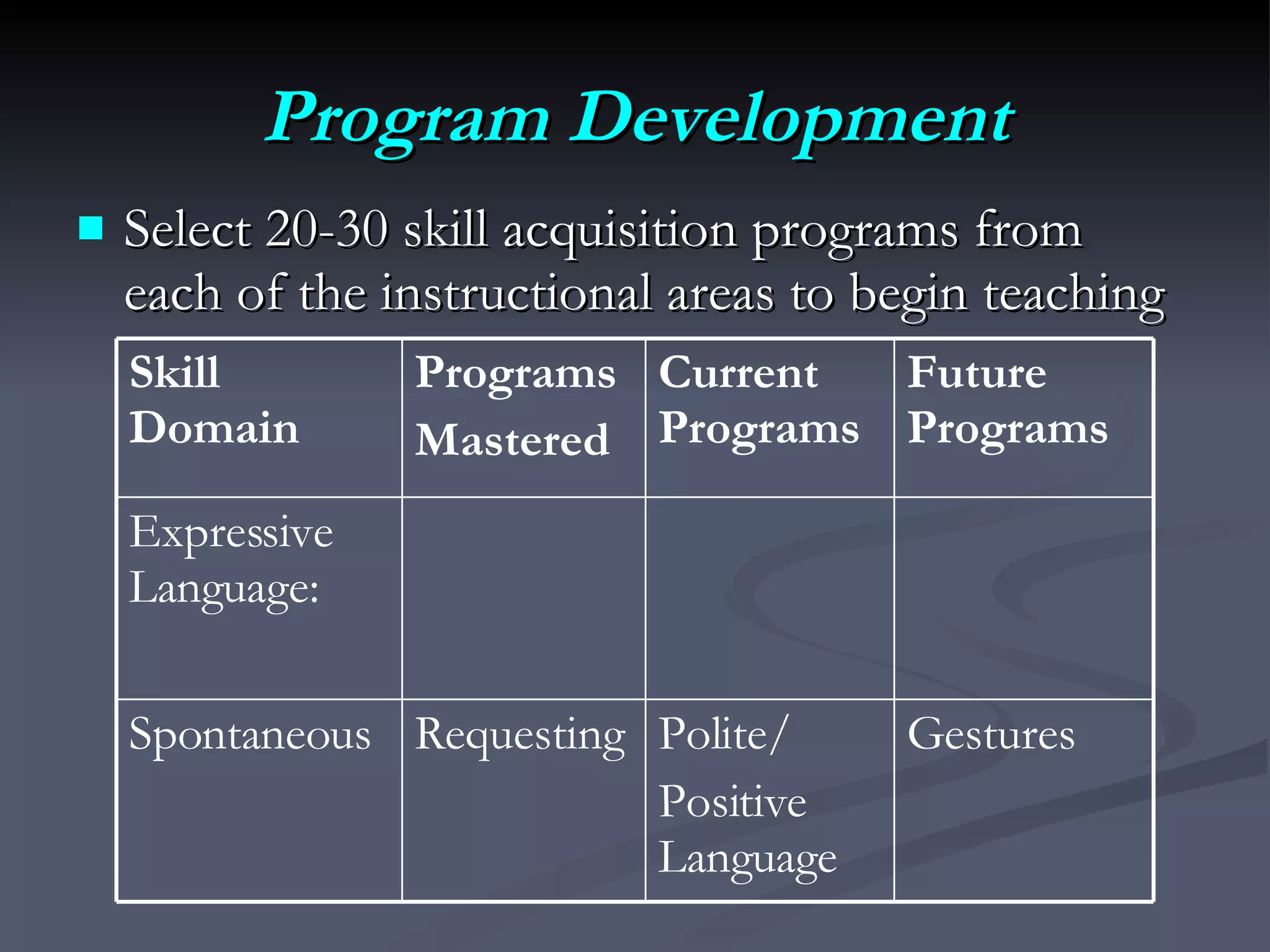
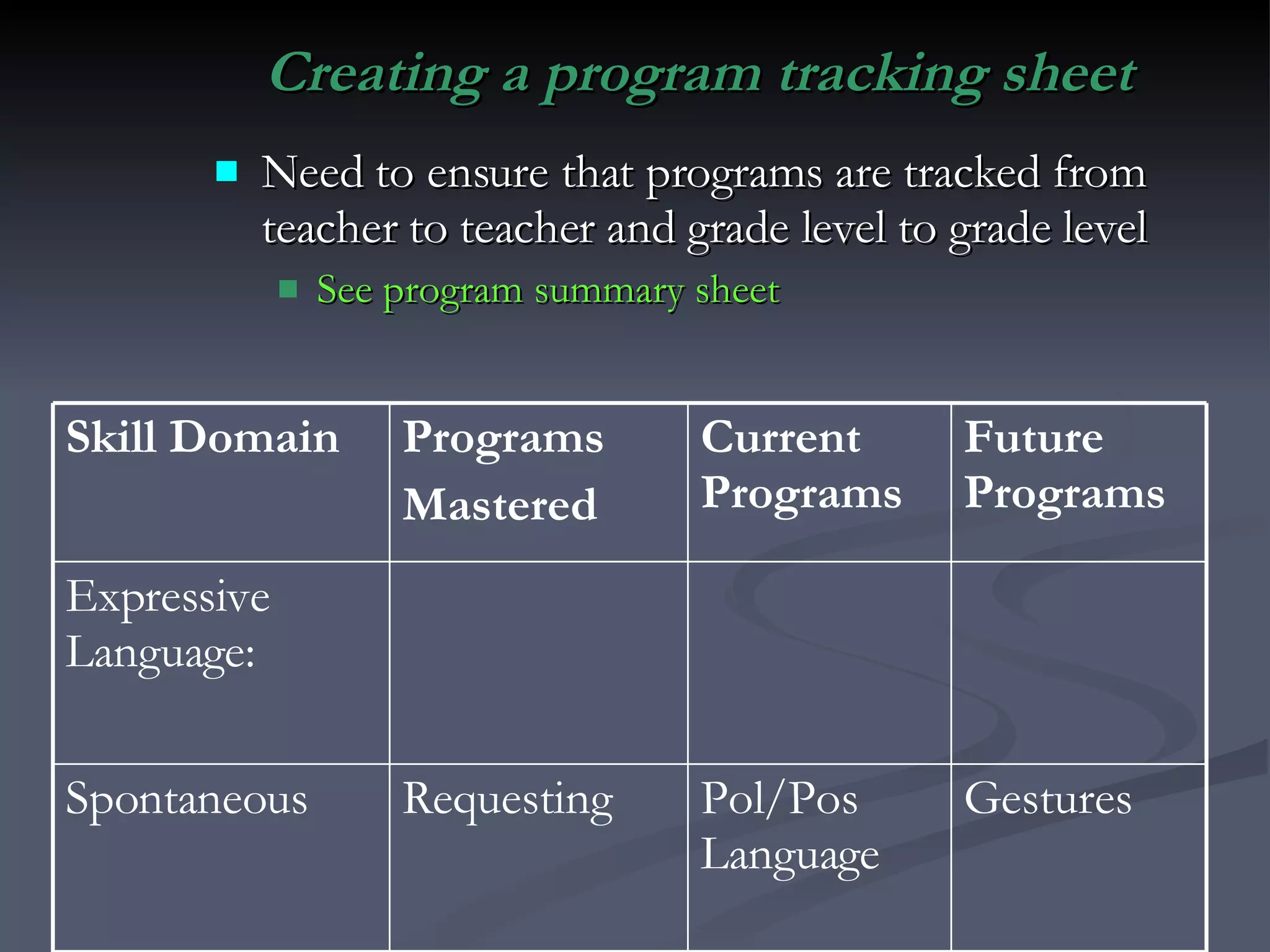
Program Development Select 20-30 skill acquisition programs from each of the instructional areas to begin teaching Gestures Polite/ Positive Language Requesting Spontaneous Expressive Language: Future Programs Current Programs Programs Mastered Skill Domain
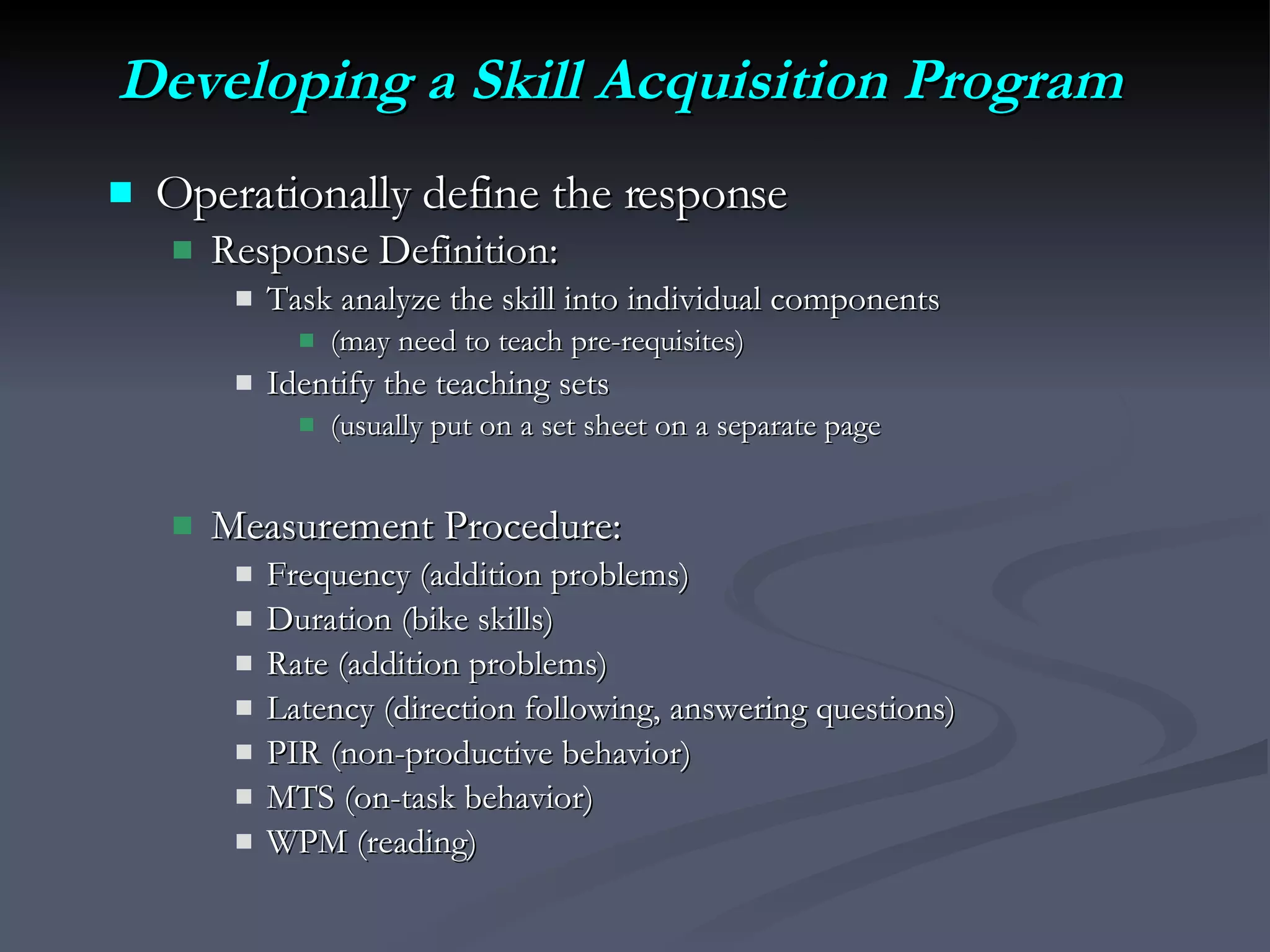
Developing a Skill Acquisition Program   Operationally define the response Response Definition: Task analyze the skill into individual components  (may need to teach pre-requisites) Identify the teaching sets (usually put on a set sheet on a separate page Measurement Procedure: Frequency (addition problems) Duration (bike skills) Rate (addition problems) Latency (direction following, answering questions) PIR (non-productive behavior) MTS (on-task behavior) WPM (reading)
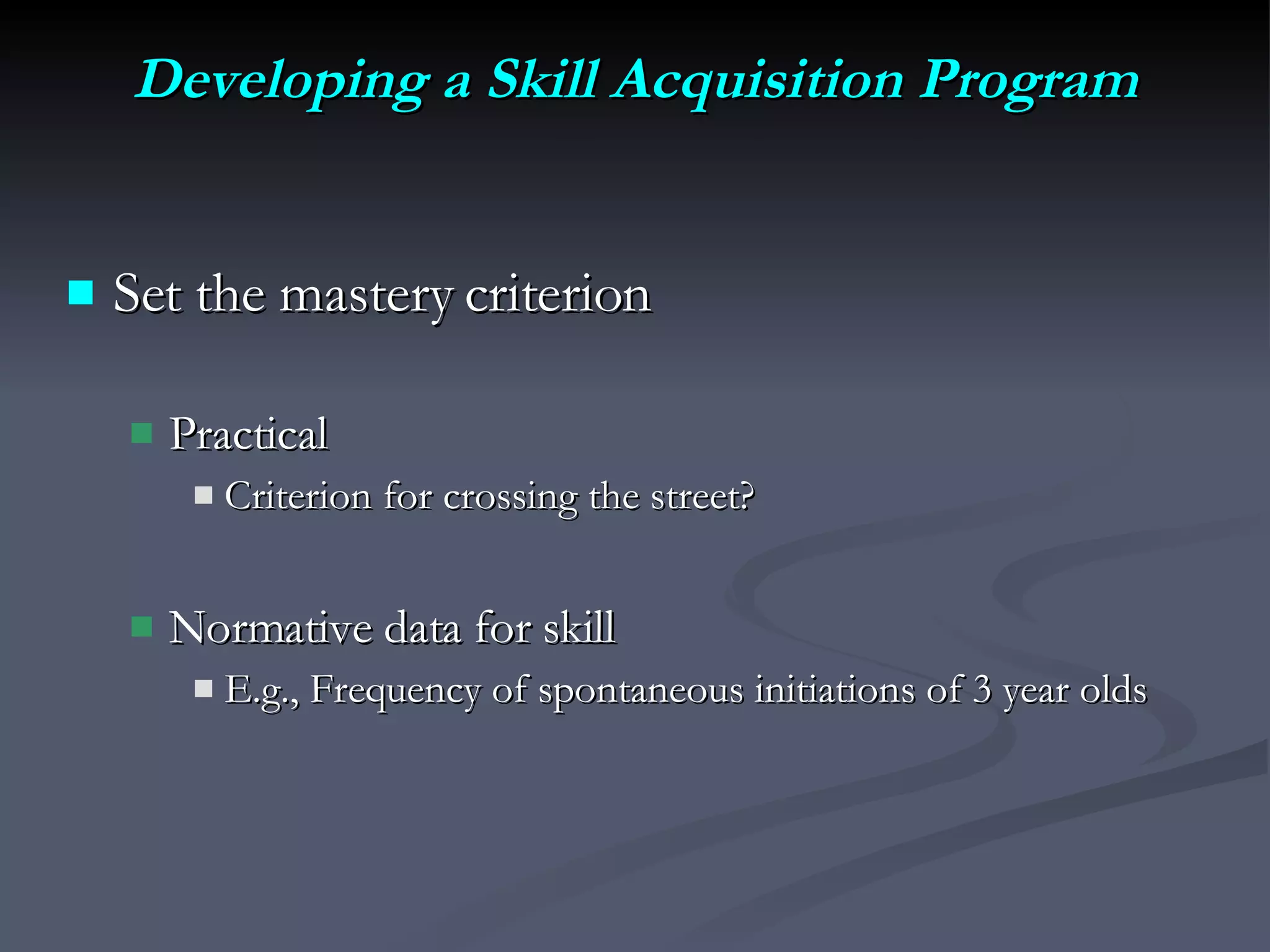
Developing a Skill Acquisition Program Set the mastery criterion Practical Criterion for crossing the street? Normative data for skill E.g., Frequency of spontaneous initiations of 3 year olds
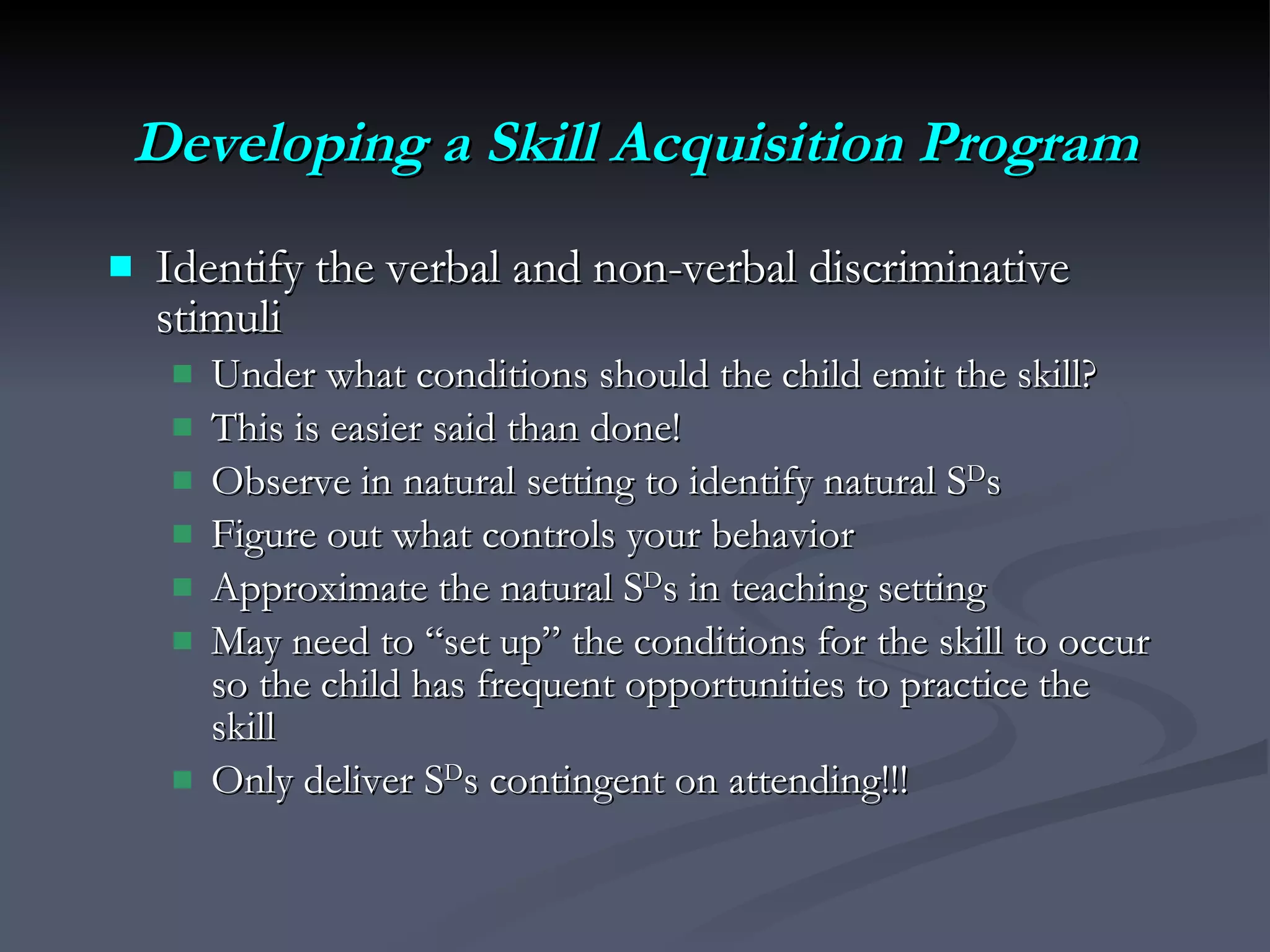
Developing a Skill Acquisition Program Identify the verbal and non-verbal discriminative stimuli  Under what conditions should the child emit the skill? This is easier said than done! Observe in natural setting to identify natural S D s Figure out what controls your behavior Approximate the natural S D s in teaching setting  May need to “set up” the conditions for the skill to occur so the child has frequent opportunities to practice the skill Only deliver S D s contingent on attending!!!
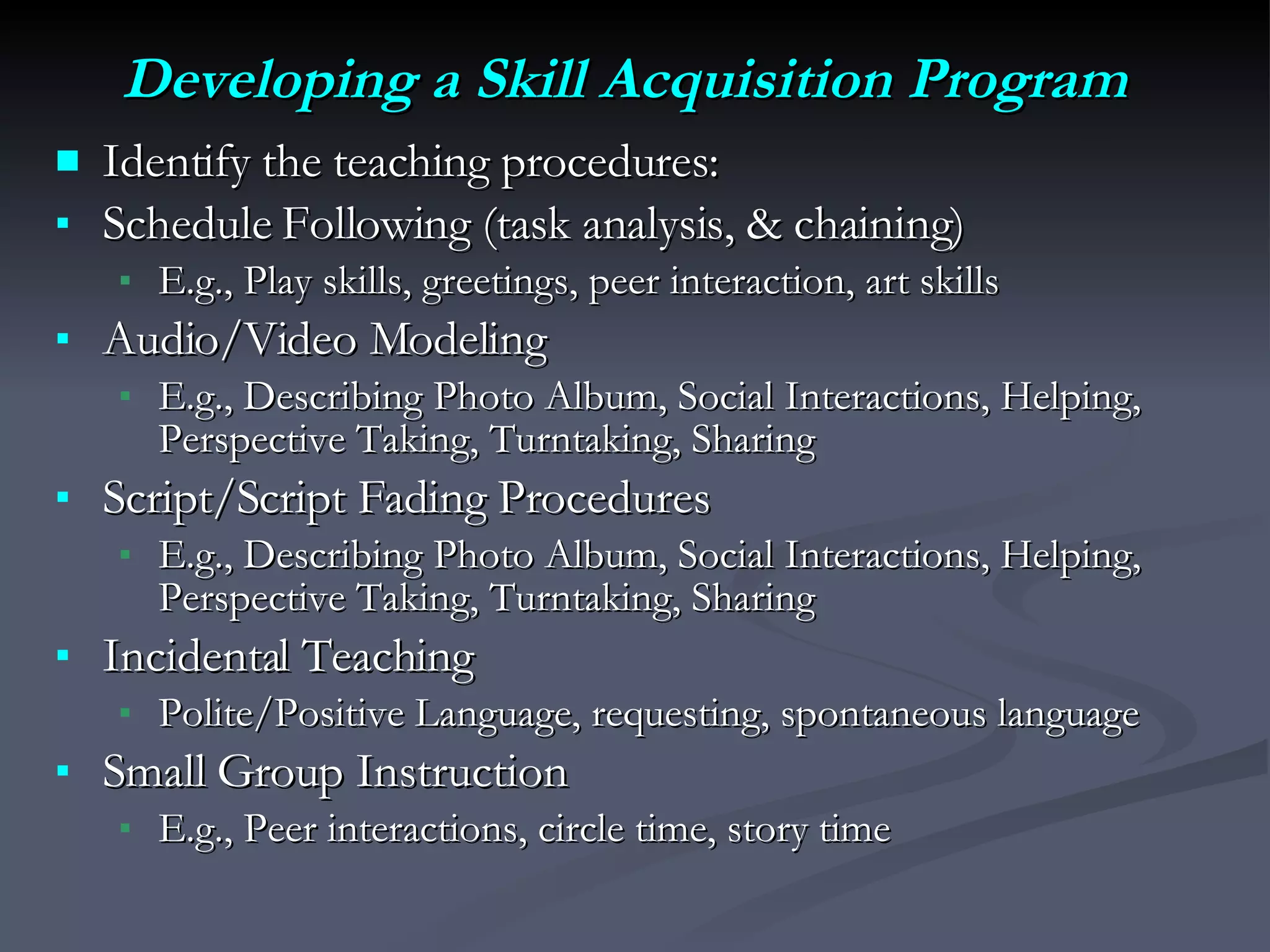
Developing a Skill Acquisition Program Identify the teaching procedures: Schedule Following (task analysis, & chaining)  E.g., Play skills, greetings, peer interaction, art skills Audio/Video Modeling  E.g., Describing Photo Album, Social Interactions, Helping, Perspective Taking, Turntaking, Sharing Script/Script Fading Procedures  E.g., Describing Photo Album, Social Interactions, Helping, Perspective Taking, Turntaking, Sharing Incidental Teaching  Polite/Positive Language, requesting, spontaneous language Small Group Instruction E.g., Peer interactions, circle time, story time
Later Small-Group Video
Developing a Skill Acquisition Program Identify the teaching procedures:  Prompting,  Prompt Fading,  Reinforcement More…
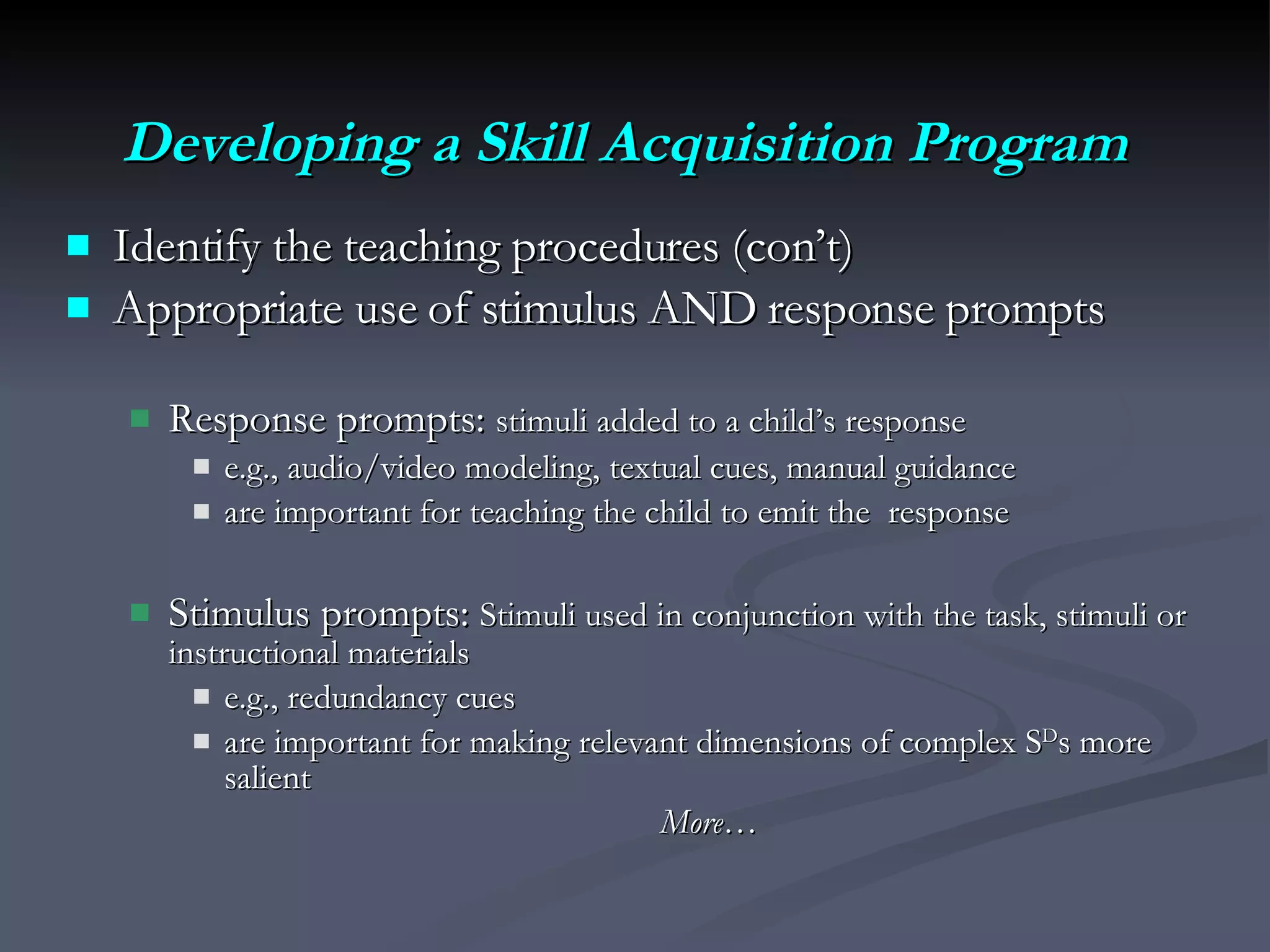
Developing a Skill Acquisition Program Identify the teaching procedures (con’t)  Appropriate use of stimulus AND response prompts Response prompts:  stimuli added to a child’s response   e.g., audio/video modeling, textual cues, manual guidance are important for teaching the child to emit the  response Stimulus prompts:  Stimuli used in conjunction with the task, stimuli or instructional materials e.g., redundancy cues are important for making relevant dimensions of complex S D s more salient More…
Developing a Skill Acquisition Program Identify the teaching procedures (con’t)  Prompt Fading:  Response Prompts: Graduated Guidance, Most-to-Least, Least-to-Most, Time Delay Stimulus Prompts: Stimulus Shaping: morphing  Stimulus Fading:  technique to gradually change the antecedent stimulus Stimuli are faded in or out. Transfer of Stimulus Control  Shifting the stimulus control from artificial cues (prompts) to naturally occurring environmental conditions. More…
Developing a Skill Acquisition Program Identify the teaching procedures (con’t)  Reinforcement strategies Token economies  Behavioral contracts  More…
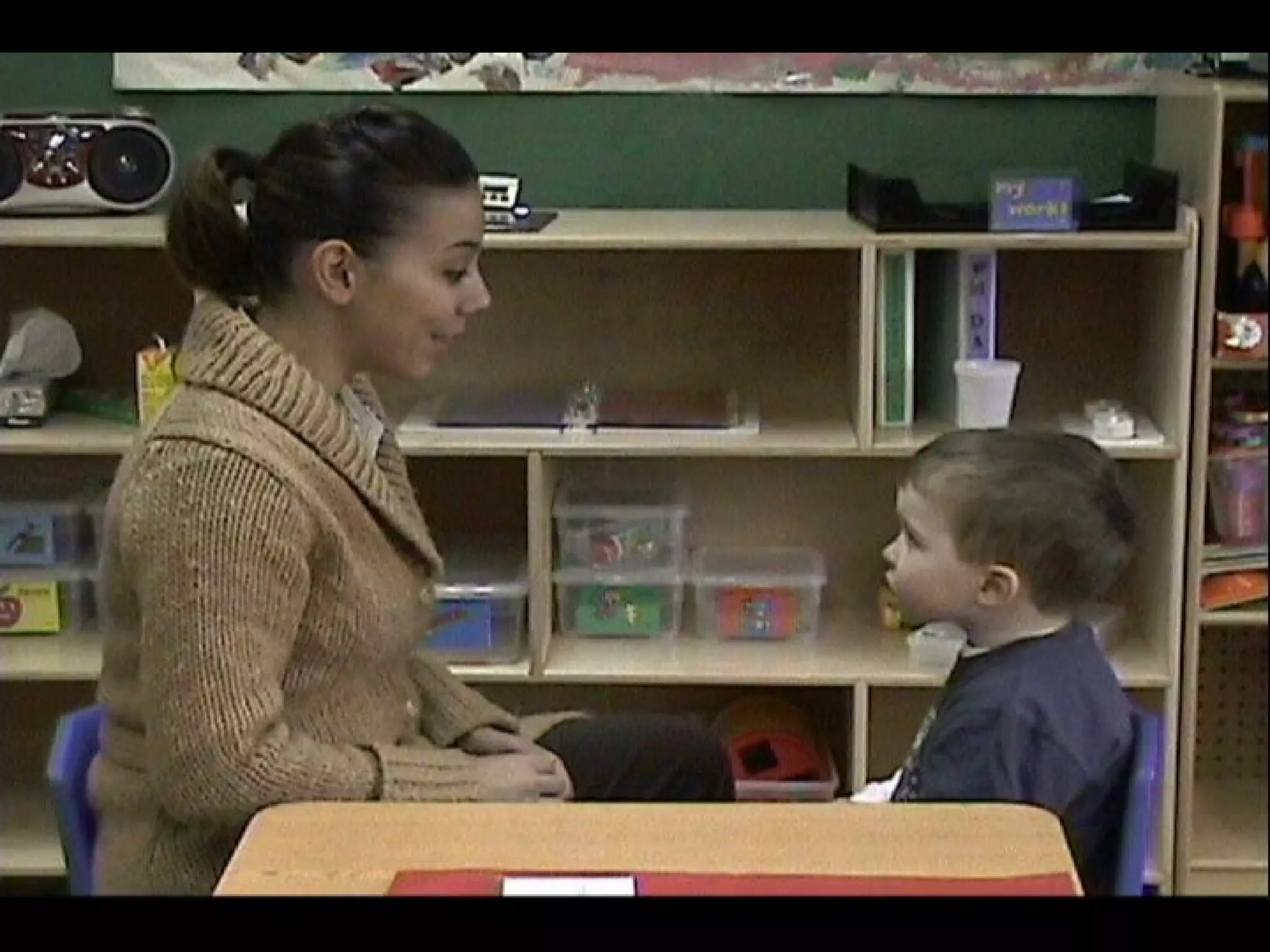
Developing a Skill Acquisition Program Identify the teaching procedures (con’t)  Reinforcement strategies Direct Snacks & Activities (video) More…
Types of Motivational Systems Direct Reinforcement Video
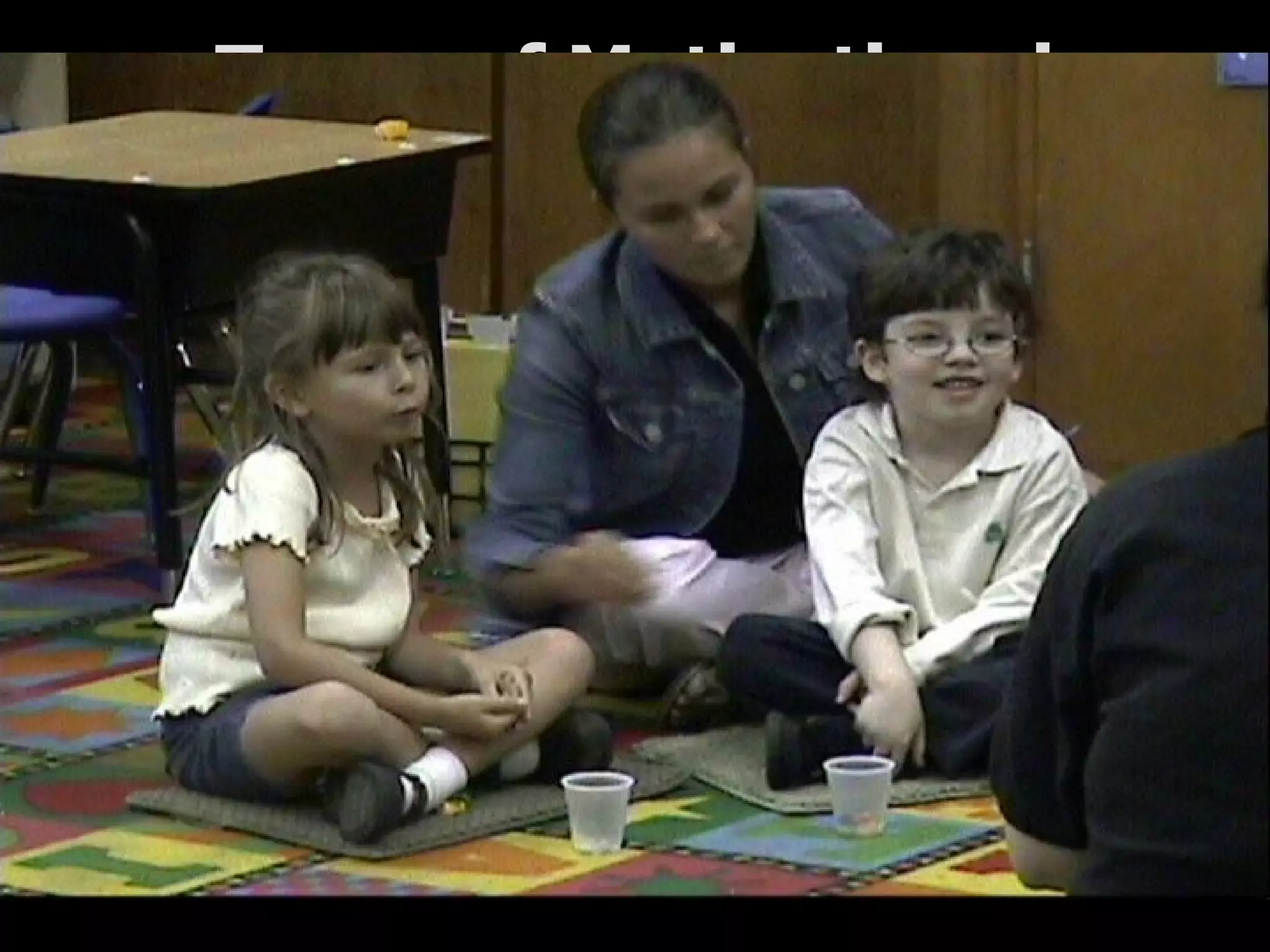
Developing a Skill Acquisition Program Identify the teaching procedures (con’t)  Reinforcement strategies Snacks in a cup (video) More…
Types of Motivational Systems Video: Snacks in a Cup
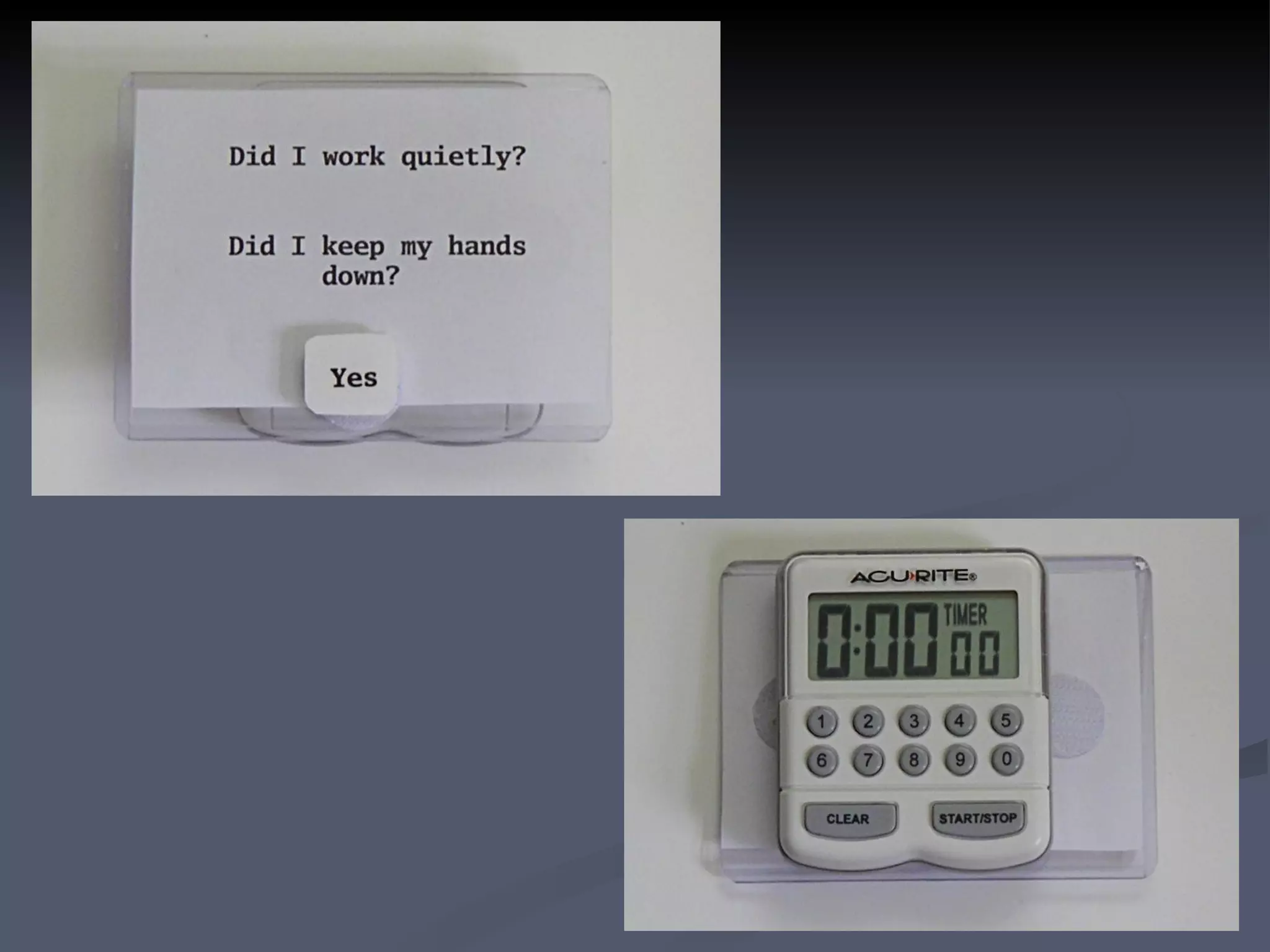
Developing a Skill Acquisition Program Identify the teaching procedures (con’t)  Reinforcement strategies DRO (video) More…
 
DRO Video
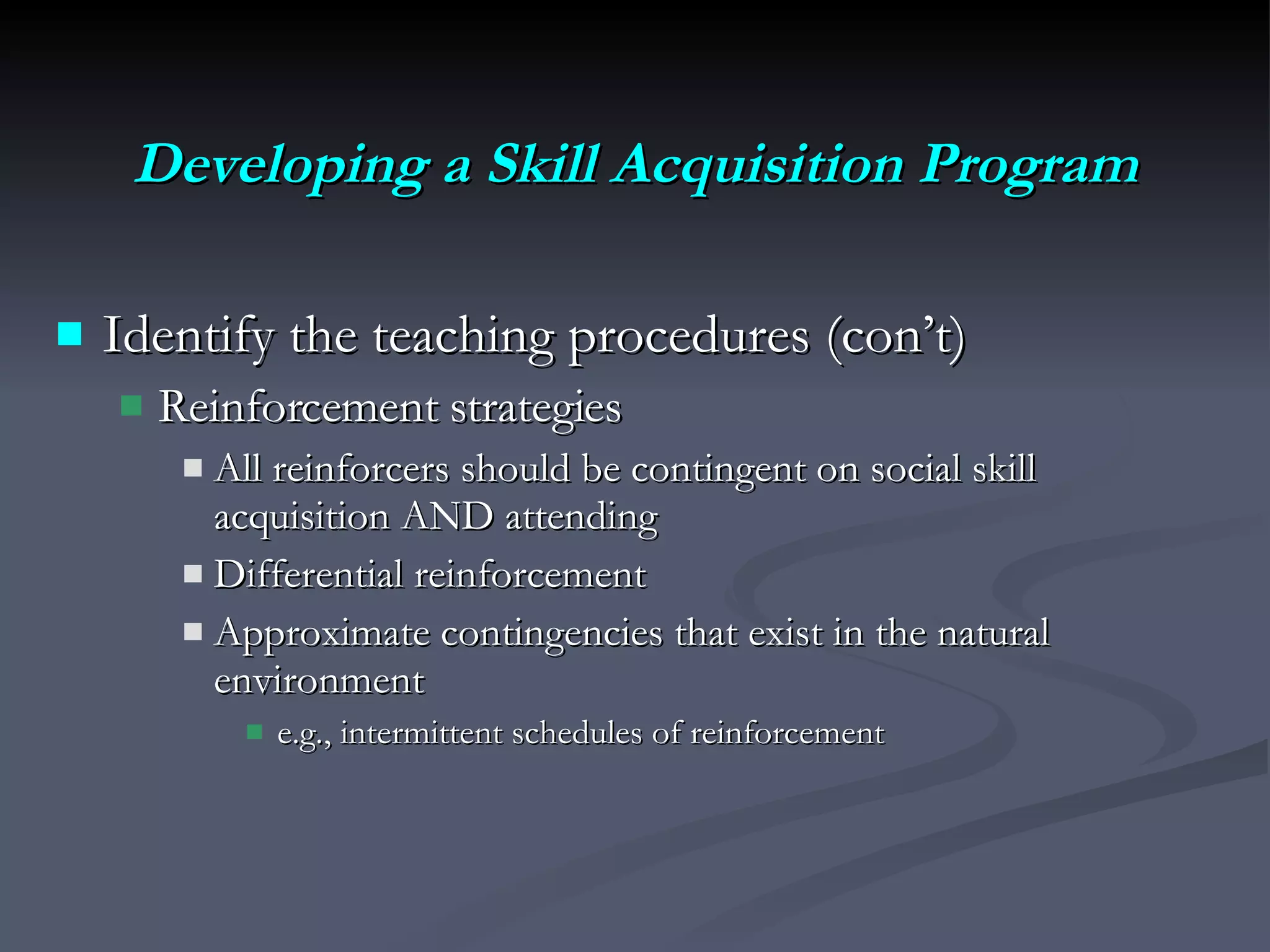
Developing a Skill Acquisition Program Identify the teaching procedures (con’t)  Reinforcement strategies All reinforcers should be contingent on social skill acquisition AND attending Differential reinforcement Approximate contingencies that exist in the natural environment  e.g., intermittent schedules of reinforcement
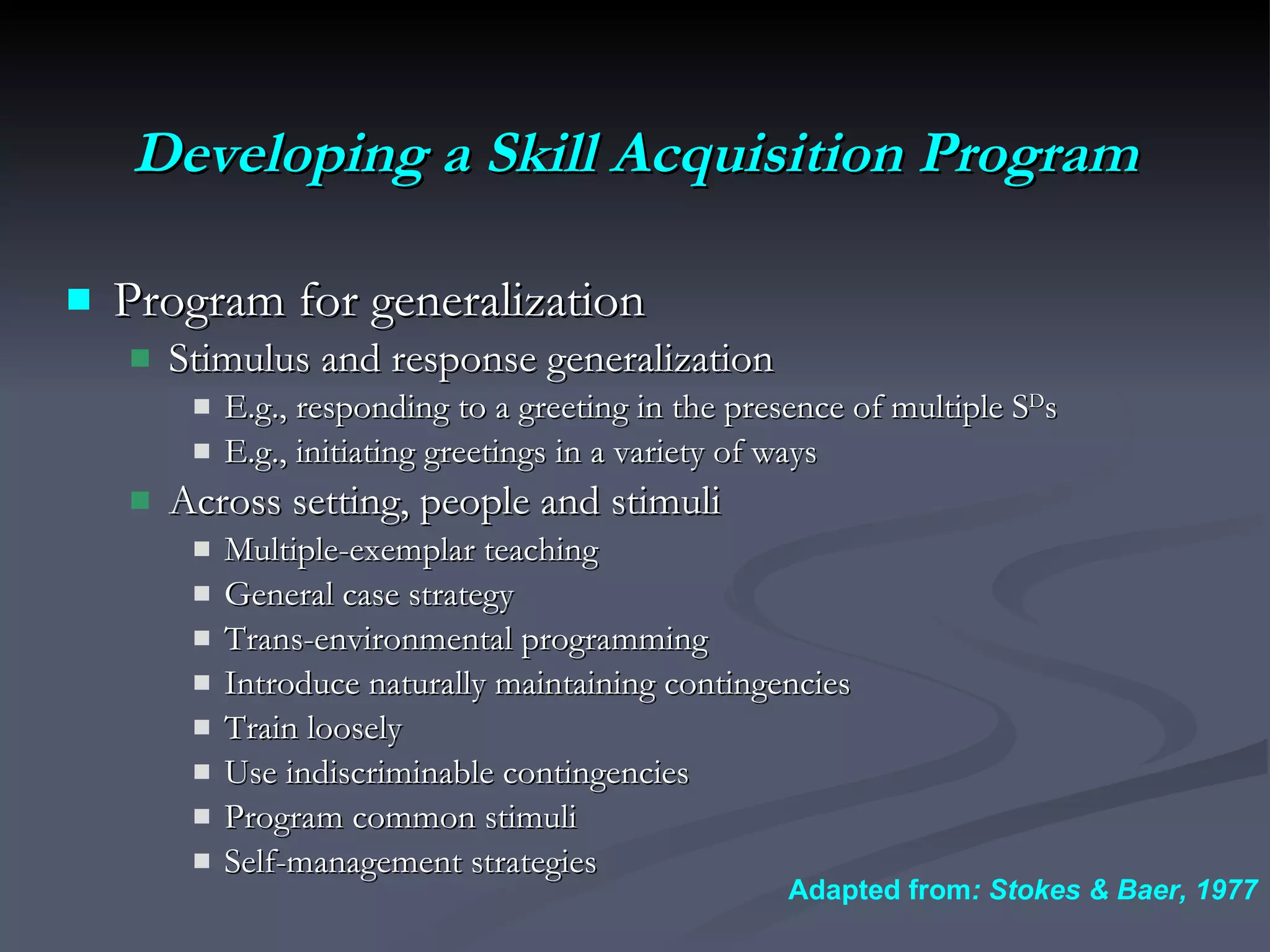
Developing a Skill Acquisition Program Program for generalization Stimulus and response generalization E.g., responding to a greeting in the presence of multiple S D s E.g., initiating greetings in a variety of ways Across setting, people and stimuli Multiple-exemplar teaching General case strategy Trans-environmental programming Introduce naturally maintaining contingencies Train loosely Use indiscriminable contingencies Program common stimuli Self-management strategies Adapted from : Stokes & Baer, 1977
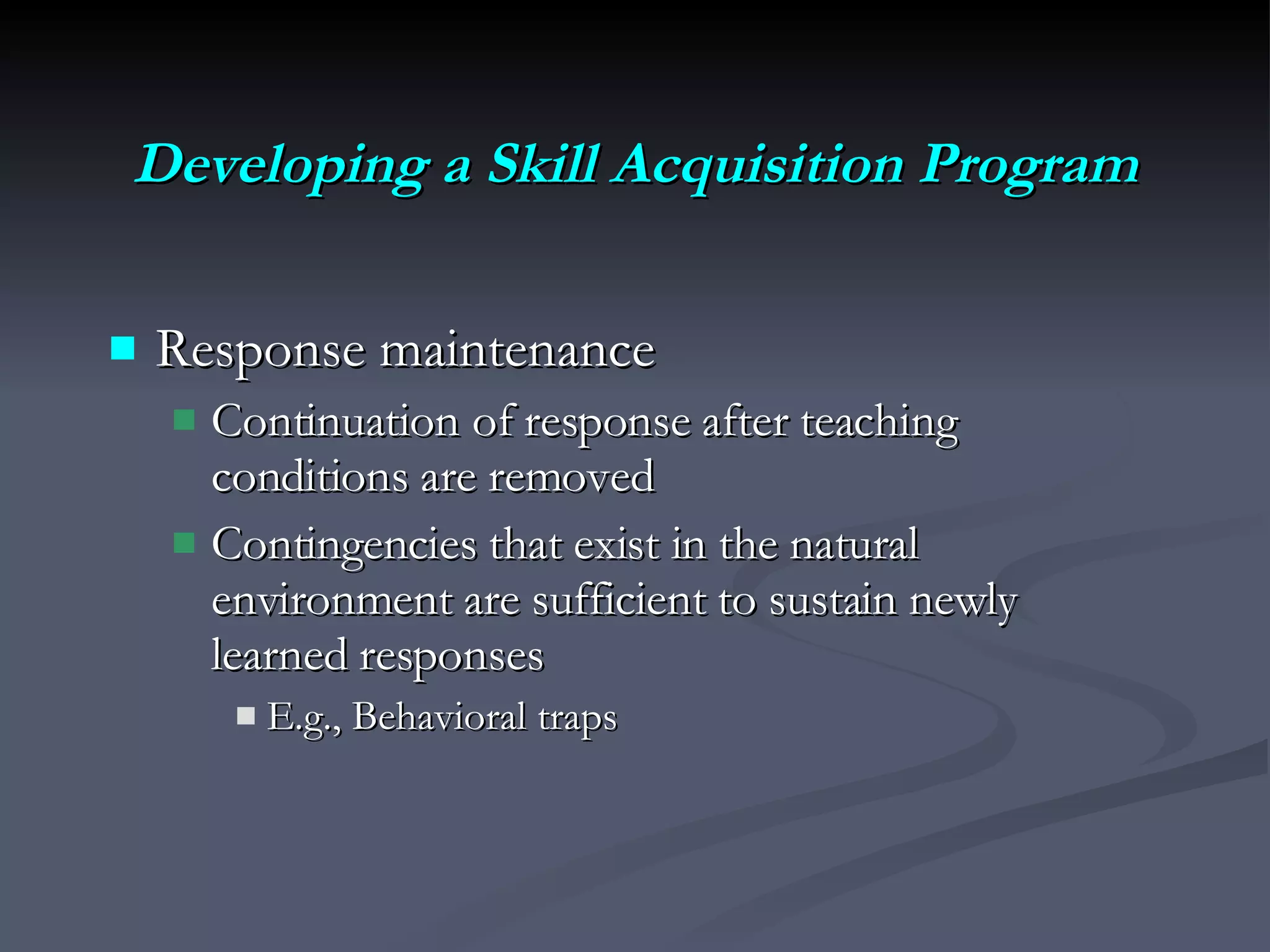
Developing a Skill Acquisition Program Response maintenance Continuation of response after teaching conditions are removed Contingencies that exist in the natural environment are sufficient to sustain newly learned responses E.g., Behavioral traps
Social Skills: ProSocial Behavior Examples of  skill acquisition programs  Helping Perspective taking
“ Helping” Skill Domain:  Social & Peer Interaction Skills  Category:  ProSocial Behavior Operational Definition :  Within 5 seconds of the discriminative stimuli (S D ) Johnny says “Can I help”AND engages in a problem-solving activity with another person .  Examples of problem-solving activities are further defined as teaching sets.  Data are collected minimally weekly and are summarized as percentage of opportunities in which Johnny effectively engaged in a helping response During data collection, no prompts are used.
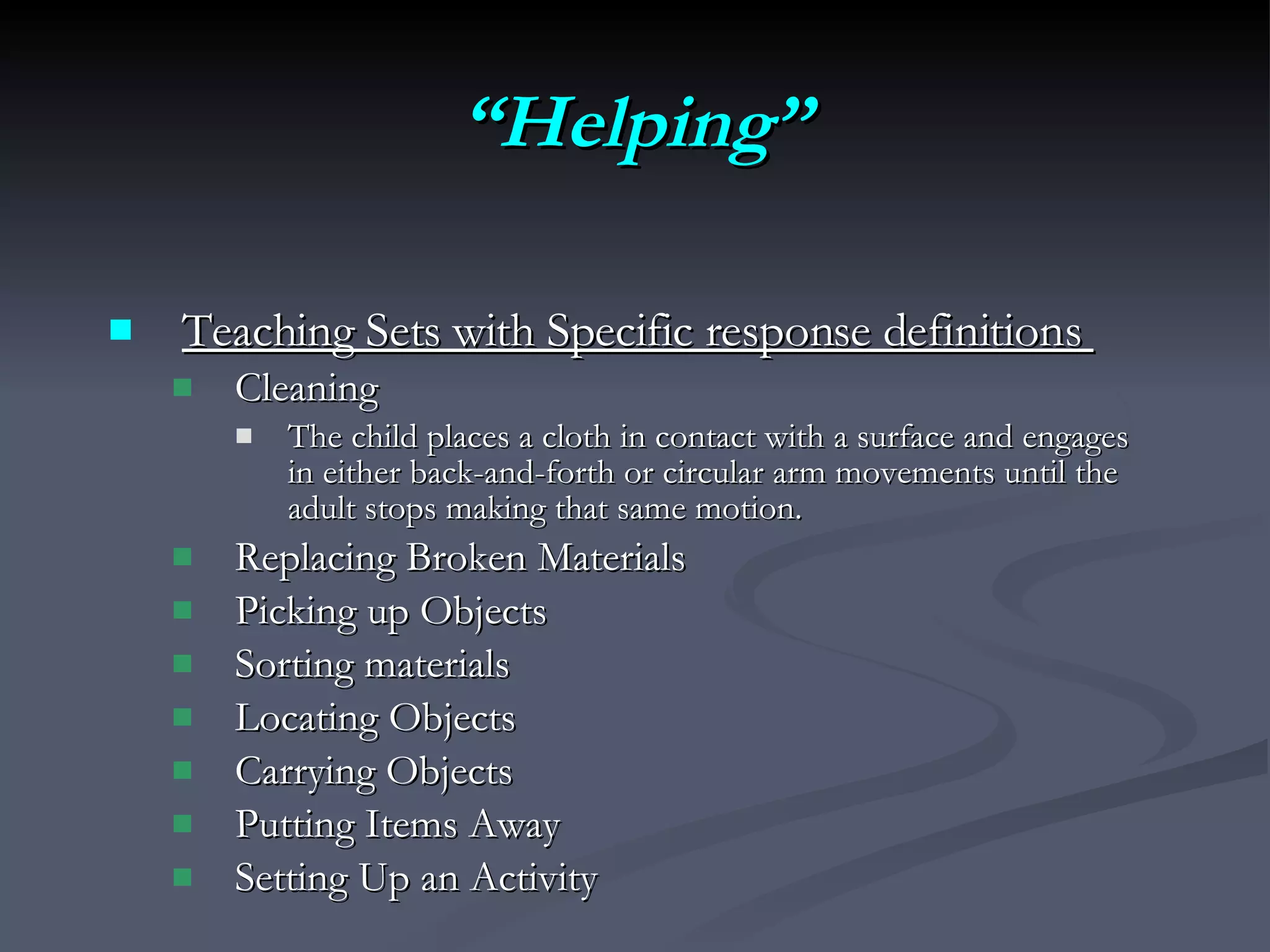
“ Helping” Teaching Sets with Specific response definitions  Cleaning The child places a cloth in contact with a surface and engages in either back-and-forth or circular arm movements until the adult stops making that same motion. Replacing Broken Materials  Picking up Objects  Sorting materials  Locating Objects Carrying Objects  Putting Items Away  Setting Up an Activity
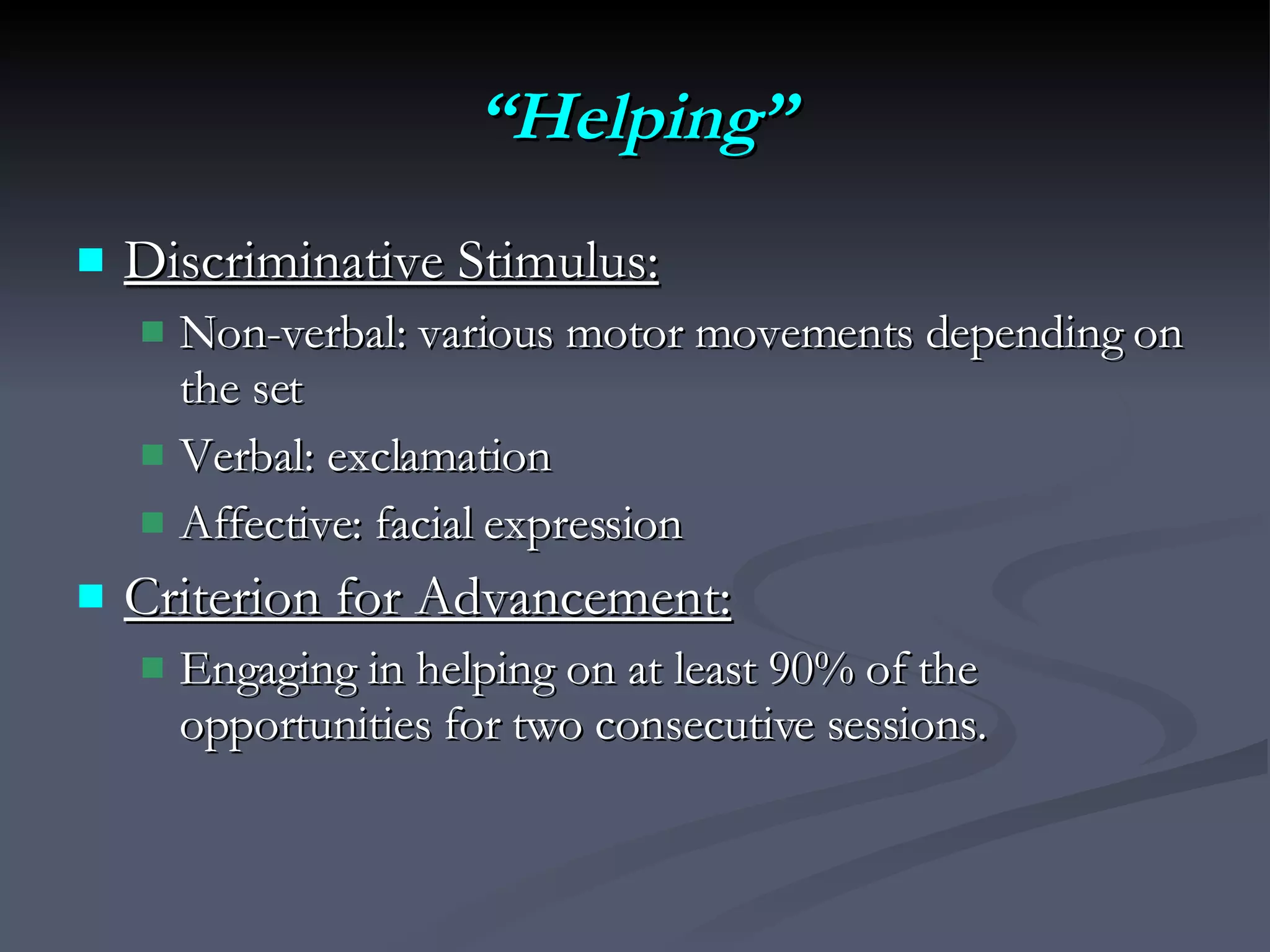
“ Helping” Discriminative Stimulus:   Non-verbal: various motor movements depending on the set Verbal: exclamation Affective: facial expression Criterion for Advancement:   Engaging in helping on at least 90% of the opportunities for two consecutive sessions.
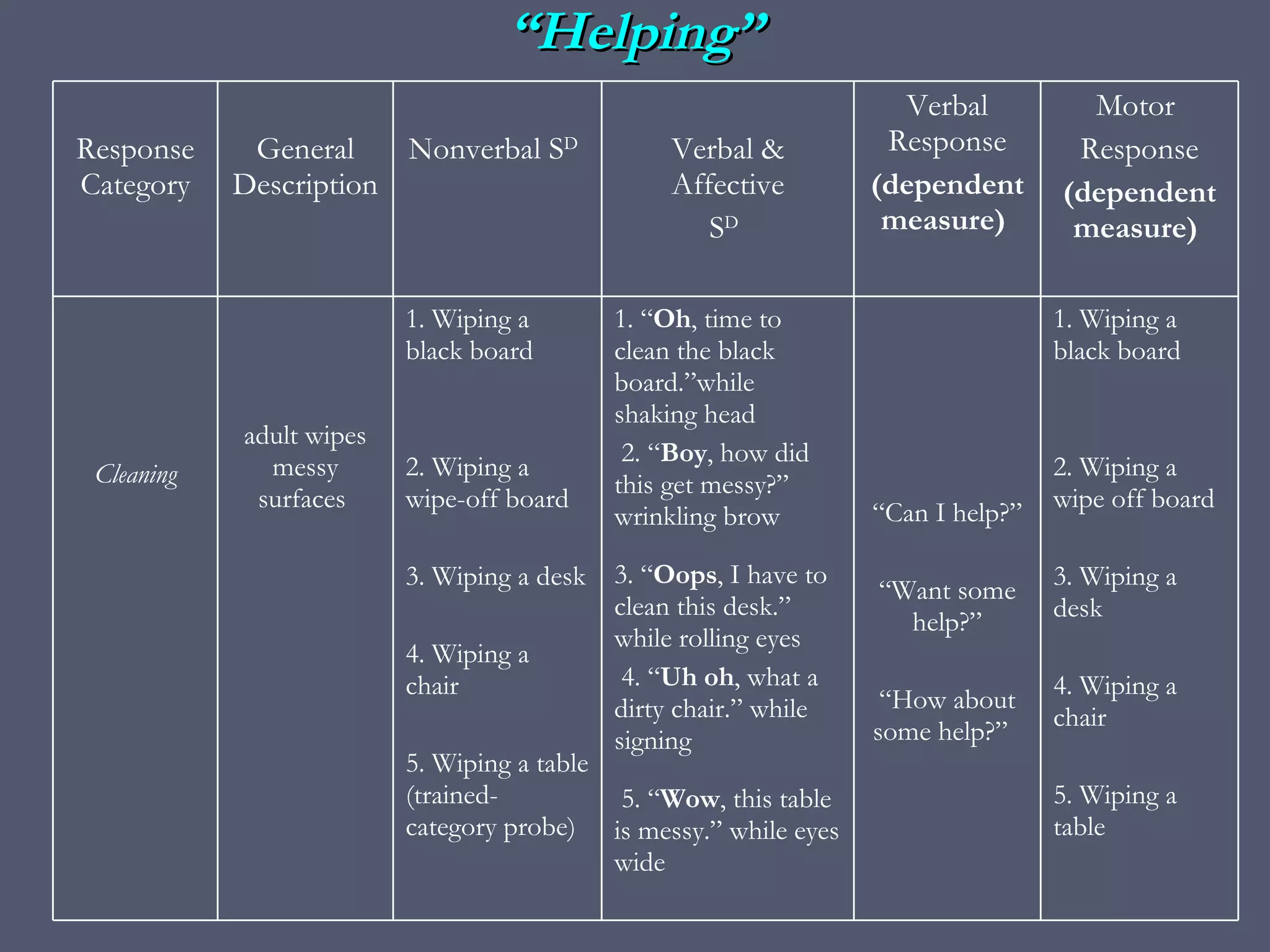
“ Helping” 1. Wiping a black board     2. Wiping a wipe off board   3. Wiping a desk     4. Wiping a chair   5. Wiping a table            “ Can I help?” “ Want some help?” “ How about some help?”   1. “ Oh , time to clean the black board.”while shaking head   2. “ Boy , how did this get messy?”  wrinkling brow 3. “ Oops , I have to clean this desk.” while rolling eyes   4. “ Uh oh , what a dirty chair.” while signing   5. “ Wow , this table is messy.” while eyes wide   1. Wiping a black board    2. Wiping a wipe-off board   3. Wiping a desk     4. Wiping a chair    5. Wiping a table  (trained-category probe)       adult wipes messy surfaces          Cleaning Motor  Response (dependent measure)   Verbal Response (dependent measure)   Verbal & Affective S D   Nonverbal S D   General Description   Response Category
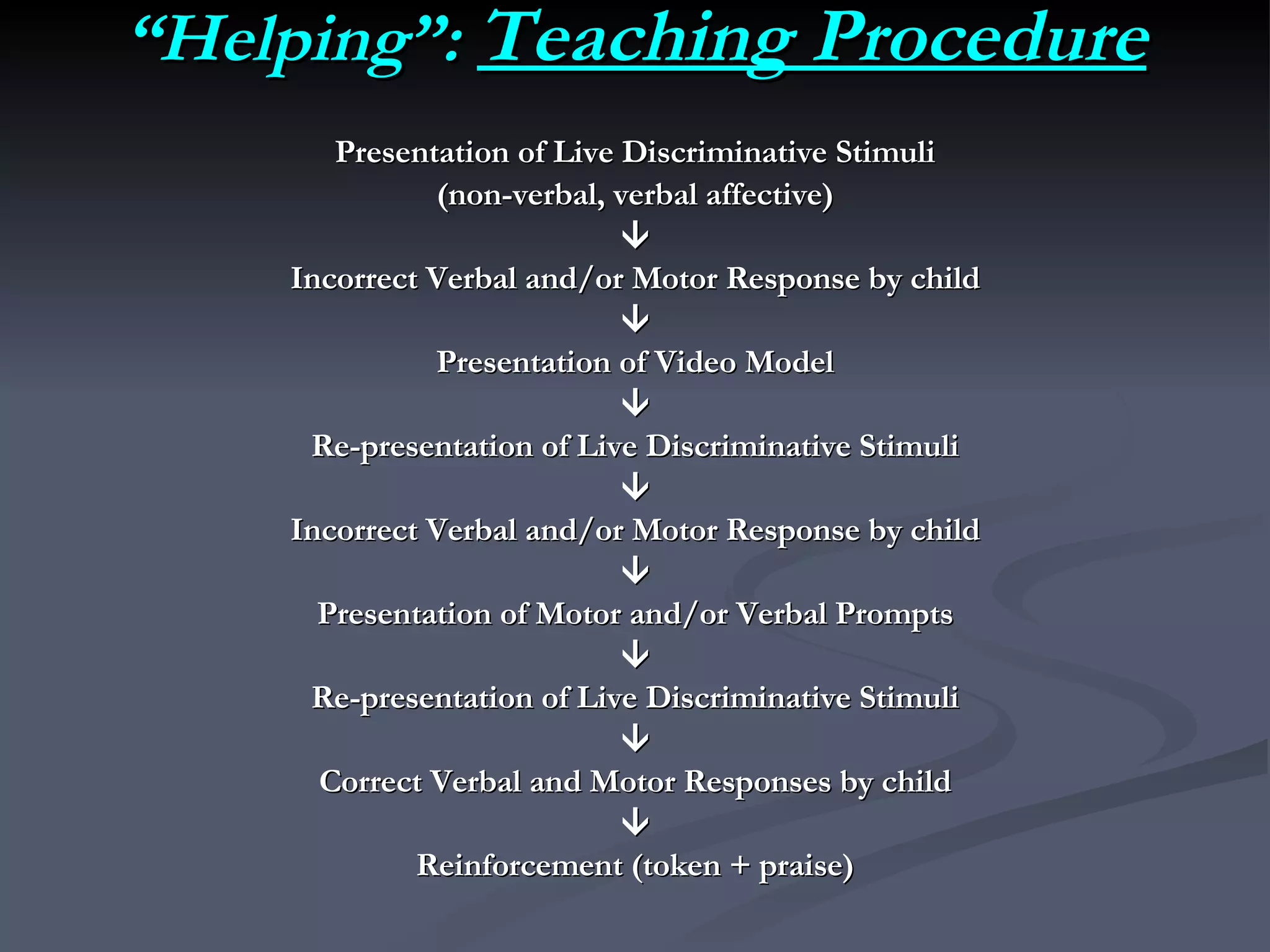
“ Helping”:  Teaching Procedure Presentation of Live Discriminative Stimuli (non-verbal, verbal affective)  Incorrect Verbal and/or Motor Response by child  Presentation of Video Model  Re-presentation of Live Discriminative Stimuli  Incorrect Verbal and/or Motor Response by child  Presentation of Motor and/or Verbal Prompts  Re-presentation of Live Discriminative Stimuli  Correct Verbal and Motor Responses by child  Reinforcement (token + praise)
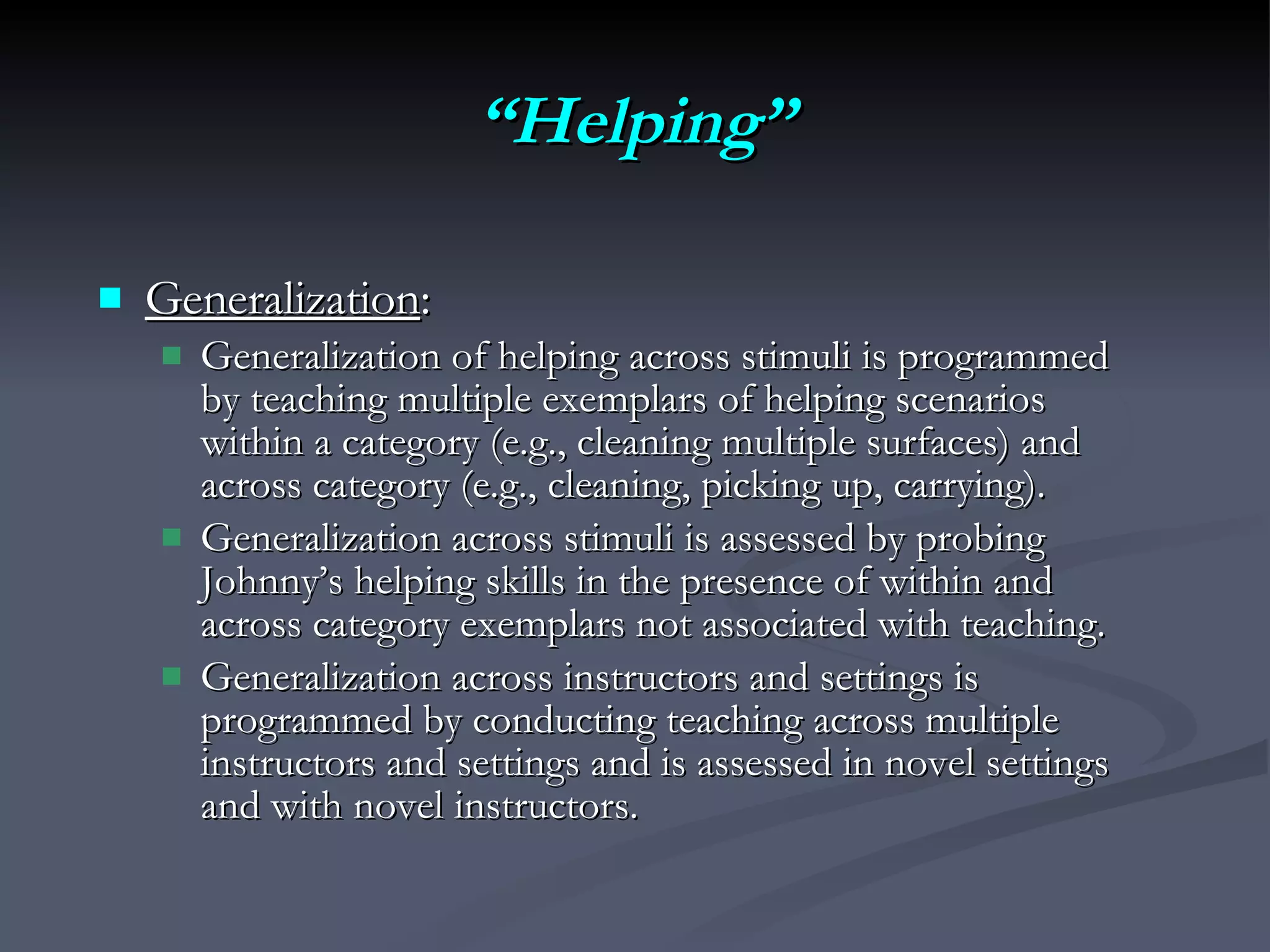
“ Helping” Generalization :  Generalization of helping across stimuli is programmed by teaching multiple exemplars of helping scenarios within a category (e.g., cleaning multiple surfaces) and across category (e.g., cleaning, picking up, carrying).  Generalization across stimuli is assessed by probing Johnny’s helping skills in the presence of within and across category exemplars not associated with teaching.  Generalization across instructors and settings is programmed by conducting teaching across multiple instructors and settings and is assessed in novel settings and with novel instructors.
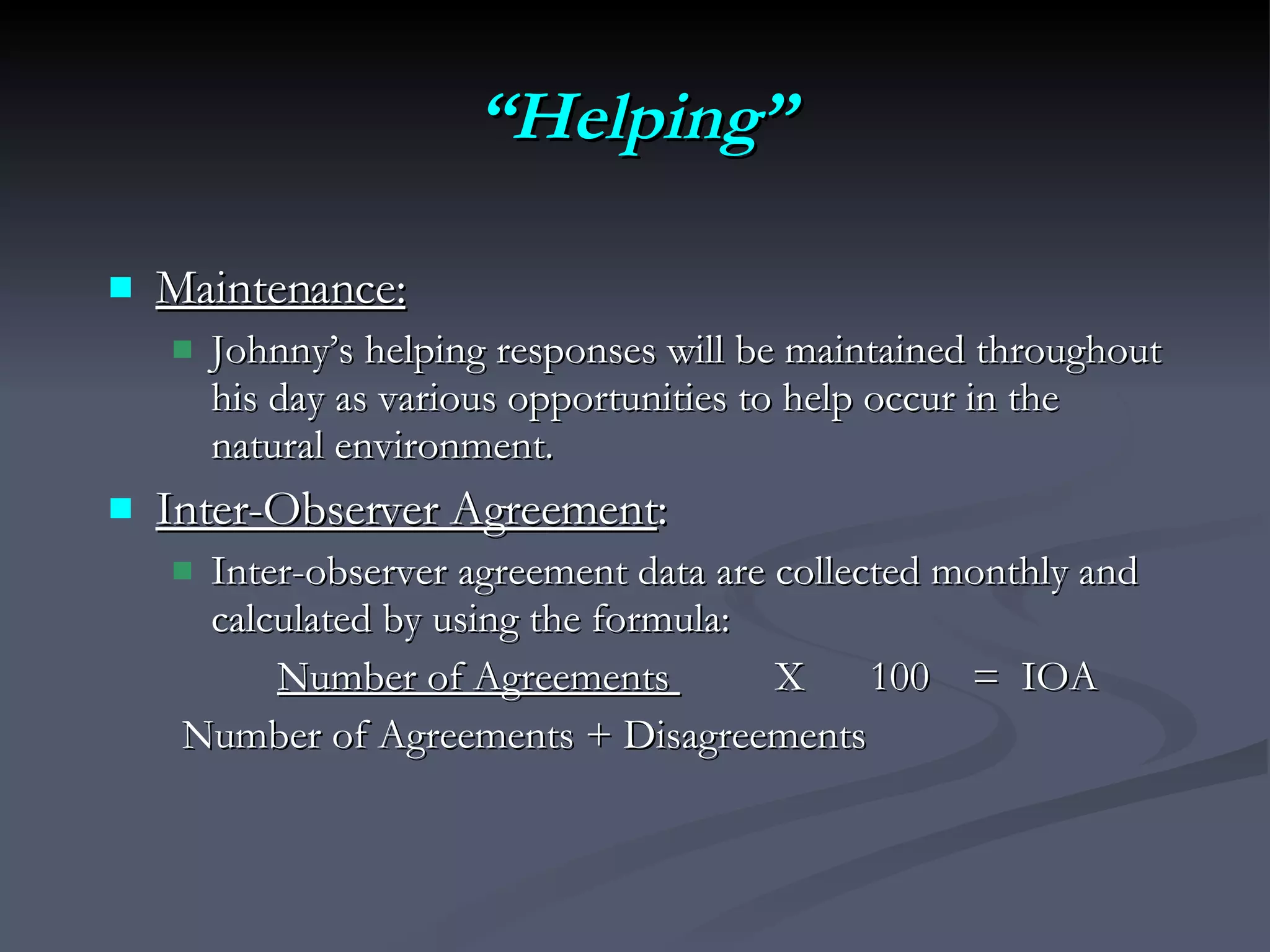
“ Helping” Maintenance:   Johnny’s helping responses will be maintained throughout his day as various opportunities to help occur in the natural environment.  Inter-Observer Agreement :  Inter-observer agreement data are collected monthly and calculated by using the formula:  Number of Agreements    X  100  =  IOA Number of Agreements + Disagreements
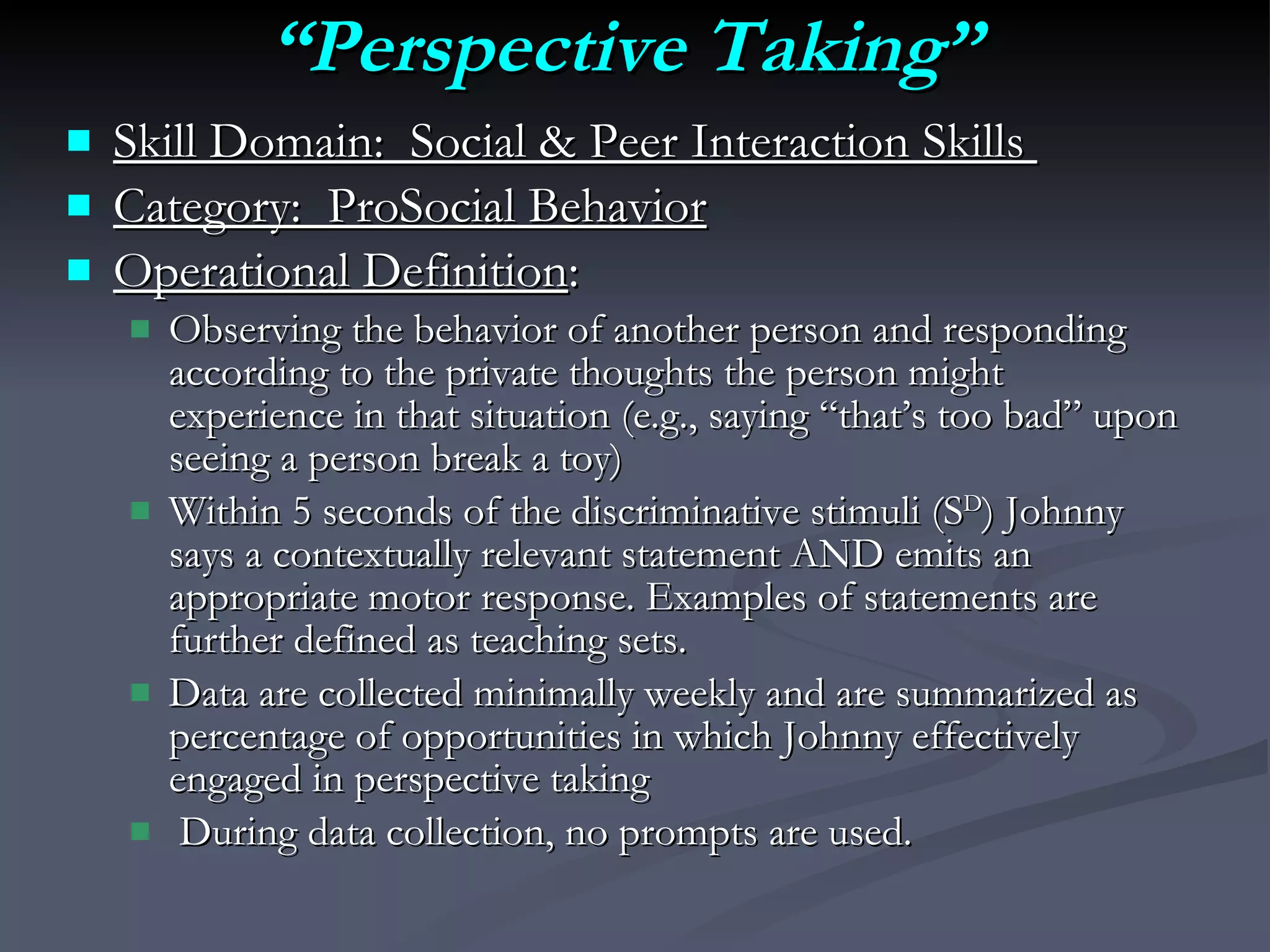
“ Perspective Taking” Skill Domain:  Social & Peer Interaction Skills  Category:  ProSocial Behavior Operational Definition :  Observing the behavior of another person and responding according to the private thoughts the person might experience in that situation (e.g., saying “that’s too bad” upon seeing a person break a toy)   Within 5 seconds of the discriminative stimuli (S D ) Johnny says a contextually relevant statement AND emits an appropriate motor response. Examples of statements are further defined as teaching sets.  Data are collected minimally weekly and are summarized as percentage of opportunities in which Johnny effectively engaged in perspective taking During data collection, no prompts are used.
“ Perspective Taking” Teaching Sets with Specific response definitions  excitement pain frustration
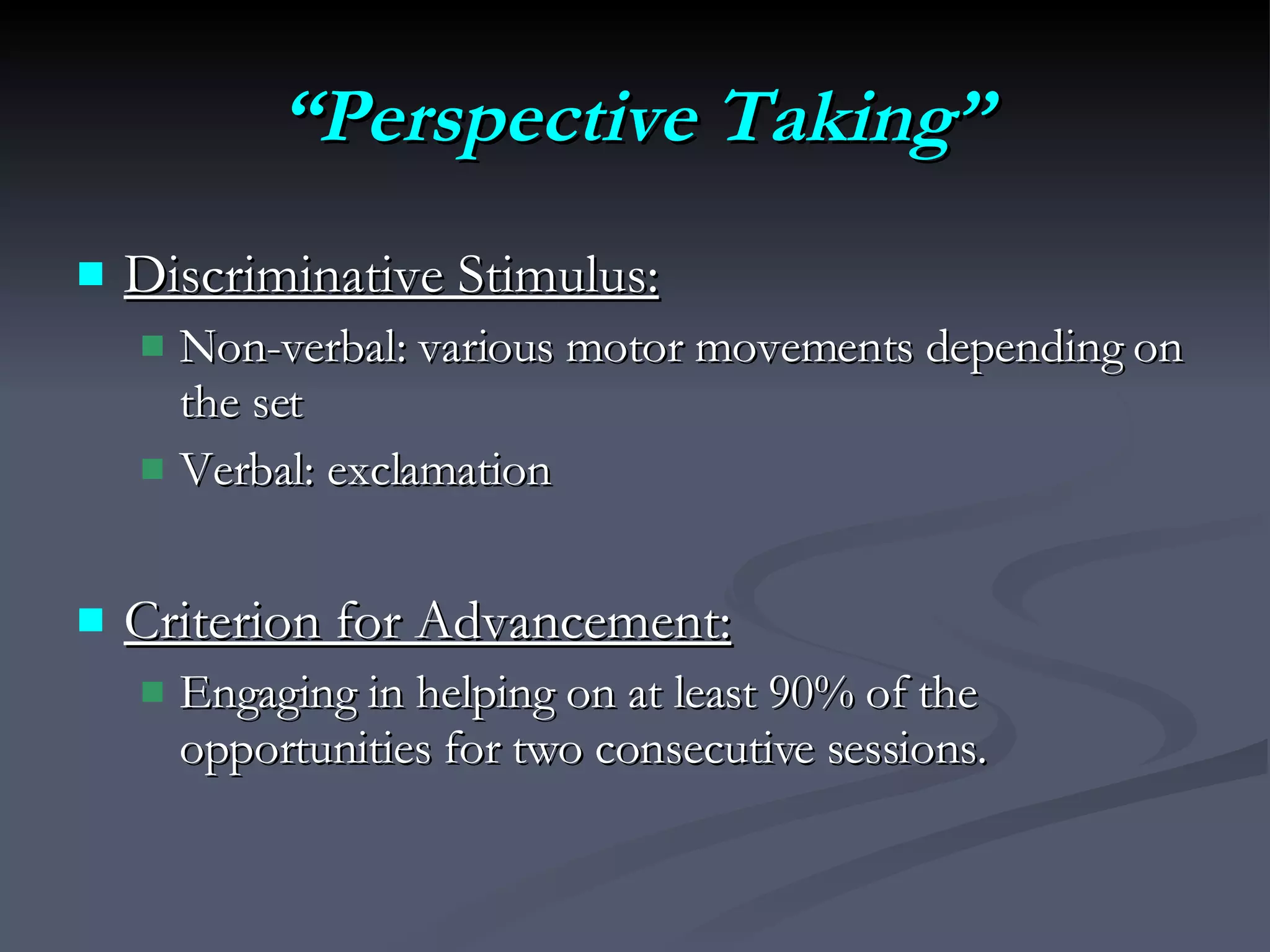
“ Perspective Taking” Discriminative Stimulus:   Non-verbal: various motor movements depending on the set Verbal: exclamation Criterion for Advancement:   Engaging in helping on at least 90% of the opportunities for two consecutive sessions.
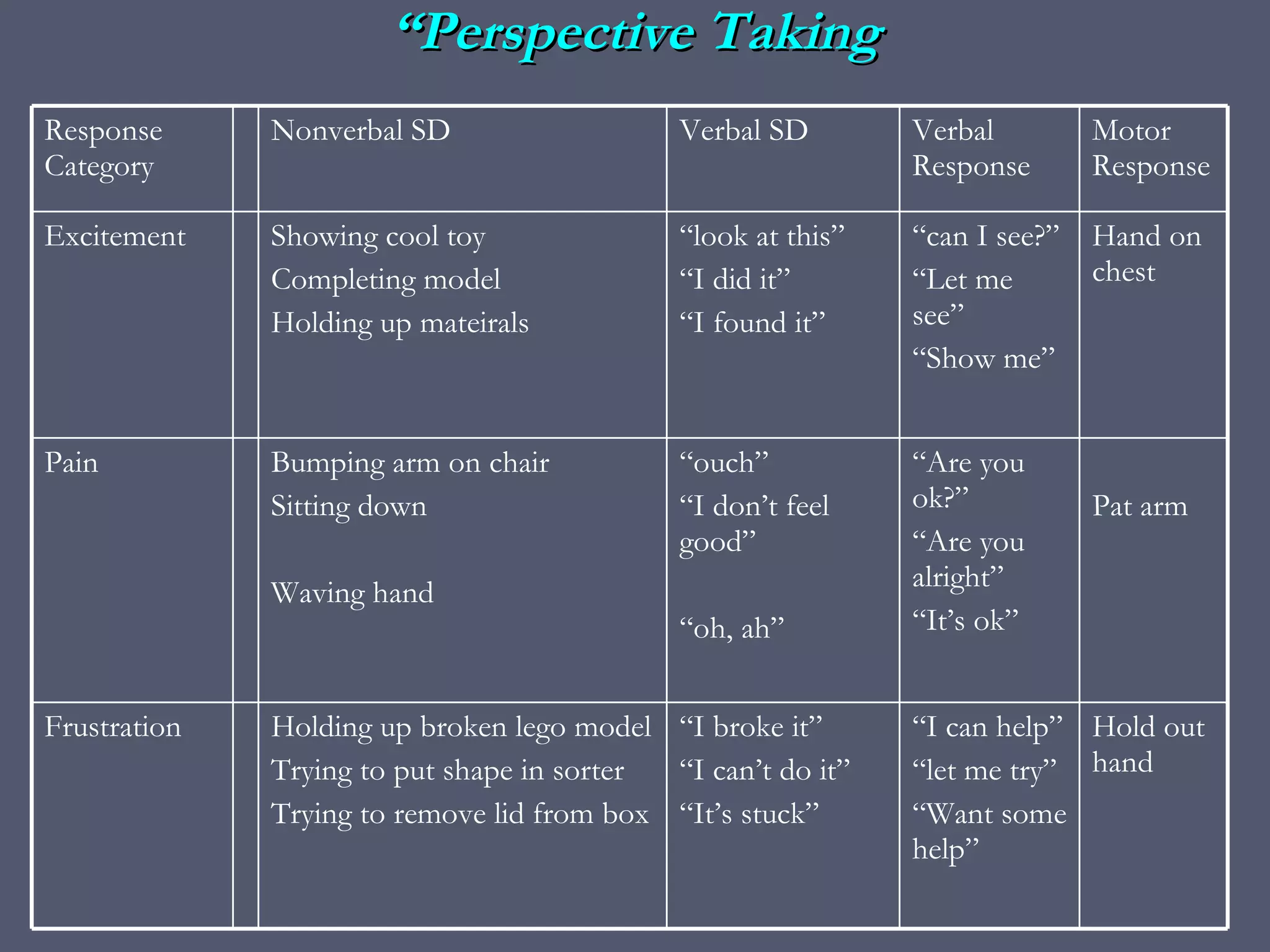
“ Perspective Taking Hold out hand “ I can help” “ let me try” “ Want some help” “ I broke it” “ I can’t do it” “ It’s stuck” Holding up broken lego model Trying to put shape in sorter Trying to remove lid from box Frustration Pat arm “ Are you ok?” “ Are you alright” “ It’s ok” “ ouch” “ I don’t feel good” “ oh, ah” Bumping arm on chair Sitting down Waving hand Pain Hand on chest “ can I see?” “ Let me see” “ Show me” “ look at this” “ I did it” “ I found it” Showing cool toy Completing model Holding up mateirals Excitement Motor Response Verbal Response Verbal SD Nonverbal SD Response Category
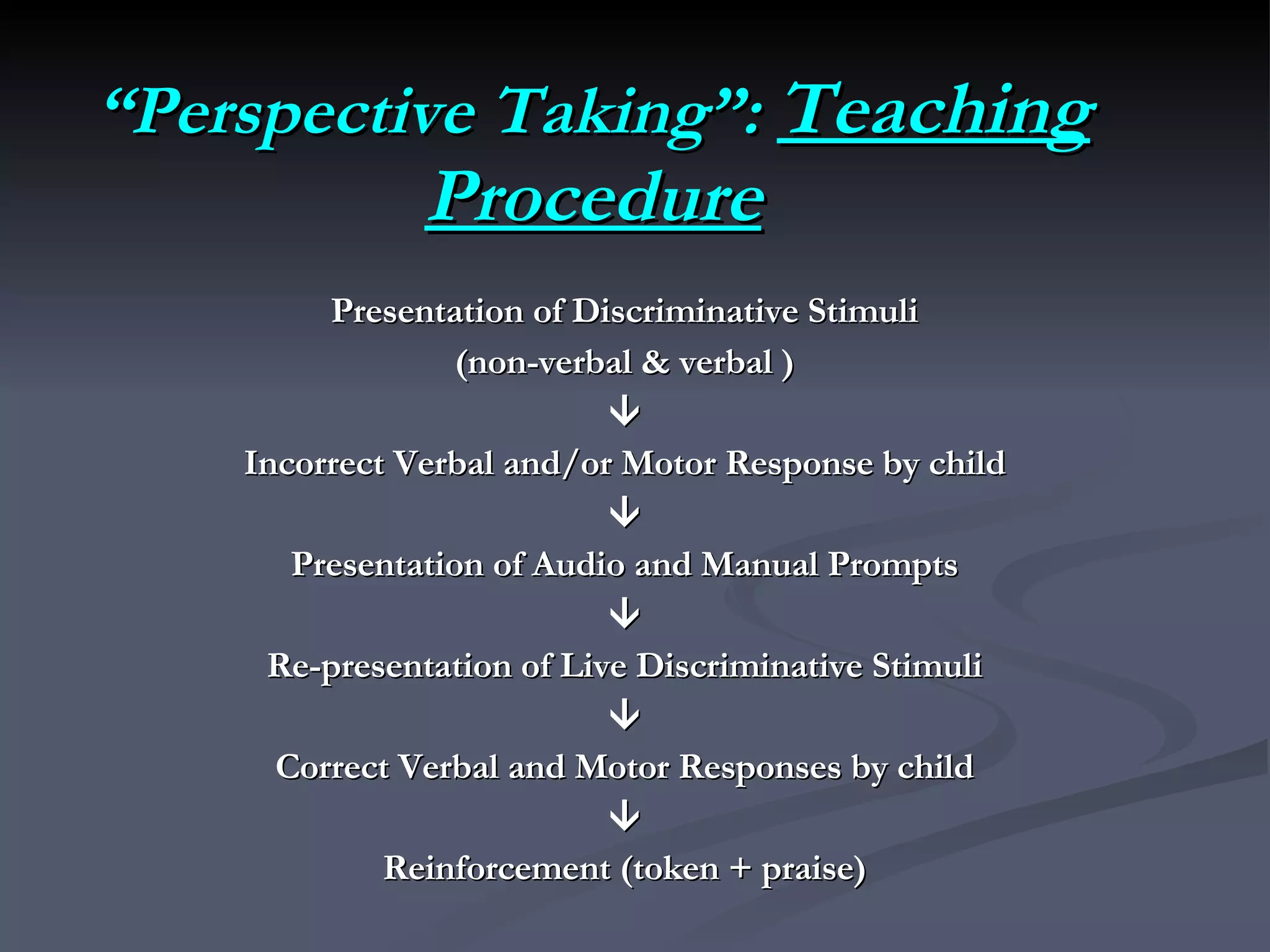
“ Perspective Taking”:  Teaching Procedure Presentation of Discriminative Stimuli (non-verbal & verbal )  Incorrect Verbal and/or Motor Response by child  Presentation of Audio and Manual Prompts  Re-presentation of Live Discriminative Stimuli  Correct Verbal and Motor Responses by child  Reinforcement (token + praise)
“ Perspective Taking Generalization :  Generalization of perspective taking across stimuli is programmed by teaching multiple exemplars of perspective taking scenarios within a category (e.g., different ways to show excitement) and across category (e.g., excitement, sadness) Generalization across stimuli is assessed by probing Johnny’s perspective taking skills in the presence of within and across category exemplars not associated with teaching.  Generalization across instructors and settings is programmed by conducting teaching across multiple instructors and settings and is assessed in novel settings and with novel instructors.
“ Perspective Taking” Maintenance:   Johnny’s perspective taking will be maintained throughout his day as various opportunities occur in the natural environment.  Inter-Observer Agreement :  Inter-observer agreement data are collected monthly and calculated by using the formula:  Number of Agreements  X  100  =  IOA Number of Agreements + Disagreements
Developing a Program:  Creating a  Data Sheet Select 30-40 programs from goals & objectives across all skill domains (majority of programs will be language based) Divide into 30 minute sessions across all instructors in class One 30 minute session (9-10 sessions per day) 2-3 programs taught with incidental teaching  3-4  programs taught using other teaching procedures
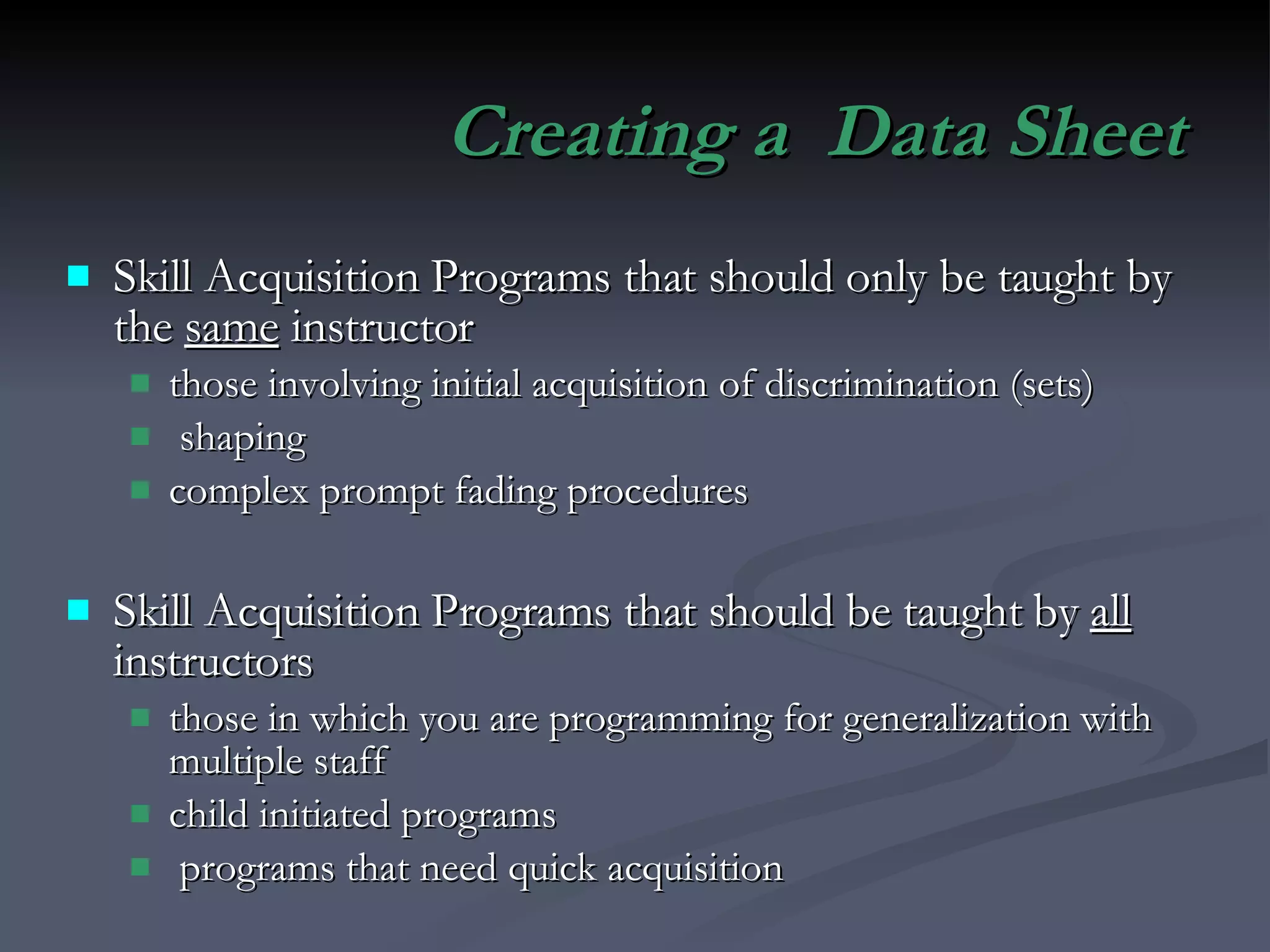
Developing a Program:  Creating a  Data Sheet Skill Acquisition Programs that should only be taught by the  same  instructor those involving initial acquisition of discrimination (sets) shaping complex prompt fading procedures Skill Acquisition Programs that should be taught by  all  instructors those in which you are programming for generalization with multiple staff child initiated programs programs that need quick acquisition handout
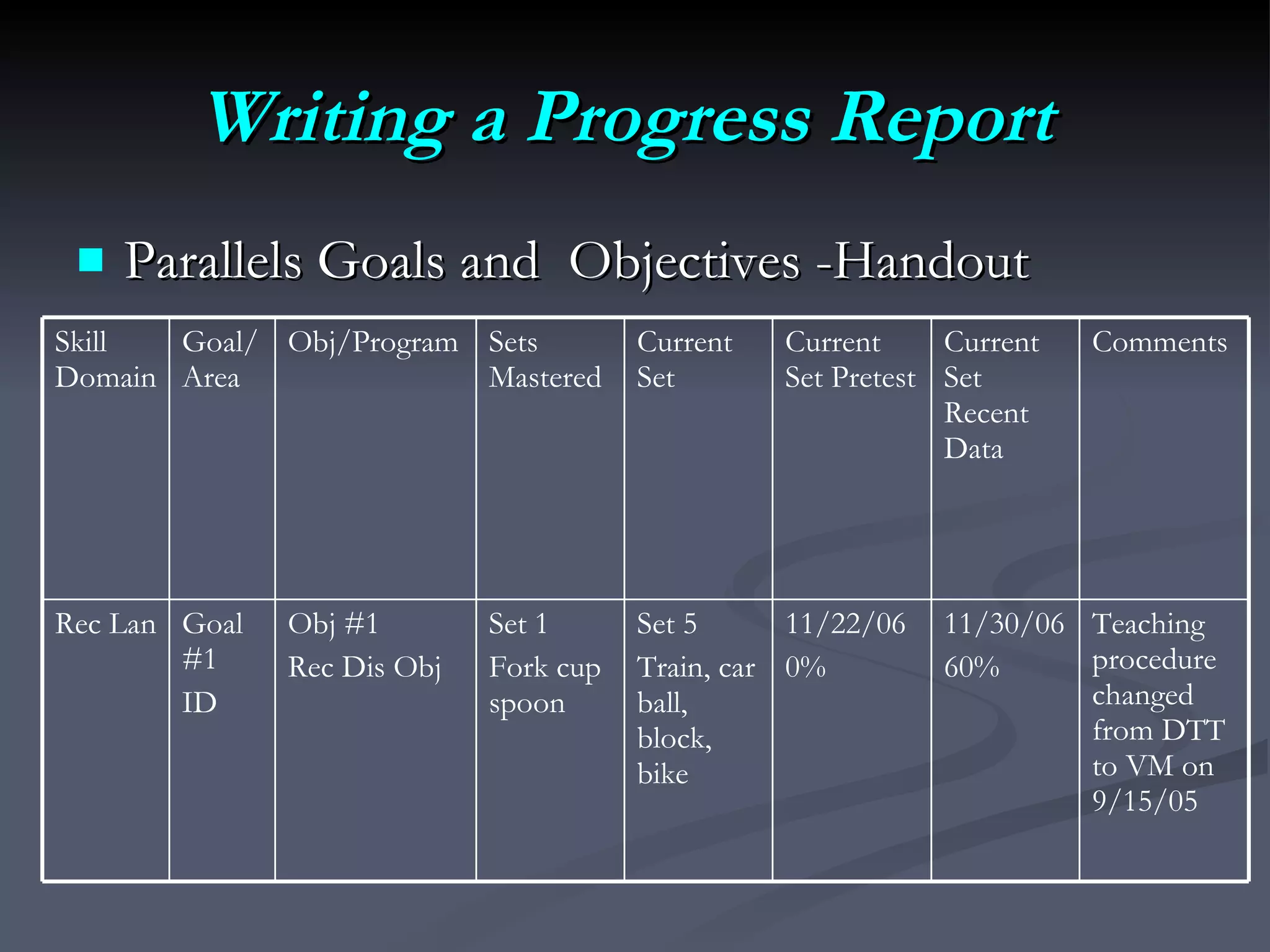
Writing a Progress Report   Parallels Goals and  Objectives -Handout Teaching procedure changed from DTT to VM on 9/15/05 11/30/06 60% 11/22/06 0% Set 5 Train, car ball, block, bike Set 1 Fork cup spoon Obj #1 Rec Dis Obj Goal #1 ID Rec Lan Comments Current Set Recent Data Current Set Pretest Current Set Sets Mastered Obj/Program Goal/Area Skill Domain
 
Home and School Program Development Chapter 9 Evaluation Systems
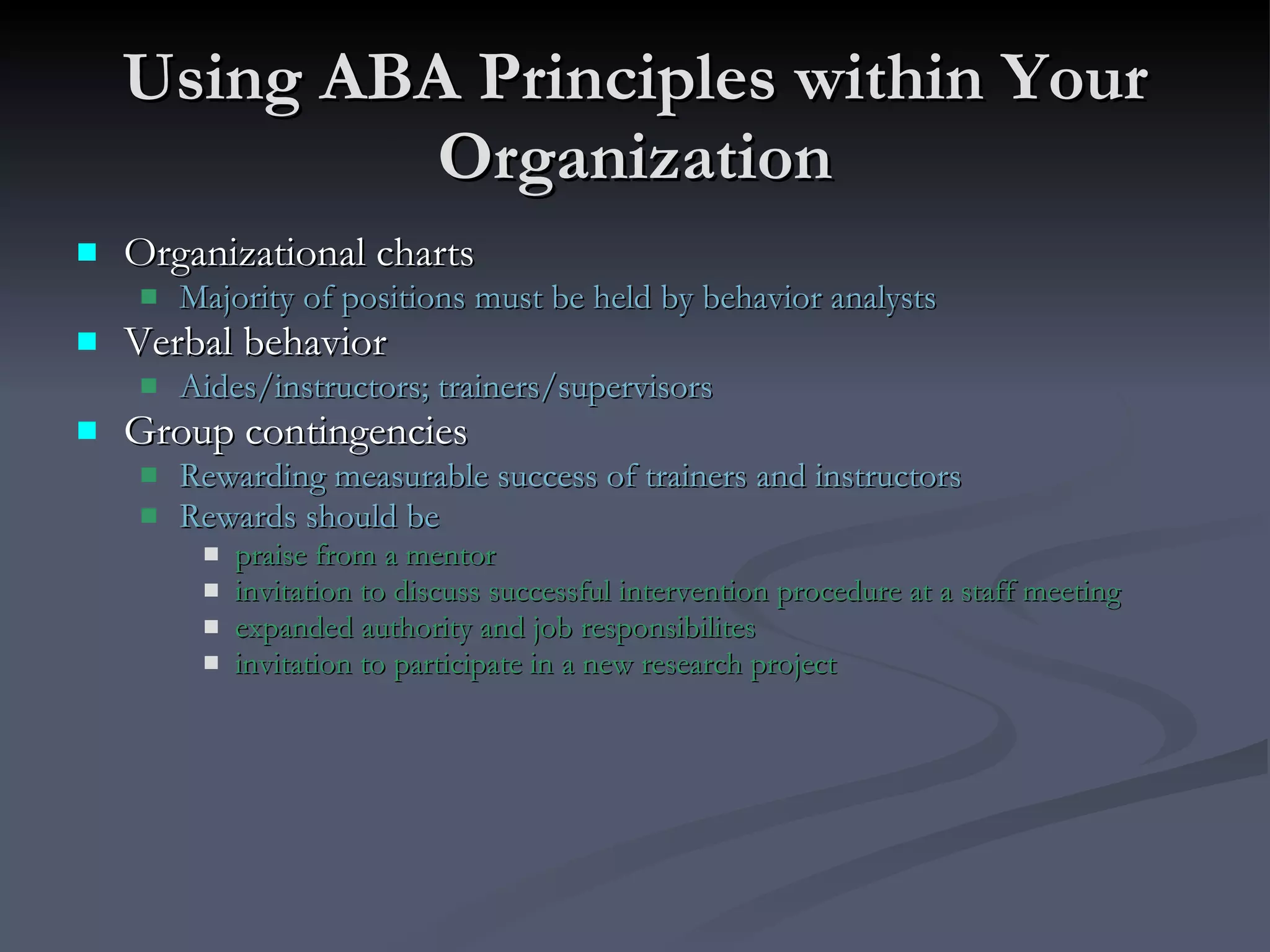
Using ABA Principles within Your Organization Organizational charts Majority of positions must be held by behavior analysts Verbal behavior Aides/instructors; trainers/supervisors Group contingencies Rewarding measurable success of trainers and instructors Rewards should be  praise from a mentor invitation to discuss successful intervention procedure at a staff meeting expanded authority and job responsibilites  invitation to participate in a new research project
Using ABA Principles within Your Organization Training expertise Direct-hands on training Modeling and Feedback Teach skills in receiving and implementing feedback Teach skills in giving positive and corrective feedback Shaping trainee performance Consumer Evaluation Survey staff members frequently   Rating scales and written feedback Use as a Prompt System for making Proactive Program Improvements Use data to implement meaningful change
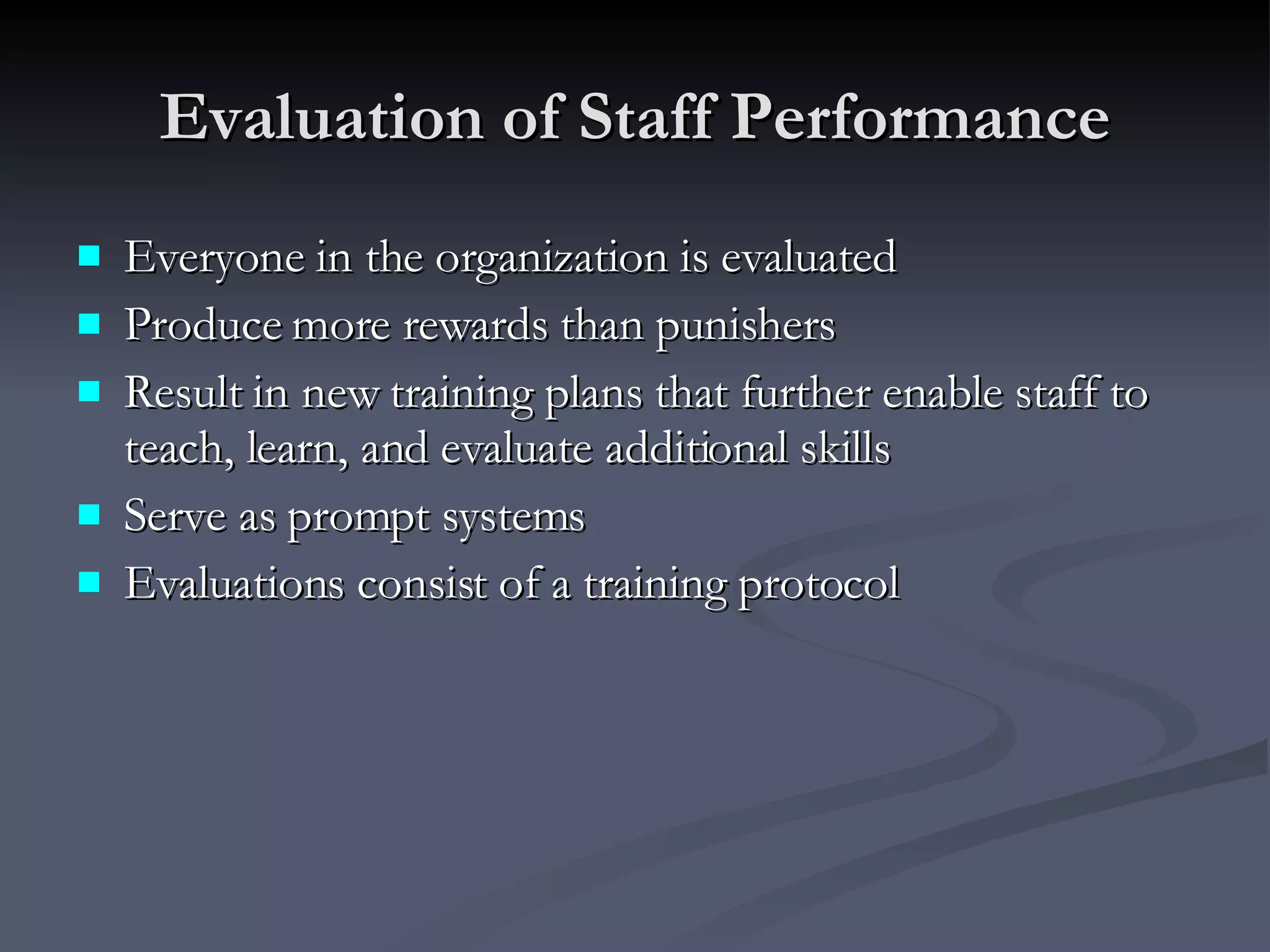
Evaluation of Staff Performance Everyone in the organization is evaluated Produce more rewards than punishers Result in new training plans that further enable staff to teach, learn, and evaluate additional skills Serve as prompt systems Evaluations consist of a training protocol
Evaluation Protocol On-task behavior of students Opportunities to Respond Behavior Specific Praise rate of reinforcement Incidental Teaching Programming & Assessing Generalization Understanding Intervention Technology
Evaluation Protocol Professionalism Appearance, use of feedback model, neat work environment, concern for students, punctual, stays on-task, seeks opportunities to develop new skills, knows the programs they teach, good collegial relationships
Evaluation Protocol Teaching New Skills Gains student’s attention, clear instructions, teaches learner to initiate, smooth transitions, contingently uses a variety of rewards, use of prompts, activity schedules, motivational systems,
Evaluation Protocol Social Competence Teaches & models hygiene, grooming, manners, facial expression, voice tone & volume, greeting skills, independence, teaches skills rewarding to others, teaches tasks to criterion, teaches peer interaction, social initiations & language,
Evaluation Protocol Relationship Building Smiles at students, provides age-appropriate physical contact, appears enthusiastic, pleasant, identifies novel relationship-building activities, makes positive statement to and about students, credits colleagues
Evaluation Protocol Decreases Problem Behavior Knows response definitions & Treatment protocols, appropriate voice tone & touch, teaching of incompatible behavior and use of proactive strategies, accurate data collection
Evaluation of Treatment Outcomes Number of students per year who successfully transition to general education Measurement of skill acquisition for individualized programs
Evaluation of Treatment Outcomes Graph Labels condition lines, sets, teaching procedures, explanation of inconsistent data, data gaps Data Consistently collection, criterion levels, new sets immediately implemented
Evaluation of Treatment Outcomes Number of programs reviewed Percentage of individualized programs Written response definition, data collection procedure, baseline/treatment, graph Percentage of programs rated effective Behavior change in desired direction Percentage of programs rated appropriate Treatment may continue Percentage of programs with current consent Percentage of programs with  some/any  interobserver agreement
Systems Non-departmentalized All trainers are evaluators Trainees evaluation result is the measure of a trainer In summary…… Administrative success is defined by the data on trainer/evaluator behavior, intervention agents’ performance; treatment outcome and consumer satisfaction
References McClannahan, L. E. & Krantz, P. J. (2004). Some guidelines for selecting behavioral intervention programs for children with autism. In H. E. Brigs and T. L. Rzepnicki (Eds.),  Using social work practice: Behavioral perspectives.  Chicago, IL: Lyceum. McClannahan ,  L. E. & Krantz ,  P.J.  (1993). On systems analysis in autism intervention programs.   Journal of Applied Behavior Analysis, 26,  589-596.
Environment: Self Contained ED 571:  School and Home-Based Programs for Children with Autism
Classroom Set up NO CUBBIES Why not? How should the classroom look? Where do you keep student materials? Reinforcers?
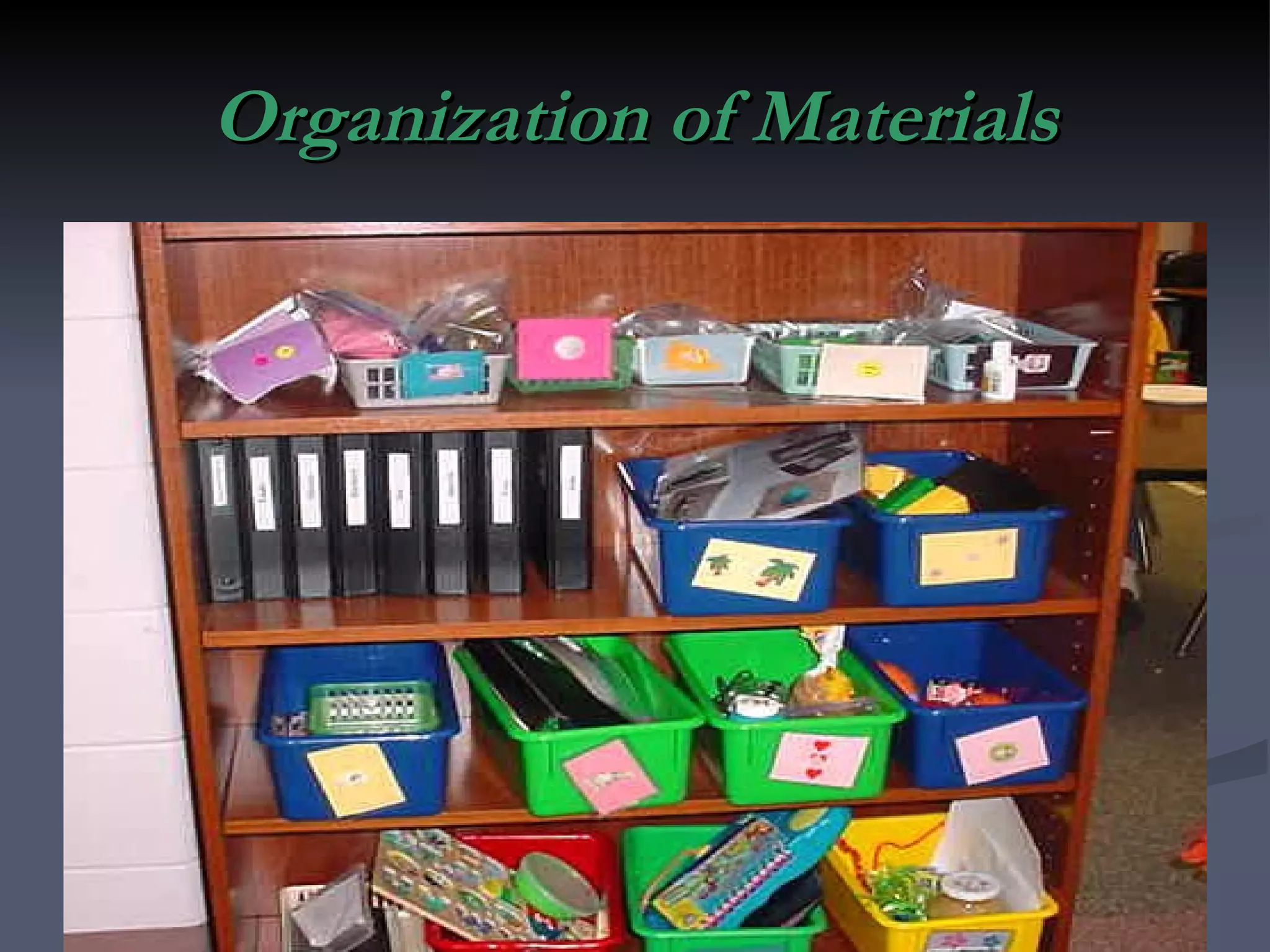
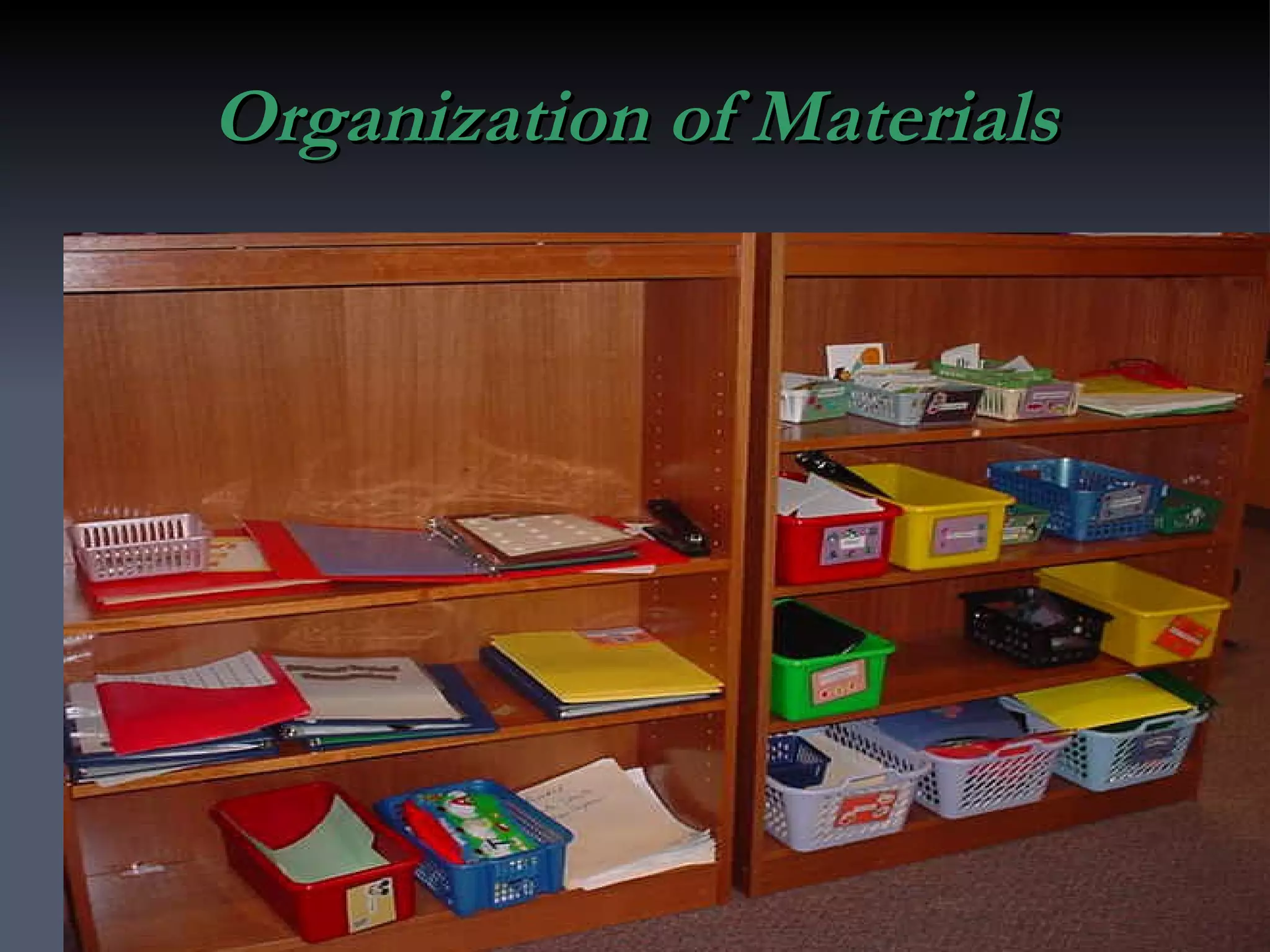
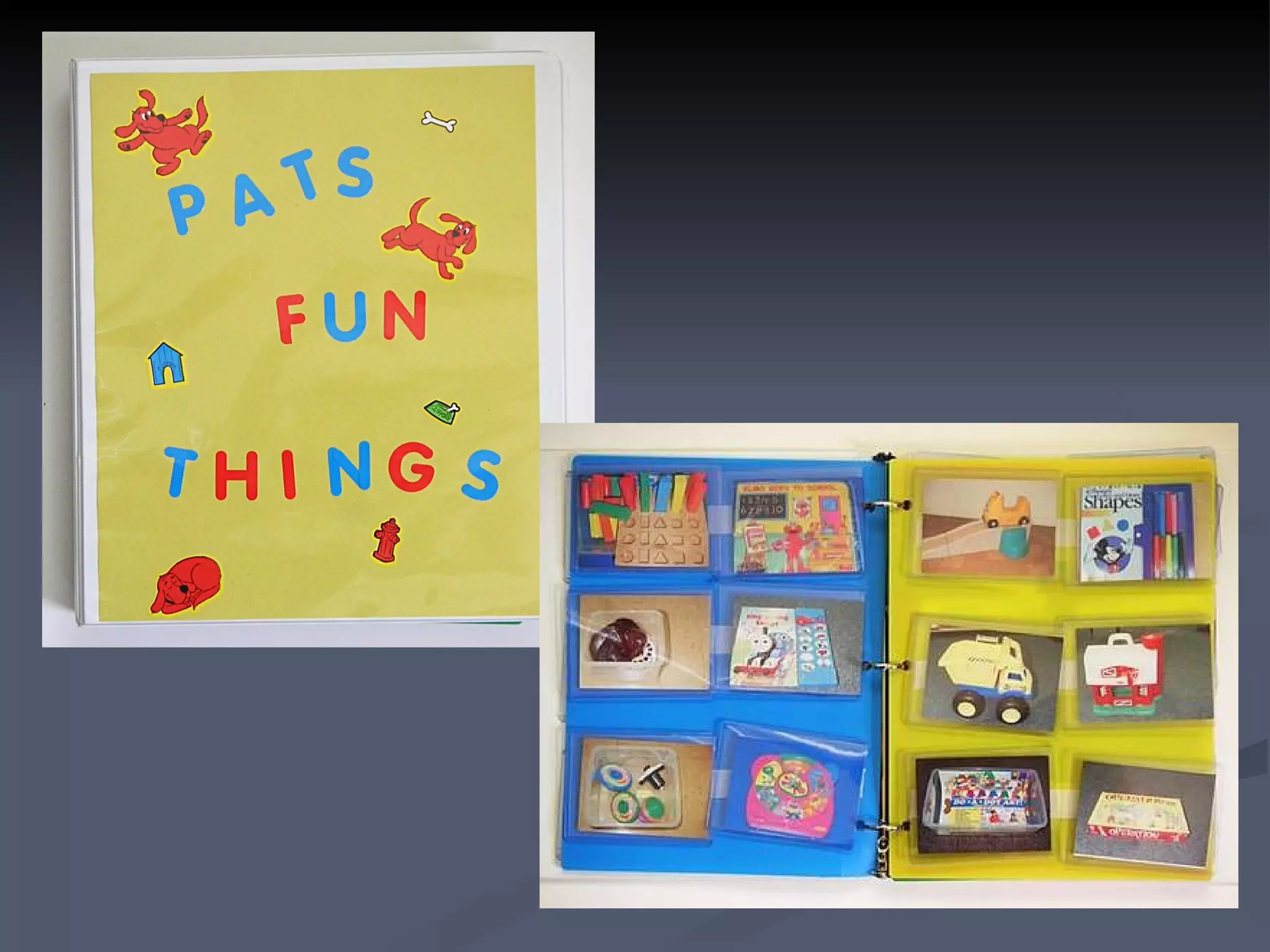
Organization of Materials
Pasting Shapes using  an Activity Schedule
Letter Matching/Identification
Making a Model from Duplos Using an Activity Schedule
Audio Prompts Embedded in an Activity Schedule


Creating a  Data Sheet Select 30-40 programs from goals & objectives across all skill domains (majority of programs will be language based) See goals and obj short and long version Divide into 30 minute sessions across all instructors in class One 30 minute session (9-10 sessions per day) 2-3 programs taught with incidental teaching  3-4  programs taught using other teaching procedures
Creating a  Data Sheet Skill Acquisition Programs that should only be taught by the  same  instructor those involving initial acquisition of discrimination (sets) shaping complex prompt fading procedures Skill Acquisition Programs that should be taught by  all  instructors those in which you are programming for generalization with multiple staff child initiated programs programs that need quick acquisition
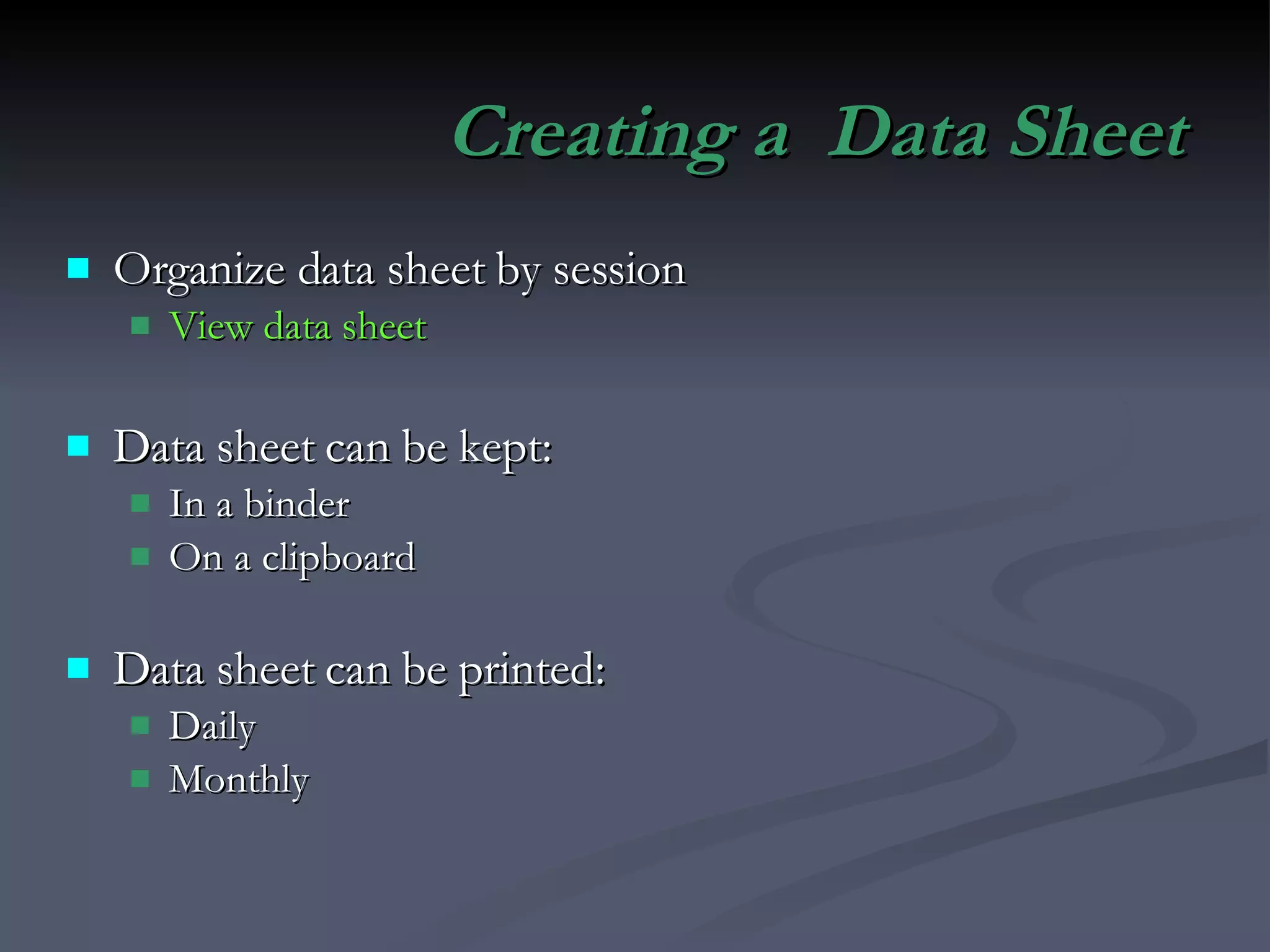
Creating a  Data Sheet Organize data sheet by session View data sheet Data sheet can be kept: In a binder On a clipboard Data sheet can be printed: Daily Monthly
Creating a  Summary Sheet The data notebook is an essential tool Sometimes you might want a quick view of the student’s progress, hence the creation of the summary sheet View summary sheet
Creating a program tracking sheet Need to ensure that programs are tracked from teacher to teacher and grade level to grade level See program summary sheet Gestures Pol/Pos Language Requesting Spontaneous Expressive Language: Future Programs Current Programs Programs Mastered Skill Domain
Creating a Rotation Schedule Put up on wall or on the students clip boards However it is easier to quickly change when staff are absent, school visits, related service etc. See sample schedule
Creating a Master Schedule Overview of all staff and programs with all students in classroom See sample master schedule
Creating Consultant Schedule Make the best use of your consultants time, think ahead where you want them to help See sample schedule When consultant comes –which staff members should they be with?
Systems Several systems you want to put in place Form for teacher consultant when child is not making progress (2 data pts) and training is needed Form for teacher/consultant when child needs new set  Anticipate this and make in advance so te child is not waiting
Additional Concerns for Classroom Make Up and Scheduling  What should your ratio of student to instructor be? Advantages & Disadvantage? What should your ratio of staff trainer to instructor be? Advantages & disadvantages
Classroom Make Up and Scheduling Issues How often should students rotate teachers? How do you decide student classroom assignments? Peers? How about staff classroom assignments? When do you tell staff? Teachers?
Staff Development
Players   Instructional aides Teachers Staff Trainer Related service providers Director & Supervisor Supervisors Consultant Administrators  Secretarial Medical Financial/Business Others?
Credentials What are the qualifications of the: aides teachers staff trainers consultant
Hiring What is the interview process? Who should the candidate interview with? Administrative AND clinical
Hiring (cont) Interview Face to face where did they hear about the position Interest in position long & short term goals Describe program AND requirements Minimally ONE year commitment Have candidate work with child  Model, have candidate imitate, provide feedback, have candidate implement feedback
Staff Training Workshops/lecture Hands-on
Staff training ~ Workshops/Lectures Monthly Workshop Various topics of ABA Teaching procedures (activity schedules, discrete trial, incidental) reinforcement, prompting, generalization Pre-service: 3-4 days prior to beginning of school year autism, basic principles of ABA & professionalism  Staff development days  3-4 days per year (no students)
Staff Training~  Hands-on Training Observation Paired with staff trainer Model, have staff imitate, provide feedback, have staff implement feedback Alternate independence with training Use of video?
Other training opportunities Provide training to a new staff member Attend conferences Present at conferences other?
Program Make-up Allocation of staff across school program Allocation of individualized programs across instructors
Allocation of Staff Across School Program How do you allocate your teachers across program? Skills Career  Move around program so can gain experience with multiple skill and age levels How do you allocate your instructors across program? Skills Career Move around program so can gain experience with multiple skill and age levels
Allocation of Individualized Programs Across Instructors Teachers teach all foundational learning skills Contingency management On-task behavior Reinforcement system Easier programs for newer staff members E.g., gross/fine motor, matching Same programs across students Other?
Supervision What is the hierarchy? E.g., Director   Consultant    Teacher    Instructor Related service providers?
Supervision (cont) Director Consultant  Be sure the role of Director and role of Consultant is well delineated Teachers In terms of teachers supervising instructional staff, check union rules for a public school Consultant & director should always empower the teachers with the instructional staff and parents How else can you increase accountability?
Communication among the Staff Classroom communication Ongoing hands-on training Effective for  teacher to spend whole day with one child and train all staff members -this ensure consistency Brief after-school meeting about that student Weekly classroom meetings Systems in place to: alert teacher when student is not making progress and observation/training is needed  alert teacher when student needs new sets
Communication among the Staff Teacher collaboration Grade level teachers should collaborate minimally weekly Biggest asset in a program are your colleagues!!!!!
Communication among the Staff Program communication Weekly grade-level meetings with director  Problem solving Ensure consistency across program Why is consistency important???? Weekly management meetings Consultant, trainers, director
Documentation For all meetings, notes should be taken and stored for future reference E.g., when consultant provides recommendations to a teacher, an e-mail is sent to all other consultants, teacher, and director
Evaluating Staff Who evaluates teachers, instructional aides, consultant?
Evaluating Staff (cont) Annual evaluations of all staff members contract contingent on successful evaluation Ongoing brief evaluations of all staff Ongoing data notebook evaluations External programmatic review
Ongoing brief staff evaluation   In one session, collect data on: On-task Opportunities to respond Contingency management Incidental teaching
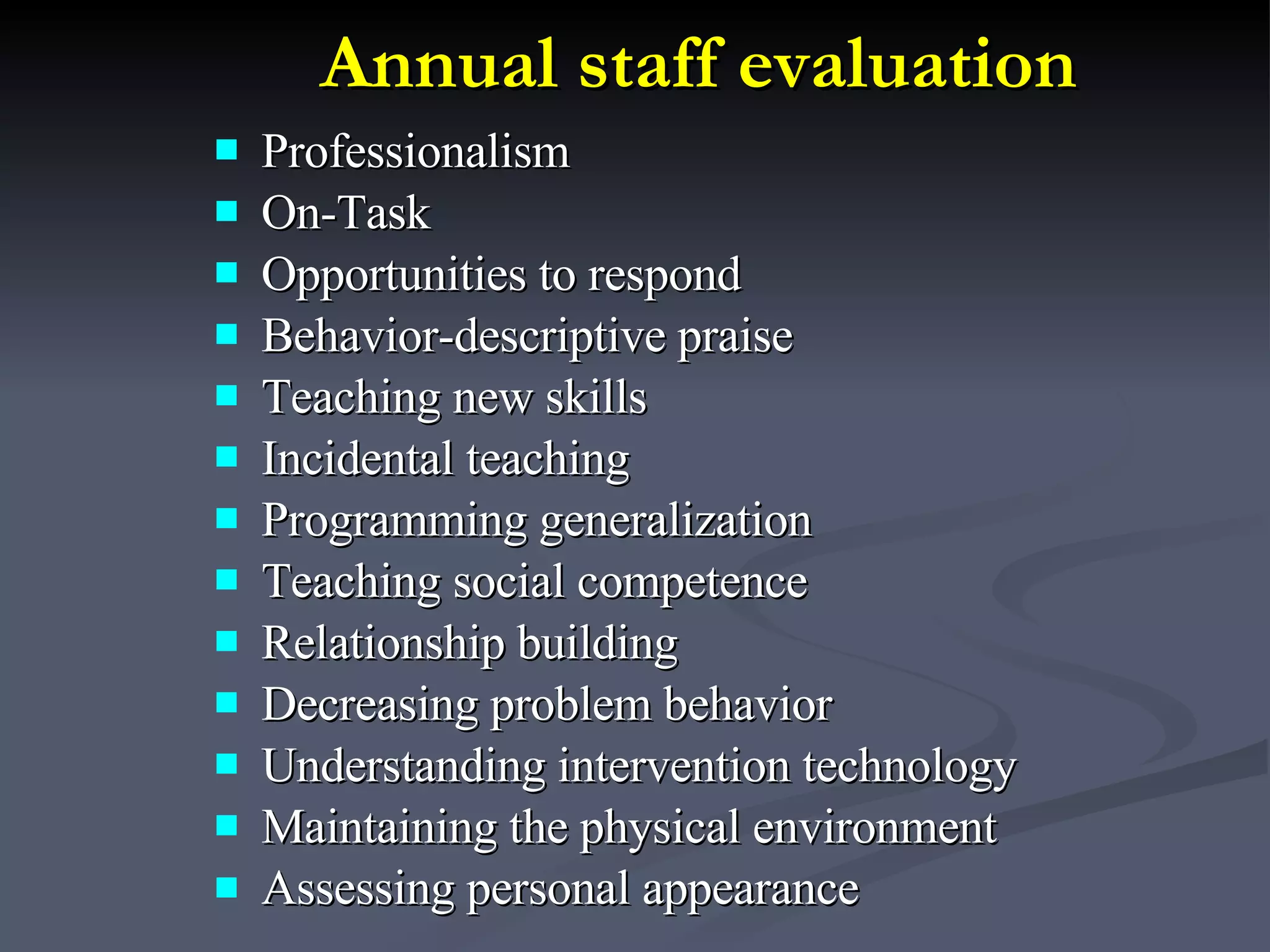
Annual staff evaluation Professionalism  On-Task Opportunities to respond Behavior-descriptive praise Teaching new skills Incidental teaching Programming generalization Teaching social competence Relationship building Decreasing problem behavior Understanding intervention technology Maintaining the physical environment Assessing personal appearance
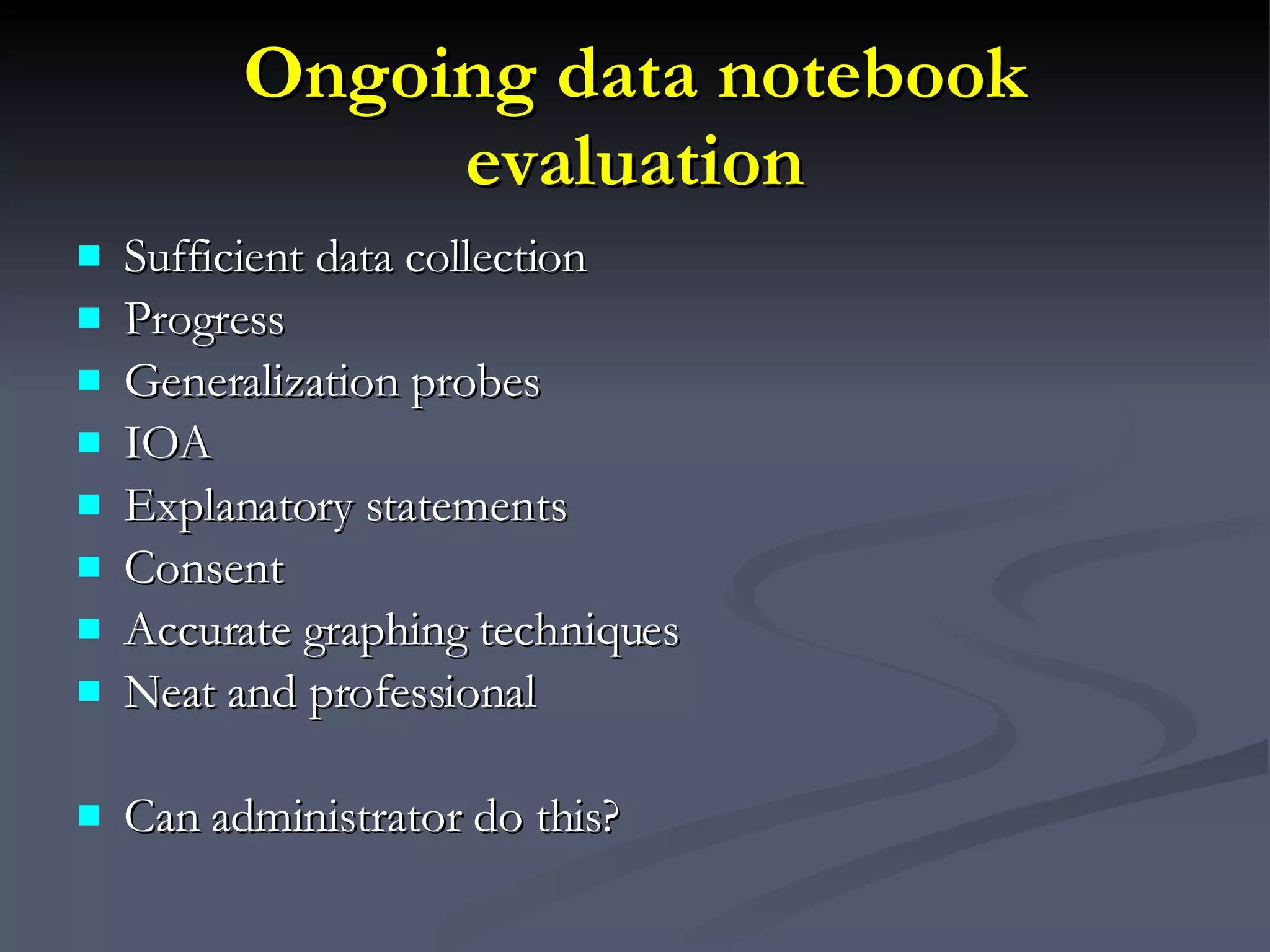
Ongoing data notebook evaluation Sufficient data collection Progress Generalization probes IOA Explanatory statements Consent Accurate graphing techniques Neat and professional Can administrator do this?
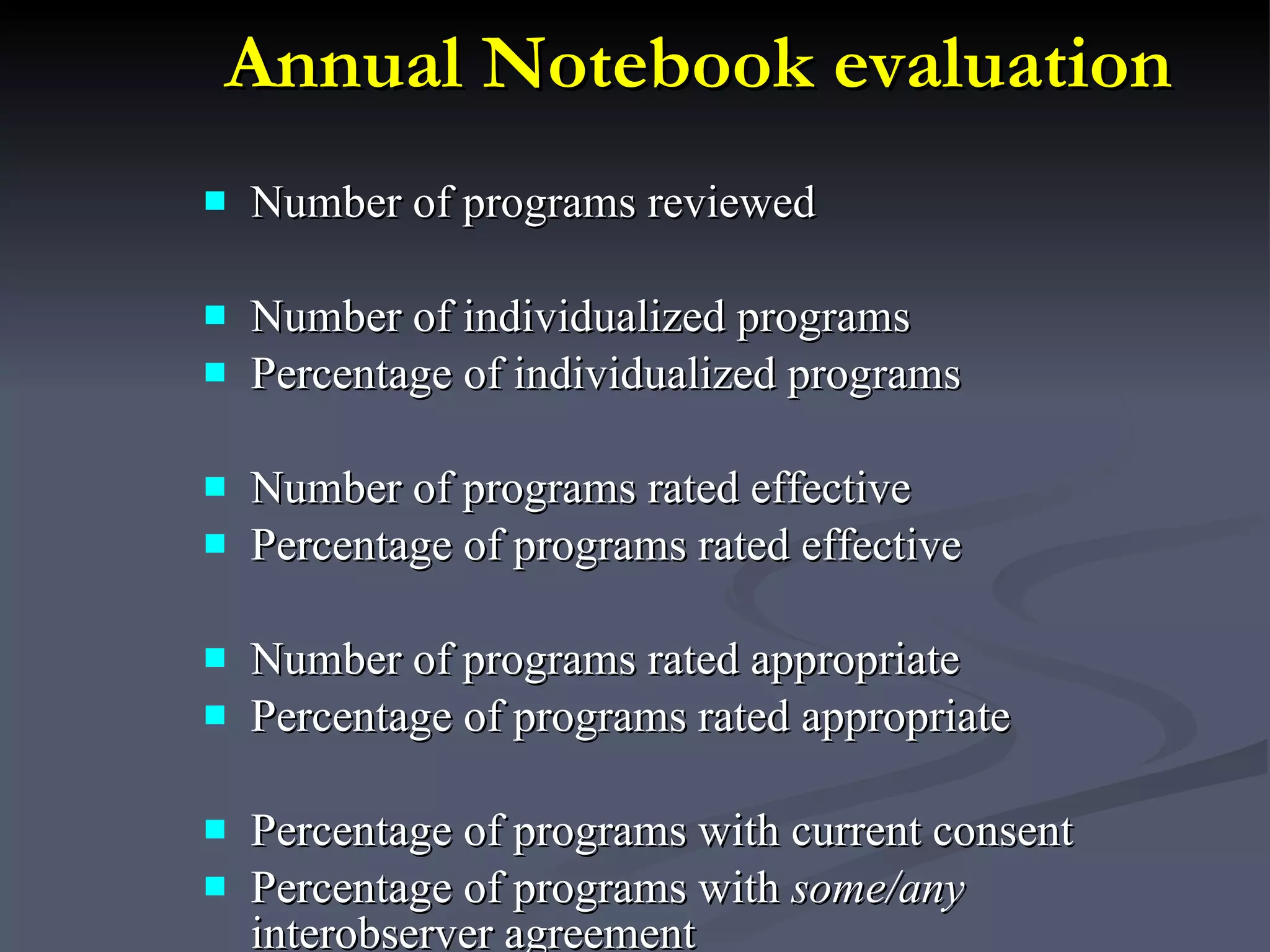
Annual Notebook evaluation Number of programs reviewed Number of individualized programs Percentage of individualized programs Number of programs rated effective Percentage of programs rated effective Number of programs rated appropriate Percentage of programs rated appropriate Percentage of programs with current consent Percentage of programs with  some/any  interobserver agreement
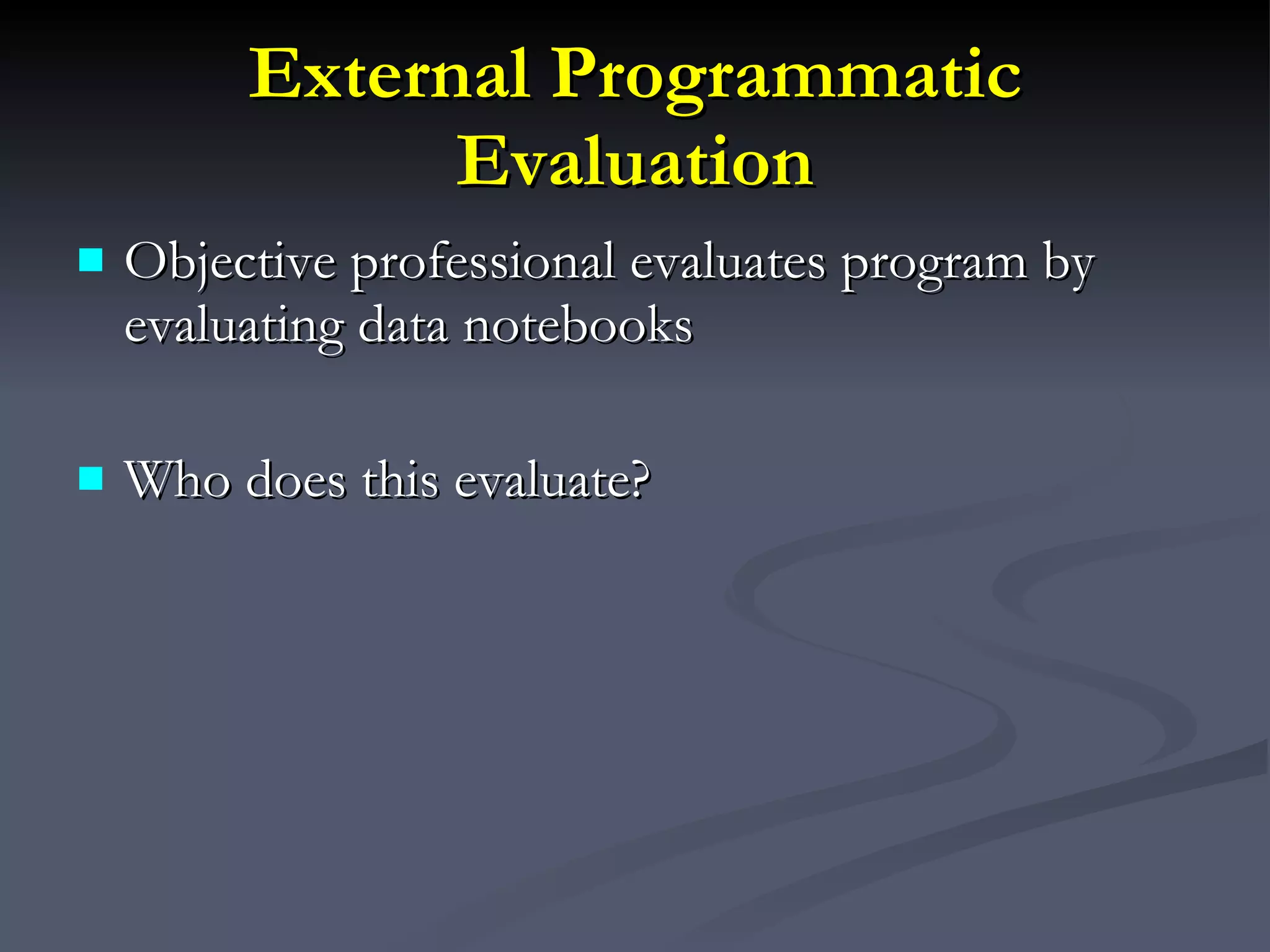
External Programmatic Evaluation Objective professional evaluates program by evaluating data notebooks Who does this evaluate?
Retention How do you keep morale high and retain your staff? Preps/lunch Daily hours Teacher support Appropriate resources Professionalism Open communication
 
Home and School Program Development Inclusion
Controversy Surrounding Inclusion Responses to Full-Inclusion Movement (FIM):  It seems that the place of instruction has become the focus of special education rather than the instruction itself.  FIM Proposed as quackery FIM is contrary to common sense and inconsistent with what we know about disabilities  how can general education  offer more to a child than specialized-therapeutic interventions shown to be effective?
Reasons for the Controversy  Special Education is not always ideally provided and teachers may be poorly trained The answer, however, is not to change the plaice in which it is offered, but the instruction itself The answer is also, not to put them with general education teachers who have NO specialized training in teaching children with disabilities but better train a special education teacher who has the appropriate background
Reasons for the Controversy  Continuum of Alternative Placement Social justice: define full inclusion as a matter of civil rights Advocacy of FIM therefore, lies in rallying against special education because it is segregation and gets compared to slavery and apartheid rather than individualized instruction based on empirically validated procedures Willful Ignorance FIM will promote social acceptability of a disability, however, to feel accepted does not cause the disability to vanish and the necessary skills to magically appear Oversimplification DO all students get included in Calculus?  What would be an appropriate high school general ed math class for a student with disabilities How much can we modify curriculum??
To Make Full-Inclusion Work (Strain, 1999) Include a student with students of typical development as much as possible.  Very systematic and rigorous training procedures of the peers of typical development are necessary for the child with autism to effectively learn in an inclusive setting
When Inclusion is done Right:  Let’s Learn from the Experts!  (Krantz & McClannahan, 1999) (Johnson, Meyer,  & Taylor, 1996) Prerequisites have to be mastered in various skill domains before a child can benefit from an inclusive setting. These skill domains include: Language Skills, Social Skills, Academic Skills, Behavior Skills Particular skills include: Sustained Engagement Following Adults’ Instructions Responding to Temporally Delayed Contingencies Exhibiting Generative Language Generalization of Skills across Settings Low Rates of Inappropriate Behavior
When Inclusion is done Right:  Let’s Learn from the Experts!  (Krantz & McClannahan, 1999) (Johnson, Meyer,  & Taylor, 1996) Transition to General Education (after at least two years of self-contained instruction) Pre-transition instruction Gradual transition to general education Gradually fading special supports Follow up
Public Schools NJ Courts will typically rule in favor of inclusion What do you do? Write against recommendation in IEP Substantially modify goals & objectives Use lots of prompting & reinforcement systems in inclusion setting Substantially modify curriculum
References Mock, R., Kauffman, J.M. (2005). The delusion of full inclusion. In J.W. Jacobson, R. Foxx  & J.A. Mulick (Eds.).  Controversial therapies for developmental disabilities: Fad, fashion, and science in professional practice . Hillsdale, NJ: Erlbaum.  Strain, P.S., (1999) Peer-mediated interventions for young children with autism: A 20 year retrospective. In P.M. Ghezzi, W.L. Williams, & J.E. Carr (Eds)  Autism: Behavior-analytic perspectives.  Reno, NV: Context Press.
 
Home and School Program Development Consultation
Definition of Consultation Indirect method of providing psychoeducational services within a cooperative problem, solving framework.
Problem-solving Consultation Based on behavioral and social learning theory Child skill change is the measure of successful consultation
Problem-solving Consultation problem identification Response definition, baseline, alternate behavior Problem analysis FBA Plan implementation BIP Problem evaluation Measures effectiveness, efficiency and social validity of interventions
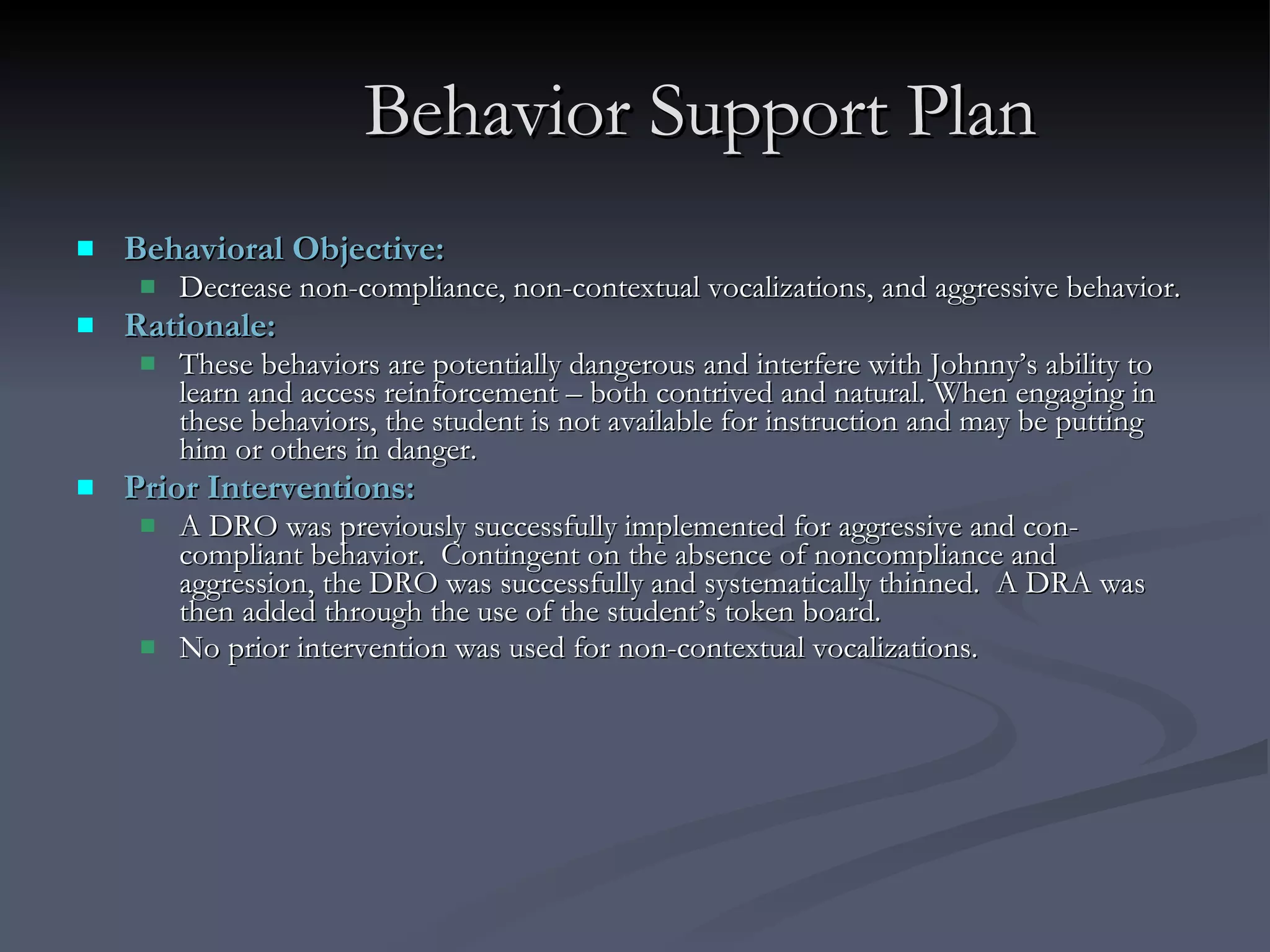
Behavior Support Plan Behavioral Objective:  Decrease non-compliance, non-contextual vocalizations, and aggressive behavior.  Rationale:  These behaviors are potentially dangerous and interfere with Johnny’s ability to learn and access reinforcement – both contrived and natural. When engaging in these behaviors, the student is not available for instruction and may be putting him or others in danger.  Prior Interventions:  A DRO was previously successfully implemented for aggressive and con-compliant behavior.  Contingent on the absence of noncompliance and aggression, the DRO was successfully and systematically thinned.  A DRA was then added through the use of the student’s token board.  No prior intervention was used for non-contextual vocalizations.
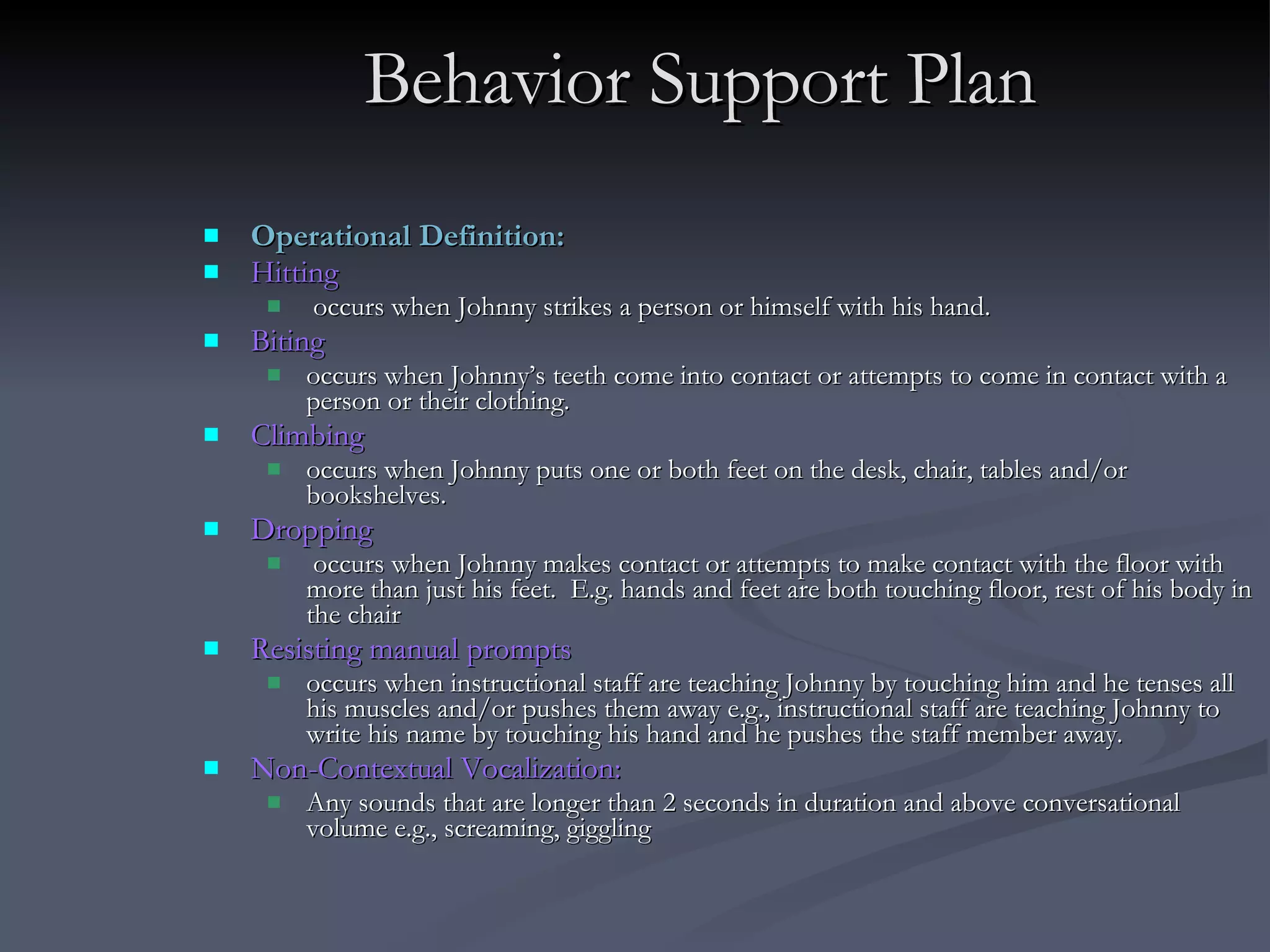
Behavior Support Plan Operational Definition:  Hitting occurs when Johnny strikes a person or himself with his hand.  Biting  occurs when Johnny’s teeth come into contact or attempts to come in contact with a person or their clothing. Climbing occurs when Johnny puts one or both feet on the desk, chair, tables and/or bookshelves. Dropping occurs when Johnny makes contact or attempts to make contact with the floor with more than just his feet.  E.g. hands and feet are both touching floor, rest of his body in the chair Resisting manual prompts occurs when instructional staff are teaching Johnny by touching him and he tenses all his muscles and/or pushes them away e.g., instructional staff are teaching Johnny to write his name by touching his hand and he pushes the staff member away. Non-Contextual Vocalization:   Any sounds that are longer than 2 seconds in duration and above conversational volume e.g., screaming, giggling
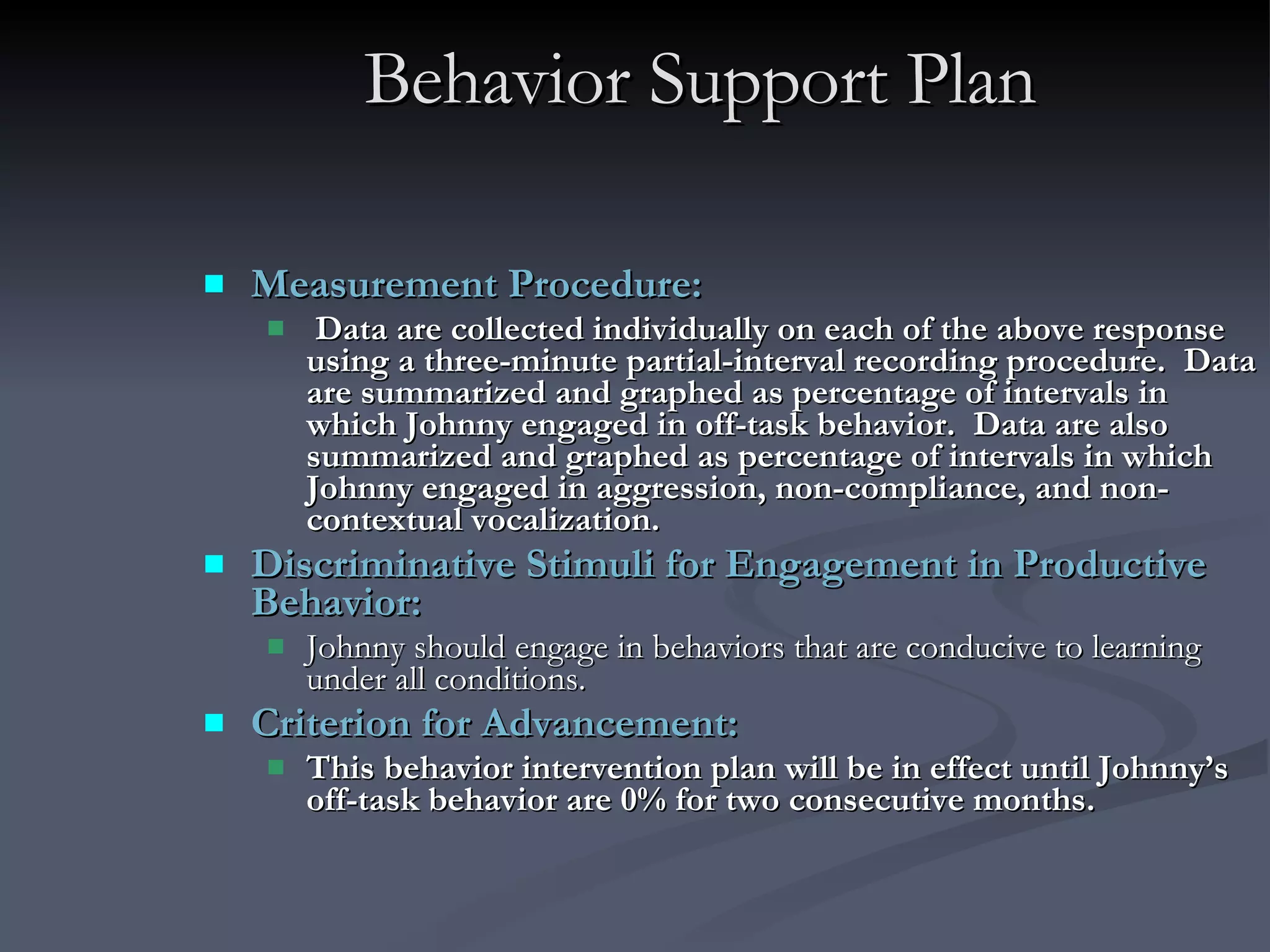
Behavior Support Plan Measurement Procedure:  Data are collected individually on each of the above response using a three-minute partial-interval recording procedure.  Data are summarized and graphed as percentage of intervals in which Johnny engaged in off-task behavior.  Data are also summarized and graphed as percentage of intervals in which Johnny engaged in aggression, non-compliance, and non-contextual vocalization. Discriminative Stimuli for Engagement in Productive Behavior:   Johnny should engage in behaviors that are conducive to learning under all conditions. Criterion for Advancement:  This behavior intervention plan will be in effect until Johnny’s off-task behavior are 0% for two consecutive months.
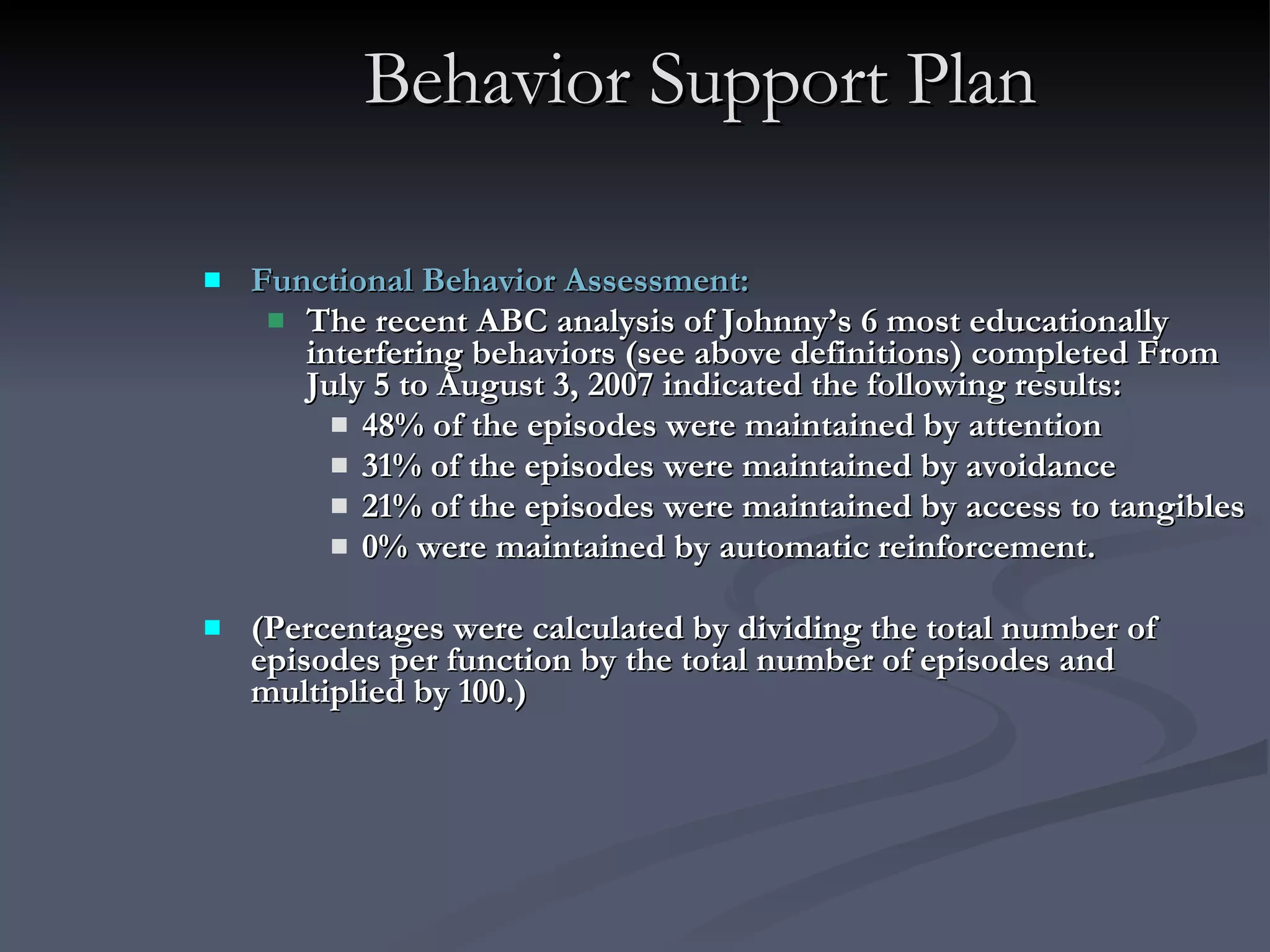
Behavior Support Plan Functional Behavior Assessment: The recent ABC analysis of Johnny’s 6 most educationally interfering behaviors (see above definitions) completed From July 5 to August 3, 2007 indicated the following results:  48% of the episodes were maintained by attention 31% of the episodes were maintained by avoidance 21% of the episodes were maintained by access to tangibles  0% were maintained by automatic reinforcement.  (Percentages were calculated by dividing the total number of episodes per function by the total number of episodes and multiplied by 100.)
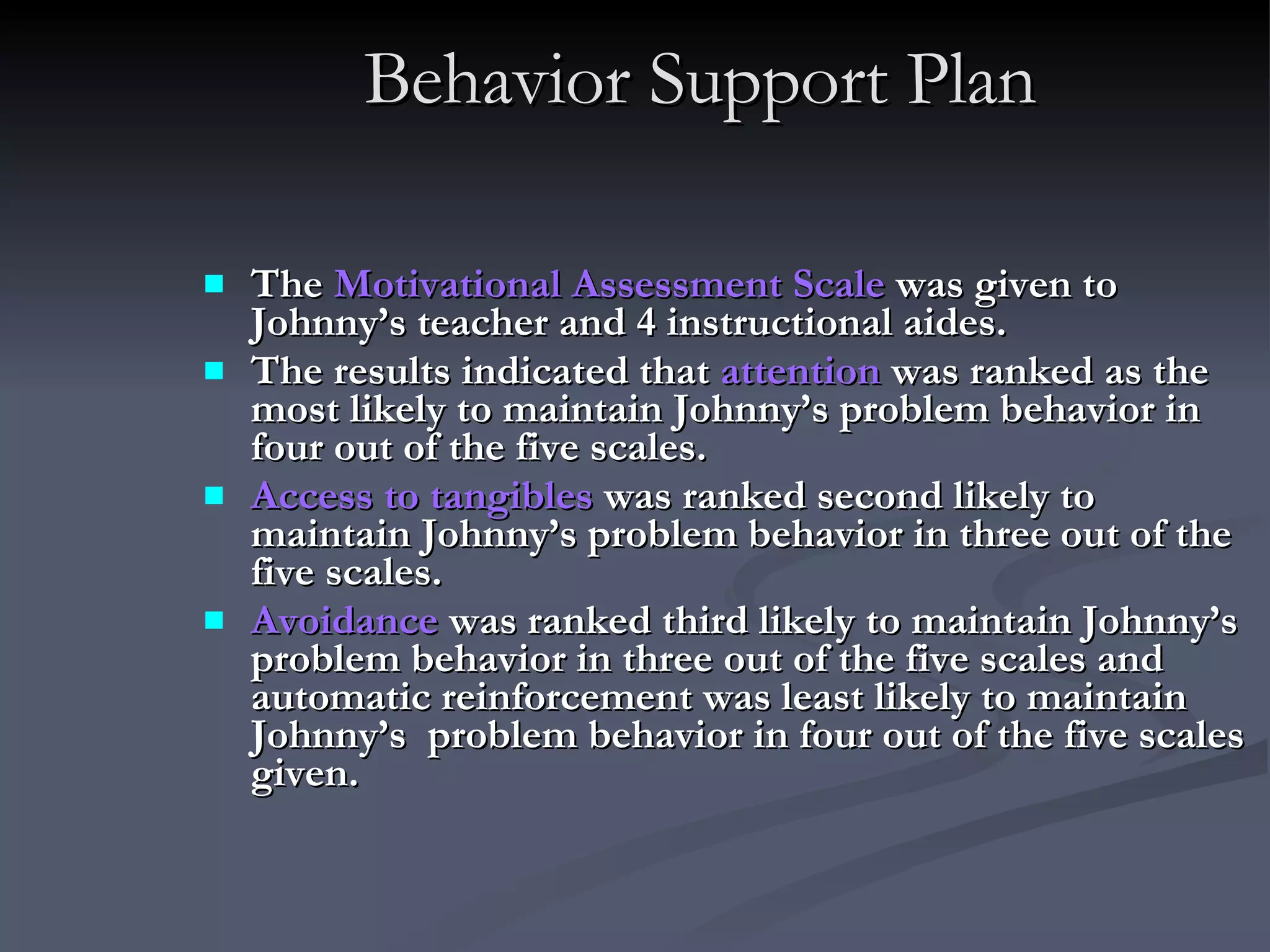
Behavior Support Plan The  Motivational Assessment Scale  was given to Johnny’s teacher and 4 instructional aides.  The results indicated that  attention  was ranked as the most likely to maintain Johnny’s problem behavior in four out of the five scales.  Access to tangibles  was ranked second likely to maintain Johnny’s problem behavior in three out of the five scales.  Avoidance  was ranked third likely to maintain Johnny’s  problem behavior in three out of the five scales and automatic reinforcement was least likely to maintain Johnny’s  problem behavior in four out of the five scales given.
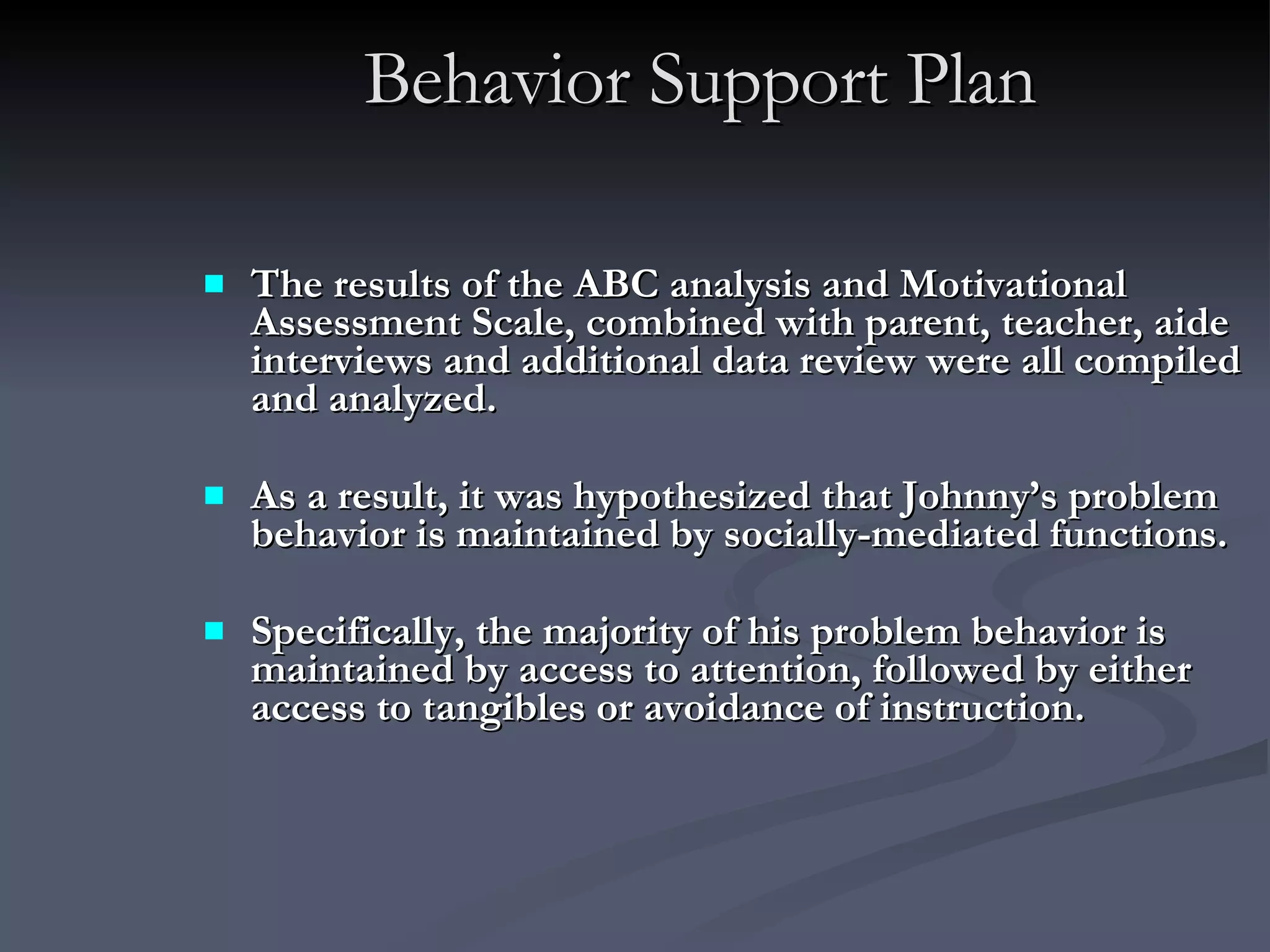
Behavior Support Plan The results of the ABC analysis and Motivational Assessment Scale, combined with parent, teacher, aide interviews and additional data review were all compiled and analyzed.  As a result, it was hypothesized that Johnny’s problem behavior is maintained by socially-mediated functions.  Specifically, the majority of his problem behavior is maintained by access to attention, followed by either access to tangibles or avoidance of instruction.
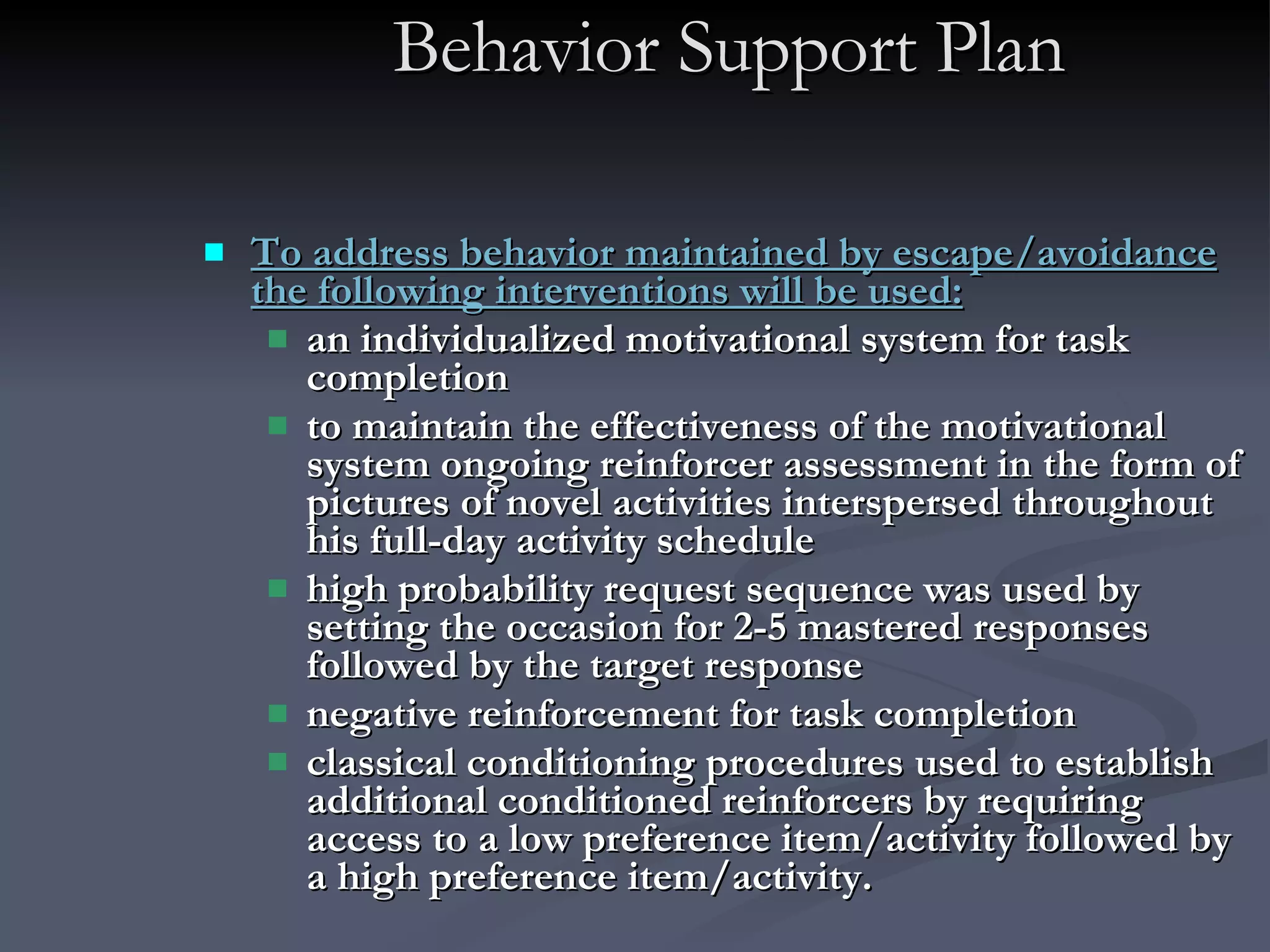
Behavior Support Plan To address behavior maintained by escape/avoidance the following interventions will be used: an individualized motivational system for task completion  to maintain the effectiveness of the motivational system ongoing reinforcer assessment in the form of  pictures of novel activities interspersed throughout his full-day activity schedule high probability request sequence was used by setting the occasion for 2-5 mastered responses followed by the target response negative reinforcement for task completion classical conditioning procedures used to establish additional conditioned reinforcers by requiring access to a low preference item/activity followed by a high preference item/activity.
Behavior Support Plan To address behavior maintained by attention the following interventions will be used:  10-15 additional social rewards were added to Johnny’s choice book engagement in these social activities is contingent on behavior conducive with learning rather than nonconductive with learning.
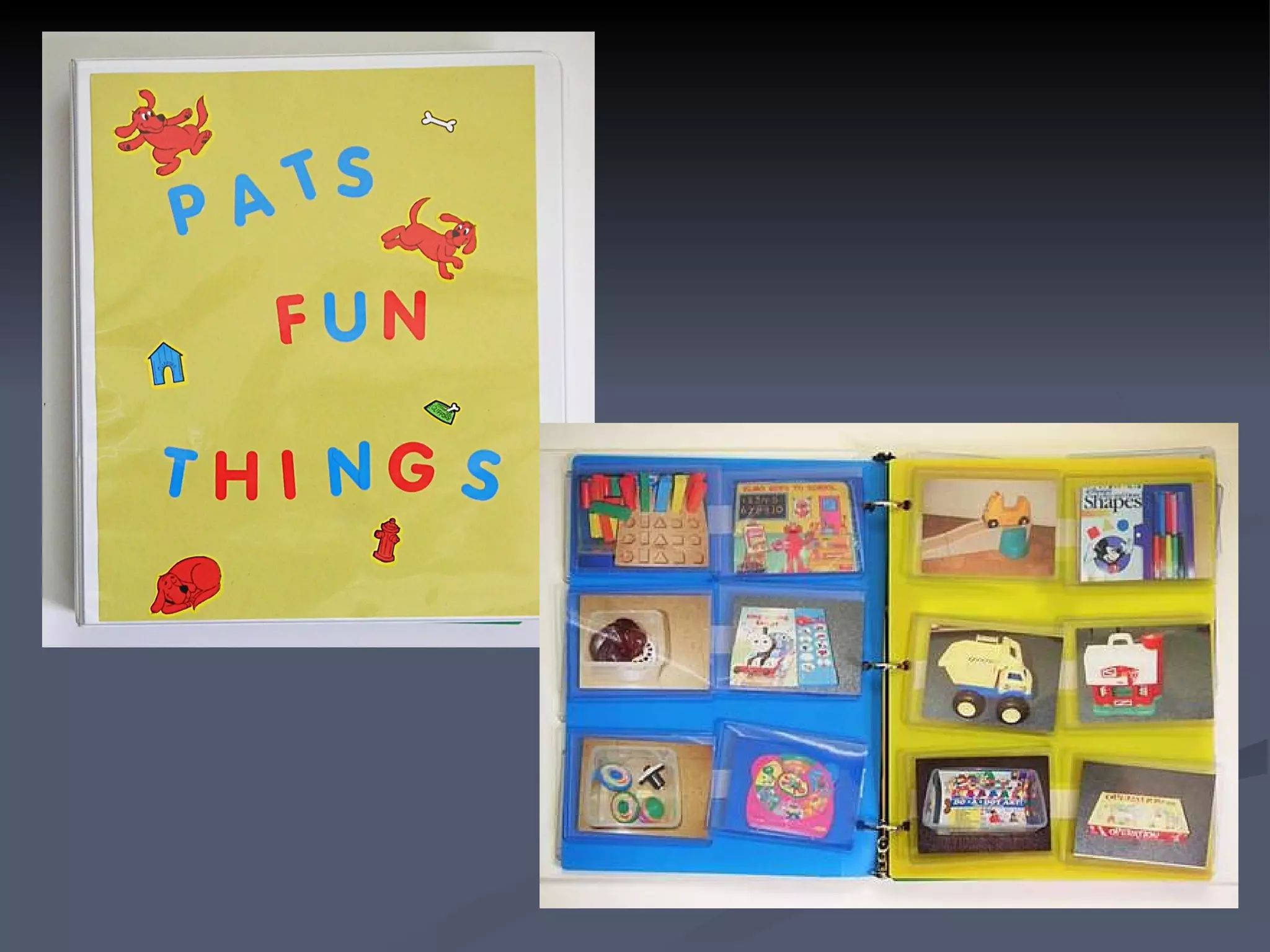
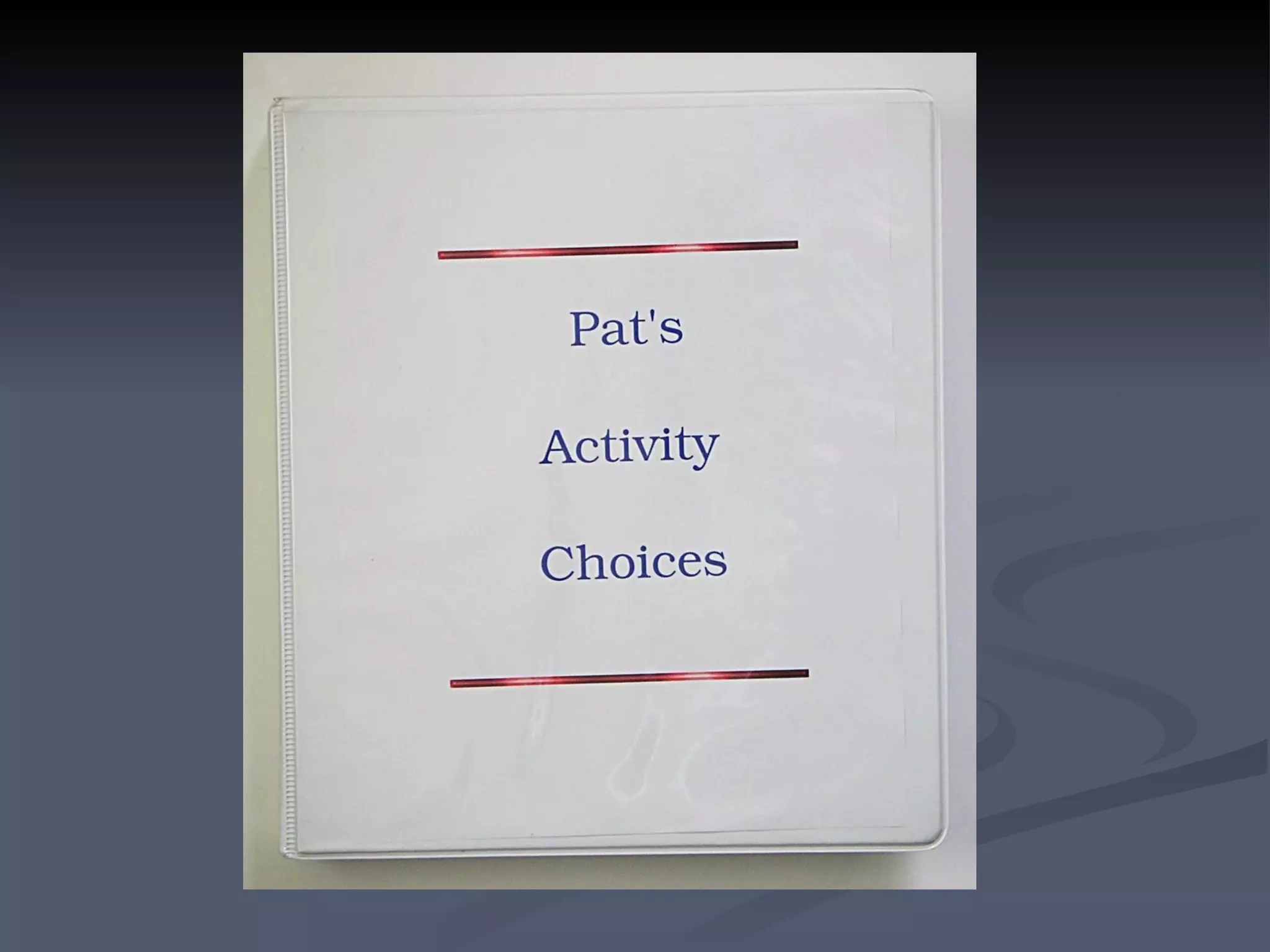
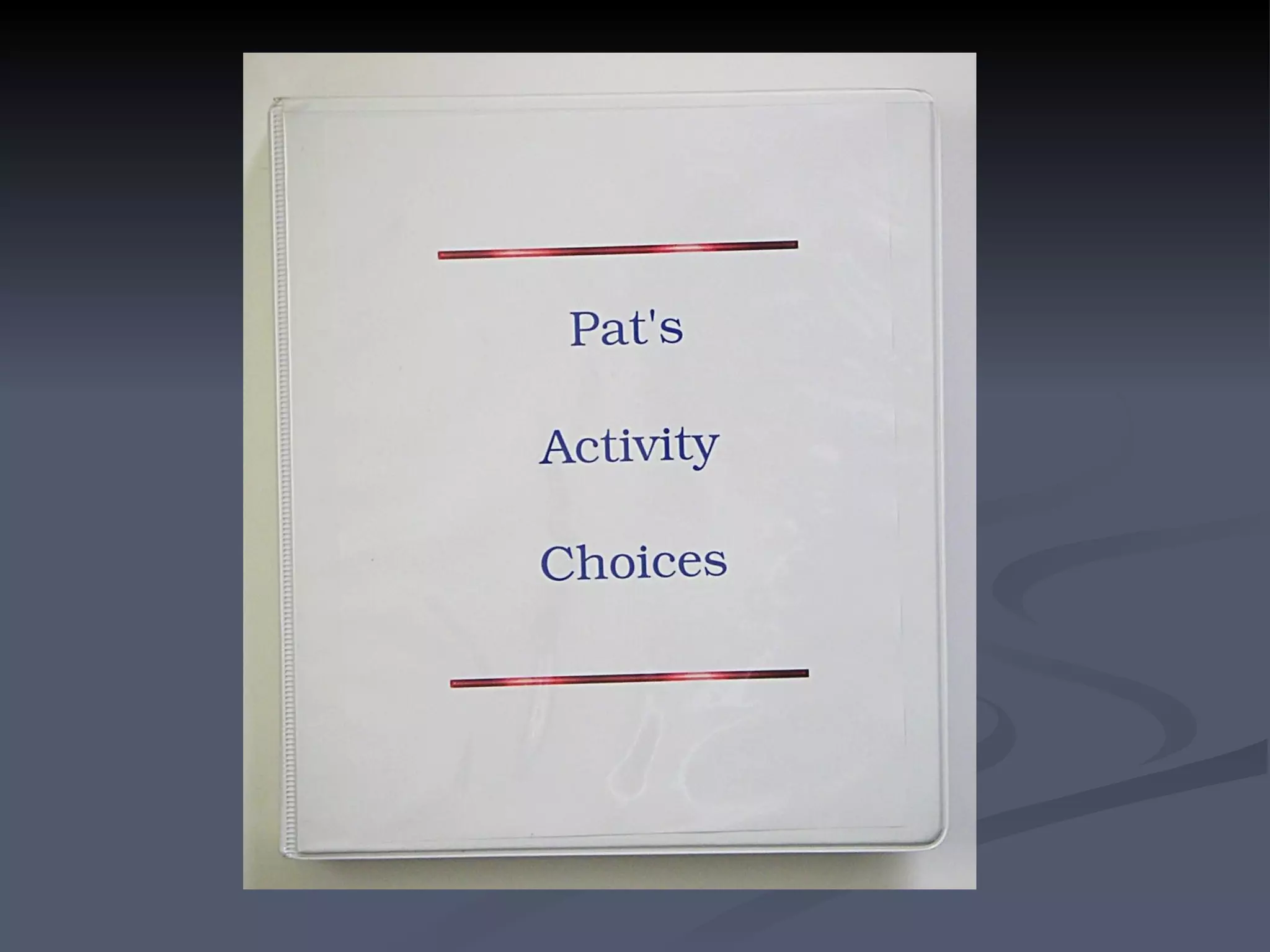
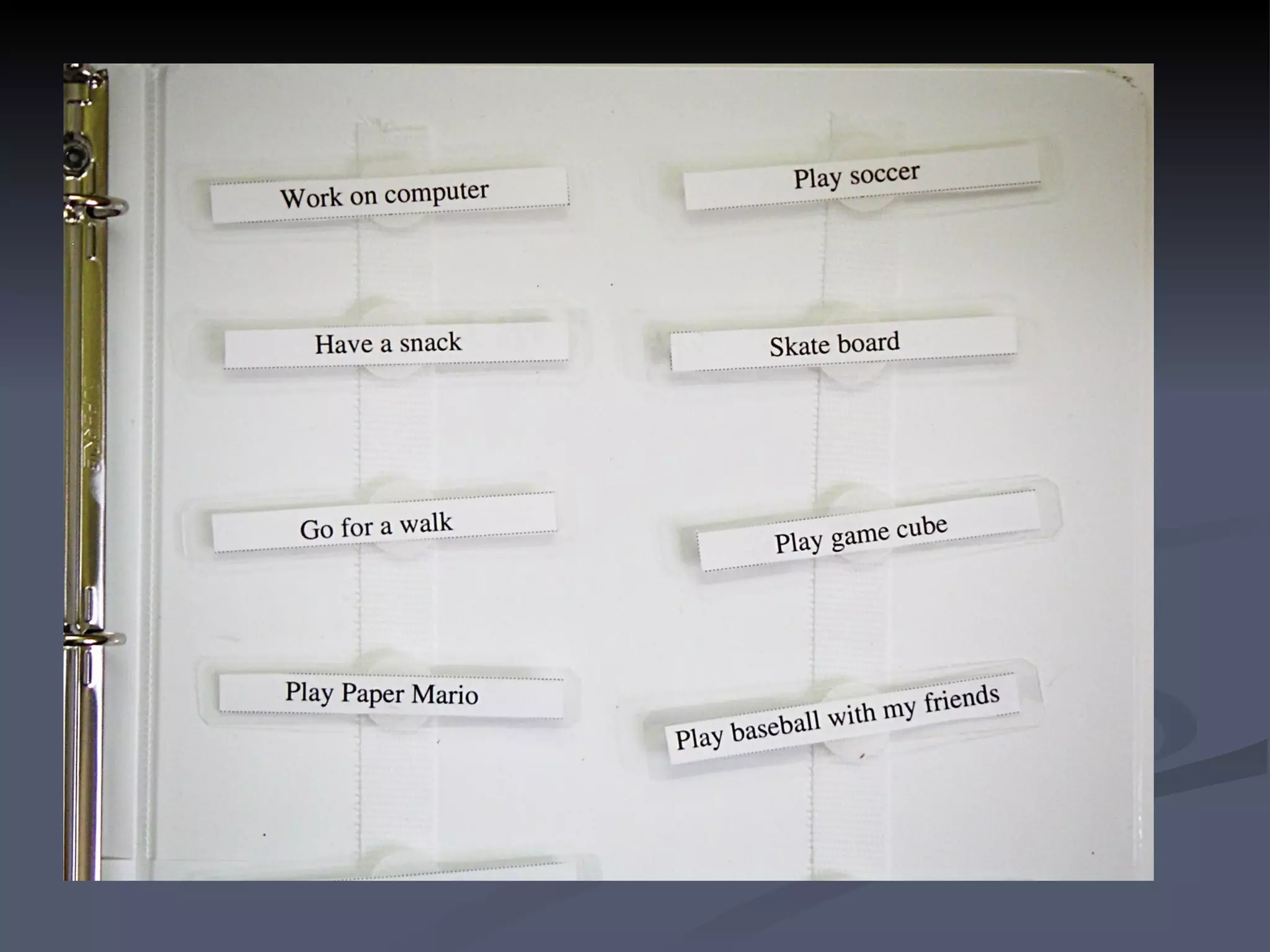
Behavior Support Plan To address behavior maintained by access to tangibles the following interventions will  be used:   Johnny has a choice book containing over 50 pictures of desired items/activities  functional communication training incidental teaching procedures are used to teach Johnny to ask for desired items and activities, spontaneous requesting program  thee specific program can be found in his goals and objectives and are titled:  spontaneous language (variable ways in which to request item),  contextual statements (commenting about desired items/and objects that he sees in his environment),  asking “wh” questions (about desired item/objects that he sees in his environment)
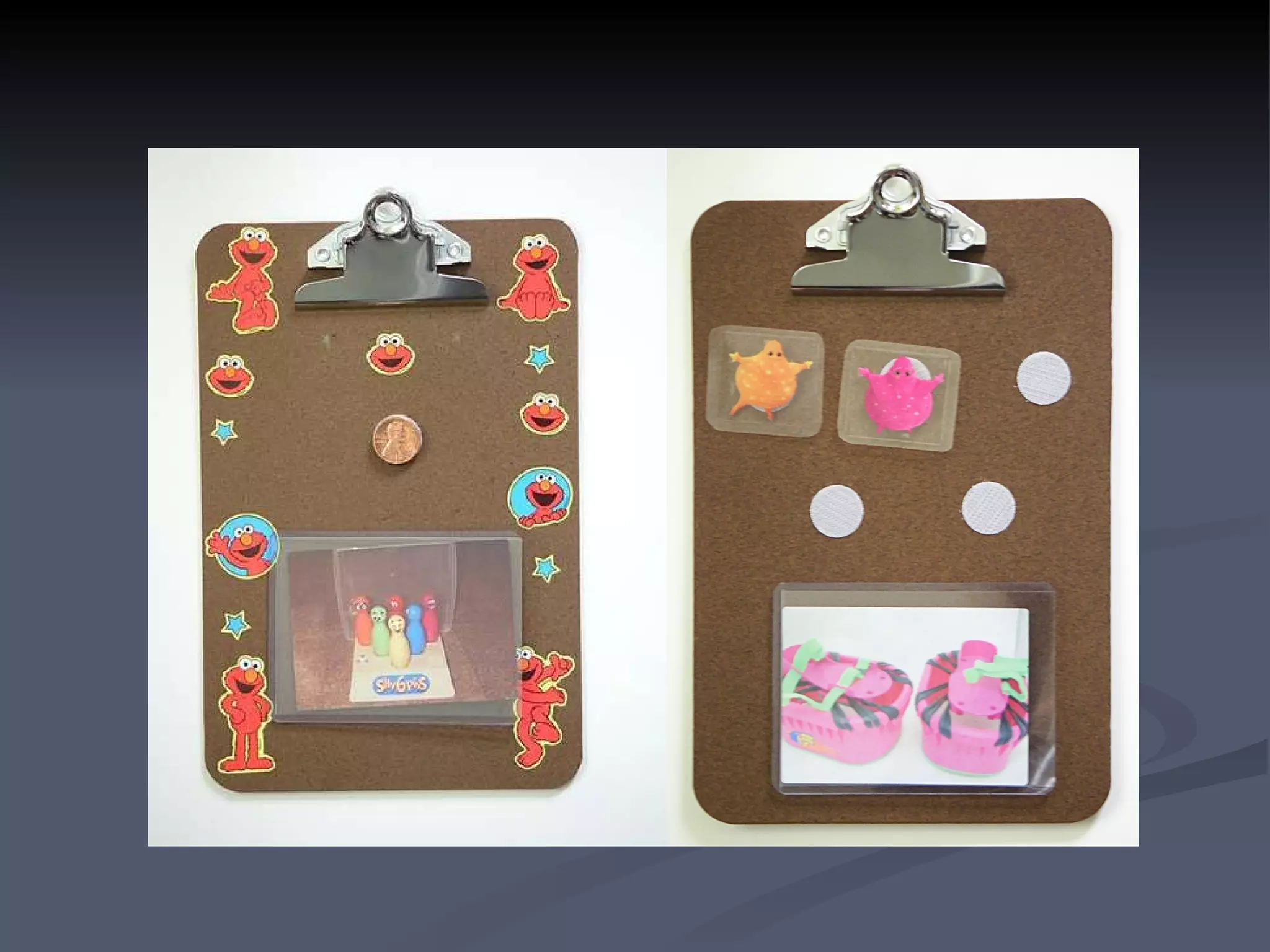
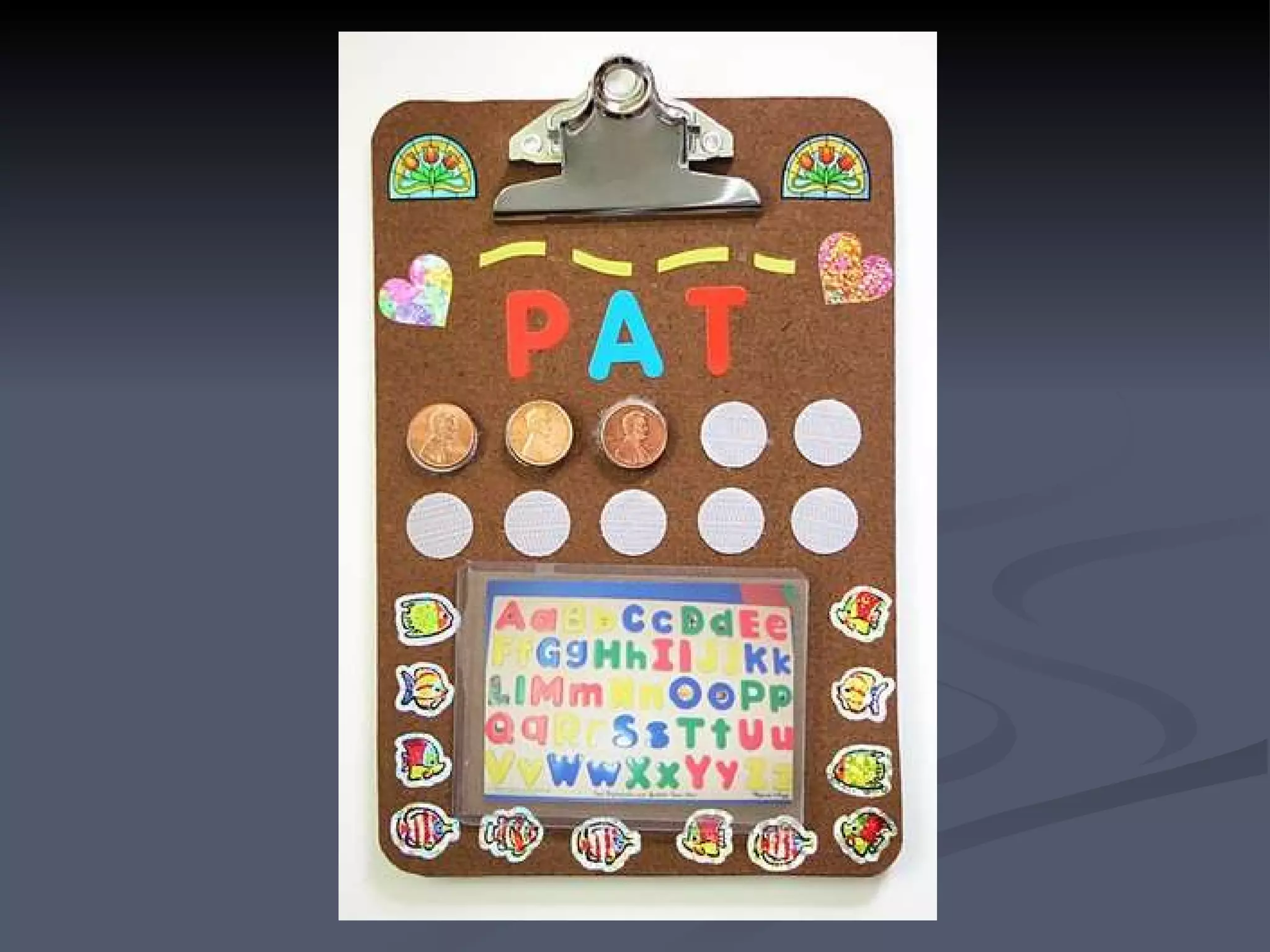
Behavior Support Plan Additional Strategies: Individualized Motivational System:   When Johnny  learned the concept of contingency management, an individualized- motivational system in the form of a 10-penny token economy was systematically taught to him. Tokens were delivered contingent on pre-requisite learning skills such as attending skills and also contingent on correct responding to increase skill acquisition (e.g., correctly responding to his individualized teaching programs in the areas of social skills, expressive and receptive language, fine and gross motor skills, independence, leisure skills, and self-help skills). When Johnny  earned all his tokens, he could exchange them for preferred snacks, items and activities.
Behavior Support Plan Choice Board/Book   Once Johnny  learned picture-object correspondence an elaborate choice board depicting preferred activities was designed for him. His choices have been depicted to him in the form of a large board and also in a book. No difference has been seen between these two formats. Reinforcer assessment   ·Instructors routinely use a systematic assessment procedure to identify preferred items and activities for the choice board. An example of how this is accomplished includes interspersing novel or preferred activities with Johnny ’s educational programs to increase exposure to a variety of potentially reinforcing activities.
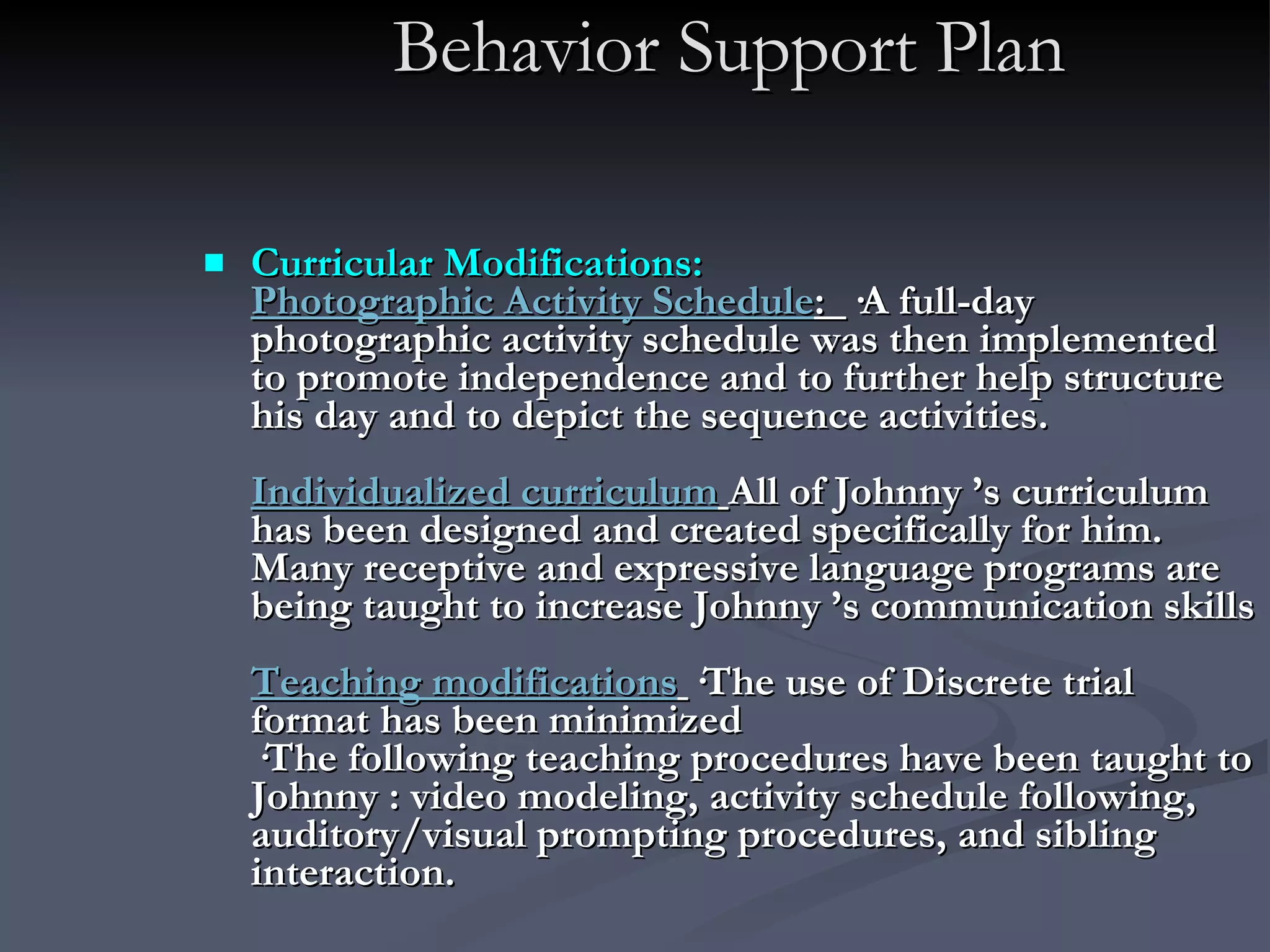
Behavior Support Plan Curricular Modifications: Photographic Activity Schedule :  ·A full-day photographic activity schedule was then implemented to promote independence and to further help structure his day and to depict the sequence activities.  Individualized curriculum   All of Johnny ’s curriculum has been designed and created specifically for him. Many receptive and expressive language programs are being taught to increase Johnny ’s communication skills Teaching modifications   ·The use of Discrete trial format has been minimized ·The following teaching procedures have been taught to Johnny : video modeling, activity schedule following, auditory/visual prompting procedures, and sibling interaction.
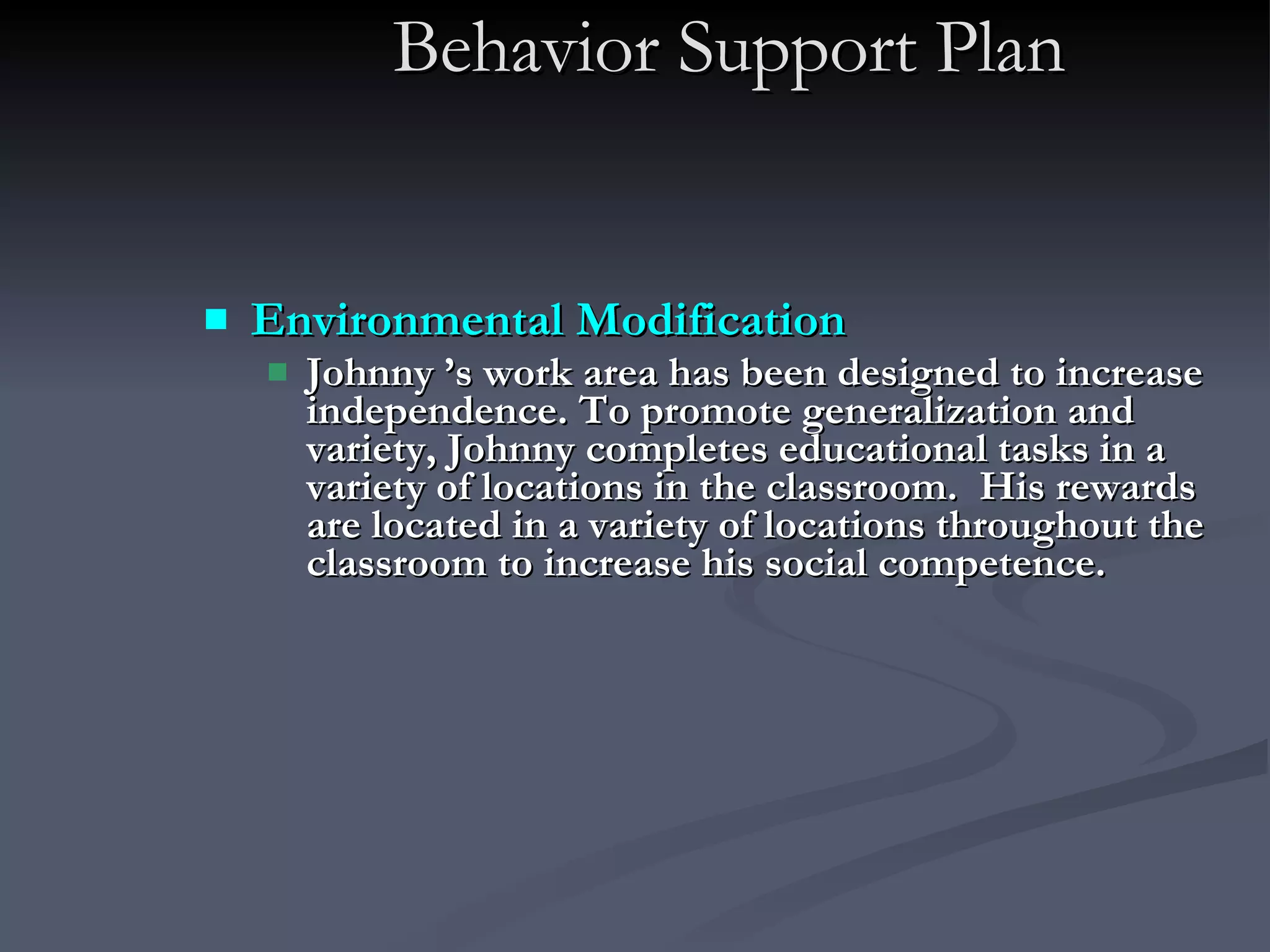
Behavior Support Plan Environmental Modification   Johnny ’s work area has been designed to increase independence. To promote generalization and variety, Johnny completes educational tasks in a variety of locations in the classroom.  His rewards are located in a variety of locations throughout the classroom to increase his social competence.
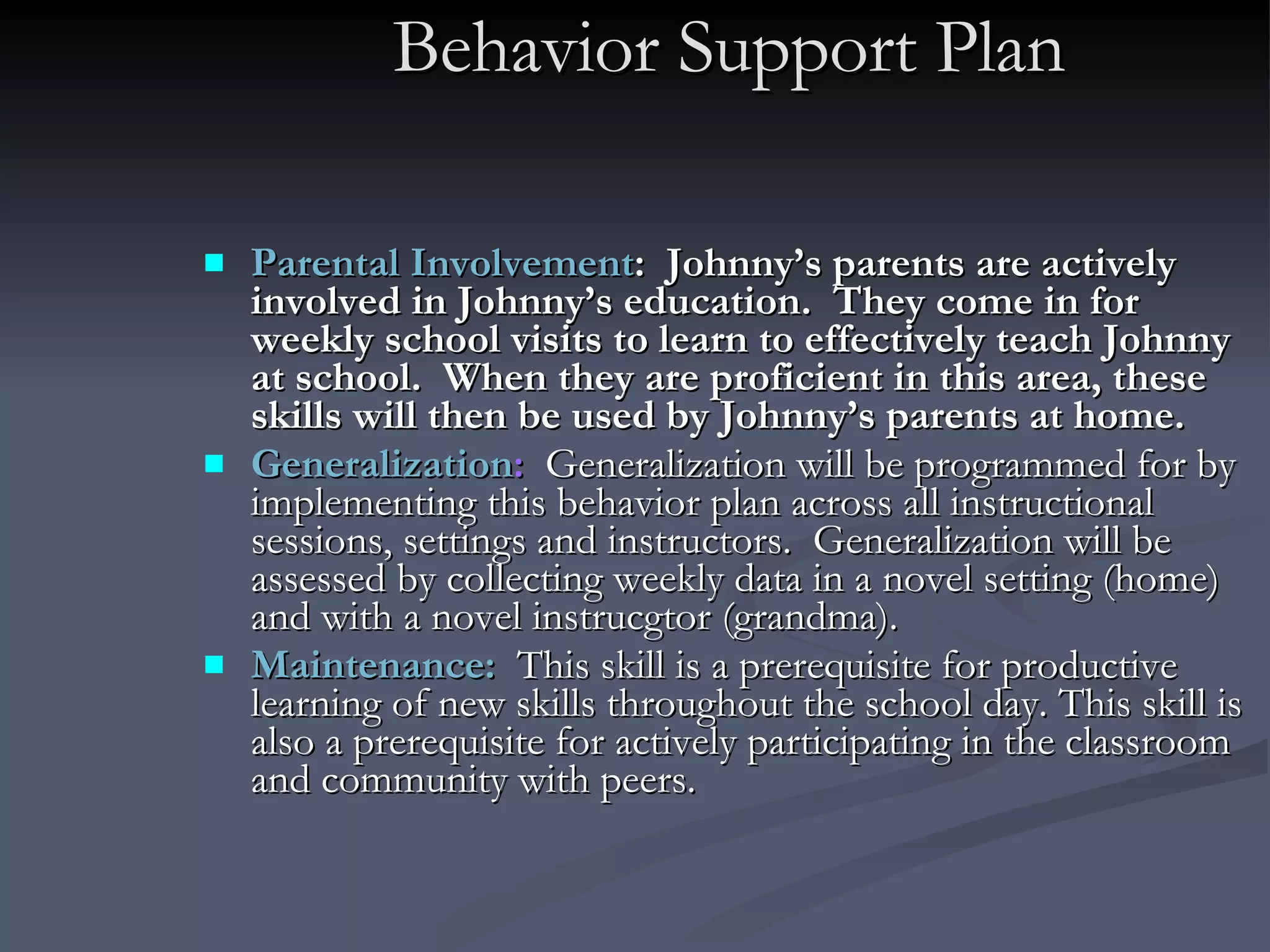
Behavior Support Plan Parental Involvement :  Johnny’s parents are actively involved in Johnny’s education.  They come in for weekly school visits to learn to effectively teach Johnny at school.  When they are proficient in this area, these skills will then be used by Johnny’s parents at home.   Generalization :   Generalization will be programmed for by implementing this behavior plan across all instructional sessions, settings and instructors.  Generalization will be assessed by collecting weekly data in a novel setting (home) and with a novel instrucgtor (grandma).  Maintenance:   This skill is a prerequisite for productive learning of new skills throughout the school day. This skill is also a prerequisite for actively participating in the classroom and community with peers.
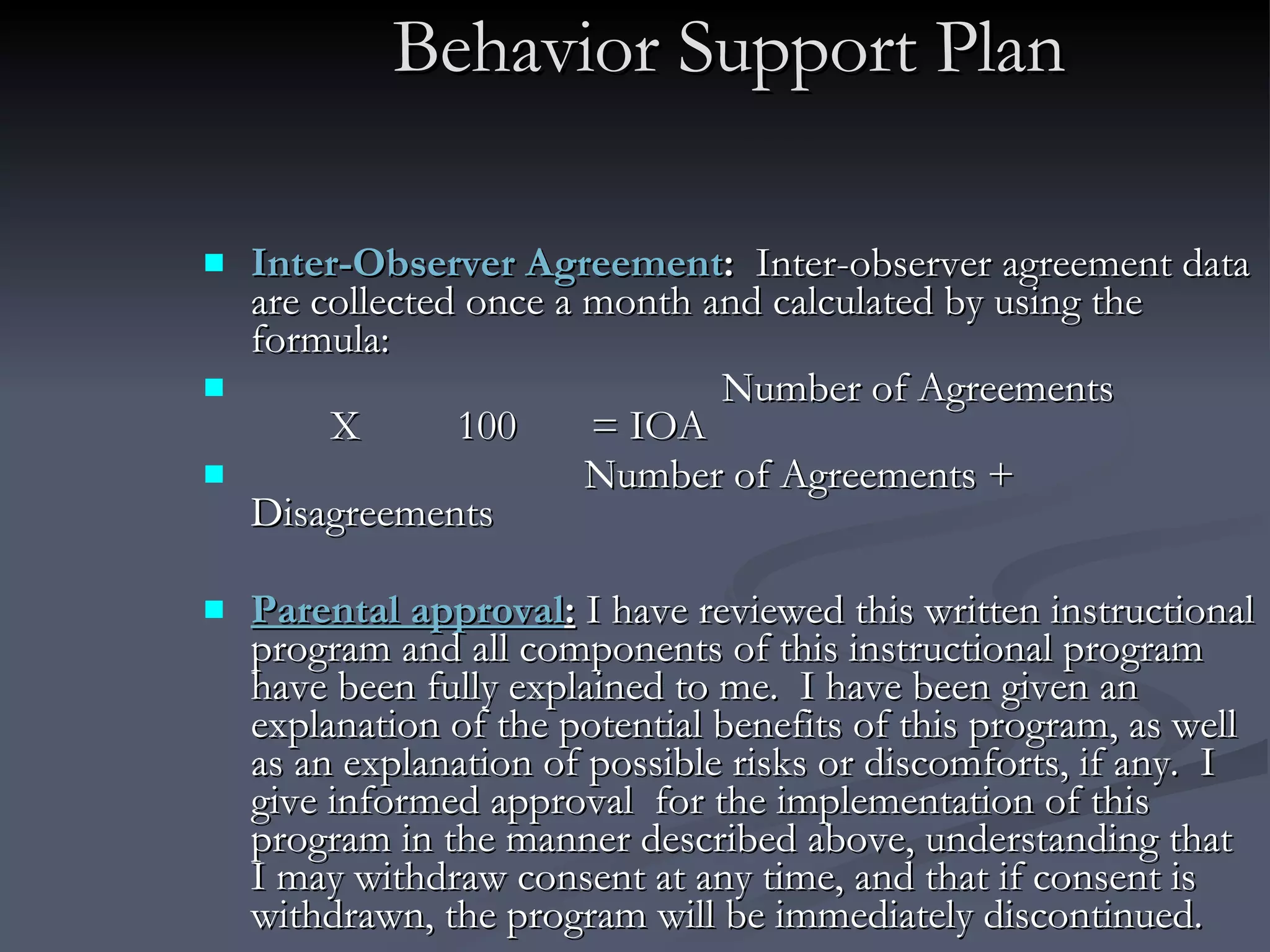
Behavior Support Plan Inter-Observer Agreement :  Inter-observer agreement data are collected once a month and calculated by using the formula:    Number of Agreements X  100  = IOA Number of Agreements + Disagreements Parental approval :   I have reviewed this written instructional program and all components of this instructional program have been fully explained to me.  I have been given an explanation of the potential benefits of this program, as well as an explanation of possible risks or discomforts, if any.  I give informed approval  for the implementation of this program in the manner described above, understanding that I may withdraw consent at any time, and that if consent is withdrawn, the program will be immediately discontinued.
Behavioral consultation Consultants need: Knowledge of problem-solving method Expertise in intervention & evaluation Expert clinical skills Excellent professional skills Knowledge of organizational structure
Public School Consultation Direct Individual Student Consultation and Assessment Evaluations & Make Recommendations of: Program efficacy, FBA, social skills, situational assessments Conducted both at school & at home School-Wide and Classroom Consultation Target all students, focus on social skills, emphasize a preventative & positive reinforcement orientation, teach problem-solving abilities & measure outcomes objectively Objectives include: Improve student academic performance, social skills, and on-task engagement decrease student discipline referrals, detentions, suspensions & attrition Increase the proficiencies, satisfaction & retention f school personnel  District-wide Consultation Focused on systematic assessment of behavior support practices across multiple school, with particular emphasis on students at high risk of being placed in out-of-district placements
Training Opportunities for School Districts Didactic training with practical application E.g., Using results of FBA to design BIPs Parent training Use of spontaneous language at home Research & Dissemination
Consumer Satisfaction Surveys
Guide to Successful Consultation  Professionalism Positive working relationship with administration & staff Credentials   Skills in both clinical & academic areas Understanding of public school system Compromise & shaping Consultant mentorship
Consultant Services What are the principles of ABA that will be implemented by the consultant? How will the consultation be implemented?   What is the rate of the consultant? What is the nature of the consultant’s training and collaboration with the instructional staff? What will be the nature of parental involvement with the consultant? What is the consultant’s role in supplemental services? What is the consultant’s role in program representation?  What is the consultant’s role in staff recruitment & hiring? How will the consultant aide in potential litigation? How will the consultant communicate recommendations?
Report Writing PsychoEducational Report Reason for Referral Background information Summary of Current Situation Sources of Information Review of Previous Reports Observation Data notebook review  Summary of Findings Programmatic Recommendations When making recommendations for specific programs, summarize the data and make recommendations based on these data.  When making generic programmatic recommendations (e.g., parent training), cite research, as much as possible to support these recommendations
Report Writing Response to a PsychoEducational Report Purpose of Report  Statement of position  Reject, accept, partially-accept report Response to observation Response to recommendations  State recommendation State your response with research to back up your position
Report Writing Examples of Responses: Recommendation:  A “traditional” ABA program Response:  The evaluators do not recommend a specific model, but in their recommendation, they describe features of the UCLA Young Autism Project, or the Lovaas method, as it was first disseminated almost twenty years ago.  Since that time, the science of behavioral psychology has substantially evolved.  Johnny’s current program effectively utilizes all aspects of ABA, including discrete trial teaching, incidental teach, video modeling, scrip/script fading procedures, activity schedules and the  implementation of new research in ABA as it is developed.
Report Writing Examples of Responses: Recommendation:  Emphasis on generalization of skills Response:  According to Baer, Wolf, and Risley (1968), generalization strategies are a defining feature of ABA.  Generalization strategies are therefore developed and assessed for every skill in a child’s educational program in the Bernards Township autism program.  We are indeed in agreement that programming for generalization should be a priority and have therefore made it so.  Johnny has demonstrated generalization of many skills across settings, including school and home settings, instructors and stimuli.  The evaluator might have had difficulty assessing Johnny’ generalization of skills in that she did not review the generalization data that is graphically displayed in Johnny’ data notebook.
Report Writing Examples of Responses: Recommendation:  Augmentative Communication such as PECs Response:  We do not agree that Johnny should be taught to use an augmentative communication system such as PECs.  Johnny is making substantial progress learning to talk in the presence of his photographic choice board and other visual supports.  In addition, there is limited peer-reviewed evidence supporting the use of PECs as an effective communication system, specifically in the acquisition of generative language (http://www.asatonline.org/resources/treatments/picture.htm) Furthermore, our functional assessment data indicate that Johnny’ disruptive behaviors are largely maintained by escape, rather than what the evaluator described as “frustration” presumably caused by lack of communication skills.
Report Writing Examples of Responses: Recommendation:  “trial by trial” data should be collected daily Response:   In order to collect “trial by trial” data, one needs to collect data in the presence of teaching conditions.  Data collected under teaching conditions provides an inaccurate representation of the child’s skill acquisition, for each subsequent trial is affected by the teaching condition and one does not get an unaffected measure of the child’s skill.  This point of view is supported by hundreds of studies in peer-reviewed journals, including the Journal of Applied Behavior Analysis.  One downside of collecting data in the absence of teaching conditions is that a child is allowed to err.  To minimize the occurrence of errors, data are collected minimally weekly.  School programs with excellent outcome data, as referenced by Handleman and Harris (2001) collect data in this fashion.  One final reason to have teaching and testing conditions is that it allows for instructors to have an uninterrupted teaching interaction, which includes modeling appropriate eye contact, attending, and social skills, as well as effective teaching of particular target skills.
Report Writing:  Dr. "Not So Smart" seemed to have some questions regarding the teaching procedures implemented for Johnny’s spontaneous language. She states “I asked Dr. Reeve whether there was a specific protocol to teach ‘spontaneous’ language, and noted that her response and the observed method was via verbal cues for Johnny to imitate the words one at a time.” In fact, the teaching procedure used to promote Johnny’s spontaneous language is incidental teaching. This is the teaching procedure that Dr. "Not So Smart" observed. In addition, Dr. Reeve did not indicate that this was merely “verbal cues for Johnny to imitate the words.” Rather, Dr. Reeve said that incidental teaching was used to promote Johnny’s spontaneous language. This teaching procedure is thoroughly described in the skill acquisition program titled “Spontaneous Language.” This, and all, skill acquisition programs are kept in Johnny’s data notebook. Johnny’s data notebook is a record of his progress since beginning the program in October, 2003 and it contains a detailed description of each one of his current programs, including response definitions, measurement procedures, the conditions under which each response is to be emitted, teaching procedures (including prompt/prompt fading and reinforcement procedures), methods to promote and assess generalization, maintenance conditions, and inter-observer agreement data collection procedures. Dr. "Not So Smart" only briefly looked through Johnny’s data notebook while Johnny ate lunch.
References Putnam, R.F., Handler, M.W., Rey, J. & McCarty, J. (2005).  The Development Of Behaviorally Based Public School Consultation services.  Behavior Modification 29,  521-538.
 
Professional Collaboration Adriane Miliotis Delia O’Mahony Martine Torriero
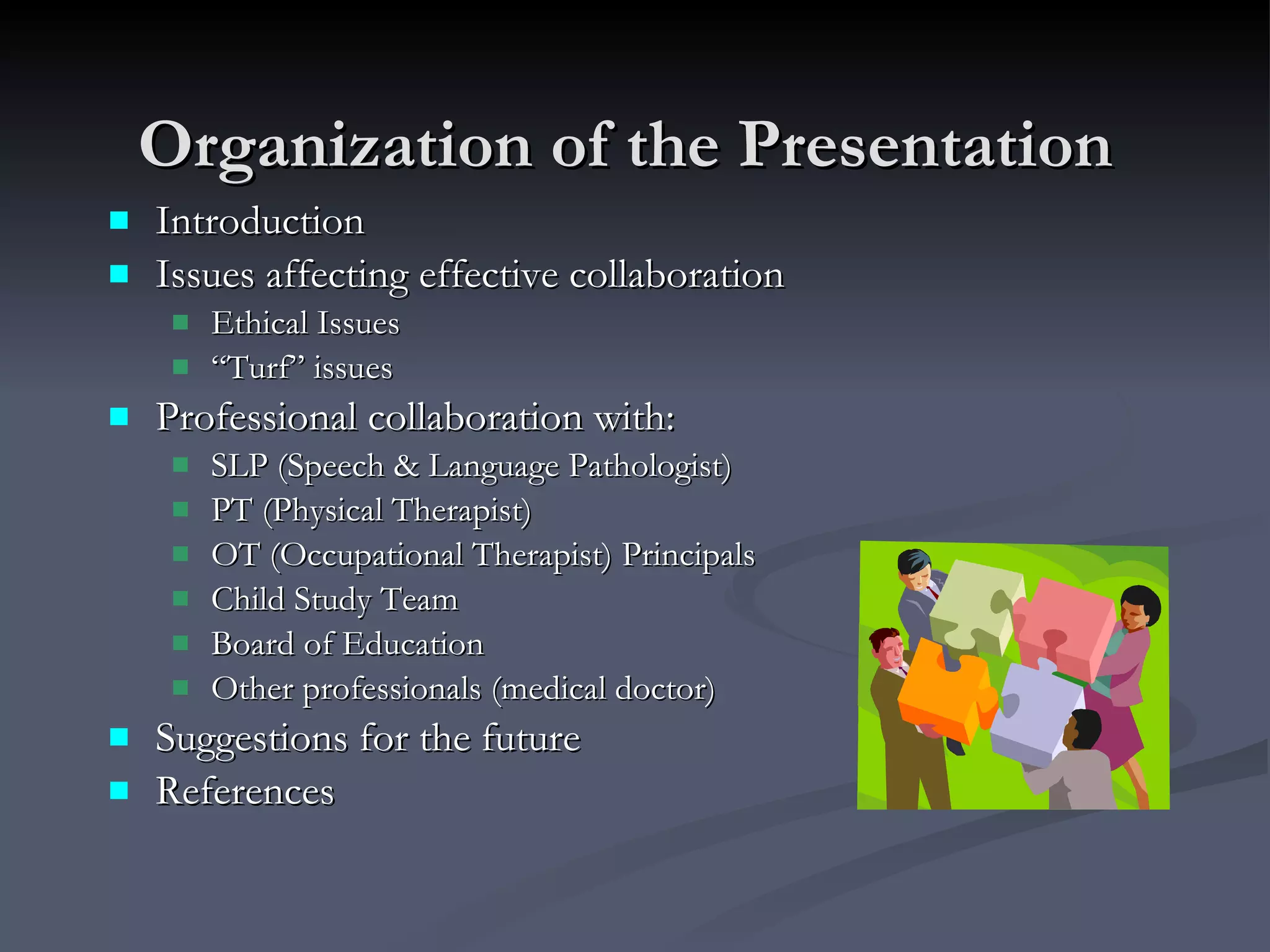
Organization of the Presentation   Introduction Issues affecting effective collaboration  Ethical Issues “ Turf” issues Professional collaboration with: SLP (Speech & Language Pathologist) PT (Physical Therapist) OT (Occupational Therapist) Principals Child Study Team Board of Education Other professionals (medical doctor) Suggestions for the future References
Discouraging Search Advanced Search Search Terms: professional collaboration Journal: Applied Behavior Analysis (Searching: PsycINFO)   No results were found.
What is collaboration? Working together to enhance the learner’s experience Respecting professional expertise
What is collaboration? con’t participation in identifying, designing, and developing inclusive program options  with families and other professionals forming partnerships …has enhanced professional practice early childhood special educator's experiences, resources, and contacts can be valuable assets to communities as they seek to expand and sustain community-based service options (Allen & Polaha, 2003)
What are the components of collaboration? communication  decision making Goal setting organization  team process Nijhuis et. al. (2007)
Why collaborate? Learners and parents:  How many different people do they see   before the child receives instruction?  What happens if parents and learners get conflicting information?
Why collaborate? con’t Team Members: Can we teach effectively  in a vacuum? Consistent instruction Share ideas Learn from each other
Effective Collaboration A basic understanding of:  expertise orientation terminology potential role of the other professionals in the collaborating team (Geroski, Rodgers and Breen 1997)
Helpful to Know Qualifications  + Philosophy  + Professional terms  + Possible contribution to the team  + =  Professional respect
Successful Collaborators Willing to try strategies Interested in using something new Quick to implement suggestions High adopters had the most  knowledge of curriculum and pedagogy knowledge and student friendly beliefs about managing student behavior student-focused views of instruction ability to carefully reflect on students' learning (Brownell et. al. 2006)
Roadblocks to Effective Collaboration Excessive paperwork  Difficulties identifying appropriate interventions with existing resources Lack of financial support Inadequate training in problem solving procedures No release time for meetings Meeting times difficult to arrange Meetings last too long (Yetter & Doll, 2007)
Unsuccessful Collaborators Moderate and low adopters were less knowledgeable took longer to grasp ideas did not always implement them well some of these teachers needed to have ideas explained in detail  would discard ideas they did not appear to comprehend (Brownell et. al. 2006)
Educating other professionals Autism is a low-incidence disorder that has received increasing attention as parents have organized seeking more effective education services for their children with autism  1 prepare early intervention practitioners to work with young children with  autism , severe physical impairments, and other low incidence disabilities  1 The program features joint course work across the Schools of Medicine and Education and seminars on  collaboration  and teaming  2 1  Shriver,  Allen, Mathews,  1999  2  Able-Boone, Crais, Downing,  2003
Expanding Professional Roles Will the shift from direct to indirect roles  affect: job satisfaction staff turnover potential for burn-out among early childhood special educators professionals who were originally attracted to the field because of direct work with young children and families may be less satisfied with roles that are now primarily adult oriented and facilitative in nature
Ethical Issues  Before we can collaborate, we need: Mutual consent form signed by parents and student Identify specific professionals to include Hand deliver, fax or mail Make initial contact through a letter Avoid phone tag due to different schedules Send parents a copy of the letter  Indicate an interest in collaboration in this letter
Collaboration with related service providers
Why should we collaborate? “ Coordination between the disciplines is important when adding speech-language therapy to an applied behavioral program. All objectives must reflect a common goal in order to build speech, language, play, and social skills.” (Parker 1996)  “ ... SLPs are not the only professionals who target communication outcomes within the scope of their practice. Teachers, occupational therapists, reading specialists, and behavior analysts do so as well, either directly or indirectly. Therefore, cross-disciplinary collaboration is essential.” (Koenig and Gunter 2005)
Benefits of Collaboration The creation of evidence-based therapeutic approaches and practices by individuals with combined expertise in ABA and SLP The ability to improve the integration of support provided by SLP and ABA professionals as participants on home-, school-, and center-based intervention teams A reduction in the number of reinvented wheels Discrete trial to establish skills and NET to generalize (Koenig and Gerenser, 2006)
The Role of the SLP From the ASHA Position Statement “Roles and Responsibilities of Speech-Language Pathologists in Diagnosis, Assessment, and Treatment of Autism Spectrum Disorders Across the Life Span” “Collaboration: Speech-language pathologists should collaborate with families, individuals with ASD, other professionals, support personnel, peers, and other invested parties to identify priorities and build consensus on a service plan and functional outcomes.”
What do the fields of SLP and ABA have in common? ABA and SLP are the treatment components most frequently requested by parents ABA and SLP therapists are highly focused on the individual, his or her unique learning style, and the outcomes of treatment Both ABA and SLP address skill deficits directly by teaching specific language behaviors rather than treating the problem indirectly using specialized diets or sensory stimulation programs Both fields rely on procedures that are supported by evidence. Most therapists measure the child's performance by collecting data to make decisions about progress and potential changes in instruction. (Harchik, 2005)
Coordinating Speech-Language Pathology with an Applied Behavior Analysis Program (Parker, 1996)   1. The SLP should develop language goals similar to those developed by the behavior program in order to facilitate generalization. - Ex. ABA program is working on expressive labels with the Sd, “What is this?” The SLP’s goal can be to use the same vocabulary to request those items in a low structure, play context.
2. The SLP should help to make the discrete-trial goals of the behavior program as communicative and functional as possible. Ex. Work on requesting programs using objects of high interest. 3. The SLP can add valuable information about speech-language goals that are being addressed in the behavior program. Ex. Suggest a prompt to remediate specific sound errors such as placing a hand on the student’s throat to teach the /k/ sound.
4.  The SLP helps to ensure that all therapists are attempting to use similar vocabulary, commands, and toys in focusing on their goals. 5.  The SLP can offer information to the behavior team and parents on developmentally appropriate linguistic forms and the developmentally normal communication sequence. Ex. Assists with the periodic reassessment of linguistic goals.
6. The SLP can demonstrate how to incorporate specific goals into daily, preexisting activities, such as dinner, bath, and bedtime, which will be helpful with generalization and sequencing. Ex. A daily activity such as cooking dinner can be used to teach sequencing skills and specific language forms. If the child is working on prepositions, the parent can say, “First we put the water  in  the pot, then the salt  in , then the spaghetti  in .”
7. The SLP should help develop reinforcers- both tangible, such as food, stickers, and toys, and social, such as praise, hugs, and tickles. 8. The SLP should assess the manner in which speech-language skills are used within the classroom or play group in order to ensure maximum benefit from these interactions. - Ex. Suggest that the teacher give the child a toy that she knows another child likes, then encourage the two children to play together. - Ex. Encourage the classroom teacher to set up activities that require a buddy, and pair the child with a peer who is both a strong language model and a friendly child.
9. The SLP can also help troubleshoot specific linguistic problems. Ex. If the child is having difficulty remembering the names of objects, the SLP can develop appropriate categorization and world knowledge tasks. 10. The SLP can also aid in the diagnosis and treatment of concurrent disorders (e.g. apraxia or dysarthria)
Three models for team interaction
Staff development is across disciplines and is  critical to team  development and role  transition.  Frequently shared and  held across disciplines.  Generally is independent and  within disciplines.  Staff Development Team meets regularly to share information and to teach and learn across disciplines (for consultation, team building, etc.).  Team meets regularly for case conferences, consultations, etc.  Typically informal. Members may not think of themselves as part of a team.  Lines of  Communication  Families are always members of the team and determine their own roles.  The family may or may not be considered a team member. Families may work with the whole team or team representatives. Generally, families meet with team members separately by discipline.  Family Role Team members commit to teach, learn and work across disciplinary boundaries to plan and provide integrated  services. Team members are willing and able to share responsibilities for services among disciplines.  Team members recognize the importance of contributions from other disciplines. Philosophy of team interaction Transdisciplinary  Interdisciplinary Multidisciplinary Component
http://www.njeis.org/NJFoundationsSP.pdf Team members share responsibilities and are accountable for how the plan is implemented by one person, with the family.  Team members implement parts of the plan for which their discipline is responsible.  Team members implement their own plan separately by discipline.  Plan implementation  Staff and family develop plan together based on family’s concerns, priorities, and resources.  Goals are developed by discipline and shared with the rest of the team to develop a single service plan.  Team members develop separate plans for intervention within their own disciplines.  Plan Development  The team participates in an arena assessment, observing and recording across disciplines.  Team members conduct assessments by discipline and share results.  Team members conduct separate assessments by discipline.  Assessment Process Transdisciplinary  Interdisciplinary Multidisciplinary Component
The Consultative Model of Service Delivery   (Bellone, et. al 2005)
Why should we use  this model? “ For individuals with ASD, exclusive provision of services through pull-out services does not address the underlying challenge of social communication inherent in the disorder, the issues of generalization, functional outcomes, or the importance of collaborating with significant communication partners.” (ASHA 2006)
Why?, con’t Research on children with ASD suggests that the greatest effects of any direct treatment are reflected in the generalization of learning achieved by working with parents and classroom personnel.”(NRC 2001)
Traditional S&L services are inadequate 1-5 hours treatment per week  SLP is sole instructor  Isolated setting  Skill generalization and maintenance difficult to achieve given these limitations (Bellone, et.al., 2005)
BUT… The pull-out model of service delivery continues to be the most used model for preschool and school-age children. (ASHA, 2004) EVEN THOUGH… There is no evidence supporting the long-term effectiveness of individual therapies implemented infrequently (e.g., once or twice a week), unless the strategies are taught to be used regularly by communication partners in the natural environment. (ASHA 2006)
Consultative S&L services afford…   Consistent and continuous instruction throughout the child’s day  Skill generalization across people and settings in child’s natural environment  Skill maintenance through practice in naturally occurring and programmed opportunities (Bellone, et.al., 2005)
The role of the SLP Develop curriculum  Select data collection systems  Train teachers  Observe teachers & students  Attend meetings  Modify teaching procedures
The role of the  teaching staff  Provide multiple daily opportunities  Collect & sum data  Review data w/ SLP  Initiate questions, concerns  Troubleshoot w/ SLP  Incorporate changes into instruction
The consultative model in a public school   School administrator contacted NECC’s consulting department NECC directors met with teachers and administrators Defined role of SLPs and teaching staff A letter was sent home to parents inviting them to an informational meeting After a follow up letter and phone call, 33% (n=24) selected the consultative model
The consultative model in a public school   Public School Contract Services were provided in 8 children in 3 classrooms 2 hours/mo of consultative (indirect) services from SLP 40 hours/mo direct S&L instruction from lead classroom teacher  SLP consult with Head teachers  Head teachers train teaching assistants
The consultative model in a public school   Results Public school students  m ade progress/met 98% of objectives (2005)  NECC students made progress/met 90% of objectives (2004)
What do other disciplines have to say about professional collaboration?
Guide for Professional Conduct  PRINCIPLE 11 A physical therapist shall respect the rights, knowledge, and skills of colleagues and other healthcare professionals. 11.1 Consultation A physical therapist shall seek consultation whenever the welfare of the patient will be safeguarded or advanced by consulting those who have special skills, knowledge, and experience. 11.2 Patient/Provider Relationships A physical therapist shall not undermine the relationship(s) between his/her patient and other healthcare professionals. 11.3 Disparagement Physical therapists shall not disparage colleagues and other health care professionals. See Section 9 and Section 2.4.A.
Code of Ethics  Principle 7. Occupational therapy personnel shall treat colleagues and other professionals with respect, fairness, discretion, and integrity. (FIDELITY)
Guidelines for Responsible Conduct For Behavior Analysts 9.0 The Behavior Analyst's Responsibility to Colleagues. Behavior analysts have an obligation to bring attention to   and resolve ethical violations by colleagues, to make sure their data are accurate and presented truthfully, and they share data with colleagues. 9.01 Ethical Violations by Colleagues 9.02 Accuracy of Data 9.03 Authorship and Findings 9.04 Publishing Data 9.05 Withholding data
Are related service providers a necessary component of an effective program?
A public program serving children in preschool through eighth grade diagnosed with Autism and related disabilities in Bergen County, NJ “ The speech-language department works collaboratively with the classroom teachers to promote various communication modes such as the Picture Exchange System, computerized voice output devices, sign language, and fostering expressive language.” (McKeon, et.al. 2006)
Does not employ related service personnel  Curriculum includes teaching programs that facilitate the development of language and fine and gross motor skills Programs are implemented by instructional personnel throughout the day Pull-out related services are rarely necessary because of the breadth and comprehensiveness of the curriculum If services are deemed necessary, appropriate referrals or consultations are arranged by ALG staff   (Meyer, et. al, 2006)
The Douglass School “…  each class is supported by a half-time speech-language specialist who provides individual and group therapy as well as consultative services to the preschool teachers. An adaptive physical education professional serves the preschool children on the three times a week and acts as a liaison for consulting professionals such as physical or occupational therapists.” (Harris, et. al, 2001) Douglass Outreach   “ Douglass Outreach employs five licensed part-time speech pathologists for speech-language services.” (Harris, et. al, 2001)
Princeton Child Development Institute Strong emphasis on language development Does not employ specialists  All intervention personnel are trained to teach receptive and expressive language in  every  activity Toilet training, outdoor play, lunchtime  Language instruction encompasses discrete trials, incidental teaching, time-delay procedures, and video-modeling procedures.  36 of 41 children entered PCDI before 60 months of age and had  no  functional expressive language The skills of these children currently range from using sounds as mands   to age appropriate verbal repertoires.   (McClanahan and Krantz, 2001)
Recommendations for Continued Collaboration Share treatment efficacy data Share innovative teaching procedures Share basic information Share successful collaboration experiences Read articles in journals associated with the other profession Share your concerns Share lunch (Koenig and Gerenser, 2006)
Parents / Home / Family Physician  Dentist, Doctor Siblings  Family Celebrations Community State of New Jersey Department Of Education Director of Special Services ST OT PT ART Music BCBA Teacher After school services (latch key) DDD  DVR Employment Sheltered Living Department of Human Services   SPAN/COSAC/ Autism Society of America BOE - Local School / Sending School District Board of Education (Receiving School) Child Service Team Neighborhood, Shops, Restaurants The Office of Early Care and Education (OECE) School Principle Child Bus
Collaboration with Administration Who are the possible collaborative partners?  How can we develop a collaborative relationship?
NJDOE Press Release:   February 20, 2007 “ Approximately 7,400 New Jersey children between the ages of 5 and 21 have been diagnosed with autism spectrum disorders.” “ Fifty-five New Jersey school districts will share $15 million in state funds to establish, expand or enhance public school programs and services for students diagnosed with Autism Spectrum Disorders…..”
Administration State of New Jersey Department of Human Services The Office of Early Care & Education (OECE) Division of Family Development Department of Children and Families Build NJ: Partners for Early Learning Coalition of Infant/Toddler Educators (CITE)
Administration Child care services are coordinated through Department of Human Services' Office of Early Care and Education for information, policy and resources the Division of Family Development for child care operations the Division of Developmental Disabilities  the Office of Licensing in the Department of Children and Families (DCF)  all in cooperation with Child Care Resource and Referral Agencies in every county Services include:  information and referral to help parents locate child care resources and to  answer typical questions regarding types of child care how to pay for care how to become family day care and licensed child care providers.
Administration Department of Education Division of Early Childhood Education The Division of Early Childhood Education (DECE) of the New Jersey Department of Education has programmatic responsibility for preschool through 3rd grade (PK3) programs.  responsible for the development, implementation, and alignment of program components with a focus on standards, curricula, and assessment. The creation of this division: Acknowledges that a continuum of developmental stages constitute what is traditionally known as early childhood,  Protects New Jersey’s investment in high quality preschool by providing high quality kindergarten through third grade educational experiences for young children. PK3 work will be organized within a framework that includes   structural  (administration, class size, teacher-child ratio, etc.) process  (quality of classroom environments, teacher-child interactions, etc), alignment  (standards, curriculum, assessments) components that are associated with children’s social and academic outcomes.   The DECE’s work will be: Research-based, with a series of advisory committees consisting of nationally recognized experts representing a range of early childhood-related areas Cross-departmental to align all DOE PK3 initiatives,  Supportive of the efforts of the Division of School Improvement .
Office of Special Education Programs   Implements state and federal laws and regulations governing special education to ensure that pupils with disabilities in New Jersey receive full educational  opportunities. Provides statewide leadership through the development of policy and implementation documents and provides guidance to school districts and parents regarding the implementation of special education programs and services.  Responsible for administering all federal funds received by the state for educating pupils with disabilities ages 3 through 21. Monitors the delivery of special education programs operated under state authority, provides mediation services to parents and school districts,  processes hearings with the Office of Administrative Law, and conducts complaint investigations requested by the public. Funds four learning resource centers (LRCs) that provide schools and parents with information services, materials circulation, technical assistance, consultation services and production services.  Plans and implements program and personnel development activities in areas such as implementing the least restrictive environment provision, planning the transition of students with disabilities from school to adulthood, planning programs and services for preschool children with disabilities,developing Individualized Education Programs (IEPs) and accessing individual rights and entitlements.
LEARNING RESOURCE CENTER - NORTH 7 Glenwood Avenue, 2nd Floor, Suite 201  East Orange, New Jersey 07017 Regions served:  Bergen, Essex, Hudson, Morris, Passaic, Sussex, and Warren Counties (973) 414-4491 - LRC General Service (973) 414-4496-FAX (973) 266-1849-TTY   (973) 631-6349 - Preschool Technical Assistance e-mail:  [email_address]
A collaborative model The Child Study Team Composed of teachers, specialists, administrators, and parents Responsible for identifying and evaluating students aged 3 – 21 for special education programs and services.  Required to conduct both an educational evaluation and a psychological evaluation. (A neurological examination is also required before a child becomes eligible for special services.) Develops an Individual Education Plan with parent/child. Assigns a case manager Visits receiving school or agency with parent/child Organizes placement and transportation (Walther-Thomas, Korinek, & McLaughlin, 1999)
IEP Meeting Who should attend? Student (if appropriate) Parent At least one general (or special) education teacher At least one Child Study Team member Student’s case manager School district representatives Persons invited by parent or school Representatives of agencies providing payment for services
Typical School Operations Network Council of the Borough   (duly elected by town) Board of Education  (elected by Council) Superintendent  Hired by the BOE to direct operations  Manage the fiscal year budget Hire all school staff including Child Study Team members, teachers, and professional support staff (ST, OT, PT, BCBA, librarian, etc.)
School “ Effective collaboration emerges out of concerns by individuals who are like-minded in some ways and very different in others.” Walther-Thomas, Korinek, McLaughlin & Williams (2000) Principals  tend to focus on issues such as achievement trends, financial implications, professional development, student placement, professional schedules, and community relations. Teachers  are concerned with individual and group performance, IEP planning, and new responsibilities. Families  care about the impact of new initiatives on their children.
Improving student bus-riding behavior through a whole-school intervention (Putnam, Handler Ramirez-Platt & Luiselli, 2003) Intervention developed through collaboration with students, school personnel and bus drivers 624 students participated during 5 phases of the study Disruptive behavior that resulted in referrals or suspensions was targeted and measured in an ABAB reversal design Results indicated an overall decrease in bus suspensions
Parents have power! Parents and children are the service users Parents and children have the most to  gain/lose regarding adequate effective  services The child is at the center and the parent needs  to learn to collaborate with all the service  providers and get them to collaborate with  each other from the time of diagnosis to adult development. Parents can enlist the work of nonprofit agencies and foundations to work with one another to “map the terrain” of a problem They should talk to public officials about providing long-term funding for vital programs both in their community and at the State level. Parents should know their rights and not accept anything less.
Suggestions for the Future develop and evaluate new methods of preparing early childhood special educators whose primary role now consists of consultation and collaboration, rather than teaching Use the case method of instruction Prepare  professionals to become independent and competent problem solvers in the role of consultant personnel training programs must be systemic in nature  (Dybvik, 2004)
Suggestion for the Future, con’t changes in professional roles create opportunities for interactive learning for professionals who function in a variety of roles, including administrative ones ensure a shared knowledge and values base among all professionals who serve young children and families Remedy roadblocks ( Skrtic, 1991 )
Suggestion for the Future, con’t 21st century changes: "the entire history of special education is (and should continue to be) one of incremental progress toward more socially inclusive instructional placements for students with disabilities"  Efforts aimed at early childhood community integration will continue to present profound challenges to practitioners in ECSE Effectively change our roles in response to the changing times, in support of young children with and without disabilities growing up together (Skrtic, 1991)
 

Mary and Sharon

  • 1.
    Developing Effective SchoolBased Program for Individuals with Autism Spectrum Disorder Sharon A. Reeve, Ph.D., BCBA Caldwell College Director of Graduate Programs in ABA Mary E. McDonald, Ph.D., BCBA Hofstra University Assistant Professor of Special Education
  • 2.
    Goals of TodayOverview of autism and ABA Components of comprehensive school-based ABA program Sequence of events in developing an educational program for a particular student Integrated curriculum Skill domains Sample assessment Goals selection based on assessment Program development Developing a data sheet Developing a skill acquisition program Writing progress reports
  • 3.
    Diagnostic Criteria for299.00: Autistic Disorder A. A total of six (or more) from (1), (2) and (3), with at least two from (1) and one each from (2) and (3) (1) Qualitative impairment in social interaction (2) Qualitative impairment in communication (3) Restricted repetitive and stereotyped patterns of behavior, interests and activities Adapted from : Diagnostic and Statistical Manual, 4th Ed., APA, 1994
  • 4.
    Autism and Pervasive Developmental Disorders Autism is a type of Pervasive Developmental Disorder (PDD) A child with autism is affected along multiple dimensions (Unlike other single dimension problems) learning disability, communication disorder, emotional and behavioral disorders
  • 5.
    Characteristics ofChildren with Autism learning deficits Affects every aspect of child’s education language disabilities Articulation, expressive, receptive, spontaneous, conversation, non-contextual vocalizations behavioral disorders Stereotypic behavior: motor, visual, tactile, compulsive behaviors rigidity of routine, intolerant of change
  • 6.
    Characteristics ofChildren with Autism attentional deficits Lack of eye contact, availability of learning, unaware of danger emotional deficits Non-contextual emotions, lack of self-concept social deficits Eye contact, gestures, facial expression, greetings, awareness of other children, friendships, play skills deficits Imaginative, pre-occupations with objects/activities, general content knowledge
  • 7.
    Characteristics ofChildren with Autism sleep disturbances Go to sleep late, get up early, get up during night toileting deficiencies Lack of awareness of accidents eating problems Texture, appearance, gustatory
  • 8.
    Why Scientifically ValidatedIntervention for Children with Autism? Applied behavior analysis (ABA) was specifically designed and researched for children with autism empirically demonstrated to be most effective intervention for children with autism research findings have been replicated many times over span of 30 years ( Lovass, 1960; Fenske, Zalenski, Krantz, & McClannahan, 1985; Smith, 1996; Anderson, Avery, DiPietro, Edwards, & Christian, 1987; Lovaas, 1987; Harris, Handleman, Gordon, Kristoff, & Fuentes, 1991; Birnbrauer & Leach, 1993; McEachin, Smith, & Lovaas, 1993; Perry, Cohen & DeCarlo, 1995; Sheinkopf & Siegel, 1998; Green, 1996, 1999; New York State Department of Health, 1999)
  • 9.
    What Makes aScientifically Validated Treatment Intervention for Children with Autism Effective? The science of ABA is a flexible and powerful enough to address every aspect/dimension of the disorder every aspects of the child’s life Over 500 studies published in peer-reviewed research journals about teaching many specific skills to children with autism using principles of applied behavior analysis General skill domains include: gross motor, fine motor, speech and language, reading, math, leisure, social, self-help and independence In addition, we have dozens of teaching procedures that have shown to be effective and additional teaching procedures continue to be developed and refined
  • 10.
    Applied Behavior Analysis Applied behavior analysis (ABA) is: A science Teaching procedures derived from learning principles Teaching procedures systematically applied Teaching procedures geared to improve socially significant behavior Requires experimental demonstration that the teaching procedures employed were responsible for the improvement in behavior (accountability)
  • 11.
    Components of Comprehensive School-Based ABA Program Individualized Skill Assessment and Goal Selection Individualized Teaching Programs Individualized Curriculum Individualized Data Collection Assessing Progress Of Each Skill On-going Hands-on Staff Training Workshop Training School Visits Home Visits Related Services Evaluation of Program Effectiveness
  • 12.
    Components of Comprehensive School-Based ABA Program INDIVIDUALIZED SKILL ASSESSMENT AND GOAL SELECTION (Bondy, 1996; Jacobson, 2001) First several weeks after child enters program Skills assessed in all domains: gross- and fine-motor skills, academics, pre-requisite learning skills, self-help, independence, receptive and expressive language, non-productive behavior that interferes with learning, and leisure skills Updated on a continual basis Goals selected by parents, teacher, speech therapist, occupational therapist, and school psychologist
  • 13.
    Components of Comprehensive School-Based ABA Program INDIVIDUALIZED TEACHING PROGRAMS (McClannahan & Krantz, 2001; Smith, Donahoe & Davis, 2001) Operational definition, Measurement procedure, Discriminative Stimuli, Teaching Procedures (e.g., activity schedules, video modeling, peer tutoring, audio modeling, small group instruction, discrete trial instruction, incidental teaching) Generalization, Maintenance, IOA, specific teaching sets 30-40 individualized teaching programs will be written based on the above criteria for all skill domains for each child. Approximately 90% of each child’s individualized programs are language-based programs. Programs that are child initiated, that promote generalization across multiple staff, or that need rapid skill acquisition are taught by all instructors Programs that have complex fading procedures, involve initial acquisition of discrimination or involve shaping procedures are initially taught by one instructor and then generalized to all instructors.
  • 14.
    INDIVIDUALIZED CURRICULUM (Bondy, 1996; Taylor & McDonough, 1996; McClannahan & Krantz, 2001; Smith, Donahoe, & Davis, 2001) Curriculum is based on general education curriculum broken down into multiple steps All curriculum written by the teachers and the consultant Skills are taught in a systematic fashion (mastering pre-requisite skills before being introduced to more complex skills) Examples of general packaged curriculum that can be used and possibly modified are Edmark Reading, Distar Language, MacMillan Math, Sensible Pencil, Learn to Cut Almost all curriculum materials are specifically made for a particular child Components of Comprehensive School-Based ABA Program
  • 15.
    INDIVIDUALIZED DATA COLLECTIONASSESSING PROGRESS OF EACH SKILL (McClannahan & Krantz, 2001; Jacobson, 2001) Ongoing monitoring of skill acquisition Every program (skill) is evaluated approximately once a week (some programs more frequently, some programs less frequently depending on a child’s skill acquisition) Accountability! Components of Comprehensive School-Based ABA Program
  • 16.
    ON-GOING HANDS-ON STAFFTRAINING (Bondy, 1996; Jacobson, 2001; Smith, Donahoe & Davis, 2001; McClannahan & Krantz, 2001) No one is ever fully trained in ABA, training will be ongoing and provided by a classroom teacher and/or consultant WORKSHOP TRAINING (Jacobson, 2001, Bondy, 1996; Smith, Donahoe & Davis, 2001; McClannahan & Krantz, 2001) Twice a month all staff members participate in workshop trainings in the principles of ABA and other relevant topics related to teaching children with autism Components of Comprehensive School-Based ABA Program
  • 17.
    SCHOOL VISITS (McClannahan & Krantz, 2001; Jacobson, 2001; Bondy, 1996) Bi-monthly school visits in which parents will receive training in teaching their child various skills During school visits parents access to child’s data notebook and can monitor progress Workshop training several times per year Components of Comprehensive School-Based ABA Program
  • 18.
    HOME VISITS (McClannahan & Krantz, 2001; Smith, Donahoe & Davis, 2001; Bondy, 1996) Home visits provided at least monthly by classroom teacher Child’s progress will be reviewed Training provided in areas specific to home (e.g., going to dentist, doctor, mall, grocery store; eating; sleeping; leisure skills; language skills) Any instructional staff hired by the parents at home has the opportunity to receive training several times per week by the school program. Recommend that approximately 20 hours of training with child at school before home staff teaches the child at home . Components of Comprehensive School-Based ABA Program
  • 19.
    RELATED SERVICES : Many ABA techniques shown to be effective for increasing and improving language and communication in children with autism (e.g., activity schedules, audio modeling, video modeling, PECS) (Skinner, 1957; Lovaas, 1977, 1987; McGee, Krantz, & McClannahan, 1985; Sundberg & Partington, 1998; McClannahan & Krantz, 1999; New York State Department of Health, 1999; Bondy & Frost, 1994; Fenske, Krantz, & McClannahan, 2001; Rappaport, 2001; Reeve, Reeve, Poulson, & Buffington-Townsend, manuscript in preparation). When teaching children with autism, related services have been shown to be maximally effective when delivered using the principles of ABA (Jacobson, 2000; Smith, 1993; New York State Department of Health, 1999; Bondy, 1996; Romanczyk, Lockshin,& Matey, 2001; Meyer, Taylor, Levin, & Fisher, 2001). Components of Comprehensive School-Based ABA Program
  • 20.
    Evaluation of ProgramEffectiveness (McClannahan & Krantz, 2004) Engagement with Activities with Other Persons Opportunities to Respond Behavior-Descriptive Praise Relationship Building Children’s Hygiene and Personal Appearance Social Competence Inappropriate Behavior Family Participation in Intervention Components of Comprehensive School-Based ABA Program
  • 21.
    Direct Care TeamMembership Consultant/Director Provides supervision for teacher Helps teacher develop goals and objectives for each child Helps teacher develop data management system to evaluate effectiveness of each child’s program Provides direction for the development of curriculum Trains teacher in effective individualized teaching procedures Provides frequent hands-on training to all instructional staff Provides workshop training for all team members Periodically accompanies teacher and/or instructional aide on home visits Consults with and brings in other doctoral level professionals in the field when necessary
  • 22.
    Direct Care TeamMembership Teacher/Trainers Enrollment in BCBA-approved program and certified in special ed Develops individualized programs for each child Manages all data collection systems to ensure program effectiveness for each child Creates individualized curriculum to accompany each program for each child Provides hands-on training to instructional aides and the implementation of individualized programs for each child Provides hands-on training to parents and any person that frequently interacts with the child Teaches each child
  • 23.
    Direct Care TeamMembership Instructional Aides Training in applied behavior analysis (ABA) and autism Continually receives hands-on training Teaches all children in the classroom rotating approximately every half hour Serve as data analyst for one child Prepares individualized curriculum for one specific child May be selected by consultant and teacher to provide home visits and training on home staff
  • 24.
    Direct Care TeamMembership Parents Active participation in annual home and school selection of goals and objectives for their child Active participation in hands-on training in how to effectively keep their child engaged in productive activity at home and in the community, increase child’s direction following skills, and maximize their child’s use of language at home and/or whatever other area parent requests training in Receives workshop training in specific areas of applied behavior analysis
  • 25.
    Assessment Most ofwhat we do is child-specific. There is no one correct sequence or number of steps or number of pre-requisite skills. The is no “one size fits all”. One of the hallmarks of applied behavior analysis is its focus on the identification of goals and the development of educational interventions specifically tailored for individual learners.
  • 26.
    Assessment Tools StandardizedTests E.g., Brigance, WISC, WAIS-R Assessment Forms that Relate to Specific Curriculum E.g., Carolina Curriculum, IGS Curriculum, ABLLS Informal Assessment Forms the Relate to Curriculum Guides or Educational Assessment Organizationally developed forms & checklists On-Going Data-Based Assessment
  • 27.
    Which One? Allof them can be helpful We will focus on i nformal assessment forms the relate to curriculum guides or educational assessments Why? Enables us to develop a comprehensive and individualized educational program for a child with autism
  • 28.
    Sequencing of Eventsin Developing an Educational Program for a Particular Learning Assessment of the learner when they enter your program Development of appropriate goals and objectives based on that assessment Development of skill acquisition programs based on those goals and objectives. Implementation of skill acquisition programs Conducting of ongoing assessments to ensure program effectiveness
  • 29.
    Effective Because? ComprehensiveAll skill domains are addressed Integrated the same tools are used for each and every component, from initial assessment to program development Continuum of services  ---------------------------------  General Specific Individualized Ongoing development of educational program for a particular consumer One size does not fit all
  • 30.
    Integrated Curriculum Notsimply a reference or a rigid linear sequence, It is a curriculum that is fully integrated into The assessment, Selection of goals and objectives, Development of program Implementation of the program Ongoing evaluation of educational program It is a work in progress because you are always developing additional individualized programs specific to a particular learner.
  • 31.
    Integrated Curriculum Acurriculum is a framework based on the general education curriculum to determine appropriate sequencing for each child. There is no instructional sequence that is appropriate for each child. Often children with autism have splinter skills May not learn in a developmental sequence
  • 32.
    Integrated Curriculum Onemust always choose goals in a context and take into consideration: Age appropriateness Level of skill in each skill domain Criterion level of each skill .
  • 33.
    Skill Domains ExpressiveLanguage Receptive Language Social and Peer Interaction Skills Gross Motor Skills Fine Motor Skills Academics Math Reading
  • 34.
    Skill Domains LeisureIndependence Self-Care and Home-Living Skills Community Living Vocational Skills Transition Motivational system Non-productive Behavior
  • 35.
    Expressive Language SpeechVerbal imitation of phonemes, words & phrases, delayed imitation, imitation of audio/video prompt, volume, inflection/intonation, prosody, simple sentences Spontaneous Requesting, gestures, polite-positive language
  • 36.
  • 37.
    Expressive Language LabelObjects, people, nouns, choice, body parts, verbs, prepositions, emotions, environment sounds, rooms, gender, left/right, olfactory, opposites, prepositions, pronouns, five senses
  • 38.
    Leisure Choice Schedule with Audio Prompts
  • 39.
    Expressive Language DescriptionObjects, occupations, animals, using adjectives, olfactory, photo album
  • 40.
    Expressive Language Answeringquestions General information, yes/no, analogies, what’s missing, what’s wrong, distar language (video), acknowledgement, remote events, recalling information, social stories
  • 41.
    Building Initial TokenSystems Earning five stickers video
  • 42.
    Expressive Language Category& Concepts Colors, attributes/adjectives, names of, functions, concepts, same/different Conversation giving items, delivering a message, reciprocal language, verbal reasoning, interaction, topical, during meals, recalling events, riddles
  • 43.
    Conversation Embedded inFull-Day Activity schedule
  • 44.
    Conversation During LunchUsing Script Fading
  • 45.
    Expressive Language Questionasking Obtaining information, locating objects,
  • 46.
    Receptive Language Directionfollowing Pointing, One-step, multi-step, performs actions/emotions, if-then statements, temporal concepts, written directions Identification Objects, people, nouns, choice, body parts, verbs, prepositions, emotions, environment sounds, rooms, gender, left/right Categories/Concepts Colors, attributes/adjectives, categories, functions, concepts Imitation Gross-motor, fine-motor, video models, imitation of songs/story time (video), simon says
  • 47.
  • 48.
    Receptive Language Matching Identity, picture/object, sorting identical object, sorting non-identical pictures
  • 49.
    Using Matching forFull-Day Activity Schedule
  • 50.
    Picture/Object Correspondence forFull-Day Activity Schedule
  • 51.
    Picture/Object Correspondence forFull-Day Activity Schedule
  • 52.
    Social and PeerInteraction Skills Social competence/Prosocial behavior Eye contact, offering assistance, polite/positive language, waiting (toy, on-line, attention, for a direction), tolerating (vitamins, “no”, change in routine, not winning/being first, mistakes), asking for help, greetings, responding to strangers, responding to co-workers, empathy, perspective taking, social referencing, giving directions, walking (with someone, in the mall, grocery store) Games and toy play Turntaking (video), play-doh, 21 questions, riddles, pretend play, puzzles, independent, musical chairs (video), tag
  • 53.
  • 54.
  • 55.
  • 56.
    Social and PeerInteraction Skills Peers Eye contact, offering assistance, polite/positive language, greetings, waiting (toy, on-line, attention, for a direction), tolerating (vitamins, “no”, change in routine, not winning/being first, mistakes), walking (with someone, in the mall, grocery store), asking for help, ask for permission, responding to strangers, responding to co-workers, empathy, perspective taking, social referencing, giving directions), safety skills
  • 57.
  • 58.
  • 59.
  • 60.
  • 61.
    Fine Motor Skills Art Coloring, cutting, copying a drawing, drawing shapes drawing people and objects, pasting shapes, painting
  • 62.
    Pasting Shapes using an Activity Schedule
  • 63.
    Fine Motor Skills Handwriting Scribbling, Holding pencil, imitating lines, Tracing letters, sensible pencil, writing letters, writing name, copying words and sentences, signing name Keyboard skills Data entry, typing, using a keyboard, using a mouse, type to learn, word processing
  • 64.
    Gross Motor SkillsTeam sports kick ball, tee ball, bowling, basketball, tennis, volley ball Individual/Peer activity Motor imitation, ball skills, aerobics, riding vehicles, riding a bike, dancing, circuit training, exercising, gymnastics, golf, jumping rope, playing hopscotch, jogging, rollerblading, swinging, swimming, treadmill, walking
  • 65.
    Academics Science Colormatching, color labeling, anatomy, animals, plants, skills in applied science Social Studies States, capitals, US geography, US history, using a map, using a newspaper
  • 66.
    Math Pre-Math Matchingnumbers, number/object, shape id Math Number id, counting (video), oral counting (1s, 5s, 10s), money skills, more/less, patterning, measuring, addition, subtraction, multiplication ,division, word problems, McMillan Math, telling time, calendar, budgeting, reconciling checkbook, estimating costs, paying a bill, using a calculator
  • 67.
    Practicing Addition By Using Token Board
  • 68.
  • 69.
    Reading Pre-reading Matchingletters, word/objects/pictures, Letter id, sequencing, alphabet
  • 70.
  • 71.
    Reading Reading , before/after, sight words, reading a storybook, Edmark reading, phonics, vocabulary words, rhyming, spelling, using a dictionary, proofreading, Reading Comprehension Wh concepts, reading for understanding, retelling a story, answering questions about a story Writing Journal writing,
  • 72.
    Leisure Bingo, don’tspill the beans, board games, model building, connect four, checkers, maisy, scrambled eggs, card games, dominoes, Air hockey, bowling, stamp collecting, playing piano (video), parquetry, ping pong, puzzle, book & tape, playing a video game/computer game, I-pod, singing songs, gameboy, going to movies, dating
  • 73.
    Making a Modelfrom Duplos Using an Activity Schedule
  • 74.
  • 75.
    Independence Schedule FollowingPictorial, written, independent, interactive, with language
  • 76.
    Audio Prompts Embeddedin an Activity Schedule
  • 77.
  • 78.
    Full Day Choice Written Activity Schedule
  • 79.
    Independence Independent tasksRemain in designated area Completing a homework assignment Building endurance/longevity Keeping appointments Using a planner
  • 80.
  • 81.
    Types of MotivationalSystems Video: Sticker-Check Board
  • 82.
  • 83.
    Self-Care Washing faceToileting Fastening Shoe tying Tying necktie Getting dressed Getting undressed Selecting clothing Styling hair Bathing Showering Non-preferred foods Polite eating Using a utensil Morning routine Nighttime routine Personal hygiene Checking appearance
  • 84.
    Home-Living Skills Payingbills Making a budget Bedroom cleaning Making a bed Cooking Housekeeping Cleaning a sink Cleaning the kitchen Unloading dishwasher Sorting flatware Grocery shopping Planning a meal Sandwich making Food prep Ironing Laundry Folding laundry Sorting clean laundry Putting away laundry Making a phone call Answering phone Setting the table Napkin use Vacuum
  • 85.
    Community Skills Ordering at a restaurant Using a vending machine Using a locker room Using a gym Using a community pool Shopping Writing a check Atm withdrwal Planning a trip Taking trips Using a laundromat Waiting in line Crossing street Describing signs
  • 86.
    Vocational Skills Inputtinginvoices Filing Proofreading Cleaning hotel room Stocking shelves Fashion discrimination Check timecards Completing work task Taking messages Answering phone Word processing skills Job interview Coffee break
  • 87.
    Transition Pre-requisite skillsDelayed Consequences Generalized Imitation Sustained productive behavior/flexibility On-task Behavior in a Group Following Group Directions
  • 88.
    Behavioral Contract forTransition Setting
  • 89.
    Transition School skills Initiating conversation Responding to questions Recruiting teacher attention Walking in a line Hand raising Cares for belongings Following class routines Asking for help
  • 90.
  • 91.
    Motivational Systems andBehavior Chains Video: Behavior Chain
  • 92.
    On-Task Behavior Leisureactivities Self-help skills Vocational task In a group
  • 93.
    Motivational System Workinga Token Board (video) Responding to Timer (video)
  • 94.
  • 95.
  • 96.
  • 97.
  • 98.
  • 99.
    Building Initial TokenSystems Video: Trading one token for a toy
  • 100.
    Motivational Systems andBehavior Chains Video: Behavior Chain
  • 101.
    Motivational System Followinga Behavioral Contract
  • 102.
    Behavioral Contract for Eating Breakfast
  • 103.
    Motivational System Followinga School Note (video)
  • 104.
    Types of MotivationalSystems Video: School Note
  • 105.
    Non-Productive Behavior AvoidanceAttention Access to tangible Multiple function
  • 106.
    Conducting an Educational Assessment Sample Assessment Form (handout) Eating PerformActions Get lunch and sit Mulit-Step Clap, One-step Obj/ Pic Pointing Direction Following Rec Lang Number/Example Incon Con None Obs Specific set Specific Skills Category Within Skill Domain
  • 107.
    Creating Goals andObjectives Skill Domain Goal Objective (40-60 –most language based) Operational definition Discriminative stimulus (S D ) Criterion for Advancement Curriculum Handout
  • 108.
    Program Development Select20-30 skill acquisition programs from each of the instructional areas to begin teaching Gestures Polite/ Positive Language Requesting Spontaneous Expressive Language: Future Programs Current Programs Programs Mastered Skill Domain
  • 109.
    Developing a SkillAcquisition Program Operationally define the response Response Definition: Task analyze the skill into individual components (may need to teach pre-requisites) Identify the teaching sets (usually put on a set sheet on a separate page Measurement Procedure: Frequency (addition problems) Duration (bike skills) Rate (addition problems) Latency (direction following, answering questions) PIR (non-productive behavior) MTS (on-task behavior) WPM (reading)
  • 110.
    Developing a SkillAcquisition Program Set the mastery criterion Practical Criterion for crossing the street? Normative data for skill E.g., Frequency of spontaneous initiations of 3 year olds
  • 111.
    Developing a SkillAcquisition Program Identify the verbal and non-verbal discriminative stimuli Under what conditions should the child emit the skill? This is easier said than done! Observe in natural setting to identify natural S D s Figure out what controls your behavior Approximate the natural S D s in teaching setting May need to “set up” the conditions for the skill to occur so the child has frequent opportunities to practice the skill Only deliver S D s contingent on attending!!!
  • 112.
    Developing a SkillAcquisition Program Identify the teaching procedures: Schedule Following (task analysis, & chaining) E.g., Play skills, greetings, peer interaction, art skills Audio/Video Modeling E.g., Describing Photo Album, Social Interactions, Helping, Perspective Taking, Turntaking, Sharing Script/Script Fading Procedures E.g., Describing Photo Album, Social Interactions, Helping, Perspective Taking, Turntaking, Sharing Incidental Teaching Polite/Positive Language, requesting, spontaneous language Small Group Instruction E.g., Peer interactions, circle time, story time
  • 113.
  • 114.
    Developing a SkillAcquisition Program Identify the teaching procedures: Prompting, Prompt Fading, Reinforcement More…
  • 115.
    Developing a SkillAcquisition Program Identify the teaching procedures (con’t) Appropriate use of stimulus AND response prompts Response prompts: stimuli added to a child’s response e.g., audio/video modeling, textual cues, manual guidance are important for teaching the child to emit the response Stimulus prompts: Stimuli used in conjunction with the task, stimuli or instructional materials e.g., redundancy cues are important for making relevant dimensions of complex S D s more salient More…
  • 116.
    Developing a SkillAcquisition Program Identify the teaching procedures (con’t) Prompt Fading: Response Prompts: Graduated Guidance, Most-to-Least, Least-to-Most, Time Delay Stimulus Prompts: Stimulus Shaping: morphing Stimulus Fading: technique to gradually change the antecedent stimulus Stimuli are faded in or out. Transfer of Stimulus Control Shifting the stimulus control from artificial cues (prompts) to naturally occurring environmental conditions. More…
  • 117.
    Developing a SkillAcquisition Program Identify the teaching procedures (con’t) Reinforcement strategies Token economies Behavioral contracts More…
  • 118.
    Developing a SkillAcquisition Program Identify the teaching procedures (con’t) Reinforcement strategies Direct Snacks & Activities (video) More…
  • 119.
    Types of MotivationalSystems Direct Reinforcement Video
  • 120.
    Developing a SkillAcquisition Program Identify the teaching procedures (con’t) Reinforcement strategies Snacks in a cup (video) More…
  • 121.
    Types of MotivationalSystems Video: Snacks in a Cup
  • 122.
    Developing a SkillAcquisition Program Identify the teaching procedures (con’t) Reinforcement strategies DRO (video) More…
  • 123.
  • 124.
  • 125.
    Developing a SkillAcquisition Program Identify the teaching procedures (con’t) Reinforcement strategies All reinforcers should be contingent on social skill acquisition AND attending Differential reinforcement Approximate contingencies that exist in the natural environment e.g., intermittent schedules of reinforcement
  • 126.
    Developing a SkillAcquisition Program Program for generalization Stimulus and response generalization E.g., responding to a greeting in the presence of multiple S D s E.g., initiating greetings in a variety of ways Across setting, people and stimuli Multiple-exemplar teaching General case strategy Trans-environmental programming Introduce naturally maintaining contingencies Train loosely Use indiscriminable contingencies Program common stimuli Self-management strategies Adapted from : Stokes & Baer, 1977
  • 127.
    Developing a SkillAcquisition Program Response maintenance Continuation of response after teaching conditions are removed Contingencies that exist in the natural environment are sufficient to sustain newly learned responses E.g., Behavioral traps
  • 128.
    Social Skills: ProSocialBehavior Examples of skill acquisition programs Helping Perspective taking
  • 129.
    “ Helping” SkillDomain: Social & Peer Interaction Skills Category: ProSocial Behavior Operational Definition : Within 5 seconds of the discriminative stimuli (S D ) Johnny says “Can I help”AND engages in a problem-solving activity with another person . Examples of problem-solving activities are further defined as teaching sets. Data are collected minimally weekly and are summarized as percentage of opportunities in which Johnny effectively engaged in a helping response During data collection, no prompts are used.
  • 130.
    “ Helping” TeachingSets with Specific response definitions Cleaning The child places a cloth in contact with a surface and engages in either back-and-forth or circular arm movements until the adult stops making that same motion. Replacing Broken Materials  Picking up Objects  Sorting materials  Locating Objects Carrying Objects  Putting Items Away  Setting Up an Activity
  • 131.
    “ Helping” DiscriminativeStimulus: Non-verbal: various motor movements depending on the set Verbal: exclamation Affective: facial expression Criterion for Advancement: Engaging in helping on at least 90% of the opportunities for two consecutive sessions.
  • 132.
    “ Helping” 1.Wiping a black board    2. Wiping a wipe off board   3. Wiping a desk    4. Wiping a chair   5. Wiping a table           “ Can I help?” “ Want some help?” “ How about some help?”   1. “ Oh , time to clean the black board.”while shaking head   2. “ Boy , how did this get messy?” wrinkling brow 3. “ Oops , I have to clean this desk.” while rolling eyes   4. “ Uh oh , what a dirty chair.” while signing   5. “ Wow , this table is messy.” while eyes wide 1. Wiping a black board    2. Wiping a wipe-off board   3. Wiping a desk    4. Wiping a chair   5. Wiping a table (trained-category probe)       adult wipes messy surfaces         Cleaning Motor Response (dependent measure) Verbal Response (dependent measure) Verbal & Affective S D Nonverbal S D General Description Response Category
  • 133.
    “ Helping”: Teaching Procedure Presentation of Live Discriminative Stimuli (non-verbal, verbal affective)  Incorrect Verbal and/or Motor Response by child  Presentation of Video Model  Re-presentation of Live Discriminative Stimuli  Incorrect Verbal and/or Motor Response by child  Presentation of Motor and/or Verbal Prompts  Re-presentation of Live Discriminative Stimuli  Correct Verbal and Motor Responses by child  Reinforcement (token + praise)
  • 134.
    “ Helping” Generalization: Generalization of helping across stimuli is programmed by teaching multiple exemplars of helping scenarios within a category (e.g., cleaning multiple surfaces) and across category (e.g., cleaning, picking up, carrying). Generalization across stimuli is assessed by probing Johnny’s helping skills in the presence of within and across category exemplars not associated with teaching. Generalization across instructors and settings is programmed by conducting teaching across multiple instructors and settings and is assessed in novel settings and with novel instructors.
  • 135.
    “ Helping” Maintenance: Johnny’s helping responses will be maintained throughout his day as various opportunities to help occur in the natural environment. Inter-Observer Agreement : Inter-observer agreement data are collected monthly and calculated by using the formula: Number of Agreements X 100 = IOA Number of Agreements + Disagreements
  • 136.
    “ Perspective Taking”Skill Domain: Social & Peer Interaction Skills Category: ProSocial Behavior Operational Definition : Observing the behavior of another person and responding according to the private thoughts the person might experience in that situation (e.g., saying “that’s too bad” upon seeing a person break a toy) Within 5 seconds of the discriminative stimuli (S D ) Johnny says a contextually relevant statement AND emits an appropriate motor response. Examples of statements are further defined as teaching sets. Data are collected minimally weekly and are summarized as percentage of opportunities in which Johnny effectively engaged in perspective taking During data collection, no prompts are used.
  • 137.
    “ Perspective Taking”Teaching Sets with Specific response definitions excitement pain frustration
  • 138.
    “ Perspective Taking”Discriminative Stimulus: Non-verbal: various motor movements depending on the set Verbal: exclamation Criterion for Advancement: Engaging in helping on at least 90% of the opportunities for two consecutive sessions.
  • 139.
    “ Perspective TakingHold out hand “ I can help” “ let me try” “ Want some help” “ I broke it” “ I can’t do it” “ It’s stuck” Holding up broken lego model Trying to put shape in sorter Trying to remove lid from box Frustration Pat arm “ Are you ok?” “ Are you alright” “ It’s ok” “ ouch” “ I don’t feel good” “ oh, ah” Bumping arm on chair Sitting down Waving hand Pain Hand on chest “ can I see?” “ Let me see” “ Show me” “ look at this” “ I did it” “ I found it” Showing cool toy Completing model Holding up mateirals Excitement Motor Response Verbal Response Verbal SD Nonverbal SD Response Category
  • 140.
    “ Perspective Taking”: Teaching Procedure Presentation of Discriminative Stimuli (non-verbal & verbal )  Incorrect Verbal and/or Motor Response by child  Presentation of Audio and Manual Prompts  Re-presentation of Live Discriminative Stimuli  Correct Verbal and Motor Responses by child  Reinforcement (token + praise)
  • 141.
    “ Perspective TakingGeneralization : Generalization of perspective taking across stimuli is programmed by teaching multiple exemplars of perspective taking scenarios within a category (e.g., different ways to show excitement) and across category (e.g., excitement, sadness) Generalization across stimuli is assessed by probing Johnny’s perspective taking skills in the presence of within and across category exemplars not associated with teaching. Generalization across instructors and settings is programmed by conducting teaching across multiple instructors and settings and is assessed in novel settings and with novel instructors.
  • 142.
    “ Perspective Taking”Maintenance: Johnny’s perspective taking will be maintained throughout his day as various opportunities occur in the natural environment. Inter-Observer Agreement : Inter-observer agreement data are collected monthly and calculated by using the formula: Number of Agreements X 100 = IOA Number of Agreements + Disagreements
  • 143.
    Developing a Program: Creating a Data Sheet Select 30-40 programs from goals & objectives across all skill domains (majority of programs will be language based) Divide into 30 minute sessions across all instructors in class One 30 minute session (9-10 sessions per day) 2-3 programs taught with incidental teaching 3-4 programs taught using other teaching procedures
  • 144.
    Developing a Program: Creating a Data Sheet Skill Acquisition Programs that should only be taught by the same instructor those involving initial acquisition of discrimination (sets) shaping complex prompt fading procedures Skill Acquisition Programs that should be taught by all instructors those in which you are programming for generalization with multiple staff child initiated programs programs that need quick acquisition handout
  • 145.
    Writing a ProgressReport Parallels Goals and Objectives -Handout Teaching procedure changed from DTT to VM on 9/15/05 11/30/06 60% 11/22/06 0% Set 5 Train, car ball, block, bike Set 1 Fork cup spoon Obj #1 Rec Dis Obj Goal #1 ID Rec Lan Comments Current Set Recent Data Current Set Pretest Current Set Sets Mastered Obj/Program Goal/Area Skill Domain
  • 146.
  • 147.
    Home and SchoolProgram Development Chapter 9 Evaluation Systems
  • 148.
    Using ABA Principleswithin Your Organization Organizational charts Majority of positions must be held by behavior analysts Verbal behavior Aides/instructors; trainers/supervisors Group contingencies Rewarding measurable success of trainers and instructors Rewards should be praise from a mentor invitation to discuss successful intervention procedure at a staff meeting expanded authority and job responsibilites invitation to participate in a new research project
  • 149.
    Using ABA Principleswithin Your Organization Training expertise Direct-hands on training Modeling and Feedback Teach skills in receiving and implementing feedback Teach skills in giving positive and corrective feedback Shaping trainee performance Consumer Evaluation Survey staff members frequently Rating scales and written feedback Use as a Prompt System for making Proactive Program Improvements Use data to implement meaningful change
  • 150.
    Evaluation of StaffPerformance Everyone in the organization is evaluated Produce more rewards than punishers Result in new training plans that further enable staff to teach, learn, and evaluate additional skills Serve as prompt systems Evaluations consist of a training protocol
  • 151.
    Evaluation Protocol On-taskbehavior of students Opportunities to Respond Behavior Specific Praise rate of reinforcement Incidental Teaching Programming & Assessing Generalization Understanding Intervention Technology
  • 152.
    Evaluation Protocol ProfessionalismAppearance, use of feedback model, neat work environment, concern for students, punctual, stays on-task, seeks opportunities to develop new skills, knows the programs they teach, good collegial relationships
  • 153.
    Evaluation Protocol TeachingNew Skills Gains student’s attention, clear instructions, teaches learner to initiate, smooth transitions, contingently uses a variety of rewards, use of prompts, activity schedules, motivational systems,
  • 154.
    Evaluation Protocol SocialCompetence Teaches & models hygiene, grooming, manners, facial expression, voice tone & volume, greeting skills, independence, teaches skills rewarding to others, teaches tasks to criterion, teaches peer interaction, social initiations & language,
  • 155.
    Evaluation Protocol RelationshipBuilding Smiles at students, provides age-appropriate physical contact, appears enthusiastic, pleasant, identifies novel relationship-building activities, makes positive statement to and about students, credits colleagues
  • 156.
    Evaluation Protocol DecreasesProblem Behavior Knows response definitions & Treatment protocols, appropriate voice tone & touch, teaching of incompatible behavior and use of proactive strategies, accurate data collection
  • 157.
    Evaluation of TreatmentOutcomes Number of students per year who successfully transition to general education Measurement of skill acquisition for individualized programs
  • 158.
    Evaluation of TreatmentOutcomes Graph Labels condition lines, sets, teaching procedures, explanation of inconsistent data, data gaps Data Consistently collection, criterion levels, new sets immediately implemented
  • 159.
    Evaluation of TreatmentOutcomes Number of programs reviewed Percentage of individualized programs Written response definition, data collection procedure, baseline/treatment, graph Percentage of programs rated effective Behavior change in desired direction Percentage of programs rated appropriate Treatment may continue Percentage of programs with current consent Percentage of programs with some/any interobserver agreement
  • 160.
    Systems Non-departmentalized Alltrainers are evaluators Trainees evaluation result is the measure of a trainer In summary…… Administrative success is defined by the data on trainer/evaluator behavior, intervention agents’ performance; treatment outcome and consumer satisfaction
  • 161.
    References McClannahan, L.E. & Krantz, P. J. (2004). Some guidelines for selecting behavioral intervention programs for children with autism. In H. E. Brigs and T. L. Rzepnicki (Eds.), Using social work practice: Behavioral perspectives. Chicago, IL: Lyceum. McClannahan , L. E. & Krantz , P.J. (1993). On systems analysis in autism intervention programs.   Journal of Applied Behavior Analysis, 26, 589-596.
  • 162.
    Environment: Self ContainedED 571: School and Home-Based Programs for Children with Autism
  • 163.
    Classroom Set upNO CUBBIES Why not? How should the classroom look? Where do you keep student materials? Reinforcers?
  • 164.
  • 165.
  • 166.
    Pasting Shapes using an Activity Schedule
  • 167.
  • 168.
    Making a Modelfrom Duplos Using an Activity Schedule
  • 169.
    Audio Prompts Embeddedin an Activity Schedule
  • 170.
  • 171.
  • 172.
  • 173.
  • 174.
  • 175.
  • 176.
    Creating a Data Sheet Select 30-40 programs from goals & objectives across all skill domains (majority of programs will be language based) See goals and obj short and long version Divide into 30 minute sessions across all instructors in class One 30 minute session (9-10 sessions per day) 2-3 programs taught with incidental teaching 3-4 programs taught using other teaching procedures
  • 177.
    Creating a Data Sheet Skill Acquisition Programs that should only be taught by the same instructor those involving initial acquisition of discrimination (sets) shaping complex prompt fading procedures Skill Acquisition Programs that should be taught by all instructors those in which you are programming for generalization with multiple staff child initiated programs programs that need quick acquisition
  • 178.
    Creating a Data Sheet Organize data sheet by session View data sheet Data sheet can be kept: In a binder On a clipboard Data sheet can be printed: Daily Monthly
  • 179.
    Creating a Summary Sheet The data notebook is an essential tool Sometimes you might want a quick view of the student’s progress, hence the creation of the summary sheet View summary sheet
  • 180.
    Creating a programtracking sheet Need to ensure that programs are tracked from teacher to teacher and grade level to grade level See program summary sheet Gestures Pol/Pos Language Requesting Spontaneous Expressive Language: Future Programs Current Programs Programs Mastered Skill Domain
  • 181.
    Creating a RotationSchedule Put up on wall or on the students clip boards However it is easier to quickly change when staff are absent, school visits, related service etc. See sample schedule
  • 182.
    Creating a MasterSchedule Overview of all staff and programs with all students in classroom See sample master schedule
  • 183.
    Creating Consultant ScheduleMake the best use of your consultants time, think ahead where you want them to help See sample schedule When consultant comes –which staff members should they be with?
  • 184.
    Systems Several systemsyou want to put in place Form for teacher consultant when child is not making progress (2 data pts) and training is needed Form for teacher/consultant when child needs new set Anticipate this and make in advance so te child is not waiting
  • 185.
    Additional Concerns forClassroom Make Up and Scheduling What should your ratio of student to instructor be? Advantages & Disadvantage? What should your ratio of staff trainer to instructor be? Advantages & disadvantages
  • 186.
    Classroom Make Upand Scheduling Issues How often should students rotate teachers? How do you decide student classroom assignments? Peers? How about staff classroom assignments? When do you tell staff? Teachers?
  • 187.
  • 188.
    Players Instructional aides Teachers Staff Trainer Related service providers Director & Supervisor Supervisors Consultant Administrators Secretarial Medical Financial/Business Others?
  • 189.
    Credentials What arethe qualifications of the: aides teachers staff trainers consultant
  • 190.
    Hiring What isthe interview process? Who should the candidate interview with? Administrative AND clinical
  • 191.
    Hiring (cont) InterviewFace to face where did they hear about the position Interest in position long & short term goals Describe program AND requirements Minimally ONE year commitment Have candidate work with child Model, have candidate imitate, provide feedback, have candidate implement feedback
  • 192.
  • 193.
    Staff training ~Workshops/Lectures Monthly Workshop Various topics of ABA Teaching procedures (activity schedules, discrete trial, incidental) reinforcement, prompting, generalization Pre-service: 3-4 days prior to beginning of school year autism, basic principles of ABA & professionalism Staff development days 3-4 days per year (no students)
  • 194.
    Staff Training~ Hands-on Training Observation Paired with staff trainer Model, have staff imitate, provide feedback, have staff implement feedback Alternate independence with training Use of video?
  • 195.
    Other training opportunitiesProvide training to a new staff member Attend conferences Present at conferences other?
  • 196.
    Program Make-up Allocationof staff across school program Allocation of individualized programs across instructors
  • 197.
    Allocation of StaffAcross School Program How do you allocate your teachers across program? Skills Career Move around program so can gain experience with multiple skill and age levels How do you allocate your instructors across program? Skills Career Move around program so can gain experience with multiple skill and age levels
  • 198.
    Allocation of IndividualizedPrograms Across Instructors Teachers teach all foundational learning skills Contingency management On-task behavior Reinforcement system Easier programs for newer staff members E.g., gross/fine motor, matching Same programs across students Other?
  • 199.
    Supervision What isthe hierarchy? E.g., Director  Consultant  Teacher  Instructor Related service providers?
  • 200.
    Supervision (cont) DirectorConsultant Be sure the role of Director and role of Consultant is well delineated Teachers In terms of teachers supervising instructional staff, check union rules for a public school Consultant & director should always empower the teachers with the instructional staff and parents How else can you increase accountability?
  • 201.
    Communication among theStaff Classroom communication Ongoing hands-on training Effective for teacher to spend whole day with one child and train all staff members -this ensure consistency Brief after-school meeting about that student Weekly classroom meetings Systems in place to: alert teacher when student is not making progress and observation/training is needed alert teacher when student needs new sets
  • 202.
    Communication among theStaff Teacher collaboration Grade level teachers should collaborate minimally weekly Biggest asset in a program are your colleagues!!!!!
  • 203.
    Communication among theStaff Program communication Weekly grade-level meetings with director Problem solving Ensure consistency across program Why is consistency important???? Weekly management meetings Consultant, trainers, director
  • 204.
    Documentation For allmeetings, notes should be taken and stored for future reference E.g., when consultant provides recommendations to a teacher, an e-mail is sent to all other consultants, teacher, and director
  • 205.
    Evaluating Staff Whoevaluates teachers, instructional aides, consultant?
  • 206.
    Evaluating Staff (cont)Annual evaluations of all staff members contract contingent on successful evaluation Ongoing brief evaluations of all staff Ongoing data notebook evaluations External programmatic review
  • 207.
    Ongoing brief staffevaluation In one session, collect data on: On-task Opportunities to respond Contingency management Incidental teaching
  • 208.
    Annual staff evaluationProfessionalism On-Task Opportunities to respond Behavior-descriptive praise Teaching new skills Incidental teaching Programming generalization Teaching social competence Relationship building Decreasing problem behavior Understanding intervention technology Maintaining the physical environment Assessing personal appearance
  • 209.
    Ongoing data notebookevaluation Sufficient data collection Progress Generalization probes IOA Explanatory statements Consent Accurate graphing techniques Neat and professional Can administrator do this?
  • 210.
    Annual Notebook evaluationNumber of programs reviewed Number of individualized programs Percentage of individualized programs Number of programs rated effective Percentage of programs rated effective Number of programs rated appropriate Percentage of programs rated appropriate Percentage of programs with current consent Percentage of programs with some/any interobserver agreement
  • 211.
    External Programmatic EvaluationObjective professional evaluates program by evaluating data notebooks Who does this evaluate?
  • 212.
    Retention How doyou keep morale high and retain your staff? Preps/lunch Daily hours Teacher support Appropriate resources Professionalism Open communication
  • 213.
  • 214.
    Home and SchoolProgram Development Inclusion
  • 215.
    Controversy Surrounding InclusionResponses to Full-Inclusion Movement (FIM): It seems that the place of instruction has become the focus of special education rather than the instruction itself. FIM Proposed as quackery FIM is contrary to common sense and inconsistent with what we know about disabilities how can general education offer more to a child than specialized-therapeutic interventions shown to be effective?
  • 216.
    Reasons for theControversy Special Education is not always ideally provided and teachers may be poorly trained The answer, however, is not to change the plaice in which it is offered, but the instruction itself The answer is also, not to put them with general education teachers who have NO specialized training in teaching children with disabilities but better train a special education teacher who has the appropriate background
  • 217.
    Reasons for theControversy Continuum of Alternative Placement Social justice: define full inclusion as a matter of civil rights Advocacy of FIM therefore, lies in rallying against special education because it is segregation and gets compared to slavery and apartheid rather than individualized instruction based on empirically validated procedures Willful Ignorance FIM will promote social acceptability of a disability, however, to feel accepted does not cause the disability to vanish and the necessary skills to magically appear Oversimplification DO all students get included in Calculus? What would be an appropriate high school general ed math class for a student with disabilities How much can we modify curriculum??
  • 218.
    To Make Full-InclusionWork (Strain, 1999) Include a student with students of typical development as much as possible. Very systematic and rigorous training procedures of the peers of typical development are necessary for the child with autism to effectively learn in an inclusive setting
  • 219.
    When Inclusion isdone Right: Let’s Learn from the Experts! (Krantz & McClannahan, 1999) (Johnson, Meyer, & Taylor, 1996) Prerequisites have to be mastered in various skill domains before a child can benefit from an inclusive setting. These skill domains include: Language Skills, Social Skills, Academic Skills, Behavior Skills Particular skills include: Sustained Engagement Following Adults’ Instructions Responding to Temporally Delayed Contingencies Exhibiting Generative Language Generalization of Skills across Settings Low Rates of Inappropriate Behavior
  • 220.
    When Inclusion isdone Right: Let’s Learn from the Experts! (Krantz & McClannahan, 1999) (Johnson, Meyer, & Taylor, 1996) Transition to General Education (after at least two years of self-contained instruction) Pre-transition instruction Gradual transition to general education Gradually fading special supports Follow up
  • 221.
    Public Schools NJCourts will typically rule in favor of inclusion What do you do? Write against recommendation in IEP Substantially modify goals & objectives Use lots of prompting & reinforcement systems in inclusion setting Substantially modify curriculum
  • 222.
    References Mock, R.,Kauffman, J.M. (2005). The delusion of full inclusion. In J.W. Jacobson, R. Foxx & J.A. Mulick (Eds.). Controversial therapies for developmental disabilities: Fad, fashion, and science in professional practice . Hillsdale, NJ: Erlbaum. Strain, P.S., (1999) Peer-mediated interventions for young children with autism: A 20 year retrospective. In P.M. Ghezzi, W.L. Williams, & J.E. Carr (Eds) Autism: Behavior-analytic perspectives. Reno, NV: Context Press.
  • 223.
  • 224.
    Home and SchoolProgram Development Consultation
  • 225.
    Definition of ConsultationIndirect method of providing psychoeducational services within a cooperative problem, solving framework.
  • 226.
    Problem-solving Consultation Basedon behavioral and social learning theory Child skill change is the measure of successful consultation
  • 227.
    Problem-solving Consultation problemidentification Response definition, baseline, alternate behavior Problem analysis FBA Plan implementation BIP Problem evaluation Measures effectiveness, efficiency and social validity of interventions
  • 228.
    Behavior Support PlanBehavioral Objective: Decrease non-compliance, non-contextual vocalizations, and aggressive behavior. Rationale: These behaviors are potentially dangerous and interfere with Johnny’s ability to learn and access reinforcement – both contrived and natural. When engaging in these behaviors, the student is not available for instruction and may be putting him or others in danger. Prior Interventions: A DRO was previously successfully implemented for aggressive and con-compliant behavior. Contingent on the absence of noncompliance and aggression, the DRO was successfully and systematically thinned. A DRA was then added through the use of the student’s token board. No prior intervention was used for non-contextual vocalizations.
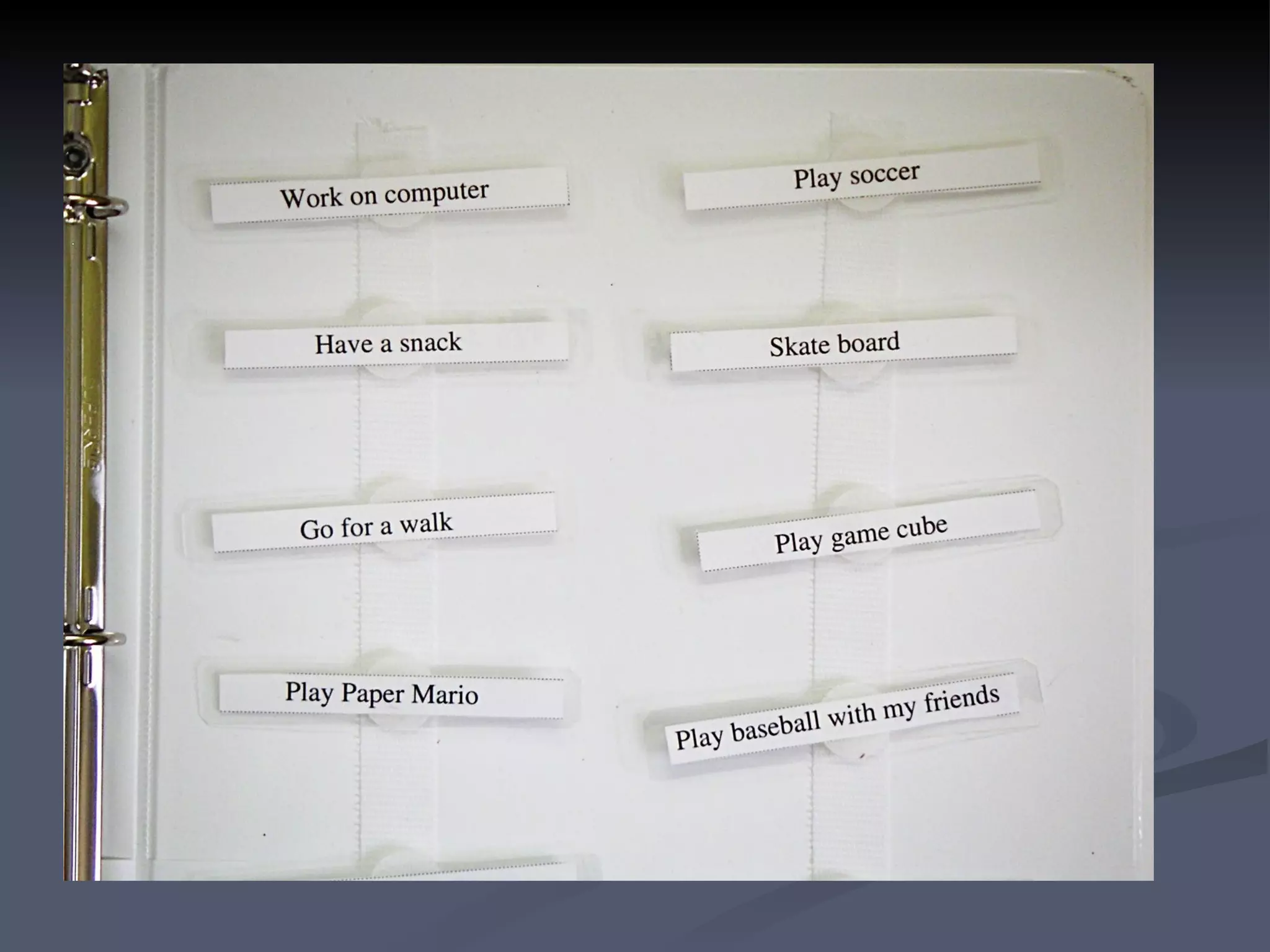
  • 229.
    Behavior Support PlanOperational Definition: Hitting occurs when Johnny strikes a person or himself with his hand. Biting occurs when Johnny’s teeth come into contact or attempts to come in contact with a person or their clothing. Climbing occurs when Johnny puts one or both feet on the desk, chair, tables and/or bookshelves. Dropping occurs when Johnny makes contact or attempts to make contact with the floor with more than just his feet. E.g. hands and feet are both touching floor, rest of his body in the chair Resisting manual prompts occurs when instructional staff are teaching Johnny by touching him and he tenses all his muscles and/or pushes them away e.g., instructional staff are teaching Johnny to write his name by touching his hand and he pushes the staff member away. Non-Contextual Vocalization: Any sounds that are longer than 2 seconds in duration and above conversational volume e.g., screaming, giggling
  • 230.
    Behavior Support PlanMeasurement Procedure: Data are collected individually on each of the above response using a three-minute partial-interval recording procedure. Data are summarized and graphed as percentage of intervals in which Johnny engaged in off-task behavior. Data are also summarized and graphed as percentage of intervals in which Johnny engaged in aggression, non-compliance, and non-contextual vocalization. Discriminative Stimuli for Engagement in Productive Behavior: Johnny should engage in behaviors that are conducive to learning under all conditions. Criterion for Advancement: This behavior intervention plan will be in effect until Johnny’s off-task behavior are 0% for two consecutive months.
  • 231.
    Behavior Support PlanFunctional Behavior Assessment: The recent ABC analysis of Johnny’s 6 most educationally interfering behaviors (see above definitions) completed From July 5 to August 3, 2007 indicated the following results: 48% of the episodes were maintained by attention 31% of the episodes were maintained by avoidance 21% of the episodes were maintained by access to tangibles 0% were maintained by automatic reinforcement. (Percentages were calculated by dividing the total number of episodes per function by the total number of episodes and multiplied by 100.)
  • 232.
    Behavior Support PlanThe Motivational Assessment Scale was given to Johnny’s teacher and 4 instructional aides. The results indicated that attention was ranked as the most likely to maintain Johnny’s problem behavior in four out of the five scales. Access to tangibles was ranked second likely to maintain Johnny’s problem behavior in three out of the five scales. Avoidance was ranked third likely to maintain Johnny’s problem behavior in three out of the five scales and automatic reinforcement was least likely to maintain Johnny’s problem behavior in four out of the five scales given.
  • 233.
    Behavior Support PlanThe results of the ABC analysis and Motivational Assessment Scale, combined with parent, teacher, aide interviews and additional data review were all compiled and analyzed. As a result, it was hypothesized that Johnny’s problem behavior is maintained by socially-mediated functions. Specifically, the majority of his problem behavior is maintained by access to attention, followed by either access to tangibles or avoidance of instruction.
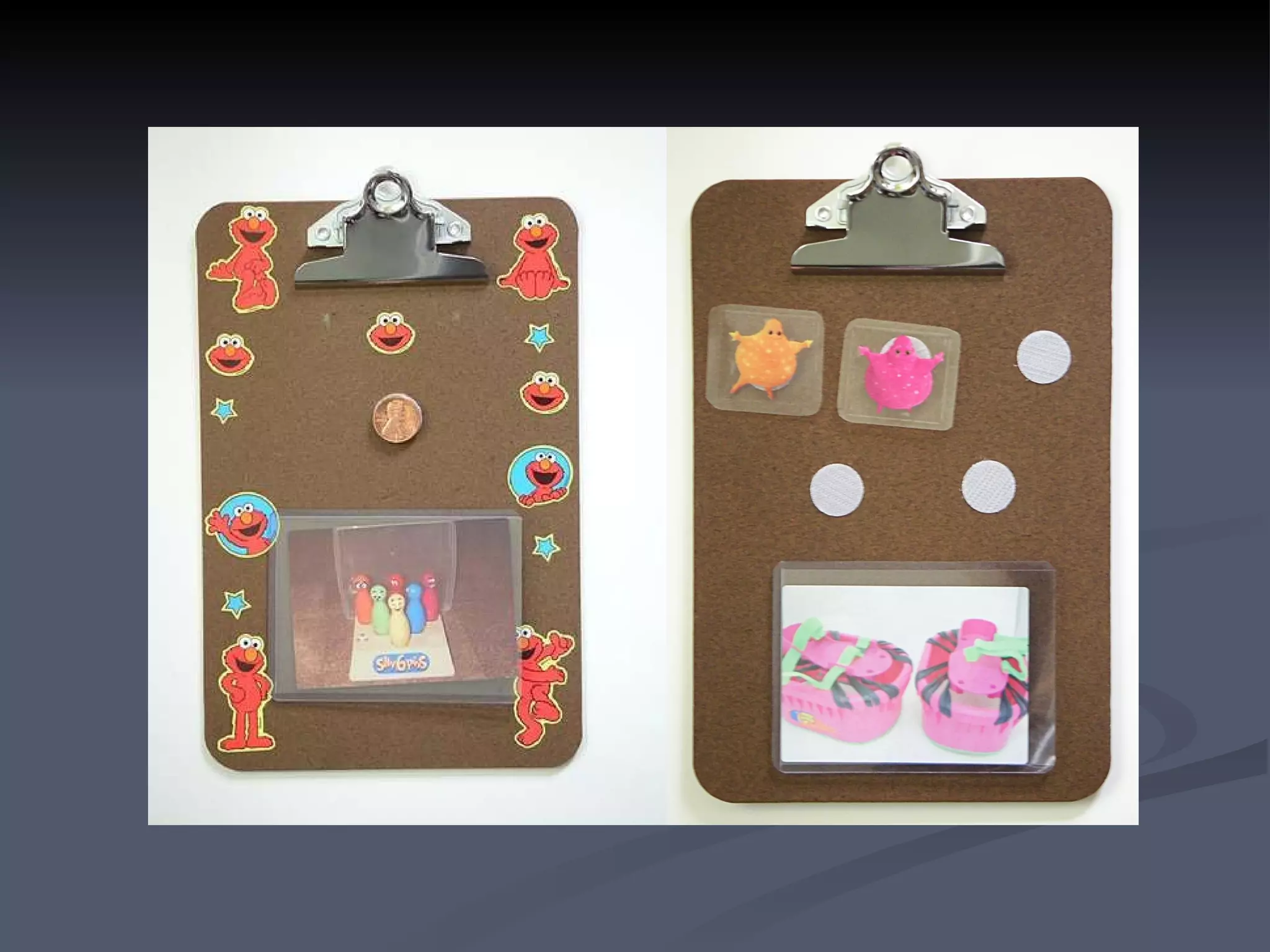
  • 234.
    Behavior Support PlanTo address behavior maintained by escape/avoidance the following interventions will be used: an individualized motivational system for task completion to maintain the effectiveness of the motivational system ongoing reinforcer assessment in the form of pictures of novel activities interspersed throughout his full-day activity schedule high probability request sequence was used by setting the occasion for 2-5 mastered responses followed by the target response negative reinforcement for task completion classical conditioning procedures used to establish additional conditioned reinforcers by requiring access to a low preference item/activity followed by a high preference item/activity.
  • 235.
    Behavior Support PlanTo address behavior maintained by attention the following interventions will be used: 10-15 additional social rewards were added to Johnny’s choice book engagement in these social activities is contingent on behavior conducive with learning rather than nonconductive with learning.
  • 236.
    Behavior Support PlanTo address behavior maintained by access to tangibles the following interventions will be used: Johnny has a choice book containing over 50 pictures of desired items/activities functional communication training incidental teaching procedures are used to teach Johnny to ask for desired items and activities, spontaneous requesting program thee specific program can be found in his goals and objectives and are titled: spontaneous language (variable ways in which to request item), contextual statements (commenting about desired items/and objects that he sees in his environment), asking “wh” questions (about desired item/objects that he sees in his environment)
  • 237.
    Behavior Support PlanAdditional Strategies: Individualized Motivational System: When Johnny learned the concept of contingency management, an individualized- motivational system in the form of a 10-penny token economy was systematically taught to him. Tokens were delivered contingent on pre-requisite learning skills such as attending skills and also contingent on correct responding to increase skill acquisition (e.g., correctly responding to his individualized teaching programs in the areas of social skills, expressive and receptive language, fine and gross motor skills, independence, leisure skills, and self-help skills). When Johnny earned all his tokens, he could exchange them for preferred snacks, items and activities.
  • 238.
    Behavior Support PlanChoice Board/Book Once Johnny learned picture-object correspondence an elaborate choice board depicting preferred activities was designed for him. His choices have been depicted to him in the form of a large board and also in a book. No difference has been seen between these two formats. Reinforcer assessment ·Instructors routinely use a systematic assessment procedure to identify preferred items and activities for the choice board. An example of how this is accomplished includes interspersing novel or preferred activities with Johnny ’s educational programs to increase exposure to a variety of potentially reinforcing activities.
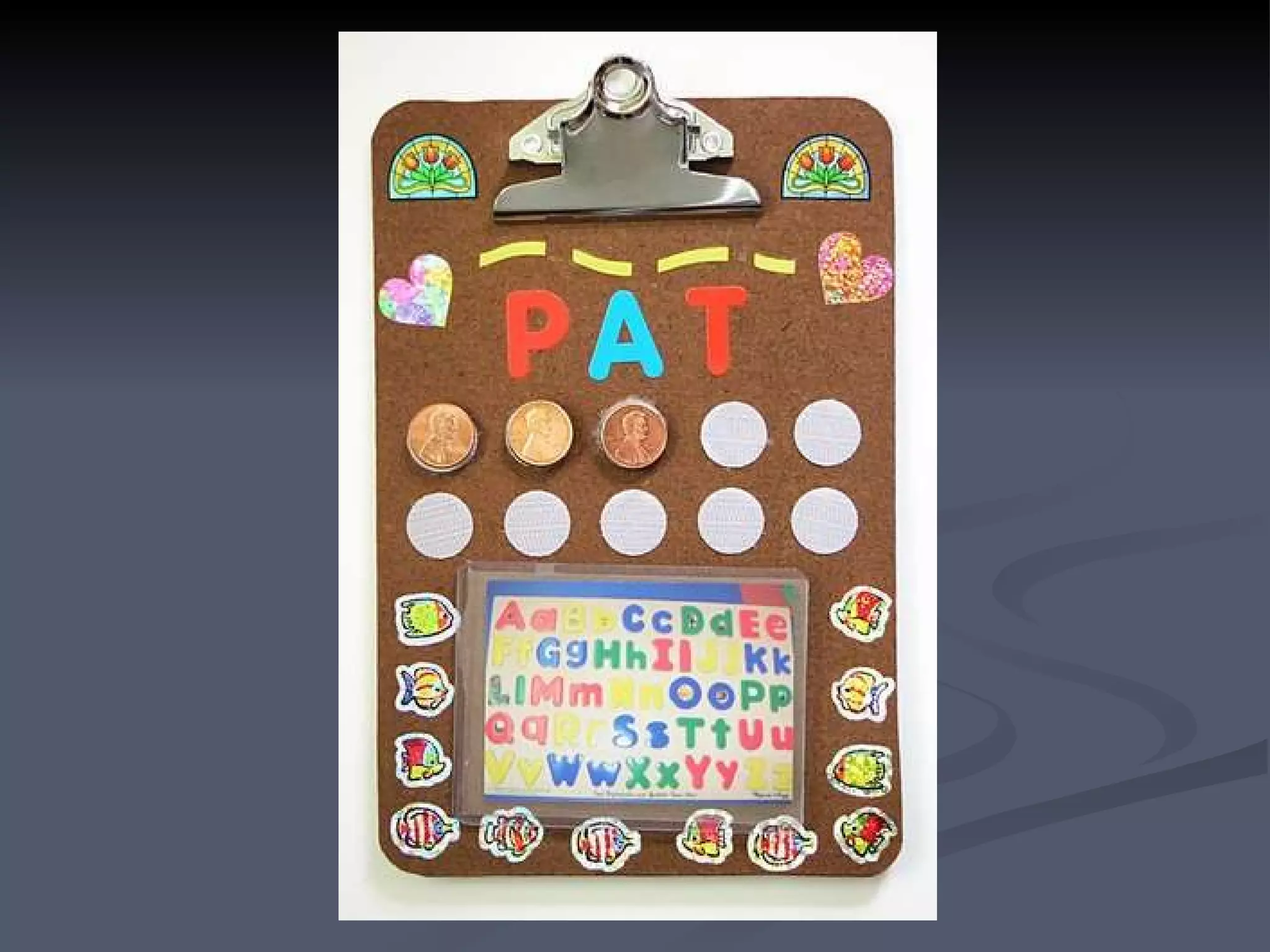
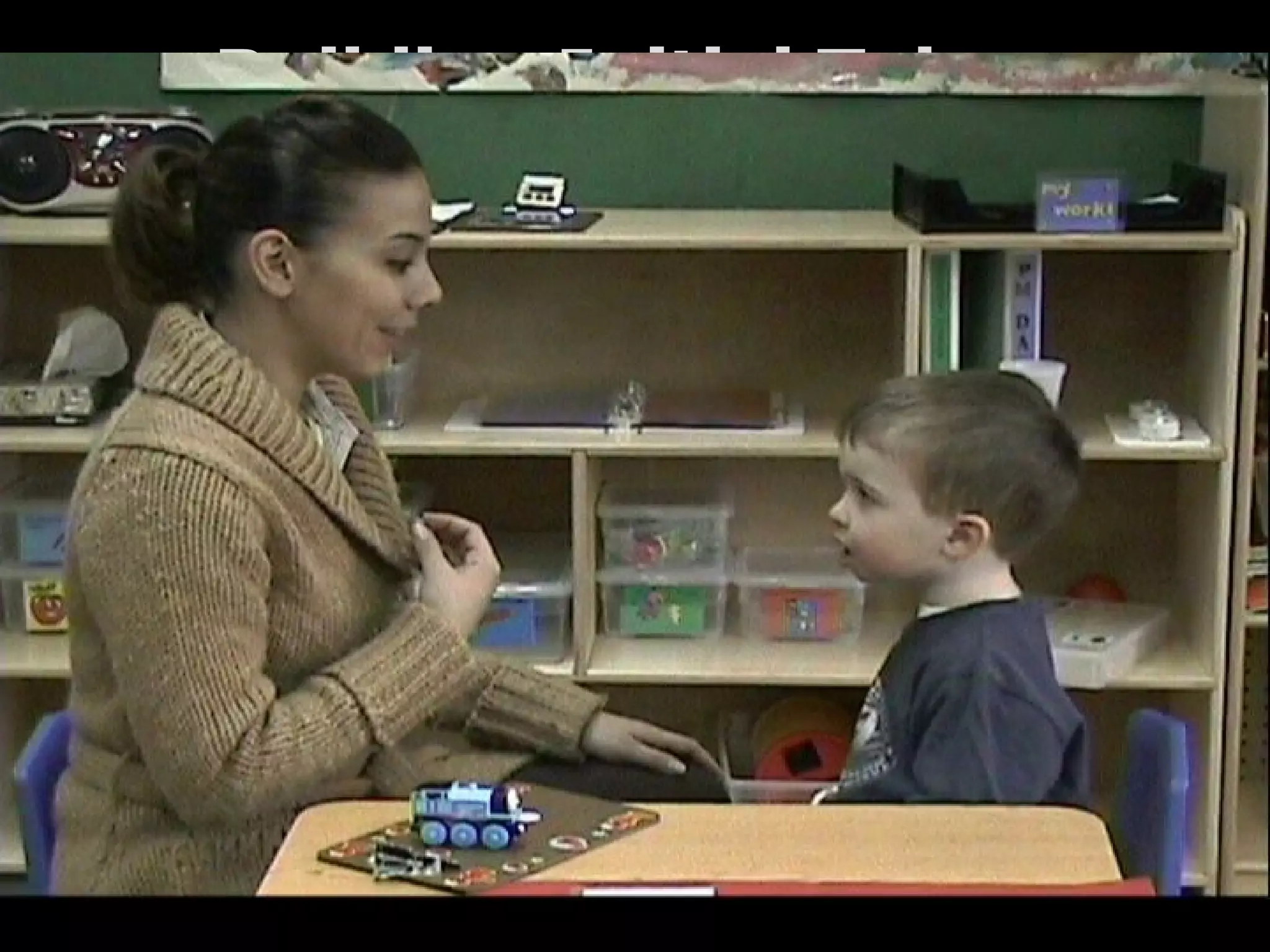
  • 239.
    Behavior Support PlanCurricular Modifications: Photographic Activity Schedule : ·A full-day photographic activity schedule was then implemented to promote independence and to further help structure his day and to depict the sequence activities. Individualized curriculum All of Johnny ’s curriculum has been designed and created specifically for him. Many receptive and expressive language programs are being taught to increase Johnny ’s communication skills Teaching modifications ·The use of Discrete trial format has been minimized ·The following teaching procedures have been taught to Johnny : video modeling, activity schedule following, auditory/visual prompting procedures, and sibling interaction.
  • 240.
    Behavior Support PlanEnvironmental Modification Johnny ’s work area has been designed to increase independence. To promote generalization and variety, Johnny completes educational tasks in a variety of locations in the classroom. His rewards are located in a variety of locations throughout the classroom to increase his social competence.
  • 241.
    Behavior Support PlanParental Involvement : Johnny’s parents are actively involved in Johnny’s education. They come in for weekly school visits to learn to effectively teach Johnny at school. When they are proficient in this area, these skills will then be used by Johnny’s parents at home. Generalization : Generalization will be programmed for by implementing this behavior plan across all instructional sessions, settings and instructors. Generalization will be assessed by collecting weekly data in a novel setting (home) and with a novel instrucgtor (grandma). Maintenance: This skill is a prerequisite for productive learning of new skills throughout the school day. This skill is also a prerequisite for actively participating in the classroom and community with peers.
  • 242.
    Behavior Support PlanInter-Observer Agreement : Inter-observer agreement data are collected once a month and calculated by using the formula: Number of Agreements X 100 = IOA Number of Agreements + Disagreements Parental approval : I have reviewed this written instructional program and all components of this instructional program have been fully explained to me. I have been given an explanation of the potential benefits of this program, as well as an explanation of possible risks or discomforts, if any. I give informed approval for the implementation of this program in the manner described above, understanding that I may withdraw consent at any time, and that if consent is withdrawn, the program will be immediately discontinued.
  • 243.
    Behavioral consultation Consultantsneed: Knowledge of problem-solving method Expertise in intervention & evaluation Expert clinical skills Excellent professional skills Knowledge of organizational structure
  • 244.
    Public School ConsultationDirect Individual Student Consultation and Assessment Evaluations & Make Recommendations of: Program efficacy, FBA, social skills, situational assessments Conducted both at school & at home School-Wide and Classroom Consultation Target all students, focus on social skills, emphasize a preventative & positive reinforcement orientation, teach problem-solving abilities & measure outcomes objectively Objectives include: Improve student academic performance, social skills, and on-task engagement decrease student discipline referrals, detentions, suspensions & attrition Increase the proficiencies, satisfaction & retention f school personnel District-wide Consultation Focused on systematic assessment of behavior support practices across multiple school, with particular emphasis on students at high risk of being placed in out-of-district placements
  • 245.
    Training Opportunities forSchool Districts Didactic training with practical application E.g., Using results of FBA to design BIPs Parent training Use of spontaneous language at home Research & Dissemination
  • 246.
  • 247.
    Guide to SuccessfulConsultation Professionalism Positive working relationship with administration & staff Credentials Skills in both clinical & academic areas Understanding of public school system Compromise & shaping Consultant mentorship
  • 248.
    Consultant Services Whatare the principles of ABA that will be implemented by the consultant? How will the consultation be implemented? What is the rate of the consultant? What is the nature of the consultant’s training and collaboration with the instructional staff? What will be the nature of parental involvement with the consultant? What is the consultant’s role in supplemental services? What is the consultant’s role in program representation? What is the consultant’s role in staff recruitment & hiring? How will the consultant aide in potential litigation? How will the consultant communicate recommendations?
  • 249.
    Report Writing PsychoEducationalReport Reason for Referral Background information Summary of Current Situation Sources of Information Review of Previous Reports Observation Data notebook review Summary of Findings Programmatic Recommendations When making recommendations for specific programs, summarize the data and make recommendations based on these data. When making generic programmatic recommendations (e.g., parent training), cite research, as much as possible to support these recommendations
  • 250.
    Report Writing Responseto a PsychoEducational Report Purpose of Report Statement of position Reject, accept, partially-accept report Response to observation Response to recommendations State recommendation State your response with research to back up your position
  • 251.
    Report Writing Examplesof Responses: Recommendation: A “traditional” ABA program Response: The evaluators do not recommend a specific model, but in their recommendation, they describe features of the UCLA Young Autism Project, or the Lovaas method, as it was first disseminated almost twenty years ago. Since that time, the science of behavioral psychology has substantially evolved. Johnny’s current program effectively utilizes all aspects of ABA, including discrete trial teaching, incidental teach, video modeling, scrip/script fading procedures, activity schedules and the implementation of new research in ABA as it is developed.
  • 252.
    Report Writing Examplesof Responses: Recommendation: Emphasis on generalization of skills Response: According to Baer, Wolf, and Risley (1968), generalization strategies are a defining feature of ABA. Generalization strategies are therefore developed and assessed for every skill in a child’s educational program in the Bernards Township autism program. We are indeed in agreement that programming for generalization should be a priority and have therefore made it so. Johnny has demonstrated generalization of many skills across settings, including school and home settings, instructors and stimuli. The evaluator might have had difficulty assessing Johnny’ generalization of skills in that she did not review the generalization data that is graphically displayed in Johnny’ data notebook.
  • 253.
    Report Writing Examplesof Responses: Recommendation: Augmentative Communication such as PECs Response: We do not agree that Johnny should be taught to use an augmentative communication system such as PECs. Johnny is making substantial progress learning to talk in the presence of his photographic choice board and other visual supports. In addition, there is limited peer-reviewed evidence supporting the use of PECs as an effective communication system, specifically in the acquisition of generative language (http://www.asatonline.org/resources/treatments/picture.htm) Furthermore, our functional assessment data indicate that Johnny’ disruptive behaviors are largely maintained by escape, rather than what the evaluator described as “frustration” presumably caused by lack of communication skills.
  • 254.
    Report Writing Examplesof Responses: Recommendation: “trial by trial” data should be collected daily Response: In order to collect “trial by trial” data, one needs to collect data in the presence of teaching conditions. Data collected under teaching conditions provides an inaccurate representation of the child’s skill acquisition, for each subsequent trial is affected by the teaching condition and one does not get an unaffected measure of the child’s skill. This point of view is supported by hundreds of studies in peer-reviewed journals, including the Journal of Applied Behavior Analysis. One downside of collecting data in the absence of teaching conditions is that a child is allowed to err. To minimize the occurrence of errors, data are collected minimally weekly. School programs with excellent outcome data, as referenced by Handleman and Harris (2001) collect data in this fashion. One final reason to have teaching and testing conditions is that it allows for instructors to have an uninterrupted teaching interaction, which includes modeling appropriate eye contact, attending, and social skills, as well as effective teaching of particular target skills.
  • 255.
    Report Writing: Dr. "Not So Smart" seemed to have some questions regarding the teaching procedures implemented for Johnny’s spontaneous language. She states “I asked Dr. Reeve whether there was a specific protocol to teach ‘spontaneous’ language, and noted that her response and the observed method was via verbal cues for Johnny to imitate the words one at a time.” In fact, the teaching procedure used to promote Johnny’s spontaneous language is incidental teaching. This is the teaching procedure that Dr. "Not So Smart" observed. In addition, Dr. Reeve did not indicate that this was merely “verbal cues for Johnny to imitate the words.” Rather, Dr. Reeve said that incidental teaching was used to promote Johnny’s spontaneous language. This teaching procedure is thoroughly described in the skill acquisition program titled “Spontaneous Language.” This, and all, skill acquisition programs are kept in Johnny’s data notebook. Johnny’s data notebook is a record of his progress since beginning the program in October, 2003 and it contains a detailed description of each one of his current programs, including response definitions, measurement procedures, the conditions under which each response is to be emitted, teaching procedures (including prompt/prompt fading and reinforcement procedures), methods to promote and assess generalization, maintenance conditions, and inter-observer agreement data collection procedures. Dr. "Not So Smart" only briefly looked through Johnny’s data notebook while Johnny ate lunch.
  • 256.
    References Putnam, R.F.,Handler, M.W., Rey, J. & McCarty, J. (2005). The Development Of Behaviorally Based Public School Consultation services. Behavior Modification 29, 521-538.
  • 257.
  • 258.
    Professional Collaboration AdrianeMiliotis Delia O’Mahony Martine Torriero
  • 259.
    Organization of thePresentation Introduction Issues affecting effective collaboration Ethical Issues “ Turf” issues Professional collaboration with: SLP (Speech & Language Pathologist) PT (Physical Therapist) OT (Occupational Therapist) Principals Child Study Team Board of Education Other professionals (medical doctor) Suggestions for the future References
  • 260.
    Discouraging Search AdvancedSearch Search Terms: professional collaboration Journal: Applied Behavior Analysis (Searching: PsycINFO)   No results were found.
  • 261.
    What is collaboration?Working together to enhance the learner’s experience Respecting professional expertise
  • 262.
    What is collaboration?con’t participation in identifying, designing, and developing inclusive program options with families and other professionals forming partnerships …has enhanced professional practice early childhood special educator's experiences, resources, and contacts can be valuable assets to communities as they seek to expand and sustain community-based service options (Allen & Polaha, 2003)
  • 263.
    What are thecomponents of collaboration? communication decision making Goal setting organization team process Nijhuis et. al. (2007)
  • 264.
    Why collaborate? Learnersand parents: How many different people do they see before the child receives instruction? What happens if parents and learners get conflicting information?
  • 265.
    Why collaborate? con’tTeam Members: Can we teach effectively in a vacuum? Consistent instruction Share ideas Learn from each other
  • 266.
    Effective Collaboration Abasic understanding of: expertise orientation terminology potential role of the other professionals in the collaborating team (Geroski, Rodgers and Breen 1997)
  • 267.
    Helpful to KnowQualifications + Philosophy + Professional terms + Possible contribution to the team + = Professional respect
  • 268.
    Successful Collaborators Willingto try strategies Interested in using something new Quick to implement suggestions High adopters had the most knowledge of curriculum and pedagogy knowledge and student friendly beliefs about managing student behavior student-focused views of instruction ability to carefully reflect on students' learning (Brownell et. al. 2006)
  • 269.
    Roadblocks to EffectiveCollaboration Excessive paperwork Difficulties identifying appropriate interventions with existing resources Lack of financial support Inadequate training in problem solving procedures No release time for meetings Meeting times difficult to arrange Meetings last too long (Yetter & Doll, 2007)
  • 270.
    Unsuccessful Collaborators Moderateand low adopters were less knowledgeable took longer to grasp ideas did not always implement them well some of these teachers needed to have ideas explained in detail would discard ideas they did not appear to comprehend (Brownell et. al. 2006)
  • 271.
    Educating other professionalsAutism is a low-incidence disorder that has received increasing attention as parents have organized seeking more effective education services for their children with autism 1 prepare early intervention practitioners to work with young children with autism , severe physical impairments, and other low incidence disabilities 1 The program features joint course work across the Schools of Medicine and Education and seminars on collaboration and teaming 2 1 Shriver, Allen, Mathews, 1999 2 Able-Boone, Crais, Downing, 2003
  • 272.
    Expanding Professional RolesWill the shift from direct to indirect roles affect: job satisfaction staff turnover potential for burn-out among early childhood special educators professionals who were originally attracted to the field because of direct work with young children and families may be less satisfied with roles that are now primarily adult oriented and facilitative in nature
  • 273.
    Ethical Issues Before we can collaborate, we need: Mutual consent form signed by parents and student Identify specific professionals to include Hand deliver, fax or mail Make initial contact through a letter Avoid phone tag due to different schedules Send parents a copy of the letter Indicate an interest in collaboration in this letter
  • 274.
    Collaboration with relatedservice providers
  • 275.
    Why should wecollaborate? “ Coordination between the disciplines is important when adding speech-language therapy to an applied behavioral program. All objectives must reflect a common goal in order to build speech, language, play, and social skills.” (Parker 1996) “ ... SLPs are not the only professionals who target communication outcomes within the scope of their practice. Teachers, occupational therapists, reading specialists, and behavior analysts do so as well, either directly or indirectly. Therefore, cross-disciplinary collaboration is essential.” (Koenig and Gunter 2005)
  • 276.
    Benefits of CollaborationThe creation of evidence-based therapeutic approaches and practices by individuals with combined expertise in ABA and SLP The ability to improve the integration of support provided by SLP and ABA professionals as participants on home-, school-, and center-based intervention teams A reduction in the number of reinvented wheels Discrete trial to establish skills and NET to generalize (Koenig and Gerenser, 2006)
  • 277.
    The Role ofthe SLP From the ASHA Position Statement “Roles and Responsibilities of Speech-Language Pathologists in Diagnosis, Assessment, and Treatment of Autism Spectrum Disorders Across the Life Span” “Collaboration: Speech-language pathologists should collaborate with families, individuals with ASD, other professionals, support personnel, peers, and other invested parties to identify priorities and build consensus on a service plan and functional outcomes.”
  • 278.
    What do thefields of SLP and ABA have in common? ABA and SLP are the treatment components most frequently requested by parents ABA and SLP therapists are highly focused on the individual, his or her unique learning style, and the outcomes of treatment Both ABA and SLP address skill deficits directly by teaching specific language behaviors rather than treating the problem indirectly using specialized diets or sensory stimulation programs Both fields rely on procedures that are supported by evidence. Most therapists measure the child's performance by collecting data to make decisions about progress and potential changes in instruction. (Harchik, 2005)
  • 279.
    Coordinating Speech-Language Pathologywith an Applied Behavior Analysis Program (Parker, 1996) 1. The SLP should develop language goals similar to those developed by the behavior program in order to facilitate generalization. - Ex. ABA program is working on expressive labels with the Sd, “What is this?” The SLP’s goal can be to use the same vocabulary to request those items in a low structure, play context.
  • 280.
    2. The SLPshould help to make the discrete-trial goals of the behavior program as communicative and functional as possible. Ex. Work on requesting programs using objects of high interest. 3. The SLP can add valuable information about speech-language goals that are being addressed in the behavior program. Ex. Suggest a prompt to remediate specific sound errors such as placing a hand on the student’s throat to teach the /k/ sound.
  • 281.
    4. TheSLP helps to ensure that all therapists are attempting to use similar vocabulary, commands, and toys in focusing on their goals. 5. The SLP can offer information to the behavior team and parents on developmentally appropriate linguistic forms and the developmentally normal communication sequence. Ex. Assists with the periodic reassessment of linguistic goals.
  • 282.
    6. The SLPcan demonstrate how to incorporate specific goals into daily, preexisting activities, such as dinner, bath, and bedtime, which will be helpful with generalization and sequencing. Ex. A daily activity such as cooking dinner can be used to teach sequencing skills and specific language forms. If the child is working on prepositions, the parent can say, “First we put the water in the pot, then the salt in , then the spaghetti in .”
  • 283.
    7. The SLPshould help develop reinforcers- both tangible, such as food, stickers, and toys, and social, such as praise, hugs, and tickles. 8. The SLP should assess the manner in which speech-language skills are used within the classroom or play group in order to ensure maximum benefit from these interactions. - Ex. Suggest that the teacher give the child a toy that she knows another child likes, then encourage the two children to play together. - Ex. Encourage the classroom teacher to set up activities that require a buddy, and pair the child with a peer who is both a strong language model and a friendly child.
  • 284.
    9. The SLPcan also help troubleshoot specific linguistic problems. Ex. If the child is having difficulty remembering the names of objects, the SLP can develop appropriate categorization and world knowledge tasks. 10. The SLP can also aid in the diagnosis and treatment of concurrent disorders (e.g. apraxia or dysarthria)
  • 285.
    Three models forteam interaction
  • 286.
    Staff development isacross disciplines and is critical to team development and role transition. Frequently shared and held across disciplines. Generally is independent and within disciplines. Staff Development Team meets regularly to share information and to teach and learn across disciplines (for consultation, team building, etc.). Team meets regularly for case conferences, consultations, etc. Typically informal. Members may not think of themselves as part of a team. Lines of Communication Families are always members of the team and determine their own roles. The family may or may not be considered a team member. Families may work with the whole team or team representatives. Generally, families meet with team members separately by discipline. Family Role Team members commit to teach, learn and work across disciplinary boundaries to plan and provide integrated services. Team members are willing and able to share responsibilities for services among disciplines. Team members recognize the importance of contributions from other disciplines. Philosophy of team interaction Transdisciplinary Interdisciplinary Multidisciplinary Component
  • 287.
    http://www.njeis.org/NJFoundationsSP.pdf Team membersshare responsibilities and are accountable for how the plan is implemented by one person, with the family. Team members implement parts of the plan for which their discipline is responsible. Team members implement their own plan separately by discipline. Plan implementation Staff and family develop plan together based on family’s concerns, priorities, and resources. Goals are developed by discipline and shared with the rest of the team to develop a single service plan. Team members develop separate plans for intervention within their own disciplines. Plan Development The team participates in an arena assessment, observing and recording across disciplines. Team members conduct assessments by discipline and share results. Team members conduct separate assessments by discipline. Assessment Process Transdisciplinary Interdisciplinary Multidisciplinary Component
  • 288.
    The Consultative Modelof Service Delivery (Bellone, et. al 2005)
  • 289.
    Why should weuse this model? “ For individuals with ASD, exclusive provision of services through pull-out services does not address the underlying challenge of social communication inherent in the disorder, the issues of generalization, functional outcomes, or the importance of collaborating with significant communication partners.” (ASHA 2006)
  • 290.
    Why?, con’t Researchon children with ASD suggests that the greatest effects of any direct treatment are reflected in the generalization of learning achieved by working with parents and classroom personnel.”(NRC 2001)
  • 291.
    Traditional S&L servicesare inadequate 1-5 hours treatment per week SLP is sole instructor Isolated setting Skill generalization and maintenance difficult to achieve given these limitations (Bellone, et.al., 2005)
  • 292.
    BUT… The pull-outmodel of service delivery continues to be the most used model for preschool and school-age children. (ASHA, 2004) EVEN THOUGH… There is no evidence supporting the long-term effectiveness of individual therapies implemented infrequently (e.g., once or twice a week), unless the strategies are taught to be used regularly by communication partners in the natural environment. (ASHA 2006)
  • 293.
    Consultative S&L servicesafford… Consistent and continuous instruction throughout the child’s day Skill generalization across people and settings in child’s natural environment Skill maintenance through practice in naturally occurring and programmed opportunities (Bellone, et.al., 2005)
  • 294.
    The role ofthe SLP Develop curriculum Select data collection systems Train teachers Observe teachers & students Attend meetings Modify teaching procedures
  • 295.
    The role ofthe teaching staff Provide multiple daily opportunities Collect & sum data Review data w/ SLP Initiate questions, concerns Troubleshoot w/ SLP Incorporate changes into instruction
  • 296.
    The consultative modelin a public school School administrator contacted NECC’s consulting department NECC directors met with teachers and administrators Defined role of SLPs and teaching staff A letter was sent home to parents inviting them to an informational meeting After a follow up letter and phone call, 33% (n=24) selected the consultative model
  • 297.
    The consultative modelin a public school Public School Contract Services were provided in 8 children in 3 classrooms 2 hours/mo of consultative (indirect) services from SLP 40 hours/mo direct S&L instruction from lead classroom teacher SLP consult with Head teachers Head teachers train teaching assistants
  • 298.
    The consultative modelin a public school Results Public school students m ade progress/met 98% of objectives (2005) NECC students made progress/met 90% of objectives (2004)
  • 299.
    What do otherdisciplines have to say about professional collaboration?
  • 300.
    Guide for ProfessionalConduct PRINCIPLE 11 A physical therapist shall respect the rights, knowledge, and skills of colleagues and other healthcare professionals. 11.1 Consultation A physical therapist shall seek consultation whenever the welfare of the patient will be safeguarded or advanced by consulting those who have special skills, knowledge, and experience. 11.2 Patient/Provider Relationships A physical therapist shall not undermine the relationship(s) between his/her patient and other healthcare professionals. 11.3 Disparagement Physical therapists shall not disparage colleagues and other health care professionals. See Section 9 and Section 2.4.A.
  • 301.
    Code of Ethics Principle 7. Occupational therapy personnel shall treat colleagues and other professionals with respect, fairness, discretion, and integrity. (FIDELITY)
  • 302.
    Guidelines for ResponsibleConduct For Behavior Analysts 9.0 The Behavior Analyst's Responsibility to Colleagues. Behavior analysts have an obligation to bring attention to and resolve ethical violations by colleagues, to make sure their data are accurate and presented truthfully, and they share data with colleagues. 9.01 Ethical Violations by Colleagues 9.02 Accuracy of Data 9.03 Authorship and Findings 9.04 Publishing Data 9.05 Withholding data
  • 303.
    Are related serviceproviders a necessary component of an effective program?
  • 304.
    A public programserving children in preschool through eighth grade diagnosed with Autism and related disabilities in Bergen County, NJ “ The speech-language department works collaboratively with the classroom teachers to promote various communication modes such as the Picture Exchange System, computerized voice output devices, sign language, and fostering expressive language.” (McKeon, et.al. 2006)
  • 305.
    Does not employrelated service personnel Curriculum includes teaching programs that facilitate the development of language and fine and gross motor skills Programs are implemented by instructional personnel throughout the day Pull-out related services are rarely necessary because of the breadth and comprehensiveness of the curriculum If services are deemed necessary, appropriate referrals or consultations are arranged by ALG staff (Meyer, et. al, 2006)
  • 306.
    The Douglass School“… each class is supported by a half-time speech-language specialist who provides individual and group therapy as well as consultative services to the preschool teachers. An adaptive physical education professional serves the preschool children on the three times a week and acts as a liaison for consulting professionals such as physical or occupational therapists.” (Harris, et. al, 2001) Douglass Outreach “ Douglass Outreach employs five licensed part-time speech pathologists for speech-language services.” (Harris, et. al, 2001)
  • 307.
    Princeton Child DevelopmentInstitute Strong emphasis on language development Does not employ specialists All intervention personnel are trained to teach receptive and expressive language in every activity Toilet training, outdoor play, lunchtime Language instruction encompasses discrete trials, incidental teaching, time-delay procedures, and video-modeling procedures. 36 of 41 children entered PCDI before 60 months of age and had no functional expressive language The skills of these children currently range from using sounds as mands to age appropriate verbal repertoires. (McClanahan and Krantz, 2001)
  • 308.
    Recommendations for ContinuedCollaboration Share treatment efficacy data Share innovative teaching procedures Share basic information Share successful collaboration experiences Read articles in journals associated with the other profession Share your concerns Share lunch (Koenig and Gerenser, 2006)
  • 309.
    Parents / Home/ Family Physician Dentist, Doctor Siblings Family Celebrations Community State of New Jersey Department Of Education Director of Special Services ST OT PT ART Music BCBA Teacher After school services (latch key) DDD DVR Employment Sheltered Living Department of Human Services SPAN/COSAC/ Autism Society of America BOE - Local School / Sending School District Board of Education (Receiving School) Child Service Team Neighborhood, Shops, Restaurants The Office of Early Care and Education (OECE) School Principle Child Bus
  • 310.
    Collaboration with AdministrationWho are the possible collaborative partners? How can we develop a collaborative relationship?
  • 311.
    NJDOE Press Release: February 20, 2007 “ Approximately 7,400 New Jersey children between the ages of 5 and 21 have been diagnosed with autism spectrum disorders.” “ Fifty-five New Jersey school districts will share $15 million in state funds to establish, expand or enhance public school programs and services for students diagnosed with Autism Spectrum Disorders…..”
  • 312.
    Administration State ofNew Jersey Department of Human Services The Office of Early Care & Education (OECE) Division of Family Development Department of Children and Families Build NJ: Partners for Early Learning Coalition of Infant/Toddler Educators (CITE)
  • 313.
    Administration Child careservices are coordinated through Department of Human Services' Office of Early Care and Education for information, policy and resources the Division of Family Development for child care operations the Division of Developmental Disabilities the Office of Licensing in the Department of Children and Families (DCF) all in cooperation with Child Care Resource and Referral Agencies in every county Services include: information and referral to help parents locate child care resources and to  answer typical questions regarding types of child care how to pay for care how to become family day care and licensed child care providers.
  • 314.
    Administration Department ofEducation Division of Early Childhood Education The Division of Early Childhood Education (DECE) of the New Jersey Department of Education has programmatic responsibility for preschool through 3rd grade (PK3) programs. responsible for the development, implementation, and alignment of program components with a focus on standards, curricula, and assessment. The creation of this division: Acknowledges that a continuum of developmental stages constitute what is traditionally known as early childhood, Protects New Jersey’s investment in high quality preschool by providing high quality kindergarten through third grade educational experiences for young children. PK3 work will be organized within a framework that includes structural (administration, class size, teacher-child ratio, etc.) process (quality of classroom environments, teacher-child interactions, etc), alignment (standards, curriculum, assessments) components that are associated with children’s social and academic outcomes. The DECE’s work will be: Research-based, with a series of advisory committees consisting of nationally recognized experts representing a range of early childhood-related areas Cross-departmental to align all DOE PK3 initiatives, Supportive of the efforts of the Division of School Improvement .
  • 315.
    Office of SpecialEducation Programs Implements state and federal laws and regulations governing special education to ensure that pupils with disabilities in New Jersey receive full educational opportunities. Provides statewide leadership through the development of policy and implementation documents and provides guidance to school districts and parents regarding the implementation of special education programs and services. Responsible for administering all federal funds received by the state for educating pupils with disabilities ages 3 through 21. Monitors the delivery of special education programs operated under state authority, provides mediation services to parents and school districts, processes hearings with the Office of Administrative Law, and conducts complaint investigations requested by the public. Funds four learning resource centers (LRCs) that provide schools and parents with information services, materials circulation, technical assistance, consultation services and production services. Plans and implements program and personnel development activities in areas such as implementing the least restrictive environment provision, planning the transition of students with disabilities from school to adulthood, planning programs and services for preschool children with disabilities,developing Individualized Education Programs (IEPs) and accessing individual rights and entitlements.
  • 316.
    LEARNING RESOURCE CENTER- NORTH 7 Glenwood Avenue, 2nd Floor, Suite 201 East Orange, New Jersey 07017 Regions served: Bergen, Essex, Hudson, Morris, Passaic, Sussex, and Warren Counties (973) 414-4491 - LRC General Service (973) 414-4496-FAX (973) 266-1849-TTY (973) 631-6349 - Preschool Technical Assistance e-mail: [email_address]
  • 317.
    A collaborative modelThe Child Study Team Composed of teachers, specialists, administrators, and parents Responsible for identifying and evaluating students aged 3 – 21 for special education programs and services. Required to conduct both an educational evaluation and a psychological evaluation. (A neurological examination is also required before a child becomes eligible for special services.) Develops an Individual Education Plan with parent/child. Assigns a case manager Visits receiving school or agency with parent/child Organizes placement and transportation (Walther-Thomas, Korinek, & McLaughlin, 1999)
  • 318.
    IEP Meeting Whoshould attend? Student (if appropriate) Parent At least one general (or special) education teacher At least one Child Study Team member Student’s case manager School district representatives Persons invited by parent or school Representatives of agencies providing payment for services
  • 319.
    Typical School OperationsNetwork Council of the Borough (duly elected by town) Board of Education (elected by Council) Superintendent Hired by the BOE to direct operations Manage the fiscal year budget Hire all school staff including Child Study Team members, teachers, and professional support staff (ST, OT, PT, BCBA, librarian, etc.)
  • 320.
    School “ Effectivecollaboration emerges out of concerns by individuals who are like-minded in some ways and very different in others.” Walther-Thomas, Korinek, McLaughlin & Williams (2000) Principals tend to focus on issues such as achievement trends, financial implications, professional development, student placement, professional schedules, and community relations. Teachers are concerned with individual and group performance, IEP planning, and new responsibilities. Families care about the impact of new initiatives on their children.
  • 321.
    Improving student bus-ridingbehavior through a whole-school intervention (Putnam, Handler Ramirez-Platt & Luiselli, 2003) Intervention developed through collaboration with students, school personnel and bus drivers 624 students participated during 5 phases of the study Disruptive behavior that resulted in referrals or suspensions was targeted and measured in an ABAB reversal design Results indicated an overall decrease in bus suspensions
  • 322.
    Parents have power!Parents and children are the service users Parents and children have the most to gain/lose regarding adequate effective services The child is at the center and the parent needs to learn to collaborate with all the service providers and get them to collaborate with each other from the time of diagnosis to adult development. Parents can enlist the work of nonprofit agencies and foundations to work with one another to “map the terrain” of a problem They should talk to public officials about providing long-term funding for vital programs both in their community and at the State level. Parents should know their rights and not accept anything less.
  • 323.
    Suggestions for theFuture develop and evaluate new methods of preparing early childhood special educators whose primary role now consists of consultation and collaboration, rather than teaching Use the case method of instruction Prepare professionals to become independent and competent problem solvers in the role of consultant personnel training programs must be systemic in nature (Dybvik, 2004)
  • 324.
    Suggestion for theFuture, con’t changes in professional roles create opportunities for interactive learning for professionals who function in a variety of roles, including administrative ones ensure a shared knowledge and values base among all professionals who serve young children and families Remedy roadblocks ( Skrtic, 1991 )
  • 325.
    Suggestion for theFuture, con’t 21st century changes: "the entire history of special education is (and should continue to be) one of incremental progress toward more socially inclusive instructional placements for students with disabilities" Efforts aimed at early childhood community integration will continue to present profound challenges to practitioners in ECSE Effectively change our roles in response to the changing times, in support of young children with and without disabilities growing up together (Skrtic, 1991)
  • 326.