IEA DSM TASK XXIV
                 Closing the Loop -
Behaviour Change in DSM: From Theory to Practice


 Pecha Kucha - Brussels Workshop, Sept 7, 2012


  Subtask I: Helicopter Overview
      Dr Sea Rotmann (Co-operating Agent, Task XXIV)
      1
      1
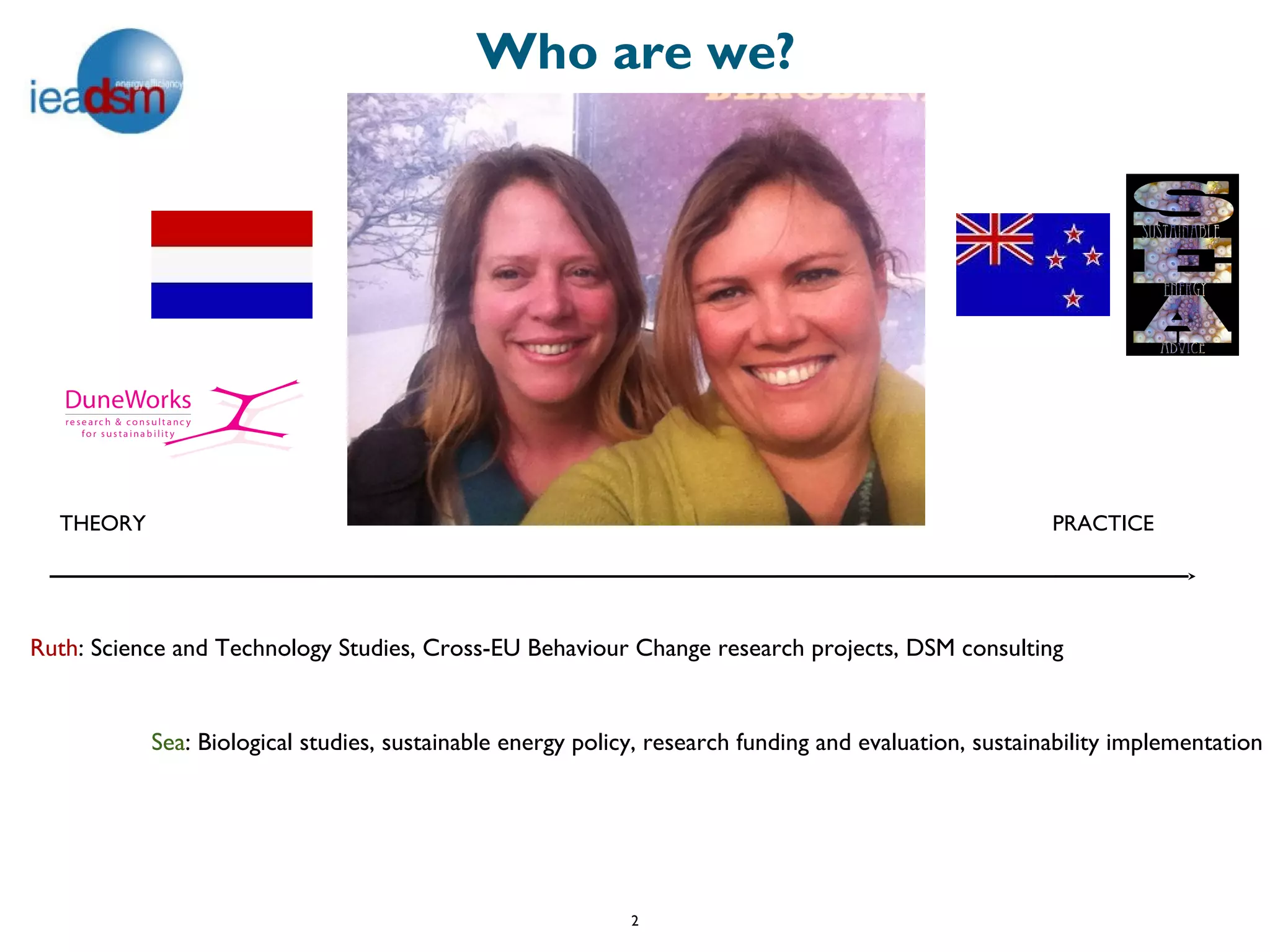
Who are we?


  THEORY                                                                                               PRACTICE


Ruth: Science and Technology Studies, Cross-EU Behaviour Change research projects, DSM consulting


           Sea: Biological studies, sustainable energy policy, research funding and evaluation, sustainability implementation


                                                            2
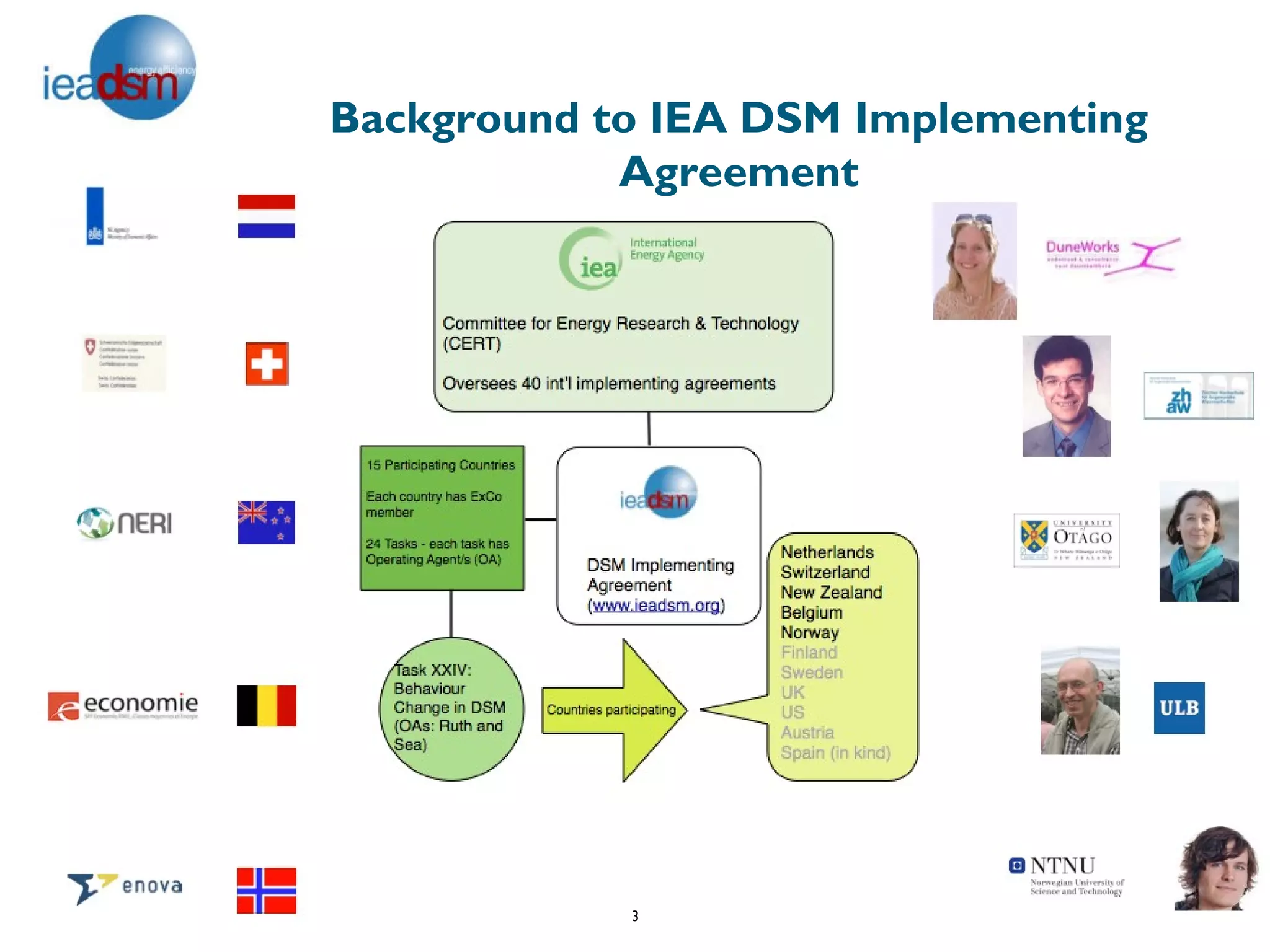
Background to IEA DSM Implementing
            Agreement


            3
            3
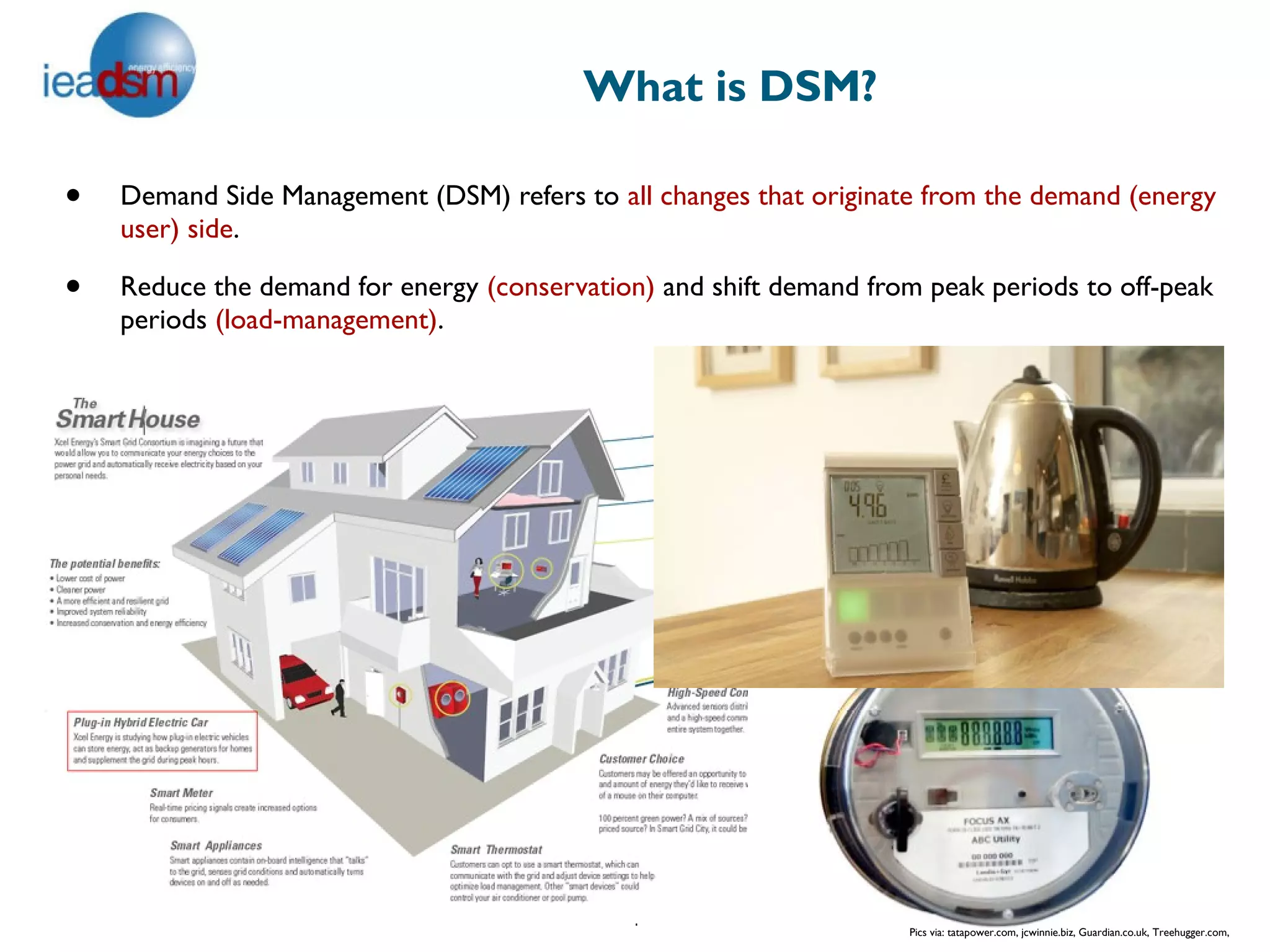
What is DSM?

•   Demand Side Management (DSM) refers to all changes that originate from the demand (energy
    user) side.

•   Reduce the demand for energy (conservation) and shift demand from peak periods to off-peak
    periods (load-management).


                                              4
                                                                     Pics via: tatapower.com, jcwinnie.biz, Guardian.co.uk, Treehugger.com,
What is Behaviour Change?

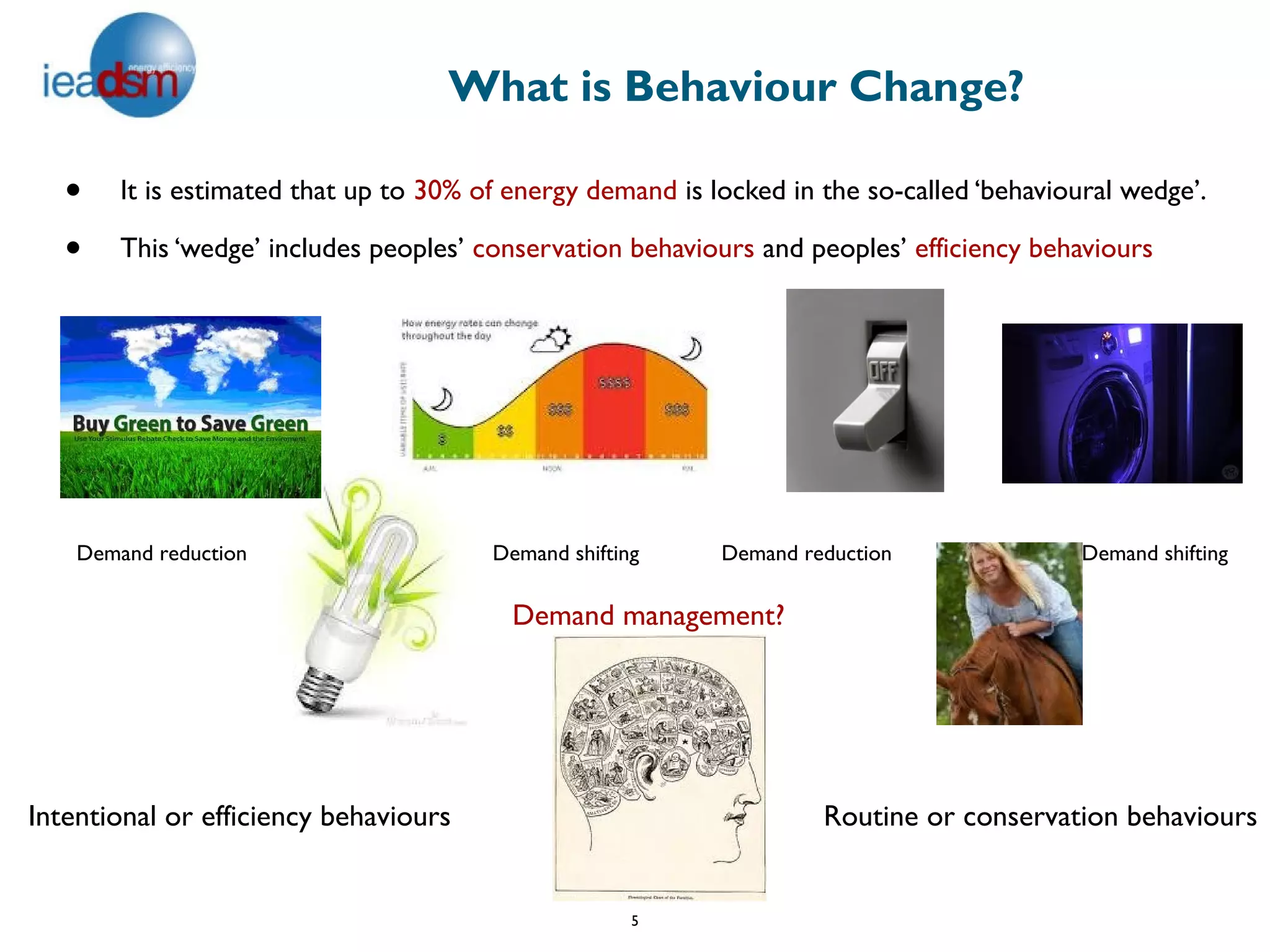
   •    It is estimated that up to 30% of energy demand is locked in the so-called ‘behavioural wedge’.

   •    This ‘wedge’ includes peoples’ conservation behaviours and peoples’ efficiency behaviours


    Demand reduction                    Demand shifting     Demand reduction                Demand shifting

                                          Demand management?


Intentional or efficiency behaviours                                 Routine or conservation behaviours


                                                      5
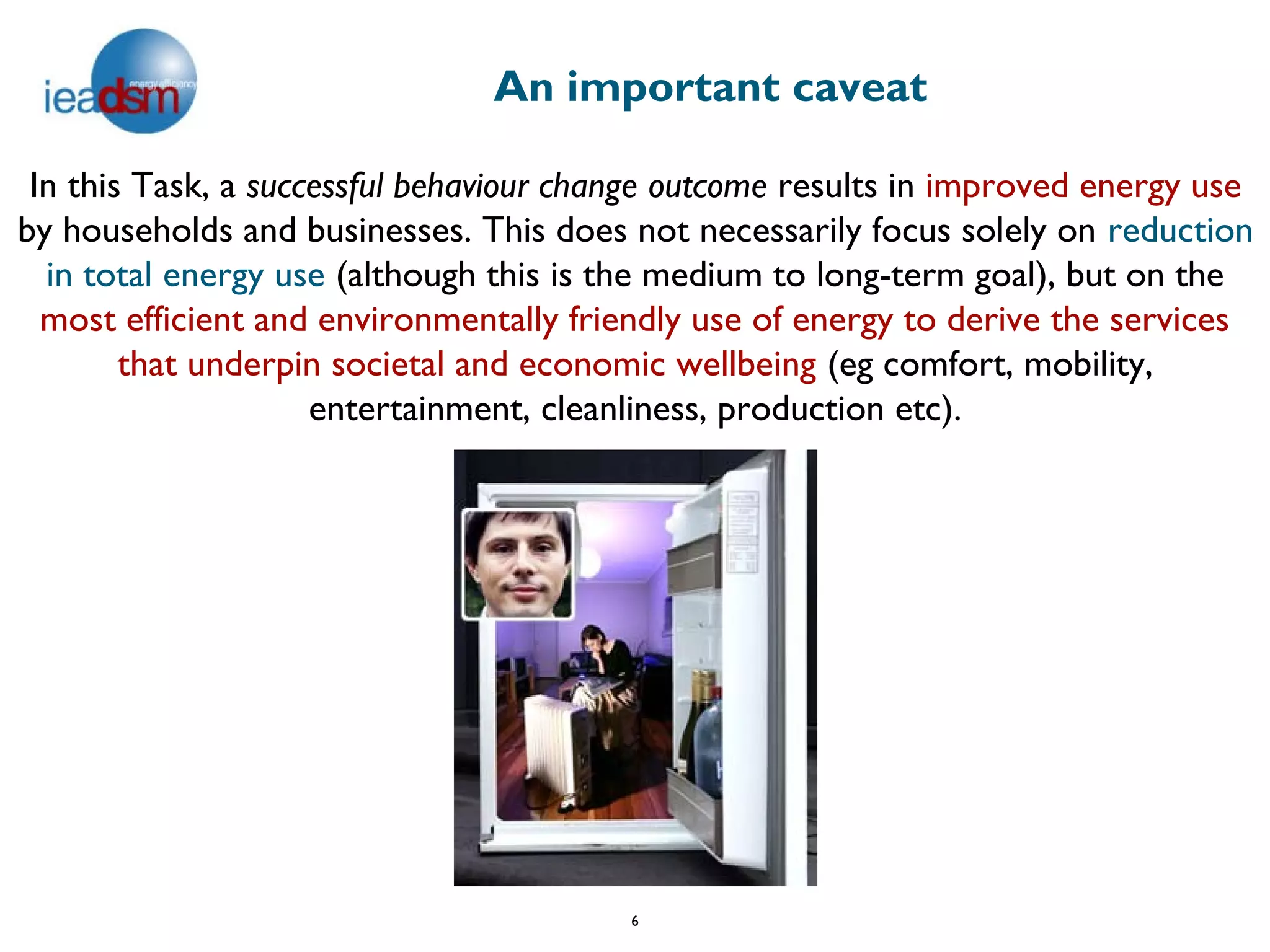
An important caveat

 In this Task, a successful behaviour change outcome results in improved energy use
by households and businesses. This does not necessarily focus solely on reduction
  in total energy use (although this is the medium to long-term goal), but on the
  most efficient and environmentally friendly use of energy to derive the services
        that underpin societal and economic wellbeing (eg comfort, mobility,
                     entertainment, cleanliness, production etc).


                                         6
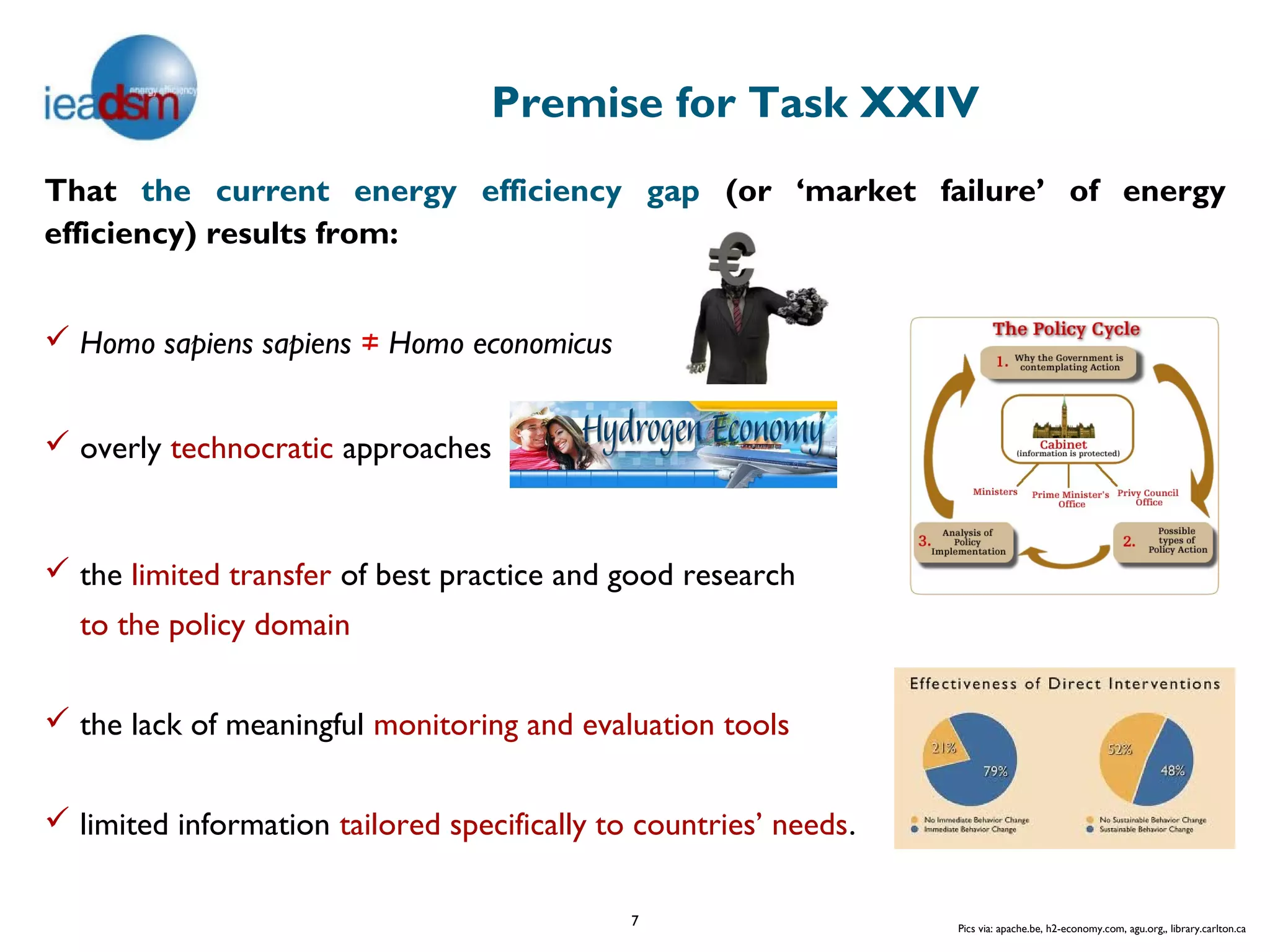
Premise for Task XXIV
That the current energy efficiency gap (or ‘market failure’ of energy
efficiency) results from:


 Homo sapiens sapiens ≠ Homo economicus


 overly technocratic approaches


 the limited transfer of best practice and good research
  to the policy domain


 the lack of meaningful monitoring and evaluation tools


 limited information tailored specifically to countries’ needs.

                                              7                    Pics via: apache.be, h2-economy.com, agu.org,, library.carlton.ca
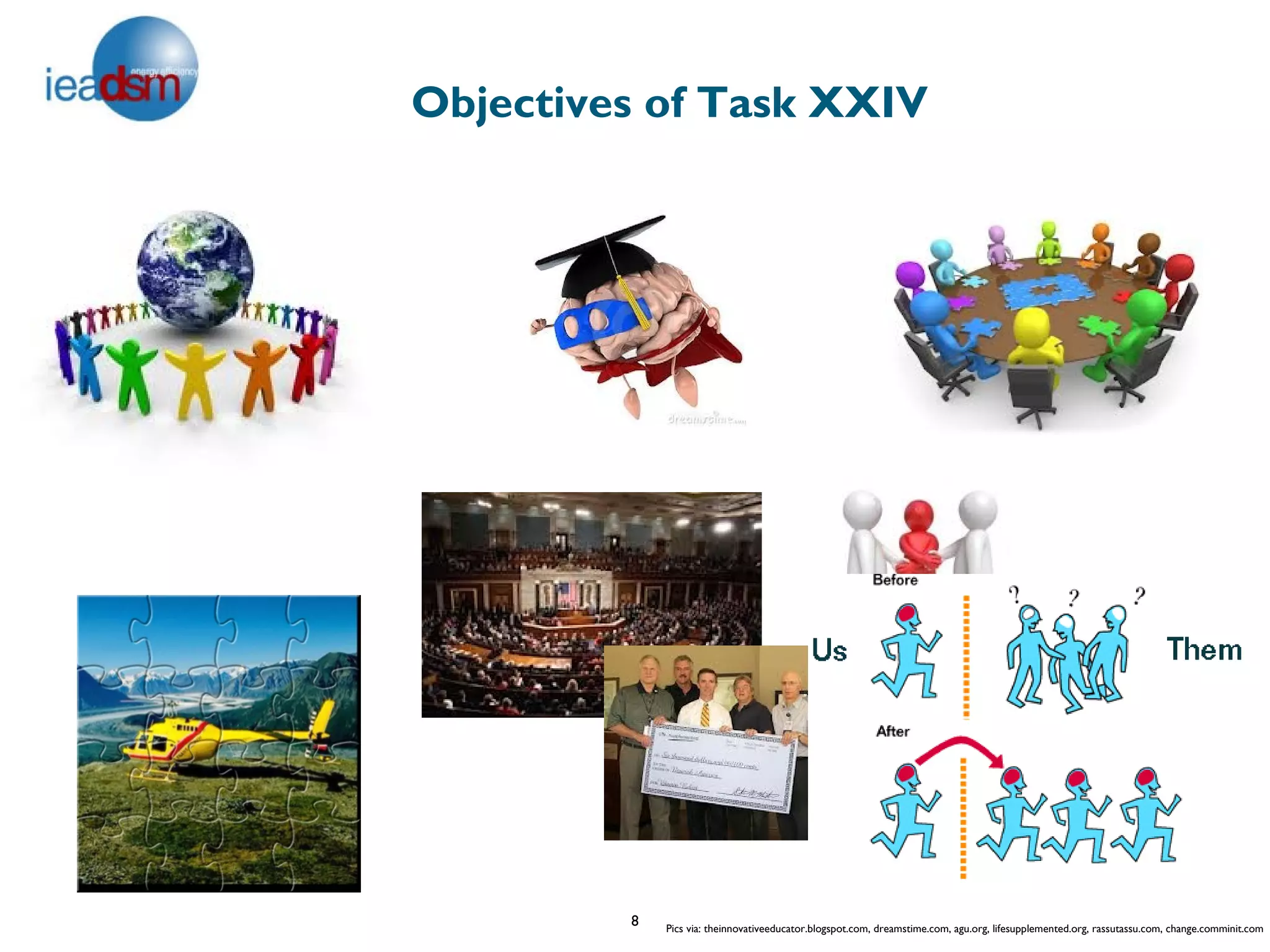
Objectives of Task XXIV


         8   Pics via: theinnovativeeducator.blogspot.com, dreamstime.com, agu.org, lifesupplemented.org, rassutassu.com, change.comminit.com
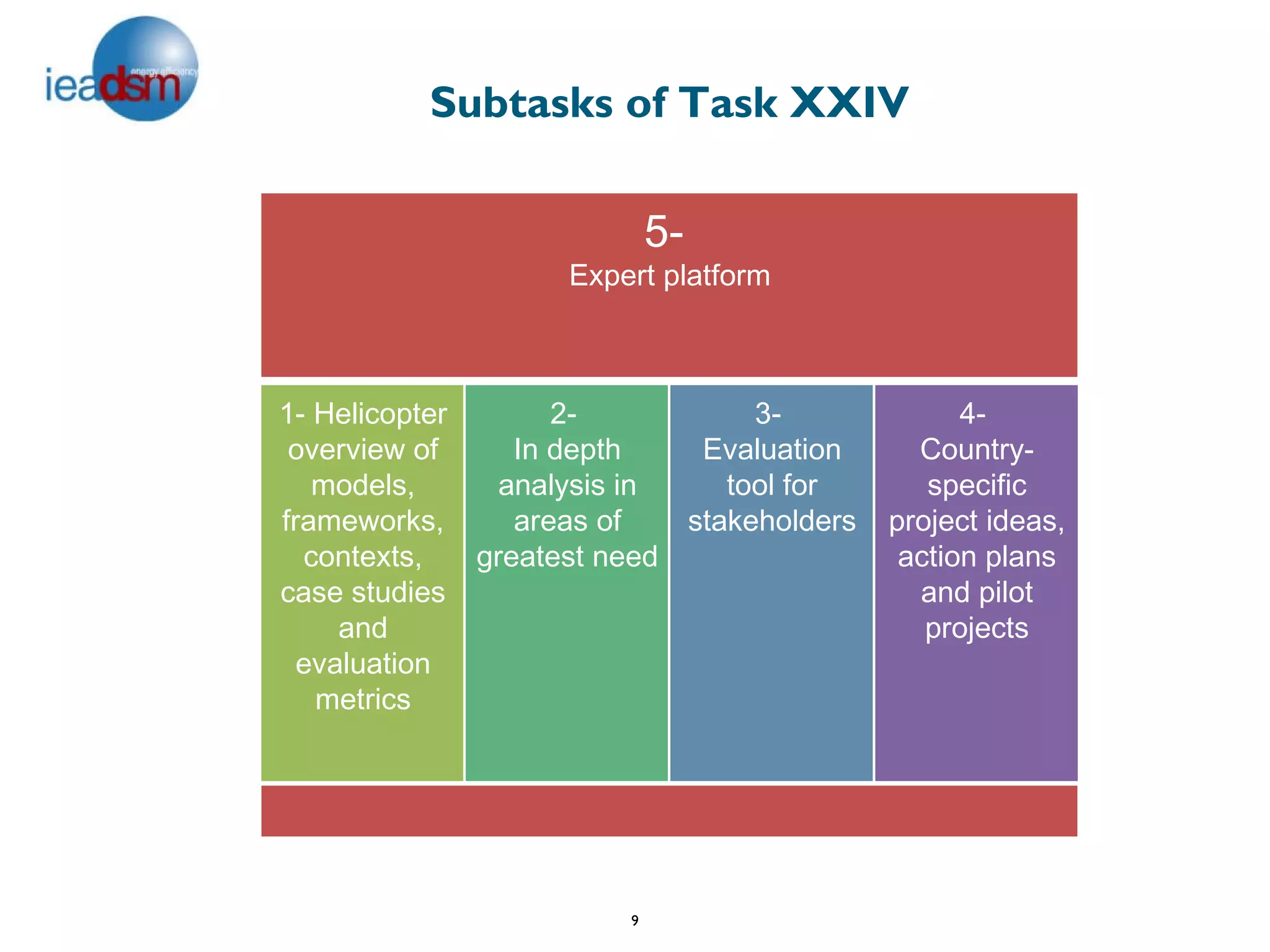
Subtasks of Task XXIV

                            5-
                    Expert platform


1- Helicopter       2-           3-              4-
 overview of     In depth    Evaluation      Country-
   models,      analysis in    tool for       specific
frameworks,      areas of   stakeholders   project ideas,
  contexts,   greatest need                 action plans
case studies                                 and pilot
     and                                      projects
  evaluation
   metrics


                        9
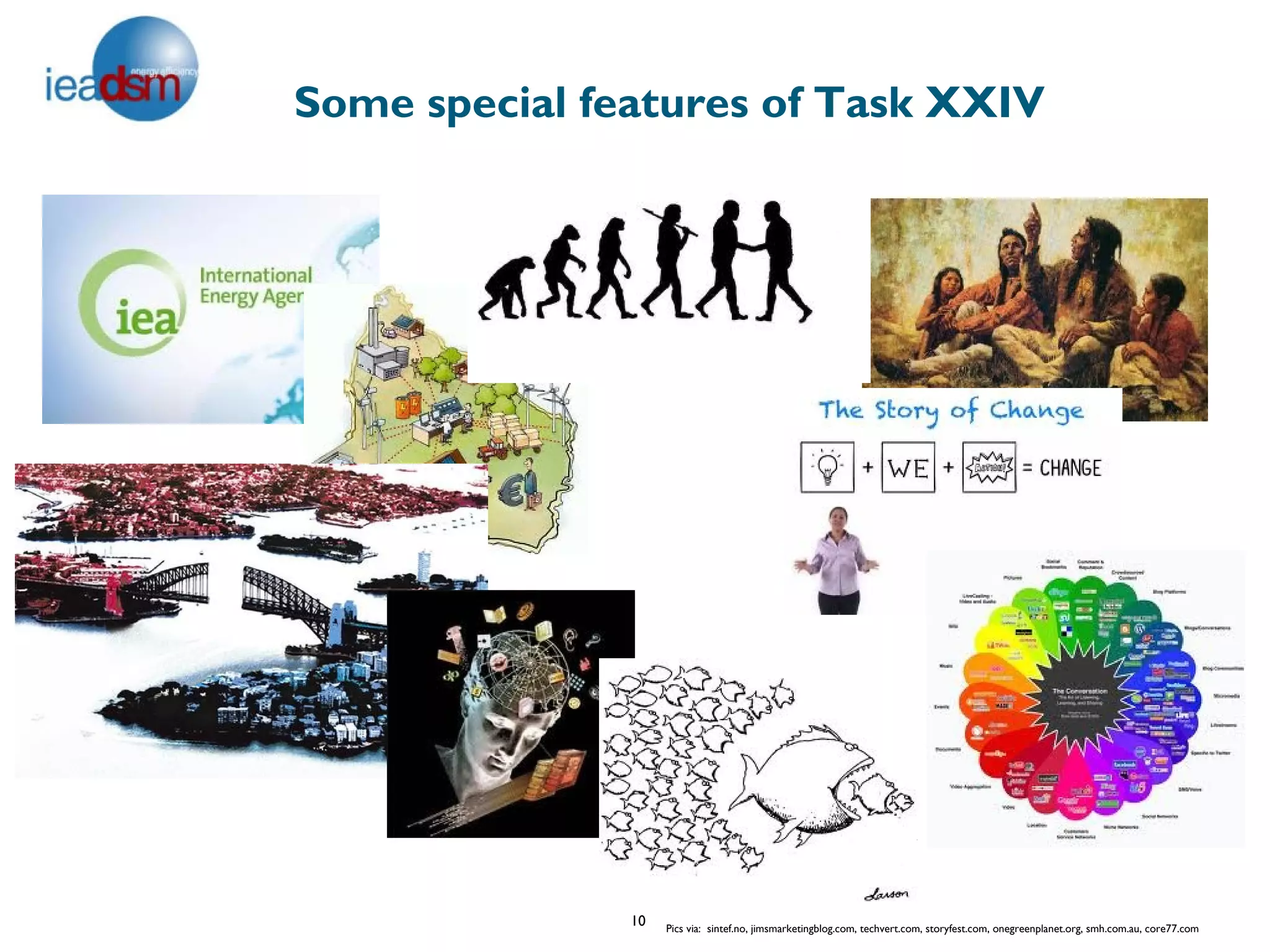
Some special features of Task XXIV


               10   Pics via: sintef.no, jimsmarketingblog.com, techvert.com, storyfest.com, onegreenplanet.org, smh.com.au, core77.com
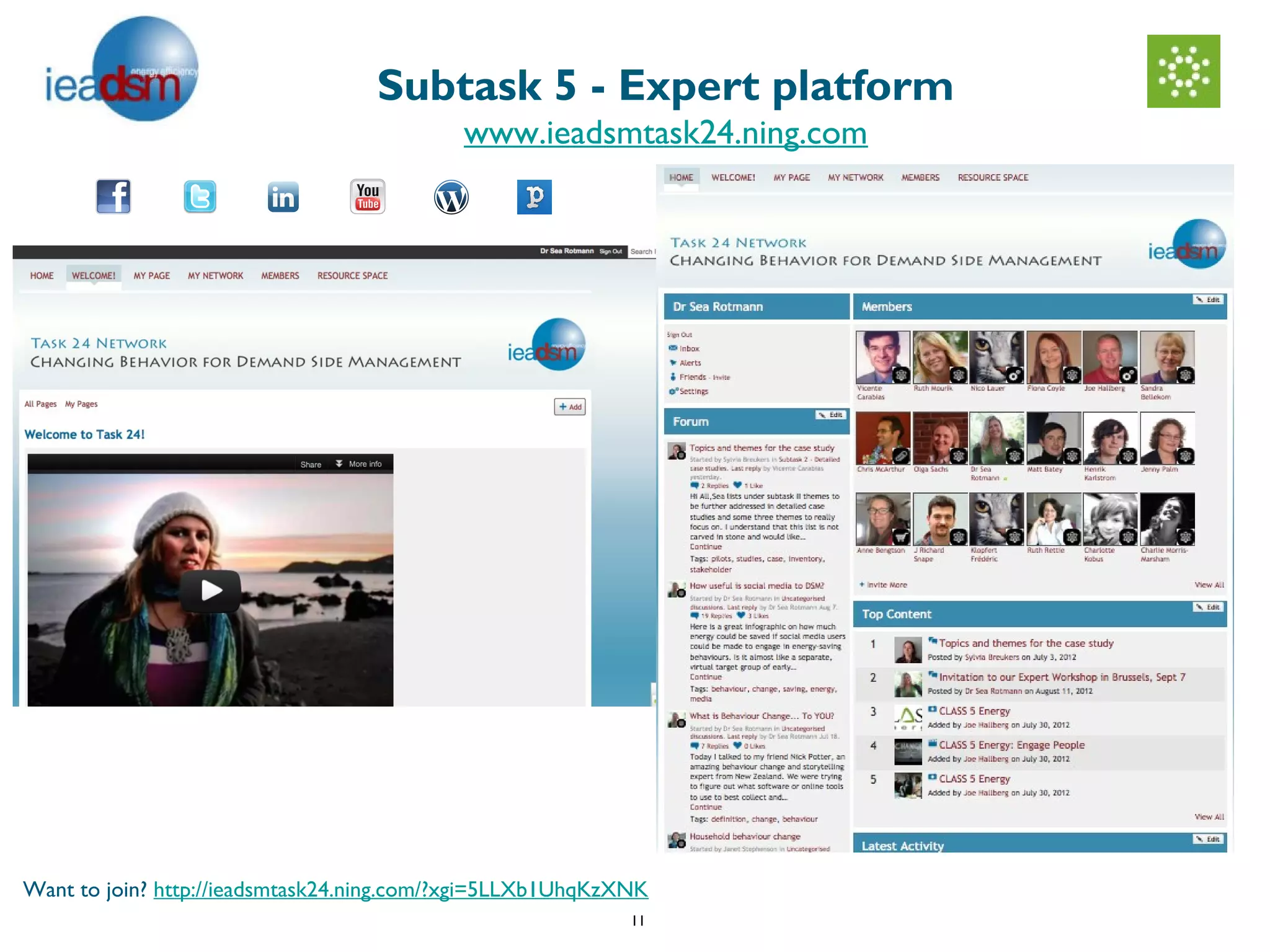
Subtask 5 - Expert platform
                                           www.ieadsmtask24.ning.com


Want to join? http://ieadsmtask24.ning.com/?xgi=5LLXb1UhqKzXNK
                                                            11
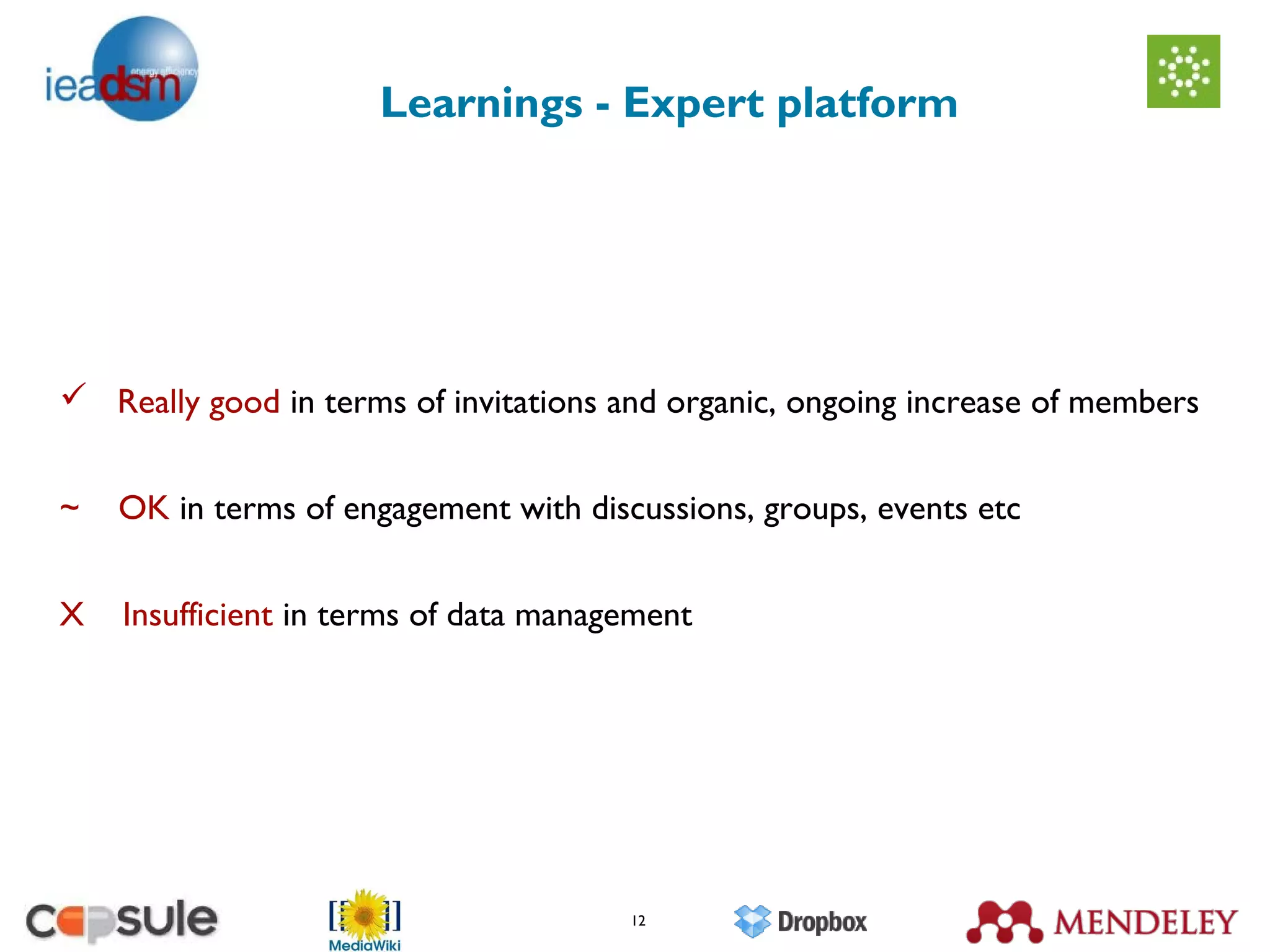
Learnings - Expert platform


 Really good in terms of invitations and organic, ongoing increase of members


~   OK in terms of engagement with discussions, groups, events etc


X   Insufficient in terms of data management


                                       12
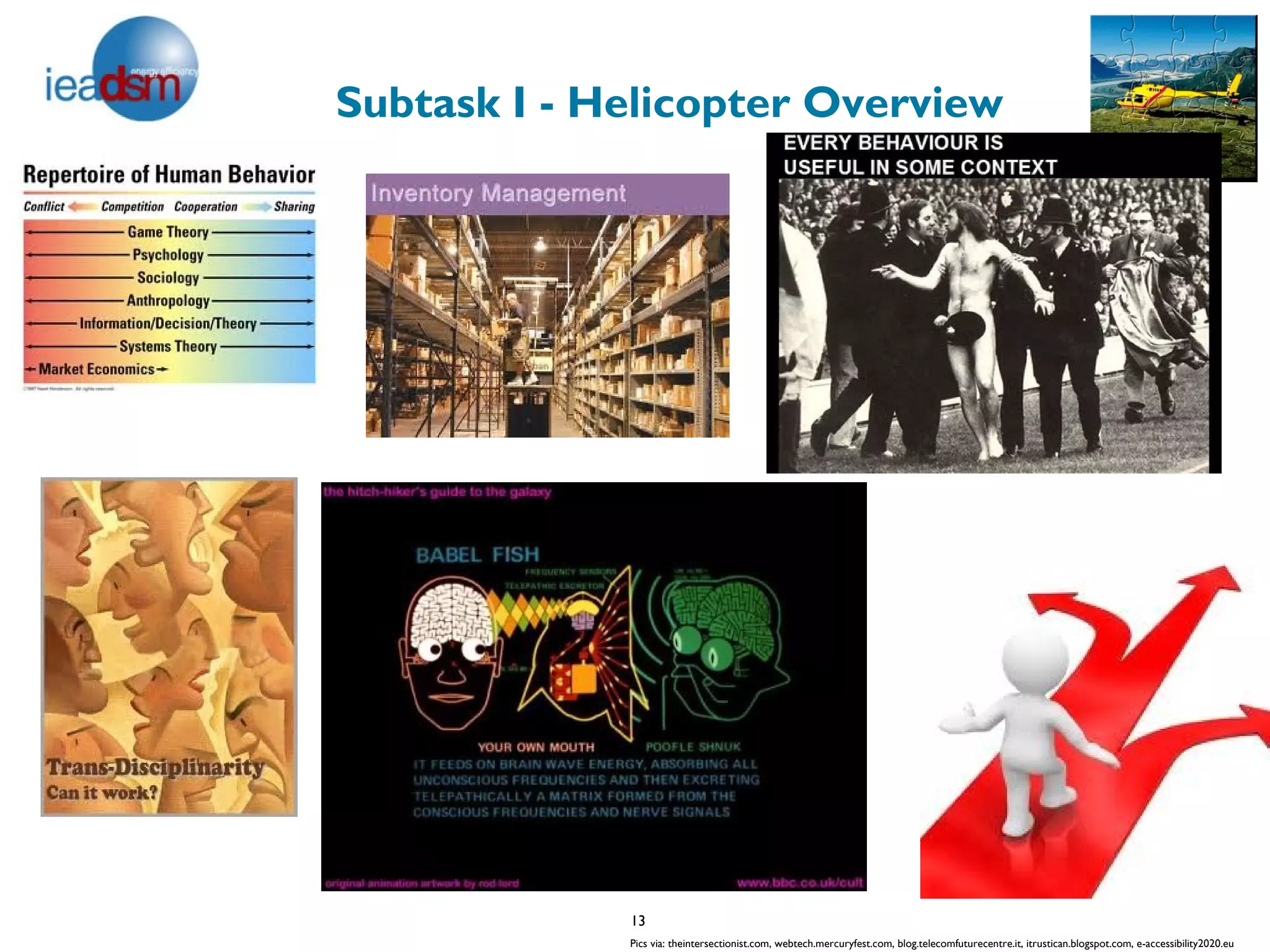
Subtask I - Helicopter Overview


             13
             Pics via: theintersectionist.com, webtech.mercuryfest.com, blog.telecomfuturecentre.it, itrustican.blogspot.com, e-accessibility2020.eu
Subtask I - Example: Energy Cultures
3. What are the strengths of this model?                                              Model offers a novel perspective for thinking about energy behaviour in an integrated way. It is applicable at
(e.g. in terms of providing explanation, insight, a novel perspective; in terms of
providing ideas for intervention; being action oriented or not; grounded in theory;   different scales (one household to nation); applies in different contexts (households, businesses and even non-
grounded in empirical work)                                                           energy contexts) and deals with heterogeneity of situations. Useful as basis for design of interdisciplinary research
                                                                                      and integrating findings from different sources. Gives insights into where effort is best placed for interventions to
                                                                                      achieve behaviour change. Draws from several theoretical perspectives.

4. What are the weaknesses of this model?                                             It is a theoretical framework rather than an explanatory theory of behaviour. Model has been used & tested in New
(e.g. in terms of providing explanation, insight, a novel perspective; in terms of
providing ideas for intervention; being action oriented or not; grounded in theory;   Zealand work since 2010 and we are aware of it being used elsewhere, but is still relatively new - to date (Aug
grounded in empirical work)                                                           2012) it has 15 citations.
5. Additional comments                                                               Model has also been applied (by others) to changing behaviour in relation to greenhouse gas emissions.
(e.g. on how this model can be made practicable for practitioners, policy makers; in
case this model addresses other topics than energy, how it still bears relevance to
energy DSM)


                                                                                                         14
                                                                                                         14
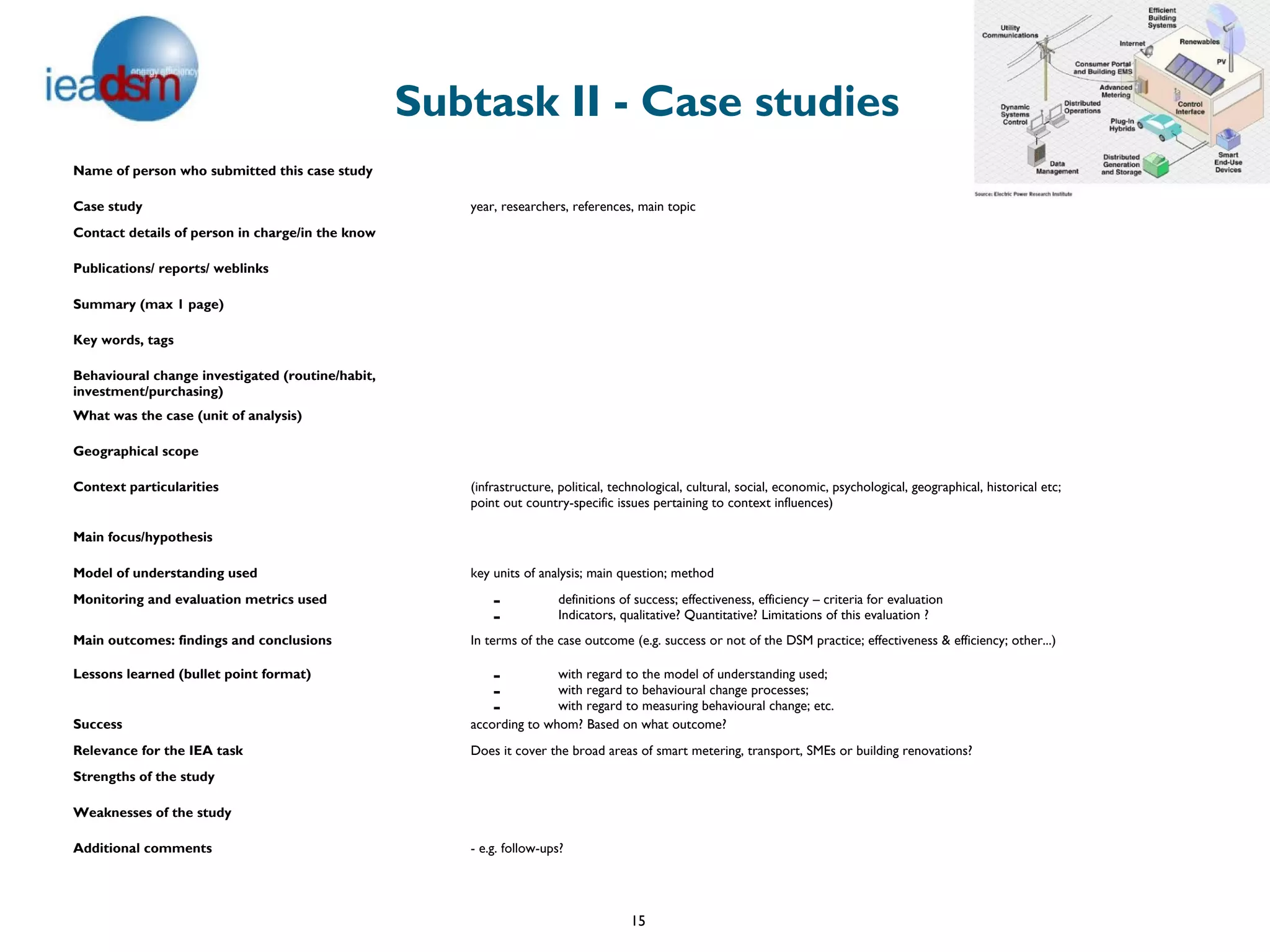
Subtask II - Case studies
Name of person who submitted this case study

Case study                                           year, researchers, references, main topic
Contact details of person in charge/in the know

Publications/ reports/ weblinks

Summary (max 1 page)

Key words, tags

Behavioural change investigated (routine/habit,
investment/purchasing)
What was the case (unit of analysis)

Geographical scope

Context particularities                              (infrastructure, political, technological, cultural, social, economic, psychological, geographical, historical etc;
                                                     point out country-specific issues pertaining to context influences)

Main focus/hypothesis

Model of understanding used                          key units of analysis; main question; method
Monitoring and evaluation metrics used                   -            definitions of success; effectiveness, efficiency – criteria for evaluation
                                                         -            Indicators, qualitative? Quantitative? Limitations of this evaluation ?
Main outcomes: findings and conclusions              In terms of the case outcome (e.g. success or not of the DSM practice; effectiveness & efficiency; other...)

Lessons learned (bullet point format)                    -          with regard to the model of understanding used;
                                                         -          with regard to behavioural change processes;
                                                         -          with regard to measuring behavioural change; etc.
Success                                              according to whom? Based on what outcome?
Relevance for the IEA task                           Does it cover the broad areas of smart metering, transport, SMEs or building renovations?
Strengths of the study

Weaknesses of the study

Additional comments                                  - e.g. follow-ups?


                                                                                    15
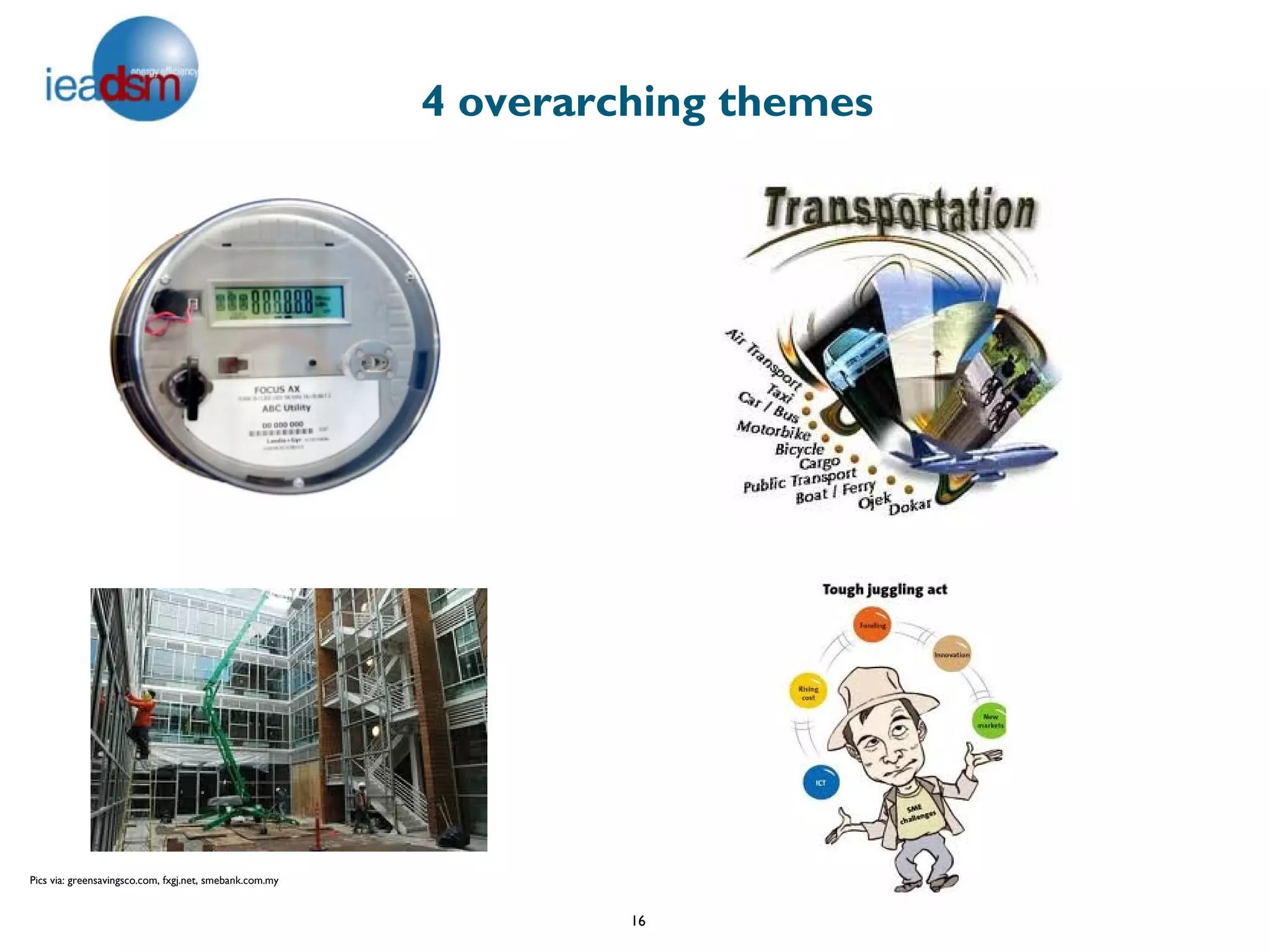
4 overarching themes


Pics via: greensavingsco.com, fxgj.net, smebank.com.my


                                                                  16
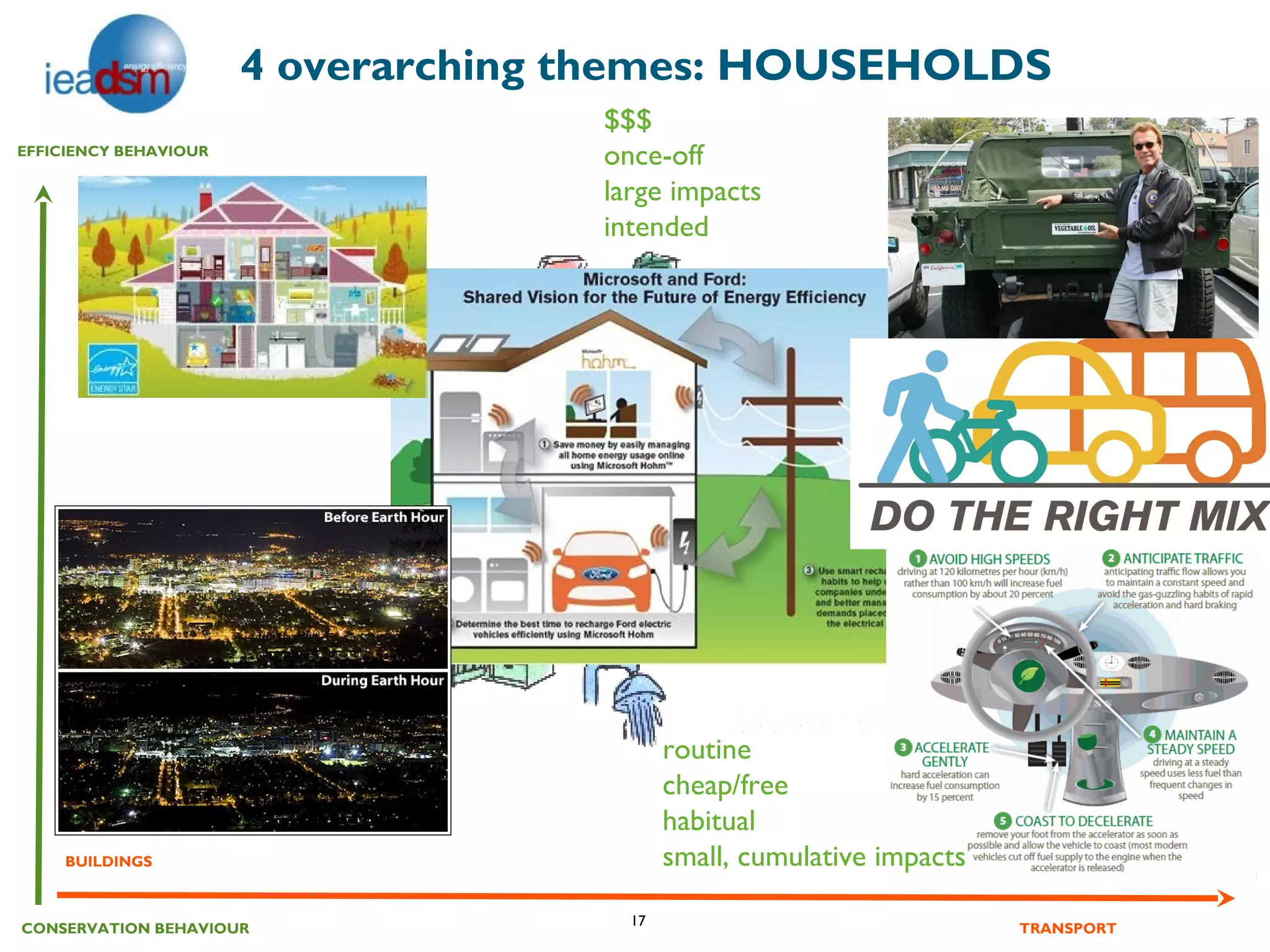
4 overarching themes: HOUSEHOLDS
                                     $$$
EFFICIENCY BEHAVIOUR
                                     once-off
                                     large impacts
                                     intended


                                            routine
                                            cheap/free
                                            habitual
     BUILDINGS                              small, cumulative impacts

                                       17
CONSERVATION BEHAVIOUR                                                  TRANSPORT
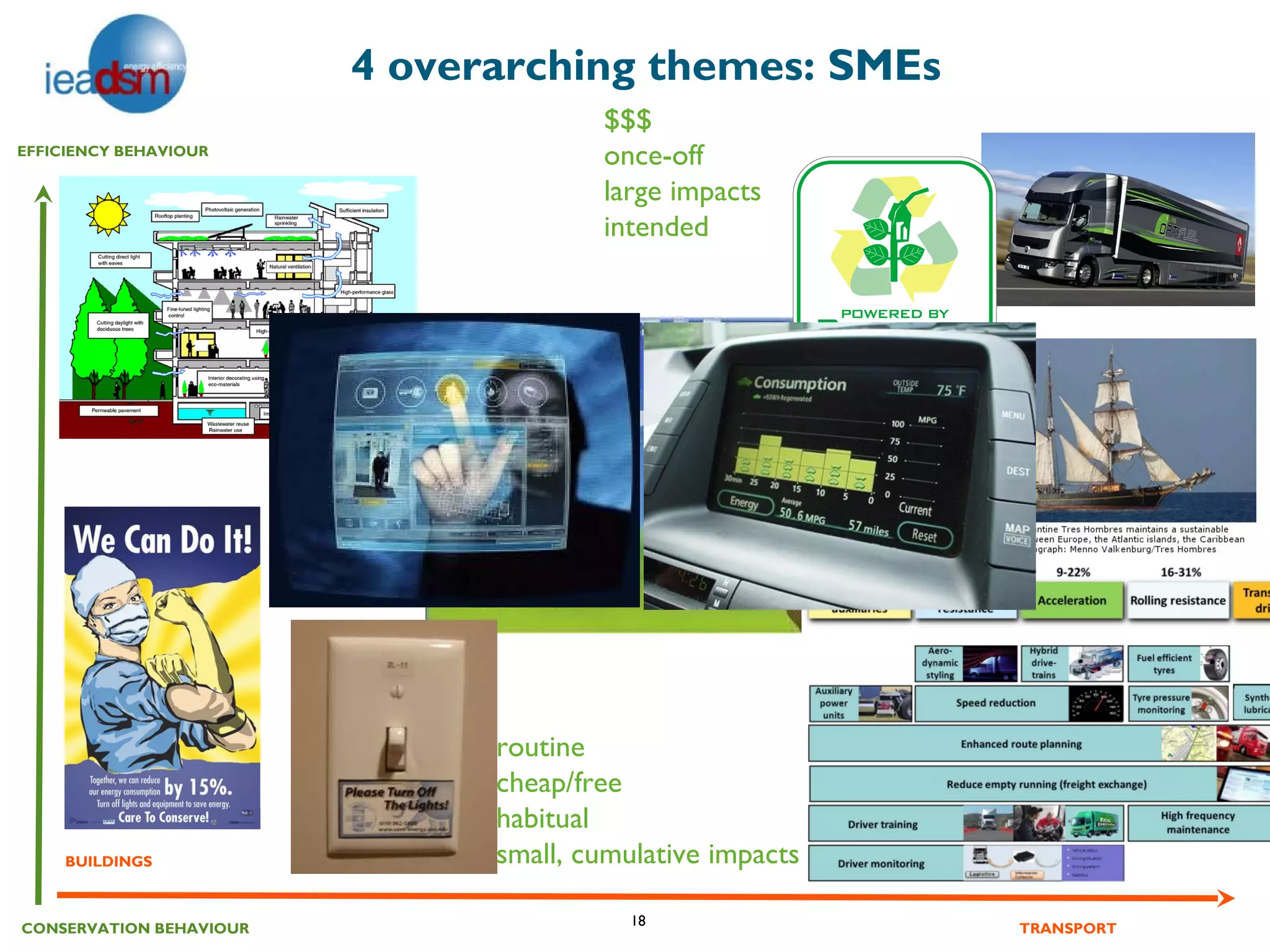
4 overarching themes: SMEs
                                       $$$
EFFICIENCY BEHAVIOUR
                                       once-off
                                       large impacts
                                       intended


                               routine
                               cheap/free
                               habitual
     BUILDINGS                 small, cumulative impacts

                                          18
CONSERVATION BEHAVIOUR                                     TRANSPORT
Subtask III- Evaluation


 WHAT IS A SUCCESSFUL LONG-TERM BEHAVIOUR
        CHANGE OUTCOME TO YOU?


                     19
Subtask IV: Country-specific
    recommendations


             20

IEA DSM Pecha Kucha Brussels workshop

  • 1.
    IEA DSM TASKXXIV Closing the Loop - Behaviour Change in DSM: From Theory to Practice Pecha Kucha - Brussels Workshop, Sept 7, 2012 Subtask I: Helicopter Overview Dr Sea Rotmann (Co-operating Agent, Task XXIV) 1 1
  • 2.
    Who are we? THEORY PRACTICE Ruth: Science and Technology Studies, Cross-EU Behaviour Change research projects, DSM consulting Sea: Biological studies, sustainable energy policy, research funding and evaluation, sustainability implementation 2
  • 3.
    Background to IEADSM Implementing Agreement 3 3
  • 4.
    What is DSM? • Demand Side Management (DSM) refers to all changes that originate from the demand (energy user) side. • Reduce the demand for energy (conservation) and shift demand from peak periods to off-peak periods (load-management). 4 Pics via: tatapower.com, jcwinnie.biz, Guardian.co.uk, Treehugger.com,
  • 5.
    What is BehaviourChange? • It is estimated that up to 30% of energy demand is locked in the so-called ‘behavioural wedge’. • This ‘wedge’ includes peoples’ conservation behaviours and peoples’ efficiency behaviours Demand reduction Demand shifting Demand reduction Demand shifting Demand management? Intentional or efficiency behaviours Routine or conservation behaviours 5
  • 6.
    An important caveat In this Task, a successful behaviour change outcome results in improved energy use by households and businesses. This does not necessarily focus solely on reduction in total energy use (although this is the medium to long-term goal), but on the most efficient and environmentally friendly use of energy to derive the services that underpin societal and economic wellbeing (eg comfort, mobility, entertainment, cleanliness, production etc). 6
  • 7.
    Premise for TaskXXIV That the current energy efficiency gap (or ‘market failure’ of energy efficiency) results from:  Homo sapiens sapiens ≠ Homo economicus  overly technocratic approaches  the limited transfer of best practice and good research to the policy domain  the lack of meaningful monitoring and evaluation tools  limited information tailored specifically to countries’ needs. 7 Pics via: apache.be, h2-economy.com, agu.org,, library.carlton.ca
  • 8.
    Objectives of TaskXXIV 8 Pics via: theinnovativeeducator.blogspot.com, dreamstime.com, agu.org, lifesupplemented.org, rassutassu.com, change.comminit.com
  • 9.
    Subtasks of TaskXXIV 5- Expert platform 1- Helicopter 2- 3- 4- overview of In depth Evaluation Country- models, analysis in tool for specific frameworks, areas of stakeholders project ideas, contexts, greatest need action plans case studies and pilot and projects evaluation metrics 9
  • 10.
    Some special featuresof Task XXIV 10 Pics via: sintef.no, jimsmarketingblog.com, techvert.com, storyfest.com, onegreenplanet.org, smh.com.au, core77.com
  • 11.
    Subtask 5 -Expert platform www.ieadsmtask24.ning.com Want to join? http://ieadsmtask24.ning.com/?xgi=5LLXb1UhqKzXNK 11
  • 12.
    Learnings - Expertplatform  Really good in terms of invitations and organic, ongoing increase of members ~ OK in terms of engagement with discussions, groups, events etc X Insufficient in terms of data management 12
  • 13.
    Subtask I -Helicopter Overview 13 Pics via: theintersectionist.com, webtech.mercuryfest.com, blog.telecomfuturecentre.it, itrustican.blogspot.com, e-accessibility2020.eu
  • 14.
    Subtask I -Example: Energy Cultures 3. What are the strengths of this model? Model offers a novel perspective for thinking about energy behaviour in an integrated way. It is applicable at (e.g. in terms of providing explanation, insight, a novel perspective; in terms of providing ideas for intervention; being action oriented or not; grounded in theory; different scales (one household to nation); applies in different contexts (households, businesses and even non- grounded in empirical work) energy contexts) and deals with heterogeneity of situations. Useful as basis for design of interdisciplinary research and integrating findings from different sources. Gives insights into where effort is best placed for interventions to achieve behaviour change. Draws from several theoretical perspectives. 4. What are the weaknesses of this model? It is a theoretical framework rather than an explanatory theory of behaviour. Model has been used & tested in New (e.g. in terms of providing explanation, insight, a novel perspective; in terms of providing ideas for intervention; being action oriented or not; grounded in theory; Zealand work since 2010 and we are aware of it being used elsewhere, but is still relatively new - to date (Aug grounded in empirical work) 2012) it has 15 citations. 5. Additional comments Model has also been applied (by others) to changing behaviour in relation to greenhouse gas emissions. (e.g. on how this model can be made practicable for practitioners, policy makers; in case this model addresses other topics than energy, how it still bears relevance to energy DSM) 14 14
  • 15.
    Subtask II -Case studies Name of person who submitted this case study Case study year, researchers, references, main topic Contact details of person in charge/in the know Publications/ reports/ weblinks Summary (max 1 page) Key words, tags Behavioural change investigated (routine/habit, investment/purchasing) What was the case (unit of analysis) Geographical scope Context particularities (infrastructure, political, technological, cultural, social, economic, psychological, geographical, historical etc; point out country-specific issues pertaining to context influences) Main focus/hypothesis Model of understanding used key units of analysis; main question; method Monitoring and evaluation metrics used - definitions of success; effectiveness, efficiency – criteria for evaluation - Indicators, qualitative? Quantitative? Limitations of this evaluation ? Main outcomes: findings and conclusions In terms of the case outcome (e.g. success or not of the DSM practice; effectiveness & efficiency; other...) Lessons learned (bullet point format) - with regard to the model of understanding used; - with regard to behavioural change processes; - with regard to measuring behavioural change; etc. Success according to whom? Based on what outcome? Relevance for the IEA task Does it cover the broad areas of smart metering, transport, SMEs or building renovations? Strengths of the study Weaknesses of the study Additional comments - e.g. follow-ups? 15
  • 16.
    4 overarching themes Picsvia: greensavingsco.com, fxgj.net, smebank.com.my 16
  • 17.
    4 overarching themes:HOUSEHOLDS $$$ EFFICIENCY BEHAVIOUR once-off large impacts intended routine cheap/free habitual BUILDINGS small, cumulative impacts 17 CONSERVATION BEHAVIOUR TRANSPORT
  • 18.
    4 overarching themes:SMEs $$$ EFFICIENCY BEHAVIOUR once-off large impacts intended routine cheap/free habitual BUILDINGS small, cumulative impacts 18 CONSERVATION BEHAVIOUR TRANSPORT
  • 19.
    Subtask III- Evaluation WHAT IS A SUCCESSFUL LONG-TERM BEHAVIOUR CHANGE OUTCOME TO YOU? 19
  • 20.

Editor's Notes

  • #9 To create a global behaviour change expert network (a superbrain) where each expert will provide a piece to the puzzle to provide an overview of the landscape and to support participating countries’ policymakers, funders and intermediaries to know the best approaches and examples in their own contexts and show what is a successful, long-term behaviour change outcome
  • #11 1. The International Energy Agency as umbrella - mutual influence 2. Consciously taking a very ‘human’ approach to address this (human) problem 3. Creative solutions to visualise and simplify this complex issue: storytelling, infographics, graphic representations of workshops, Pecha Kuchas, videos, social media etc 4. Bridging divides - between research disciplines, experts from various sectors, countries 5. Embracing bottom-up and open approaches: open innovation, participatory learning, action research, community engagement 6. Strong emphasis on evaluation that makes sense - what is a successful behaviour change outcome to you? 7. A future vision to turn the theory into practice with a Task extension to 2017 - this will enable cross-cultural/country comparisons of how the recommended approach/es fare in different contexts
  • #13 There is still a widespread reluctance to use social media professionally, even in a ‘safe’, closed expert group like this. The most common reasons are likely: the time required to interact/engage; a ‘trust’ factor especially when not knowing the other members personally/professionally; not seeing the ‘point’ of social media; feeling silly/unsafe (see also: Rotmann et al , 2011 )... It also takes a lot of time for the moderator to post and to keep it going. We hope that more engagement will happen once most members have met face-to-face in workshops, and that members will continue to interact with one another on their own terms. Right now, most communication and organisation is still happening via (mass) emails . Webinars are also working quite well, particularly when discussing very specific aspects of the Task. Social media is an excellent way to foster interest and discover new ‘experts’.
  • #14 There are many different behaviour change disciplines, models and frameworks, which often operate in silos . As a first step in the challenge of moving towards an interdisciplinary model of better understanding behaviour change, we will present an inventory of what the diverse (sub)disciplines have to offer both theoretically and empirically. Case studies will be provided by experts to outline (un)successful uses of the various models etc, what contexts have been examined, and how they have been evaluated . This will help understanding the benefits and limitations of applying different models to different contexts. Ultimately, we hope to provide participating countries with the ability to select relevant models that inform DSM initiatives focusing on particular topics of interest: e.g. smart metering, SMEs, renovation programmes and transport (detailed analysis in Subtask II) Next steps : Workshop on Subtask I in Brussels, September 7 and Subtasks I and II in Oxford, October 9-10