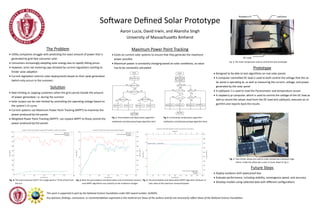
Raspberry Pi LabQuest
DC Load
Fig. 6. The main components used to control the solar prototype
Software Defined Solar Prototype
Aaron Lucia, David Irwin, and Akansha Singh
University of Massachusetts Amherst
This work is supported in part by the National Science Foundation under NSF award number 1639591.
Any opinions, findings, conclusions, or recommendations expressed in this material are those of the authors and do not necessarily reflect those of the National Science Foundation.
The Problem
 Utility companies struggle with predicting the exact amount of power that is
generated by grid-tied consumer solar
 Consumers increasingly adopting solar energy due to rapidly falling prices
 However, strict net metering caps dictated by current regulations starting to
hinder solar adoption
 Current legislation restricts solar deployments based on their peak generation
(which only occurs in the summer)
Solution
 Rate-limiting or capping customers when the grid cannot handle the amount
of power generated, i.e. during the summer
 Solar output can be rate-limited by controlling the operating voltage based on
the system’s IV curve
 Current systems use Maximum Power Point Tracking (MPPT) to maximize the
power produced by the panels
 Weighted Power Point Tracking (WPPT) can replace MPPT to finely control the
power produced by the panels
Maximum Power Point Tracking
 Exists on current solar systems to ensure that they generate the maximum
power possible
 Maximum power is constantly changing based on solar conditions, so value
has to be constantly calculated
Fig. 1. Perturbation and observation algorithm
mathworks.com/discovery/mppt-algorithm.html
Fig. 2. Incremental conductance algorithm
mathworks.com/discovery/mppt-algorithm.html
Prototype
 Designed to be able to test algorithms on real solar panels
 A computer controlled DC load is used to both control the voltage that the so-
lar panel is operating at, as well as measuring the current, voltage, and power
generated by the solar panel
 A LabQuest 2 is used to read the Pyranometer and temperature sensor
 A raspberry pi computer, which is used to control the voltage of the DC load as
well as record the values read from the DC load and LabQuest, executes an al-
gorithm and reports back the results
Future Steps
 Deploy outdoors with waterproof box
 Evaluate performance, including stability, convergence speed, and accuracy
 Develop models using collected data with different configurations
Fig. 3. The total maximum W/m² of a single panel is ~9.5% of that from
the sun
Fig. 4. Both the perturbation and observation and incremental conduct-
ance MPPT algorithms vary similarly as the irradiance changes
Fig. 5. The perturbation and observation MPPT algorithm achieves re-
sults close to the maximum measured power
Fig. 7. Two similar setups are used to make comparisons between algo-
rithms. Inside the white box is seen in closer detail in Fig. 6

Aaron Lucia Poster

  • 1.
    Raspberry Pi LabQuest DCLoad Fig. 6. The main components used to control the solar prototype Software Defined Solar Prototype Aaron Lucia, David Irwin, and Akansha Singh University of Massachusetts Amherst This work is supported in part by the National Science Foundation under NSF award number 1639591. Any opinions, findings, conclusions, or recommendations expressed in this material are those of the authors and do not necessarily reflect those of the National Science Foundation. The Problem  Utility companies struggle with predicting the exact amount of power that is generated by grid-tied consumer solar  Consumers increasingly adopting solar energy due to rapidly falling prices  However, strict net metering caps dictated by current regulations starting to hinder solar adoption  Current legislation restricts solar deployments based on their peak generation (which only occurs in the summer) Solution  Rate-limiting or capping customers when the grid cannot handle the amount of power generated, i.e. during the summer  Solar output can be rate-limited by controlling the operating voltage based on the system’s IV curve  Current systems use Maximum Power Point Tracking (MPPT) to maximize the power produced by the panels  Weighted Power Point Tracking (WPPT) can replace MPPT to finely control the power produced by the panels Maximum Power Point Tracking  Exists on current solar systems to ensure that they generate the maximum power possible  Maximum power is constantly changing based on solar conditions, so value has to be constantly calculated Fig. 1. Perturbation and observation algorithm mathworks.com/discovery/mppt-algorithm.html Fig. 2. Incremental conductance algorithm mathworks.com/discovery/mppt-algorithm.html Prototype  Designed to be able to test algorithms on real solar panels  A computer controlled DC load is used to both control the voltage that the so- lar panel is operating at, as well as measuring the current, voltage, and power generated by the solar panel  A LabQuest 2 is used to read the Pyranometer and temperature sensor  A raspberry pi computer, which is used to control the voltage of the DC load as well as record the values read from the DC load and LabQuest, executes an al- gorithm and reports back the results Future Steps  Deploy outdoors with waterproof box  Evaluate performance, including stability, convergence speed, and accuracy  Develop models using collected data with different configurations Fig. 3. The total maximum W/m² of a single panel is ~9.5% of that from the sun Fig. 4. Both the perturbation and observation and incremental conduct- ance MPPT algorithms vary similarly as the irradiance changes Fig. 5. The perturbation and observation MPPT algorithm achieves re- sults close to the maximum measured power Fig. 7. Two similar setups are used to make comparisons between algo- rithms. Inside the white box is seen in closer detail in Fig. 6