AUSTRALASIAN ASSOCIATION OF DISTANCE EDUCATION SCHOOLS
ANNUAL CONFERENCE 2013 – MELBOURNE SEPTEMBER 11 - 13
Learning
in a networked
world
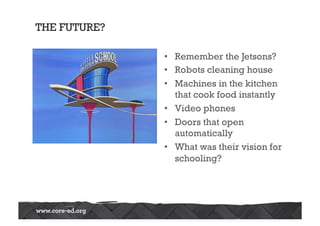
THE FUTURE?
•  Remember the Jetsons?
•  Robots cleaning house
•  Machines in the kitchen
that cook food instantly
•  Video phones
•  Doors that open
automatically
•  What was their vision for
schooling?
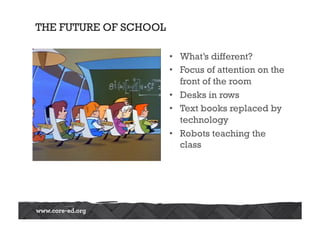
THE FUTURE OF SCHOOL
•  What’s different?
•  Focus of attention on the
front of the room
•  Desks in rows
•  Text books replaced by
technology
•  Robots teaching the
class
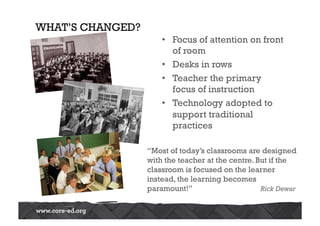
WHAT’S CHANGED?
•  Focus of attention on front
of room
•  Desks in rows
•  Teacher the primary
focus of instruction
•  Technology adopted to
support traditional
practices
“Most of today’s classrooms are designed
with the teacher at the centre. But if the
classroom is focused on the learner
instead, the learning becomes
paramount!” Rick Dewar
“Flipped	
  	
  
classroom”	
  
Virtual	
  	
  
schools	
  
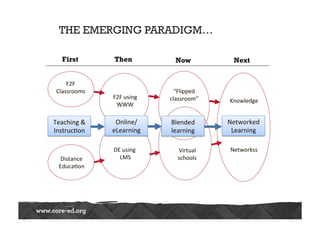
THE EMERGING PARADIGM…
F2F	
  
Classrooms	
  
Distance	
  	
  
Educa9on	
  
Teaching	
  &	
  
Instruc9on	
  
F2F	
  using	
  	
  
WWW	
  
DE	
  using	
  
	
  LMS	
  
Knowledge	


Networkss	
  
Online/
eLearning	
  
Blended	
  
learning	
  
Networked	
  
Learning	
  
First Then Now Next
WHAT ARE THE GAME CHANGERS?
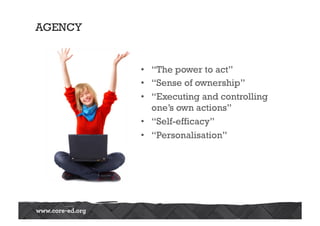
AGENCY
•  “The power to act”
•  “Sense of ownership”
•  “Executing and controlling
one’s own actions”
•  “Self-efficacy”
•  “Personalisation”
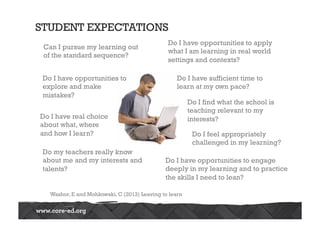
STUDENT EXPECTATIONS
Washor, E and Mohkowski, C (2013) Leaving to learn
Do my teachers really know
about me and my interests and
talents?
Do I find what the school is
teaching relevant to my
interests?
Do I have opportunities to apply
what I am learning in real world
settings and contexts?
Do I feel appropriately
challenged in my learning?
Can I pursue my learning out
of the standard sequence?
Do I have sufficient time to
learn at my own pace?
Do I have real choice
about what, where
and how I learn?
Do I have opportunities to
explore and make
mistakes?
Do I have opportunities to engage
deeply in my learning and to practice
the skills I need to lean?
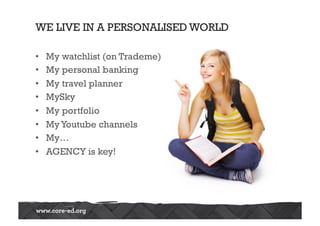
WE LIVE IN A PERSONALISED WORLD
•  My watchlist (on Trademe)
•  My personal banking
•  My travel planner
•  MySky
•  My portfolio
•  MyYoutube channels
•  My…
•  AGENCY is key!
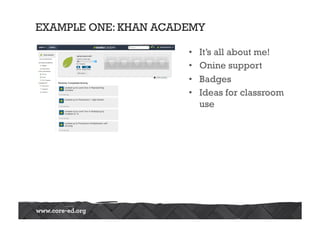
EXAMPLE ONE: KHAN ACADEMY
•  It’s all about me!
•  Onine support
•  Badges
•  Ideas for classroom
use
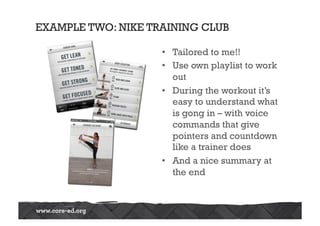
EXAMPLE TWO: NIKE TRAINING CLUB
•  Tailored to me!!
•  Use own playlist to work
out
•  During the workout it’s
easy to understand what
is gong in – with voice
commands that give
pointers and countdown
like a trainer does
•  And a nice summary at
the end
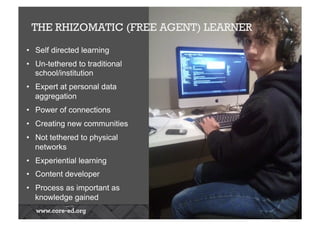
THE RHIZOMATIC (FREE AGENT) LEARNER
•  Self directed learning
•  Un-tethered to traditional
school/institution
•  Expert at personal data
aggregation
•  Power of connections
•  Creating new communities
•  Not tethered to physical
networks
•  Experiential learning
•  Content developer
•  Process as important as
knowledge gained
CHALLENGES
•  Do our learners have to adapt to
our way of doing things, or do
we adapt to theirs?
•  Are we focused on delivery – or
learning experience?
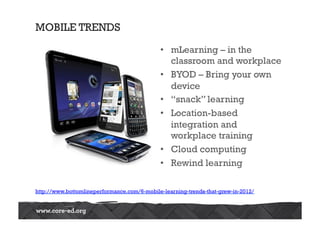
MOBILE TRENDS
•  mLearning – in the
classroom and workplace
•  BYOD – Bring your own
device
•  “snack” learning
•  Location-based
integration and
workplace training
•  Cloud computing
•  Rewind learning
http://www.bottomlineperformance.com/6-mobile-learning-trends-that-grew-in-2012/
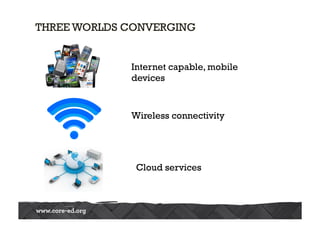
THREE WORLDS CONVERGING
Internet capable, mobile
devices
Wireless connectivity
Cloud services
CHALLENGE
Have we grasped how significantly
student access to technology has
changed their expectations as
learners?
In a world where information is
always accessible, how will
teaching and learning change?
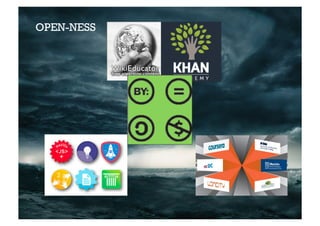
OPEN-NESS
CHALLENGES
•  Is the content you develop
available under a CC license?
•  How open are you prepared to
make your programmes?
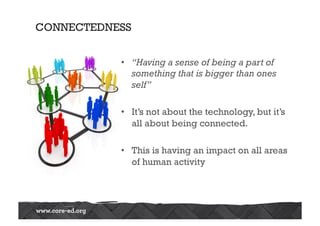
•  “Having a sense of being a part of
something that is bigger than ones
self”
•  It’s not about the technology, but it’s
all about being connected.
•  This is having an impact on all areas
of human activity
CONNECTEDNESS
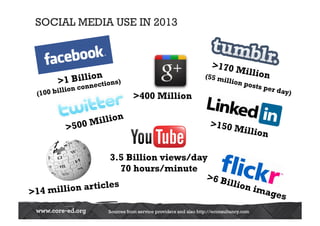
>1 Billion
(100 billion connections)
>500 Million
>150 Million
>14 million articles
>6 Billion images
Sources from service providers and also http://econsultancy.com
3.5 Billion views/day
70 hours/minute
>400 Million
>170 Million(55 million posts per day)
SOCIAL MEDIA USE IN 2013
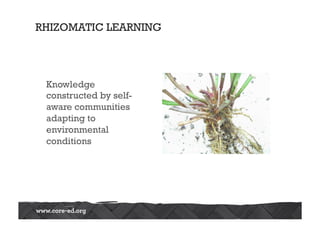
RHIZOMATIC LEARNING
Knowledge
constructed by self-
aware communities
adapting to
environmental
conditions
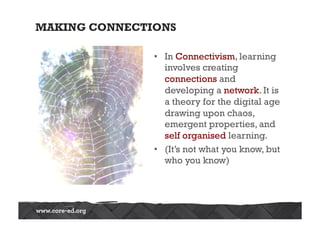
MAKING CONNECTIONS
•  In Connectivism, learning
involves creating
connections and
developing a network. It is
a theory for the digital age
drawing upon chaos,
emergent properties, and
self organised learning.
•  (It’s not what you know, but
who you know)
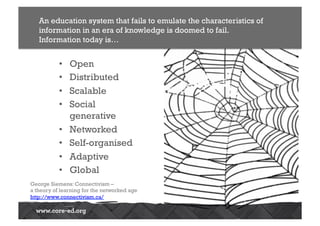
•  Open
•  Distributed
•  Scalable
•  Social
generative
•  Networked
•  Self-organised
•  Adaptive
•  Global
An education system that fails to emulate the characteristics of
information in an era of knowledge is doomed to fail.
Information today is…
George Siemens: Connectivism –
a theory of learning for the networked age
http://www.connectivism.ca/
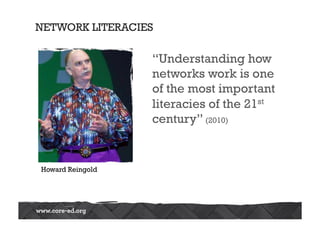
NETWORK LITERACIES
“Understanding how
networks work is one
of the most important
literacies of the 21st
century” (2010)
Howard Reingold
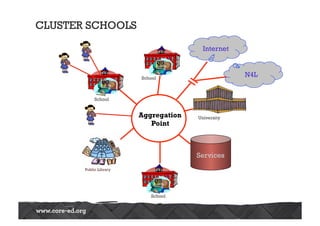
CLUSTER SCHOOLS
School A
School A
School A
Services	

Internet	

School	

School	

School	

Public Library	

University	

N4L	

Aggregation
Point
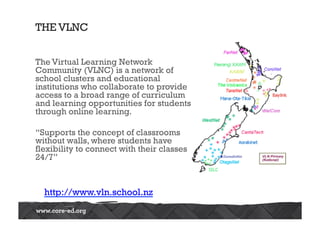
THE VLNC
The Virtual Learning Network
Community (VLNC) is a network of
school clusters and educational
institutions who collaborate to provide 
access to a broad range of curriculum
and learning opportunities for students
through online learning.
“Supports the concept of classrooms
without walls, where students have
flexibility to connect with their classes
24/7”
http://www.vln.school.nz
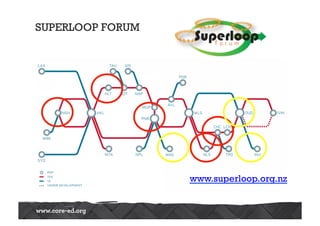
SUPERLOOP FORUM
www.superloop.org.nz
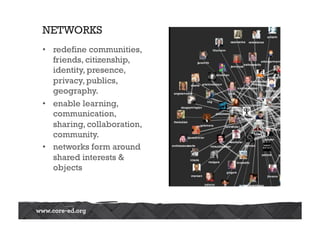
NETWORKS
•  redefine communities,
friends, citizenship,
identity, presence,
privacy, publics,
geography.
•  enable learning,
communication,
sharing, collaboration,
community.
•  networks form around
shared interests &
objects
NETWORK LITERACIES
“Understanding how
networks work is one
of the most important
literacies of the 21st
century” (2010)
Howard Reingold
www.superloop.org.nz
How will your institution
negotiate the new ecology of
learning?
What will a distance education
institution look like in the
future?
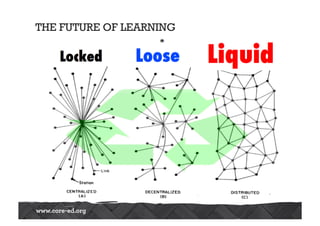
THE FUTURE OF LEARNING
School A
Schools
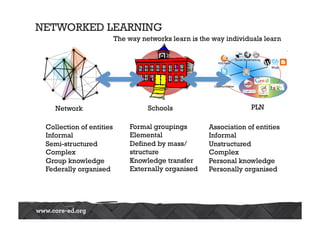
NETWORKED LEARNING
Network PLN
Collection of entities
Informal
Semi-structured
Complex
Group knowledge
Federally organised
Formal groupings
Elemental
Defined by mass/
structure
Knowledge transfer
Externally organised
Association of entities
Informal
Unstructured
Complex
Personal knowledge
Personally organised
The way networks learn is the way individuals learn
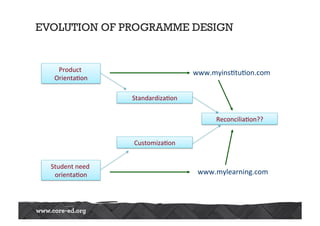
EVOLUTION OF PROGRAMME DESIGN
Product	
  	
  
Orienta9on	
  
Student	
  need	
  
orienta9on	
  
Standardiza9on	
  
Customiza9on	
  
Reconcilia9on??	
  
www.myins9tu9on.com	
  
www.mylearning.com	
  
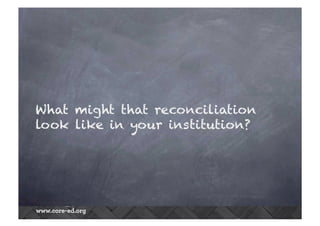
What might that reconciliation
look like in your institution?
Derek Wenmoth
Email: derek@core-ed.org
Blog: http://blog.core-ed.org/derek
Skype: <dwenmoth>

Learning in a networked world

  • 1.
    AUSTRALASIAN ASSOCIATION OFDISTANCE EDUCATION SCHOOLS ANNUAL CONFERENCE 2013 – MELBOURNE SEPTEMBER 11 - 13 Learning in a networked world
  • 2.
    THE FUTURE? •  Rememberthe Jetsons? •  Robots cleaning house •  Machines in the kitchen that cook food instantly •  Video phones •  Doors that open automatically •  What was their vision for schooling?
  • 3.
    THE FUTURE OFSCHOOL •  What’s different? •  Focus of attention on the front of the room •  Desks in rows •  Text books replaced by technology •  Robots teaching the class
  • 4.
    WHAT’S CHANGED? •  Focusof attention on front of room •  Desks in rows •  Teacher the primary focus of instruction •  Technology adopted to support traditional practices “Most of today’s classrooms are designed with the teacher at the centre. But if the classroom is focused on the learner instead, the learning becomes paramount!” Rick Dewar
  • 5.
    “Flipped     classroom”   Virtual     schools   THE EMERGING PARADIGM… F2F   Classrooms   Distance     Educa9on   Teaching  &   Instruc9on   F2F  using     WWW   DE  using    LMS   Knowledge           Networkss   Online/ eLearning   Blended   learning   Networked   Learning   First Then Now Next
  • 6.
    WHAT ARE THEGAME CHANGERS?
  • 7.
    AGENCY •  “The powerto act” •  “Sense of ownership” •  “Executing and controlling one’s own actions” •  “Self-efficacy” •  “Personalisation”
  • 8.
    STUDENT EXPECTATIONS Washor, Eand Mohkowski, C (2013) Leaving to learn Do my teachers really know about me and my interests and talents? Do I find what the school is teaching relevant to my interests? Do I have opportunities to apply what I am learning in real world settings and contexts? Do I feel appropriately challenged in my learning? Can I pursue my learning out of the standard sequence? Do I have sufficient time to learn at my own pace? Do I have real choice about what, where and how I learn? Do I have opportunities to explore and make mistakes? Do I have opportunities to engage deeply in my learning and to practice the skills I need to lean?
  • 9.
    WE LIVE INA PERSONALISED WORLD •  My watchlist (on Trademe) •  My personal banking •  My travel planner •  MySky •  My portfolio •  MyYoutube channels •  My… •  AGENCY is key!
  • 10.
    EXAMPLE ONE: KHANACADEMY •  It’s all about me! •  Onine support •  Badges •  Ideas for classroom use
  • 11.
    EXAMPLE TWO: NIKETRAINING CLUB •  Tailored to me!! •  Use own playlist to work out •  During the workout it’s easy to understand what is gong in – with voice commands that give pointers and countdown like a trainer does •  And a nice summary at the end
  • 12.
    THE RHIZOMATIC (FREEAGENT) LEARNER •  Self directed learning •  Un-tethered to traditional school/institution •  Expert at personal data aggregation •  Power of connections •  Creating new communities •  Not tethered to physical networks •  Experiential learning •  Content developer •  Process as important as knowledge gained
  • 13.
    CHALLENGES •  Do ourlearners have to adapt to our way of doing things, or do we adapt to theirs? •  Are we focused on delivery – or learning experience?
  • 15.
    MOBILE TRENDS •  mLearning– in the classroom and workplace •  BYOD – Bring your own device •  “snack” learning •  Location-based integration and workplace training •  Cloud computing •  Rewind learning http://www.bottomlineperformance.com/6-mobile-learning-trends-that-grew-in-2012/
  • 16.
    THREE WORLDS CONVERGING Internetcapable, mobile devices Wireless connectivity Cloud services
  • 17.
    CHALLENGE Have we graspedhow significantly student access to technology has changed their expectations as learners? In a world where information is always accessible, how will teaching and learning change?
  • 18.
  • 20.
    CHALLENGES •  Is thecontent you develop available under a CC license? •  How open are you prepared to make your programmes?
  • 21.
    •  “Having asense of being a part of something that is bigger than ones self” •  It’s not about the technology, but it’s all about being connected. •  This is having an impact on all areas of human activity CONNECTEDNESS
  • 22.
    >1 Billion (100 billionconnections) >500 Million >150 Million >14 million articles >6 Billion images Sources from service providers and also http://econsultancy.com 3.5 Billion views/day 70 hours/minute >400 Million >170 Million(55 million posts per day) SOCIAL MEDIA USE IN 2013
  • 23.
    RHIZOMATIC LEARNING Knowledge constructed byself- aware communities adapting to environmental conditions
  • 24.
    MAKING CONNECTIONS •  InConnectivism, learning involves creating connections and developing a network. It is a theory for the digital age drawing upon chaos, emergent properties, and self organised learning. •  (It’s not what you know, but who you know)
  • 25.
    •  Open •  Distributed • Scalable •  Social generative •  Networked •  Self-organised •  Adaptive •  Global An education system that fails to emulate the characteristics of information in an era of knowledge is doomed to fail. Information today is… George Siemens: Connectivism – a theory of learning for the networked age http://www.connectivism.ca/
  • 26.
    NETWORK LITERACIES “Understanding how networkswork is one of the most important literacies of the 21st century” (2010) Howard Reingold
  • 27.
    CLUSTER SCHOOLS School A SchoolA School A Services Internet School School School Public Library University N4L Aggregation Point
  • 28.
    THE VLNC The VirtualLearning Network Community (VLNC) is a network of school clusters and educational institutions who collaborate to provide  access to a broad range of curriculum and learning opportunities for students through online learning. “Supports the concept of classrooms without walls, where students have flexibility to connect with their classes 24/7” http://www.vln.school.nz
  • 29.
  • 30.
    NETWORKS •  redefine communities, friends,citizenship, identity, presence, privacy, publics, geography. •  enable learning, communication, sharing, collaboration, community. •  networks form around shared interests & objects
  • 31.
    NETWORK LITERACIES “Understanding how networkswork is one of the most important literacies of the 21st century” (2010) Howard Reingold
  • 32.
  • 33.
    How will yourinstitution negotiate the new ecology of learning? What will a distance education institution look like in the future?
  • 34.
    THE FUTURE OFLEARNING
  • 35.
    School A Schools NETWORKED LEARNING NetworkPLN Collection of entities Informal Semi-structured Complex Group knowledge Federally organised Formal groupings Elemental Defined by mass/ structure Knowledge transfer Externally organised Association of entities Informal Unstructured Complex Personal knowledge Personally organised The way networks learn is the way individuals learn
  • 36.
    EVOLUTION OF PROGRAMMEDESIGN Product     Orienta9on   Student  need   orienta9on   Standardiza9on   Customiza9on   Reconcilia9on??   www.myins9tu9on.com   www.mylearning.com  
  • 37.
    What might thatreconciliation look like in your institution?
  • 38.
    Derek Wenmoth Email: derek@core-ed.org Blog:http://blog.core-ed.org/derek Skype: <dwenmoth>