An Introduction to Graphic design

                By Nitisha Lokare
Basic Questions
What is graphic design?
How did it evolve?
When did the profession come into existence?
And why?


Slide 2
Definition
The term graphic design can refer to a number of artistic and
   professional disciplines which focus on visual
   communication and presentation.


 Various methods are used to create and combine
symbols, images       and/or words to create a visual
representation of ideas and messages.


 Slide 3
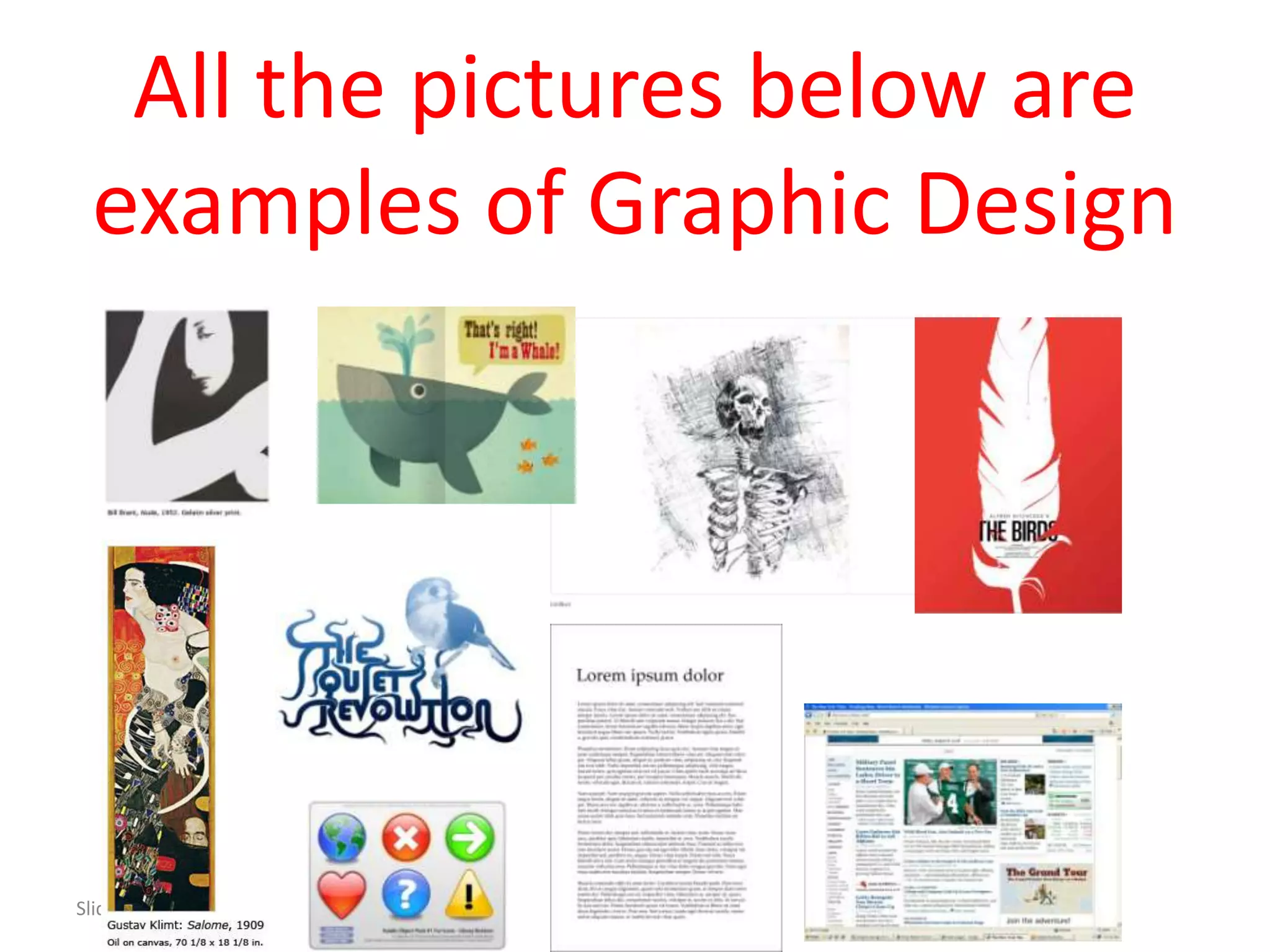
All the pictures below are
 examples of Graphic Design


Slide 4
When people need to necessarily express something, usually with an
aim towards promotion or information dispensing, the focus becomes
how best to do it.


Graphic design was born of art and technology (printing).


   Slide 5
What does a Graphic Designer do?
 When he gets a graphic design job, be it a poster design, book
 design,web design, advertising, he has to start with asking himself
 the following fundamental questions:


What is the objective of the communication
What needs to be said first and then next and then after that?
 (levels of hierarchy)
How do you want the eye to flow through the page?
What is the tone of voice?
Who are you speaking to?
Fundamental Question 1:
Objectives of the communication
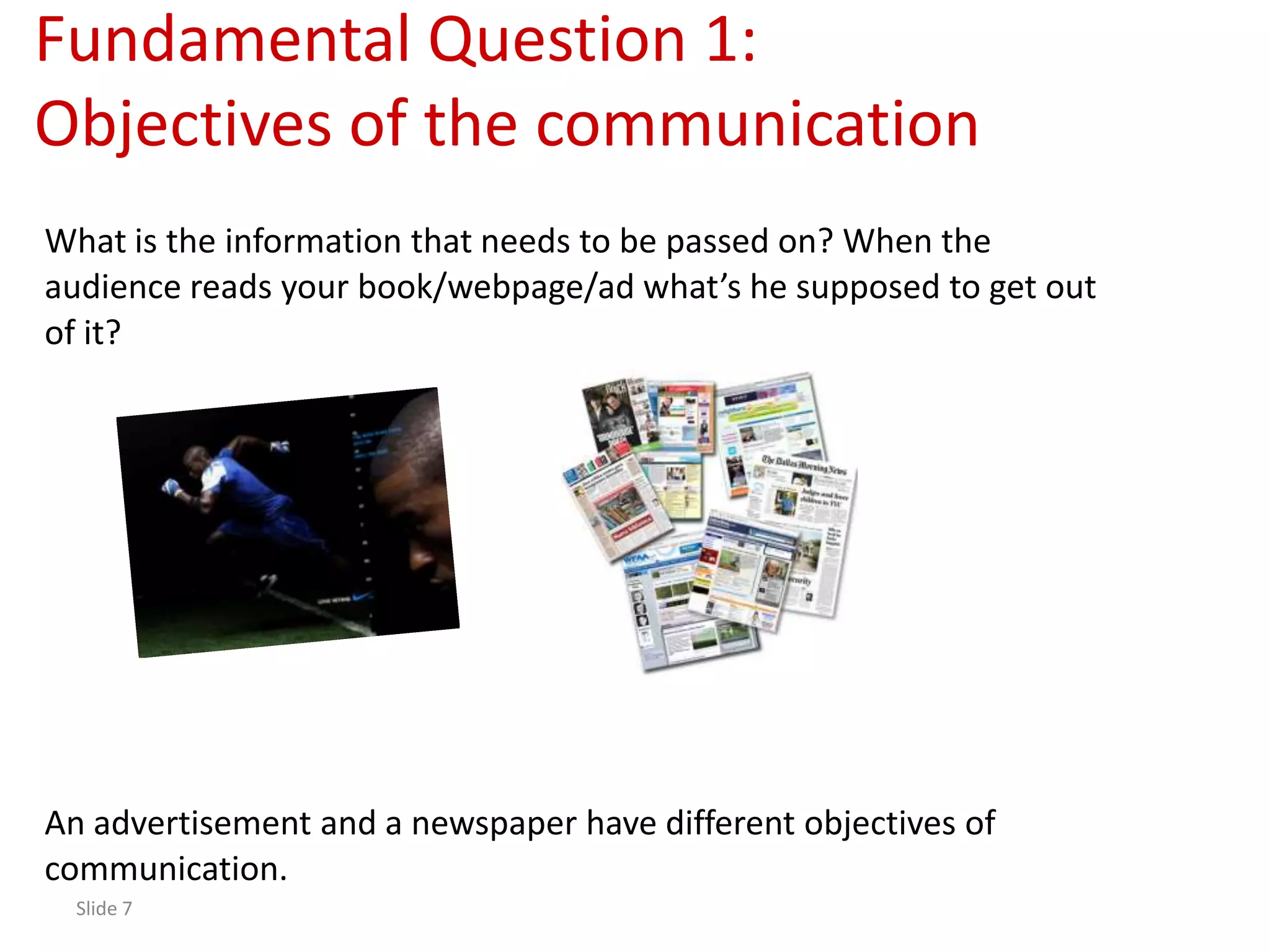
What is the information that needs to be passed on? When the
audience reads your book/webpage/ad what’s he supposed to get out
of it?


An advertisement and a newspaper have different objectives of
communication.
  Slide 7
Fundamental Question 2: What needs to be
said first and then next and then after that?
(hierarchy)
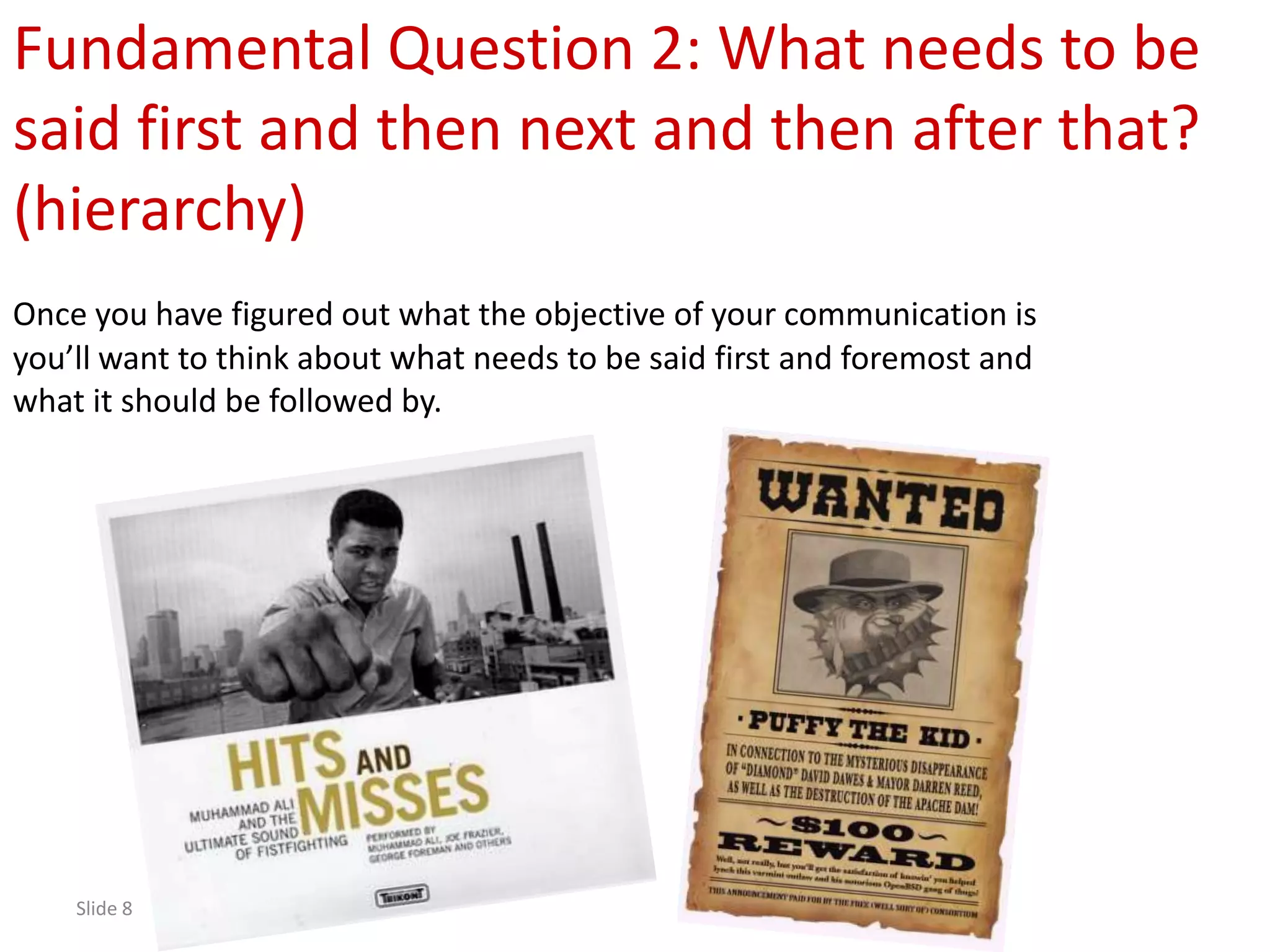
Once you have figured out what the objective of your communication is
you’ll want to think about what needs to be said first and foremost and
what it should be followed by.


    Slide 8
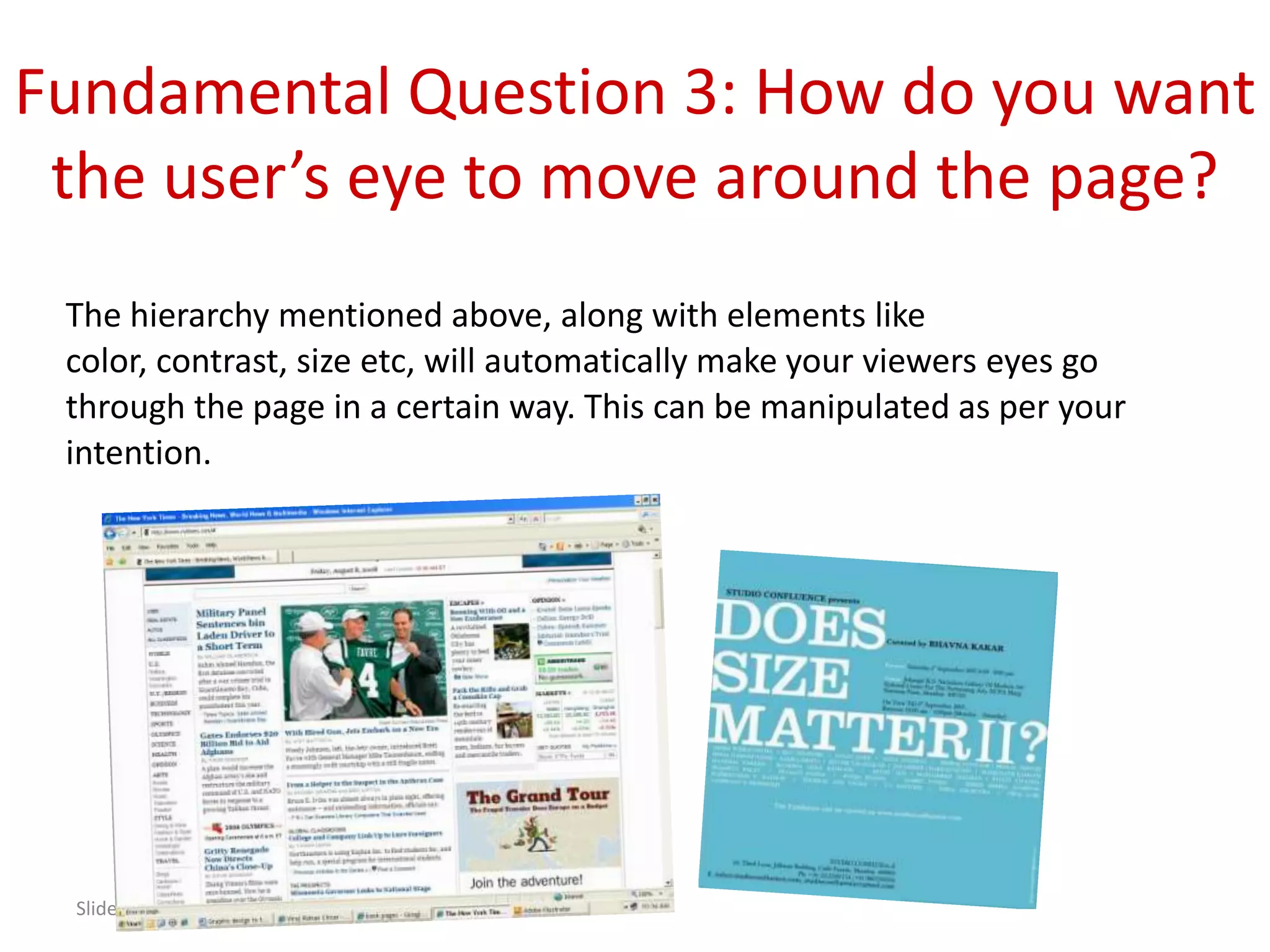
Fundamental Question 3: How do you want
 the user’s eye to move around the page?
 The hierarchy mentioned above, along with elements like
 color, contrast, size etc, will automatically make your viewers eyes go
 through the page in a certain way. This can be manipulated as per your
 intention.


  Slide 9
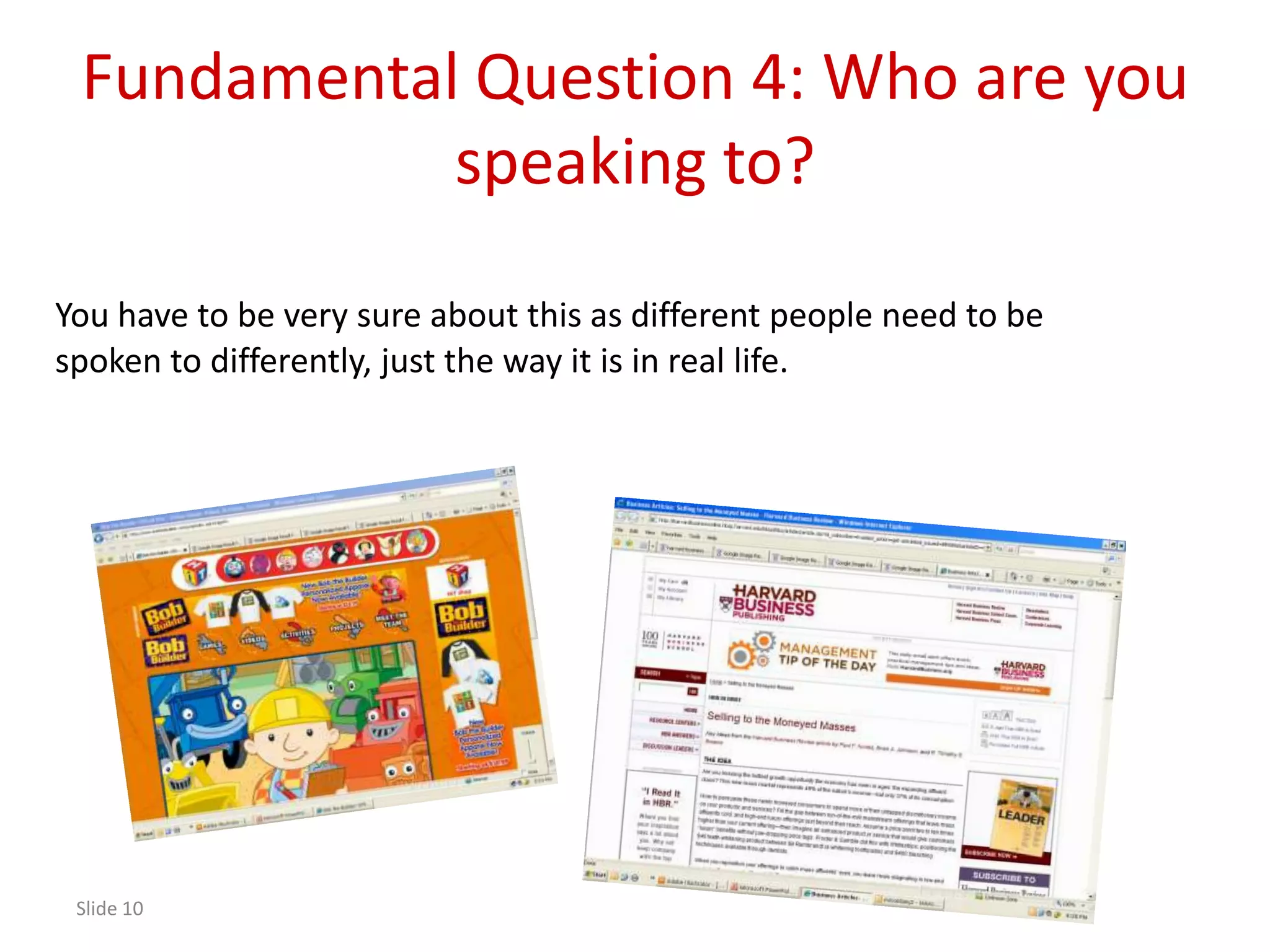
Fundamental Question 4: Who are you
            speaking to?

You have to be very sure about this as different people need to be
spoken to differently, just the way it is in real life.


 Slide 10
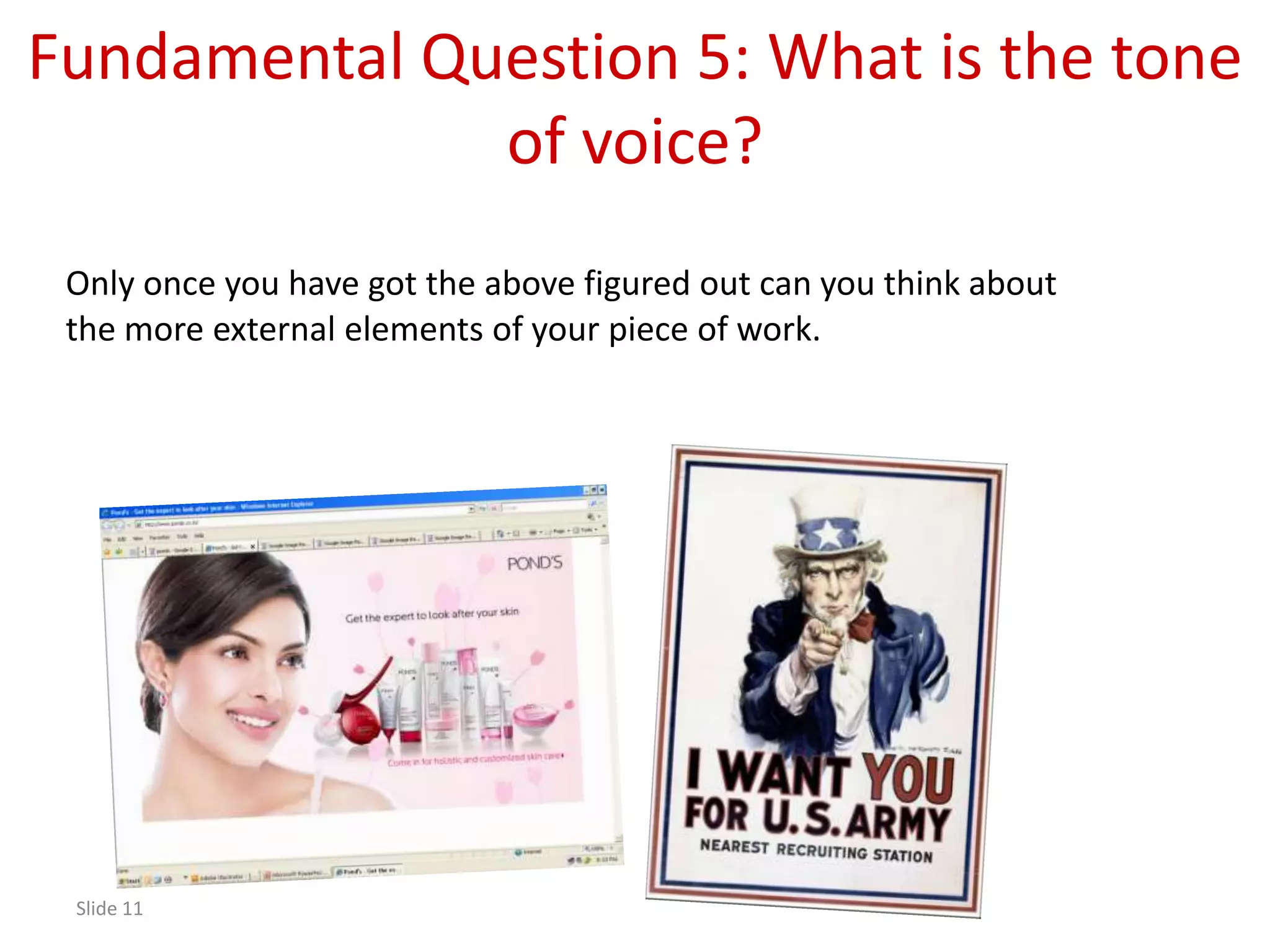
Fundamental Question 5: What is the tone
              of voice?
 Only once you have got the above figured out can you think about
 the more external elements of your piece of work.


 Slide 11
The solutions to these questions are tackled using
the graphic designer’s tool kit.


Slide 12
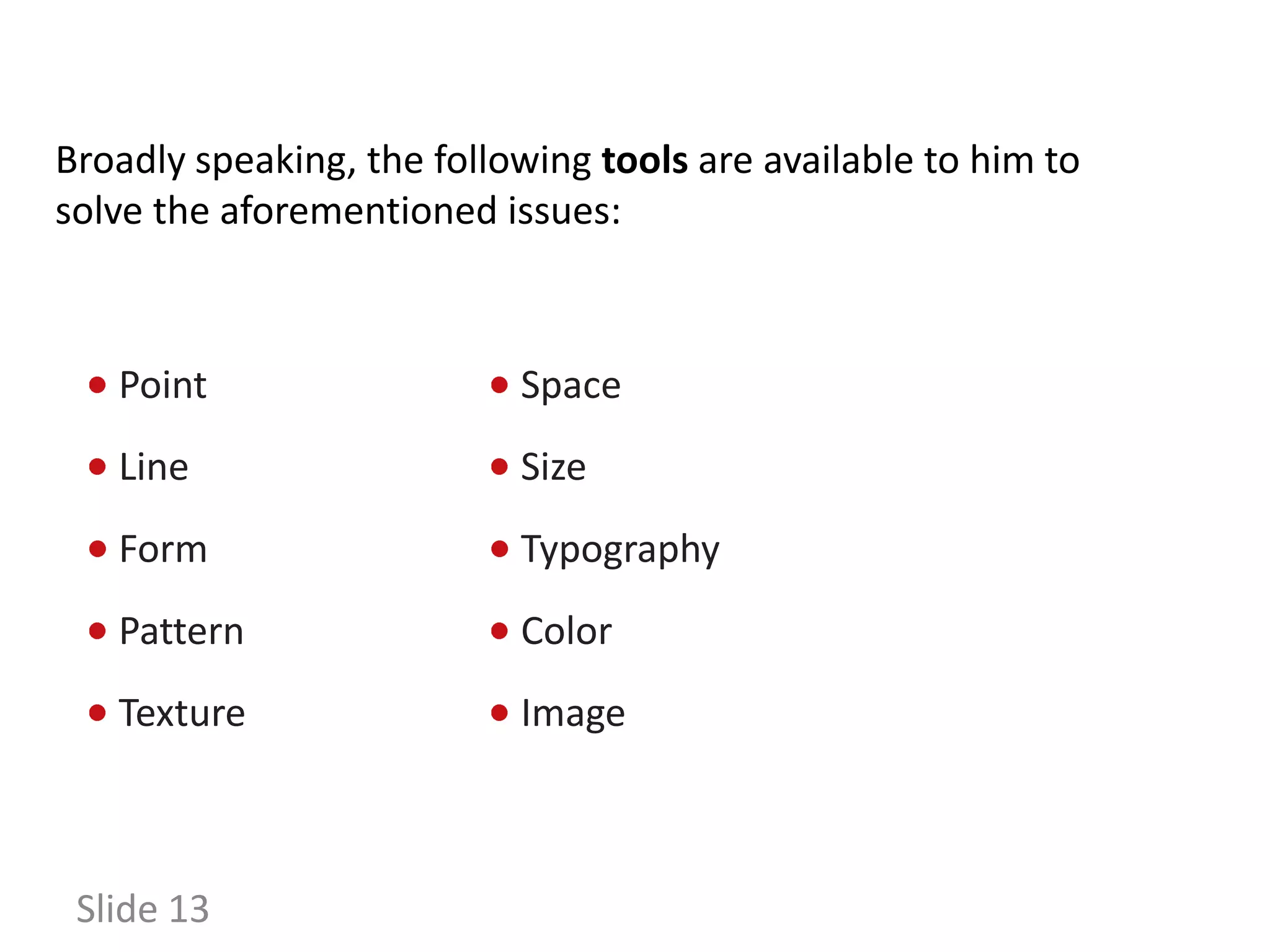
Broadly speaking, the following tools are available to him to
solve the aforementioned issues:


   Point                   Space
   Line                    Size
   Form                    Typography
   Pattern                 Color
   Texture                 Image


 Slide 13
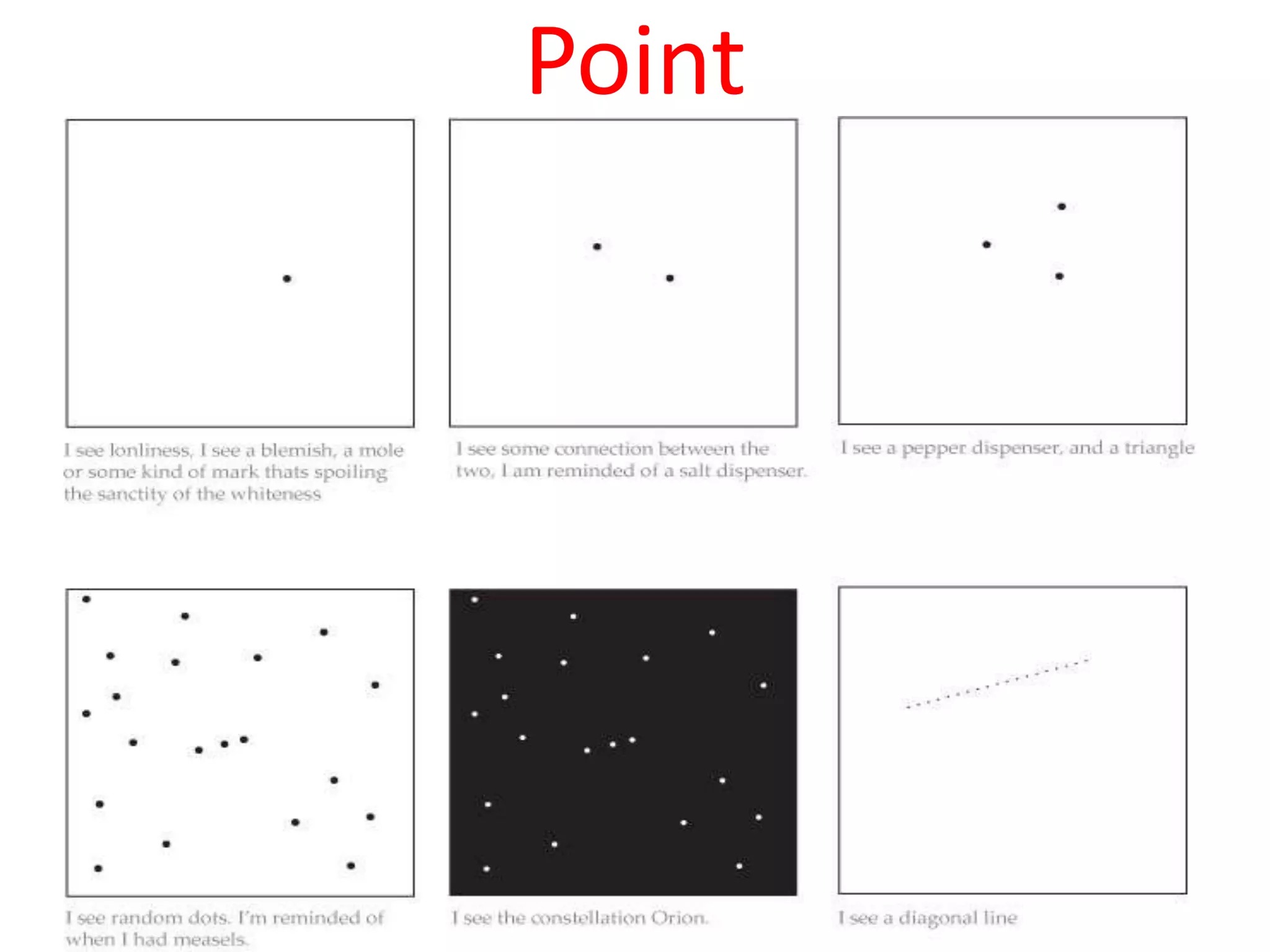
Point


        Slide 14
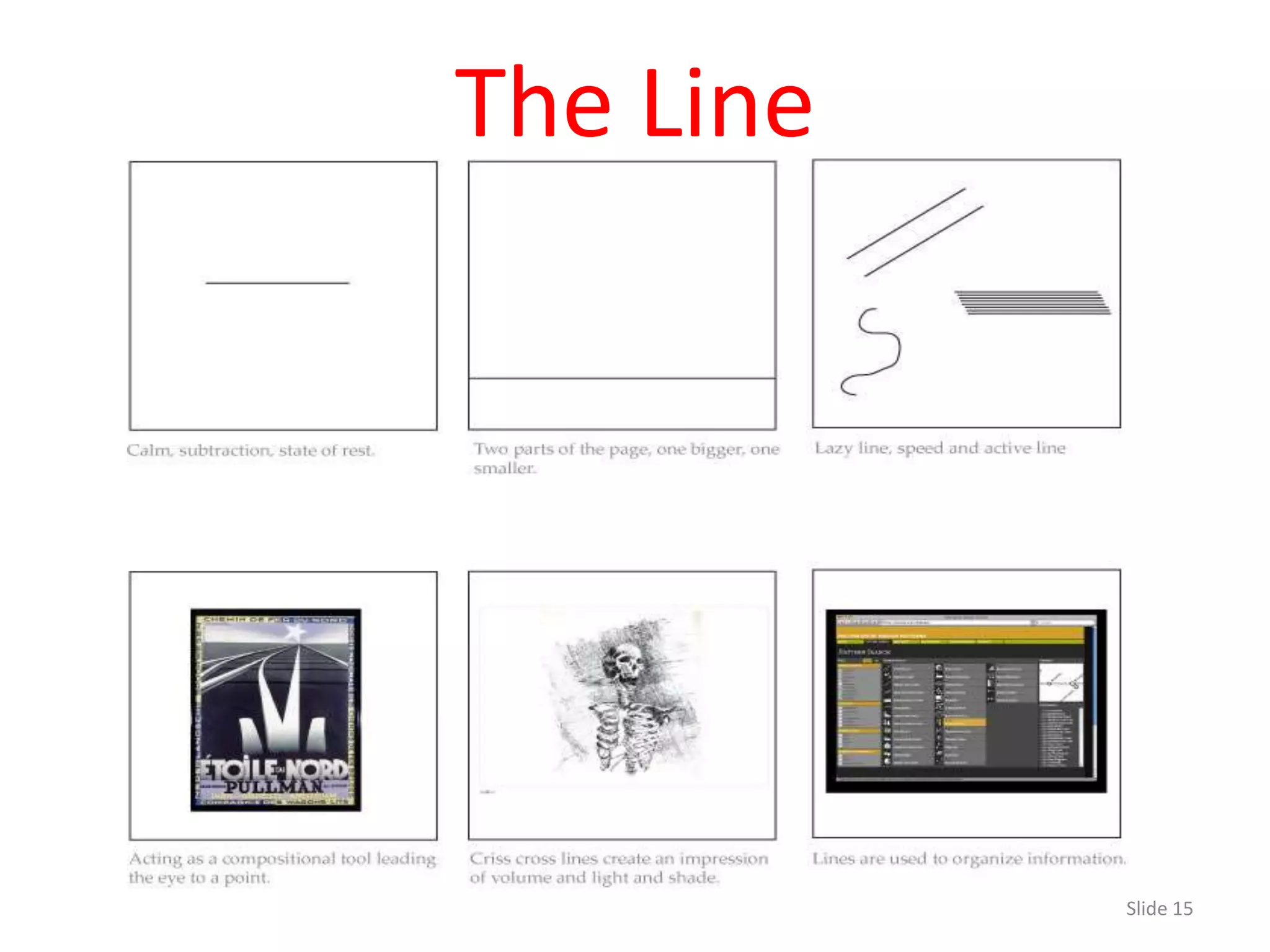
The Line


           Slide 15
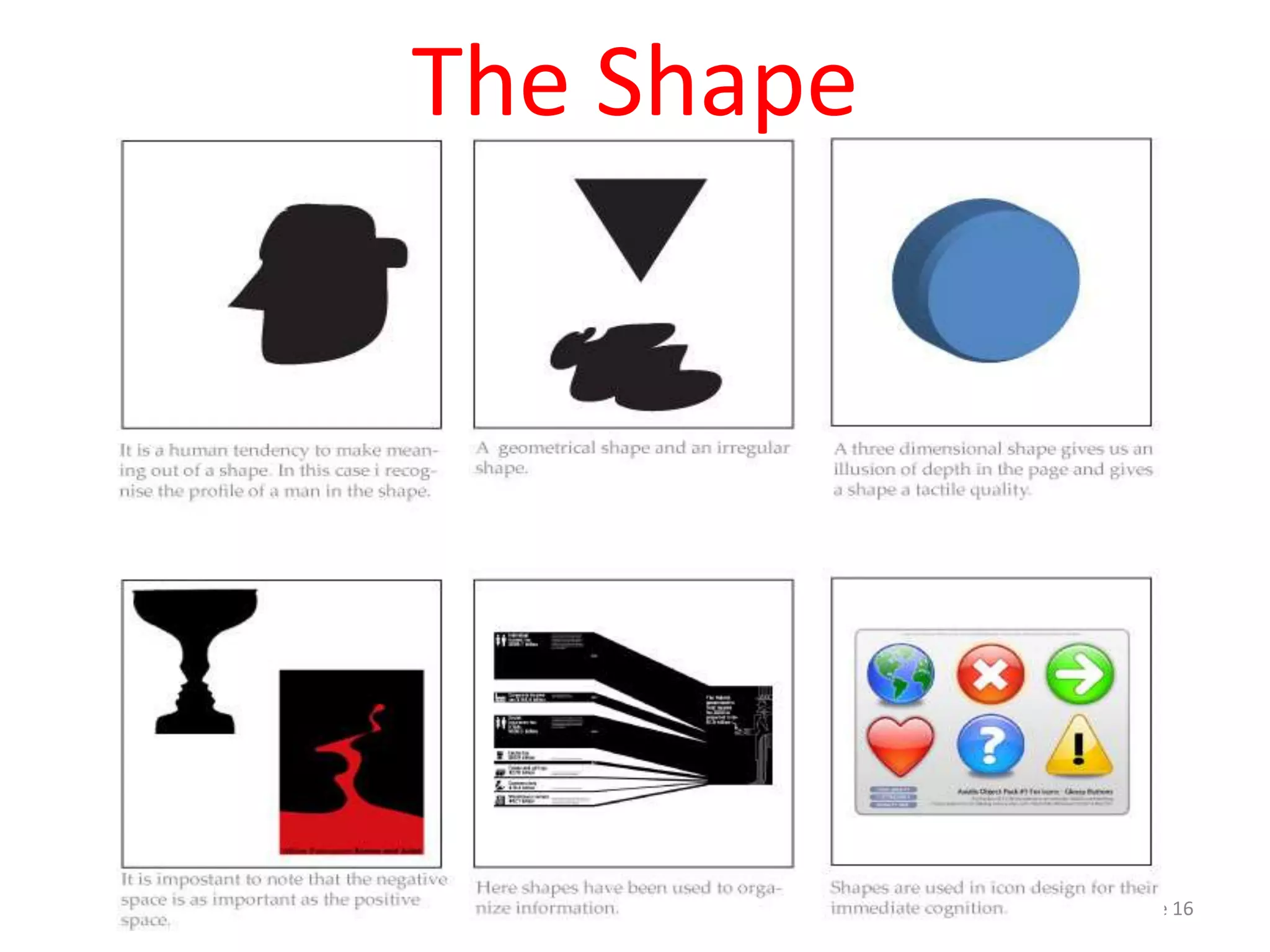
The Shape


            Slide 16
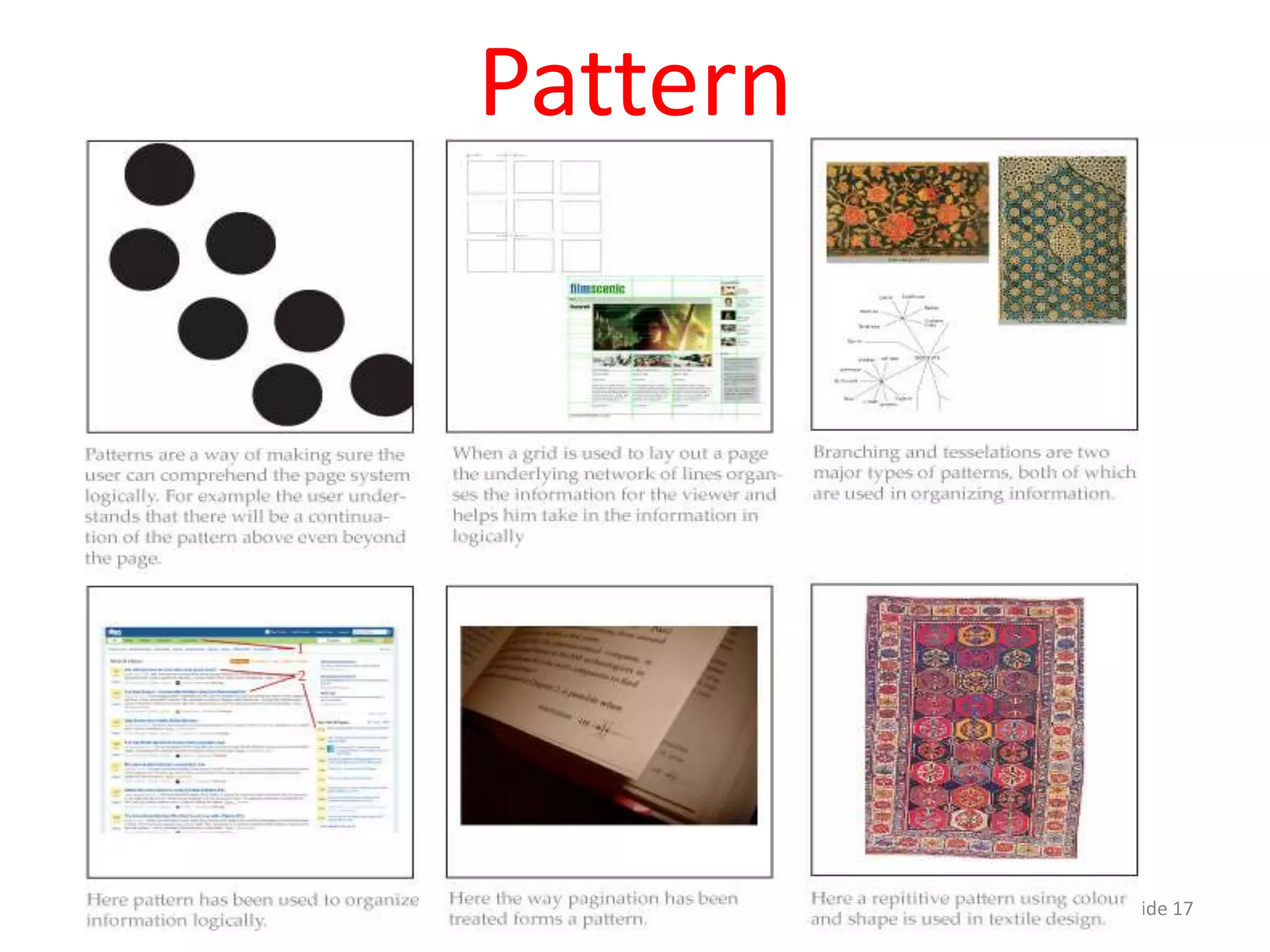
Pattern


          Slide 17
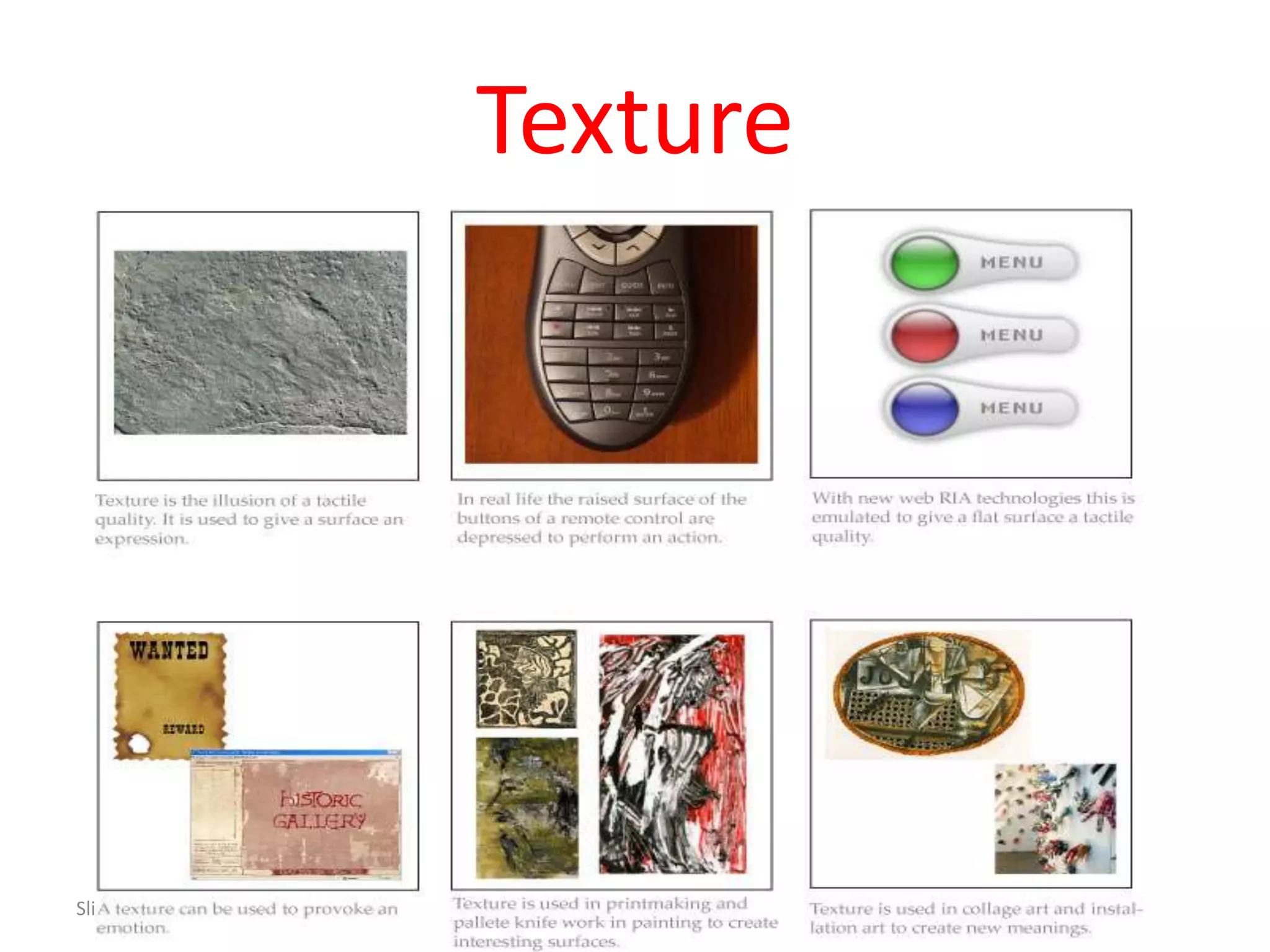
Texture


Slide 18
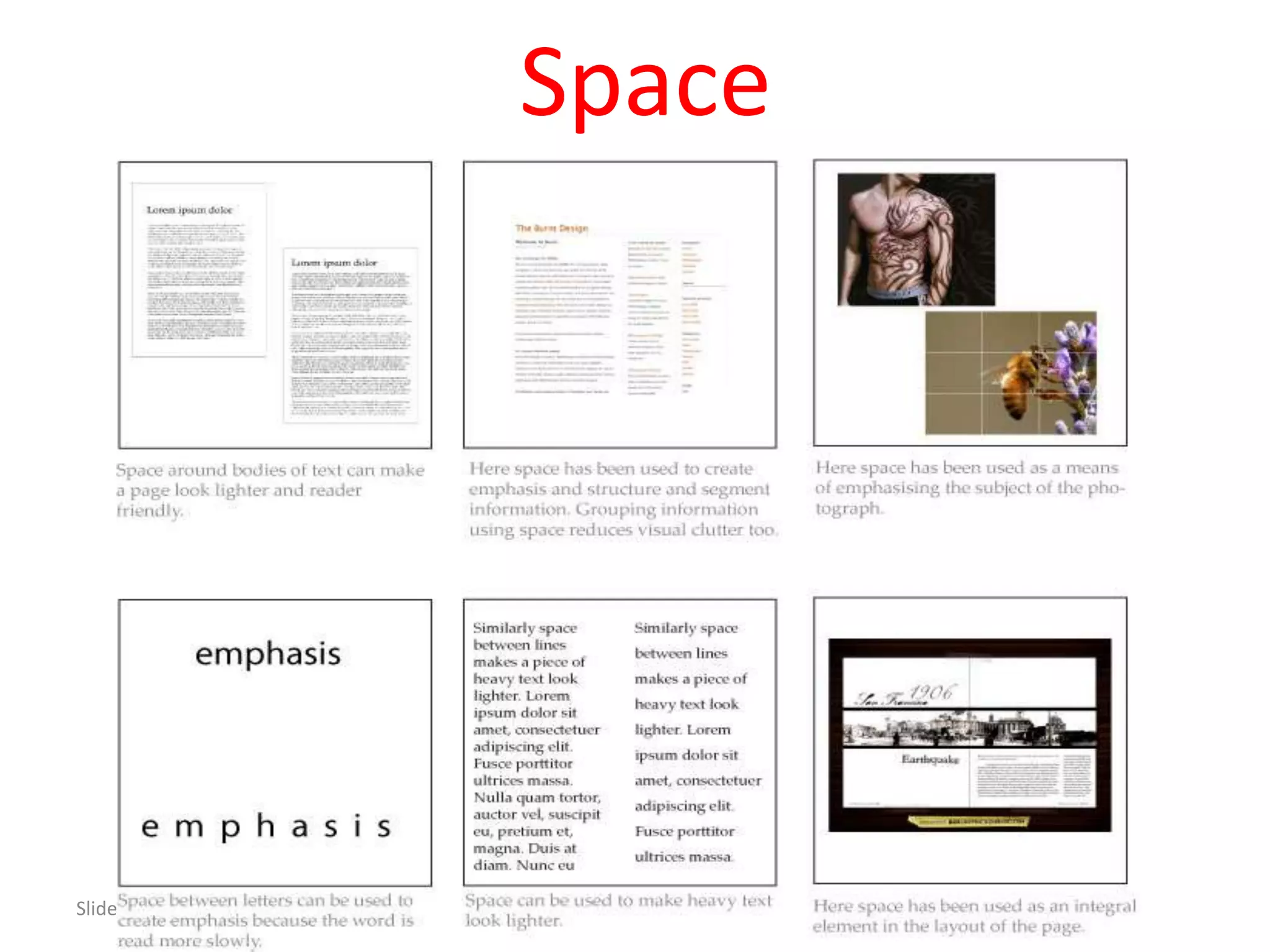
Space


Slide 19
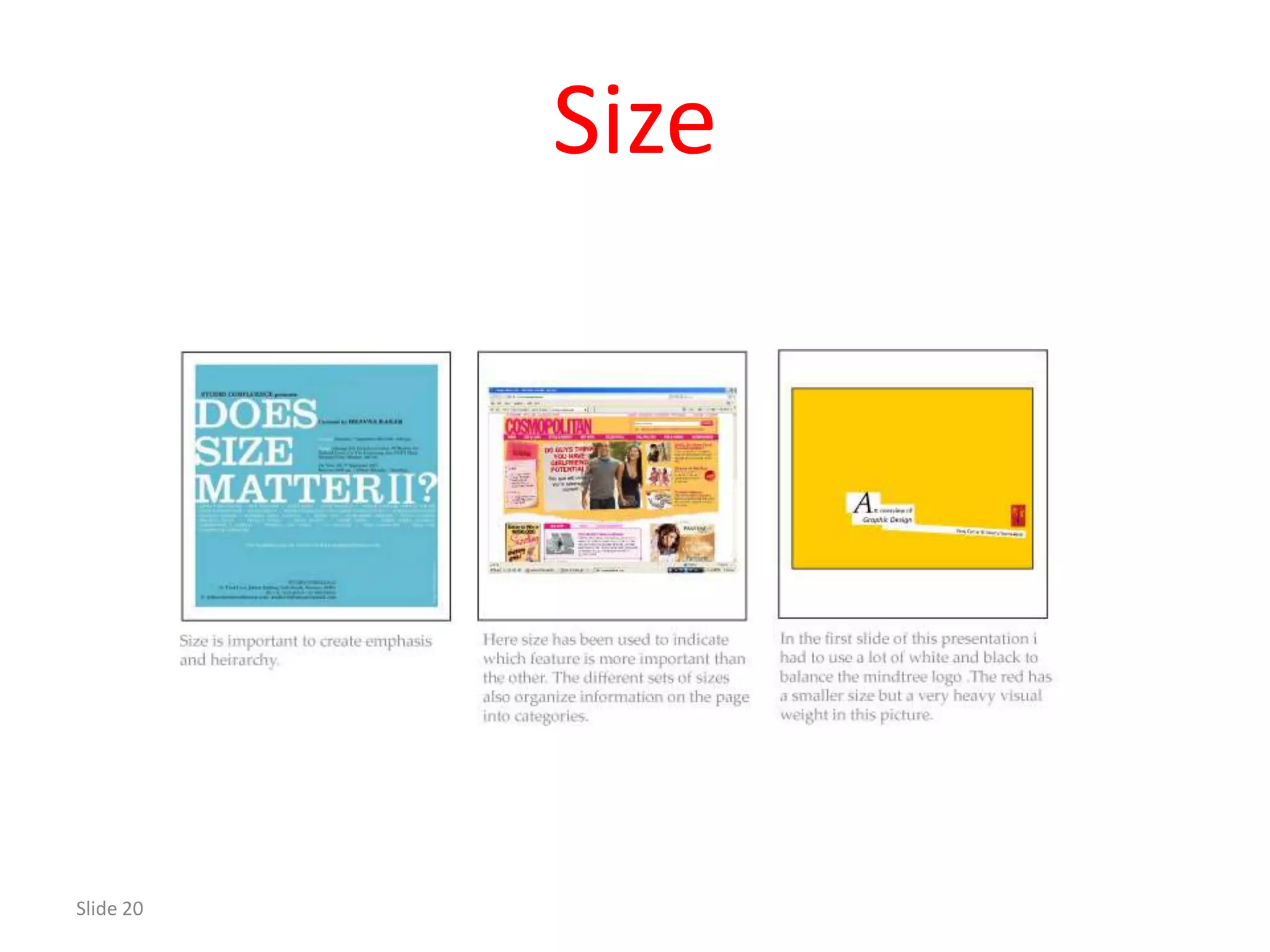
Size


Slide 20
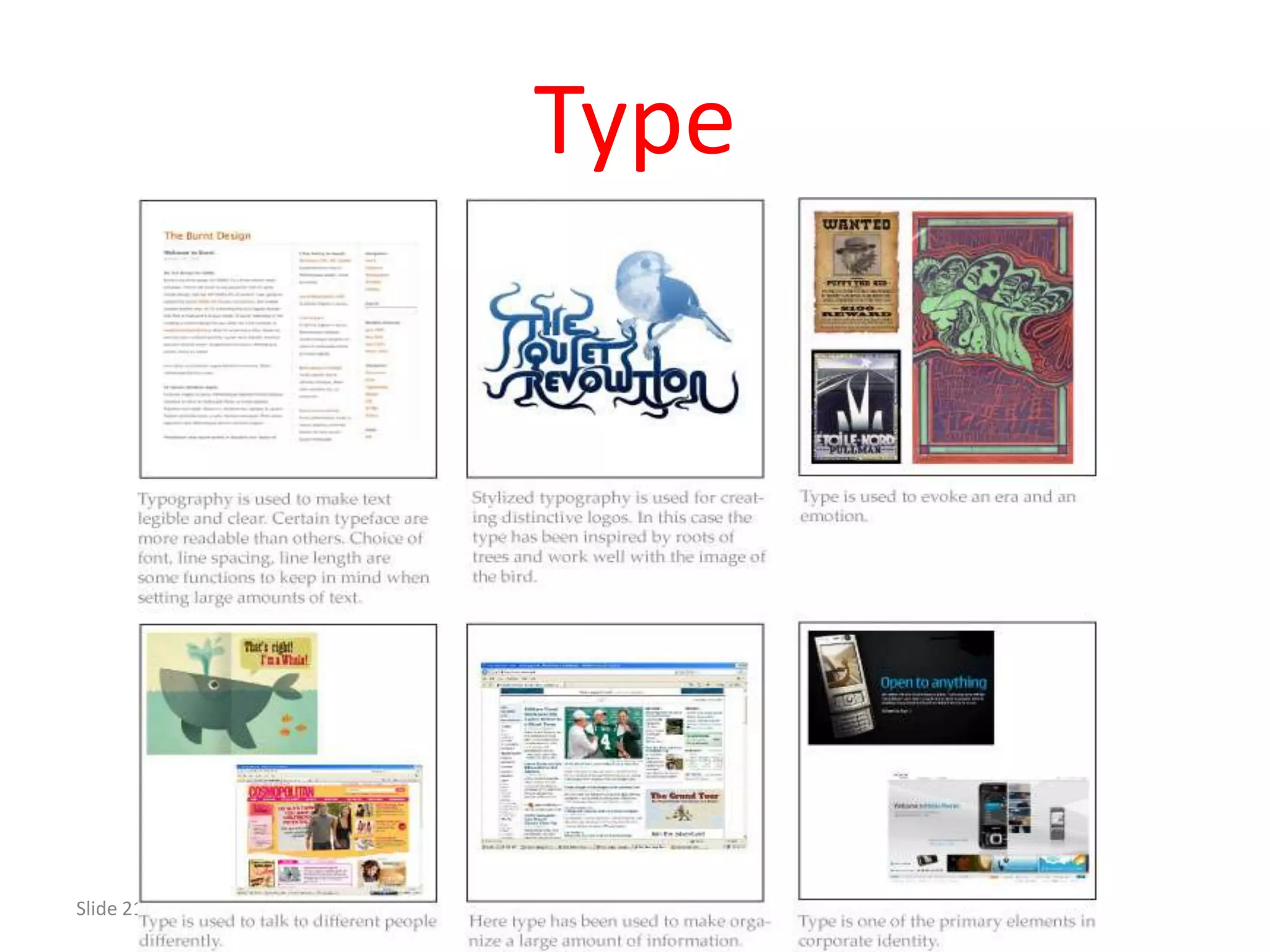
Type


Slide 21
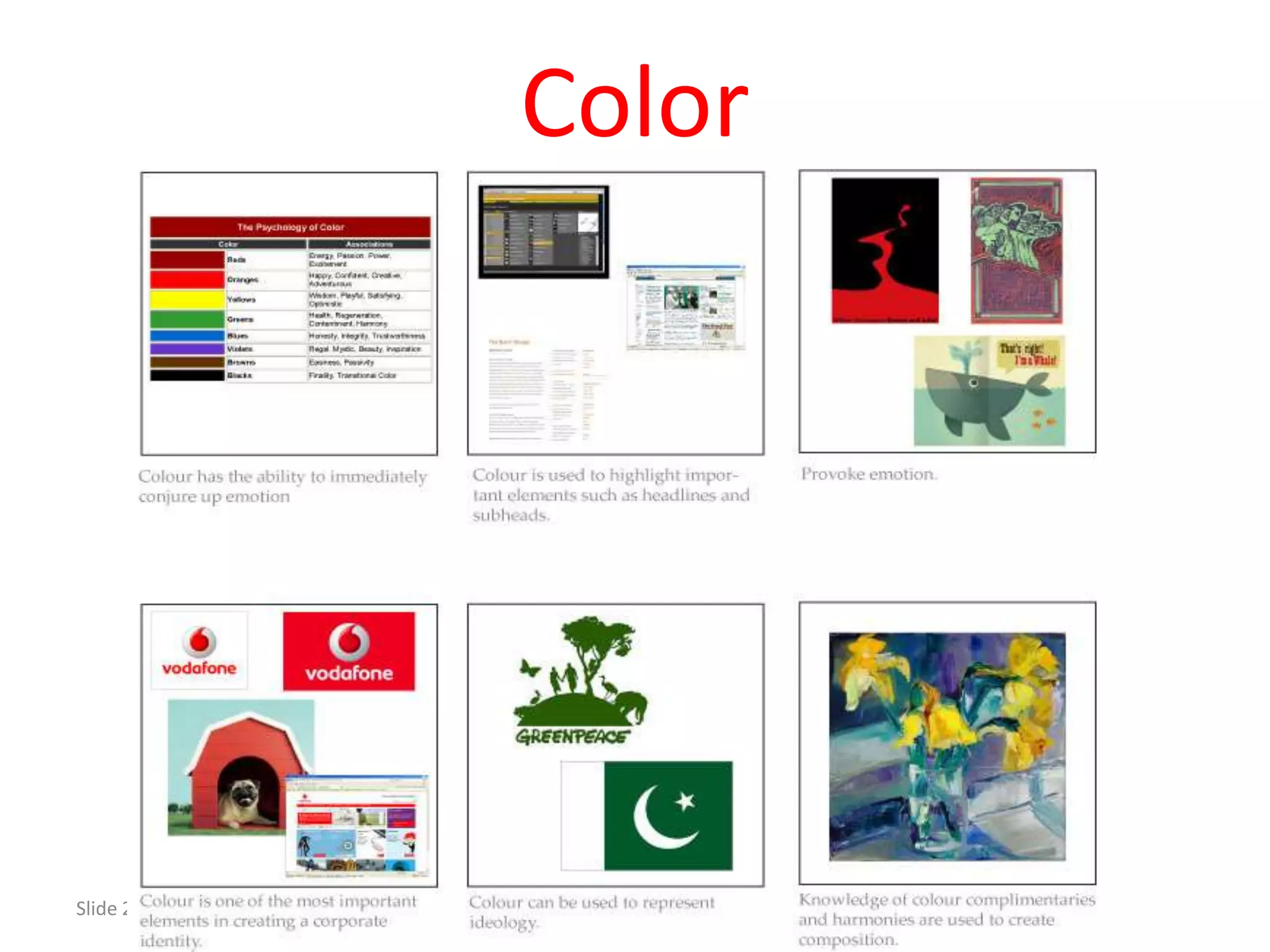
Color


Slide 22
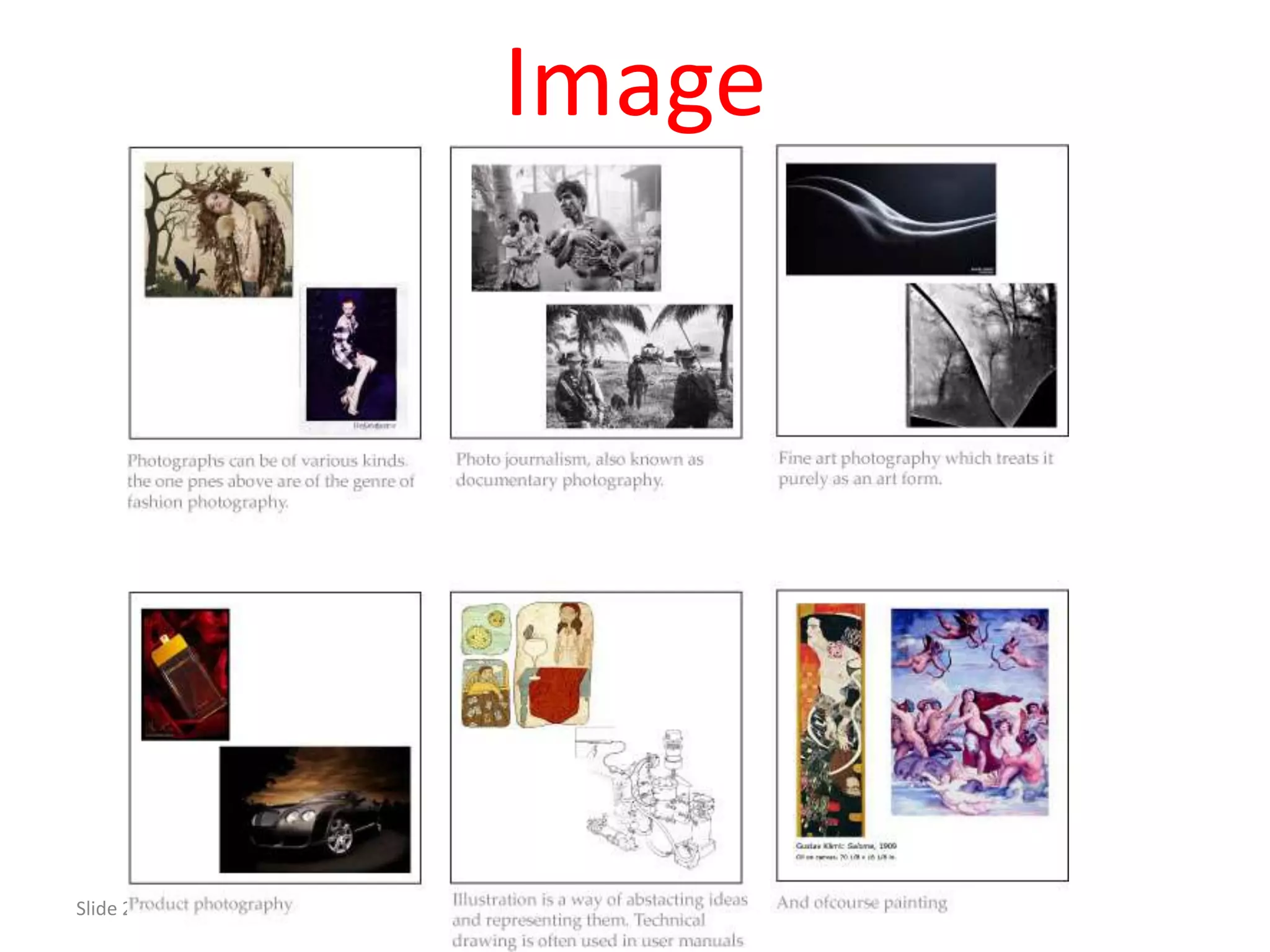
Image


Slide 23
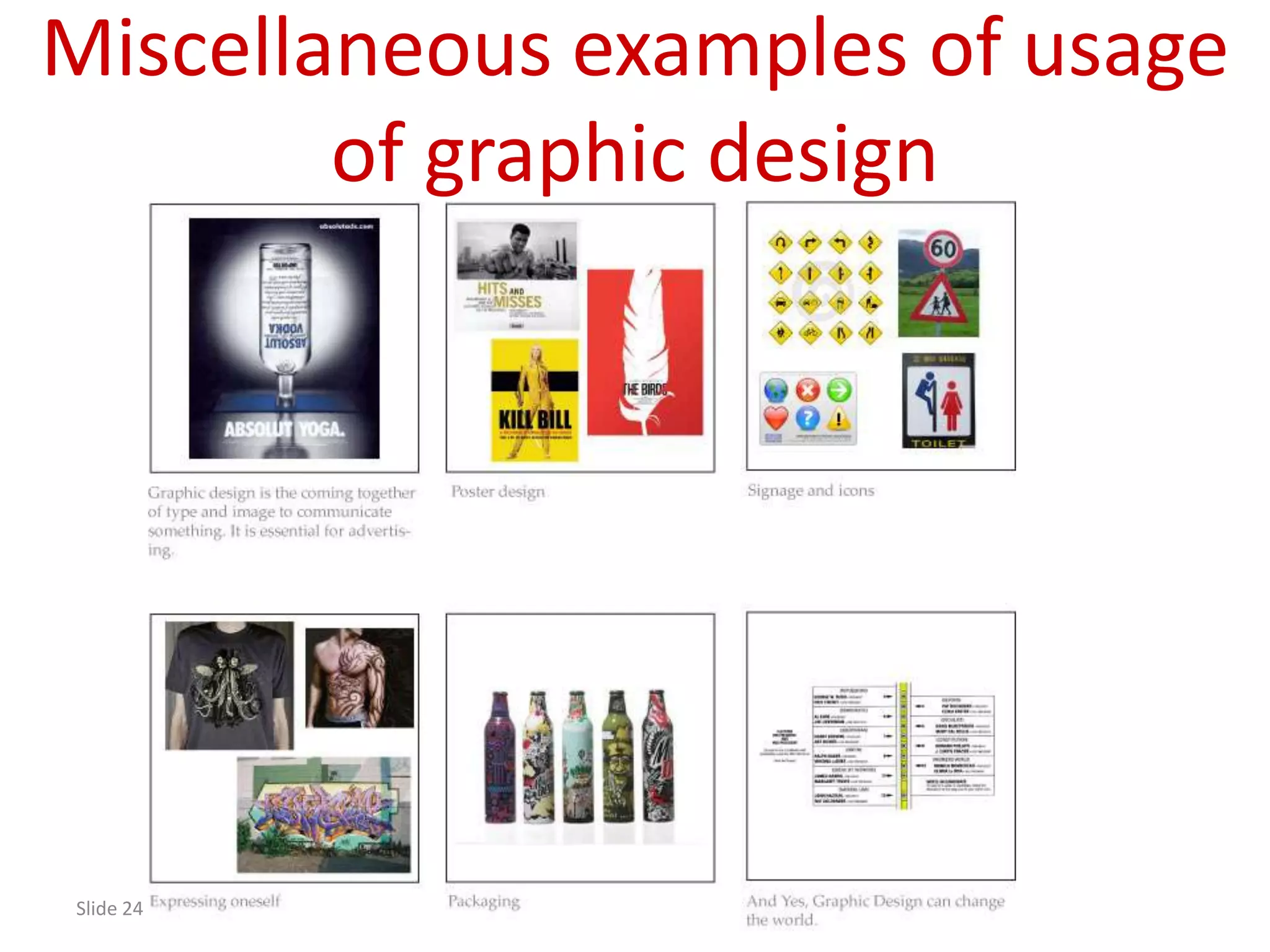
Miscellaneous examples of usage
        of graphic design


Slide 24
COLOUR THEORY
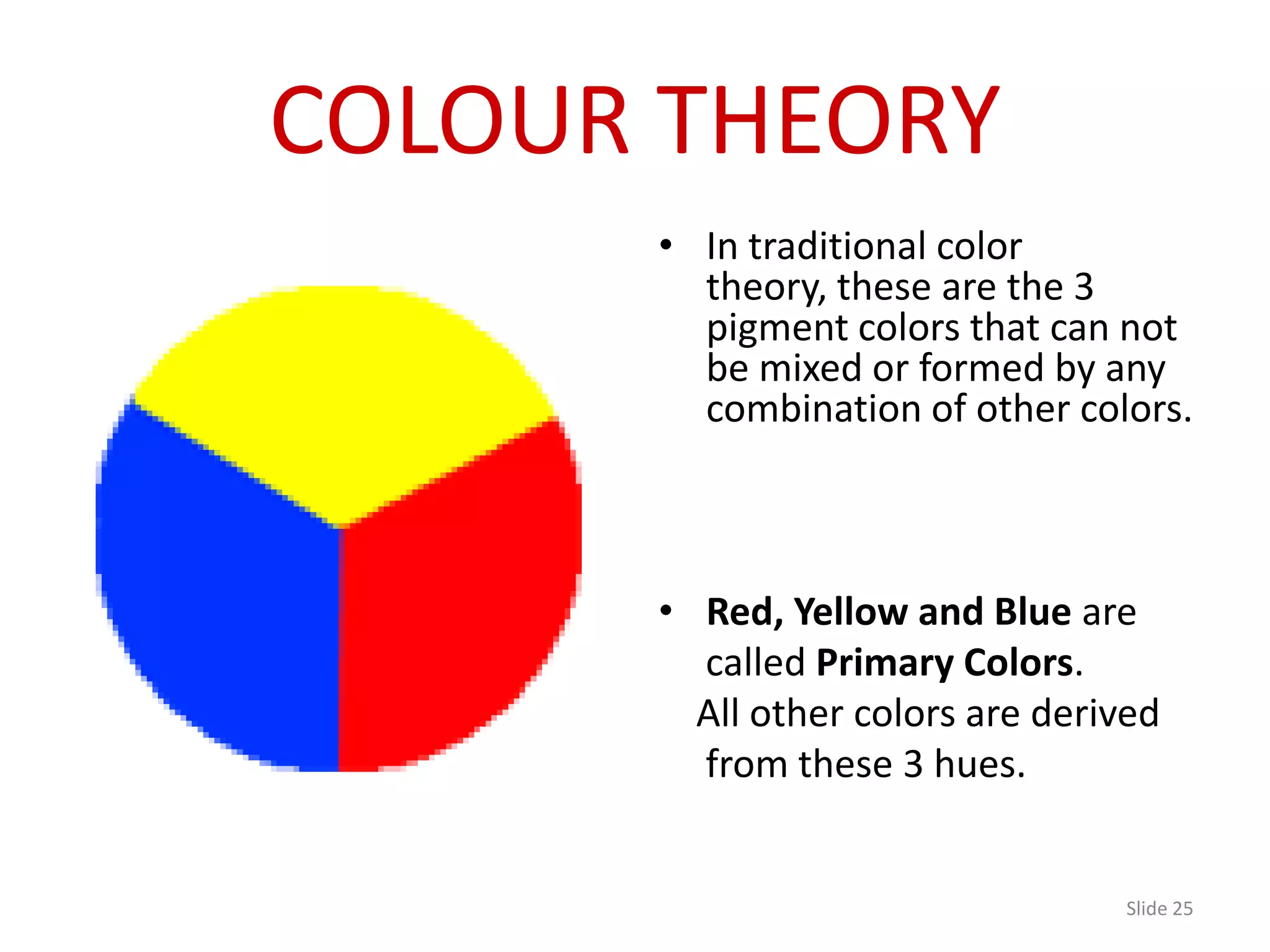
      • In traditional color
        theory, these are the 3
        pigment colors that can not
        be mixed or formed by any
        combination of other colors.


      • Red, Yellow and Blue are
        called Primary Colors.
        All other colors are derived
        from these 3 hues.


                                 Slide 25
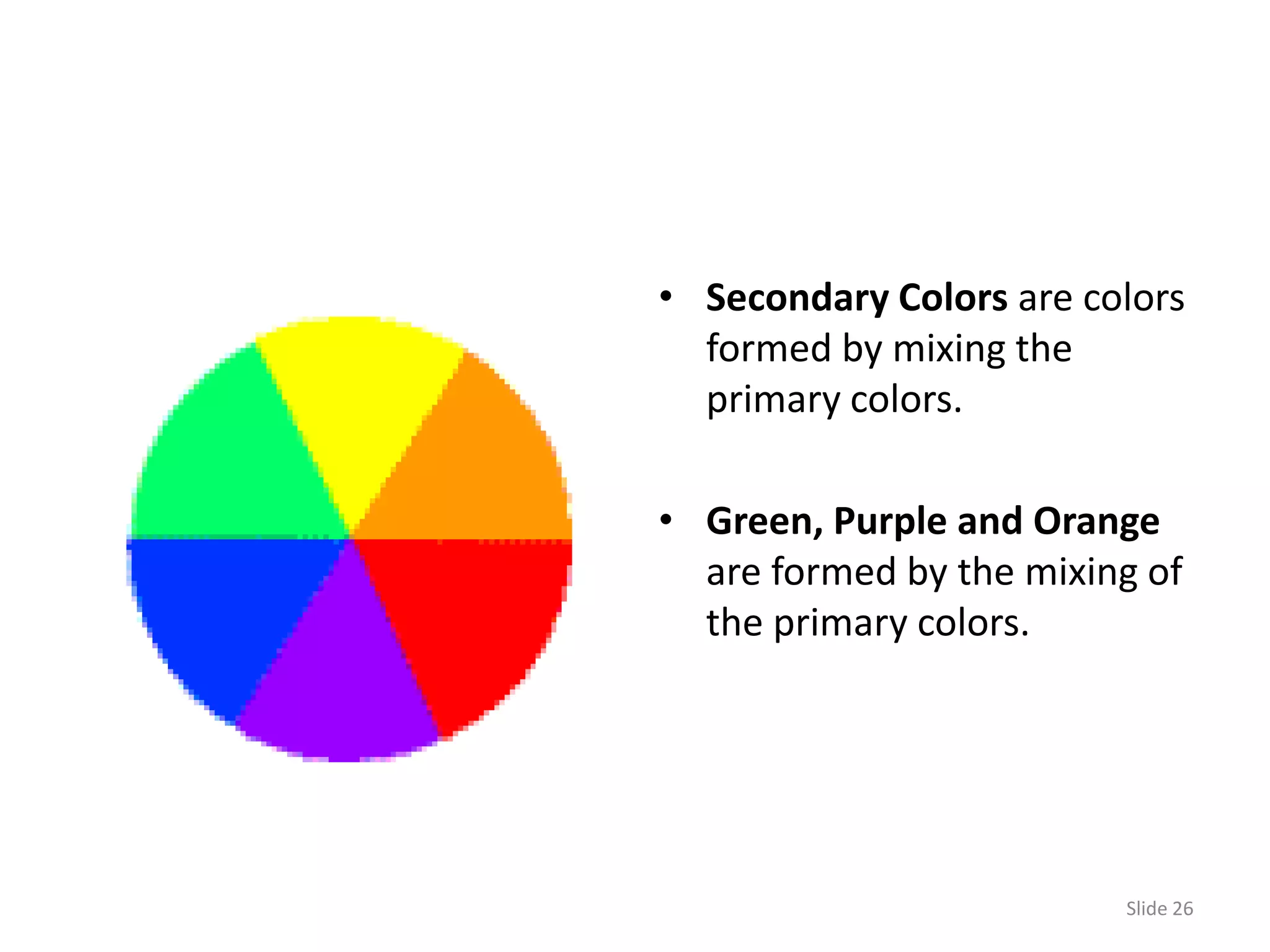
• Secondary Colors are colors
  formed by mixing the
  primary colors.

• Green, Purple and Orange
  are formed by the mixing of
  the primary colors.


                         Slide 26
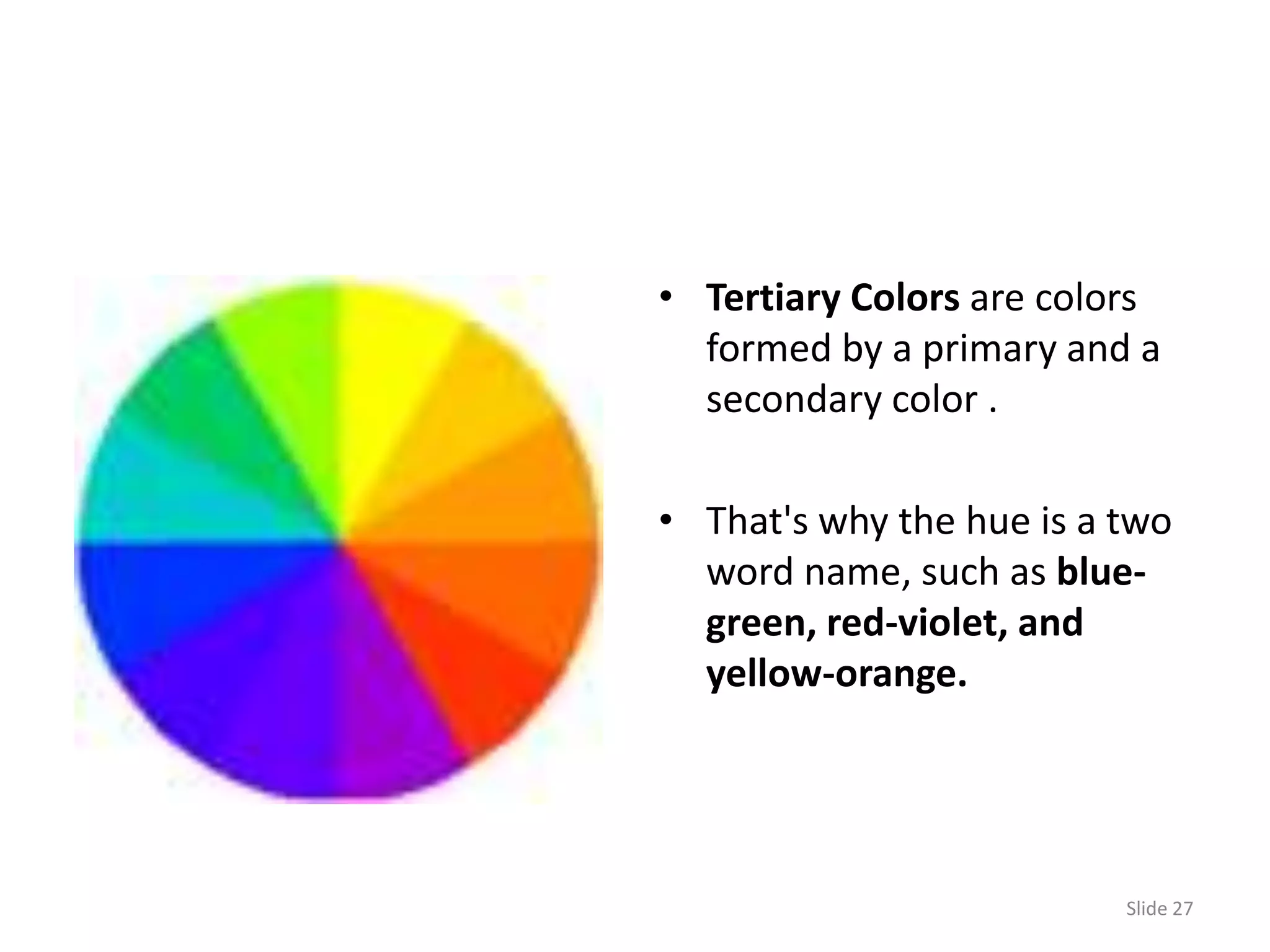
• Tertiary Colors are colors
  formed by a primary and a
  secondary color .

• That's why the hue is a two
  word name, such as blue-
  green, red-violet, and
  yellow-orange.


                          Slide 27
Why do we need to know this?
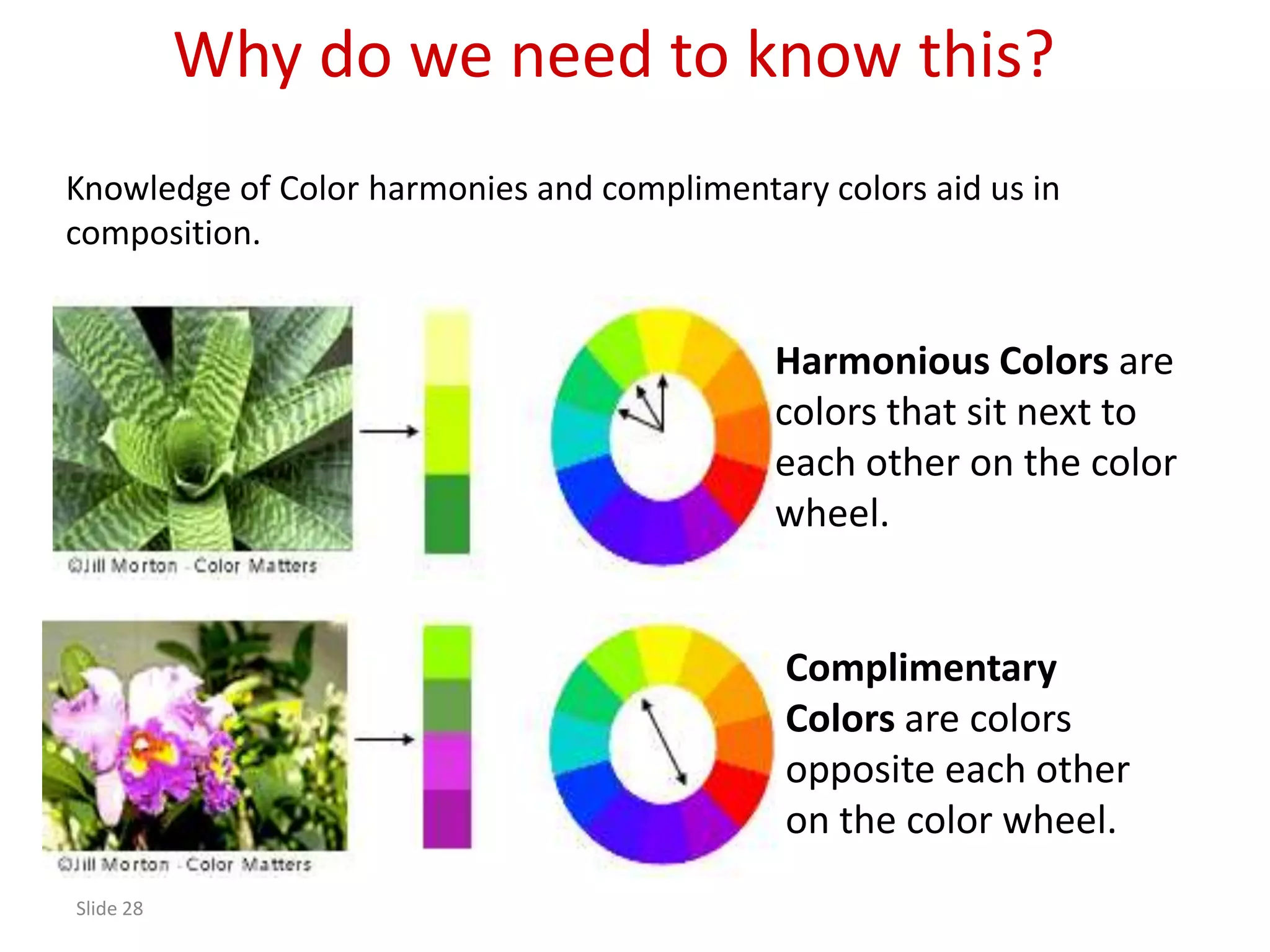
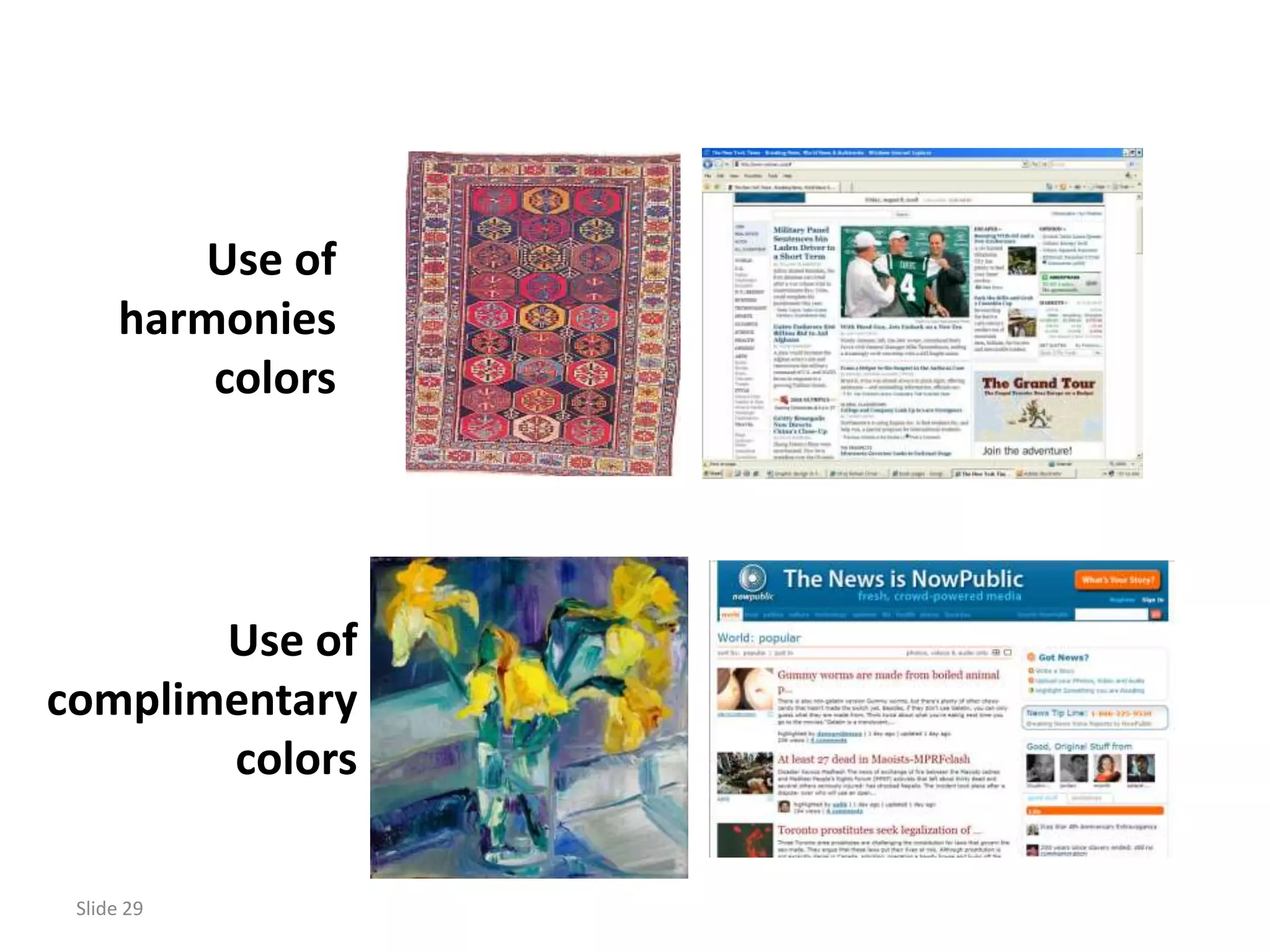
Knowledge of Color harmonies and complimentary colors aid us in
composition.


                                            Harmonious Colors are
                                            colors that sit next to
                                            each other on the color
                                            wheel.


                                             Complimentary
                                             Colors are colors
                                             opposite each other
                                             on the color wheel.
Slide 28
Use of
      harmonies
          colors


       Use of
complimentary
       colors

 Slide 29
Color against different colors
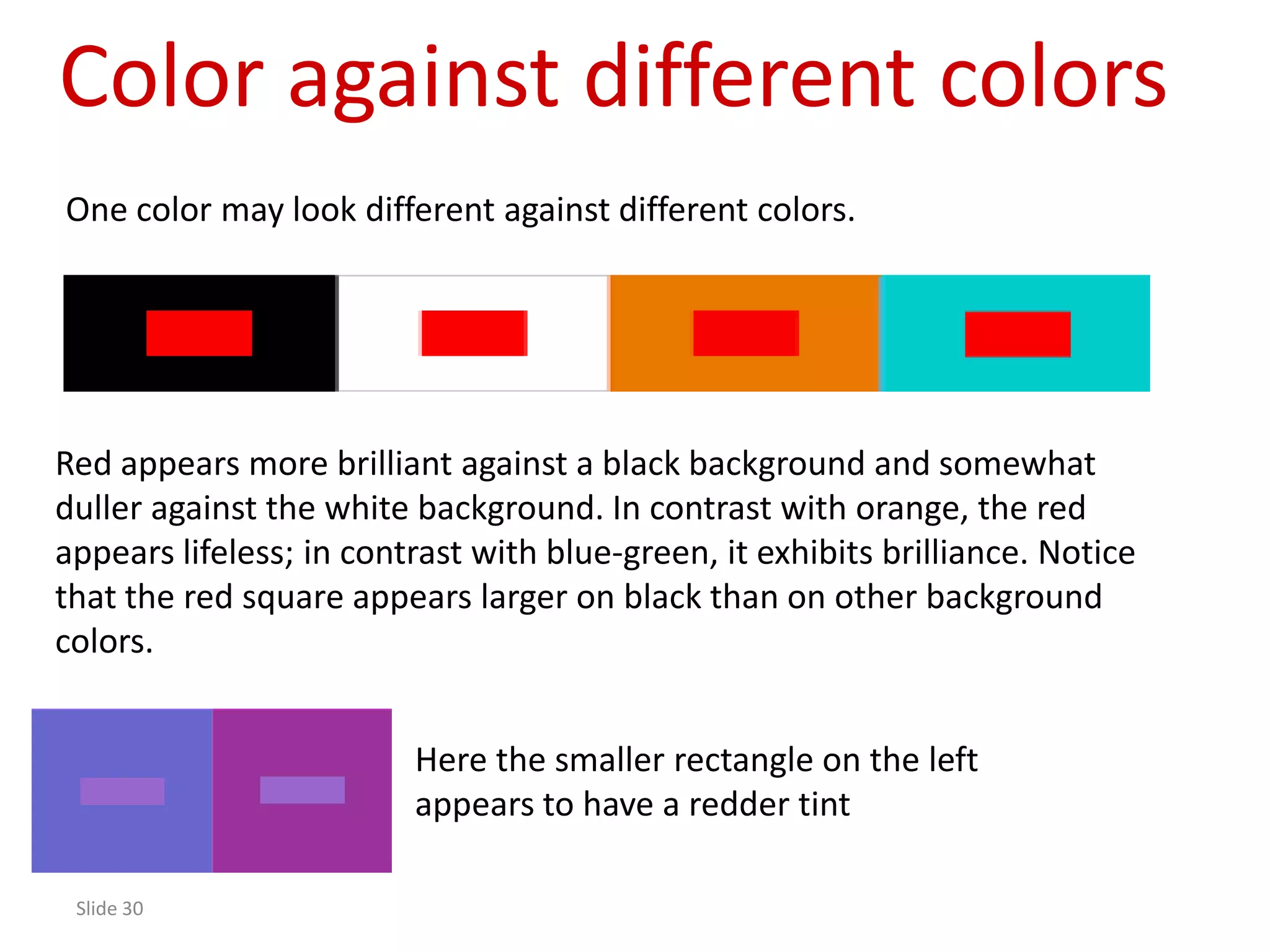
One color may look different against different colors.


Red appears more brilliant against a black background and somewhat
duller against the white background. In contrast with orange, the red
appears lifeless; in contrast with blue-green, it exhibits brilliance. Notice
that the red square appears larger on black than on other background
colors.


                         Here the smaller rectangle on the left
                         appears to have a redder tint

 Slide 30
Color Symbolism
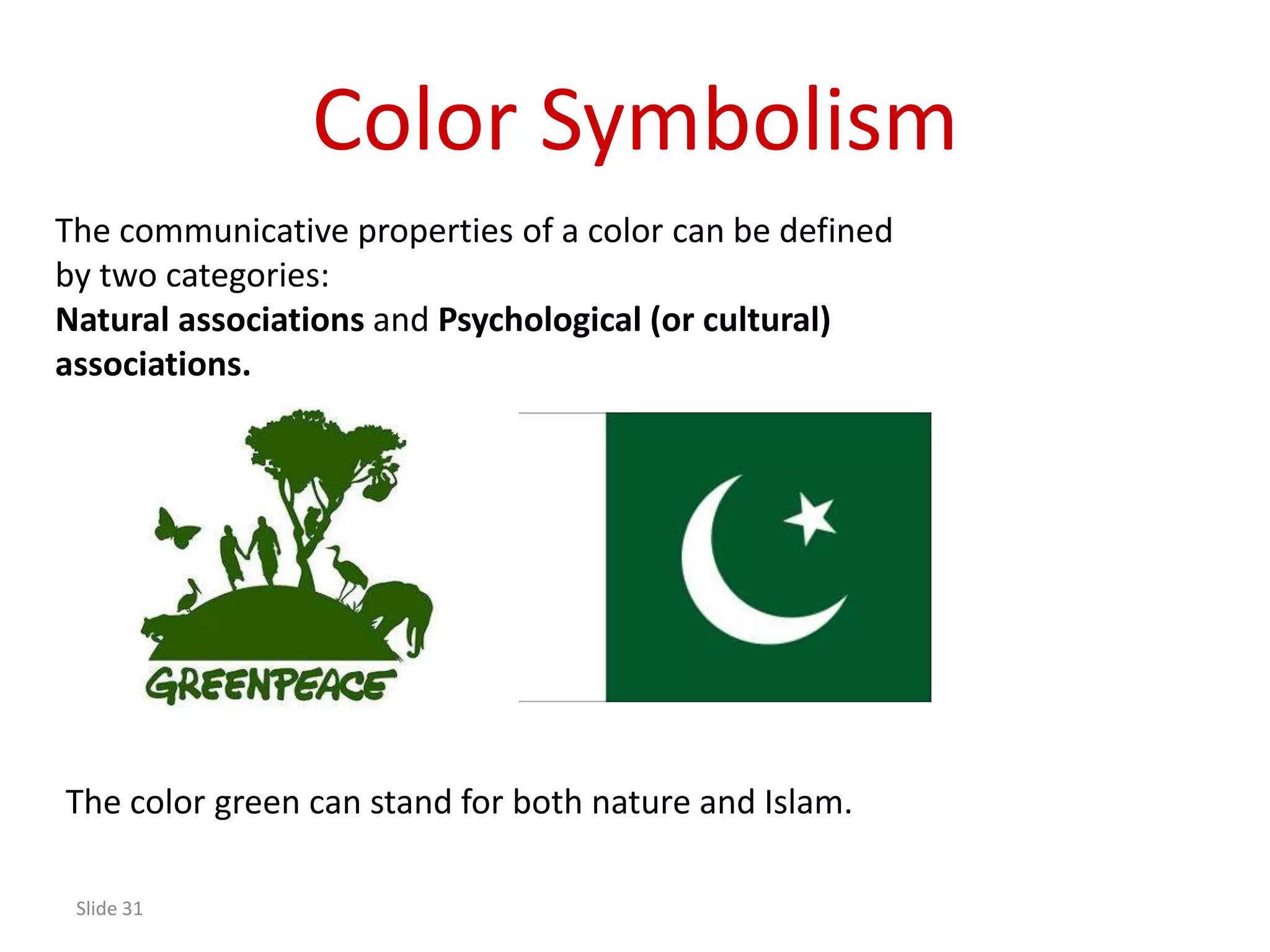
The communicative properties of a color can be defined
by two categories:
Natural associations and Psychological (or cultural)
associations.


The color green can stand for both nature and Islam.

 Slide 31
Thank
You…!!!

AN Introduction To Graphic Design

  • 1.
    An Introduction toGraphic design By Nitisha Lokare
  • 2.
    Basic Questions What isgraphic design? How did it evolve? When did the profession come into existence? And why? Slide 2
  • 3.
    Definition The term graphicdesign can refer to a number of artistic and professional disciplines which focus on visual communication and presentation. Various methods are used to create and combine symbols, images and/or words to create a visual representation of ideas and messages. Slide 3
  • 4.
    All the picturesbelow are examples of Graphic Design Slide 4
  • 5.
    When people needto necessarily express something, usually with an aim towards promotion or information dispensing, the focus becomes how best to do it. Graphic design was born of art and technology (printing). Slide 5
  • 6.
    What does aGraphic Designer do? When he gets a graphic design job, be it a poster design, book design,web design, advertising, he has to start with asking himself the following fundamental questions: What is the objective of the communication What needs to be said first and then next and then after that? (levels of hierarchy) How do you want the eye to flow through the page? What is the tone of voice? Who are you speaking to?
  • 7.
    Fundamental Question 1: Objectivesof the communication What is the information that needs to be passed on? When the audience reads your book/webpage/ad what’s he supposed to get out of it? An advertisement and a newspaper have different objectives of communication. Slide 7
  • 8.
    Fundamental Question 2:What needs to be said first and then next and then after that? (hierarchy) Once you have figured out what the objective of your communication is you’ll want to think about what needs to be said first and foremost and what it should be followed by. Slide 8
  • 9.
    Fundamental Question 3:How do you want the user’s eye to move around the page? The hierarchy mentioned above, along with elements like color, contrast, size etc, will automatically make your viewers eyes go through the page in a certain way. This can be manipulated as per your intention. Slide 9
  • 10.
    Fundamental Question 4:Who are you speaking to? You have to be very sure about this as different people need to be spoken to differently, just the way it is in real life. Slide 10
  • 11.
    Fundamental Question 5:What is the tone of voice? Only once you have got the above figured out can you think about the more external elements of your piece of work. Slide 11
  • 12.
    The solutions tothese questions are tackled using the graphic designer’s tool kit. Slide 12
  • 13.
    Broadly speaking, thefollowing tools are available to him to solve the aforementioned issues: Point Space Line Size Form Typography Pattern Color Texture Image Slide 13
  • 14.
    Point Slide 14
  • 15.
    The Line Slide 15
  • 16.
    The Shape Slide 16
  • 17.
    Pattern Slide 17
  • 18.
  • 19.
  • 20.
  • 21.
  • 22.
  • 23.
  • 24.
    Miscellaneous examples ofusage of graphic design Slide 24
  • 25.
    COLOUR THEORY • In traditional color theory, these are the 3 pigment colors that can not be mixed or formed by any combination of other colors. • Red, Yellow and Blue are called Primary Colors. All other colors are derived from these 3 hues. Slide 25
  • 26.
    • Secondary Colorsare colors formed by mixing the primary colors. • Green, Purple and Orange are formed by the mixing of the primary colors. Slide 26
  • 27.
    • Tertiary Colorsare colors formed by a primary and a secondary color . • That's why the hue is a two word name, such as blue- green, red-violet, and yellow-orange. Slide 27
  • 28.
    Why do weneed to know this? Knowledge of Color harmonies and complimentary colors aid us in composition. Harmonious Colors are colors that sit next to each other on the color wheel. Complimentary Colors are colors opposite each other on the color wheel. Slide 28
  • 29.
    Use of harmonies colors Use of complimentary colors Slide 29
  • 30.
    Color against differentcolors One color may look different against different colors. Red appears more brilliant against a black background and somewhat duller against the white background. In contrast with orange, the red appears lifeless; in contrast with blue-green, it exhibits brilliance. Notice that the red square appears larger on black than on other background colors. Here the smaller rectangle on the left appears to have a redder tint Slide 30
  • 31.
    Color Symbolism The communicativeproperties of a color can be defined by two categories: Natural associations and Psychological (or cultural) associations. The color green can stand for both nature and Islam. Slide 31
  • 32.

Editor's Notes

  • #4 DefinitionThe term graphic design can refer to a number of artistic and professional disciplines which focus on visual communication and presentation. Various methods are used to create and combine symbols, images and/or words to create a visual representation of ideas and messages.
  • #5 All the pictures are the examples of Graphic Design.
  • #6 When people need to necessarily express something, usually with an aim towards promotion or information dispensing, the focus becomes how best to do it. Graphic design was born of art and technology (printing).
  • #7 What does a Graphic Designer do?When he gets a graphic design job, be it a poster design, book design, web design, advertising, he has to start with asking himself the following fundamental questions:What is the objective of the communicationWhat needs to be said first and then next and then after that? (levels of hierarchy)How do you want the eye to flow through the page?What is the tone of voice?Who are you speaking to?
  • #8 Fundamental Question 1:Objectives of the communicationWhat is the information that needs to be passed on? When the audience reads your book/webpage/ad what’s he supposed to get out of it? For eg.An advertisement and a newspaper have different objectives of communication.
  • #9 Fundamental Question 2: What needs to be said first and then next and then after that? (hierarchy)Once you have figured out what the objective of your communication is you’ll want to think about what needs to be said first and foremost and what it should be followed by.
  • #10 Fundamental Question 3: How do you want the user’s eye to move around the page?The hierarchy mentioned above, along with elements like color, contrast, size etc, will automatically make your viewers eyes go through the page in a certain way. This can be manipulated as per your intention.
  • #11 Fundamental Question 4: Who are you speaking to?You have to be very sure about this as different people need to be spoken to differently, just the way it is in real life.
  • #12 Fundamental Question 5: What is the tone of voice?Only once you have got the above figured out can you think about the more external elements of your piece of work.
  • #13 The solutions to these questions are tackled using the graphic designer’s tool kit.
  • #14 Broadly speaking, the following tools are available to him to solve the aforementioned issues:PointLineFormPattern TextureSpaceSizeTypographyColorImage
  • #15 A Point :A point is the fundamental particle of graphic design.
  • #16 The Line :Line is any mark connecting two points.
  • #17 The SpaceAnything that has a width and a height is a shape.
  • #18 The Pattern :Our tendency to make meaning an order will find a pattern in things.
  • #19 Texture : Texture is the look or feel of a surface. You can add richness and dimension to your layouts with texture. Visual texture creates an illusion of texture on a printed publication or web page. Texture can create mood and personalityProvoke emotion
  • #20 Space :Space is the distance or area between or around things.Space separates or unifies, highlights, and gives the eye a visual rest.
  • #21 Size :Size is how large or small something is.Size is very important in making a layout functional, attractive, and organized.It shows what is most important, attracts attention, and helps to fit the layout together.
  • #22 Type : Typography is one of the most important tools for a graphic designer.Typography can take you back to a different time, set a mood, set a tone of voice, organize pages, create unity between objects etc.
  • #23 Color :Color in layouts can convey moods, create images, attract attention, and identify objects. When selecting colors for a publication or a web page, think about what you want the color to do and what is appropriate for your purpose.
  • #24 Image :Image is an essential part of graphic design. Images can be of basically three kinds; Photographs, Illustration and paintings.Images can be interpreted in many ways and cultural differences should be kept in mind when ‘reading’ an image.
  • #25 The examples of graphic desing shown in pictures.
  • #26 COLOUR THEORYIn traditional color theory, these are the 3 pigment colors that can not be mixed or formed by any combination of other colors. Red, Yellow and Blue are called Primary Colors. All other colors are derived from these 3 hues.
  • #27 Secondary Colors are colors formed by mixing the primary colors.Green, Purple and Orange are formed by the mixing of the primary colors.
  • #28 Tertiary Colors are colors formed by a primary and a secondary color .That's why the hue is a two word name, such as blue-green, red-violet, and yellow-orange. 
  • #29 Why do we need to know this?Knowledge of Color harmonies and complimentary colors aid us in composition.Harmonious Colors are colors that sit next to each other on the color wheel. Complimentary Colors are colors opposite each other on the color wheel.
  • #31 Color against different colorsOne color may look different against different colors.Red appears more brilliant against a black background and somewhat duller against the white background. In contrast with orange, the red appears lifeless; in contrast with blue-green, it exhibits brilliance. Notice that the red square appears larger on black than on other background colors.Here the smaller rectangle on the left appears to have a redder tint
  • #32 Color SymbolismThe communicative properties of a color can be defined by two categories:Natural associations and Psychological (or cultural) associations.The color green can stand for both nature and Islam.
  • #33 Thank You…!!!