This paper proposes a digital image watermarking scheme using LU decomposition combined with a fuzzy inference system (FIS) to enhance robustness against attacks. The methodology described involves embedding a watermark into an image by partitioning it into blocks, applying mathematical techniques, and evaluating parameters such as edge and contrast sensitivities. Experimental results demonstrate the effectiveness of the proposed method, which shows good resilience to various attacks, particularly in preserving visibility and robustness.
![International Advance Journal of Engineering Research (IAJER)
Volume 2, Issue 8 (August- 2019), PP 01-08
ISSN: 2360-819X
www.iajer.com
Engineering Journal www.iajer.com Page | 1
Research Paper Open Access
*
Areej M. Abduldaim1
, Raghad I. Sabri2
1
(Department of Applied Sciences / University of Technology, Baghdad, Iraq)
2
(Department of Applied Sciences / University of Technology, Baghdad, Iraq)
*Corresponding author:Areej M. Abduldaim
ABSTRACT: Recently digital image watermarking techniques becomes broadly dependent on mathematics.
This paper introduced a proposed scheme using the algebraic matrix decomposition method LU along with two
folds Mamdani fuzzy inference system (FIS). The proposed scheme to embedding the watermark into the
original image involves two separate cases, one of them splits the original image into 8×8 blocks in order to
apply the LUD method on each block and collect the resulted matrices U of each block in one matrix to be ready
to the embedding process. Independently, the second case includes computing two values of the FIS according
to the two inputs edge sensitivity and contrast sensitivity. The sum of these two values used as a control
parameter that decided the robustness of the scheme. The evaluation of the results done by the PSNR and NC
which shows that this scheme is robust against various attacks.
Keywords -Fuzzy Inference System, LU decomposition, watermarked image, the Peak Signal to Noise
Ratio(PSNR), normalized correlation(NC).
I. INTRODUCTION
Linear algebra used in many applications of mathematics. Linear algebra is centric to most whole scopes
of mathematics and it is a very important field to study. A perfect understanding of linear algebra is substantial
for comprehending and dealing with numerous algorithms, in particular, image processing algorithms.On the
other hand, linear algebra is a subfield of mathematics interested with matrices, vectors, and linear transforms. It
is a fundamental key to the field of image processing, from symbols used to describe the approach of algorithms
to the enforcement of algorithms in code. Furthermore, linear algebra plays an important role in image
processing, particularly in watermarking.
Fuzzy theory has become the cornerstone of many important sciences today. With the gradual
transition of science into the digital world, fuzzy logic has become one of the most important influences in the
development of the rest of science, including image processing. Digital watermarking techniques depends on
many factors to insert the information of the watermark into the cover image. Fuzzy Inference System (FIS) [1]
is one of these factors that used to control the decision of how to embed bits of the watermark depending on the
goal to be achieved.
Digital image watermarking is information (the watermark) hiding into the digital data. In other words,
to affirm the originality of the data; the embedded secret image can be specified or extracted later. Digital
watermarking is the first kind of mechanisms to better the impartiality and reliability of digital data. Lately,
authentication is one of the major watermarking requirements in image processing applications [2].
Imran and Harvey proposed in [3] a blind adaptive color image watermarking technique depending on
PCA, SVD, and HVS. To improve the perceptual quality of the watermarked image PCA is used to decorrelate
the three color channels of the cover image. While the HVS and FIS worked to further improve both robustness
and imperceptibility by choosing a suitable running scale, for this reason, regions more susceptible to noise can
be added with additional information as compared to fewer susceptible regions.
Typically the goodness of the watermarked image is handled in [4] by locating the adaptable running
factor for every demarcation pixel intensity. The HVS (texture masking) and FIS were used in order to set the
adaptable scaling factor. To enhance the security grade and robustness DWT has been used. This improvement
is owing to the irregular apportionment of the watermark within the image through the transform converse. The
algorithm of using (SVD) in order to decompose LH; and HL sub-bands is given.
The Algebraic LUD Method Combined with the Two Folds FIS to
Build Digital Image Watermarking Scheme](https://image.slidesharecdn.com/a280108-191009114528/85/A280108-1-320.jpg)
![International Advance Journal of Engineering Research (IAJER)
Volume 2, Issue 8 (August- 2019), PP 01-08
ISSN: 2360-819X
www.iajer.com
Engineering Journal www.iajer.com Page | 1
Research Paper Open Access
*
Areej M. Abduldaim1
, Raghad I. Sabri2
1
(Department of Applied Sciences / University of Technology, Baghdad, Iraq)
2
(Department of Applied Sciences / University of Technology, Baghdad, Iraq)
*Corresponding author:Areej M. Abduldaim
ABSTRACT: Recently digital image watermarking techniques becomes broadly dependent on mathematics.
This paper introduced a proposed scheme using the algebraic matrix decomposition method LU along with two
folds Mamdani fuzzy inference system (FIS). The proposed scheme to embedding the watermark into the
original image involves two separate cases, one of them splits the original image into 8×8 blocks in order to
apply the LUD method on each block and collect the resulted matrices U of each block in one matrix to be ready
to the embedding process. Independently, the second case includes computing two values of the FIS according
to the two inputs edge sensitivity and contrast sensitivity. The sum of these two values used as a control
parameter that decided the robustness of the scheme. The evaluation of the results done by the PSNR and NC
which shows that this scheme is robust against various attacks.
Keywords -Fuzzy Inference System, LU decomposition, watermarked image, the Peak Signal to Noise
Ratio(PSNR), normalized correlation(NC).
I. INTRODUCTION
Linear algebra used in many applications of mathematics. Linear algebra is centric to most whole scopes
of mathematics and it is a very important field to study. A perfect understanding of linear algebra is substantial
for comprehending and dealing with numerous algorithms, in particular, image processing algorithms.On the
other hand, linear algebra is a subfield of mathematics interested with matrices, vectors, and linear transforms. It
is a fundamental key to the field of image processing, from symbols used to describe the approach of algorithms
to the enforcement of algorithms in code. Furthermore, linear algebra plays an important role in image
processing, particularly in watermarking.
Fuzzy theory has become the cornerstone of many important sciences today. With the gradual
transition of science into the digital world, fuzzy logic has become one of the most important influences in the
development of the rest of science, including image processing. Digital watermarking techniques depends on
many factors to insert the information of the watermark into the cover image. Fuzzy Inference System (FIS) [1]
is one of these factors that used to control the decision of how to embed bits of the watermark depending on the
goal to be achieved.
Digital image watermarking is information (the watermark) hiding into the digital data. In other words,
to affirm the originality of the data; the embedded secret image can be specified or extracted later. Digital
watermarking is the first kind of mechanisms to better the impartiality and reliability of digital data. Lately,
authentication is one of the major watermarking requirements in image processing applications [2].
Imran and Harvey proposed in [3] a blind adaptive color image watermarking technique depending on
PCA, SVD, and HVS. To improve the perceptual quality of the watermarked image PCA is used to decorrelate
the three color channels of the cover image. While the HVS and FIS worked to further improve both robustness
and imperceptibility by choosing a suitable running scale, for this reason, regions more susceptible to noise can
be added with additional information as compared to fewer susceptible regions.
Typically the goodness of the watermarked image is handled in [4] by locating the adaptable running
factor for every demarcation pixel intensity. The HVS (texture masking) and FIS were used in order to set the
adaptable scaling factor. To enhance the security grade and robustness DWT has been used. This improvement
is owing to the irregular apportionment of the watermark within the image through the transform converse. The
algorithm of using (SVD) in order to decompose LH; and HL sub-bands is given.
The Algebraic LUD Method Combined with the Two Folds FIS to
Build Digital Image Watermarking Scheme](https://image.slidesharecdn.com/a280108-191009114528/75/A280108-1-2048.jpg)
![The Algebraic LUD Method Combined with the Two Folds FIS to Build Digital Image…
Engineering Journal www.iajer.com Page | 2
A novel robust watermarking scheme is implemented relying on DWT and SVD using Fuzzy Logic and Genetic
Algorithm.Fuzzy logic system is used to find the strength of watermark that has to be added to the original
image while embedding [5].
The essential difficulty for creating a new watermarking scheme is typically the stalemate between
impressionability plus robustness. Lalani and Doye [6] proposed a technique tries to solve this problem by
designing a fuzzy inference system (FIS) based on just-noticeable distortion (JND) that takes into consideration
the image characteristics for deciding the transparency of the cover signal and applya worthy tool in numerical
linear algebra named SVD to the HL band obtained from the 3rd
level of DWT to get the modified component.
Authors in [7] used the DWT and then develops a DWT-SVD path using the band LL obtained from
the 2-level DWT. Even if DWT has a broad scope of implementation but when combined both SVD and DWT it
will boost the robustness of the extracted watermark.
In the proposed work in [8], an authentication technique has been developed in the wavelet domain of a
medical image. The authentication message is embedded in the singular values of Region of Non-Interest
(RONI) pixels. The watermark strength of the pixels in the RONI portion is predicted using fuzzy inference
rules, Singular Value Decomposition (SVD)is applied to the HL details of the RONI.
Firstly in [9] Fan and Wu decompose the cover image using the complex wavelet transform. Secondly,
the selection of the singular value of the low-frequency coefficients is made as an embedded factor, which hides
the watermark perfectly. Ultimately, as a fuzzy clustering feature vectors, image high frequency texture features
and low frequency background, that are regarding human visual masking, are utilized in order to set the different
embedding strength.
Motivated by the above, this paper focus on a digital watermarking algorithm depends primarily on
LUD factorization which is taken into consideration for the first time in the watermarking techniques common
side by side with the Fuzzy Inference System (FIS). This work investigates the robustness and the
imperceptibility in the frequency domain of LUD. Moreover, in this paper, various attacks are adopted to
explain the advantages of the given digital image watermarking.
The rest of this paper is ordered as follows. In Section II basic important information of LUD and FIS
are covered concisely. Section III devoted to present the proposed algorithm. Section IV of this paper
particularized to explain the experimental results and discussion. Finally, the conclusion is documented in
Section V.
II. BACKGROUND
In this section needed data is provided that used in the rest of the paper.
2.1 LU decomposition
In linear algebra and numerical analysis, lower–upper decomposition (LU) (or LU factorization)
operators a matrix A as the product of a lower triangular matrix (L) and an upper triangular matrix(U), as well
as sometimes the product includes a permutation matrix. In 1948 [10]Turing gives LU decomposition which is
the basic modified way of Gaussian elimination. LU decomposition is often adopted in solving square systems
of linear equations. It is a necessary process when calculating the determinant of a matrix or inverting a matrix.
For example, for a 3×3 matrix A, its LU decomposition can be presented as:
𝐴 =
𝑎11 𝑎12 𝑎13
𝑎21 𝑎22 𝑎23
𝑎31 𝑎32 𝑎33
= 𝐿𝑈 =
1 0 0
𝑙21 1 0
𝑙31 𝑙32 1
𝑢11 𝑢12 𝑢13
0 𝑢22 𝑢23
0 0 𝑢33
=
𝑢11 𝑢12 𝑢13
𝑙21 𝑢11 𝑙21 𝑢12 + 𝑢22 𝑙21 𝑢13 + 𝑢23
𝑙31 𝑢11 𝑙31 𝑢12 + 𝑙32 𝑢22 𝑙31 𝑢13 + 𝑙32 𝑢23 + 𝑢33
2.2 Discrete Cosine Transform
DCT represents a technique for converting the signal from time domain representation to frequency
band form. For a given image 𝐴 of size 𝑛 × 𝑛, in digital image processing, the two-dimensional DCT is given
as:
𝐶𝑛𝑚 = 𝛼𝑛 𝛼𝑚 𝑍𝑖𝑗 (
cos 2𝜋𝑖 +1 𝑛
2𝐼
)(
cos 2𝜋𝑗 +1 𝑚
2𝐽
𝐽−1
𝑗 =0
𝐼−1
𝑖=0 ) , for 0 ≤ 𝑛 ≤ 𝐼 − 1 and 0 ≤ 𝑚 ≤ 𝐽 − 1 (1)](https://image.slidesharecdn.com/a280108-191009114528/85/A280108-2-320.jpg)
![The Algebraic LUD Method Combined with the Two Folds FIS to Build Digital Image…
Engineering Journal www.iajer.com Page | 3
𝛼𝑛 =
1
𝐽
, 𝑛 = 0
2
𝐽
, 1 ≤ 𝑛 ≤ 𝐽 − 1
, 𝛼𝑚 =
1
𝐼
, 𝑚 = 0
2
𝐼
, 1 ≤ 𝑚 ≤ 𝐼 − 1
Dct is characterized by the property that most of the important optical functions are concentrated around the
image in a few DCT parameters and therefore we observe the use of DCT frequently in image compression
applications[11, 12].
2.3Fuzzy Inference System
Fuzzy inference system illustrates the procedure of deriving the mapping from a specific stimulus to a
suitable result utilizing fuzzy logic. Two kinds of these systems are familiar: Mamdani-type and Sugeno-type
which can be implemented through fuzzy logic Toolbox. Mamdani's method represents among the first control
systems built using fuzzy set theory which is the most common method used. The procedure of fuzzy inference
includes Fuzzy variables and corresponding membership functions, logic operators and if-then rules.
Fuzzy inference system is also called the rule base, which consists of the fuzzy rules. These rules
combine one or more fuzzy set utilizing the fuzzy operators AND, OR, and NOT. The valuation of fuzzy rules is
executed by the inference system to employ the aggregate function. These operation combines a weight
parameter of the resultant part of all relevant rules in a fuzzy set to obtain the output. On output, the fuzzy
inference system can not supply fuzzy values that can only operate, so it is needful to provide precise values.
This stage is done using membership functions. many values will be obtained from the degrees of membership
functions. To determine the accurate value to use, one of the four methods can be applied which is: Centroid,
Max, Sum, and Probor. Using one of these methods, one output value will be obtained from the total output
values. In this method, we use the Centroid concept to find the weighing parameter [11].
2.4Fuzzy Variables and Membership Functions
One of the steps or stages of implementing a fuzzy inference system is processed the given
informationand classify the grade of results to which they belong utilizing membership functions. One of the
mathematical functions used in the FIS is a membership function which takes the given information to a grade
of membership between [0,1]. There are several shapes of membership functions, they are not limited to
triangular and trapezoidal functions. Any form for membership functions can be adopted mathematically
defined according to the demands of the case. The input variables used in our system are Edge sensitivity and
contrast sensitivity while the membership functions used are triangular functions[12].
𝜇 𝐴 𝑥 =
0, 𝑥 ≤ 𝑎
𝑥 − 𝑎
𝑚 − 𝑎
, 𝑎 < 𝑥 ≤ 𝑚
𝑏 − 𝑥
𝑏 − 𝑚
, 𝑏 < 𝑥 < 𝑚
0, 𝑥 ≥ 𝑏
2.5 Rules of Inference and Logic Operators
Rules of inference represent all fuzzy rules aggregating the various variables of a fuzzy inference
system. These rules take the following form:
- If (condition 1) and / or condition (N) then (action on the outputs)
Inference rules are crafted using a fuzzy logical operator such as AND or OR. After we apply the rules using the
"AND" or "OR" operator, the output value is obtained with the minimum or maximum input values
respectively[11].
III. METHODOLOGY
In this section, we propose a protection scheme for improving watermarking relies on FIS and LUD
Matrix Decomposition. The proposed watermarking scheme can be characterized as follows:
3.1 Embedding Algorithm
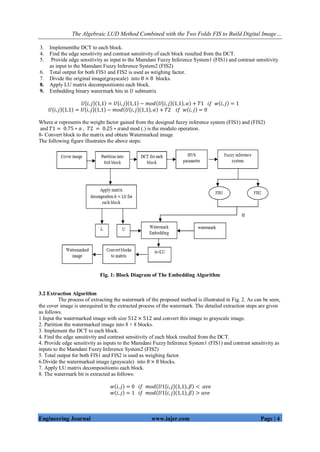
The process of embedding the watermark into the cover image based on FIS and LUD is illustrated by
Fig. 1, and the detailed steps are listed as follows.
1. Input the cover image which is a grayscale imageof size 512×512 pixels and the watermark image is a
binary image of size 64×64pixels.
2. Partition the cover image into 8×8 blocks.](https://image.slidesharecdn.com/a280108-191009114528/85/A280108-3-320.jpg)
![The Algebraic LUD Method Combined with the Two Folds FIS to Build Digital Image…
Engineering Journal www.iajer.com Page | 5
where 𝛽 represents the weight factor gained from the designed fuzzy inference system (FIS1) and (FIS2) and
𝑎𝑣𝑒 = (𝑇1 + 𝑇2)/2 represents the average.
Fig. 2: Block Diagram of Extraction Algorithm
IV. EXPERIMENTAL RESULTS
In this section, some experiments are performed to assess the imperceptibility and robustness of the
proposed watermarking algorithm. The proposed image watermarking technique is examined with different
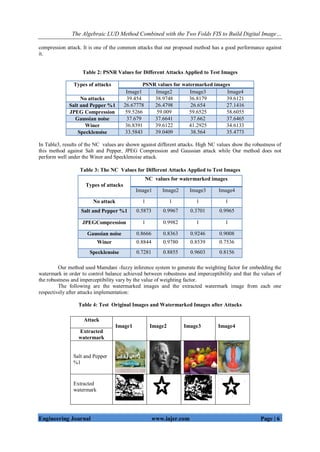
grayscale cover images of size 512×512. A binary image of size 64×64 is utilized as a watermark image. Table
1 shows the watermark and the images used to test the proposed algorithm.
Table 1: The Watermark and the Images used to Test the Proposed Algorithm
To evidence the soundness of the proposed watermarking algorithm, some results are clarified. Five
sorts of attacks were utilized to test the robustness of the proposed watermarking algorithm.
In general, the performances of image watermarking techniques are measured by the robustness,
invisibility, computation complexity, etc.
PSNR as a good tester for the watermark visibility assess and it is given by the following equation:
PSNR = 10log10(
MAX 2
MSE
). (2)
where
MES =
1
pq
[I i,j − K i, j ]2q−1
j=0
p−1
i=0 . (3)
and MAX is the maximum greyscale value which here is equal to 256.
The matching between the extracted watermark Wʹ and the authentic watermark Wis computed based on NC (a
normalized correlation) between W and Wʹ.
NC =
w i,j .w′(i,j)ji
w(i,j)ji w′(i,j)ji
. ( 4)
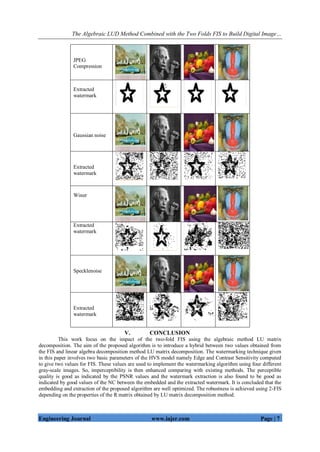
To show the robustness of the proposed mechanism, diverse attacks are implemented on the watermarked image
to assess the robustness of the proposed mechanism as shown in Table 2, Table 3 respectively. In salt and pepper
noise attack, noise is added to the watermarked image at 1 % density. Another important attack is JPEG
Image 1 Image 2 Image 3 Image 4 Watermark
Image](https://image.slidesharecdn.com/a280108-191009114528/85/A280108-5-320.jpg)
![The Algebraic LUD Method Combined with the Two Folds FIS to Build Digital Image…
Engineering Journal www.iajer.com Page | 8
REFERENCES
[1]. E.H. Mamdani and S. Assilian, An Experiment in Linguistic Synthesis with a Fuzzy Logic
Controller,International Journal ofMan-Machine Studies,vol 7, 1975, 1–13.
[2]. Guru. J and Damecha. H, Digital Watermarking Classification : A Survey, International Journal of
Computer Science Trends and Technology (IJCST),.2(5), 2014, available
online:http://www.ijcstjournal.org/volume-2/issue-5/IJCST-V2I5P2.pdf.
[3]. M. Imran and B. A. Harvey, A Blind Adaptive ColorImageWatermarking Scheme Based on Principal
Component Analysis, Singular Value Decomposition and Human Visual System, Radioengineering,
26( 3), 2017, 823-834.
[4]. M. Imran, A. Ghafoor and M. M. Riaz , Adaptive watermarking technique based on human visual
system and fuzzy inference system, IEEE International Symposium on Circuits and Systems
(ISCAS2013), Beijing, 2013, 2816-2819.
[5]. Arun Kumar R, T.V. N. Rao, Digital Image Watermarking using Fuzzy Logic and Genetic Algorithm,
International Journal of Computer Trends and Technology (IJCTT) –. 41 ( 2), 2016, 101-105.
[6]. S. Lalani and D. D. Doye, Discrete Wavelet Transform and a Singular Value Decomposition
Technique for Watermarking Based on an Adaptive Fuzzy Inference System, J Inf Process Syst, 13(2),
2017, 340-347.
[7]. Anita and A. Parmar, Image security using watermarking based on DWT-SVD and Fuzzy Logic, 4th
International Conference on Reliability, Infocom Technologies and Optimization (ICRITO) (Trends
and Future Directions), Noida, 2015, 1-6.
[8]. S.K. Jayanthi and K. Sridevi, Region of Non Interest based Medical Image Authentication in Wavelet
Domain Using Fuzzy Inference System, International Journal of Pure and Applied Mathematics, 114
(11), 2017, 199-209.
[9]. J. Fan and Y. Wu, Watermarking Algorithm Based on Kernel Fuzzy Clustering and Singular Value
Decomposition in the Complex Wavelet Transform Domain, International Conference of Information
Technology, Computer Engineering and Management Sciences, Nanjing, Jiangsu, 2011, 42-46.
[10]. A. M. Turing, Rounding-off errors in matrix processes, The Quarterly Journal of Mechanics and
Applied Mathematics, 1(1), 1948, 287-308.
[11]. Ahmed, N,Natarajan, T and Rao, K, Discrete Cosine Transform, IEEE Transactions on Computers, C-
23 (1), 1974, 90–93.
[12]. K. Rao, , P.Yip , Discrete Cosine Transform: Algorithms, Advantages, Applications, Boston: Academic
Press, 1990, ISBN 978-0-12-580203-1.
[13]. T. Takagi, M, Sugeno, Fuzzy Identification of System and Its Applications to modeling and Control,
IEEE Transaction on Systems, Man and Cybernetics, 15, 1985,116-132.
[14]. L.A. Zadeh, Fuzzy Logic and Soft Computing: Issues, Contentions and Perspectives, In: Proc. of
IIZUKA’94: Third Int.Conf. on Fuzzy Logic, Neural Nets and Soft Computing, Iizuka, Japan, 1994, 1-
2.](https://image.slidesharecdn.com/a280108-191009114528/85/A280108-8-320.jpg)


![[IJET V2I4P2] Authors:Damanbir Singh, Guneet Kaur](https://cdn.slidesharecdn.com/ss_thumbnails/ijet-v2i4p2-160810100856-thumbnail.jpg?width=640&height=640&fit=bounds)


