FACULTY: FOREIGN LANGUAGES
Course: ……….- Course code:………….. Test: 30%
AY: 2021-2022
Date: …/…/20… Time:Group:…………
Duration: …...mins – Material (not) allowed
Document No: TT/P.KT&KĐCL/11/BM07
Version: 05
Effective: 07/01/2019
Student’s full name:… Student ID:…………… OrdinalNo.: 202818012.
Students must complete all the sections above.
Examiner
(Name and Signature)
Score
(In figures) (In words)
Course:……………………………..Course code:……………………….
Test code:…………...…..
CURRICULUM DESIGN
Chapter 10: NEGOTIATED SYLLABUSES
Lecturer: Nguyen Tan Loc PhD
Student: Nguyen Phuoc Dieu Hang
Table of contents
Syllabus vs. Curriculum
Syllabus
A negotiated syllabus
Requirements for a negotiated syllabus
Syllabus with some elements negotiated
Negotiating assessment
Disadvantages and advantages of a negotiated syllabus
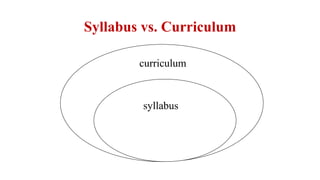
Syllabus vs. Curriculum
curriculum
syllabus
Syllabus vs. Curriculum
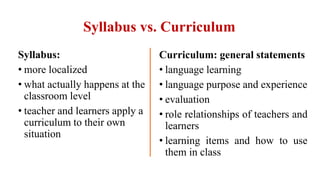
Syllabus:
• more localized
• what actually happens at the
classroom level
• teacher and learners apply a
curriculum to their own
situation
Curriculum: general statements
• language learning
• language purpose and experience
• evaluation
• role relationships of teachers and
learners
• learning items and how to use
them in class
Syllabus vs. Curriculum
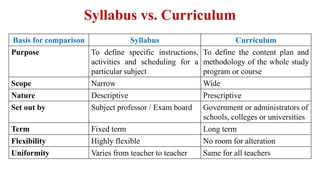
Basis for comparison Syllabus Curriculum
Purpose To define specific instructions,
activities and scheduling for a
particular subject
To define the content plan and
methodology of the whole study
program or course
Scope Narrow Wide
Nature Descriptive Prescriptive
Set out by Subject professor / Exam board Government or administrators of
schools, colleges or universities
Term Fixed term Long term
Flexibility Highly flexible No room for alteration
Uniformity Varies from teacher to teacher Same for all teachers
Syllabus
Definition
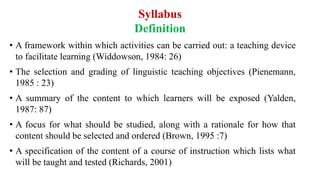
• A framework within which activities can be carried out: a teaching device
to facilitate learning (Widdowson, 1984: 26)
• The selection and grading of linguistic teaching objectives (Pienemann,
1985 : 23)
• A summary of the content to which learners will be exposed (Yalden,
1987: 87)
• A focus for what should be studied, along with a rationale for how that
content should be selected and ordered (Brown, 1995 :7)
• A specification of the content of a course of instruction which lists what
will be taught and tested (Richards, 2001)
Syllabus
6 broad types of syllabus
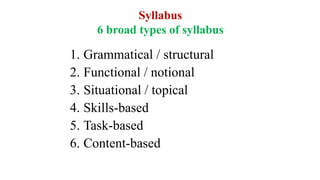
1. Grammatical / structural
2. Functional / notional
3. Situational / topical
4. Skills-based
5. Task-based
6. Content-based
Grammar / structural syllabus
The content of the language teaching is a collection of the
forms and structures of the language being taught.
1. Choosing the structures according to the level and the goals
proposed in the course
2. Choosing a set of vocabulary to be learned together with forms
and structures
3. Deciding the main words according to the topics to be learned
4. Designing exercises to put in practice the structures, vocabulary
and sentence patterns
Examples: nouns, verbs, adjectives, statements, questions,
complex sentences, subordinate clauses, past tense…
Functional / notional syllabus
“The content of language teaching is a collection of the functions or
the notions that are performed when the language is used” (Wilkins,
1976, p 8).
1. Making a list of communication functions of the language that
students will learn
2. Writing a list of the semantic notions based on the culture and the
context of the speakers
3. Applying the functions and the notions together into learning tasks
Examples of functions: informing, agreeing, apologizing, requesting,
promising…
Examples of notions: size, age, color, comparison, time…
Situational / topical syllabus
In this syllabus the contents are organized according to situations in
which students learn.
1. Making a list of communication situations that will take place
2. Making a list of topics, grammatical forms and vocabulary and
sequence them
3. Classifying the topics, forms and structures and fit them with
communication situations
Examples: seeing the dentist, complaining to the landlord, buying a
book at the bookstore, meeting a new student, asking directions in
a new town…
Skills-based syllabus
This syllabus is based on the development of the language skills
(listening, reading, writing and speaking) using the target language.
1. Making a list of language skills that students need to acquire.
2. Making a list of topics, grammatical forms, structures and
vocabulary and sequences according to language skills.
Examples: listening to spoken language for the main idea, writing
well-formed paragraphs, giving effective oral presentations, taking
language tests, reading texts for main ideas or supporting details…
Task-based syllabus
The content of language teaching includes a series of purposeful tasks
that language learners need to perform; tasks are defined as activities
that are needed when using the target language (Nunan, 1988).
1. Making a list of abilities or tasks that students need to develop.
2. Writing a list of topics, grammatical forms and vocabulary and sequence them.
3. Organizing the topics, forms and structures and fit them with the tasks.
Examples: applying for a job, talking with a social worker, getting housing
information over the telephone, completing bureaucratic forms, collecting information
about preschools to decide which to send a child to, preparing a paper for another
course, reading a textbook for another course…
Content-based syllabus
The primary purpose of instruction is to teach some content or
information using the language that the students are also
learning, in other words, the learners use the foreign language to
study other subjects.
1. Choosing the topics from the content (subject)
2. Making a list of topics, grammatical forms and vocabulary and
adjust them to the topics
Example: a science class taught in the language that the students need or
want to learn, possibly with linguistic adjustments to make the science
more comprehensible.
A negotiated syllabus
give learners a say in the design and running of the course
- recognition of learners’ needs
- timely adjustments of the course to suit changing needs and
circumstances
involves the teacher and the learners working together to make
decisions at many of the parts of the curriculum design process
Reasons for having a negotiated syllabus
Humanistic methodologies
Needs analysis
Work in individualization and learner autonomy
Learner strategy research
Situations for having a negotiated syllabus
The teacher and students’ different backgrounds
Time constraint  the most useful choices
A diverse group of students
Impossible to have an initial needs analysis
No course book
Students’ past experiences  part of the course
The course: open-ended and exploratory
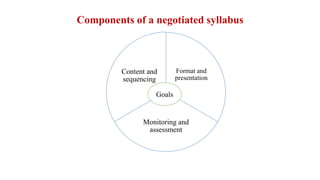
Components of a negotiated syllabus
Format and
presentation
Monitoring and
assessment
Content and
sequencing
Goals
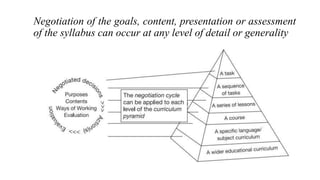
Negotiation of the goals, content, presentation or assessment
of the syllabus can occur at any level of detail or generality
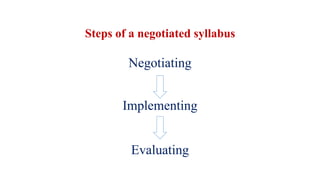
Steps of a negotiated syllabus
Negotiating
Implementing
Evaluating
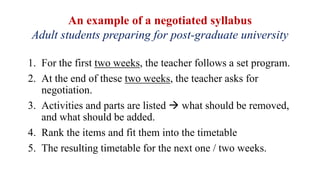
An example of a negotiated syllabus
Adult students preparing for post-graduate university
1. For the first two weeks, the teacher follows a set program.
2. At the end of these two weeks, the teacher asks for
negotiation.
3. Activities and parts are listed  what should be removed,
and what should be added.
4. Rank the items and fit them into the timetable
5. The resulting timetable for the next one / two weeks.
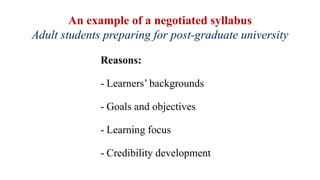
An example of a negotiated syllabus
Adult students preparing for post-graduate university
Reasons:
- Learners’ backgrounds
- Goals and objectives
- Learning focus
- Credibility development
Are there any situations for negotiation when teacher and
students first meet?
• Boon (2005) began on the first day
because his fee-paying students were
enrolled on a short course.
• Macalister (2007) was concerned with
quickly meeting the ESP “wants” of
engineering students, and used
ranking and consensus-building
activities in the first class to find out
what their “wants” were.
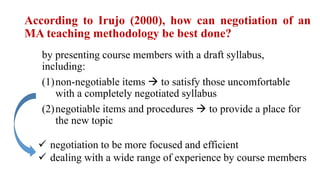
According to Irujo (2000), how can negotiation of an
MA teaching methodology be best done?
by presenting course members with a draft syllabus,
including:
(1)non-negotiable items  to satisfy those uncomfortable
with a completely negotiated syllabus
(2)negotiable items and procedures  to provide a place for
the new topic
 negotiation to be more focused and efficient
 dealing with a wide range of experience by course members
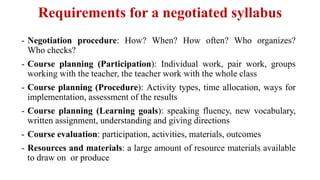
Requirements for a negotiated syllabus
- Negotiation procedure: How? When? How often? Who organizes?
Who checks?
- Course planning (Participation): Individual work, pair work, groups
working with the teacher, the teacher work with the whole class
- Course planning (Procedure): Activity types, time allocation, ways for
implementation, assessment of the results
- Course planning (Learning goals): speaking fluency, new vocabulary,
written assignment, understanding and giving directions
- Course evaluation: participation, activities, materials, outcomes
- Resources and materials: a large amount of resource materials available
to draw on or produce
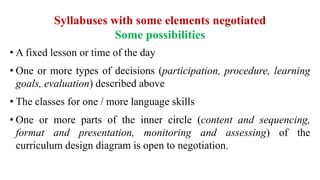
Syllabuses with some elements negotiated
Some possibilities
• A fixed lesson or time of the day
• One or more types of decisions (participation, procedure, learning
goals, evaluation) described above
• The classes for one / more language skills
• One or more parts of the inner circle (content and sequencing,
format and presentation, monitoring and assessing) of the
curriculum design diagram is open to negotiation.
Negotiating assessment
Factors affecting feedback through assessment
1. The extent to which students are aware of the criteria being used.
2. The relative emphasis given to what they have achieved as
compared with what they have failed to achieve.
3. The coincidence between what the feedback focuses upon and
what the students themselves have recognized as particularly
difficult for them.
4. Whether or not they believe they can act on the basis of the
feedback in a way that solves a recognized problem.
An example of negotiated assessment
Disadvantages of a negotiated syllabus
•Lack of knowledge and experience with
such a syllabus
•Requiring considerable teacher skill and
time in accessing and producing resources
Factors against implementing a negotiated syllabus
Learner factors
• Limited awareness of the possible activities.
• Happy to let the teacher teach.
• In need of training in negotiation.
• No sense of progress without course book
• Learners’ wants: a small part of learners’ needs.
• Learners’ diverse needs  no agreement.
• Reluctance (cultural expectations) for negotiation
• Lack of confidence
• Negative attitudes if the teacher is not taking control of the course.
Factors against implementing a negotiated syllabus
Teacher factors
•Negotiation: time consuming
•Workload
•Schools’ expectation of all learners following the
same course
•Teachers’ belief: uniformity
•No adequacy of teaching resources
•Not skilful enough with short-term planning
Advantages of a negotiated syllabus
• Responsiveness to the learners’ wants
• Involvement of the learners
• Learners’ awareness of the goals
• Enhancing meaning-focused activities (if the negotiation is
carried out in the target language)
Summary of the steps
1. Decide how the negotiation will be carried out
2. Negotiate the participation, procedure and goals
3. Begin to run the course
4. Evaluate the effectiveness of the negotiated decisions
5. Go through the steps again
Conclusion
Negotiated syllabuses can lead to wider range of outcomes
• improvement in one’s confidence
• motivation
• learning quality
• taking responsibility
• working independently
Negotiated syllabuses do not imply replacing the teacher’s power as
the basic decision maker
• convey the teacher’s recognition of potentialities of negotiation
• initiate it in the classroom for students’ benefit in language learning
References
Breen, M. P., & Littlejohn, A. (2000a). The practicalities of
negotiation. In M. P. Breen & A. Littlejohn(Eds.), Classroom
decision making: Negotiation and process syllabuses in practice
(pp. 272-296). Cambridge: CUP.
Nation, I. S. P., & Macalister, J. (2010). Language curriculum
design. New York, NY: Routledge.
Nunan, D. (1988). Syllabus Design. Oxford University Press.

Negotiated syllabuses_Hang

  • 1.
    FACULTY: FOREIGN LANGUAGES Course:……….- Course code:………….. Test: 30% AY: 2021-2022 Date: …/…/20… Time:Group:………… Duration: …...mins – Material (not) allowed Document No: TT/P.KT&KĐCL/11/BM07 Version: 05 Effective: 07/01/2019 Student’s full name:… Student ID:…………… OrdinalNo.: 202818012. Students must complete all the sections above. Examiner (Name and Signature) Score (In figures) (In words) Course:……………………………..Course code:………………………. Test code:…………...…..
  • 2.
    CURRICULUM DESIGN Chapter 10:NEGOTIATED SYLLABUSES Lecturer: Nguyen Tan Loc PhD Student: Nguyen Phuoc Dieu Hang
  • 3.
    Table of contents Syllabusvs. Curriculum Syllabus A negotiated syllabus Requirements for a negotiated syllabus Syllabus with some elements negotiated Negotiating assessment Disadvantages and advantages of a negotiated syllabus
  • 4.
  • 5.
    Syllabus vs. Curriculum Syllabus: •more localized • what actually happens at the classroom level • teacher and learners apply a curriculum to their own situation Curriculum: general statements • language learning • language purpose and experience • evaluation • role relationships of teachers and learners • learning items and how to use them in class
  • 6.
    Syllabus vs. Curriculum Basisfor comparison Syllabus Curriculum Purpose To define specific instructions, activities and scheduling for a particular subject To define the content plan and methodology of the whole study program or course Scope Narrow Wide Nature Descriptive Prescriptive Set out by Subject professor / Exam board Government or administrators of schools, colleges or universities Term Fixed term Long term Flexibility Highly flexible No room for alteration Uniformity Varies from teacher to teacher Same for all teachers
  • 7.
    Syllabus Definition • A frameworkwithin which activities can be carried out: a teaching device to facilitate learning (Widdowson, 1984: 26) • The selection and grading of linguistic teaching objectives (Pienemann, 1985 : 23) • A summary of the content to which learners will be exposed (Yalden, 1987: 87) • A focus for what should be studied, along with a rationale for how that content should be selected and ordered (Brown, 1995 :7) • A specification of the content of a course of instruction which lists what will be taught and tested (Richards, 2001)
  • 8.
    Syllabus 6 broad typesof syllabus 1. Grammatical / structural 2. Functional / notional 3. Situational / topical 4. Skills-based 5. Task-based 6. Content-based
  • 9.
    Grammar / structuralsyllabus The content of the language teaching is a collection of the forms and structures of the language being taught. 1. Choosing the structures according to the level and the goals proposed in the course 2. Choosing a set of vocabulary to be learned together with forms and structures 3. Deciding the main words according to the topics to be learned 4. Designing exercises to put in practice the structures, vocabulary and sentence patterns Examples: nouns, verbs, adjectives, statements, questions, complex sentences, subordinate clauses, past tense…
  • 10.
    Functional / notionalsyllabus “The content of language teaching is a collection of the functions or the notions that are performed when the language is used” (Wilkins, 1976, p 8). 1. Making a list of communication functions of the language that students will learn 2. Writing a list of the semantic notions based on the culture and the context of the speakers 3. Applying the functions and the notions together into learning tasks Examples of functions: informing, agreeing, apologizing, requesting, promising… Examples of notions: size, age, color, comparison, time…
  • 11.
    Situational / topicalsyllabus In this syllabus the contents are organized according to situations in which students learn. 1. Making a list of communication situations that will take place 2. Making a list of topics, grammatical forms and vocabulary and sequence them 3. Classifying the topics, forms and structures and fit them with communication situations Examples: seeing the dentist, complaining to the landlord, buying a book at the bookstore, meeting a new student, asking directions in a new town…
  • 12.
    Skills-based syllabus This syllabusis based on the development of the language skills (listening, reading, writing and speaking) using the target language. 1. Making a list of language skills that students need to acquire. 2. Making a list of topics, grammatical forms, structures and vocabulary and sequences according to language skills. Examples: listening to spoken language for the main idea, writing well-formed paragraphs, giving effective oral presentations, taking language tests, reading texts for main ideas or supporting details…
  • 13.
    Task-based syllabus The contentof language teaching includes a series of purposeful tasks that language learners need to perform; tasks are defined as activities that are needed when using the target language (Nunan, 1988). 1. Making a list of abilities or tasks that students need to develop. 2. Writing a list of topics, grammatical forms and vocabulary and sequence them. 3. Organizing the topics, forms and structures and fit them with the tasks. Examples: applying for a job, talking with a social worker, getting housing information over the telephone, completing bureaucratic forms, collecting information about preschools to decide which to send a child to, preparing a paper for another course, reading a textbook for another course…
  • 14.
    Content-based syllabus The primarypurpose of instruction is to teach some content or information using the language that the students are also learning, in other words, the learners use the foreign language to study other subjects. 1. Choosing the topics from the content (subject) 2. Making a list of topics, grammatical forms and vocabulary and adjust them to the topics Example: a science class taught in the language that the students need or want to learn, possibly with linguistic adjustments to make the science more comprehensible.
  • 15.
    A negotiated syllabus givelearners a say in the design and running of the course - recognition of learners’ needs - timely adjustments of the course to suit changing needs and circumstances involves the teacher and the learners working together to make decisions at many of the parts of the curriculum design process
  • 16.
    Reasons for havinga negotiated syllabus Humanistic methodologies Needs analysis Work in individualization and learner autonomy Learner strategy research
  • 17.
    Situations for havinga negotiated syllabus The teacher and students’ different backgrounds Time constraint  the most useful choices A diverse group of students Impossible to have an initial needs analysis No course book Students’ past experiences  part of the course The course: open-ended and exploratory
  • 18.
    Components of anegotiated syllabus Format and presentation Monitoring and assessment Content and sequencing Goals
  • 19.
    Negotiation of thegoals, content, presentation or assessment of the syllabus can occur at any level of detail or generality
  • 20.
    Steps of anegotiated syllabus Negotiating Implementing Evaluating
  • 21.
    An example ofa negotiated syllabus Adult students preparing for post-graduate university 1. For the first two weeks, the teacher follows a set program. 2. At the end of these two weeks, the teacher asks for negotiation. 3. Activities and parts are listed  what should be removed, and what should be added. 4. Rank the items and fit them into the timetable 5. The resulting timetable for the next one / two weeks.
  • 22.
    An example ofa negotiated syllabus Adult students preparing for post-graduate university Reasons: - Learners’ backgrounds - Goals and objectives - Learning focus - Credibility development
  • 23.
    Are there anysituations for negotiation when teacher and students first meet? • Boon (2005) began on the first day because his fee-paying students were enrolled on a short course. • Macalister (2007) was concerned with quickly meeting the ESP “wants” of engineering students, and used ranking and consensus-building activities in the first class to find out what their “wants” were.
  • 26.
    According to Irujo(2000), how can negotiation of an MA teaching methodology be best done? by presenting course members with a draft syllabus, including: (1)non-negotiable items  to satisfy those uncomfortable with a completely negotiated syllabus (2)negotiable items and procedures  to provide a place for the new topic  negotiation to be more focused and efficient  dealing with a wide range of experience by course members
  • 27.
    Requirements for anegotiated syllabus - Negotiation procedure: How? When? How often? Who organizes? Who checks? - Course planning (Participation): Individual work, pair work, groups working with the teacher, the teacher work with the whole class - Course planning (Procedure): Activity types, time allocation, ways for implementation, assessment of the results - Course planning (Learning goals): speaking fluency, new vocabulary, written assignment, understanding and giving directions - Course evaluation: participation, activities, materials, outcomes - Resources and materials: a large amount of resource materials available to draw on or produce
  • 28.
    Syllabuses with someelements negotiated Some possibilities • A fixed lesson or time of the day • One or more types of decisions (participation, procedure, learning goals, evaluation) described above • The classes for one / more language skills • One or more parts of the inner circle (content and sequencing, format and presentation, monitoring and assessing) of the curriculum design diagram is open to negotiation.
  • 29.
    Negotiating assessment Factors affectingfeedback through assessment 1. The extent to which students are aware of the criteria being used. 2. The relative emphasis given to what they have achieved as compared with what they have failed to achieve. 3. The coincidence between what the feedback focuses upon and what the students themselves have recognized as particularly difficult for them. 4. Whether or not they believe they can act on the basis of the feedback in a way that solves a recognized problem.
  • 30.
    An example ofnegotiated assessment
  • 31.
    Disadvantages of anegotiated syllabus •Lack of knowledge and experience with such a syllabus •Requiring considerable teacher skill and time in accessing and producing resources
  • 32.
    Factors against implementinga negotiated syllabus Learner factors • Limited awareness of the possible activities. • Happy to let the teacher teach. • In need of training in negotiation. • No sense of progress without course book • Learners’ wants: a small part of learners’ needs. • Learners’ diverse needs  no agreement. • Reluctance (cultural expectations) for negotiation • Lack of confidence • Negative attitudes if the teacher is not taking control of the course.
  • 33.
    Factors against implementinga negotiated syllabus Teacher factors •Negotiation: time consuming •Workload •Schools’ expectation of all learners following the same course •Teachers’ belief: uniformity •No adequacy of teaching resources •Not skilful enough with short-term planning
  • 34.
    Advantages of anegotiated syllabus • Responsiveness to the learners’ wants • Involvement of the learners • Learners’ awareness of the goals • Enhancing meaning-focused activities (if the negotiation is carried out in the target language)
  • 35.
    Summary of thesteps 1. Decide how the negotiation will be carried out 2. Negotiate the participation, procedure and goals 3. Begin to run the course 4. Evaluate the effectiveness of the negotiated decisions 5. Go through the steps again
  • 36.
    Conclusion Negotiated syllabuses canlead to wider range of outcomes • improvement in one’s confidence • motivation • learning quality • taking responsibility • working independently Negotiated syllabuses do not imply replacing the teacher’s power as the basic decision maker • convey the teacher’s recognition of potentialities of negotiation • initiate it in the classroom for students’ benefit in language learning
  • 38.
    References Breen, M. P.,& Littlejohn, A. (2000a). The practicalities of negotiation. In M. P. Breen & A. Littlejohn(Eds.), Classroom decision making: Negotiation and process syllabuses in practice (pp. 272-296). Cambridge: CUP. Nation, I. S. P., & Macalister, J. (2010). Language curriculum design. New York, NY: Routledge. Nunan, D. (1988). Syllabus Design. Oxford University Press.