THE INSTITUTE OF CHARTERED 
ACCOUNTANTS OF INDIA. 
This is to Certify that 
Mr. AVINASH KUMAR NIRALA 
(WRO-0550140) 
has successfully completed the 100 hours 
Information Technology 
Training. 
Chairman 
CA Vikrant M Kulkarni
INTRODUCTION TO E-COMMERCE 
Transacting or facilitating business on the Internet is 
called E-Commerce. E-Commerce is short for 
“electronic commerce”. The process of buying and 
selling goods and services over the internet .A type of 
business model, or segment of a larger business model, 
that enables a firm or individual to conduct business 
over an electronic network, typically the internet that 
doesn’t require any bargaining.
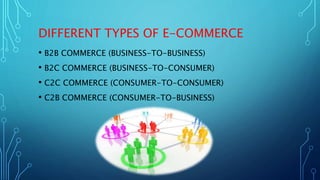
DIFFERENT TYPES OF E-COMMERCE 
• B2B COMMERCE (BUSINESS-TO-BUSINESS) 
• B2C COMMERCE (BUSINESS-TO-CONSUMER) 
• C2C COMMERCE (CONSUMER-TO-CONSUMER) 
• C2B COMMERCE (CONSUMER-TO-BUSINESS)
BUSINESS-TO-BUSINESS (B2B) 
• B2B stands for Business to Business. It consists of largest 
form of Ecommerce. 
• This model defines that Buyer and seller are two different 
entities. 
• It is similar to manufacturer issuing goods to the retailer 
or wholesaler. 
• It includes trading goods, such as business subscriptions, 
professional services, manufacturing, and wholesale 
dealings. 
Examples:- Alibaba.com, Tradeindia.com etc.
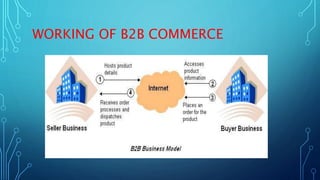
WORKING OF B2B COMMERCE
BUSINESS-TO-CONSUMER (B2C) 
• The B2C model involves transactions between business organizations 
and consumers. 
• It applies to any business organization that sells its products or 
services to consumers over the Internet. 
• These sites display product information in an online catalog and 
store it in a database. 
• The B2C model also includes services online banking, travel services, 
and health information. 
Examples:- Flipkart.com, HS18, Amazon.in etc.
PROCEDURE OF B2C BUSINESS
CONSUMER-TO-CONSUMER (C2C) 
• The C2C model involves transaction between consumers. Here, 
a consumer sells directly to another consumer. 
• It is a business model that facilitates the transaction of 
products or services between customers. 
• Even if you do not run a business, you are free to sell your 
product through such marketplace to the end customers. 
Examples:- Quikr.com, Olx.in, Tradus.in etc.
WORKING OF C2C BUSINESS
CONSUMER-TO-BUSINESS (C2B) 
• The C2B model involves a transaction that is conducted 
between a consumer and a business organization. 
• It is similar to the B2C model, however, the difference is that in 
this case the consumer is the seller and the business 
organization is the buyer. 
• In this kind of a transaction, the consumers decide the price of 
a particular product rather than the supplier. 
For example : www.monster.com is a Web site on which a 
consumer can post his bio-data for the services he can offer. Any 
business organization that is interested in deploying the services 
of the consumer can contact him and then employ him, if 
suitable.
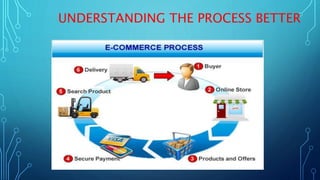
PROCESS OF E- COMMERCE 
1. A consumer uses Web browser to connect to the home page of a 
merchant's Web site on the Internet. 
2. The consumer browses the catalog of products featured on the site 
and selects items to purchase. The selected items are placed in the 
electronic equivalent of a shopping cart. 
3. When the consumer is ready to complete the purchase of selected 
items, she provides a bill-to and ship-to address for purchase and 
delivery 
4. When the merchant's Web server receives this information, it 
computes the total cost of the order--including tax, shipping, and 
handling charges--and then displays the total to the customer. 
5. The customer can now provide payment information, such as a 
credit card number, and then submit the order.
PROCESS OF E- COMMERCE (continue…. 
• When the credit card number is validated and the order is 
completed at the Commerce Server site, the merchant's site 
displays a receipt confirming the customer's purchase. 
• Cash on Delivery option is also available for those who wish to 
make payment after receiving the goods. 
• The Commerce Server site then forwards the order to a 
Processing Network for payment processing and fulfillment.
UNDERSTANDING THE PROCESS BETTER
DEMOGRAPHIC STUDY OF ONLINE 
CUSTOMERS
ADVANTAGES OF E-COMMERCE 
Faster buying/selling procedure, as well as easy to find products. 
Buying/selling 24/7. 
More reach to customers, there is no theoretical geographic 
limitations. 
Low operational costs and better quality of services. 
No need of physical company set-ups. 
Easy to start and manage a business. 
Customers can easily select products from different providers 
without moving around physically.
DISADVANTAGES 
1. Unable to examine products personally. 
2. Everyone is connected to the Internet. 
3. There is the possibility of credit card number theft. 
4. Mechanical failures can cause unpredictable effects on the 
total processes. 
5. Lack of sufficient system's security, reliability, standards, and 
communication protocols.
STATISTIC SHOWING THE COMPETITION
FUTURE OF E-COMMERCE IN INDIA 
• According to business world estimate near about 
Sixty thousand new jobs will be created for the 
internet world alone in the next two years. 
• e-Commerce transactions are expected to cross the 
Rs. 5500 crore milestone in 2013-14, a jump of 
around 350 percent from the 2010-11. 
• eBay said that consumers were trading goods worth 
almost three crore rupees everyday, across the 
globe. 
• According to Forrester’s Asia Pacific online retail 
forecast for the years 2013 to 2018, the number of 
online buyers in India will reach 39 million by the 
end of 2014 and 128 million by the end of 2018.
FUTURE OF E-COMMERCE IN INDIA 
(continue…
REFERENCES 
• http://www.statista.com/ 
• http://www.forbes.com/ 
• http://en.wikipedia.org/ 
• http://www.caclubindia.com/ 
• http://www.businessinsider.in/
AVINASH KUMAR NIRALA

AVINASH KUMAR NIRALA

  • 2.
    THE INSTITUTE OFCHARTERED ACCOUNTANTS OF INDIA. This is to Certify that Mr. AVINASH KUMAR NIRALA (WRO-0550140) has successfully completed the 100 hours Information Technology Training. Chairman CA Vikrant M Kulkarni
  • 3.
    INTRODUCTION TO E-COMMERCE Transacting or facilitating business on the Internet is called E-Commerce. E-Commerce is short for “electronic commerce”. The process of buying and selling goods and services over the internet .A type of business model, or segment of a larger business model, that enables a firm or individual to conduct business over an electronic network, typically the internet that doesn’t require any bargaining.
  • 4.
    DIFFERENT TYPES OFE-COMMERCE • B2B COMMERCE (BUSINESS-TO-BUSINESS) • B2C COMMERCE (BUSINESS-TO-CONSUMER) • C2C COMMERCE (CONSUMER-TO-CONSUMER) • C2B COMMERCE (CONSUMER-TO-BUSINESS)
  • 5.
    BUSINESS-TO-BUSINESS (B2B) •B2B stands for Business to Business. It consists of largest form of Ecommerce. • This model defines that Buyer and seller are two different entities. • It is similar to manufacturer issuing goods to the retailer or wholesaler. • It includes trading goods, such as business subscriptions, professional services, manufacturing, and wholesale dealings. Examples:- Alibaba.com, Tradeindia.com etc.
  • 6.
  • 7.
    BUSINESS-TO-CONSUMER (B2C) •The B2C model involves transactions between business organizations and consumers. • It applies to any business organization that sells its products or services to consumers over the Internet. • These sites display product information in an online catalog and store it in a database. • The B2C model also includes services online banking, travel services, and health information. Examples:- Flipkart.com, HS18, Amazon.in etc.
  • 8.
  • 9.
    CONSUMER-TO-CONSUMER (C2C) •The C2C model involves transaction between consumers. Here, a consumer sells directly to another consumer. • It is a business model that facilitates the transaction of products or services between customers. • Even if you do not run a business, you are free to sell your product through such marketplace to the end customers. Examples:- Quikr.com, Olx.in, Tradus.in etc.
  • 10.
  • 11.
    CONSUMER-TO-BUSINESS (C2B) •The C2B model involves a transaction that is conducted between a consumer and a business organization. • It is similar to the B2C model, however, the difference is that in this case the consumer is the seller and the business organization is the buyer. • In this kind of a transaction, the consumers decide the price of a particular product rather than the supplier. For example : www.monster.com is a Web site on which a consumer can post his bio-data for the services he can offer. Any business organization that is interested in deploying the services of the consumer can contact him and then employ him, if suitable.
  • 12.
    PROCESS OF E-COMMERCE 1. A consumer uses Web browser to connect to the home page of a merchant's Web site on the Internet. 2. The consumer browses the catalog of products featured on the site and selects items to purchase. The selected items are placed in the electronic equivalent of a shopping cart. 3. When the consumer is ready to complete the purchase of selected items, she provides a bill-to and ship-to address for purchase and delivery 4. When the merchant's Web server receives this information, it computes the total cost of the order--including tax, shipping, and handling charges--and then displays the total to the customer. 5. The customer can now provide payment information, such as a credit card number, and then submit the order.
  • 13.
    PROCESS OF E-COMMERCE (continue…. • When the credit card number is validated and the order is completed at the Commerce Server site, the merchant's site displays a receipt confirming the customer's purchase. • Cash on Delivery option is also available for those who wish to make payment after receiving the goods. • The Commerce Server site then forwards the order to a Processing Network for payment processing and fulfillment.
  • 14.
  • 15.
    DEMOGRAPHIC STUDY OFONLINE CUSTOMERS
  • 16.
    ADVANTAGES OF E-COMMERCE Faster buying/selling procedure, as well as easy to find products. Buying/selling 24/7. More reach to customers, there is no theoretical geographic limitations. Low operational costs and better quality of services. No need of physical company set-ups. Easy to start and manage a business. Customers can easily select products from different providers without moving around physically.
  • 17.
    DISADVANTAGES 1. Unableto examine products personally. 2. Everyone is connected to the Internet. 3. There is the possibility of credit card number theft. 4. Mechanical failures can cause unpredictable effects on the total processes. 5. Lack of sufficient system's security, reliability, standards, and communication protocols.
  • 18.
  • 19.
    FUTURE OF E-COMMERCEIN INDIA • According to business world estimate near about Sixty thousand new jobs will be created for the internet world alone in the next two years. • e-Commerce transactions are expected to cross the Rs. 5500 crore milestone in 2013-14, a jump of around 350 percent from the 2010-11. • eBay said that consumers were trading goods worth almost three crore rupees everyday, across the globe. • According to Forrester’s Asia Pacific online retail forecast for the years 2013 to 2018, the number of online buyers in India will reach 39 million by the end of 2014 and 128 million by the end of 2018.
  • 20.
    FUTURE OF E-COMMERCEIN INDIA (continue…
  • 21.
    REFERENCES • http://www.statista.com/ • http://www.forbes.com/ • http://en.wikipedia.org/ • http://www.caclubindia.com/ • http://www.businessinsider.in/