Basic Shielded Metal
Arc Welding
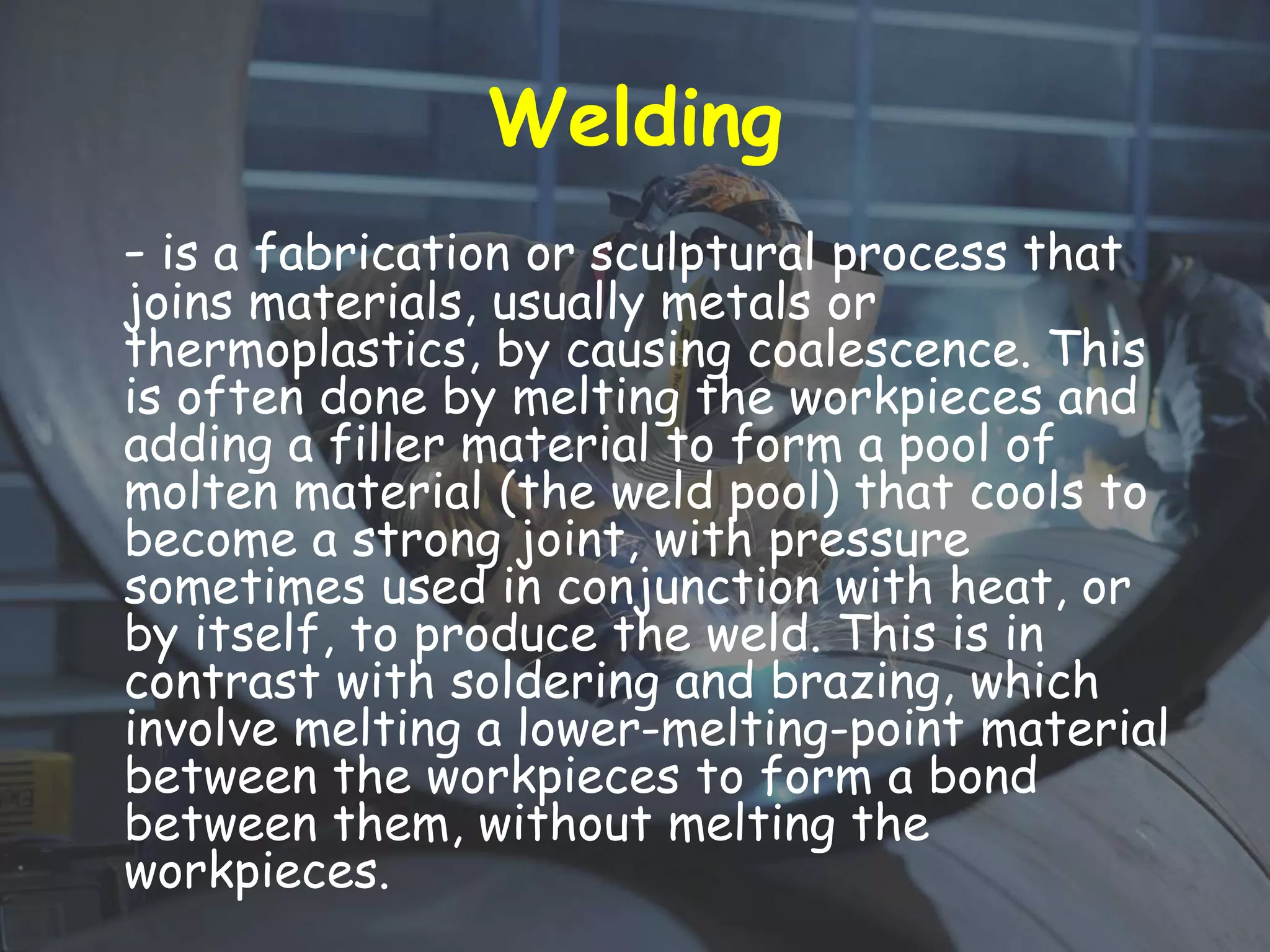
Welding
- is a fabrication or sculptural process that
joins materials, usually metals or
thermoplastics, by causing coalescence. This
is often done by melting the workpieces and
adding a filler material to form a pool of
molten material (the weld pool) that cools to
become a strong joint, with pressure
sometimes used in conjunction with heat, or
by itself, to produce the weld. This is in
contrast with soldering and brazing, which
involve melting a lower-melting-point material
between the workpieces to form a bond
between them, without melting the
workpieces.
Butt Joint
Tee Joint
Many different energy sources can be used for
welding, including a gas flame, an electric arc, a
laser, an electron beam, friction, and ultrasound.
While often an industrial process, welding may
be performed in many different environments,
including open air, under water and in outer
space. Welding is a potentially hazardous
undertaking and precautions are required to
avoid burns, electric shock, vision damage,
inhalation of poisonous gases and fumes, and
exposure to intense ultraviolet radiation.
Shielded Metal Arc Welding
- Shielded metal arc welding (SMAW), also
known as manual metal arc (MMA) welding, flux
shielded arc welding or informally as stick
welding, is a manual arc welding process that
uses a consumable electrode coated in flux to lay
the weld. An electric current, in the form of
either alternating current or direct current
from a welding power supply, is used to form an
electric arc between the electrode and the
metals to be joined. As the weld is laid, the flux
coating of the electrode disintegrates, giving
off vapors that serve as a shielding gas and
providing a layer of slag, both of which protect
the weld area from atmospheric contamination.
Tube welding
Operation
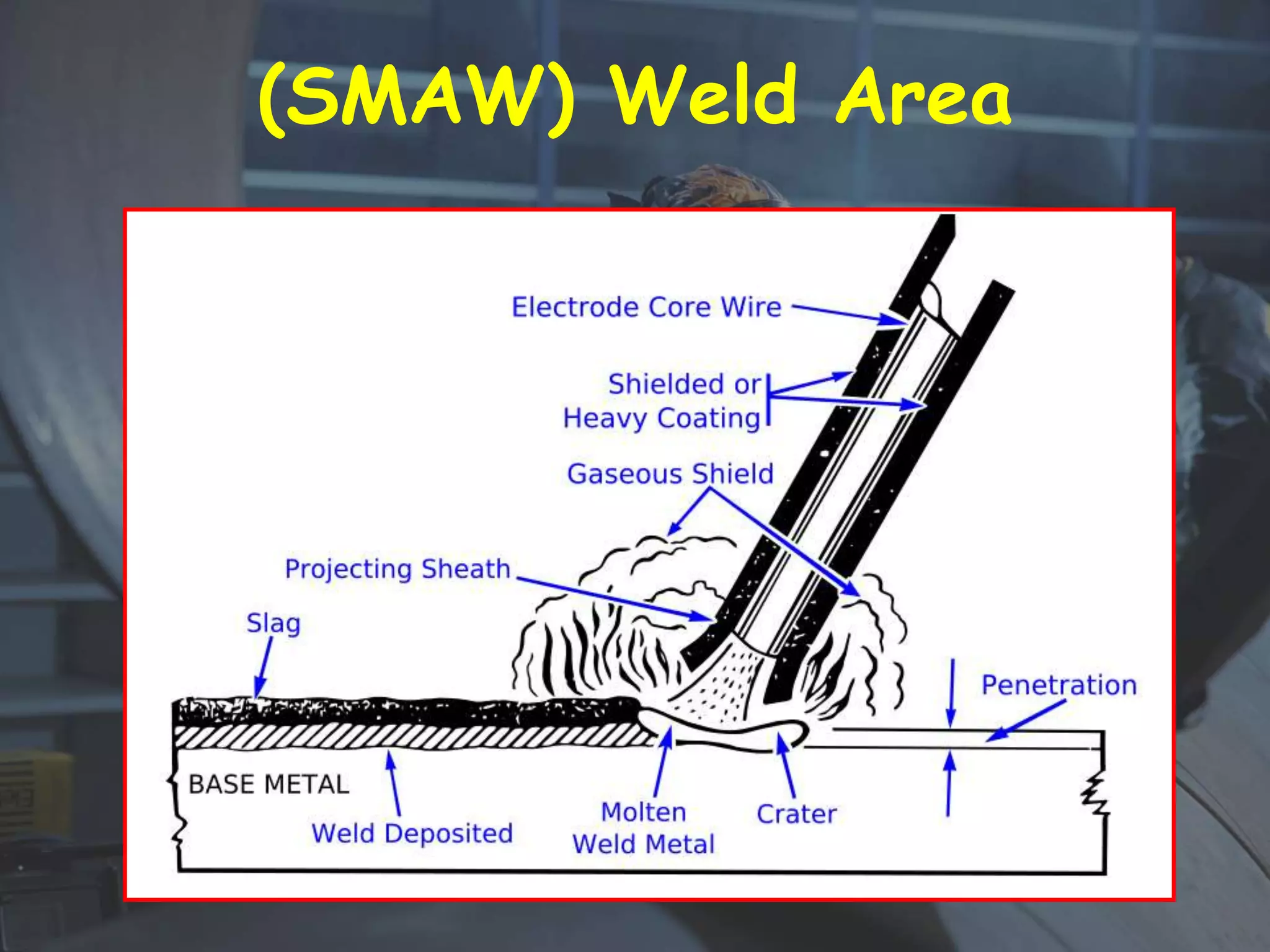
- To strike the electric arc, the electrode is brought
into contact with the workpiece by a very light touch
with the electrode to the base metal then is pulled
back slightly. This initiates the arc and thus the
melting of the workpiece and the consumable
electrode, and causes droplets of the electrode to
be passed from the electrode to the weld pool. As
the electrode melts, the flux covering disintegrates,
giving off shielding gases that protect the weld area
from oxygen and other atmospheric gases. In
addition, the flux provides molten slag which covers
the filler metal as it travels from the electrode to the
weld pool. Once part of the weld pool, the slag
floats to the surface and protects the weld from
contamination as it solidifies.
With Slag
(SMAW) Weld Area
Types of joints
Welding Position
5G & 6G
6G – all position in 45º
5G – all position
Equipment
- Shielded metal arc welding equipment
typically consists of a constant current
welding power supply and an electrode,
with an electrode holder, a ground clamp,
and welding cables (also known as
welding leads) connecting the two.
Tools
Chipping Hammer Steel Brush
Pliers
Electrode
An electrode is an electrical conductor
used to make contact with a nonmetallic
part of a circuit (e.g. a semiconductor,
an electrolyte or a vacuum).
Code on the Electrode
Types of Electrode
Safety
1. Danger Signs – indicates hazardous
situation which, if not avoided will result
in death or serious injury. The possible
are shown in the adjoining symbols or
explained in the text.
2. Electric Shock – touching live electrical parts can
fatal shocks or severe burns. The electrode and work
circuit is electrically live whenever the output is on.
The input power circuit and machine internal circuit
are also live when power is on. In semiautomatic or
automatic wire welding, the wire, wire reel, drive roll
housing, and all metal parts touching the welding wire
are electrically live. Incorrectly installed or
improperly grounded equipment is hazard.
3. Hot Parts Can Burn:
- Do not touch hot parts bare
handed.
- Allow cooling period before working
on equipment.
- To handle hot parts, use proper
tools and/or wear gloves and clothing to
prevent burn.
4. Fumes and Gases – welding produces
fumes and gases. Breathing these fumes
and gases can be hazardous to your
health.
5. Arc Rays – arc rays from the welding
process produce intense visible and
invisible (ultraviolet and infrared) rays
that can burn eyes and skin. Sparks fly
off the weld.
6. Fire Hazard or Explosion – welding on closed
containers, such as tanks, drums, or pipes, can
cause them to blow up. Sparks can fly off
from the welding arc. The flying sparks, hot
workpiece, and hot equipment can cause fires
and burns. Accidental contact of electrode to
metal objects can cause sparks, explosion,
overheating, or fire. Check and be sure the
area is safe before doing welding.
Personal Protective Equipment
(PPE)
- Personal protective equipment
(PPE) must protect hazards such as
burns, spark, spatter, electric
shock, and radiation. The use of PPE
is a good safe practice and may be
required by regulatory agencies.
Welding Mask
Welding Working Clothes
SMAW Advantages
and Limitations
Advantages
• Low initial cost
• Portable
• Easy to use
outdoors
• All position
capabilities
• Easy to change
between many base
materials
Limitations
• Lower consumable
efficiency
• Difficult to weld
very thin materials
• Frequent restarts
• Lower operating
factor
• Higher operator skill
required for SMAW
than some other
processes
End
Working without
safety is a
dead-end job.
Good luck and
enjoy welding!

Basic Metal Arc Welding PPT..ppt

  • 1.
  • 2.
    Welding - is afabrication or sculptural process that joins materials, usually metals or thermoplastics, by causing coalescence. This is often done by melting the workpieces and adding a filler material to form a pool of molten material (the weld pool) that cools to become a strong joint, with pressure sometimes used in conjunction with heat, or by itself, to produce the weld. This is in contrast with soldering and brazing, which involve melting a lower-melting-point material between the workpieces to form a bond between them, without melting the workpieces.
  • 3.
  • 4.
    Many different energysources can be used for welding, including a gas flame, an electric arc, a laser, an electron beam, friction, and ultrasound. While often an industrial process, welding may be performed in many different environments, including open air, under water and in outer space. Welding is a potentially hazardous undertaking and precautions are required to avoid burns, electric shock, vision damage, inhalation of poisonous gases and fumes, and exposure to intense ultraviolet radiation.
  • 5.
    Shielded Metal ArcWelding - Shielded metal arc welding (SMAW), also known as manual metal arc (MMA) welding, flux shielded arc welding or informally as stick welding, is a manual arc welding process that uses a consumable electrode coated in flux to lay the weld. An electric current, in the form of either alternating current or direct current from a welding power supply, is used to form an electric arc between the electrode and the metals to be joined. As the weld is laid, the flux coating of the electrode disintegrates, giving off vapors that serve as a shielding gas and providing a layer of slag, both of which protect the weld area from atmospheric contamination.
  • 6.
  • 8.
    Operation - To strikethe electric arc, the electrode is brought into contact with the workpiece by a very light touch with the electrode to the base metal then is pulled back slightly. This initiates the arc and thus the melting of the workpiece and the consumable electrode, and causes droplets of the electrode to be passed from the electrode to the weld pool. As the electrode melts, the flux covering disintegrates, giving off shielding gases that protect the weld area from oxygen and other atmospheric gases. In addition, the flux provides molten slag which covers the filler metal as it travels from the electrode to the weld pool. Once part of the weld pool, the slag floats to the surface and protects the weld from contamination as it solidifies.
  • 9.
  • 10.
  • 11.
  • 12.
  • 13.
    5G & 6G 6G– all position in 45º 5G – all position
  • 14.
    Equipment - Shielded metalarc welding equipment typically consists of a constant current welding power supply and an electrode, with an electrode holder, a ground clamp, and welding cables (also known as welding leads) connecting the two.
  • 16.
  • 17.
    Electrode An electrode isan electrical conductor used to make contact with a nonmetallic part of a circuit (e.g. a semiconductor, an electrolyte or a vacuum).
  • 18.
    Code on theElectrode
  • 19.
  • 20.
    Safety 1. Danger Signs– indicates hazardous situation which, if not avoided will result in death or serious injury. The possible are shown in the adjoining symbols or explained in the text.
  • 21.
    2. Electric Shock– touching live electrical parts can fatal shocks or severe burns. The electrode and work circuit is electrically live whenever the output is on. The input power circuit and machine internal circuit are also live when power is on. In semiautomatic or automatic wire welding, the wire, wire reel, drive roll housing, and all metal parts touching the welding wire are electrically live. Incorrectly installed or improperly grounded equipment is hazard.
  • 22.
    3. Hot PartsCan Burn: - Do not touch hot parts bare handed. - Allow cooling period before working on equipment. - To handle hot parts, use proper tools and/or wear gloves and clothing to prevent burn.
  • 23.
    4. Fumes andGases – welding produces fumes and gases. Breathing these fumes and gases can be hazardous to your health.
  • 24.
    5. Arc Rays– arc rays from the welding process produce intense visible and invisible (ultraviolet and infrared) rays that can burn eyes and skin. Sparks fly off the weld.
  • 25.
    6. Fire Hazardor Explosion – welding on closed containers, such as tanks, drums, or pipes, can cause them to blow up. Sparks can fly off from the welding arc. The flying sparks, hot workpiece, and hot equipment can cause fires and burns. Accidental contact of electrode to metal objects can cause sparks, explosion, overheating, or fire. Check and be sure the area is safe before doing welding.
  • 26.
    Personal Protective Equipment (PPE) -Personal protective equipment (PPE) must protect hazards such as burns, spark, spatter, electric shock, and radiation. The use of PPE is a good safe practice and may be required by regulatory agencies.
  • 27.
  • 28.
  • 29.
    Advantages • Low initialcost • Portable • Easy to use outdoors • All position capabilities • Easy to change between many base materials
  • 30.
    Limitations • Lower consumable efficiency •Difficult to weld very thin materials • Frequent restarts • Lower operating factor • Higher operator skill required for SMAW than some other processes
  • 31.
  • 32.
  • 33.