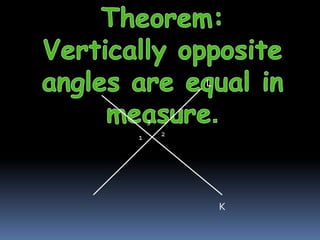
L 
K 
3 
1 2
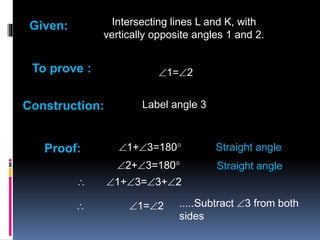
Given: 
To prove : 
Intersecting lines L and K, with 
vertically opposite angles 1 and 2. 
Construction: 
1=2 
Label angle 3 
Proof: Straight angle 
Straight angle 
1+3=180 
2+3=180 
 1+3=3+2 
 1=2 
.....Subtract 3 from both 
sides
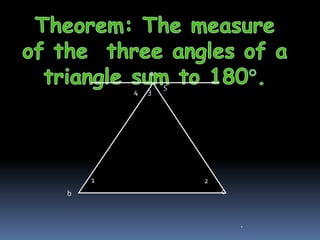
4 
5 
a 
3 
1 2 
b c 
. 
5
Given: 
The triangle abc with 1,2 and 3. 
To Prove: 1+2+3=180 
Construction: 
Proof: 
Draw a line through a, Parallel to bc. 
Label angles 4 and 5. 
1=4 and 
2=5 
Alternate 
angles 
1+2+3=4+5+3 
But 
4+5+3=180 
Straight 
angle 
 1+2+3=180 
Angle sum property
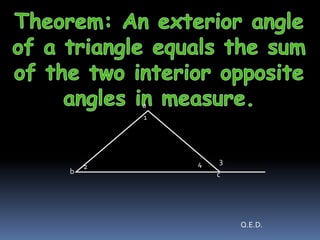
a 
3 
1 
2 4 
b c 
Q.E.D.
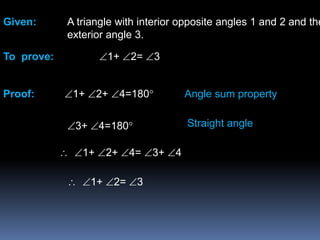
Given: A triangle with interior opposite angles 1 and 2 and the 
exterior angle 3. 
To prove: 1+ 2= 3 
Proof: 1+ 2+ 4=180 
3+ 4=180 
Angle sum property 
 1+ 2+ 4= 3+ 4 
Straight angle 
 1+ 2= 3
a 
3 4 
b 1 2 c 
d
Given: The triangle abc, with ab = ac and base angles 1 and 2. 
To prove: 1 = 2 
Construction: Draw ad, the bisector of bac. Label angles 3 
and 4. 
Proof: 
consider ABD and ACD 
ab = ac 
construction 
3 = 4 given 
ad = ad common 
SAS criteria 
 ABD ACD 
 1 = 2 CPCT
1 
3 
2 
t 
A B 
P 
C D 
Q
Given: AB||CD and EFGH is a transversal. 
To Prove:  1 =  2 
Proof : 1= 5 [1] v .o .a 
5= 2 [2] corresponding 
angles 
from equation 1 and 2 we get , 
1= 2
Angles opposite to equal 
sides of triangle are 
equal A 
B 
D C
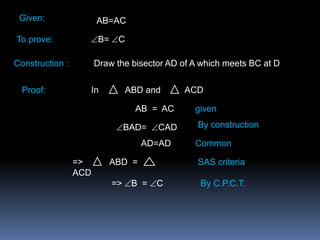
Given: AB=AC 
To prove: B= C 
Construction : Draw the bisector AD of A which meets BC at D 
Proof: In ABD and ACD 
AB = AC g i v e n 
BAD= CAD By construction 
AD=AD Common 
=> ABD = 
ACD 
SAS criteria 
=> B = C By C.P.C.T.
a very nice ppt for learning theorems

a very nice ppt for learning theorems

  • 1.
    L K 3 1 2
  • 2.
    Given: To prove: Intersecting lines L and K, with vertically opposite angles 1 and 2. Construction: 1=2 Label angle 3 Proof: Straight angle Straight angle 1+3=180 2+3=180  1+3=3+2  1=2 .....Subtract 3 from both sides
  • 3.
    4 5 a 3 1 2 b c . 5
  • 4.
    Given: The triangleabc with 1,2 and 3. To Prove: 1+2+3=180 Construction: Proof: Draw a line through a, Parallel to bc. Label angles 4 and 5. 1=4 and 2=5 Alternate angles 1+2+3=4+5+3 But 4+5+3=180 Straight angle  1+2+3=180 Angle sum property
  • 5.
    a 3 1 2 4 b c Q.E.D.
  • 6.
    Given: A trianglewith interior opposite angles 1 and 2 and the exterior angle 3. To prove: 1+ 2= 3 Proof: 1+ 2+ 4=180 3+ 4=180 Angle sum property  1+ 2+ 4= 3+ 4 Straight angle  1+ 2= 3
  • 7.
    a 3 4 b 1 2 c d
  • 8.
    Given: The triangleabc, with ab = ac and base angles 1 and 2. To prove: 1 = 2 Construction: Draw ad, the bisector of bac. Label angles 3 and 4. Proof: consider ABD and ACD ab = ac construction 3 = 4 given ad = ad common SAS criteria  ABD ACD  1 = 2 CPCT
  • 9.
    1 3 2 t A B P C D Q
  • 10.
    Given: AB||CD andEFGH is a transversal. To Prove:  1 =  2 Proof : 1= 5 [1] v .o .a 5= 2 [2] corresponding angles from equation 1 and 2 we get , 1= 2
  • 11.
    Angles opposite toequal sides of triangle are equal A B D C
  • 12.
    Given: AB=AC Toprove: B= C Construction : Draw the bisector AD of A which meets BC at D Proof: In ABD and ACD AB = AC g i v e n BAD= CAD By construction AD=AD Common => ABD = ACD SAS criteria => B = C By C.P.C.T.