Downloaded 24 times
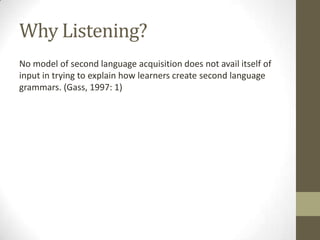
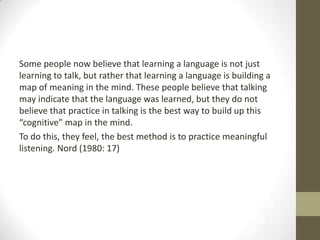
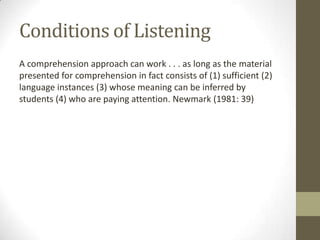
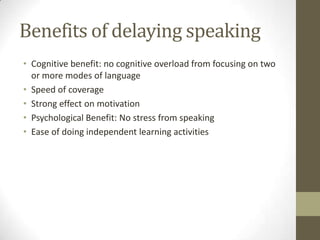
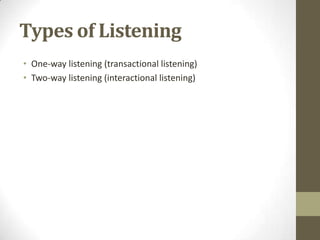
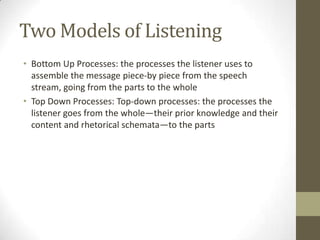
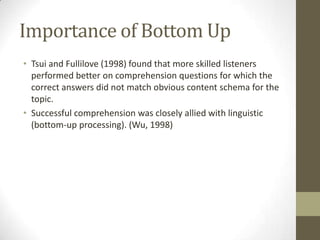
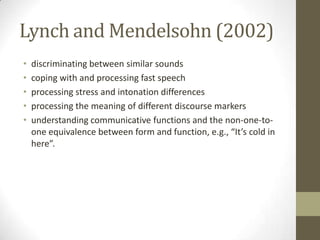


This document discusses listening as an important part of second language acquisition. It argues that listening provides input that allows learners to build a "cognitive map" of meaning in their mind, which may be more important than speaking practice alone. There are two main types of listening discussed: one-way transactional listening and two-way interactional listening. Successful listening relies on both bottom-up processing of linguistic elements as well as top-down processing using prior knowledge and schemata. The document outlines several specific listening challenges and provides suggestions for practice, including working with reduced forms, assimilation, elision, and resyllabification.


![Richards teaching-listening-speaking[1]](https://cdn.slidesharecdn.com/ss_thumbnails/richards-teaching-listening-speaking1-130611222232-phpapp01-thumbnail.jpg?width=640&height=640&fit=bounds)


