



Open data developments in
Japan
Tomoaki Watanabe
Center for Global Communications (GLOCOM)
International U. of Japan/ Creative Commons Japan/
Open Knowledge Foundation Japan Initiative
Internet Governance Forum
October 22-25, 2013, Bali
A bit about myself
- Academic (full time): ICT policies, information
society issues
(Senior Research Fellow& Associate Prof.
at GLOCOM)
- Advocate (volunteer): open licensing
(Creative Commons Japan; executive director for its
host organization CommonSphere)
Open Knowledge Foundation (Co-founder)
2
Menu
Overview
I. National Policy Development
II. Major Projects
III. Policy Performance

3
An Overview

4
Japan’s major developments
- National strategy adopted (June 2012)
- Decent support from the political leadership (Jan. ‘13)
Emphasis on economic effects
- Decent institution for the execution
Newly created gov’t CIO close to the matter
Pub-priv joint conference for implementation;
Priv-led, pub-supported forum
- Civic sector growing
- National data portal soon to launch
- Many pioneering projects
- Discussion ongoing on: evaluation, standards, etc.
5
Early Trials
-Ministries of…
Internal Affairs &Communications
Econ. Trade& Industry
Environment
-Other Agencies
Reconstruction Agency
Japan Meteorological Agency
Geospatial Information Authority of Japan
National Diet Library
Japan Aerospace Exploration Agency
6
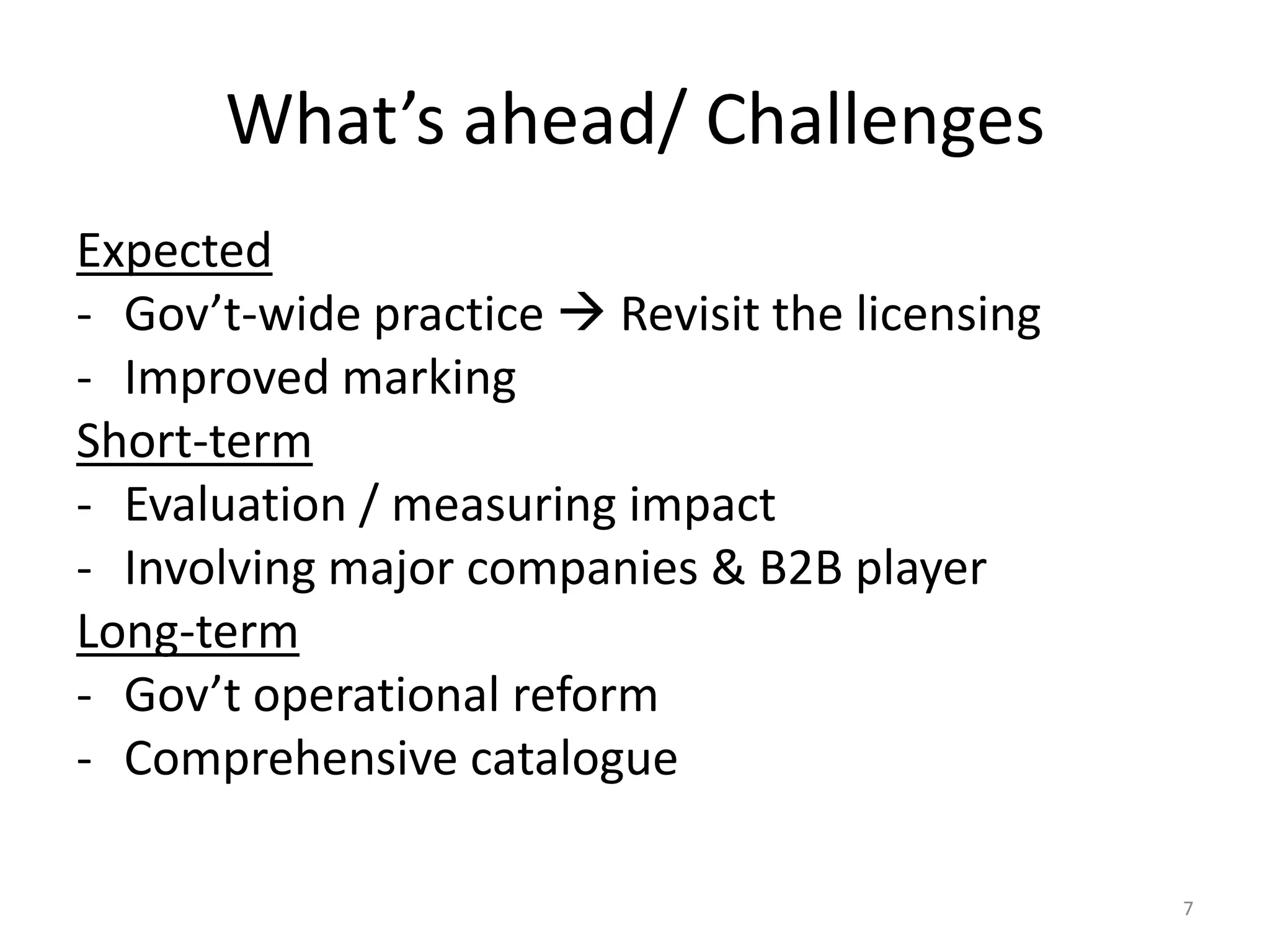
What’s ahead/ Challenges
Expected
- Gov’t-wide practice  Revisit the licensing
- Improved marking
Short-term
- Evaluation / measuring impact
- Involving major companies & B2B player
Long-term
- Gov’t operational reform
- Comprehensive catalogue
7
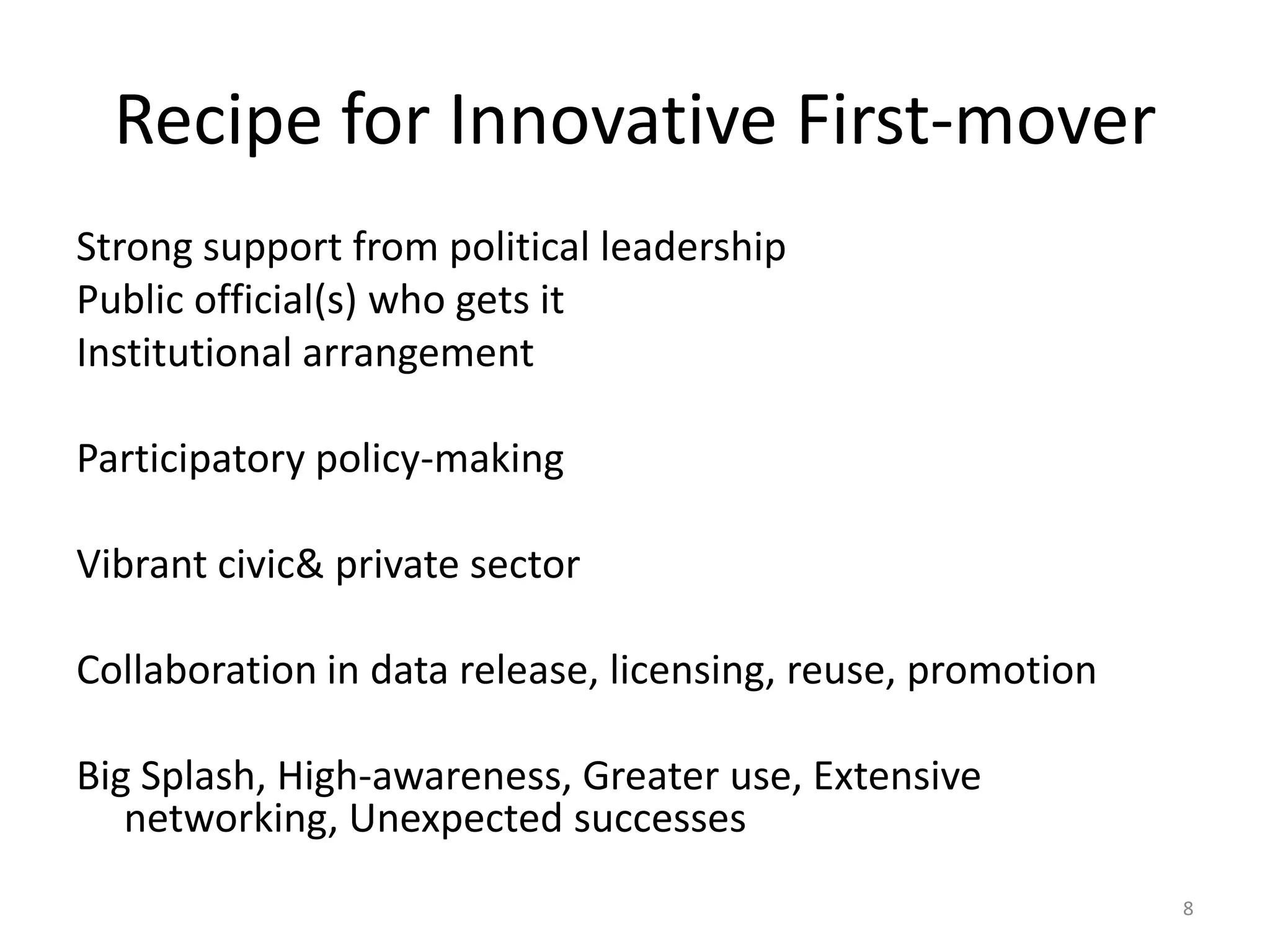
Recipe for Innovative First-mover
Strong support from political leadership
Public official(s) who gets it
Institutional arrangement
Participatory policy-making
Vibrant civic& private sector
Collaboration in data release, licensing, reuse, promotion

Big Splash, High-awareness, Greater use, Extensive
networking, Unexpected successes
8
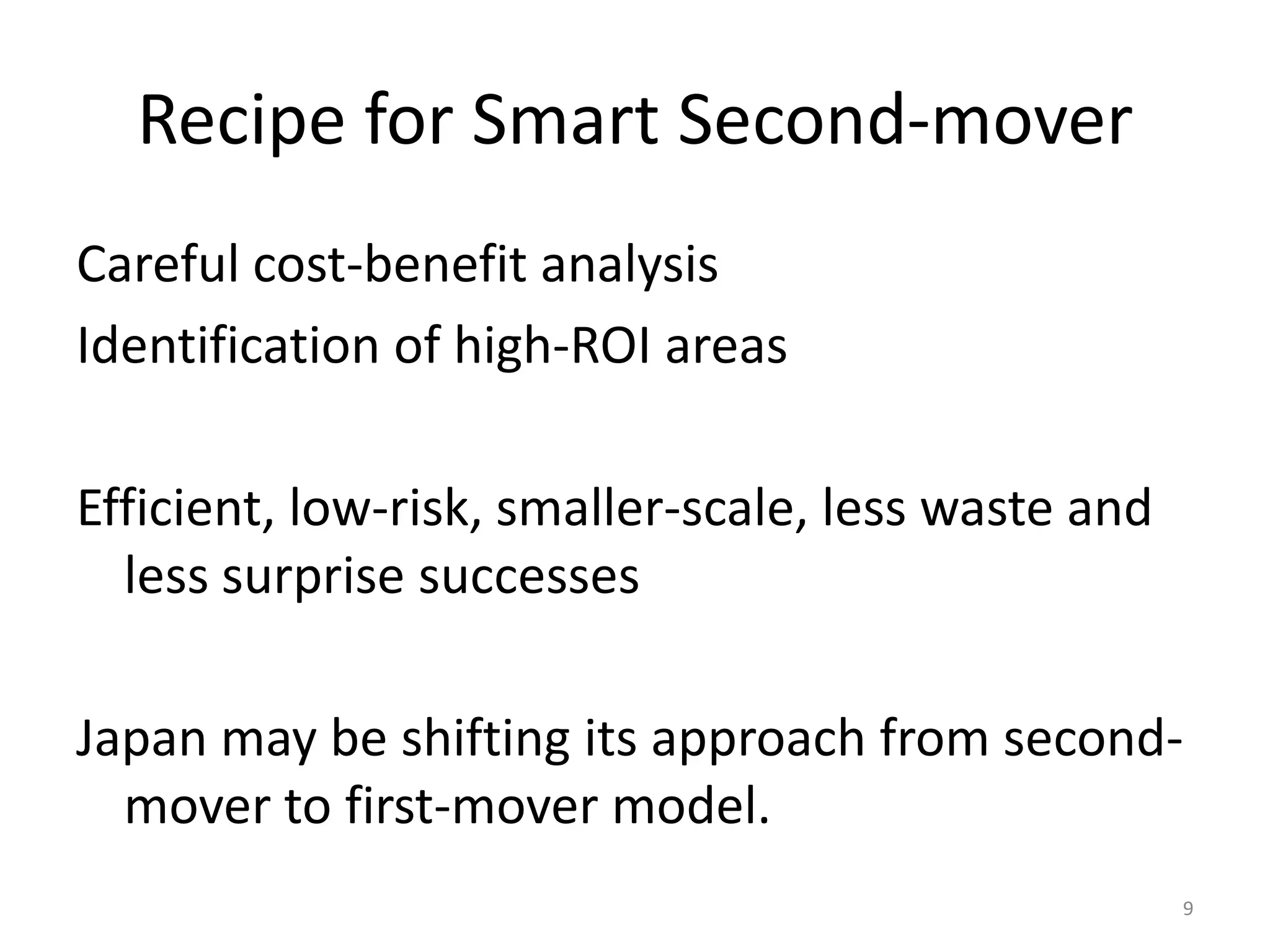
Recipe for Smart Second-mover
Careful cost-benefit analysis
Identification of high-ROI areas
Efficient, low-risk, smaller-scale, less waste and
less surprise successes
Japan may be shifting its approach from secondmover to first-mover model.
9
National Policy Development

10
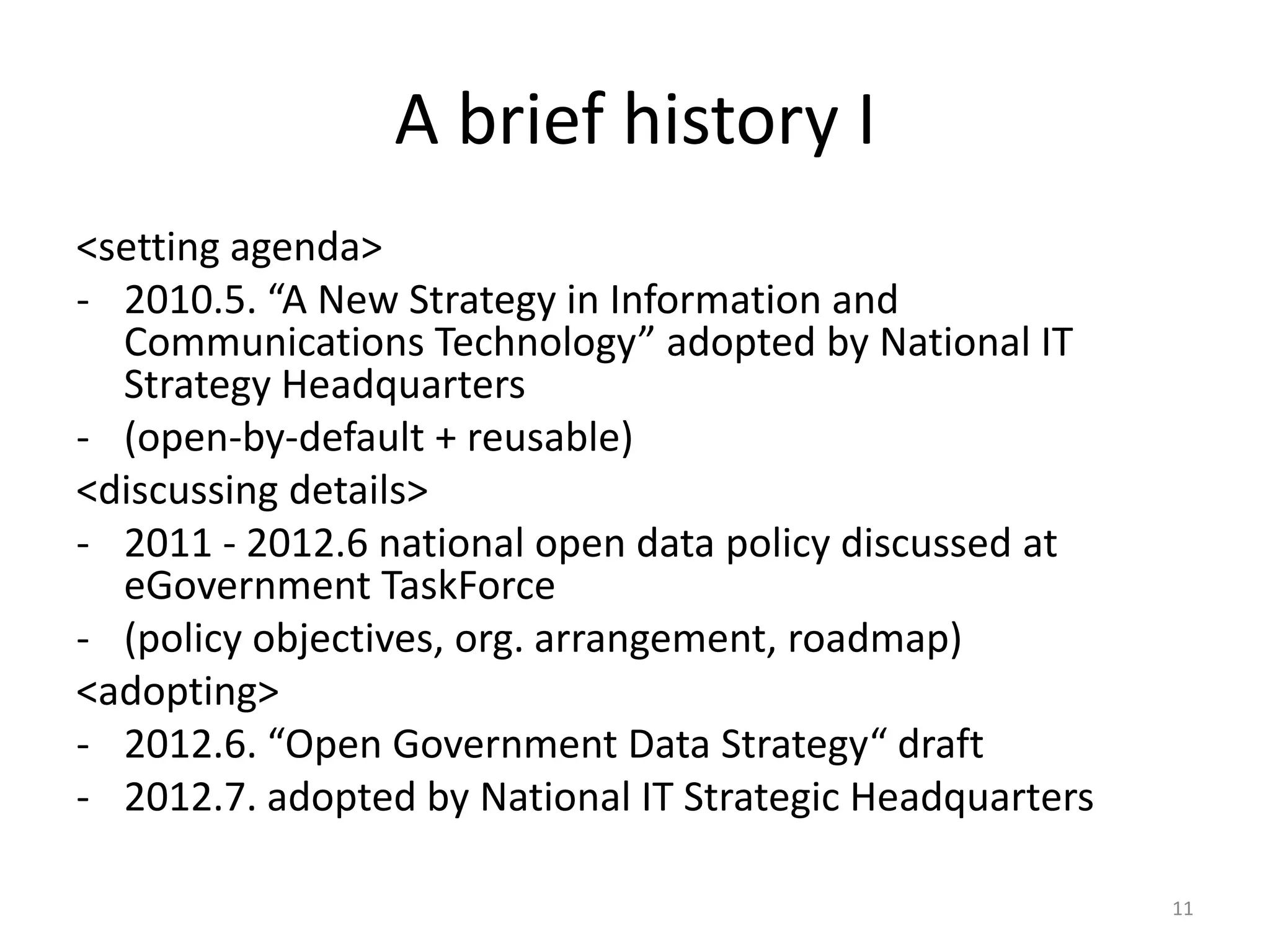
A brief history I
<setting agenda>
- 2010.5. “A New Strategy in Information and
Communications Technology” adopted by National IT
Strategy Headquarters
- (open-by-default + reusable)
<discussing details>
- 2011 - 2012.6 national open data policy discussed at
eGovernment TaskForce
- (policy objectives, org. arrangement, roadmap)
<adopting>
- 2012.6. “Open Government Data Strategy“ draft
- 2012.7. adopted by National IT Strategic Headquarters
11
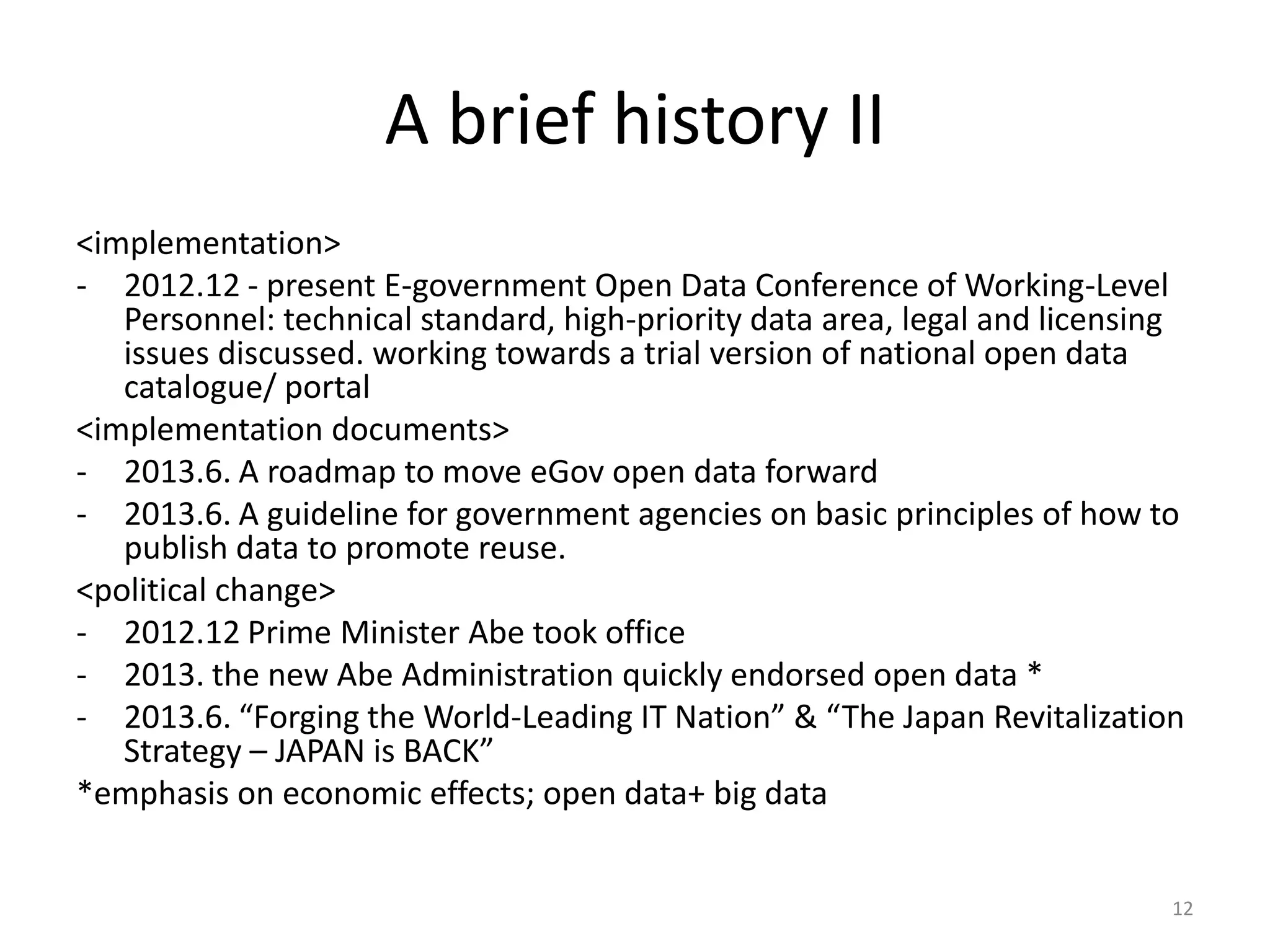
A brief history II
<implementation>
- 2012.12 - present E-government Open Data Conference of Working-Level
Personnel: technical standard, high-priority data area, legal and licensing
issues discussed. working towards a trial version of national open data
catalogue/ portal
<implementation documents>
- 2013.6. A roadmap to move eGov open data forward
- 2013.6. A guideline for government agencies on basic principles of how to
publish data to promote reuse.
<political change>
- 2012.12 Prime Minister Abe took office
- 2013. the new Abe Administration quickly endorsed open data *
- 2013.6. “Forging the World-Leading IT Nation” & “The Japan Revitalization
Strategy – JAPAN is BACK”
*emphasis on economic effects; open data+ big data
12
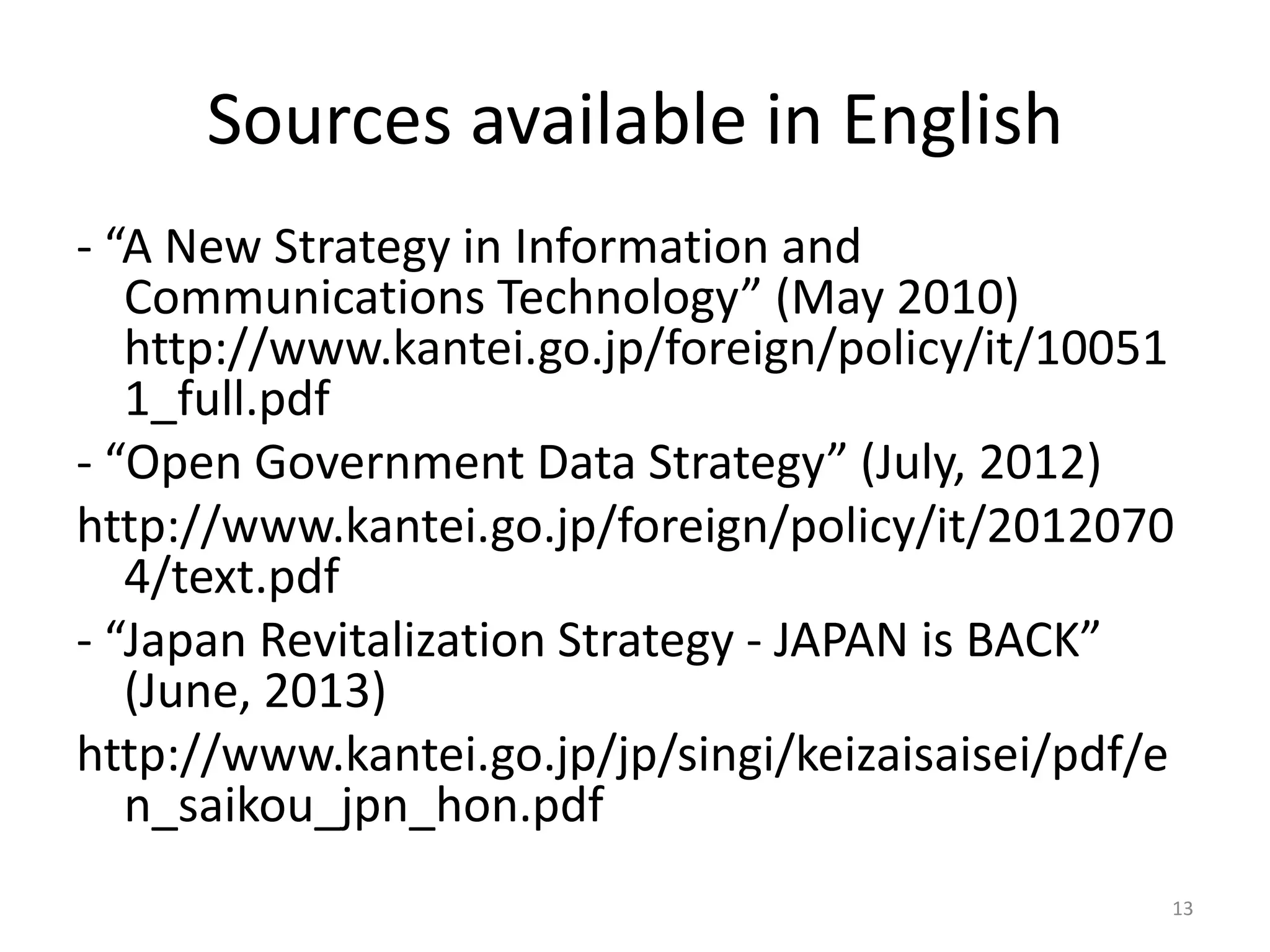
Sources available in English
- “A New Strategy in Information and
Communications Technology” (May 2010)
http://www.kantei.go.jp/foreign/policy/it/10051
1_full.pdf
- “Open Government Data Strategy” (July, 2012)
http://www.kantei.go.jp/foreign/policy/it/2012070
4/text.pdf
- “Japan Revitalization Strategy - JAPAN is BACK”
(June, 2013)
http://www.kantei.go.jp/jp/singi/keizaisaisei/pdf/e
n_saikou_jpn_hon.pdf
13
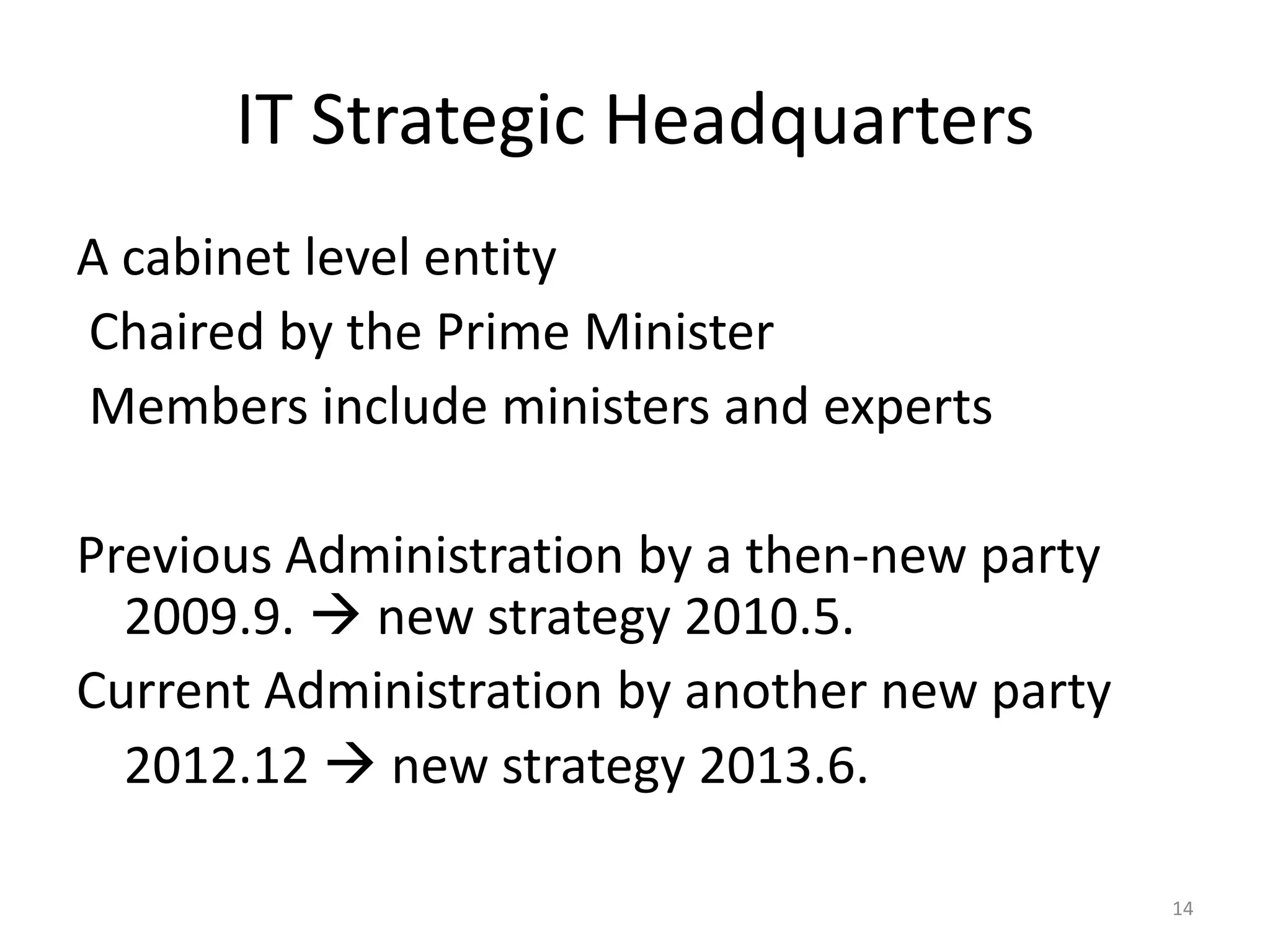
IT Strategic Headquarters
A cabinet level entity
Chaired by the Prime Minister
Members include ministers and experts

Previous Administration by a then-new party
2009.9.  new strategy 2010.5.
Current Administration by another new party
2012.12  new strategy 2013.6.
14
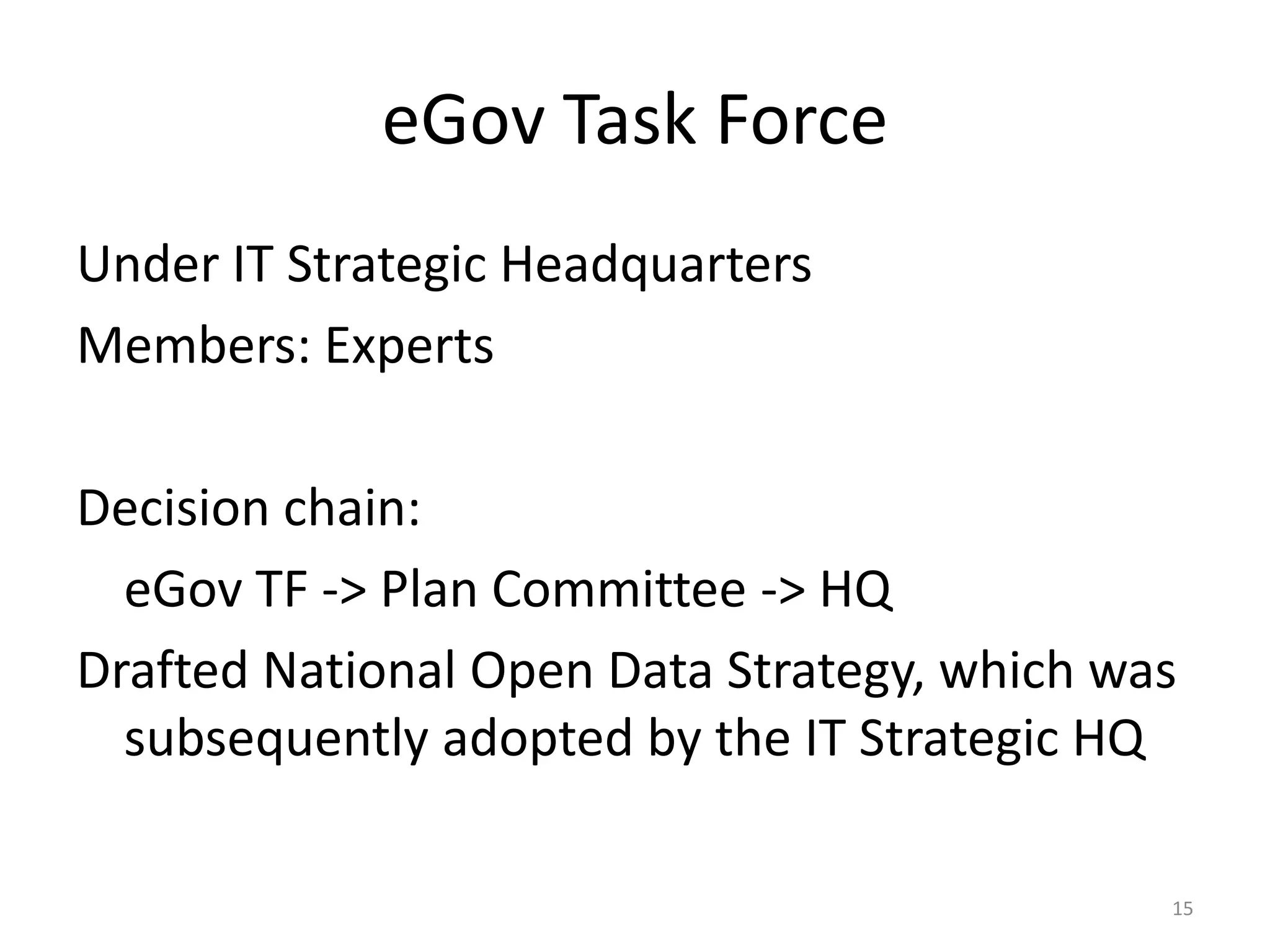
eGov Task Force
Under IT Strategic Headquarters
Members: Experts
Decision chain:
eGov TF -> Plan Committee -> HQ
Drafted National Open Data Strategy, which was
subsequently adopted by the IT Strategic HQ
15
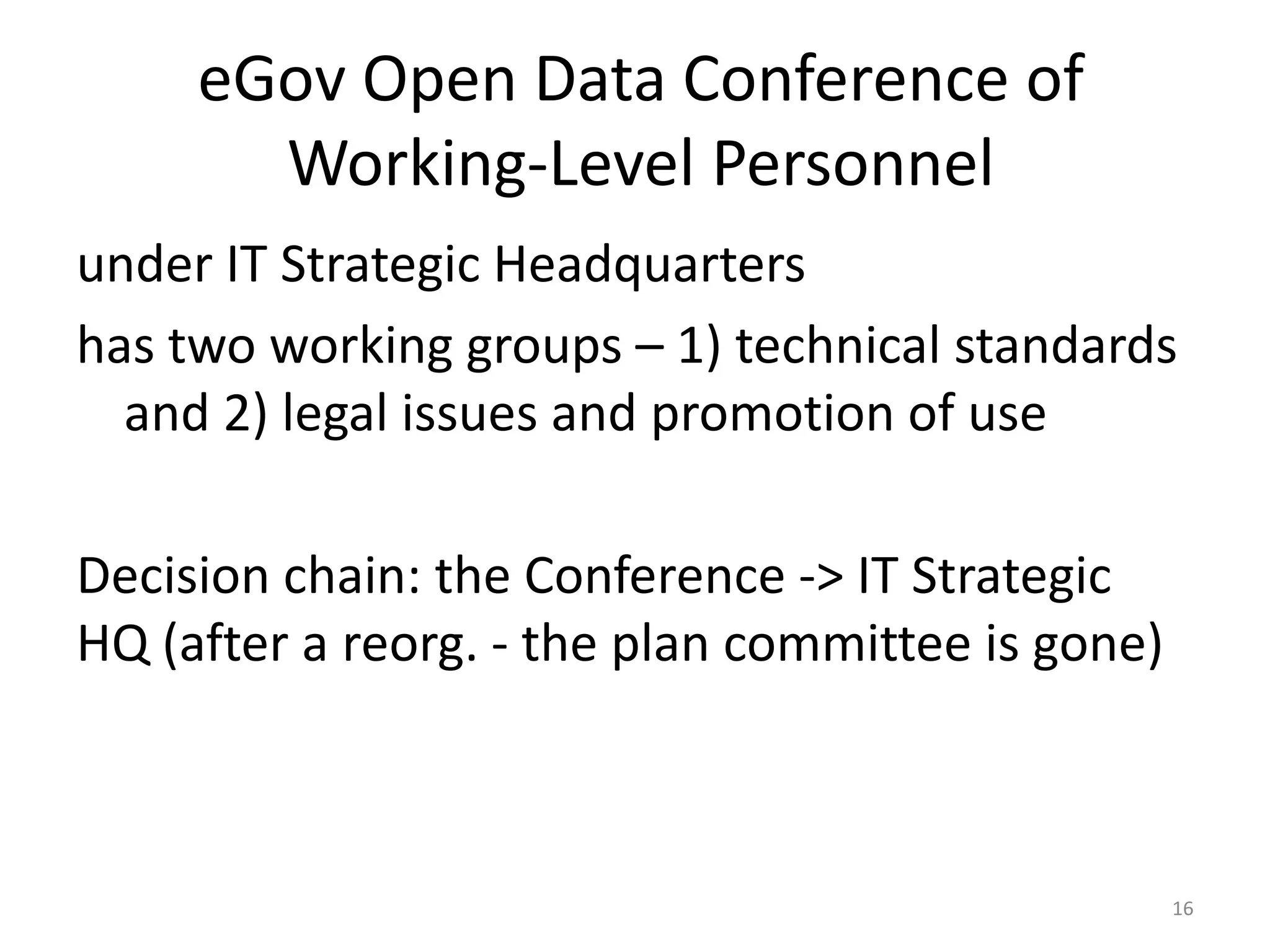
eGov Open Data Conference of
Working-Level Personnel
under IT Strategic Headquarters
has two working groups – 1) technical standards
and 2) legal issues and promotion of use

Decision chain: the Conference -> IT Strategic
HQ (after a reorg. - the plan committee is gone)

16
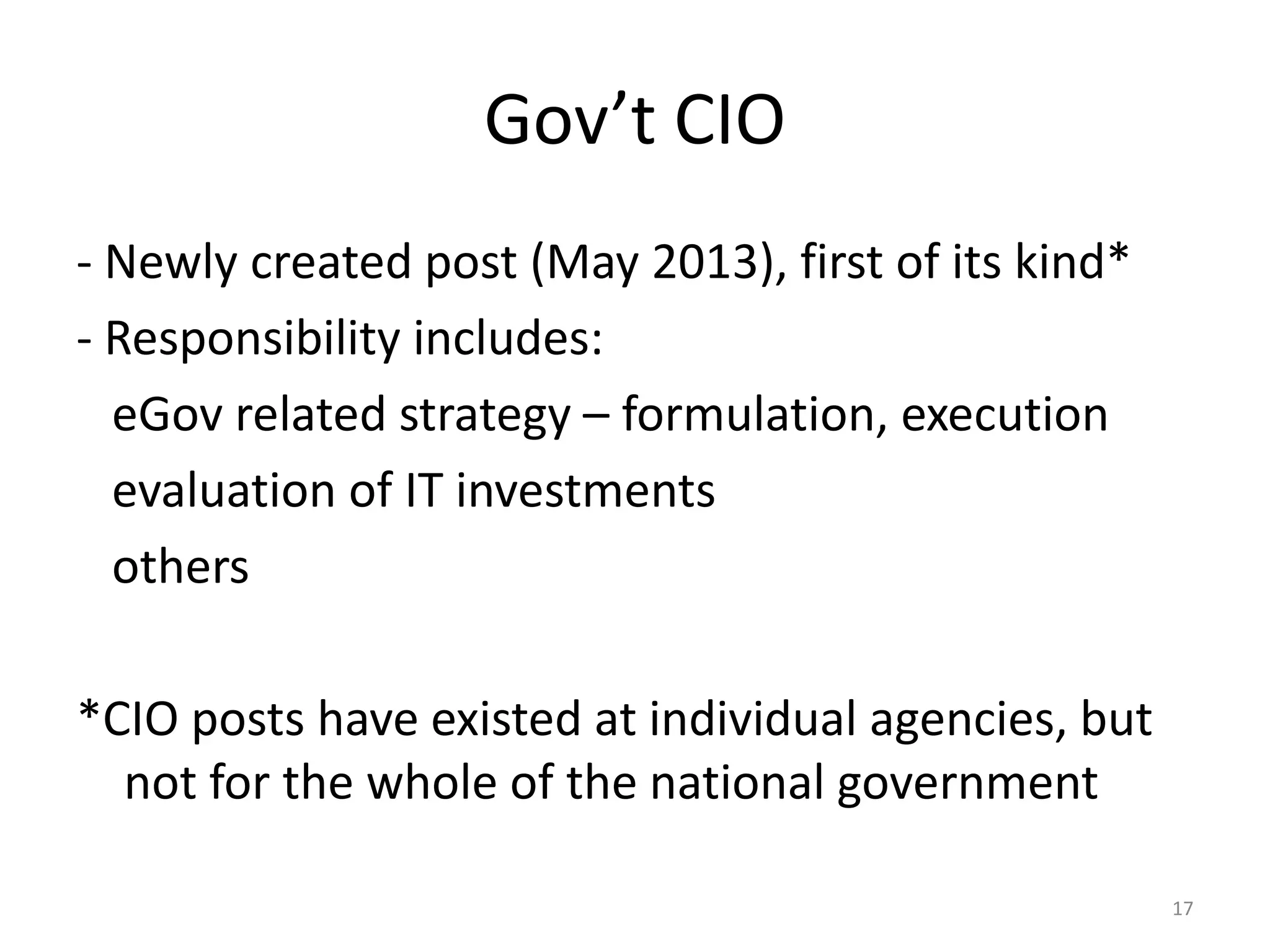
Gov’t CIO
- Newly created post (May 2013), first of its kind*
- Responsibility includes:
eGov related strategy – formulation, execution
evaluation of IT investments
others
*CIO posts have existed at individual agencies, but
not for the whole of the national government
17
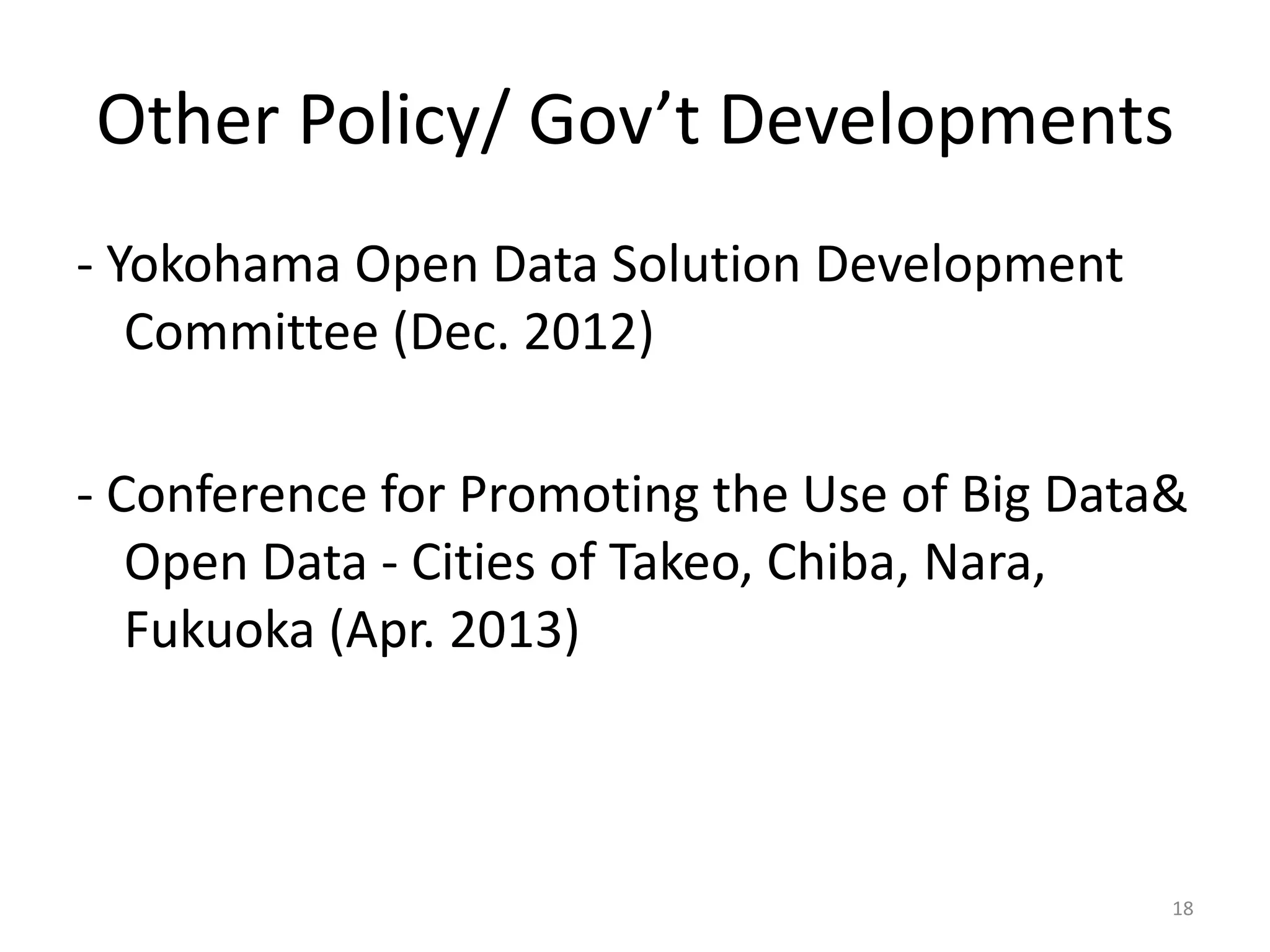
Other Policy/ Gov’t Developments
- Yokohama Open Data Solution Development
Committee (Dec. 2012)
- Conference for Promoting the Use of Big Data&
Open Data - Cities of Takeo, Chiba, Nara,
Fukuoka (Apr. 2013)

18
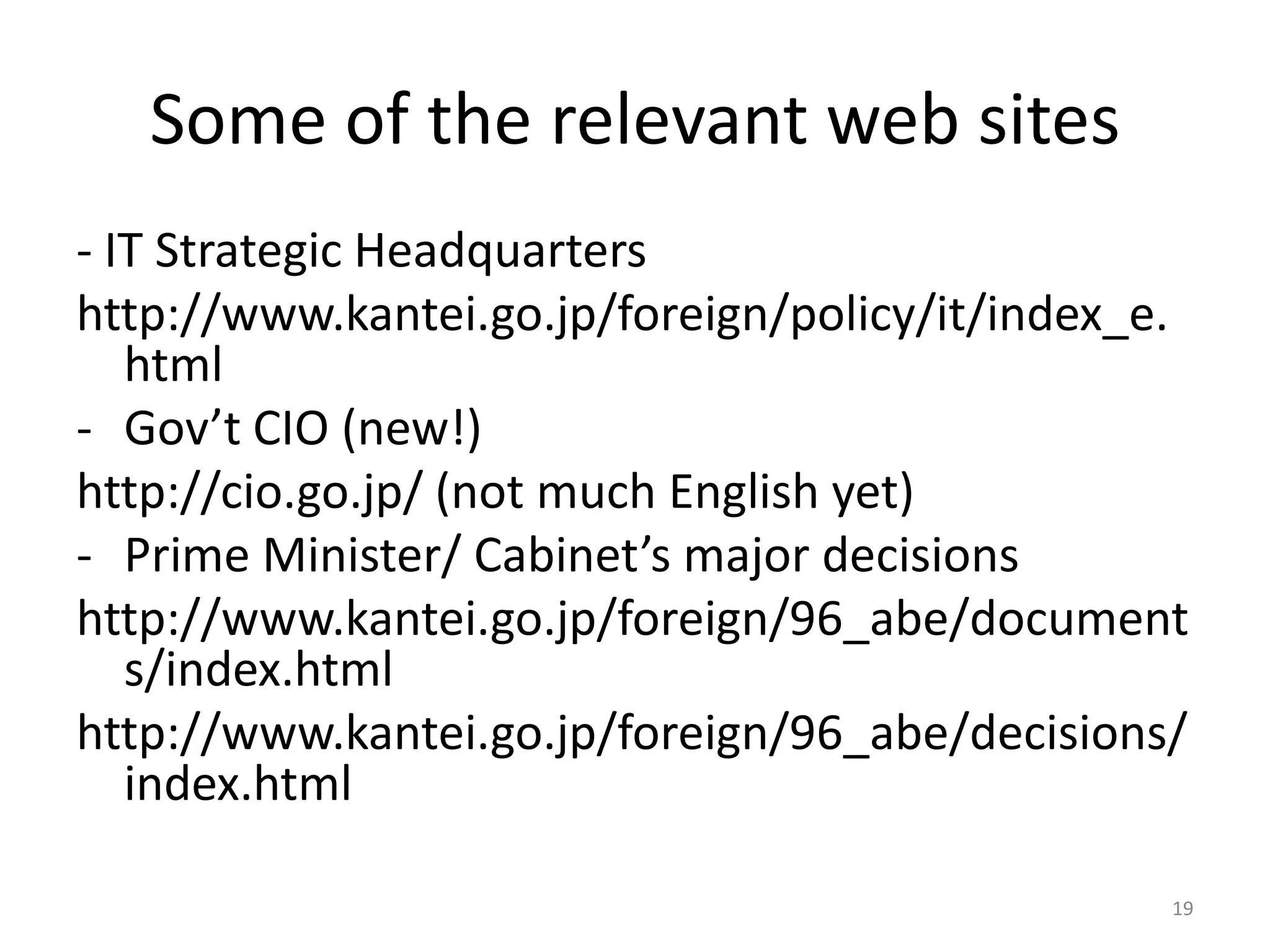
Some of the relevant web sites
- IT Strategic Headquarters
http://www.kantei.go.jp/foreign/policy/it/index_e.
html
- Gov’t CIO (new!)
http://cio.go.jp/ (not much English yet)
- Prime Minister/ Cabinet’s major decisions
http://www.kantei.go.jp/foreign/96_abe/document
s/index.html
http://www.kantei.go.jp/foreign/96_abe/decisions/
index.html
19
Major Projects

20
MIC’s early works
1. Open data sharing /reuse experiments in real time
transportation data, geological data, disaster data and
other areas, leading to API standards (2012-)
2. Open Data Promotion Consortium – backed by MIC
http://www.opendata.gr.jp/ (2012-)
- Committees on technical and legal issues; promotional
events – hackathon with Japan Meteorological Agency’s
data; a symposium; awarding notable efforts and
achievements
3. Making its ICT White Paper and statistics of ICT open data
(2013)
- the permission for free secondary use is indicated as a
general rule
- numeric data does not bear any copyright
- provided in csv format (in addition to Excel)
21
METI’s pioneering programs
- Post 3.11 Earthquake actions:
1. Awards for power saving-related apps
(summer of 2011)
- Others:
2. A website for sharing infographics
3. OpenData METI – a trial version of an open
data catalogue/ portal (Jan. 2012) http://datameti.go.jp
22
Other Programs
<data reuse>
- Reuse of geospatial information (a cabinet level
entity) *
- Reuse of govt-administered statistics through a
consortium (MIC) *
- Hackathon on database of recovery assistance
programs (open API)
- JST hackathon
* (not necessarily “open” data, but preceding open
data)
23
Other Programs
<local level>
- Pioneer in data catalogue and app dev.
City of Sabae (Fukui prefecture) and a local engineer
- data catalogues/ portals launched by:
Pref. Shizuoka, Cities of Chiba, Muroran, & AizuWakamatsu
- International Open Data Day : 8-city participation in
Japan
- Open Spending/ Where Does My Money Go spreading;
other similar visualization tools developed
24
Other Programs
<civic sector>
- Open Linked Data Challenge
- Urban Data Challenge; International Space App
Challenge
- Many hackathons & other collaborative events
- Open Spending, Where Does My Money Go , CKAN localization efforts
- Many groups& orgs formed or worked on open
data space
25
Active Civic Sector Players
<NPOs and others>
OKF Japan
Open Street Map Foundation Japan
LOD Initiative
Code for Japan
Creative Commons Japan
JIPDEC (part industry assoc. in nature?)
<Academic>
U. Tokyo
Keio U. (esp. SFC)
NII
Mitsubishi Research Institute
GLOCOM
26
Policy Performance

27
Policy Objectives
- Improving Transparency, Trust
- Participation & Collaboration
- Improving Economy & Government

28
How to provide data
- machine-readable
- allow commercial use
- easily publishable data first

29
Other notable policies
2014-15 – period for intensive efforts in open
data space
2013. trial version of the national open data
portal/ catalogue to be launched
2015. To be on par with other top level
countries in terms of amount of data
published (10K data sets).

30
Tasks ahead
Better understanding of…
- Existing needs for data, format, licenses
- Potential legal barriers for reuse
- Reasons for not opening (cultural, procedural, others)
- License pros and cons
- Impact measurement/ Evaluation
Coordination
- Technical formats
- License
- Search
- International/ Interlingual
Promotion/ Outreach
- Involving major companies and B2B players
- Domain specific experts& practitioners
- Incentive for gov’t agencies

31
Tasks ahead
Mid- to Long-term
- Comprehensive catalogue
- Gov’t operational reform
- Strategic use in int’l relations

32
earlier challenges
- Political support: weak
- Government resistance: the same as other
countries, or more
 risk of too little data
- Public awareness: weak
- Relevant civic sector/ tech communities: limited
 risk of too little reuse

 difficult choice between “big splash” to give
impetus or “small start” to avoid wasting efforts
33
Increasingly important questions
-

Measure economic benefits - How?
Measure cost?
Cost-benefit analysis (how precise?)
Or just some anecdotes of success?

34
Thank You!
Email:
watanabe at glocom dot ac dot jp

35
License
In order to provide slide set (and individual slides) under
two licenses that users can choose from, here are
license notices:
- This work is licensed under CC-BY-SA 3.0 Unported
- This work is licensed under CC-BY 3.0 Unported
Just to clarify, there is no copyright notice, no URI
associated with the work. The original author is
Tomoaki Watanabe, and the title of the work is “Open
data policy developments in Japan”
36

Open data developments in Japan

  • 1.
    Open data developmentsin Japan Tomoaki Watanabe Center for Global Communications (GLOCOM) International U. of Japan/ Creative Commons Japan/ Open Knowledge Foundation Japan Initiative Internet Governance Forum October 22-25, 2013, Bali
  • 2.
    A bit aboutmyself - Academic (full time): ICT policies, information society issues (Senior Research Fellow& Associate Prof. at GLOCOM) - Advocate (volunteer): open licensing (Creative Commons Japan; executive director for its host organization CommonSphere) Open Knowledge Foundation (Co-founder) 2
  • 3.
    Menu Overview I. National PolicyDevelopment II. Major Projects III. Policy Performance 3
  • 4.
  • 5.
    Japan’s major developments -National strategy adopted (June 2012) - Decent support from the political leadership (Jan. ‘13) Emphasis on economic effects - Decent institution for the execution Newly created gov’t CIO close to the matter Pub-priv joint conference for implementation; Priv-led, pub-supported forum - Civic sector growing - National data portal soon to launch - Many pioneering projects - Discussion ongoing on: evaluation, standards, etc. 5
  • 6.
    Early Trials -Ministries of… InternalAffairs &Communications Econ. Trade& Industry Environment -Other Agencies Reconstruction Agency Japan Meteorological Agency Geospatial Information Authority of Japan National Diet Library Japan Aerospace Exploration Agency 6
  • 7.
    What’s ahead/ Challenges Expected -Gov’t-wide practice  Revisit the licensing - Improved marking Short-term - Evaluation / measuring impact - Involving major companies & B2B player Long-term - Gov’t operational reform - Comprehensive catalogue 7
  • 8.
    Recipe for InnovativeFirst-mover Strong support from political leadership Public official(s) who gets it Institutional arrangement Participatory policy-making Vibrant civic& private sector Collaboration in data release, licensing, reuse, promotion Big Splash, High-awareness, Greater use, Extensive networking, Unexpected successes 8
  • 9.
    Recipe for SmartSecond-mover Careful cost-benefit analysis Identification of high-ROI areas Efficient, low-risk, smaller-scale, less waste and less surprise successes Japan may be shifting its approach from secondmover to first-mover model. 9
  • 10.
  • 11.
    A brief historyI <setting agenda> - 2010.5. “A New Strategy in Information and Communications Technology” adopted by National IT Strategy Headquarters - (open-by-default + reusable) <discussing details> - 2011 - 2012.6 national open data policy discussed at eGovernment TaskForce - (policy objectives, org. arrangement, roadmap) <adopting> - 2012.6. “Open Government Data Strategy“ draft - 2012.7. adopted by National IT Strategic Headquarters 11
  • 12.
    A brief historyII <implementation> - 2012.12 - present E-government Open Data Conference of Working-Level Personnel: technical standard, high-priority data area, legal and licensing issues discussed. working towards a trial version of national open data catalogue/ portal <implementation documents> - 2013.6. A roadmap to move eGov open data forward - 2013.6. A guideline for government agencies on basic principles of how to publish data to promote reuse. <political change> - 2012.12 Prime Minister Abe took office - 2013. the new Abe Administration quickly endorsed open data * - 2013.6. “Forging the World-Leading IT Nation” & “The Japan Revitalization Strategy – JAPAN is BACK” *emphasis on economic effects; open data+ big data 12
  • 13.
    Sources available inEnglish - “A New Strategy in Information and Communications Technology” (May 2010) http://www.kantei.go.jp/foreign/policy/it/10051 1_full.pdf - “Open Government Data Strategy” (July, 2012) http://www.kantei.go.jp/foreign/policy/it/2012070 4/text.pdf - “Japan Revitalization Strategy - JAPAN is BACK” (June, 2013) http://www.kantei.go.jp/jp/singi/keizaisaisei/pdf/e n_saikou_jpn_hon.pdf 13
  • 14.
    IT Strategic Headquarters Acabinet level entity Chaired by the Prime Minister Members include ministers and experts Previous Administration by a then-new party 2009.9.  new strategy 2010.5. Current Administration by another new party 2012.12  new strategy 2013.6. 14
  • 15.
    eGov Task Force UnderIT Strategic Headquarters Members: Experts Decision chain: eGov TF -> Plan Committee -> HQ Drafted National Open Data Strategy, which was subsequently adopted by the IT Strategic HQ 15
  • 16.
    eGov Open DataConference of Working-Level Personnel under IT Strategic Headquarters has two working groups – 1) technical standards and 2) legal issues and promotion of use Decision chain: the Conference -> IT Strategic HQ (after a reorg. - the plan committee is gone) 16
  • 17.
    Gov’t CIO - Newlycreated post (May 2013), first of its kind* - Responsibility includes: eGov related strategy – formulation, execution evaluation of IT investments others *CIO posts have existed at individual agencies, but not for the whole of the national government 17
  • 18.
    Other Policy/ Gov’tDevelopments - Yokohama Open Data Solution Development Committee (Dec. 2012) - Conference for Promoting the Use of Big Data& Open Data - Cities of Takeo, Chiba, Nara, Fukuoka (Apr. 2013) 18
  • 19.
    Some of therelevant web sites - IT Strategic Headquarters http://www.kantei.go.jp/foreign/policy/it/index_e. html - Gov’t CIO (new!) http://cio.go.jp/ (not much English yet) - Prime Minister/ Cabinet’s major decisions http://www.kantei.go.jp/foreign/96_abe/document s/index.html http://www.kantei.go.jp/foreign/96_abe/decisions/ index.html 19
  • 20.
  • 21.
    MIC’s early works 1.Open data sharing /reuse experiments in real time transportation data, geological data, disaster data and other areas, leading to API standards (2012-) 2. Open Data Promotion Consortium – backed by MIC http://www.opendata.gr.jp/ (2012-) - Committees on technical and legal issues; promotional events – hackathon with Japan Meteorological Agency’s data; a symposium; awarding notable efforts and achievements 3. Making its ICT White Paper and statistics of ICT open data (2013) - the permission for free secondary use is indicated as a general rule - numeric data does not bear any copyright - provided in csv format (in addition to Excel) 21
  • 22.
    METI’s pioneering programs -Post 3.11 Earthquake actions: 1. Awards for power saving-related apps (summer of 2011) - Others: 2. A website for sharing infographics 3. OpenData METI – a trial version of an open data catalogue/ portal (Jan. 2012) http://datameti.go.jp 22
  • 23.
    Other Programs <data reuse> -Reuse of geospatial information (a cabinet level entity) * - Reuse of govt-administered statistics through a consortium (MIC) * - Hackathon on database of recovery assistance programs (open API) - JST hackathon * (not necessarily “open” data, but preceding open data) 23
  • 24.
    Other Programs <local level> -Pioneer in data catalogue and app dev. City of Sabae (Fukui prefecture) and a local engineer - data catalogues/ portals launched by: Pref. Shizuoka, Cities of Chiba, Muroran, & AizuWakamatsu - International Open Data Day : 8-city participation in Japan - Open Spending/ Where Does My Money Go spreading; other similar visualization tools developed 24
  • 25.
    Other Programs <civic sector> -Open Linked Data Challenge - Urban Data Challenge; International Space App Challenge - Many hackathons & other collaborative events - Open Spending, Where Does My Money Go , CKAN localization efforts - Many groups& orgs formed or worked on open data space 25
  • 26.
    Active Civic SectorPlayers <NPOs and others> OKF Japan Open Street Map Foundation Japan LOD Initiative Code for Japan Creative Commons Japan JIPDEC (part industry assoc. in nature?) <Academic> U. Tokyo Keio U. (esp. SFC) NII Mitsubishi Research Institute GLOCOM 26
  • 27.
  • 28.
    Policy Objectives - ImprovingTransparency, Trust - Participation & Collaboration - Improving Economy & Government 28
  • 29.
    How to providedata - machine-readable - allow commercial use - easily publishable data first 29
  • 30.
    Other notable policies 2014-15– period for intensive efforts in open data space 2013. trial version of the national open data portal/ catalogue to be launched 2015. To be on par with other top level countries in terms of amount of data published (10K data sets). 30
  • 31.
    Tasks ahead Better understandingof… - Existing needs for data, format, licenses - Potential legal barriers for reuse - Reasons for not opening (cultural, procedural, others) - License pros and cons - Impact measurement/ Evaluation Coordination - Technical formats - License - Search - International/ Interlingual Promotion/ Outreach - Involving major companies and B2B players - Domain specific experts& practitioners - Incentive for gov’t agencies 31
  • 32.
    Tasks ahead Mid- toLong-term - Comprehensive catalogue - Gov’t operational reform - Strategic use in int’l relations 32
  • 33.
    earlier challenges - Politicalsupport: weak - Government resistance: the same as other countries, or more  risk of too little data - Public awareness: weak - Relevant civic sector/ tech communities: limited  risk of too little reuse  difficult choice between “big splash” to give impetus or “small start” to avoid wasting efforts 33
  • 34.
    Increasingly important questions - Measureeconomic benefits - How? Measure cost? Cost-benefit analysis (how precise?) Or just some anecdotes of success? 34
  • 35.
    Thank You! Email: watanabe atglocom dot ac dot jp 35
  • 36.
    License In order toprovide slide set (and individual slides) under two licenses that users can choose from, here are license notices: - This work is licensed under CC-BY-SA 3.0 Unported - This work is licensed under CC-BY 3.0 Unported Just to clarify, there is no copyright notice, no URI associated with the work. The original author is Tomoaki Watanabe, and the title of the work is “Open data policy developments in Japan” 36