Effective Consultation with your Doctor
Your Relationship With Your Doctor


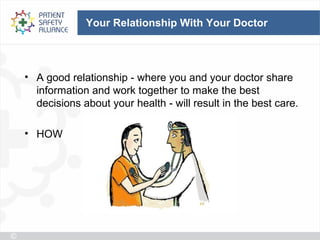
• A good relationship - where you and your doctor share
  information and work together to make the best
  decisions about your health - will result in the best care.

• HOW
Improving Communication


• Builds trust between patient and
   doctor;
                                        Communication
• May help the patient disclose
   information;
• Enhances patient satisfaction;
• Reduces the risk of errors and
   mishaps.

  Improved communication and
  overcoming obstacles will barriers
  result in better health outcomes
  for the patient.
Solutions….          Be Prepared


The best way to make the most of your limited time is to
  come to your appointment prepared:

• Write down all the questions
• Include details on any previous visits to
  doctors/specialists
• Make and bring a list of symptoms.
• Bring a list of all the medicines you take.
• Arrive early
• Bring your medical records/
  insurance details
You need to be clear on TESTS


•   What tests do I need and why?
•   What do the tests involve?
•   How do I prepare for the tests?
•   When will I know the test results?
•   Will my insurance cover the cost of the tests?
Discuss your diagnosis and what you can expect


Questions to ask about your diagnosis
• What am I suffering from?
• Is it confirmed or I need some more
  tests for confirmation?
• What is the effect on my life?
• How can I learn more about my
  condition?
TREATMENT


• What are my treatment choices?
• What are the benefits and risks
  of each treatment?
• What are the side effects?
• How good is each treatment?
• Which treatment is most common for my condition?
• What do I do if treatment fails?
MEDICATION


• What kind of medication(s) must I take?
  For how long?
• What does the drug do? Will there be
  any side effects?
• What should I do if I have side effects?
• Can I take a generic version of the
  drug?
• Will the medicine interact with any I am
  already taking?
• Should I avoid any kind of food or
  activity while taking this medicine?
Do not leave till you are clear on
               ….Action Points


•   When do I see you again ?
•   Do I need to see a specialist?
•   Should I get a second opinion?
•   Do I need a follow-up visit?
•   Can I call you?
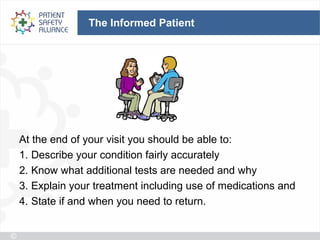
The Informed Patient


At the end of your visit you should be able to:
1. Describe your condition fairly accurately
2. Know what additional tests are needed and why
3. Explain your treatment including use of medications and
4. State if and when you need to return.
There Is Only One You.
    Your Health Is A Priority!

•   Make Your Health A Priority

• Play An Active Role In Your Healthcare

• Be an Informed patient.
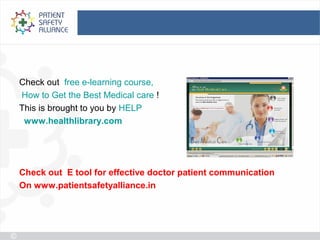
Check out free e-learning course,
How to Get the Best Medical care !
This is brought to you by HELP
 www.healthlibrary.com


Check out E tool for effective doctor patient communication
On www.patientsafetyalliance.in
Your Doctor Cannot Read Your Mind !
   The More Organized You Are,
The Easier It Is for Him To Help You !


                   Thank You !

Effective communication

  • 1.
  • 2.
    Your Relationship WithYour Doctor • A good relationship - where you and your doctor share information and work together to make the best decisions about your health - will result in the best care. • HOW
  • 4.
    Improving Communication • Buildstrust between patient and doctor; Communication • May help the patient disclose information; • Enhances patient satisfaction; • Reduces the risk of errors and mishaps. Improved communication and overcoming obstacles will barriers result in better health outcomes for the patient.
  • 5.
    Solutions…. Be Prepared The best way to make the most of your limited time is to come to your appointment prepared: • Write down all the questions • Include details on any previous visits to doctors/specialists • Make and bring a list of symptoms. • Bring a list of all the medicines you take. • Arrive early • Bring your medical records/ insurance details
  • 6.
    You need tobe clear on TESTS • What tests do I need and why? • What do the tests involve? • How do I prepare for the tests? • When will I know the test results? • Will my insurance cover the cost of the tests?
  • 7.
    Discuss your diagnosisand what you can expect Questions to ask about your diagnosis • What am I suffering from? • Is it confirmed or I need some more tests for confirmation? • What is the effect on my life? • How can I learn more about my condition?
  • 8.
    TREATMENT • What aremy treatment choices? • What are the benefits and risks of each treatment? • What are the side effects? • How good is each treatment? • Which treatment is most common for my condition? • What do I do if treatment fails?
  • 9.
    MEDICATION • What kindof medication(s) must I take? For how long? • What does the drug do? Will there be any side effects? • What should I do if I have side effects? • Can I take a generic version of the drug? • Will the medicine interact with any I am already taking? • Should I avoid any kind of food or activity while taking this medicine?
  • 10.
    Do not leavetill you are clear on ….Action Points • When do I see you again ? • Do I need to see a specialist? • Should I get a second opinion? • Do I need a follow-up visit? • Can I call you?
  • 11.
    The Informed Patient Atthe end of your visit you should be able to: 1. Describe your condition fairly accurately 2. Know what additional tests are needed and why 3. Explain your treatment including use of medications and 4. State if and when you need to return.
  • 12.
    There Is OnlyOne You. Your Health Is A Priority! • Make Your Health A Priority • Play An Active Role In Your Healthcare • Be an Informed patient.
  • 13.
    Check out freee-learning course, How to Get the Best Medical care ! This is brought to you by HELP www.healthlibrary.com Check out E tool for effective doctor patient communication On www.patientsafetyalliance.in
  • 14.
    Your Doctor CannotRead Your Mind ! The More Organized You Are, The Easier It Is for Him To Help You ! Thank You !

Editor's Notes

  • #2 the doctor-patient relationship is unique; since it is the ultimate one-to-one relationship, in which you confide fully in your doctor and entrust him with your life, you must learn to work as a partner with your doctor !
  • #3 How do you talk to your doctor? Does he or she do all the talking while you do all the listening? Are you afraid to ask questions? Do you leave the office feeling like you just sat through a foreign language class?
  • #5 The patient may be: • affected by the condition, illness or medication; • anxious, embarrassed or in denial about the medical condition; • inexperienced in identifying and describing symptoms; • intimidated by health care settings; • overawed by the doctor’s perceived status; • disadvantaged by differences in language and culture; • confused by the use of medical jargon; • reluctant to ask questions; or • concerned about time pressures. All of these factors may impede the patient’s capacity to provide, take in and assimilate information. SPEAK UP Don't be put off by big words or a doctor's impatient manner. If you don't understand what the doctor is telling you, ask him or her to explain it again. Using different words, or drawing or showing you a picture can help. Don't leave the office without understanding everything the doctor told you. If there are issues you want to discuss that the doctor doesn't mention, raise them yourself. Doctors often are so focused on making sick people better — or so rushed — they forget to talk about important health matters like diet and weight, exercise, stress, sleep, tobacco and alcohol use, sexual practices, vaccines, and tests to find diseases. Find out what tests you might need for your age, such as a mammogram or colonoscopy, and ask your doctor about getting them. Don't be embarrassed or ashamed to bring up sensitive topics. DON'T WITHHOLD INFORMATION Speaking up also means telling your doctor everything you know about your body and health, including all your symptoms and problems. The more information you share, the better the doctor will be able to figure out what's wrong and how to treat you. Don't make the doctor guess. Be sure to mention any and all medicines, vitamins, and herbs you are taking, and anyone else you are seeing about your health, physical and mental. BRING SOMEONE WITH YOU Sometimes, people like to bring a friend or family member to a doctor appointment for moral support. A companion also could help you relax, remind you of questions you forgot to ask, and help you remember what the doctor said. If you need personal time with the doctor, the person can sit in the waiting room. Having someone join you is especially helpful if you feel too ill to get around easily on your own.
  • #6 Make a list of your concerns and prioritize them Take information with you Consider bringing a family member or friend — http://www.ahrq.gov/consumer/quicktips/doctalk.htm
  • #8 Eg. A cardiologist has seen the patient and he feels that there is nothing wrong from cardiology point of view. So this will help new doctor focus on other things to clinch the diagnosis.
  • #9 http://www.consumerreports.org/health/doctors-hospitals/your-doctor-relationship/how-to-talk-to-your-doctor/discussing-a-new-diagnosis/discussing-a-new-diagnosis.htm
  • #11 If you feel nervous, rushed, or just plain overwhelmed, you might forget to ask a question, even if you wrote it down. If this happens, or if you think of a new question, call the office right away. Be patient but firm if you want to speak directly with the doctor, who might not be able to take your call at that moment. If the doctor wants you to come back for a follow up visit, be sure to set and keep the appointment. You might forget to ask a question, even if you wrote it down - or if you think of a new question, call the office right away
  • #13 Building a successful partnership with your doctor takes time and effort. It's not uncommon to have a frustrating doctor visit now and then. But overall, your relationship with your doctor should be positive and comfortable. You should have confidence and trust in his or her medical ability and judgment. Let your doctor know when there's a problem. If you can't resolve things together, you might need to entrust your care to someone else.