Dementia in the workplace
Dr Louise Ritchie
Alzheimer Scotland Dementia Awareness Week Conference
3rd June 2016.
@lourit
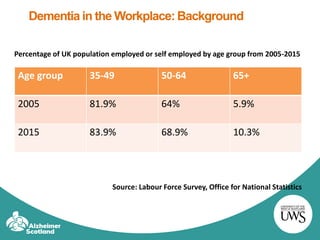
Dementia in the Workplace: Background
Age group 35-49 50-64 65+
2005 81.9% 64% 5.9%
2015 83.9% 68.9% 10.3%
Percentage of UK population employed or self employed by age group from 2005-2015
Source: Labour Force Survey, Office for National Statistics
Dementia in the workplace: the potential for
continued employment post diagnosis
 Alzheimer’s Society funded research study 2013-2015
 Aim: To explore the employment related experiences of
people with dementia or mild cognitive impairment (MCI),
and attitudes of employers and/or co-workers towards
supporting people with dementia, in order to identify the
potential for continued employment post diagnosis
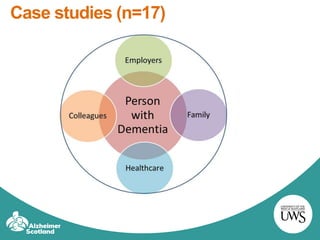
Case studies (n=17)
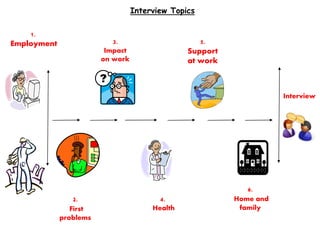
Interview Topics
1.
Employment
Interview
2.
First
problems
3.
Impact
on work
5.
Support
at work
4.
Health
6.
Home and
family
Participants
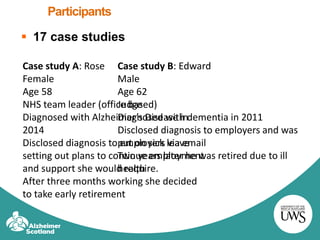
 17 case studies
Case study A: Rose
Female
Age 58
NHS team leader (office based)
Diagnosed with Alzheimer’s Disease in
2014
Disclosed diagnosis to employers via email
setting out plans to continue employment
and support she would require.
After three months working she decided
to take early retirement
Case study B: Edward
Male
Age 62
Judge
Diagnosed with dementia in 2011
Disclosed diagnosis to employers and was
put on sick leave
Two years later he was retired due to ill
health
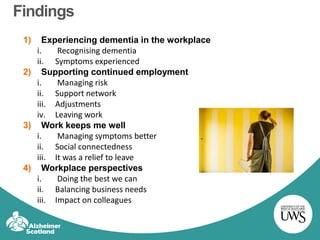
Findings
1) Experiencing dementia in the workplace
i. Recognising dementia
ii. Symptoms experienced
2) Supporting continued employment
i. Managing risk
ii. Support network
iii. Adjustments
iv. Leaving work
3) Work keeps me well
i. Managing symptoms better
ii. Social connectedness
iii. It was a relief to leave
4) Workplace perspectives
i. Doing the best we can
ii. Balancing business needs
iii. Impact on colleagues
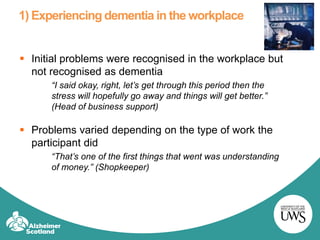
1) Experiencing dementia in the workplace
 Initial problems were recognised in the workplace but
not recognised as dementia
“I said okay, right, let’s get through this period then the
stress will hopefully go away and things will get better.”
(Head of business support)
 Problems varied depending on the type of work the
participant did
“That’s one of the first things that went was understanding
of money.” (Shopkeeper)
2) Supporting continued employment
 Supporting continued employment was
complex and includes:
– Support networks (home and work)
– Insight into abilities
– Workplace adjustments
– Support for leaving work
3) Work keeps me well
 Perceived benefits of continuing employment
“The more I do, the longer I’ll keep some sort of good function
there.”(Head of Business support)
 Contrasted with those who left employment
Conclusions
 Each individual had a unique experience in
the workplace
 For many, appropriate support at an earlier
stage may have prevented loss of
employment
 Support for employers and occupational
health nurses is required
Thank you
louise.ritchie@uws.ac.uk
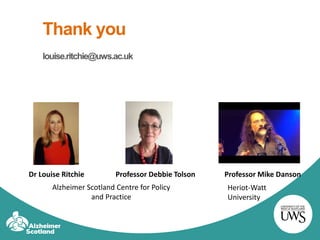
Dr Louise Ritchie Professor Debbie Tolson Professor Mike Danson
Alzheimer Scotland Centre for Policy
and Practice
Heriot-Watt
University

Louise Ritchie

  • 1.
    Dementia in theworkplace Dr Louise Ritchie Alzheimer Scotland Dementia Awareness Week Conference 3rd June 2016. @lourit
  • 2.
    Dementia in theWorkplace: Background Age group 35-49 50-64 65+ 2005 81.9% 64% 5.9% 2015 83.9% 68.9% 10.3% Percentage of UK population employed or self employed by age group from 2005-2015 Source: Labour Force Survey, Office for National Statistics
  • 3.
    Dementia in theworkplace: the potential for continued employment post diagnosis  Alzheimer’s Society funded research study 2013-2015  Aim: To explore the employment related experiences of people with dementia or mild cognitive impairment (MCI), and attitudes of employers and/or co-workers towards supporting people with dementia, in order to identify the potential for continued employment post diagnosis
  • 4.
  • 5.
  • 6.
    Participants  17 casestudies Case study A: Rose Female Age 58 NHS team leader (office based) Diagnosed with Alzheimer’s Disease in 2014 Disclosed diagnosis to employers via email setting out plans to continue employment and support she would require. After three months working she decided to take early retirement Case study B: Edward Male Age 62 Judge Diagnosed with dementia in 2011 Disclosed diagnosis to employers and was put on sick leave Two years later he was retired due to ill health
  • 7.
    Findings 1) Experiencing dementiain the workplace i. Recognising dementia ii. Symptoms experienced 2) Supporting continued employment i. Managing risk ii. Support network iii. Adjustments iv. Leaving work 3) Work keeps me well i. Managing symptoms better ii. Social connectedness iii. It was a relief to leave 4) Workplace perspectives i. Doing the best we can ii. Balancing business needs iii. Impact on colleagues
  • 8.
    1) Experiencing dementiain the workplace  Initial problems were recognised in the workplace but not recognised as dementia “I said okay, right, let’s get through this period then the stress will hopefully go away and things will get better.” (Head of business support)  Problems varied depending on the type of work the participant did “That’s one of the first things that went was understanding of money.” (Shopkeeper)
  • 9.
    2) Supporting continuedemployment  Supporting continued employment was complex and includes: – Support networks (home and work) – Insight into abilities – Workplace adjustments – Support for leaving work
  • 10.
    3) Work keepsme well  Perceived benefits of continuing employment “The more I do, the longer I’ll keep some sort of good function there.”(Head of Business support)  Contrasted with those who left employment
  • 11.
    Conclusions  Each individualhad a unique experience in the workplace  For many, appropriate support at an earlier stage may have prevented loss of employment  Support for employers and occupational health nurses is required
  • 12.
    Thank you louise.ritchie@uws.ac.uk Dr LouiseRitchie Professor Debbie Tolson Professor Mike Danson Alzheimer Scotland Centre for Policy and Practice Heriot-Watt University

Editor's Notes

  • #6 I am now going to talk a little about data collection, or the interview process. We have found in the past that it is useful to have some form of reference when carrying our interviews, it allows you to bring participants back to previous issues and also allows them to have an idea of what will be coming next and makes it more of a ‘shared experience’ . This provisional ‘timeline’ is based on a combination of LifeGrid and Timeline methods, both of which have been found to be useful when gathering retrospective data. We would use the same visuals for participants with dementia or MCI, family members and work colleagues – it gives an understanding of the nature of information that we are looking for. We would not use it with Managers and other workplace representatives e.g. HR Trade Unions etc where we would use a traditional semi-structured interview schedule which would be developed to suit their role.