Dhinaharan Nagamalai et al. (Eds) : CCSEA, DKMP, AIFU, SEA - 2015
pp. 213–222, 2015. © CS & IT-CSCP 2015 DOI : 10.5121/csit.2015.50218
A NOVEL APPROACH BASED ON TOPIC
MODELING FOR CLONE GROUP MAPPING
Ruixia Zhang, Liping Zhang, Huan Wang and Zhuo Chen
Computer and information engineering college,
Inner Mongolia normal university, Hohhot, China
zhangruixia923@163.com
ABSTRACT
Clone group mapping has a very important significance in the evolution of code clone. The topic
modeling techniques were applied into code clone firstly and a new clone group mapping method
was proposed. By using topic modeling techniques to transform the mapping problem of
high-dimensional code space into a low-dimensional topic space, the goal of clone group
mapping was indirectly reached by mapping clone group topics. Experiments on four open source
software show that the recall and precision are up to 0.99, thus the method can effectively and
accurately reach the goal of clone group mapping.
KEYWORDS
code clone; software evolution; topic; topic modeling; clone group mapping
1. INTRODUCTION
The activities of the programmers including copy, paste and modify result in lots of code clone in
the software systems. A code clone is a code portion in source files that is identical or similar to
another[1]. It is suspected that many large systems contain approximately 9%-17% clone code,
sometimes as high as even 50%[2].
After a decade of active research, it is evident that code clones have both a positive [3] and a
negative [4] impact in the maintenance and evolution of software systems. For example, copying
source code without defect can reduce the potential risk of writing new code, save development
time and cost; code clones can cause additional maintenance effort. Changes to one segment of
code may need to be propagated to several others, incurring unnecessary maintenance costs.
Code clone is inevitable in software development, and in order to exploit the advantages of clones
while lowering their negative impact, it is important to understand the evolution of clones and
manage them accordingly. Therefore,in order to meet the demands of clone evolution, an clone
mapping method is put forward. Clone group mapping reflect how an clone group evolve from a
previous version to the current version, is the core technology in the evolution of code clone across
versions.
The topic modeling techniques is applied to code clone firstly and a new clone group mapping
method is proposed. Topic modeling technology can make full use of the source text and structure
information to transform the mapping problem of high-dimensional code space into a
214 Computer Science & Information Technology (CS & IT)
low-dimensional topic space, and thus indirectly achieve the clone group mapping purposes by
mapping clone group topics.
2. RELATED WORK
Software development and maintenance in practice follow a dynamic process. With the growth of
the program source, code clones also experience evolution from version to version. what change the
Clone group have happened from one version to next need to be made judgments by clone group
mapping.
To map clone group across consecutive versions of a program, mainly five different approaches
have been found in the literature.
• Based on text[5]::::It separates clone detection from each version, and then similarity
based heuristic mapping of clones in pairs of subsequent versions. Text similarity are often
computed by the Longest Common Subsequence(LCS)or Edit Distance(Levenshtein
Distance, LD) algorithm that have quadratic runtime, which lead to inefficient clone
mapping. The method is susceptible to large change in clone.
• Based on version management tools (CVS or SVN)[6]::::Clones detected from the first
version are mapped to consecutive versions based on change logs obtained from source
code repositories. It is faster than the above technique, but can miss the clones introduced
after the first version.
• Based on incremental clone detection algorithm[7]::::Clones are mapped during the
incremental clone detection that used source code changes between revisions. It can reduce
the redundant computation and save time .So it is faster than the above two techniques, but
cannot operate on the clone detection results obtained from traditional non-incremental
tools.
• Based on functions[8]: It separates clone detection from each version, functions are
mapped across subsequent versions, then clones are mapped based on the mapped
functions. To some extent, it improves the efficiency and accuracy of the mapping, but it is
susceptible to similar overloaded/overridden functions for its over-reliance on function
information.
• Based on CRD(Clone Region Descriptor)[9]::::Clone code is represented by CRD, then
clones are mapped based on CRD between versions. It is not easily influenced by position
of the code clone. Mutations or big difference between versions can reduce the mapping
validity greatly.
This paper presents a new clone group mapping method based on topic modeling technology,
unlike the mapping method based on text, the basic collection of the mapping is the clone group
topics, not intermediate representation of clone code(e.g., token and AST). Topic has a large
granularity and the higher level of abstraction. However, the difference of topics between different
clone groups in the same version is very large and the difference of topics between same clone
groups in the different version is very little, which make the clone group mapping method based on
topic modeling practicable and effective.
Computer Science & Information Technology (CS & IT) 215
3. APPROACH
In this section we present a new clone group mapping approach based on topic modeling for
tracking clone groups across different versions.
3.1 Overview of Topic Model
Topic models are generative probabilistic models, originally used in the area of natural language
processing for representing text documents. LDA (Latent Dirichlet Allocation) has recently been
applied to a variety of domains, due to its attractive features. First, LDA enables a low-dimensional
representation of text, which (i) uncovers latent semantic relationships and (ii) allows faster
analysis on text [10]. Second, LDA is unsupervised, meaning no labeled training data is required
for it to automatically discover topics in a corpus. And finally, LDA has proven to be fast and
scalable to millions of documents or more [11]. For these reasons, in this paper we use LDA as our
topic model.
In the LDA model, LDA is statistical models that infer latent topics to describe a corpus of text
documents [12]. Topics are collections of words that co-occur frequently in the corpus. For
example, a topic discovered from a newspaper collection might contain the words {cash bank
money finance loan}, representing the “finance industry” concept; another might contain {fish
river stream water bank}, representing the “river” concept. So, documents can be represented by
the topics within them. Topic modeling techniques transform the text into topic space.
Recently, researchers found topics to be effective tools for structuring various software artifacts,
such as source code, requirements documents, and bug reports. Kuhn [13] made the first attempt to
apply topic modeling technique to source code, and tried to discover the functional topics. W.
Thomas[14]performed a detailed investigation of the usefulness of topic evolution models for
analyzing software evolution, they found that topic models were an effective technique for
automatically discovering and summarizing software change activities. Asuncion[15] used the
topic modeling techniques to study software traceability. Tian [16]used LDA to Automatically
classify software in the software repository. Gethersd[17]developed the IDE plug-in, they
combined topic modeling results and the existing software development tools to help developers
apply topic modeling results. Liu Chao[18] applied topic model to retrieval traceability links
between source code and Chinese documentation. Xie Bing[19] from Beijing university proposed a
function recognition approach based on LDA and code static analysis technology o better support
the activity of code reuse. In addition, topic model was also used to study class cohesion [20]and
bug location[21].
3.2 Mapping Clone Group Based on Topic Modeling
3.2.1 Framework of The Algorithm.
Typically a clone detection tool reports results as a collection of clone groups where each clone
group has two or more clone fragments. The paper uses the LDA topic modeling technology to map
clone group. It mainly works in the following three steps: (1) extracting the topics from clone
group, (2) calculating the similarity between topics,(3) mapping clone group topics. Let CG୬
=
{cgଵ
୬
, cgଶ
୬
, ⋯ cgୱ
୬
}be the reported clone groups in V୬, T୬
= {tଵ
୬
, tଶ
୬
, ⋯ tୱ
୬
}refers to the clone group
topics extracted from the clone group CG୬where t୧
୬
was extracted from cg୧
୬
,1 ≤ i ≤ n. Figure 1
shows the framework of the algorithm.
216 Computer Science & Information Technology (CS & IT)
Figure 1. The frame of mapping algorithm
To track clone groups over two different versions ܸ௡ାଵ and ܸ௡,we compare every clone group in
version ܸ௡ାଵto every clone group in version ܸ௡. Topic modeling technology is used to extract the
topics from each clone group in the version ܸ௡ and ܸ௡ାଵrespectively. At this point, since topic is the
only representation of corresponding clone group, the problem of mapping clone group between
two versions of a program is reduced to the mapping of clone group topics between two versions.
Then clone group topics are mapped by comparing similarity between topics in the version ܸ௡ାଵ
and ܸ௡. If the topic ‫ݐ‬௜
௡ାଵ
of a clone group ܿ݃௜
௡ାଵ
in version ‫ݒ‬௡ାଵ matches to the topic ‫ݐ‬௝
௡
of a clone
group ܿ݃௝
௡
in the version ܸ௡, we know that the clone group cg୧
୬ାଵ
in ܸ௡ାଵ and the clone group
cg୨
୬
in ܸ௡ are the same. Due to the transitivity of the relation of equivalence, we can then
conclude that clone group cg୧
୬ାଵ
is related to clone group cg୨
୬
.The algorithm is as follows:
Clone Group Mapping algorithm
∀ ܿ݃௜
௡ାଵ
∈ ‫ܩܥ‬௡ାଵ
, ‫ܩܥ‬௡ାଵ
in ܸ௡ାଵ
extract ‫ݐ‬௜
௡ାଵ
from ܿ݃௜
௡ାଵ
∀ ܿ݃௝
௡
∈ ‫ܩܥ‬௡
, ‫ܩܥ‬௡
in ܸ௡
extract ‫ݐ‬௝
௡
from ܿ݃௝
௡
caculate similarity between ‫ݐ‬௝
௡
and ‫ݐ‬௜
௡ାଵ
, and store similarity value in the array
unit sim [j]
suppose sim[k]=max{sim[ ]}:
IF sim[k]≥δ,ܿ݃௜
௡ାଵ
is mapped back to ܿ݃௝
௡
,namely ܿ݃௜
௡ାଵ
—﹥ܿ݃௝
௡
;
THEN ܿ݃௜
௡ାଵ
——﹥null.
Return all mapping results
3.2.2 Extract Clone Group Topics
Under the standard programming style, software is suitable for extracting the topics using the LDA
model. The paper uses MALLET topic modeling toolkit to extract the topics. MALLET is a
Java-based package for statistical natural language processing, document classification, clustering,
topic modeling, information extraction, and other machine learning applications to text. It contains
efficient, sampling-based implementations of LDA.
Preprocess the source code. Each topic is collections of words that co-occur frequently in the
clone group, and is the only representation of corresponding clone group. The topic contains a large
number of stop words which play a small role in characterization of clone group information. So,
we remove stop words to reduce noise before extracting the topics. Stop words mainly include the
following three categories:1)programming language keywords, such as "for", "return", and
"class", etc. 2) Programming related words, such as "main", "arg", and "util", etc. 3)common
English language stop words, such as "the", "it", and "on", etc.
Computer Science & Information Technology (CS & IT) 217
Choose the number of topic. In order to make the topic accurately represent the information of
clone group, the proper number of topic is a key to influence the accuracy of clone group mapping.
For any given corpus, there is no provably optimal choice for the number of topics. The choice is a
trade-off between coarser topics and finer-grained topics. setting the number of topics to extremely
small values results in topics that contain multiple concepts, while setting the number of topics to
extremely large values results in topics that are too fine to be meaningful and only reveal the
idiosyncrasies of the clone group.
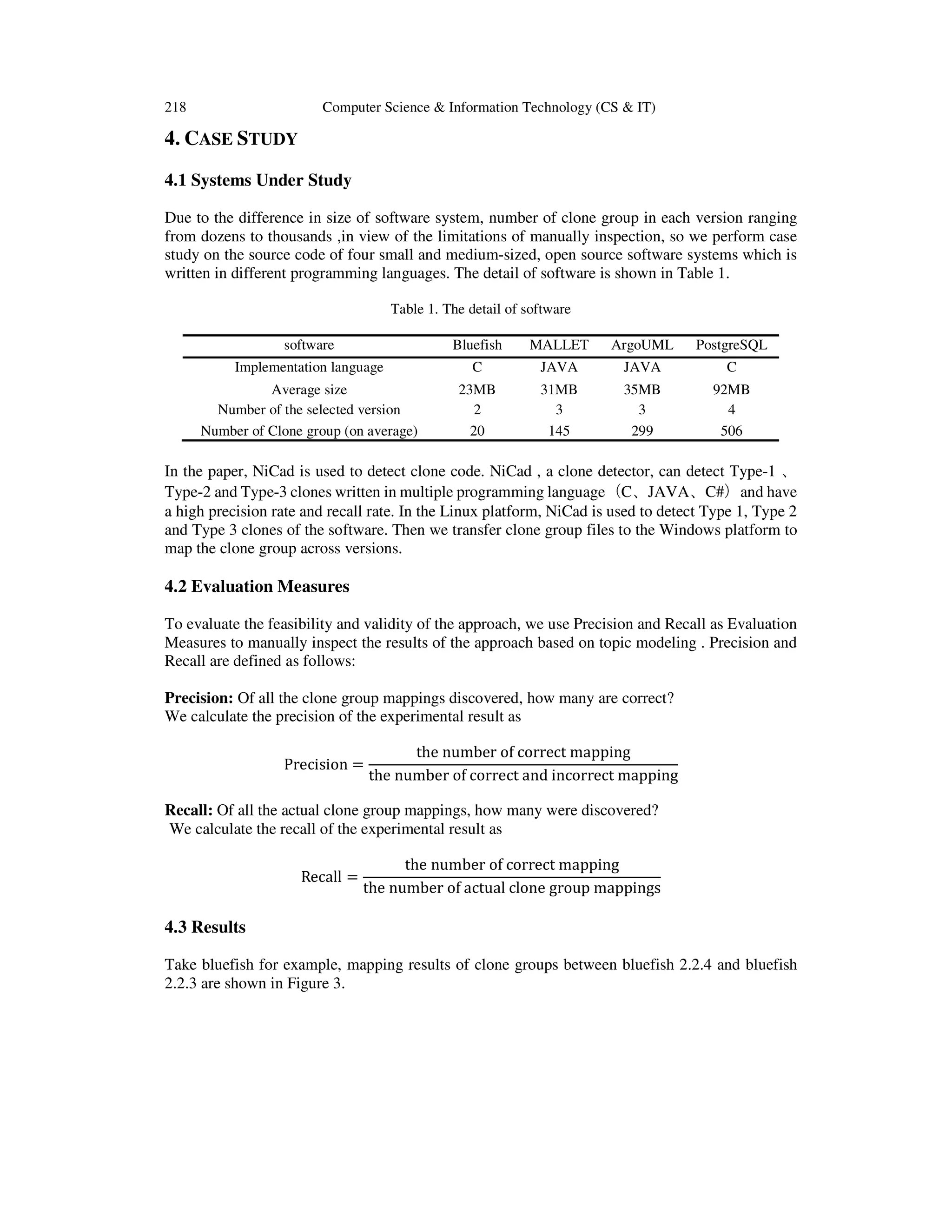
In the paper, through experimental analysis, it is best for setting the number of topics to one. In the
same clone group, clone code is a code portion that is identical or similar to another. The whole
clone group is multiple copies of the same clone whose syntactic or semantic function is same. In
other words, a clone group can be represented by a topic. The topics extracted from clone group by
MALLET are shown in Figure 2.
Figure 2.The topics extracted by MALLET
3.2.3 Mapping Clone Group Topics
Clone group mapping is determined by the degree of similarity between clone groups in the
different versions. In the paper, clone group mapping is determined indirectly by similarity
between clone group topics from different versions. If the similarity between the topic t୨
୬
and topic
t୧
୬ାଵ
is highest, and the similarity values is not less than certain threshold (δ).In that way, we can
conclude that the topic t୧
୬ାଵ
is mapped back to the topic t୨
୬
, namely the clone group cg୧
୬ାଵ
is
mapped back to the clone group cg୨
୬
. In the paper, Similarity threshold δ is set to 0.8. That's
because the similarity value between t୧
୬ାଵ
and t୨
୬
vary from 0.8 to 1 when cg୧
୬ାଵ
is mapped back to
the clone group cg୨
୬
, and the similarity value between t୧
୬ାଵ
and t୨
୬
is less than 0.8 when cg୨
୬
is not
origin of clone group cg୧
୬ାଵ
.
In the paper, the mapping is carried out from the version V୬ାଵto V୬. That's because the number of
clone group is generally on the rise in the process of software evolution. If the mapping is carried
out from the version V୬ to V୬ାଵ, new clone groups are failed to map. On the contrary, disappeared
clone groups are failed to map. However, we are more interested in clone code near to the current
version in the study of clone evolution. That is to say, compared with disappeared clone group, we
are more interested in new clone group. So, the mapping is carried out from the version V୬ାଵto V୬.
218 Computer Science & Information Technology (CS & IT)
4. CASE STUDY
4.1 Systems Under Study
Due to the difference in size of software system, number of clone group in each version ranging
from dozens to thousands ,in view of the limitations of manually inspection, so we perform case
study on the source code of four small and medium-sized, open source software systems which is
written in different programming languages. The detail of software is shown in Table 1.
Table 1. The detail of software
software Bluefish MALLET ArgoUML PostgreSQL
Implementation language C JAVA JAVA C
Average size 23MB 31MB 35MB 92MB
Number of the selected version 2 3 3 4
Number of Clone group (on average) 20 145 299 506
In the paper, NiCad is used to detect clone code. NiCad , a clone detector, can detect Type-1 、
Type-2 and Type-3 clones written in multiple programming language(C、JAVA、C#)and have
a high precision rate and recall rate. In the Linux platform, NiCad is used to detect Type 1, Type 2
and Type 3 clones of the software. Then we transfer clone group files to the Windows platform to
map the clone group across versions.
4.2 Evaluation Measures
To evaluate the feasibility and validity of the approach, we use Precision and Recall as Evaluation
Measures to manually inspect the results of the approach based on topic modeling . Precision and
Recall are defined as follows:
Precision: Of all the clone group mappings discovered, how many are correct?
We calculate the precision of the experimental result as
Precision =
the number of correct mapping
the number of correct and incorrect mapping
Recall: Of all the actual clone group mappings, how many were discovered?
We calculate the recall of the experimental result as
Recall =
the number of correct mapping
the number of actual clone group mappings
4.3 Results
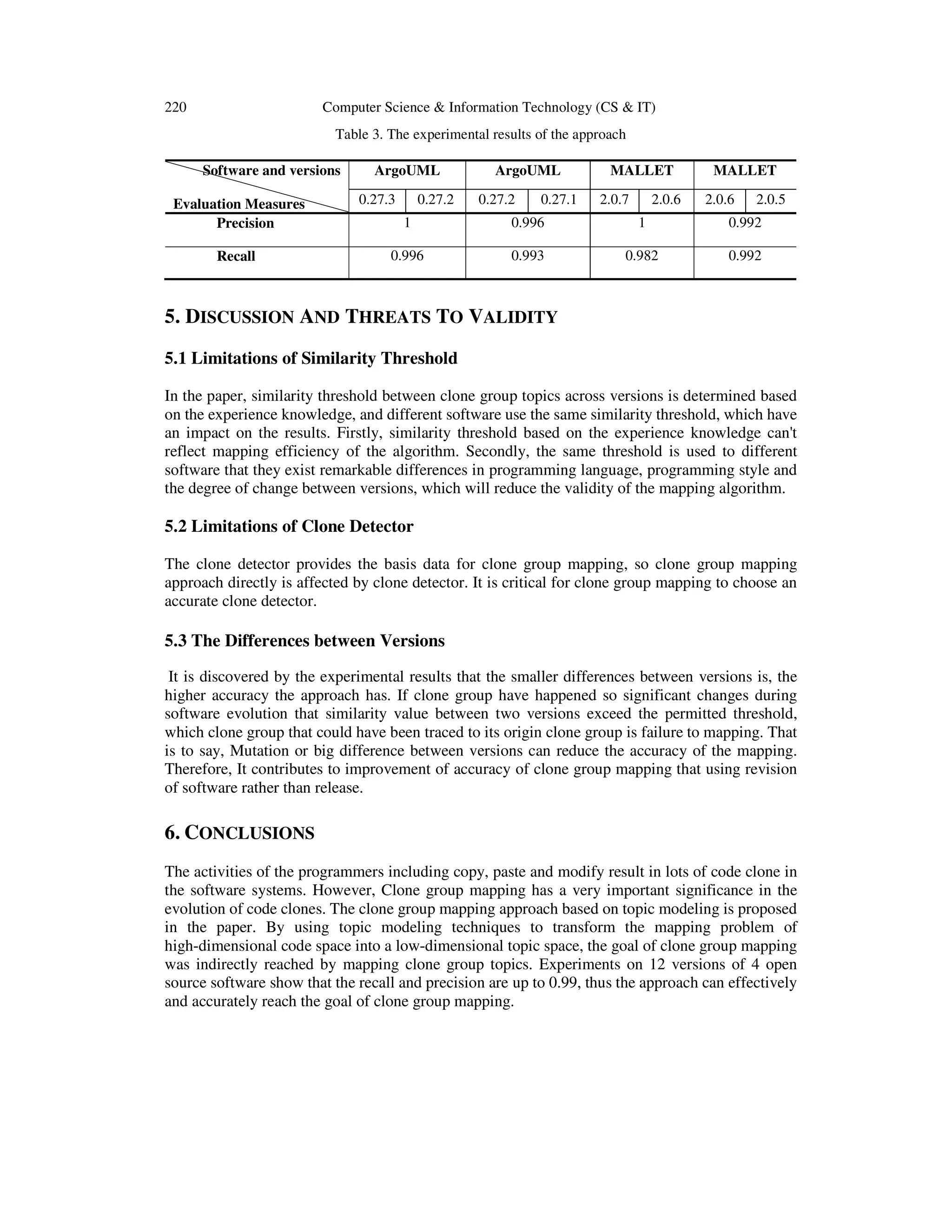
Take bluefish for example, mapping results of clone groups between bluefish 2.2.4 and bluefish
2.2.3 are shown in Figure 3.
Computer Science & Information Technology (CS & IT) 219
Figure 3. Mapping results of clone groups between Bluefish 2.2.4 and 2.2.3
The second and third column of the figure show clone group number of the corresponding version
in Bluefish. There are 19(From 0 to 18) clone groups in Bluefish 2.2.4. There are 20(From 0 to 19)
clone groups in Bluefish 2.2.3.The arrows indicate the corresponding clone group is traced to its
origin clone group. For example, the 14th clone group of Bluefish 2.2.4 is mapped back to the 16th
clone group of Bluefish 2.2.3.But the 14th clone group of Bluefish 2.2.4 is not traced to its origin
clone group, which indicate that it is a new clone group, probably the great changes have taken
place in its origin during the software evolution from Bluefish 2.2.3 to Bluefish 2.2.4, which
similarity value between them is less than the threshold δ. We note that 8th and 9th clone group of
Bluefish2.2.3 do not appear in the list, probably they are removed or take great change during
software evolution. The first column of the figure show the largest similarity values of clone group
topics between Bluefish 2.2.4 and Bluefish 2.2.3. If the value is not less than δ(0.8), There is a
mapping relationship between them. It can be seen in the Figure 3 that most of the similarity value
are as high as 1, namely most of the clone groups do not change during software evolution. Few of
the similarity values are not 1, which indicate that clone codes have experienced some degree of
change, such as the clone group is deleted, a few of clone fragments are added or removed.
Clone group mapping is carried on consecutive versions of other software, and manually inspect
the Precision and Recall of the mapping results. The results can be seen in Table 2 and Table 3. The
Precision and Recall of the approach are as high as 0.99, which reveal the validity and feasibility of
clone group mapping approach based on topic modeling. The runtime of clone group mapping
across versions is acceptable. Since number of clone groups in some software is large, in view of
the limitations of manually inspection, we conduct experiments on only 12 versions of the above 4
software. But the results are enough to reveal the feasibility of the approach.
Table 2. The experimental results of the approach
Software and versions
Evaluation Measures
Bluefish PostgreSQL PostgreSQL PostgreSQL
2.2.4 2.2.3 9.1.5 9.1.4 9.1.4 9.1.3 9.1.3 9.1.2
Precision 1 0.996 0.996 0.994
Recall 0.95 1 1 1
220 Computer Science & Information Technology (CS & IT)
Table 3. The experimental results of the approach
Software and versions
Evaluation Measures
ArgoUML ArgoUML MALLET MALLET
0.27.3 0.27.2 0.27.2 0.27.1 2.0.7 2.0.6 2.0.6 2.0.5
Precision 1 0.996 1 0.992
Recall 0.996 0.993 0.982 0.992
5. DISCUSSION AND THREATS TO VALIDITY
5.1 Limitations of Similarity Threshold
In the paper, similarity threshold between clone group topics across versions is determined based
on the experience knowledge, and different software use the same similarity threshold, which have
an impact on the results. Firstly, similarity threshold based on the experience knowledge can't
reflect mapping efficiency of the algorithm. Secondly, the same threshold is used to different
software that they exist remarkable differences in programming language, programming style and
the degree of change between versions, which will reduce the validity of the mapping algorithm.
5.2 Limitations of Clone Detector
The clone detector provides the basis data for clone group mapping, so clone group mapping
approach directly is affected by clone detector. It is critical for clone group mapping to choose an
accurate clone detector.
5.3 The Differences between Versions
It is discovered by the experimental results that the smaller differences between versions is, the
higher accuracy the approach has. If clone group have happened so significant changes during
software evolution that similarity value between two versions exceed the permitted threshold,
which clone group that could have been traced to its origin clone group is failure to mapping. That
is to say, Mutation or big difference between versions can reduce the accuracy of the mapping.
Therefore, It contributes to improvement of accuracy of clone group mapping that using revision
of software rather than release.
6. CONCLUSIONS
The activities of the programmers including copy, paste and modify result in lots of code clone in
the software systems. However, Clone group mapping has a very important significance in the
evolution of code clones. The clone group mapping approach based on topic modeling is proposed
in the paper. By using topic modeling techniques to transform the mapping problem of
high-dimensional code space into a low-dimensional topic space, the goal of clone group mapping
was indirectly reached by mapping clone group topics. Experiments on 12 versions of 4 open
source software show that the recall and precision are up to 0.99, thus the approach can effectively
and accurately reach the goal of clone group mapping.
Computer Science & Information Technology (CS & IT) 221
REFERENCES
[1] Bettenburg N, Shang W, Ibrahim W, et al. An Empirical Study on Inconsistent Changes to Code Clones
at Release Level[C]//Proc. of the 2009 16th Working Conference on Reverse Engineering. IEEE Press,
pp. 85-94, 2009.
[2] Zibran M F, Roy C K. The Road to Software Clone Management: A Survey[R], Technical Report
2012-03, The University of Saskatchewan, Canada, 2012, pp. 1-66.
[3] M. Kim, V. Sazawal, D. Notkin, and G. C. Murphy, “An Empirical Study of Code Clone Genealogies,”
Proc. ESEC-FSE, 2005, pp. 187–196.
[4] F. Rahman, C. Bird, P. Devanbu, “Clones: What is that Smell?,” Proc. MSR, 2010, pp. 72–81.
[5] Bakota T, Ferenc R, Gyimothy T. Clone smells in Software evolution[C]//IEEE International
Conference on Software Maintenance. Washington DC: IEEE Computer Society, 2007:24-33.
[6] Barbour L, Khomh F, Zou Y. Late propagation in software clones[C]//Proceedings of the 27th IEEE
International Conference on Software Maintenance. Washington DC:IEEE Computer Society, 2011:
273-282.
[7] Gode N, Koschke R. Incremental Clone Detection[C]//Proceedings of the 2009 European Conference
on Software Maintenance and Reengineering. Washington DC:IEEE Computer Society, 2009:
219-228.
[8] Saha R K, Roy C K, Schneider K A. An automatic framework for extracting and classifying near-miss
clone genealogies[C]//Software Maintenance (ICSM), 2011 27th IEEE International Conference on.
IEEE, 2011: 293-302.
[9] Duala-Ekoko E, Robillard M P. Tracking Code Clones in Evolving Software[C]//Proceedings of the
29th international conference on Software Engineering. Washington DC:IEEE Computer Society,
2007:158-167.
[10] C.X. Zhai, Statistical language models for information retrieval, Synthesis Lectures on Human
Language Technologies 1 (1) (2008) 1–141.
[11] I. Porteous, D. Newman, A. Ihler, A. Asuncion, P. Smyth, M. Welling, Fast collapsed Gibbs sampling
for latent Dirichlet allocation, in: Proceeding of the 14th International Conference on Knowledge
Discovery and Data Mining, 2008, pp. 569–577.
[12] D.M. Blei, J.D. Lafferty, Topic models, in: Text Mining: Classification, Clustering, and Applications,
Chapman & Hall, London, UK, 2009, pp. 71–94.
[13] Kuhn A, Ducasse S, Gírba T. Semantic clustering: Identifying topics in source code. Information and
Software Technology, 2007, 49(3):230–243
[14] Thomas S W, Adams B, Hassan A E, et al. Studying software evolution using topic models[J]. Science
of Computer Programming, 2012
[15] Asuncion H, Asuncion A, Taylor R. Software traceability with topic modeling.32nd ACM/IEEE
International Conference on Software Engineering (ICSE). 2010:95–104
[16] Tian K, Revelle M, Poshyvanyk D. Using Latent Dirichlet Allocation for automatic categorization of
software. 6th IEEE International Working Conference on Mining Software Repositories (MSR).
2009:163–166
[17]Gethers M, Savage T, Di Penta M, et al. CodeTopics: Which topic am I coding now? 33rd International
Conference on Software Engineering (ICSE). 2011:1034–1036
[18] HAN Xiaodong ,WANG Xiaobo, LIU Chao.Retrieval method for traceability links between source
code and Chinese documentation[J]. Journal of Hefei University of Technology: Natural Science, 2010
,33(2):188-192.
[19] JIN Jing, LI Meng, HUA Zhebang, SONG Huaida, ZHAO Junfeng, XIE Bing. Code function
recognition approach based on LDA and static analysis[J]. Computer Engineering and
Applications,2013(15).
[20] Liu Y, Poshyvanyk D, Ferenc R, et al. Modeling class cohesion as mixtures of latent
topics[C]//Software Maintenance, 2009. ICSM 2009. IEEE International Conference on. IEEE, 2009:
233-242
[21] Lukins S, Kraft N, Etzkorn L. Bug localization using latent Dirichlet allocation. Information and
Software Technology, 2010, 52(9):972–990.
222 Computer Science & Information Technology (CS & IT)
AUTHORS
Ruixia Zhang, born in 1989, master,student at Inner Mongolia normal university.Her current
research interests include software englneering, code analysis.
Liping Zhang, born in 1974, master, professor at Inner Mongolia normal university.Her
current research interests include software englneering, code analysis.
Huan Wang, born in 1991, master,student at Inner Mongolia normal university.His current
research interests include software englneering, code analysis.
Zhuo Chen, born in 1989, master,student at Inner Mongolia normal university.His current
research interests include software englneering, code analysis.

A novel approach based on topic

  • 1.
    Dhinaharan Nagamalai etal. (Eds) : CCSEA, DKMP, AIFU, SEA - 2015 pp. 213–222, 2015. © CS & IT-CSCP 2015 DOI : 10.5121/csit.2015.50218 A NOVEL APPROACH BASED ON TOPIC MODELING FOR CLONE GROUP MAPPING Ruixia Zhang, Liping Zhang, Huan Wang and Zhuo Chen Computer and information engineering college, Inner Mongolia normal university, Hohhot, China zhangruixia923@163.com ABSTRACT Clone group mapping has a very important significance in the evolution of code clone. The topic modeling techniques were applied into code clone firstly and a new clone group mapping method was proposed. By using topic modeling techniques to transform the mapping problem of high-dimensional code space into a low-dimensional topic space, the goal of clone group mapping was indirectly reached by mapping clone group topics. Experiments on four open source software show that the recall and precision are up to 0.99, thus the method can effectively and accurately reach the goal of clone group mapping. KEYWORDS code clone; software evolution; topic; topic modeling; clone group mapping 1. INTRODUCTION The activities of the programmers including copy, paste and modify result in lots of code clone in the software systems. A code clone is a code portion in source files that is identical or similar to another[1]. It is suspected that many large systems contain approximately 9%-17% clone code, sometimes as high as even 50%[2]. After a decade of active research, it is evident that code clones have both a positive [3] and a negative [4] impact in the maintenance and evolution of software systems. For example, copying source code without defect can reduce the potential risk of writing new code, save development time and cost; code clones can cause additional maintenance effort. Changes to one segment of code may need to be propagated to several others, incurring unnecessary maintenance costs. Code clone is inevitable in software development, and in order to exploit the advantages of clones while lowering their negative impact, it is important to understand the evolution of clones and manage them accordingly. Therefore,in order to meet the demands of clone evolution, an clone mapping method is put forward. Clone group mapping reflect how an clone group evolve from a previous version to the current version, is the core technology in the evolution of code clone across versions. The topic modeling techniques is applied to code clone firstly and a new clone group mapping method is proposed. Topic modeling technology can make full use of the source text and structure information to transform the mapping problem of high-dimensional code space into a
  • 2.
    214 Computer Science& Information Technology (CS & IT) low-dimensional topic space, and thus indirectly achieve the clone group mapping purposes by mapping clone group topics. 2. RELATED WORK Software development and maintenance in practice follow a dynamic process. With the growth of the program source, code clones also experience evolution from version to version. what change the Clone group have happened from one version to next need to be made judgments by clone group mapping. To map clone group across consecutive versions of a program, mainly five different approaches have been found in the literature. • Based on text[5]::::It separates clone detection from each version, and then similarity based heuristic mapping of clones in pairs of subsequent versions. Text similarity are often computed by the Longest Common Subsequence(LCS)or Edit Distance(Levenshtein Distance, LD) algorithm that have quadratic runtime, which lead to inefficient clone mapping. The method is susceptible to large change in clone. • Based on version management tools (CVS or SVN)[6]::::Clones detected from the first version are mapped to consecutive versions based on change logs obtained from source code repositories. It is faster than the above technique, but can miss the clones introduced after the first version. • Based on incremental clone detection algorithm[7]::::Clones are mapped during the incremental clone detection that used source code changes between revisions. It can reduce the redundant computation and save time .So it is faster than the above two techniques, but cannot operate on the clone detection results obtained from traditional non-incremental tools. • Based on functions[8]: It separates clone detection from each version, functions are mapped across subsequent versions, then clones are mapped based on the mapped functions. To some extent, it improves the efficiency and accuracy of the mapping, but it is susceptible to similar overloaded/overridden functions for its over-reliance on function information. • Based on CRD(Clone Region Descriptor)[9]::::Clone code is represented by CRD, then clones are mapped based on CRD between versions. It is not easily influenced by position of the code clone. Mutations or big difference between versions can reduce the mapping validity greatly. This paper presents a new clone group mapping method based on topic modeling technology, unlike the mapping method based on text, the basic collection of the mapping is the clone group topics, not intermediate representation of clone code(e.g., token and AST). Topic has a large granularity and the higher level of abstraction. However, the difference of topics between different clone groups in the same version is very large and the difference of topics between same clone groups in the different version is very little, which make the clone group mapping method based on topic modeling practicable and effective.
  • 3.
    Computer Science &Information Technology (CS & IT) 215 3. APPROACH In this section we present a new clone group mapping approach based on topic modeling for tracking clone groups across different versions. 3.1 Overview of Topic Model Topic models are generative probabilistic models, originally used in the area of natural language processing for representing text documents. LDA (Latent Dirichlet Allocation) has recently been applied to a variety of domains, due to its attractive features. First, LDA enables a low-dimensional representation of text, which (i) uncovers latent semantic relationships and (ii) allows faster analysis on text [10]. Second, LDA is unsupervised, meaning no labeled training data is required for it to automatically discover topics in a corpus. And finally, LDA has proven to be fast and scalable to millions of documents or more [11]. For these reasons, in this paper we use LDA as our topic model. In the LDA model, LDA is statistical models that infer latent topics to describe a corpus of text documents [12]. Topics are collections of words that co-occur frequently in the corpus. For example, a topic discovered from a newspaper collection might contain the words {cash bank money finance loan}, representing the “finance industry” concept; another might contain {fish river stream water bank}, representing the “river” concept. So, documents can be represented by the topics within them. Topic modeling techniques transform the text into topic space. Recently, researchers found topics to be effective tools for structuring various software artifacts, such as source code, requirements documents, and bug reports. Kuhn [13] made the first attempt to apply topic modeling technique to source code, and tried to discover the functional topics. W. Thomas[14]performed a detailed investigation of the usefulness of topic evolution models for analyzing software evolution, they found that topic models were an effective technique for automatically discovering and summarizing software change activities. Asuncion[15] used the topic modeling techniques to study software traceability. Tian [16]used LDA to Automatically classify software in the software repository. Gethersd[17]developed the IDE plug-in, they combined topic modeling results and the existing software development tools to help developers apply topic modeling results. Liu Chao[18] applied topic model to retrieval traceability links between source code and Chinese documentation. Xie Bing[19] from Beijing university proposed a function recognition approach based on LDA and code static analysis technology o better support the activity of code reuse. In addition, topic model was also used to study class cohesion [20]and bug location[21]. 3.2 Mapping Clone Group Based on Topic Modeling 3.2.1 Framework of The Algorithm. Typically a clone detection tool reports results as a collection of clone groups where each clone group has two or more clone fragments. The paper uses the LDA topic modeling technology to map clone group. It mainly works in the following three steps: (1) extracting the topics from clone group, (2) calculating the similarity between topics,(3) mapping clone group topics. Let CG୬ = {cgଵ ୬ , cgଶ ୬ , ⋯ cgୱ ୬ }be the reported clone groups in V୬, T୬ = {tଵ ୬ , tଶ ୬ , ⋯ tୱ ୬ }refers to the clone group topics extracted from the clone group CG୬where t୧ ୬ was extracted from cg୧ ୬ ,1 ≤ i ≤ n. Figure 1 shows the framework of the algorithm.
  • 4.
    216 Computer Science& Information Technology (CS & IT) Figure 1. The frame of mapping algorithm To track clone groups over two different versions ܸ௡ାଵ and ܸ௡,we compare every clone group in version ܸ௡ାଵto every clone group in version ܸ௡. Topic modeling technology is used to extract the topics from each clone group in the version ܸ௡ and ܸ௡ାଵrespectively. At this point, since topic is the only representation of corresponding clone group, the problem of mapping clone group between two versions of a program is reduced to the mapping of clone group topics between two versions. Then clone group topics are mapped by comparing similarity between topics in the version ܸ௡ାଵ and ܸ௡. If the topic ‫ݐ‬௜ ௡ାଵ of a clone group ܿ݃௜ ௡ାଵ in version ‫ݒ‬௡ାଵ matches to the topic ‫ݐ‬௝ ௡ of a clone group ܿ݃௝ ௡ in the version ܸ௡, we know that the clone group cg୧ ୬ାଵ in ܸ௡ାଵ and the clone group cg୨ ୬ in ܸ௡ are the same. Due to the transitivity of the relation of equivalence, we can then conclude that clone group cg୧ ୬ାଵ is related to clone group cg୨ ୬ .The algorithm is as follows: Clone Group Mapping algorithm ∀ ܿ݃௜ ௡ାଵ ∈ ‫ܩܥ‬௡ାଵ , ‫ܩܥ‬௡ାଵ in ܸ௡ାଵ extract ‫ݐ‬௜ ௡ାଵ from ܿ݃௜ ௡ାଵ ∀ ܿ݃௝ ௡ ∈ ‫ܩܥ‬௡ , ‫ܩܥ‬௡ in ܸ௡ extract ‫ݐ‬௝ ௡ from ܿ݃௝ ௡ caculate similarity between ‫ݐ‬௝ ௡ and ‫ݐ‬௜ ௡ାଵ , and store similarity value in the array unit sim [j] suppose sim[k]=max{sim[ ]}: IF sim[k]≥δ,ܿ݃௜ ௡ାଵ is mapped back to ܿ݃௝ ௡ ,namely ܿ݃௜ ௡ାଵ —﹥ܿ݃௝ ௡ ; THEN ܿ݃௜ ௡ାଵ ——﹥null. Return all mapping results 3.2.2 Extract Clone Group Topics Under the standard programming style, software is suitable for extracting the topics using the LDA model. The paper uses MALLET topic modeling toolkit to extract the topics. MALLET is a Java-based package for statistical natural language processing, document classification, clustering, topic modeling, information extraction, and other machine learning applications to text. It contains efficient, sampling-based implementations of LDA. Preprocess the source code. Each topic is collections of words that co-occur frequently in the clone group, and is the only representation of corresponding clone group. The topic contains a large number of stop words which play a small role in characterization of clone group information. So, we remove stop words to reduce noise before extracting the topics. Stop words mainly include the following three categories:1)programming language keywords, such as "for", "return", and "class", etc. 2) Programming related words, such as "main", "arg", and "util", etc. 3)common English language stop words, such as "the", "it", and "on", etc.
  • 5.
    Computer Science &Information Technology (CS & IT) 217 Choose the number of topic. In order to make the topic accurately represent the information of clone group, the proper number of topic is a key to influence the accuracy of clone group mapping. For any given corpus, there is no provably optimal choice for the number of topics. The choice is a trade-off between coarser topics and finer-grained topics. setting the number of topics to extremely small values results in topics that contain multiple concepts, while setting the number of topics to extremely large values results in topics that are too fine to be meaningful and only reveal the idiosyncrasies of the clone group. In the paper, through experimental analysis, it is best for setting the number of topics to one. In the same clone group, clone code is a code portion that is identical or similar to another. The whole clone group is multiple copies of the same clone whose syntactic or semantic function is same. In other words, a clone group can be represented by a topic. The topics extracted from clone group by MALLET are shown in Figure 2. Figure 2.The topics extracted by MALLET 3.2.3 Mapping Clone Group Topics Clone group mapping is determined by the degree of similarity between clone groups in the different versions. In the paper, clone group mapping is determined indirectly by similarity between clone group topics from different versions. If the similarity between the topic t୨ ୬ and topic t୧ ୬ାଵ is highest, and the similarity values is not less than certain threshold (δ).In that way, we can conclude that the topic t୧ ୬ାଵ is mapped back to the topic t୨ ୬ , namely the clone group cg୧ ୬ାଵ is mapped back to the clone group cg୨ ୬ . In the paper, Similarity threshold δ is set to 0.8. That's because the similarity value between t୧ ୬ାଵ and t୨ ୬ vary from 0.8 to 1 when cg୧ ୬ାଵ is mapped back to the clone group cg୨ ୬ , and the similarity value between t୧ ୬ାଵ and t୨ ୬ is less than 0.8 when cg୨ ୬ is not origin of clone group cg୧ ୬ାଵ . In the paper, the mapping is carried out from the version V୬ାଵto V୬. That's because the number of clone group is generally on the rise in the process of software evolution. If the mapping is carried out from the version V୬ to V୬ାଵ, new clone groups are failed to map. On the contrary, disappeared clone groups are failed to map. However, we are more interested in clone code near to the current version in the study of clone evolution. That is to say, compared with disappeared clone group, we are more interested in new clone group. So, the mapping is carried out from the version V୬ାଵto V୬.
  • 6.
    218 Computer Science& Information Technology (CS & IT) 4. CASE STUDY 4.1 Systems Under Study Due to the difference in size of software system, number of clone group in each version ranging from dozens to thousands ,in view of the limitations of manually inspection, so we perform case study on the source code of four small and medium-sized, open source software systems which is written in different programming languages. The detail of software is shown in Table 1. Table 1. The detail of software software Bluefish MALLET ArgoUML PostgreSQL Implementation language C JAVA JAVA C Average size 23MB 31MB 35MB 92MB Number of the selected version 2 3 3 4 Number of Clone group (on average) 20 145 299 506 In the paper, NiCad is used to detect clone code. NiCad , a clone detector, can detect Type-1 、 Type-2 and Type-3 clones written in multiple programming language(C、JAVA、C#)and have a high precision rate and recall rate. In the Linux platform, NiCad is used to detect Type 1, Type 2 and Type 3 clones of the software. Then we transfer clone group files to the Windows platform to map the clone group across versions. 4.2 Evaluation Measures To evaluate the feasibility and validity of the approach, we use Precision and Recall as Evaluation Measures to manually inspect the results of the approach based on topic modeling . Precision and Recall are defined as follows: Precision: Of all the clone group mappings discovered, how many are correct? We calculate the precision of the experimental result as Precision = the number of correct mapping the number of correct and incorrect mapping Recall: Of all the actual clone group mappings, how many were discovered? We calculate the recall of the experimental result as Recall = the number of correct mapping the number of actual clone group mappings 4.3 Results Take bluefish for example, mapping results of clone groups between bluefish 2.2.4 and bluefish 2.2.3 are shown in Figure 3.
  • 7.
    Computer Science &Information Technology (CS & IT) 219 Figure 3. Mapping results of clone groups between Bluefish 2.2.4 and 2.2.3 The second and third column of the figure show clone group number of the corresponding version in Bluefish. There are 19(From 0 to 18) clone groups in Bluefish 2.2.4. There are 20(From 0 to 19) clone groups in Bluefish 2.2.3.The arrows indicate the corresponding clone group is traced to its origin clone group. For example, the 14th clone group of Bluefish 2.2.4 is mapped back to the 16th clone group of Bluefish 2.2.3.But the 14th clone group of Bluefish 2.2.4 is not traced to its origin clone group, which indicate that it is a new clone group, probably the great changes have taken place in its origin during the software evolution from Bluefish 2.2.3 to Bluefish 2.2.4, which similarity value between them is less than the threshold δ. We note that 8th and 9th clone group of Bluefish2.2.3 do not appear in the list, probably they are removed or take great change during software evolution. The first column of the figure show the largest similarity values of clone group topics between Bluefish 2.2.4 and Bluefish 2.2.3. If the value is not less than δ(0.8), There is a mapping relationship between them. It can be seen in the Figure 3 that most of the similarity value are as high as 1, namely most of the clone groups do not change during software evolution. Few of the similarity values are not 1, which indicate that clone codes have experienced some degree of change, such as the clone group is deleted, a few of clone fragments are added or removed. Clone group mapping is carried on consecutive versions of other software, and manually inspect the Precision and Recall of the mapping results. The results can be seen in Table 2 and Table 3. The Precision and Recall of the approach are as high as 0.99, which reveal the validity and feasibility of clone group mapping approach based on topic modeling. The runtime of clone group mapping across versions is acceptable. Since number of clone groups in some software is large, in view of the limitations of manually inspection, we conduct experiments on only 12 versions of the above 4 software. But the results are enough to reveal the feasibility of the approach. Table 2. The experimental results of the approach Software and versions Evaluation Measures Bluefish PostgreSQL PostgreSQL PostgreSQL 2.2.4 2.2.3 9.1.5 9.1.4 9.1.4 9.1.3 9.1.3 9.1.2 Precision 1 0.996 0.996 0.994 Recall 0.95 1 1 1
  • 8.
    220 Computer Science& Information Technology (CS & IT) Table 3. The experimental results of the approach Software and versions Evaluation Measures ArgoUML ArgoUML MALLET MALLET 0.27.3 0.27.2 0.27.2 0.27.1 2.0.7 2.0.6 2.0.6 2.0.5 Precision 1 0.996 1 0.992 Recall 0.996 0.993 0.982 0.992 5. DISCUSSION AND THREATS TO VALIDITY 5.1 Limitations of Similarity Threshold In the paper, similarity threshold between clone group topics across versions is determined based on the experience knowledge, and different software use the same similarity threshold, which have an impact on the results. Firstly, similarity threshold based on the experience knowledge can't reflect mapping efficiency of the algorithm. Secondly, the same threshold is used to different software that they exist remarkable differences in programming language, programming style and the degree of change between versions, which will reduce the validity of the mapping algorithm. 5.2 Limitations of Clone Detector The clone detector provides the basis data for clone group mapping, so clone group mapping approach directly is affected by clone detector. It is critical for clone group mapping to choose an accurate clone detector. 5.3 The Differences between Versions It is discovered by the experimental results that the smaller differences between versions is, the higher accuracy the approach has. If clone group have happened so significant changes during software evolution that similarity value between two versions exceed the permitted threshold, which clone group that could have been traced to its origin clone group is failure to mapping. That is to say, Mutation or big difference between versions can reduce the accuracy of the mapping. Therefore, It contributes to improvement of accuracy of clone group mapping that using revision of software rather than release. 6. CONCLUSIONS The activities of the programmers including copy, paste and modify result in lots of code clone in the software systems. However, Clone group mapping has a very important significance in the evolution of code clones. The clone group mapping approach based on topic modeling is proposed in the paper. By using topic modeling techniques to transform the mapping problem of high-dimensional code space into a low-dimensional topic space, the goal of clone group mapping was indirectly reached by mapping clone group topics. Experiments on 12 versions of 4 open source software show that the recall and precision are up to 0.99, thus the approach can effectively and accurately reach the goal of clone group mapping.
  • 9.
    Computer Science &Information Technology (CS & IT) 221 REFERENCES [1] Bettenburg N, Shang W, Ibrahim W, et al. An Empirical Study on Inconsistent Changes to Code Clones at Release Level[C]//Proc. of the 2009 16th Working Conference on Reverse Engineering. IEEE Press, pp. 85-94, 2009. [2] Zibran M F, Roy C K. The Road to Software Clone Management: A Survey[R], Technical Report 2012-03, The University of Saskatchewan, Canada, 2012, pp. 1-66. [3] M. Kim, V. Sazawal, D. Notkin, and G. C. Murphy, “An Empirical Study of Code Clone Genealogies,” Proc. ESEC-FSE, 2005, pp. 187–196. [4] F. Rahman, C. Bird, P. Devanbu, “Clones: What is that Smell?,” Proc. MSR, 2010, pp. 72–81. [5] Bakota T, Ferenc R, Gyimothy T. Clone smells in Software evolution[C]//IEEE International Conference on Software Maintenance. Washington DC: IEEE Computer Society, 2007:24-33. [6] Barbour L, Khomh F, Zou Y. Late propagation in software clones[C]//Proceedings of the 27th IEEE International Conference on Software Maintenance. Washington DC:IEEE Computer Society, 2011: 273-282. [7] Gode N, Koschke R. Incremental Clone Detection[C]//Proceedings of the 2009 European Conference on Software Maintenance and Reengineering. Washington DC:IEEE Computer Society, 2009: 219-228. [8] Saha R K, Roy C K, Schneider K A. An automatic framework for extracting and classifying near-miss clone genealogies[C]//Software Maintenance (ICSM), 2011 27th IEEE International Conference on. IEEE, 2011: 293-302. [9] Duala-Ekoko E, Robillard M P. Tracking Code Clones in Evolving Software[C]//Proceedings of the 29th international conference on Software Engineering. Washington DC:IEEE Computer Society, 2007:158-167. [10] C.X. Zhai, Statistical language models for information retrieval, Synthesis Lectures on Human Language Technologies 1 (1) (2008) 1–141. [11] I. Porteous, D. Newman, A. Ihler, A. Asuncion, P. Smyth, M. Welling, Fast collapsed Gibbs sampling for latent Dirichlet allocation, in: Proceeding of the 14th International Conference on Knowledge Discovery and Data Mining, 2008, pp. 569–577. [12] D.M. Blei, J.D. Lafferty, Topic models, in: Text Mining: Classification, Clustering, and Applications, Chapman & Hall, London, UK, 2009, pp. 71–94. [13] Kuhn A, Ducasse S, Gírba T. Semantic clustering: Identifying topics in source code. Information and Software Technology, 2007, 49(3):230–243 [14] Thomas S W, Adams B, Hassan A E, et al. Studying software evolution using topic models[J]. Science of Computer Programming, 2012 [15] Asuncion H, Asuncion A, Taylor R. Software traceability with topic modeling.32nd ACM/IEEE International Conference on Software Engineering (ICSE). 2010:95–104 [16] Tian K, Revelle M, Poshyvanyk D. Using Latent Dirichlet Allocation for automatic categorization of software. 6th IEEE International Working Conference on Mining Software Repositories (MSR). 2009:163–166 [17]Gethers M, Savage T, Di Penta M, et al. CodeTopics: Which topic am I coding now? 33rd International Conference on Software Engineering (ICSE). 2011:1034–1036 [18] HAN Xiaodong ,WANG Xiaobo, LIU Chao.Retrieval method for traceability links between source code and Chinese documentation[J]. Journal of Hefei University of Technology: Natural Science, 2010 ,33(2):188-192. [19] JIN Jing, LI Meng, HUA Zhebang, SONG Huaida, ZHAO Junfeng, XIE Bing. Code function recognition approach based on LDA and static analysis[J]. Computer Engineering and Applications,2013(15). [20] Liu Y, Poshyvanyk D, Ferenc R, et al. Modeling class cohesion as mixtures of latent topics[C]//Software Maintenance, 2009. ICSM 2009. IEEE International Conference on. IEEE, 2009: 233-242 [21] Lukins S, Kraft N, Etzkorn L. Bug localization using latent Dirichlet allocation. Information and Software Technology, 2010, 52(9):972–990.
  • 10.
    222 Computer Science& Information Technology (CS & IT) AUTHORS Ruixia Zhang, born in 1989, master,student at Inner Mongolia normal university.Her current research interests include software englneering, code analysis. Liping Zhang, born in 1974, master, professor at Inner Mongolia normal university.Her current research interests include software englneering, code analysis. Huan Wang, born in 1991, master,student at Inner Mongolia normal university.His current research interests include software englneering, code analysis. Zhuo Chen, born in 1989, master,student at Inner Mongolia normal university.His current research interests include software englneering, code analysis.