5 Key Lessons for Successful
Portfolio Optimization
A Webinar Sponsored by the Product
Development and Management Association
August 3rd, 2016 1pm ET
Stephen Wilson, Managing Partner
Wilson Perumal & Company
Wilson Perumal & Company, Inc. 2
Complexity Assessment
Enterprise Transformation
Growth
strategy
Customer
Offer
Operating
Model
Management
System
Culture for
Execution
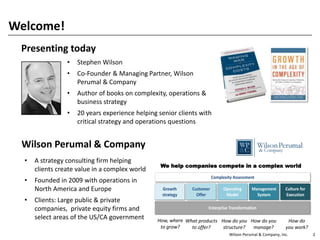
Presenting today
• Stephen Wilson
• Co-Founder & Managing Partner, Wilson
Perumal & Company
• Author of books on complexity, operations &
business strategy
• 20 years experience helping senior clients with
critical strategy and operations questions
Wilson Perumal & Company
• A strategy consulting firm helping
clients create value in a complex world
• Founded in 2009 with operations in
North America and Europe
• Clients: Large public & private
companies, private equity firms and
select areas of the US/CA government
We help companies compete in a complex world
What products
to offer?
How do you
structure?
How do you
manage?
How do
you work?
How, where
to grow?
Welcome!
Wilson Perumal & Company, Inc. 3
Our Discussion
• Introduction
• 5 key lessons from the field
• Getting started
• Q&A
Wilson Perumal & Company, Inc. 4
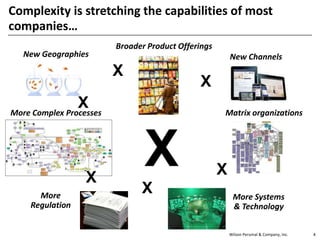
Complexity is stretching the capabilities of most
companies…
4
New ChannelsNew Geographies
Broader Product Offerings
4
More Systems
& Technology
Matrix organizations
More
Regulation
More Complex Processes
X
X
X
X
X
X
X
Wilson Perumal & Company, Inc. 5
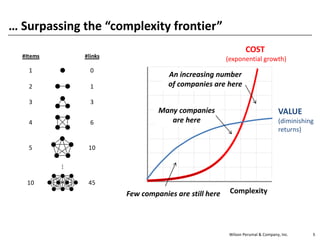
… Surpassing the “complexity frontier”
VALUE
(diminishing
returns)
COST
(exponential growth)
Level of complexity
you can support
$
#Items #links
1 0
2 1
3 3
4 6
5 10
…
10 45
ComplexityFew companies are still here
Many companies
are here
An increasing number
of companies are here
Wilson Perumal & Company, Inc. 6
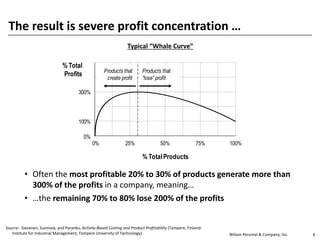
The result is severe profit concentration …
• Often the most profitable 20% to 30% of products generate more than
300% of the profits in a company, meaning…
• …the remaining 70% to 80% lose 200% of the profits
Products that
create profit
Products that
“lose” profit
0% 25% 50% 75% 100%
100%
300%
% TotalProducts
0%
% Total
Profits
Typical “Whale Curve”
Source: Sievanen, Suomala, and Paranko, Activity-Based Costing and Product Profitability (Tampere, Finland:
Institute for Industrial Management, Tampere University of Technology)
Wilson Perumal & Company, Inc. 7
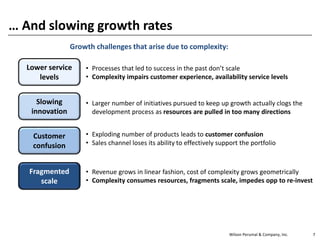
… And slowing growth rates
Slowing
innovation
Fragmented
scale
• Revenue grows in linear fashion, cost of complexity grows geometrically
• Complexity consumes resources, fragments scale, impedes opp to re-invest
Customer
confusion
• Exploding number of products leads to customer confusion
• Sales channel loses its ability to effectively support the portfolio
• Larger number of initiatives pursued to keep up growth actually clogs the
development process as resources are pulled in too many directions
Lower service
levels
• Processes that led to success in the past don’t scale
• Complexity impairs customer experience, availability service levels
Growth challenges that arise due to complexity:
Wilson Perumal & Company, Inc. 8
The benefits of Portfolio Optimization reduction can
be felt across the business
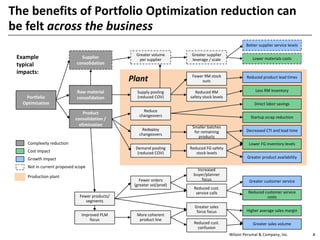
Supply pooling
(reduced COV)
Reduced RM
safety stock levels
Raw material
consolidation
Product
consolidation /
elimination
Fewer RM stock
outs
Less RM inventory
Reduced product lead times

Supplier
consolidation
Greater supplier
leverage / scale Lower materials costs
Greater volume
per supplier
Better supplier service levels
Reduce
changeovers
Direct labor savings
Startup scrap reduction
Redeploy
changeovers
Smaller batches
for remaining
products
Decreased CTI and lead time
Lower FG inventory levels
Demand pooling
(reduced COV)
Reduced FG safety
stock levels
Greater product availability
Greater sales
force focus
Greater sales volume
More coherent
product line
Fewer orders
(greater vol/prod)
Increased
buyer/planner
focus
Improved PLM
focus
Reduced cust.
confusion
Higher average sales margin
Reduced cust.
service calls
Greater customer service
Reduced customer service
costsFewer products/
segments
Portfolio
Optimization
Plant
Complexity reduction
Growth impact
Cost impact
Not in current proposed scope
Production plant
Example
typical
impacts:
Wilson Perumal & Company, Inc. 9
Companies pursue portfolio optimization for a variety
of goals; aligning upfront can shape the effort
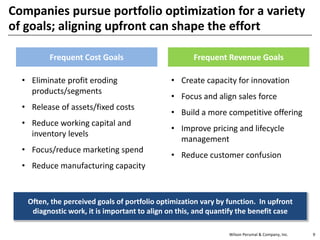
Often, the perceived goals of portfolio optimization vary by function. In upfront
diagnostic work, it is important to align on this, and quantify the benefit case
• Eliminate profit eroding
products/segments
• Release of assets/fixed costs
• Reduce working capital and
inventory levels
• Focus/reduce marketing spend
• Reduce manufacturing capacity
• Create capacity for innovation
• Focus and align sales force
• Build a more competitive offering
• Improve pricing and lifecycle
management
• Reduce customer confusion
Frequent Cost Goals Frequent Revenue Goals
Wilson Perumal & Company, Inc. 10
Our Discussion
• Introduction
• 5 key lessons from the field
• Getting started
• Q&A
Wilson Perumal & Company, Inc.
Lessons from the field
1. Put the customer at the heart of your portfolio exercise1
Wilson Perumal & Company, Inc. 12
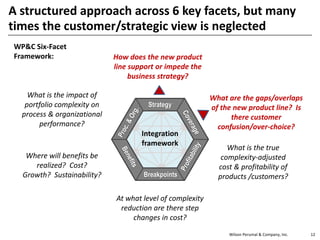
What are the gaps/overlaps
of the new product line? Is
there customer
confusion/over-choice?
What is the true
complexity-adjusted
cost & profitability of
products /customers?
Where will benefits be
realized? Cost?
Growth? Sustainability?
What is the impact of
portfolio complexity on
process & organizational
performance?
How does the new product
line support or impede the
business strategy?
At what level of complexity
reduction are there step
changes in cost?
WP&C Six-Facet
Framework:
Strategy
Breakpoints
Integration
framework
A structured approach across 6 key facets, but many
times the customer/strategic view is neglected
Wilson Perumal & Company, Inc. 13
Portfolio rationalization is not just a cost cutting
exercise, it is about improving service to the customer
Source: Market Interviews
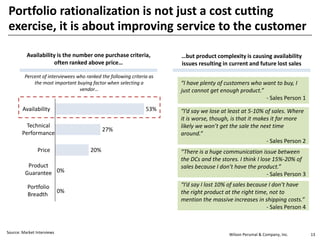
0%
0%
20%
27%
53%
Price
Availability
Availability is the number one purchase criteria,
often ranked above price…
Percent of interviewees who ranked the following criteria as
the most important buying factor when selecting a
vendor…
“I have plenty of customers who want to buy, I
just cannot get enough product.”
- Sales Person 1
“I’d say we lose at least at 5-10% of sales. Where
it is worse, though, is that it makes it far more
likely we won’t get the sale the next time
around.”
- Sales Person 2
Technical
Performance
Product
Guarantee
Portfolio
Breadth
…but product complexity is causing availability
issues resulting in current and future lost sales
“There is a huge communication issue between
the DCs and the stores. I think I lose 15%-20% of
sales because I don’t have the product.”
- Sales Person 3
“I’d say I lost 10% of sales because I don’t have
the right product at the right time, not to
mention the massive increases in shipping costs.”
- Sales Person 4
Wilson Perumal & Company, Inc. 14
25.0%
75.0%
About right
Too many
Too few
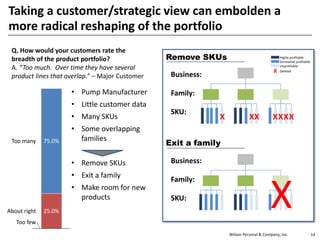
Q. How would your customers rate the
breadth of the product portfolio?
A. “Too much. Over time they have several
product lines that overlap.” – Major Customer
Taking a customer/strategic view can embolden a
more radical reshaping of the portfolio
• Pump Manufacturer
• Little customer data
• Many SKUs
• Some overlapping
families
• Remove SKUs
• Exit a family
• Make room for new
products
Business:
Family:
SKU:
Business:
Family:
SKU:
XXXXXXX
Highly profitable
Somewhat profitable
Unprofitable
DeletedX
X
Remove SKUs
Exit a family
Wilson Perumal & Company, Inc.
Lessons from the field
1. Put the customer at the heart of your portfolio exercise
2. Understand your true profitability, accounting for complexity
1
2
Wilson Perumal & Company, Inc. 16
It is very hard to make portfolio decisions before first
understanding true profitability
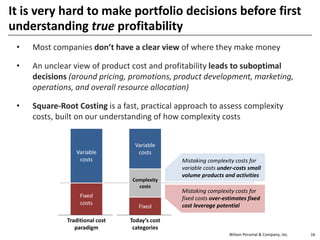
• Most companies don’t have a clear view of where they make money
• An unclear view of product cost and profitability leads to suboptimal
decisions (around pricing, promotions, product development, marketing,
operations, and overall resource allocation)
• Square-Root Costing is a fast, practical approach to assess complexity
costs, built on our understanding of how complexity costs
Variable
costs
Fixed
costs
Variable
costs
Fixed
Complexity
costs
Traditional cost
paradigm
Today’s cost
categories
Mistaking complexity costs for
variable costs under-costs small
volume products and activities
Mistaking complexity costs for
fixed costs over-estimates fixed
cost leverage potential
Wilson Perumal & Company, Inc.
Client Example – Beer Co
Situation
Complication
Key
Questions
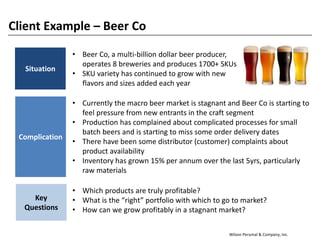
• Beer Co, a multi-billion dollar beer producer,
operates 8 breweries and produces 1700+ SKUs
• SKU variety has continued to grow with new
flavors and sizes added each year
• Currently the macro beer market is stagnant and Beer Co is starting to
feel pressure from new entrants in the craft segment
• Production has complained about complicated processes for small
batch beers and is starting to miss some order delivery dates
• There have been some distributor (customer) complaints about
product availability
• Inventory has grown 15% per annum over the last 5yrs, particularly
raw materials
• Which products are truly profitable?
• What is the “right” portfolio with which to go to market?
• How can we grow profitably in a stagnant market?
Wilson Perumal & Company, Inc. 18
Square-root costing example
Beer Co: Adjusting for complexity led to new insights
Client Example:
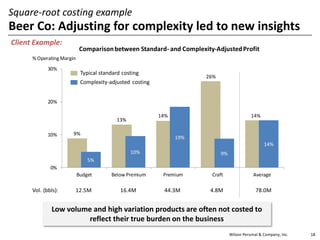
Low volume and high variation products are often not costed to
reflect their true burden on the business
9%
13%
14%
26%
14%
5%
10%
19%
9%
14%
0%
10%
20%
30%
Budget Below Premium Premium Craft Average
% Operating Margin
Vol. (bbls): 12.5M 16.4M 44.3M 4.8M 78.0M
Comparisonbetween Standard- and Complexity-AdjustedProfit
Typical standard costing
Complexity-adjusted costing
Wilson Perumal & Company, Inc.
Lessons from the field
1. Put the customer at the heart of your portfolio exercise
2. Understand your true profitability, accounting for complexity
3. Leverage substitutability to cut costs while maintaining the top line
1
2
3
Wilson Perumal & Company, Inc. 20
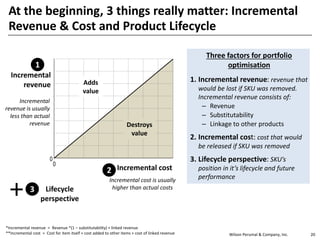
At the beginning, 3 things really matter: Incremental
Revenue & Cost and Product Lifecycle
Incremental cost
0
0
Destroys
value
Incremental
revenue Adds
value
1
2
Incremental
revenue is usually
less than actual
revenue
Incremental cost is usually
higher than actual costs
+ 3 Lifecycle
perspective
**Incremental cost = Cost for item itself + cost added to other items + cost of linked revenue
*Incremental revenue = Revenue *(1 ‒ substitutability) + linked revenue
Three factors for portfolio
optimisation
1. Incremental revenue: revenue that
would be lost if SKU was removed.
Incremental revenue consists of:
‒ Revenue
‒ Substitutability
‒ Linkage to other products
2. Incremental cost: cost that would
be released if SKU was removed
3. Lifecycle perspective: SKU’s
position in it’s lifecycle and future
performance
Wilson Perumal & Company, Inc. 21
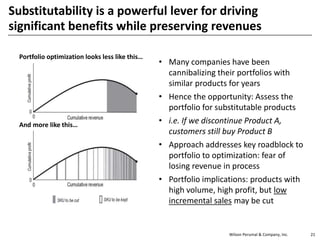
Portfolio optimization looks less like this…
And more like this…
Substitutability is a powerful lever for driving
significant benefits while preserving revenues
• Many companies have been
cannibalizing their portfolios with
similar products for years
• Hence the opportunity: Assess the
portfolio for substitutable products
• i.e. If we discontinue Product A,
customers still buy Product B
• Approach addresses key roadblock to
portfolio to optimization: fear of
losing revenue in process
• Portfolio implications: products with
high volume, high profit, but low
incremental sales may be cut
Wilson Perumal & Company, Inc. 22
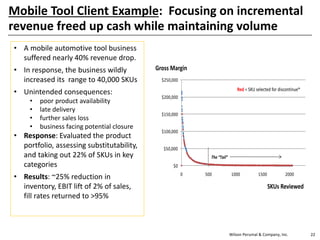
Mobile Tool Client Example: Focusing on incremental
revenue freed up cash while maintaining volume
• A mobile automotive tool business
suffered nearly 40% revenue drop.
• In response, the business wildly
increased its range to 40,000 SKUs
• Unintended consequences:
• poor product availability
• late delivery
• further sales loss
• business facing potential closure
• Response: Evaluated the product
portfolio, assessing substitutability,
and taking out 22% of SKUs in key
categories
• Results: ~25% reduction in
inventory, EBIT lift of 2% of sales,
fill rates returned to >95%
$0
$50,000
$100,000
$150,000
$200,000
$250,000
0 500 1000 1500 2000
Gross Margin
SKUs Reviewed
Red = SKU selected for discontinue*
The “Tail”
Wilson Perumal & Company, Inc.
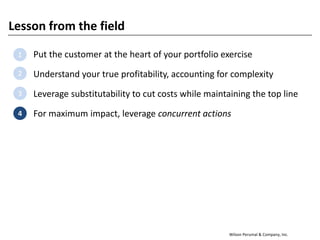
Lesson from the field
1. Put the customer at the heart of your portfolio exercise
2. Understand your true profitability, accounting for complexity
3. Leverage substitutability to cut costs while maintaining the top line
4. For maximum impact, leverage concurrent actions
1
2
3
4
© Wilson Perumal & Company, Inc. 24
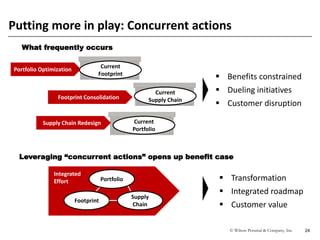
What frequently occurs
Leveraging “concurrent actions” opens up benefit case
Portfolio Optimization
Supply Chain Redesign
Footprint Consolidation
Current
Footprint
Current
Supply Chain
Current
Portfolio
Footprint
Portfolio
Supply
Chain
Integrated
Effort
 Benefits constrained
 Dueling initiatives
 Customer disruption
 Transformation
 Integrated roadmap
 Customer value
Putting more in play: Concurrent actions
© Wilson Perumal & Company, Inc. 25
Cadbury example
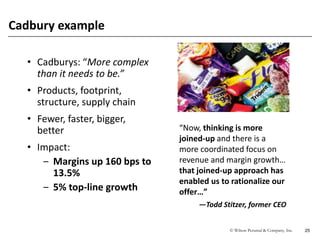
“Now, thinking is more
joined-up and there is a
more coordinated focus on
revenue and margin growth…
that joined-up approach has
enabled us to rationalize our
offer…”
—Todd Stitzer, former CEO
• Cadburys: “More complex
than it needs to be.”
• Products, footprint,
structure, supply chain
• Fewer, faster, bigger,
better
• Impact:
‒ Margins up 160 bps to
13.5%
‒ 5% top-line growth
Wilson Perumal & Company, Inc. 26
Animal Feed Co: Product consolidation enables
transformation of the distribution model
Unwinding a product proliferation dynamic to move the needle
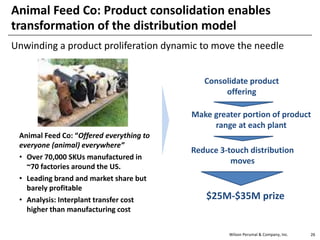
Animal Feed Co: “Offered everything to
everyone (animal) everywhere”
• Over 70,000 SKUs manufactured in
~70 factories around the US.
• Leading brand and market share but
barely profitable
• Analysis: Interplant transfer cost
higher than manufacturing cost
Consolidate product
offering
$25M-$35M prize
Make greater portion of product
range at each plant
Reduce 3-touch distribution
moves
Wilson Perumal & Company, Inc.
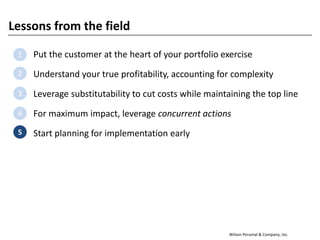
Lessons from the field
1. Put the customer at the heart of your portfolio exercise
2. Understand your true profitability, accounting for complexity
3. Leverage substitutability to cut costs while maintaining the top line
4. For maximum impact, leverage concurrent actions
5. Start planning for implementation early
1
2
3
4
5
Wilson Perumal & Company, Inc. 28
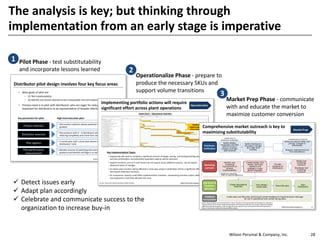
The analysis is key; but thinking through
implementation from an early stage is imperative
Wilson Perumal & Company, Inc.
Distributor pilot design involves four key focus areas
• Main goals of pilot are:
– (1) Test substitutability
– (2) Identify any lessons learned to be incorporated into full implementation
• Primary need is to pilot with distributors who are eager for reduced portfolio; also
important for distributors to be representative of broader distributor population
6
Key parameters for pilot:
Product selection
Distributor selection
Pilot logistics
Pilot performance
measurement
• Test product switches whose potential margin benefit is
greatest
• Monitor process of switching end-users to replacement
products and identify red flags in so doing
• Test products with 4 – 6 distributors who are excited about
reducing complexity and come from variety of sales regions
• 2 month pilot with critical task owners both on Pump Co’s and
distributors’ ends
High-level execution plan:
Wilson Perumal & Company, Inc.Wilson Perumal & Company, Inc. 12
Implementing portfolio actions will require
significant effort across plant operations
Key Implementation Topics
• Engineering will need to complete a significant amount of design, testing, and tooling/molding work
and thus prioritization and potentially expanded capacity will be necessary
• Support functions such as IT and Finance do not require many additional actions, but do require
advanced notice of changes
• As nearly every function will be affected in some way, project coordination will be a significant effort
and require dedicated resources
• Air compressor capacity could affect implementation timelines, reevaluating priorities and/or adding
new equipment could help alleviate this issue
Source: Internal & market Interviews; WP&C Analysis
Gantt Chart – Operational Activities
Operationalize
Significant
engineering work
drives timelines
Pilot Phase - test substitutability
and incorporate lessons learned
Operationalize Phase - prepare to
produce the necessary SKUs and
support volume transitions
Market Prep Phase - communicate
with and educate the market to
maximize customer conversion
Wilson Perumal & Company, Inc.Wilson Perumal & Company, Inc. 15
Comprehensive market outreach is key to
maximizing substitutability
Notify Wilden
employees and PSG
Sales of product
changes and high-
level timeline
Notify Distributors
of product changes
and high-level
timeline
Identify new
marketing
requirements to
achieve
substitutability
• Target key industries
• Tailor to regional differences
Create/update slick
sheets, technical
bulletins and
catalogs in major
global languages
Train Wilden
Inside Sales
Inside sales and PSG Sales will forward market feedback to Implementation Manager
for use in operational and market-facing plans
Train
Distributors
Wilden-led
marketing
outreach
Distributor-led
marketing
outreach
Provide
materials to
Distributors
Train PSG sales
Announce launch dates and
pricing1 changes to
Distributors
1 week prior to
distributor notification
Distributor
notification
Marketing
outreach
Distributor &
Customer
education
3 months prior to launch
Create educational
materials2
Feedback
incorporation
Market Prep
Request ordering forecast
from Distributors
Notes: These activities are not illustrated to scale or timeline 1) Pricing and lead time changes are captured in
‘operationalize’section of the implementationplan 2) Educational materialsmay include objective-handling,
application-specificexceptions, industry-specificissues, regional issues, pricing and lead-time expectations
Source: Internal and market interviews; WP&C analysis
1
2
3
 Detect issues early
 Adapt plan accordingly
 Celebrate and communicate success to the
organization to increase buy-in
Wilson Perumal & Company, Inc.
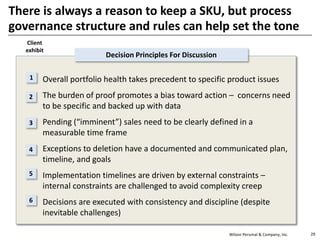
There is always a reason to keep a SKU, but process
governance structure and rules can help set the tone
• Overall portfolio health takes precedent to specific product issues
• The burden of proof promotes a bias toward action – concerns need
to be specific and backed up with data
• Pending (“imminent”) sales need to be clearly defined in a
measurable time frame
• Exceptions to deletion have a documented and communicated plan,
timeline, and goals
• Implementation timelines are driven by external constraints –
internal constraints are challenged to avoid complexity creep
• Decisions are executed with consistency and discipline (despite
inevitable challenges)
Decision Principles For Discussion
1
2
3
4
5
6
29
Client
exhibit
Wilson Perumal & Company, Inc.
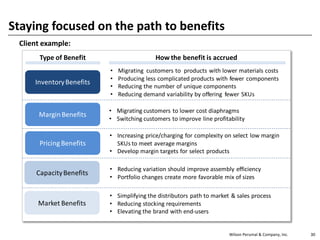
Staying focused on the path to benefits
30
InventoryBenefits
MarginBenefits
• Migrating customers to products with lower materials costs
• Producing less complicated products with fewer components
• Reducing the number of unique components
• Reducing demand variability by offering fewer SKUs
Pricing Benefits
• Migrating customers to lower cost diaphragms
• Switching customers to improve line profitability
• Increasing price/charging for complexity on select low margin
SKUs to meet average margins
• Develop margin targets for select products
CapacityBenefits
• Reducing variation should improve assembly efficiency
• Portfolio changes create more favorable mix of sizes
Market Benefits
• Simplifying the distributors path to market & sales process
• Reducing stocking requirements
• Elevating the brand with end-users
Type of Benefit How the benefit is accrued
Client example:
Wilson Perumal & Company, Inc. 31
Our Discussion
• Introduction
• 5 key lessons from the field
• Getting started
• Q&A
Wilson Perumal & Company, Inc. 32
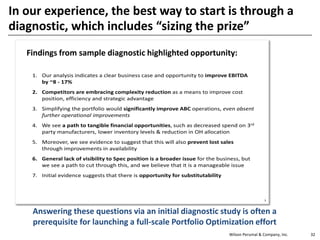
In our experience, the best way to start is through a
diagnostic, which includes “sizing the prize”
Answering these questions via an initial diagnostic study is often a
prerequisite for launching a full-scale Portfolio Optimization effort
1. Do we have a complexity issue in our portfolio? What impacts?
2. If we had a different/tighter portfolio, what would that mean?
3. What is the “size of the prize” for addressing portfolio?
4. What, ideally, would be additionally in play?
5. What do we want to achieve via our efforts in this area?
6. Is the organization aligned on the need to do something, or
what would be required to mobilize action in this area?
1. Do we have a complexity issue in our portfolio? What impacts?
2. If we had a different/tighter portfolio, what would that mean?
3. What is the “size of the prize” for addressing portfolio?
4. What, ideally, would be additionally in play?
5. What do we want to achieve via our efforts in this area?
6. Is the organization aligned on the need to do something, or what
would be required to mobilize action in this area?
1
In sum, we recommend that Client proceed with
complexity reduction:
1. Our analysis indicates a clear business case and opportunity to improve EBITDA
by ~8 - 17%
2. Competitors are embracing complexity reduction as a means to improve cost
position, efficiency and strategic advantage
3. Simplifying the portfolio would significantly improve ABC operations, even absent
further operational improvements
4. We see a path to tangible financial opportunities, such as decreased spend on 3rd
party manufacturers, lower inventory levels & reduction in OH allocation
5. Moreover, we see evidence to suggest that this will also prevent lost sales
through improvements in availability
6. General lack of visibility to Spec position is a broader issue for the business, but
we see a path to cut through this, and we believe that it is a manageable issue
7. Initial evidence suggests that there is opportunity for substitutability
Findings from sample diagnostic highlighted opportunity:
Stephen Wilson
swilson@wilsonperumal.com
Mobile: 214-938-4400
www.wilsonperumal.com
Contact information:
• To receive a copy of the slides
• To discuss content shared today or if you have additional questions
• For more information on our Complexity Diagnostic, on Square-Root
Costing, or other services
• Or Link In! https://www.linkedin.com/in/stephen-a-wilson-5782a2
Thank You!
Wilson Perumal & Company, Inc. 34
Our Discussion
• Introduction
• 5 key lessons from the field
• Getting started
• Q&A

PDMA: 5 Key Lessons for Successful Portfolio Optimization

  • 1.
    5 Key Lessonsfor Successful Portfolio Optimization A Webinar Sponsored by the Product Development and Management Association August 3rd, 2016 1pm ET Stephen Wilson, Managing Partner Wilson Perumal & Company
  • 2.
    Wilson Perumal &Company, Inc. 2 Complexity Assessment Enterprise Transformation Growth strategy Customer Offer Operating Model Management System Culture for Execution Presenting today • Stephen Wilson • Co-Founder & Managing Partner, Wilson Perumal & Company • Author of books on complexity, operations & business strategy • 20 years experience helping senior clients with critical strategy and operations questions Wilson Perumal & Company • A strategy consulting firm helping clients create value in a complex world • Founded in 2009 with operations in North America and Europe • Clients: Large public & private companies, private equity firms and select areas of the US/CA government We help companies compete in a complex world What products to offer? How do you structure? How do you manage? How do you work? How, where to grow? Welcome!
  • 3.
    Wilson Perumal &Company, Inc. 3 Our Discussion • Introduction • 5 key lessons from the field • Getting started • Q&A
  • 4.
    Wilson Perumal &Company, Inc. 4 Complexity is stretching the capabilities of most companies… 4 New ChannelsNew Geographies Broader Product Offerings 4 More Systems & Technology Matrix organizations More Regulation More Complex Processes X X X X X X X
  • 5.
    Wilson Perumal &Company, Inc. 5 … Surpassing the “complexity frontier” VALUE (diminishing returns) COST (exponential growth) Level of complexity you can support $ #Items #links 1 0 2 1 3 3 4 6 5 10 … 10 45 ComplexityFew companies are still here Many companies are here An increasing number of companies are here
  • 6.
    Wilson Perumal &Company, Inc. 6 The result is severe profit concentration … • Often the most profitable 20% to 30% of products generate more than 300% of the profits in a company, meaning… • …the remaining 70% to 80% lose 200% of the profits Products that create profit Products that “lose” profit 0% 25% 50% 75% 100% 100% 300% % TotalProducts 0% % Total Profits Typical “Whale Curve” Source: Sievanen, Suomala, and Paranko, Activity-Based Costing and Product Profitability (Tampere, Finland: Institute for Industrial Management, Tampere University of Technology)
  • 7.
    Wilson Perumal &Company, Inc. 7 … And slowing growth rates Slowing innovation Fragmented scale • Revenue grows in linear fashion, cost of complexity grows geometrically • Complexity consumes resources, fragments scale, impedes opp to re-invest Customer confusion • Exploding number of products leads to customer confusion • Sales channel loses its ability to effectively support the portfolio • Larger number of initiatives pursued to keep up growth actually clogs the development process as resources are pulled in too many directions Lower service levels • Processes that led to success in the past don’t scale • Complexity impairs customer experience, availability service levels Growth challenges that arise due to complexity:
  • 8.
    Wilson Perumal &Company, Inc. 8 The benefits of Portfolio Optimization reduction can be felt across the business Supply pooling (reduced COV) Reduced RM safety stock levels Raw material consolidation Product consolidation / elimination Fewer RM stock outs Less RM inventory Reduced product lead times Supplier consolidation Greater supplier leverage / scale Lower materials costs Greater volume per supplier Better supplier service levels Reduce changeovers Direct labor savings Startup scrap reduction Redeploy changeovers Smaller batches for remaining products Decreased CTI and lead time Lower FG inventory levels Demand pooling (reduced COV) Reduced FG safety stock levels Greater product availability Greater sales force focus Greater sales volume More coherent product line Fewer orders (greater vol/prod) Increased buyer/planner focus Improved PLM focus Reduced cust. confusion Higher average sales margin Reduced cust. service calls Greater customer service Reduced customer service costsFewer products/ segments Portfolio Optimization Plant Complexity reduction Growth impact Cost impact Not in current proposed scope Production plant Example typical impacts:
  • 9.
    Wilson Perumal &Company, Inc. 9 Companies pursue portfolio optimization for a variety of goals; aligning upfront can shape the effort Often, the perceived goals of portfolio optimization vary by function. In upfront diagnostic work, it is important to align on this, and quantify the benefit case • Eliminate profit eroding products/segments • Release of assets/fixed costs • Reduce working capital and inventory levels • Focus/reduce marketing spend • Reduce manufacturing capacity • Create capacity for innovation • Focus and align sales force • Build a more competitive offering • Improve pricing and lifecycle management • Reduce customer confusion Frequent Cost Goals Frequent Revenue Goals
  • 10.
    Wilson Perumal &Company, Inc. 10 Our Discussion • Introduction • 5 key lessons from the field • Getting started • Q&A
  • 11.
    Wilson Perumal &Company, Inc. Lessons from the field 1. Put the customer at the heart of your portfolio exercise1
  • 12.
    Wilson Perumal &Company, Inc. 12 What are the gaps/overlaps of the new product line? Is there customer confusion/over-choice? What is the true complexity-adjusted cost & profitability of products /customers? Where will benefits be realized? Cost? Growth? Sustainability? What is the impact of portfolio complexity on process & organizational performance? How does the new product line support or impede the business strategy? At what level of complexity reduction are there step changes in cost? WP&C Six-Facet Framework: Strategy Breakpoints Integration framework A structured approach across 6 key facets, but many times the customer/strategic view is neglected
  • 13.
    Wilson Perumal &Company, Inc. 13 Portfolio rationalization is not just a cost cutting exercise, it is about improving service to the customer Source: Market Interviews 0% 0% 20% 27% 53% Price Availability Availability is the number one purchase criteria, often ranked above price… Percent of interviewees who ranked the following criteria as the most important buying factor when selecting a vendor… “I have plenty of customers who want to buy, I just cannot get enough product.” - Sales Person 1 “I’d say we lose at least at 5-10% of sales. Where it is worse, though, is that it makes it far more likely we won’t get the sale the next time around.” - Sales Person 2 Technical Performance Product Guarantee Portfolio Breadth …but product complexity is causing availability issues resulting in current and future lost sales “There is a huge communication issue between the DCs and the stores. I think I lose 15%-20% of sales because I don’t have the product.” - Sales Person 3 “I’d say I lost 10% of sales because I don’t have the right product at the right time, not to mention the massive increases in shipping costs.” - Sales Person 4
  • 14.
    Wilson Perumal &Company, Inc. 14 25.0% 75.0% About right Too many Too few Q. How would your customers rate the breadth of the product portfolio? A. “Too much. Over time they have several product lines that overlap.” – Major Customer Taking a customer/strategic view can embolden a more radical reshaping of the portfolio • Pump Manufacturer • Little customer data • Many SKUs • Some overlapping families • Remove SKUs • Exit a family • Make room for new products Business: Family: SKU: Business: Family: SKU: XXXXXXX Highly profitable Somewhat profitable Unprofitable DeletedX X Remove SKUs Exit a family
  • 15.
    Wilson Perumal &Company, Inc. Lessons from the field 1. Put the customer at the heart of your portfolio exercise 2. Understand your true profitability, accounting for complexity 1 2
  • 16.
    Wilson Perumal &Company, Inc. 16 It is very hard to make portfolio decisions before first understanding true profitability • Most companies don’t have a clear view of where they make money • An unclear view of product cost and profitability leads to suboptimal decisions (around pricing, promotions, product development, marketing, operations, and overall resource allocation) • Square-Root Costing is a fast, practical approach to assess complexity costs, built on our understanding of how complexity costs Variable costs Fixed costs Variable costs Fixed Complexity costs Traditional cost paradigm Today’s cost categories Mistaking complexity costs for variable costs under-costs small volume products and activities Mistaking complexity costs for fixed costs over-estimates fixed cost leverage potential
  • 17.
    Wilson Perumal &Company, Inc. Client Example – Beer Co Situation Complication Key Questions • Beer Co, a multi-billion dollar beer producer, operates 8 breweries and produces 1700+ SKUs • SKU variety has continued to grow with new flavors and sizes added each year • Currently the macro beer market is stagnant and Beer Co is starting to feel pressure from new entrants in the craft segment • Production has complained about complicated processes for small batch beers and is starting to miss some order delivery dates • There have been some distributor (customer) complaints about product availability • Inventory has grown 15% per annum over the last 5yrs, particularly raw materials • Which products are truly profitable? • What is the “right” portfolio with which to go to market? • How can we grow profitably in a stagnant market?
  • 18.
    Wilson Perumal &Company, Inc. 18 Square-root costing example Beer Co: Adjusting for complexity led to new insights Client Example: Low volume and high variation products are often not costed to reflect their true burden on the business 9% 13% 14% 26% 14% 5% 10% 19% 9% 14% 0% 10% 20% 30% Budget Below Premium Premium Craft Average % Operating Margin Vol. (bbls): 12.5M 16.4M 44.3M 4.8M 78.0M Comparisonbetween Standard- and Complexity-AdjustedProfit Typical standard costing Complexity-adjusted costing
  • 19.
    Wilson Perumal &Company, Inc. Lessons from the field 1. Put the customer at the heart of your portfolio exercise 2. Understand your true profitability, accounting for complexity 3. Leverage substitutability to cut costs while maintaining the top line 1 2 3
  • 20.
    Wilson Perumal &Company, Inc. 20 At the beginning, 3 things really matter: Incremental Revenue & Cost and Product Lifecycle Incremental cost 0 0 Destroys value Incremental revenue Adds value 1 2 Incremental revenue is usually less than actual revenue Incremental cost is usually higher than actual costs + 3 Lifecycle perspective **Incremental cost = Cost for item itself + cost added to other items + cost of linked revenue *Incremental revenue = Revenue *(1 ‒ substitutability) + linked revenue Three factors for portfolio optimisation 1. Incremental revenue: revenue that would be lost if SKU was removed. Incremental revenue consists of: ‒ Revenue ‒ Substitutability ‒ Linkage to other products 2. Incremental cost: cost that would be released if SKU was removed 3. Lifecycle perspective: SKU’s position in it’s lifecycle and future performance
  • 21.
    Wilson Perumal &Company, Inc. 21 Portfolio optimization looks less like this… And more like this… Substitutability is a powerful lever for driving significant benefits while preserving revenues • Many companies have been cannibalizing their portfolios with similar products for years • Hence the opportunity: Assess the portfolio for substitutable products • i.e. If we discontinue Product A, customers still buy Product B • Approach addresses key roadblock to portfolio to optimization: fear of losing revenue in process • Portfolio implications: products with high volume, high profit, but low incremental sales may be cut
  • 22.
    Wilson Perumal &Company, Inc. 22 Mobile Tool Client Example: Focusing on incremental revenue freed up cash while maintaining volume • A mobile automotive tool business suffered nearly 40% revenue drop. • In response, the business wildly increased its range to 40,000 SKUs • Unintended consequences: • poor product availability • late delivery • further sales loss • business facing potential closure • Response: Evaluated the product portfolio, assessing substitutability, and taking out 22% of SKUs in key categories • Results: ~25% reduction in inventory, EBIT lift of 2% of sales, fill rates returned to >95% $0 $50,000 $100,000 $150,000 $200,000 $250,000 0 500 1000 1500 2000 Gross Margin SKUs Reviewed Red = SKU selected for discontinue* The “Tail”
  • 23.
    Wilson Perumal &Company, Inc. Lesson from the field 1. Put the customer at the heart of your portfolio exercise 2. Understand your true profitability, accounting for complexity 3. Leverage substitutability to cut costs while maintaining the top line 4. For maximum impact, leverage concurrent actions 1 2 3 4
  • 24.
    © Wilson Perumal& Company, Inc. 24 What frequently occurs Leveraging “concurrent actions” opens up benefit case Portfolio Optimization Supply Chain Redesign Footprint Consolidation Current Footprint Current Supply Chain Current Portfolio Footprint Portfolio Supply Chain Integrated Effort  Benefits constrained  Dueling initiatives  Customer disruption  Transformation  Integrated roadmap  Customer value Putting more in play: Concurrent actions
  • 25.
    © Wilson Perumal& Company, Inc. 25 Cadbury example “Now, thinking is more joined-up and there is a more coordinated focus on revenue and margin growth… that joined-up approach has enabled us to rationalize our offer…” —Todd Stitzer, former CEO • Cadburys: “More complex than it needs to be.” • Products, footprint, structure, supply chain • Fewer, faster, bigger, better • Impact: ‒ Margins up 160 bps to 13.5% ‒ 5% top-line growth
  • 26.
    Wilson Perumal &Company, Inc. 26 Animal Feed Co: Product consolidation enables transformation of the distribution model Unwinding a product proliferation dynamic to move the needle Animal Feed Co: “Offered everything to everyone (animal) everywhere” • Over 70,000 SKUs manufactured in ~70 factories around the US. • Leading brand and market share but barely profitable • Analysis: Interplant transfer cost higher than manufacturing cost Consolidate product offering $25M-$35M prize Make greater portion of product range at each plant Reduce 3-touch distribution moves
  • 27.
    Wilson Perumal &Company, Inc. Lessons from the field 1. Put the customer at the heart of your portfolio exercise 2. Understand your true profitability, accounting for complexity 3. Leverage substitutability to cut costs while maintaining the top line 4. For maximum impact, leverage concurrent actions 5. Start planning for implementation early 1 2 3 4 5
  • 28.
    Wilson Perumal &Company, Inc. 28 The analysis is key; but thinking through implementation from an early stage is imperative Wilson Perumal & Company, Inc. Distributor pilot design involves four key focus areas • Main goals of pilot are: – (1) Test substitutability – (2) Identify any lessons learned to be incorporated into full implementation • Primary need is to pilot with distributors who are eager for reduced portfolio; also important for distributors to be representative of broader distributor population 6 Key parameters for pilot: Product selection Distributor selection Pilot logistics Pilot performance measurement • Test product switches whose potential margin benefit is greatest • Monitor process of switching end-users to replacement products and identify red flags in so doing • Test products with 4 – 6 distributors who are excited about reducing complexity and come from variety of sales regions • 2 month pilot with critical task owners both on Pump Co’s and distributors’ ends High-level execution plan: Wilson Perumal & Company, Inc.Wilson Perumal & Company, Inc. 12 Implementing portfolio actions will require significant effort across plant operations Key Implementation Topics • Engineering will need to complete a significant amount of design, testing, and tooling/molding work and thus prioritization and potentially expanded capacity will be necessary • Support functions such as IT and Finance do not require many additional actions, but do require advanced notice of changes • As nearly every function will be affected in some way, project coordination will be a significant effort and require dedicated resources • Air compressor capacity could affect implementation timelines, reevaluating priorities and/or adding new equipment could help alleviate this issue Source: Internal & market Interviews; WP&C Analysis Gantt Chart – Operational Activities Operationalize Significant engineering work drives timelines Pilot Phase - test substitutability and incorporate lessons learned Operationalize Phase - prepare to produce the necessary SKUs and support volume transitions Market Prep Phase - communicate with and educate the market to maximize customer conversion Wilson Perumal & Company, Inc.Wilson Perumal & Company, Inc. 15 Comprehensive market outreach is key to maximizing substitutability Notify Wilden employees and PSG Sales of product changes and high- level timeline Notify Distributors of product changes and high-level timeline Identify new marketing requirements to achieve substitutability • Target key industries • Tailor to regional differences Create/update slick sheets, technical bulletins and catalogs in major global languages Train Wilden Inside Sales Inside sales and PSG Sales will forward market feedback to Implementation Manager for use in operational and market-facing plans Train Distributors Wilden-led marketing outreach Distributor-led marketing outreach Provide materials to Distributors Train PSG sales Announce launch dates and pricing1 changes to Distributors 1 week prior to distributor notification Distributor notification Marketing outreach Distributor & Customer education 3 months prior to launch Create educational materials2 Feedback incorporation Market Prep Request ordering forecast from Distributors Notes: These activities are not illustrated to scale or timeline 1) Pricing and lead time changes are captured in ‘operationalize’section of the implementationplan 2) Educational materialsmay include objective-handling, application-specificexceptions, industry-specificissues, regional issues, pricing and lead-time expectations Source: Internal and market interviews; WP&C analysis 1 2 3  Detect issues early  Adapt plan accordingly  Celebrate and communicate success to the organization to increase buy-in
  • 29.
    Wilson Perumal &Company, Inc. There is always a reason to keep a SKU, but process governance structure and rules can help set the tone • Overall portfolio health takes precedent to specific product issues • The burden of proof promotes a bias toward action – concerns need to be specific and backed up with data • Pending (“imminent”) sales need to be clearly defined in a measurable time frame • Exceptions to deletion have a documented and communicated plan, timeline, and goals • Implementation timelines are driven by external constraints – internal constraints are challenged to avoid complexity creep • Decisions are executed with consistency and discipline (despite inevitable challenges) Decision Principles For Discussion 1 2 3 4 5 6 29 Client exhibit
  • 30.
    Wilson Perumal &Company, Inc. Staying focused on the path to benefits 30 InventoryBenefits MarginBenefits • Migrating customers to products with lower materials costs • Producing less complicated products with fewer components • Reducing the number of unique components • Reducing demand variability by offering fewer SKUs Pricing Benefits • Migrating customers to lower cost diaphragms • Switching customers to improve line profitability • Increasing price/charging for complexity on select low margin SKUs to meet average margins • Develop margin targets for select products CapacityBenefits • Reducing variation should improve assembly efficiency • Portfolio changes create more favorable mix of sizes Market Benefits • Simplifying the distributors path to market & sales process • Reducing stocking requirements • Elevating the brand with end-users Type of Benefit How the benefit is accrued Client example:
  • 31.
    Wilson Perumal &Company, Inc. 31 Our Discussion • Introduction • 5 key lessons from the field • Getting started • Q&A
  • 32.
    Wilson Perumal &Company, Inc. 32 In our experience, the best way to start is through a diagnostic, which includes “sizing the prize” Answering these questions via an initial diagnostic study is often a prerequisite for launching a full-scale Portfolio Optimization effort 1. Do we have a complexity issue in our portfolio? What impacts? 2. If we had a different/tighter portfolio, what would that mean? 3. What is the “size of the prize” for addressing portfolio? 4. What, ideally, would be additionally in play? 5. What do we want to achieve via our efforts in this area? 6. Is the organization aligned on the need to do something, or what would be required to mobilize action in this area? 1. Do we have a complexity issue in our portfolio? What impacts? 2. If we had a different/tighter portfolio, what would that mean? 3. What is the “size of the prize” for addressing portfolio? 4. What, ideally, would be additionally in play? 5. What do we want to achieve via our efforts in this area? 6. Is the organization aligned on the need to do something, or what would be required to mobilize action in this area? 1 In sum, we recommend that Client proceed with complexity reduction: 1. Our analysis indicates a clear business case and opportunity to improve EBITDA by ~8 - 17% 2. Competitors are embracing complexity reduction as a means to improve cost position, efficiency and strategic advantage 3. Simplifying the portfolio would significantly improve ABC operations, even absent further operational improvements 4. We see a path to tangible financial opportunities, such as decreased spend on 3rd party manufacturers, lower inventory levels & reduction in OH allocation 5. Moreover, we see evidence to suggest that this will also prevent lost sales through improvements in availability 6. General lack of visibility to Spec position is a broader issue for the business, but we see a path to cut through this, and we believe that it is a manageable issue 7. Initial evidence suggests that there is opportunity for substitutability Findings from sample diagnostic highlighted opportunity:
  • 33.
    Stephen Wilson swilson@wilsonperumal.com Mobile: 214-938-4400 www.wilsonperumal.com Contactinformation: • To receive a copy of the slides • To discuss content shared today or if you have additional questions • For more information on our Complexity Diagnostic, on Square-Root Costing, or other services • Or Link In! https://www.linkedin.com/in/stephen-a-wilson-5782a2 Thank You!
  • 34.
    Wilson Perumal &Company, Inc. 34 Our Discussion • Introduction • 5 key lessons from the field • Getting started • Q&A

Editor's Notes

  • #8 So, my msg here, is complexity creeps in. And left unaddressed or ignored, can have an impact. It can certainly impact growth. Think about as complexity creeps in, it can impair service levels, or customer experiences, a driver of top-line growth We’ve seen a lot of examples wehre to feed multiple BUs, dfferent demnads, the innov pipe gets crowded and nothing gets out Customers may get confused. Lot of research on overchoise Portfolio mgmt – proliferation can consume resources that should be used on step-change products Trading scale for revenue – understanding from the whale curve how complexity consumes resources, it can fragment scale
  • #19 Wv 1 is about reducing variety and Wv2 is about helping to drive down raw material volumes