Mathematical Theory and Modeling www.iiste.org 
ISSN 2224-5804 (Paper) ISSN 2225-0522 (Online) 
Vol.4, No.9, 2014 
Solution of Second Kind Volterra Integro Equations Using linear 
Non-Polynomial Spline Function 
Saba N. Majeed 
College of Education for Pure Scince Ibn-Al Haitham, Baghdad, Addamia. Iraq . 
E-mail: snoori39@yahoo.com 
78 
Abstract: 
This research use linear non-polynomial Spline function to solve second kind Volterra 
integro equations . An algorithem introduced with numerical examples to illustrate the 
proposed method. 
Keywords : Integro equation, Volterra second kind , Non-Polynomial Spline 
1-Introduction: 
Spline functions are piecewise polynomials of degree n joined together at the break points 
with n-1 continuous derivatives. The break points of the splins are called knots [1].A 
piecewise non-polynomial spline function is a blend of trigonometric, as well as, polynomial 
basis functions, which form a complete extended Chebyshev space. This approach ensures 
enhanced accuracy and general form to the existing spline function . A parameter is 
introduced in the trigonometric part of the splin function of non-polynomial splines 
compensates for the loss of smoothes inherited by spline function.It is well known that the 
Bezire basis is a basis for the degree n algebraic polynomials Sn=span{1,x,x²,….xⁿ} 
A new basis , called c-Bezire basis, is constructed in [2], for the space 휞(n) = 
span{1,x,x²,xⁿ,…..,xⁿ⁻²,cos x , sin x } 
In which xⁿ⁻¹ and xⁿ in (1) replaced by cos x and sin x . There is wide use to non-polynomial 
spline functions , see [3,4,5,6,7,8,9]. 
Integro differential equations occure in various area of engineering , mechanics , physics , 
chemistry , astronomy , biology , economies , potential theory , electrostatics , ets…[10 , 11] . 
An integro-differential equation involves one (or more ) unkown functions u(t) and both at its 
differential and integral , to solve this equations several analytics and numerical approaches 
have been proposed [12],[13]. 
Spline non-polynomial , proposed in this paper to solve second kind Volterra integro 
differential equation of the form 
( ) ( ) ( ) ( ) ∫ ( ) ( ) 
( ) 
( )
Mathematical Theory and Modeling www.iiste.org 
ISSN 2224-5804 (Paper) ISSN 2225-0522 (Online) 
Vol.4, No.9, 2014 
The rest of this paper is organized as follows : section 2 introduce the non-polynomial spline 
function , section 3 perform it on Volterra integro equation of the second kind and 
demonstrate the solving process by discretiation with an essential algorithem ,section 4 offers 
three examples of second kind Volterra integro equation with non-polynomial spline 
approximation method , and finally section 5 conclude the paper . 
2- Second order non-polynomial spline function : 
Consider the partition of [a,b] . Let S( ) denote the set of 
piecewise polynomials on subinterval of partition . In this work, we using 
second order non-polynomial spline function for finding approximate solution of Volttera 
integro differential of the second kind. Consider the grid point ti on the interval [a,b] as 
follows: 
79 
a=t0< t1< t2< … <tn=b … (2) 
ti=t0+ih ,i=0,1,…,n … (3) 
… (4) 
where n is a positive integer. The form of n order non-polynomial spline function is: 
( ) ( ) ( ) ( ) ( ) …(5) 
where are constant to be determined, and k is the frequency of the 
trigonometric functions which will be used to raise the accuracy of the method, therefore the 
linear non- polynomial spline has the form[8] 
( ) ( ) ( ) ( ) ( ) 
obtained by the segment Qi(t). 
Let us consider the following relations: 
( ) ( ) 
( ) 
( ) ( ) 
( ) 
( ) = ( ) 
( ) 
We can obtain the values of as follows: 
( ) 
( ) … (7) 
( ) 
( ) … (8) 
( ) 
( ) 
( ) 
( ) … (9)
Mathematical Theory and Modeling www.iiste.org 
ISSN 2224-5804 (Paper) ISSN 2225-0522 (Online) 
Vol.4, No.9, 2014 
80 
( ) 
( ) … (10) 
fori=0,1,…,n. 
3-The method of solution : 
Consider the Volterra integro differential equation of the second kind (1), in order to 
solve (1), we differentiate (1) two times with respect to x and then put x=a, to get: 
( ) …………(11) 
( ) ( ) ( ) ( ) …………(12) 
( ) ( ) ( ) ( ) ( ) ( ) ( ) ( ) .. .………(13) 
( ) 
( ) ( ) ( ) ( ) ( ) ( ) ( ) 
( 
( ) 
) ( ) [ 
( ) 
] ( ) ( ) …....(14) 
Therefore, we approximate the solution of equation (1) using equation (6) in the following 
algorithm (IVNPS)=(Integro Volterra Non-Polynomial Spline ) : 
Algorithm (VIENPS): 
To find the approximate solution of (1), first we select positive integer n, and perform the 
following steps: 
Step 1: Set h=(b-a)/n; and ( ) 
Step 2: Evaluate by substituting 11-14 in equations 7-10. 
Step 3: Calculate 
( ) using step 2 and equation 6 for i=0. 
Step 4: Approximate 
( ). 
Step 5: For t=1 to n-1 do the following steps: 
Step6: Evaluate using equations7-10 and replacing ( ) ( ) ( ) in 
( ) 
( ) 
( ). 
Step 8: Approximate ( ) 
4-Numerical Examples: 
4.1- Example 1: consider the integro Volterra differential equation of the second kind: 
{ 
( ) ( ) ( ) ∫ ( ) 
( )
Mathematical Theory and Modeling www.iiste.org 
ISSN 2224-5804 (Paper) ISSN 2225-0522 (Online) 
Vol.4, No.9, 2014 
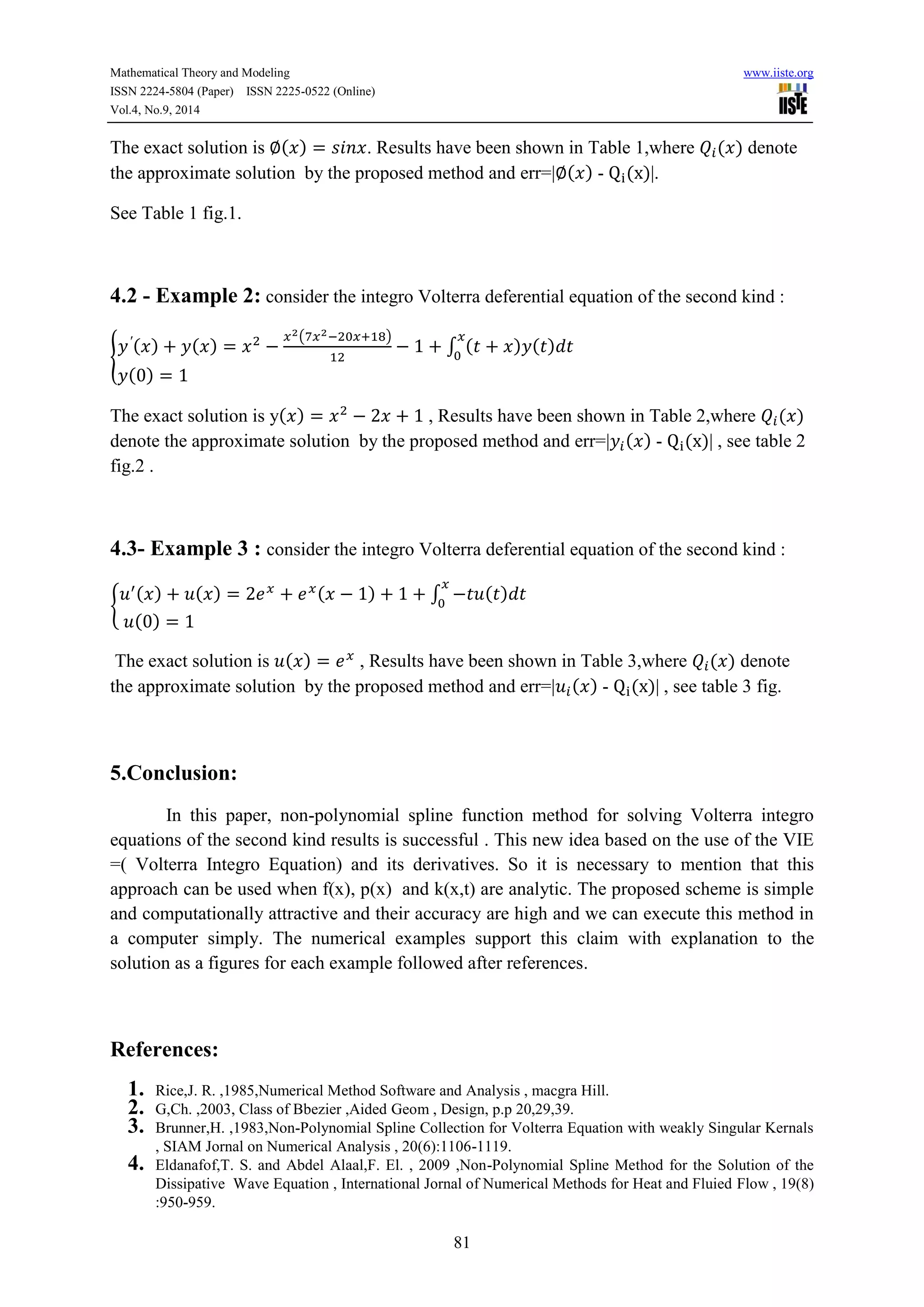
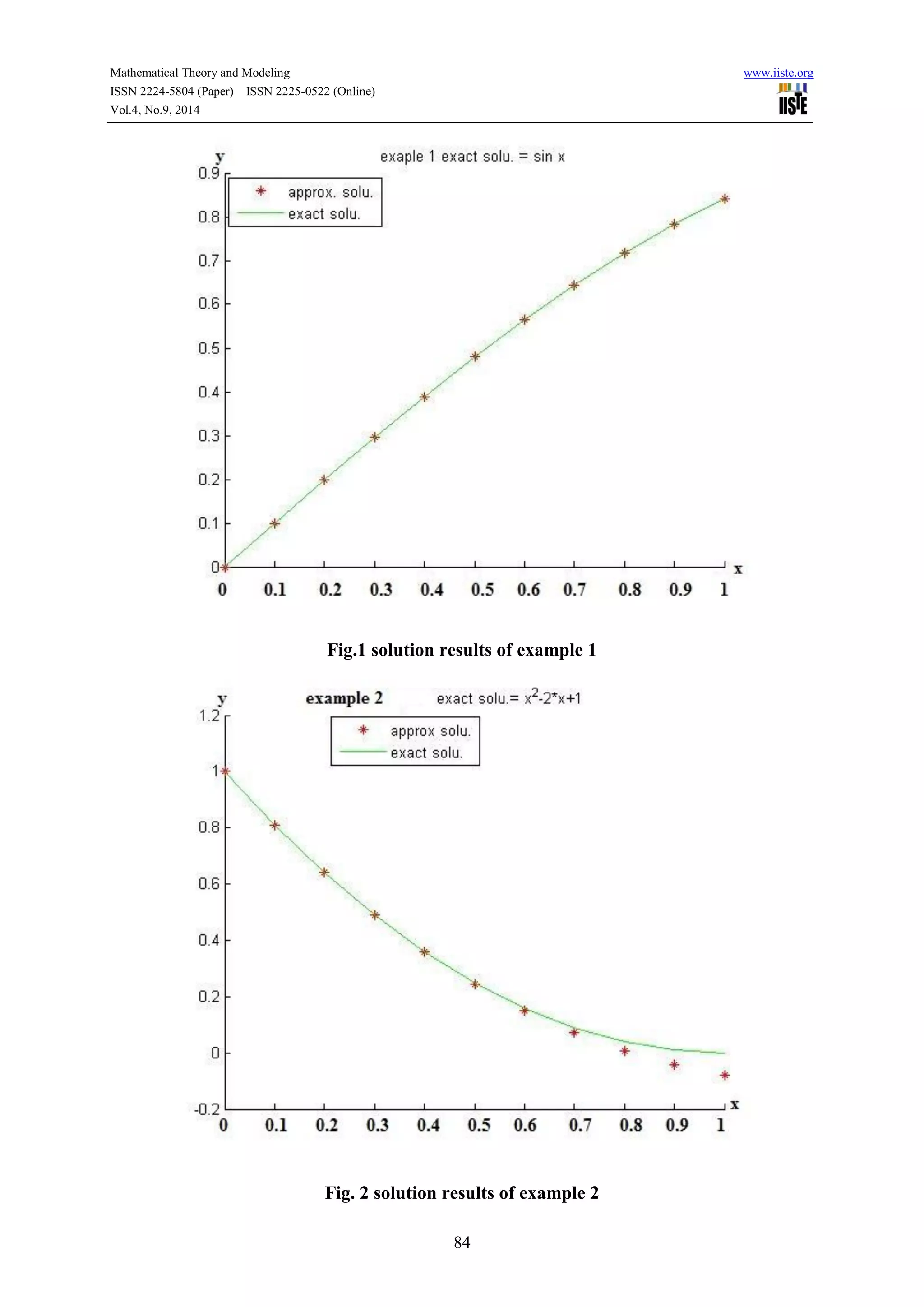
The exact solution is ( ) . Results have been shown in Table 1,where ( ) denote 
the approximate solution by the proposed method and err=| ( ) - ( )|. 
81 
See Table 1 fig.1. 
4.2 - Example 2: consider the integro Volterra deferential equation of the second kind : 
{ 
( ) ( ) 
( ) 
∫ ( ) ( ) 
( ) 
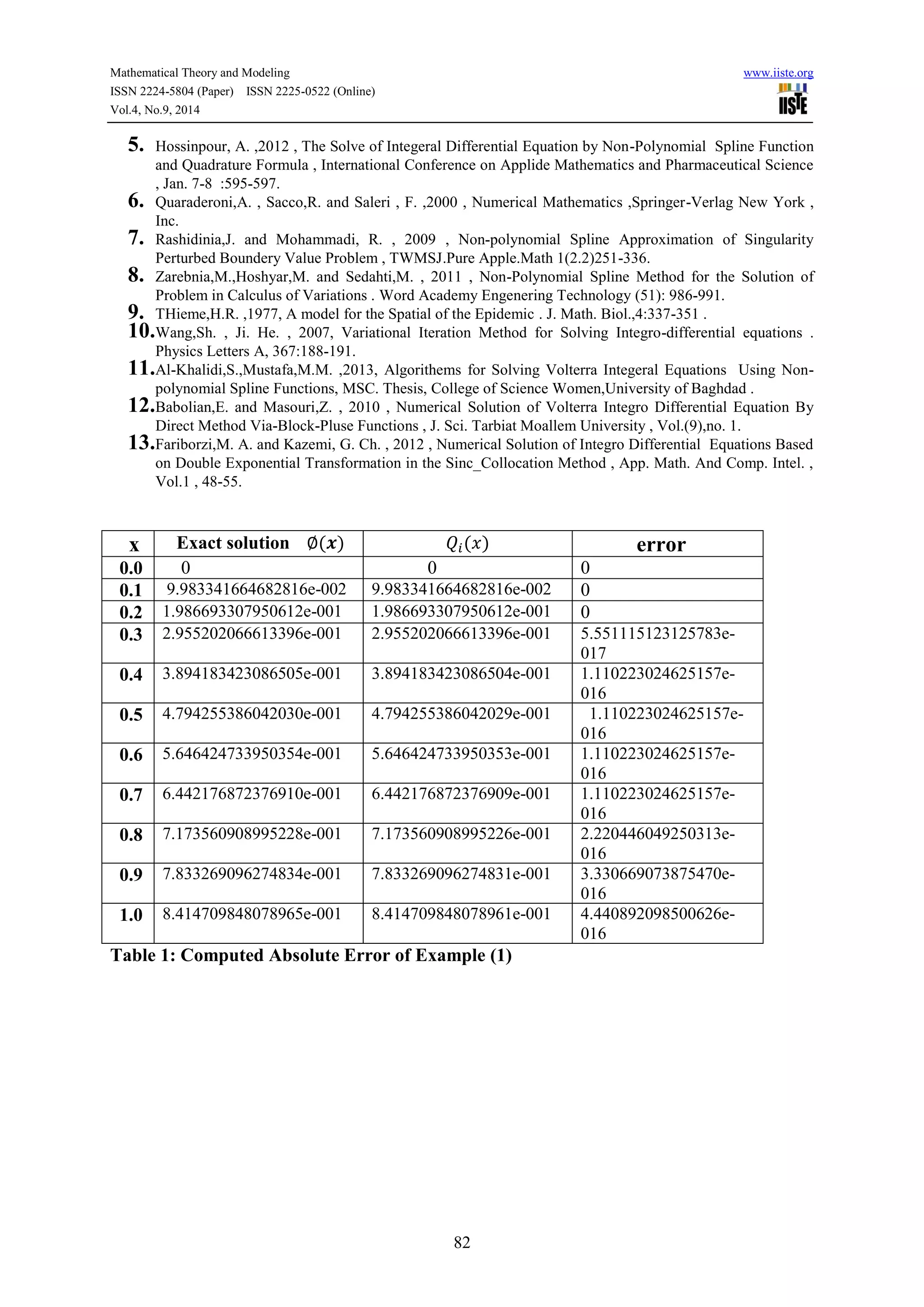
The exact solution is y( ) , Results have been shown in Table 2,where ( ) 
denote the approximate solution by the proposed method and err=| ( ) - ( )| , see table 2 
fig.2 . 
4.3- Example 3 : consider the integro Volterra deferential equation of the second kind : 
{ 
( ) ( ) ( ) ∫ ( ) 
( ) 
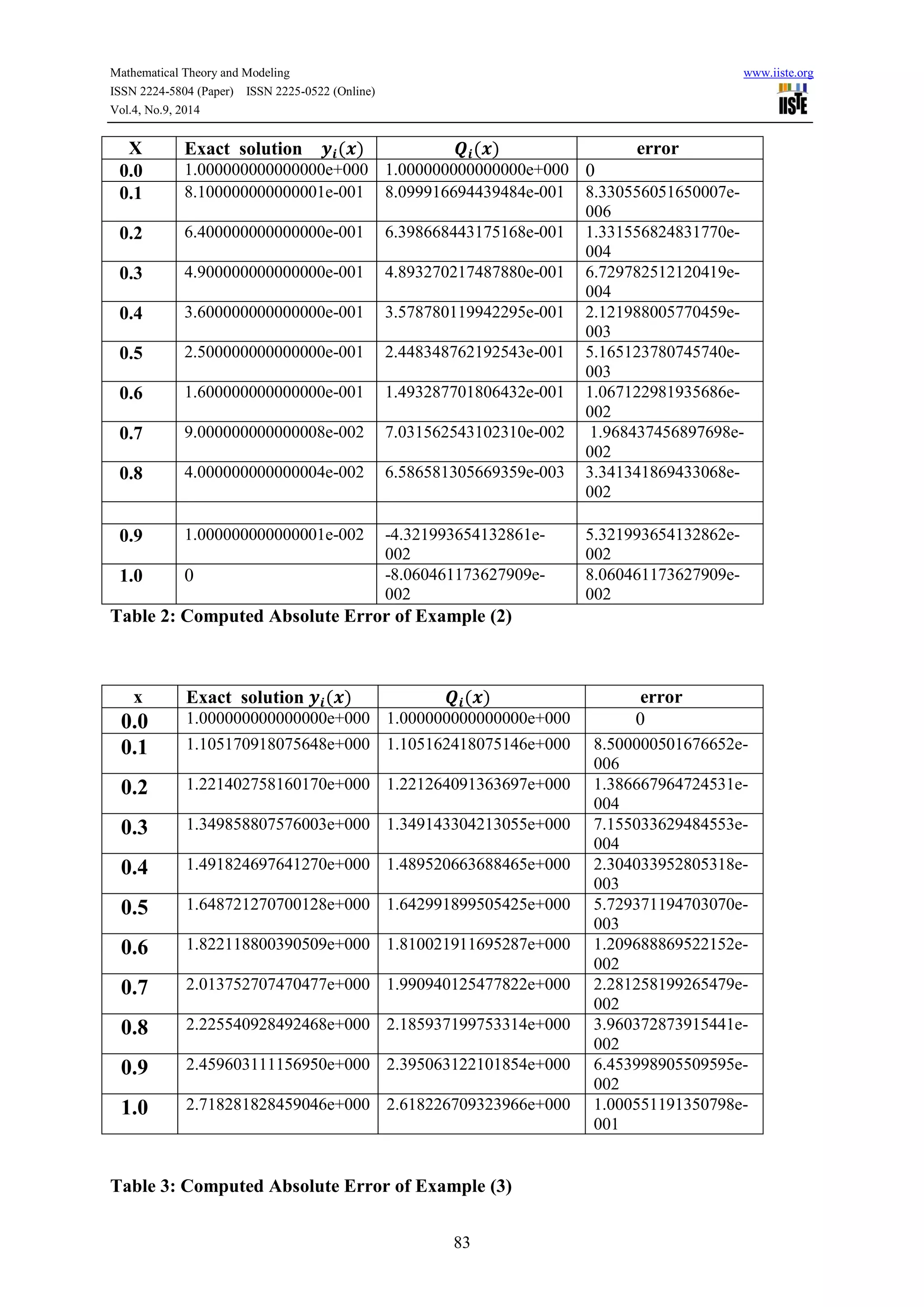
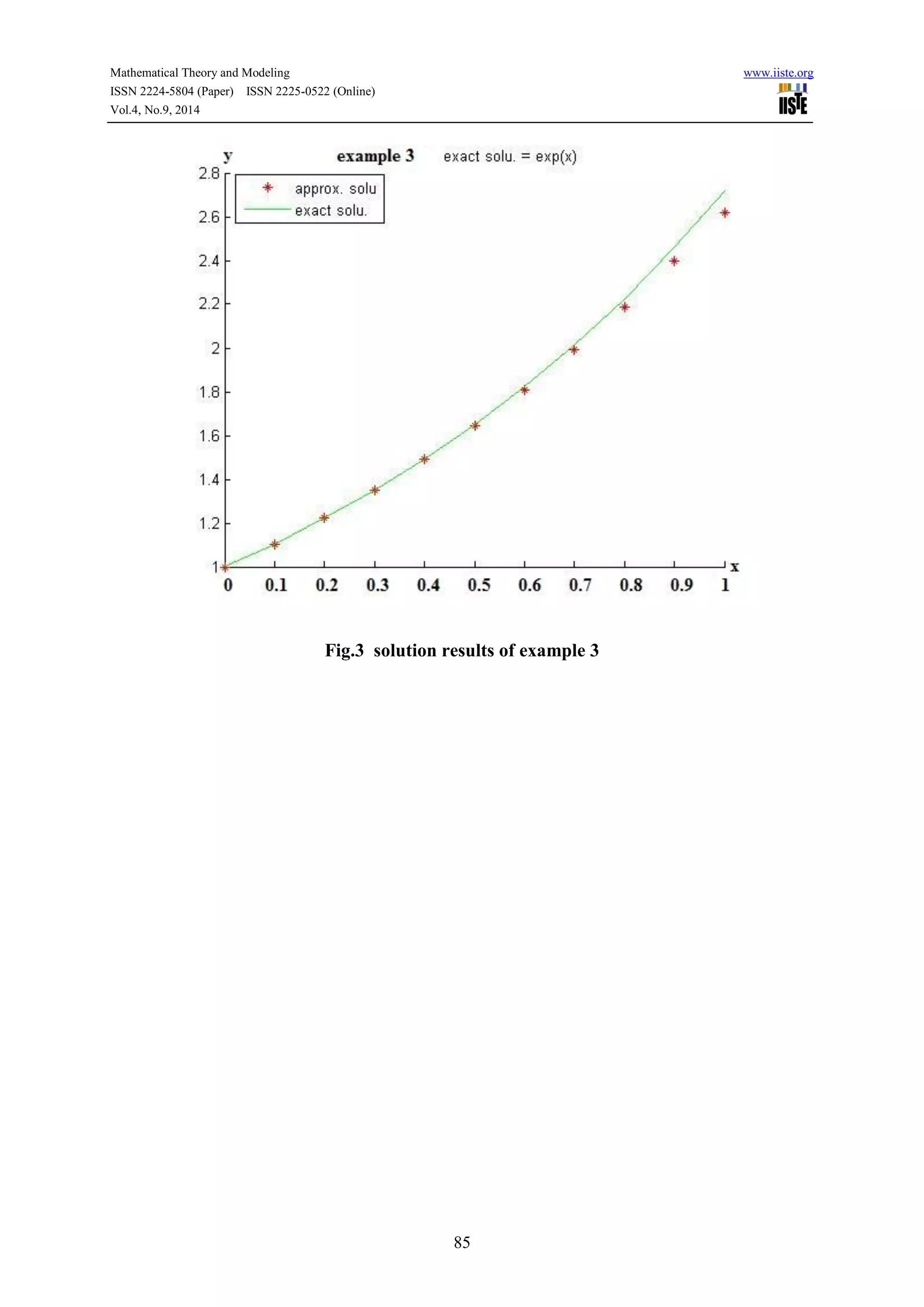
The exact solution is ( ) , Results have been shown in Table 3,where ( ) denote 
the approximate solution by the proposed method and err=| ( ) - ( )| , see table 3 fig. 
5.Conclusion: 
In this paper, non-polynomial spline function method for solving Volterra integro 
equations of the second kind results is successful . This new idea based on the use of the VIE 
=( Volterra Integro Equation) and its derivatives. So it is necessary to mention that this 
approach can be used when f(x), p(x) and k(x,t) are analytic. The proposed scheme is simple 
and computationally attractive and their accuracy are high and we can execute this method in 
a computer simply. The numerical examples support this claim with explanation to the 
solution as a figures for each example followed after references. 
References: 
1. Rice,J. R. ,1985,Numerical Method Software and Analysis , macgra Hill. 
2. G,Ch. ,2003, Class of Bbezier ,Aided Geom , Design, p.p 20,29,39. 
3. Brunner,H. ,1983,Non-Polynomial Spline Collection for Volterra Equation with weakly Singular Kernals 
, SIAM Jornal on Numerical Analysis , 20(6):1106-1119. 
4. Eldanafof,T. S. and Abdel Alaal,F. El. , 2009 ,Non-Polynomial Spline Method for the Solution of the 
Dissipative Wave Equation , International Jornal of Numerical Methods for Heat and Fluied Flow , 19(8) 
:950-959.
Mathematical Theory and Modeling www.iiste.org 
ISSN 2224-5804 (Paper) ISSN 2225-0522 (Online) 
Vol.4, No.9, 2014 
5. Hossinpour, A. ,2012 , The Solve of Integeral Differential Equation by Non-Polynomial Spline Function 
and Quadrature Formula , International Conference on Applide Mathematics and Pharmaceutical Science 
, Jan. 7-8 :595-597. 
6. Quaraderoni,A. , Sacco,R. and Saleri , F. ,2000 , Numerical Mathematics ,Springer-Verlag New York , 
82 
Inc. 
7. Rashidinia,J. and Mohammadi, R. , 2009 , Non-polynomial Spline Approximation of Singularity 
Perturbed Boundery Value Problem , TWMSJ.Pure Apple.Math 1(2.2)251-336. 
8. Zarebnia,M.,Hoshyar,M. and Sedahti,M. , 2011 , Non-Polynomial Spline Method for the Solution of 
Problem in Calculus of Variations . Word Academy Engenering Technology (51): 986-991. 
9. THieme,H.R. ,1977, A model for the Spatial of the Epidemic . J. Math. Biol.,4:337-351 . 
10. Wang,Sh. , Ji. He. , 2007, Variational Iteration Method for Solving Integro-differential equations . 
Physics Letters A, 367:188-191. 
11. Al-Khalidi,S.,Mustafa,M.M. ,2013, Algorithems for Solving Volterra Integeral Equations Using Non-polynomial 
Spline Functions, MSC. Thesis, College of Science Women,University of Baghdad . 
12. Babolian,E. and Masouri,Z. , 2010 , Numerical Solution of Volterra Integro Differential Equation By 
Direct Method Via-Block-Pluse Functions , J. Sci. Tarbiat Moallem University , Vol.(9),no. 1. 
13. Fariborzi,M. A. and Kazemi, G. Ch. , 2012 , Numerical Solution of Integro Differential Equations Based 
on Double Exponential Transformation in the Sinc_Collocation Method , App. Math. And Comp. Intel. , 
Vol.1 , 48-55. 
x Exact solution ( ) ( ) error 
0.0 0 0 0 
0.1 9.983341664682816e-002 9.983341664682816e-002 0 
0.2 1.986693307950612e-001 1.986693307950612e-001 0 
0.3 2.955202066613396e-001 2.955202066613396e-001 5.551115123125783e- 
017 
0.4 3.894183423086505e-001 3.894183423086504e-001 1.110223024625157e- 
016 
0.5 4.794255386042030e-001 4.794255386042029e-001 1.110223024625157e- 
016 
0.6 5.646424733950354e-001 5.646424733950353e-001 1.110223024625157e- 
016 
0.7 6.442176872376910e-001 6.442176872376909e-001 1.110223024625157e- 
016 
0.8 7.173560908995228e-001 7.173560908995226e-001 2.220446049250313e- 
016 
0.9 7.833269096274834e-001 7.833269096274831e-001 3.330669073875470e- 
016 
1.0 8.414709848078965e-001 8.414709848078961e-001 4.440892098500626e- 
016 
Table 1: Computed Absolute Error of Example (1)
Mathematical Theory and Modeling www.iiste.org 
ISSN 2224-5804 (Paper) ISSN 2225-0522 (Online) 
Vol.4, No.9, 2014 
X Exact solution ( ) ( ) error 
0.0 1.000000000000000e+000 1.000000000000000e+000 0 
0.1 8.100000000000001e-001 8.099916694439484e-001 8.330556051650007e- 
83 
006 
0.2 6.400000000000000e-001 6.398668443175168e-001 1.331556824831770e- 
004 
0.3 4.900000000000000e-001 4.893270217487880e-001 6.729782512120419e- 
004 
0.4 3.600000000000000e-001 3.578780119942295e-001 2.121988005770459e- 
003 
0.5 2.500000000000000e-001 2.448348762192543e-001 5.165123780745740e- 
003 
0.6 1.600000000000000e-001 1.493287701806432e-001 1.067122981935686e- 
002 
0.7 9.000000000000008e-002 7.031562543102310e-002 1.968437456897698e- 
002 
0.8 4.000000000000004e-002 6.586581305669359e-003 3.341341869433068e- 
002 
0.9 1.000000000000001e-002 -4.321993654132861e- 
002 
5.321993654132862e- 
002 
1.0 0 -8.060461173627909e- 
002 
8.060461173627909e- 
002 
Table 2: Computed Absolute Error of Example (2) 
x Exact solution ( ) ( ) error 
0.0 1.000000000000000e+000 1.000000000000000e+000 0 
0.1 1.105170918075648e+000 1.105162418075146e+000 8.500000501676652e- 
006 
0.2 1.221402758160170e+000 1.221264091363697e+000 1.386667964724531e- 
004 
0.3 1.349858807576003e+000 1.349143304213055e+000 7.155033629484553e- 
004 
0.4 1.491824697641270e+000 1.489520663688465e+000 2.304033952805318e- 
003 
0.5 1.648721270700128e+000 1.642991899505425e+000 5.729371194703070e- 
003 
0.6 1.822118800390509e+000 1.810021911695287e+000 1.209688869522152e- 
002 
0.7 2.013752707470477e+000 1.990940125477822e+000 2.281258199265479e- 
002 
0.8 2.225540928492468e+000 2.185937199753314e+000 3.960372873915441e- 
002 
0.9 2.459603111156950e+000 2.395063122101854e+000 6.453998905509595e- 
002 
1.0 2.718281828459046e+000 2.618226709323966e+000 1.000551191350798e- 
001 
Table 3: Computed Absolute Error of Example (3)
Mathematical Theory and Modeling www.iiste.org 
ISSN 2224-5804 (Paper) ISSN 2225-0522 (Online) 
Vol.4, No.9, 2014 
Fig.1 solution results of example 1 
Fig. 2 solution results of example 2 
84
Mathematical Theory and Modeling www.iiste.org 
ISSN 2224-5804 (Paper) ISSN 2225-0522 (Online) 
Vol.4, No.9, 2014 
Fig.3 solution results of example 3 
85
The IISTE is a pioneer in the Open-Access hosting service and academic event 
management. The aim of the firm is Accelerating Global Knowledge Sharing. 
More information about the firm can be found on the homepage: 
http://www.iiste.org 
CALL FOR JOURNAL PAPERS 
There are more than 30 peer-reviewed academic journals hosted under the hosting 
platform. 
Prospective authors of journals can find the submission instruction on the 
following page: http://www.iiste.org/journals/ All the journals articles are available 
online to the readers all over the world without financial, legal, or technical barriers 
other than those inseparable from gaining access to the internet itself. Paper version 
of the journals is also available upon request of readers and authors. 
MORE RESOURCES 
Book publication information: http://www.iiste.org/book/ 
IISTE Knowledge Sharing Partners 
EBSCO, Index Copernicus, Ulrich's Periodicals Directory, JournalTOCS, PKP Open 
Archives Harvester, Bielefeld Academic Search Engine, Elektronische 
Zeitschriftenbibliothek EZB, Open J-Gate, OCLC WorldCat, Universe Digtial 
Library , NewJour, Google Scholar

Solution of second kind volterra integro equations using linear

  • 1.
    Mathematical Theory andModeling www.iiste.org ISSN 2224-5804 (Paper) ISSN 2225-0522 (Online) Vol.4, No.9, 2014 Solution of Second Kind Volterra Integro Equations Using linear Non-Polynomial Spline Function Saba N. Majeed College of Education for Pure Scince Ibn-Al Haitham, Baghdad, Addamia. Iraq . E-mail: snoori39@yahoo.com 78 Abstract: This research use linear non-polynomial Spline function to solve second kind Volterra integro equations . An algorithem introduced with numerical examples to illustrate the proposed method. Keywords : Integro equation, Volterra second kind , Non-Polynomial Spline 1-Introduction: Spline functions are piecewise polynomials of degree n joined together at the break points with n-1 continuous derivatives. The break points of the splins are called knots [1].A piecewise non-polynomial spline function is a blend of trigonometric, as well as, polynomial basis functions, which form a complete extended Chebyshev space. This approach ensures enhanced accuracy and general form to the existing spline function . A parameter is introduced in the trigonometric part of the splin function of non-polynomial splines compensates for the loss of smoothes inherited by spline function.It is well known that the Bezire basis is a basis for the degree n algebraic polynomials Sn=span{1,x,x²,….xⁿ} A new basis , called c-Bezire basis, is constructed in [2], for the space 휞(n) = span{1,x,x²,xⁿ,…..,xⁿ⁻²,cos x , sin x } In which xⁿ⁻¹ and xⁿ in (1) replaced by cos x and sin x . There is wide use to non-polynomial spline functions , see [3,4,5,6,7,8,9]. Integro differential equations occure in various area of engineering , mechanics , physics , chemistry , astronomy , biology , economies , potential theory , electrostatics , ets…[10 , 11] . An integro-differential equation involves one (or more ) unkown functions u(t) and both at its differential and integral , to solve this equations several analytics and numerical approaches have been proposed [12],[13]. Spline non-polynomial , proposed in this paper to solve second kind Volterra integro differential equation of the form ( ) ( ) ( ) ( ) ∫ ( ) ( ) ( ) ( )
  • 2.
    Mathematical Theory andModeling www.iiste.org ISSN 2224-5804 (Paper) ISSN 2225-0522 (Online) Vol.4, No.9, 2014 The rest of this paper is organized as follows : section 2 introduce the non-polynomial spline function , section 3 perform it on Volterra integro equation of the second kind and demonstrate the solving process by discretiation with an essential algorithem ,section 4 offers three examples of second kind Volterra integro equation with non-polynomial spline approximation method , and finally section 5 conclude the paper . 2- Second order non-polynomial spline function : Consider the partition of [a,b] . Let S( ) denote the set of piecewise polynomials on subinterval of partition . In this work, we using second order non-polynomial spline function for finding approximate solution of Volttera integro differential of the second kind. Consider the grid point ti on the interval [a,b] as follows: 79 a=t0< t1< t2< … <tn=b … (2) ti=t0+ih ,i=0,1,…,n … (3) … (4) where n is a positive integer. The form of n order non-polynomial spline function is: ( ) ( ) ( ) ( ) ( ) …(5) where are constant to be determined, and k is the frequency of the trigonometric functions which will be used to raise the accuracy of the method, therefore the linear non- polynomial spline has the form[8] ( ) ( ) ( ) ( ) ( ) obtained by the segment Qi(t). Let us consider the following relations: ( ) ( ) ( ) ( ) ( ) ( ) ( ) = ( ) ( ) We can obtain the values of as follows: ( ) ( ) … (7) ( ) ( ) … (8) ( ) ( ) ( ) ( ) … (9)
  • 3.
    Mathematical Theory andModeling www.iiste.org ISSN 2224-5804 (Paper) ISSN 2225-0522 (Online) Vol.4, No.9, 2014 80 ( ) ( ) … (10) fori=0,1,…,n. 3-The method of solution : Consider the Volterra integro differential equation of the second kind (1), in order to solve (1), we differentiate (1) two times with respect to x and then put x=a, to get: ( ) …………(11) ( ) ( ) ( ) ( ) …………(12) ( ) ( ) ( ) ( ) ( ) ( ) ( ) ( ) .. .………(13) ( ) ( ) ( ) ( ) ( ) ( ) ( ) ( ) ( ( ) ) ( ) [ ( ) ] ( ) ( ) …....(14) Therefore, we approximate the solution of equation (1) using equation (6) in the following algorithm (IVNPS)=(Integro Volterra Non-Polynomial Spline ) : Algorithm (VIENPS): To find the approximate solution of (1), first we select positive integer n, and perform the following steps: Step 1: Set h=(b-a)/n; and ( ) Step 2: Evaluate by substituting 11-14 in equations 7-10. Step 3: Calculate ( ) using step 2 and equation 6 for i=0. Step 4: Approximate ( ). Step 5: For t=1 to n-1 do the following steps: Step6: Evaluate using equations7-10 and replacing ( ) ( ) ( ) in ( ) ( ) ( ). Step 8: Approximate ( ) 4-Numerical Examples: 4.1- Example 1: consider the integro Volterra differential equation of the second kind: { ( ) ( ) ( ) ∫ ( ) ( )
  • 4.
    Mathematical Theory andModeling www.iiste.org ISSN 2224-5804 (Paper) ISSN 2225-0522 (Online) Vol.4, No.9, 2014 The exact solution is ( ) . Results have been shown in Table 1,where ( ) denote the approximate solution by the proposed method and err=| ( ) - ( )|. 81 See Table 1 fig.1. 4.2 - Example 2: consider the integro Volterra deferential equation of the second kind : { ( ) ( ) ( ) ∫ ( ) ( ) ( ) The exact solution is y( ) , Results have been shown in Table 2,where ( ) denote the approximate solution by the proposed method and err=| ( ) - ( )| , see table 2 fig.2 . 4.3- Example 3 : consider the integro Volterra deferential equation of the second kind : { ( ) ( ) ( ) ∫ ( ) ( ) The exact solution is ( ) , Results have been shown in Table 3,where ( ) denote the approximate solution by the proposed method and err=| ( ) - ( )| , see table 3 fig. 5.Conclusion: In this paper, non-polynomial spline function method for solving Volterra integro equations of the second kind results is successful . This new idea based on the use of the VIE =( Volterra Integro Equation) and its derivatives. So it is necessary to mention that this approach can be used when f(x), p(x) and k(x,t) are analytic. The proposed scheme is simple and computationally attractive and their accuracy are high and we can execute this method in a computer simply. The numerical examples support this claim with explanation to the solution as a figures for each example followed after references. References: 1. Rice,J. R. ,1985,Numerical Method Software and Analysis , macgra Hill. 2. G,Ch. ,2003, Class of Bbezier ,Aided Geom , Design, p.p 20,29,39. 3. Brunner,H. ,1983,Non-Polynomial Spline Collection for Volterra Equation with weakly Singular Kernals , SIAM Jornal on Numerical Analysis , 20(6):1106-1119. 4. Eldanafof,T. S. and Abdel Alaal,F. El. , 2009 ,Non-Polynomial Spline Method for the Solution of the Dissipative Wave Equation , International Jornal of Numerical Methods for Heat and Fluied Flow , 19(8) :950-959.
  • 5.
    Mathematical Theory andModeling www.iiste.org ISSN 2224-5804 (Paper) ISSN 2225-0522 (Online) Vol.4, No.9, 2014 5. Hossinpour, A. ,2012 , The Solve of Integeral Differential Equation by Non-Polynomial Spline Function and Quadrature Formula , International Conference on Applide Mathematics and Pharmaceutical Science , Jan. 7-8 :595-597. 6. Quaraderoni,A. , Sacco,R. and Saleri , F. ,2000 , Numerical Mathematics ,Springer-Verlag New York , 82 Inc. 7. Rashidinia,J. and Mohammadi, R. , 2009 , Non-polynomial Spline Approximation of Singularity Perturbed Boundery Value Problem , TWMSJ.Pure Apple.Math 1(2.2)251-336. 8. Zarebnia,M.,Hoshyar,M. and Sedahti,M. , 2011 , Non-Polynomial Spline Method for the Solution of Problem in Calculus of Variations . Word Academy Engenering Technology (51): 986-991. 9. THieme,H.R. ,1977, A model for the Spatial of the Epidemic . J. Math. Biol.,4:337-351 . 10. Wang,Sh. , Ji. He. , 2007, Variational Iteration Method for Solving Integro-differential equations . Physics Letters A, 367:188-191. 11. Al-Khalidi,S.,Mustafa,M.M. ,2013, Algorithems for Solving Volterra Integeral Equations Using Non-polynomial Spline Functions, MSC. Thesis, College of Science Women,University of Baghdad . 12. Babolian,E. and Masouri,Z. , 2010 , Numerical Solution of Volterra Integro Differential Equation By Direct Method Via-Block-Pluse Functions , J. Sci. Tarbiat Moallem University , Vol.(9),no. 1. 13. Fariborzi,M. A. and Kazemi, G. Ch. , 2012 , Numerical Solution of Integro Differential Equations Based on Double Exponential Transformation in the Sinc_Collocation Method , App. Math. And Comp. Intel. , Vol.1 , 48-55. x Exact solution ( ) ( ) error 0.0 0 0 0 0.1 9.983341664682816e-002 9.983341664682816e-002 0 0.2 1.986693307950612e-001 1.986693307950612e-001 0 0.3 2.955202066613396e-001 2.955202066613396e-001 5.551115123125783e- 017 0.4 3.894183423086505e-001 3.894183423086504e-001 1.110223024625157e- 016 0.5 4.794255386042030e-001 4.794255386042029e-001 1.110223024625157e- 016 0.6 5.646424733950354e-001 5.646424733950353e-001 1.110223024625157e- 016 0.7 6.442176872376910e-001 6.442176872376909e-001 1.110223024625157e- 016 0.8 7.173560908995228e-001 7.173560908995226e-001 2.220446049250313e- 016 0.9 7.833269096274834e-001 7.833269096274831e-001 3.330669073875470e- 016 1.0 8.414709848078965e-001 8.414709848078961e-001 4.440892098500626e- 016 Table 1: Computed Absolute Error of Example (1)
  • 6.
    Mathematical Theory andModeling www.iiste.org ISSN 2224-5804 (Paper) ISSN 2225-0522 (Online) Vol.4, No.9, 2014 X Exact solution ( ) ( ) error 0.0 1.000000000000000e+000 1.000000000000000e+000 0 0.1 8.100000000000001e-001 8.099916694439484e-001 8.330556051650007e- 83 006 0.2 6.400000000000000e-001 6.398668443175168e-001 1.331556824831770e- 004 0.3 4.900000000000000e-001 4.893270217487880e-001 6.729782512120419e- 004 0.4 3.600000000000000e-001 3.578780119942295e-001 2.121988005770459e- 003 0.5 2.500000000000000e-001 2.448348762192543e-001 5.165123780745740e- 003 0.6 1.600000000000000e-001 1.493287701806432e-001 1.067122981935686e- 002 0.7 9.000000000000008e-002 7.031562543102310e-002 1.968437456897698e- 002 0.8 4.000000000000004e-002 6.586581305669359e-003 3.341341869433068e- 002 0.9 1.000000000000001e-002 -4.321993654132861e- 002 5.321993654132862e- 002 1.0 0 -8.060461173627909e- 002 8.060461173627909e- 002 Table 2: Computed Absolute Error of Example (2) x Exact solution ( ) ( ) error 0.0 1.000000000000000e+000 1.000000000000000e+000 0 0.1 1.105170918075648e+000 1.105162418075146e+000 8.500000501676652e- 006 0.2 1.221402758160170e+000 1.221264091363697e+000 1.386667964724531e- 004 0.3 1.349858807576003e+000 1.349143304213055e+000 7.155033629484553e- 004 0.4 1.491824697641270e+000 1.489520663688465e+000 2.304033952805318e- 003 0.5 1.648721270700128e+000 1.642991899505425e+000 5.729371194703070e- 003 0.6 1.822118800390509e+000 1.810021911695287e+000 1.209688869522152e- 002 0.7 2.013752707470477e+000 1.990940125477822e+000 2.281258199265479e- 002 0.8 2.225540928492468e+000 2.185937199753314e+000 3.960372873915441e- 002 0.9 2.459603111156950e+000 2.395063122101854e+000 6.453998905509595e- 002 1.0 2.718281828459046e+000 2.618226709323966e+000 1.000551191350798e- 001 Table 3: Computed Absolute Error of Example (3)
  • 7.
    Mathematical Theory andModeling www.iiste.org ISSN 2224-5804 (Paper) ISSN 2225-0522 (Online) Vol.4, No.9, 2014 Fig.1 solution results of example 1 Fig. 2 solution results of example 2 84
  • 8.
    Mathematical Theory andModeling www.iiste.org ISSN 2224-5804 (Paper) ISSN 2225-0522 (Online) Vol.4, No.9, 2014 Fig.3 solution results of example 3 85
  • 9.
    The IISTE isa pioneer in the Open-Access hosting service and academic event management. The aim of the firm is Accelerating Global Knowledge Sharing. More information about the firm can be found on the homepage: http://www.iiste.org CALL FOR JOURNAL PAPERS There are more than 30 peer-reviewed academic journals hosted under the hosting platform. Prospective authors of journals can find the submission instruction on the following page: http://www.iiste.org/journals/ All the journals articles are available online to the readers all over the world without financial, legal, or technical barriers other than those inseparable from gaining access to the internet itself. Paper version of the journals is also available upon request of readers and authors. MORE RESOURCES Book publication information: http://www.iiste.org/book/ IISTE Knowledge Sharing Partners EBSCO, Index Copernicus, Ulrich's Periodicals Directory, JournalTOCS, PKP Open Archives Harvester, Bielefeld Academic Search Engine, Elektronische Zeitschriftenbibliothek EZB, Open J-Gate, OCLC WorldCat, Universe Digtial Library , NewJour, Google Scholar