A Market for Lemons
Market Failure Under Asymmetric Information The Market for "Lemons": Quality Uncertainty and the Market Mechanism George Akerlof, 1970 The Quarterly Journal of Economics ,  Vol. 84, No. 3. (Aug., 1970)
Akerlof’s Lemons When product quality is unobservable by buyers, sellers will lower product quality. Buyers will expect sellers to “skimp” on quality, and they lower their willingness to pay. Prices will decline. In turn, sellers will be forced to lower quality even further to make profits at the lower prices. Thus, quality will decline until nothing but the lowest quality  lemons  are left.
Akerlof’s Lemons Thus, the market fails! Sellers cannot sell high quality goods at high prices even though buyers would be willing to pay the high prices for the high  quality goods!
LETS TAKE SECOND HAND CARS AS AN EXAMPLE Second hand cars can be classified into 2 categories : Lemons Plums
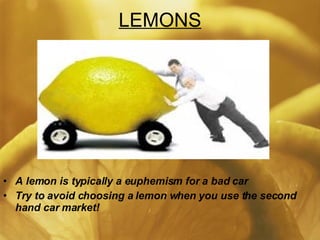
LEMONS A lemon is typically a euphemism for a bad car Try to avoid choosing a lemon when you use the second hand car market!
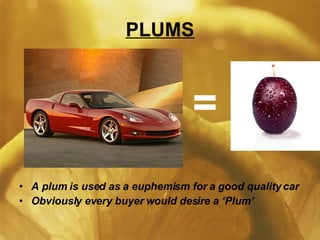
PLUMS A plum is used as a euphemism for a good quality car Obviously every buyer would desire a ‘Plum’ =
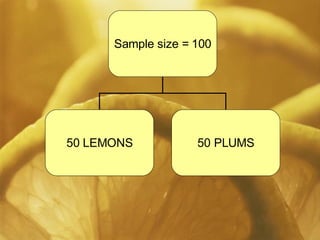
Sample size = 100 50 LEMONS 50 PLUMS
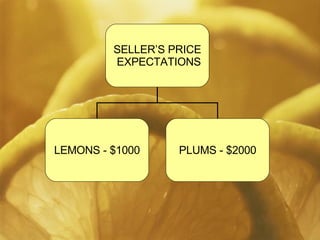
  SELLER’S PRICE EXPECTATIONS LEMONS - $1000 PLUMS - $2000
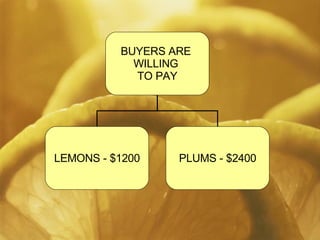
  BUYERS ARE  WILLING  TO PAY LEMONS - $1200 PLUMS - $2400
If it were easy to verify quality then there would be absolutely no problem. The ideal equilibrium price for lemons would be between $1000 - $1200 The ideal equilibrium price for plums would be between $2000 - $2400 Unfortunately there is no assurance of quality and hence prospective buyers must make an informed guess about quality.
If a buyer were to assume that there will be an equal probability of getting either a plum or a lemon, then the buyer would be willing to pay :     ½ (1200) + ½ (2400) = 1800  The average price that the buyer is willing to pay is less than the average price that a seller will demand for lemons At $1800, only lemons would be offered for sale
But if a buyer were certain that they were getting a plum, they would be willing to pay anywhere between $2000 - $2400 Even though the price at which buyers are willing to buy plums exceeds the price at which sellers are willing to sell them, no such transaction will take place.
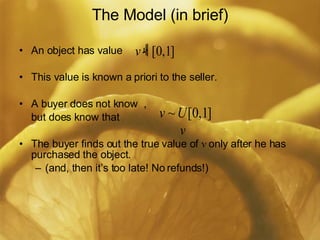
The Model (in brief) An object has value This value is known a priori to the seller. A buyer does not know  , but does know that The buyer finds out the true value of  v  only after he has purchased the object. (and, then it’s too late! No refunds!)
 
Moral Hazard is the lack of incentive to take care. It works on the premise that you believe that if you have insurance then the cost of the theft is less. Less Insurance = More Risk More Insurance = Less Care
THE  PERFECT  EXAMPLE?? NO ATTENDANCE TO LATECOMERS!

A Market For Lemons

  • 1.
  • 2.
    Market Failure UnderAsymmetric Information The Market for "Lemons": Quality Uncertainty and the Market Mechanism George Akerlof, 1970 The Quarterly Journal of Economics , Vol. 84, No. 3. (Aug., 1970)
  • 3.
    Akerlof’s Lemons Whenproduct quality is unobservable by buyers, sellers will lower product quality. Buyers will expect sellers to “skimp” on quality, and they lower their willingness to pay. Prices will decline. In turn, sellers will be forced to lower quality even further to make profits at the lower prices. Thus, quality will decline until nothing but the lowest quality lemons are left.
  • 4.
    Akerlof’s Lemons Thus,the market fails! Sellers cannot sell high quality goods at high prices even though buyers would be willing to pay the high prices for the high quality goods!
  • 5.
    LETS TAKE SECONDHAND CARS AS AN EXAMPLE Second hand cars can be classified into 2 categories : Lemons Plums
  • 6.
    LEMONS A lemonis typically a euphemism for a bad car Try to avoid choosing a lemon when you use the second hand car market!
  • 7.
    PLUMS A plumis used as a euphemism for a good quality car Obviously every buyer would desire a ‘Plum’ =
  • 8.
    Sample size =100 50 LEMONS 50 PLUMS
  • 9.
      SELLER’S PRICEEXPECTATIONS LEMONS - $1000 PLUMS - $2000
  • 10.
      BUYERS ARE WILLING TO PAY LEMONS - $1200 PLUMS - $2400
  • 11.
    If it wereeasy to verify quality then there would be absolutely no problem. The ideal equilibrium price for lemons would be between $1000 - $1200 The ideal equilibrium price for plums would be between $2000 - $2400 Unfortunately there is no assurance of quality and hence prospective buyers must make an informed guess about quality.
  • 12.
    If a buyerwere to assume that there will be an equal probability of getting either a plum or a lemon, then the buyer would be willing to pay : ½ (1200) + ½ (2400) = 1800 The average price that the buyer is willing to pay is less than the average price that a seller will demand for lemons At $1800, only lemons would be offered for sale
  • 13.
    But if abuyer were certain that they were getting a plum, they would be willing to pay anywhere between $2000 - $2400 Even though the price at which buyers are willing to buy plums exceeds the price at which sellers are willing to sell them, no such transaction will take place.
  • 14.
    The Model (inbrief) An object has value This value is known a priori to the seller. A buyer does not know , but does know that The buyer finds out the true value of v only after he has purchased the object. (and, then it’s too late! No refunds!)
  • 15.
  • 16.
    Moral Hazard isthe lack of incentive to take care. It works on the premise that you believe that if you have insurance then the cost of the theft is less. Less Insurance = More Risk More Insurance = Less Care
  • 17.
    THE PERFECT EXAMPLE?? NO ATTENDANCE TO LATECOMERS!