08/26/2013
1
Chapter 11
The Economics of
Information
Copyright © 2013 by The McGraw-Hill Companies, Inc. All rights reserved.McGraw-Hill/Irwin
11-2
Learning Objectives
1. Explain how middlemen add value to market
transactions
2. Use the concept of rational search to find the
optimal amount of information market
participants should obtain
3. Define asymmetric information and describe
how it leads to the lemons problem
4. Discuss how advertising, conspicuous
consumption, statistical discrimination, and
other devices are responses to asymmetric
information
08/26/2013
2
11-3
Information and the Invisible
Hand
• All parties have all relevant information
– Without free information, market results are not
efficient
• Bargaining for a bowl in Kashmir
• Parties must decide how much information to
gather
– Information gathering strategies differ
11-4
How The Middleman Adds Value
• Buyers sometimes choose among several
version of a product
– Each has complex feature sets
• Research options
– Company web site
– Ask friends and family
– Consumer Reports, online product reviews
– Visit stores, ecommerce sites
08/26/2013
3
11-5
Consumer Choice: Buying Skis
• Skis R Us recommend $600 Salomon X-Scream
9 skis
– Sales rep seems knowledgeable
• Your next move is
– Thank them and do more research
– Trust the sales rep and buy them
– Go home and buy at the best price online ($400)
• Evaluate the importance of
– Immediate possession
– Best price
– Post-sales service and support
11-6
The Value of the Middleman
• Sales representatives supply information to
buyers
– Manufacturers can offer direct sales to bypass
middlemen
• Information makes markets more efficient
– Purchasing the bowl in Kashmir
08/26/2013
4
11-7
Selling Babe Ruth
• Ellis wants to sell a Babe Ruth baseball card.
– His reservation price is $300
– An ad in the local newspaper cost $5
– eBay cost is 5% of the Internet auction price
– The maximum price in the local market is $400
– Two eBay shoppers have secret reservation prices
of $800 and $900, respectively
11-8
Selling Babe Ruth
• Benefits of eBay
– Card sells for $800 on eBay less $40 commission
• Ellis nets $760, $460 above his reservation price
• Buyer surplus is $100
• Local option is inferior
– Card sells for $400 less $5 cost of ad
– Ellis nets $395, $95 more than his reservation price
– Buyer surplus is $0
• Economic surplus is increased when a product
goes to the person who values it the most
08/26/2013
5
11-9
$/unit
Units of information
MB
The Optimal Amount of
Information
• More information is better than less
– Gathering information has a cost
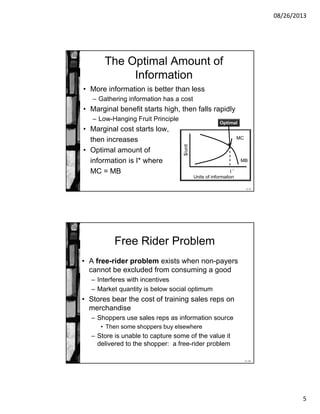
• Marginal benefit starts high, then falls rapidly
– Low-Hanging Fruit Principle
• Marginal cost starts low,
then increases
• Optimal amount of
information is I* where
MC = MB
MC
I *
Optimal
11-10
Free Rider Problem
• A free-rider problem exists when non-payers
cannot be excluded from consuming a good
– Interferes with incentives
– Market quantity is below social optimum
• Stores bear the cost of training sales reps on
merchandise
– Shoppers use sales reps as information source
• Then some shoppers buy elsewhere
– Store is unable to capture some of the value it
delivered to the shopper: a free-rider problem
08/26/2013
6
11-11
Example: The Last Bookstore
• Independent bookstores differentiate themselves
with personalized service
– Offer more information and recommendations than
Barnes & Nobles or Borders
• Chain bookstores carry large inventory and shopping
center location can erode local store base
– Ecommerce sites such as Amazon.com and
Overstock.com offer reviews and recommendations
• Large inventory; quick delivery
• Online sales further reduce sales in independent
stores
11-12
Rational Search Guidelines
• Additional search time is more likely to be
worthwhile for expensive items than cheap ones
– Apartment search in Paris, Texas involves less time
than Paris, France
• Texas has lower rents and narrower price range
• Prices paid will be higher when the cost of a
search is higher
– Two buyers, only one with a car
• Buyer with the car will look at more pianos before
buying
08/26/2013
7
11-13
Gamble Inherent in Search
• Additional search has costs that are certain
– Benefits are uncertain benefits
– Additional search has elements of a gamble
• A gamble has a number of possible outcomes
– Each outcome has a probability that it will occur
11-14
Gamble Inherent in Search
• The expected value of a gamble is the sum of
(the possible outcomes times their respective
probability)
– A fair gamble has an expected value of zero
– A better-than-fair gamble has a positive expected
value
08/26/2013
8
11-15
Risk Preferences
• A risk-neutral person would accept any gamble
that is fair or better-than-fair
– A risk-averse person would refuse any fair gamble
11-16
The Gamble in the Search
• You need a one-month sublet in San Francisco
– One type of apartment rents for $400 and it is 80%
of the available market
– The other type rents for $360 and makes up 20% of
the market
– You must visit the apartment to get the rental rate
• Cost per visit is $6
– You are risk-neutral
08/26/2013
9
11-17
San Francisco Apartment
Search
• The first apartment you visit is the $400 version
• Look at the next apartment if the gamble is at
least fair
– Two outcomes to the gamble
• You find a lower-priced apartment and your net
benefit is $34 with 20% probability
• You find another $400 apartment and your net
benefit is – $6 with 80% probability
– Expected value of the gamble is
(34) (0.20) + (– 6) (0.80) = $2
– Keep searching
11-18
Commitment Problems and
Search
• Some searches are for circumstances requiring
commitment over some period of time
– Leasing an apartment
– Taking a job
– Getting married
• Search is costly and therefore limited
– People end their searches when the marginal cost
of searching exceeds the marginal benefit
• BUT… what if you fall into a better option?
08/26/2013
10
11-19
Commitment Problems and
Search
• If information were freely available, there would
be no commitment problem
– Contracts are used to bind parties together AND
– Contracts carry penalties for breaking the
arrangement
• People terminate their search because
information gathering is costly
• Under some circumstances, one party may
rationally choose to terminate the agreement
and pay the penalties
11-20
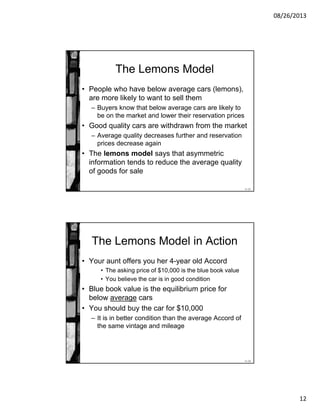
Asymmetric Information
• Asymmetric information occurs when either the
buyer or seller Is better informed about the
goods in the market
– Mutually beneficial trades
may not occur
– A seller might know that
a murder was committed in a
house offered for sale
• Buyer does not know
Buyer Seller
08/26/2013
11
11-21
Private Sale of a Used Car
• Jane's Miata is in excellent condition
– Jane's reservation price is $10,000
• Blue Book value is $8,000
• Tom wants to buy a Miata
– His reservation price is $13,000 for one in excellent
condition and $9,000 for one in average condition
– Determining the condition of Jane's car has a cost
and the results are uncertain
– Tom cannot verify that Jane's Miata is superior
• Tom buys another Miata for $8,000; Jane's is
unsold
11-22
Surplus Loss and Asymmetric
Information
• Tom's loss is $1,000
– Pays $8,000 and has a gain of $1,000
– Tom’s loss from buying an average car instead of
Jane's
• $13,000 – $11,000 = $2,000
– Tom's net loss is $1,000
• Jane’s loss from losing Tom as a customer is
$1,000
• Total loss is $2,000
08/26/2013
12
11-23
The Lemons Model
• People who have below average cars (lemons),
are more likely to want to sell them
– Buyers know that below average cars are likely to
be on the market and lower their reservation prices
• Good quality cars are withdrawn from the market
– Average quality decreases further and reservation
prices decrease again
• The lemons model says that asymmetric
information tends to reduce the average quality
of goods for sale
11-24
The Lemons Model in Action
• Your aunt offers you her 4-year old Accord
• The asking price of $10,000 is the blue book value
• You believe the car is in good condition
• Blue book value is the equilibrium price for
below average cars
• You should buy the car for $10,000
– It is in better condition than the average Accord of
the same vintage and mileage
08/26/2013
13
11-25
Naïve Buyer
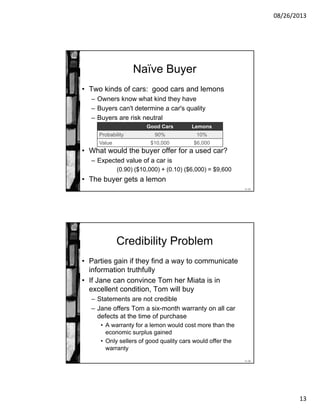
• Two kinds of cars: good cars and lemons
– Owners know what kind they have
– Buyers can't determine a car's quality
– Buyers are risk neutral
• What would the buyer offer for a used car?
– Expected value of a car is
(0.90) ($10,000) + (0.10) ($6,000) = $9,600
• The buyer gets a lemon
Good Cars Lemons
Probability 90% 10%
Value $10,000 $6,000
11-26
Credibility Problem
• Parties gain if they find a way to communicate
information truthfully
• If Jane can convince Tom her Miata is in
excellent condition, Tom will buy
– Statements are not credible
– Jane offers Tom a six-month warranty on all car
defects at the time of purchase
• A warranty for a lemon would cost more than the
economic surplus gained
• Only sellers of good quality cars would offer the
warranty
08/26/2013
14
11-27
The Costly-to-Fake Principle
• To communicate information credibly, a signal
must be costly or difficult to fake
– Sellers have an incentive to exaggerate the quality
of their product
– Buyers value objective information about quality
11-28
Costly Signals
• Television advertising is expensive
– In print advertising, "As seen on TV" signals a
company's commitment to its product
• Potential signal of quality
• Educational institutions' brands and students'
grades signal quality
– An A+ student from MIT is more likely to be offered
a job than a C student from an average academic
institution
08/26/2013
15
11-29
Conspicuous Consumption
• Choose a lawyer
– Lawyer A wears inexpensive suits and drives a
10-year old Dodge Neon
– Lawyer B wears custom-tailored suits and drives a
new BMW 745i
– No other information is available
• Conspicuous consumption signals success
– Choose Lawyer B ….
… and pass on Ben Matlock!
11-30
Statistical Discrimination
• Statistical discrimination uses group
characteristics to infer individual characteristics
– Can be applied to people as well as to goods and
services
– Results from observed differences between groups
• Example
– This candidate for employment is in her late
twenties
– Women have babies in their late twenties
– This candidate will have a baby in the next few
years
• High cost compared to other candidates
08/26/2013
16
11-31
Dangerous Drivers
• Men under 25 years of age pay more than other
drivers for auto insurance
– Expected cost of insuring a driver depends the
probability and size of claims
• Individual assessments are not possible
– Rates are based on demographic groups and the
claim history of those groups
• Individual rates are adjusted upward as more
information becomes available
11-32
Adverse Selection
• Adverse selection occurs because insurance
tends to be purchased more by those who are
most costly for companies to insure
– Insurance is most valuable to those with many
claims
• Adverse selection increases insurance
premiums
– Reduces attractiveness of insurance to low-risk
customers
• "Best" insurance risk customers opt out
– Rates increase
– Repeat
08/26/2013
17
11-33
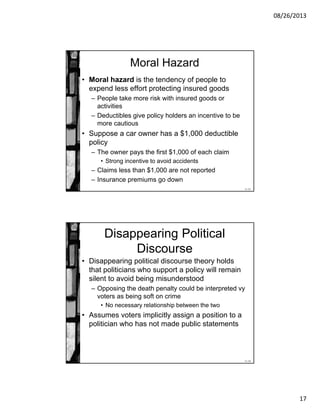
Moral Hazard
• Moral hazard is the tendency of people to
expend less effort protecting insured goods
– People take more risk with insured goods or
activities
– Deductibles give policy holders an incentive to be
more cautious
• Suppose a car owner has a $1,000 deductible
policy
– The owner pays the first $1,000 of each claim
• Strong incentive to avoid accidents
– Claims less than $1,000 are not reported
– Insurance premiums go down
11-34
Disappearing Political
Discourse
• Disappearing political discourse theory holds
that politicians who support a policy will remain
silent to avoid being misunderstood
– Opposing the death penalty could be interpreted vy
voters as being soft on crime
• No necessary relationship between the two
• Assumes voters implicitly assign a position to a
politician who has not made public statements
08/26/2013
18
11-35
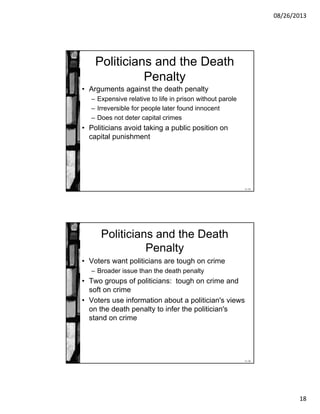
Politicians and the Death
Penalty
• Arguments against the death penalty
– Expensive relative to life in prison without parole
– Irreversible for people later found innocent
– Does not deter capital crimes
• Politicians avoid taking a public position on
capital punishment
11-36
Politicians and the Death
Penalty
• Voters want politicians are tough on crime
– Broader issue than the death penalty
• Two groups of politicians: tough on crime and
soft on crime
• Voters use information about a politician's views
on the death penalty to infer the politician's
stand on crime
08/26/2013
19
11-37
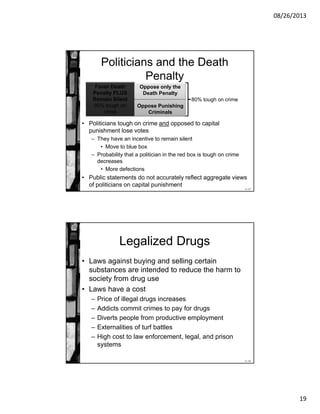
Politicians and the Death
Penalty
• Politicians tough on crime and opposed to capital
punishment lose votes
– They have an incentive to remain silent
• Move to blue box
– Probability that a politician in the red box is tough on crime
decreases
• More defections
• Public statements do not accurately reflect aggregate views
of politicians on capital punishment
Favor Death
Penalty PLUS
Remain Silent
95% tough on
crime
Oppose only the
Death Penalty
Oppose Punishing
Criminals
80% tough on crime
11-38
Legalized Drugs
• Laws against buying and selling certain
substances are intended to reduce the harm to
society from drug use
• Laws have a cost
– Price of illegal drugs increases
– Addicts commit crimes to pay for drugs
– Diverts people from productive employment
– Externalities of turf battles
– High cost to law enforcement, legal, and prison
systems
08/26/2013
20
11-39
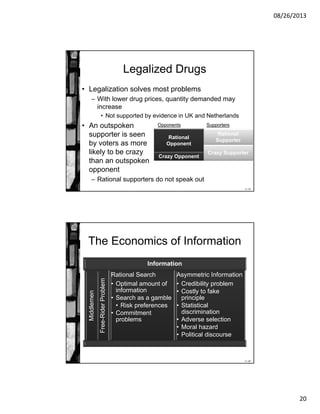
Legalized Drugs
• Legalization solves most problems
– With lower drug prices, quantity demanded may
increase
• Not supported by evidence in UK and Netherlands
• An outspoken
supporter is seen
by voters as more
likely to be crazy
than an outspoken
opponent
– Rational supporters do not speak out
Rational
Opponent
Rational
Supporter
Crazy Opponent
Crazy Supporter
Opponents Supporters
11-40
The Economics of Information
Information
Middlemen
Free-RiderProblem
Rational Search
• Optimal amount of
information
• Search as a gamble
• Risk preferences
• Commitment
problems
Asymmetric Information
• Credibility problem
• Costly to fake
principle
• Statistical
discrimination
• Adverse selection
• Moral hazard
• Political discourse

Chap011 lecture

  • 1.
    08/26/2013 1 Chapter 11 The Economicsof Information Copyright © 2013 by The McGraw-Hill Companies, Inc. All rights reserved.McGraw-Hill/Irwin 11-2 Learning Objectives 1. Explain how middlemen add value to market transactions 2. Use the concept of rational search to find the optimal amount of information market participants should obtain 3. Define asymmetric information and describe how it leads to the lemons problem 4. Discuss how advertising, conspicuous consumption, statistical discrimination, and other devices are responses to asymmetric information
  • 2.
    08/26/2013 2 11-3 Information and theInvisible Hand • All parties have all relevant information – Without free information, market results are not efficient • Bargaining for a bowl in Kashmir • Parties must decide how much information to gather – Information gathering strategies differ 11-4 How The Middleman Adds Value • Buyers sometimes choose among several version of a product – Each has complex feature sets • Research options – Company web site – Ask friends and family – Consumer Reports, online product reviews – Visit stores, ecommerce sites
  • 3.
    08/26/2013 3 11-5 Consumer Choice: BuyingSkis • Skis R Us recommend $600 Salomon X-Scream 9 skis – Sales rep seems knowledgeable • Your next move is – Thank them and do more research – Trust the sales rep and buy them – Go home and buy at the best price online ($400) • Evaluate the importance of – Immediate possession – Best price – Post-sales service and support 11-6 The Value of the Middleman • Sales representatives supply information to buyers – Manufacturers can offer direct sales to bypass middlemen • Information makes markets more efficient – Purchasing the bowl in Kashmir
  • 4.
    08/26/2013 4 11-7 Selling Babe Ruth •Ellis wants to sell a Babe Ruth baseball card. – His reservation price is $300 – An ad in the local newspaper cost $5 – eBay cost is 5% of the Internet auction price – The maximum price in the local market is $400 – Two eBay shoppers have secret reservation prices of $800 and $900, respectively 11-8 Selling Babe Ruth • Benefits of eBay – Card sells for $800 on eBay less $40 commission • Ellis nets $760, $460 above his reservation price • Buyer surplus is $100 • Local option is inferior – Card sells for $400 less $5 cost of ad – Ellis nets $395, $95 more than his reservation price – Buyer surplus is $0 • Economic surplus is increased when a product goes to the person who values it the most
  • 5.
    08/26/2013 5 11-9 $/unit Units of information MB TheOptimal Amount of Information • More information is better than less – Gathering information has a cost • Marginal benefit starts high, then falls rapidly – Low-Hanging Fruit Principle • Marginal cost starts low, then increases • Optimal amount of information is I* where MC = MB MC I * Optimal 11-10 Free Rider Problem • A free-rider problem exists when non-payers cannot be excluded from consuming a good – Interferes with incentives – Market quantity is below social optimum • Stores bear the cost of training sales reps on merchandise – Shoppers use sales reps as information source • Then some shoppers buy elsewhere – Store is unable to capture some of the value it delivered to the shopper: a free-rider problem
  • 6.
    08/26/2013 6 11-11 Example: The LastBookstore • Independent bookstores differentiate themselves with personalized service – Offer more information and recommendations than Barnes & Nobles or Borders • Chain bookstores carry large inventory and shopping center location can erode local store base – Ecommerce sites such as Amazon.com and Overstock.com offer reviews and recommendations • Large inventory; quick delivery • Online sales further reduce sales in independent stores 11-12 Rational Search Guidelines • Additional search time is more likely to be worthwhile for expensive items than cheap ones – Apartment search in Paris, Texas involves less time than Paris, France • Texas has lower rents and narrower price range • Prices paid will be higher when the cost of a search is higher – Two buyers, only one with a car • Buyer with the car will look at more pianos before buying
  • 7.
    08/26/2013 7 11-13 Gamble Inherent inSearch • Additional search has costs that are certain – Benefits are uncertain benefits – Additional search has elements of a gamble • A gamble has a number of possible outcomes – Each outcome has a probability that it will occur 11-14 Gamble Inherent in Search • The expected value of a gamble is the sum of (the possible outcomes times their respective probability) – A fair gamble has an expected value of zero – A better-than-fair gamble has a positive expected value
  • 8.
    08/26/2013 8 11-15 Risk Preferences • Arisk-neutral person would accept any gamble that is fair or better-than-fair – A risk-averse person would refuse any fair gamble 11-16 The Gamble in the Search • You need a one-month sublet in San Francisco – One type of apartment rents for $400 and it is 80% of the available market – The other type rents for $360 and makes up 20% of the market – You must visit the apartment to get the rental rate • Cost per visit is $6 – You are risk-neutral
  • 9.
    08/26/2013 9 11-17 San Francisco Apartment Search •The first apartment you visit is the $400 version • Look at the next apartment if the gamble is at least fair – Two outcomes to the gamble • You find a lower-priced apartment and your net benefit is $34 with 20% probability • You find another $400 apartment and your net benefit is – $6 with 80% probability – Expected value of the gamble is (34) (0.20) + (– 6) (0.80) = $2 – Keep searching 11-18 Commitment Problems and Search • Some searches are for circumstances requiring commitment over some period of time – Leasing an apartment – Taking a job – Getting married • Search is costly and therefore limited – People end their searches when the marginal cost of searching exceeds the marginal benefit • BUT… what if you fall into a better option?
  • 10.
    08/26/2013 10 11-19 Commitment Problems and Search •If information were freely available, there would be no commitment problem – Contracts are used to bind parties together AND – Contracts carry penalties for breaking the arrangement • People terminate their search because information gathering is costly • Under some circumstances, one party may rationally choose to terminate the agreement and pay the penalties 11-20 Asymmetric Information • Asymmetric information occurs when either the buyer or seller Is better informed about the goods in the market – Mutually beneficial trades may not occur – A seller might know that a murder was committed in a house offered for sale • Buyer does not know Buyer Seller
  • 11.
    08/26/2013 11 11-21 Private Sale ofa Used Car • Jane's Miata is in excellent condition – Jane's reservation price is $10,000 • Blue Book value is $8,000 • Tom wants to buy a Miata – His reservation price is $13,000 for one in excellent condition and $9,000 for one in average condition – Determining the condition of Jane's car has a cost and the results are uncertain – Tom cannot verify that Jane's Miata is superior • Tom buys another Miata for $8,000; Jane's is unsold 11-22 Surplus Loss and Asymmetric Information • Tom's loss is $1,000 – Pays $8,000 and has a gain of $1,000 – Tom’s loss from buying an average car instead of Jane's • $13,000 – $11,000 = $2,000 – Tom's net loss is $1,000 • Jane’s loss from losing Tom as a customer is $1,000 • Total loss is $2,000
  • 12.
    08/26/2013 12 11-23 The Lemons Model •People who have below average cars (lemons), are more likely to want to sell them – Buyers know that below average cars are likely to be on the market and lower their reservation prices • Good quality cars are withdrawn from the market – Average quality decreases further and reservation prices decrease again • The lemons model says that asymmetric information tends to reduce the average quality of goods for sale 11-24 The Lemons Model in Action • Your aunt offers you her 4-year old Accord • The asking price of $10,000 is the blue book value • You believe the car is in good condition • Blue book value is the equilibrium price for below average cars • You should buy the car for $10,000 – It is in better condition than the average Accord of the same vintage and mileage
  • 13.
    08/26/2013 13 11-25 Naïve Buyer • Twokinds of cars: good cars and lemons – Owners know what kind they have – Buyers can't determine a car's quality – Buyers are risk neutral • What would the buyer offer for a used car? – Expected value of a car is (0.90) ($10,000) + (0.10) ($6,000) = $9,600 • The buyer gets a lemon Good Cars Lemons Probability 90% 10% Value $10,000 $6,000 11-26 Credibility Problem • Parties gain if they find a way to communicate information truthfully • If Jane can convince Tom her Miata is in excellent condition, Tom will buy – Statements are not credible – Jane offers Tom a six-month warranty on all car defects at the time of purchase • A warranty for a lemon would cost more than the economic surplus gained • Only sellers of good quality cars would offer the warranty
  • 14.
    08/26/2013 14 11-27 The Costly-to-Fake Principle •To communicate information credibly, a signal must be costly or difficult to fake – Sellers have an incentive to exaggerate the quality of their product – Buyers value objective information about quality 11-28 Costly Signals • Television advertising is expensive – In print advertising, "As seen on TV" signals a company's commitment to its product • Potential signal of quality • Educational institutions' brands and students' grades signal quality – An A+ student from MIT is more likely to be offered a job than a C student from an average academic institution
  • 15.
    08/26/2013 15 11-29 Conspicuous Consumption • Choosea lawyer – Lawyer A wears inexpensive suits and drives a 10-year old Dodge Neon – Lawyer B wears custom-tailored suits and drives a new BMW 745i – No other information is available • Conspicuous consumption signals success – Choose Lawyer B …. … and pass on Ben Matlock! 11-30 Statistical Discrimination • Statistical discrimination uses group characteristics to infer individual characteristics – Can be applied to people as well as to goods and services – Results from observed differences between groups • Example – This candidate for employment is in her late twenties – Women have babies in their late twenties – This candidate will have a baby in the next few years • High cost compared to other candidates
  • 16.
    08/26/2013 16 11-31 Dangerous Drivers • Menunder 25 years of age pay more than other drivers for auto insurance – Expected cost of insuring a driver depends the probability and size of claims • Individual assessments are not possible – Rates are based on demographic groups and the claim history of those groups • Individual rates are adjusted upward as more information becomes available 11-32 Adverse Selection • Adverse selection occurs because insurance tends to be purchased more by those who are most costly for companies to insure – Insurance is most valuable to those with many claims • Adverse selection increases insurance premiums – Reduces attractiveness of insurance to low-risk customers • "Best" insurance risk customers opt out – Rates increase – Repeat
  • 17.
    08/26/2013 17 11-33 Moral Hazard • Moralhazard is the tendency of people to expend less effort protecting insured goods – People take more risk with insured goods or activities – Deductibles give policy holders an incentive to be more cautious • Suppose a car owner has a $1,000 deductible policy – The owner pays the first $1,000 of each claim • Strong incentive to avoid accidents – Claims less than $1,000 are not reported – Insurance premiums go down 11-34 Disappearing Political Discourse • Disappearing political discourse theory holds that politicians who support a policy will remain silent to avoid being misunderstood – Opposing the death penalty could be interpreted vy voters as being soft on crime • No necessary relationship between the two • Assumes voters implicitly assign a position to a politician who has not made public statements
  • 18.
    08/26/2013 18 11-35 Politicians and theDeath Penalty • Arguments against the death penalty – Expensive relative to life in prison without parole – Irreversible for people later found innocent – Does not deter capital crimes • Politicians avoid taking a public position on capital punishment 11-36 Politicians and the Death Penalty • Voters want politicians are tough on crime – Broader issue than the death penalty • Two groups of politicians: tough on crime and soft on crime • Voters use information about a politician's views on the death penalty to infer the politician's stand on crime
  • 19.
    08/26/2013 19 11-37 Politicians and theDeath Penalty • Politicians tough on crime and opposed to capital punishment lose votes – They have an incentive to remain silent • Move to blue box – Probability that a politician in the red box is tough on crime decreases • More defections • Public statements do not accurately reflect aggregate views of politicians on capital punishment Favor Death Penalty PLUS Remain Silent 95% tough on crime Oppose only the Death Penalty Oppose Punishing Criminals 80% tough on crime 11-38 Legalized Drugs • Laws against buying and selling certain substances are intended to reduce the harm to society from drug use • Laws have a cost – Price of illegal drugs increases – Addicts commit crimes to pay for drugs – Diverts people from productive employment – Externalities of turf battles – High cost to law enforcement, legal, and prison systems
  • 20.
    08/26/2013 20 11-39 Legalized Drugs • Legalizationsolves most problems – With lower drug prices, quantity demanded may increase • Not supported by evidence in UK and Netherlands • An outspoken supporter is seen by voters as more likely to be crazy than an outspoken opponent – Rational supporters do not speak out Rational Opponent Rational Supporter Crazy Opponent Crazy Supporter Opponents Supporters 11-40 The Economics of Information Information Middlemen Free-RiderProblem Rational Search • Optimal amount of information • Search as a gamble • Risk preferences • Commitment problems Asymmetric Information • Credibility problem • Costly to fake principle • Statistical discrimination • Adverse selection • Moral hazard • Political discourse