Chapter Thirty-Six
Asymmetric Information
Information in Competitive Markets
In purely competitive markets all
agents are fully informed about
traded commodities and other
aspects of the market.
What about markets for medical
services, or insurance, or used cars?
Asymmetric Information in Markets
A doctor knows more about medical
services than does the buyer.
An insurance buyer knows more
about his riskiness than does the
seller.
A used car’s owner knows more about
it than does a potential buyer.
Asymmetric Information in Markets
Markets with one side or the other
imperfectly informed are markets
with imperfect information.
Imperfectly informed markets with
one side better informed than the
other are markets with asymmetric
information.
Asymmetric Information in Markets
In what ways can asymmetric
information affect the functioning of
a market?
Four applications will be considered:
adverse selection
signaling
moral hazard
incentives contracting.
Adverse Selection
Consider a used car market.
Two types of cars; “lemons” and
“peaches”.
Each lemon seller will accept $1,000;
a buyer will pay at most $1,200.
Each peach seller will accept $2,000;
a buyer will pay at most $2,400.
Adverse Selection
If every buyer can tell a peach from a
lemon, then lemons sell for between
$1,000 and $1,200, and peaches sell
for between $2,000 and $2,400.
Gains-to-trade are generated when
buyers are well informed.
Adverse Selection
Suppose no buyer can tell a peach
from a lemon before buying.
What is the most a buyer will pay for
any car?
Adverse Selection
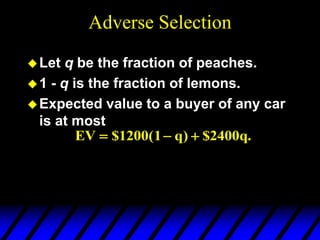
Let q be the fraction of peaches.
1 - q is the fraction of lemons.
Expected value to a buyer of any car
is at most
EV q q
  
$1200( ) $2400 .
1
Adverse Selection
Suppose EV > $2000.
Every seller can negotiate a price
between $2000 and $EV (no matter if
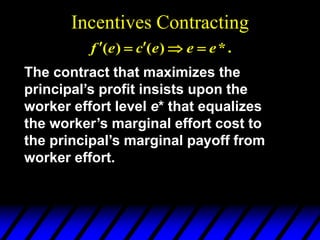
the car is a lemon or a peach).
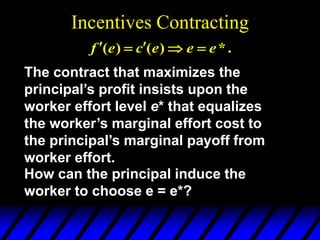
All sellers gain from being in the
market.
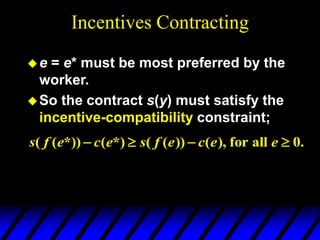
Adverse Selection
Suppose EV < $2000.
A peach seller cannot negotiate a
price above $2000 and will exit the
market.
So all buyers know that remaining
sellers own lemons only.
Buyers will pay at most $1200 and
only lemons are sold.
Adverse Selection
Hence “too many” lemons “crowd
out” the peaches from the market.
Gains-to-trade are reduced since no
peaches are traded.
The presence of the lemons inflicts
an external cost on buyers and
peach owners.
Adverse Selection
How many lemons can be in the
market without crowding out the
peaches?
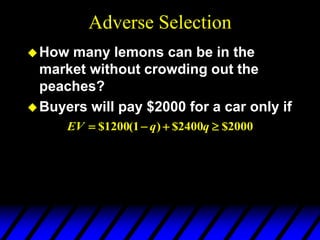
Buyers will pay $2000 for a car only if
2000
$
2400
$
)
1
(
1200
$ 


 q
q
EV
Adverse Selection
How many lemons can be in the
market without crowding out the
peaches?
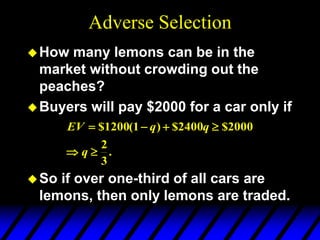
Buyers will pay $2000 for a car only if
So if over one-third of all cars are
lemons, then only lemons are traded.
.
3
2
2000
$
2400
$
)
1
(
1200
$






q
q
q
EV
Adverse Selection
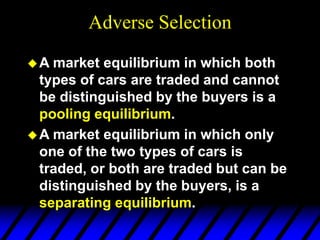
A market equilibrium in which both
types of cars are traded and cannot
be distinguished by the buyers is a
pooling equilibrium.
A market equilibrium in which only
one of the two types of cars is
traded, or both are traded but can be
distinguished by the buyers, is a
separating equilibrium.
Adverse Selection
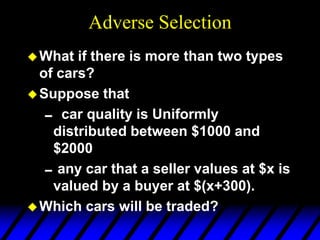
What if there is more than two types
of cars?
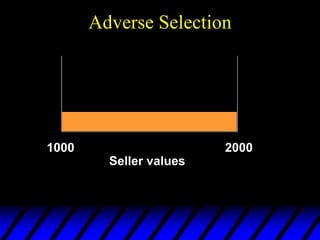
Suppose that
 car quality is Uniformly
distributed between $1000 and
$2000
any car that a seller values at $x is
valued by a buyer at $(x+300).
Which cars will be traded?
Adverse Selection
Seller values
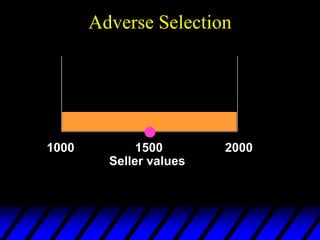
1000 2000
Adverse Selection
1000 2000
1500
Seller values
Adverse Selection
1000 2000
1500
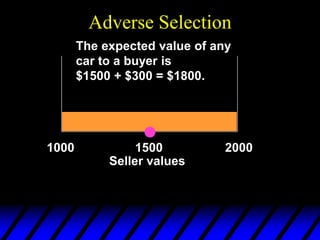
The expected value of any
car to a buyer is
$1500 + $300 = $1800.
Seller values
Adverse Selection
1000 2000
1500
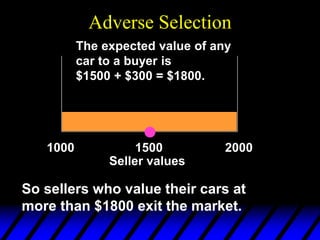
The expected value of any
car to a buyer is
$1500 + $300 = $1800.
So sellers who value their cars at
more than $1800 exit the market.
Seller values
Adverse Selection
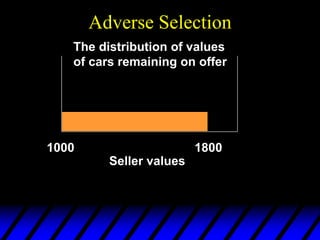
1000 1800
The distribution of values
of cars remaining on offer
Seller values
Adverse Selection
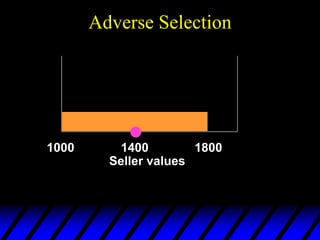
1000 1800
1400
Seller values
Adverse Selection
1000 1800
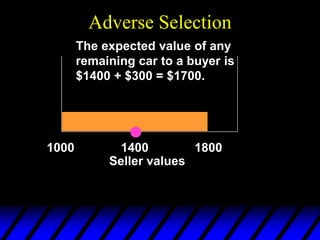
1400
The expected value of any
remaining car to a buyer is
$1400 + $300 = $1700.
Seller values
Adverse Selection
1000 1800
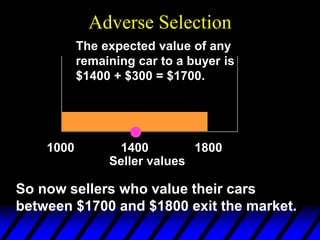
1400
The expected value of any
remaining car to a buyer is
$1400 + $300 = $1700.
So now sellers who value their cars
between $1700 and $1800 exit the market.
Seller values
Adverse Selection
Where does this unraveling of the
market end?
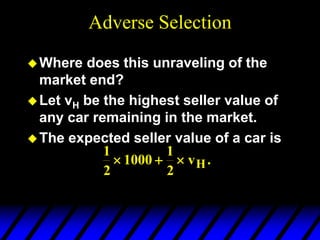
Let vH be the highest seller value of
any car remaining in the market.
The expected seller value of a car is
1
2
1000
1
2
   vH.
Adverse Selection
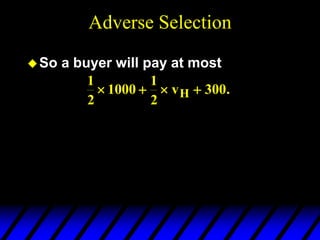
So a buyer will pay at most
1
2
1000
1
2
300
   
vH .
Adverse Selection
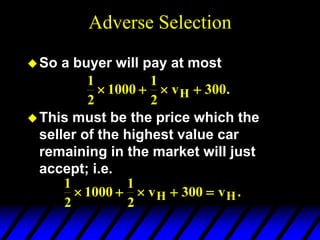
So a buyer will pay at most
This must be the price which the
seller of the highest value car
remaining in the market will just
accept; i.e.
1
2
1000
1
2
300
   
vH .
1
2
1000
1
2
300
    
v v
H H.
Adverse Selection
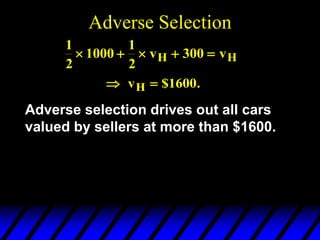
1
2
1000
1
2
300
    
v v
H H
 
vH $1600.
Adverse selection drives out all cars
valued by sellers at more than $1600.
Adverse Selection with Quality Choice
Now each seller can choose the
quality, or value, of her product.
Two umbrellas; high-quality and low-
quality.
Which will be manufactured and sold?
Adverse Selection with Quality Choice
Buyers value a high-quality umbrella at
$14 and a low-quality umbrella at $8.
Before buying, no buyer can tell
quality.
Marginal production cost of a high-
quality umbrella is $11.
Marginal production cost of a low-
quality umbrella is $10.
Adverse Selection with Quality Choice
Suppose every seller makes only high-
quality umbrellas.
Every buyer pays $14 and sellers’
profit per umbrella is $14 - $11 = $3.
But then a seller can make low-quality
umbrellas for which buyers still pay
$14, so increasing profit to
$14 - $10 = $4.
Adverse Selection with Quality Choice
There is no market equilibrium in
which only high-quality umbrellas
are traded.
Is there a market equilibrium in
which only low-quality umbrellas are
traded?
Adverse Selection with Quality Choice
All sellers make only low-quality
umbrellas.
Buyers pay at most $8 for an
umbrella, while marginal production
cost is $10.
There is no market equilibrium in
which only low-quality umbrellas are
traded.
Adverse Selection with Quality Choice
Now we know there is no market
equilibrium in which only one type of
umbrella is manufactured.
Is there an equilibrium in which both
types of umbrella are manufactured?
Adverse Selection with Quality Choice
A fraction q of sellers make high-
quality umbrellas; 0 < q < 1.
Buyers’ expected value of an
umbrella is
EV = 14q + 8(1 - q) = 8 + 6q.
High-quality manufacturers must
recover the manufacturing cost,
EV = 8 + 6q  11  q  1/2.
Adverse Selection with Quality Choice
So at least half of the sellers must
make high-quality umbrellas for there
to be a pooling market equilibrium.
But then a high-quality seller can
switch to making low-quality and
increase profit by $1 on each
umbrella sold.
Adverse Selection with Quality Choice
Since all sellers reason this way, the
fraction of high-quality sellers will
shrink towards zero -- but then
buyers will pay only $8.
So there is no equilibrium in which
both umbrella types are traded.
Adverse Selection with Quality Choice
The market has no equilibrium
with just one umbrella type traded
with both umbrella types traded
Adverse Selection with Quality Choice
The market has no equilibrium
with just one umbrella type traded
with both umbrella types traded
so the market has no equilibrium at
all.
Adverse Selection with Quality Choice
The market has no equilibrium
with just one umbrella type traded
with both umbrella types traded
so the market has no equilibrium at
all.
Adverse selection has destroyed the
entire market!
Signaling
Adverse selection is an outcome of an
informational deficiency.
What if information can be improved
by high-quality sellers signaling
credibly that they are high-quality?
E.g. warranties, professional
credentials, references from previous
clients etc.
Signaling
A labor market has two types of
workers; high-ability and low-ability.
A high-ability worker’s marginal
product is aH.
A low-ability worker’s marginal
product is aL.
aL < aH.
Signaling
A fraction h of all workers are high-
ability.
1 - h is the fraction of low-ability
workers.
Signaling
Each worker is paid his expected
marginal product.
If firms knew each worker’s type they
would
pay each high-ability worker wH =
aH
pay each low-ability worker wL = aL.
Signaling
If firms cannot tell workers’ types
then every worker is paid the
(pooling) wage rate; i.e. the expected
marginal product
wP = (1 - h)aL + haH.
Signaling
wP = (1 - h)aL + haH < aH, the wage
rate paid when the firm knows a
worker really is high-ability.
So high-ability workers have an
incentive to find a credible signal.
Signaling
Workers can acquire “education”.
Education costs a high-ability worker
cH per unit
and costs a low-ability worker cL per
unit.
cL > cH.
Signaling
Suppose that education has no effect
on workers’ productivities; i.e., the
cost of education is a deadweight
loss.
Signaling
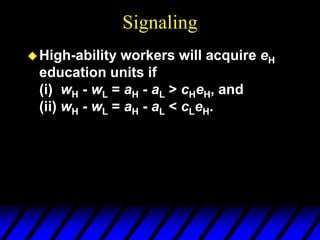
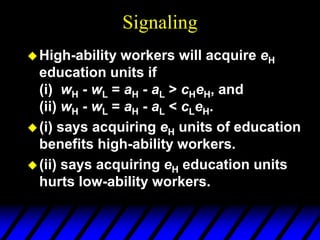
High-ability workers will acquire eH
education units if
(i) wH - wL = aH - aL > cHeH, and
(ii) wH - wL = aH - aL < cLeH.
Signaling
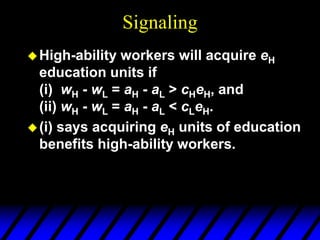
High-ability workers will acquire eH
education units if
(i) wH - wL = aH - aL > cHeH, and
(ii) wH - wL = aH - aL < cLeH.
(i) says acquiring eH units of education
benefits high-ability workers.
Signaling
High-ability workers will acquire eH
education units if
(i) wH - wL = aH - aL > cHeH, and
(ii) wH - wL = aH - aL < cLeH.
(i) says acquiring eH units of education
benefits high-ability workers.
(ii) says acquiring eH education units
hurts low-ability workers.
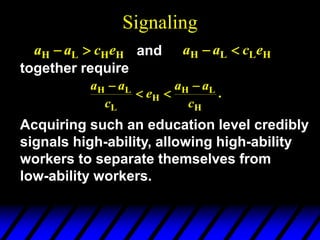
Signaling
H
H
L
H e
c
a
a 
 H
L
L
H e
c
a
a 

and
together require
.
H
L
H
H
L
L
H
c
a
a
e
c
a
a 



Acquiring such an education level credibly
signals high-ability, allowing high-ability
workers to separate themselves from
low-ability workers.
Signaling
Q: Given that high-ability workers
acquire eH units of education, how
much education should low-ability
workers acquire?
Signaling
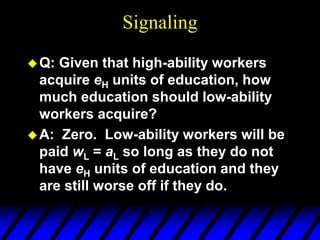
Q: Given that high-ability workers
acquire eH units of education, how
much education should low-ability
workers acquire?
A: Zero. Low-ability workers will be
paid wL = aL so long as they do not
have eH units of education and they
are still worse off if they do.
Signaling
Signaling can improve information in
the market.
But, total output did not change and
education was costly so signaling
worsened the market’s efficiency.
So improved information need not
improve gains-to-trade.
Moral Hazard
If you have full car insurance are you
more likely to leave your car unlocked?
Moral hazard is a reaction to incentives
to increase the risk of a loss
and is a consequence of asymmetric
information.
Moral Hazard
If an insurer knows the exact risk
from insuring an individual, then a
contract specific to that person can
be written.
If all people look alike to the insurer,
then one contract will be offered to
all insurees; high-risk and low-risk
types are then pooled, causing low-
risks to subsidize high-risks.
Moral Hazard
Examples of efforts to avoid moral
hazard by using signals are:
 higher life and medical insurance
premiums for smokers or heavy
drinkers of alcohol
 lower car insurance premiums for
contracts with higher deductibles
or for drivers with histories of safe
driving.
Incentives Contracting
A worker is hired by a principal to do
a task.
Only the worker knows the effort she
exerts (asymmetric information).
The effort exerted affects the
principal’s payoff.
Incentives Contracting
The principal’s problem: design an
incentives contract that induces the
worker to exert the amount of effort
that maximizes the principal’s payoff.
Incentives Contracting
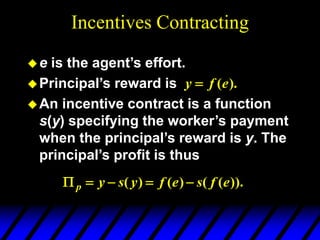
e is the agent’s effort.
Principal’s reward is
An incentive contract is a function
s(y) specifying the worker’s payment
when the principal’s reward is y. The
principal’s profit is thus
)).
(
(
)
(
)
( e
f
s
e
f
y
s
y
p 




).
(e
f
y 
Incentives Contracting
Let be the worker’s (reservation)
utility of not working.
To get the worker’s participation, the
contract must offer the worker a
utility of at least
The worker’s utility cost of an effort
level e is c(e).
u
~
.
~
u
Incentives Contracting
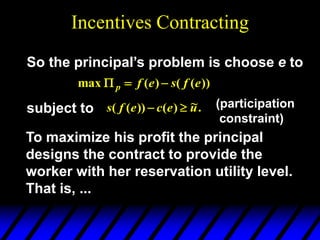
So the principal’s problem is choose e to
))
(
(
)
(
max e
f
s
e
f
p 


subject to .
~
)
(
))
(
( u
e
c
e
f
s 
 (participation
constraint)
To maximize his profit the principal
designs the contract to provide the
worker with her reservation utility level.
That is, ...
Incentives Contracting
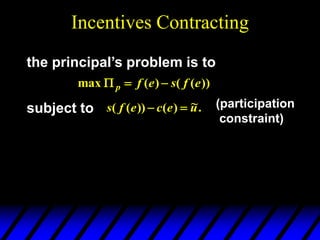
the principal’s problem is to
))
(
(
)
(
max e
f
s
e
f
p 


subject to .
~
)
(
))
(
( u
e
c
e
f
s 
 (participation
constraint)
Incentives Contracting
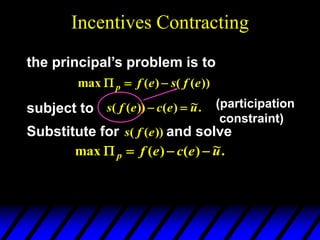
the principal’s problem is to
subject to (participation
constraint)
Substitute for and solve
))
(
(
)
(
max e
f
s
e
f
p 


.
~
)
(
))
(
( u
e
c
e
f
s 

.
~
)
(
)
(
max u
e
c
e
f
p 



))
(
( e
f
s
Incentives Contracting
the principal’s problem is to
subject to (participation
constraint)
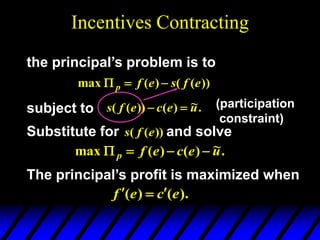
The principal’s profit is maximized when
).
(
)
( e
c
e
f 


))
(
(
)
(
max e
f
s
e
f
p 


.
~
)
(
))
(
( u
e
c
e
f
s 

.
~
)
(
)
(
max u
e
c
e
f
p 



Substitute for and solve
))
(
( e
f
s
Incentives Contracting
.
*
)
(
)
( e
e
e
c
e
f 




The contract that maximizes the
principal’s profit insists upon the
worker effort level e* that equalizes
the worker’s marginal effort cost to
the principal’s marginal payoff from
worker effort.
Incentives Contracting
How can the principal induce the
worker to choose e = e*?
.
*
)
(
)
( e
e
e
c
e
f 




The contract that maximizes the
principal’s profit insists upon the
worker effort level e* that equalizes
the worker’s marginal effort cost to
the principal’s marginal payoff from
worker effort.
Incentives Contracting
e = e* must be most preferred by the
worker.
Incentives Contracting
e = e* must be most preferred by the
worker.
So the contract s(y) must satisfy the
incentive-compatibility constraint;
.
0
all
for
),
(
))
(
(
*)
(
*))
(
( 


 e
e
c
e
f
s
e
c
e
f
s
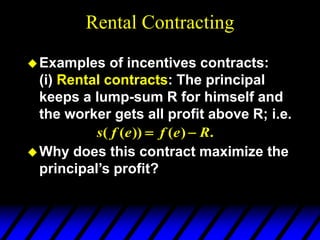
Rental Contracting
Examples of incentives contracts:
(i) Rental contracts: The principal
keeps a lump-sum R for himself and
the worker gets all profit above R; i.e.
Why does this contract maximize the
principal’s profit?
.
)
(
))
(
( R
e
f
e
f
s 

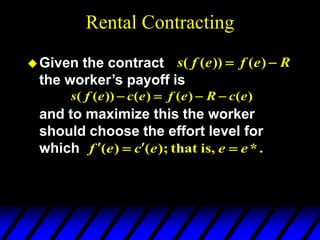
Rental Contracting
Given the contract
the worker’s payoff is
and to maximize this the worker
should choose the effort level for
which
)
(
)
(
)
(
))
(
( e
c
R
e
f
e
c
e
f
s 



.
*
,
is
that
);
(
)
( e
e
e
c
e
f 



R
e
f
e
f
s 
 )
(
))
(
(
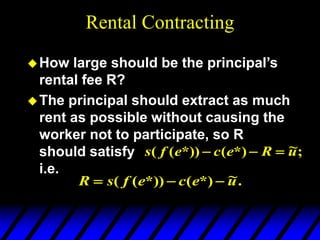
Rental Contracting
How large should be the principal’s
rental fee R?
The principal should extract as much
rent as possible without causing the
worker not to participate, so R
should satisfy
i.e.
;
~
*)
(
*))
(
( u
R
e
c
e
f
s 


.
~
*)
(
*))
(
( u
e
c
e
f
s
R 


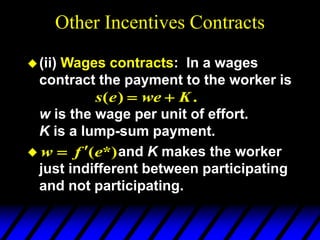
Other Incentives Contracts
(ii) Wages contracts: In a wages
contract the payment to the worker is
w is the wage per unit of effort.
K is a lump-sum payment.
 and K makes the worker
just indifferent between participating
and not participating.
.
)
( K
we
e
s 

*)
(e
f
w 

Other Incentives Contracts
(iii) Take-it-or-leave-it: Choose e = e*
and be paid a lump-sum L, or choose
e  e* and be paid zero.
The worker’s utility from choosing
e  e* is - c(e), so the worker will
choose e = e*.
L is chosen to make the worker
indifferent between participating and
not participating.
Incentives Contracts in General
The common feature of all efficient
incentive contracts is that they make
the worker the full residual claimant
on profits.
I.e. the last part of profit earned must
accrue entirely to the worker.

Asymmetric Information

  • 1.
  • 2.
    Information in CompetitiveMarkets In purely competitive markets all agents are fully informed about traded commodities and other aspects of the market. What about markets for medical services, or insurance, or used cars?
  • 3.
    Asymmetric Information inMarkets A doctor knows more about medical services than does the buyer. An insurance buyer knows more about his riskiness than does the seller. A used car’s owner knows more about it than does a potential buyer.
  • 4.
    Asymmetric Information inMarkets Markets with one side or the other imperfectly informed are markets with imperfect information. Imperfectly informed markets with one side better informed than the other are markets with asymmetric information.
  • 5.
    Asymmetric Information inMarkets In what ways can asymmetric information affect the functioning of a market? Four applications will be considered: adverse selection signaling moral hazard incentives contracting.
  • 6.
    Adverse Selection Consider aused car market. Two types of cars; “lemons” and “peaches”. Each lemon seller will accept $1,000; a buyer will pay at most $1,200. Each peach seller will accept $2,000; a buyer will pay at most $2,400.
  • 7.
    Adverse Selection If everybuyer can tell a peach from a lemon, then lemons sell for between $1,000 and $1,200, and peaches sell for between $2,000 and $2,400. Gains-to-trade are generated when buyers are well informed.
  • 8.
    Adverse Selection Suppose nobuyer can tell a peach from a lemon before buying. What is the most a buyer will pay for any car?
  • 9.
    Adverse Selection Let qbe the fraction of peaches. 1 - q is the fraction of lemons. Expected value to a buyer of any car is at most EV q q    $1200( ) $2400 . 1
  • 10.
    Adverse Selection Suppose EV> $2000. Every seller can negotiate a price between $2000 and $EV (no matter if the car is a lemon or a peach). All sellers gain from being in the market.
  • 11.
    Adverse Selection Suppose EV< $2000. A peach seller cannot negotiate a price above $2000 and will exit the market. So all buyers know that remaining sellers own lemons only. Buyers will pay at most $1200 and only lemons are sold.
  • 12.
    Adverse Selection Hence “toomany” lemons “crowd out” the peaches from the market. Gains-to-trade are reduced since no peaches are traded. The presence of the lemons inflicts an external cost on buyers and peach owners.
  • 13.
    Adverse Selection How manylemons can be in the market without crowding out the peaches? Buyers will pay $2000 for a car only if 2000 $ 2400 $ ) 1 ( 1200 $     q q EV
  • 14.
    Adverse Selection How manylemons can be in the market without crowding out the peaches? Buyers will pay $2000 for a car only if So if over one-third of all cars are lemons, then only lemons are traded. . 3 2 2000 $ 2400 $ ) 1 ( 1200 $       q q q EV
  • 15.
    Adverse Selection A marketequilibrium in which both types of cars are traded and cannot be distinguished by the buyers is a pooling equilibrium. A market equilibrium in which only one of the two types of cars is traded, or both are traded but can be distinguished by the buyers, is a separating equilibrium.
  • 16.
    Adverse Selection What ifthere is more than two types of cars? Suppose that  car quality is Uniformly distributed between $1000 and $2000 any car that a seller values at $x is valued by a buyer at $(x+300). Which cars will be traded?
  • 17.
  • 18.
  • 19.
    Adverse Selection 1000 2000 1500 Theexpected value of any car to a buyer is $1500 + $300 = $1800. Seller values
  • 20.
    Adverse Selection 1000 2000 1500 Theexpected value of any car to a buyer is $1500 + $300 = $1800. So sellers who value their cars at more than $1800 exit the market. Seller values
  • 21.
    Adverse Selection 1000 1800 Thedistribution of values of cars remaining on offer Seller values
  • 22.
  • 23.
    Adverse Selection 1000 1800 1400 Theexpected value of any remaining car to a buyer is $1400 + $300 = $1700. Seller values
  • 24.
    Adverse Selection 1000 1800 1400 Theexpected value of any remaining car to a buyer is $1400 + $300 = $1700. So now sellers who value their cars between $1700 and $1800 exit the market. Seller values
  • 25.
    Adverse Selection Where doesthis unraveling of the market end? Let vH be the highest seller value of any car remaining in the market. The expected seller value of a car is 1 2 1000 1 2    vH.
  • 26.
    Adverse Selection So abuyer will pay at most 1 2 1000 1 2 300     vH .
  • 27.
    Adverse Selection So abuyer will pay at most This must be the price which the seller of the highest value car remaining in the market will just accept; i.e. 1 2 1000 1 2 300     vH . 1 2 1000 1 2 300      v v H H.
  • 28.
    Adverse Selection 1 2 1000 1 2 300     v v H H   vH $1600. Adverse selection drives out all cars valued by sellers at more than $1600.
  • 29.
    Adverse Selection withQuality Choice Now each seller can choose the quality, or value, of her product. Two umbrellas; high-quality and low- quality. Which will be manufactured and sold?
  • 30.
    Adverse Selection withQuality Choice Buyers value a high-quality umbrella at $14 and a low-quality umbrella at $8. Before buying, no buyer can tell quality. Marginal production cost of a high- quality umbrella is $11. Marginal production cost of a low- quality umbrella is $10.
  • 31.
    Adverse Selection withQuality Choice Suppose every seller makes only high- quality umbrellas. Every buyer pays $14 and sellers’ profit per umbrella is $14 - $11 = $3. But then a seller can make low-quality umbrellas for which buyers still pay $14, so increasing profit to $14 - $10 = $4.
  • 32.
    Adverse Selection withQuality Choice There is no market equilibrium in which only high-quality umbrellas are traded. Is there a market equilibrium in which only low-quality umbrellas are traded?
  • 33.
    Adverse Selection withQuality Choice All sellers make only low-quality umbrellas. Buyers pay at most $8 for an umbrella, while marginal production cost is $10. There is no market equilibrium in which only low-quality umbrellas are traded.
  • 34.
    Adverse Selection withQuality Choice Now we know there is no market equilibrium in which only one type of umbrella is manufactured. Is there an equilibrium in which both types of umbrella are manufactured?
  • 35.
    Adverse Selection withQuality Choice A fraction q of sellers make high- quality umbrellas; 0 < q < 1. Buyers’ expected value of an umbrella is EV = 14q + 8(1 - q) = 8 + 6q. High-quality manufacturers must recover the manufacturing cost, EV = 8 + 6q  11  q  1/2.
  • 36.
    Adverse Selection withQuality Choice So at least half of the sellers must make high-quality umbrellas for there to be a pooling market equilibrium. But then a high-quality seller can switch to making low-quality and increase profit by $1 on each umbrella sold.
  • 37.
    Adverse Selection withQuality Choice Since all sellers reason this way, the fraction of high-quality sellers will shrink towards zero -- but then buyers will pay only $8. So there is no equilibrium in which both umbrella types are traded.
  • 38.
    Adverse Selection withQuality Choice The market has no equilibrium with just one umbrella type traded with both umbrella types traded
  • 39.
    Adverse Selection withQuality Choice The market has no equilibrium with just one umbrella type traded with both umbrella types traded so the market has no equilibrium at all.
  • 40.
    Adverse Selection withQuality Choice The market has no equilibrium with just one umbrella type traded with both umbrella types traded so the market has no equilibrium at all. Adverse selection has destroyed the entire market!
  • 41.
    Signaling Adverse selection isan outcome of an informational deficiency. What if information can be improved by high-quality sellers signaling credibly that they are high-quality? E.g. warranties, professional credentials, references from previous clients etc.
  • 42.
    Signaling A labor markethas two types of workers; high-ability and low-ability. A high-ability worker’s marginal product is aH. A low-ability worker’s marginal product is aL. aL < aH.
  • 43.
    Signaling A fraction hof all workers are high- ability. 1 - h is the fraction of low-ability workers.
  • 44.
    Signaling Each worker ispaid his expected marginal product. If firms knew each worker’s type they would pay each high-ability worker wH = aH pay each low-ability worker wL = aL.
  • 45.
    Signaling If firms cannottell workers’ types then every worker is paid the (pooling) wage rate; i.e. the expected marginal product wP = (1 - h)aL + haH.
  • 46.
    Signaling wP = (1- h)aL + haH < aH, the wage rate paid when the firm knows a worker really is high-ability. So high-ability workers have an incentive to find a credible signal.
  • 47.
    Signaling Workers can acquire“education”. Education costs a high-ability worker cH per unit and costs a low-ability worker cL per unit. cL > cH.
  • 48.
    Signaling Suppose that educationhas no effect on workers’ productivities; i.e., the cost of education is a deadweight loss.
  • 49.
    Signaling High-ability workers willacquire eH education units if (i) wH - wL = aH - aL > cHeH, and (ii) wH - wL = aH - aL < cLeH.
  • 50.
    Signaling High-ability workers willacquire eH education units if (i) wH - wL = aH - aL > cHeH, and (ii) wH - wL = aH - aL < cLeH. (i) says acquiring eH units of education benefits high-ability workers.
  • 51.
    Signaling High-ability workers willacquire eH education units if (i) wH - wL = aH - aL > cHeH, and (ii) wH - wL = aH - aL < cLeH. (i) says acquiring eH units of education benefits high-ability workers. (ii) says acquiring eH education units hurts low-ability workers.
  • 52.
    Signaling H H L H e c a a  H L L H e c a a   and together require . H L H H L L H c a a e c a a     Acquiring such an education level credibly signals high-ability, allowing high-ability workers to separate themselves from low-ability workers.
  • 53.
    Signaling Q: Given thathigh-ability workers acquire eH units of education, how much education should low-ability workers acquire?
  • 54.
    Signaling Q: Given thathigh-ability workers acquire eH units of education, how much education should low-ability workers acquire? A: Zero. Low-ability workers will be paid wL = aL so long as they do not have eH units of education and they are still worse off if they do.
  • 55.
    Signaling Signaling can improveinformation in the market. But, total output did not change and education was costly so signaling worsened the market’s efficiency. So improved information need not improve gains-to-trade.
  • 56.
    Moral Hazard If youhave full car insurance are you more likely to leave your car unlocked? Moral hazard is a reaction to incentives to increase the risk of a loss and is a consequence of asymmetric information.
  • 57.
    Moral Hazard If aninsurer knows the exact risk from insuring an individual, then a contract specific to that person can be written. If all people look alike to the insurer, then one contract will be offered to all insurees; high-risk and low-risk types are then pooled, causing low- risks to subsidize high-risks.
  • 58.
    Moral Hazard Examples ofefforts to avoid moral hazard by using signals are:  higher life and medical insurance premiums for smokers or heavy drinkers of alcohol  lower car insurance premiums for contracts with higher deductibles or for drivers with histories of safe driving.
  • 59.
    Incentives Contracting A workeris hired by a principal to do a task. Only the worker knows the effort she exerts (asymmetric information). The effort exerted affects the principal’s payoff.
  • 60.
    Incentives Contracting The principal’sproblem: design an incentives contract that induces the worker to exert the amount of effort that maximizes the principal’s payoff.
  • 61.
    Incentives Contracting e isthe agent’s effort. Principal’s reward is An incentive contract is a function s(y) specifying the worker’s payment when the principal’s reward is y. The principal’s profit is thus )). ( ( ) ( ) ( e f s e f y s y p      ). (e f y 
  • 62.
    Incentives Contracting Let bethe worker’s (reservation) utility of not working. To get the worker’s participation, the contract must offer the worker a utility of at least The worker’s utility cost of an effort level e is c(e). u ~ . ~ u
  • 63.
    Incentives Contracting So theprincipal’s problem is choose e to )) ( ( ) ( max e f s e f p    subject to . ~ ) ( )) ( ( u e c e f s   (participation constraint) To maximize his profit the principal designs the contract to provide the worker with her reservation utility level. That is, ...
  • 64.
    Incentives Contracting the principal’sproblem is to )) ( ( ) ( max e f s e f p    subject to . ~ ) ( )) ( ( u e c e f s   (participation constraint)
  • 65.
    Incentives Contracting the principal’sproblem is to subject to (participation constraint) Substitute for and solve )) ( ( ) ( max e f s e f p    . ~ ) ( )) ( ( u e c e f s   . ~ ) ( ) ( max u e c e f p     )) ( ( e f s
  • 66.
    Incentives Contracting the principal’sproblem is to subject to (participation constraint) The principal’s profit is maximized when ). ( ) ( e c e f    )) ( ( ) ( max e f s e f p    . ~ ) ( )) ( ( u e c e f s   . ~ ) ( ) ( max u e c e f p     Substitute for and solve )) ( ( e f s
  • 67.
    Incentives Contracting . * ) ( ) ( e e e c e f     The contract that maximizes the principal’s profit insists upon the worker effort level e* that equalizes the worker’s marginal effort cost to the principal’s marginal payoff from worker effort.
  • 68.
    Incentives Contracting How canthe principal induce the worker to choose e = e*? . * ) ( ) ( e e e c e f      The contract that maximizes the principal’s profit insists upon the worker effort level e* that equalizes the worker’s marginal effort cost to the principal’s marginal payoff from worker effort.
  • 69.
    Incentives Contracting e =e* must be most preferred by the worker.
  • 70.
    Incentives Contracting e =e* must be most preferred by the worker. So the contract s(y) must satisfy the incentive-compatibility constraint; . 0 all for ), ( )) ( ( *) ( *)) ( (     e e c e f s e c e f s
  • 71.
    Rental Contracting Examples ofincentives contracts: (i) Rental contracts: The principal keeps a lump-sum R for himself and the worker gets all profit above R; i.e. Why does this contract maximize the principal’s profit? . ) ( )) ( ( R e f e f s  
  • 72.
    Rental Contracting Given thecontract the worker’s payoff is and to maximize this the worker should choose the effort level for which ) ( ) ( ) ( )) ( ( e c R e f e c e f s     . * , is that ); ( ) ( e e e c e f     R e f e f s   ) ( )) ( (
  • 73.
    Rental Contracting How largeshould be the principal’s rental fee R? The principal should extract as much rent as possible without causing the worker not to participate, so R should satisfy i.e. ; ~ *) ( *)) ( ( u R e c e f s    . ~ *) ( *)) ( ( u e c e f s R   
  • 74.
    Other Incentives Contracts (ii)Wages contracts: In a wages contract the payment to the worker is w is the wage per unit of effort. K is a lump-sum payment.  and K makes the worker just indifferent between participating and not participating. . ) ( K we e s   *) (e f w  
  • 75.
    Other Incentives Contracts (iii)Take-it-or-leave-it: Choose e = e* and be paid a lump-sum L, or choose e  e* and be paid zero. The worker’s utility from choosing e  e* is - c(e), so the worker will choose e = e*. L is chosen to make the worker indifferent between participating and not participating.
  • 76.
    Incentives Contracts inGeneral The common feature of all efficient incentive contracts is that they make the worker the full residual claimant on profits. I.e. the last part of profit earned must accrue entirely to the worker.