Interactivity in eLearning
Environment
Presented by
Paulina Kuforiji , Department of Teacher Education & Florence Wakoko-Studstill,
Department of Criminal Justice & Sociology
March 26, 2020
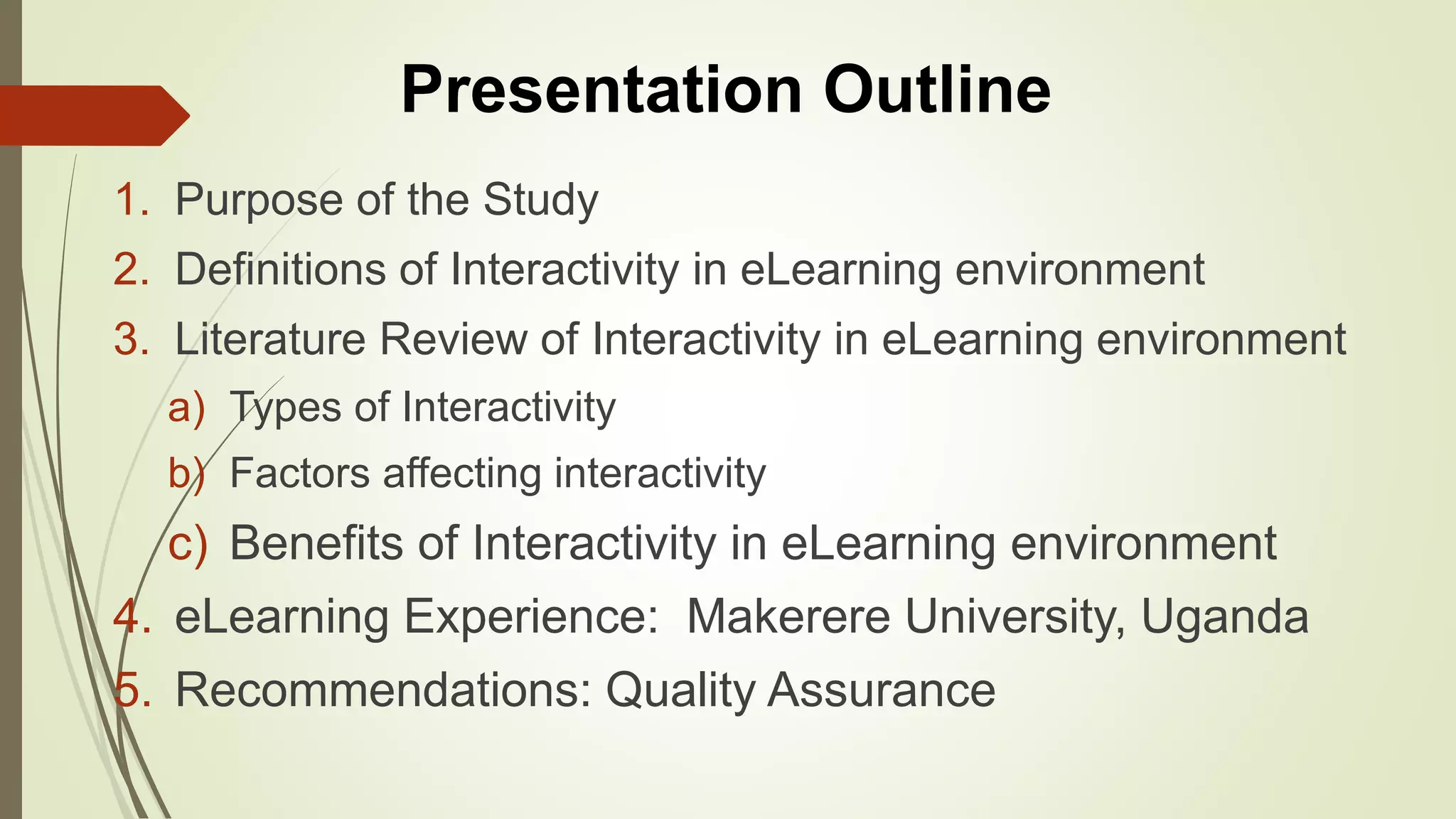
1. Purpose of the Study
2. Definitions of Interactivity in eLearning environment
3. Literature Review of Interactivity in eLearning environment
a) Types of Interactivity
b) Factors affecting interactivity
c) Benefits of Interactivity in eLearning environment
4. eLearning Experience: Makerere University, Uganda
5. Recommendations: Quality Assurance
Presentation Outline
1. Define Interactivity as it relates to eLearning environment
2. Discuss Interactivity in eLearning environment based on
existing literature
a) Types of Interactivity
b) Factors affecting interactivity
c) Benefits of Interactivity in eLearning environment
3. eLearning Experience: Makerere University, Uganda
4. Recommendations: Quality Assurance
Purpose of the Study
Definition
https://www.youtube.com/watch?v=Ww7bpC1YP2Q
Interactivity in eLearning Environment
A simple definition of the term interactive as provided by
Merriam-Webster is mutually or reciprocally active. The
American Heritage Dictionary of the English Language (5th ed.
2019) provides the computer science definition as of or
relating to a program that responds to user activity.
Interactivity in eLearning environment refers to how much a
student uses the online course; how active he or she is and how
much he or she participates in all the aspects of the course.
Studies have shown that students who interact more with their
courses report higher levels of success and satisfaction with
their online course.
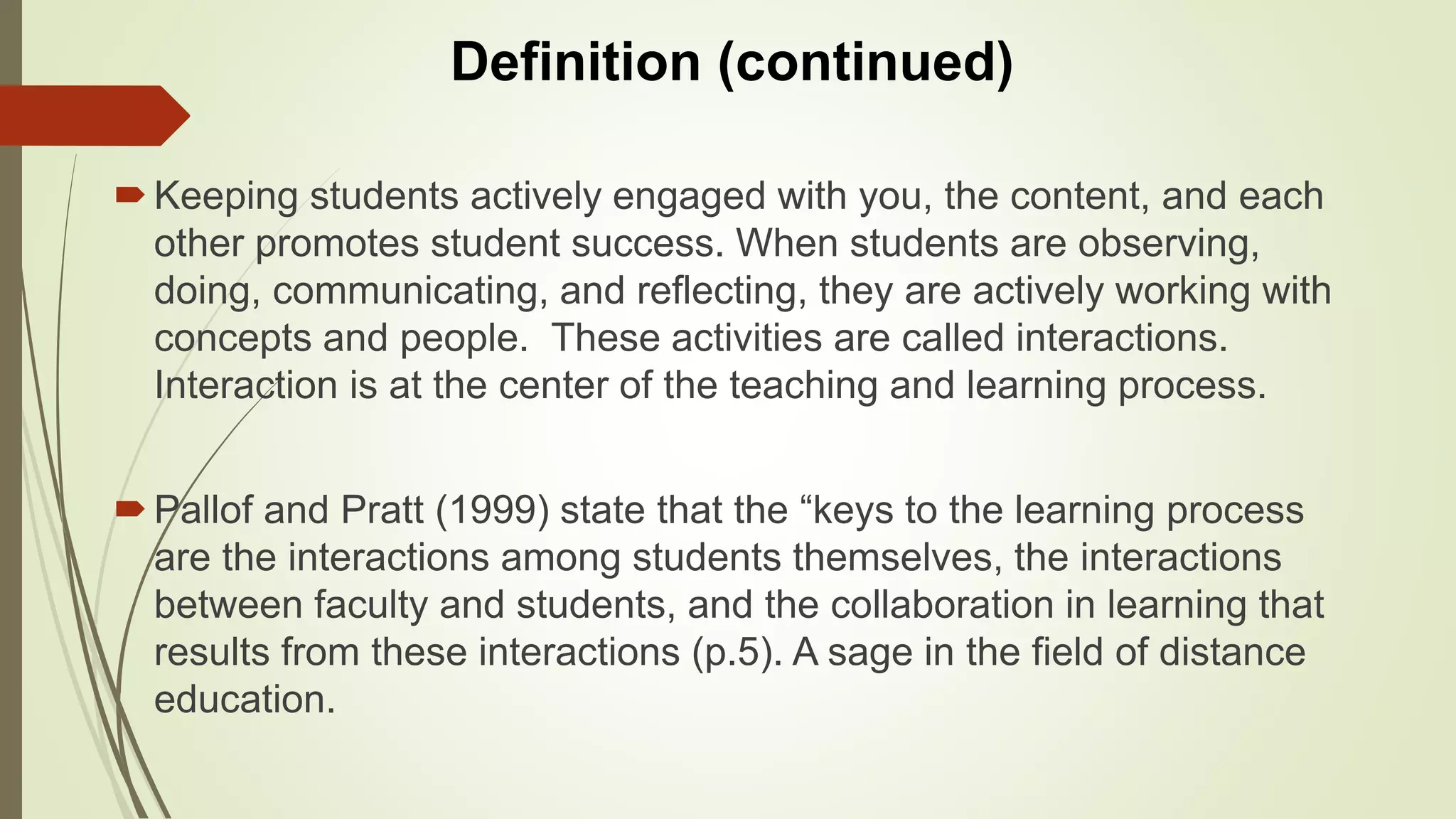
Definition (Continued)
Keeping students actively engaged with you, the content, and each
other promotes student success. When students are observing,
doing, communicating, and reflecting, they are actively working with
concepts and people. These activities are called interactions.
Interaction is at the center of the teaching and learning process.
Pallof and Pratt (1999) state that the “keys to the learning process
are the interactions among students themselves, the interactions
between faculty and students, and the collaboration in learning that
results from these interactions (p.5). A sage in the field of distance
education.
Definition (continued)
Savenye, 2005, identifies three central areas, regarding
interaction. These are the interaction between the learner and the
instructor, the learner, and other learners, and the learner and the
content.
Types of Interactivity
 Student - Instructor interaction can include both formal direct
instruction and more informal mentoring and support by
instructor’s Online Presence. Regular and substantive
student-instructor interaction is required for courses to be
classified as "online courses" and not "correspondence
courses"
Literature Review
Types of Interactivity in eLearning Environment
A few examples of student-instructor interaction include:
providing feedback on assignments, learning journals, or other
reflective activities
participating in discussion forums or chats
sending frequent announcements to summarize the previous
week or describe the next week
providing online or telephone office hours
mentoring individual learners
working with small groups of students assigned to help teach
portions of the course (peer teaching)
Literature Review
Types of Interactivity in eLearning Environment
(continued)
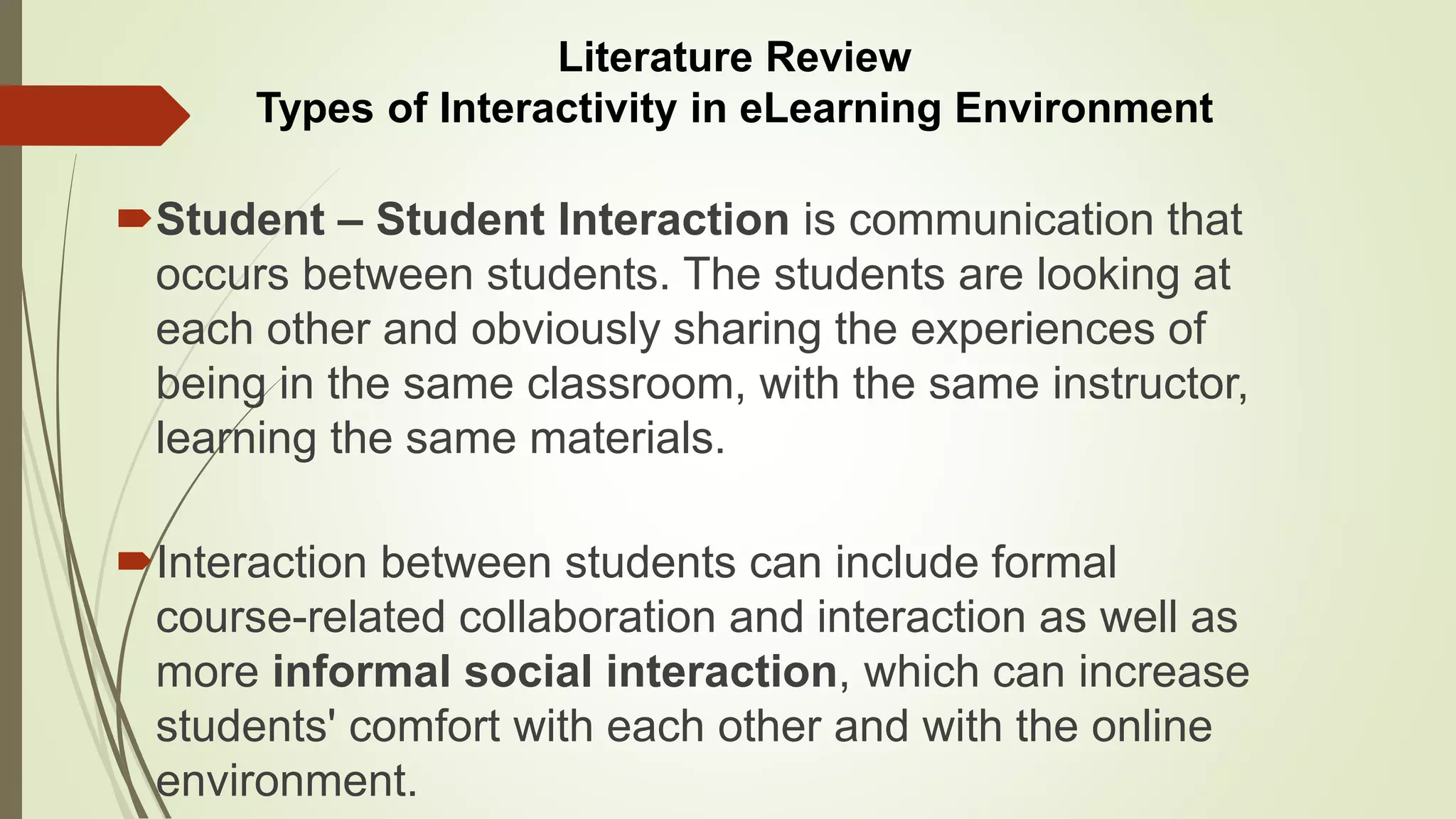
Student – Student Interaction is communication that
occurs between students. The students are looking at
each other and obviously sharing the experiences of
being in the same classroom, with the same instructor,
learning the same materials.
Interaction between students can include formal
course-related collaboration and interaction as well as
more informal social interaction, which can increase
students' comfort with each other and with the online
environment.
Literature Review
Types of Interactivity in eLearning Environment
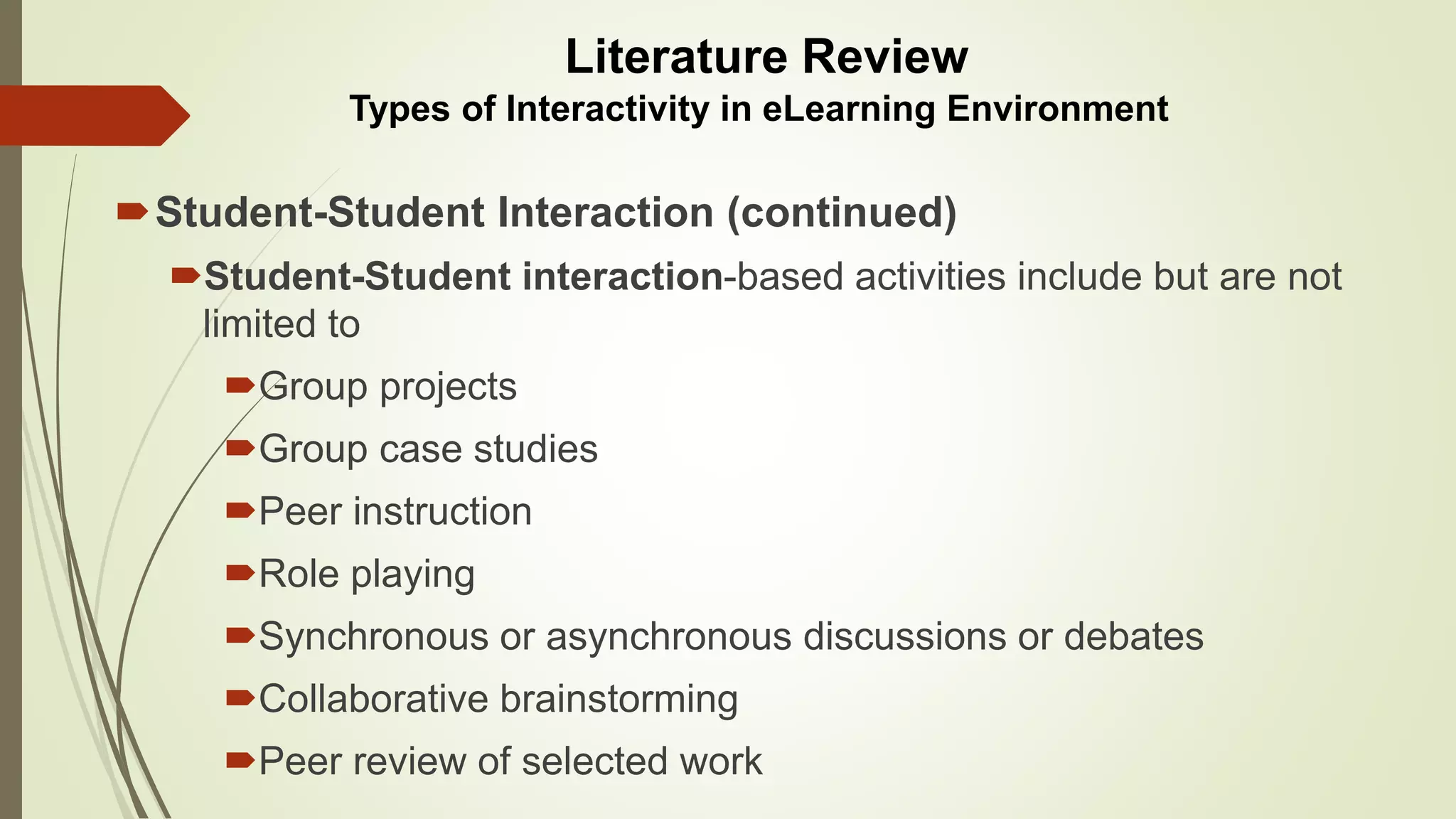
Student-Student Interaction (continued)
Student-Student interaction-based activities include but are not
limited to
Group projects
Group case studies
Peer instruction
Role playing
Synchronous or asynchronous discussions or debates
Collaborative brainstorming
Peer review of selected work
Literature Review
Types of Interactivity in eLearning Environment
 Student-Content Interaction
Student-content interaction includes students' concrete interactions
with the course materials and their more abstract interactions with the
concepts and ideas they present. It is more than just reading a book or
watching a video.
Student-content interaction refers to the time spent with course
content including textbooks, PowerPoint, web pages, and discussion
forums (Su, Bonk, Magjuka, Liu, & Lee, 2005).
Palloff and Pratt (2001) state “the key to success in our online classes
rests not with the content that is being presented but with the method
by which the course is being delivered” (p. 152).
Literature Review
Types of Interactivity in eLearning Environment
Student-Content Interaction (continued)
Dixson (2010) suggested that students must incorporate different types
of interactivity for students. Learning experiences such as tutorials,
learning modules, and online learning objects These tools include but is
not limited to
tutorials (using text, still images, audio, and/ or video)
quizzes
WebQuests
reading/video discussion or reflections (Reading a textbook is technically a
student-content activity but explicitly requiring students to reflect on the
reading and providing directed prompts for that reflection improves the
interaction.)
simulations (like Froguts Virtual Dissection Software (Links to an external
site.)Links to an external site.)
Literature Review
Types of Interactivity in eLearning Environment
Literature Review
Factors affecting Interactivity in eLearning Environment
Student-Faculty Interactivity
 Effective student-instructor interaction inspires students to succeed, promotes
critical thinking and encourages student retention and persistence (Jaggers,
2016, Budash & Shaw, 2017). Examples:
 Encouragement through content focused discussion:
Instructor creates 8 discussion prompts in a 15-week class, moderates it and
provides constructive examples
 Nature and frequency of scheduled meetings:
Instructor engages students in WebEx/synchronous meetings: reviews, record,
and uploads them for later review and non attending students
 Current event reflect and discussion:
Review of Videos on current events; instructor summarizes students’ reaction
posts
 Interaction outside established benchmarks: Emails with prompt response;
Weekly announcements; Weekly audio/videos; office hours
Student – Student Interaction
Swan (2002) identified that the student-student interaction
positively influenced students’ success. Swan (2002) further
explained that the discussion among students contributed to
students’ success, implying the importance of the quality of
student-student interaction in online discussion.
Thurmond (2003) emphasized that participation in online
discussions enable students to learn by constructing meaning and
knowledge through dialogue and from other perspectives
Literature Review
Factors affecting Interactivity in eLearning Environment
Student – Content Interaction
Thurmond (2003) highlights factors that can influence student
perspectives on their ability to learn course curriculum:
continuous contact with the content- enables students to gain
mastery
clarity of course design – the structuring of the materials and
the manner in which it is sequenced will help make it both
accessible and easy to understand.
Literature Review
Factors affecting Interactivity in eLearning Environment
Student – content Interaction (continued)
Thurmond (2003)
time – adequate time is needed for students to engage with the
materials and discourse and to reflect on their learning
mode of delivering course content – appropriate sequencing of
content and learning activities will enhance interactivity and make
learning more effective and meaningful.
Literature Review
Factors affecting Interactivity in eLearning Environment
Online Learning without engagement is like a car without an engine.
Suzanne Young and Mary Alice Bruce (2011), of the University
of Wyoming, conducted a study about student engagement
and concluded that “engagement and sense of classroom
community are closely related to one another; students who
feel a sense of connectedness rather than isolation are
very likely better prepared to become more actively
involved with course learning, successfully persist, and
experience real world success.” As you interact with others
and develop connections you are also creating a support
system that can increase your motivation to be an active
participant in class.
Literature Review
Benefits of Interactivity in eLearning Environment
It accommodates diverse learning styles. Online lessons may
contain lecture text, video, and check-for-understanding
questions. To make for a streamlined learning experience,
interactive lessons can combine course content into a single
and efficient presentation-style activity. (Norman et. Al (2010).
Increased student-to-teacher and student-to-student interaction
and discussion; a more student-centered learning
environment; less passive listening and more active learning;
a greater sense of connectedness, synergy.
Literature Review
Benefits of Interactivity in eLearning Environment
(continued)
It encourages student-faculty contact through introductions,
announcements, online office hours, and prompt response to
student questions and concerns
It encourages cooperation among students through all-class or
small-group discussions and well-supported group work using both
asynchronous and synchronous collaboration technology
It encourages active learning
It provides both prompt feedback (both formative summative
feedback)
Research publication opportunities.
Literature Review
Benefits of Interactivity in eLearning Environment
(continued)
Carnegie African Diaspora Fellowship, 2019
In a two month hybrid research course taught in the Department of
Instructional Design & Technology (MIDT) at Makerere University,
the key author conducted a preliminary assessment of student and
faculty experience in eLearning Environment. This was to
establish the participants’ knowledge about eLearning interactivity,
and suggestions about their needs regarding eLearning
experience.
Responses summarized here provide a basis for the authors to
design an in-depth study to generate policy recommendations
tailored to the unique realities of student eLearning experiences at
Makerere University.
eLearning: Experience from Makerere
University, Uganda
eLearning: Experience from Makerere
University, Uganda (Continued)
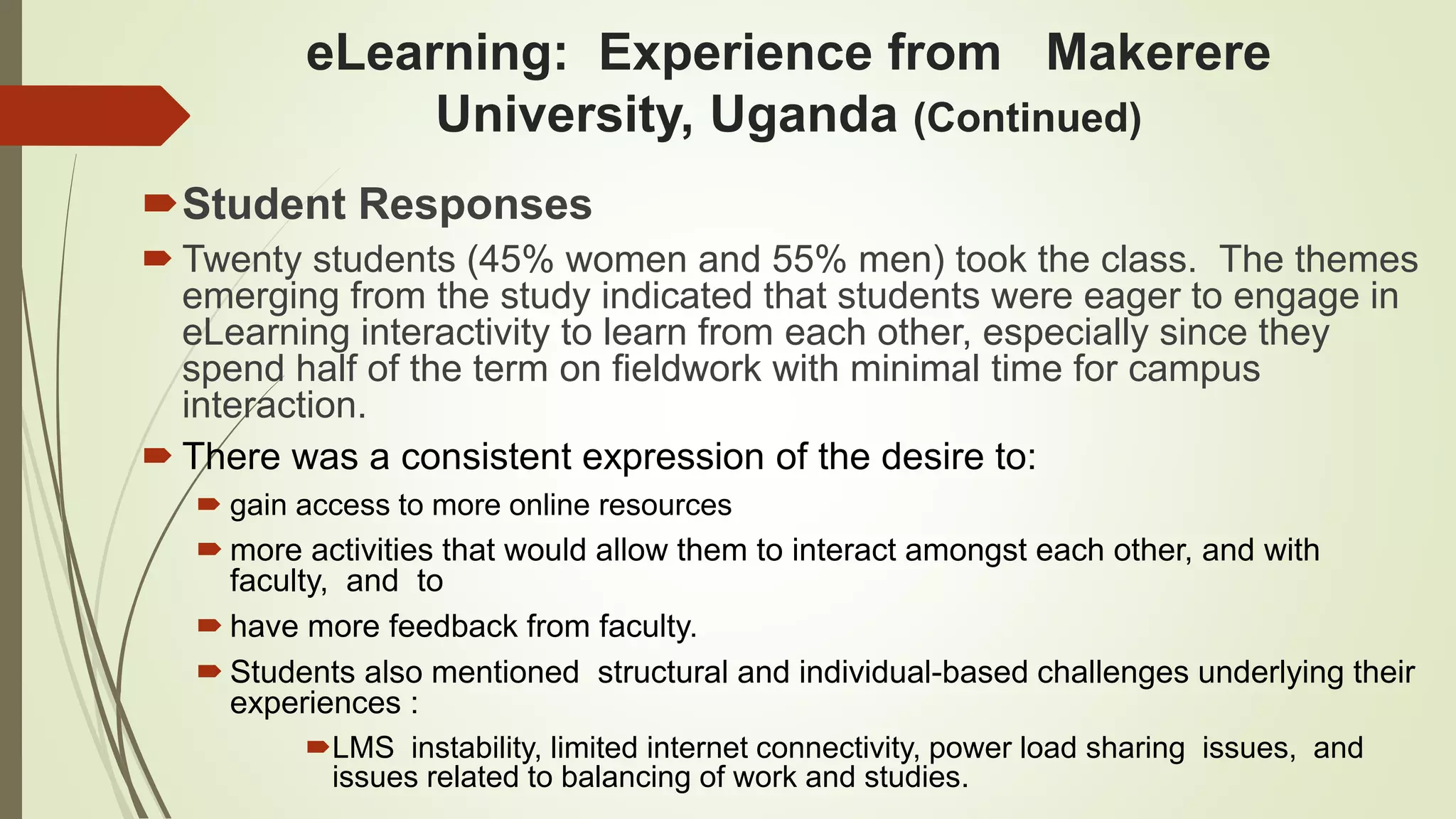
Student Responses
 Twenty students (45% women and 55% men) took the class. The themes
emerging from the study indicated that students were eager to engage in
eLearning interactivity to learn from each other, especially since they
spend half of the term on fieldwork with minimal time for campus
interaction.
 There was a consistent expression of the desire to:
 gain access to more online resources
 more activities that would allow them to interact amongst each other, and with
faculty, and to
 have more feedback from faculty.
 Students also mentioned structural and individual-based challenges underlying their
experiences :
LMS instability, limited internet connectivity, power load sharing issues, and
issues related to balancing of work and studies.
eLearning: Experience from Makerere
University, Uganda (continued)
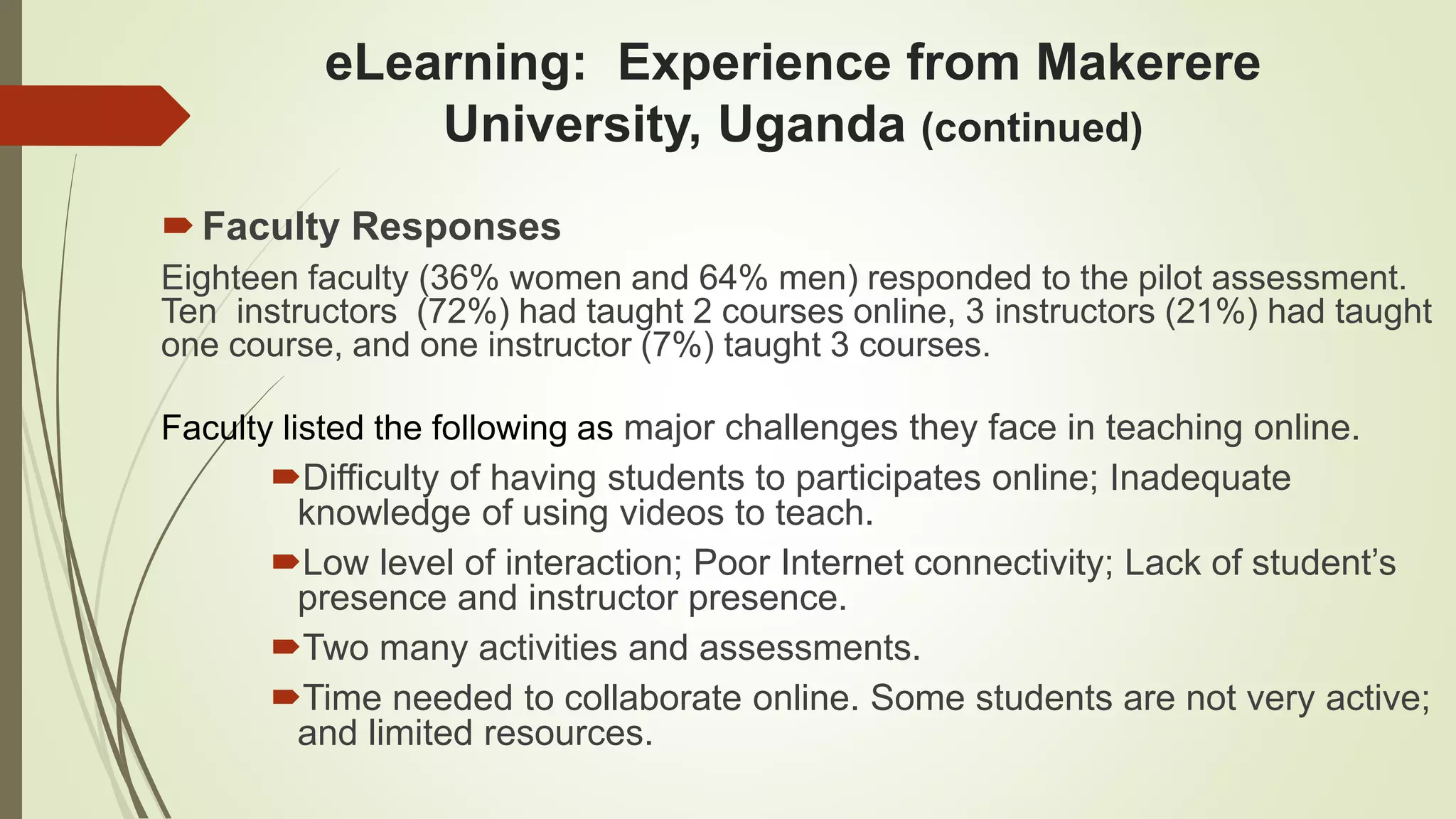
Faculty Responses
Eighteen faculty (36% women and 64% men) responded to the pilot assessment.
Ten instructors (72%) had taught 2 courses online, 3 instructors (21%) had taught
one course, and one instructor (7%) taught 3 courses.
Faculty listed the following as major challenges they face in teaching online.
Difficulty of having students to participates online; Inadequate
knowledge of using videos to teach.
Low level of interaction; Poor Internet connectivity; Lack of student’s
presence and instructor presence.
Two many activities and assessments.
Time needed to collaborate online. Some students are not very active;
and limited resources.
Student - Instructor interaction
Instructor’s Online Presence (At a minimum, the instructor
checks the course four days out of seven)
Course Design – Easy to navigate
Course Organization
Chunk the syllabus into sections
Divide the course syllabus into discrete segments. Provide course
schedule and assignment deadlines.
Recommendations: Quality Assurance
(Continued)
Student - Instructor interaction
Course Organization
Post course syllabus, policies, expectations, and objectives on the
course website
Chunk the syllabus into sections
Divide the course syllabus into discrete segments.
Provide course schedule and assignment deadlines.
Provide due dates for assignments
Recommendations: Quality Assurance
(Continued)
Student - Instructor interaction
Provide Welcome Video about the course - How to
start this course? About the instructor
Technical Help” Getting Help When You Need It!
(STUDENT SUPPORT)
Provide LMS Student Guide
Provide Weekly Overview
Technology - Clarify computer skills/terminology
Recommendations: Quality Assurance
(Continued)
Student - Instructor interaction
Clarify expectations –
Set clear expectations with regard to student
performance/activity
Remind students frequently of course
expectations.
Give students a clear overall understanding of the
course structure
Send frequent announcements to summarize the
previous week or describe the next week.
Provide online or telephone office hours
Recommendations: Quality Assurance
(Continued)
Student - Instructor interaction
Discussion forums or chats (participating in discussion
forums or chats)
Discussion Board Netiquette -
https://www.youtube.com/watch?v=DwdqQjCfWSc
Give credit for participating in online discussions
Rules for Online Discussions
Assign students to a group and identify each group with a name
and location online. Within each group, identify a group leader. Be
explicit about what each group should discuss and in what medium
(email, threaded discussion, or offline) they should work.
Recommendations: Quality Assurance
(Continued)
Student - Instructor interaction
Tools for Interactivity
Two-way video - Using a variety of teaching methods. (Zoom)
VoiceThread - (visual presentations with discussion)
Quizlet - flash cards
Camtasia by TechSmith. (Screen capture and video editing tool)
Screen-O-Matic - https://screencast-o-matic.com/
Powtoon: https://www.powtoon.com/home/?
Kaltura (lecture recordings)
Recommendations: Quality Assurance
(Continued)
Student - Instructor interaction
Tools for Interactivity (Cont.)
ThingLink: Annotate images and videos —
https://www.thinglink.com/
Voki: https://www.voki.com/
VideoScribe for Education
GoAnimate
Prezi
Picktochart: https://piktochart.com/
Recommendations: Quality Assurance
(Continued)
Student – Student Interaction
Group projects
Group case studies
Peer instruction
Role playing
Synchronous or asynchronous discussions or debates
Collaborative brainstorming
Peer review of selected work
Recommendations: Quality Assurance
(Continued)
Student-Content Interaction
Tutorials (using text, still images, audio, and/ or video)
Quizzes (if the feedback is useful and usable)
WebQuests
Reading/video discussion or reflections (Reading a textbook is
technically a student-content activity but explicitly requiring
students to reflect on the reading and providing directed
prompts for that reflection improves the interaction.)
Simulations
Recommendations: Quality Assurance
(Continued)
Interactivity in eLearning environment
 The American Heritage® Dictionary of the English Language, Fifth Edition copyright ©2019 by Houghton Mifflin
Harcourt Publishing Company. All rights reserved.
 Budash, D., & Shaw, M. (2017). Persistence in an online master’s degree program: perceptions of students
and faculty. Online Journal of Distance Learning Administration, 10(3). Retrieved from
http://www.westga.edu/~distance/ojdla/fall203/budash_shaw203.html
 Byuicurdev. (2012, Jun 12). Discussion Board Netiquette. Available:
https://www.youtube.com/watch?v=DwdqQjCfWSc.
 Dixson, Marcia D. 2010. “Creating Effective Student Engagement in Online Courses: What do Students Find
Engaging?” Journal of the Scholarship of Teaching and Learning10(2): 1-13.
http://josotl.indiana.edu/article/view/1744/1742.
 Jaggers S. S. & Xu, D. (2016). How do online course design features influence student performance?.
Computers & Education (95), 270‐284.
 Norman, M. K., Ambrose, S. A., Bridges, M. W., DiPietro, M., & Lovett, M. C. (2010). How learning works:
Seven research-based principles for smart teaching. San Francisco, CA: Jossey-Bass.
 Palloff, R. M., & Pratt, K. (1999). Building Learning Communities in Cyberspace: Effective Strategies for the
Online Classroom. San Francisco, CA: Jossey-Bass.
 Palloff, R. M. and Pratt, K. (2001). Lessons from the cbyerspace classroom: The realities of online teaching.
San Francisco: Jossey-Bass.
References
 Pheang, G. ( 2016, February 18). What is online interactivity? Available:
https://www.youtube.com/watch?v=Ww7bpC1YP2Q
 Savenye, W.C. (2005). Improving Online Courses: What is Interaction and Why Use It? (Undetermined).
Distance Learning, 2(6), 22-28
 Su, B., Bonk, C. J., Magjuka, R. J., Liu, Z., & Lee, S.-h. (2005). The importance of interaction in web-
based education: A program-level case study of online MBA courses. Journal of Interactive Online
Learning, 4, 1-19.
 Swan, K. (2002). Building learning communities in online courses: The importance of interaction.
Education, Communication & Information, 2(1), 23-49.
 Thurmond, V. A. (2003). Examination of interaction variables as predictors of students’ satisfaction and
willingness to enroll in future Web-based courses. Doctoral dissertation. University of Kansas Medical
Center, Kansas City, KS.
 Young, S and Bruce, M (2011). Classroom community and student engagement in online courses.
MERLOT Journal of Online Learning and Teaching, 7 (2): 219-230.
References

Interactivity In E-Learning Environment

  • 1.
    Interactivity in eLearning Environment Presentedby Paulina Kuforiji , Department of Teacher Education & Florence Wakoko-Studstill, Department of Criminal Justice & Sociology March 26, 2020
  • 2.
    1. Purpose ofthe Study 2. Definitions of Interactivity in eLearning environment 3. Literature Review of Interactivity in eLearning environment a) Types of Interactivity b) Factors affecting interactivity c) Benefits of Interactivity in eLearning environment 4. eLearning Experience: Makerere University, Uganda 5. Recommendations: Quality Assurance Presentation Outline
  • 3.
    1. Define Interactivityas it relates to eLearning environment 2. Discuss Interactivity in eLearning environment based on existing literature a) Types of Interactivity b) Factors affecting interactivity c) Benefits of Interactivity in eLearning environment 3. eLearning Experience: Makerere University, Uganda 4. Recommendations: Quality Assurance Purpose of the Study
  • 4.
  • 5.
    A simple definitionof the term interactive as provided by Merriam-Webster is mutually or reciprocally active. The American Heritage Dictionary of the English Language (5th ed. 2019) provides the computer science definition as of or relating to a program that responds to user activity. Interactivity in eLearning environment refers to how much a student uses the online course; how active he or she is and how much he or she participates in all the aspects of the course. Studies have shown that students who interact more with their courses report higher levels of success and satisfaction with their online course. Definition (Continued)
  • 6.
    Keeping students activelyengaged with you, the content, and each other promotes student success. When students are observing, doing, communicating, and reflecting, they are actively working with concepts and people. These activities are called interactions. Interaction is at the center of the teaching and learning process. Pallof and Pratt (1999) state that the “keys to the learning process are the interactions among students themselves, the interactions between faculty and students, and the collaboration in learning that results from these interactions (p.5). A sage in the field of distance education. Definition (continued)
  • 7.
    Savenye, 2005, identifiesthree central areas, regarding interaction. These are the interaction between the learner and the instructor, the learner, and other learners, and the learner and the content. Types of Interactivity  Student - Instructor interaction can include both formal direct instruction and more informal mentoring and support by instructor’s Online Presence. Regular and substantive student-instructor interaction is required for courses to be classified as "online courses" and not "correspondence courses" Literature Review Types of Interactivity in eLearning Environment
  • 8.
    A few examplesof student-instructor interaction include: providing feedback on assignments, learning journals, or other reflective activities participating in discussion forums or chats sending frequent announcements to summarize the previous week or describe the next week providing online or telephone office hours mentoring individual learners working with small groups of students assigned to help teach portions of the course (peer teaching) Literature Review Types of Interactivity in eLearning Environment (continued)
  • 9.
    Student – StudentInteraction is communication that occurs between students. The students are looking at each other and obviously sharing the experiences of being in the same classroom, with the same instructor, learning the same materials. Interaction between students can include formal course-related collaboration and interaction as well as more informal social interaction, which can increase students' comfort with each other and with the online environment. Literature Review Types of Interactivity in eLearning Environment
  • 10.
    Student-Student Interaction (continued) Student-Studentinteraction-based activities include but are not limited to Group projects Group case studies Peer instruction Role playing Synchronous or asynchronous discussions or debates Collaborative brainstorming Peer review of selected work Literature Review Types of Interactivity in eLearning Environment
  • 11.
     Student-Content Interaction Student-contentinteraction includes students' concrete interactions with the course materials and their more abstract interactions with the concepts and ideas they present. It is more than just reading a book or watching a video. Student-content interaction refers to the time spent with course content including textbooks, PowerPoint, web pages, and discussion forums (Su, Bonk, Magjuka, Liu, & Lee, 2005). Palloff and Pratt (2001) state “the key to success in our online classes rests not with the content that is being presented but with the method by which the course is being delivered” (p. 152). Literature Review Types of Interactivity in eLearning Environment
  • 12.
    Student-Content Interaction (continued) Dixson(2010) suggested that students must incorporate different types of interactivity for students. Learning experiences such as tutorials, learning modules, and online learning objects These tools include but is not limited to tutorials (using text, still images, audio, and/ or video) quizzes WebQuests reading/video discussion or reflections (Reading a textbook is technically a student-content activity but explicitly requiring students to reflect on the reading and providing directed prompts for that reflection improves the interaction.) simulations (like Froguts Virtual Dissection Software (Links to an external site.)Links to an external site.) Literature Review Types of Interactivity in eLearning Environment
  • 13.
    Literature Review Factors affectingInteractivity in eLearning Environment Student-Faculty Interactivity  Effective student-instructor interaction inspires students to succeed, promotes critical thinking and encourages student retention and persistence (Jaggers, 2016, Budash & Shaw, 2017). Examples:  Encouragement through content focused discussion: Instructor creates 8 discussion prompts in a 15-week class, moderates it and provides constructive examples  Nature and frequency of scheduled meetings: Instructor engages students in WebEx/synchronous meetings: reviews, record, and uploads them for later review and non attending students  Current event reflect and discussion: Review of Videos on current events; instructor summarizes students’ reaction posts  Interaction outside established benchmarks: Emails with prompt response; Weekly announcements; Weekly audio/videos; office hours
  • 14.
    Student – StudentInteraction Swan (2002) identified that the student-student interaction positively influenced students’ success. Swan (2002) further explained that the discussion among students contributed to students’ success, implying the importance of the quality of student-student interaction in online discussion. Thurmond (2003) emphasized that participation in online discussions enable students to learn by constructing meaning and knowledge through dialogue and from other perspectives Literature Review Factors affecting Interactivity in eLearning Environment
  • 15.
    Student – ContentInteraction Thurmond (2003) highlights factors that can influence student perspectives on their ability to learn course curriculum: continuous contact with the content- enables students to gain mastery clarity of course design – the structuring of the materials and the manner in which it is sequenced will help make it both accessible and easy to understand. Literature Review Factors affecting Interactivity in eLearning Environment
  • 16.
    Student – contentInteraction (continued) Thurmond (2003) time – adequate time is needed for students to engage with the materials and discourse and to reflect on their learning mode of delivering course content – appropriate sequencing of content and learning activities will enhance interactivity and make learning more effective and meaningful. Literature Review Factors affecting Interactivity in eLearning Environment
  • 17.
    Online Learning withoutengagement is like a car without an engine. Suzanne Young and Mary Alice Bruce (2011), of the University of Wyoming, conducted a study about student engagement and concluded that “engagement and sense of classroom community are closely related to one another; students who feel a sense of connectedness rather than isolation are very likely better prepared to become more actively involved with course learning, successfully persist, and experience real world success.” As you interact with others and develop connections you are also creating a support system that can increase your motivation to be an active participant in class. Literature Review Benefits of Interactivity in eLearning Environment
  • 18.
    It accommodates diverselearning styles. Online lessons may contain lecture text, video, and check-for-understanding questions. To make for a streamlined learning experience, interactive lessons can combine course content into a single and efficient presentation-style activity. (Norman et. Al (2010). Increased student-to-teacher and student-to-student interaction and discussion; a more student-centered learning environment; less passive listening and more active learning; a greater sense of connectedness, synergy. Literature Review Benefits of Interactivity in eLearning Environment (continued)
  • 19.
    It encourages student-facultycontact through introductions, announcements, online office hours, and prompt response to student questions and concerns It encourages cooperation among students through all-class or small-group discussions and well-supported group work using both asynchronous and synchronous collaboration technology It encourages active learning It provides both prompt feedback (both formative summative feedback) Research publication opportunities. Literature Review Benefits of Interactivity in eLearning Environment (continued)
  • 20.
    Carnegie African DiasporaFellowship, 2019 In a two month hybrid research course taught in the Department of Instructional Design & Technology (MIDT) at Makerere University, the key author conducted a preliminary assessment of student and faculty experience in eLearning Environment. This was to establish the participants’ knowledge about eLearning interactivity, and suggestions about their needs regarding eLearning experience. Responses summarized here provide a basis for the authors to design an in-depth study to generate policy recommendations tailored to the unique realities of student eLearning experiences at Makerere University. eLearning: Experience from Makerere University, Uganda
  • 21.
    eLearning: Experience fromMakerere University, Uganda (Continued) Student Responses  Twenty students (45% women and 55% men) took the class. The themes emerging from the study indicated that students were eager to engage in eLearning interactivity to learn from each other, especially since they spend half of the term on fieldwork with minimal time for campus interaction.  There was a consistent expression of the desire to:  gain access to more online resources  more activities that would allow them to interact amongst each other, and with faculty, and to  have more feedback from faculty.  Students also mentioned structural and individual-based challenges underlying their experiences : LMS instability, limited internet connectivity, power load sharing issues, and issues related to balancing of work and studies.
  • 22.
    eLearning: Experience fromMakerere University, Uganda (continued) Faculty Responses Eighteen faculty (36% women and 64% men) responded to the pilot assessment. Ten instructors (72%) had taught 2 courses online, 3 instructors (21%) had taught one course, and one instructor (7%) taught 3 courses. Faculty listed the following as major challenges they face in teaching online. Difficulty of having students to participates online; Inadequate knowledge of using videos to teach. Low level of interaction; Poor Internet connectivity; Lack of student’s presence and instructor presence. Two many activities and assessments. Time needed to collaborate online. Some students are not very active; and limited resources.
  • 23.
    Student - Instructorinteraction Instructor’s Online Presence (At a minimum, the instructor checks the course four days out of seven) Course Design – Easy to navigate Course Organization Chunk the syllabus into sections Divide the course syllabus into discrete segments. Provide course schedule and assignment deadlines. Recommendations: Quality Assurance (Continued)
  • 24.
    Student - Instructorinteraction Course Organization Post course syllabus, policies, expectations, and objectives on the course website Chunk the syllabus into sections Divide the course syllabus into discrete segments. Provide course schedule and assignment deadlines. Provide due dates for assignments Recommendations: Quality Assurance (Continued)
  • 25.
    Student - Instructorinteraction Provide Welcome Video about the course - How to start this course? About the instructor Technical Help” Getting Help When You Need It! (STUDENT SUPPORT) Provide LMS Student Guide Provide Weekly Overview Technology - Clarify computer skills/terminology Recommendations: Quality Assurance (Continued)
  • 26.
    Student - Instructorinteraction Clarify expectations – Set clear expectations with regard to student performance/activity Remind students frequently of course expectations. Give students a clear overall understanding of the course structure Send frequent announcements to summarize the previous week or describe the next week. Provide online or telephone office hours Recommendations: Quality Assurance (Continued)
  • 27.
    Student - Instructorinteraction Discussion forums or chats (participating in discussion forums or chats) Discussion Board Netiquette - https://www.youtube.com/watch?v=DwdqQjCfWSc Give credit for participating in online discussions Rules for Online Discussions Assign students to a group and identify each group with a name and location online. Within each group, identify a group leader. Be explicit about what each group should discuss and in what medium (email, threaded discussion, or offline) they should work. Recommendations: Quality Assurance (Continued)
  • 28.
    Student - Instructorinteraction Tools for Interactivity Two-way video - Using a variety of teaching methods. (Zoom) VoiceThread - (visual presentations with discussion) Quizlet - flash cards Camtasia by TechSmith. (Screen capture and video editing tool) Screen-O-Matic - https://screencast-o-matic.com/ Powtoon: https://www.powtoon.com/home/? Kaltura (lecture recordings) Recommendations: Quality Assurance (Continued)
  • 29.
    Student - Instructorinteraction Tools for Interactivity (Cont.) ThingLink: Annotate images and videos — https://www.thinglink.com/ Voki: https://www.voki.com/ VideoScribe for Education GoAnimate Prezi Picktochart: https://piktochart.com/ Recommendations: Quality Assurance (Continued)
  • 30.
    Student – StudentInteraction Group projects Group case studies Peer instruction Role playing Synchronous or asynchronous discussions or debates Collaborative brainstorming Peer review of selected work Recommendations: Quality Assurance (Continued)
  • 31.
    Student-Content Interaction Tutorials (usingtext, still images, audio, and/ or video) Quizzes (if the feedback is useful and usable) WebQuests Reading/video discussion or reflections (Reading a textbook is technically a student-content activity but explicitly requiring students to reflect on the reading and providing directed prompts for that reflection improves the interaction.) Simulations Recommendations: Quality Assurance (Continued)
  • 32.
  • 34.
     The AmericanHeritage® Dictionary of the English Language, Fifth Edition copyright ©2019 by Houghton Mifflin Harcourt Publishing Company. All rights reserved.  Budash, D., & Shaw, M. (2017). Persistence in an online master’s degree program: perceptions of students and faculty. Online Journal of Distance Learning Administration, 10(3). Retrieved from http://www.westga.edu/~distance/ojdla/fall203/budash_shaw203.html  Byuicurdev. (2012, Jun 12). Discussion Board Netiquette. Available: https://www.youtube.com/watch?v=DwdqQjCfWSc.  Dixson, Marcia D. 2010. “Creating Effective Student Engagement in Online Courses: What do Students Find Engaging?” Journal of the Scholarship of Teaching and Learning10(2): 1-13. http://josotl.indiana.edu/article/view/1744/1742.  Jaggers S. S. & Xu, D. (2016). How do online course design features influence student performance?. Computers & Education (95), 270‐284.  Norman, M. K., Ambrose, S. A., Bridges, M. W., DiPietro, M., & Lovett, M. C. (2010). How learning works: Seven research-based principles for smart teaching. San Francisco, CA: Jossey-Bass.  Palloff, R. M., & Pratt, K. (1999). Building Learning Communities in Cyberspace: Effective Strategies for the Online Classroom. San Francisco, CA: Jossey-Bass.  Palloff, R. M. and Pratt, K. (2001). Lessons from the cbyerspace classroom: The realities of online teaching. San Francisco: Jossey-Bass. References
  • 35.
     Pheang, G.( 2016, February 18). What is online interactivity? Available: https://www.youtube.com/watch?v=Ww7bpC1YP2Q  Savenye, W.C. (2005). Improving Online Courses: What is Interaction and Why Use It? (Undetermined). Distance Learning, 2(6), 22-28  Su, B., Bonk, C. J., Magjuka, R. J., Liu, Z., & Lee, S.-h. (2005). The importance of interaction in web- based education: A program-level case study of online MBA courses. Journal of Interactive Online Learning, 4, 1-19.  Swan, K. (2002). Building learning communities in online courses: The importance of interaction. Education, Communication & Information, 2(1), 23-49.  Thurmond, V. A. (2003). Examination of interaction variables as predictors of students’ satisfaction and willingness to enroll in future Web-based courses. Doctoral dissertation. University of Kansas Medical Center, Kansas City, KS.  Young, S and Bruce, M (2011). Classroom community and student engagement in online courses. MERLOT Journal of Online Learning and Teaching, 7 (2): 219-230. References