
Listening and Reading
Comprehension
Presented By : Group 1
Anna Wuryani | Athina Rokhmah Arsyaf
Erwin Wicaksono | Dody Setiadi | Anas
| Dova Dwi Yanti | Cahya Surya Saputra
| Ayu Mulianti | Abdullah Fidad Ailatat |
Yudi Anggara
The Outline
What and How
Do We Test
Reading
Comprehension?
What and How
Do We Test
Listening
Comprehension?
What and How Do
We Test Reading
Comprehension?
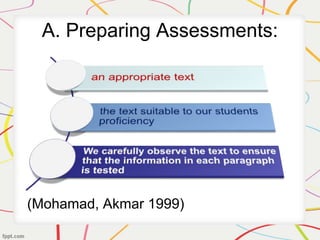
A. Preparing Assessments:
(Mohamad, Akmar 1999)
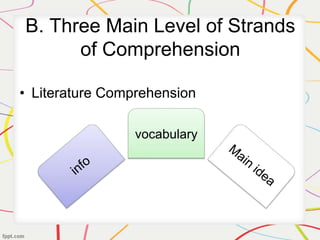
B. Three Main Level of Strands
of Comprehension
• Literature Comprehension
vocabulary
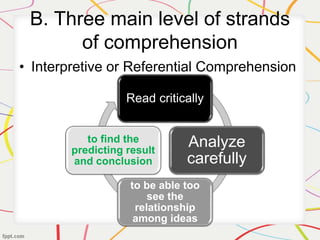
B. Three main level of strands
of comprehension
• Interpretive or Referential Comprehension
Read critically
Analyze
carefully
to be able too
see the
relationship
among ideas
to find the
predicting result
and conclusion
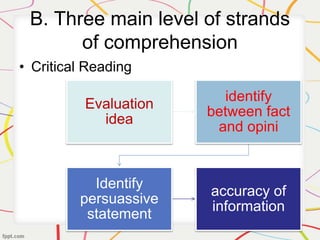
B. Three main level of strands
of comprehension
• Critical Reading
Evaluation
idea
identify
between fact
and opini
Identify
persuassive
statement
accuracy of
information
What and How Do
We Test Listening
Comprehension?
A. Listening Comprehension
Assessed
• The ability to understand words what are spoken aloud
• Involve teacher reading a text aloud and asking
student to retell the text & answer comprehension
question
• Idea classroom teacher seat with the student
individually and listen their retell text
• Assessed by having student listen to a text read a load
& used their written skill to communicate their
understanding
B. Here are 4 things you can do in
your classroom
• Balance Reading Comprehension with
Listening Comprehension
• Model Note-Taking for Students
• Collect and Offer Feedback on Student’s Note
• Teach Students How to Create Their Own
Simple Graphic Organizer:
C. Strategies to
Improve Listening Comprehension
• Read aloud a story
• Read aloud a non-fiction text and have
students take notes on a graphic organizer
to practice fact-collecting.
• Read aloud a non-fiction text and teach
students how to take bulleted notes
without a graphic organizer for efficient
fact collecting.
• Doing a science experiment? Read aloud
the procedure and have students take
notes in sequential order.
C. Strategies to
Improve Listening Comprehension
• Practice re-phrasing ideas through group
discussions to support students with their
note-taking.
C. Strategies to
Improve Listening Comprehension
That’s All
Thank You 

Listening and Reading comprehensions

  • 1.
    Listening and Reading Comprehension PresentedBy : Group 1 Anna Wuryani | Athina Rokhmah Arsyaf Erwin Wicaksono | Dody Setiadi | Anas | Dova Dwi Yanti | Cahya Surya Saputra | Ayu Mulianti | Abdullah Fidad Ailatat | Yudi Anggara
  • 2.
    The Outline What andHow Do We Test Reading Comprehension? What and How Do We Test Listening Comprehension?
  • 3.
    What and HowDo We Test Reading Comprehension?
  • 4.
  • 5.
    B. Three MainLevel of Strands of Comprehension • Literature Comprehension vocabulary
  • 6.
    B. Three mainlevel of strands of comprehension • Interpretive or Referential Comprehension Read critically Analyze carefully to be able too see the relationship among ideas to find the predicting result and conclusion
  • 7.
    B. Three mainlevel of strands of comprehension • Critical Reading Evaluation idea identify between fact and opini Identify persuassive statement accuracy of information
  • 8.
    What and HowDo We Test Listening Comprehension?
  • 9.
    A. Listening Comprehension Assessed •The ability to understand words what are spoken aloud • Involve teacher reading a text aloud and asking student to retell the text & answer comprehension question • Idea classroom teacher seat with the student individually and listen their retell text • Assessed by having student listen to a text read a load & used their written skill to communicate their understanding
  • 10.
    B. Here are4 things you can do in your classroom • Balance Reading Comprehension with Listening Comprehension • Model Note-Taking for Students • Collect and Offer Feedback on Student’s Note • Teach Students How to Create Their Own Simple Graphic Organizer:
  • 11.
    C. Strategies to ImproveListening Comprehension • Read aloud a story • Read aloud a non-fiction text and have students take notes on a graphic organizer to practice fact-collecting.
  • 12.
    • Read alouda non-fiction text and teach students how to take bulleted notes without a graphic organizer for efficient fact collecting. • Doing a science experiment? Read aloud the procedure and have students take notes in sequential order. C. Strategies to Improve Listening Comprehension
  • 13.
    • Practice re-phrasingideas through group discussions to support students with their note-taking. C. Strategies to Improve Listening Comprehension
  • 14.