READING INSTRUCTION TO
          AGE GROUP 3-9
      BY SUPARNA KOLEY
          1/3/2013
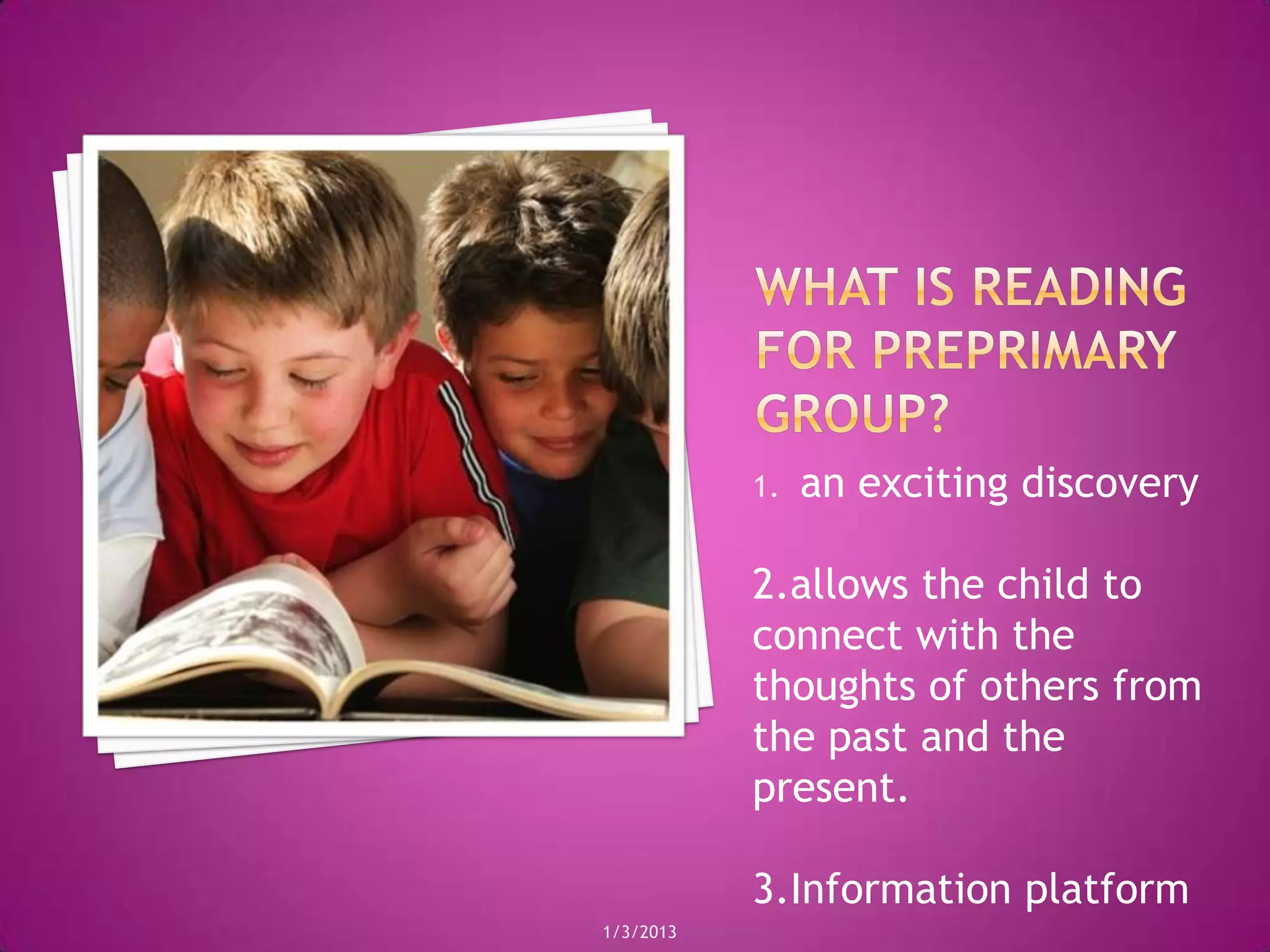
1.   an exciting discovery

           2.allows the child to
           connect with the
           thoughts of others from
           the past and the
           present.

           3.Information platform
1/3/2013
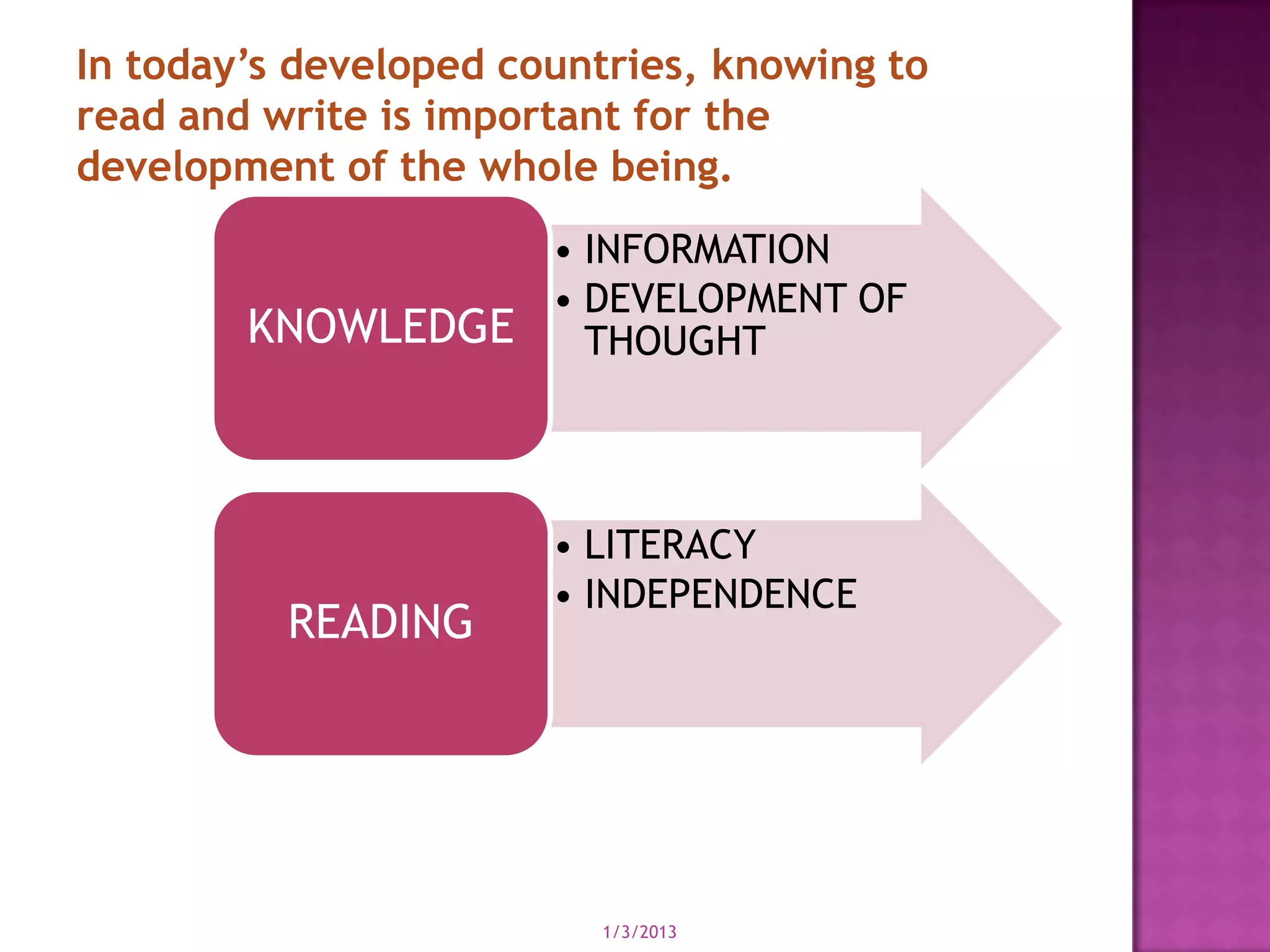
In today’s developed countries, knowing to
read and write is important for the
development of the whole being.
                  • INFORMATION
                  • DEVELOPMENT OF
        KNOWLEDGE THOUGHT


                       • LITERACY
                       • INDEPENDENCE
          READING


                         1/3/2013
Reading can improve hand-eye
coordination.


                     1/3/2013
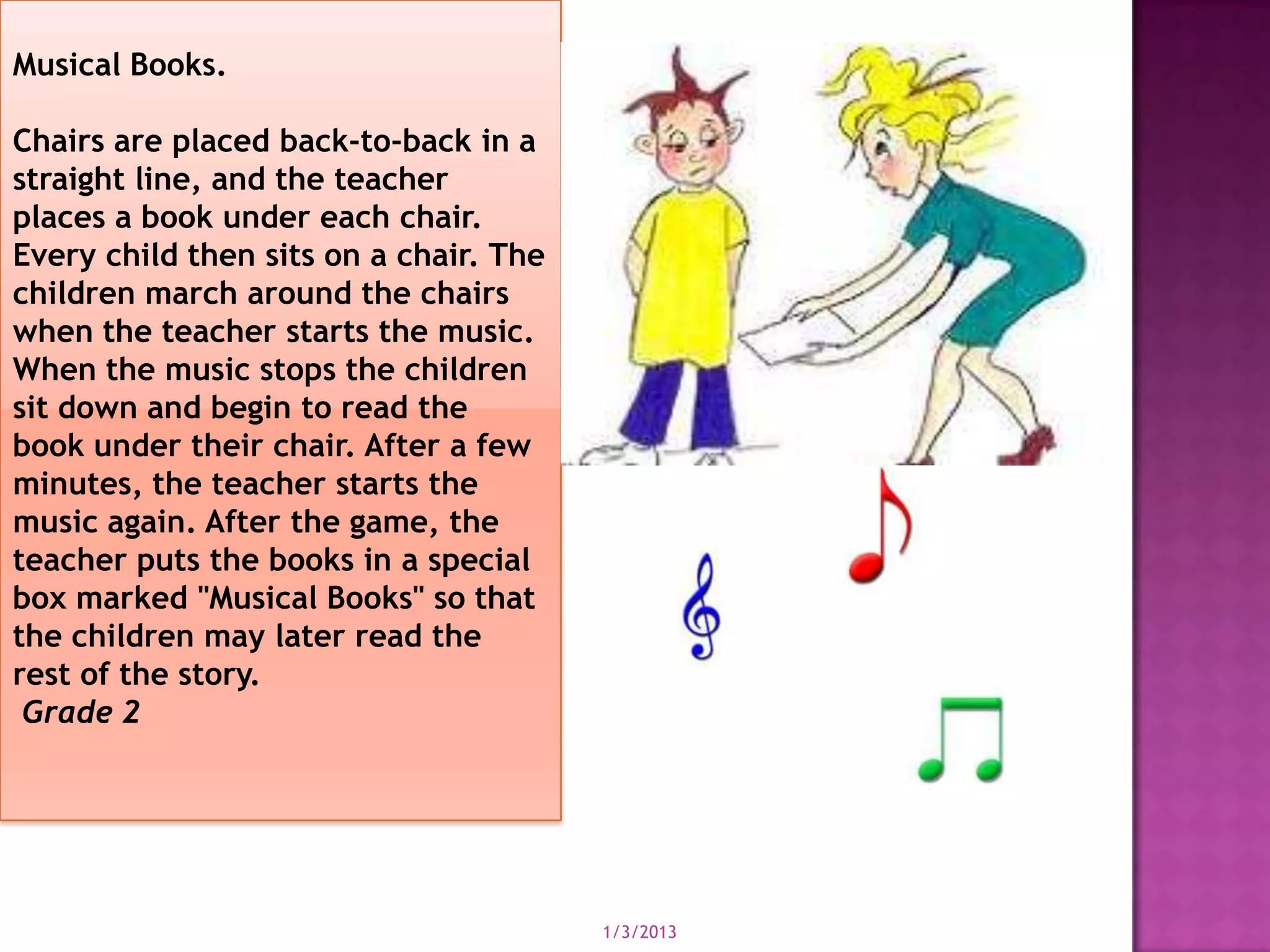
Musical Books.

Chairs are placed back-to-back in a
straight line, and the teacher
places a book under each chair.
Every child then sits on a chair. The
children march around the chairs
when the teacher starts the music.
When the music stops the children
sit down and begin to read the
book under their chair. After a few
minutes, the teacher starts the
music again. After the game, the
teacher puts the books in a special
box marked "Musical Books" so that
the children may later read the
rest of the story.
 Grade 2


                                        1/3/2013
Scavenger Hunt. Have a
"scavenger hunt" by
dividing the class into
teams and giving each
team a copy of the same
book. Have them find
the page numbers of
particular
objects, events, or
people in the book. Give
a reward to the winning
team.
                   1/3/2013
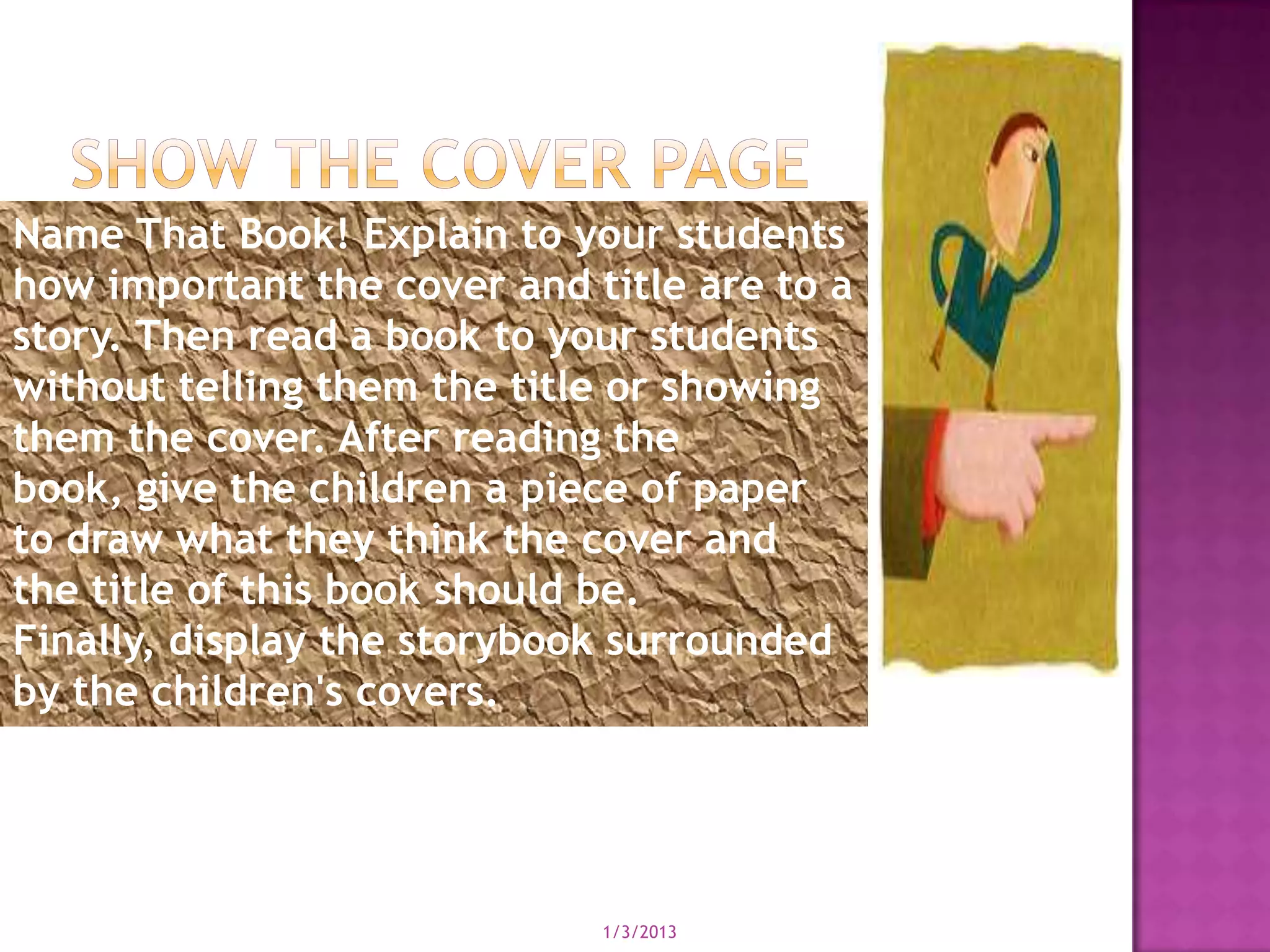
Name That Book! Explain to your students
how important the cover and title are to a
story. Then read a book to your students
without telling them the title or showing
them the cover. After reading the
book, give the children a piece of paper
to draw what they think the cover and
the title of this book should be.
Finally, display the storybook surrounded
by the children's covers.


                             1/3/2013
All you need for this game is a ball of string
and a story to share. Have your students sit in
a circle on the floor. One of the students gives
the beginning sentence of a familiar story.
Then the student holds onto the end of a ball
of string and rolls the ball to another
student, who will give the next part of the
story in sentence form. This is repeated until
the story has been told. Soon you'll have a
spider's web in your students' circle. Any
story can be used for variation, or new stories
can be created with each student adding a
new idea!
                        1/3/2013
Readers' BINGO.

 Brainstorm 25 to 30 words that deal with
books and write them on the board. Give your
students 9" x 12" newsprint and have them fold
it into nine squares. Then have the students
write nine of the words from the board into
each of the squares on their sheet. Give them
corn or candy for markers. Randomly call off
words from the board. When a student has
filled in a vertical, horizontal, or diagonal row,
he/she should call out "BOOKS!" I give the
winner a paperback book. For variety, the
teacher can play Readers' BINGO by giving the
definition of words rather than the words
themselves.               1/3/2013
1.Goal: To establish purpose for reading
primary source, to activate and build
background knowledge, and address
unfamiliar vocabulary words/concepts.

    2.K-W-L-H Chart
K - stands for what students already Know about
the topic.
W – stands for what students Want to Learn by
reading the primary source.
L – stands for what students have Learned while
reading the primary source.
H – stands for ideas of How to Learn more.
                         1/3/2013
Anticipation/Reaction
                                      Guide
1.Identify major concepts or “big ideas” you want
students to learn from the primary source.
                   1
2.Create four to six statements that support or
challenge students' beliefs about the topic.

3.Share the guide with students and ask them to
Agree or Disagree with the statements and be
prepared to defend their opinions.


                                   1/3/2013
4.Discuss with class.
            Have students read the primary source to
           find evidence to support or disprove their
                                           responses.


            5.After reading, students will confirm or
                              revise their responses.


response                       1/3/2013
1/3/2013
ABC or Alphablocks Brainstorming
ABC Brainstorming activates student’s prior
knowledge by asking students to brainstorm a
list of words, phrases, or sub-topics related to
the primary source’s topic and match those to
a letter of the alphabet. A variation, Alpha
blocks, (credited to Janet Allen) speeds up the
process by asking students to brainstorm items
within alphabet groups (ABC, DEF, GHI, etc.)


                      1/3/2013
Charts that ask the student to
assess their prior knowledge are
called Knowledge Ratings


                 1/3/2013
READING ENHANCES WITH JOY


 we  must provide a number of good
  books. We need to be sure
 we have a great variety. Children enjoy
  books about people, other places,
  about
 animals and birds and flowers, about
  events from the past and about
  everyday life. The
 child recognizes the enormity of
  information possible to get from
  reading
                            1/3/2013
1.Students should be divided into small groups (4-6
students). The younger the students the smaller the
groups. (Learn more about grouping students).

2.Guided reading lessons are to be about 15-20
minutes in duration.

3.Appropriately leveled reading materials must be
selected for the group and each child should have
his/her own copy of the literature. Learn more about
reading levels/leveled materials.


                             1/3/2013
1/3/2013
Post Reading: The teacher asks
questions to ensure that the
text has been comprehended
by the readers and praises
their efforts. Further, the
teacher may observe gaps in
strategy application and
address these gaps following
the reading in a mini-lesson
format.

                1/3/2013
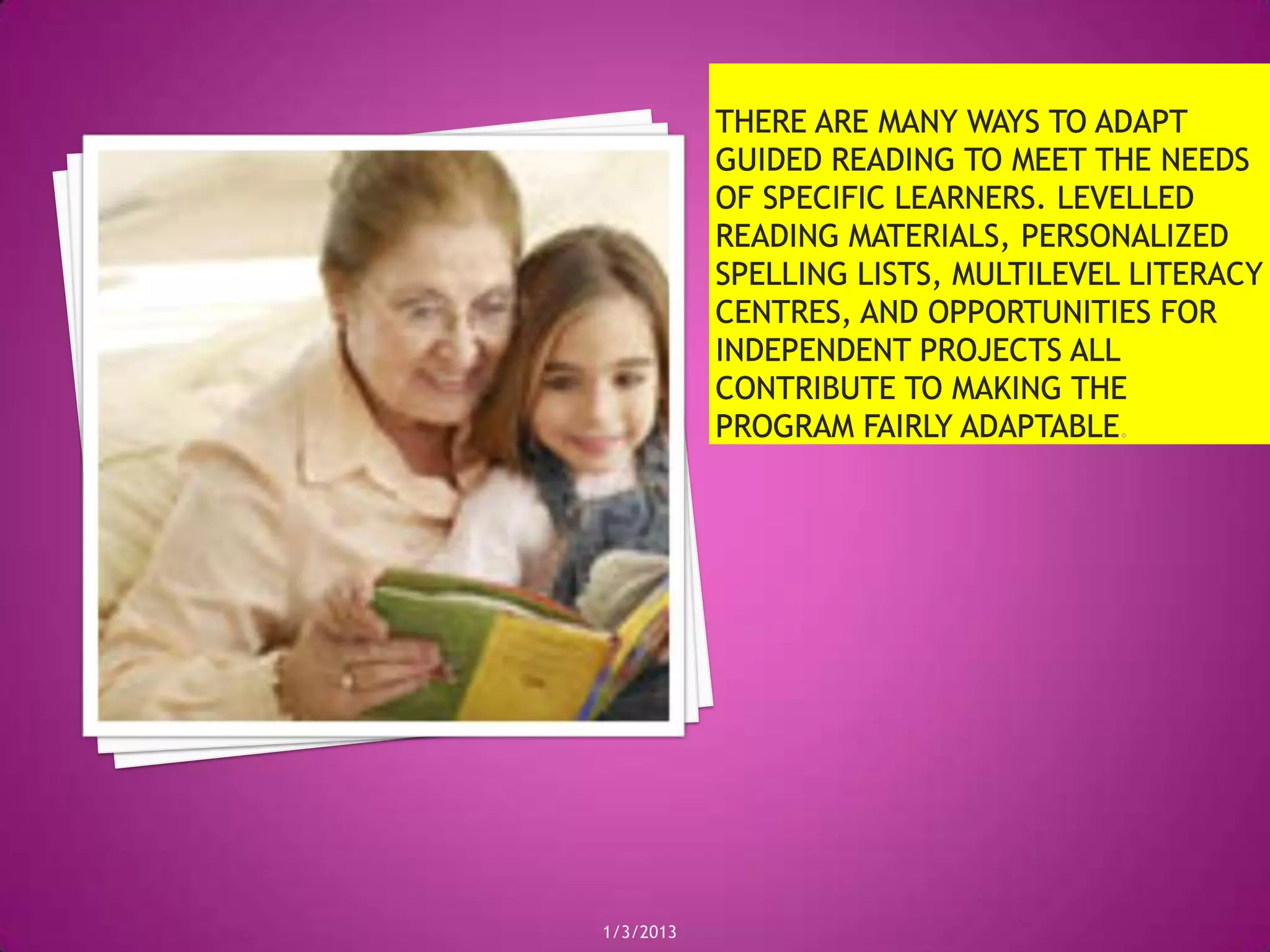
Tips for adapting: select one grade-level text and
one easier than grade level to read each week so
that your weaker students have the opportunity
to read with greater ease & confidence
consider alternative grouping (interest, social,
ability)
encourage rereading of selections to increase
fluency each time selection is read
use reading partners, parent volunteers, and care
partners to support the struggling readers and
challenge the strong readers
encourage reading time to provide more practice
time
establish a parent volunteer reading program
(study buddy)
                          1/3/2013
 Inindirect instruction, the role of the
 teacher shifts from lecturer/director to
 that of facilitator, supporter, and
 resource person. The teacher arranges
 the learning environment, provides
 opportunity for student
 involvement, and, when
 appropriate, provides feedback to
 students while they conduct the inquiry
 (Martin, 1983).
                      1/3/2013
When you teach guided reading you are busy observing
and instructing a small group of students. The other
students in your class must be kept engage in a literacy
activity while you are with your GR group. To ensure
success of guided reading, be prepared to invest time
upfront teaching your students the procedures you would
like them to follow while you are busy with the GR
groups. Once you are certain that the students can
follow the procedures THEN focus on actually teaching
guided reading.


                             1/3/2013
1/3/2013
Text selection is a critical
           component of the Reading
           Workshop; it must be
           purposeful and have the needs
           of the learners in mind.
           According to Fountas and
           Pinnell, as a teacher reads "a
           text in preparation for
           teaching, you decide what
           demands the text will make
           on the processing systems of
           the readers." Texts should not
           be chosen to simply teach a
           specific strategy. Rather, the
           texts should be of such high
           quality that students can
           apply a wide range of reading
           comprehension strategies
           throughout the reading.


1/3/2013
A Teacher will access background
knowledge, build schema, set a purpose for
reading, and preview the text with students.
Typically a group will engage in a variety of
pre-reading activities such as
predicting, learning new vocabulary, and
discussing various text features. If
applicable, the group may also engage in
completing a "picture walk." This activity
involves scanning through the text to look at
pictures and predicting how the story will go.
The students will engage in a conversation
                         1/3/2013
During Reading: The students will read independently
within the group. As students read, the teacher will
monitor student decoding and comprehension. The
teacher may ask students if something makes
sense, encourage students to try something again, or
prompt them to use a strategy. The teacher makes
observational notes about the strategy use of individual
readers and may also take a short running record of the
child's reading. The students may read the whole text or
a part of the text silently or softly for beginning readers


                                1/3/2013
After Reading: Following the reading, the teacher
will again check students' comprehension by
talking about the story with the children. The
teacher returns to the text for teaching
opportunities such as finding evidence or
discussing problem solving. The teacher also uses
this time to assess the sudents' understanding of
what they have read. The group will also discuss
reading strategies they used during the reading. To
extend the reading, students may participate in
activities such as drama, writing, art, or more
reading
                             1/3/2013
Book Introduction
Adult with group. Prepare the children, providing
support through reading the title, talking about the
type of text, looking at the pictures and accessing
previous knowledge. Aim to give them confidence
without reading the book to them. If necessary,
locate and preview difficult new words and
unfamiliar concepts or names. A variety of
books/genres can be used
Strategy Check
Adult with group. Introduce or review specific
reading strategies that the children have been
taught and remind them to use these when reading.
Independent Reading
Individuals. Children read the book at their own
pace. Monitor individuals and use appropriate
prompts to encourage problem-solving. Praise
correct use of reading strategies.
                               1/3/2013
Returning to the Text
Adult with group. Briefly talk about what has been read
to check children's understanding. Praise correct use of
reading strategies.

Response to the Text
Adult with group. Encourage children to respond to the
book either through a short discussion where they express
opinions, or through providing follow-up activities.

Re-reading Guided Text
"Individuals." Provide a 'familiar book' box for each group,
containing texts recently used in Guided Reading.
Children can re-read texts to themselves or with a
partner as an independent activity to give them
opportunities to develop fluency and expression and build
up reading miles.
                                1/3/2013
Early Model
This model is used for children who are
reading up to about NC level 1A/2C. In
this model the book introduction,
strategy check, independent reading,
return to text and response to text all
take place generally within one session.
This is aided by the fact that the books
suitable for children reading at this stage
are very short. (Baker, Bickler and
Bodman)


                       1/3/2013
Transitional Model
This model is used for children who are reading at NC
level 2C to 3C/B. Generally two guided sessions will be
needed to read a book. The first session generally
focuses on the book introduction, strategy check and
independent reading. Whilst children are reading at
their own pace, it is important to start to introduce an
element of silent reading. This is to develop the skills
of meaning making when reading independently.
Because books at this stage are generally longer, it is
not possible to read the whole book in one session.
Once the children have done some reading in the
session they can be asked to read the rest of the book
prior to the second session. This session then focuses
on returning to the text and responding to the text.
These are the more able children and not those at
level 1
                              1/3/2013
Fluent Model
Readers working at a NC level of 3B
upwards will need the fluent model of
guided reading. Here it is not necessary
for children to read the text during the
guided sessions. At these levels children
can generally decode the words. What is
important is that they discuss the
meaning that they make from the text
which will form the basis of the
discussion. Therefore the session tends
to focus on return to text and response
to the text with the strategy check
implicit in the discussions.
                      1/3/2013
The indirect preparations for reading are the same as
for writing in the preparation for
the mind. Everything the child has been working with
up until this time with Practical Life
and Sensorial materials help the child to read. Indirect
preparation in the language area
is also of extremely important for reading. The
directress is another major role in the
child’s learning to read. By doing the Sound Games,
Sandpaper Letters, and the
Moveable Alphabet, the child is getting direct
preparations for reading with the help of
the directress. And when some of the children start
reading with the words they create
with the Moveable Alphabet, it is then time to begin
teaching them the reading
Exercises.
                              1/3/2013
Children with reading
difficulties


                1/3/2013
If adequate screening and assessment procedures
are in place, early intervention may begin even
before formal instruction in reading.
Interventions that are begun when children are
very young have a much better chance of success
than interventions begun later.

Interventions begun at Grade 3 are much less likely to
succeed than early interventions. It is essential to
identify reading difficulties by Grade 1 and to put
appropriate supplemental interventions in place
immediately. In this way, reading problems can be
tackled before they become entrenched and before
repeated failures affect children's motivation and
compound their difficulties in learning to read and
write.
                             1/3/2013
1/3/2013
To stay abreast of new and emerging literacy developments,
teachers can consult with local university-based researchers.


So that effective classroom practices that support early
identification and intervention might be encouraged,
professional development must be available for teachers in
Kindergarten to Grade 3 and beyond, with a focus on:

maintaining high expectations for children with reading
difficulties
understanding the nature of reading difficulties and the
impact on achievement

understanding and applying interventions and other
modifications
helping children to capitalize on early gains
                             1/3/2013
1/3/2013

Reading powerpoint by s.k

  • 1.
    READING INSTRUCTION TO AGE GROUP 3-9 BY SUPARNA KOLEY 1/3/2013
  • 2.
    1. an exciting discovery 2.allows the child to connect with the thoughts of others from the past and the present. 3.Information platform 1/3/2013
  • 3.
    In today’s developedcountries, knowing to read and write is important for the development of the whole being. • INFORMATION • DEVELOPMENT OF KNOWLEDGE THOUGHT • LITERACY • INDEPENDENCE READING 1/3/2013
  • 4.
    Reading can improvehand-eye coordination. 1/3/2013
  • 5.
    Musical Books. Chairs areplaced back-to-back in a straight line, and the teacher places a book under each chair. Every child then sits on a chair. The children march around the chairs when the teacher starts the music. When the music stops the children sit down and begin to read the book under their chair. After a few minutes, the teacher starts the music again. After the game, the teacher puts the books in a special box marked "Musical Books" so that the children may later read the rest of the story. Grade 2 1/3/2013
  • 6.
    Scavenger Hunt. Havea "scavenger hunt" by dividing the class into teams and giving each team a copy of the same book. Have them find the page numbers of particular objects, events, or people in the book. Give a reward to the winning team. 1/3/2013
  • 7.
    Name That Book!Explain to your students how important the cover and title are to a story. Then read a book to your students without telling them the title or showing them the cover. After reading the book, give the children a piece of paper to draw what they think the cover and the title of this book should be. Finally, display the storybook surrounded by the children's covers. 1/3/2013
  • 8.
    All you needfor this game is a ball of string and a story to share. Have your students sit in a circle on the floor. One of the students gives the beginning sentence of a familiar story. Then the student holds onto the end of a ball of string and rolls the ball to another student, who will give the next part of the story in sentence form. This is repeated until the story has been told. Soon you'll have a spider's web in your students' circle. Any story can be used for variation, or new stories can be created with each student adding a new idea! 1/3/2013
  • 9.
    Readers' BINGO. Brainstorm25 to 30 words that deal with books and write them on the board. Give your students 9" x 12" newsprint and have them fold it into nine squares. Then have the students write nine of the words from the board into each of the squares on their sheet. Give them corn or candy for markers. Randomly call off words from the board. When a student has filled in a vertical, horizontal, or diagonal row, he/she should call out "BOOKS!" I give the winner a paperback book. For variety, the teacher can play Readers' BINGO by giving the definition of words rather than the words themselves. 1/3/2013
  • 10.
    1.Goal: To establishpurpose for reading primary source, to activate and build background knowledge, and address unfamiliar vocabulary words/concepts. 2.K-W-L-H Chart K - stands for what students already Know about the topic. W – stands for what students Want to Learn by reading the primary source. L – stands for what students have Learned while reading the primary source. H – stands for ideas of How to Learn more. 1/3/2013
  • 11.
    Anticipation/Reaction Guide 1.Identify major concepts or “big ideas” you want students to learn from the primary source. 1 2.Create four to six statements that support or challenge students' beliefs about the topic. 3.Share the guide with students and ask them to Agree or Disagree with the statements and be prepared to defend their opinions. 1/3/2013
  • 12.
    4.Discuss with class. Have students read the primary source to find evidence to support or disprove their responses. 5.After reading, students will confirm or revise their responses. response 1/3/2013
  • 13.
  • 14.
    ABC or AlphablocksBrainstorming ABC Brainstorming activates student’s prior knowledge by asking students to brainstorm a list of words, phrases, or sub-topics related to the primary source’s topic and match those to a letter of the alphabet. A variation, Alpha blocks, (credited to Janet Allen) speeds up the process by asking students to brainstorm items within alphabet groups (ABC, DEF, GHI, etc.) 1/3/2013
  • 15.
    Charts that askthe student to assess their prior knowledge are called Knowledge Ratings 1/3/2013
  • 16.
    READING ENHANCES WITHJOY  we must provide a number of good books. We need to be sure  we have a great variety. Children enjoy books about people, other places, about  animals and birds and flowers, about events from the past and about everyday life. The  child recognizes the enormity of information possible to get from reading 1/3/2013
  • 17.
    1.Students should bedivided into small groups (4-6 students). The younger the students the smaller the groups. (Learn more about grouping students). 2.Guided reading lessons are to be about 15-20 minutes in duration. 3.Appropriately leveled reading materials must be selected for the group and each child should have his/her own copy of the literature. Learn more about reading levels/leveled materials. 1/3/2013
  • 18.
  • 19.
    Post Reading: Theteacher asks questions to ensure that the text has been comprehended by the readers and praises their efforts. Further, the teacher may observe gaps in strategy application and address these gaps following the reading in a mini-lesson format. 1/3/2013
  • 20.
    Tips for adapting:select one grade-level text and one easier than grade level to read each week so that your weaker students have the opportunity to read with greater ease & confidence consider alternative grouping (interest, social, ability) encourage rereading of selections to increase fluency each time selection is read use reading partners, parent volunteers, and care partners to support the struggling readers and challenge the strong readers encourage reading time to provide more practice time establish a parent volunteer reading program (study buddy) 1/3/2013
  • 21.
     Inindirect instruction,the role of the teacher shifts from lecturer/director to that of facilitator, supporter, and resource person. The teacher arranges the learning environment, provides opportunity for student involvement, and, when appropriate, provides feedback to students while they conduct the inquiry (Martin, 1983). 1/3/2013
  • 22.
    When you teachguided reading you are busy observing and instructing a small group of students. The other students in your class must be kept engage in a literacy activity while you are with your GR group. To ensure success of guided reading, be prepared to invest time upfront teaching your students the procedures you would like them to follow while you are busy with the GR groups. Once you are certain that the students can follow the procedures THEN focus on actually teaching guided reading. 1/3/2013
  • 23.
  • 24.
    Text selection isa critical component of the Reading Workshop; it must be purposeful and have the needs of the learners in mind. According to Fountas and Pinnell, as a teacher reads "a text in preparation for teaching, you decide what demands the text will make on the processing systems of the readers." Texts should not be chosen to simply teach a specific strategy. Rather, the texts should be of such high quality that students can apply a wide range of reading comprehension strategies throughout the reading. 1/3/2013
  • 25.
    A Teacher willaccess background knowledge, build schema, set a purpose for reading, and preview the text with students. Typically a group will engage in a variety of pre-reading activities such as predicting, learning new vocabulary, and discussing various text features. If applicable, the group may also engage in completing a "picture walk." This activity involves scanning through the text to look at pictures and predicting how the story will go. The students will engage in a conversation 1/3/2013
  • 26.
    During Reading: Thestudents will read independently within the group. As students read, the teacher will monitor student decoding and comprehension. The teacher may ask students if something makes sense, encourage students to try something again, or prompt them to use a strategy. The teacher makes observational notes about the strategy use of individual readers and may also take a short running record of the child's reading. The students may read the whole text or a part of the text silently or softly for beginning readers 1/3/2013
  • 27.
    After Reading: Followingthe reading, the teacher will again check students' comprehension by talking about the story with the children. The teacher returns to the text for teaching opportunities such as finding evidence or discussing problem solving. The teacher also uses this time to assess the sudents' understanding of what they have read. The group will also discuss reading strategies they used during the reading. To extend the reading, students may participate in activities such as drama, writing, art, or more reading 1/3/2013
  • 28.
    Book Introduction Adult withgroup. Prepare the children, providing support through reading the title, talking about the type of text, looking at the pictures and accessing previous knowledge. Aim to give them confidence without reading the book to them. If necessary, locate and preview difficult new words and unfamiliar concepts or names. A variety of books/genres can be used Strategy Check Adult with group. Introduce or review specific reading strategies that the children have been taught and remind them to use these when reading. Independent Reading Individuals. Children read the book at their own pace. Monitor individuals and use appropriate prompts to encourage problem-solving. Praise correct use of reading strategies. 1/3/2013
  • 29.
    Returning to theText Adult with group. Briefly talk about what has been read to check children's understanding. Praise correct use of reading strategies. Response to the Text Adult with group. Encourage children to respond to the book either through a short discussion where they express opinions, or through providing follow-up activities. Re-reading Guided Text "Individuals." Provide a 'familiar book' box for each group, containing texts recently used in Guided Reading. Children can re-read texts to themselves or with a partner as an independent activity to give them opportunities to develop fluency and expression and build up reading miles. 1/3/2013
  • 30.
    Early Model This modelis used for children who are reading up to about NC level 1A/2C. In this model the book introduction, strategy check, independent reading, return to text and response to text all take place generally within one session. This is aided by the fact that the books suitable for children reading at this stage are very short. (Baker, Bickler and Bodman) 1/3/2013
  • 31.
    Transitional Model This modelis used for children who are reading at NC level 2C to 3C/B. Generally two guided sessions will be needed to read a book. The first session generally focuses on the book introduction, strategy check and independent reading. Whilst children are reading at their own pace, it is important to start to introduce an element of silent reading. This is to develop the skills of meaning making when reading independently. Because books at this stage are generally longer, it is not possible to read the whole book in one session. Once the children have done some reading in the session they can be asked to read the rest of the book prior to the second session. This session then focuses on returning to the text and responding to the text. These are the more able children and not those at level 1 1/3/2013
  • 32.
    Fluent Model Readers workingat a NC level of 3B upwards will need the fluent model of guided reading. Here it is not necessary for children to read the text during the guided sessions. At these levels children can generally decode the words. What is important is that they discuss the meaning that they make from the text which will form the basis of the discussion. Therefore the session tends to focus on return to text and response to the text with the strategy check implicit in the discussions. 1/3/2013
  • 33.
    The indirect preparationsfor reading are the same as for writing in the preparation for the mind. Everything the child has been working with up until this time with Practical Life and Sensorial materials help the child to read. Indirect preparation in the language area is also of extremely important for reading. The directress is another major role in the child’s learning to read. By doing the Sound Games, Sandpaper Letters, and the Moveable Alphabet, the child is getting direct preparations for reading with the help of the directress. And when some of the children start reading with the words they create with the Moveable Alphabet, it is then time to begin teaching them the reading Exercises. 1/3/2013
  • 34.
  • 35.
    If adequate screeningand assessment procedures are in place, early intervention may begin even before formal instruction in reading. Interventions that are begun when children are very young have a much better chance of success than interventions begun later. Interventions begun at Grade 3 are much less likely to succeed than early interventions. It is essential to identify reading difficulties by Grade 1 and to put appropriate supplemental interventions in place immediately. In this way, reading problems can be tackled before they become entrenched and before repeated failures affect children's motivation and compound their difficulties in learning to read and write. 1/3/2013
  • 36.
  • 37.
    To stay abreastof new and emerging literacy developments, teachers can consult with local university-based researchers. So that effective classroom practices that support early identification and intervention might be encouraged, professional development must be available for teachers in Kindergarten to Grade 3 and beyond, with a focus on: maintaining high expectations for children with reading difficulties understanding the nature of reading difficulties and the impact on achievement understanding and applying interventions and other modifications helping children to capitalize on early gains 1/3/2013
  • 38.