A general framework of
particle swarm optimization
Prof. Dr. Loc Nguyen
Independent scholar, Vietnam
Email: ng_phloc@yahoo.com
Homepage: www.locnguyen.net
A general framework of PSO - Loc Nguyen - VIT
3/17/2021 1
Abstract
Particle swarm optimization (PSO) is an effective algorithm to solve the
optimization problem in case that derivative of target function is inexistent or
difficult to be determined. Because PSO has many parameters and variants, I
propose a general framework of PSO called GPSO which aggregates important
parameters and generalizes important variants so that researchers can customize
PSO easily. Moreover, two main properties of PSO are exploration and exploitation.
The exploration property aims to avoid premature converging so as to reach global
optimal solution whereas the exploitation property aims to motivate PSO to
converge as fast as possible. These two aspects are equally important. Therefore,
GPSO also aims to balance the exploration and the exploitation. It is expected that
GPSO supports users to tune parameters for not only solving premature problem but
also fast convergence.
2
A general framework of PSO - Loc Nguyen - VIT
3/17/2021
Table of contents
1. Introduction
2. GPSO with probabilistic constriction
3. Experimental results
4. Conclusions
3
A general framework of PSO - Loc Nguyen - VIT
3/17/2021
1. Introduction
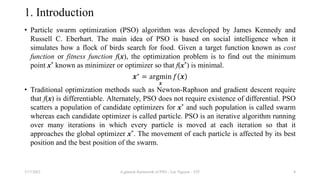
• Particle swarm optimization (PSO) algorithm was developed by James Kennedy and
Russell C. Eberhart. The main idea of PSO is based on social intelligence when it
simulates how a flock of birds search for food. Given a target function known as cost
function or fitness function f(x), the optimization problem is to find out the minimum
point x* known as minimizer or optimizer so that f(x*) is minimal.
𝒙∗
= argmin
𝒙
𝑓 𝒙
• Traditional optimization methods such as Newton-Raphson and gradient descent require
that f(x) is differentiable. Alternately, PSO does not require existence of differential. PSO
scatters a population of candidate optimizers for x* and such population is called swarm
whereas each candidate optimizer is called particle. PSO is an iterative algorithm running
over many iterations in which every particle is moved at each iteration so that it
approaches the global optimizer x*. The movement of each particle is affected by its best
position and the best position of the swarm.
3/17/2021 A general framework of PSO - Loc Nguyen - VIT 4
1. Introduction
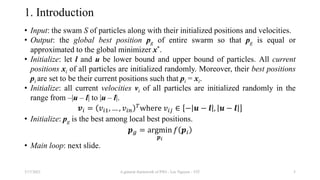
• Input: the swam S of particles along with their initialized positions and velocities.
• Output: the global best position pg of entire swarm so that pg is equal or
approximated to the global minimizer x*.
• Initialize: let l and u be lower bound and upper bound of particles. All current
positions xi of all particles are initialized randomly. Moreover, their best positions
pi are set to be their current positions such that pi = xi.
• Initialize: all current velocities vi of all particles are initialized randomly in the
range from –|u – l| to |u – l|.
𝒗𝑖 = 𝑣𝑖1, … , 𝑣𝑖𝑛
𝑇where 𝑣𝑖𝑗 ∈ − 𝒖 − 𝒍 , 𝒖 − 𝒍
• Initialize: pg is the best among local best positions.
𝒑𝑔 = argmin
𝒑𝑖
𝑓 𝒑𝑖
• Main loop: next slide.
3/17/2021 A general framework of PSO - Loc Nguyen - VIT 5
1. Introduction
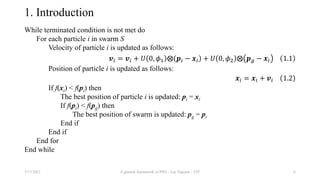
While terminated condition is not met do
For each particle i in swarm S
Velocity of particle i is updated as follows:
𝒗𝑖 = 𝒗𝑖 + 𝑈 0, 𝜙1 ⨂ 𝒑𝑖 − 𝒙𝑖 + 𝑈 0, 𝜙2 ⨂ 𝒑𝑔 − 𝒙𝑖 1.1
Position of particle i is updated as follows:
𝒙𝑖 = 𝒙𝑖 + 𝒗𝑖 1.2
If f(xi) < f(pi) then
The best position of particle i is updated: pi = xi
If f(pi) < f(pg) then
The best position of swarm is updated: pg = pi
End if
End if
End for
End while
3/17/2021 A general framework of PSO - Loc Nguyen - VIT 6
1. Introduction
• Equation 1.1 is the heart of PSO, which is velocity update rule.
Equation 1.2 is position update rule.
• Two most popular terminated conditions are that the cost function at pg
which is evaluated as f(pg) is small enough or PSO ran over a large
enough number of iterations.
• Functions U(0, ϕ1) and U(0, ϕ2) generate random vector whose
elements are random numbers in ranges [0, ϕ1] and [0, ϕ2],
respectively.
• The operator ⨂ denotes component-wise multiplication of two points
[2, p. 3].
3/17/2021 A general framework of PSO - Loc Nguyen - VIT 7
1. Introduction
• Two components 𝑈 0, 𝜙1 ⨂ 𝒑𝑖 − 𝒙𝑖 and 𝑈 0, 𝜙2 ⨂ 𝒑𝑔 − 𝒙𝑖 are
attraction forces that push every particle to move. Sources of force
𝑈 0, 𝜙1 ⨂ 𝒑𝑖 − 𝒙𝑖 and force 𝑈 0, 𝜙2 ⨂ 𝒑𝑔 − 𝒙𝑖 are the particle i itself
and its neighbors.
• Parameter ϕ1 along with the first force express the exploitation whereas
parameter ϕ2 along with the second force express the exploration. The larger
ϕ1 is, the faster PSO converges but it trends to converge at local minimizer.
In opposite, if ϕ2 is large, convergence to local minimizer will be avoided in
order to achieve better global optimizer but convergence speed is decreased.
They are called acceleration coefficients.
• Velocity vi can be bounded in the range [–vmax, +vmax] in order to avoid out
of convergence trajectories.
3/17/2021 A general framework of PSO - Loc Nguyen - VIT 8
1. Introduction
• Because any movement has inertia, inertial force is added to the two
attraction forces, which is represented by a so-called inertial weight ω
where 0 < ω ≤ 1 [2, p. 4]:
𝒗𝑖 = 𝜔𝒗𝑖 + 𝑈 0, 𝜙1 ⨂ 𝒑𝑖 − 𝒙𝑖 + 𝑈 0, 𝜙2 ⨂ 𝒑𝑔 − 𝒙𝑖 1.3
• The larger inertial weight ω is, the faster particles move, which leads
PSO to explore global optimizer. The smaller ω leads PSO to exploit
local optimizer. In general, large ω expresses exploration and small ω
expresses exploitation.
• The popular value of ω is 0.7298 given ϕ1 = ϕ2 = 1.4962.
3/17/2021 A general framework of PSO - Loc Nguyen - VIT 9
1. Introduction
• If velocities vi of particles are not restricted [2, p. 5], their movements
can be out of convergence trajectories at unacceptable levels. Thus, a
so-called constriction coefficient χ is proposed to damp dynamics of
particles.
𝒗𝑖 = 𝜒 𝒗𝑖 + 𝑈 0, 𝜙1 ⨂ 𝒑𝑖 − 𝒙𝑖 + 𝑈 0, 𝜙2 ⨂ 𝒑𝑔 − 𝒙𝑖 1.4
• Equation 1.3 is the special case of equation 1.4 when the expression
χvi is equivalent to the expression ωvi. Inertial weight ω also damps
dynamics of particles. This is the reason that ω = 1 when χ ≠ 1 but χ is
stronger than ω because χ affects previous velocity and two attraction
forces whereas ω affects only previous velocity.
• Popular value of χ is 0.7298 given ϕ1 = ϕ2 = 2.05 and ω = 1.
3/17/2021 A general framework of PSO - Loc Nguyen - VIT 10
1. Introduction
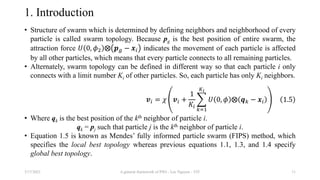
• Structure of swarm which is determined by defining neighbors and neighborhood of every
particle is called swarm topology. Because pg is the best position of entire swarm, the
attraction force 𝑈 0, 𝜙2 ⨂ 𝒑𝑔 − 𝒙𝑖 indicates the movement of each particle is affected
by all other particles, which means that every particle connects to all remaining particles.
• Alternately, swarm topology can be defined in different way so that each particle i only
connects with a limit number Ki of other particles. So, each particle has only Ki neighbors.
𝒗𝑖 = 𝜒 𝒗𝑖 +
1
𝐾𝑖
𝑘=1
𝐾𝑖
𝑈 0, 𝜙 ⨂ 𝒒𝑘 − 𝒙𝑖 1.5
• Where qk is the best position of the kth neighbor of particle i.
qk = pj such that particle j is the kth neighbor of particle i.
• Equation 1.5 is known as Mendes’ fully informed particle swarm (FIPS) method, which
specifies the local best topology whereas previous equations 1.1, 1.3, and 1.4 specify
global best topology.
3/17/2021 A general framework of PSO - Loc Nguyen - VIT 11
1. Introduction
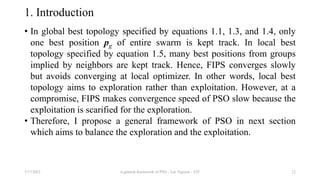
• In global best topology specified by equations 1.1, 1.3, and 1.4, only
one best position pg of entire swarm is kept track. In local best
topology specified by equation 1.5, many best positions from groups
implied by neighbors are kept track. Hence, FIPS converges slowly
but avoids converging at local optimizer. In other words, local best
topology aims to exploration rather than exploitation. However, at a
compromise, FIPS makes convergence speed of PSO slow because the
exploitation is scarified for the exploration.
• Therefore, I propose a general framework of PSO in next section
which aims to balance the exploration and the exploitation.
3/17/2021 A general framework of PSO - Loc Nguyen - VIT 12
2. GPSO with probabilistic constriction
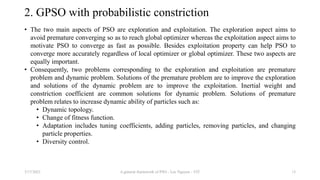
• The two main aspects of PSO are exploration and exploitation. The exploration aspect aims to
avoid premature converging so as to reach global optimizer whereas the exploitation aspect aims to
motivate PSO to converge as fast as possible. Besides exploitation property can help PSO to
converge more accurately regardless of local optimizer or global optimizer. These two aspects are
equally important.
• Consequently, two problems corresponding to the exploration and exploitation are premature
problem and dynamic problem. Solutions of the premature problem are to improve the exploration
and solutions of the dynamic problem are to improve the exploitation. Inertial weight and
constriction coefficient are common solutions for dynamic problem. Solutions of premature
problem relates to increase dynamic ability of particles such as:
• Dynamic topology.
• Change of fitness function.
• Adaptation includes tuning coefficients, adding particles, removing particles, and changing
particle properties.
• Diversity control.
3/17/2021 A general framework of PSO - Loc Nguyen - VIT 13
2. GPSO with probabilistic constriction
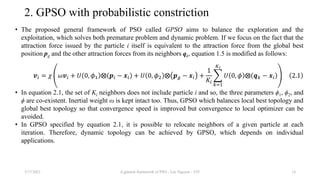
• The proposed general framework of PSO called GPSO aims to balance the exploration and the
exploitation, which solves both premature problem and dynamic problem. If we focus on the fact that the
attraction force issued by the particle i itself is equivalent to the attraction force from the global best
position pg and the other attraction forces from its neighbors qk, equation 1.5 is modified as follows:
𝒗𝑖 = 𝜒 𝜔𝒗𝑖 + 𝑈 0, 𝜙1 ⨂ 𝒑𝑖 − 𝒙𝑖 + 𝑈 0, 𝜙2 ⨂ 𝒑𝑔 − 𝒙𝑖 +
1
𝐾𝑖
𝑘=1
𝐾𝑖
𝑈 0, 𝜙 ⨂ 𝒒𝑘 − 𝒙𝑖 2.1
• In equation 2.1, the set of Ki neighbors does not include particle i and so, the three parameters ϕ1, ϕ2, and
ϕ are co-existent. Inertial weight ω is kept intact too. Thus, GPSO which balances local best topology and
global best topology so that convergence speed is improved but convergence to local optimizer can be
avoided.
• In GPSO specified by equation 2.1, it is possible to relocate neighbors of a given particle at each
iteration. Therefore, dynamic topology can be achieved by GPSO, which depends on individual
applications.
3/17/2021 A general framework of PSO - Loc Nguyen - VIT 14
2. GPSO with probabilistic constriction
• In PSO theory, solutions of dynamic problem are to improve the
exploitation so that PSO can converge as fast as possible. Inertial weight
and constriction coefficient are common solutions for dynamic problem.
Hence, constriction coefficient is tuned with GPSO. However, tuning a
parameter does not mean that such parameter is modified simply at each
iteration because the modification must be solid and based on valuable
knowledge.
• Fortunately, Kennedy and Eberhart [2, p. 13], [3, p. 3], [4, p. 51] proposed
bare bones PSO (BBPSO) in which they asserted that, given xi = (xi1, xi2,…,
xin)T, pi = (pi1, pi2,…, pin)T, and pg = (pg1, pg2,…, pgn)T, the jth element xij of xi
follows normal distribution with mean (pij+pgj)/2 and variance (pij–pgj)2.
Based on this valuable knowledge, I tune constriction parameter χ with
normal distribution at each iteration.
3/17/2021 A general framework of PSO - Loc Nguyen - VIT 15
2. GPSO with probabilistic constriction
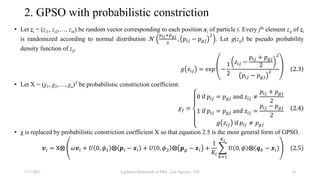
• Let zi = (zi1, zi2,…, zin) be random vector corresponding to each position xi of particle i. Every jth element zij of zi
is randomized according to normal distribution 𝒩
𝑝𝑖𝑗+𝑝𝑔𝑗
2
, 𝑝𝑖𝑗 − 𝑝𝑔𝑗
2
. Let g(zij) be pseudo probability
density function of zij.
𝑔 𝑧𝑖𝑗 = exp −
1
2
𝑧𝑖𝑗 −
𝑝𝑖𝑗 + 𝑝𝑔𝑗
2
2
𝑝𝑖𝑗 − 𝑝𝑔𝑗
2 2.3
• Let Χ = (χ1, χ2,…, χn)T be probabilistic constriction coefficient.
𝜒𝑗 =
0 if 𝑝𝑖𝑗 = 𝑝𝑔𝑗 and 𝑧𝑖𝑗 ≠
𝑝𝑖𝑗 + 𝑝𝑔𝑗
2
1 if 𝑝𝑖𝑗 = 𝑝𝑔𝑗 and 𝑧𝑖𝑗 =
𝑝𝑖𝑗 − 𝑝𝑔𝑗
2
𝑔 𝑧𝑖𝑗 if 𝑝𝑖𝑗 ≠ 𝑝𝑔𝑗
2.4
• χ is replaced by probabilistic constriction coefficient Χ so that equation 2.5 is the most general form of GPSO.
𝒗𝑖 = Χ⨂ 𝜔𝒗𝑖 + 𝑈 0, 𝜙1 ⨂ 𝒑𝑖 − 𝒙𝑖 + 𝑈 0, 𝜙2 ⨂ 𝒑𝑔 − 𝒙𝑖 +
1
𝐾𝑖
𝑘=1
𝐾𝑖
𝑈 0, 𝜙 ⨂ 𝒒𝑘 − 𝒙𝑖 2.5
3/17/2021 A general framework of PSO - Loc Nguyen - VIT 16
2. GPSO with probabilistic constriction
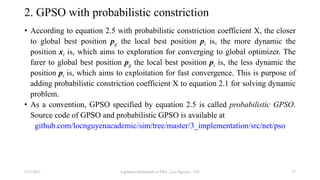
• According to equation 2.5 with probabilistic constriction coefficient Χ, the closer
to global best position pg the local best position pi is, the more dynamic the
position xi is, which aims to exploration for converging to global optimizer. The
farer to global best position pg the local best position pi is, the less dynamic the
position pi is, which aims to exploitation for fast convergence. This is purpose of
adding probabilistic constriction coefficient Χ to equation 2.1 for solving dynamic
problem.
• As a convention, GPSO specified by equation 2.5 is called probabilistic GPSO.
Source code of GPSO and probabilistic GPSO is available at
github.com/locnguyenacademic/sim/tree/master/3_implementation/src/net/pso
3/17/2021 A general framework of PSO - Loc Nguyen - VIT 17
3. Experimental results
• GPSO specified by equation 2.1 and probabilistic GPSO specified by equation 2.5 are tested with
basic PSO specified by equation 1.4. The cost function (fitness function) is [5, p. 24]:
𝑓 𝒙 = 𝑥1, 𝑥2
𝑇
= −cos 𝑥1 cos 𝑥2 exp − 𝑥1 − 𝜋 2
− 𝑥2 − 𝜋 2
3.1
• The lower bound and upper bound of positions in initialization stage are l = (–10, –10)T and u =
(10, 10)T. The terminated condition is that the bias of the current global best value and the previous
global best value is less than ε = 0.01. Parameters of GPSO are ϕ1 = ϕ2 = ϕ = 2.05, ω = 1, and χ =
0.7298. Parameters of probabilistic GPSO are ϕ1 = ϕ2 = ϕ = 2.05. Parameters of basic PSO are ϕ1 =
ϕ2 = 2.05 and χ = 0.7298. The swarm size is 50.
• Dynamic topology is established at each iteration by a so-called fitness distance ratio (FDR) [2, p.
8]. Given target particle i and another particle j, their FDR is the ratio of the difference between
f(xi) and f(xj) to the Euclidean difference between xi and xj. If FDR(xi, xj) is larger than a threshold
(> 1), the particle j is a neighbor of the target particle i.
FDR 𝒙𝑖, 𝒙𝑗 =
𝑓 𝒙𝑖 − 𝑓 𝒙𝑗
𝒙𝑖 − 𝒙𝑗
3/17/2021 A general framework of PSO - Loc Nguyen - VIT 18
3. Experimental results
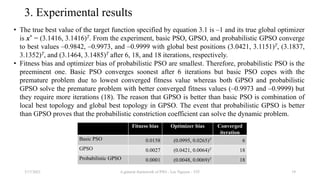
• The true best value of the target function specified by equation 3.1 is –1 and its true global optimizer
is x* = (3.1416, 3.1416)T. From the experiment, basic PSO, GPSO, and probabilistic GPSO converge
to best values –0.9842, –0.9973, and –0.9999 with global best positions (3.0421, 3.1151)T, (3.1837,
3.1352)T, and (3.1464, 3.1485)T after 6, 18, and 18 iterations, respectively.
• Fitness bias and optimizer bias of probabilistic PSO are smallest. Therefore, probabilistic PSO is the
preeminent one. Basic PSO converges soonest after 6 iterations but basic PSO copes with the
premature problem due to lowest converged fitness value whereas both GPSO and probabilistic
GPSO solve the premature problem with better converged fitness values (–0.9973 and –0.9999) but
they require more iterations (18). The reason that GPSO is better than basic PSO is combination of
local best topology and global best topology in GPSO. The event that probabilistic GPSO is better
than GPSO proves that the probabilistic constriction coefficient can solve the dynamic problem.
3/17/2021 A general framework of PSO - Loc Nguyen - VIT 19
Fitness bias Optimizer bias Converged
iteration
Basic PSO 0.0158 (0.0995, 0.0265)T 6
GPSO 0.0027 (0.0421, 0.0064)T 18
Probabilistic GPSO 0.0001 (0.0048, 0.0069)T 18
4. Conclusions
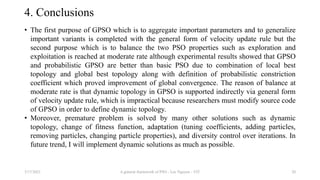
• The first purpose of GPSO which is to aggregate important parameters and to generalize
important variants is completed with the general form of velocity update rule but the
second purpose which is to balance the two PSO properties such as exploration and
exploitation is reached at moderate rate although experimental results showed that GPSO
and probabilistic GPSO are better than basic PSO due to combination of local best
topology and global best topology along with definition of probabilistic constriction
coefficient which proved improvement of global convergence. The reason of balance at
moderate rate is that dynamic topology in GPSO is supported indirectly via general form
of velocity update rule, which is impractical because researchers must modify source code
of GPSO in order to define dynamic topology.
• Moreover, premature problem is solved by many other solutions such as dynamic
topology, change of fitness function, adaptation (tuning coefficients, adding particles,
removing particles, changing particle properties), and diversity control over iterations. In
future trend, I will implement dynamic solutions as much as possible.
3/17/2021 A general framework of PSO - Loc Nguyen - VIT 20
Thank you for attention
21
A general framework of PSO - Loc Nguyen - VIT
3/17/2021
References
1. Wikipedia, "Particle swarm optimization," Wikimedia Foundation, 7
March 2017. [Online]. Available:
https://en.wikipedia.org/wiki/Particle_swarm_optimization. [Accessed 8
April 2017].
2. R. Poli, J. Kennedy and T. Blackwell, "Particle swarm optimization,"
Swarm Intelligence, vol. 1, no. 1, pp. 33-57, June 2007.
3. F. Pan, X. Hu, R. Eberhart and Y. Chen, "An Analysis of Bare Bones
Particle Swarm," in IEEE Swarm Intelligence Symposium 2008 (SIS
2008), St. Louis, MO, US, 2008.
4. M. M. al-Rifaie and T. Blackwell, "Bare Bones Particle Swarms with
Jumps," in International Conference on Swarm Intelligence, Brussels,
2012.
5. K. Sharma, V. Chhamunya, P. C. Gupta, H. Sharma and J. C. Bansal,
"Fitness based Particle Swarm Optimization," International Journal of
System Assurance Engineering and Management, vol. 6, no. 3, pp. 319-
329, September 2015.
3/17/2021 A general framework of PSO - Loc Nguyen - VIT 22

A general framework of particle swarm optimization

  • 1.
    A general frameworkof particle swarm optimization Prof. Dr. Loc Nguyen Independent scholar, Vietnam Email: ng_phloc@yahoo.com Homepage: www.locnguyen.net A general framework of PSO - Loc Nguyen - VIT 3/17/2021 1
  • 2.
    Abstract Particle swarm optimization(PSO) is an effective algorithm to solve the optimization problem in case that derivative of target function is inexistent or difficult to be determined. Because PSO has many parameters and variants, I propose a general framework of PSO called GPSO which aggregates important parameters and generalizes important variants so that researchers can customize PSO easily. Moreover, two main properties of PSO are exploration and exploitation. The exploration property aims to avoid premature converging so as to reach global optimal solution whereas the exploitation property aims to motivate PSO to converge as fast as possible. These two aspects are equally important. Therefore, GPSO also aims to balance the exploration and the exploitation. It is expected that GPSO supports users to tune parameters for not only solving premature problem but also fast convergence. 2 A general framework of PSO - Loc Nguyen - VIT 3/17/2021
  • 3.
    Table of contents 1.Introduction 2. GPSO with probabilistic constriction 3. Experimental results 4. Conclusions 3 A general framework of PSO - Loc Nguyen - VIT 3/17/2021
  • 4.
    1. Introduction • Particleswarm optimization (PSO) algorithm was developed by James Kennedy and Russell C. Eberhart. The main idea of PSO is based on social intelligence when it simulates how a flock of birds search for food. Given a target function known as cost function or fitness function f(x), the optimization problem is to find out the minimum point x* known as minimizer or optimizer so that f(x*) is minimal. 𝒙∗ = argmin 𝒙 𝑓 𝒙 • Traditional optimization methods such as Newton-Raphson and gradient descent require that f(x) is differentiable. Alternately, PSO does not require existence of differential. PSO scatters a population of candidate optimizers for x* and such population is called swarm whereas each candidate optimizer is called particle. PSO is an iterative algorithm running over many iterations in which every particle is moved at each iteration so that it approaches the global optimizer x*. The movement of each particle is affected by its best position and the best position of the swarm. 3/17/2021 A general framework of PSO - Loc Nguyen - VIT 4
  • 5.
    1. Introduction • Input:the swam S of particles along with their initialized positions and velocities. • Output: the global best position pg of entire swarm so that pg is equal or approximated to the global minimizer x*. • Initialize: let l and u be lower bound and upper bound of particles. All current positions xi of all particles are initialized randomly. Moreover, their best positions pi are set to be their current positions such that pi = xi. • Initialize: all current velocities vi of all particles are initialized randomly in the range from –|u – l| to |u – l|. 𝒗𝑖 = 𝑣𝑖1, … , 𝑣𝑖𝑛 𝑇where 𝑣𝑖𝑗 ∈ − 𝒖 − 𝒍 , 𝒖 − 𝒍 • Initialize: pg is the best among local best positions. 𝒑𝑔 = argmin 𝒑𝑖 𝑓 𝒑𝑖 • Main loop: next slide. 3/17/2021 A general framework of PSO - Loc Nguyen - VIT 5
  • 6.
    1. Introduction While terminatedcondition is not met do For each particle i in swarm S Velocity of particle i is updated as follows: 𝒗𝑖 = 𝒗𝑖 + 𝑈 0, 𝜙1 ⨂ 𝒑𝑖 − 𝒙𝑖 + 𝑈 0, 𝜙2 ⨂ 𝒑𝑔 − 𝒙𝑖 1.1 Position of particle i is updated as follows: 𝒙𝑖 = 𝒙𝑖 + 𝒗𝑖 1.2 If f(xi) < f(pi) then The best position of particle i is updated: pi = xi If f(pi) < f(pg) then The best position of swarm is updated: pg = pi End if End if End for End while 3/17/2021 A general framework of PSO - Loc Nguyen - VIT 6
  • 7.
    1. Introduction • Equation1.1 is the heart of PSO, which is velocity update rule. Equation 1.2 is position update rule. • Two most popular terminated conditions are that the cost function at pg which is evaluated as f(pg) is small enough or PSO ran over a large enough number of iterations. • Functions U(0, ϕ1) and U(0, ϕ2) generate random vector whose elements are random numbers in ranges [0, ϕ1] and [0, ϕ2], respectively. • The operator ⨂ denotes component-wise multiplication of two points [2, p. 3]. 3/17/2021 A general framework of PSO - Loc Nguyen - VIT 7
  • 8.
    1. Introduction • Twocomponents 𝑈 0, 𝜙1 ⨂ 𝒑𝑖 − 𝒙𝑖 and 𝑈 0, 𝜙2 ⨂ 𝒑𝑔 − 𝒙𝑖 are attraction forces that push every particle to move. Sources of force 𝑈 0, 𝜙1 ⨂ 𝒑𝑖 − 𝒙𝑖 and force 𝑈 0, 𝜙2 ⨂ 𝒑𝑔 − 𝒙𝑖 are the particle i itself and its neighbors. • Parameter ϕ1 along with the first force express the exploitation whereas parameter ϕ2 along with the second force express the exploration. The larger ϕ1 is, the faster PSO converges but it trends to converge at local minimizer. In opposite, if ϕ2 is large, convergence to local minimizer will be avoided in order to achieve better global optimizer but convergence speed is decreased. They are called acceleration coefficients. • Velocity vi can be bounded in the range [–vmax, +vmax] in order to avoid out of convergence trajectories. 3/17/2021 A general framework of PSO - Loc Nguyen - VIT 8
  • 9.
    1. Introduction • Becauseany movement has inertia, inertial force is added to the two attraction forces, which is represented by a so-called inertial weight ω where 0 < ω ≤ 1 [2, p. 4]: 𝒗𝑖 = 𝜔𝒗𝑖 + 𝑈 0, 𝜙1 ⨂ 𝒑𝑖 − 𝒙𝑖 + 𝑈 0, 𝜙2 ⨂ 𝒑𝑔 − 𝒙𝑖 1.3 • The larger inertial weight ω is, the faster particles move, which leads PSO to explore global optimizer. The smaller ω leads PSO to exploit local optimizer. In general, large ω expresses exploration and small ω expresses exploitation. • The popular value of ω is 0.7298 given ϕ1 = ϕ2 = 1.4962. 3/17/2021 A general framework of PSO - Loc Nguyen - VIT 9
  • 10.
    1. Introduction • Ifvelocities vi of particles are not restricted [2, p. 5], their movements can be out of convergence trajectories at unacceptable levels. Thus, a so-called constriction coefficient χ is proposed to damp dynamics of particles. 𝒗𝑖 = 𝜒 𝒗𝑖 + 𝑈 0, 𝜙1 ⨂ 𝒑𝑖 − 𝒙𝑖 + 𝑈 0, 𝜙2 ⨂ 𝒑𝑔 − 𝒙𝑖 1.4 • Equation 1.3 is the special case of equation 1.4 when the expression χvi is equivalent to the expression ωvi. Inertial weight ω also damps dynamics of particles. This is the reason that ω = 1 when χ ≠ 1 but χ is stronger than ω because χ affects previous velocity and two attraction forces whereas ω affects only previous velocity. • Popular value of χ is 0.7298 given ϕ1 = ϕ2 = 2.05 and ω = 1. 3/17/2021 A general framework of PSO - Loc Nguyen - VIT 10
  • 11.
    1. Introduction • Structureof swarm which is determined by defining neighbors and neighborhood of every particle is called swarm topology. Because pg is the best position of entire swarm, the attraction force 𝑈 0, 𝜙2 ⨂ 𝒑𝑔 − 𝒙𝑖 indicates the movement of each particle is affected by all other particles, which means that every particle connects to all remaining particles. • Alternately, swarm topology can be defined in different way so that each particle i only connects with a limit number Ki of other particles. So, each particle has only Ki neighbors. 𝒗𝑖 = 𝜒 𝒗𝑖 + 1 𝐾𝑖 𝑘=1 𝐾𝑖 𝑈 0, 𝜙 ⨂ 𝒒𝑘 − 𝒙𝑖 1.5 • Where qk is the best position of the kth neighbor of particle i. qk = pj such that particle j is the kth neighbor of particle i. • Equation 1.5 is known as Mendes’ fully informed particle swarm (FIPS) method, which specifies the local best topology whereas previous equations 1.1, 1.3, and 1.4 specify global best topology. 3/17/2021 A general framework of PSO - Loc Nguyen - VIT 11
  • 12.
    1. Introduction • Inglobal best topology specified by equations 1.1, 1.3, and 1.4, only one best position pg of entire swarm is kept track. In local best topology specified by equation 1.5, many best positions from groups implied by neighbors are kept track. Hence, FIPS converges slowly but avoids converging at local optimizer. In other words, local best topology aims to exploration rather than exploitation. However, at a compromise, FIPS makes convergence speed of PSO slow because the exploitation is scarified for the exploration. • Therefore, I propose a general framework of PSO in next section which aims to balance the exploration and the exploitation. 3/17/2021 A general framework of PSO - Loc Nguyen - VIT 12
  • 13.
    2. GPSO withprobabilistic constriction • The two main aspects of PSO are exploration and exploitation. The exploration aspect aims to avoid premature converging so as to reach global optimizer whereas the exploitation aspect aims to motivate PSO to converge as fast as possible. Besides exploitation property can help PSO to converge more accurately regardless of local optimizer or global optimizer. These two aspects are equally important. • Consequently, two problems corresponding to the exploration and exploitation are premature problem and dynamic problem. Solutions of the premature problem are to improve the exploration and solutions of the dynamic problem are to improve the exploitation. Inertial weight and constriction coefficient are common solutions for dynamic problem. Solutions of premature problem relates to increase dynamic ability of particles such as: • Dynamic topology. • Change of fitness function. • Adaptation includes tuning coefficients, adding particles, removing particles, and changing particle properties. • Diversity control. 3/17/2021 A general framework of PSO - Loc Nguyen - VIT 13
  • 14.
    2. GPSO withprobabilistic constriction • The proposed general framework of PSO called GPSO aims to balance the exploration and the exploitation, which solves both premature problem and dynamic problem. If we focus on the fact that the attraction force issued by the particle i itself is equivalent to the attraction force from the global best position pg and the other attraction forces from its neighbors qk, equation 1.5 is modified as follows: 𝒗𝑖 = 𝜒 𝜔𝒗𝑖 + 𝑈 0, 𝜙1 ⨂ 𝒑𝑖 − 𝒙𝑖 + 𝑈 0, 𝜙2 ⨂ 𝒑𝑔 − 𝒙𝑖 + 1 𝐾𝑖 𝑘=1 𝐾𝑖 𝑈 0, 𝜙 ⨂ 𝒒𝑘 − 𝒙𝑖 2.1 • In equation 2.1, the set of Ki neighbors does not include particle i and so, the three parameters ϕ1, ϕ2, and ϕ are co-existent. Inertial weight ω is kept intact too. Thus, GPSO which balances local best topology and global best topology so that convergence speed is improved but convergence to local optimizer can be avoided. • In GPSO specified by equation 2.1, it is possible to relocate neighbors of a given particle at each iteration. Therefore, dynamic topology can be achieved by GPSO, which depends on individual applications. 3/17/2021 A general framework of PSO - Loc Nguyen - VIT 14
  • 15.
    2. GPSO withprobabilistic constriction • In PSO theory, solutions of dynamic problem are to improve the exploitation so that PSO can converge as fast as possible. Inertial weight and constriction coefficient are common solutions for dynamic problem. Hence, constriction coefficient is tuned with GPSO. However, tuning a parameter does not mean that such parameter is modified simply at each iteration because the modification must be solid and based on valuable knowledge. • Fortunately, Kennedy and Eberhart [2, p. 13], [3, p. 3], [4, p. 51] proposed bare bones PSO (BBPSO) in which they asserted that, given xi = (xi1, xi2,…, xin)T, pi = (pi1, pi2,…, pin)T, and pg = (pg1, pg2,…, pgn)T, the jth element xij of xi follows normal distribution with mean (pij+pgj)/2 and variance (pij–pgj)2. Based on this valuable knowledge, I tune constriction parameter χ with normal distribution at each iteration. 3/17/2021 A general framework of PSO - Loc Nguyen - VIT 15
  • 16.
    2. GPSO withprobabilistic constriction • Let zi = (zi1, zi2,…, zin) be random vector corresponding to each position xi of particle i. Every jth element zij of zi is randomized according to normal distribution 𝒩 𝑝𝑖𝑗+𝑝𝑔𝑗 2 , 𝑝𝑖𝑗 − 𝑝𝑔𝑗 2 . Let g(zij) be pseudo probability density function of zij. 𝑔 𝑧𝑖𝑗 = exp − 1 2 𝑧𝑖𝑗 − 𝑝𝑖𝑗 + 𝑝𝑔𝑗 2 2 𝑝𝑖𝑗 − 𝑝𝑔𝑗 2 2.3 • Let Χ = (χ1, χ2,…, χn)T be probabilistic constriction coefficient. 𝜒𝑗 = 0 if 𝑝𝑖𝑗 = 𝑝𝑔𝑗 and 𝑧𝑖𝑗 ≠ 𝑝𝑖𝑗 + 𝑝𝑔𝑗 2 1 if 𝑝𝑖𝑗 = 𝑝𝑔𝑗 and 𝑧𝑖𝑗 = 𝑝𝑖𝑗 − 𝑝𝑔𝑗 2 𝑔 𝑧𝑖𝑗 if 𝑝𝑖𝑗 ≠ 𝑝𝑔𝑗 2.4 • χ is replaced by probabilistic constriction coefficient Χ so that equation 2.5 is the most general form of GPSO. 𝒗𝑖 = Χ⨂ 𝜔𝒗𝑖 + 𝑈 0, 𝜙1 ⨂ 𝒑𝑖 − 𝒙𝑖 + 𝑈 0, 𝜙2 ⨂ 𝒑𝑔 − 𝒙𝑖 + 1 𝐾𝑖 𝑘=1 𝐾𝑖 𝑈 0, 𝜙 ⨂ 𝒒𝑘 − 𝒙𝑖 2.5 3/17/2021 A general framework of PSO - Loc Nguyen - VIT 16
  • 17.
    2. GPSO withprobabilistic constriction • According to equation 2.5 with probabilistic constriction coefficient Χ, the closer to global best position pg the local best position pi is, the more dynamic the position xi is, which aims to exploration for converging to global optimizer. The farer to global best position pg the local best position pi is, the less dynamic the position pi is, which aims to exploitation for fast convergence. This is purpose of adding probabilistic constriction coefficient Χ to equation 2.1 for solving dynamic problem. • As a convention, GPSO specified by equation 2.5 is called probabilistic GPSO. Source code of GPSO and probabilistic GPSO is available at github.com/locnguyenacademic/sim/tree/master/3_implementation/src/net/pso 3/17/2021 A general framework of PSO - Loc Nguyen - VIT 17
  • 18.
    3. Experimental results •GPSO specified by equation 2.1 and probabilistic GPSO specified by equation 2.5 are tested with basic PSO specified by equation 1.4. The cost function (fitness function) is [5, p. 24]: 𝑓 𝒙 = 𝑥1, 𝑥2 𝑇 = −cos 𝑥1 cos 𝑥2 exp − 𝑥1 − 𝜋 2 − 𝑥2 − 𝜋 2 3.1 • The lower bound and upper bound of positions in initialization stage are l = (–10, –10)T and u = (10, 10)T. The terminated condition is that the bias of the current global best value and the previous global best value is less than ε = 0.01. Parameters of GPSO are ϕ1 = ϕ2 = ϕ = 2.05, ω = 1, and χ = 0.7298. Parameters of probabilistic GPSO are ϕ1 = ϕ2 = ϕ = 2.05. Parameters of basic PSO are ϕ1 = ϕ2 = 2.05 and χ = 0.7298. The swarm size is 50. • Dynamic topology is established at each iteration by a so-called fitness distance ratio (FDR) [2, p. 8]. Given target particle i and another particle j, their FDR is the ratio of the difference between f(xi) and f(xj) to the Euclidean difference between xi and xj. If FDR(xi, xj) is larger than a threshold (> 1), the particle j is a neighbor of the target particle i. FDR 𝒙𝑖, 𝒙𝑗 = 𝑓 𝒙𝑖 − 𝑓 𝒙𝑗 𝒙𝑖 − 𝒙𝑗 3/17/2021 A general framework of PSO - Loc Nguyen - VIT 18
  • 19.
    3. Experimental results •The true best value of the target function specified by equation 3.1 is –1 and its true global optimizer is x* = (3.1416, 3.1416)T. From the experiment, basic PSO, GPSO, and probabilistic GPSO converge to best values –0.9842, –0.9973, and –0.9999 with global best positions (3.0421, 3.1151)T, (3.1837, 3.1352)T, and (3.1464, 3.1485)T after 6, 18, and 18 iterations, respectively. • Fitness bias and optimizer bias of probabilistic PSO are smallest. Therefore, probabilistic PSO is the preeminent one. Basic PSO converges soonest after 6 iterations but basic PSO copes with the premature problem due to lowest converged fitness value whereas both GPSO and probabilistic GPSO solve the premature problem with better converged fitness values (–0.9973 and –0.9999) but they require more iterations (18). The reason that GPSO is better than basic PSO is combination of local best topology and global best topology in GPSO. The event that probabilistic GPSO is better than GPSO proves that the probabilistic constriction coefficient can solve the dynamic problem. 3/17/2021 A general framework of PSO - Loc Nguyen - VIT 19 Fitness bias Optimizer bias Converged iteration Basic PSO 0.0158 (0.0995, 0.0265)T 6 GPSO 0.0027 (0.0421, 0.0064)T 18 Probabilistic GPSO 0.0001 (0.0048, 0.0069)T 18
  • 20.
    4. Conclusions • Thefirst purpose of GPSO which is to aggregate important parameters and to generalize important variants is completed with the general form of velocity update rule but the second purpose which is to balance the two PSO properties such as exploration and exploitation is reached at moderate rate although experimental results showed that GPSO and probabilistic GPSO are better than basic PSO due to combination of local best topology and global best topology along with definition of probabilistic constriction coefficient which proved improvement of global convergence. The reason of balance at moderate rate is that dynamic topology in GPSO is supported indirectly via general form of velocity update rule, which is impractical because researchers must modify source code of GPSO in order to define dynamic topology. • Moreover, premature problem is solved by many other solutions such as dynamic topology, change of fitness function, adaptation (tuning coefficients, adding particles, removing particles, changing particle properties), and diversity control over iterations. In future trend, I will implement dynamic solutions as much as possible. 3/17/2021 A general framework of PSO - Loc Nguyen - VIT 20
  • 21.
    Thank you forattention 21 A general framework of PSO - Loc Nguyen - VIT 3/17/2021
  • 22.
    References 1. Wikipedia, "Particleswarm optimization," Wikimedia Foundation, 7 March 2017. [Online]. Available: https://en.wikipedia.org/wiki/Particle_swarm_optimization. [Accessed 8 April 2017]. 2. R. Poli, J. Kennedy and T. Blackwell, "Particle swarm optimization," Swarm Intelligence, vol. 1, no. 1, pp. 33-57, June 2007. 3. F. Pan, X. Hu, R. Eberhart and Y. Chen, "An Analysis of Bare Bones Particle Swarm," in IEEE Swarm Intelligence Symposium 2008 (SIS 2008), St. Louis, MO, US, 2008. 4. M. M. al-Rifaie and T. Blackwell, "Bare Bones Particle Swarms with Jumps," in International Conference on Swarm Intelligence, Brussels, 2012. 5. K. Sharma, V. Chhamunya, P. C. Gupta, H. Sharma and J. C. Bansal, "Fitness based Particle Swarm Optimization," International Journal of System Assurance Engineering and Management, vol. 6, no. 3, pp. 319- 329, September 2015. 3/17/2021 A general framework of PSO - Loc Nguyen - VIT 22