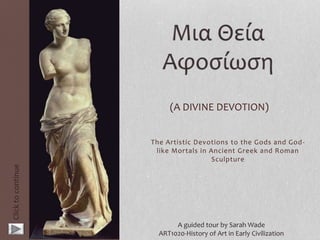
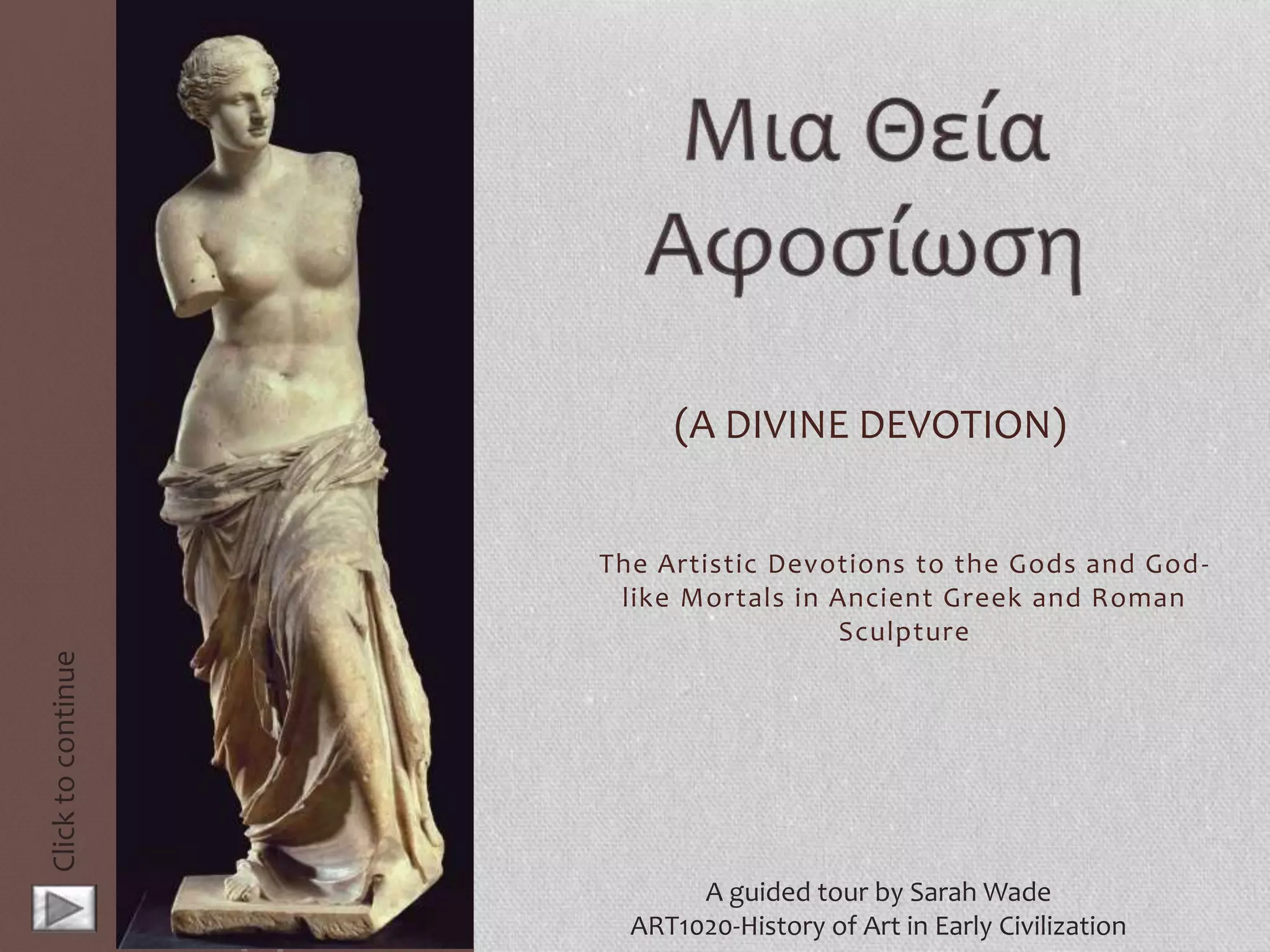
The Artistic Devotions to the Gods and God-
like Mortals in Ancient Greek and Roman
Sculpture
(A DIVINE DEVOTION)
A guided tour by Sarah Wade
ART1020-History of Art in Early Civilization
Clicktocontinue
Ariadne’s Thread
When we think of Ancient Greek and Roman Goddesses, the most common names that
come to mind are Hera, Athena, Aphrodite, etc. The most commonly recognized
goddesses of Greek and Roman mythology are but a few of the many Goddesses they
showed reverence and devotion to through their art, and some of them were mortal
women loved by gods and men alike.
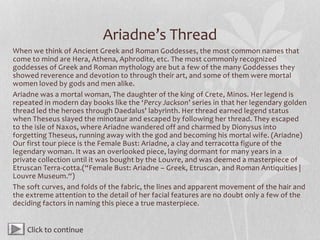
Ariadne was a mortal woman, The daughter of the king of Crete, Minos. Her legend is
repeated in modern day books like the ‘Percy Jackson’ series in that her legendary golden
thread led the heroes through Daedalus' labyrinth. Her thread earned legend status
when Theseus slayed the minotaur and escaped by following her thread. They escaped
to the isle of Naxos, where Ariadne wandered off and charmed by Dionysus into
forgetting Theseus, running away with the god and becoming his mortal wife. (Ariadne)
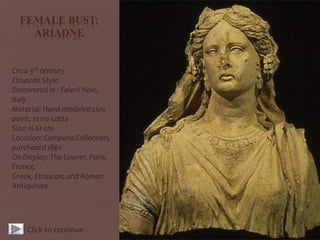
Our first tour piece is the Female Bust: Ariadne, a clay and terracotta figure of the
legendary woman. It was an overlooked piece, laying dormant for many years in a
private collection until it was bought by the Louvre, and was deemed a masterpiece of
Etruscan Terra-cotta.(“Female Bust: Ariadne – Greek, Etruscan, and Roman Antiquities |
Louvre Museum.“)
The soft curves, and folds of the fabric, the lines and apparent movement of the hair and
the extreme attention to the detail of her facial features are no doubt only a few of the
deciding factors in naming this piece a true masterpiece.
Click to continue
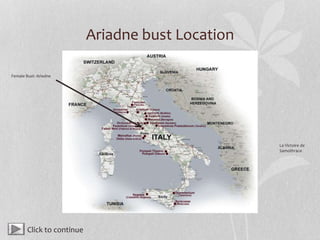
Ariadne bust Location
La Victoire de
Samothrace
Female Bust: Ariadne
Click to continue
FEMALE BUST:
ARIADNE
Circa 3rd century
Etruscan Style
Discovered in : Falerii Novi,
Italy
Material: Hand-modeled clay,
paint, terra-cotta
Size: H.61 cm
Location: Campana Collection,
purchased 1861
On Display: The Louver, Paris,
France.
Greek, Etruscan, and Roman
Antiquities
Click to continue
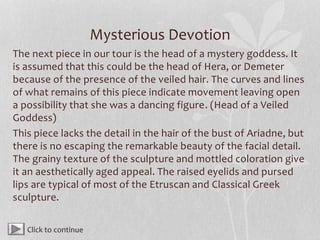
Mysterious Devotion
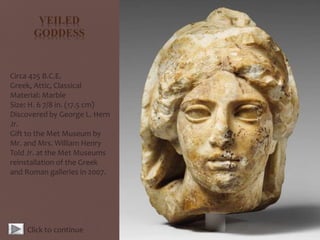
The next piece in our tour is the head of a mystery goddess. It
is assumed that this could be the head of Hera, or Demeter
because of the presence of the veiled hair. The curves and lines
of what remains of this piece indicate movement leaving open
a possibility that she was a dancing figure. (Head of a Veiled
Goddess)
This piece lacks the detail in the hair of the bust of Ariadne, but
there is no escaping the remarkable beauty of the facial detail.
The grainy texture of the sculpture and mottled coloration give
it an aesthetically aged appeal. The raised eyelids and pursed
lips are typical of most of the Etruscan and Classical Greek
sculpture.
Click to continue
VEILED
GODDESS
Circa 425 B.C.E.
Greek, Attic, Classical
Material: Marble
Size: H. 6 7/8 in. (17.5 cm)
Discovered by George L. Hern
Jr.
Gift to the Met Museum by
Mr. and Mrs. William Henry
Told Jr. at the Met Museums
reinstallation of the Greek
and Roman galleries in 2007.
Click to continue
A Naval Victory
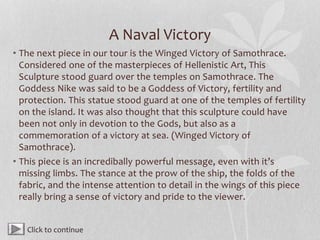
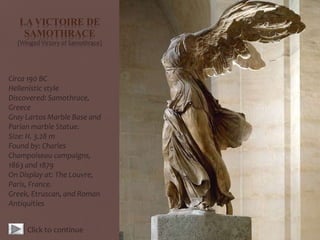
• The next piece in our tour is the Winged Victory of Samothrace.
Considered one of the masterpieces of Hellenistic Art, This
Sculpture stood guard over the temples on Samothrace. The
Goddess Nike was said to be a Goddess of Victory, fertility and
protection. This statue stood guard at one of the temples of fertility
on the island. It was also thought that this sculpture could have
been not only in devotion to the Gods, but also as a
commemoration of a victory at sea. (Winged Victory of
Samothrace).
• This piece is an incredibally powerful message, even with it’s
missing limbs. The stance at the prow of the ship, the folds of the
fabric, and the intense attention to detail in the wings of this piece
really bring a sense of victory and pride to the viewer.
Click to continue
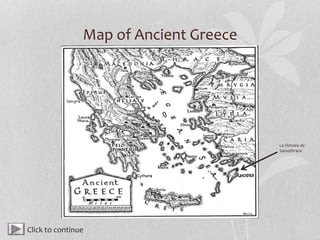
Map of Ancient Greece
La Victoire de
Samothrace
Click to continue
LA VICTOIRE DE
SAMOTHRACE
(Winged Victory of Samothrace)
Circa 190 BC
Hellenistic style
Discovered: Samothrace,
Greece
Gray Lartos Marble Base and
Parian marble Statue.
Size: H. 3.28 m
Found by: Charles
Champoiseau campaigns,
1863 and 1879
On Display at: The Louvre,
Paris, France.
Greek, Etruscan, and Roman
Antiquities
Click to continue
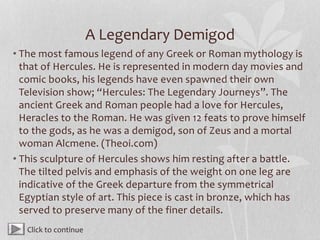
A Legendary Demigod
• The most famous legend of any Greek or Roman mythology is
that of Hercules. He is represented in modern day movies and
comic books, his legends have even spawned their own
Television show; “Hercules: The Legendary Journeys”. The
ancient Greek and Roman people had a love for Hercules,
Heracles to the Roman. He was given 12 feats to prove himself
to the gods, as he was a demigod, son of Zeus and a mortal
woman Alcmene. (Theoi.com)
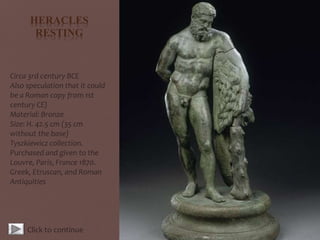
• This sculpture of Hercules shows him resting after a battle.
The tilted pelvis and emphasis of the weight on one leg are
indicative of the Greek departure from the symmetrical
Egyptian style of art. This piece is cast in bronze, which has
served to preserve many of the finer details.
Click to continue
HERACLES
RESTING
Circa 3rd century BCE
Also speculation that it could
be a Roman copy from 1st
century CE)
Material: Bronze
Size: H. 42.5 cm (35 cm
without the base)
Tyszkiewicz collection.
Purchased and given to the
Louvre, Paris, France 1870.
Greek, Etruscan, and Roman
Antiquities
Click to continue
WORKS CITED
• "Ariadne." Women in Greek Myths. Web. 01 Mar. 2011. <http://www.paleothea.com/Myths/Ariadne.html>.
• Female Bust: Ariadne – Greek, Etruscan, and Roman Antiquities | Louvre Museum." Site Officiel Du Musée
Du Louvre. Web. 02 Mar. 2011.
<http://www.louvre.fr/llv/oeuvres/detail_notice.jsp?CONTENT%3C%3Ecnt_id=10134198673226439&CURRE
NT_LLV_NOTICE%3C%3Ecnt_id=10134198673226439&FOLDER%3C%3Efolder_id=9852723696500818&baseI
ndex=4&bmLocale=en>.
• http://www.louvre.fr/llv/oeuvres/detail_notice.jsp?CONTENT%3C%3Ecnt_id=10134198673225416&CURREN
T_LLV_NOTICE%3C%3Ecnt_id=10134198673225416&FOLDER%3C%3Efolder_id=9852723696500817&baseInd
ex=10&bmLocale=en#
• "Head of a Veiled Goddess [Greek, Attic] (2007.328) | Heilbrunn Timeline of Art History | The
Metropolitan Museum of Art." The Metropolitan Museum of Art, New York: Metmuseum.org. Web. 01 Mar.
2011. <http://www.metmuseum.org/toah/works-of-art/2007.328>.
• "Map of Ancient Greece." Greek Islands, Greece Travel Guide, Greece Hotels by Greeka.com. Web. 01 Mar.
2011. <http://www.greeka.com/greece-maps/ancient-greece-map.htm>.
• "Winged Victory of Samothrace – Greek, Etruscan, and Roman Antiquities | Louvre Museum." Site Officiel
Du Musée Du Louvre. Web. 02 Mar. 2011.
<http://www.louvre.fr/llv/oeuvres/detail_notice.jsp?CONTENTcnt_id=10134198673225805&CURRENT_LLV
_NOTICEcnt_id=10134198673225805&FOLDERfolder_id=9852723696500817&bmLocale=en>.
• "Theoi.com | Heracles the Great Hero of Greek Mythology." THEOI GREEK MYTHOLOGY, Exploring
Mythology & the Greek Gods in Classical Literature & Art. Web. 02 Mar. 2011.
<http://www.theoi.com/greek-mythology/heracles.html>.
Click to End Slideshow

A divine devotion

  • 1.
    The Artistic Devotionsto the Gods and God- like Mortals in Ancient Greek and Roman Sculpture (A DIVINE DEVOTION) A guided tour by Sarah Wade ART1020-History of Art in Early Civilization Clicktocontinue
  • 2.
    Ariadne’s Thread When wethink of Ancient Greek and Roman Goddesses, the most common names that come to mind are Hera, Athena, Aphrodite, etc. The most commonly recognized goddesses of Greek and Roman mythology are but a few of the many Goddesses they showed reverence and devotion to through their art, and some of them were mortal women loved by gods and men alike. Ariadne was a mortal woman, The daughter of the king of Crete, Minos. Her legend is repeated in modern day books like the ‘Percy Jackson’ series in that her legendary golden thread led the heroes through Daedalus' labyrinth. Her thread earned legend status when Theseus slayed the minotaur and escaped by following her thread. They escaped to the isle of Naxos, where Ariadne wandered off and charmed by Dionysus into forgetting Theseus, running away with the god and becoming his mortal wife. (Ariadne) Our first tour piece is the Female Bust: Ariadne, a clay and terracotta figure of the legendary woman. It was an overlooked piece, laying dormant for many years in a private collection until it was bought by the Louvre, and was deemed a masterpiece of Etruscan Terra-cotta.(“Female Bust: Ariadne – Greek, Etruscan, and Roman Antiquities | Louvre Museum.“) The soft curves, and folds of the fabric, the lines and apparent movement of the hair and the extreme attention to the detail of her facial features are no doubt only a few of the deciding factors in naming this piece a true masterpiece. Click to continue
  • 3.
    Ariadne bust Location LaVictoire de Samothrace Female Bust: Ariadne Click to continue
  • 4.
    FEMALE BUST: ARIADNE Circa 3rdcentury Etruscan Style Discovered in : Falerii Novi, Italy Material: Hand-modeled clay, paint, terra-cotta Size: H.61 cm Location: Campana Collection, purchased 1861 On Display: The Louver, Paris, France. Greek, Etruscan, and Roman Antiquities Click to continue
  • 5.
    Mysterious Devotion The nextpiece in our tour is the head of a mystery goddess. It is assumed that this could be the head of Hera, or Demeter because of the presence of the veiled hair. The curves and lines of what remains of this piece indicate movement leaving open a possibility that she was a dancing figure. (Head of a Veiled Goddess) This piece lacks the detail in the hair of the bust of Ariadne, but there is no escaping the remarkable beauty of the facial detail. The grainy texture of the sculpture and mottled coloration give it an aesthetically aged appeal. The raised eyelids and pursed lips are typical of most of the Etruscan and Classical Greek sculpture. Click to continue
  • 6.
    VEILED GODDESS Circa 425 B.C.E. Greek,Attic, Classical Material: Marble Size: H. 6 7/8 in. (17.5 cm) Discovered by George L. Hern Jr. Gift to the Met Museum by Mr. and Mrs. William Henry Told Jr. at the Met Museums reinstallation of the Greek and Roman galleries in 2007. Click to continue
  • 7.
    A Naval Victory •The next piece in our tour is the Winged Victory of Samothrace. Considered one of the masterpieces of Hellenistic Art, This Sculpture stood guard over the temples on Samothrace. The Goddess Nike was said to be a Goddess of Victory, fertility and protection. This statue stood guard at one of the temples of fertility on the island. It was also thought that this sculpture could have been not only in devotion to the Gods, but also as a commemoration of a victory at sea. (Winged Victory of Samothrace). • This piece is an incredibally powerful message, even with it’s missing limbs. The stance at the prow of the ship, the folds of the fabric, and the intense attention to detail in the wings of this piece really bring a sense of victory and pride to the viewer. Click to continue
  • 8.
    Map of AncientGreece La Victoire de Samothrace Click to continue
  • 9.
    LA VICTOIRE DE SAMOTHRACE (WingedVictory of Samothrace) Circa 190 BC Hellenistic style Discovered: Samothrace, Greece Gray Lartos Marble Base and Parian marble Statue. Size: H. 3.28 m Found by: Charles Champoiseau campaigns, 1863 and 1879 On Display at: The Louvre, Paris, France. Greek, Etruscan, and Roman Antiquities Click to continue
  • 10.
    A Legendary Demigod •The most famous legend of any Greek or Roman mythology is that of Hercules. He is represented in modern day movies and comic books, his legends have even spawned their own Television show; “Hercules: The Legendary Journeys”. The ancient Greek and Roman people had a love for Hercules, Heracles to the Roman. He was given 12 feats to prove himself to the gods, as he was a demigod, son of Zeus and a mortal woman Alcmene. (Theoi.com) • This sculpture of Hercules shows him resting after a battle. The tilted pelvis and emphasis of the weight on one leg are indicative of the Greek departure from the symmetrical Egyptian style of art. This piece is cast in bronze, which has served to preserve many of the finer details. Click to continue
  • 11.
    HERACLES RESTING Circa 3rd centuryBCE Also speculation that it could be a Roman copy from 1st century CE) Material: Bronze Size: H. 42.5 cm (35 cm without the base) Tyszkiewicz collection. Purchased and given to the Louvre, Paris, France 1870. Greek, Etruscan, and Roman Antiquities Click to continue
  • 12.
    WORKS CITED • "Ariadne."Women in Greek Myths. Web. 01 Mar. 2011. <http://www.paleothea.com/Myths/Ariadne.html>. • Female Bust: Ariadne – Greek, Etruscan, and Roman Antiquities | Louvre Museum." Site Officiel Du Musée Du Louvre. Web. 02 Mar. 2011. <http://www.louvre.fr/llv/oeuvres/detail_notice.jsp?CONTENT%3C%3Ecnt_id=10134198673226439&CURRE NT_LLV_NOTICE%3C%3Ecnt_id=10134198673226439&FOLDER%3C%3Efolder_id=9852723696500818&baseI ndex=4&bmLocale=en>. • http://www.louvre.fr/llv/oeuvres/detail_notice.jsp?CONTENT%3C%3Ecnt_id=10134198673225416&CURREN T_LLV_NOTICE%3C%3Ecnt_id=10134198673225416&FOLDER%3C%3Efolder_id=9852723696500817&baseInd ex=10&bmLocale=en# • "Head of a Veiled Goddess [Greek, Attic] (2007.328) | Heilbrunn Timeline of Art History | The Metropolitan Museum of Art." The Metropolitan Museum of Art, New York: Metmuseum.org. Web. 01 Mar. 2011. <http://www.metmuseum.org/toah/works-of-art/2007.328>. • "Map of Ancient Greece." Greek Islands, Greece Travel Guide, Greece Hotels by Greeka.com. Web. 01 Mar. 2011. <http://www.greeka.com/greece-maps/ancient-greece-map.htm>. • "Winged Victory of Samothrace – Greek, Etruscan, and Roman Antiquities | Louvre Museum." Site Officiel Du Musée Du Louvre. Web. 02 Mar. 2011. <http://www.louvre.fr/llv/oeuvres/detail_notice.jsp?CONTENTcnt_id=10134198673225805&CURRENT_LLV _NOTICEcnt_id=10134198673225805&FOLDERfolder_id=9852723696500817&bmLocale=en>. • "Theoi.com | Heracles the Great Hero of Greek Mythology." THEOI GREEK MYTHOLOGY, Exploring Mythology & the Greek Gods in Classical Literature & Art. Web. 02 Mar. 2011. <http://www.theoi.com/greek-mythology/heracles.html>. Click to End Slideshow