A Career in Physical
Therapy
University of Oklahoma
Department of Health & Exercise Science
October 26 & October 28, 2010
Dale Boren Jr. PT, MPT, OCS
Physical Therapy Central
Norman, OK
www.ptcentral.org
Questions?
 Can anyone tell me what a physical therapist
does?????
 Has anyone ever been treated by a physical
therapist or physical therapist assistant??
 Is anyone planning to pursue a career in
physical therapy??
Historical Perspectives in PT
 The first physical therapy association,
American Women’s Physical Therapeutic
Association, formed in 1921 by founder Mary
McMillan.
 Made of up women referred to as Reconstruction
Aides who treated injured soldiers returning home
from World War I.
 In the late 1930’s, the association became
known as the American Physiotherapy
Association.
 Men were admitted and membership was
approximately 1000.
Historical Perspectives in PT
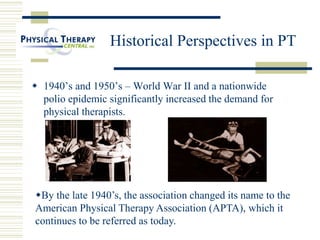
 1940’s and 1950’s – World War II and a nationwide
polio epidemic significantly increased the demand for
physical therapists.
By the late 1940’s, the association changed its name to the
American Physical Therapy Association (APTA), which it
continues to be referred as today.
Physical Therapists & Physical
Therapy Assistants
 Physical Therapist (PT) - a professional concerned with
prevention and management of movement disorders arising from
conditions and diseases occurring throughout the lifespan.
 PT’s examine individuals, determine a diagnosis, and develop a
plan of care using treatment techniques to promote the ability to
move, reduce pain, restore function, and prevent disability.
 Physical Therapist Assistant (PTA) - provides physical therapy
services under the direction and supervision of a physical
therapist.
 PTA’s assist in instructing patients in exercises and activities of
daily living.
Conditions commonly treated
by PT’s
 Orthopedic conditions such as neck/low back pain, shoulder
pain, hamstring strain, and ankle sprains.
 Post-operative conditions such as rotator cuff repair and
ACL reconstruction.
 Arthritic conditions such as osteoarthritis and rheumatoid
arthritis.
 Neurological conditions such as cerebral palsy, Down’s
syndrome, stroke, and Parkinson’s disease.
 Integumentary conditions such as burns, ulcers, and wounds.
 Cardiopulmonary conditions such as congestive heart failure
and COPD
Common PT Treatment
Techniques
 Modalities including heat packs, cryotherapy, ultrasound, electrical
stimulation, and cold compression
 Therapeutic exercise to improve strength and flexibility
 Balance training and reeducation to restore normal control to the body
and to reduce falls
 Manual therapy such as myofascial release, joint mobilization, PROM,
& peripheral/spinal manipulation
 Aquatic therapy which is helpful for arthritis, early movement, reduced
joint stresses, and continuous resistance
 Prosthetics, orthotics, and assistive devices
 Functional training for activities of daily living and return to sport or
occupational demands
 Gait and transfer training
Where do PT’s and PTA’s
work?
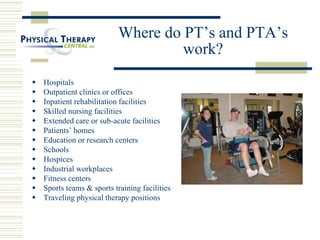
 Hospitals
 Outpatient clinics or offices
 Inpatient rehabilitation facilities
 Skilled nursing facilities
 Extended care or sub-acute facilities
 Patients’ homes
 Education or research centers
 Schools
 Hospices
 Industrial workplaces
 Fitness centers
 Sports teams & sports training facilities
 Traveling physical therapy positions
PT Demographics - Income
 Median annual earnings of physical therapists in May 2008 were
$72,790. The middle 50 percent earned between $60,300 and $85,540.
The lowest 10 percent earned less than $50,350, and the highest 10
percent earned more than $104,350.
 Median salaries based on practice environment:
 Home health care services – $77, 630
 Nursing care facilities - $76,680
 General medical and surgical hospitals - $73,270
 Offices of physicians – $72,790
 Offices of other health care professionals – $71, 400
Bureau of Labor Statistics, Occupational Outlook Handbook 2010-2011 Edition.
http://www.bls.gov/oco/ocos080.htm#oes_links
PT Demographics - Income
 Highest paying states in terms of median annual wage and salary:
 Alaska – $87,410; Median wage $42.02 per hour
 Maryland - $86,190; Median wage $41.44 per hour
 Nevada $85,360; Median wage $41.04 per hour
 New Jersey $83,780; Median wage $40.28 per hour
 California $83,740; Median wage $40.26
http://www.bls.gov/oes/current/oes291123.htm
 Mean PT earnings in Oklahoma
 PT - $69,630 annually or $33.48 per hour
http://www.bls.gov/oes/current/oes_ok.htm#31-0000
PTA Demographics - Income
 Median annual earnings of physical therapist assistants
in May 2008 was $46,140. The middle 50% earned
between $37,170 and $54,900. The lowest 10% earned
less than $28,580 and the top 10% earned more than
$63,830.
 PTA - $43,140 annually or $20.74 per hour
 Median Salaries based on practice environment:
 Home health services $51,950
 Nursing care facilities $51,090
 General medical and surgical hospitals $45,510
 Offices of other health practitioners $44,580
 Physician offices $43,390
http://www.bls.gov/oco/ocos167.htm
Demographics – PT/PTA Job
Demand
 Employment of physical therapists and physical therapist assistants is
expected to grow much faster than average for all occupations.
 Employment of PT’s and PTA’s is expected to grow 30 percent and 35%
respectively from 2008 to 2018.
 Job opportunities will be good, especially in acute hospital, rehabilitation,
and orthopedic settings.
 Reasons for expected growth:
 Changes in healthcare reimbursement will increase accessibility to services & demand
 Increasing elderly population and Baby Boomers who will need services
 Medical and technological advances will allow > trauma victims, birth defects to
survive
 Evidence Based Practice – treat and help things previously untreatable
http://www.bls.gov/oco/ocos080.htm
Physical Therapy in the
Headlines
 In 2006, Wall Street Journal's CareerJournal.com survey determined
that physical therapists have one of the "eight best careers" based on the
following categories: intellectual stimulation, strong job security, level
of control and freedom, and extensive direct contact with clients.
 In the April 15, 2007 issue of PARADE Magazine, physical therapists
were found to have one of the six "Hottest Jobs For College Graduates."
 A national opinion poll printed in the April 17, 2007 issue of Chicago
Tribune found that physical therapists report one of the highest job-
satisfaction levels in the country, second only to clergy!
 U.S. News & World Report 2008 Rankings – Physical Therapy
 In October 2010, CNNMoney.com rated physical therapist the 4th Best
Job in America.
Preparation for a career in PT?
 What courses should you expect to take at the University level?
 Anatomy and Physiology
 Exercise Physiology
 Chemistry
 Physics
 Statistics
 Psychology
 Biology
 Social science
 English
 Computers
 Medical Terminology
 Research Methods
Preparation for a career in PT?
 Job Shadowing: is a program for students to find out what it is like to be
in a specific profession. This helps the student to choose the college
program (higher education/training) and subsequently the profession that
they would like to choose. Typically requires an employee / company to
partner with the school.
 Physical therapy tech work/training: many physical therapy clinics
utilize high school or college students to assist in basic delivery of PT
services. Typical job duties include preparing patients to see the
PT/PTA, keeping the clinic clean and orderly, and basic services to keep
the clinic running smoothly.
Educational requirements for
PT’s
 The minimum requirement is a master’s degree (MPT) from an accredited
education program. Currently 9 U.S. programs.
 The majority of programs offer the Doctor of Physical Therapy (DPT)
degree. Currently 203 U.S. programs.
 The majority of DPT programs require students to enter with an
undergraduate degree, though some will admit students after three years of
undergraduate work, and a few admit students at the freshman level.
 Students are in a MPT/DPT program between six and nine semesters (2-3
years).
 Physical Therapy Education FAQ’s.
 Directory of Accredited Physical Therapist Education Programs
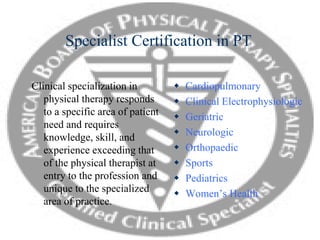
Specialist Certification in PT
Clinical specialization in
physical therapy responds
to a specific area of patient
need and requires
knowledge, skill, and
experience exceeding that
of the physical therapist at
entry to the profession and
unique to the specialized
area of practice.
 Cardiopulmonary
 Clinical Electrophysiologic
 Geriatric
 Neurologic
 Orthopaedic
 Sports
 Pediatrics
 Women’s Health
Educational requirements for
PTA’s
 The minimum requirement is an associate’s degree after two years of
undergraduate study.
 The physical therapist assistant (PTA) is a graduate of an accredited
PTA associate degree program.
 Physical Therapist Assistant Education Information
 Directory of CAPTE Accredited PTA Programs
PTA Recognition of Advanced
Proficiency
The PTA Recognition of Advanced
Proficiency Program recognizes Physical
Therapist Assistants (PTAs) who have achieved
advanced proficiency through education,
experience, leadership and as part of the
PT/PTA team in a specified area of work -
Musculoskeletal, Neuromuscular, Geriatric,
Pediatric, Cardiovascular/Pulmonary, and/or
Integumentary
What should you consider when
looking at PT/PTA schools?
 How far from home do you want to be?
 What size school and program do you want to attend?
 How much financial aid do you need and how much can you get?
 How many of the program's graduates pass the licensure exam on the
first try?
 How experienced are the faculty members? Are they members of
APTA? Do their areas of expertise match what you might want to do
after graduation?
 Is there a PT or PTA Student Club or other department activities?
 Will the program link you with a mentor?
 What degree can you earn, and how long will you be in the program?
 What kind of clinical experiences are provided for students? Where are
they located, and in what settings?
Admission Requirements for
PT School
 OU Health Sciences Center (DPT)
 Complete a bachelor's degree from an accredited college or university, or
complete requirements to be eligible to earn the B.S. in Health Studies
degree after completion of 30 hours in the program;
 Have successfully completed, or be in the process of completing, prerequisite
course work (90 credit hours - no more than 60 credit hours from a two-year
college will count toward the required 90) from any accredited college or
university, prior to starting the program
 Have at a minimum both a 2.75 cumulative grade point average and a 2.75
science grade point average on a 4.0 scale.
 Have completed all departmental prerequisite courses with grades of C or
better.
 Document 40 hours of physical therapy observation which are due with the
on-line application.
 Submit Graduate Record Examination (GRE) scores (the General Test prior
to the deadline date).
 Submit a completed on-line application.
 3-year Curriculum
Admission Requirements for
PT School
 Langston University (DPT)
 Applicants must have completed requirements for a baccalaureate degree at an
accredited college or university with a minimum grade point average (GPA) of 3.0 on
a scale of 4.0 in which 4.0 is equivalent to an "A".
 Prerequisite courses must be completed with a "C" or better grade in each course and
an overall GPA of 3.0 for the prerequisite courses.
 Submit three recommendations from academic advisors or individuals who can
address the potential for success of the applicant.
 Submit an autobiographical statement of no less than 500 words (and no more than
1000 words)
 Submit scores from the Graduate Record Examination (GRE) directly to the School
of Physical Therapy.
 Submit documentation of 50 clinical observation hours with a licensed physical
therapist.
 2011 Application Packet
 3-year Course of Study
Admission requirements for
PTA school
 Oklahoma City Community College (OCCC)
 Must be eligible for admission to OCCC – Application Procedures
 Fall 2010 Application
 GPA requirements: High school GPA minimum 3.00; GED Transcript
Average Score Minimum 550; College Retention GPA Minimum 2.50
(minimum 12 hours).
 Point Preference System takes into account: College Degree, GPA, GED,
science scores, ACT, observation experience, and work experience.
 Criminal history & sexual offender background checks
 Randomly administered drug tests
 Other PTA programs include: Caddo-Kiowa Technology Center, Murray
State College, Tulsa Community College, Carl Albert State College.
How to improve your chances of
getting into PT/PTA school?
 Strive for a high overall grade point average (GPA),
especially in courses such as biology, chemistry,
anatomy, and statistics
 Volunteer or get work experience as a physical therapy
tech or aide
 Be involved in school and community activities such as
sports or social clubs
 Show evidence of leadership experience
 Have strong writing and interpersonal skills
 Provide letters of recommendation from physical
therapists or science teachers
 How to become a physical therapist checklist –
Ehow.com
Physical Therapist Central
Application Service (PTCAS)
 PTCAS will allow you to use a single Web-based application and one set
of materials to apply to multiple physical therapist (PT) education
programs.
 PTCAS provides the following three primary benefits:
 Facilitates the PT admissions process for applicants and programs.
 Promotes the physical therapist profession and educational programs
to a broad spectrum of applicants.
 Provides rich applicant data for institutional, regional, and national
analysis.
 Currently, no Oklahoma based PT program participates in the PTCAS
system.
Current Trends in Physical
Therapy
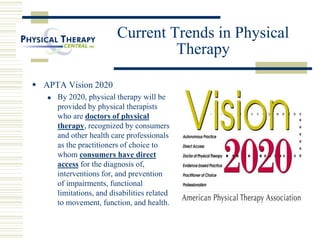
 APTA Vision 2020
 By 2020, physical therapy will be
provided by physical therapists
who are doctors of physical
therapy, recognized by consumers
and other health care professionals
as the practitioners of choice to
whom consumers have direct
access for the diagnosis of,
interventions for, and prevention
of impairments, functional
limitations, and disabilities related
to movement, function, and health.
Current Trends in Physical
Therapy
 Direct Access
 Currently, persons in the State of Oklahoma must have a referral
from a physician in order for a physical therapist to provide
treatment to a person.
 A person can be evaluated without a referral in this state, but
cannot receive treatment without the referral.
 At this time, Oklahoma physical therapists are attempting to get
legislation passed which will allow people to have much needed
direct access to physical therapy services.
 Currently, Oklahoma is one of only five states that do not
allow patients to see a physical therapist without a
physician referral.
The Brand –
 In 2007, amid growing competition in the health care industry and shrinking
budgets, the APTA Board of Directors determined a need to re-brand the physical
therapist and the profession to better position us as the experts in restoring and
improving ”motion” in people's lives.
90 percent of consumers already have a very positive impression of physical
therapists
 Among consumers interviewed, physical therapists are the providers of choice,
even above orthopedists and chiropractors, for treatment of loss or limitation of
movement, or injury, or pain.
 Consumers are actively seeking prevention and wellness options, and they are more
likely to turn to physical therapy if they know a physical therapist can:
Significantly improve mobility to perform daily activities
Provide an alternative to painful and expensive surgery, in many cases
Manage or eliminate pain, reducing the need for long-term use of
prescription medication and its side effects, in many cases
The Brand –
Consumer research revealed 2 distinct professional personality types
Sage - the person who helps people accomplish things. He or she is
smart and confident in explaining how to do something. The Sage is
described as a teacher and coach - someone who instructs and inspires us
to get things done, to achieve things. You also have a strong sense of
understanding and compassion for what the person is experiencing, but
you don't see that as an excuse for not making improvements.
Hero - someone who makes them better and stronger just by being in
the same room as them. They see you as the professionals who have the
courage to make it happen. You are a "Hero" in their eyes.
Together these personalities merge the independence gained from a
teacher/coach with the strength and mastery offered by a hero.
 Consumer website with informative videos and general information
about PT – http://www.moveforwardpt.com/
Polls
Find Your Condition
Ask a PT
Patient Legislative Center
 Commercials in Major Markets – Paint
 Social Media Outlets
YouTube – MoveForwardPT
Twitter - @MoveForwardPT
Facebook – Move Forward PT
The Brand
Videos
 You Can Be Me – A Career in Physical
Therapy (APTA)
 Move Forward: Physical Therapy Brings
Motion to Life (APTA)
A Little About Us?
 Physical Therapy Central
 We consist of seven, going on eight, physical therapist-owned clinics
in Oklahoma. Our clinics are located in Norman, Newcastle, Pauls
Valley, Choctaw, Oklahoma City, Stillwater, Chickasha, and soon to
be Elk City.
 We provide specialized care in the areas of orthopaedics, post-
operative care, spinal injuries, sports medicine, total joint
replacement, balance rehabilitation and work-related injuries.
 Check us out on Facebook – Physical Therapy Central or Twitter
@PhThCentral. Follow me @borenjr
 Please check out our website for more information:
www.ptcentral.org
QUESTIONS????

A career in physical therapy

  • 1.
    A Career inPhysical Therapy University of Oklahoma Department of Health & Exercise Science October 26 & October 28, 2010 Dale Boren Jr. PT, MPT, OCS Physical Therapy Central Norman, OK www.ptcentral.org
  • 2.
    Questions?  Can anyonetell me what a physical therapist does?????  Has anyone ever been treated by a physical therapist or physical therapist assistant??  Is anyone planning to pursue a career in physical therapy??
  • 3.
    Historical Perspectives inPT  The first physical therapy association, American Women’s Physical Therapeutic Association, formed in 1921 by founder Mary McMillan.  Made of up women referred to as Reconstruction Aides who treated injured soldiers returning home from World War I.  In the late 1930’s, the association became known as the American Physiotherapy Association.  Men were admitted and membership was approximately 1000.
  • 4.
    Historical Perspectives inPT  1940’s and 1950’s – World War II and a nationwide polio epidemic significantly increased the demand for physical therapists. By the late 1940’s, the association changed its name to the American Physical Therapy Association (APTA), which it continues to be referred as today.
  • 5.
    Physical Therapists &Physical Therapy Assistants  Physical Therapist (PT) - a professional concerned with prevention and management of movement disorders arising from conditions and diseases occurring throughout the lifespan.  PT’s examine individuals, determine a diagnosis, and develop a plan of care using treatment techniques to promote the ability to move, reduce pain, restore function, and prevent disability.  Physical Therapist Assistant (PTA) - provides physical therapy services under the direction and supervision of a physical therapist.  PTA’s assist in instructing patients in exercises and activities of daily living.
  • 6.
    Conditions commonly treated byPT’s  Orthopedic conditions such as neck/low back pain, shoulder pain, hamstring strain, and ankle sprains.  Post-operative conditions such as rotator cuff repair and ACL reconstruction.  Arthritic conditions such as osteoarthritis and rheumatoid arthritis.  Neurological conditions such as cerebral palsy, Down’s syndrome, stroke, and Parkinson’s disease.  Integumentary conditions such as burns, ulcers, and wounds.  Cardiopulmonary conditions such as congestive heart failure and COPD
  • 7.
    Common PT Treatment Techniques Modalities including heat packs, cryotherapy, ultrasound, electrical stimulation, and cold compression  Therapeutic exercise to improve strength and flexibility  Balance training and reeducation to restore normal control to the body and to reduce falls  Manual therapy such as myofascial release, joint mobilization, PROM, & peripheral/spinal manipulation  Aquatic therapy which is helpful for arthritis, early movement, reduced joint stresses, and continuous resistance  Prosthetics, orthotics, and assistive devices  Functional training for activities of daily living and return to sport or occupational demands  Gait and transfer training
  • 8.
    Where do PT’sand PTA’s work?  Hospitals  Outpatient clinics or offices  Inpatient rehabilitation facilities  Skilled nursing facilities  Extended care or sub-acute facilities  Patients’ homes  Education or research centers  Schools  Hospices  Industrial workplaces  Fitness centers  Sports teams & sports training facilities  Traveling physical therapy positions
  • 9.
    PT Demographics -Income  Median annual earnings of physical therapists in May 2008 were $72,790. The middle 50 percent earned between $60,300 and $85,540. The lowest 10 percent earned less than $50,350, and the highest 10 percent earned more than $104,350.  Median salaries based on practice environment:  Home health care services – $77, 630  Nursing care facilities - $76,680  General medical and surgical hospitals - $73,270  Offices of physicians – $72,790  Offices of other health care professionals – $71, 400 Bureau of Labor Statistics, Occupational Outlook Handbook 2010-2011 Edition. http://www.bls.gov/oco/ocos080.htm#oes_links
  • 10.
    PT Demographics -Income  Highest paying states in terms of median annual wage and salary:  Alaska – $87,410; Median wage $42.02 per hour  Maryland - $86,190; Median wage $41.44 per hour  Nevada $85,360; Median wage $41.04 per hour  New Jersey $83,780; Median wage $40.28 per hour  California $83,740; Median wage $40.26 http://www.bls.gov/oes/current/oes291123.htm  Mean PT earnings in Oklahoma  PT - $69,630 annually or $33.48 per hour http://www.bls.gov/oes/current/oes_ok.htm#31-0000
  • 11.
    PTA Demographics -Income  Median annual earnings of physical therapist assistants in May 2008 was $46,140. The middle 50% earned between $37,170 and $54,900. The lowest 10% earned less than $28,580 and the top 10% earned more than $63,830.  PTA - $43,140 annually or $20.74 per hour  Median Salaries based on practice environment:  Home health services $51,950  Nursing care facilities $51,090  General medical and surgical hospitals $45,510  Offices of other health practitioners $44,580  Physician offices $43,390 http://www.bls.gov/oco/ocos167.htm
  • 12.
    Demographics – PT/PTAJob Demand  Employment of physical therapists and physical therapist assistants is expected to grow much faster than average for all occupations.  Employment of PT’s and PTA’s is expected to grow 30 percent and 35% respectively from 2008 to 2018.  Job opportunities will be good, especially in acute hospital, rehabilitation, and orthopedic settings.  Reasons for expected growth:  Changes in healthcare reimbursement will increase accessibility to services & demand  Increasing elderly population and Baby Boomers who will need services  Medical and technological advances will allow > trauma victims, birth defects to survive  Evidence Based Practice – treat and help things previously untreatable http://www.bls.gov/oco/ocos080.htm
  • 13.
    Physical Therapy inthe Headlines  In 2006, Wall Street Journal's CareerJournal.com survey determined that physical therapists have one of the "eight best careers" based on the following categories: intellectual stimulation, strong job security, level of control and freedom, and extensive direct contact with clients.  In the April 15, 2007 issue of PARADE Magazine, physical therapists were found to have one of the six "Hottest Jobs For College Graduates."  A national opinion poll printed in the April 17, 2007 issue of Chicago Tribune found that physical therapists report one of the highest job- satisfaction levels in the country, second only to clergy!  U.S. News & World Report 2008 Rankings – Physical Therapy  In October 2010, CNNMoney.com rated physical therapist the 4th Best Job in America.
  • 14.
    Preparation for acareer in PT?  What courses should you expect to take at the University level?  Anatomy and Physiology  Exercise Physiology  Chemistry  Physics  Statistics  Psychology  Biology  Social science  English  Computers  Medical Terminology  Research Methods
  • 15.
    Preparation for acareer in PT?  Job Shadowing: is a program for students to find out what it is like to be in a specific profession. This helps the student to choose the college program (higher education/training) and subsequently the profession that they would like to choose. Typically requires an employee / company to partner with the school.  Physical therapy tech work/training: many physical therapy clinics utilize high school or college students to assist in basic delivery of PT services. Typical job duties include preparing patients to see the PT/PTA, keeping the clinic clean and orderly, and basic services to keep the clinic running smoothly.
  • 16.
    Educational requirements for PT’s The minimum requirement is a master’s degree (MPT) from an accredited education program. Currently 9 U.S. programs.  The majority of programs offer the Doctor of Physical Therapy (DPT) degree. Currently 203 U.S. programs.  The majority of DPT programs require students to enter with an undergraduate degree, though some will admit students after three years of undergraduate work, and a few admit students at the freshman level.  Students are in a MPT/DPT program between six and nine semesters (2-3 years).  Physical Therapy Education FAQ’s.  Directory of Accredited Physical Therapist Education Programs
  • 17.
    Specialist Certification inPT Clinical specialization in physical therapy responds to a specific area of patient need and requires knowledge, skill, and experience exceeding that of the physical therapist at entry to the profession and unique to the specialized area of practice.  Cardiopulmonary  Clinical Electrophysiologic  Geriatric  Neurologic  Orthopaedic  Sports  Pediatrics  Women’s Health
  • 18.
    Educational requirements for PTA’s The minimum requirement is an associate’s degree after two years of undergraduate study.  The physical therapist assistant (PTA) is a graduate of an accredited PTA associate degree program.  Physical Therapist Assistant Education Information  Directory of CAPTE Accredited PTA Programs
  • 19.
    PTA Recognition ofAdvanced Proficiency The PTA Recognition of Advanced Proficiency Program recognizes Physical Therapist Assistants (PTAs) who have achieved advanced proficiency through education, experience, leadership and as part of the PT/PTA team in a specified area of work - Musculoskeletal, Neuromuscular, Geriatric, Pediatric, Cardiovascular/Pulmonary, and/or Integumentary
  • 20.
    What should youconsider when looking at PT/PTA schools?  How far from home do you want to be?  What size school and program do you want to attend?  How much financial aid do you need and how much can you get?  How many of the program's graduates pass the licensure exam on the first try?  How experienced are the faculty members? Are they members of APTA? Do their areas of expertise match what you might want to do after graduation?  Is there a PT or PTA Student Club or other department activities?  Will the program link you with a mentor?  What degree can you earn, and how long will you be in the program?  What kind of clinical experiences are provided for students? Where are they located, and in what settings?
  • 21.
    Admission Requirements for PTSchool  OU Health Sciences Center (DPT)  Complete a bachelor's degree from an accredited college or university, or complete requirements to be eligible to earn the B.S. in Health Studies degree after completion of 30 hours in the program;  Have successfully completed, or be in the process of completing, prerequisite course work (90 credit hours - no more than 60 credit hours from a two-year college will count toward the required 90) from any accredited college or university, prior to starting the program  Have at a minimum both a 2.75 cumulative grade point average and a 2.75 science grade point average on a 4.0 scale.  Have completed all departmental prerequisite courses with grades of C or better.  Document 40 hours of physical therapy observation which are due with the on-line application.  Submit Graduate Record Examination (GRE) scores (the General Test prior to the deadline date).  Submit a completed on-line application.  3-year Curriculum
  • 22.
    Admission Requirements for PTSchool  Langston University (DPT)  Applicants must have completed requirements for a baccalaureate degree at an accredited college or university with a minimum grade point average (GPA) of 3.0 on a scale of 4.0 in which 4.0 is equivalent to an "A".  Prerequisite courses must be completed with a "C" or better grade in each course and an overall GPA of 3.0 for the prerequisite courses.  Submit three recommendations from academic advisors or individuals who can address the potential for success of the applicant.  Submit an autobiographical statement of no less than 500 words (and no more than 1000 words)  Submit scores from the Graduate Record Examination (GRE) directly to the School of Physical Therapy.  Submit documentation of 50 clinical observation hours with a licensed physical therapist.  2011 Application Packet  3-year Course of Study
  • 23.
    Admission requirements for PTAschool  Oklahoma City Community College (OCCC)  Must be eligible for admission to OCCC – Application Procedures  Fall 2010 Application  GPA requirements: High school GPA minimum 3.00; GED Transcript Average Score Minimum 550; College Retention GPA Minimum 2.50 (minimum 12 hours).  Point Preference System takes into account: College Degree, GPA, GED, science scores, ACT, observation experience, and work experience.  Criminal history & sexual offender background checks  Randomly administered drug tests  Other PTA programs include: Caddo-Kiowa Technology Center, Murray State College, Tulsa Community College, Carl Albert State College.
  • 24.
    How to improveyour chances of getting into PT/PTA school?  Strive for a high overall grade point average (GPA), especially in courses such as biology, chemistry, anatomy, and statistics  Volunteer or get work experience as a physical therapy tech or aide  Be involved in school and community activities such as sports or social clubs  Show evidence of leadership experience  Have strong writing and interpersonal skills  Provide letters of recommendation from physical therapists or science teachers  How to become a physical therapist checklist – Ehow.com
  • 25.
    Physical Therapist Central ApplicationService (PTCAS)  PTCAS will allow you to use a single Web-based application and one set of materials to apply to multiple physical therapist (PT) education programs.  PTCAS provides the following three primary benefits:  Facilitates the PT admissions process for applicants and programs.  Promotes the physical therapist profession and educational programs to a broad spectrum of applicants.  Provides rich applicant data for institutional, regional, and national analysis.  Currently, no Oklahoma based PT program participates in the PTCAS system.
  • 26.
    Current Trends inPhysical Therapy  APTA Vision 2020  By 2020, physical therapy will be provided by physical therapists who are doctors of physical therapy, recognized by consumers and other health care professionals as the practitioners of choice to whom consumers have direct access for the diagnosis of, interventions for, and prevention of impairments, functional limitations, and disabilities related to movement, function, and health.
  • 27.
    Current Trends inPhysical Therapy  Direct Access  Currently, persons in the State of Oklahoma must have a referral from a physician in order for a physical therapist to provide treatment to a person.  A person can be evaluated without a referral in this state, but cannot receive treatment without the referral.  At this time, Oklahoma physical therapists are attempting to get legislation passed which will allow people to have much needed direct access to physical therapy services.  Currently, Oklahoma is one of only five states that do not allow patients to see a physical therapist without a physician referral.
  • 28.
    The Brand – In 2007, amid growing competition in the health care industry and shrinking budgets, the APTA Board of Directors determined a need to re-brand the physical therapist and the profession to better position us as the experts in restoring and improving ”motion” in people's lives. 90 percent of consumers already have a very positive impression of physical therapists  Among consumers interviewed, physical therapists are the providers of choice, even above orthopedists and chiropractors, for treatment of loss or limitation of movement, or injury, or pain.  Consumers are actively seeking prevention and wellness options, and they are more likely to turn to physical therapy if they know a physical therapist can: Significantly improve mobility to perform daily activities Provide an alternative to painful and expensive surgery, in many cases Manage or eliminate pain, reducing the need for long-term use of prescription medication and its side effects, in many cases
  • 29.
    The Brand – Consumerresearch revealed 2 distinct professional personality types Sage - the person who helps people accomplish things. He or she is smart and confident in explaining how to do something. The Sage is described as a teacher and coach - someone who instructs and inspires us to get things done, to achieve things. You also have a strong sense of understanding and compassion for what the person is experiencing, but you don't see that as an excuse for not making improvements. Hero - someone who makes them better and stronger just by being in the same room as them. They see you as the professionals who have the courage to make it happen. You are a "Hero" in their eyes. Together these personalities merge the independence gained from a teacher/coach with the strength and mastery offered by a hero.
  • 30.
     Consumer websitewith informative videos and general information about PT – http://www.moveforwardpt.com/ Polls Find Your Condition Ask a PT Patient Legislative Center  Commercials in Major Markets – Paint  Social Media Outlets YouTube – MoveForwardPT Twitter - @MoveForwardPT Facebook – Move Forward PT The Brand
  • 31.
    Videos  You CanBe Me – A Career in Physical Therapy (APTA)  Move Forward: Physical Therapy Brings Motion to Life (APTA)
  • 32.
    A Little AboutUs?  Physical Therapy Central  We consist of seven, going on eight, physical therapist-owned clinics in Oklahoma. Our clinics are located in Norman, Newcastle, Pauls Valley, Choctaw, Oklahoma City, Stillwater, Chickasha, and soon to be Elk City.  We provide specialized care in the areas of orthopaedics, post- operative care, spinal injuries, sports medicine, total joint replacement, balance rehabilitation and work-related injuries.  Check us out on Facebook – Physical Therapy Central or Twitter @PhThCentral. Follow me @borenjr  Please check out our website for more information: www.ptcentral.org
  • 33.