Research on Career:
Physical Therapy
DANIELLE LASHLEE
Introduction
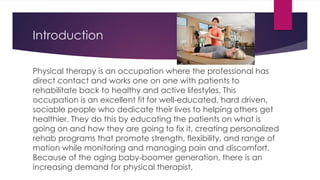
Physical therapy is an occupation where the professional has
direct contact and works one on one with patients to
rehabilitate back to healthy and active lifestyles. This
occupation is an excellent fit for well-educated, hard driven,
sociable people who dedicate their lives to helping others get
healthier. They do this by educating the patients on what is
going on and how they are going to fix it, creating personalized
rehab programs that promote strength, flexibility, and range of
motion while monitoring and managing pain and discomfort.
Because of the aging baby-boomer generation, there is an
increasing demand for physical therapist.
What does a physical therapist do?
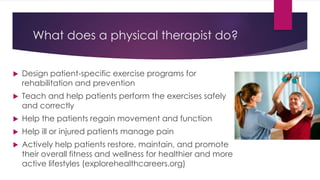
 Design patient-specific exercise programs for
rehabilitation and prevention
 Teach and help patients perform the exercises safely
and correctly
 Help the patients regain movement and function
 Help ill or injured patients manage pain
 Actively help patients restore, maintain, and promote
their overall fitness and wellness for healthier and more
active lifestyles (explorehealthcareers.org)
History of Physical Therapy
 Dates back to Greek culture – Hippocrates
 Europe 1500-1700s  Progression for treating muscle and bone
disorders
 By 1800s  exercise and muscle therapy used for orthopedic diseases
and injuries
 Polio epidemic in US (1916) – this became very important
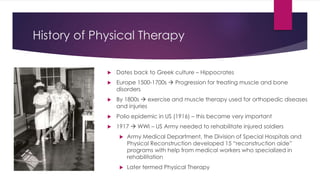
 1917  WWI – US Army needed to rehabilitate injured soldiers
 Army Medical Department, the Division of Special Hospitals and
Physical Reconstruction developed 15 “reconstruction aide”
programs with help from medical workers who specialized in
rehabilitation
 Later termed Physical Therapy
History of Physical Therapy (contd.)
 1920s  physical therapists partnered with surgical sectors and the
public started to recognize the profession
 WWII continued the high demand for rehabilitation
 APTA  American Physical Therapy Association (founded in 1921)
 1954 first national examination for licensure
 1959  state regulations for PT in 45 states
 1967  addition of outpatient PT in Medicare
Quick Facts
 Entry-level Education: Doctoral or professional degree
 Time in school: 6-7 years
 In 2014, Physical Therapy was named a “Top Job” (2014)
 In Forbes magazine, PTs are 5th strongest-growth professionals
(ahead of web developers and petroleum engineers)
 Estimated 200,000 jobs
 Employment of PTs is projected to grow 36% from 2012-2022
 Services coming from aging baby boomers as well as treating people with
mobility issues coming from chronic illnesses arising today (ex: diabetes and
obesity)
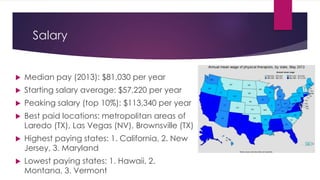
Salary
 Median pay (2013): $81,030 per year
 Starting salary average: $57,220 per year
 Peaking salary (top 10%): $113,340 per year
 Best paid locations: metropolitan areas of
Laredo (TX), Las Vegas (NV), Brownsville (TX)
 Highest paying states: 1. California, 2. New
Jersey, 3. Maryland
 Lowest paying states: 1. Hawaii, 2.
Montana, 3. Vermont
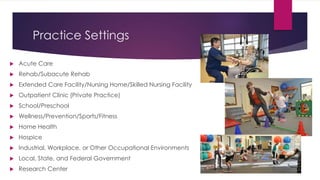
Practice Settings
 Acute Care
 Rehab/Subacute Rehab
 Extended Care Facility/Nursing Home/Skilled Nursing Facility
 Outpatient Clinic (Private Practice)
 School/Preschool
 Wellness/Prevention/Sports/Fitness
 Home Health
 Hospice
 Industrial, Workplace, or Other Occupational Environments
 Local, State, and Federal Government
 Research Center
Qualities of a Good Physical Therapist
Determined
Supportive
Compassionate
Confident
Resilient
Fit/Health Conscious
Sociable
Cooperative
Patient
Dedicated
Resourceful
Positive
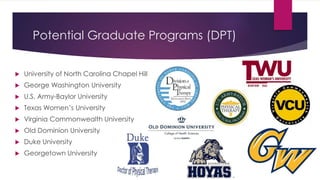
Potential Graduate Programs (DPT)
 University of North Carolina Chapel Hill
 George Washington University
 U.S. Army-Baylor University
 Texas Women’s University
 Virginia Commonwealth University
 Old Dominion University
 Duke University
 Georgetown University
Why I am a good candidate?
 Academically prepared for the demanding educational program
 Show interest in community involvement
 Knowledgeable of the field and have experience in different types of
practices
 Exhibit exceptional communication skills
 Interpersonal
 Intrigued in teaching others
 Live a healthy driven lifestyle
 Can follow strict rules and laws (HIPPA, etc.)
Why am I a good candidate? (O*NET
examples)
 Top 3 categories:
 1. Social – like working with others to help them learn and grow
 Like teaching, giving advice, good communication skills, helping and being of service to people
 PT is a very hands-on and face-to-face job with patients so good communication skills are needed to
perform the tasks and explain exercises
 2. Enterprising – like work that has to do with starting up and carrying out business projects
 Persuading and leading people, making decision, taking risks for profits
 I want to eventually work in my own private practice so these skills are needed in order to be able to do so
 3. Conventional – like work that follows set procedures and routines
 Working with clear rules
 There are many rules and laws that have to be followed in the health profession as well as certain
guidelines to get patients back to living healthy and active lifestyles
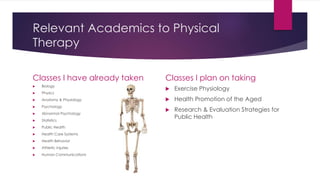
Relevant Academics to Physical
Therapy
Classes I have already taken
 Biology
 Physics
 Anatomy & Physiology
 Psychology
 Abnormal Psychology
 Statistics
 Public Health
 Health Care Systems
 Health Behavior
 Athletic Injuries
 Human Communications
Classes I plan on taking
 Exercise Physiology
 Health Promotion of the Aged
 Research & Evaluation Strategies for
Public Health
Conclusion
With the increasing demand of physical therapists today, people are
becoming more and more educated about this profession. It makes a great
impact on those who are ill and injured, and has become more important
with the progression of chronic illnesses and increasing numbers of injuries. This
profession is perfect for people who have excellent communication skills and
are willing to put every effort into helping people get better and back to a
more fit and healthy lifestyle.
Works Cited
 http://www.network-synergy.com/news/the-history-of-physical-
therapy.aspx
 http://www.apta.org/
 http://www.bls.gov/ooh/healthcare/physical-therapists.htm
 http://www.apta.org/PTinMotion/NewsNow/2013/12/17/ForbesMagPTJobs
/
 http://money.usnews.com/careers/best-jobs/physical-therapist
 http://explorehealthcareers.org/en/Career/70/Physical_Therapist
 http://prospective.westernu.edu/physical-therapy-e/competitive-18/

Research on Career PowerPoint

  • 1.
    Research on Career: PhysicalTherapy DANIELLE LASHLEE
  • 2.
    Introduction Physical therapy isan occupation where the professional has direct contact and works one on one with patients to rehabilitate back to healthy and active lifestyles. This occupation is an excellent fit for well-educated, hard driven, sociable people who dedicate their lives to helping others get healthier. They do this by educating the patients on what is going on and how they are going to fix it, creating personalized rehab programs that promote strength, flexibility, and range of motion while monitoring and managing pain and discomfort. Because of the aging baby-boomer generation, there is an increasing demand for physical therapist.
  • 3.
    What does aphysical therapist do?  Design patient-specific exercise programs for rehabilitation and prevention  Teach and help patients perform the exercises safely and correctly  Help the patients regain movement and function  Help ill or injured patients manage pain  Actively help patients restore, maintain, and promote their overall fitness and wellness for healthier and more active lifestyles (explorehealthcareers.org)
  • 4.
    History of PhysicalTherapy  Dates back to Greek culture – Hippocrates  Europe 1500-1700s  Progression for treating muscle and bone disorders  By 1800s  exercise and muscle therapy used for orthopedic diseases and injuries  Polio epidemic in US (1916) – this became very important  1917  WWI – US Army needed to rehabilitate injured soldiers  Army Medical Department, the Division of Special Hospitals and Physical Reconstruction developed 15 “reconstruction aide” programs with help from medical workers who specialized in rehabilitation  Later termed Physical Therapy
  • 5.
    History of PhysicalTherapy (contd.)  1920s  physical therapists partnered with surgical sectors and the public started to recognize the profession  WWII continued the high demand for rehabilitation  APTA  American Physical Therapy Association (founded in 1921)  1954 first national examination for licensure  1959  state regulations for PT in 45 states  1967  addition of outpatient PT in Medicare
  • 6.
    Quick Facts  Entry-levelEducation: Doctoral or professional degree  Time in school: 6-7 years  In 2014, Physical Therapy was named a “Top Job” (2014)  In Forbes magazine, PTs are 5th strongest-growth professionals (ahead of web developers and petroleum engineers)  Estimated 200,000 jobs  Employment of PTs is projected to grow 36% from 2012-2022  Services coming from aging baby boomers as well as treating people with mobility issues coming from chronic illnesses arising today (ex: diabetes and obesity)
  • 7.
    Salary  Median pay(2013): $81,030 per year  Starting salary average: $57,220 per year  Peaking salary (top 10%): $113,340 per year  Best paid locations: metropolitan areas of Laredo (TX), Las Vegas (NV), Brownsville (TX)  Highest paying states: 1. California, 2. New Jersey, 3. Maryland  Lowest paying states: 1. Hawaii, 2. Montana, 3. Vermont
  • 8.
    Practice Settings  AcuteCare  Rehab/Subacute Rehab  Extended Care Facility/Nursing Home/Skilled Nursing Facility  Outpatient Clinic (Private Practice)  School/Preschool  Wellness/Prevention/Sports/Fitness  Home Health  Hospice  Industrial, Workplace, or Other Occupational Environments  Local, State, and Federal Government  Research Center
  • 9.
    Qualities of aGood Physical Therapist Determined Supportive Compassionate Confident Resilient Fit/Health Conscious Sociable Cooperative Patient Dedicated Resourceful Positive
  • 10.
    Potential Graduate Programs(DPT)  University of North Carolina Chapel Hill  George Washington University  U.S. Army-Baylor University  Texas Women’s University  Virginia Commonwealth University  Old Dominion University  Duke University  Georgetown University
  • 11.
    Why I ama good candidate?  Academically prepared for the demanding educational program  Show interest in community involvement  Knowledgeable of the field and have experience in different types of practices  Exhibit exceptional communication skills  Interpersonal  Intrigued in teaching others  Live a healthy driven lifestyle  Can follow strict rules and laws (HIPPA, etc.)
  • 12.
    Why am Ia good candidate? (O*NET examples)  Top 3 categories:  1. Social – like working with others to help them learn and grow  Like teaching, giving advice, good communication skills, helping and being of service to people  PT is a very hands-on and face-to-face job with patients so good communication skills are needed to perform the tasks and explain exercises  2. Enterprising – like work that has to do with starting up and carrying out business projects  Persuading and leading people, making decision, taking risks for profits  I want to eventually work in my own private practice so these skills are needed in order to be able to do so  3. Conventional – like work that follows set procedures and routines  Working with clear rules  There are many rules and laws that have to be followed in the health profession as well as certain guidelines to get patients back to living healthy and active lifestyles
  • 13.
    Relevant Academics toPhysical Therapy Classes I have already taken  Biology  Physics  Anatomy & Physiology  Psychology  Abnormal Psychology  Statistics  Public Health  Health Care Systems  Health Behavior  Athletic Injuries  Human Communications Classes I plan on taking  Exercise Physiology  Health Promotion of the Aged  Research & Evaluation Strategies for Public Health
  • 14.
    Conclusion With the increasingdemand of physical therapists today, people are becoming more and more educated about this profession. It makes a great impact on those who are ill and injured, and has become more important with the progression of chronic illnesses and increasing numbers of injuries. This profession is perfect for people who have excellent communication skills and are willing to put every effort into helping people get better and back to a more fit and healthy lifestyle.
  • 15.
    Works Cited  http://www.network-synergy.com/news/the-history-of-physical- therapy.aspx http://www.apta.org/  http://www.bls.gov/ooh/healthcare/physical-therapists.htm  http://www.apta.org/PTinMotion/NewsNow/2013/12/17/ForbesMagPTJobs /  http://money.usnews.com/careers/best-jobs/physical-therapist  http://explorehealthcareers.org/en/Career/70/Physical_Therapist  http://prospective.westernu.edu/physical-therapy-e/competitive-18/