Physical Therapy
Melissa Link
Introduction
Physical therapists are licensed health care professionals who
aid patients by helping to reduce pain and improve or restore
mobility through the use of therapy. Physical therapists work
hands on with patients and create individual health and
wellness plans in order to help the individual lead a healthier
and more active lifestyle. These health care professionals work
in a variety of settings which can range from schools to
hospitals. They are also able to work with individuals of all
ages, newborns to the elderly. The American Physical Therapy
Association (APTA) states that the vision statement for the
physical therapy profession is “transforming society by
optimizing movement to improve the human experience.”
History of Physical Therapy
ď‚— The use of exercise, massage, heat, cold, water, and
electricity in order to treat people’s disorders and disabilities
dates back to Greek culture and Hippocrates’ influence in
Western medicine.
ď‚— In Europe during the 1500s-1700s, progress was made in
the use of exercise to treat muscle and bone disabilities and
disorders and by 1800, exercise and muscle re-education
were a vital part of treating orthopedic diseases and injuries.
ď‚— In 1916, the polio epidemic in the US caused much need for
the restoration of muscle function. In 1917, soldiers of World
War I needed rehabilitation. 15 reconstruction aide training
programs were developed by the Army Medical
Department’s Division of Special Hospitals and Physical
Reconstruction.
History of Physical Therapy
ď‚— In 1920s, physical therapists partnered with medical
and surgical communities and the profession gained
public recognition and validation.
ď‚— Congress adopted the Hill Burton Act in 1946
ď‚— This increased access to heath care facilities by building
hospitals all across the country. This increased hospital
based practice for PTs and increased need for PT
services.
History of Physical Therapy
ď‚— 1950-2000: a time of independence, autonomy and professionalism
ď‚— APTA urged state chapters to seek licensure; state regulations existed in
45 states by 1959
ď‚— First national examination given in 1954
ď‚— Neuromuscular practice area expanded with techniques for patients who
suffered a stroke or had a CNS disorder
ď‚— Cardiovascular/pulmonary practice area developed due to need of
postoperative therapy for open heart surgery patients
ď‚— Orthopedic practice area took hold with postoperative therapy for joint
replacements
ď‚— Technology development allowed new testing methodologies and
intervention of a new range of diseases and conditions
ď‚— Education of All Handicapped Children Act allowed PTs to enter into the
public school system for work
ď‚— APTA adopted a policy for PTs to practice without a doctor referral,
increasing individualism and professionalism
Duties of a Physical Therapist
 Review patient’s medical history and referrals/notes from doctors or
surgeons
 Diagnose patients’ dysfunctional movement by observation and
concerns (paired with other methods)
ď‚— Watch them stand or walk
ď‚— Set up a plan of care for patients
ď‚— Goals and expected outcomes are outlined
ď‚— Use exercises, stretching, hands-on therapy and equipment to
facilitate health and wellness and improve quality of life
 Evaluate a patients’ progress
ď‚— Modifying plan of care if needed (plans are individualized)
ď‚— Educate patients and their families about what should be expected
and how to cope with the sometimes difficult recovery process
Work Setting of a Physical
Therapist
ď‚— Industries that employed the most physical therapists in 2012:
ď‚— Offices of physical, occupational and speech therapists, and
audiologists (33%)
ď‚— Hospitals; state, local, and private (28%)
ď‚— Home health care services (11%)
ď‚— Nursing and residential care facilities (7%)
ď‚— Offices of physicians (5%)
ď‚— Other places of employment:
ď‚— Schools
ď‚— Hospices
ď‚— Fitness centers and sports training facilities
ď‚— Education or research centers
Work Schedule and Possible
Risks
ď‚— Most physical therapists work full time
ď‚— This consists of a 40 hour week and may include some
evenings and weekends
ď‚— This career can be physically demanding
ď‚— PTs have to kneel, crouch and stand for long periods of
time while working with patients
ď‚— PTs have to move heavy equipment and patients who
need additional aid in turning, standing or walking
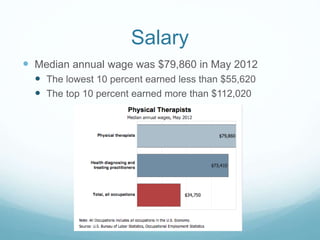
Salary
ď‚— Median annual wage was $79,860 in May 2012
ď‚— The lowest 10 percent earned less than $55,620
ď‚— The top 10 percent earned more than $112,020
Employment Outlook
ď‚— There are currently more than 184,000 physical
therapists licensed in the US today
ď‚— According to the Bureau of Labor Statistics,
employment is expected to grow by 30 percent from
2008 to 2018 which is faster than the average for all
occupations
How to Become a Physical
Therapist
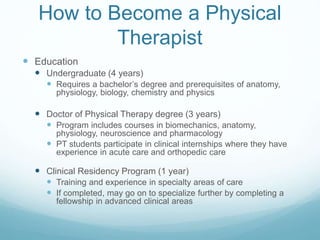
ď‚— Education
ď‚— Undergraduate (4 years)
 Requires a bachelor’s degree and prerequisites of anatomy,
physiology, biology, chemistry and physics
ď‚— Doctor of Physical Therapy degree (3 years)
ď‚— Program includes courses in biomechanics, anatomy,
physiology, neuroscience and pharmacology
ď‚— PT students participate in clinical internships where they have
experience in acute care and orthopedic care
ď‚— Clinical Residency Program (1 year)
ď‚— Training and experience in specialty areas of care
ď‚— If completed, may go on to specialize further by completing a
fellowship in advanced clinical areas
How to Become an Physical
Therapist
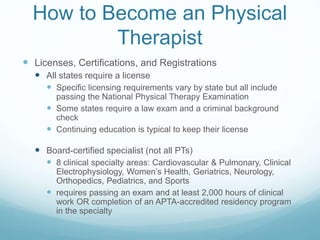
ď‚— Licenses, Certifications, and Registrations
ď‚— All states require a license
ď‚— Specific licensing requirements vary by state but all include
passing the National Physical Therapy Examination
ď‚— Some states require a law exam and a criminal background
check
ď‚— Continuing education is typical to keep their license
ď‚— Board-certified specialist (not all PTs)
ď‚— 8 clinical specialty areas: Cardiovascular & Pulmonary, Clinical
Electrophysiology, Women’s Health, Geriatrics, Neurology,
Orthopedics, Pediatrics, and Sports
ď‚— requires passing an exam and at least 2,000 hours of clinical
work OR completion of an APTA-accredited residency program
in the specialty
Important Skills and Qualities
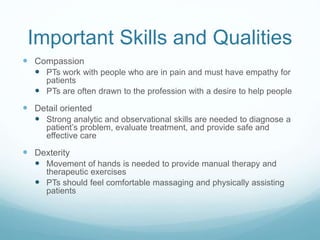
ď‚— Compassion
ď‚— PTs work with people who are in pain and must have empathy for
patients
ď‚— PTs are often drawn to the profession with a desire to help people
ď‚— Detail oriented
ď‚— Strong analytic and observational skills are needed to diagnose a
patient’s problem, evaluate treatment, and provide safe and
effective care
ď‚— Dexterity
ď‚— Movement of hands is needed to provide manual therapy and
therapeutic exercises
ď‚— PTs should feel comfortable massaging and physically assisting
patients
Important Skills and Qualities
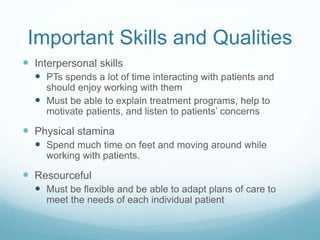
ď‚— Interpersonal skills
ď‚— PTs spends a lot of time interacting with patients and
should enjoy working with them
ď‚— Must be able to explain treatment programs, help to
motivate patients, and listen to patients’ concerns
ď‚— Physical stamina
ď‚— Spend much time on feet and moving around while
working with patients.
ď‚— Resourceful
ď‚— Must be flexible and be able to adapt plans of care to
meet the needs of each individual patient
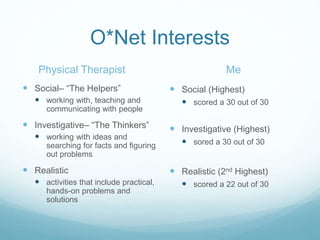
O*Net Interests
Physical Therapist
 Social– “The Helpers”
ď‚— working with, teaching and
communicating with people
 Investigative– “The Thinkers”
ď‚— working with ideas and
searching for facts and figuring
out problems
ď‚— Realistic
ď‚— activities that include practical,
hands-on problems and
solutions
Me
ď‚— Social (Highest)
ď‚— scored a 30 out of 30
ď‚— Investigative (Highest)
ď‚— sored a 30 out of 30
ď‚— Realistic (2nd Highest)
ď‚— scored a 22 out of 30
My Personal Work Style
ď‚— Concern for others
ď‚— understanding and helpful;
sensitive to others
ď‚— Integrity
ď‚— honest and ethical
ď‚— Dependable
ď‚— reliable, responsible and
dependable in fulfilling
obligations
ď‚— Adaptable/flexible
ď‚— open to change and
variability
ď‚— Analytical thinking
ď‚— use logic to address
problems and issues
ď‚— Cooperation
ď‚— good-natured attitude and
pleasant with others
ď‚— Independence
ď‚— depend on oneself to get
things done
ď‚— Initiative
ď‚— willing to take on
responsibilities and
challenges
Conclusion
Physical therapy has come a long way since its start with its
most basic practices beginning in Greek culture. Today it has
evolved to be a career in which people get to work hands on
and use their extensive education and clinical expertise to
provide efficient and effective care. Physical therapists aim to
help individuals of all ages to have optimal functioning and
quality of life by using a uniquely individualized approach.
While under the care of a physical therapist, a patient is safe
and plans are tailored based on individual needs. Physical
therapy is more than just a treatment option, its an opportunity
for growth and development which is aided by instruction and a
caring and supportive relationship provided by the physical
therapist.
References
ď‚— American Board of Physical Therapy Specialties- ABPTS. Retrieved January
26, 2015, from http://www.abpts.org/home.aspx
ď‚— American Physical Therapy Association. Careers & Education. Retrieved
January 26, 2015, from http://www.apta.org/AboutPTs/
ď‚— Bureau of Labor Statistics, U.S. Department of Labor, Occupational Outlook
Handbook, 2014-15 Edition, Physical Therapists. Retrieved January 27, 2015,
from http://www.bls.gov/ooh/healthcare/physical-therapists.htm
ď‚— NetworkSynergyGroup. The History of Physical Therapy. Retrieved January
26, 2015 from http://www.network-synergy.com/news/the-history-of-physical-
therapy.aspx
 O*NET OnLine. 29-1123.00 – Physical Therapists. (n.d.). retrieved January
27, 2015, from http://www.onetonline.org/link/summary/29-1123.00

Research on Career Powerpoint

  • 1.
  • 2.
    Introduction Physical therapists arelicensed health care professionals who aid patients by helping to reduce pain and improve or restore mobility through the use of therapy. Physical therapists work hands on with patients and create individual health and wellness plans in order to help the individual lead a healthier and more active lifestyle. These health care professionals work in a variety of settings which can range from schools to hospitals. They are also able to work with individuals of all ages, newborns to the elderly. The American Physical Therapy Association (APTA) states that the vision statement for the physical therapy profession is “transforming society by optimizing movement to improve the human experience.”
  • 3.
    History of PhysicalTherapy  The use of exercise, massage, heat, cold, water, and electricity in order to treat people’s disorders and disabilities dates back to Greek culture and Hippocrates’ influence in Western medicine.  In Europe during the 1500s-1700s, progress was made in the use of exercise to treat muscle and bone disabilities and disorders and by 1800, exercise and muscle re-education were a vital part of treating orthopedic diseases and injuries.  In 1916, the polio epidemic in the US caused much need for the restoration of muscle function. In 1917, soldiers of World War I needed rehabilitation. 15 reconstruction aide training programs were developed by the Army Medical Department’s Division of Special Hospitals and Physical Reconstruction.
  • 4.
    History of PhysicalTherapy ď‚— In 1920s, physical therapists partnered with medical and surgical communities and the profession gained public recognition and validation. ď‚— Congress adopted the Hill Burton Act in 1946 ď‚— This increased access to heath care facilities by building hospitals all across the country. This increased hospital based practice for PTs and increased need for PT services.
  • 5.
    History of PhysicalTherapy ď‚— 1950-2000: a time of independence, autonomy and professionalism ď‚— APTA urged state chapters to seek licensure; state regulations existed in 45 states by 1959 ď‚— First national examination given in 1954 ď‚— Neuromuscular practice area expanded with techniques for patients who suffered a stroke or had a CNS disorder ď‚— Cardiovascular/pulmonary practice area developed due to need of postoperative therapy for open heart surgery patients ď‚— Orthopedic practice area took hold with postoperative therapy for joint replacements ď‚— Technology development allowed new testing methodologies and intervention of a new range of diseases and conditions ď‚— Education of All Handicapped Children Act allowed PTs to enter into the public school system for work ď‚— APTA adopted a policy for PTs to practice without a doctor referral, increasing individualism and professionalism
  • 6.
    Duties of aPhysical Therapist  Review patient’s medical history and referrals/notes from doctors or surgeons  Diagnose patients’ dysfunctional movement by observation and concerns (paired with other methods)  Watch them stand or walk  Set up a plan of care for patients  Goals and expected outcomes are outlined  Use exercises, stretching, hands-on therapy and equipment to facilitate health and wellness and improve quality of life  Evaluate a patients’ progress  Modifying plan of care if needed (plans are individualized)  Educate patients and their families about what should be expected and how to cope with the sometimes difficult recovery process
  • 7.
    Work Setting ofa Physical Therapist ď‚— Industries that employed the most physical therapists in 2012: ď‚— Offices of physical, occupational and speech therapists, and audiologists (33%) ď‚— Hospitals; state, local, and private (28%) ď‚— Home health care services (11%) ď‚— Nursing and residential care facilities (7%) ď‚— Offices of physicians (5%) ď‚— Other places of employment: ď‚— Schools ď‚— Hospices ď‚— Fitness centers and sports training facilities ď‚— Education or research centers
  • 8.
    Work Schedule andPossible Risks ď‚— Most physical therapists work full time ď‚— This consists of a 40 hour week and may include some evenings and weekends ď‚— This career can be physically demanding ď‚— PTs have to kneel, crouch and stand for long periods of time while working with patients ď‚— PTs have to move heavy equipment and patients who need additional aid in turning, standing or walking
  • 9.
    Salary ď‚— Median annualwage was $79,860 in May 2012 ď‚— The lowest 10 percent earned less than $55,620 ď‚— The top 10 percent earned more than $112,020
  • 10.
    Employment Outlook ď‚— Thereare currently more than 184,000 physical therapists licensed in the US today ď‚— According to the Bureau of Labor Statistics, employment is expected to grow by 30 percent from 2008 to 2018 which is faster than the average for all occupations
  • 11.
    How to Becomea Physical Therapist  Education  Undergraduate (4 years)  Requires a bachelor’s degree and prerequisites of anatomy, physiology, biology, chemistry and physics  Doctor of Physical Therapy degree (3 years)  Program includes courses in biomechanics, anatomy, physiology, neuroscience and pharmacology  PT students participate in clinical internships where they have experience in acute care and orthopedic care  Clinical Residency Program (1 year)  Training and experience in specialty areas of care  If completed, may go on to specialize further by completing a fellowship in advanced clinical areas
  • 12.
    How to Becomean Physical Therapist  Licenses, Certifications, and Registrations  All states require a license  Specific licensing requirements vary by state but all include passing the National Physical Therapy Examination  Some states require a law exam and a criminal background check  Continuing education is typical to keep their license  Board-certified specialist (not all PTs)  8 clinical specialty areas: Cardiovascular & Pulmonary, Clinical Electrophysiology, Women’s Health, Geriatrics, Neurology, Orthopedics, Pediatrics, and Sports  requires passing an exam and at least 2,000 hours of clinical work OR completion of an APTA-accredited residency program in the specialty
  • 13.
    Important Skills andQualities  Compassion  PTs work with people who are in pain and must have empathy for patients  PTs are often drawn to the profession with a desire to help people  Detail oriented  Strong analytic and observational skills are needed to diagnose a patient’s problem, evaluate treatment, and provide safe and effective care  Dexterity  Movement of hands is needed to provide manual therapy and therapeutic exercises  PTs should feel comfortable massaging and physically assisting patients
  • 14.
    Important Skills andQualities  Interpersonal skills  PTs spends a lot of time interacting with patients and should enjoy working with them  Must be able to explain treatment programs, help to motivate patients, and listen to patients’ concerns  Physical stamina  Spend much time on feet and moving around while working with patients.  Resourceful  Must be flexible and be able to adapt plans of care to meet the needs of each individual patient
  • 15.
    O*Net Interests Physical Therapist Social– “The Helpers”  working with, teaching and communicating with people  Investigative– “The Thinkers”  working with ideas and searching for facts and figuring out problems  Realistic  activities that include practical, hands-on problems and solutions Me  Social (Highest)  scored a 30 out of 30  Investigative (Highest)  sored a 30 out of 30  Realistic (2nd Highest)  scored a 22 out of 30
  • 16.
    My Personal WorkStyle ď‚— Concern for others ď‚— understanding and helpful; sensitive to others ď‚— Integrity ď‚— honest and ethical ď‚— Dependable ď‚— reliable, responsible and dependable in fulfilling obligations ď‚— Adaptable/flexible ď‚— open to change and variability ď‚— Analytical thinking ď‚— use logic to address problems and issues ď‚— Cooperation ď‚— good-natured attitude and pleasant with others ď‚— Independence ď‚— depend on oneself to get things done ď‚— Initiative ď‚— willing to take on responsibilities and challenges
  • 17.
    Conclusion Physical therapy hascome a long way since its start with its most basic practices beginning in Greek culture. Today it has evolved to be a career in which people get to work hands on and use their extensive education and clinical expertise to provide efficient and effective care. Physical therapists aim to help individuals of all ages to have optimal functioning and quality of life by using a uniquely individualized approach. While under the care of a physical therapist, a patient is safe and plans are tailored based on individual needs. Physical therapy is more than just a treatment option, its an opportunity for growth and development which is aided by instruction and a caring and supportive relationship provided by the physical therapist.
  • 18.
    References  American Boardof Physical Therapy Specialties- ABPTS. Retrieved January 26, 2015, from http://www.abpts.org/home.aspx  American Physical Therapy Association. Careers & Education. Retrieved January 26, 2015, from http://www.apta.org/AboutPTs/  Bureau of Labor Statistics, U.S. Department of Labor, Occupational Outlook Handbook, 2014-15 Edition, Physical Therapists. Retrieved January 27, 2015, from http://www.bls.gov/ooh/healthcare/physical-therapists.htm  NetworkSynergyGroup. The History of Physical Therapy. Retrieved January 26, 2015 from http://www.network-synergy.com/news/the-history-of-physical- therapy.aspx  O*NET OnLine. 29-1123.00 – Physical Therapists. (n.d.). retrieved January 27, 2015, from http://www.onetonline.org/link/summary/29-1123.00