Physical TherapyLauren Sappington11/30/09Leslie SeawrightENGL 3053
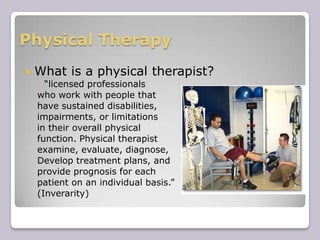
Physical TherapyWhat is a physical therapist?“licensed professionals who work with people thathave sustained disabilities,impairments, or limitationsin their overall physical function. Physical therapistexamine, evaluate, diagnose, Develop treatment plans, and provide prognosis for each patient on an individual basis.” (Inverarity)
EducationUndergraduate DegreeAs an undergrad, looking to go into physical therapy, you can have basically any degree you wish.  However, keep in mind that each PT school will have prerequisites and that certain degrees (biology, kinesiology, etc) already include those prerequisites.Those prerequisites often include: Biology, Chemistry, Social Science, Mathematics, Anatomy, Physiology, and Physics 1 and 2.
Important Websitewww.APTA.orgThis is the American Physical Therapy Association’s websiteGreat resource for all information about physical therapy including:Student resourcesJob opportunitiesResearchAnd much more!
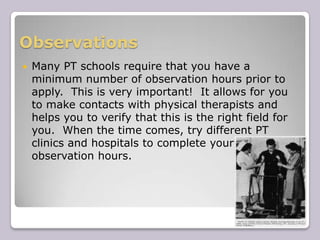
ObservationsMany PT schools require that you have a minimum number of observation hours prior to apply.  This is very important!  It allows for you to make contacts with physical therapists and helps you to verify that this is the right field for you.  When the time comes, try different PT clinics and hospitals to complete your observation hours.
What to ExpectPhysical Therapy school is very competitive and demanding.  It is a 3 year doctorate program.  Most PT schools accept anywhere between 40-45 students each year.  Work on making good contacts/references, many observation hours and good grades.  Volunteering and being actively involved in student organizations also helps too!
Different ConcentrationsThere are numerous specialty areas in the field of physical therapy.  Below are a few:CardiopulmonaryClinical electrophysiologicGeriatricNeurologicOrthopedicPediatricSportsWomen’s Health(American Physical Therapy Association)
SalaryMedian annual earnings of physical therapists were $66,200 in May 2006. Median annual earnings in the industries employing the largest numbers of physical therapists in May 2006 were:Home health care services $70,920 Nursing care facilities $68,650 General medical and surgical hospitals $66,630 Offices of physicians $65,900 Offices of physical, occupational and speech therapists, and audiologists $65,150(U.S. Bureau of Labor)
Job OutlookEmployment of physical therapists is expected to grow much faster than average. Job opportunities will be good, especially in acute hospital, rehabilitation, and orthopedic settings.Employment of physical therapists is expected to grow 27 percent from 2006 to 2016, much faster than the average for all occupations.This is primarily due to all the “baby boomers”.  Physical therapists planning on working “where the elderly are most often treated. Physical therapists with specialized knowledge of particular types of treatment also will have excellent job prospects.” (U.S. Bureau of Labor)
Physical Therapy SettingsThere are several different settings for Physical Therapists to work in.  Depending on what specialty you plan on going into, you could work in:
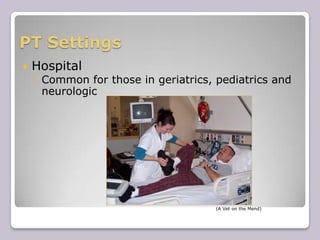
PT SettingsHospitalCommon for those in geriatrics, pediatrics and neurologic																							 (A Vet on the Mend)
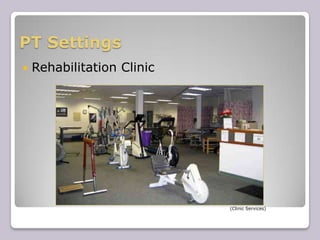
PT SettingsRehabilitation Clinic							          (Clinic Services)
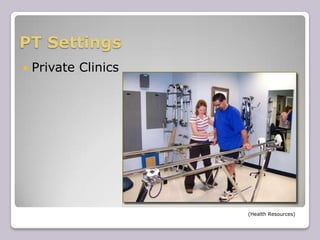
PT SettingsPrivate Clinics								 (Health Resources)
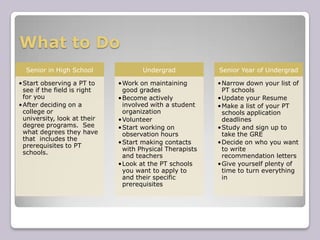
What to Do
What PT’s Read Mr. Neil Yust, 1994 graduate in physical therapy and owner of Industrial Physical Therapy, reads “APTA magazines and emails on a daily, weekly and monthly basis”(Yust).  Mrs. Peg Maher, holds her Bachelor’s in physical therapy from University of Central Arkansas, reads “patient charts, progress notes, and APTA magazines in print and online” on a daily, weekly, monthly and yearly basis. (Maher)Mrs. Lori Young, holds her master’s in physical therapy from University of Missouri, and also reads “patient charts, emails, and monthly hospital newsletters” on a daily, weekly, monthly and yearly basis. (Young)
What PT’s WriteMrs. Maher and Mrs. Young both stated they write evaluation's of patients, progress notes, daily documentation of patients, emails on a daily, weekly and monthly basis. (Maher and Young)Mr. Yust writes a physical therapy related article every month in a monthly newsletter that is sent out    from his private clinic. (Yust)(Neil Yust)
How You Should PrepareTo prepare for this kind of reading and writing, the Physical Therapists I interviewed suggested:Mr. Yust suggests, “reading up on Ethical information, run your own business information, Medicare and billing information”(Yust).Mrs. Mahersuggests reading and studying “case studies prior to physical therapy school.  Once in, then I would start looking at more statistical and analytical articles.” (Maher)Mrs. Young suggest learning “proper email etiquette and to learn the shorthand that all physical therapist use.” (Young)
Current Issues in the FieldMr. Yust mentioned that the two issues he is or has been aware of in the field are: Ownership in PT National Healthcare National Healthcare was the primary issue in the field discussed among the physical therapists. (Maher and Young)
Upsides/Downsides Mr. Yust had mentioned that “being able to coach and teach everyday” is a great upside; however, “all walks of life (family, friends, church, etc…) ask any and all medical related questions” and that can sometimes be a downside. (Yust)
Flexibility, diverse areas of work settings and many different job markets are an upside according to Mrs. Maher.  However, she said a downside would be that, “it’s physically demanding, many burnout because of repeat lifting and the increasing obese population”(Maher).References and Works cited"A Vet on the Mend." Jackson News. Web. 7 Dec 2009. 	<http://images.google.com/imgres?imgurl=http://blog.mlive.com/citpat/2008/04/large_P	Tblaxton.jpg&imgrefurl=http://blog.mlive.com/citpat/2008/04/a_vet_on_the_mend.html&	usg=__BglKEPQhVMJE-	s5Kisz4H10nBqQ=&h=340&w=453&sz=80&hl=en&start=1&um=1&tbnid=zMza0A5AyHPR	LM:&tbnh=95&tbnw=127&prev=/images%3Fq%3Dhospital%2Bphysical%2Btherapy%26h	l%3Den%26um%3D1>. Clinic Services. Web. 7 Dec 2009. 	<http://images.google.com/imgres?imgurl=http://www.healthoneclinics.com/CPM/northwest_reh	ab_gym.jpg&imgrefurl=http://www.healthoneclinics.com/CustomPage.asp%3FguidCustomContent	ID%3D%257BACD099CF-F18A-4750-813F-86B6394E6610%257D&usg=__4oS6bpbFn0nl8ImFLbU-	k1waeek=&h=359&w=622&sz=14&hl=en&start=34&um=1&tbnid=UIApNkQC0fHtRM:&tbnh=78&tbnw	=136&prev=/images%3Fq%3Drehabilitation%2Bclinic%2Bphysical%2Btherapy%26ndsp%3D18%26hl	%3Den%26sa%3DN%26start%3D18%26um%3D1>. Health Resources. Web. 7 Dec 2009. <http://images.google.com/imgres?imgurl=http://www.progressive-	pt.net/images/physical_therapy.png&imgrefurl=http://www.health-res.com/physical-therapy-for-	carpaltunnel/&usg=__8eEhSPi3nfCkk1tBh9WS3QxpMck=&h=303&w=400&sz=234&hl=en&start=40&u	m=1&tbnid=nuOPukH4baQ8BM:&tbnh=94&tbnw=124&prev=/images%3Fq%3Dprivate%2Bphysical%2	Btherapy%2Bclinics%26ndsp%3D18%26hl%3Den%26sa%3DN%26start%3D36%26um%3D1>Inverarity, Laura. "Physical Therapy." What is a Physcial Therapist?. 02 01 2007. about.com, Web. 6 Dec 2009. 		<http://physicaltherapy.about.com/od/typesofphysicaltherapy/a/WhatisaPT.htm>.
References and Works cited"Neil Yust." Physical Therapy: Staff. Web. 7 Dec 2009. 	<http://industrialpt.com/PhysTherapy_Staff.html>."Professional Development." American Physical Therapy Association. 28 Sep 2009. APTA, Web. 7 		Dec 2009. 	<http://www.apta.org/AM/Template.cfm?Section=Certification2&Template=/TaggedPage/TaggedPageDisplay.cfm&TPLID=206&ContentID=60265>.U.S. Bureau of Labor Statistics Office of Occupational Statistics and Employment Projections.	 Washington: , 2008. Web. 7 Dec 2009. <http://www.bls.gov/oco/ocos080.htm>.Primary:Yust, Neil. "Class Assignment Interview." Message to Lauren Sappington. 02 Dec 2009. E-mail.Maher, Peg. Phone Interview. 07 Dec 2009.Young, Lori. Phone Interview. 04 Dec 2009.

Physical Therapy Twpresentation

  • 1.
  • 2.
    Physical TherapyWhat isa physical therapist?“licensed professionals who work with people thathave sustained disabilities,impairments, or limitationsin their overall physical function. Physical therapistexamine, evaluate, diagnose, Develop treatment plans, and provide prognosis for each patient on an individual basis.” (Inverarity)
  • 3.
    EducationUndergraduate DegreeAs anundergrad, looking to go into physical therapy, you can have basically any degree you wish. However, keep in mind that each PT school will have prerequisites and that certain degrees (biology, kinesiology, etc) already include those prerequisites.Those prerequisites often include: Biology, Chemistry, Social Science, Mathematics, Anatomy, Physiology, and Physics 1 and 2.
  • 4.
    Important Websitewww.APTA.orgThis isthe American Physical Therapy Association’s websiteGreat resource for all information about physical therapy including:Student resourcesJob opportunitiesResearchAnd much more!
  • 5.
    ObservationsMany PT schoolsrequire that you have a minimum number of observation hours prior to apply. This is very important! It allows for you to make contacts with physical therapists and helps you to verify that this is the right field for you. When the time comes, try different PT clinics and hospitals to complete your observation hours.
  • 6.
    What to ExpectPhysicalTherapy school is very competitive and demanding. It is a 3 year doctorate program. Most PT schools accept anywhere between 40-45 students each year. Work on making good contacts/references, many observation hours and good grades. Volunteering and being actively involved in student organizations also helps too!
  • 7.
    Different ConcentrationsThere arenumerous specialty areas in the field of physical therapy. Below are a few:CardiopulmonaryClinical electrophysiologicGeriatricNeurologicOrthopedicPediatricSportsWomen’s Health(American Physical Therapy Association)
  • 8.
    SalaryMedian annual earningsof physical therapists were $66,200 in May 2006. Median annual earnings in the industries employing the largest numbers of physical therapists in May 2006 were:Home health care services $70,920 Nursing care facilities $68,650 General medical and surgical hospitals $66,630 Offices of physicians $65,900 Offices of physical, occupational and speech therapists, and audiologists $65,150(U.S. Bureau of Labor)
  • 9.
    Job OutlookEmployment ofphysical therapists is expected to grow much faster than average. Job opportunities will be good, especially in acute hospital, rehabilitation, and orthopedic settings.Employment of physical therapists is expected to grow 27 percent from 2006 to 2016, much faster than the average for all occupations.This is primarily due to all the “baby boomers”. Physical therapists planning on working “where the elderly are most often treated. Physical therapists with specialized knowledge of particular types of treatment also will have excellent job prospects.” (U.S. Bureau of Labor)
  • 10.
    Physical Therapy SettingsThereare several different settings for Physical Therapists to work in. Depending on what specialty you plan on going into, you could work in:
  • 11.
    PT SettingsHospitalCommon forthose in geriatrics, pediatrics and neurologic (A Vet on the Mend)
  • 12.
  • 13.
    PT SettingsPrivate Clinics (Health Resources)
  • 14.
  • 15.
    What PT’s ReadMr. Neil Yust, 1994 graduate in physical therapy and owner of Industrial Physical Therapy, reads “APTA magazines and emails on a daily, weekly and monthly basis”(Yust). Mrs. Peg Maher, holds her Bachelor’s in physical therapy from University of Central Arkansas, reads “patient charts, progress notes, and APTA magazines in print and online” on a daily, weekly, monthly and yearly basis. (Maher)Mrs. Lori Young, holds her master’s in physical therapy from University of Missouri, and also reads “patient charts, emails, and monthly hospital newsletters” on a daily, weekly, monthly and yearly basis. (Young)
  • 16.
    What PT’s WriteMrs.Maher and Mrs. Young both stated they write evaluation's of patients, progress notes, daily documentation of patients, emails on a daily, weekly and monthly basis. (Maher and Young)Mr. Yust writes a physical therapy related article every month in a monthly newsletter that is sent out from his private clinic. (Yust)(Neil Yust)
  • 17.
    How You ShouldPrepareTo prepare for this kind of reading and writing, the Physical Therapists I interviewed suggested:Mr. Yust suggests, “reading up on Ethical information, run your own business information, Medicare and billing information”(Yust).Mrs. Mahersuggests reading and studying “case studies prior to physical therapy school. Once in, then I would start looking at more statistical and analytical articles.” (Maher)Mrs. Young suggest learning “proper email etiquette and to learn the shorthand that all physical therapist use.” (Young)
  • 18.
    Current Issues inthe FieldMr. Yust mentioned that the two issues he is or has been aware of in the field are: Ownership in PT National Healthcare National Healthcare was the primary issue in the field discussed among the physical therapists. (Maher and Young)
  • 19.
    Upsides/Downsides Mr. Yusthad mentioned that “being able to coach and teach everyday” is a great upside; however, “all walks of life (family, friends, church, etc…) ask any and all medical related questions” and that can sometimes be a downside. (Yust)
  • 20.
    Flexibility, diverse areasof work settings and many different job markets are an upside according to Mrs. Maher. However, she said a downside would be that, “it’s physically demanding, many burnout because of repeat lifting and the increasing obese population”(Maher).References and Works cited"A Vet on the Mend." Jackson News. Web. 7 Dec 2009. <http://images.google.com/imgres?imgurl=http://blog.mlive.com/citpat/2008/04/large_P Tblaxton.jpg&imgrefurl=http://blog.mlive.com/citpat/2008/04/a_vet_on_the_mend.html& usg=__BglKEPQhVMJE- s5Kisz4H10nBqQ=&h=340&w=453&sz=80&hl=en&start=1&um=1&tbnid=zMza0A5AyHPR LM:&tbnh=95&tbnw=127&prev=/images%3Fq%3Dhospital%2Bphysical%2Btherapy%26h l%3Den%26um%3D1>. Clinic Services. Web. 7 Dec 2009. <http://images.google.com/imgres?imgurl=http://www.healthoneclinics.com/CPM/northwest_reh ab_gym.jpg&imgrefurl=http://www.healthoneclinics.com/CustomPage.asp%3FguidCustomContent ID%3D%257BACD099CF-F18A-4750-813F-86B6394E6610%257D&usg=__4oS6bpbFn0nl8ImFLbU- k1waeek=&h=359&w=622&sz=14&hl=en&start=34&um=1&tbnid=UIApNkQC0fHtRM:&tbnh=78&tbnw =136&prev=/images%3Fq%3Drehabilitation%2Bclinic%2Bphysical%2Btherapy%26ndsp%3D18%26hl %3Den%26sa%3DN%26start%3D18%26um%3D1>. Health Resources. Web. 7 Dec 2009. <http://images.google.com/imgres?imgurl=http://www.progressive- pt.net/images/physical_therapy.png&imgrefurl=http://www.health-res.com/physical-therapy-for- carpaltunnel/&usg=__8eEhSPi3nfCkk1tBh9WS3QxpMck=&h=303&w=400&sz=234&hl=en&start=40&u m=1&tbnid=nuOPukH4baQ8BM:&tbnh=94&tbnw=124&prev=/images%3Fq%3Dprivate%2Bphysical%2 Btherapy%2Bclinics%26ndsp%3D18%26hl%3Den%26sa%3DN%26start%3D36%26um%3D1>Inverarity, Laura. "Physical Therapy." What is a Physcial Therapist?. 02 01 2007. about.com, Web. 6 Dec 2009. <http://physicaltherapy.about.com/od/typesofphysicaltherapy/a/WhatisaPT.htm>.
  • 21.
    References and Workscited"Neil Yust." Physical Therapy: Staff. Web. 7 Dec 2009. <http://industrialpt.com/PhysTherapy_Staff.html>."Professional Development." American Physical Therapy Association. 28 Sep 2009. APTA, Web. 7 Dec 2009. <http://www.apta.org/AM/Template.cfm?Section=Certification2&Template=/TaggedPage/TaggedPageDisplay.cfm&TPLID=206&ContentID=60265>.U.S. Bureau of Labor Statistics Office of Occupational Statistics and Employment Projections. Washington: , 2008. Web. 7 Dec 2009. <http://www.bls.gov/oco/ocos080.htm>.Primary:Yust, Neil. "Class Assignment Interview." Message to Lauren Sappington. 02 Dec 2009. E-mail.Maher, Peg. Phone Interview. 07 Dec 2009.Young, Lori. Phone Interview. 04 Dec 2009.