
Permanent Weight Reduction after Abdominoplasty:
              Neurocrine Factors,
                 A Pilot Study

Rex Moulton-Barrett, MD & Jennifer Fuller, B.A.
      Plastic & Reconstructive Surgery
         Alameda and Brentwood, Ca
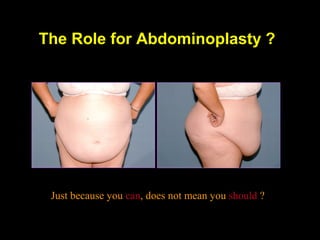
The Role for Abdominoplasty ?


 Just because you can, does not mean you should ?
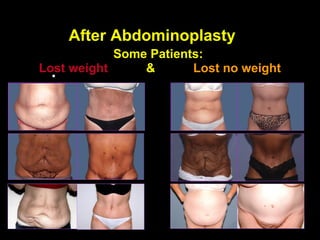
After Abdominoplasty
            Some Patients:
Lost weight     &       Lost no weight
  •
Questions

• Does abdominoplasty lead to long-term weight loss ?

• Which group of patient’s benefit most ?

• What are the cause(s) of weight loss after surgery ?
Obesity Epidemic
• BMI: Body Mass Index: weight kg/(height m) 2


• <1/3 of U.S.    Normal                                  BMI
19-25
• 1/3 of U.S.    Overweight                           BMI
25-30
• 1/3 of U.S.      Obese
BMI 30-40
• The prevalence of obesity has more than doubled since
1980
• 3% of U.S.     Morbid-Super Obese
BMI> 40
Treatment of Obesity


    3 main methods of treatment:

•   Life Style Modification
    – Moderately effective but difficult to monitor and sustain


•   Pharmacological Therapy
    – Few effective treatments exist


•   Surgical Treatment
    – Significant and permanent weight loss
    – Insurance criteria morbid obesity (BMI ≥40)
Life Style Modification
• Convert to ‘ negative energy gap ’

• Increased energy expenditure:
       reduce non-active time: car, chair, sofa
       increased exercise time
       increased energy lost during exercise

• Diet: high protein
        low carbohydrate
        low sugar
        ‘+ ketogenic diets’ reduce appetite
        ( Am J of Clin Nutrition, 2008: 87(1), 44-55 )
       avoid exercise before meals: 20 minute run =
  20oz
      ie avoid post exercise ‘calorie rewards’
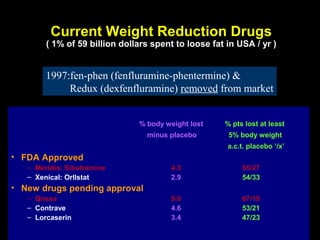
Current Weight Reduction Drugs
        ( 1% of 59 billion dollars spent to loose fat in USA / yr )


        1997:fen-phen (fenfluramine-phentermine) &
             Redux (dexfenfluramine) removed from market


                               % body weight lost    % pts lost at least
                                 minus placebo        5% body weight
                                                      a.c.t. placebo ‘/x’
• FDA Approved
   – Meridia: Sibutramine               4.3               55/27
   – Xenical: Orllstat                  2.9               54/33
• New drugs pending approval
   – Qnexa                              9.0               67/19
   – Contrave                           4.6               53/21
   – Lorcaserin                         3.4               47/23
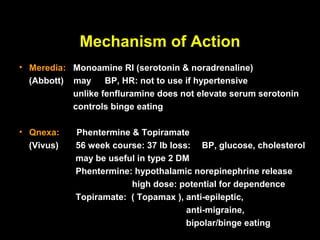
Mechanism of Action
• Meredia: Monoamine RI (serotonin & noradrenaline)
  (Abbott) may     BP, HR: not to use if hypertensive
           unlike fenfluramine does not elevate serum serotonin
           controls binge eating

• Qnexa:    Phentermine & Topiramate
  (Vivus)   56 week course: 37 lb loss: BP, glucose, cholesterol
            may be useful in type 2 DM
            Phentermine: hypothalamic norepinephrine release
                        high dose: potential for dependence
            Topiramate: ( Topamax ), anti-epileptic,
                                      anti-migraine,
                                      bipolar/binge eating
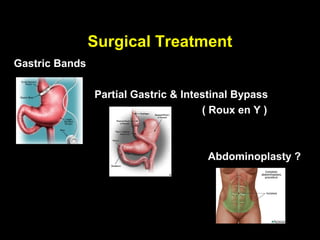
Surgical Treatment
Gastric Bands

                Partial Gastric & Intestinal Bypass
                                      ( Roux en Y )


                                      Abdominoplasty ?
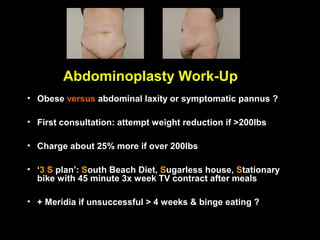
Abdominoplasty Work-Up
• Obese versus abdominal laxity or symptomatic pannus ?

• First consultation: attempt weight reduction if >200lbs

• Charge about 25% more if over 200lbs

• ‘3 S plan’: South Beach Diet, Sugarless house, Stationary
  bike with 45 minute 3x week TV contract after meals

• + Meridia if unsuccessful > 4 weeks & binge eating ?
Abdominoplasty Technique
•   Low incision 4 cm above the anterior labial commissure
•   Aggressive midline Rectus Abdominus plication
•   Jack knife sitting / Trendelenburg position closure
•   Closure: interrupted Scarpa’s fascia
              running dermal barbed 3.0 V -Lock Suture
              skin glue and 1 inch Steri-Strips
•   Lateral flank liposuction for contour
•   5 day pain pump & overnight in surgery center
•   Rented surgical bed at home for 2-4 weeks
•   Prolonged paper taping for 6 months when clothed
•   3 S’s starting 6 weeks post-op
Methods

•    Retrospective case review: chart & structured
    interview

•    same surgeon and one post-graduate student

•    n= 21 patients post-abdominoplasty

• Follow up to > 1 year: 2007-2009
Methods
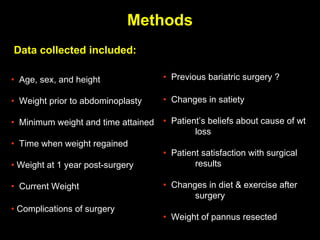
Data collected included:

• Age, sex, and height               • Previous bariatric surgery ?

• Weight prior to abdominoplasty     • Changes in satiety

• Minimum weight and time attained   • Patient’s beliefs about cause of wt
                                             loss
• Time when weight regained
                                     • Patient satisfaction with surgical
• Weight at 1 year post-surgery              results

• Current Weight                     • Changes in diet & exercise after
                                            surgery
• Complications of surgery
                                     • Weight of pannus resected
Results: Patient Population
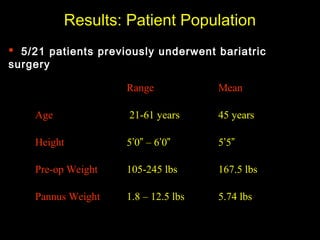
 5/21 patients previously underwent bariatric
surgery

                     Range            Mean

    Age              21-61 years      45 years

    Height           5’0” – 6’0”      5’5”

    Pre-op Weight    105-245 lbs      167.5 lbs

    Pannus Weight    1.8 – 12.5 lbs   5.74 lbs
Results: BMI’s

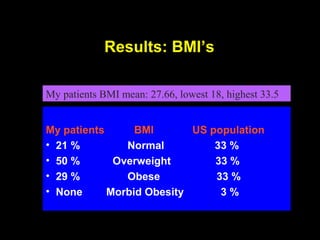
My patients BMI mean: 27.66, lowest 18, highest 33.5


My patients      BMI       US population
• 21 %         Normal          33 %
• 50 %       Overweight        33 %
• 29 %         Obese           33 %
• None      Morbid Obesity      3%
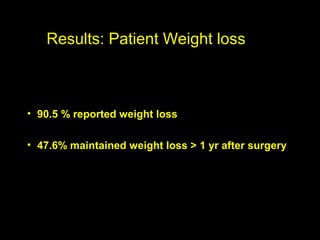
Results: Patient Weight loss


• 90.5 % reported weight loss

• 47.6% maintained weight loss > 1 yr after surgery
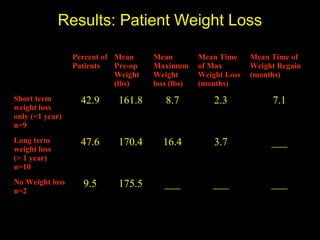
Results: Patient Weight Loss

                 Percent of Mean     Mean         Mean Time     Mean Time of
                 Patients   Pre-op   Maximum      of Max        Weight Regain
                            Weight   Weight       Weight Loss   (months)
                            (lbs)    loss (lbs)   (months)
Short term         42.9     161.8       8.7           2.3            7.1
weight loss
only (<1 year)
n=9
Long term          47.6     170.4      16.4           3.7            ___
weight loss
(> 1 year)
n=10
No Weight loss     9.5      175.5       ___          ___             ___
n=2
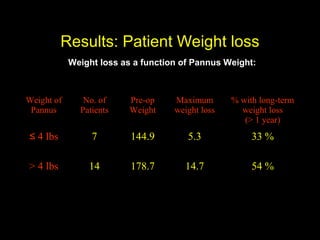
Results: Patient Weight loss
            Weight loss as a function of Pannus Weight:


Weight of      No. of     Pre-op    Maximum       % with long-term
 Pannus       Patients    Weight    weight loss     weight loss
                                                     (> 1 year)
≤ 4 lbs          7        144.9        5.3             33 %

> 4 lbs         14        178.7       14.7             54 %
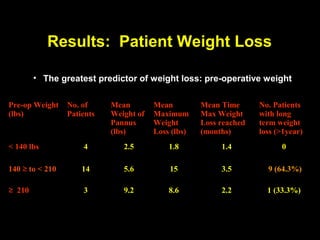
Results: Patient Weight Loss

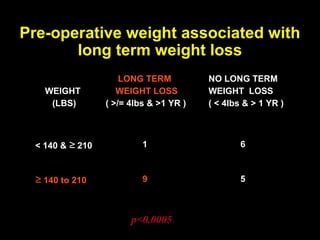
        • The greatest predictor of weight loss: pre-operative weight

Pre-op Weight    No. of     Mean        Mean         Mean Time      No. Patients
(lbs)            Patients   Weight of   Maximum      Max Weight     with long
                            Pannus      Weight       Loss reached   term weight
                            (lbs)       Loss (lbs)   (months)       loss (>1year)
< 140 lbs            4         2.5          1.8           1.4             0

140 ≥ to < 210       14        5.6          15            3.5         9 (64.3%)

≥ 210                3         9.2          8.6           2.2         1 (33.3%)
Pre-operative weight associated with
       long term weight loss
                      LONG TERM          NO LONG TERM
    WEIGHT           WEIGHT LOSS         WEIGHT LOSS
     (LBS)        ( >/= 4lbs & >1 YR )   ( < 4lbs & > 1 YR )


  < 140 & ≥ 210            1                     6


  ≥ 140 to 210             9                     5


                        p<0.0005
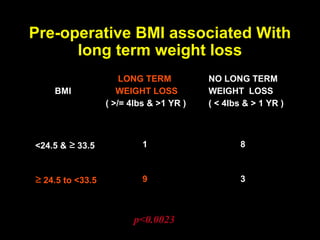
Pre-operative BMI associated With
      long term weight loss
                      LONG TERM          NO LONG TERM
    BMI              WEIGHT LOSS         WEIGHT LOSS
                  ( >/= 4lbs & >1 YR )   ( < 4lbs & > 1 YR )


<24.5 & ≥ 33.5             1                     8


≥ 24.5 to <33.5            9                     3


                         p<0.0023
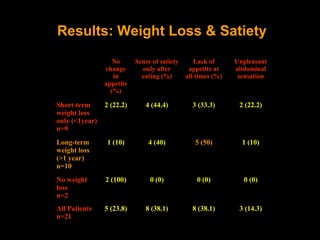
Results: Weight Loss & Satiety
                   No      Sense of satiety      Lack of      Unpleasant
                change       only after        appetite at    abdominal
                   in        eating (%)       all times (%)    sensation
                appetite
                  (%)

Short-term      2 (22.2)      4 (44.4)          3 (33.3)       2 (22.2)
weight loss
only (<1year)
n=9
Long-term        1 (10)        4 (40)            5 (50)         1 (10)
weight loss
(>1 year)
n=10
No weight       2 (100)         0 (0)             0 (0)         0 (0)
loss
n=2
All Patients    5 (23.8)      8 (38.1)          8 (38.1)       3 (14.3)
n=21
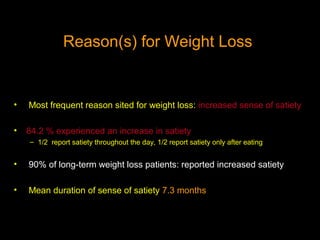
Reason(s) for Weight Loss


•   Most frequent reason sited for weight loss: increased sense of satiety

•   84.2 % experienced an increase in satiety
    – 1/2 report satiety throughout the day, 1/2 report satiety only after eating


•   90% of long-term weight loss patients: reported increased satiety

•   Mean duration of sense of satiety 7.3 months
Conclusions

• The greatest predictor of long-term weight
   loss was pre-operative weight then BMI

• 64.3% of patients weighing between 140
   and 210 lbs had long term weight loss

• Only 14.3 % of patients outside this range
   had long-term weight loss
Conclusions

• The key factor in patient weight loss is
        an increase in satiety


• Short-term weight loss patients began
    to regain their weight at 7.1 months,
       about the same time when their
             satiety dissipated
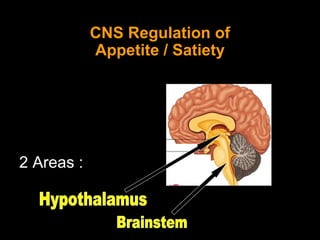
CNS Regulation of
            Appetite / Satiety


2 Areas :
The Hypothalamus

• One of the Hypothalamic Nuclei is called
  the Arcuate Nucleus (ARC)

• ARC incomplete blood-brain barrier

• Allows CNS entry of peripheral peptides
                      and proteins
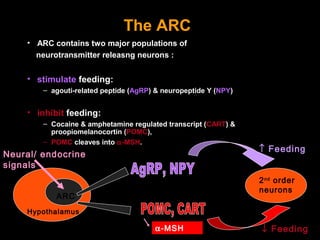
The ARC
    • ARC contains two major populations of
      neurotransmitter releasng neurons :


    • stimulate feeding:
        – agouti-related peptide (AgRP) & neuropeptide Y (NPY)


    • inhibit feeding:
        – Cocaine & amphetamine regulated transcript (CART) &
          proopiomelanocortin (POMC),
        – POMC cleaves into α -MSH.
                                                                 ↑ Feeding
Neural/ endocrine
signals
                                                                 2 nd order
                                                                 neurons
           ARC
    Hypothalamus

                                       α-MSH                     ↓ Feeding
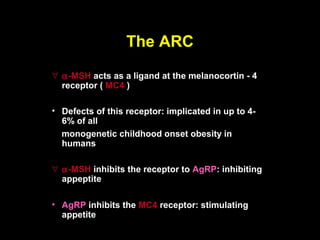
The ARC
∀ α -MSH acts as a ligand at the melanocortin - 4
  receptor ( MC4 )

• Defects of this receptor: implicated in up to 4-
  6% of all
  monogenetic childhood onset obesity in
  humans

∀ α -MSH inhibits the receptor to AgRP: inhibiting
  appeptite

• AgRP inhibits the MC4 receptor: stimulating
  appetite
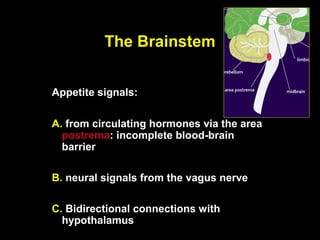
The Brainstem


Appetite signals:

A. from circulating hormones via the area
  postrema: incomplete blood-brain
  barrier

B. neural signals from the vagus nerve

C. Bidirectional connections with
  hypothalamus
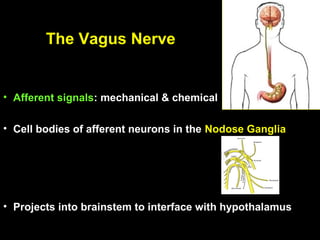
The Vagus Nerve


• Afferent signals: mechanical & chemical

• Cell bodies of afferent neurons in the Nodose Ganglia


• Projects into brainstem to interface with hypothalamus
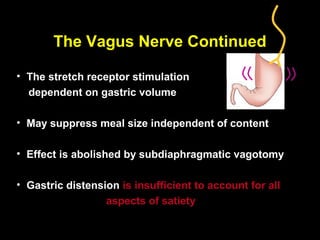
The Vagus Nerve Continued

• The stretch receptor stimulation
  dependent on gastric volume

• May suppress meal size independent of content

• Effect is abolished by subdiaphragmatic vagotomy

• Gastric distension is insufficient to account for all
                  aspects of satiety
The Vagus Nerve

• Contains receptors for a number of gut
  hormones

• Vagotomy abolishes appetite-modifying
  action of
  many gut hormones: CCK, PYY, GLP-1

• Vagus nerve is thought to be a major
  sight of gut hormone signaling
A Very Quick Overview of Appetite
      Regulating Hormones
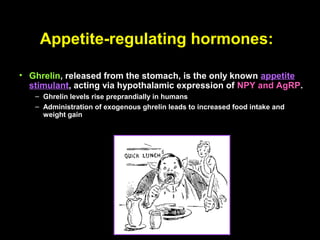
Appetite-regulating hormones:

• Ghrelin, released from the stomach, is the only known appetite
  stimulant, acting via hypothalamic expression of NPY and AgRP.
   – Ghrelin levels rise preprandially in humans
   – Administration of exogenous ghrelin leads to increased food intake and
     weight gain
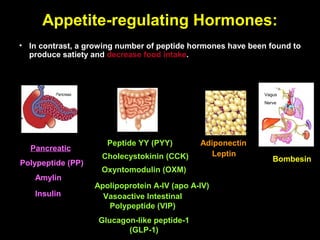
Appetite-regulating Hormones:
• In contrast, a growing number of peptide hormones have been found to
  produce satiety and decrease food intake.


                                                            Vagus
                                                            Nerve


                      Peptide YY (PYY)        Adiponectin
  Pancreatic
                    Cholecystokinin (CCK)       Leptin
Polypeptide (PP)                                               Bombesin
                    Oxyntomodulin (OXM)
   Amylin
                   Apolipoprotein A-IV (apo A-IV)
   Insulin           Vasoactive Intestinal
                      Polypeptide (VIP)
                    Glucagon-like peptide-1
                           (GLP-1)
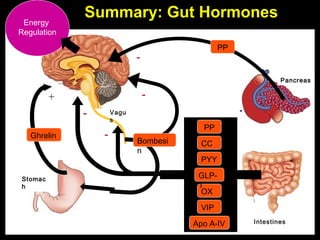
Energy
             Summary: Gut Hormones
Regulation
                                              PP
                            -

                                                           Pancreas

         +                      -
             -       Vagu
                     s
                                        PP
   Ghrelin       -
                            Bombesi     CC
                            n           K
                                        PYY

Stomac                                 GLP-
h                                      1
                                        OX
                                        M
                                        VIP

                                      Apo A-IV     Intestines
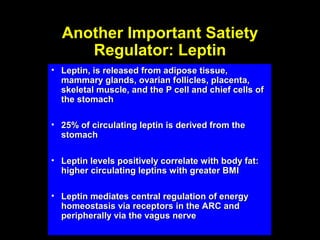
Another Important Satiety
     Regulator: Leptin
• Leptin, is released from adipose tissue,
  mammary glands, ovarian follicles, placenta,
  skeletal muscle, and the P cell and chief cells of
  the stomach

• 25% of circulating leptin is derived from the
  stomach

• Leptin levels positively correlate with body fat:
  higher circulating leptins with greater BMI

• Leptin mediates central regulation of energy
  homeostasis via receptors in the ARC and
  peripherally via the vagus nerve
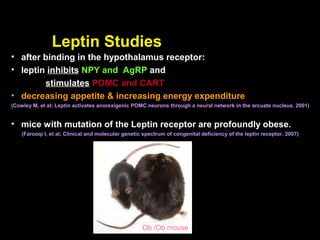
Leptin Studies
• after binding in the hypothalamus receptor:
• leptin inhibits NPY and AgRP and
        stimulates POMC and CART
• decreasing appetite & increasing energy expenditure
(Cowley M, et al; Leptin activates anorexigenic POMC neurons through a neural network in the arcuate nucleus. 2001)


• mice with mutation of the Leptin receptor are profoundly obese.
    (Farooqi I, et al; Clinical and molecular genetic spectrum of congenital deficiency of the leptin receptor. 2007)


                                                     Ob /Ob mouse
Appetite-regulating hormones:
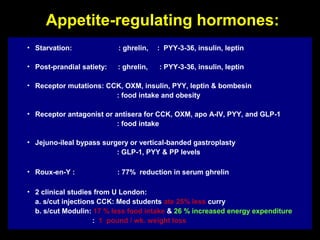
• Starvation:              : ghrelin,   : PYY-3-36, insulin, leptin

• Post-prandial satiety:   : ghrelin,   : PYY-3-36, insulin, leptin

• Receptor mutations: CCK, OXM, insulin, PYY, leptin & bombesin
                        : food intake and obesity

• Receptor antagonist or antisera for CCK, OXM, apo A-IV, PYY, and GLP-1
                          : food intake

• Jejuno-ileal bypass surgery or vertical-banded gastroplasty
                          : GLP-1, PYY & PP levels

• Roux-en-Y :              : 77% reduction in serum ghrelin

• 2 clinical studies from U London:
  a. s/cut injections CCK: Med students ate 25% less curry
  b. s/cut Modulin: 17 % less food intake & 26 % increased energy expenditure
                    : 1 pound / wk. weight loss
Future Study

• Patients are tested before abdominoplasty and
  incrementally after for levels of specific gut hormones

• Is there an association between hormone expression
  levels, reported satiety, and patient weight loss?
Methods


• 15 patients to participate in our study

• Prior to surgery: age, weight, height, gynecological history, previous
  bariatric surgeries, and exercise regimens

• Fasting blood draw: Prior to & 1, 3, 6, and 12 months after surgery

• At surgery weight of the pannus will be recorded
Methods

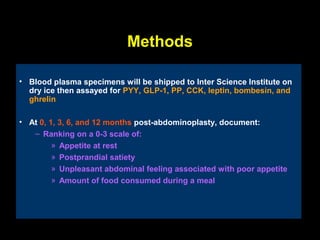
• Blood plasma specimens will be shipped to Inter Science Institute on
  dry ice then assayed for PYY, GLP-1, PP, CCK, leptin, bombesin, and
  ghrelin

• At 0, 1, 3, 6, and 12 months post-abdominoplasty, document:
   – Ranking on a 0-3 scale of:
         » Appetite at rest
         » Postprandial satiety
         » Unpleasant abdominal feeling associated with poor appetite
         » Amount of food consumed during a meal
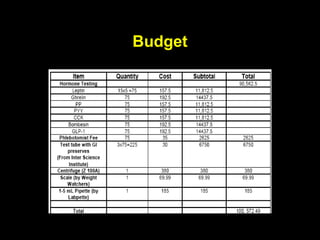
Budget
A. abdominoplasty

A. abdominoplasty

  • 1.
    Permanent Weight Reductionafter Abdominoplasty: Neurocrine Factors, A Pilot Study Rex Moulton-Barrett, MD & Jennifer Fuller, B.A. Plastic & Reconstructive Surgery Alameda and Brentwood, Ca
  • 2.
    The Role forAbdominoplasty ? Just because you can, does not mean you should ?
  • 3.
    After Abdominoplasty Some Patients: Lost weight & Lost no weight •
  • 4.
    Questions • Does abdominoplastylead to long-term weight loss ? • Which group of patient’s benefit most ? • What are the cause(s) of weight loss after surgery ?
  • 5.
    Obesity Epidemic • BMI:Body Mass Index: weight kg/(height m) 2 • <1/3 of U.S. Normal BMI 19-25 • 1/3 of U.S. Overweight BMI 25-30 • 1/3 of U.S. Obese BMI 30-40 • The prevalence of obesity has more than doubled since 1980 • 3% of U.S. Morbid-Super Obese BMI> 40
  • 6.
    Treatment of Obesity 3 main methods of treatment: • Life Style Modification – Moderately effective but difficult to monitor and sustain • Pharmacological Therapy – Few effective treatments exist • Surgical Treatment – Significant and permanent weight loss – Insurance criteria morbid obesity (BMI ≥40)
  • 7.
    Life Style Modification •Convert to ‘ negative energy gap ’ • Increased energy expenditure: reduce non-active time: car, chair, sofa increased exercise time increased energy lost during exercise • Diet: high protein low carbohydrate low sugar ‘+ ketogenic diets’ reduce appetite ( Am J of Clin Nutrition, 2008: 87(1), 44-55 ) avoid exercise before meals: 20 minute run = 20oz ie avoid post exercise ‘calorie rewards’
  • 8.
    Current Weight ReductionDrugs ( 1% of 59 billion dollars spent to loose fat in USA / yr ) 1997:fen-phen (fenfluramine-phentermine) & Redux (dexfenfluramine) removed from market % body weight lost % pts lost at least minus placebo 5% body weight a.c.t. placebo ‘/x’ • FDA Approved – Meridia: Sibutramine 4.3 55/27 – Xenical: Orllstat 2.9 54/33 • New drugs pending approval – Qnexa 9.0 67/19 – Contrave 4.6 53/21 – Lorcaserin 3.4 47/23
  • 9.
    Mechanism of Action •Meredia: Monoamine RI (serotonin & noradrenaline) (Abbott) may BP, HR: not to use if hypertensive unlike fenfluramine does not elevate serum serotonin controls binge eating • Qnexa: Phentermine & Topiramate (Vivus) 56 week course: 37 lb loss: BP, glucose, cholesterol may be useful in type 2 DM Phentermine: hypothalamic norepinephrine release high dose: potential for dependence Topiramate: ( Topamax ), anti-epileptic, anti-migraine, bipolar/binge eating
  • 10.
    Surgical Treatment Gastric Bands Partial Gastric & Intestinal Bypass ( Roux en Y ) Abdominoplasty ?
  • 11.
    Abdominoplasty Work-Up • Obeseversus abdominal laxity or symptomatic pannus ? • First consultation: attempt weight reduction if >200lbs • Charge about 25% more if over 200lbs • ‘3 S plan’: South Beach Diet, Sugarless house, Stationary bike with 45 minute 3x week TV contract after meals • + Meridia if unsuccessful > 4 weeks & binge eating ?
  • 12.
    Abdominoplasty Technique • Low incision 4 cm above the anterior labial commissure • Aggressive midline Rectus Abdominus plication • Jack knife sitting / Trendelenburg position closure • Closure: interrupted Scarpa’s fascia running dermal barbed 3.0 V -Lock Suture skin glue and 1 inch Steri-Strips • Lateral flank liposuction for contour • 5 day pain pump & overnight in surgery center • Rented surgical bed at home for 2-4 weeks • Prolonged paper taping for 6 months when clothed • 3 S’s starting 6 weeks post-op
  • 14.
    Methods • Retrospective case review: chart & structured interview • same surgeon and one post-graduate student • n= 21 patients post-abdominoplasty • Follow up to > 1 year: 2007-2009
  • 15.
    Methods Data collected included: •Age, sex, and height • Previous bariatric surgery ? • Weight prior to abdominoplasty • Changes in satiety • Minimum weight and time attained • Patient’s beliefs about cause of wt loss • Time when weight regained • Patient satisfaction with surgical • Weight at 1 year post-surgery results • Current Weight • Changes in diet & exercise after surgery • Complications of surgery • Weight of pannus resected
  • 16.
    Results: Patient Population 5/21 patients previously underwent bariatric surgery Range Mean Age 21-61 years 45 years Height 5’0” – 6’0” 5’5” Pre-op Weight 105-245 lbs 167.5 lbs Pannus Weight 1.8 – 12.5 lbs 5.74 lbs
  • 17.
    Results: BMI’s My patientsBMI mean: 27.66, lowest 18, highest 33.5 My patients BMI US population • 21 % Normal 33 % • 50 % Overweight 33 % • 29 % Obese 33 % • None Morbid Obesity 3%
  • 18.
    Results: Patient Weightloss • 90.5 % reported weight loss • 47.6% maintained weight loss > 1 yr after surgery
  • 19.
    Results: Patient WeightLoss Percent of Mean Mean Mean Time Mean Time of Patients Pre-op Maximum of Max Weight Regain Weight Weight Weight Loss (months) (lbs) loss (lbs) (months) Short term 42.9 161.8 8.7 2.3 7.1 weight loss only (<1 year) n=9 Long term 47.6 170.4 16.4 3.7 ___ weight loss (> 1 year) n=10 No Weight loss 9.5 175.5 ___ ___ ___ n=2
  • 20.
    Results: Patient Weightloss Weight loss as a function of Pannus Weight: Weight of No. of Pre-op Maximum % with long-term Pannus Patients Weight weight loss weight loss (> 1 year) ≤ 4 lbs 7 144.9 5.3 33 % > 4 lbs 14 178.7 14.7 54 %
  • 21.
    Results: Patient WeightLoss • The greatest predictor of weight loss: pre-operative weight Pre-op Weight No. of Mean Mean Mean Time No. Patients (lbs) Patients Weight of Maximum Max Weight with long Pannus Weight Loss reached term weight (lbs) Loss (lbs) (months) loss (>1year) < 140 lbs 4 2.5 1.8 1.4 0 140 ≥ to < 210 14 5.6 15 3.5 9 (64.3%) ≥ 210 3 9.2 8.6 2.2 1 (33.3%)
  • 22.
    Pre-operative weight associatedwith long term weight loss LONG TERM NO LONG TERM WEIGHT WEIGHT LOSS WEIGHT LOSS (LBS) ( >/= 4lbs & >1 YR ) ( < 4lbs & > 1 YR ) < 140 & ≥ 210 1 6 ≥ 140 to 210 9 5 p<0.0005
  • 23.
    Pre-operative BMI associatedWith long term weight loss LONG TERM NO LONG TERM BMI WEIGHT LOSS WEIGHT LOSS ( >/= 4lbs & >1 YR ) ( < 4lbs & > 1 YR ) <24.5 & ≥ 33.5 1 8 ≥ 24.5 to <33.5 9 3 p<0.0023
  • 24.
    Results: Weight Loss& Satiety No Sense of satiety Lack of Unpleasant change only after appetite at abdominal in eating (%) all times (%) sensation appetite (%) Short-term 2 (22.2) 4 (44.4) 3 (33.3) 2 (22.2) weight loss only (<1year) n=9 Long-term 1 (10) 4 (40) 5 (50) 1 (10) weight loss (>1 year) n=10 No weight 2 (100) 0 (0) 0 (0) 0 (0) loss n=2 All Patients 5 (23.8) 8 (38.1) 8 (38.1) 3 (14.3) n=21
  • 25.
    Reason(s) for WeightLoss • Most frequent reason sited for weight loss: increased sense of satiety • 84.2 % experienced an increase in satiety – 1/2 report satiety throughout the day, 1/2 report satiety only after eating • 90% of long-term weight loss patients: reported increased satiety • Mean duration of sense of satiety 7.3 months
  • 26.
    Conclusions • The greatestpredictor of long-term weight loss was pre-operative weight then BMI • 64.3% of patients weighing between 140 and 210 lbs had long term weight loss • Only 14.3 % of patients outside this range had long-term weight loss
  • 27.
    Conclusions • The keyfactor in patient weight loss is an increase in satiety • Short-term weight loss patients began to regain their weight at 7.1 months, about the same time when their satiety dissipated
  • 28.
    CNS Regulation of Appetite / Satiety 2 Areas :
  • 29.
    The Hypothalamus • Oneof the Hypothalamic Nuclei is called the Arcuate Nucleus (ARC) • ARC incomplete blood-brain barrier • Allows CNS entry of peripheral peptides and proteins
  • 30.
    The ARC • ARC contains two major populations of neurotransmitter releasng neurons : • stimulate feeding: – agouti-related peptide (AgRP) & neuropeptide Y (NPY) • inhibit feeding: – Cocaine & amphetamine regulated transcript (CART) & proopiomelanocortin (POMC), – POMC cleaves into α -MSH. ↑ Feeding Neural/ endocrine signals 2 nd order neurons ARC Hypothalamus α-MSH ↓ Feeding
  • 31.
    The ARC ∀ α-MSH acts as a ligand at the melanocortin - 4 receptor ( MC4 ) • Defects of this receptor: implicated in up to 4- 6% of all monogenetic childhood onset obesity in humans ∀ α -MSH inhibits the receptor to AgRP: inhibiting appeptite • AgRP inhibits the MC4 receptor: stimulating appetite
  • 32.
    The Brainstem Appetite signals: A.from circulating hormones via the area postrema: incomplete blood-brain barrier B. neural signals from the vagus nerve C. Bidirectional connections with hypothalamus
  • 33.
    The Vagus Nerve •Afferent signals: mechanical & chemical • Cell bodies of afferent neurons in the Nodose Ganglia • Projects into brainstem to interface with hypothalamus
  • 34.
    The Vagus NerveContinued • The stretch receptor stimulation dependent on gastric volume • May suppress meal size independent of content • Effect is abolished by subdiaphragmatic vagotomy • Gastric distension is insufficient to account for all aspects of satiety
  • 35.
    The Vagus Nerve •Contains receptors for a number of gut hormones • Vagotomy abolishes appetite-modifying action of many gut hormones: CCK, PYY, GLP-1 • Vagus nerve is thought to be a major sight of gut hormone signaling
  • 36.
    A Very QuickOverview of Appetite Regulating Hormones
  • 37.
    Appetite-regulating hormones: • Ghrelin,released from the stomach, is the only known appetite stimulant, acting via hypothalamic expression of NPY and AgRP. – Ghrelin levels rise preprandially in humans – Administration of exogenous ghrelin leads to increased food intake and weight gain
  • 38.
    Appetite-regulating Hormones: • Incontrast, a growing number of peptide hormones have been found to produce satiety and decrease food intake. Vagus Nerve Peptide YY (PYY) Adiponectin Pancreatic Cholecystokinin (CCK) Leptin Polypeptide (PP) Bombesin Oxyntomodulin (OXM) Amylin Apolipoprotein A-IV (apo A-IV) Insulin Vasoactive Intestinal Polypeptide (VIP) Glucagon-like peptide-1 (GLP-1)
  • 39.
    Energy Summary: Gut Hormones Regulation PP - Pancreas + - - Vagu s PP Ghrelin - Bombesi CC n K PYY Stomac GLP- h 1 OX M VIP Apo A-IV Intestines
  • 40.
    Another Important Satiety Regulator: Leptin • Leptin, is released from adipose tissue, mammary glands, ovarian follicles, placenta, skeletal muscle, and the P cell and chief cells of the stomach • 25% of circulating leptin is derived from the stomach • Leptin levels positively correlate with body fat: higher circulating leptins with greater BMI • Leptin mediates central regulation of energy homeostasis via receptors in the ARC and peripherally via the vagus nerve
  • 41.
    Leptin Studies • afterbinding in the hypothalamus receptor: • leptin inhibits NPY and AgRP and stimulates POMC and CART • decreasing appetite & increasing energy expenditure (Cowley M, et al; Leptin activates anorexigenic POMC neurons through a neural network in the arcuate nucleus. 2001) • mice with mutation of the Leptin receptor are profoundly obese. (Farooqi I, et al; Clinical and molecular genetic spectrum of congenital deficiency of the leptin receptor. 2007) Ob /Ob mouse
  • 42.
    Appetite-regulating hormones: • Starvation: : ghrelin, : PYY-3-36, insulin, leptin • Post-prandial satiety: : ghrelin, : PYY-3-36, insulin, leptin • Receptor mutations: CCK, OXM, insulin, PYY, leptin & bombesin : food intake and obesity • Receptor antagonist or antisera for CCK, OXM, apo A-IV, PYY, and GLP-1 : food intake • Jejuno-ileal bypass surgery or vertical-banded gastroplasty : GLP-1, PYY & PP levels • Roux-en-Y : : 77% reduction in serum ghrelin • 2 clinical studies from U London: a. s/cut injections CCK: Med students ate 25% less curry b. s/cut Modulin: 17 % less food intake & 26 % increased energy expenditure : 1 pound / wk. weight loss
  • 43.
    Future Study • Patientsare tested before abdominoplasty and incrementally after for levels of specific gut hormones • Is there an association between hormone expression levels, reported satiety, and patient weight loss?
  • 44.
    Methods • 15 patientsto participate in our study • Prior to surgery: age, weight, height, gynecological history, previous bariatric surgeries, and exercise regimens • Fasting blood draw: Prior to & 1, 3, 6, and 12 months after surgery • At surgery weight of the pannus will be recorded
  • 45.
    Methods • Blood plasmaspecimens will be shipped to Inter Science Institute on dry ice then assayed for PYY, GLP-1, PP, CCK, leptin, bombesin, and ghrelin • At 0, 1, 3, 6, and 12 months post-abdominoplasty, document: – Ranking on a 0-3 scale of: » Appetite at rest » Postprandial satiety » Unpleasant abdominal feeling associated with poor appetite » Amount of food consumed during a meal
  • 46.