Weight Loss Information Session
Agenda Understanding Obesity Are you a Candidate?  Weight Loss Surgery Options  The Process Next Steps
Understanding Obesity
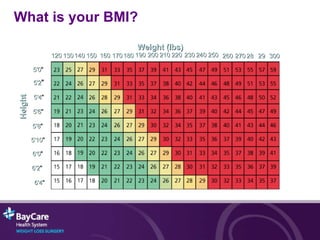
Clinically severe obesity at which point serious medical conditions occur as a direct result of the obesity  Defined as >200% of ideal weight, >100 lbs overweight, or a body mass index of   40 BMI =    weight (kg)_____  height (m) x height (m) What is Morbid Obesity
What is your BMI? 5'4 " Height Weight   (lbs) 5'2 " 5'0 " 5'10 " 5'8 " 5'6 " 6'0 " 6'2 " 120 130 150 160 170 180 190 200 210 220 230 240 250 140 260 270 280 290 300 6'4 "
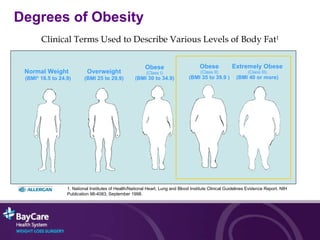
Clinical Terms Used to Describe Various Levels of Body Fat 1 Normal Weight   (BMI* 18.5 to 24.9) Overweight (BMI 25 to 29.9) Obese (Class I) (BMI 30 to 34.9) Obese (Class II) (BMI 35 to 39.9 ) Extremely Obese (Class III) (BMI 40 or more) 1. National Institutes of Health/National Heart, Lung and Blood Institute Clinical Guidelines Evidence Report. NIH Publication 98-4083, September 1998. Degrees of Obesity
Co-morbid diseases  (medical and non-medical) diabetes, hypertension, cancer, sleep apnea, depression Decreased quality of life Psychological: low self-esteem, depression Social: workplace, friends, home, associates Increased medical costs Disability Increased risk of premature death Impact of Obesity
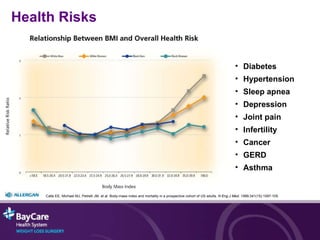
Diabetes Hypertension Sleep apnea Depression Joint pain Infertility Cancer GERD Asthma Calle EE, Michael MJ, Petrelli JM, et al. Body-mass index and mortality in a prospective cohort of US adults.  N Eng J Med . 1999;341(15):1097-105. Health Risks
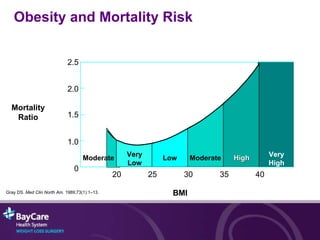
BMI Gray DS.  Med Clin North Am . 1989;73(1):1–13.  2.5 2.0 1.5 1.0 0 20 25 30 35 40 Mortality Ratio Moderate Very Low Low Moderate High Very High Obesity and Mortality Risk
Are you a Candidate?
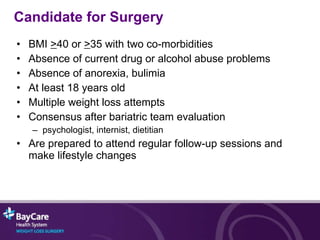
BMI  > 40 or  > 35 with two co-morbidities Absence of current drug or alcohol abuse problems Absence of anorexia, bulimia At least 18 years old Multiple weight loss attempts Consensus after bariatric team evaluation psychologist, internist, dietitian Are prepared to attend regular follow-up sessions and make lifestyle changes Candidate for Surgery
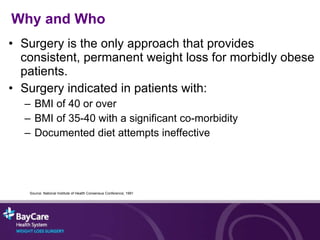
Why and Who Surgery is the only approach that provides consistent, permanent weight loss for morbidly obese patients. Surgery indicated in patients with: BMI of 40 or over BMI of 35-40   with a significant co-morbidity Documented diet attempts ineffective Source: National Institute of Health Consensus Conference; 1991
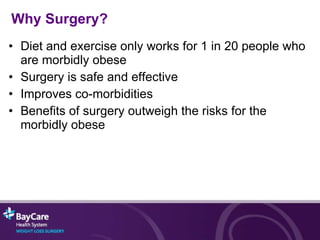
Why Surgery? Diet and exercise only works for 1 in 20 people who are morbidly obese Surgery is safe and effective Improves co-morbidities Benefits of surgery outweigh the risks for the morbidly obese
The “Other Side” Surgery is a serious event  Surgery is  not  the “easy way out” Requires multiple pre-op visits and tests Insurance hassles and/or personal expense Adjustment to drastic life change Life-long maintenance and follow-up
Patient Stories - Before: (INSERT HERE) Deborah Patient
Weight Loss Surgery Options
Advantages of Laparoscopy Fewer wound complications  Less infection Fewer hernias Less pain and faster recovery Surgeon has better view of the anatomy  Nguyen 2001, Wittgrove 2000, Schauer 2000, Watson 1997
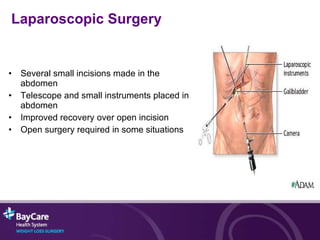
Several small incisions made in the abdomen Telescope and small instruments placed in abdomen  Improved recovery over open incision Open surgery required in some situations Laparoscopic Surgery
Surgical Options Restrictive procedures reduce how much the stomach can hold Adjustable Gastric Band Sleeve Gastrectomy Combined procedures of restriction and malabsorption shorten the digestive tract and reduce how much the stomach can hold Gastric Bypass
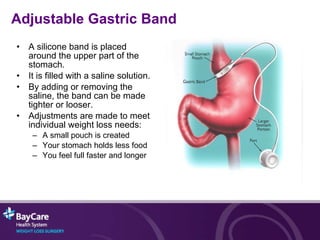
Adjustable Gastric Band A silicone   band is placed around the upper part of the stomach. It is filled with a saline solution.  By adding or removing the saline, the band can be made tighter or looser. Adjustments are made to meet individual weight loss needs: A small pouch is created Your stomach holds less food You feel full faster and longer
Advantages Least invasive approach No stomach stapling or cutting,  or intestinal rerouting Adjustable Reversible Lowest operative complication rate Lowest mortality rate Low malnutrition risk Disadvantages Slower initial weight loss than gastric bypass Regular follow-up critical for optimal results Adjustable Gastric Band
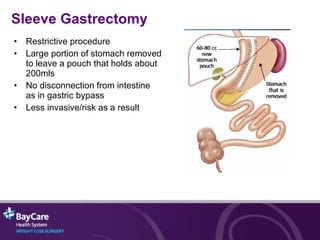
Sleeve Gastrectomy Restrictive procedure Large portion of stomach removed to leave a pouch that holds about 200mls No disconnection from intestine as in gastric bypass  Less invasive/risk as a result
Advantages No malabsorption No adjustments Fundus removed Can be converted to a gastric bypass later if needed Disadvantages Stomach may stretch over time Large portion of the stomach removed No long term data Sleeve Gastrectomy
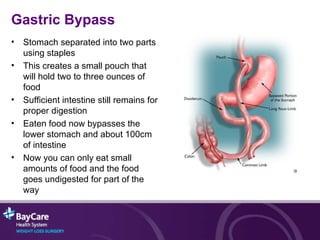
Gastric Bypass Stomach separated into two parts using staples This creates a small pouch that will hold two to three ounces of food Sufficient intestine still remains for proper digestion Eaten food now bypasses the lower stomach and about 100cm of intestine Now you can only eat small amounts of food and the food goes undigested for part of the way
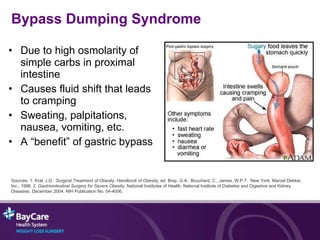
Bypass Dumping Syndrome Due to high osmolarity of simple carbs in proximal intestine Causes fluid shift that leads to cramping Sweating, palpitations, nausea, vomiting, etc. A “benefit” of gastric bypass Sources: 1. Kral, J.G.   Surgical Treatment of Obesity. Handbook of Obesity , ed. Bray, G.A., Bouchard, C., James, W.P.T.  New York. Marcel Dekker, Inc., 1998. 2.  Gastriointestinal Surgery for Severe Obesity . National Institutes of Health. National Institute of Diabetes and Digestive and Kidney Diseases. December 2004, NIH Publication No. 04-4006.
Advantages Rapid initial weight loss Minimally invasive approach is possible Longer experience in USA Higher total average weight loss reported than with LAP-BAND System or VBG Disadvantages Cutting and stapling of stomach and bowel is required More operative complications than with LAP-BAND System/LSG Portion of digestive track is bypassed, reducing absorption of essential nutrients Gastric Bypass
Results of Weight Loss Surgery Weight Loss Cure or Improvement in Co-morbidities Increased Longevity Improved Quality of Life Health Social Personal Work
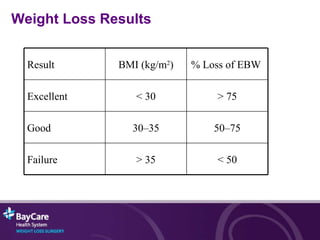
Weight Loss Results < 50 > 35 Failure 50–75 30–35 Good > 75 < 30 Excellent % Loss of EBW   BMI (kg/m 2 ) Result
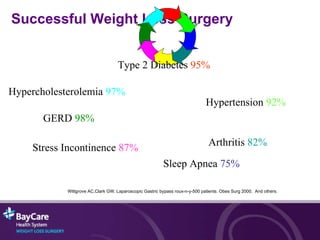
Successful Weight Loss Surgery Type 2 Diabetes  95% GERD  98% Stress Incontinence  87% Sleep Apnea  75% Arthritis  82% Hypertension  92% Hypercholesterolemia  97% Wittgrove AC,Clark GW. Laparoscopic Gastric bypass roux-n-y-500 patients. Obes Surg 2000.  And others.
What to expect after surgery In addition to losing weight, you can expect: Be rid of medications for diabetes, oxygen for sleep apnea, improved arthritis, better cholesterol levels Socialize more Feel better about yourself – no more discrimination Enjoy new relationships or explore new aspects of current relationships  Exercise, sports
Patient Stories - After: (INSERT HERE) Deborah Patient
The Process
Insurance Most plans require documented failure of conservative treatments and high patient motivation before approving surgery. A growing number of states have passed legislation that requires insurance companies to provide benefits for weight loss surgery for patients who meet the National Institutes of Health surgical criteria.  Insurance coverage often requires a lengthy and complicated approval process.
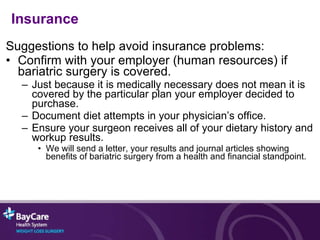
Suggestions to help avoid insurance problems: Confirm with your employer (human resources) if bariatric surgery is covered. Just because it is medically necessary does not mean it is covered by the particular plan your employer decided to purchase. Document diet attempts in your physician’s office. Ensure your surgeon receives all of your dietary history and workup results. We will send a letter, your results and journal articles showing benefits of bariatric surgery from a health and financial standpoint. Insurance
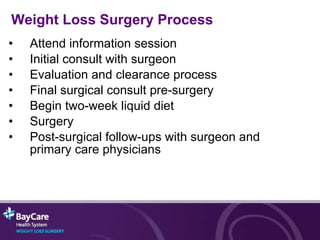
Attend information session  Initial consult with surgeon Evaluation and clearance process  Final surgical consult pre-surgery Begin two-week liquid diet Surgery Post-surgical follow-ups with surgeon and primary care physicians Weight Loss Surgery Process
Common Pre-surgical Consults/Tests   Psychological consult and clearance Dietitian consults Fitness consult Sleep study Chest X-ray Abdominal ultrasound Stress test Upper endoscopy
Next Steps
Surgery Follow-up Actions Subscribe to Nutrition/Diet Plan Regular Exercise as Advised by Physician Undergo Behavior Counseling/Therapy Regular Follow-ups with Physician
You have just completed Step 1 of the process. Request an appointment today on your evaluation form or call to schedule an appointment. If you are not ready today…go home and think about: How serious you are about weight loss How committed you are to changing your lifestyle and habits Which surgery is right for you Talk to others and visit the Web to research more. Next Steps
Thank You Q & A

Bay care weight_loss_info_session

  • 1.
  • 2.
    Agenda Understanding ObesityAre you a Candidate? Weight Loss Surgery Options The Process Next Steps
  • 3.
  • 4.
    Clinically severe obesityat which point serious medical conditions occur as a direct result of the obesity Defined as >200% of ideal weight, >100 lbs overweight, or a body mass index of  40 BMI = weight (kg)_____ height (m) x height (m) What is Morbid Obesity
  • 5.
    What is yourBMI? 5'4 &quot; Height Weight (lbs) 5'2 &quot; 5'0 &quot; 5'10 &quot; 5'8 &quot; 5'6 &quot; 6'0 &quot; 6'2 &quot; 120 130 150 160 170 180 190 200 210 220 230 240 250 140 260 270 280 290 300 6'4 &quot;
  • 6.
    Clinical Terms Usedto Describe Various Levels of Body Fat 1 Normal Weight (BMI* 18.5 to 24.9) Overweight (BMI 25 to 29.9) Obese (Class I) (BMI 30 to 34.9) Obese (Class II) (BMI 35 to 39.9 ) Extremely Obese (Class III) (BMI 40 or more) 1. National Institutes of Health/National Heart, Lung and Blood Institute Clinical Guidelines Evidence Report. NIH Publication 98-4083, September 1998. Degrees of Obesity
  • 7.
    Co-morbid diseases (medical and non-medical) diabetes, hypertension, cancer, sleep apnea, depression Decreased quality of life Psychological: low self-esteem, depression Social: workplace, friends, home, associates Increased medical costs Disability Increased risk of premature death Impact of Obesity
  • 8.
    Diabetes Hypertension Sleepapnea Depression Joint pain Infertility Cancer GERD Asthma Calle EE, Michael MJ, Petrelli JM, et al. Body-mass index and mortality in a prospective cohort of US adults. N Eng J Med . 1999;341(15):1097-105. Health Risks
  • 9.
    BMI Gray DS. Med Clin North Am . 1989;73(1):1–13. 2.5 2.0 1.5 1.0 0 20 25 30 35 40 Mortality Ratio Moderate Very Low Low Moderate High Very High Obesity and Mortality Risk
  • 10.
    Are you aCandidate?
  • 11.
    BMI >40 or > 35 with two co-morbidities Absence of current drug or alcohol abuse problems Absence of anorexia, bulimia At least 18 years old Multiple weight loss attempts Consensus after bariatric team evaluation psychologist, internist, dietitian Are prepared to attend regular follow-up sessions and make lifestyle changes Candidate for Surgery
  • 12.
    Why and WhoSurgery is the only approach that provides consistent, permanent weight loss for morbidly obese patients. Surgery indicated in patients with: BMI of 40 or over BMI of 35-40 with a significant co-morbidity Documented diet attempts ineffective Source: National Institute of Health Consensus Conference; 1991
  • 13.
    Why Surgery? Dietand exercise only works for 1 in 20 people who are morbidly obese Surgery is safe and effective Improves co-morbidities Benefits of surgery outweigh the risks for the morbidly obese
  • 14.
    The “Other Side”Surgery is a serious event Surgery is not the “easy way out” Requires multiple pre-op visits and tests Insurance hassles and/or personal expense Adjustment to drastic life change Life-long maintenance and follow-up
  • 15.
    Patient Stories -Before: (INSERT HERE) Deborah Patient
  • 16.
  • 17.
    Advantages of LaparoscopyFewer wound complications Less infection Fewer hernias Less pain and faster recovery Surgeon has better view of the anatomy Nguyen 2001, Wittgrove 2000, Schauer 2000, Watson 1997
  • 18.
    Several small incisionsmade in the abdomen Telescope and small instruments placed in abdomen Improved recovery over open incision Open surgery required in some situations Laparoscopic Surgery
  • 19.
    Surgical Options Restrictiveprocedures reduce how much the stomach can hold Adjustable Gastric Band Sleeve Gastrectomy Combined procedures of restriction and malabsorption shorten the digestive tract and reduce how much the stomach can hold Gastric Bypass
  • 20.
    Adjustable Gastric BandA silicone band is placed around the upper part of the stomach. It is filled with a saline solution. By adding or removing the saline, the band can be made tighter or looser. Adjustments are made to meet individual weight loss needs: A small pouch is created Your stomach holds less food You feel full faster and longer
  • 21.
    Advantages Least invasiveapproach No stomach stapling or cutting, or intestinal rerouting Adjustable Reversible Lowest operative complication rate Lowest mortality rate Low malnutrition risk Disadvantages Slower initial weight loss than gastric bypass Regular follow-up critical for optimal results Adjustable Gastric Band
  • 22.
    Sleeve Gastrectomy Restrictiveprocedure Large portion of stomach removed to leave a pouch that holds about 200mls No disconnection from intestine as in gastric bypass Less invasive/risk as a result
  • 23.
    Advantages No malabsorptionNo adjustments Fundus removed Can be converted to a gastric bypass later if needed Disadvantages Stomach may stretch over time Large portion of the stomach removed No long term data Sleeve Gastrectomy
  • 24.
    Gastric Bypass Stomachseparated into two parts using staples This creates a small pouch that will hold two to three ounces of food Sufficient intestine still remains for proper digestion Eaten food now bypasses the lower stomach and about 100cm of intestine Now you can only eat small amounts of food and the food goes undigested for part of the way
  • 25.
    Bypass Dumping SyndromeDue to high osmolarity of simple carbs in proximal intestine Causes fluid shift that leads to cramping Sweating, palpitations, nausea, vomiting, etc. A “benefit” of gastric bypass Sources: 1. Kral, J.G.  Surgical Treatment of Obesity. Handbook of Obesity , ed. Bray, G.A., Bouchard, C., James, W.P.T.  New York. Marcel Dekker, Inc., 1998. 2. Gastriointestinal Surgery for Severe Obesity . National Institutes of Health. National Institute of Diabetes and Digestive and Kidney Diseases. December 2004, NIH Publication No. 04-4006.
  • 26.
    Advantages Rapid initialweight loss Minimally invasive approach is possible Longer experience in USA Higher total average weight loss reported than with LAP-BAND System or VBG Disadvantages Cutting and stapling of stomach and bowel is required More operative complications than with LAP-BAND System/LSG Portion of digestive track is bypassed, reducing absorption of essential nutrients Gastric Bypass
  • 27.
    Results of WeightLoss Surgery Weight Loss Cure or Improvement in Co-morbidities Increased Longevity Improved Quality of Life Health Social Personal Work
  • 28.
    Weight Loss Results< 50 > 35 Failure 50–75 30–35 Good > 75 < 30 Excellent % Loss of EBW BMI (kg/m 2 ) Result
  • 29.
    Successful Weight LossSurgery Type 2 Diabetes 95% GERD 98% Stress Incontinence 87% Sleep Apnea 75% Arthritis 82% Hypertension 92% Hypercholesterolemia 97% Wittgrove AC,Clark GW. Laparoscopic Gastric bypass roux-n-y-500 patients. Obes Surg 2000. And others.
  • 30.
    What to expectafter surgery In addition to losing weight, you can expect: Be rid of medications for diabetes, oxygen for sleep apnea, improved arthritis, better cholesterol levels Socialize more Feel better about yourself – no more discrimination Enjoy new relationships or explore new aspects of current relationships Exercise, sports
  • 31.
    Patient Stories -After: (INSERT HERE) Deborah Patient
  • 32.
  • 33.
    Insurance Most plansrequire documented failure of conservative treatments and high patient motivation before approving surgery. A growing number of states have passed legislation that requires insurance companies to provide benefits for weight loss surgery for patients who meet the National Institutes of Health surgical criteria. Insurance coverage often requires a lengthy and complicated approval process.

  • 34.
    Suggestions to helpavoid insurance problems: Confirm with your employer (human resources) if bariatric surgery is covered. Just because it is medically necessary does not mean it is covered by the particular plan your employer decided to purchase. Document diet attempts in your physician’s office. Ensure your surgeon receives all of your dietary history and workup results. We will send a letter, your results and journal articles showing benefits of bariatric surgery from a health and financial standpoint. Insurance
  • 35.
    Attend information session Initial consult with surgeon Evaluation and clearance process Final surgical consult pre-surgery Begin two-week liquid diet Surgery Post-surgical follow-ups with surgeon and primary care physicians Weight Loss Surgery Process
  • 36.
    Common Pre-surgical Consults/Tests Psychological consult and clearance Dietitian consults Fitness consult Sleep study Chest X-ray Abdominal ultrasound Stress test Upper endoscopy
  • 37.
  • 38.
    Surgery Follow-up ActionsSubscribe to Nutrition/Diet Plan Regular Exercise as Advised by Physician Undergo Behavior Counseling/Therapy Regular Follow-ups with Physician
  • 39.
    You have justcompleted Step 1 of the process. Request an appointment today on your evaluation form or call to schedule an appointment. If you are not ready today…go home and think about: How serious you are about weight loss How committed you are to changing your lifestyle and habits Which surgery is right for you Talk to others and visit the Web to research more. Next Steps
  • 40.

Editor's Notes

  • #7 There are clinical terms used to describe people’s levels of body fat to see if they are candidates for weight-loss surgery. The ideal BMI ranges from 18.5 to 24.9. If your BMI is between 25 and 29.9, you are thought to be overweight. If it is between 30 and 34.9, you are class 1 obese. If it is between 35 and 39.9, you are class 2 obese. If your BMI is 40 or more, you are said to be class 3 or extremely obesity. 1 Extreme obesity is sometimes call “morbid” obesity because this degree of excess weight may considerably reduce life expectancy and is associated with an increased risk of developing conditions or diseases such as type 2 diabetes, high blood pressure, sleep apnea, joint problems, heat disease and even cancer 2 . Severely and morbidly obese adult patients are considered candidates for weight-loss surgery. Source: 1. National Institutes of Health/National Heart, Lung and Blood Institute Clinical Guidelines Evidence Report. NIH Publication 98-4083, September 1998. 2. Weight-control Information Network (WIN); an information service of the National Institute of Diabetes and Digestive and Kidney Diseases (NIDDK). Do you know the health risks of being overweight? Available at: http://win.niddk.nih.gove/publications/health_risks.htm. Accessed May, 2, 2007.

  • #9 Over 80% of people with diabetes are overweight or obese. Carrying excess weight around causes “wear and tear” on joints and can result in problems like arthritis. For every 2-pound increase in weight, the risk of developing arthritis is increased by 9% to 13%. High blood pressure is twice as common in adults who are obese than in those who are of normal weight. According to the New England Journal of Medicine report a BMI over 35 is associated with a higher risk of death. 1 Source: 1. Calle EE, Michael MJ, Petrelli JM, et al. Body-mass index and mortality in a prospective cohort of US adults. N Eng J Med . 1999;341(15):1097-105.
  • #26 The “ dumping syndrome ” in which food moves too quickly through the small intestine can cause nausea, weakness, sweating, faintness, and sometimes diarrhea after eating.   There can also be an inability to eat sweets without severe weakness and sweating causing patients to lie down to let the symptoms pass.   Dairy intolerance, constipation, headache, hair loss and depression are other possible side effects.1,2 Sources: 1. Kral, J.G.   Surgical Treatment of Obesity.   Handbook of Obesity , ed. Bray, G.A., Bouchard, C., James, W.P.T.   New York. Marcel Dekker, Inc., 1998. 2. Gastriointestinal Surgery for Severe Obesity .   National Institutes of Health. National Institute of Diabetes and Digestive and Kidney Diseases. December 2004,   NIH Publication No. 04-4006.